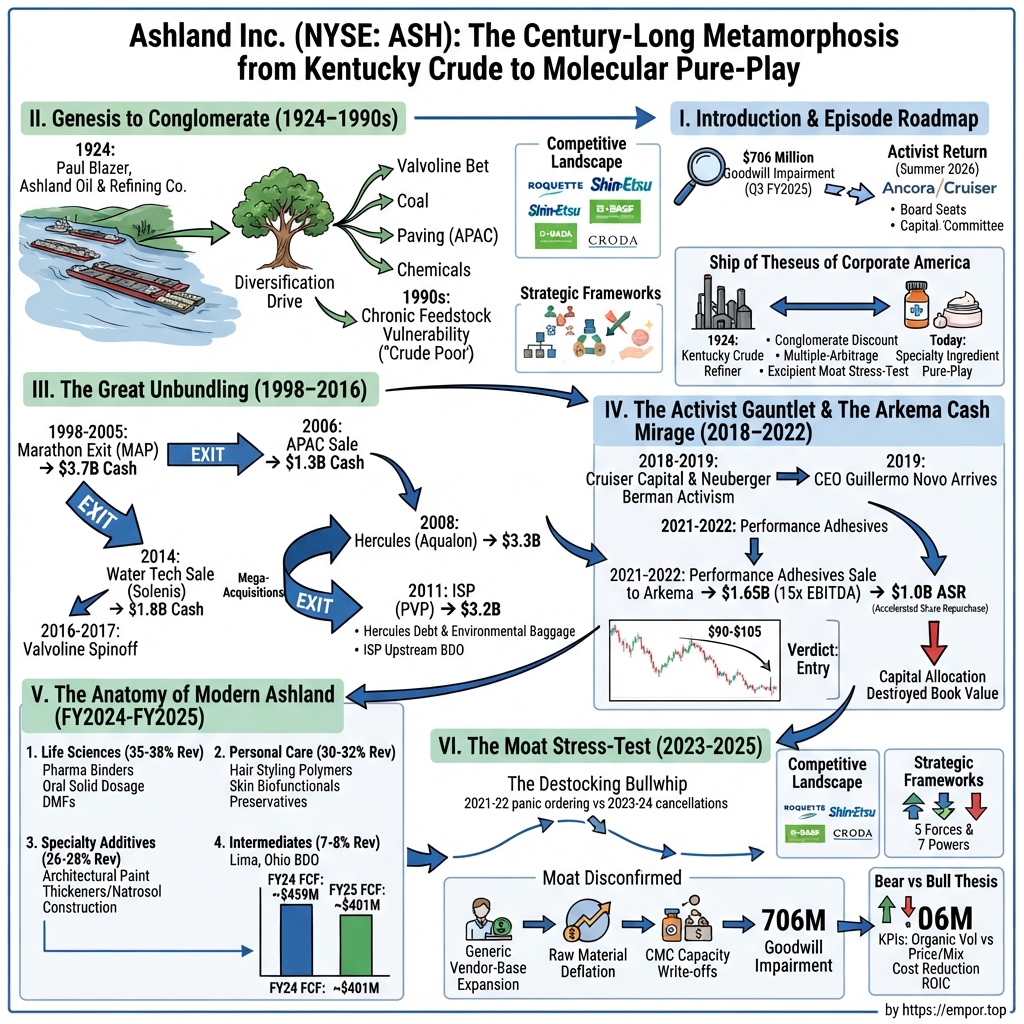
Ashland Inc. (NYSE: ASH): The Century-Long Metamorphosis from Kentucky Crude to Molecular Pure-Play
I. Introduction & Episode Roadmap (00:00:00 – 00:14:00 | 14 min)
The Cold Open: A Board Table in Wilmington, Summer 2026
On the morning of July 28, 2026, Ashland's board took a step corporate directors rarely take voluntarily: it invited two outsiders into the room and gave them direct influence over capital allocation. The company announced that Peter Thomas, the former chair, chief executive, and president of Ferro Corporation, and Allen Spizzo, formerly the chief financial officer of Hercules Incorporated, would join the board as independent directors, effective immediately. The board expanded temporarily to eleven seats before scheduled attrition back to ten at the 2027 annual meeting. Concurrently, directors created a Capital Allocation Advisory Committee chaired by Scott Tozier and joined by Bertrand Loy, Susan L. Main, Thomas, and Spizzo, tasked with recommending capital deployment priorities and strategic alternatives to the full board.1
The historical symmetry was unmistakable. Spizzo's career included years at Hercules, the Delaware specialty chemical company Ashland acquired in 2008. Its Aqualon cellulosics business remains, eighteen years later, Ashland's primary industrial engine. An activist campaign had, in effect, reintroduced an executive from Ashland's past to help determine the company's future.
The governance agreement followed months of mounting investor pressure. In June 2026, Cruiser Capital Advisors, which had previously launched a proxy fight against Ashland's board in 2018, renewed its campaign. Managing partner Keith Rosenbloom and research director Charles Rose argued that while Ashland held high-quality specialty chemical assets, it lacked the scale to maximize value as an independent public entity. They contended that a larger strategic or private equity buyer could eliminate more than $100 million in overhead and asserted that "a sale is not merely one option among many but the best risk-adjusted path forward." Cruiser warned it would consider a proxy contest if the board failed to run a formal sale process by September 15.2 Ancora Holdings had disclosed an equity stake and voiced similar demands earlier that summer.
On August 7, 2026, Bloomberg reported that Ashland was actively exploring a sale following unsolicited takeover interest, retaining Citigroup and Lazard to evaluate inbound bids. Private equity sponsors, including Advent International, Apollo Global Management, and Carlyle, had reportedly reached out, alongside Standard Industries, already one of Ashland's largest shareholders. The company's strategic review was characterized as ongoing, with no transaction guaranteed.6 As of September 5, 2026, no transaction has been announced.
The Number That Started It
The operational catalyst behind the current governance showdown was an accounting write-down. In the third quarter of fiscal 2025, Ashland took a $706 million pre-tax, non-cash goodwill impairment charge: $375 million against Life Sciences and $331 million against Specialty Additives. Management attributed the write-down to a prolonged share price decline and weaker macroeconomic demand, which resulted in volume and margin projections falling well below internal acquisition models. Prior to the impairment, carrying goodwill for the two segments totaled $841 million and $443 million; following the revision, remaining goodwill stood at $466 million and $112 million.43
While non-cash charges do not immediately deplete liquidity, they serve as a formal, balance-sheet acknowledgment that past capital allocation failed to yield expected cash flows. For fiscal 2025, Ashland reported a net loss of $845 million, compared with net income of $169 million in fiscal 2024.3 Over the same twelve-month period, shareholders' equity contracted from $2.87 billion to $1.90 billion, wiping out roughly a third of the company's book value.417
The Central Paradox: A Corporate Ship of Theseus
Ashland presents a classic corporate paradox: very few public companies have systematically replaced every operating asset they ever owned while maintaining the same corporate charter and ticker symbol.
Founded in 1924 as a small crude oil refiner along the Ohio River, Ashland spent a century divesting legacy industrial operations in successive stages. Refineries, river barges, and service stations were sold, followed by highway paving and asphalt operations, coal extraction, water treatment chemicals, motor oil and Valvoline quick-lube centers, polyester resins and composite plastics, industrial adhesives, and botanical extraction units. Each divestiture was framed as a strategic shift away from cyclical, commodity-sensitive exposure and toward higher-margin, premium-multiple specialty businesses.
By 2026, Ashland had evolved into a focused specialty ingredients producer generating roughly $1.8 billion in annual revenue. The business centers on two core chemical platforms—cellulose ethers and polyvinylpyrrolidone (PVP)—supplying binding, thickening, and film-forming agents to pharmaceutical tablets, personal care formulations, and architectural paints. Yet despite shedding commodity drag and improving structural margins, the market assigns the remaining business a valuation lower than the cumulative enterprise values of the divisions it liquidated.
The Four Questions This Story Has to Answer
One: does multiple arbitrage actually work? For twenty-five years, Ashland's strategic thesis held that shedding capital-intensive, cyclical assets in favor of pure-play specialty ingredients would produce sustained valuation expansion. The test is not whether the divested assets were cyclical—they indisputably were—but whether the acquired specialty businesses compounded value. Sections V and VI examine that record.
Two: how strong is the excipient moat, really? In regulated pharmaceutical manufacturing, an excipient registered in a Drug Master File creates formidable switching barriers. However, technical stickiness within a formulation does not necessarily protect volume when commercial purchasing departments adjust order cadence. The 2023–2025 destocking cycle tested that dynamic in real time.
Three: what happened to the money? In 2022, Ashland completed the sale of its Performance Adhesives division to Arkema for $1.65 billion at an exceptional valuation multiple.10 How that capital was redeployed—and the returns it delivered—offers the clearest empirical test of executive capital allocation.
Four: how does this end? Guillermo Novo took the chief executive post in December 2019 following his tenure leading Versum Materials, which he guided through an activist defense and an eventual premium sale to Merck KGaA.15 Whether Ashland's trajectory concludes with an operational turnaround, a separation of its core chemical lines, or a private equity buyout remains the central question before the board.
Understanding how Ashland reached this point requires first examining why an Appalachian crude refiner decided to enter the market for molecular thickeners and polymers.
 Subscribe on LinkedIn
II. Genesis to Conglomerate: The Blazer Era & The Refining Cash Cow (1924–1990s) (00:14:00 – 00:32:00 | 18 min)
A Second-Hand Refinery on the Ohio River
In 1923, a Lexington-based oil producer named Swiss Oil Company was in financial distress. A postwar slump and the premature depletion of its primary wells had left the business fragile, yet its leadership still sought to expand downstream into refining. To lead the effort, Swiss Oil hired Paul G. Blazer, an enterprising executive tasked with finding a suitably positioned refinery to acquire.
Blazer selected an existing plant in Catlettsburg, Kentucky, located on the Ohio River near the West Virginia border, just upstream from the town of Ashland, where he established an office. On February 2, 1924, Blazer and three Swiss Oil executives incorporated Ashland Refining Company with $250,000 of capital. The operation they acquired had a capacity of 1,000 barrels per day and employed twenty-five people working twelve-hour shifts, seven days a week.11
A processing capacity of 1,000 barrels a day was modest even by early-twentieth-century standards; a modern mid-sized U.S. refinery handles two to three hundred times that volume. The underlying technology was equally primitive. Blazer had purchased what was essentially a topping still—a plant that heated crude oil to separate it by boiling point into basic cuts of gasoline, kerosene, and fuel oil, lacking the catalytic cracking technology that would later allow refiners to convert heavier fractions into higher-margin light fuels. From an engineering standpoint, it was an unremarkable asset.
Blazer’s competitive insight was logistical rather than chemical. The Catlettsburg facility sat along hundreds of miles of navigable river, enabling Ashland to receive crude and deliver refined products throughout the Ohio River basin by barge—an advantage that held until pipelines eventually changed the freight map.11 Because river barges transported bulk cargo at a fraction of prevailing rail tariffs, a small, technically basic refinery with direct water access could undercut integrated majors that possessed superior oil fields but costlier transportation routes. Ashland's initial moat was not a proprietary molecule; it was a river.
That dynamic established a foundational pattern: Ashland rarely prevailed by developing superior technology. It succeeded instead by securing a defensible position within another counterparty's supply chain—whether anchored by a river bend, a specialized chemical formulation, or a regulatory filing.
Blazer consolidated Swiss Oil and Ashland Refining in 1936 to build what became Ashland Oil & Refining.11 World War II provided the next major catalyst. Ashland constructed a new Catlettsburg facility to refine 100-octane aviation fuel, pushing company revenues to $35 million by 1945.11 Meeting wartime military specifications required technical rigor from an operator that had started as a simple crude separator, leaving Ashland with expanded processing scale and a fortified balance sheet.
Diversification as Insurance, Not Ambition
Beneath that postwar expansion lay a persistent structural vulnerability: Ashland was, in industry terminology, "crude poor." The company refined and marketed petroleum, but it never developed an upstream exploration and production division. Following the 1970s oil shocks, it exited crude extraction altogether, becoming wholly dependent on outside crude sourced substantially from the Middle East.11 Consequently, Ashland was forced to purchase its single most critical feedstock at prevailing market prices.
In stable operating environments, being crude poor was merely a margin drag. During the 1970s, when the Arab oil embargo drove spot crude prices sharply higher, that exposure threatened the firm's survival. The economic reality explains much of Ashland's subsequent evolution: a company that buys raw materials at spot rates and sells finished commodities at spot rates controls neither end of the value chain, capturing only the volatile spread in between. Ashland was structurally short the exact resource required to keep its operations running.
That vulnerability, rather than corporate empire-building, was the primary catalyst for Ashland's conglomerate era. Management turned to acquisitions to hedge against single-commodity cyclicality. In 1950, Ashland purchased Freedom-Valvoline, the Pennsylvania maker of Valvoline motor oil—already a recognized brand that under Ashland expanded into one of the most widely distributed motor oils in the world.11 The acquisition gave Ashland its first consumer-facing identity and its first major product line whose pricing was underpinned by brand equity rather than local freight economics.
Further non-refining divisions were added over the following three decades. Ashland Chemical Company was formed in 1966, expanding into petrochemical manufacturing and chemical distribution. The company entered highway paving by acquiring Warren Brothers, which grew into APAC and laid more than 13 million tons of asphalt annually by the 1990s. Ashland Coal, Inc. was established in 1975 and later consolidated with Arch Mineral, an exposure Ashland finally eliminated when Arch Coal was spun off in 1998.11
From an investor's perspective, this conglomerate push was not haphazard empire-building. For a crude-poor refiner facing OPEC pricing power, acquiring uncorrelated cash flows was a defensible risk-management strategy, backed by operating businesses serving real commercial needs—asphalt on interstate highways, motor oil in vehicle engines, and solvents in industrial plants. However, that rationale carried an inherent expiration date. Balance-sheet insurance is worth its cost only while the underlying risk remains in the portfolio. Once Ashland determined that refining itself had to be exited, the diversification that had served as a hedge became simply a collection of unrelated businesses sharing a corporate headquarters in Kentucky—a structure public equity markets rarely reward.
By the late 1990s, Ashland's leadership had internalized a conclusion that would govern corporate strategy for the next three decades: refining was no longer a business to run, but an asset to exit.
The challenge was orchestrating that exit without eroding shareholder value or triggering massive tax bills. The transaction structure management devised proved decisive, setting the template for every portfolio transformation that followed.
III. The Great Unbundling: Exiting Oil, Paving, and Water (1998–2016) (00:32:00 – 00:54:00 | 22 min)
The Marathon Manoeuvre
Ashland did not sell its refining business outright. It parked it.
In 1998, Ashland contributed its refining, marketing, and pipeline assets into a joint venture called Marathon Ashland Petroleum LLC, taking a 38% minority interest while Marathon Oil held the controlling 62% stake. The structure functioned as corporate finance in slow motion: Ashland retained the cash flow of a business it no longer wished to operate, transferred operational responsibility to an operator with superior refining scale, and bought time to define what it wanted to become.
The definitive exit came on June 30, 2005. Ashland transferred its 38% interest in the joint venture, alongside selected maleic anhydride operations, to Marathon in a structured, tax-efficient transaction valued at roughly $3.7 billion, delivering value to Ashland stockholders through a combination of cash, debt retirement, and Marathon common shares.7 Fourteen months later, on August 21, 2006, CRH's U.S. subsidiary Oldcastle Materials agreed to acquire Ashland Paving And Construction for $1.3 billion—at the time the largest acquisition in CRH's history.[^8]
In less than two years, Ashland converted its legacy industrial base into a pristine balance sheet and substantial liquidity. Yet capital without an operating focus created an immediate dilemma. Having exited its primary cash cows, Ashland had to determine how to deploy those proceeds to justify its existence as a public enterprise.
Buying Aqualon at the Bottom of the World
Ashland's strategic answer was specialty chemistry—specifically, water-soluble polymers.
In November 2008, during the acute liquidity squeeze of the global financial crisis, Ashland completed the acquisition of Hercules Incorporated for approximately $3.3 billion, including assumed debt, funding the transaction with high-yield bonds and bank facilities negotiated in one of the tightest credit environments on record.12
The centerpiece of the transaction was Aqualon. Hercules' cellulosics franchise manufactured water-soluble cellulose ethers that govern rheology and texture across modern consumer and industrial formulations: carboxymethylcellulose (CMC), hydroxyethylcellulose (sold as Natrosol), and hydroxypropylcellulose (sold as Klucel). Derived from chemically modified plant fibers, these polymers dissolve in water to regulate viscosity, film formation, and suspension stability. They explain why premium architectural paint clings to a roller without spattering, and why an oral pharmaceutical tablet retains its mechanical integrity in the bottle yet disintegrates rapidly upon ingestion.
The acquisition also came with legacy liabilities: Hercules' paper chemicals business and a long tail of historical environmental obligations common to century-old chemical producers.
In 2011, Ashland expanded the polymer strategy by acquiring International Specialty Products for $3.2 billion from the estate of Samuel J. Heyman, who had assembled ISP from the corporate reorganization of GAF.13 ISP contributed Ashland's second foundational chemical family: polyvinylpyrrolidone (PVP). A synthetic polymer characterized by broad solubility, high film strength, and surface adhesion, PVP serves as a pharmaceutical binder (Plasdone) and cross-linked superdisintegrant (Polyplasdone, or crospovidone), while functioning as a film former in hair care and an emulsion stabilizer across industrial applications.
ISP also brought an upstream butanediol (BDO) production facility in Marl, Germany. BDO is the critical chemical precursor leading to N-vinylpyrrolidone and ultimately PVP. While vertical ownership assured feedstock access, it also reintroduced the capital intensity and commodity margin volatility that Ashland had spent a decade seeking to exit.
The transaction reinforced a recurring operational pattern: Ashland repeatedly acquired premier downstream specialty platforms encumbered by upstream manufacturing assets it did not require, then spent subsequent years and capital working to separate them.
Selling the Defensible Businesses
Between 2014 and 2017, the portfolio-transformation thesis encountered its most critical commercial test.
In February 2014, Ashland agreed to sell Ashland Water Technologies—comprising its industrial water treatment and pulp-and-paper chemical operations—to a fund managed by Clayton, Dubilier & Rice for approximately $1.8 billion. The sale closed in July 2014, and the business was rebranded Solenis.8 Under private equity stewardship, Solenis executed an aggressive roll-up strategy across a fragmented market, later changing hands among private sponsors at compounding valuations. While the divestiture provided immediate liquidity to Ashland, the substantial enterprise value created through industry consolidation accrued entirely to outside sponsors.
Next came Valvoline. Ashland took the business public through an initial public offering in 2016 and completed a full tax-free separation on May 12, 2017, distributing its remaining equity stake directly to Ashland shareholders.[^10] Management framed the spinoff around conventional sum-of-the-parts logic: separating a branded consumer lubricant and retail quick-lube business from an industrial specialty chemical producer would remove the conglomerate discount and allow each unit to trade at premium peer multiples.
The separation unlocked meaningful value for investors who held their distributed Valvoline shares, but it stripped Ashland of its most defensible cash generator. Unlike industrial chemical segments exposed to procurement destocking, Valvoline possessed durable consumer brand equity, pricing power, and an expanding quick-lube retail network backed by local density economics. Valvoline subsequently sold its Global Products lubricant manufacturing business to Saudi Aramco for $2.65 billion in cash on March 1, 2023, refocusing purely as a retail automotive service network.23 The consumer brand Paul Blazer acquired in 1950 ultimately realized premium enterprise value—just not inside Ashland.
By 2017, Ashland had achieved its structural ambition: it was an unencumbered specialty chemicals pure-play. Yet management quickly discovered that declaring a specialty focus and earning a specialty valuation multiple are two distinct challenges—and activist shareholders were already preparing to contest the difference.
IV. The Activist Gauntlet & The Arkema Cash Mirage (2018–2022) (00:54:00 – 01:16:00 | 22 min)
The Valuation Gap Nobody Could Explain Away
The activist arithmetic in 2018 was simple enough to fit on a single presentation slide, which made it difficult to ignore. Ashland traded at a mid-to-high single-digit multiple of EBITDA, while the specialty ingredient producers management identified as peers—including Croda, Symrise, and IFF—commanded multiples in the high teens. Activists argued that this valuation discount was not caused by inferior chemical assets, but by excessive corporate overhead, an unoptimized manufacturing footprint, lingering conglomerate complexity, and executive hesitation to enact structural operational cuts.
Cruiser Capital, led by Keith Rosenbloom, mounted an activist campaign alongside Neuberger Berman. The pressure culminated in a January 2019 settlement agreement under which Ashland agreed to consult Cruiser regarding two open independent board seats and appointed Dr. William H. Joyce—a veteran chemical executive who had led Nalco, Hercules, and Union Carbide as chief executive, and served as vice chairman at Dow—as an operations consultant reporting recommendations directly to the board.14
Retaining an outside operational consultant with a reporting line directly to the board of directors rather than to the chief executive was an unusual governance measure. It signaled that directors harbored operational concerns they no longer expected internal management to resolve independently.
Nine months later, on October 8, 2019, Ashland announced that Guillermo Novo would become chairman and chief executive effective December 31, with William Wulfsohn stepping down at year-end.15
The Man From Versum
Novo arrived with a distinct corporate pedigree. A chemical engineer by training with three decades of industry experience across Rohm and Haas and Dow, he had led Versum Materials—the electronic materials supplier spun out of Air Products—from 2016 to 2019.15 At Versum, Novo rebuffed an unsolicited hostile bid from Entegris and negotiated an all-cash sale to Germany's Merck KGaA at a significant premium. Ashland's board had selected an executive with a demonstrated track record of structuring high-value exits.
That operational background shaped Novo's subsequent tenure. A chief executive whose career milestone was an orchestrated takeover approached corporate portfolios much like an investment manager: divesting cyclical divisions, streamlining remaining product lines, and preserving optionality for a sale. Yet whether portfolio pruning could substitute for organic operational execution became the central question facing Ashland over the next several years.
Two Sales, One Very Big Cheque
Novo moved quickly to reshape the balance sheet. On September 3, 2019—shortly before formally assuming executive leadership—Ashland completed the sale of its Composites business and the Marl, Germany butanediol facility to INEOS Enterprises for $1.015 billion, generating net proceeds of roughly $930 million, over $400 million of which went immediately to retiring debt with a further $500 million earmarked within days.9 The transaction partially unburdened Ashland of the upstream commodity exposure it had acquired through ISP in 2011.
A much larger divestiture followed. On February 28, 2022, Arkema finalized its acquisition of Ashland's Performance Adhesives business for $1.65 billion.10 Performance Adhesives was a strong, high-margin asset characterized by proprietary formulations and structural volume growth, and Ashland sold it into an unusually aggressive specialty chemical M&A environment.
How management redeployed the capital from that transaction determined the company's financial resilience over the following four years.
Falsification Layer: The Capital Allocation Stress-Test
The affirmative claim. Ashland's management capitalized on peak valuation multiples to harvest premium cash from non-core assets and returned that liquidity to shareholders through disciplined, opportunistic capital allocation.
Testing the counter-thesis: what did the redeployed capital actually purchase, and what is that capital worth today?
Share repurchases formed the core of management's capital return strategy. In September 2021, with the stock trading near historical highs, Ashland entered into a $450 million accelerated share repurchase agreement, taking initial delivery of 3.9 million shares that month; the counterparty exercised early termination in February 2022 and delivered another 0.7 million shares, bringing the total to 4.6 million shares.16 That implied an average purchase price of roughly $98 per share on that tranche alone.
The accelerated repurchase agreement was merely the opening phase of a multi-year program. Across fiscal 2021 through fiscal 2025, Ashland repurchased approximately $450 million, $200 million, $300 million, $380 million, and $100 million of stock, respectively—totaling roughly $1.43 billion in aggregate.16174 Weighted average diluted shares fell from approximately 61 million in fiscal 2021 to about 46 million in fiscal 2025.417 In total, spending roughly $1.43 billion retired approximately 15 million shares, reflecting an implied average cost in the mid-$90s.
As of early September 2026, Ashland's shares trade near $73, within a fifty-two-week range of roughly $46 to $78.24 Capital deployed into equity repurchases between 2021 and 2024 has not compounded value; it was expended at share prices the market has not sustained.
The structural vulnerability went beyond mistimed equity purchases. Executing aggressive buybacks at cycle peaks while maintaining $1.4 billion to $1.5 billion in gross debt left the balance sheet exposed to unpredictable cyclical downturns. Ashland concluded fiscal 2025 with approximately $1.58 billion in total debt against $215 million in cash, resulting in roughly $1.36 billion in net debt.4 Annual cash interest payments ranged between $52 million and $56 million across fiscal 2022 through fiscal 2025, consuming cash flow just as adjusted EBITDA contracted to $401 million.43
Tax frictions also diminished the real proceeds. In fiscal 2022—the year the Arkema proceeds arrived—Ashland reported net income of $927 million, but $746 million of that total derived from discontinued operations, and the company paid $406 million in cash taxes that year, driving reported operating cash flow to negative $213 million.17 A headline valuation multiple of fifteen times represents a gross figure. The net cash that reaches corporate treasury after transaction taxes is substantially smaller, yet the share repurchase program was sized against the headline proceeds.
Verdict. The historical record narrows management's investment thesis. Ashland demonstrated tactical skill at selling businesses—the divestitures of Performance Adhesives, Composites, and the Marathon joint venture were well-timed and realized premium valuations. However, capital redeployment requires an entirely distinct discipline. Conflating effective selling with effective reinvestment is among the most frequent analytical missteps when evaluating serial divestors. The evidence remains unyielding: approximately $1.43 billion committed to repurchases in the mid-$90s, a share price in the low $70s four years later, and an encumbered balance sheet that provided minimal cushion when chemical demand collapsed.
What would change this verdict. A demonstrably counter-cyclical capital allocation record under the board's newly created Capital Allocation Advisory Committee, characterized by repurchases executed below, rather than above, subsequent trading ranges.
The volume contraction that laid bare these financial constraints is detailed in Section VI. But understanding why that downturn proved so damaging requires first examining the specific chemical platforms Ashland retained, and the customer formulations that rely on them.
V. The Anatomy of Modern Ashland: Segments, Chemistries & Economics (01:16:00 – 01:42:00 | 26 min)
The Shape of the Company Today
Stripped of a century of conglomerate diversification, Ashland in 2026 operates as a focused, mid-sized ingredients company. In fiscal 2024, revenue stood at $2.113 billion; by fiscal 2025, it contracted approximately 14% to $1.824 billion.173 Adjusted EBITDA declined from $459 million to $401 million, though adjusted EBITDA margin expanded roughly 30 basis points to approximately 22%.3
That divergence—top-line revenue falling 14% while adjusted operating margins held flat to slightly up—is central to understanding Ashland's modern operating profile. On one hand, it indicates genuine portfolio mix quality and strict operational cost control during an industry-wide cyclical contraction. On the other, it shows that the company shrank without achieving the margin expansion required to justify a premium specialty valuation multiple. Preserving a 22% adjusted margin through an aggressive destocking cycle demonstrated operational discipline, but it did not demonstrate pricing power.
On a GAAP basis, the results reflected significant structural distress. Ashland posted an operating loss of $775 million and a net loss of $845 million for fiscal 2025, driven by the $706 million pre-tax goodwill impairment and a $175 million loss recognized on the divestiture of the Avoca botanical extraction business.34
A critical accounting-quality distinction lies beneath the adjusted cash-flow disclosures. On a strict GAAP basis, fiscal 2025 operating cash flow fell to $94 million against capital expenditures of $98 million, yielding effectively zero free cash flow.4 Management presented an "ongoing" free cash flow figure that appeared materially stronger, but the variance largely reflected cash-tax timing: a $103 million tax refund tied to the Nutraceuticals divestiture was received in October 2025, landing in the first month of fiscal 2026 rather than in fiscal 2025.3 While both accounting presentations are defensible within GAAP reporting frameworks, investors evaluating ongoing cash conversion must recognize that fiscal 2025's operational cash generation was flattered by a receivable that cleared in the subsequent fiscal year.
Ashland also reports segment sales inclusive of inter-segment transfers, primarily captive butanediol moving from Intermediates into downstream polymer lines. Consequently, the sum of individual segment revenues exceeds consolidated net sales.
Life Sciences: The Pharmaceutical Anchor
Life Sciences generated $641 million in sales in fiscal 2025, down roughly 10% from $810 million in fiscal 2024, maintaining an adjusted EBITDA margin of approximately 32%.317
The segment's product portfolio represents Ashland's most defensible operational franchise, rooted in the physical chemistry of oral solid-dosage pharmaceuticals. Inside a standard medicinal tablet, a binder compresses active pharmaceutical ingredients into a stable tablet core—the function served by Klucel (hydroxypropylcellulose) and Plasdone (povidone). To ensure the tablet releases its therapeutic payload upon ingestion, a cross-linked disintegrant such as Polyplasdone (crospovidone) swells rapidly on contact with gastric fluids, breaking the compressed matrix apart. Conversely, extended-release formulations require a matrix polymer such as Benecel (hypromellose) to dissolve slowly over hours, metering drug delivery into the bloodstream. Beyond oral solid-dose tablets, the segment supplies Viatel bioresorbable polymers for long-acting therapeutic injectables and Gafchromic films for dosimetric calibration in radiation oncology.
The commercial durability of these chemistries rests on regulatory lock-in. When a pharmaceutical manufacturer files a New Drug Application or Abbreviated New Drug Application, the excipient specification and its approved supplier are filed directly with regulators through a Drug Master File. Switching suppliers is not an ordinary commercial procurement choice; it constitutes a formal regulatory event requiring re-qualification, bioequivalence testing, and multi-year stability studies. That dynamic creates high switching costs and underpins the division's segment-leading margins.
Yet that regulatory barrier is narrower than headline descriptions suggest, protecting specified formulations from displacement while leaving overall volume vulnerable to customer inventory adjustments.
Management has systematically pruned peripheral lines within the segment. Ashland divested its Nutraceuticals unit to Turnspire Solutions in a transaction announced August 1, 2024,[^13] and exited the Avoca botanical extraction business in 2025 at a $175 million loss.3 While both units were sub-scale and diluted segment margins, their removal also permanently reduced the division's baseline revenue.
Recent operating results indicate cyclical stabilization. On the third-quarter fiscal 2026 earnings call, Life Sciences president Alessandra Faccin reported the pharmaceutical business had delivered its fifth consecutive quarter of year-over-year volume growth, with segment sales rising 11% to $180 million and adjusted EBITDA advancing 11% to $60 million at a 33% margin. Crucially, Faccin noted that a portion of the quarter's expansion reflected customer order timing rolling forward from the prior quarter, framing the sustainable underlying run rate closer to mid-single-digit volume growth.185 That distinction provided a measured check against assuming accelerated top-line recovery.
Personal Care: The Margin Leader
Personal Care delivered $577 million in sales in fiscal 2025 compared with $634 million the prior year, generating an adjusted EBITDA margin near 28.5%.317 It represents Ashland's highest-margin operating unit.
The portfolio spans four core product lines. Styling and conditioning polymers—marketed under the Styleze, Aquastyle, and Advantage brands—function as film-forming agents that provide mechanical hold and humidity resistance in hair care. Biofunctionals comprise plant-derived active complexes, developed primarily at Ashland's research facility in Sophia Antipolis, France, marketed for clinically documented benefits in skin hydration, cellular protection, and anti-aging formulations. Microbial protection encompasses preservative systems such as Optiphen, Rokonsal, and Phenonip, which prevent microbial contamination—a technically demanding formulation niche that expanded as global consumer brands phased out traditional parabens. Finally, specialty oral and sun care includes Escalol UV absorbers and Gantrez bioadhesives used in consumer dentifrice.
Commercial success in personal care relies on joint development cycles. Ashland's counterparties are global personal care and household conglomerates. Ingredient suppliers secure defensible margins not by prevailing in transactional price auctions, but by embedding technical specialists in a customer's formulation laboratories eighteen to twenty-four months prior to a product launch.
Through fiscal 2026, Personal Care demonstrated the strongest operational recovery across the portfolio. Third-quarter sales grew 5% to $155 million, adjusted EBITDA reached $45 million, and operating margin expanded 110 basis points to 29.0%, driven primarily by volume rather than pricing actions.5 Segment president James Minicucci reported that biofunctional actives expanded nearly 30% during the quarter and microbial protection generated double-digit volume gains across all geographic regions. Notably, Minicucci explained that these volume gains were enabled by a lower manufacturing cost structure following the commercial commissioning of a new European production facility, which management used to fund competitive market-share gains rather than extracting price increases.18
That operational choice highlights a critical economic reality: Personal Care's volume recovery was secured by passing manufacturing cost efficiencies on to institutional customers. While an effective commercial response to competitive pressures, the strategy reflects cost competition rather than pure pricing leverage.
Specialty Additives: Where the Cycle Lives
Specialty Additives generated $511 million in fiscal 2025 revenue, down approximately 9% from $572 million in fiscal 2024, recording an adjusted EBITDA margin of roughly 22%—alongside a deeply negative GAAP operating result following the $331 million segment impairment.317
The division's anchor product is Natrosol, a hydroxyethylcellulose thickener that has served as a benchmark rheology modifier in premium waterborne architectural coatings for decades. The broader portfolio supplies cellulosic and synthetic additives that regulate viscosity, leveling, and water retention in commercial gypsum, cement mortars, ceramic extrusion, and electronic applications.
The underlying demand drivers are tethered directly to the construction and macroeconomic credit cycle: residential real estate transactions, commercial building starts, and discretionary architectural repainting. On the third-quarter fiscal 2026 earnings call, segment president Dago Caceres delivered an unvarnished geographic review: China's new-construction architectural coatings market continued to decline, Europe remained flat with "no signs of recovery" amid persistent manufacturing weakness in Germany and France, and North America remained "the million dollar question" dependent on interest-rate movements and consumer sentiment. Caceres attributed the segment's 4% quarterly sales growth to competitive share capture and internal pricing discipline rather than end-market expansion, characterizing overall architectural coatings demand as offering "really nothing to report."18
The unit's exposure to volume swings was evident in quarterly profitability. Third-quarter adjusted EBITDA contracted to $20 million from $26 million in the prior-year period, with margins dropping from 19.8% to 14.7%—an erosion management attributed directly to unabsorbed fixed overhead caused by curtailed production rates at the Hopewell, Virginia facility.518 That operating margin compression demonstrated how rapidly specialty chemistry returns deteriorate when manufacturing volumes drop below plant design capacity.
Intermediates: The Legacy Upstream Asset
Intermediates generated fiscal 2025 sales of $137 million compared with $144 million in fiscal 2024, with adjusted EBITDA falling by half, from approximately $42 million to roughly $21 million.317
The division centers on Ashland's manufacturing facility in Lima, Ohio, a capital-intensive plant that synthesizes butanediol (BDO) via high-pressure acetylene chemistry. The majority of Lima's BDO output is consumed internally as the captive chemical precursor to N-vinylpyrrolidone (NVP) and downstream polyvinylpyrrolidone (PVP) polymer lines. Unconsumed volume is sold into the open merchant market, primarily as N-methyl-2-pyrrolidone (NMP) solvent used in microelectronics fabrication and lithium-ion battery manufacturing for electric vehicles and stationary energy storage.
During the third quarter of fiscal 2026, merchant sales rose to $26 million from $23 million on solid NMP demand from North American battery manufacturers, alongside $11 million in captive internal transfers. Nevertheless, segment adjusted EBITDA declined from $7 million to $4 million. Management attributed that contraction largely to lower benefits from advanced manufacturing tax credits—a headwind of approximately $3 million year-over-year on a credit structure the company expects to utilize through at least 2029 before statutory phase-downs commence.18
A business unit whose quarterly operating profits fluctuate by nearly half based on the cadence of a federal production tax credit operates with the economics of an upstream commodity asset rather than a specialty ingredients supplier. As Life Sciences head Faccin acknowledged on the third-quarter call, conditions across the broader BDO merchant chain "remain below historical levels," registering only "soft yet encouraging improvement."18 Ashland retains the Lima facility primarily to guarantee captive raw-material security for its core pharmaceutical and personal care polymer lines. While vertically integrating a critical precursor is a legitimate operational risk hedge, it leaves modern Ashland tethered to upstream chemical asset intensity—a structural exposure potential buyers evaluate when pricing the business.
That structural tension set the stage for the acute customer destocking shock that tested whether this portfolio was as insulated from commodity cyclicality as corporate presentations had asserted.
VI. The Moat Stress-Test: The 2023–2025 Destocking Bullwhip & The $706M Goodwill Impairment (01:42:00 – 02:05:00 | 23 min)
How a Supply Chain Panic Becomes a Write-Down
The mechanism is familiar in operations research: the bullwhip effect. A modest shift in end-consumer demand amplifies at every stage upstream, and the further back a supplier sits in the chain, the more violent the swing.
Between 2021 and 2022, consumer goods companies and pharmaceutical manufacturers watched global logistics seize up and reached an entirely rational conclusion: running out of a three-dollar-a-kilo excipient was an unacceptable reason to halt a three-hundred-million-dollar production line. Commercial buyers ordered more than they needed, and then ordered again. Ashland's revenue peaked at $2.391 billion in fiscal 2022.17
Then the inventory panic subsided. Beginning in late 2022 and across fiscal 2023, customers curtailed new orders and systematically worked down bloated warehouse stockpiles. Ashland's top line contracted to $2.191 billion in fiscal 2023, $2.113 billion in fiscal 2024, and $1.824 billion in fiscal 2025—a cumulative drop of nearly 24% from its cyclical peak.173
The impact on operating profit was far more severe than the drop in sales, driven by operating leverage. A cellulose etherification facility or a high-pressure acetylene unit carries roughly the same fixed overhead running at 70% capacity as it does at 95%. When order volumes drop, unabsorbed fixed manufacturing costs land directly on gross margin, compounded by idle capacity charges.
Falsification Layer: Testing the "Pharma and Additive Moat"
The affirmative claim. Pharmaceutical excipients and premium coatings additives are protected by regulatory switching costs, formulation lock-in, and technical differentiation. Ashland should therefore defend price and volume through an industrial downturn far better than a commodity chemical business.
Test it through the three mechanisms that would actually break it.
First, vendor-base expansion. A Drug Master File protects a specified molecule inside an approved pharmaceutical formulation, but it does not protect a single vendor's commercial share of customer orders. Generic pharmaceutical manufacturers routinely qualify multiple suppliers for standard-grade excipients specifically to maintain commercial leverage. Ashland's hydroxypropyl methylcellulose (HPMC) competes with alternatives from Dow, Roquette, and the former IFF Pharma Solutions business; its povidone and crospovidone contend head-on with BASF's Kollidon line. Once a secondary supplier is validated, the regulatory switching cost has already been incurred. Reallocating volume between pre-qualified suppliers costs an institutional buyer virtually nothing. When cash conservation became the overriding mandate across the customer base in 2023 and 2024, procurement teams did exactly that.
Second, price realization collapsed with input costs. Specialty pricing is theoretically value-based and insulated from underlying feedstock swings. In practice, as wood pulp, raw intermediates, and European energy costs deflated from post-pandemic highs, institutional procurement departments demanded contractual pass-through price cuts—and secured them. The clearest evidence appeared in Ashland's own disclosures: pricing was down 2% year-over-year in the second quarter of fiscal 2026 before edging up 1% in the third.18 A supplier possessing unilateral pricing power does not concede price reductions during a period of sticky general operating inflation.
Third, the low-cost competitive floor moved. Ashland had been rationalizing legacy carboxymethylcellulose (CMC) capacity in response to low-cost Asian competition, incurring accelerated depreciation charges as older facilities were idled and written down. On the third-quarter fiscal 2026 earnings call, Novo described the hydroxyethylcellulose (HEC) manufacturing footprint adjustment in unvarnished terms: "We eliminated a plant. So you know, 25, 30 million are gone." Yet he immediately qualified the financial benefit: because domestic demand in China had contracted while the restructuring was being executed, producers in that region repurposed excess local capacity for export. Consequently, the cost savings merely preserved baseline profitability rather than delivering incremental margin expansion.18 It was an unusually candid executive acknowledgment of an operational cost program that effectively ran in place.
The culmination. In the third quarter of fiscal 2025, Ashland's quantitative goodwill impairment testing confirmed that projected cash flows across Life Sciences and Specialty Additives could no longer support their balance-sheet carrying values, triggering the $706 million pre-tax charge.4 In plain accounting terms, the write-down represented an explicit admission that internal long-term earnings projections—the very cash flows once used to justify the purchase prices of Hercules and ISP—had been revised downward permanently rather than cyclically.
Verdict. The moat is genuine, but considerably narrower than corporate marketing suggested. Ashland's regulatory and formulation stickiness prevents customers from substituting alternative chemistries out of approved formulations—there is no evidence of widespread de-specification, and Life Sciences sustained an adjusted EBITDA margin near 32% through the trough of the downturn, a resilience a commodity chemical producer could not match.3 However, the empirical record refutes the stronger strategic claim: that technical stickiness confers unilateral pricing power or protects baseline volumes. It does neither. Ashland's specialty excipients are insulated against sudden customer defection, but remain exposed to customer multi-sourcing, procurement destocking, and deflationary pass-through. The regulatory moat establishes a defensive floor under margins; it does not provide an offensive lever over price.
What would confirm or falsify the revised claim. The critical metric to monitor is the quarterly split between volume and pricing realization across Life Sciences and Personal Care. If segment volumes rebound while pricing contribution remains negative or negligible, the narrower thesis is confirmed: Ashland represents a volume-and-mix recovery business with defensible but structurally bounded margins. Conversely, if Ashland can sustain positive pricing gains alongside volume recovery—chief financial officer William Whitaker guided to an additional sequential pricing step-up in the fourth quarter matching the third quarter's improvement, working toward a run rate consistent with the 3% to 8% range Novo outlined a quarter earlier18—then the case for genuine pricing power gains empirical support. That pricing spread is the benchmark against which management's strategy must be judged.
The competitive field that produced this pressure has itself been consolidating, and that is where Ashland's scale problem stops being theoretical.
VII. Competitive Landscape & Strategic Positioning (02:05:00 – 02:25:00 | 20 min)
The Excipient Arena Just Got Bigger Without Ashland
Consider the procurement office of a large generic pharmaceutical manufacturer in 2026. On the desk sits an approved vendor list for a single excipient—such as the hypromellose that controls the release profile of an oral solid-dose tablet. Five years ago, that roster typically contained two qualified suppliers, one of which was Ashland. By 2026, the list often features three or four, including an integrated competitor that did not exist in its current form eighteen months earlier.
That shift captures the competitive challenge facing Ashland: while the company focused on internal plant maintenance and footprint rationalization, peer platforms consolidated around it.
On May 1, 2025, Roquette Frères completed its acquisition of IFF's Pharma Solutions business for an enterprise value of up to $2.85 billion—approximately 13 times EBITDA—absorbing an operation generating roughly $1 billion in 2023 revenue with 1,100 employees across ten research and manufacturing facilities.20 Building on its 2023 purchase of Qualicaps, the privately held French group assembled an integrated excipient platform spanning hypromellose, microcrystalline cellulose, alginates, starches, and capsules at substantial commercial scale.
That transaction altered the competitive landscape for Ashland's core franchise. The assets Roquette acquired trace back through IFF to DuPont, and previously to Dow Wolff Cellulosics and FMC BioPolymer. The broad cellulosics consolidation Ashland initiated with Hercules in 2008 was reassembled by a global rival on a larger scale, and at a transaction multiple that established a clear market valuation for scaled excipient platforms. A 13-times multiple on a $1 billion revenue business provides a concrete external benchmark for valuing Ashland's Life Sciences division.
The broader peer group presents comparable scale advantages. Shin-Etsu Chemical maintains a premier technical standing in synthetic cellulose derivatives—supplying Pharmacoat and Metolose hypromellose grades, alongside HPMC phthalate for enteric coatings—competing directly against Ashland's Benecel in controlled-release matrices and tablet films. In vinylpyrrolidone chemistry, BASF remains the global heavyweight, fielding its Kollidon line of povidone, crospovidone, and copovidone in direct competition with Ashland's Plasdone and Polyplasdone.
Adjacent players such as DFE Pharma and Colorcon pose a distinct structural risk: customer disintermediation. Rather than marketing unblended polymers, these suppliers specialize in formulated systems—pre-blended, pre-validated tablet coatings and excipient combinations that generic drug manufacturers can integrate with minimal development overhead. When a pharmaceutical customer purchases a turnkey formulated system, the systems house determines the underlying polymer specifications and controls the commercial relationship with the drug maker. As the industry migrates toward pre-formulated solutions, polymer manufacturers risk being pushed further back into the supply chain as component suppliers. While this transition unfolds over multi-year formulation cycles rather than quarterly procurement periods, it runs counter to a specialty thesis grounded in proprietary customer intimacy.
Consolidation has similarly accelerated across adjacent specialty ingredients. On November 15, 2024, Tate & Lyle closed its acquisition of CP Kelco from J.M. Huber for an implied enterprise value of roughly $1.8 billion—comprising $1.15 billion in cash and 75 million ordinary shares—leaving Huber with an approximate 16% stake in the combined entity while creating an expanded platform in pectin, specialty gums, and nature-based hydrocolloids.25 The transaction reflects both the scale and the deal mechanics relevant to Ashland: an ingredients supplier of comparable revenue size changing hands near $1.8 billion, with the seller accepting equity alongside cash to participate in subsequent operating synergies. That structure offers an operational precedent for how private equity or strategic buyers might approach Ashland, while demonstrating the ongoing absorption of standalone mid-sized ingredient houses. For remaining independent producers, the issue is not whether consolidation will reach them, but whether strategic options are evaluated from operational strength or a depressed trading multiple.
Personal Care and Coatings: Different War, Same Problem
In consumer ingredients, Croda International serves as the standard equity benchmark against which Ashland is evaluated. Croda's focused portfolio of bio-based surfactants, botanical actives, and lipid systems for drug delivery has historically generated gross margins above 40% and returns on capital that Ashland has yet to match. Concurrently, Evonik and Clariant bring expansive European manufacturing scale across cosmetic actives, rheology modifiers, and preservation systems.
In architectural coatings, Ashland's Natrosol hydroxyethylcellulose (HEC) competes with Dow's Cellosize, Nouryon's Bermocoll, and Shin-Etsu's Tylose. While Ashland maintains a leading global share in premium HEC grades—and cited coatings market-share gains as a contributor to recent top-line stabilization18—structural pressure continues from Chinese manufacturers expanding into Southeast Asia and the Middle East.
The mechanics of this competition govern operating margins across the sector. Cellulose ethers represent a broad performance continuum, ranging from standardized, high-volume industrial grades to tightly specified polymers where client formulations depend strictly on molecular uniformity. Low-cost producers typically enter the lower end of that spectrum, where broader technical tolerances allow pricing to dictate vendor selection. Competing suppliers do not need to replicate Ashland's highest-specification grades to affect its business model; capturing base-grade volume strips away the baseline manufacturing loading required to absorb plant overhead across premium lines. Ashland has consequently responded with network rationalization and product-line pruning rather than price competition, idling older carboxymethylcellulose and hydroxyethylcellulose capacity. While eliminating uncompetitive assets protects baseline margins, it structurally reduces consolidated revenue.
A parallel substitution risk exists in paint formulations via associative thickeners—synthetic polymers such as hydrophobically modified ethoxylated urethanes (HEUR) and hydrophobically modified alkali-swellable emulsions (HASE), which yield distinct rheological profiles. Coatings formulators frequently blend cellulosic and synthetic thickeners, adjusting those proportions over multi-year reformulations. This dynamic creates ongoing substitution risk within Ashland's primary coatings franchise, governed by formulation redesign cycles rather than transactional price adjustments.
Management has acknowledged the competitive landscape directly. On the July 2026 earnings call, Novo characterized the broader sector as experiencing "a hypercompetitive commoditization," identifying innovation-driven product differentiation rather than the defense of legacy formulations as Ashland's core strategic imperative.18 While the operating diagnosis is straightforward, it highlights the fundamental strategic question facing Ashland: whether a mid-sized specialty producer can out-innovate global peers operating with R&D budgets several times its own—a challenge that can be evaluated through formal strategic frameworks.
VIII. Strategic Frameworks: Five Forces & Seven Powers (02:25:00 – 02:45:00 | 20 min)
Porter's Five Forces
Buyer power: high, and rising with customer concentration. The fragmented tail of smaller regional formulators faces meaningful switching hurdles, but the institutional tier does not. Multinational personal care groups, generic pharmaceutical manufacturers, and major architectural paint companies maintain dedicated procurement organizations whose mandate is to qualify secondary sources, enforce dual-sourcing requirements, and extract deflationary price concessions. The 2023–2025 destocking cycle demonstrated which end of that customer barbell dictates commercial terms. Verdict: customer purchasing leverage remains the primary constraint on Ashland's operating economics.
Supplier power: moderate, and structurally awkward. Ashland's core chemical inputs include dissolving-grade chemical wood pulp, cotton linters, acetic acid derivatives, and acetylene alongside its natural gas precursor. Specialty dissolving wood pulp is a consolidated sector dominated by a limited cadre of qualified global producers, restricting Ashland's purchasing leverage upstream even as institutional customers constrain its pricing downstream. Being squeezed from both directions illustrates the enduring dilemma of an intermediate, mid-scale chemical converter.
Threat of new entrants: low. This represents Ashland's most durable structural shield. A greenfield challenger would require hundreds of millions of dollars in capital expenditure to construct high-pressure acetylene infrastructure or etherification reactors, navigate multi-year environmental permitting processes, and—for pharmaceutical excipients—secure current Good Manufacturing Practice validation and Drug Master File registrations over several additional years. No enterprise is constructing a greenfield Western polyvinylpyrrolidone chain to contest this market. The competitive pressure originates from expanding incumbents rather than new entrants.
Threat of substitutes: moderate, and higher in additives than in pharma. As established in architectural coatings, synthetic associative thickeners such as hydrophobically modified ethoxylated urethanes offer formulators viable technical alternatives to cellulosic thickeners during reformulation cycles. In pharmaceutical applications, substituting an excipient requires extensive regulatory re-filing, clinical bioequivalence validation, and stability testing—a process that substantially slows substitution without permanently preventing it.
Rivalry: high and intensifying. Roquette's acquisition of IFF Pharma Solutions demonstrates the structural shift. Consolidation among peer platforms raises the scale requirements for multinational enterprise agreements, research and development investment, and localized production networks—precisely the operational domains where a $1.8 billion pure-play producer faces resource constraints.
Hamilton Helmer's Seven Powers
Switching costs — strong in Life Sciences, moderate in Personal Care. This dynamic represents Ashland's core operational power, though recent financial results clarify its practical boundaries. Re-qualifying an excipient supplier requires regulatory amendments, clinical testing, and multi-year stability documentation, which explains why commercial drug formulations rarely replace specified chemistries. However, as the post-pandemic cycle proved, high regulatory switching costs do not prevent procurement teams that have pre-qualified multiple vendors from shifting marginal order volume between approved suppliers.
Process power — moderate and real. Synthesizing cellulose ethers to exacting, uniform tolerances presents complex chemical and engineering hurdles. The process chemically modifies a natural polymer whose molecular weight distribution and etherification uniformity dictate whether an architectural paint levels properly or a pharmaceutical tablet dissolves across a precise pharmacokinetic window. That institutional know-how is accumulated over decades across specialized manufacturing crews and cannot be readily duplicated by hiring an outside engineer. A comparable operational discipline governs the safe operation of high-pressure acetylene synthesis at Lima. Yet while this process capability is genuine, it is also shared with established global competitors such as Shin-Etsu, BASF, and Roquette.
Scale economies — weak. Ashland operates at an operational disadvantage against each of its primary global peers. This dynamic sits at the center of activist investor critiques: while stakeholders may debate whether a sale or a breakup represents the proper strategic remedy, the structural handicap of sub-scale corporate overhead and smaller procurement volume remains an empirical reality.
Counter-positioning, network economies, cornered resource, branding — absent. Ashland functions as an intermediate business-to-business ingredient supplier. There is no consumer requesting its polymers by name, no network dynamic that strengthens as product adoption expands, and no proprietary, cornered chemical feedstock. Notably, the sole consumer-facing brand the enterprise ever developed—Valvoline—was spun off in 2017.
The strategic synthesis. Ashland possesses two of the seven powers—switching costs and process power—both moderate in scope and both shared with larger global peers, within an operating environment defined by high capital barriers and intensifying rivalry. That combination describes an enterprise capable of generating a defensible, mid-teens return on invested capital that commands a market-average multiple, rather than a compounding specialty pure-play deserving of a premium valuation. The public equity market's valuation reflects that underlying economic reality. Consequently, the fundamental question before the board is no longer whether public markets have mispriced the business, but whether internal management can independently achieve sufficient operating scale—or whether the platform creates greater economic value under outside ownership.
IX. Management, Governance & Activist Stress-Test (02:45:00 – 03:00:00 | 15 min)
Novo's Record, Measured Against His Own Promises
Guillermo Novo has led Ashland for more than six and a half years—a tenure long enough to evaluate executive strategy on tangible outcomes rather than strategic intent.
On portfolio reshaping, the record is substantial: Novo completed the exit from Composites and the Marl BDO facility, divested Performance Adhesives at a peak valuation multiple, shed peripheral lines including Nutraceuticals and Avoca, and rationalized legacy manufacturing. Operationally, modern Ashland is far more coherent than the sprawling conglomerate he inherited.
Yet the operational scoreboard tells a more difficult story. Revenue contracted from $2.391 billion in fiscal 2022 to $1.824 billion in fiscal 2025.173 While portfolio divestitures account for part of that decline, organic volume erosion drove much of it. Guidance for fiscal 2026 projects net sales between $1.835 billion and $1.870 billion, with adjusted EBITDA of $385 million to $400 million5—leaving Ashland to conclude Novo's seventh fiscal year at the helm with roughly the same top-line scale and lower adjusted operating profit than when the destocking downturn began.
Guidance discipline offers the most objective measure of executive forecasting, and here the record reveals a clear pattern. In November 2025, alongside its fiscal 2025 results, Ashland introduced fiscal 2026 adjusted EBITDA guidance of $400 million to $430 million.3 Five months later, on April 28, 2026, management lowered that range to $385 million to $400 million—placing the ceiling of the revised outlook below the floor of the original target. Executives attributed the revision to slower productivity improvements at the Hopewell plant, startup delays at Calvert City, adverse weather, softer energy-sector demand tied to Middle Eastern geopolitical conflict, and diminished electric-vehicle demand for BDO derivatives.19
A closer examination of those five factors shows that two—plant productivity at Hopewell and startup execution at Calvert City—stemmed entirely from internal operations. Novo acknowledged the scale of that drag on the third-quarter earnings call, noting that full-year adjusted EBITDA margin "should have been 200 basis points higher," while Whitaker quantified the unabsorbed overhead penalty from deliberate inventory reduction at $30 million to $35 million against approximately $80 million of total working-capital drawdown.18 For an enterprise generating roughly $390 million in adjusted EBITDA, an operational misstep of 200 basis points represents a material earnings impairment rather than a rounding error.
To management's credit, the operational disclosure was unusually specific and remained consistent across subsequent investor calls. Novo also resisted the temptation to project an aggressive rebound, telling analysts he would "be more careful in terms of how much we want to promise the rate of improvement," while Whitaker explained that leadership had intentionally maintained the guidance midpoint even as internal tracking models trended higher.18 Adopting conservative targets following an earnings revision is sound corporate practice. Yet it remains, inevitably, the posture of a management team rebuilding credibility after an internal forecast miss.
A deeper governance question surrounds executive compensation. Ashland's primary operational performance benchmark is adjusted EBITDA, which excludes goodwill impairments, restructuring expenses, and accelerated depreciation from rationalized cellulosics plants.3 While such adjustments are standard across public disclosures, anchoring executive incentives to a metric that strips away the costs of past capital allocation structurally under-penalizes the exact failure mode that has eroded shareholder equity.
The CFO Transition
The finance seat changed hands in mid-2025 under abrupt timing. Kevin Willis, who joined Ashland in 1987 and served for a decade as its chief financial officer, departed effective May 16, 2025, to pursue other opportunities, prompting the appointment of William C. Whitaker, then vice president of finance, as interim CFO.21 On July 18, 2025, the board formalized Whitaker's role, promoting him to senior vice president and chief financial officer.22 Whitaker, who joined Ashland in 2015, was thirty-six years old when he assumed the interim post.
The departure of a thirty-eight-year company veteran mere weeks before a $706 million balance-sheet write-down inevitably invited outside scrutiny. While Ashland cited a personal career move and disclosed no further details, the shift in financial communication under Whitaker has been pronounced. His commentary provides granular visibility into overhead absorption, working-capital discipline, and cash conversion. On the July 2026 earnings call, Whitaker explicitly pledged that Ashland would not run manufacturing lines merely to generate accounting absorption, stating, "we're not going to start producing just artificially to create absorption," while openly acknowledging historical inventory overproduction.18 For a manufacturer whose margin volatility has been exacerbated by plant utilization swings, that commitment represents a notable cultural reset—and one that investors can track directly through balance-sheet working capital.
The Activist Stress-Test
What would a skeptical investor present to Ashland's board? The core critique rests on four structural arguments, each of which the board's recent actions have tacitly acknowledged.
Overhead cannot be justified. Cruiser Capital's central thesis asserts that public-company corporate overhead—including compliance expenses, duplicative administrative functions, and a dual-site corporate footprint—is structurally excessive for an enterprise generating under $2 billion in revenue, arguing that a strategic buyer or private equity sponsor could eliminate more than $100 million in overhead.2 For a business generating roughly $390 million in adjusted EBITDA, $100 million represents more than a quarter of its total operating profit.
Capital allocation has eroded shareholder value. As detailed in Section IV, spending roughly $1.43 billion on peak-cycle share repurchases while debt remained elevated left the company financially constrained. The board's own remedy—establishing a dedicated Capital Allocation Advisory Committee with outside directors1—serves as an institutional concession that capital governance required independent oversight.
The portfolio remains incomplete. The high-pressure acetylene and BDO manufacturing complex in Lima, Ohio, remains in the portfolio. Despite fifteen years of concerted efforts to divest cyclical commodity assets, upstream chemical volatility and capital intensity continue to weigh on consolidated returns.
Forecasting accountability. While the assets impaired in 2025 were acquired under prior management in 2008 and 2011, the optimistic cash-flow projections that sustained their carrying values on the balance sheet were formulated and defended by the current leadership team.
Novo's remarks on the July 2026 earnings call were carefully measured. When asked directly by Mizuho analyst John Roberts whether the activist settlement included an implicit agreement to run a formal sale process, Novo acknowledged the issue as "the elephant in the room," declined to anticipate the committee's findings, and maintained that leadership's role was to execute operationally to "create the optionality of value, organic or inorganic. We want to make sure that we have options to create value in multiple directions."18 Pressed subsequently by JPMorgan analyst Jeffrey Zekauskas on when the committee would present its recommendations to the full board, Novo declined to provide a timeline.18
Ten days later, Bloomberg reported that Ashland had retained Citigroup and Lazard to evaluate inbound buyout interest and was actively exploring a company sale.6 Whether management's earnings commentary was fully forthcoming remains an open question; what is clear is that the company's formal public posture and its strategic advisory process were operating on very different timelines.
X. The Bear vs. Bull Investment Thesis & What to Watch (03:00:00 – 03:12:00 | 12 min)
The Bull Case: Operating Leverage in Reverse
The constructive investment thesis does not require heroic operational assumptions. It requires primarily that recent operational and self-inflicted headwinds cease to compound.
Volume has inflected. In the third quarter of fiscal 2026, sales rose 7% to $497 million, driven by a 6% volume increase across all four operating segments alongside a 1% pricing contribution—representing a 300 basis point sequential pricing improvement following negative realization in the second quarter, with volume expanding across every unit.518 After eight consecutive quarters of top-line contraction, that shift marks a tangible operational turn rather than an accounting artifact.
The margin drag has been identified and quantified. Management acknowledged that full-year adjusted EBITDA margin should have been approximately 200 basis points higher, attributing roughly $30 million to $35 million of the shortfall to unabsorbed overhead from a deliberate $80 million working-capital and inventory reduction, while confirming that the Hopewell facility completed its turnaround with upgraded equipment and process controls.18 If Ashland simply matches production to baseline demand in the coming year rather than curtailing operating rates to drain inventory, a meaningful portion of that operating margin should recover independently of broader macroeconomic expansion.
Cash conversion has rebounded and the balance sheet has stabilized. Third-quarter ongoing free cash flow reached $103 million against $109 million in adjusted EBITDA—delivering conversion above 90%—bringing net leverage to 2.4 times, in line with management's long-term target, supported by $936 million in available liquidity and an amended credit agreement that extended debt maturities.518
A transactional floor supports equity valuation. With Citigroup and Lazard retained to evaluate inbound interest, private equity sponsors in dialogue, and an existing anchor shareholder in Standard Industries reportedly among prospective suitors,6 equity markets are no longer pricing Ashland purely on stand-alone operating metrics. Valuation is partially supported by an active strategic process.
The essential caveat alongside this thesis: the case for fundamental equity re-rating rests on sustained operational recovery, while near-term share-price support depends substantially on an orchestrated takeover. Those are distinct investment propositions carrying divergent risk profiles, and conflating an operational turnaround with an acquisition thesis obscures the underlying investment dynamics. As management has explicitly cautioned, there is no assurance that the strategic review will culminate in a transaction.6
The Bear Case: The Sub-Scale Value Trap
The impairment may reflect structural rather than cyclical impairment. Quantitative testing conducted by Ashland determined that long-term cash flows across Life Sciences and Specialty Additives are permanently lower than internal acquisition models originally projected.4 When paired with negative price realization as recently as the second quarter of fiscal 2026,18 expanding Chinese cellulose ether capacity resetting global cost floors, and Roquette's newly consolidated excipient platform, the write-down reads less like a cyclical trough and more like a permanent repricing of Ashland's competitive position.
Operating scale cannot be resolved organically. As established in the strategic review, Ashland cannot match the research budgets or global manufacturing footprints of Shin-Etsu, BASF, or the consolidated Roquette platform. Novo's commercial innovation program—encompassing silicone alternatives in personal care, synthetic thickener replacements in coatings, titanium dioxide spacer technology, and agricultural chemistries, backed by more than fifty-two patent filings and an investor presentation scheduled for September 17—targets addressable markets management has sized in the hundreds of millions to billions of dollars.18 While these represent meaningful commercial opportunities, they remain pre-revenue. Fiscal 2026 guidance does not rely on them, and Ashland's historical record of commercializing novel platforms into scaled revenue streams suggests these initiatives should be evaluated as long-dated options rather than near-term earnings.
The upstream commodity drag persists. Profitability at the Lima, Ohio facility fluctuated significantly based on the cadence of federal manufacturing tax credits. An operating asset whose quarterly earnings swing on tax incentives does not possess the characteristics of a high-multiple specialty chemical business.
Refinancing risks and capital costs. Ashland carries approximately $1.58 billion in gross debt against $215 million in cash.4 While the revolving credit agreement was extended during fiscal 2026,18 euro-denominated senior notes maturing in 2028 were issued in an era of near-zero interest rates; refinancing that debt under prevailing credit spreads threatens to increase annual interest expense for an enterprise whose adjusted EBITDA has contracted over a four-year period.
Process risk remains acute. If the board's strategic review concludes without an announced transaction or recapitalization, the equity loses its M&A valuation floor, leaving the shares to trade strictly on an operational turnaround that current disclosures indicate is gradual and volume-dependent.
The Three Numbers That Actually Matter
Beyond financial modeling, three specific disclosures carry the essential signals regarding Ashland's operational trajectory.
One: the quarterly volume-versus-pricing split. This disclosure represents the most revealing operating metric Ashland publishes, separating the year-over-year top-line contribution of volume from pricing actions. Sustained volume gains accompanied by flat or negative pricing realization would confirm the narrower thesis outlined in Section VI: that Ashland operates as a volume-and-mix converter possessing a defensive margin floor but lacking offensive pricing power. Conversely, volume growth combined with sustained positive pricing realization through cyclical recovery would provide the first tangible empirical evidence in three years that its specialty formulation lock-in confers pricing power.
Two: adjusted EBITDA margins, particularly within Specialty Additives. Consolidated margins held near 22% through the trough of the destocking cycle before moderating to 21.9% in the third quarter of fiscal 2026 from 24.4% in the prior-year period.5 Management has publicly framed approximately 200 basis points of that margin contraction as self-inflicted operational overhead that is recoverable as inventory drawdowns cease and plant utilization normalizes.18 Specialty Additives—where third-quarter segment margin dropped from 19.8% to 14.7%—bears the brunt of that unabsorbed fixed overhead, and its earnings recovery remains closely tied to construction end markets that leadership characterizes as stagnant.
Three: free cash flow conversion, verified against GAAP cash flow. Management expects ongoing free cash flow conversion of approximately 50% of adjusted EBITDA for full-year fiscal 2026.3 While third-quarter conversion exceeded 90%,5 a substantial portion of fiscal 2026 cash flow stemmed from the $80 million inventory liquidation—a non-recurring benefit that reverses once production rates rise to support volume expansion. The true test of cash generation is whether conversion remains near target once working-capital tailwinds dissipate, and whether GAAP operating cash flow minus capital expenditures converges with non-GAAP presentations rather than diverging sharply as it did in fiscal 2025.4
XI. Epilogue & Playbook Lessons (03:12:00 – 03:15:00 | 3 min)
A hundred and two years after four men incorporated a refining company with $250,000 and acquired a plant where twenty-five employees worked twelve-hour shifts, Ashland's board is conferring with investment bankers to determine whether the enterprise should continue to exist independently at all.116 There is a geological quality to the corporate transformation: virtually everything Paul Blazer built has been quarried away, leaving behind a specialized seam of molecular chemistry that outside suitors are now seeking to acquire.
Four strategic lessons extend well beyond Ashland.
Divesting and compounding are different skills. Ashland's management repeatedly demonstrated an ability to harvest non-core assets at premium valuations, but executing profitable divestitures does not guarantee effective capital reinvestment. Deploying roughly $1.43 billion into share repurchases at an average cost in the mid-$90s, with the stock trading near $73 four years later, captures the underlying arithmetic.16424 When evaluating a serial divestor, investors must grade the redeployment of capital rather than the headline exit multiple.
A regulatory moat is not a demand moat. A Drug Master File prevents a customer from casually substituting a specified molecule out of an approved formulation. However, it provides no protection against an institutional buyer that has qualified a secondary supplier, accumulated excess inventory, or faced declining end-market volumes. Life Sciences maintained an adjusted EBITDA margin near 32% through the sharpest destocking downturn in a generation—demonstrating the defensive power of formulation stickiness.3 Segment revenue contracted 10% nonetheless—marking the practical boundaries of that regulatory shield.
Operating leverage is symmetrical, and management usually only markets one half. The same fixed-cost manufacturing base that converted the post-pandemic volume surge into rapid margin expansion turned the subsequent demand contraction into a $706 million balance-sheet write-down. The underlying physical assets did not alter; only their utilization rates did.
You cannot declare yourself a high-multiple business. Ashland spent twenty-five years assembling the portfolio it believed public markets would re-rate, yet that premium multiple never materialized. Structural re-rating is not earned through portfolio composition alone; it requires sustained organic volume growth, demonstrated pricing discipline, and returns on invested capital that comfortably exceed capital costs. That is why the volume-versus-pricing split in Ashland's upcoming earnings reports will reveal far more about the durability of the enterprise than any strategic transaction announcement could.
References
-
Ashland announces appointment of two new directors as part of Cooperation Agreement with stockholder Ancora — Ashland Inc. / GlobeNewswire, 2026-07-28 ↩↩
-
Cruiser Capital Presses Ashland to Pursue Sale, Citing Shareholder Value — Bloomberg, 2026-06-18 ↩↩
-
Ashland reports fourth quarter fiscal 2025 results and issues outlook for full-year 2026 — Ashland Inc. / GlobeNewswire, 2025-11-04 ↩↩↩↩↩↩↩↩↩↩↩↩↩↩↩↩↩↩↩
-
Ashland Inc. Form 10-K for the fiscal year ended September 30, 2025 — U.S. Securities and Exchange Commission, 2025-11-20 ↩↩↩↩↩↩↩↩↩↩↩↩↩
-
Ashland reports third quarter 2026 results and reaffirms full-year sales & Adjusted EBITDA outlook — Ashland Inc. / GlobeNewswire, 2026-07-28 ↩↩↩↩↩↩↩↩
-
Ashland Is Said to Explore Sale After Getting Takeover Interest — Bloomberg, 2026-08-07 ↩↩↩↩↩
-
Marathon Oil Corporation Form 8-K regarding completion of the MAP transaction with Ashland Inc. — U.S. Securities and Exchange Commission, 2005-06-30 ↩
-
Clayton, Dubilier & Rice to Acquire Ashland Water Technologies in $1.8 Billion Transaction — Clayton, Dubilier & Rice, 2014-02-18 ↩
-
Ashland completes sale of Composites business and butanediol facility in Marl, Germany to INEOS Enterprises for $1.015 billion — Ashland Inc., 2019-09-03 ↩
-
Arkema finalizes the acquisition of Ashland Performance Adhesives — Arkema, 2022-02-28 ↩↩
-
History of Ashland Inc. — International Directory of Company Histories / FundingUniverse ↩↩↩↩↩↩↩↩
-
Ashland completes Hercules acquisition — ICIS Chemical Business, 2008-11-13 ↩
-
Ashland announces agreement with Cruiser Capital — Ashland Global Holdings Inc., 2019-01 ↩
-
Ashland Announces CEO Transition — Ashland Global Holdings Inc. / GlobeNewswire, 2019-10-08 ↩↩↩
-
Ashland announces $450 million accelerated share repurchase program — Ashland Global Holdings Inc., 2021-09 ↩↩↩
-
Ashland Inc. Form 10-K for the fiscal year ended September 30, 2024 — U.S. Securities and Exchange Commission, 2024-11-18 ↩↩↩↩↩↩↩↩↩↩↩↩
-
Ashland Inc. (ASH) Q3 2026 Earnings Call Transcript — Seeking Alpha, 2026-07-29 ↩↩↩↩↩↩↩↩↩↩↩↩↩↩↩↩↩↩↩↩↩↩↩
-
Ashland reports second quarter fiscal 2026 results and updates full-year outlook — Ashland Inc. / GlobeNewswire, 2026-04-28 ↩
-
Roquette Completes the Acquisition of IFF Pharma Solutions — Roquette Frères / GlobeNewswire, 2025-05-01 ↩
-
Ashland announces executive leadership changes — Ashland Inc., 2025-05 ↩
-
Whitaker named senior vice president and chief financial officer, Ashland — Ashland Inc., 2025-07 ↩
-
Aramco completes $2.65bn acquisition of Valvoline Inc's global products business — Aramco, 2023-03-01 ↩
-
Ashland (ASH) Stock Price & Overview — StockAnalysis.com, accessed 2026-09-05 ↩↩
-
Completion of combination of Tate & Lyle and CP Kelco to create a leading global speciality food and beverage solutions business — Tate & Lyle plc, 2024-11-15 ↩
 LinkedIn
 WhatsApp
 Reddit
 Hacker News
 Email
Email Kindle
 RSS Feed
 Spotify
 Apple Podcasts
 Amazon Music
 Audible
 YouTube