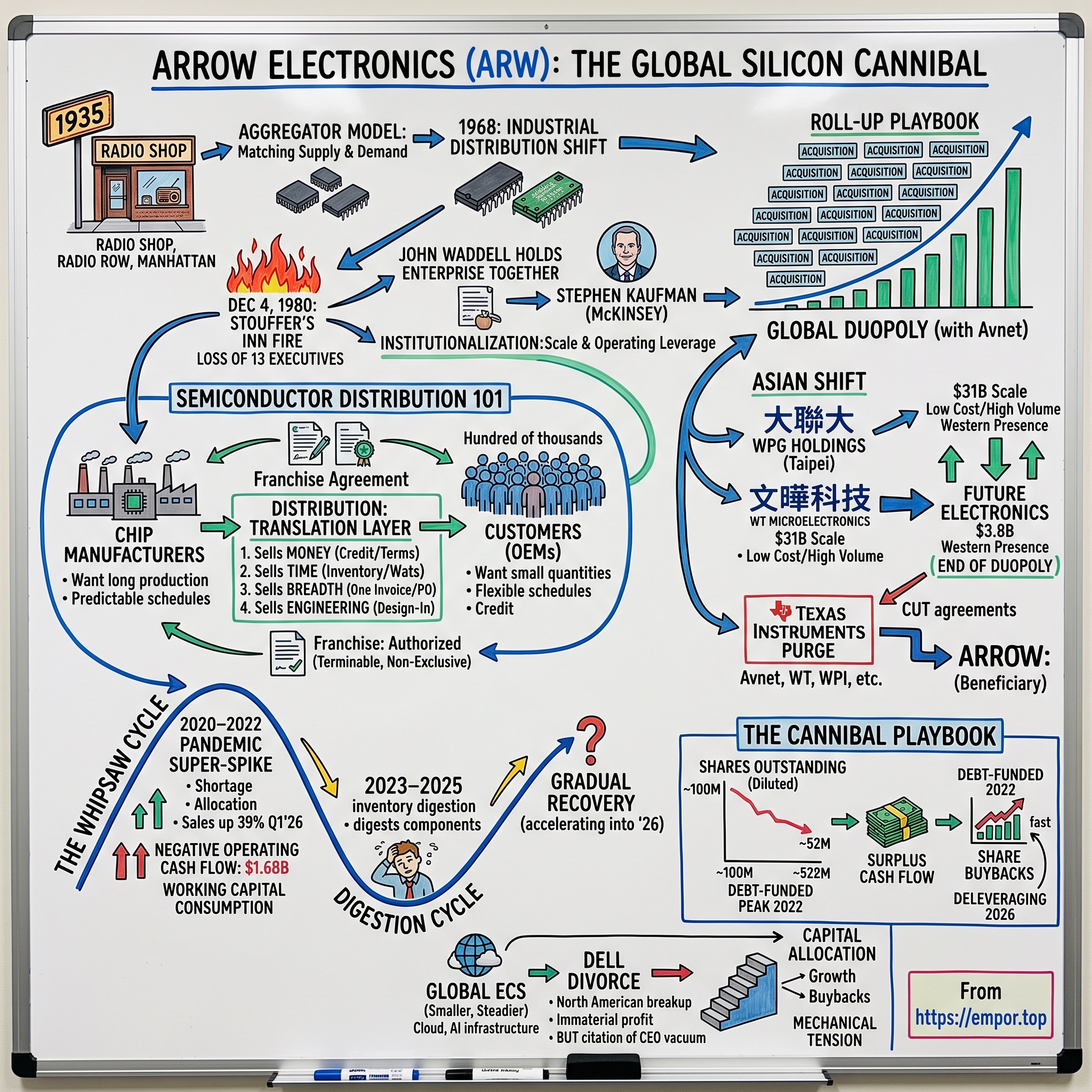
Arrow Electronics: The Global Silicon Cannibal
I. Introduction & Episode Roadmap
There is a low-slung office building in Centennial, Colorado — a suburb south of Denver best known for its highway interchanges and its proximity to good skiing — that serves as the nerve center for roughly $31 billion a year in commerce. From that building, Arrow Electronics, Inc. orchestrates the movement of billions of individual electronic components: microcontrollers, analog chips, capacitors, connectors, power modules, memory. The parts go into automobiles, insulin pumps, factory robots, wind turbines, smart thermostats, radar systems, and the servers now being racked at furious pace inside AI data centers.
Almost nobody outside the industry has heard of the company. That is not an accident. Arrow's product is not a product at all — it is the absence of a problem. When a chip arrives at a contract manufacturer's dock in Guadalajara on the morning it is needed, nobody writes a press release. When it doesn't, an entire production line stops and someone gets fired.
Here is the first tension worth sitting with. Arrow reported full-year 2025 sales of $30.9 billion, up 10%, and consolidated segment operating income of roughly $1.2 billion across its two divisions.1 Do that arithmetic and you land somewhere near a four percent operating margin. This is a Fortune 100-scale enterprise that keeps about four cents of every revenue dollar before interest and tax. Grocery stores are more profitable on a percentage basis. And yet Arrow has, over the last decade, executed one of the more aggressive share-shrinkage campaigns in American corporate life: diluted weighted-average shares outstanding fell from roughly 99.9 million in fiscal 2014 to about 52.3 million in fiscal 2025 — a reduction of nearly half.21 The company has never paid a dividend. Every dollar of genuinely surplus cash has gone into retiring its own stock.
That combination — thin margins, enormous scale, relentless self-cannibalization — is the whole investment argument in miniature. It is also, as we will see, the whole risk.
The second tension is the present moment. Arrow has just come through the most violent demand cycle in its modern history: a pandemic-era chip shortage that let distributors dictate terms, followed by a savage multi-year inventory hangover as customers who had double- and triple-ordered simply stopped buying. Revenue fell from $37.1 billion in fiscal 2022 to $27.9 billion in fiscal 2024 — nearly a quarter of the business, gone — and operating income fell far harder.2 Recovery arrived in 2025 and accelerated sharply into 2026, but it arrived without a permanent chief executive. On September 16, 2025, Arrow announced that Sean J. Kerins had "separated" from the company as President, CEO and director, effective immediately, after roughly three years in the seat.3 The board offered no explanation beyond confirming the departure was unrelated to Arrow's financial statements. Independent director William F. Austen, a former packaging executive, stepped in as interim CEO. As of July 2026, ten months later, he is still there.
And in June 2026, Dell Technologies ended its long-running North American distribution relationship with Arrow's enterprise computing arm — a book of business reported at roughly $1.4 billion in annual gross billings.[^4] Arrow's public posture has been that the profit contribution was immaterial. That claim deserves testing rather than acceptance.
What follows traces how a shop selling used radio parts on a Manhattan street in 1935 became a global duopolist; how a hotel fire in 1980 killed thirteen of its senior executives in a single morning and nearly ended the company; how it built a machine for converting cyclical cash flow into a permanently smaller share count; and why that machine is now being stress-tested simultaneously by chipmakers who want to sell direct, by Taiwanese distributors that have grown larger than Arrow itself, and by a leadership vacuum at the top of the house.
 Subscribe on LinkedIn
II. The Genesis: Radio Row & Rebuilding from the Ashes
Cortlandt Street in lower Manhattan in the 1930s smelled of solder and dust. The stretch between Greenwich and Church was known as Radio Row — a dense warren of storefronts where hobbyists, tinkerers, and small manufacturers picked through bins of vacuum tubes, coils, dials, and salvaged chassis. It was the physical internet of its day: the place where you went if you wanted to build something that received a signal.
In 1935, a shop called Arrow Radio opened there, selling used radio equipment and surplus parts. That is the founding myth, and like most founding myths it matters less for what happened than for what it reveals about the business's permanent DNA. Arrow began as an aggregator — a place that took supply from many sources and matched it to demand from many buyers, capturing a spread. Ninety years later, stripped of the romance, that is still precisely what the company does. Only the parts got smaller and the customers got bigger.
The retail-hobbyist model had a ceiling, and by the late 1960s it was obvious. The real money was moving to industry. Transistors had displaced tubes; integrated circuits were displacing discrete transistors; and a generation of American manufacturers needed a supply chain for components that the semiconductor makers themselves had no interest in serving. In 1968, an investment group led by B. Duke Glenn, Jr., Roger E. Green, and John C. Kuelthau acquired control of Arrow with exactly that thesis. They were not buying a store. They were buying a beachhead in industrial distribution.
For twelve years the strategy worked. Arrow grew through the 1970s into a serious national distributor, acquiring regional players and building the franchise relationships with chipmakers that are the currency of the trade. And then, on the morning of December 4, 1980, the company was nearly erased.
The Haight Room
Arrow's senior leadership had gathered for a breakfast meeting at the Stouffer's Inn in Harrison, New York, in Westchester County. At approximately 10:13 a.m., fire ignited in the third-floor conference center, at the junction of three meeting rooms.4 It spread with extraordinary speed. Twenty-six people died — the deadliest such event in Westchester's history.4
Thirteen of the dead were Arrow Electronics executives, including chief executive Duke Glenn and executive vice president Roger Green.45 They had been meeting in the Haight room: windowless, with a single exit. Six of them were found in a closet they had apparently mistaken for a fire door.4 Eleven employees of Nestlé died in the same fire.4
It is difficult to overstate what this did to a company. Arrow lost, in a matter of minutes, essentially its entire executive suite — the people who held the supplier relationships, the pricing knowledge, the customer trust, the institutional memory. The company was carrying meaningful debt. The American economy was entering a severe recession. On any reasonable actuarial basis, Arrow should have been sold for parts.
John Waddell — a co-founder-generation executive who had stayed behind at headquarters that morning rather than attend the breakfast — became the surviving senior leader and the person responsible for holding the enterprise together.5 What he did over the following eighteen months was, in its way, the most consequential act in the company's history: he kept it independent long enough to recruit professional management.
Kaufman and the Institutionalization of Arrow
In 1982, the board brought in Stephen P. Kaufman as president. Kaufman was a McKinsey consultant — an outsider to distribution, trained in the discipline of taking apart a business's cost structure and rebuilding it around process rather than personality. He would run Arrow for the better part of two decades and become the subject of Harvard Business School case study material on how the company was rebuilt.6
The strategic insight Kaufman institutionalized is the one that still governs the business. In a distribution industry where gross margins are structurally thin, the only durable source of advantage is operating leverage: the ability to push more volume through the same fixed base of warehouses, systems, credit lines, and sales engineers. That makes scale not merely nice but existential — and it makes acquisition the natural mode of growth, because buying a competitor's revenue and running it through your existing infrastructure is arithmetically superior to building that revenue yourself.
There is a subtler lesson too, and it is the one worth carrying forward. The fire proved that Arrow's value did not reside in thirteen people. It resided in franchise agreements, customer relationships, inventory positions, and credit lines — assets that survived the morning of December 4. A business that can lose its entire leadership and continue functioning is a business whose moat is structural, not personal. That is a genuinely rare property, and it is worth remembering in Section VII, when we get to a company operating for the better part of a year under an interim chief executive and find management gesturing at exactly this resilience.
To understand why the structure holds, we need to understand what a distributor actually does.
III. The Industrial Engine: Semiconductor Distribution 101
Picture two rooms that cannot hear each other.
In the first room sit the semiconductor manufacturers. A modern fabrication plant costs tens of billions of dollars, runs continuously, and achieves acceptable economics only at enormous volume. The economics of a fab reward long production runs of identical parts. What a chipmaker wants is a small number of customers ordering vast quantities on predictable schedules, paying promptly, and never changing their minds.
In the second room sit the customers. There are hundreds of thousands of them. A mid-sized company in Ohio making industrial sensors needs eleven thousand units of one microcontroller, four hundred of a particular voltage regulator, and a reel of capacitors — this quarter. Next quarter the bill of materials changes. They want ninety-day payment terms. They want the parts to arrive the week they are needed, not six months early, because inventory is cash they do not have.
These two rooms want opposite things, and neither has any interest in learning the other's language. Distribution is the translation layer. It is one of the oldest commercial structures in existence, and it exists wherever supply is concentrated and demand is fragmented.
The Four Jobs
What Arrow actually sells is best understood as four distinct services bundled into a single invoice.
It sells money. This is the least appreciated and possibly the most important. When Arrow ships components to an OEM on sixty- or ninety-day terms, it is extending credit — functioning as a specialty finance company that happens to settle in silicon rather than cash. Chipmakers have no appetite for underwriting the credit of thousands of mid-market manufacturers. Arrow does that underwriting at scale, and the balance sheet consequences are visible: in fiscal 2025, as revenue grew 10%, changes in working capital consumed roughly $522 million of cash, with receivables and inventory absorbing capital faster than payables released it.2 Growth in this business is not free. It is purchased with the balance sheet.
It sells time. Arrow holds physical inventory in warehouses positioned near customer factories. The value of that inventory is not the parts; it is the elimination of the scenario where a $40 million production line stops because a $0.30 component is three weeks out. Distributors are, functionally, an insurance policy against line-down events, and customers pay a premium for it without calling it a premium.
It sells breadth. Arrow carries components from hundreds of suppliers. A customer building a product needs parts from dozens of them. Consolidating that into one purchase order, one delivery, one invoice, and one relationship is a real reduction in administrative cost — the same logic that makes a supermarket more useful than fourteen specialty shops.
It sells engineering. This is the highest-value and most defensible layer. Arrow employs field application engineers who sit with a customer's design team during prototyping and help specify which chips go into the product. This is called "design-in," and it is the closest thing the industry has to a lock-in mechanism: once a part is designed into a circuit board and qualified, changing it requires re-testing, re-certification, and sometimes regulatory re-approval. In automotive or medical applications that can take years. Whoever wins the design-in wins the production volume for the life of the product.
The Franchise: A Contract Everyone Pretends Is an Asset
There is one more piece of plumbing that outsiders almost always miss, and it explains a great deal about why this industry behaves the way it does.
A distributor cannot simply buy chips on the open market and resell them. To sell a manufacturer's parts as genuine, warrantied, traceable product, the distributor needs an authorized franchise agreement with that manufacturer. Franchised distribution is a closed club, and membership is what separates Arrow from the grey-market brokers who buy and sell surplus inventory of uncertain provenance. In safety-critical applications — automotive braking, medical devices, aerospace — buying outside the franchised channel is effectively prohibited, because a counterfeit or out-of-spec component can kill someone and no engineering manager will sign off on the risk.
So the franchise is genuinely valuable. It is also, structurally, a contract that the supplier can end.
Layered on top is a pricing mechanism called ship-and-debit, which is worth understanding because it shapes the economics. When a distributor wins a competitive design at a customer, the manufacturer will often authorize a special lower price for that specific customer and part. The distributor ships from inventory it purchased at standard cost, sells at the negotiated price, and then debits the manufacturer for the difference. The practical effect is that the manufacturer, not the distributor, sets the price on the most important business — and the distributor's realized margin on a contested design is determined by someone else's decision.
This is the quiet reason distribution margins are so thin and so stable. The distributor is not a merchant setting prices against demand. On a large share of its volume it is closer to a logistics and credit provider being compensated at a rate its supplier controls. Understanding that removes most of the mystery from why a company can grow revenue 39% in a quarter and still operate at four cents on the dollar.
Reading the Five Forces
Michael Porter's framework maps onto this sector with unusual clarity, and the picture it produces is not a comfortable one.
Threat of new entrants: very low. To become a global distributor you need authorized franchise agreements from top-tier chipmakers, a worldwide warehouse and logistics network, and billions of dollars of working capital to fund receivables and inventory. You cannot software your way in. This is the strongest structural feature of the business.
Supplier power: high. Semiconductor manufacturers have consolidated relentlessly, and they hold the whip. Franchise agreements are generally non-exclusive and terminable on relatively short notice. A distributor can lose a line — and with it a meaningful slice of revenue — by decision of a supplier's channel executive. We will see exactly this happen in Section VIII.
Buyer power: mixed, and rising at the top. The long tail of small OEMs has essentially no leverage; they need Arrow more than Arrow needs any one of them. But the largest electronics manufacturing services firms buy in volumes that let them negotiate hard, and the sector's largest customers increasingly have the option of dealing direct.
Threat of substitutes: high and structural. The substitute is not another distributor. It is the supplier selling direct, through its own digital storefront and its own sales force, capturing the distributor's margin and — more importantly — the customer's data. Every advance in e-commerce infrastructure makes this cheaper for the chipmaker to attempt.
Rivalry: intense. Distributors compete on price for identical parts, which is the definition of a commodity market. The differentiation exists in service, credit, and engineering — real, but partial.
Add these up and you get an honest characterization: Arrow occupies a position that is extremely hard to attack from below and meaningfully exposed from above. New competitors cannot easily arrive. Existing suppliers can leave. That asymmetry is the single most important thing to understand about the equity.
It also explains why, for four decades, Arrow's answer to nearly every strategic question was the same: get bigger.
IV. Consolidation, the Duopoly, and the Taiwanese Threat
If you want to understand how consolidation works in a low-margin business, look at what Arrow bought.
Through the 1980s, 1990s, and 2000s the company executed well over a hundred acquisitions. The names read like a lost history of American electronics: Cramer Electronics, Kierulff Electronics, Schweber Electronics, Wyle Electronics, Bell Industries' distribution arm, Richey Electronics, and dozens of regional European and Asian distributors absorbed one after another. Each deal followed the same arithmetic. A regional distributor has revenue, customer relationships, and franchise lines — plus a full complement of warehouses, IT systems, back-office staff, and credit facilities. Arrow could buy the first set and eliminate most of the second. The revenue arrived; a large fraction of the cost did not.
This is the roll-up playbook, and in distribution it works better than almost anywhere else, because the underlying product is identical regardless of who ships it. There is no brand to destroy, no culture that customers care about. There is only cost per shipped line item, and that number falls as volume rises.
There is a second, less obvious reason the roll-up worked so well here, and it has to do with franchise lines. When Arrow acquired a regional distributor, it did not only acquire customers; it acquired that distributor's authorizations. A company holding a line in one geography could, after enough acquisitions, hold it globally — and global coverage is exactly what a semiconductor manufacturer wants from a channel partner, because it means one negotiation instead of eleven. Each acquisition therefore improved Arrow's standing with suppliers, which improved its ability to win the next set of lines, which improved its attractiveness to customers. That is the closest the industry comes to a flywheel, and it ran for three decades.
It also created the problem that defines the company today. Consolidation raises the floor for everyone who consolidates. If Arrow and its main rival both roll up their regions and both end up with global coverage and similar cost structures, neither one has an advantage over the other. The industry gets more efficient; the participants do not get more profitable. That is precisely what happened.
Coke and Pepsi, With Reels of Capacitors
The consolidation produced a duopoly. For roughly three decades, global electronic component distribution was a two-horse race between Arrow, headquartered eventually in Colorado, and Avnet, Inc., headquartered in Phoenix.7 The two companies mirrored each other with almost comic precision — matching acquisitions, matching ERP investments, matching global logistics build-outs, matching moves into enterprise computing and back out again.
The rivalry had a disciplining effect and a corrosive one. Disciplining, because two large players in a scale business tend to compete on service and efficiency rather than pure suicide pricing. Corrosive, because neither could ever get far enough ahead to earn real pricing power. Two competitors is far better than twenty, but it is not one.
And then the map changed.
The View From Taipei
The center of gravity in electronics manufacturing moved to Asia — first to Taiwan, then to mainland China, and never back. TSMC became the world's foundry. The vast majority of contract manufacturing capacity clustered within a few flight hours of Taipei. And a distribution industry grew up alongside it that was native to that ecosystem in a way that a Denver-headquartered company could never be.
Two names matter. 大聯大控股 WPG Holdings, founded in Taipei in 2005 as a holding-company roll-up of Taiwanese distributors, reported consolidated 2025 revenue of NT$999.11 billion — roughly $31 billion at prevailing exchange rates, which puts it at or above Arrow's scale.8 It operates with approximately 5,000 employees across some 69 locations, working with more than 250 suppliers.8 Note the employee number against the revenue: this is a business model tuned for extraordinarily high revenue per head, reflecting a mix weighted toward high-volume fulfillment for large Asian manufacturers rather than the engineering-heavy, service-intensive model of the Western distributors.
The second name is 文曄科技 WT Microelectronics, and its move was the more aggressive. On September 14, 2023, WT announced a definitive agreement to acquire Future Electronics — the large, privately held Montreal-based distributor — for an enterprise value of $3.8 billion in cash. The deal closed on April 2, 2024, creating a dual-headquartered entity spanning Taipei and Montreal.[^10] WT's own 2023 global revenue had been approximately $19.1 billion before the deal.[^10]
That transaction deserves a moment. A Taiwanese distributor bought one of North America's largest privately held distributors, in cash, and in doing so acquired instant Western customer relationships, Western franchise lines, and Western engineering staff. It was, in one move, the answer to the criticism that Asian distributors were merely volume shippers confined to their home region. The combined group's revenue placed it in the same weight class as Arrow and above Avnet.
What Changed for Arrow
The strategic consequence is that the comfortable duopoly no longer exists. Arrow now competes in a fragmented top tier of four or five global players, at least two of which have structurally lower cost bases and are closer to where electronics are actually built.
Arrow's response has been to argue that raw volume is not the game — that the future belongs to value-added services, design engineering, supply-chain-as-a-service, and specialized offerings that command higher margins than box-moving. Management repeated this framing on the first-quarter 2026 call, describing a plan to expand high-margin, value-added offerings across both segments in order to enhance "the quality, resilience, and durability of earnings over time."9
That is a coherent strategy. It is also, at this stage, more assertion than demonstration. The falsifiable test is straightforward and available to any investor: does Arrow's Global Components operating margin structurally exceed its own prior-cycle peaks, or does it merely track the cycle? If value-added services genuinely change the mix, the margin at a given revenue level should be higher this cycle than last. If it doesn't, the services narrative is decoration on a cyclical business. We will return to this in the KPI discussion, because it is the single most useful question an outside investor can hold the company to.
Before that, though, we have to understand the cycle itself — because nothing in the last five years of Arrow's financials makes sense without it.
V. The Semiconductor Cycle & Pandemic Distortion
Every industry has a rhythm. Electronic component distribution has a whipsaw.
The mechanism is a textbook bullwhip. A modest change in end demand — say, consumers buying 5% more appliances — travels backward through the supply chain and amplifies at every stage. The appliance maker increases orders by more than 5% because it also wants to rebuild safety stock. Its contract manufacturer orders more still. The distributor, watching orders accelerate and lead times extend, builds inventory. By the time the signal reaches the semiconductor fab, a 5% consumer move has become a 30% order swing. Then it runs in reverse, harder.
Arrow sits in the middle of that whip, holding inventory it bought at one price and selling it into demand that may have evaporated. This is why the business has high operational beta despite being, at the customer level, remarkably stable.
A Warning Shot Before the Storm
It is worth noting that Arrow had already been handed a preview of how badly this could go, eighteen months before anyone had heard of a pandemic.
Fiscal 2019 was a cyclical downturn year for components, and it exposed how much of Arrow's balance sheet was built on acquisition accounting. In July 2019 the company disclosed an interim goodwill impairment analysis covering its Americas and Asia-Pacific components reporting units, ultimately recognizing partial goodwill impairment of $509 million in the Americas unit, full impairment of $61 million in Asia-Pacific, and a separate trade-name impairment of $46 million connected to integrating two global components businesses.10 Arrow reported a net loss of $204 million for fiscal 2019 as a result — its only annual loss in the modern era.2
The impairments were non-cash and did not change the operating business by a dollar. But they revealed something about how decades of roll-up accumulate: the price paid above book value for a hundred-plus acquisitions sits on the balance sheet as goodwill, and its carrying value rests on assumptions about future cash flows in a cyclical industry. When the cycle disappoints for long enough, the auditors ask questions. That risk did not go away in 2019; it is simply dormant when demand is good.
The Super-Spike, 2020–2022
The pandemic supplied the most violent version of this dynamic in modern memory. Fabs shut down or ran short-staffed; ports jammed; lead times for ordinary microcontrollers stretched from twelve weeks to over a year. Manufacturers, terrified of stopping production, did the rational individual thing and the catastrophic collective thing: they ordered far more than they needed, from multiple sources, hoping something would arrive.
For distributors, this was the best environment imaginable. Scarcity inverted the normal power balance. Distributors holding physical inventory could effectively allocate it, and pricing moved in their favor. Arrow's revenue climbed from $28.7 billion in fiscal 2020 to $34.5 billion in 2021 and $37.1 billion in 2022, while operating income more than doubled from $895 million to $2.07 billion over the same span.2 Diluted EPS reached $21.80 in fiscal 2022.2
But look at the cash flow, because this is where the mechanics of distribution become visible. In fiscal 2022 — the peak earnings year — Arrow's operating cash flow was negative $33 million.2 Working capital consumed roughly $1.68 billion as the company poured money into receivables and inventory to serve the boom. The company earned $1.4 billion of net income and generated no cash at all. Distributors do not get paid in cash during upturns; they get paid in balance sheet.
The Hangover, 2023–2025
The reckoning arrived on schedule. Once supply normalized, customers discovered they were sitting on mountains of components they had panic-ordered. They stopped buying — not gradually, but nearly completely, in a phase the industry politely calls "inventory digestion."
Arrow's revenue fell to $33.1 billion in fiscal 2023 and then to $27.9 billion in fiscal 2024.2 Operating income compressed from the peak to $769 million by 2024 — a 63% decline from 2022 on a 25% revenue decline, which is operating leverage running in the direction nobody enjoys.2 The Global Components segment bore the brunt.
The mirror image showed up in cash. In fiscal 2024, with revenue collapsing, operating cash flow was $1.13 billion and free cash flow $1.04 billion, as working capital released $628 million.2 This is the counterintuitive signature of the distribution model: the business generates its cash in downturns, when receivables and inventory liquidate, and consumes cash in upturns. A distributor's cash flow statement is roughly an inverted image of its income statement. Any investor tempted to value Arrow on trailing free cash flow in any single year is measuring the cycle, not the business.
The Hedge That Wasn't Quite a Hedge
Through this, Arrow's second segment — Global Enterprise Computing Solutions, or ECS — behaved differently. ECS distributes enterprise infrastructure and software (virtualization, security, storage, cloud services) to value-added resellers and systems integrators. Its demand driver is corporate IT budgets, not industrial production, and corporate IT budgets did not collapse in 2023–2024. They were, in fact, being reallocated toward AI infrastructure.
The word "hedge" is doing some work here that deserves scrutiny. ECS did cushion consolidated results — but it did not offset them. Components is roughly seventy percent of revenue, and a segment that size falling by double digits cannot be neutralized by a smaller segment growing modestly. What ECS provided was damping, not immunity, plus a genuinely different revenue-recognition profile: a substantial share of ECS activity is software and cloud, much of which is recognized on a net basis, so ECS reports far less revenue than it bills.
That distinction — billings versus revenue — matters enormously for interpreting the Dell announcement, and it matters for understanding the segment economics we turn to now.
VI. Current State of the Business: The Two Engines
By early 2026, the digestion cycle had clearly broken. The question was how much of the improvement was recovery and how much was durable.
Global Components: The Cyclical Machine
In fiscal 2025, Global Components generated $21.5 billion in sales, up 8%, and $775 million in operating income, up 5%.1 That is a segment operating margin of about 3.6%. The fourth quarter told a more dramatic story: components sales of $5.9 billion, up 22%, with segment operating income of $219 million — up 87% year over year.1
That 87% figure is the entire operating-leverage thesis in one number. When a business converts an incremental dollar of revenue at a far higher margin than its average, small volume recoveries produce large profit recoveries. It works identically in reverse, which is what happened in 2024.
The momentum continued into 2026. First-quarter consolidated sales reached $9.47 billion, up 39% from $6.81 billion a year earlier, with GAAP diluted EPS of $4.55 and non-GAAP EPS of $5.22 — the latter comfortably above the top of guidance.11 Consolidated operating margin expanded 160 basis points year over year to 4.2%.9
Two details from that call are worth more than the headline. First, management characterized the recovery as unit-volume driven rather than price-driven, with book-to-bill ratios above parity in all three operating regions and lead times extending gradually but remaining well below shortage conditions.9 If accurate, that is a healthier recovery than 2021's, because it reflects real consumption rather than panic. Second, CFO Rajesh Agrawal noted that operating expenses grew at roughly one-third the rate of revenue — evidence that the cost work of the prior two years actually stuck.9
The skeptical reading: a 39% revenue increase against a badly depressed comparable quarter is not proof of structural improvement. Arrow's fiscal 2022 peak revenue of $37.1 billion remains well above the current annualized run rate, and components operating margin at 3.6% for full-year 2025 sits below the levels the segment achieved at prior peaks. The recovery is real; the claim that the business has been structurally re-rated is not yet supported by the margin data.
There is a further wrinkle in reading the components recovery that investors should hold onto. Distribution revenue in an upturn contains two very different things: parts that customers will actually consume, and parts customers are buying because they are frightened of not having them later. Only the first kind is durable. The 2021 boom was heavily the second kind, which is why it reversed so violently. Management's insistence that this recovery is unit-volume driven, with lead times still well short of shortage conditions, is precisely the assertion that distinguishes the two — and it is one the data will confirm or refute within a few quarters. If lead times keep extending and book-to-bill climbs well above parity, the honest interpretation is not that things are getting better; it is that the panic-ordering phase has restarted, and a hangover is being scheduled.
Global ECS: Smaller, Steadier, Higher-Margin
ECS produced $9.4 billion in fiscal 2025 sales, up 18%, and $426 million in operating income, up 4%.1 At roughly 4.5%, its operating margin runs about a point above Components — a meaningful gap in a business where a point is enormous.
Note, though, that ECS revenue grew 18% while its operating income grew 4%. That divergence says the growth came disproportionately from lower-margin activity, or that Arrow invested ahead of it, or both. It is a useful check on the reflex framing of ECS as the high-quality half of the company. In the first quarter of 2026, ECS sales of $2.8 billion were up 39% against billings of $6.4 billion — and management flagged that four extra shipping days in the period contributed several hundred million dollars of billings, with ECS president Eric Nowak noting the calendar effect would compensate in the fourth quarter.9 Management volunteering a calendar distortion that flatters the current quarter is a small but genuine mark in favor of disclosure quality.
The Dell Divorce
In June 2026, Dell Technologies concluded a formal review and request-for-proposal process covering its North American distribution and ended its relationship with Arrow ECS.[^4] Reporting placed the book of business at roughly $1.4 billion.
Three things need separating here.
First, the number is gross billings, not revenue, and certainly not profit. Hardware distribution of this kind is recognized differently and carries thin margins. Analysts covering the situation characterized the earnings impact as likely immaterial.12
Second, the reasons cited by reporting were not entirely flattering to Arrow. Accounts pointed to Arrow's narrower focus on enterprise and midmarket customers rather than Dell's full portfolio, and to more limited inventory and warehouse capabilities on the hardware side.[^4] Notably, Dell was also reported to have cited the departure of Arrow's former chief executive as a factor.[^4] That is an uncomfortable data point: it suggests the September 2025 leadership rupture had commercial consequences with at least one major partner, which is exactly the kind of second-order cost that a board hopes an interim arrangement will avoid.
Third, and most substantively, the strategic logic Arrow offers is genuinely coherent. Dell wanted distribution partners to carry the full portfolio, including low-margin client hardware. Arrow's stated priority is high-margin software, cloud, and AI infrastructure. Declining to fund working capital for commodity hardware in order to preserve mix is a defensible choice — the same logic that made Arrow's decision to shrink its share count more valuable than growing its revenue.
The honest investor position is that this is unfalsifiable in the short run and highly falsifiable in the medium run. If Arrow is right, ECS operating margin should hold at or above 4.5% even as the segment loses $1.4 billion of billings. If ECS margin drifts down while billings shrink, the "margin over volume" framing was a rationalization. That test resolves within four quarters, and it costs nothing to wait for.
Which brings us to the people making these calls — and to the question of whether anyone is permanently in charge.
VII. Current Management, Corporate Governance, and the Cannibal Playbook
The press release went out on the afternoon of September 16, 2025, and it was notable mostly for what it did not say.
Arrow announced that Sean J. Kerins had separated from the company as director and as President and CEO, effective that day. Independent director William F. Austen was appointed interim President and CEO. Board chair Steven Gunby offered the customary reassurance about the leadership team and Austen's willingness to step in.3 The filing confirmed that Kerins had agreed to assist with the transition and that his separation was unrelated to Arrow's financial statements.13
That last clause is the standard formulation used to head off the market's first assumption. It rules out accounting problems. It rules out nothing else. No performance rationale was offered, no strategic disagreement described, no successor named or timeline given. Kerins had been in the role roughly three years, having risen through the ECS side of the business.
An investor should treat unexplained CEO separations as an analytical fact rather than a curiosity. The set of explanations consistent with the disclosure is wide — board dissatisfaction with execution, a strategic disagreement, a conduct matter, or a mutual loss of confidence — and Arrow has narrowed it only at one end. What is observable is the consequence: as of July 2026, the company is approaching a full year under an interim chief executive, and on the first-quarter call management would say only that the board continued to evaluate candidates and would update when one was selected.9
Who Is Bill Austen?
Austen joined Arrow's board on May 15, 2020. His executive career was built at Bemis Company, the flexible packaging manufacturer, where he served as president, CEO and director for six years until June 2019.3 On assuming the interim role he stepped down as chair of the board's corporate governance committee and left the compensation committee, while remaining a director.3
The profile is worth pausing on, because it is an unusual fit and a revealing choice. Austen is not a semiconductor person or a channel person. He is an industrial operator — a packaging executive whose career was built on manufacturing footprint, plant consolidation, and cost discipline. Appointing him signals a board that wanted operational steadiness and cost execution during a transition, not a strategic reinvention. His public language supports that read: on the third-quarter 2025 call he described components trends that "suggest we are in the early stages of a gradual recovery" — deliberately unheroic phrasing for a company whose stock moves on cyclical inflections.14 By the first quarter of 2026 he was describing a more efficient cost structure "demonstrating the positive operating leverage we have built into our model."9
Consistency across those two calls is a genuine credibility marker. The narrative did not lurch. Management called a gradual recovery in October 2025 and then delivered results consistent with a gradual recovery accelerating — rather than, as happens often enough in cyclical businesses, discovering a boom in hindsight and claiming to have predicted it.
The offsetting concern is real. An interim CEO is structurally constrained. They cannot credibly reorganize the leadership team, cannot commit to multi-year strategic bets, and cannot easily recruit senior talent. Arrow is simultaneously executing a major restructuring, defending against supplier disintermediation, and competing against consolidating Asian rivals. Doing all of that with a caretaker at the top, for the better part of a year, is an execution risk that compounds quietly rather than announcing itself.
The Cannibal Playbook
Now to the thing Arrow is genuinely distinctive at.
Arrow pays no dividend. It never has in its modern era. Every dollar of surplus cash flow has been directed to repurchasing stock, and the cumulative effect is dramatic. Across fiscal 2020 through 2024, the company deployed roughly $3.48 billion on buybacks — $484 million, $912 million, $1.05 billion, $770 million, and $265 million respectively.2 Combined with earlier years, diluted share count fell from about 99.9 million in fiscal 2014 to 52.3 million in fiscal 2025.21
The logic is elegant. In a mature, cyclical, low-margin business with limited high-return organic reinvestment opportunities, the highest-return use of cash is often buying your own earnings stream at a low multiple. Distribution stocks chronically trade at single-digit price-earnings multiples because the market — correctly — discounts cyclical earnings. If management believes those earnings are more durable than the multiple implies, repurchasing shares at that multiple is a high-return investment. Arrow has effectively run a two-decade arbitrage against its own market perception.
The mechanical consequence for equity holders is powerful: when net income eventually returns to prior peaks, it lands on roughly half as many shares.
But three qualifications deserve equal billing, and they are the things a skeptical investor would press hardest.
The buyback was partly debt-funded. In fiscal 2022, Arrow repurchased $1.05 billion of stock while operating cash flow was negative $33 million and net debt issuance was $1.14 billion.2 That is not returning free cash flow; that is levering the balance sheet to shrink the equity at the top of a cycle. It worked, but it was not conservative, and it is exactly the pattern that gets punished if the downturn runs longer than expected.
The pace has collapsed. In fiscal 2025 Arrow repurchased just $162 million of stock — a fraction of the 2022 pace — while operating cash flow was $64 million and free cash flow was actually negative $37 million.21 In the first quarter of 2026, buybacks were $25 million, while the company applied cash to reducing gross debt by $619 million to $2.5 billion.9 Management chose deleveraging over repurchase. That is a defensible, arguably admirable, capital allocation decision — but it means the cannibal is currently fasting, and it complicates the narrative of relentless share retirement.
The new authorization is a ceiling, not a commitment. On May 12, 2026, the board authorized a new program of up to $1 billion, replacing the prior authorization.15 An authorization is permission to spend, not a promise. Given that the first quarter of 2026 saw $25 million of actual repurchases against $699.8 million of operating cash flow, the gap between authorization and execution is the thing to watch.119
An activist would frame the whole picture more sharply. Arrow returns capital exclusively through buybacks, executed with heavily cyclical timing — largest at the top, smallest at the bottom. That is the opposite of the countercyclical discipline the strategy's own logic recommends. The company has bought back more stock when its stock was expensive relative to the cycle and less when it was cheap. This is an extremely common corporate pathology, and it is not excused by the impressive cumulative share-count reduction.
Governance and Incentives
Arrow's board has moved to strengthen alignment, raising director stock ownership guidelines to five times the annual cash retainer — an above-average requirement that puts directors' personal balance sheets behind the equity.16 Executive incentives remain anchored to diluted earnings per share and return on working capital.16
That second metric deserves attention because it is unusually well-matched to the business. Return on working capital directly targets the thing that determines whether growth creates or destroys value in distribution: how much receivables and inventory you must fund to earn a dollar. An executive compensated on revenue would happily buy volume with the balance sheet. One compensated on return on working capital will not. Pairing it with diluted EPS also does something subtle — it makes the share count a compensation variable, which structurally biases management toward buybacks. That alignment is genuine, but investors should understand it cuts both ways: EPS-linked pay rewards share repurchase regardless of whether the price paid was sensible.
The Efficiency Plan
The final piece of the current management program is the Operating Expense Efficiency Plan, announced October 31, 2024.17 The targets: $90 million to $100 million of annualized operating expense reduction, to be substantially complete by the end of fiscal 2026, against estimated restructuring costs of approximately $185 million — roughly $135 million for efficiency initiatives and $50 million to exit non-core lines of business.17
The specific measures are the standard industrial playbook: centralizing functions into lower-cost regions, upgrading warehouse and logistics operations, investing in IT for automation, consolidating global real estate, cutting third-party spend, and winding down businesses that no longer fit.17 Arrow recorded $116 million of restructuring charges in fiscal 2025 alone.1
The evidence that it is working is indirect but real: operating expenses growing at one-third the rate of revenue in the first quarter of 2026 is precisely the signature you would expect if fixed costs had genuinely been removed rather than merely deferred.9 The test that matters is whether that gap persists through a full year of recovery, or whether costs reappear as volume returns — the historical failure mode of every distribution restructuring ever announced.
Cost programs, however, do not address the existential question. What happens if the suppliers decide they no longer need a distributor at all?
VIII. Hamilton Helmer's 7 Powers & The Tech Disintermediation Battle
In October 2019, Texas Instruments sent letters that reorganized an industry.
TI announced it would terminate distribution agreements with several major partners, effective the end of 2020. Among those cut: Avnet, 文曄科技 WT Microelectronics, and WPI Group.1819 The stated rationale was that TI wanted "closer, more direct relationships" with its customers.18 The company had already brought demand creation in house in 2016, relegating distributors to fulfillment.
The financial exposure was severe for the affected parties. TI products represented roughly 10% of Avnet's fiscal 2019 sales, approximately 20% of WT's, and 22% of WPI's fiscal 2018 sales.18
Arrow was not on the list. It remained an authorized TI distributor across most of the world and was widely identified as the principal beneficiary of the reshuffle.19
That escape is the single most important competitive data point in Arrow's recent history, and it deserves careful interpretation rather than celebration. The plausible explanation is that Arrow's role in TI's supply chain was harder to replicate — deeper technical design-in engagement, broader small-customer coverage, more entangled logistics. But the alternative explanation cannot be dismissed: TI may simply have needed to retain one large global partner to serve the long tail it did not want to serve itself, and Arrow was the largest available. Under that reading, Arrow's position was not earned so much as it was the residual.
Either way, the episode established the sector's central risk with unusual clarity. A distributor's largest lines can disappear by memo.
Scoring the Powers
Hamilton Helmer's framework asks what would actually prevent a competitor from replicating a business's economics. Applied honestly to Arrow, the results are mixed.
Scale economies — genuinely strong, but shared. Arrow's warehouse network, product breadth, systems, and multi-billion-dollar credit capacity create unit costs that no small distributor can match. This is real power. But it is not exclusive: Avnet has it, WPG has it, and post-Future so does WT. Scale economies protect Arrow from below and do nothing against peers of similar size. In a business with four or five players at similar scale, scale alone confers no pricing advantage.
Switching costs — moderate and unevenly distributed. For a customer that has integrated Arrow's supply-chain systems directly into its enterprise resource planning — automated replenishment, consigned inventory, electronic data interchange — switching is genuinely painful. For a customer buying reels of standard parts on price, switching takes an afternoon. The proportion of Arrow's revenue that sits in the first category versus the second is not disclosed, which is itself informative. Distributors emphasize integration in investor materials precisely because it is their strongest claim; the absence of quantification means investors should treat it as directional rather than measured.
Cornered resource — weak, and weaker than commonly claimed. Franchise agreements are the closest thing Arrow has to a proprietary asset. But TI demonstrated that they are terminable at supplier discretion. An asset that a counterparty can revoke is not a cornered resource in Helmer's sense; it is a contract. The correct framing is that Arrow's franchise portfolio is valuable, broad, and structurally insecure.
Process power — moderate and mostly invisible. Decades of accumulated routing logic, inventory positioning, warehouse automation, and demand forecasting produce efficiency that a new entrant genuinely could not copy quickly. This is arguably Arrow's most underrated advantage precisely because it is unmarketable.
Network economies, counter-positioning, and branding — essentially absent. No customer values Arrow more because other customers use it. There is no business-model asymmetry that incumbents cannot copy. And no engineer chooses a capacitor because of the logo on the box.
The candid conclusion: Arrow has a wide moat against small competitors and a narrow one against large ones, with its most important supplier relationships resting on revocable contracts. That is a decent business. It is not a fortress.
The Defensive Shield
Arrow's most interesting strategic response to disintermediation was to change what it sells.
On January 8, 2018, the company acquired eInfochips for a purchase price of approximately $328 million including cash acquired.20 eInfochips is an India-headquartered product-engineering and R&D services firm serving customers across the full arc of technology deployment — custom hardware, embedded software, and IoT-based business models.20 It was recorded within the Global Components segment.20
The strategy embedded in that deal is worth spelling out, because it is genuinely clever. If a chipmaker's argument is that distributors add no value beyond logistics — the argument TI effectively made — then the counter is to move upstream of the purchase decision entirely. When Arrow's engineers design a customer's product from scratch, they choose the components. They write the bill of materials. At that point Arrow is not competing to fulfill an order; Arrow is creating the order and specifying its contents.
An analogy: a lumber yard that also employs the architect. The architect does not shop around for a supplier — the architect is the supplier, and by the time the blueprints are done, the specification is already written.
Does it work? The evidence is genuinely incomplete. Arrow does not break out design-services revenue or attach rates separately, which means investors cannot verify how much of the components business is actually protected by engineering entanglement versus how much remains commodity fulfillment. What can be observed is that Arrow survived the TI purge while distributors with weaker Western design presences did not, and that management continues to point to value-added offerings as the growth priority.9 That is suggestive. It is not proof.
And the counter-risk is structural: the chipmakers are building their own design-support ecosystems, reference designs, and developer tools, and they are giving them away. Every improvement in a supplier's self-service design tooling reduces the value of a distributor's field application engineer. Arrow is running up an escalator that its own suppliers control the speed of.
That is the tension the investment case ultimately resolves into.
IX. The Investment Story Spine: Bull vs. Bear Case
Set the narrative aside and reduce this to a wager.
Why Arrow Wins From Here
The cycle turned, and operating leverage is arithmetic. The evidence is not rhetorical. Fourth-quarter 2025 components operating income rose 87% on a 22% revenue increase; first-quarter 2026 consolidated operating margin expanded 160 basis points on 39% revenue growth.19 Book-to-bill above parity in all three regions, with recovery described as unit-driven rather than price-driven, is consistent with genuine end-demand improvement rather than another restocking illusion.9 If the components segment returns toward prior-cycle revenue levels on a cost base reduced by $90–100 million annually, the incremental margin math is compelling.
The share count is permanently smaller. This is the most reliable element of the bull case because it has already happened. Roughly half the shares that existed in 2014 no longer exist.2 Any given level of net income now produces roughly twice the earnings per share it would have. This is not a forecast; it is a completed fact whose payoff is contingent only on earnings recovering.
Costs came out and appear to have stayed out. Operating expenses growing at one-third the rate of revenue is the strongest available evidence that the restructuring was structural rather than cosmetic.9
ECS has a real secular driver. AI and data center infrastructure spending is not a cycle Arrow created and is not one that depends on industrial production. The segment grew 18% in fiscal 2025 and 39% in the first quarter of 2026, with management citing cloud, AI, and data center activity.19 Whatever one thinks of AI capital expenditure durability, it is a demand source uncorrelated with the components cycle.
The balance sheet improved. Gross debt down $619 million to $2.5 billion in a single quarter, with reduced securitization borrowings, gives the company room to be opportunistic.911 Fitch has maintained Arrow's investment-grade profile through the trough.21
Why Arrow Loses From Here
Disintermediation is not a hypothetical risk; it is a demonstrated one. TI did it. It cost Avnet roughly a tenth of its revenue and WT and WPI a fifth or more.18 Nothing prevents Analog Devices, Infineon, STMicroelectronics or others from reaching the same conclusion, and every year of improvement in e-commerce and self-service design tooling makes the direct model cheaper to run. Arrow's escape in 2019 provides no assurance about 2027.
The Asian competitors are structurally advantaged and no longer regional. 文曄科技 WT Microelectronics's $3.8 billion acquisition of Future Electronics eliminated the geographic limitation that had confined Asian distributors, and WPG's revenue now sits at or above Arrow's on a far leaner cost base.[^10]8 Distribution is a scale game, and Arrow is no longer unambiguously winning it.
The leadership vacuum is real and has already cost something. Ten months of interim leadership, with no announced timeline, during a restructuring and a competitive transition, is not a neutral condition. The reported role of Kerins's departure in Dell's decision is a concrete instance of the abstraction becoming a cost.[^4]
Cash generation is structurally weak during recovery. This is the least discussed and possibly most important bear point. Arrow generates cash when business is bad and consumes it when business is good. Fiscal 2025 free cash flow was negative $37 million on 10% revenue growth.2 If the recovery is strong, working capital will absorb a great deal of cash, and the $1 billion buyback authorization may go substantially unspent. The bull case's two pillars — earnings recovery and aggressive repurchase — are in direct mechanical tension with one another.
Margins have not yet proven anything structural. Full-year 2025 components operating margin of 3.6% is not evidence of a mix shift toward value-added services.1 Until the segment earns a higher margin at a comparable revenue level than it did in the prior cycle, the services narrative remains a hypothesis.
Impairment risk is not theoretical. The 2019 write-downs established that a sufficiently prolonged components downturn forces Arrow to revisit the carrying value of goodwill accumulated across decades of acquisition. That exposure has not been eliminated; it is simply quiet while demand is strong. An investor should treat reported book value in this business as cycle-contingent rather than fixed.
The Three Numbers That Matter
Reduce the monitoring problem to as few variables as possible, and three survive.
1. Book-to-bill in Global Components. This is the industry's leading indicator: orders received divided by orders shipped. Above 1.0 means the backlog is building and revenue is coming; below 1.0 means the reverse. It is the earliest available signal of whether the recovery is continuing or rolling over, and it turns before revenue does.
2. Segment-level operating margin — Components and ECS separately. For Components, the question is whether margin can exceed prior-cycle peaks rather than merely reach them; only that would validate the value-added-services thesis. For ECS, the question is whether it holds at or above 4.5% now that the Dell billings are gone; that is the direct test of the margin-over-volume claim.
3. Free cash flow conversion and actual buyback execution. Not the authorization — the dollars actually spent, measured against operating cash flow. This reveals whether Arrow can grow and repurchase simultaneously, or whether working capital consumption forces the cannibal to fast through every upturn.
Track those three and you will know, well before the headlines do, whether the story is working.
X. Epilogue & Playbook Lessons
Ninety-one years after a shop on Cortlandt Street began selling used radio parts, Arrow Electronics remains what it has always been: an intermediary that survives by being harder to remove than it is to tolerate. That is a less glamorous proposition than the businesses that usually attract narrative attention, and it is why almost nobody outside the industry can name the company.
Myth Versus Reality
Before the lessons, three consensus framings are worth correcting, because each is repeated often enough to have become received wisdom.
Myth: Arrow is a high-quality compounder disguised as a distributor. Reality: it is a cyclical intermediary whose earnings have swung from $21.80 per diluted share in fiscal 2022 to a loss in fiscal 2019, and the compounding investors point to comes overwhelmingly from share retirement rather than from expanding returns on capital.2 That is a legitimate mechanism, but it is a financial one, not an operating one, and the two deserve different multiples.
Myth: ECS is a software business. Reality: ECS is a channel business that resells other companies' software and infrastructure to resellers. Its 4.5% operating margin is better than components, not good in absolute terms, and the divergence between 18% revenue growth and 4% profit growth in fiscal 2025 suggests the mix is less premium than the framing implies.1
Myth: surviving the Texas Instruments purge proved Arrow's moat. Reality: it proved Arrow was the partner TI found least convenient to replace at that moment. That is a meaningfully weaker claim, and it comes with no guarantee of renewal.
Three lessons carry beyond the specific equity.
The first is about capital allocation in unloved businesses. When your industry is capital-intensive, cyclical, and structurally low-margin, the market will assign you a low multiple more or less permanently. Fighting that with acquisitions, diversification, or narrative usually destroys value. Arrow's alternative — declining to pay a dividend, declining to diversify into adjacencies it did not understand, and instead using surplus cash to retire nearly half its own equity at those low multiples — converted a market inefficiency into a compounding mechanism. The critical caveat, which Arrow's own record demonstrates, is that the strategy only works if the repurchases are executed countercyclically. Buying $1.05 billion of stock at the peak in 2022 and $162 million at the trough in 2025 is the correct idea with the timing inverted.
The second is about moats in commodity businesses. A distributor that only moves boxes is a logistics cost line waiting to be optimized away, and the chipmakers have shown they will do exactly that when they can. Arrow's answer — buying an engineering services firm so that its own people specify the components before a purchase order exists — is the right structural response. Whether it is sufficient depends on a race Arrow does not fully control: whether its engineering entanglement deepens faster than its suppliers' self-service tools improve. Investors should demand disclosure on this, and note that the absence of such disclosure is itself a data point.
The third is about resilience, and it is the oldest lesson in the file. On a December morning in 1980, Arrow lost thirteen senior executives in a matter of minutes. The company survived because its value was not stored in those thirteen people. It was stored in franchise agreements, inventory positions, credit relationships, and processes — assets that outlasted the individuals who managed them. Stephen Kaufman spent the following two decades making that accidental resilience deliberate.
There is a certain symmetry in the fact that Arrow now operates under an interim chief executive, ten months into a search, executing a restructuring and defending a franchise, while the business continues to compound orders and ship parts. The company's history suggests the systems will hold. Its history also suggests that systems holding is not the same as a strategy working — and the distinction between those two things is precisely what the next several quarters will settle.
References
-
Arrow Electronics Reports Fourth-Quarter and Full-Year 2025 Results — Arrow Electronics / Businesswire, 2026-02-05 ↩↩↩↩↩↩↩↩↩↩↩↩
-
Arrow Electronics, Inc. — SEC Filings and Annual Financial Statements, EDGAR (CIK 0000007536) ↩↩↩↩↩↩↩↩↩↩↩↩↩↩↩↩↩
-
Arrow Electronics Announces Leadership Change — Businesswire, 2025-09-16 ↩↩↩↩
-
Stouffer's Hotel Fire Kills 26 Executives of Major Firms — The New York Times, 1980-12-05 ↩↩↩↩↩
-
Arrow Electronics Marks 40th Anniversary of Tragic Fire — EE Times, 2020-12 ↩↩
-
Stephen P. Kaufman and the Rebuilding of Arrow Electronics — Harvard Business School Case Study, 1995-10-18 ↩
-
WPG Holdings (大聯大控股) — Company Overview and Financial Information ↩↩↩
-
Arrow Electronics (ARW) Q1 2026 Earnings Call Transcript — The Motley Fool, 2026-05-07 ↩↩↩↩↩↩↩↩↩↩↩↩↩↩↩↩
-
Arrow Electronics Provides Business Update — Businesswire, 2019-07-15 ↩
-
Arrow Electronics Reports First-Quarter 2026 Results — Businesswire, 2026-05-12 ↩↩↩
-
Raymond James Says Dell Termination Earnings Effect on Arrow 'Likely Immaterial' — Insider Monkey, 2026-06 ↩
-
Arrow Electronics, Inc. (ARW) Q3 2025 Earnings Call Transcript — Seeking Alpha, 2025-10-30 ↩
-
Arrow Electronics Announces New $1 Billion Share Repurchase Program — Arrow Electronics, 2026-05-13 ↩
-
Arrow Electronics, Inc. — Form DEF 14A (2026 Proxy Statement), SEC EDGAR, 2026 ↩↩
-
Arrow Electronics Reports Third-Quarter 2024 Results — Businesswire, 2024-10-31 ↩↩↩
-
Texas Instruments Ends WT Micro and WPG Relationships — EE Times, 2019-10 ↩↩↩↩
-
Texas Instruments Disengages With Global Distributor Avnet — EPSNews / EE Times, 2019-10-04 ↩↩
-
Arrow Electronics, Inc. — Form 10-K for Fiscal Year 2018, SEC EDGAR, 2019-02-07 ↩↩↩
-
Fitch Ratings Affirms Arrow Electronics at BBB — Fitch Ratings, 2025-11-20 ↩
 LinkedIn
 WhatsApp
 Reddit
 Hacker News
 Email
Email Kindle
 RSS Feed
 Spotify
 Apple Podcasts
 Amazon Music
 Audible
 YouTube