Archrock, Inc. (NYSE: AROC): The Invisible Engine of American Energy
I. Introduction & Episode Roadmap
Picture a gravel pad somewhere in the Permian Basin of West Texas, twenty miles from the nearest paved road. The sun is doing its usual work of turning the caliche white. There is no drilling rig here, no fracking spread, no flare stack throwing an orange plume against the sky — none of the imagery that gets stapled to magazine covers about the American shale boom. There is just a low steel skid, the size of a shipping container, humming at a pitch you feel in your sternum before you hear it. Inside sits a 1,500-horsepower reciprocating compressor, its pistons hammering thousands of times a minute, squeezing natural gas until it has enough pressure to push its way into a gathering pipeline and begin a journey that might end at a liquefied natural gas terminal on the Gulf Coast, or a gas-fired turbine feeding an artificial-intelligence data center in Virginia.
Turn that box off, and the whole romantic picture of the shale revolution simply stops. Gas that cannot be pressurized does not move, and gas that does not move backs up into the reservoir and chokes the well that produces the oil. This is the unglamorous physical truth at the base of the energy economy: hydrocarbons are useless until something forces them through a pipe, and forcing them through a pipe is a mechanical, capital-hungry, maintenance-intensive grind. The companies that own those humming steel boxes are not household names. The largest of them is Archrock, Inc., which trades on the New York Stock Exchange under the ticker AROC.
Archrock is the biggest pure-play provider of contract natural gas compression services in the United States. By the end of 2025 it operated roughly 4.6 million horsepower of compression equipment across every major producing basin in the country, and it ran that fleet at about 95% utilization — effectively sold out.1 It does not drill wells, own reserves, or bet on the price of gas. It rents mission-critical iron to the people who do, under multi-year contracts, and it sends a crew out to keep that iron running. In the argot of the industry, it sells horsepower by the month.
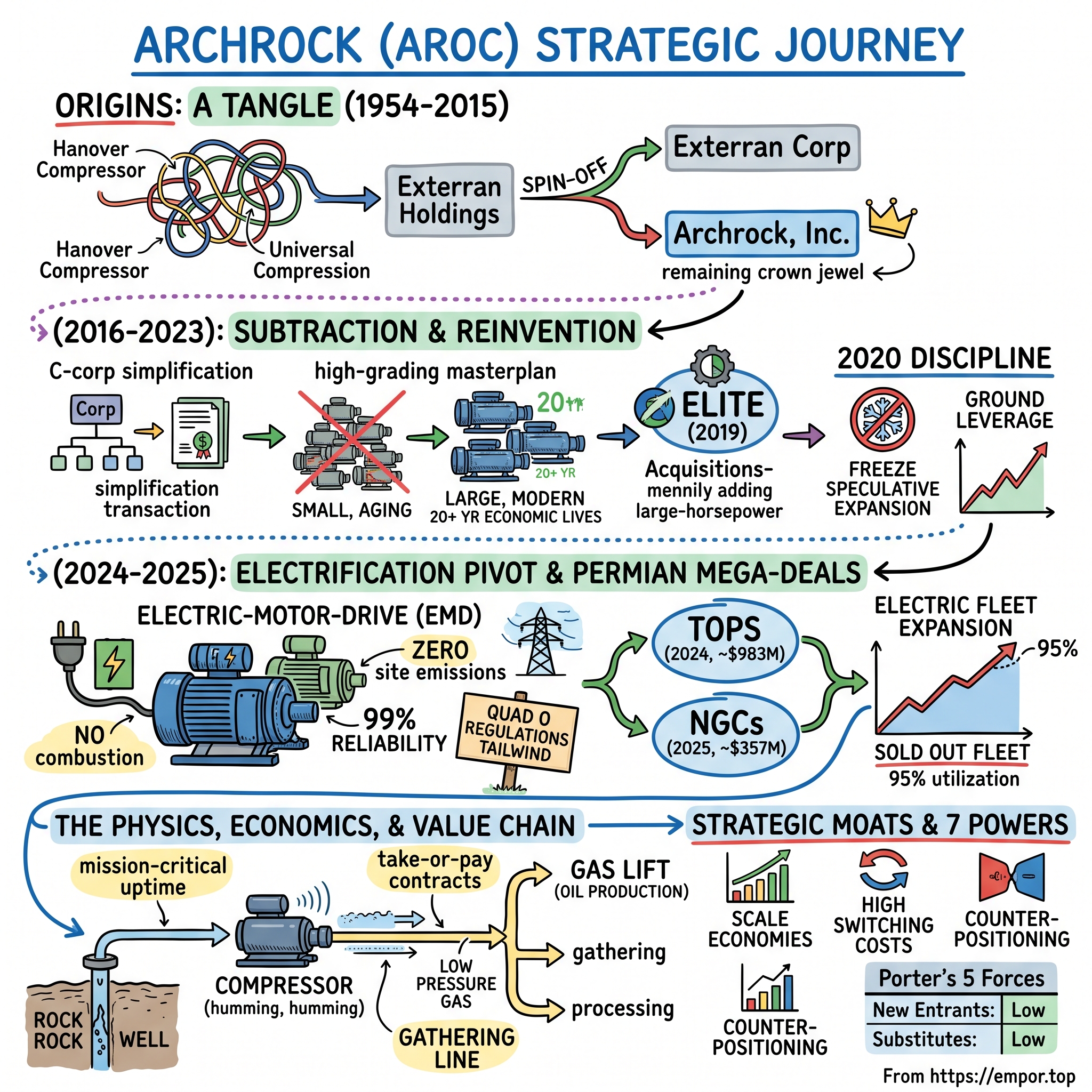
This is the story of how that business got to where it is — and it is a more interesting corporate story than the sleepy cash-flow profile suggests. Archrock spent its first years as a public company as the leftover half of a broken conglomerate, spun out at the exact bottom of an oil crash, carrying too much debt and too many small, worn-out machines. What followed was a decade-long project of subtraction and reinvention: collapsing a clumsy master-limited-partnership structure into a clean corporation, scrapping thousands of aging low-horsepower units, and reloading the fleet with big, modern, long-lived compressors. Then, in 2024 and 2025, management made two of the largest bets in the company's history — nearly $1.3 billion in acquisitions — to plant a flag in the newest frontier of the business: electric-motor-drive compression, machines that swap the gas-burning engine for a plug into the power grid.35
The core narrative arc, then, is a transformation from a debt-laden spin-off into a higher-margin, sold-out infrastructure operator riding two of the largest demand stories in American energy — LNG exports and electricity-hungry data centers. But this is a business story told for investors, not a victory lap written by the company's own communications department. So the interesting questions are the skeptical ones. How durable is a moat built on the tedium of moving heavy equipment? Is the electrification pivot a genuine structural advantage or an expensive fashion? What happens to a "sold out" compression fleet if oil drops below $60 and the drilling slows? And after a decade of management promising discipline and mostly delivering it, what should make an investor nervous now?
Along the way this episode will unpack a few things worth understanding in their own right. The physics and unit economics of compression — why an oil producer would rather rent this equipment than own it. The oligopoly structure of the U.S. contract compression market, where three companies control the bulk of the horsepower. The mechanics of the TOPS and NGCS deals and what they reveal about how Archrock thinks about capital. And the two or three numbers that actually tell you whether this business is healthy in any given quarter. Let us start with the machine itself, because you cannot value Archrock without first understanding why the world cannot do without the thing it rents.
 Subscribe on LinkedIn
II. The Physics, Economics, & Industry Structure of Natural Gas Compression
Here is a fact that sounds trivial and is not: gas has no weight to speak of and no desire to go anywhere. Crude oil is a liquid — you can pump it, truck it, let gravity carry it downhill into a tank. Natural gas is a compressible fluid that fills whatever volume it is given and flows only from higher pressure to lower pressure. A pipeline is essentially a long tube held at high pressure, and to get gas into that tube you must first raise it to a pressure higher than what is already inside. That is the entire job of a compressor: to take low-pressure gas and squeeze it up to line pressure so it will flow.
The problem compounds over the life of a well. When a well is young, the reservoir itself is pressurized enough to push gas to the surface with energy to spare. But reservoir pressure depletes — sometimes alarmingly fast in shale, where the steepest production declines come in the first year or two. As pressure falls, the well needs help. Compression lowers the backpressure at the wellhead, which is a bit like unclogging a straw: reduce the resistance the reservoir has to fight against, and more gas — and crucially, in oil-rich basins, more oil — comes out. In the Permian this is the workhorse application called gas lift, where high-pressure gas is injected back down the wellbore to lighten the column of fluid and coax liquids to the surface. The compressor is not a nice-to-have accessory here. It is the difference between a well that flows and a well that sulks.
Why this is mission-critical, and why that matters commercially. If a compressor at a gathering station trips offline, the wells feeding it can be shut in within minutes, and every hour of shut-in production is revenue that simply evaporates — money the operator will never recover. That single fact shapes the economics of the entire industry. Because the machine is critical, the operator cares far more about whether it runs than about shaving a few dollars off the monthly rate. Reliability, measured as uptime, becomes the product. Archrock and its peers routinely design contracts and service around uptime guarantees in the high-90s percent, and they staff field mechanics densely enough to reach a sick unit before a shutdown turns into a shut-in.
The rent-versus-buy decision. So why don't producers just buy their own compressors? Some do. But the largest, most capital-disciplined shale operators increasingly choose to rent, and the logic is worth sitting with because it is the foundation of Archrock's entire existence. A large-horsepower compression package — say a Caterpillar engine married to an Ariel compressor frame on an engineered skid — is a multi-million-dollar piece of equipment, often in the range of $2 million to $3 million or more for the largest units. An exploration-and-production company has a finite pile of capital and a menu of places to spend it, and almost every one of those places earns a better return than owning static midstream iron. A dollar spent drilling and completing a new well can pay back in months; a dollar sunk into a compressor sits on the balance sheet depreciating for twenty years. Renting converts a big upfront capital outlay into a predictable monthly operating expense and hands the headaches — maintenance, parts inventory, specialized labor, emissions permitting, overhaul cycles — to someone whose entire business is those headaches.
There is a further wrinkle in how these contracts are written that turns a rental agreement into something closer to infrastructure. The core contracts are structured on a take-or-pay basis: the producer pays a fixed monthly fee for the horsepower whether or not it runs the unit at full duty, and Archrock guarantees a level of availability in return. That structure decouples Archrock's revenue from two things that would otherwise make it a treacherous business to own — the volume of gas actually flowing through any given unit, and the spot price of that gas. A producer that chokes back a well for a month still owes the standby fee. The result is a revenue stream that behaves far more like a toll on installed capacity than like a commodity-linked royalty, which is precisely why the market is willing to think of Archrock's contract operations cash flow as infrastructure-grade rather than as a cyclical equipment rental. The catch, as always, is at the margin: while the installed base is contracted and sticky, the pace of new unit deployment still tracks the drilling cycle closely, so the toll grows or stalls with the health of the basins.
That last point about labor is underrated. Keeping a heavy internal-combustion engine and a high-pressure gas cylinder running in a remote field is a skilled trade, and skilled field mechanics are scarce and getting scarcer. A company like Archrock can spread a technician across dozens of nearby units and amortize the training, the truck, the parts van, and the drive time in a way a producer with a handful of compressors never can. The rental model is, at bottom, a labor-and-logistics arbitrage dressed up as an equipment lease.
It is worth making the gas-lift mechanism concrete, because it is where so much of Archrock's most valuable horsepower now works and it is widely misunderstood as a gas-production tool when it is really an oil-production tool. In a maturing shale oil well, the column of fluid in the wellbore eventually gets too heavy for the reservoir to push to surface — the well "loads up" and dies. Gas lift solves this by injecting high-pressure gas down the well; the gas bubbles up through the fluid column, lightens it, and lets the reservoir lift oil to the surface again. The compressor is what generates that injection pressure. This is why a machine that ostensibly moves gas is, in the Permian, frequently in the business of producing oil — and why its demand is quietly levered to oil economics even though its revenue is contracted and gas-denominated. It is a nuance that cuts both ways, as later sections make clear.
Where in the value chain the horsepower sits. Compression shows up at three points along the path from rock to pipeline. Nearest the well is gas lift and wellhead compression, boosting individual wells — this is where the Permian's oil-directed drilling creates enormous demand, because all that oil comes with associated gas that has to be handled. In the middle sits gathering and processing, where big centralized stations aggregate gas from many wells and push it into and through processing plants; this is the domain of large-horsepower units. Farthest downstream is transmission, maintaining pressure on the long interstate pipelines. The economics differ at each stage, but the common thread is that as the industry has consolidated around fewer, bigger, longer-lived assets, the value has migrated toward large horsepower — machines above 1,000 horsepower with twenty-year-plus economic lives.
The structure of the market. Contract compression in the United States is not a fragmented free-for-all; it is an oligopoly. Three pure-play providers dominate. Archrock, with roughly 4.6 million operating horsepower at the end of 2025, is the largest and the only one with a truly national, all-basin footprint and a heavy tilt toward the Permian and toward electric compression.1 Kodiak Gas Services (NYSE: KGS) is close behind, reporting about 4.46 million total fleet horsepower at year-end 2025, concentrated in large-horsepower, high-pressure gathering work.15 USA Compression Partners (NYSE: USAC), structured as a master limited partnership, reported roughly 3.89 million total horsepower and pushed higher in early 2026 with an acquisition that added around 800,000 active horsepower.16 Below these three sit customer-owned fleets and a long tail of smaller regional operators and equipment-focused firms such as CSI Compressco. The concentration matters because it has produced something rare in an equipment-rental business: pricing discipline. When three players control most of the horsepower and none of them is desperate to steal share by slashing monthly rates, the industry can hold price even as costs rise.
That disciplined, oligopolistic, sold-out market did not arrive by accident, and it certainly did not describe Archrock at birth. To understand how this company earned its place at the top of the pile, you have to go back to a messy corporate divorce that closed at the worst possible moment.
III. History & Origins: From Corporate Complexity to Pure-Play Independence (1954–2015)
Every clean, focused business seems to have a cluttered ancestor, and Archrock's is a genuine tangle. The modern company is the surviving remnant of decades of roll-ups in the compression trade, a business that has always had a tendency to consolidate because scale is the whole game. The two great rivers that fed it were Hanover Compressor Company and Universal Compression Holdings, each a serial acquirer of smaller fleets in its own right. In 2007 the two combined in a mega-merger to create Exterran Holdings, at the time the largest natural gas compression enterprise in the world.
On paper the logic was impeccable — combine the two biggest players and dominate. In practice, Exterran was a conglomerate that had wandered into several businesses at once, and they did not sit well together. Alongside the steady, cash-generative work of renting compressors to American producers, Exterran ran a sprawling international operation, built and sold compression and process equipment as a manufacturer, and dabbled in fabricated production and water-treatment systems. These businesses had wildly different rhythms. Domestic contract compression was a recurring-revenue annuity. International project work and equipment manufacturing were lumpy, capital-intensive, and exposed to the whims of foreign state oil companies and one-off construction contracts. The good business subsidized the volatile one, and the market, unable to decide what it was looking at, valued the whole thing at a muddle.
It is worth dwelling for a moment on the two ancestral companies, because they explain something about the industry's DNA. Hanover Compressor, founded in the early 1990s and taken public toward the end of that decade, grew by rolling up compression fleets and rental businesses at a furious pace — the classic strategy of a fragmented service industry consolidating toward scale. Universal Compression followed a parallel path. Both learned the same lesson the hard way: compression is a business where scale lowers unit costs and improves equipment access, so the incentive to keep acquiring is relentless, but where over-leverage and over-expansion into adjacent, lumpier businesses can quickly turn that scale into a liability. Hanover in particular went through a difficult stretch of accounting and restructuring troubles in the early 2000s before the 2007 combination. The Exterran that emerged carried both the consolidator's instinct and the conglomerate's baggage — a company that knew how to buy fleets but had lost the discipline to stay focused on the one part of the business that reliably made money.
The fix was to break it in two. In November 2015, Exterran Holdings split into two independent public companies.7 One, Exterran Corporation (NYSE: EXTN), inherited the international services, the product-manufacturing arm, and the process-equipment business; it would eventually be acquired by Enerflex in 2022. The other kept the crown jewels — the high-margin, predictable, domestic U.S. contract compression and aftermarket-services business — and took the name Archrock, Inc.7 The parent-company MLP that had financed much of the fleet was renamed Archrock Partners, L.P. In one stroke, investors who wanted a clean bet on American gas compression could finally buy one.
The idea was right. The timing was cruel. The spin-off closed in late 2015, in the depths of one of the worst oil-and-gas downturns in a generation. Crude had collapsed from over $100 a barrel in 2014 toward the $30s, producers were slashing budgets, and the last thing anyone wanted to talk about was renting more compressors. A newly independent Archrock walked onto the public stage carrying a legacy debt load, a fleet skewed toward small-horsepower wellhead units under 1,000 horsepower — precisely the equipment with the highest customer churn and the weakest pricing power — and a two-headed corporate structure, with the C-corporation (AROC) sitting atop a publicly traded partnership (the old APL), each with its own governance, its own investors, and its own tax quirks.
That structure was more than an inconvenience. The MLP model came with incentive distribution rights, a mechanism by which the general partner captured a rising share of cash distributions as payouts grew — a wonderful arrangement for the general partner and a growing drag on the limited partners and on the cost of capital for the whole enterprise. It also fenced Archrock off from a large swath of institutional investors who, for tax or mandate reasons, simply would not touch a partnership. The company had been born with the right business and the wrong wrapper, at the wrong moment in the cycle.
For a management team, this is the unglamorous kind of inheritance that defines a company more than any acquisition ever will. There was no growth story to sell in 2016. There was a balance sheet to survive, a fleet to rationalize, and a corporate structure to dismantle. What Archrock did over the following eight years — quietly, unfashionably, one decision at a time — is the part of the story that actually built the company that exists today.
IV. The C-Corp Transformation & Fleet High-Grading Strategy (2016–2023)
If the spin-off was the birth, the years that followed were the reconstructive surgery, and the first incision was structural. In 2018, Archrock completed a simplification transaction, acquiring all of the publicly held units of Archrock Partners, L.P. in an all-stock deal and folding the partnership back into the corporation.8 The board framed it in the dry language of capital markets, but the substance was a deliberate demolition of the very MLP architecture the company had been born with.
Why tear it down? Three reasons, each of which compounds. First, it killed the incentive distribution rights, removing the escalating toll that the partnership structure levied on every incremental dollar of cash flow and lowering the company's effective cost of capital. Second, it collapsed two sets of governance, two sets of public filings, and the constant related-party friction between the corporation and the partnership into a single, legible balance sheet. Third, and most strategically, it converted Archrock into a plain-vanilla C-corporation that index funds, generalist institutions, and tax-sensitive investors could actually own. A business does not become more valuable simply by being easier to buy — but a business with genuinely durable cash flows that had been artificially fenced off from half its natural shareholder base does re-rate when the fence comes down. Management was, in effect, widening the front door.
The high-grading masterplan. The second, longer campaign was about the fleet itself, and it is the clearest window into how this management team thinks. Archrock inherited thousands of small, aging, low-horsepower compressors — the kind of equipment that dominates in shallow, declining, conventional gas fields. These units were a quiet drain: they demanded disproportionate maintenance capital, they broke down often, they sat idle whenever a marginal well was shut in, and because anyone could supply them, they commanded no pricing power. The strategic response was a sustained program of subtraction. Archrock systematically retired, sold, and scrapped its oldest, smallest units — a deliberate shrinking of the low end of the fleet that would depress reported horsepower in the short run in exchange for a healthier fleet in the long run.
At the same time, capital flowed the other way — into large horsepower. The company reinvested in big Caterpillar and Waukesha engines driving Ariel compressor frames, the industrial equivalent of moving from a fleet of aging sedans to a fleet of long-haul trucks. These large units have economic lives north of twenty years, sign initial contracts of three to five years, and serve the centralized gathering and processing applications that grow rather than deplete. They are also far harder for a new entrant to assemble, because the engines and frames sit behind long factory lead times. Every year of this program shifted Archrock's average unit toward bigger, newer, longer-lived, better-priced iron. The reported horsepower number stayed relatively flat for years; the quality underneath it improved dramatically. That is a distinction a superficial reading of the financials misses entirely, and it is the crux of the pre-2024 story.
The Elite acquisition — a benchmark for how Archrock buys. In June 2019, Archrock put the strategy on display with its largest deal to that point: the acquisition of Elite Compression Services for total consideration of about $410 million, adding roughly 430,000 horsepower of predominantly large-horsepower equipment, funded with a mix of cash and newly issued shares.9 The deal deepened Archrock's presence in the Eagle Ford and the Permian and, critically, brought in exactly the kind of large-horsepower assets the high-grading program was chasing. It set a template that would echo through the later, much bigger transactions: buy fleets that upgrade the mix, pay a multiple below where the assets can earn once integrated, and fund the deal in a way that does not blow up the balance sheet. Whether Archrock has always struck that balance is a fair question — but the disciplined intent has been remarkably consistent across a decade of deals.
Discipline under fire. Then came 2020. The pandemic crushed oil demand, drove crude briefly into negative territory, and forced the entire U.S. shale complex into a religion of capital discipline it had never previously observed. For a compression company, this was a live-fire test. Producers stopped growing, which meant no new units to deploy; the only way to create value was to squeeze cash out of the existing fleet. Archrock's response, over the following years, was to freeze speculative fleet expansion, fund its maintenance capital out of operating cash flow rather than debt, and grind its leverage down. The company had entered the downturn with net debt above four and a half times adjusted EBITDA — an uncomfortable place to be in a cyclical business — and set itself a target range of roughly 3.0 to 3.5 times. It kept paying, and modestly growing, its dividend the entire way.1
The larger point for an investor is behavioral. It is easy for a management team to talk about discipline when capital is cheap and demand is booming. Archrock talked about it, and then spent the ugliest years of the cycle actually doing it — deleveraging, avoiding speculative overbuilding, and refusing to chase volume for its own sake.
There is a subtler payoff to the high-grading and deleveraging that is easy to miss. As Archrock shed small iron and reinvested in large horsepower, the maintenance-capital intensity of the whole fleet fell — big modern units on multi-year contracts need proportionally less unplanned repair than a scatter of ancient wellhead compressors bouncing in and out of service. Lower maintenance capex means more of each dollar of gross profit falls through to free cash flow, which is the fuel for both the dividend and the deleveraging. In other words, the two campaigns reinforced each other: high-grading the fleet made the cash flow cleaner, and cleaner cash flow made the deleveraging faster, which lowered the cost of capital, which made the next round of fleet investment cheaper to fund. It is a quiet compounding loop, and it is the mechanism that turned a survival story into a growth story. That track record is the credibility collateral management would spend, all at once, when it decided the moment had come to make the biggest bet in the company's history. That bet had a name, and it was TOPS.
V. The Electrification Pivot: TOPS, NGCS, & The Permian Mega-Deals (2024–2025)
Every compression company faces the same awkward paradox: the machine that moves natural gas is itself powered by burning natural gas. A conventional compressor package runs on an internal-combustion engine that pulls a slipstream of wellhead gas and burns it, throwing off carbon dioxide, nitrogen oxides, and — from the inevitable small leaks and slip — methane, a greenhouse gas dozens of times more potent than CO2 over the near term. For decades that was simply the cost of doing business. But as producers came under real pressure — from investors, from lenders, and from a tightening federal methane regime — the emissions profile of the compression fleet stopped being an afterthought and became a procurement criterion.
Enter electric-motor-drive compression, or EMD. The concept is almost embarrassingly simple: rip out the gas-burning engine and replace it with an electric motor that draws power from the local utility grid. The compressor frame does the same work; only the prime mover changes. The consequences, though, are large. At the compression site itself, emissions fall toward zero — no combustion, no exhaust, dramatically less methane slip. There are fewer moving parts to break, which pushes reliability higher, toward the 99% range. Operating costs drop because there is no engine to overhaul on a punishing maintenance cycle. And the units run quieter, which matters more than you would think when your equipment sits near towns, roads, and increasingly watchful regulators. For a producer trying to hit an emissions target while keeping wells flowing, EMD is close to an ideal answer — provided the one thing it depends on, grid power, is actually available at the wellsite. Hold that caveat; it becomes the central risk later.
By the early 2020s, Archrock had recognized that EMD was not a niche but the leading edge of the market, and that whoever built scale in electric compression fastest would own the most attractive slice of the fleet. The trouble was that building an EMD fleet organically is slow. So Archrock did what it had learned to do well: it bought one.
The TOPS acquisition. On July 22, 2024, Archrock announced the largest deal in its history — the acquisition of Total Operations and Production Services, LLC (TOPS) for approximately $983 million in cash and stock, from investment funds managed by affiliates of Apollo Global Management.3 The transaction closed on August 30, 2024, with Archrock paying an $826 million cash portion and issuing roughly 6.87 million new shares.4 What it bought was transformational in kind, not just in size: about 580,000 horsepower, of which roughly 500,000 was operating, and the great majority high-spec electric-motor-drive equipment deployed in gas-lift service in the Permian — the exact application, the exact geography, and the exact technology Archrock most wanted.34
The financial framing management put around the deal is worth examining rather than swallowing. Archrock argued the purchase came at a multiple in the mid-7-times range on forward EBITDA before synergies, dropping toward the mid-6s after — well below where Archrock's own shares traded, which management pegged nearer 8.5 to 9 times. On that math the deal was immediately accretive to earnings and to cash available for dividends, and management guided to accretion above 10% on EPS and above 20% on cash available per share.3 The independent read: buying assets at six-and-a-half times to fold into a vehicle the market values at nine times is genuinely value-creating arithmetic if — and it is a real if — the synergies show up and the acquired fleet stays as fully utilized as promised. The prize was strategic as much as financial. Overnight, TOPS made Archrock the premier electric-compression provider in North America, leapfrogging a capability that would have taken years and enormous factory lead times to build from scratch.
The NGCS follow-on. Having reset the board, Archrock pressed its advantage. On March 10, 2025, it announced the acquisition of Natural Gas Compression Systems, Inc. (NGCS) for roughly $357 million in cash and stock, closing on May 1, 2025.56 NGCS added about 351,000 horsepower — some 316,000 operating plus a backlog of contracted new equipment — and layered in roughly 78,000 horsepower of additional EMD capability, pushing Archrock's electric fleet to around 815,000 horsepower.5 Where TOPS was a step-change, NGCS was a consolidation play: a bolt-on that thickened Archrock's density in the Permian and reinforced the electric footprint it had just established. Together, the two deals committed roughly $1.3 billion inside a year — a striking burst of aggression from a management team that had spent the prior eight years preaching restraint. That tension, between the discipline of 2016–2023 and the boldness of 2024–2025, is precisely the thing a thoughtful investor should keep turning over.
Why now — the demand backdrop. The bet was not made in a vacuum. Three structural forces converged to make aggressive capital deployment look rational. First, Permian gas production kept breaking records, not because anyone was drilling for gas but because the basin's oil wells produce enormous volumes of associated gas as a byproduct; that gas has to be gathered and moved whether the operator wants it or not, and moving it takes compression. Second, a wall of new LNG export capacity was coming online along the Gulf Coast — projects such as Plaquemines, Golden Pass, and Corpus Christi Stage 3 — creating durable, high-pressure pipeline demand pulling gas out of the interior. On the Q1 2026 earnings call, management noted that roughly 2 billion cubic feet a day of additional export capacity was expected to come online in 2026, with sanctioned projects representing about 14 Bcf a day of incremental capacity through 2030.11 Third, and newest, the explosion in AI data-center construction was driving a surge in electricity demand, much of it to be met by new gas-fired generation — another structural pull on the gas that Archrock's machines exist to move.11 The mechanism here is worth spelling out because it is genuinely new to the compression thesis. Training and running large AI models consumes staggering amounts of power, and the grid cannot build wind, solar, and transmission fast enough to meet it on the timeline the hyperscalers demand. Natural gas turbines — dispatchable, buildable in a couple of years, and increasingly sited near gas supply — have become the default bridge. Every new gas-fired plant that comes online to feed a data-center campus is another sustained draw on the pipeline system, and sustained pipeline draw means sustained compression demand across gathering, processing, and transmission. It is an indirect link, and its magnitude is still being discovered, but it points the same direction as LNG: more molecules moving, for longer, than the pre-2023 consensus assumed.
There is one more strand to the electrification story worth pulling, because it explains why the regulatory wind is at Archrock's back rather than in its face. The federal methane rules — the EPA's Quad O family of standards, which govern how oil-and-gas facilities detect and repair leaks and limit emissions from equipment — have been tightening steadily, and combustion-driven compressors are squarely in their sights. Every ratchet of those rules raises the compliance cost and operational friction of running a gas engine in the field, and simultaneously raises the relative appeal of an electric unit that emits essentially nothing at the site. A company that had bet its fleet entirely on legacy combustion would experience regulatory tightening as pure cost. A company with the largest electric fleet in the country experiences it, on balance, as a demand tailwind — its most differentiated product becomes more valuable precisely as the rules bite. That is the strategic elegance of having bought TOPS before electric compression became a regulatory necessity rather than a customer preference.
Each of these forces is real. Each is also, to some degree, a story about the future that has not yet fully arrived, and every one of them depends on gas continuing to flow at volume out of basins where the compression is Archrock's to supply. The demand thesis is strong. Whether it is strong enough to justify $1.3 billion of acquisitions and a materially larger debt load is a question best answered not by the narrative but by the numbers — the segment economics, the margins, and the balance sheet. That is where we turn next.
VI. Segment Breakdown, Financial Engine, & Management Performance
Strip away the narrative and Archrock is, financially, a two-part machine — one large, capital-intensive engine that generates the overwhelming majority of the profit, and one small, asset-light attachment that deepens customer relationships and throws off cash across the cycle. Understanding how these two fit together is the key to reading the company's results.
Contract Operations — the core engine. This is the business of owning, operating, and maintaining Archrock's own compression fleet under multi-year contracts, and it is the whole ballgame. In 2025 it generated $1.27 billion of the company's $1.49 billion in total revenue — roughly 85% of the top line and an even larger share of profit.1 Its economics are what make Archrock interesting: contract operations posted an adjusted gross margin of 73% for the full year, and the fourth quarter reached 78% (or about 71.5% stripping out a one-time sales-tax benefit).1 Those are not the margins of an equipment-rental commodity; they are the margins of an operator selling reliability into a supply-constrained market. The revenue is recurring, contracted, and largely insulated from the spot price of gas because customers pay for horsepower and uptime, not for molecules. When you hear "infrastructure-like cash flows," this segment is what the phrase is pointing at.
Aftermarket Services — the asset-light attachment. The second segment, aftermarket services, does for other people's compressors what contract operations does for Archrock's own: maintenance, overhauls, parts, and operating support for customer-owned equipment. It contributed $217.7 million of 2025 revenue, roughly 15% of the total, at much thinner margins than the core.1 Its importance is not its profit but its role. It requires little capital, so its returns on capital employed are high; it generates cash even in downturns when producers defer new-unit deployments but still must keep their existing iron running; and it keeps Archrock's technicians embedded in customer operations, which quietly reinforces the relationships that make the core business sticky. It is the connective tissue, not the muscle. There is also a strategic intelligence dividend that rarely gets discussed: a technician servicing a customer's owned fleet is a set of eyes inside that customer's operation, aware of which units are aging out, where the producer is expanding, and when the buy-versus-rent calculus might tip. In a business where the next contract often comes from an existing relationship rather than a competitive bid, that embedded presence is worth more than its thin margin suggests. It is, in effect, a low-cost sales-and-market-intelligence channel that happens to pay for itself.
The financial engine in 2025. Put the two together and 2025 was, by any measure, a breakout year — though one that has to be read with care because the acquisitions distort the comparisons. Total revenue rose to $1.49 billion from $1.16 billion the year before, and adjusted EBITDA jumped to $900.9 million from $595.4 million.1 Net income nearly doubled to $322.3 million.1 The size of those increases owes a great deal to a full year of TOPS and a partial year of NGCS being absorbed into the fleet, plus some non-recurring help: management noted that excluding a $22.9 million net sales-tax benefit and $31.6 million of asset-sale gains, adjusted EBITDA would have been about $846 million — still a large step up, and comfortably at the top of the company's guidance range.1 The honest reading is that the underlying business grew strongly and the acquisitions supercharged the reported figures; an investor should mentally separate the organic engine from the M&A-driven jump.
The deleveraging that made the bets defensible. Here is the number that most validates management's decade-long credibility claim. After committing roughly $1.3 billion to acquisitions, one might expect leverage to spike. Instead, Archrock exited 2025 with net debt at 2.69 times adjusted EBITDA — down from 3.3 times a year earlier, and below its own long-term target band of 3.0 to 3.5 times.1 By the first quarter of 2026 it had edged down further to about 2.6 times.2 In other words, Archrock made the two largest acquisitions in its history and came out the other side less levered than it went in, because the acquired cash flows and the sold-out fleet paid down the debt faster than expected. That is the single most impressive operational fact in the recent story, and it is the strongest available evidence that this management team does what it says. Over the same stretch the company kept raising the dividend — the payout reached $0.22 a quarter, roughly 16% above the prior-year level, covered nearly five times over by cash flow — and bought back stock, returning $211.8 million to shareholders in 2025, up more than 70% year over year.1
Reading the 2026 outlook. Management's own guidance for 2026 tells you how it sees the near-term shape of the business. It pointed to adjusted EBITDA of $865 million to $915 million, growth capital of $250 million to $275 million, and maintenance capital of $125 million to $135 million, with cash available for dividends of $572 million to $602 million.1 Read those numbers together and a clear picture emerges: management is guiding to roughly flat-to-modestly-higher EBITDA on a normalized basis after stripping out 2025's one-time items, while still committing a quarter-billion dollars to growing the fleet. That is not the capital plan of a team that thinks the demand cycle is about to roll over — it is a plan that assumes the sold-out market persists and that new large and electric horsepower can be deployed at attractive returns. The reaffirmation of that same EBITDA range on the Q1 2026 call, one quarter into the year, suggests management felt confident enough in the trajectory not to hedge.2 Whether that confidence proves warranted is, of course, exactly what the skeptical section that follows will test.
The people running it. Sitting atop all of this is Brad Childers, president and chief executive since 2011, whose tenure stretches back through the predecessor Exterran and spans essentially every chapter of this story — the 2015 spin-off, the 2018 MLP collapse, the grinding deleveraging, the fleet high-grading, and the TOPS and NGCS deals.10 There is a coherence to Archrock's strategy over fifteen years that is unusual in a cyclical commodity-linked business, and it is largely attributable to the continuity of the person setting it. Childers is not a wildcatter or a promoter; his background is operational and legal-commercial, shaped inside the compression business itself rather than parachuted in from finance or private equity, and the strategy bears that fingerprint — incremental, engineering-minded, allergic to the kind of swing-for-the-fences bets that have blown up more flamboyant energy operators. His long-serving chief financial officer, Doug Aron — who joined in 2018 after years as CFO of refiner HollyFrontier and, before that, senior finance roles at Frontier Oil ahead of its 2011 merger with Holly, and who brought the capital-markets fluency evident in the refinancings and the disciplined balance-sheet management — announced on the Q1 2026 earnings call that he plans to retire by the end of 2026, staying until a successor is named.11 That is a genuine, current governance item worth flagging: losing the architect of the deleveraging just as the company digests its largest-ever acquisitions is a real, if manageable, transition risk, and investors will want to see who fills the seat.
A correction to the conventional framing. It is often said that Archrock's executives are paid on return on capital employed. A look at the actual 2026 proxy does not support that. The compensation plan ties the annual cash incentive primarily to adjusted EBITDA, with sustainability and safety metrics attached, and it ties long-term incentives to a mix of restricted stock, relative and absolute total-shareholder-return performance units, and cumulative cash-available-for-distribution units — not to a formal ROCE target.10 The distinction matters. A plan anchored on EBITDA and cash generation rewards profitable growth and cash return; it does not, by itself, guard against deploying capital at mediocre returns as long as the absolute EBITDA keeps climbing. For a business whose central risk is precisely the temptation to overbuild the fleet, that is a governance nuance worth watching rather than waving away. Which is a natural bridge to the harder question: how durable is Archrock's advantage really, and where could the whole case break?
VII. Strategic Moats & The Investment Spine: Helmer's 7 Powers & Porter's 5 Forces
Every investor eventually has to answer one question about a business like this: what stops a competitor, or the customers themselves, from simply doing this cheaper? For Archrock the honest answer is that no single moat is impregnable, but several modest advantages stack into something genuinely durable. It helps to run the business through two well-worn analytical frames — Hamilton Helmer's 7 Powers and Michael Porter's Five Forces — not as an academic exercise but as a way to pressure-test where the profit actually comes from.
Scale economies. Start with the most tangible power. Archrock is the largest buyer of compression packages in the country, and that buying weight translates into real advantage on two fronts. With original-equipment suppliers — Caterpillar and Waukesha for engines, Ariel for compressor frames — scale earns preferred pricing and, more importantly in a supply-constrained market, priority on delivery slots. When engine lead times stretch to absurd lengths, the operator at the front of the queue wins the business the others physically cannot serve. On the Q1 2026 call, management noted Caterpillar lead times had blown out to roughly 160 weeks — more than three years — and that Archrock was already placing orders for 2027 deliveries.11 In that environment, allocation priority is not a rounding error; it is the difference between capturing demand and watching it walk. The second scale advantage is local: in the Delaware and Midland basins, Archrock's technician density means shorter drive times and lower labor cost per horsepower than a subscale competitor can achieve. Density begets efficiency begets density.
High switching costs. The second power is subtle but powerful, and it flows directly from the physics discussed earlier. Swapping out a compressor at a live wellsite is not like changing a rental car. It means disconnecting high-pressure piping, mobilizing heavy cranes and flatbed trucks, potentially re-permitting, and — worst of all — risking a production shut-in during the changeover. Against that friction, a competitor offering a modestly lower monthly rate has almost nothing to sell. As long as Archrock keeps the units running, the incumbent position is remarkably sticky. Switching costs here are not a contractual trick; they are baked into the steel and the risk of lost production.
Counter-positioning. The third, weaker power is the rental model itself. By letting producers convert capital expenditure into operating expenditure and offload the operational burden, Archrock occupies a position that the equipment manufacturers find awkward to attack. Caterpillar could in theory sell compressors directly to producers, but doing so would require it to build a nationwide field-service organization and a rental balance sheet — a different business it has little appetite to enter. This is real but it is not fortress-grade; it is more accurately a reason the value chain is structured as it is than a moat unique to Archrock versus its two direct rivals.
Running the Five Forces. Porter's frame fills in the competitive picture. The threat of new entrants is low: the capital required to assemble a fleet is enormous, the equipment lead times run to years, and the specialized labor is scarce — you cannot simply decide to enter this business and be relevant next quarter. Supplier power is moderate-to-high, because Caterpillar and Ariel hold genuine pricing leverage as near-indispensable OEMs, though Archrock's order volume buys it the best available terms. Buyer power is moderate: the giant consolidated producers — ExxonMobil, Chevron, ConocoPhillips — have real negotiating heft, but in a sold-out market with high switching costs, their ability to squeeze is bounded by their need for reliable uptime. The threat of substitutes is low bordering on nonexistent: there is no alternative technology that moves bulk natural gas or performs gas lift at scale — you compress it or it stays in the ground. And competitive rivalry is moderate and, crucially, disciplined: with three players controlling most of the horsepower and a shared memory of what indiscriminate price-cutting does to returns, the industry has behaved rationally on pricing per horsepower.
The comparison that sharpens the picture. It is tempting to conclude Archrock therefore wins by default, but the competitive data complicate that. At year-end 2025, Kodiak ran its fleet at 97.7% utilization against Archrock's 95.5%, and it did so with a comparable horsepower base concentrated in exactly the large-horsepower Permian gathering work everyone wants.151 Kodiak is not a weakling; it is a genuine peer executing well. USA Compression, structured as a master limited partnership, meanwhile expanded aggressively — its early-2026 acquisition of J-W Power added roughly 800,000 active horsepower in a single stroke.16 The oligopoly is real and it is disciplined, but Archrock is the largest fish in a pond with two other large, capable fish — not a monopolist. Its differentiation rests less on being uniquely un-catchable and more on its national footprint, its lead in electric compression, and the density of its Permian position.
A useful myth to retire. The consensus shorthand on Archrock is "a bond proxy — a boring, sold-out, take-or-pay compression annuity you buy for the dividend." That framing is half right and dangerously incomplete. It is right that the installed base throws off contracted, infrastructure-like cash flow. It is incomplete because the part of the business that drives growth — new unit deployment and, above all, the electric-compression build-out — is genuinely cyclical and genuinely capital-hungry, and it depends on variables Archrock does not control: the pace of Permian drilling, the availability of grid interconnections, and multi-year equipment queues at Caterpillar. An investor who buys the "bond proxy" myth will be surprised, in either direction, by how much the growth trajectory swings with the oil-and-gas cycle. The annuity is real; the growth on top of it is not an annuity at all. Holding both truths at once is the whole analytical task.
The why-win / why-not spine. So, stated plainly: Archrock wins from here if the structural demand for gas transport keeps its fleet sold out, if its lead in electric compression lets it capture the highest-spec, lowest-emission share of new deployments at premium economics, and if its scale continues to translate into supply-chain priority and labor efficiency — all while its contracted, take-or-pay revenue base and strong free cash flow fund a rising dividend and buybacks. It may not win — or at least may disappoint — if the whole edifice rests on a gas-volume and drilling cycle that turns, if electric compression's dependence on grid power proves a harder constraint than the enthusiasm suggests, if a capable Kodiak competes away the pricing discipline, or if a management team newly comfortable with billion-dollar M&A overpays for the next deal or overbuilds into a softening market. The bull case and the bear case share the same foundation — the durability of American gas demand — which is exactly why the risks deserve their own hard look.
VIII. Skeptical Investor Stress Test & Current Risk Radar
The most useful thing an investor can do with a company that has been executing well is to argue against it — to sit in the chair of the skeptical long/short investor or the activist and ask what, specifically, could go wrong or is being papered over. Archrock invites three sharp challenges.
Stress test one: is capital allocation actually optimal, or just active? Archrock returned more than $200 million to shareholders in 2025, but it also plowed heavily into growth capital — its 2026 guidance alone contemplated $250 million to $275 million of growth capex.1 A skeptic asks the fair question: with the stock trading at a respectable multiple and the fleet already sold out, is management earning a better return by building new units than it would by simply buying back more of its own shares? Management's answer, articulated on the Q1 2026 call, is that it views the buyback as "a tool within our returns-based framework" to be used "more actively during periods of market dislocation," with about $113 million of authorization remaining.11 That is a defensible, disciplined-sounding posture — but it is also the posture of a team that would rather grow the fleet than shrink the share count, and given a compensation plan anchored on EBITDA rather than per-share returns, the incentive tilts the same way. The tension is not damning, but it is real, and it is the kind of thing an activist would press.
Stress test two: the balance sheet in a downturn. Archrock carries roughly $2.4 billion of long-term debt after the acquisition spree.1 Today that looks entirely manageable — leverage is below target at 2.6 times, the company refinanced opportunistically by pricing $800 million of 6.000% senior notes due 2034 in January 2026, and S&P had already upgraded the credit to BB- back in 2024.21214 But leverage ratios are a function of EBITDA, and EBITDA in this business ultimately depends on drilling activity. The honest question is not whether the balance sheet is safe now — it plainly is — but whether it stays comfortably inside the 3.0-to-3.5-times target if natural gas activity slows materially and the fleet's utilization and pricing soften at the same time. The company has never had to service this much debt through a genuine downturn in its current configuration. That is untested, and untested is not the same as safe.
Stress test three: the Permian gas-lift dependency. A large and growing share of Archrock's most attractive horsepower — including most of what TOPS brought — serves gas-lift applications in the Permian, and gas lift exists to produce oil. That creates a subtle exposure the compression-is-defensive narrative can obscure: if oil prices fall below roughly $60 a barrel and Permian completions slow, the demand for new gas-lift compression softens even if gas prices hold. Archrock's revenue is contracted and its existing units are sticky, which cushions the blow, but the growth in new deployments is levered to the oil cycle in a way the "we just move gas" framing understates. Notably, management pushed back on the concentration worry on the Q1 2026 call, pointing out that only about 35% of its bookings that quarter were in the Permian, with growth spread across the Northeast, Mid-Continent, East Texas/Haynesville, and the Rockies.11 That geographic diversification is a genuine mitigant — but it is also a recent development, and the installed base remains Permian-heavy.
The current risk radar. Beyond those structural challenges sit four live, material risks worth naming precisely, because each ties to a concrete business mechanism rather than generic macro hand-wringing.
The first is Permian takeaway and Waha pricing. When gas production in the basin outruns the pipelines available to carry it away, local prices at the Waha hub can collapse — at times to negative territory, where producers effectively pay to dispose of gas. Sustained negative local pricing can push operators to choke back production, which reduces the volumes needing compression. It is a regional, episodic risk, not an existential one, but it bites Archrock's growth exactly where its fleet is most concentrated.
The second is supply-chain lead times — the same 160-week Caterpillar engine queues that give Archrock its allocation advantage also cap how fast it can convert booked demand into revenue-generating horsepower.11 Growth is gated by the factory, not just by the market.
The third is the grid, and it is the sharpest irony in the whole story. The electric-compression pivot that makes Archrock's fleet cleaner and more reliable depends entirely on the local utility being able to deliver power to a remote wellsite. In a Permian grid already straining under load, utility interconnection can be slow, and a delayed interconnection is a delayed EMD deployment. The company's headline advantage and one of its headline risks are the same wire.
The fourth is regulatory. The federal methane regime — the evolving EPA Quad O standards governing leak detection and repair — cuts both ways. Tighter rules raise the compliance cost of running combustion engines, which is a headwind on the legacy fleet but a tailwind for the low-emission electric fleet Archrock is building. It is a risk and an opportunity wearing the same uniform, and which one dominates depends on how quickly Archrock can shift its mix. All of which brings us to the small handful of numbers that will actually tell an investor, quarter by quarter, whether this story is still working.
IX. Key Metrics, Playbook Lessons, & Epilogue
After 4.6 million horsepower, two big acquisitions, and a decade of restructuring, the temptation is to track everything. Resist it. For a business this focused, three numbers carry most of the signal, and an investor who watches them closely will understand Archrock better than one drowning in the full financial statements.
One: fleet utilization. This is the truest real-time gauge of whether supply and demand are in balance. Archrock ran at roughly 95% utilization at the end of 2025 and into early 2026 — effectively sold out, since a fleet is never truly 100% utilized given units in transit, overhaul, or redeployment.12 A rising utilization rate signals a tightening market and pricing power; a falling one is the earliest warning that demand is softening or that too much new equipment is chasing too few wells. Watch it against peers, too: Kodiak's 97.7% at the same date is a reminder that Archrock's number, while strong, is not best-in-class, and the gap is worth understanding rather than dismissing.15 A persistent utilization gap versus a direct peer either reflects a mix difference — more small or specialized units that idle more often — or a genuine execution difference, and distinguishing the two is exactly the kind of work that separates a real analysis from a press-release summary.
Two: monthly revenue per operating horsepower. This is the cleanest measure of pricing power and of whether the fleet high-grading is actually paying off. As the mix shifts toward large-horsepower and electric units, and as a tight market lets Archrock push rates, this figure should climb — and management has said it is climbing on both a sequential and year-over-year basis.11 One caveat worth stating plainly: Archrock does not report this metric as a clean disclosed line in its press releases, so an investor has to approximate it from contract-operations revenue and average operating horsepower and watch the trend rather than obsess over the decimal. The direction is what matters: rising rate-per-horsepower is the numerical proof that quality-over-quantity was the right strategy.
Three: leverage. Net debt to adjusted EBITDA is the discipline gauge — the single number that tells you whether management is keeping the promises it has made for a decade. At 2.6 times and below its own 3.0-to-3.5-times target after the largest acquisitions in company history, it currently reads as a green light.2 But it is also the number to watch most nervously in any downturn, and the number that would flash first if management's newfound appetite for large M&A ever outran its balance sheet.
The playbook lessons. Step back from the metrics and the Archrock story offers three durable lessons that generalize well beyond compression.
The first is that pure-play focus can beat conglomerate scale. Exterran combined the biggest compression businesses in the world and the market valued the combination at a discount, because the volatile international and manufacturing operations obscured the steady annuity underneath. Splitting the annuity out let it be seen, valued, and compounded on its own terms. Complexity is not scale; sometimes it is just fog.
The second is that quality of assets beats quantity. Archrock spent years shrinking its horsepower on purpose — scrapping small, churny, low-margin iron — and the payoff was a fleet with pricing power that survives commodity cycles. In an equipment business, the instinct to maximize the size of the fleet is exactly the instinct that destroys returns; Archrock's willingness to get smaller before getting better is the unglamorous heart of the whole transformation.
The third is that securing a transition early is cheaper than being forced through it late. By moving aggressively into electric compression via TOPS while the technology was still an edge rather than a requirement, Archrock positioned itself as an enabler of the industry's decarbonization rather than a casualty of it. Whether that bet fully pays off depends on the grid, on regulation, and on execution — but the strategic instinct to buy the future before it became mandatory is the same instinct that split the company from Exterran a decade earlier.
Epilogue. Return, finally, to that humming steel box on the caliche pad in West Texas. Nothing about it will ever make a magazine cover. But the story of the company that owns it is a genuinely instructive one: a broken spin-off that survived the worst possible birth, dismantled its own awkward structure, spent a decade patiently upgrading the least glamorous assets in energy, and then — at the exact moment American gas demand began to inflect toward LNG and AI power — spent $1.3 billion to plant its flag on the cleaner, more reliable frontier of its own business. The bull case is that this is a sold-out, take-or-pay infrastructure compounder riding the two largest demand stories in energy. The bear case is that it is a capital-intensive, cyclically exposed equipment renter that just took on its largest-ever debt and M&A load into a market that has never been tested through a real downturn in this configuration, with the architect of its balance-sheet discipline heading for the exit. Both cases are true at once. Which one dominates will be settled, quarter by quarter, by three numbers — utilization, revenue per horsepower, and leverage — and by whether a management team that spent a decade earning its credibility can keep it while making the biggest bets of its life. The engine is invisible. The stakes, for anyone who owns it, are not.
References
-
Archrock Reports Fourth Quarter and Full Year 2025 Results and Provides 2026 Financial Guidance — Archrock, Inc. (SEC EDGAR 8-K Exhibit 99.1), 2026-02-24 ↩↩↩↩↩↩↩↩↩↩↩↩↩↩↩↩
-
Archrock Reports First Quarter 2026 Results — Archrock, Inc. (SEC EDGAR 8-K Exhibit 99.1), 2026-05-06 ↩↩↩↩↩
-
Archrock to Acquire Total Operations and Production Services (TOPS) for $983 Million — Archrock, Inc. (SEC EDGAR 8-K Exhibit 99.1), 2024-07-22 ↩↩↩↩
-
Archrock Completes Acquisition of Total Operations and Production Services, LLC — Archrock, Inc. News Release, 2024-08-30 ↩↩
-
Archrock to Acquire Natural Gas Compression Systems, Inc. — Archrock, Inc. (GlobeNewswire), 2025-03-10 ↩↩↩
-
Archrock Completes Acquisition of Natural Gas Compression Systems, Inc. — Archrock, Inc. (SEC EDGAR 8-K Exhibit 99.1), 2025-05-01 ↩
-
Archrock, Inc. Completes Spin-Off of Exterran Corporation — Archrock, Inc. (SEC EDGAR 8-K Exhibit 99.1), 2015-11-03 ↩↩
-
Archrock, Inc. Announces Completion of Merger Transaction — Archrock, Inc. Investor Relations, 2018 ↩
-
Archrock Announces Agreement to Acquire Elite Compression — Archrock, Inc. (GlobeNewswire), 2019-06-24 ↩
-
Archrock, Inc. 2026 Proxy Statement (DEF 14A) — Archrock, Inc. (SEC EDGAR), 2026-03-17 ↩↩
-
Archrock (AROC) Q1 2026 Earnings Call Transcript — The Motley Fool, 2026-05-07 ↩↩↩↩↩↩↩↩
-
Archrock Announces Upsizing and Pricing of $800 Million of Senior Notes — Archrock, Inc. (GlobeNewswire), 2026-01-06 ↩
-
Archrock Announces Closing of $800 Million of Senior Notes Offering — Archrock, Inc. (GlobeNewswire), 2026-01-21 ↩
-
Archrock Announces Credit Rating Upgrade from S&P Global Ratings — Archrock, Inc. News Release, 2024 ↩
-
Kodiak Gas Services Reports Fourth Quarter and Full Year 2025 Results — Kodiak Gas Services, Inc. Investor Relations, 2026 ↩↩↩
-
USA Compression Partners Reports Fourth Quarter 2025 Results and Provides 2026 Outlook — USA Compression Partners, LP Investor Relations, 2026 ↩↩
 LinkedIn
 WhatsApp
 Reddit
 Hacker News
 Email
Email Kindle
 RSS Feed
 Spotify
 Apple Podcasts
 Amazon Music
 Audible
 YouTube