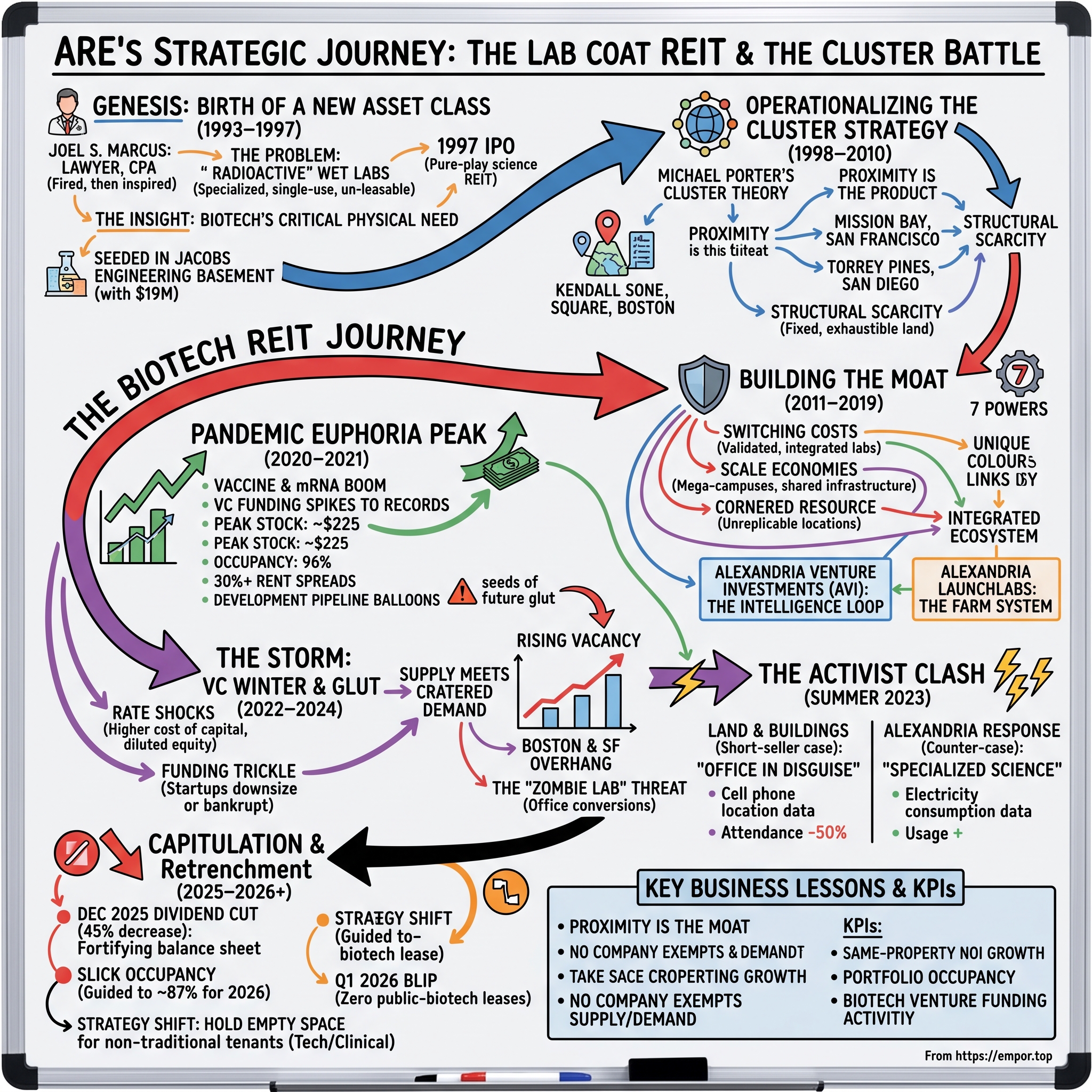
Alexandria Real Estate Equities: The Lab Coat REIT and the Battle for the Biotech Clusters
I. Introduction & Episode Roadmap
Walk the two-mile stretch between the Charles River and Massachusetts Avenue in Cambridge, Massachusetts, and you are walking through the densest concentration of scientific brainpower on the planet. MIT sits on one flank, Harvard a few subway stops away, Massachusetts General Hospital across the river. Along the way you pass the global headquarters or research hubs of a startling share of the drug industry, packed into a neighborhood — Kendall Square — that a generation ago was a half-abandoned district of parking lots, candy factories, and industrial slack. If you look closely at the buildings where the actual science happens, a surprising number carry the same landlord. That landlord is Alexandria Real Estate Equities, and the story of how a company most Americans have never heard of came to own the ground beneath the biotechnology revolution is one of the great, quiet empires of modern capitalism.
Alexandria (NYSE: ARE) is not a household name, and it likes it that way. It is a real estate investment trust — a REIT — but calling it a landlord is a little like calling Nvidia a chip company. Technically true, wildly incomplete. Over three decades, Alexandria took a category of building that banks refused to finance and treated as radioactive — the "wet lab," a specialized science facility that most developers viewed as an un-leasable, single-use liability — and turned it into one of the most premium, high-barrier asset classes in public markets. At its 2021 peak the company commanded an equity value north of $30 billion and a stock price approaching $225 a share.1 It had done something that sounds impossible in real estate, a business that is almost definitionally commoditized: it had built a moat.
Here is the central drama this story exists to test. A company founded in 1994 with just $19 million in seed capital, run out of a borrowed corner of an engineering firm's Pasadena office, methodically assembled a near-monopoly over the handful of geographic nodes where the world's elite biology actually gets done — Cambridge, South San Francisco, San Diego's Torrey Pines.[^2] It did this by understanding something almost no one else in real estate understood: that in science, physical proximity is not a nicety, it is the product. And then, in the 2020s, that fortress was hit by a dual storm. First, an activist short-seller marched onto CNBC waving cell-phone location data, declaring that Alexandria's buildings were half-empty and that "life science is just office space in disguise."2 Then, in December 2025, after twenty-nine consecutive years of paying and growing its dividend, the company slashed that dividend by 45% — an act of capitulation that would have been unthinkable to the investors who had treated Alexandria as a bond-like compounder.3
So which is it? Is Alexandria a durable, cornered-resource monopoly experiencing a cyclical air pocket — the kind of dislocation that patient capital prays for? Or is it a company whose central thesis, that specialized labs are structurally different from ordinary offices, is being quietly eroded by oversupply, a biotech funding winter, and the same work-patterns that hollowed out downtown towers? This is not a question with a comfortable answer, and anyone who tells you it is has picked a side. Our job is to hold both.
The arc runs like this. First, the invention — literally from scratch — of institutional-grade wet-lab real estate as a financeable asset class. Second, the operationalizing of a Harvard Business School idea, Michael Porter's cluster theory, into a concrete land-banking strategy. Third, the construction of a genuine moat through venture-capital integration and campus-scale economics — a moat we will stress-test against Hamilton Helmer's 7 Powers rather than take on faith. Fourth, the pandemic euphoria, the speculative overbuilding crash that followed, the activist clash, and the dividend cut that closes the modern chapter. Along the way we will keep a running argument with the company's own version of events, because Empor is not Alexandria's investor-relations department. When management says it will win, we will ask what evidence supports the claim and what would prove it wrong. Let us start where the whole thing started: in a basement, with a weird idea nobody wanted to fund.
 Subscribe on LinkedIn
II. The Genesis: Jacobs Engineering, the Garage Startup, and the Birth of a New Asset Class (1993–1997)
In 1993, the smart money in real estate was not thinking about laboratories. It was thinking about the things real estate people always think about: office towers, shopping malls, apartment blocks, the reliable geometry of square feet and lease terms. Laboratories were an afterthought, a nuisance category — buildings so specialized, so laden with strange plumbing and ventilation, that if the tenant ever left you were stuck with an expensive white elephant. No bank wanted to lend against them. The residual value, in the industry's judgment, was close to zero.
Into this indifference walked an unlikely figure. Joel S. Marcus was not a developer. He was a lawyer and a certified public accountant who had spent years in and around the biotechnology industry — doing the securities work, the licensing deals, the capital raises for the first generation of companies trying to turn recombinant DNA into medicine.4 Marcus understood something the real estate world did not: that the biotech revolution kicked off by Genentech and Amgen was not a fad, that it was going to need an enormous amount of a very particular kind of physical space, and that essentially no one knew how to build it or, more importantly, how to finance it. He had also, by his own telling, been fired from his previous job — a piece of professional wreckage that turned out to be the shove he needed.
Marcus found a partner in Jerry M. Sudarsky, a chemical engineer and veteran executive who had served as vice chairman of Jacobs Engineering Group, the large Pasadena-based engineering and construction firm.4 Sudarsky brought the operational credibility and the industry relationships; Marcus brought the financial architecture and a near-obsessive grasp of what biotech tenants actually needed. The seed capital was tiny by the standards of what the company would become: $19 million in Series A, with Jacobs itself putting in $5 million of it.[^2] There was no gleaming headquarters. The founding team worked out of a borrowed basement corner at Jacobs Engineering — a garage startup in all but name, except the garage was a subterranean nook in someone else's building. When Marcus recounts the origin, he leans into the improbability of it: a middle-aged lawyer with no real estate track record, betting a rounding-error of capital on the idea that scientists deserved purpose-built homes.
What Marcus brought was not construction expertise — he could hire that — but a rarer, more valuable form of pattern recognition. Having sat across the table from biotech executives during financings and licensing deals, he had watched brilliant scientific companies waste months and fortunes trying to shoehorn their operations into unsuitable buildings, or scrambling to find any landlord willing to take a chance on a business that might not exist in three years. He understood the industry's psychology: that a biotech CEO's scarcest resource is time, that every quarter spent fighting a building is a quarter not spent advancing a drug, and that a landlord who could hand a company a ready, correctly engineered lab was selling something far more valuable than square footage. He was, in a sense, a financier who had learned to think like his customers, and that empathy — the ability to see the building from the scientist's side of the glass — was the intangible asset that the $19 million could never have bought on its own. The early portfolio was assembled building by building, often by acquiring and re-tenanting existing lab properties rather than developing from scratch, a capital-efficient way to prove the model before betting on ground-up construction. It was unglamorous, deliberate work, and it established the operating muscle that would later let the company develop entire campuses.
To understand why this was a genuine invention and not just a niche, you have to understand what a wet lab actually is — because the whole investment case rests on the answer. A "wet lab" is a space where scientists work with liquids, chemicals, and biological materials: cell cultures, reagents, solvents, the physical stuff of experimental biology and chemistry. And it is a fundamentally different animal from an office. Think of an office as a box that needs light, power, and a bathroom down the hall. A wet lab is closer to a small industrial plant crossed with a hospital.
Consider the air. An office happily recirculates its air to save on heating and cooling. A wet lab cannot — the risk of spreading toxic or biological contamination is too high — so it demands single-pass, 100% outside-air ventilation, pulling fresh air in and exhausting it out, typically cycling the entire volume of a room something like six to twelve times an hour. That single requirement makes the HVAC system vastly larger, more energy-hungry, and more expensive than anything an office needs. Consider the floors. A lab has to bear the weight of heavy industrial equipment — centrifuges, electron microscopes, banks of ultra-low-temperature freezers — so its floors are engineered to carry roughly double the load of a normal office floor. Consider the power. Losing electricity in an office is an inconvenience; losing it in a lab can mean thawing a freezer that holds years of irreplaceable biological material, so labs demand redundant power, backup generators, and often on-site systems to neutralize chemical and acid waste before it ever reaches a drain.
Add it all up and the economics become brutal for the unprepared and beautiful for the specialist. Fitting out a wet lab — the "tenant improvements," in industry jargon — can cost several times what it costs to finish premium office space, running well into the hundreds of dollars per square foot. That enormous upfront cost is precisely why the asset class was so hard to finance in 1993, and precisely why, once financed and mastered, it became so hard for newcomers to enter. The very feature that scared the banks away was the moat in embryo.
Marcus's insight was that this specialized infrastructure, if built right and leased to the right tenants, could throw off the most predictable, long-duration cash flows in commercial real estate — because a company that has spent years and millions custom-fitting a lab, and has registered that physical facility with regulators, is not going anywhere. The proof came on May 27, 1997, when Alexandria went public on the New York Stock Exchange, raising roughly $155 million in a pure-play life-science REIT IPO.[^2] It was, in effect, Wall Street's first vote that scientific infrastructure could be a legitimate, institutional asset class rather than a developer's headache. The vote was tentative. The company was small, the concept unproven at scale, and skeptics abounded. But Marcus now had public currency and a mandate.
The choice of the REIT wrapper is worth pausing on, because it shapes everything that comes later in this story — including the dividend drama that closes it. A real estate investment trust is a special corporate structure created by Congress to let ordinary investors own income-producing property the way they own stocks. The bargain is simple and strict: a REIT pays essentially no corporate income tax, but in exchange it must distribute the overwhelming majority of its taxable income — at least 90% — to shareholders as dividends. That rule is why REITs are prized by income investors and why their dividends are treated as sacrosanct: the payout is not a discretionary gesture of a generous board, it is close to a structural obligation baked into the tax deal. It is also why a REIT cutting its dividend is a genuinely serious event, a signal that the underlying cash generation has deteriorated to the point where even the tax-advantaged distribution machine has to be throttled. Hold that thought; it will detonate in the 2020s. For now, the takeaway is that Marcus had chosen a structure that promised investors a steady, tax-efficient income stream — and that promise would become both the company's greatest asset in the eyes of the market and, decades later, the source of its most painful reckoning. The question in 1997 was where to point the new public currency — and the answer would come from an unexpected place: a business-school theory about why companies cluster.
III. The Cluster Strategy & Michael Porter's Theory in Action (1998–2010)
There is a moment in the life of every great strategy where a founder borrows an idea from one domain and drops it, whole, into another. For Joel Marcus, that idea came from Harvard Business School professor Michael Porter, whose work on economic clusters argued that industries thrive not when they are spread evenly across a map but when they concentrate — when suppliers, rivals, universities, specialized labor, and capital all crowd into the same small geography and feed off one another. Silicon Valley was the canonical example. Marcus looked at Porter's cluster theory and saw a real estate strategy hiding inside an economics lecture.
The reasoning was disarmingly physical. In biotechnology, the crucial inputs are not raw materials or cheap land; they are people and knowledge. The best scientists want to work near the best universities and the best hospitals. Venture capitalists want to fund companies they can drive to. A founder spinning a discovery out of an academic lab wants space within walking distance of the professors and grad students still doing the underlying research. All of this activity, Marcus realized, wanted to happen inside a radius of a mile or two — a cluster tight enough that a scientist could walk from a university bench to a startup's lab to a clinical collaborator's office in an afternoon. Innovation, in other words, has a geography, and that geography is finite.
If proximity is the product, then owning the ground at the center of a cluster is like owning the toll booth on a bridge everyone has to cross. And in the late 1990s and 2000s, that ground was still cheap, because no one else had connected Porter's abstraction to specific parcels of dirt. So Alexandria went shopping in the places that mattered most. In Greater Boston — the eventual crown jewel — it began methodically buying up Kendall Square and East Cambridge, the neighborhood pressed against MIT, later extending into the Seaport and out to Waltham. In the San Francisco Bay Area, it targeted Mission Bay, adjacent to the University of California, San Francisco, and the established biotech hub of South San Francisco. In San Diego, it concentrated on Torrey Pines and University Town Center, wrapped around UC San Diego and the cluster of research institutes on the mesa above La Jolla.
The genius of the land grab was that it exploited a structural scarcity that could never be undone. You can always build another office park on the outskirts of a city; office demand is diffuse. But you cannot manufacture another parcel adjacent to MIT, because MIT is where it is and the land around it is already spoken for. Once Alexandria assembled the primary parcels around Harvard, MIT, Stanford, UCSF, and UCSD, it held positions that a competitor could not replicate at any price, because the underlying supply was physically exhausted. This is the first-mover advantage in its purest form: not a head start that rivals can eventually erase, but a claim on a fixed resource that gets more valuable precisely because it cannot be expanded.
It helps to make the cluster idea concrete, because it is the intellectual heart of the whole enterprise. Picture a newly minted MIT professor who has spent years developing a novel way to target a cancer protein, and who now wants to build a company around it. Where does she go? She cannot decamp to a cheap industrial park two states away, because the graduate students she wants to hire are here, the venture capitalists who will fund her are a short walk down Main Street, the contract research organizations that will run her assays are around the corner, and the teaching hospital that will eventually run her clinical trials is across the river. Every one of her critical relationships has a physical address within a mile of her lab bench. Moving even a few miles out imposes real friction — a harder recruit, a longer drive to the investor meeting, one fewer chance encounter at the coffee shop where two scientists compare notes and a collaboration is born. Those chance encounters are not sentimental fluff; in innovation economics they are the actual mechanism by which knowledge diffuses and companies get built. Alexandria's bet was that it could own the coffee-shop-adjacent ground and charge a premium for it forever. And because each successful company that planted itself in the cluster made the cluster more attractive to the next one, the strategy had a self-reinforcing quality: talent drew talent, capital drew capital, and the gravitational pull of Kendall Square only intensified with each passing year.
This is also where the branding of the portfolio matters. Alexandria did not market individual buildings; over time it marketed "Megacampuses" — large, contiguous collections of buildings, amenities, and shared infrastructure that functioned as self-contained scientific villages. The logic was that a tenant was not just renting square footage but buying membership in an ecosystem, with the neighbors, the shared conference centers, and the on-campus amenities all part of the value proposition. A single lab building is a commodity; a campus that houses a tenant's collaborators, competitors, and potential acquirers is something a rival with an isolated building cannot easily match.
Then came the first real test of whether the strategy was as durable as it looked. In 2008, the global financial system nearly collapsed, and commercial real estate — drowning in the same leverage and speculative excess that sank the housing market — was among the hardest-hit sectors. Landlords with short leases, weak tenants, and heavy debt were wiped out. Alexandria, by contrast, had spent a decade doing the unglamorous work of locking in long leases — often stretching well over a decade — with investment-grade tenants: big pharmaceutical companies and established biotechs whose rent checks did not stop clearing because the credit markets froze. When a landlord's income is contracted for fifteen years with a multinational drugmaker, a two-year financial panic is survivable in a way it simply is not for a landlord dependent on rolling annual leases with fragile tenants.
It would be easy, and it would be exactly what Alexandria's investor materials want you to conclude, to read 2008 as pure vindication — proof that the model is bulletproof. The more honest reading is narrower. What 2008 proved was that Alexandria had insulated itself against a credit shock by pairing durable, specialized assets with durable, creditworthy tenants. It did not prove immunity to a demand shock — a world in which the tenants themselves stop needing space, or where too many rivals build the same specialized boxes at once. That test was still fifteen years away, and when it came it would probe a very different seam in the armor. But in 2010, with the crisis survived and the clusters locked up, Alexandria did not stop at owning the ground. It set out to build something harder to copy than a portfolio of buildings: an ecosystem.
IV. Building the Moat: The Shadow Pipeline & The 7 Powers (2011–2019)
Owning great real estate is a good business. Owning great real estate and knowing more about your tenants' futures than they know themselves is a different kind of business entirely. In the decade after the financial crisis, Alexandria set out to build the second thing, and in doing so it transcended the traditional, adversarial landlord-tenant relationship — the one where the landlord wants rent up and the tenant wants rent down and that is the whole of it. Alexandria wanted to become something closer to a member of its tenants' ecosystem, embedded deeply enough that leaving would feel like exile.
The sharpest instrument in that project was Alexandria Venture Investments, or AVI, the company's strategic venture-capital arm. On paper, a REIT running a venture fund sounds like a distraction — the kind of empire-building that value investors are trained to distrust. In practice, AVI became one of the most active early-stage life-science investors in the country, and its real value was never primarily financial. It was informational. By writing seed and Series A checks into hundreds of young biotech companies, Alexandria bought itself a proprietary, real-time window into which technologies were working, which companies were about to raise big rounds, and — crucially — which of them would soon need to dramatically expand their physical footprint.
Think about what that window is worth to a landlord. In the ordinary course, a landlord learns a tenant needs more space when the tenant calls and asks — by which point the tenant is also calling every competitor. Alexandria, sitting on the cap table of a promising startup, could see the space demand coming twelve to twenty-four months before it materialized in the market, and could position to capture it before anyone else even knew it existed. That is not a rent-collection business; that is a forward-looking prediction engine bolted onto a backward-looking lease book. It converts the fundamental weakness of real estate — that leases are static, lagging contracts — into something like an intelligence operation.
There is a governance question buried in AVI that a skeptical investor should not wave away, however, because it cuts against the tidy narrative. A REIT is supposed to be a relatively simple, income-producing property vehicle; bolting a venture-capital operation onto it introduces exactly the kind of complexity and portfolio opacity that activists elsewhere have attacked as "diworsification" — the destruction of value that occurs when a focused company wanders into adjacent businesses it does not fully understand. Venture investing is volatile and illiquid, its gains are lumpy and its losses can be sudden, and marking a portfolio of private biotech stakes involves genuine judgment that outside investors cannot easily audit. In the boom years, AVI's holdings generated substantial investment gains that flattered results; in the bust, those same holdings became a source of markdowns and volatility that had nothing to do with collecting rent. The strategic-intelligence rationale is real and probably worth the trouble. But an honest ledger records the cost: Alexandria is a more complicated company to analyze than a pure landlord, and complexity is where uncomfortable surprises like to hide. That tension — between the elegance of the intelligence loop and the messiness it adds to the financials — is one a discerning owner should keep permanently in view.
Feeding the same machine from the bottom was Alexandria LaunchLabs, a network of move-in-ready incubator spaces designed for the earliest-stage startups — companies too small and too raw to sign a conventional lab lease. LaunchLabs gave a two-person company with a promising molecule a bench, shared equipment, and an address inside the cluster, on flexible terms. And it functioned as a farm system: today's LaunchLabs tenant, if it succeeds, becomes tomorrow's Series A company needing a full floor, and then the day-after's commercial-stage company needing an entire building — all of it, ideally, inside an Alexandria campus. The company was, in effect, cultivating its own future demand.
Does all of this add up to a genuine moat, or is it a well-told story? The most rigorous way to interrogate that is Hamilton Helmer's 7 Powers framework, which asks not whether a company is currently winning but whether it possesses specific, durable barriers that let it earn excess returns competitors cannot compete away. Alexandria plausibly holds at least three.
The first is switching costs, and here they are unusually literal. When a biopharma company builds out a lab, it does not just move in furniture — it registers that physical facility with regulators, validates equipment, and ties years of ongoing clinical and manufacturing work to that specific address. Relocating a functioning wet lab is a logistical, legal, and financial ordeal that can jeopardize active trials and cost millions in transition and re-validation. A scientist cannot run a high-throughput screening robot or culture cells from a kitchen table, and a company cannot casually decamp mid-program. The tenant is bolted in, and the landlord knows it — which is the quiet source of Alexandria's historical pricing power at renewal.
The second is scale economies, expressed through the campus model. By clustering many buildings and hundreds of tenants onto a single mega-campus, Alexandria could spread the cost of capital-intensive shared infrastructure — centralized utility plants, nitrogen and specialty gas lines, high-capacity power, conference and amenity facilities — across a huge base, driving down the marginal cost of serving each additional tenant. A one-off lab building cannot amortize a central steam plant; a two-million-square-foot campus can.
The third, and the most important, is the cornered resource: the irreplaceable geographic positions established a decade earlier. This is the power that most resembles a true monopoly, because it rests on physical scarcity rather than on execution that a smart rival could eventually match. You cannot build another Kendall Square.
But 7 Powers is a discipline, not a cheerleading exercise, and intellectual honesty requires naming the limits of each power — which the storm of the 2020s would expose in sequence. Switching costs bind an existing tenant; they do nothing to conjure demand from a startup that has gone bankrupt or a pharma company that has decided it needs less space, not more. Scale economies lower cost but do not, by themselves, fill an empty building. And the cornered resource protects the value of your best parcels while offering little defense when competitors flood your market with cheaper, lower-quality supply. The moat was real. It was also narrower than the euphoria of the coming boom would suggest — and the euphoria was about to arrive all at once.
V. The Peak-Pandemic Euphoria & Stephen Richardson's Retirement (2020–2021)
In early 2020, a virus with a spike protein turned the entire planet into an audience for biotechnology. Overnight, an industry that most people thought about only when they filled a prescription became the thing standing between civilization and catastrophe. mRNA — a term that had lived in the specialist literature — became dinner-table conversation. And capital, sensing both a moral imperative and an epic profit opportunity, poured into the life sciences at a scale never seen before. Venture funding for biotech startups exploded to record highs. Every promising molecule could raise money; every raise needed lab space.
For Alexandria, this was the environment it had spent a quarter-century preparing for, arriving with the force of a tidal wave. Demand for wet-lab space in the elite clusters went vertical. And a strange thing happened to the competitive landscape: traditional office REITs, watching their downtown towers empty out as white-collar workers refused to return, began eyeing lab conversion as an escape hatch. If scientists needed space and office space was dying, why not turn one into the other? A wave of would-be lab developers — many with no idea what single-pass ventilation or 150-pound floor loads actually required — announced conversions of aging office buildings into what the industry would later dismiss as "zombie labs": structures that carried the label without the guts.
At the top of the frenzy, Alexandria's numbers looked like the vindication of the entire life's work. The stock reached an all-time high near $225 at the very end of 2021.1 Portfolio occupancy sat at a nearly flawless level in the high-96% range — the kind of figure that, in real estate, essentially means "everything that can be rented is rented." Rents on lease renewals were climbing at eye-watering spreads, in some cases more than 30% above the expiring rate, a direct readout of pricing power in a market where demand had outrun the fixed supply of quality space. And the development pipeline — the buildings Alexandria was constructing to meet all this demand — ballooned to a scale that assumed the boom would keep going.
That last assumption is where the seeds of the coming trouble were planted, and it is worth pausing on the mechanism rather than just the numbers. A development pipeline is a bet on the future. Every building started in 2021 would not deliver until 2023, 2024, or later — meaning Alexandria, along with a horde of new competitors, was committing enormous capital to supply that would hit the market years down the road, all of it underwritten on the belief that the pandemic-era demand curve was the new normal. In real estate, the most dangerous words are not "this time is different" but "this time will last." The industry was, in effect, pouring the foundations of its own future glut, and the cheap capital of the zero-interest-rate era made it painless to do so.
Amid the boom, a quieter transition was underway in the corner office. Alexandria had long run with a layered leadership structure — Marcus as the founding chairman and public face, supported by senior executives who managed operations and investment. Stephen Richardson, a longtime senior leader who had served as co-chief executive, stepped back from that role as the company moved into the 2020s, part of a succession that concentrated day-to-day executive authority in Peter Moglia, who took the reins as chief executive officer and chief investment officer. Moglia was not a charismatic founder-showman in the Marcus mold; he was an investment and operations professional, a longtime Alexandria insider who had risen through the company's real estate and investment ranks rather than parachuting in from outside. His dual title — chief executive and chief investment officer — was itself a statement of temperament: this was a leader defined by capital allocation and underwriting discipline, not by vision-casting. In calm markets that distinction hardly matters. In a downturn it matters enormously, because the questions that decide a capital-intensive company's fate are precisely the CIO's questions: which developments to pause, which assets to sell and at what price, how much dividend to sacrifice to protect the balance sheet. Handing the controls to an allocator rather than a promoter, just as the storm gathered, may prove to have been the most consequential organizational decision of the era — though it also meant the company would face its hardest test under a chief executive who had never before had to steer it through one. And weather was exactly what was coming. The interest-rate regime that had funded the entire boom was about to reverse, and the pipeline built for permanent euphoria would deliver into a market that had abruptly turned cold.
VI. The Storm: VC Winter, Oversupply, and the "Zombie Lab" Threat (2022–2024)
The turn, when it came, was violent. Starting in 2022, the Federal Reserve raised interest rates at the fastest pace in four decades, ending the era of free money that had inflated every risk asset from crypto to speculative biotech. For a capital-intensive business like Alexandria — one that funds multi-year construction projects and refinances debt continuously — a higher cost of capital is not a background nuisance; it is a direct tax on the entire growth model. Every new development had to clear a higher hurdle. Every maturing bond had to be rolled at a fatter coupon. The math that made sense at near-zero rates stopped making sense.
To see why rising rates hit Alexandria so directly, it helps to understand how a growth REIT actually funds itself. Because a REIT must pay out most of its income as dividends, it cannot simply retain earnings to fund the next round of construction the way a technology company hoards its cash. Instead it perpetually taps external capital — issuing bonds, selling shares, and forming joint ventures — to finance its development pipeline. In a zero-rate world, that was nearly costless: debt was cheap and the stock traded at a premium that made issuing equity attractive. When rates spiked, both taps tightened at once. Borrowing got dramatically more expensive, and the falling stock price meant that raising equity became dilutive and painful — selling ownership cheaply to fund projects whose returns no longer cleared the higher bar. A business model that depended on a steady inflow of inexpensive external capital suddenly found that capital scarce and dear. This is the mechanism the market fears in any capital-intensive REIT during a tightening cycle, and it is exactly why the dividend cut, when it came, was framed around internal funding: retaining cash was a way to reduce dependence on capital markets that had turned against the company.
But the rate shock was only the first blow, and not the deepest. The deeper wound was to demand. Early-stage biotechnology is a business that runs on a continuous drip of venture and public-market financing; young drug companies burn cash for years before they earn a dollar, and they depend absolutely on investors' willingness to keep funding the next stage. When rates rose and risk appetite collapsed, that drip slowed to a trickle. The biotech funding drought that followed was severe: startups that had raised eagerly in 2021 found the window slammed shut, and rather than expanding, many were forced to terminate programs, lay off staff, and in some cases file for bankruptcy. A tenant that is fighting for survival does not lease more lab space. It gives space back.
Now overlay the two problems and you have the defining dynamic of the era. On the supply side, the enormous wave of speculative lab construction launched during the 2020–2021 boom — Alexandria's own pipeline plus a crowd of opportunistic newcomers — began delivering all at once, precisely as demand cratered. Boston and San Francisco, the two markets that had run hottest, now faced a severe glut: millions of square feet of new lab space hitting a market where tenants were shrinking rather than growing. Basic supply and demand did the rest. Vacancy rose, and the spectacular double-digit rent spreads of the peak deflated. The market that had been a landlord's paradise became, in the span of about two years, a tenant's market.
This is the moment to name the competitors, because a war-game of Alexandria's position requires knowing who else is on the board. The most formidable institutional peer is BioMed Realty, the other large pure-play life-science landlord, owned since 2016 by the private-equity giant Blackstone — a rival with deep pockets and a patient owner willing to play a long game. Alongside it sit the diversified healthcare REITs Healthpeak Properties (which trades under the ticker DOC after its merger-era rebranding) and Ventas, both of which have pushed to expand their research-and-development real estate exposure, bringing scale and diversification Alexandria lacks. And then there is the diffuse threat that management spent a great deal of breath on: the "zombie lab" landlords — traditional office owners executing cheap, low-specification conversions.
Alexandria's argument about the zombies is genuinely persuasive and worth stating fairly: a converted office building that lacks the floor-loading to hold heavy equipment, the single-pass ventilation to safely exhaust fumes, and the power redundancy to protect frozen samples is not a real competitor for serious science — it is a building wearing a lab costume. On that narrow point, management is almost certainly right. But here is the uncomfortable second-order truth that the company's framing tends to skip: in a soft market, even fake supply does real damage. A desperate zombie landlord offering space at a steep discount does not need to win the elite tenant to hurt Alexandria; it only needs to distort the reference prices, drag down the market's average rent, and give every negotiating tenant a cheaper alternative to point at. Quality wins the top of the market. Oversupply, real or counterfeit, sets the price for everyone else. The moat protected the crown jewels. It did not stop the flood from rising around them — and just as the flood was cresting, a hurricane of a different kind made landfall.
VII. The Activist Clash: Cell Phones vs. Watts (Summer 2023)
In June 2023, into this already-anxious market walked one of the most theatrical figures in public-market real estate. Jonathan Litt is an activist short-seller — an investor who profits when a stock falls and who is willing to make a loud, public, evidence-laden case for why it should. Through his firm, Land & Buildings Investment Management, Litt had spent 2023 declaring war on office real estate broadly, arguing that the work-from-home era had permanently impaired a whole category of buildings. Now he trained that thesis on Alexandria, and he did it with a piece of ammunition that was clever, modern, and superficially devastating.
Litt's white paper carried the arresting title "The Work From Home Hurricane Has Hit Life Science Offices."5 Its core weapon was cell-phone mobility data, purchased from a location-analytics provider, tracking foot traffic at hundreds of Alexandria's properties. Land & Buildings compared attendance across Alexandria's coastal life-science spaces before the pandemic against the more recent period and reported a stunning conclusion: physical attendance had fallen by roughly 50%.6 The argument built from there. If the buildings were half-empty, then Alexandria's tenants were over-leased and would give back space as leases expired; the wave of new supply would make it worse; and the whole premium valuation rested on a fiction. Litt's punchline, delivered in interviews and on CNBC, was blunt: strip away the lab mystique and "life science is just office space in disguise."2 It was a genuinely dangerous claim, because it went straight at the load-bearing wall of the entire Alexandria thesis — the insistence that labs are categorically different from offices.
Alexandria's response, in July 2023, was one of the more creative pieces of investor combat in recent memory — and it turned Litt's own methodology against him. Rather than simply asserting that its buildings were full, the company argued that cell-phone location data was a fundamentally broken instrument for measuring a laboratory.7 The logic was physical and, once stated, hard to rebut. Scientific work cannot be done from a living room: you cannot operate a high-throughput screening robot, handle radioactive isotopes, or pipette live cell cultures over Zoom. More pointedly, the technicians doing that work frequently do not carry their phones onto the lab floor at all — phones are banned or impractical inside clean rooms, radiation-shielded areas, and chemically isolated environments, and they get left in lockers and offices. A metric built on tracking phones will systematically undercount exactly the workers who are most reliably, physically present. Litt, in Alexandria's telling, had measured the absence of phones and mistaken it for the absence of scientists.
Then came the counter-evidence, and it was the kind of thing that makes for great theater. Alexandria released electricity consumption data across its portfolio, arguing that power usage is a far truer proxy for lab activity than foot traffic — because labs run their energy-hungry equipment around the clock whether or not anyone is holding a phone. And the electricity data, the company said, showed consumption not falling but rising since 2019, consistent with intensifying, 24/7 laboratory operations rather than a work-from-home exodus.7 Cell phones versus watts. It was a debate about which sensor tells the truth, and Alexandria had picked the one that could not be left in a locker.
The very fact that Alexandria felt compelled to publish granular electricity data is itself worth dwelling on, because it reveals how the balance of power between companies and activists has shifted in the age of alternative data. A generation ago, a short-seller's thesis rested on reading filings and building spreadsheets; a company could rebut it with its own disclosures and let analysts arbitrate. Litt's innovation was to bring an entirely external, real-world sensor — anonymized phone movement — to bear on a question the company would rather have kept abstract. Alexandria's counter was to escalate the sensor war, deploying an even more intimate operational dataset that it would never normally reveal. The episode is a small preview of a broader future in which physical companies are surveilled by satellite imagery, foot-traffic feeds, credit-card panels, and utility records, and in which the contest between bulls and bears is increasingly a contest over whose data is less biased. On that narrow methodological battlefield, Alexandria had the better instrument. But the fact that a landlord had to open its electrical meters to defend its stock tells you how little benefit of the doubt the market was willing to extend.
Wall Street, on balance, sided with Alexandria on the specific question. Analysts broadly accepted that wet labs are not office buildings and that mobility data is a poor lens for them; the "office in disguise" framing did not stick as a description of the specialized core portfolio.8 But — and this is the part that matters for an independent reading — winning the methodological argument did not make the stock safe. Litt had lost the debate about phones while being directionally right about the macro. Demand was weakening, supply was flooding in, and the stock remained acutely vulnerable to sentiment regardless of how many watts Alexandria's freezers consumed. The activist had aimed at the wrong target and still, in a sense, drawn blood, because he had focused the market's attention on a genuine vulnerability. The debate proved the labs were occupied. It could not prove they would stay leased, or at what rent. And within two years, the company itself would deliver the most emphatic possible admission that the pressure was real.
VIII. The Capitulation: The 2025 Dividend Cut and 2026 Guidance Revisions
For a certain kind of income investor, a dividend is a promise, and a REIT that has raised its dividend for decades is a company whose promise you can build a retirement on. Alexandria had paid and grown its dividend for twenty-nine consecutive years — a streak that spanned the dot-com bust, the 2008 crisis, and the pandemic, and that had earned it a place in the portfolios of investors who treated it as a bond with upside.3 Which is why the announcement on December 3, 2025, landed with the force of a thunderclap. Alexandria's board cut the quarterly dividend from $1.32 to $0.72 per share — a reduction of $0.60, or 45%.3
The framing mattered as much as the number. Management did not describe the cut as a distress signal; it described it as a choice — a decision to "fortify its already strong balance sheet," enhance financial flexibility, and preserve liquidity.3 The arithmetic behind that language was concrete: slashing the payout would conserve roughly $410 million of cash per year, money the company could redirect to fund its development pipeline internally rather than raising it through high-cost debt or by selling stock at multi-year lows.3 In a world of expensive capital, retained cash is the cheapest capital there is. On its own terms, the logic is defensible, even prudent: preserving capital over pride is exactly what a rational allocator should do when external financing turns punitive.
But an independent reading cannot stop at management's terms, because the more important question is about credibility, and credibility is measured over time. For years, Alexandria had projected an image of near-absolute cash-flow resilience and uninterrupted dividend growth. The 45% cut is, in the plainest sense, a repudiation of that prior guidance — an admission that the earlier confidence was, at minimum, overstated. And the abruptness is its own data point. A company that reassures the market and then reverses hard has told you something not just about its business but about the reliability of its own forward statements. The cut may well have been the right financial move. That does not make the promises that preceded it any less broken, and a discerning investor logs both facts.
The operational guidance that accompanied the retrenchment filled in the picture, and it was sobering. Alexandria guided to year-end 2026 occupancy of roughly 87%, refining the range to the mid-to-high 86–88% band — a stark descent from the near-97% peak of the pandemic era.9 Every point of occupancy is income, and a ten-point drop from the top is an enormous swing in a business with high fixed costs. Alongside it, management laid out a strategy shift on dispositions — the sale of assets to raise cash. Rather than dumping vacant buildings into a weak transaction market at fire-sale prices, the company signaled it would in some cases hold empty space and try to lease it to non-traditional tenants — technology, clinical, and advanced-technology operators rather than the classic biotech tenant — accepting lower rental-rate growth in exchange for keeping the asset and finding organic demand. It reaffirmed a 2026 funds-from-operations midpoint around $6.40 per share while targeting roughly $2.9 billion of dispositions to fund the plan.9
A word on that metric, because REITs speak a slightly different financial language than ordinary companies and it is easy to be misled. Funds from operations, or FFO, is the REIT industry's preferred measure of earnings, and it exists because standard net income is distorted for property companies by depreciation. Under accounting rules, a building is treated as a wasting asset that loses value every year, generating a large non-cash depreciation charge that depresses reported net income — even though, in reality, well-located real estate often appreciates rather than decays. FFO adds that depreciation back to give a truer picture of the cash the properties actually throw off. So when management guides to roughly $6.40 of FFO per share against a newly reduced annual dividend of $2.88, the implied payout ratio drops from something uncomfortably tight to something far more comfortable — which is precisely the cushion the dividend cut was designed to create. The reassuring-sounding reaffirmation of FFO guidance, in other words, coexists with a portfolio whose occupancy and rents are visibly deteriorating; the FFO holds up in the near term partly because contractual rent escalators and the timing of lease expirations smooth the decline. An investor should read a stable FFO number in a falling-occupancy environment not as proof the business is fine, but as a reminder that reported earnings can lag the underlying operating reality by many quarters.
The live version of this story — the one that reveals the most — came on the first-quarter 2026 earnings call in late April, and it was striking for its candor. The company reported that occupancy had already slipped to 87.7%, and disclosed something that had never happened before in its history: it signed zero public-biotech leases in the quarter.10 Joel Marcus, still the company's guiding voice as executive chairman, did not spin it. He called it "a sense of what the environment is out there," explaining that with capital markets shut, an unfunded biotech "can't just go to the market and do a secondary offering just to extend your cash runway" without strong data or a clinical milestone.10 He framed it as likely "a one quarter blip" with recovery expected — but a blip that had never occurred in three decades is a strong word for it.
Two other threads from that call deserve weight. First, Marcus repeatedly pointed at Washington: instability in the leadership of the FDA and the NIH, and uncertainty over how drugs would be reviewed and how much federal research funding academic labs could count on, was suppressing tenant demand — an unusually direct acknowledgment that Alexandria's fortunes are now hostage to regulatory and political weather it cannot control.10 Second, when an analyst pressed on whether AI might reduce the need for physical labs, executive Jenna Schwalb was firm that the company was "really not seeing material changes from AI" on tenant demand, arguing that biology remains too complex for autonomous, in-silico discovery and that AI so far compresses timelines rather than replacing benches.10 That is a coherent answer — and also exactly the answer a landlord would want to be true, which is reason to hold it provisionally rather than accept it.
The sharpest moment was the skepticism from the analysts themselves. Morgan Stanley's Ronald Kamdem pushed on the obvious worry: 2027 carries a similar wall of lease expirations, so why wouldn't next year simply repeat this year's decline in same-property income? Management's answer amounted to "it's so early in the year and so much can change" — an honest reply, but not a reassuring one, and a reminder that the recovery timeline rests more on hope than on visible, contracted demand.10 Weighed together, the picture is of a management team with real strengths — three decades of strategic consistency, unmatched cluster assets, and a still-investment-grade balance sheet — but carrying a genuine trust deficit: slow to acknowledge the oversupply reality, prone to overpromising on resilience, and forced into an abrupt reversal after years of reassurance. Which brings us to what the whole saga teaches.
IX. Playbook & Business Lessons
Strip away the drama and Alexandria's history distills into a handful of durable lessons, each of which cuts in two directions — a strength and its shadow.
The first is that in innovation real estate, the moat is proximity, not property. Ordinary real estate competes on the quality of the building; Alexandria's best assets compete on the impossibility of being anywhere else. Owning the ground beside MIT or UCSF is a claim on a fixed, exhaustible resource — a geographic toll booth on human progress that no amount of competitor capital can replicate. That is the purest and most defensible thing the company owns. The shadow is that a toll booth only earns when traffic crosses the bridge; a cornered resource protects value but does not, by itself, generate demand.
The second lesson is the humbling one: even a genuine high-moat leader is not exempt from supply and demand. When capital is free, speculative developers will overbuild any attractive asset class, and no switching cost or cornered resource fully shields a company from a market-wide glut that drags down pricing for everyone. Alexandria's crown jewels held their value better than the zombie conversions — but "better than the worst supply" is not the same as immunity, and the 2020s proved that the moat protects the asset without protecting the market price. The lesson for investors is to distrust any narrative — including a beloved one — that claims a business has escaped the cycle. None has.
The third lesson is the most transferable to other businesses: the venture-intelligence loop is a genuinely elegant model. By fusing a venture-capital fund with a real estate portfolio, Alexandria converted a lagging, backward-looking lease business into a forward-looking prediction engine, seeing demand before the market did. It is a template other asset-heavy industries might envy. The caution is that an information edge is powerful in a growing market and nearly useless in a shrinking one — knowing which startup will need space next year is worthless if no startup is expanding at all. The intelligence loop amplifies an up-cycle and goes quiet in a down-cycle.
The fourth lesson is about temperament: preserve capital over pride. The dividend cut, however painful to loyal holders, was the choice of a management team willing to sacrifice a cherished streak and a prized "aristocrat" image to protect the balance sheet in a hostile financing environment. That is the correct instinct in a high-rate regime, where liquidity is survival and a vanity payout ratio is a luxury. The shadow, again, is credibility: the willingness to cut is admirable; the years of insisting a cut would never be necessary are not. Good capital allocation and honest guidance are different virtues, and Alexandria demonstrated the first partly at the expense of the second. These tensions set up the final question every investor must answer for themselves: from here, why does Alexandria win, and what would break the case?
X. Bull vs. Bear Case & Key KPIs
Let us war-game it honestly, holding the bull and the bear in the same hand.
The bull case begins with the quality of the income. A large share of Alexandria's rent — by the company's disclosure, roughly half of its annual rental revenue — comes from investment-grade or large-cap public biopharma tenants, the Eli Lillys and Bristol-Myers Squibbs and Takedas of the world, whose ability to pay does not evaporate in a biotech winter.11 Alexandria's relationships with such anchors run deep: it expanded a strategic relationship with Bristol Myers Squibb in San Diego in 2022, and the region has continued to attract big-pharma commitment, with Eli Lilly advancing a major San Diego research expansion in 2024.[^13]12 The leases themselves are long and structurally escalating — weighted-average terms for the top tenants stretching well beyond a decade, with contractual annual rent bumps of around 3% built into the vast majority of leases, which means the in-place portfolio grows its income mechanically even in a flat market.13 And the secular tailwind is real: an aging global population, the rise of oncology and gene therapies, and AI-accelerated drug discovery all point to more biology being done over time, not less.
The bear case is equally grounded, and it is mostly about supply and cost. The oversupply overhang in Boston, San Francisco, and San Diego is not a one-quarter problem; absorbing millions of square feet of excess lab space in a market with weak tenant demand takes years, which caps occupancy in the high-80s and keeps a lid on the rent spreads that once drove the story. Meanwhile, the high cost of capital makes the growth engine — funding developments through joint ventures, asset sales, and recycling — genuinely harder to run in a soft transaction market, and the dividend cut is the company's own admission of the strain. The activist's macro instinct, if not his methodology, has been partly borne out.
Run it through Porter's Five Forces and the picture sharpens. The threat of new entrants into the best clusters is low — that is the cornered resource at work. But the threat of substitutes has risen: zombie conversions and, at the margin, the possibility that some research shifts to cheaper geographies or that AI compresses lab needs. Buyer power — the tenants' — has swung sharply toward the tenant in an oversupplied market, the mirror image of the pandemic's landlord's paradise. Supplier power shows up as the cost of construction and capital. And competitive rivalry has intensified with a well-capitalized BioMed/Blackstone and the diversified healthcare REITs all fishing the same waters. The forces that were all pointing Alexandria's way in 2021 have rotated against it.
Through the 7 Powers lens revisited, the verdict is nuanced rather than triumphant. The cornered resource remains intact and is the strongest reason to believe in a recovery when demand returns. Switching costs still bind existing tenants but cannot manufacture new ones. Scale economies remain a genuine cost advantage but are, right now, being spread across empty space rather than paying tenants. The powers are real; they are simply less potent in a demand drought than they were in a demand flood — which is precisely the point a skeptical investor should hold onto.
The activist stress-test that a sharp long/short investor would press today has moved past cell phones. It would probe capital allocation and disclosure: was the pipeline over-built into the boom, and how quickly did management concede the oversupply reality? It would question whether holding vacant buildings for non-traditional tenants is a genuine strategy or a way to defer marking assets to a painful market. It would ask whether the reassurances that preceded the dividend cut reflected optimism or something closer to denial. These are not reasons to dismiss the company — the asset quality is real and the balance sheet is investment-grade — but they are the live questions, and management's credibility will be rebuilt or further eroded by how candidly it answers them over the next several quarters.
Which leaves the practical matter of what to actually watch. Amid the noise, three key performance indicators carry most of the signal for this company:
First, same-property net operating income growth — the change in income from the stabilized, already-owned portfolio. This is the cleanest readout of true pricing power, stripped of the distortions of new development and acquisitions. When it turns from negative back to positive, the pricing environment is genuinely healing.
Second, portfolio occupancy — the simplest and most honest gauge of supply and demand balance. The market has told us to watch for a durable recovery back toward the 90%+ threshold; stagnation in the high-80s would confirm the bear's oversupply thesis, while a climb would suggest absorption is finally winning.
Third, biotech venture-capital funding activity — the leading indicator that sits upstream of everything. Because startups lease space twelve to twenty-four months after they raise, the health of biotech funding today is a preview of Alexandria's physical demand tomorrow. It is the single best early-warning system for whether the drought is ending. Watch the funding, and you are watching the future occupancy before it arrives.
XI. Epilogue & Outro
Thirty years after Joel Marcus set up shop in a borrowed basement with $19 million and an idea nobody wanted to finance, the company he built stands as the physical infrastructure of an entire scientific revolution — and as a live experiment in whether even the finest moat can hold against a genuine turn in the cycle. Marcus, now the elder statesman presiding as executive chairman, has handed operational command to Peter Moglia, an investor's investor steering through the hardest environment the company has faced since its founding. The two men embody the tension in the story itself: the visionary who conjured an asset class from nothing, and the disciplined allocator now tasked with defending it through a storm the visionary's success helped create, by seeding the boom that became the glut.
What endures is the strange and durable truth that Marcus grasped before anyone else: that human progress in biology is not a cloud-based abstraction but a stubbornly physical thing, done by people who must be near one another, near the universities, near the hospitals, in specialized buildings on finite ground. That insight built a monopoly on proximity. It did not, and could not, repeal the laws of supply and demand, and the coming years will reveal which force is stronger — the scarcity of the ground Alexandria owns, or the abundance of the space the industry over-built. Either way, Alexandria remains the truest physical bellwether of the global life-science ecosystem. When the labs fill again, the world will know that biology's next boom has begun. And when they sit empty, no cell phone or watt-meter will be needed to tell us the winter is not yet over.
References
-
Alexandria Real Estate Equities - 15 Year Stock Price History | ARE — Macrotrends ↩↩
-
Litt: Remote Work is Affecting Life Sciences Valuations Too — GlobeSt, 2023-06-20 ↩↩
-
Alexandria Real Estate Equities, Inc. Declares Cash Dividend of $0.72 per Common Share for 4Q25, a Decrease of $0.60, or 45%, Compared to 3Q25 — PR Newswire, 2025-12-03 ↩↩↩↩↩
-
ALEXANDRIA REAL ESTATE EQUITIES INC - Form DEF 14A (Marcus and Sudarsky biographies) — SEC EDGAR ↩↩
-
Land & Buildings Releases White Paper Detailing Bear Case for Alexandria Real Estate Equities — Business Wire, 2023-06-13 ↩
-
Jonathan Litt Shorting Alexandria Real Estate Equities — Bisnow, 2023-06-13 ↩
-
Alexandria Refutes Jonathan Litt Cellphone Data Short Thesis With Utility Metrics — Bisnow, 2023-07-25 ↩↩
-
Jonathan Litt Shorts Alexandria Real Estate. Why It's A Poor Trade — Seeking Alpha, 2023 ↩
-
Alexandria reaffirms $6.40 2026 FFO midpoint while targeting $2.9B of dispositions amid 87% year-end occupancy outlook — Seeking Alpha, 2026 ↩↩
-
Earnings call transcript: Alexandria RE Q1 2026 — Investing.com, 2026-04-28 ↩↩↩↩↩
-
ALEXANDRIA REAL ESTATE EQUITIES, INC. - Form 10-K FY2025 — SEC EDGAR ↩
-
Eli Lilly Launches Gateway Labs Expansion in San Diego — CoStar, 2024-03-12 ↩
-
ALEXANDRIA REAL ESTATE EQUITIES, INC. - 2025 Investor Day Presentation, Form 8-K — SEC EDGAR ↩
 LinkedIn
 WhatsApp
 Reddit
 Hacker News
 Email
Email Kindle
 RSS Feed
 Spotify
 Apple Podcasts
 Amazon Music
 Audible
 YouTube