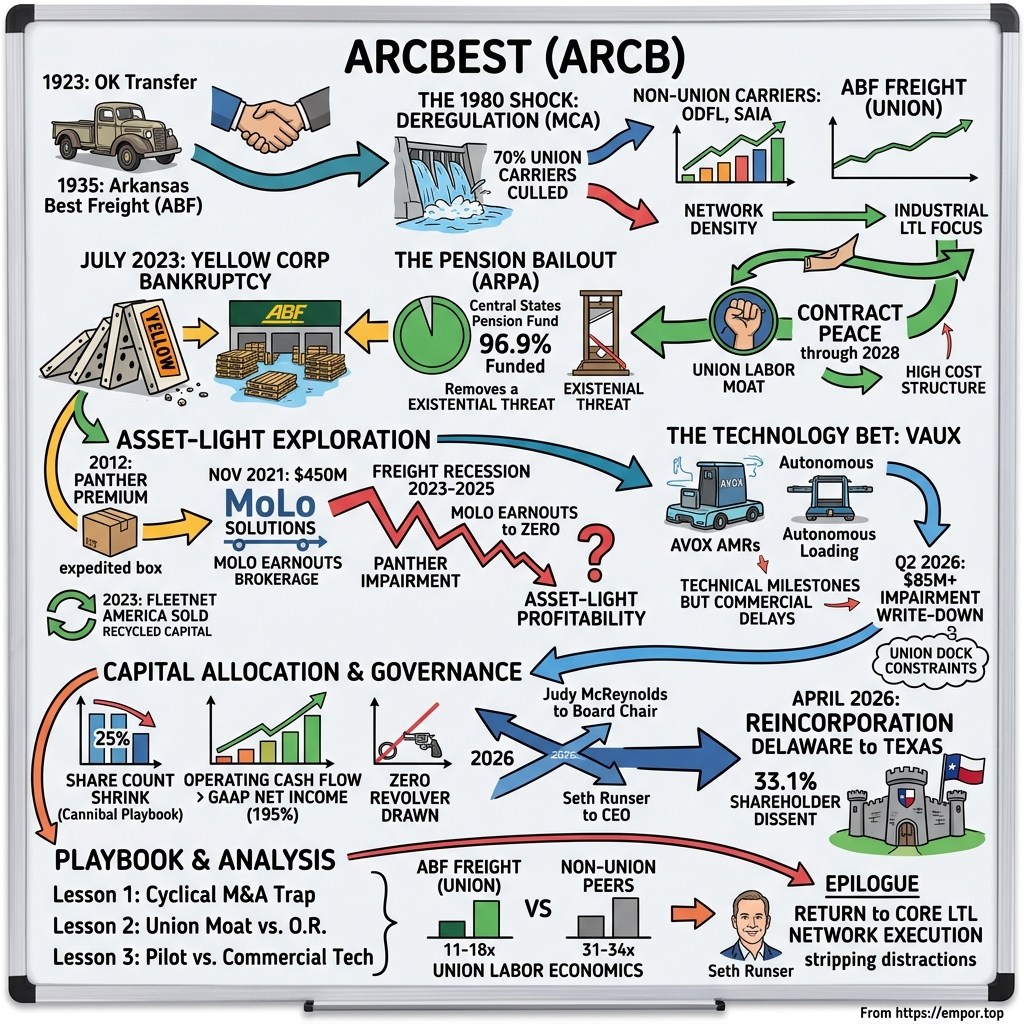
ArcBest: The Hundred-Year Trucker, the Union Moat, and the Asset-Light Trap
I. Introduction & Episode Roadmap (00:00 – 08:00)
In the summer of 2023, the gates of a century-old trucking company swung shut, and they did not open again. Yellow Corporation had been part of the American freight landscape for generations. It had absorbed Roadway, survived a government rescue loan during the pandemic, and kept moving pallets for tens of thousands of shippers. Then, in a matter of days, it stopped moving freight altogether and filed for bankruptcy in early August 2023, one of the largest collapses the trucking industry had ever seen.1 Shippers that had relied on Yellow for years woke up to find their freight had nowhere to go, and phones began ringing at every competing less-than-truckload carrier in the country.
One of those carriers was headquartered in Fort Smith, Arkansas. ABF Freight, the core operating company of ArcBest Corporation (NASDAQ: ARCB), had a peculiar status after Yellow's exit. It was now the last major national LTL carrier whose drivers and dockworkers were covered by a national contract with the International Brotherhood of Teamsters. Just weeks before Yellow went dark, ABF's Teamsters had ratified a new five-year agreement running through June 30, 2028.[^2]2 Yellow had spent its final months in a public war with the same union. ABF had signed a deal and kept the trucks rolling.
That contrast is the doorway into one of the stranger puzzles in American transportation. ArcBest generated about $4.0 billion of revenue in 2025.2 It owns and operates a national network of service centers that would be close to impossible to replicate from scratch today. Over the three years from 2023 to 2025, it converted roughly $430 million of net income into about $840 million of cash from operations, almost two dollars of cash for every dollar of reported profit.2 It has shrunk its share count by about a quarter since 2022.23 And yet the stock trades at a fraction of the earnings multiples awarded to its non-union LTL rivals, Old Dominion Freight Line and Saia.23
Is that discount a mistake the market will correct, or is it an accurate price for a business with a structural ceiling? This story argues it is mostly the latter, with important caveats. The investigation runs through five chapters.
First, the deregulation crucible of 1980, which killed most of ArcBest's unionized peers and explains why ABF survived. Second, the modern union bargain: a federal pension rescue that removed an existential threat, and a labor contract that locked in rising costs. Third, the asset-light pivot, especially the 2021 acquisition of truckload broker MoLo Solutions at the peak of a freight boom. Fourth, the technology gamble called Vaux, which ended in a large write-down in the second quarter of 2026. Fifth, capital allocation, CEO succession from Judy McReynolds to Seth Runser, and the contested 2026 move of ArcBest's legal home from Delaware to Texas.
Four questions anchor the analysis. Can ArcBest widen its unionized Asset-Based margins enough to close the valuation gap with non-union peers? Did the MoLo acquisition permanently impair the returns of the Asset-Light business? Will Vaux deliver real terminal productivity, or has it already proven to be an expensive write-off? And does the reincorporation to Texas signal a board building defenses against shareholder pressure?
The answers start with a law signed in the summer of 1980.
 Subscribe on LinkedIn
II. Surviving the 1980 Deregulation Crucible (08:00 – 24:00)
The day the rulebook disappeared
On July 1, 1980, President Jimmy Carter signed the Motor Carrier Act. For more than four decades before that, American trucking had operated like a regulated utility. The Interstate Commerce Commission decided which carriers could serve which routes and approved the rates they charged. A trucking license on a profitable lane was a valuable piece of paper, and incumbents were insulated from new competition. Labor costs could be high because rates could be set to cover them.
Deregulation tore that structure apart. Anyone with trucks and customers could now compete on any lane at any price. Non-union carriers, unburdened by national wage scales and rigid job classifications, could underprice the old guard and win freight. Over the following two decades, a long roll call of unionized carriers disappeared. Others merged into one another in a slow-motion consolidation that eventually produced Yellow, the company whose 2023 collapse opened this story.
ABF survived that cull. Understanding how is the first step to understanding what ArcBest is today and what it cannot easily become.
From horses to a freight system
The company's roots trace back to 1923 in Fort Smith, Arkansas, a river town on the Oklahoma border.4 What became Arkansas Best Freight grew through the regulated era into a regional and then national carrier, and the holding company that would become ArcBest eventually took its modern name in 2014.45 The founding details are mostly folklore at this point; what matters for investors is that ABF spent its formative decades as a regulated, unionized carrier, and then had to learn to compete in a world that punished exactly that profile.
How ABF stayed alive
Three choices separated ABF from the carriers that vanished.
The first was focus. ABF stayed in less-than-truckload freight, the business of carrying shipments too small to fill a trailer. A truckload carrier picks up a full trailer at point A and drives it to point B. An LTL carrier picks up a few pallets from dozens of shippers, brings them to a local terminal, consolidates them onto line-haul trailers, routes them through larger "breakbulk" hubs, and redistributes them for final delivery. It is the trucking equivalent of an airline hub-and-spoke system, and like airlines, it rewards density: the more freight flowing through the same terminals and lanes, the lower the cost per shipment. Truckload freight became a brutal commodity business after deregulation. LTL, with its network requirements, was much harder for a new entrant to replicate.
The second was the customer base. ABF built its book around industrial manufacturing, automotive, and retail distribution customers that needed reliable national coverage. Today that base remains highly diversified: in 2025, no single customer accounted for more than 3% of ArcBest's consolidated revenue, and the ten largest together represented about 14%.2 No customer can hold the company hostage, and no single loss can sink it.
The third was real estate. ABF owns or leases a national footprint of service centers. Those terminals, many located near urban industrial corridors, have become harder to replicate with every passing year of zoning restrictions and land inflation. When Yellow's terminals came up for sale after its bankruptcy, the bidding among surviving carriers demonstrated how scarce that kind of property had become.1
The inherited cost structure
Survival came with baggage. ArcBest employs roughly 15,000 people, and about 85% of the Asset-Based workforce is represented by the Teamsters.2 That means wages, benefits, job classifications, and work rules are set through national bargaining rather than terminal by terminal. A non-union rival can ask a driver to work the dock when trucks are idle, flex staffing quickly when volumes fall, and design its own productivity incentives. ABF has to negotiate those things.
The long-run numbers show what that means. Consolidated revenue roughly doubled from about $2.3 billion in 2013 to a peak of $5.3 billion in 2022, a decade-long revenue growth rate of about 4% a year from 2015 to 2025.562 Respectable, but hardly a compounder. Profits were far more volatile: operating income swung from about $19 million in 2013 to nearly $400 million at the 2022 peak, then fell back to about $90 million in 2025.562 That is the signature of a high-fixed-cost network. When freight floods in, incremental shipments are hugely profitable. When it ebbs, the costs stay.
So the verdict on this chapter is mixed. ABF's survival through deregulation is real evidence of operational competence: density, focus on the harder LTL product, and a network built over decades. But the same history also explains the ceiling. ABF entered the deregulated era carrying a cost structure its fastest-growing rivals never had to bear, and it still carries it. The most dramatic test of whether that structure could become an advantage instead came forty-three years later, when Yellow fell.
III. The Yellow Collapse and the Unionized LTL Moat (24:00 – 43:00)
Freight with nowhere to go
Picture an ABF dock in late July 2023. Yellow had stopped picking up freight. Its trucks were parked, its terminals were going quiet, and roughly 30,000 workers were losing their jobs.1 Shippers who had booked with Yellow were scrambling to reroute pallets, and that freight landed on whatever capacity was left. ABF absorbed a share of the displaced volume and used the moment to push through favorable pricing renewals into early 2024.2
For an investor, this looked like the scenario the bulls had been waiting for: a large, low-priced competitor removed from the market permanently, leaving fewer national LTL networks to share the freight. And in the background, a second, quieter threat to ABF had also just disappeared.
The guillotine that was removed
For roughly two decades, unionized trucking carried a hidden liability that rarely appeared in plain sight on balance sheets. ABF contributed to multiemployer pension plans, most importantly the Teamsters' Central States, Southeast and Southwest Areas Pension Fund. Under federal pension law, a company leaving an underfunded multiemployer plan owes a "withdrawal liability," its share of the plan's unfunded promises. Central States was deeply underfunded and was projected to run out of money. For ABF, that meant two terrible scenarios: if it ever tried to exit the union system, it would face a huge withdrawal bill; and if the fund collapsed, the surviving contributors would be left holding the bag.
Then Washington stepped in. Under the American Rescue Plan Act's Special Financial Assistance program, the Pension Benefit Guaranty Corporation approved about $35.8 billion for Central States in December 2022, the largest single award in the program.7 By January 1, 2024, the plan reported a funded status of 96.9%.2 A fund that had been heading toward insolvency was suddenly close to fully funded.
What this did for ArcBest is easy to overstate, so be precise. It did not reduce ABF's ongoing contributions; the company still paid about $76 million to multiemployer plans in 2025, roughly what it paid in 2023.2 What it removed was the tail risk: the possibility that a pension collapse could turn into a balance-sheet emergency. A sword that had hung over unionized LTL for twenty years was put back in its sheath. Taxpayers, not ArcBest's shareholders, paid for that.
The price of labor peace
The new labor contract delivered predictability with a bill attached. The ABF national agreement, ratified in July 2023, runs until June 30, 2028.[^2]2 It includes annual wage and benefit increases: in 2025, wage rates rose 2.4% in July and benefit rates rose 3.6% in August.2 The Teamsters, who had just watched Yellow disappear, celebrated the deal as historic.[^2]
The cost shows up clearly in the segment's numbers. Salaries, wages, and benefits consumed about 52.2% of Asset-Based revenue in 2025, up from about 50.5% in 2024.2 That is the single most important number in the ArcBest bear case. When more than half of every revenue dollar goes to labor, and labor costs are contractually escalating while freight volumes are soft, operating margins have very little room to breathe.
How LTL is priced, and why ArcBest is changing it
The other side of the margin equation is price. Historically, LTL freight has been priced per hundredweight, a hundred pounds, adjusted for distance, freight class, and a fuel surcharge tied to government diesel price indices.2 Think of it as charging by weight at the deli counter.
The problem is that modern freight increasingly fills space before it hits weight limits. E-commerce packaging, retail fixtures, and lightweight consumer goods make trailers "cube out" long before they "weigh out." A carrier pricing by weight is effectively undercharging for the scarce resource, trailer space. Beginning in the second half of 2025, ArcBest accelerated a shift toward density-based pricing, which charges according to how much space a shipment takes relative to its weight.2 Revenue per shipment should better reflect cost per shipment. Whether that translates into durably higher margins depends on whether competitors follow and whether shippers accept it without moving freight.
Myth vs. reality: did Yellow's death make ABF a tier-one carrier?
The myth, popular in 2023, was straightforward: with Yellow gone, the surviving union carrier would inherit both volume and pricing power, and its margins would converge toward the non-union leaders.
The record says otherwise. Consolidated operating income did recover from about $173 million in 2023 to about $244 million in 2024, but it then fell to about $90 million in 2025, an operating margin of roughly 2%.2 Revenue fell about 4% in both 2024 and 2025.2 Whatever pricing power Yellow's exit created was not enough to offset a soft industrial economy and escalating labor costs. Meanwhile, the non-union leaders continued to command multiples in the low-to-mid 30s times earnings.23
The mechanism matters. When volumes softened, non-union carriers could flex labor costs down faster and redeploy workers across roles. ABF, bound by seniority rules, job classifications, and scheduled wage increases, had fewer levers. Yellow's exit improved ABF's competitive position; it did not change ABF's cost structure.
The verdict: the claim that Yellow's collapse would structurally lift ABF to tier-one margins is rejected by the 2024–2025 record. A narrower claim survives: post-Yellow industry capacity is tighter, and ABF has a better chance of pricing discipline in the next upturn than it had before. The evidence that would confirm it is an Asset-Based operating ratio, operating costs as a share of revenue, sustained below 88% in the next freight recovery. Until then, the pension rescue fixed ArcBest's balance-sheet risk but not its income statement, which is exactly why management went looking for growth outside the union boundary.
IV. The $400M MoLo Gamble: Chasing Asset-Light at the Peak (43:00 – 1:01:00)
A deal born in a freight frenzy
Rewind to the autumn of 2021. Ports on the West Coast were jammed with container ships waiting at anchor. Truckload spot rates had soared to records. Digital freight brokers were raising enormous venture rounds at valuations that treated them like software companies. Any logistics business with access to trucks looked like a money machine.
On September 29, 2021, ArcBest announced it would acquire MoLo Solutions, a fast-growing Chicago-based truckload brokerage, for $235 million in cash at closing plus up to $215 million in additional earnout payments if MoLo hit future profit targets, a potential total of about $450 million.[^9] The deal closed later that year. Management pitched it as a way to accelerate growth and expand ArcBest's position as a top logistics provider.[^9]
Why Judy McReynolds wanted to go asset-light
The strategic logic was not crazy. Judy McReynolds, who became CEO in 2010 after rising through the company's finance organization, had spent years trying to make ArcBest less dependent on the capital-intensive, union-bound ABF network.8 Brokerage requires no trucks: the broker finds a shipper, finds a carrier, and keeps the spread between what the shipper pays and what the carrier is paid. The pitch was threefold: lower capital intensity, the ability to sell truckload capacity to the same customers who used ABF for LTL, and a growth engine unconstrained by union contracts.
ArcBest had been building toward this for a decade. It bought Panther Expedited Services in 2012, adding a premium expedited freight business for time-critical shipments.5 It also built FleetNet America, a roadside and fleet maintenance network. MoLo was meant to provide the scale that the earlier pieces lacked.
Buying at the top
The timing was the problem. MoLo's earnings at the time of the deal were inflated by a once-in-a-generation supply chain crunch. When the freight cycle turned in 2023, truckload rates fell sharply, capacity flooded back, and brokerage margins compressed. Brokers that had looked like growth companies were revealed to be what they had always been: intermediaries taking a thin spread in a fragmented market.
The cleanest evidence of how badly MoLo missed its targets is in ArcBest's own accounting. The earnout was recorded as a liability at its estimated fair value. As MoLo failed to hit its profit thresholds, ArcBest kept reducing that liability, booking about $19 million of reductions in 2023, about $90 million in 2024, and nearly $3 million more in 2025, until the remaining obligation reached zero.2
Those reductions flowed through the income statement as gains. Read carefully, that matters: some of ArcBest's reported 2024 profit came not from moving freight but from admitting that an acquired business would never earn enough to trigger its bonus payments. Investors who looked only at 2024 net income of $174 million were seeing a number flattered by a write-down of a liability.2
The silver lining in the structure
There is a fair counterpoint. Because roughly half the potential purchase price was contingent, ArcBest never paid most of it. A deal that could have cost about $450 million ended up costing closer to the upfront $235 million.[^9]2 Earnouts exist precisely to shift risk back to sellers, and here the mechanism worked as designed. Management deserves credit for the structure, if not for the timing.
ArcBest also recycled capital elsewhere. In February 2023, it sold FleetNet America for about $101 million of net cash proceeds, booking a pre-tax gain of about $70 million.2 That gain made up a meaningful slice of 2023 net income, which is another reason that year's headline profit overstates the underlying operating business.
The Panther coda
The expedited business has fared no better. In the second quarter of 2026, ArcBest wrote off the full remaining carrying value of the Panther trade name, about $25.7 million, as expedited volumes stagnated.3 When a company writes a brand name down to zero, it is acknowledging that the name no longer supports the cash flows once assumed. A business bought in 2012 to diversify ArcBest's earnings has become one of the impairments of 2026.
There was also a legal cleanup. In the fourth quarter of 2024, ArcBest settled a $9.8 million lawsuit over employee misclassification under federal wage law in its Asset-Light business, paid in January 2025.2 Not large, but a reminder that the asset-light model carries its own labor and operating risks.
The verdict on MoLo
Did MoLo permanently impair Asset-Light returns? The history narrows the answer. The cash damage was capped by the earnout structure; the strategic damage is harder to quantify but real. Brokerage is an industry where operating margins are thin because purchased transportation typically consumes the large majority of gross revenue, and where scale players like C.H. Robinson set the competitive bar. ArcBest has not shown that owning an LTL network gives its brokerage a durable cross-selling advantage that shows up in margins.
The settling figure is simple: an Asset-Light operating margin sustained above 4% without further goodwill or intangible impairments. Until that appears, the segment is best understood as a low-margin pass-through business that diversifies revenue but dilutes returns. Management's next big bet to break out of that trap was not a brokerage at all. It was a robot.
V. The Vaux Innovation Trap: Hardware Bets on Union Docks (1:01:00 – 1:18:00)
Five minutes to empty a trailer
In March 2023, ArcBest unveiled something that did not look like it came from a trucking company. It was called Vaux, a freight movement system built around mobile robots and a movable loading platform designed to load or unload a full trailer in minutes rather than the better part of an hour.[^11] Alongside the hardware came Vaux Smart Space software for planning and visualizing freight on a dock floor.[^11] The demonstrations were impressive. The vision was bold: ArcBest would not just use technology, it would sell it, turning an engineering division into a new revenue stream.
To understand why this mattered, think about a cross-dock. Freight arrives on one trailer, gets broken down, sorted, and reloaded onto another. Every minute a trailer sits at a door is a minute of labor and a minute of capacity tied up. A system that could dramatically compress that time could, in theory, change the economics of a terminal network.
The spending
ArcBest backed the vision with real money. Innovative technology research and development expense was about $52 million in 2023, falling to about $34 million in 2024 and $29 million in 2025, alongside more than $40 million of capitalized internal software over those three years.2 For a company earning about $90 million of operating income in 2025, these are not rounding errors.
The declining R&D spend tells its own story: management was pulling back as commercial traction failed to materialize. But declining spend is not the same as success.
When milestones failed to become cash
The claim behind Vaux was that it would transform dock productivity and create an external, higher-margin licensing business. The record falsifies the second half of that claim and leaves the first unproven.
In the second quarter of 2026, ArcBest recorded total impairment charges of about $85.3 million, of which about $50.8 million related to Vaux hardware assets.3 That followed earlier write-downs of Vaux-related assets in 2025.2 Writing down hardware means management concluded the equipment would not generate enough future cash flow to justify its carrying value. Combined with the Panther trade name, the charges turned a growing first half into an operating loss of about $17 million and a net loss of about $15 million, or a loss of $0.67 per diluted share, even as revenue rose to about $2.18 billion from about $1.99 billion a year earlier.3
Vaux was not the only technology bet that failed. ArcBest had invested in Phantom Auto, a startup developing remote vehicle operation software. When Phantom Auto shut down, ArcBest wrote off its entire investment of about $28.7 million in 2024.2
The pattern across these bets is consistent: a technical milestone or an exciting demonstration, followed by the hard reality that converting engineering into a revenue-generating product is a different discipline. ArcBest's conversion rate on its technology ventures has so far been poor.
The union dock problem
There is a second constraint that a non-union competitor would not face. Deploying autonomous equipment on docks staffed by Teamsters is a labor relations question as much as an engineering one. National freight contracts typically address technological change and the preservation of bargaining-unit work, and any meaningful automation across ABF's breakbulks requires negotiation rather than unilateral decisions. A non-union carrier can pilot, iterate, and roll out a new dock system at its own pace. ABF cannot.
That does not mean automation is impossible in a union environment. It means the payoff is slower and subject to more friction, which matters a great deal when the technology is unproven and capital is finite.
The verdict on Vaux
Will Vaux deliver real terminal productivity or prove an expensive write-off? On the external commercialization case, the write-off has already happened. On the internal productivity case, the claim survives only in narrowed form and remains unproven. ArcBest has not published terminal-level productivity metrics demonstrating a large improvement from Vaux deployments. The evidence that would revive the thesis would be documented dock productivity gains in the double digits across commercial terminals, or meaningful licensing revenue from external customers. Absent either, Vaux belongs in the same ledger as MoLo and Phantom Auto: ambitious capital deployments that the company has had to mark down.
That ledger raises an obvious question about the people allocating capital, and about the governance framework they chose for themselves in 2026.
VI. Capital Allocation & The Great Trek to Texas (1:18:00 – 1:35:00)
The vote
On April 24, 2026, ArcBest's shareholders gathered for the annual meeting. Most of the agenda was routine. Say-on-pay passed with about 97.7% support, a strong endorsement of how executives were paid.9 Then came Proposal IV: converting ArcBest from a Delaware corporation into a Texas corporation.
It passed, with about 13.9 million votes in favor. But about 6.9 million votes were cast against, roughly a third of votes cast.9 For a management proposal at a company with no controlling shareholder, that is a striking level of dissent. Large institutions rarely vote against management on structural matters without a reason. The conversion took effect in May 2026.3
To understand why investors might object, and why management might want the change, it helps to look first at the part of ArcBest's capital story that has gone well.
The cash machine
ArcBest's balance sheet is unusually clean for a trucking company. At the end of 2025, its only funded debt was about $224 million of equipment notes at a weighted average rate of about 5%, secured by revenue equipment.2 The $250 million revolving credit facility, extended in November 2025 to 2030, was undrawn, and so was the accounts receivable securitization program.2 With about $124 million of cash and short-term investments, net funded debt was about $100 million, and total liquidity exceeded $400 million.2
Equipment notes are a conservative form of leverage. Each loan is tied to a specific tractor or trailer that earns revenue, the maturities are staggered, and there is no single large refinancing wall. Contrast that with carriers that relied on large term loans or high-yield bonds; Yellow's own debt burden was a key part of why it could not survive a labor dispute.1
The cash conversion story reinforces the point. Over 2023 to 2025, ArcBest produced about $837 million of operating cash flow against about $430 million of net income.2 The gap is mostly depreciation, about $500 million over the three years, a non-cash charge reflecting the wearing down of trucks and trailers.2 That cash is not free: ArcBest spends most of it replacing equipment. Gross capital expenditures, including equipment financed with notes, ran from about $230 million to about $300 million a year over the period.2 But the business generates enough to both maintain the fleet and return capital.
Receivables tell the same disciplined story. Days sales outstanding were about 34 days at the end of 2025, and bad debt provisions ran well under a tenth of a percent of revenue.2 Customers pay, and they pay quickly.
The cannibal
Where did the excess cash go? Mostly back to shareholders. ArcBest repurchased about $92 million of stock in 2023, about $75 million in 2024, and about $76 million in 2025.2 The share count fell from about 29.8 million in 2022 to about 22.4 million by mid-2026, a reduction of roughly a quarter.23 In September 2025, the board raised the repurchase authorization to $125 million.2 The quarterly dividend has stayed at $0.12 per share.2
This is genuinely shareholder-friendly behavior, and it has partly offset the earnings decline on a per-share basis. But it should not be called disciplined capital allocation without the other half of the ledger. The same management team that bought back stock also bought MoLo at the peak, funded Vaux, and invested in Phantom Auto. Cumulatively, those decisions produced write-downs and earnout reversals in the hundreds of millions. The buybacks look like a cleanup operation as much as a strategy.
The succession
On January 1, 2026, Judy McReynolds moved to the role of board chair after sixteen years as CEO, and Seth Runser became President and CEO.[^13]8 Runser came up through the operating side and had led ABF Freight, the union LTL business that generates most of ArcBest's profit.[^13] His appointment signaled, at least symbolically, a shift in emphasis from diversification and technology back toward core network execution.
McReynolds' compensation has tracked results. Her total pay fell from about $6.3 million in 2023 to about $3.5 million in 2025, with no annual incentive plan payout in 2025 when operating profit targets were missed.8 Runser's compensation in 2025 was about $1.2 million, reflecting his role before the promotion.8 Pay-for-performance appears to function as designed. Insider ownership, however, is small: all directors and executives together owned less than 2% of the shares, and Runser held about 10,700 shares.8 Leadership does not have much personal capital at stake.
Related-party activity is negligible: the only disclosed transaction was the employment of the CFO's brother in the technology unit at about $160,000 in 2025 pay.8 The board is 90% independent.8 Another quiet change: Ernst & Young, ArcBest's auditor for more than five decades, was replaced by Grant Thornton for 2025, with no disagreements reported.2 A routine rotation after half a century, but a change worth noting in a year of large impairments.
Why Texas?
Management's formal rationale for reincorporation is laid out in the proxy.8 The analytical question is what the move changes for shareholders. Texas has spent recent years positioning itself as an alternative to Delaware, building a specialized business court and amending its corporate code in ways generally viewed as more favorable to boards, including provisions that can make shareholder lawsuits harder to bring. For a company that just took large write-downs and has a record of capital deployments that did not pay off, those features are the kind that make institutional investors wary.
ArcBest's largest holders are index and institutional funds: BlackRock with about 15%, Vanguard with nearly 12%, and AllianceBernstein with about 7%.8 The company does not reveal how each voted. What can be said is that roughly a third of votes cast opposed the move, a rare level of dissent for a company with no controlling shareholder.9
The activist stress test writes itself. A skeptical investor would point to the gap between the segments' economics, the record of write-downs, and the valuation discount, and ask whether Asset-Light should be separated or sold. They would ask whether the R&D budget should be cut further. And they would ask whether moving to Texas makes those questions harder to press. The counterweight is real: an independent board, pay that fell with profits, and a clean balance sheet are not the hallmarks of an entrenched management. The verdict: the Texas move is not proof of a fortress mentality, but it removes some shareholder protections at a moment when the record arguably calls for more accountability, not less. The settling evidence would be anti-takeover bylaws, board structure changes, or severance arrangements adopted under Texas law that Delaware practice would have constrained.
Those governance questions sharpen the larger lessons of ArcBest's past five years.
VII. Playbook: Business & Investing Lessons (1:35:00 – 1:48:00)
Lesson 1: "Never buy a broker at the top of a port jam."
In September 2021, container ships idled offshore and truckload rates set records, and ArcBest agreed to buy MoLo for up to $450 million. Within three years, the earnout had evaporated to zero. The lesson reaches far beyond trucking: when an intermediary's margins are inflated by a temporary shortage, the shortage is the asset you are really buying, and shortages end. ArcBest's earnout protected its cash, but no contract can recover the management attention and strategic years spent chasing a cycle. Cyclical earnings are a loan from the future, and the bill always arrives.
Lesson 2: "A bailout can save the pension, but it cannot fix the operating ratio."
The $35.8 billion rescue of Central States removed the scenario that had kept unionized trucking executives awake for two decades. And yet ABF's labor cost share rose the year after the rescue, and its margins fell. Balance-sheet risk and operating economics are different problems. Investors often celebrate when a tail risk is eliminated and assume the business itself has improved. At ArcBest, the threat of catastrophe disappeared while the cost of normal operations kept rising. Removing a downside is not the same as creating an upside.
Lesson 3: "A robot on a stage is not a robot on a dock."
The Vaux demonstrations were real engineering. The $50.8 million write-down in the second quarter of 2026 was real accounting. In between lay everything that separates an invention from a business: customers willing to pay, deployment costs that pencil out, and in ABF's case, a labor agreement that turns every automation step into a negotiation. Founders and investors alike should measure innovation programs by revenue and unit cost improvements, not demonstrations and press releases. At ArcBest, the record across Vaux, Phantom Auto, and Panther suggests the company is far better at running trucks than at commercializing new ventures.
Lesson 4: "Equipment notes don't panic."
In the first half of 2026, ArcBest reported a net loss. It was also undrawn on its revolver, buying back stock, and generating cash. That paradox is explained by the balance sheet: debt tied to revenue-producing trucks, staggered maturities, and no capital-markets wall. Yellow died partly because its financing gave it no room to absorb a shock. ArcBest's financing gives it room to absorb its own mistakes. In cyclical industries, the structure of the debt matters as much as its size.
VIII. Analysis & Bear vs. Bull Case (1:48:00 – 2:05:00)
Two trucks, two rulebooks
Imagine an industrial shipper's loading area in Cleveland. An Old Dominion trailer and an ABF trailer sit at adjacent dock doors. Both carriers offer national coverage. Both promise two- and three-day service across much of the country. The shipper's pallets look identical going onto either trailer. But behind each truck sits a very different organization. One can redeploy a driver to work the dock on a slow afternoon, adjust headcount freely, and reward productivity however it chooses. The other operates under a national labor agreement that sets wage increases, defines job classifications, and governs how work is allocated. That difference, more than any other, explains why the market values these two companies so differently.
What the market is pricing
As of early October 2026, ArcBest's shares traded around $133, implying a market value of about $2.9 billion and an enterprise value only modestly higher once net funded debt is added.3 The trailing earnings multiple is distorted by the 2026 impairments. On 2025 earnings of about $2.62 per share, the stock trades at roughly 50 times; on 2024 earnings of about $7.30, about 18 times; on peak 2022 earnings of about $11.69, about 11 times.26 Old Dominion and Saia trade in the low 30s times trailing earnings.23
What does the price appear to assume? Not a return to peak earnings, which would make the stock look cheap. Not a permanent stay at 2025 earnings, which would make it look expensive. Roughly, the market appears to assume a mid-cycle recovery to something like 2024 levels, with no expectation that ABF closes the gap with non-union peers. That seems consistent with the evidence.
Hamilton Helmer's 7 Powers
Scale and network economies. This is ArcBest's real power. An LTL network's cost per shipment falls as density rises, and a national terminal footprint built over decades cannot be cheaply recreated. Yellow's collapse removed one of the few comparable networks. This power is genuine, but it is shared with Old Dominion, Saia, XPO, FedEx Freight, and others, so it protects ArcBest against new entrants more than against existing rivals.
Cornered resource. The terminal real estate comes close to qualifying, given zoning constraints in industrial corridors. But rivals bought Yellow's terminals too, so the resource is scarce rather than exclusive.
Process power. Here ArcBest is at a disadvantage. The best LTL carriers' advantage lies in embedded operating cultures, cross-trained workforces, and relentless service quality. Union job classifications constrain ABF's ability to build the same kind of flexible process.
Counter-positioning. Absent. Asset-Light brokerage competes head-to-head with larger brokers and does not offer a model incumbents cannot copy.
Switching costs and brand. Modest. Shippers run annual bids and can move freight between carriers. Service quality creates stickiness, but not lock-in.
Porter's 5 Forces
Buyer power is moderate to low because customers are fragmented: the top ten represent about 14% of revenue.2 But fragmented buyers still shop. Annual rate negotiations and bids keep pricing honest.
Supplier power is high on the labor side. The Teamsters set the dominant cost line through national bargaining, and the next contract negotiation looms for 2028.2 On the Asset-Light side, thousands of independent carriers mean no single supplier matters.2
Threat of new entrants is low in national LTL because of the terminal network requirement, but high in brokerage, where barriers are minimal.
Threat of substitutes is limited for time-sensitive palletized freight; rail intermodal competes mainly for long-haul, lower-value loads.
Rivalry is intense but disciplined among the national LTL leaders, with pricing behavior improving after Yellow's exit. In brokerage, rivalry is fierce and price-driven.
The net assessment: ArcBest owns a real but shared moat in its LTL network and a weak competitive position in brokerage, with its biggest structural handicap sitting in its supplier relationship with labor.
The bear case
The labor squeeze. With labor consuming more than half of Asset-Based revenue and contractual increases locked in until mid-2028, a prolonged industrial slowdown leaves little room for margin recovery. The 2025 numbers show what happens when revenue falls while wages rise.
Asset-Light dilution. The segment has not demonstrated it can earn attractive returns through a cycle. Each impairment and earnout reversal reinforces the view that it is a low-margin appendage rather than a growth engine.
Capital deployment record. MoLo, Vaux, Phantom Auto, and Panther together represent a pattern, not an accident. A skeptic would argue that the buybacks partly compensate for capital that was misallocated elsewhere.
Governance drift. The Texas move, approved over substantial dissent, may make shareholder challenges harder just as the record invites them. Low insider ownership means management bears little personal cost from that drift.
The bull case
Irreplaceable infrastructure. Post-Yellow, national LTL capacity is tighter, and new networks are not being built. Density pricing gives ABF a tool to charge for the space freight actually consumes.
The pension risk is gone. The worst-case scenario that historically justified a deep discount on unionized carriers no longer applies.
Per-share compounding. A business that generates strong operating cash flow, keeps leverage modest, and retires shares steadily can grow per-share value even if total earnings merely recover. If earnings normalize toward the mid-cycle levels seen in 2024, today's share count magnifies that recovery.
New leadership focus. Runser's background running ABF suggests a stronger emphasis on terminal density and line-haul efficiency over diversification. That is a hypothesis, not yet a result.
The verdict
ArcBest is a durable, cash-generative industrial franchise with a genuine network advantage and an unusually conservative balance sheet. It is also a company whose margin ceiling is set by labor economics it does not fully control, and whose attempts to escape that ceiling have mostly produced write-downs. The valuation gap with non-union peers reflects real differences in operating flexibility rather than a simple market error. The bull case is not that ArcBest becomes Old Dominion; it is that a disciplined, refocused ABF earns better mid-cycle returns than the market currently expects. That case is plausible but unproven.
The three KPIs that matter
- Asset-Based operating ratio, excluding impairments. The single best measure of whether union LTL can earn its keep. The labor cost share rose to about 52% of segment revenue in 2025, pushing margins down; the test is a sustained ratio below 90% in normal conditions and toward the high 80s in a recovery.2
- Asset-Light operating margin. Currently marginal and burdened by impairments; the test is a sustained margin above 4% with no further write-downs.23
- Diluted share count and free cash flow per share. The share count has fallen from about 29.8 million in 2022 to about 22.4 million in mid-2026; the test is continued reduction without rising net debt.23
IX. Epilogue (2:05:00 – 2:12:00)
Where ArcBest stands tonight
ArcBest enters the fourth quarter of 2026 lighter in more ways than one. FleetNet is gone. The MoLo earnout is zero. Vaux hardware and the Panther brand have been written down. The first half of the year produced a net loss on paper, while revenue grew and the balance sheet held firm.3 Under Seth Runser, the company is, by its own framing, returning its focus to the core LTL network, density pricing, and returning capital to shareholders.
That clean-up is necessary but not sufficient. A company that has written off its distractions still has to prove that its core can earn better returns than it did in 2025.
The moments that will decide it
The freight cycle turn. Industrial freight has been soft for three years. When manufacturing activity and LTL volumes recover, ABF's high fixed costs will create operating leverage in the other direction. The question is whether pricing and density gains outrun contracted labor inflation. If the Asset-Based operating ratio breaks into the high 80s, the first central question tilts toward the bulls. If it stalls in the low 90s even in a recovery, the valuation gap looks permanent.
The 2028 contract. The ABF labor agreement expires on June 30, 2028.2 Negotiations will begin well before that. The union will point to inflation and the sacrifices of the downturn. Management will point to non-union competition and the fate of Yellow. The terms of that deal will shape ArcBest's economics into the 2030s more than any acquisition or technology program.
The Texas test. If ArcBest's stock continues to lag, an activist could press for a separation of Asset-Based and Asset-Light, a deeper cut to technology spending, or a sale of brokerage operations. How the board responds, and whether Texas law shapes that response, will answer the fourth central question.
The Asset-Light reckoning. Either the segment shows it can sustain healthy margins without further impairments, or the case for keeping it inside ArcBest weakens further.
The tension that remains is the one the company has lived with since 1980: a unionized carrier trying to earn non-union returns. ArcBest has survived every round of that contest. It has not yet won one.
X. Outro (2:12:00 – 2:16:00)
In 1923, in a river town on the Arkansas–Oklahoma line, a small transfer business began hauling goods on roads that were mostly dirt.4 A century later, the company it became has outlived the Great Depression, the regulated era, deregulation, a long parade of failed unionized rivals, and the spectacular collapse of Yellow. Most of the names it competed against are gone.
Picture an ABF twin-trailer rolling down Interstate 40 at dusk, turning off toward Fort Smith. It is not a software platform, and the last few years proved it is not a robotics company or a digital broker either. It is steel, diesel, concrete, and Teamsters whose pensions are finally safe. ArcBest's century-long lesson is that in American freight, survival does not go to the fastest runner. It goes to the network the economy cannot route around, and the open question for the next hundred years is whether surviving can ever be turned into thriving.
References
-
Trucking Giant Yellow Files for Bankruptcy After Decades of Turmoil — The Wall Street Journal, 2023-08-07 ↩↩↩↩
-
ArcBest Corp Form 10-K for Fiscal Year Ended Dec 31, 2025 — U.S. Securities and Exchange Commission, 2026-02-25 ↩↩↩↩↩↩↩↩↩↩↩↩↩↩↩↩↩↩↩↩↩↩↩↩↩↩↩↩↩↩↩↩↩↩↩↩↩↩↩↩↩↩↩↩↩↩↩↩↩
-
ArcBest Corp Form 10-Q for Quarterly Period Ended June 30, 2026 — U.S. Securities and Exchange Commission, 2026-07-30 ↩↩↩↩↩↩↩↩↩↩↩↩↩
-
ArcBest Corp Investor Relations Portal & Event Webcasts — ArcBest Corp, 2026-10-01 ↩↩↩
-
ArcBest Corp Form 10-K for Fiscal Year Ended Dec 31, 2017 — U.S. Securities and Exchange Commission, 2018-02-28 ↩↩↩↩
-
ArcBest Corp Form 10-K for Fiscal Year Ended Dec 31, 2022 — U.S. Securities and Exchange Commission, 2023-02-24 ↩↩↩
-
PBGC Approves $35.8 Billion Special Financial Assistance Application for Central States Pension Plan — Pension Benefit Guaranty Corporation, 2022-12-08 ↩
-
ArcBest Corp Definitive Proxy Statement Form DEF 14A — U.S. Securities and Exchange Commission, 2026-03-13 ↩↩↩↩↩↩↩↩↩
-
ArcBest Corp Form 8-K (Item 5.07 Voting Results for Texas Reincorporation) — U.S. Securities and Exchange Commission, 2026-04-24 ↩↩↩
 LinkedIn
 WhatsApp
 Reddit
 Hacker News
 Email
Email Kindle
 RSS Feed
 Spotify
 Apple Podcasts
 Amazon Music
 Audible
 YouTube