Apogee Therapeutics: The Half-Life Revolution in Biologic Immunology
I. Introduction & Episode Roadmap (10 min)
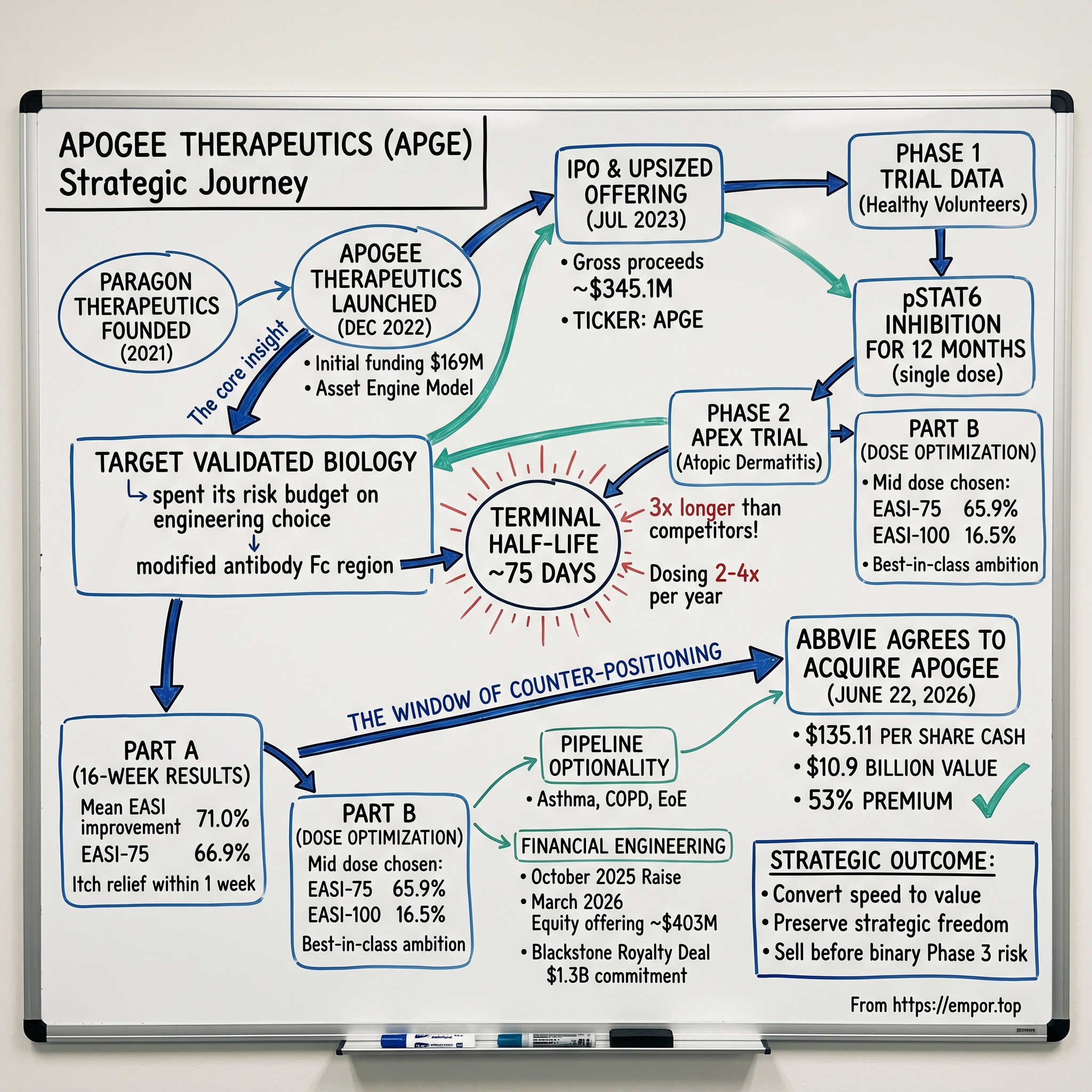
On the morning of Monday, June 22, 2026, a four-year-old company with no products, no revenue, and roughly 120 employees agreed to sell itself to AbbVie for $135.11 a share in cash — about $10.9 billion.1 The merger agreement had been signed four days earlier, on June 18.2 Apogee Therapeutics had never sold a single dose of anything to a single patient. It had never filed for approval. Its lead drug had not yet started a Phase 3 trial.
What it had was a molecule that stays in the human bloodstream for about seventy-five days.
That is the whole story, compressed. Apogee's bet — the entire architecture of the company, from its founding structure to its trial design to its balance sheet — rested on a single unglamorous insight: in chronic inflammatory disease, the biology has already been solved. Sanofi and Regeneron proved it. Dupixent, their interleukin-4-receptor antibody, generated $17.8 billion in global net sales in 2025, up 26% year over year, making it one of the largest-selling medicines on earth.3 The pathway works. Blocking type 2 inflammation clears eczema, calms asthma, and now slows chronic obstructive pulmonary disease.
The unsolved problem was never whether to block the pathway. It was how often you have to stab yourself to keep it blocked. Dupixent's maintenance regimen means an injection every two weeks — twenty-six needles a year, forever, for a disease that never goes away. Eli Lilly's Ebglyss trimmed that to monthly.4 Apogee asked a question that sounds almost insultingly simple: what if it were two to four times a year?
The "bio-better" paradigm
Most biotech is a bet on biology. You pick an unproven target, you spend a decade and a billion dollars, and roughly nine times out of ten the mechanism does not translate from mouse to human. Apogee inverted that. It took targets that were already commercially validated — IL-13, IL-4Rα, OX40L, TSLP — and spent its risk budget on protein engineering instead of target discovery. The company modified the tail end of the antibody, the Fc region, so the body's recycling machinery would keep pulling the drug out of the disposal queue and putting it back into circulation. The result, in first-in-human testing, was a terminal half-life of roughly seventy-five days, about three times longer than the IL-13 antibodies already on the market.5
That is not a scientific breakthrough in the Nobel sense. It is an engineering choice, and a well-known one — the specific mutation set Apogee used has been in the literature for years. Which is precisely the point of the trade, and precisely the source of the skepticism. If the technique is public, what stops Sanofi, Regeneron, or Lilly from doing the same thing? And if the answer is "nothing technical, only commercial incentives," then Apogee's moat was never molecular. It was a timing window.
The core thesis, and how it resolved
The question this company was built to answer was whether pharmacokinetic convenience — fewer injections, same or better efficacy — is worth enough to a patient, a dermatologist, and a pharmacy benefit manager to dislodge an entrenched multibillion-dollar incumbent. Apogee never got to answer it commercially. AbbVie bought the option before the Phase 3 trials began.
So this is not a story about a company that won a market. It is a story about a company that manufactured, priced, and sold a claim on a market — and did it with unusual precision. Along the way it raised money in a biotech nuclear winter, ran a two-part Phase 2 trial that produced one result the market loved and another the market initially punished, borrowed $1.3 billion against a drug that did not exist yet, and then handed the whole thing to the company that had already lost the biggest immunology franchise in history and was determined not to lose the next one.6
The chapters ahead trace how it was built: the venture-capital "asset engine" in Waltham, Massachusetts that manufactured the pipeline; the Fc engineering and what a seventy-five-day half-life actually means in a human body; the competitive geometry of atopic dermatitis, asthma, and COPD; the financing architecture, including a royalty deal that Blackstone called the largest of its kind for a pre-Phase 3 program; the credibility record of a management team that hit almost every date it set; the moat analysis under Helmer and Porter; the stress test a short seller would have run; and the two or three metrics that actually matter now that the outcome is a merger vote rather than a product launch.
Start with the machine that built the company.
 Subscribe on LinkedIn
II. Platform Origins: Paragon, Fairmount, & the BridgeBio Pedigree (20 min)
Waltham, Massachusetts, is a fifteen-minute drive west of Cambridge and about a hundred miles from the venture-capital mythology of Kendall Square. It is where, in 2021, a healthcare hedge fund decided that the most reliable way to make money in biotech was to stop hunting for companies and start manufacturing them.
Fairmount Funds Management had been co-founded in April 2016 by Peter Harwin and Tomas Kiselak — two investors who spent their days doing what public-market biotech specialists do, which is watch a lot of small companies fail for reasons that have nothing to do with their science. Boards that could not decide. Cap tables that could not clear. Discovery programs that burned four years producing a molecule someone else had already made better. Fairmount's conclusion was that the bottleneck in biotech was not ideas; it was assembly.
So they built an assembler. Paragon Therapeutics launched in 2021 as a Fairmount joint venture with FairJourney Biologics, a Portuguese antibody-discovery house.7 Paragon's job was narrow and industrial: take a validated target, generate a differentiated antibody against it, run the preclinical work, and hand the asset to a purpose-built company with its own management, its own investors, and its own single-minded reason to exist. Not a platform company with fifteen programs and a diluted narrative. A one-asset-family company with a thesis you can state in a sentence.
Apogee Therapeutics was the first spinout off that line. It was founded in 2022 by Fairmount and Venrock Healthcare Capital Partners, and by the time it emerged publicly on December 7, 2022, it had raised $169 million, including a $149 million Series B co-led by Deep Track Capital and RTW Investments.7 Its lead program, then still called APG777, was headed for the clinic the following year. Paragon would go on to produce siblings — Spyre Therapeutics in inflammatory bowel disease, Oruka Therapeutics in dermatology — and both later carried billion-dollar-plus public valuations.6 The engine, in other words, was not a one-off.
The man they hired to run it
The CEO Fairmount recruited was, in retrospect, the single most revealing decision of the entire enterprise.
Michael Henderson joined in September 2022.8 He had a B.A. in global health from Harvard and an M.D. from Stanford, but he had never practiced medicine in any conventional sense. He went to McKinsey, co-founded a dermatology company called PellePharm, and then spent years at BridgeBio Pharma, ultimately as Chief Business Officer — the executive responsible for the overarching strategy of a company whose entire organizing principle was hub-and-spoke drug development: a central platform of capital, regulatory expertise, and manufacturing, feeding dozens of small, focused subsidiaries each chasing one genetically validated disease. By the time he arrived at Apogee, Apogee's own materials credited him with helping create more than twenty companies, launch forty development programs, and lead two teams to FDA approval.8
Read that résumé closely and you understand what Fairmount was buying. Not a discovery scientist. Not a commercial operator. A man whose professional instinct was to strip risk out of drug development by refusing to take the kind of risk that cannot be managed. BridgeBio's thesis was that if you pick diseases where the genetics are unambiguous, you convert a biology bet into an execution bet. Apogee's thesis is the same move applied to a different variable: if you pick targets where the commercial biology is unambiguous, you convert a biology bet into a pharmacokinetics bet — and pharmacokinetics, unlike efficacy, is something you can measure in forty healthy volunteers in about a year.
Henderson recruited Jane Pritchett Henderson as Chief Financial Officer in January 2023 (no relation).9 Her background was the mirror image of his: thirty-four years spanning biopharma finance and investment banking, CFO roles at Adagio/Invivyd, Turnstone Biologics, Voyager Therapeutics, and Kolltan, and senior healthcare banking seats at HSBC, CIBC, Lehman Brothers, and Salomon Brothers, with more than ninety-five M&A and financing transactions executed.9 A company built to be sold hires a CFO who has sold companies. That was not subtext; it was the org chart.
The spinout contract — and its awkward geometry
The commercial architecture between Paragon and Apogee is where a skeptical investor should have spent time, because it is a related-party arrangement between a company and an entity controlled by its largest shareholder.
Paragon granted Apogee exclusive, worldwide, royalty-bearing licenses to antibodies directed at IL-13, IL-4Rα, OX40L, and TSLP.[^10] In exchange, Apogee owed development and regulatory milestone payments plus royalties in the low single digits as a percentage of net sales, running product-by-product and country-by-country until the later of twelve years after first commercial sale or expiry of the last valid patent claim.[^10] The individual milestone checks were, by biotech standards, small: a $1.0 million payment on the IL-4Rα license in late 2023, a $3.0 million TSLP milestone and a $5.0 million payment triggered by first dosing in the APG333 Phase 1, both in the fourth quarter of 2024.[^10] A later discovery-and-license deal covering IL-31R carried total potential milestones of up to $23.25 million, of which $5.25 million came due on first human dosing.[^10]
The outline framing of "single-digit to low-double-digit royalties" overstates it. What Apogee actually agreed to was cheap by licensing standards — low single digits, not the eight-to-twelve percent a big pharma partner would extract. Which raises the more interesting governance question, and the one an activist would have pressed: was it too cheap, and if so, for whom? Fairmount sat on both sides. It controlled Paragon and was Apogee's founding investor. Terms favorable to Apogee transferred value from Paragon's balance sheet to Apogee's; terms favorable to Paragon did the reverse. In either direction, the same fund captured most of it. That is not evidence of wrongdoing — the arrangement was disclosed in the IPO prospectus and in subsequent filings1011 — but it is a structural reason not to treat the license economics as an arm's-length benchmark for anything.
Going public into a blizzard
By mid-2023, the biotech capital markets were as bad as they had been in a decade. The XBI had spent eighteen months grinding lower; dozens of small-caps traded below cash; the IPO window was, for most companies, shut.
Apogee opened it anyway. The company priced an upsized offering on July 13, 2023 at $17.00 per share, selling 17,650,000 shares for roughly $300 million, with Jefferies, TD Cowen, Stifel, and Guggenheim Securities running the book.12 Shares began trading on the Nasdaq Global Market under APGE on July 14. Underwriters exercised their option in full for another 2,647,500 shares, bringing gross proceeds to about $345.1 million.[^14]
What made institutions write those checks in a market that was refusing to fund anything? Not the data — there was barely any; APG777 was only just entering the clinic. It was the shape of the risk. A generalist crossover fund evaluating a novel-target biotech in July 2023 was being asked to underwrite a decade of unknowable biology. A fund evaluating Apogee was being asked to underwrite whether an Fc mutation would behave in humans the way Fc mutations had already behaved in humans — and then, if it did, whether patients prefer fewer injections. Those are questions with knowable answers on a two-year clock. In a market with no risk appetite, a company that has moved most of its risk into the measurable column is not a better company. It is a more fundable one. That distinction is the entire commercial insight behind the Paragon model.
The money was raised. Now the company had to prove that the market it was aiming at was actually as unhappy as it claimed.
III. The $30B+ I&I Battlefield & Industry Economics (25 min)
Picture the patient at the center of this market. A thirty-four-year-old with moderate-to-severe atopic dermatitis — eczema, in the language of anyone who is not a dermatologist. Their skin is inflamed across the inside of the elbows, the backs of the knees, the neck, sometimes the face. The itch is not an inconvenience; it is a neurological event that wakes them at 2 a.m. and does not stop. They have tried steroid creams, which thin the skin. They have tried avoiding triggers, which are unknowable. Their disease has no cure, no remission, and no endpoint. It is a condition they will manage until they die.
That is the demand curve underneath a $17.8 billion drug.
Chronic disease is the best business model in medicine, and the worst experience in it
Atopic dermatitis, asthma, and COPD share a structural feature that makes them extraordinary commercial assets: they are lifelong, systemic, and relapsing. Stop the therapy and the disease comes back. There is no cure to compete with, no course of treatment that ends. Revenue per patient compounds for decades.
Which is exactly why the incumbents built the franchises they did. Dupixent, developed by Regeneron and commercialized with Sanofi, targets the IL-4 receptor alpha subunit — a control point that shuts down signaling from both IL-4 and IL-13, the two cytokines that drive type 2 inflammation. It was approved first in atopic dermatitis, then expanded relentlessly: asthma, chronic rhinosinusitis with nasal polyps, eosinophilic esophagitis, prurigo nodularis, and — the big one — COPD, where it became the first biologic ever approved.13 Its 2025 sales growth of 26% on a base already above $14 billion is the kind of number that makes a drug not just a product but a category.3
Behind it, a crowd. Lilly's Ebglyss (lebrikizumab) blocks IL-13 specifically and carries monthly maintenance dosing.4 LEO Pharma's Adbry (tralokinumab) is also anti-IL-13. Galderma's Nemluvio (nemolizumab) attacks IL-31, the itch cytokine. Each is a legitimate medicine. Each is also, from the patient's chair, a variation on the same deal: this will help, and you will inject yourself on a schedule for the rest of your life.
The compliance leak nobody puts on a slide
Here is where the analytical honesty has to come in, because this is the load-bearing assumption of the entire Apogee thesis and it is the one with the least hard evidence attached.
The argument runs: injection fatigue is real, adherence to biweekly self-injection decays over years, decayed adherence means worse disease control, and worse disease control means more flares, more topical steroids, more specialist visits, and more cost. Therefore a drug given two to four times a year should command a premium with patients, prescribers, and payers simultaneously.
Every clause in that chain is plausible. Not every clause is proven at the magnitude required. Real-world persistence data on biologics in dermatology exists but is noisy and confounded — patients discontinue for cost, for coverage changes, for loss of efficacy, for pregnancy, for side effects, and yes, sometimes for needle fatigue. Apogee did not disclose a payer-validated economic model quantifying how much of Dupixent's discontinuation is attributable to dosing burden specifically. Nor did anyone else. So the "compliance wedge" was, throughout the company's independent life, a hypothesis with strong face validity rather than a demonstrated commercial mechanism.
What is much harder to argue with is the arithmetic of the patient experience. Twenty-six injections a year versus two to four is not a marginal improvement in a satisfaction survey. It is the difference between a chronic-illness identity — the fortnightly ritual, the sharps container, the travel logistics, the fridge — and something closer to a dental cleaning. In categories from contraception to schizophrenia to HIV, long-acting formulations have repeatedly taken meaningful share from daily or frequent alternatives even when efficacy was comparable rather than superior. That is the closest thing to an empirical prior available here, and it points Apogee's way.
The payer's chair
The subtler question is whether the buyer cares as much as the patient does, because in U.S. specialty pharmacy the buyer is not the patient.
Pharmacy benefit managers optimize for net cost per member per month, and they do it with a blunt instrument: formulary tiering and step therapy. A PBM that has negotiated deep rebates on a category anchor has structural reasons to keep that anchor in place. Convenience does not show up in a rebate spreadsheet. Adherence does — but mostly as a cost, because a patient who takes their expensive biologic reliably is a patient the plan pays for reliably.
That is the uncomfortable inversion at the heart of the long-acting thesis: better adherence can be worse for a payer's near-term budget even as it is better for the patient. The counterargument is that fewer injections plausibly means fewer nurse-administered visits, fewer flares requiring rescue therapy, and — crucially — a differentiated product a plan can use as leverage against the incumbent's rebate position. Apogee's commercial wedge was therefore always going to be partly clinical and partly negotiating: not just "our drug is easier" but "your rebate monopoly now has a credible alternative."
The company never had to test that. AbbVie will.
Why the incumbents did not simply do this first
The final structural feature of this battlefield is the one that gave Apogee its window. Sanofi, Regeneron, and Lilly all have the scientific capability to build a half-life-extended antibody; the Fc engineering is not secret. What they have that Apogee did not is billions of dollars of installed revenue running on the old dosing schedule.
An incumbent that launches a six-month version of its own blockbuster does three things at once: it cannibalizes an existing revenue base, it resets the entire payer negotiation on a franchise that is currently working, and it commits to years and hundreds of millions of dollars of new Phase 3 work to earn the right to do so. The rational move for a company in that position is to wait — to let someone else prove the market wants it, and then respond. That is a real and durable asymmetry, and it is the closest thing to a genuine strategic power Apogee possessed.
It is also, note, an asymmetry with an expiry date. It protects a challenger only until the challenger's data is convincing enough that waiting becomes more expensive than moving. Which brings us to the molecule, and to the data that made waiting untenable.
IV. Core Asset Economics: Zumilokibart (APG777) & The 75-Day Half-Life Moat (30 min)
To understand what Apogee actually built, forget antibodies for a moment and think about a mail sorting facility.
Every day your bloodstream ingests proteins that are old, damaged, or simply finished. Cells pull them in and route them toward degradation. But the body cannot afford to destroy its own antibodies indiscriminately — they are expensive to make and essential to survival. So it maintains a rescue system: a receptor called FcRn, the neonatal Fc receptor, which sits inside those sorting compartments and grabs antibodies by their tail end before they reach the incinerator, then escorts them back out into circulation. An antibody that binds FcRn well gets recycled many times. One that binds poorly gets destroyed.
A typical therapeutic IgG1 antibody rides this system to a half-life of roughly three weeks. Zumilokibart — the drug formerly called APG777 — was engineered to ride it much harder.
The three letters that changed the schedule
Apogee's molecule carries a triple amino-acid substitution in the Fc region: methionine-to-tyrosine at position 253, serine-to-threonine at 255, threonine-to-glutamate at 257. In the field's shorthand, YTE. The effect is to tighten the antibody's grip on FcRn in the acidic environment of the sorting compartment, so more of each dose gets rescued on each pass.5
The consequence, measured in the first-in-human study, was a terminal half-life of approximately seventy-five days — roughly three times longer than the IL-13-targeted antibodies already on the market.5 Peer-reviewed reporting of the study put the range across the doses tested at 75.3 to 77.5 days.
It is worth being precise about what "half-life" means here, because it is routinely misread. It does not mean the drug works for seventy-five days. It means that seventy-five days after a dose, half of it is still there. Drug levels decay geometrically, and the clinical question is how long they stay above the concentration needed to actually shut the pathway down. That is why the pharmacodynamic readout mattered more than the pharmacokinetic one: the Phase 1 study reported near-complete inhibition of pSTAT6 — the intracellular signal that IL-13 switches on — sustained for up to twelve months after a single dose.14 Sustained inhibition of pSTAT6 and TARC, another type 2 inflammation marker, was documented in the published abstract.5
That is the whole engineering claim in one line: one injection, a year of target suppression.
The Phase 1 that was almost too clean
The first-in-human trial was small and conventional: forty healthy participants, randomized and placebo-controlled, three single-ascending-dose cohorts up to 1200 mg and two multiple-dose cohorts at 300 mg.5 Adverse events were mild and largely unrelated to study drug; no serious adverse events were observed across dose levels.5
Healthy-volunteer studies are the easiest data in drug development to over-read. They tell you a molecule is not acutely toxic and that its pharmacokinetics behave predictably. They tell you almost nothing about whether it treats disease. What made this particular readout consequential was that Apogee's thesis lived almost entirely in the PK column. For a company whose differentiation was dosing interval rather than mechanism, Phase 1 was not a gate to be cleared on the way to the real question — it was a substantial portion of the real question.
The one number a careful reader would flag: immunogenicity. Any foreign protein can provoke the immune system to make anti-drug antibodies, which can neutralize the therapy or accelerate its clearance. In a drug designed to sit in the body for months, that risk deserves scrutiny rather than a footnote. Apogee's later asthma work offered a partial reassurance — in the Phase 1b trial in nineteen mild-to-moderate asthma patients reported in January 2026, no anti-drug antibodies were observed at all.15 But nineteen patients over a few months is not a repeat-dosing immunogenicity dataset, and the definitive answer was always going to come from years of quarterly and semiannual dosing in thousands of people. That data did not exist when AbbVie bought the company.
APEX Part A: the number that made the market pay attention
The Phase 2 APEX trial in moderate-to-severe atopic dermatitis was built in two parts, and the two parts told very different stories.
Part A enrolled 123 adults, randomized two-to-one to drug or placebo, with an induction regimen of 720 mg at weeks 0 and 2 followed by 360 mg at weeks 4 and 12.16 The sixteen-week results, reported on July 7, 2025, were strong on the primary endpoint. Mean EASI improvement — the Eczema Area and Severity Index, essentially a scored map of how much skin is affected and how badly — was 71.0% versus 33.8% on placebo. EASI-75, the standard regulatory bar meaning a 75% improvement, was reached by 66.9% of treated patients versus 24.6% on placebo, a placebo-adjusted gap of 42.5 percentage points.16 Deeper responses followed the same pattern: EASI-90 at 33.9% versus 14.7%, and an investigator-assessed near-clear score in 34.9% versus 17.3%.16 Itch relief began within a week.
Chief Executive Michael Henderson framed it in the press release as "the highest response rate for any biologic globally to date."16 That claim requires the usual caveat that cross-trial comparisons in atopic dermatitis are treacherous — placebo response rates vary enormously with geography, background topical use, and enrollment criteria, and a 24.6% placebo EASI-75 is on the higher side. But the placebo-adjusted delta was genuinely large, and it was achieved in a global study rather than a single favorable region.
The subtler and more strategically important finding came from an exposure-response analysis. Patients in the top two quartiles of drug exposure hit EASI-75 at rates of 83.3% and 89.5%.16 Chief Medical Officer Carl Dambkowski pointed to this as validation of the exposure-response hypothesis.16 Translated: the drug was not maxed out. More exposure produced more response, which implied the induction dose had been set too low — and which set up Part B.
Part A at fifty-two weeks: the maintenance question
The real test arrived in March 2026, when Apogee reported what happened after those patients moved onto maintenance dosing at 360 mg given either every three months or every six months.
Among patients who had responded by week 16, EASI-75 was maintained by 75% on quarterly dosing and 85% on semiannual dosing; near-clear investigator scores were held by 86% and 78% respectively.17 Across the full treated population rather than just responders, EASI-75 reached 88% on quarterly and 81% on semiannual dosing by week 52, with itch response in the 64% to 73% range.17 Safety over a year of exposure was unremarkable: treatment-emergent adverse events in 71.4% of patients, serious events in 0.8%, discontinuations for adverse events in 3.4%, with conjunctivitis at 13.4% and upper respiratory infection at 12.6% as the most common issues.17
Two things stand out. First, responses did not merely hold — they deepened between week 16 and week 52, which is what you would expect if the drug is genuinely suppressing the pathway continuously rather than allowing troughs between doses. Second, and stranger, the six-month arm was not obviously worse than the three-month arm on the headline measure. In a small Phase 2 with subgroups this size, that is more likely noise than a real inversion, and it should not be read as evidence that less drug works better. But it did establish the thing Apogee needed: semiannual dosing was not a fantasy.
Part B, the dose correction, and the market's ambivalence
Part B was the dose-optimization study that Part A's exposure analysis demanded. It randomized 346 adults one-to-one-to-one-to-one across high, mid, and low doses of zumilokibart and placebo.18
At sixteen weeks, all three doses beat placebo with high statistical significance. But the winner was not the highest dose. EASI-75 came in at 65.9% for the mid dose, 61.6% for high, and 50.5% for low, against 23.4% for placebo.18 On the mid dose, near-clear investigator scores reached 46.0% versus 10.9% on placebo, EASI-90 hit 47.4% versus 9.3%, meaningful itch relief 50.5% versus 13.9%, and complete skin clearance — EASI-100 — 16.5% versus 3.4%.18 A measure called very low disease activity was achieved by 20.6% versus 4.5%; Ruth Ann Vleugels of Harvard and Massachusetts General called that level of very-low-disease-activity response one "not seen with any biologic to date."18
Conjunctivitis, the class side effect of IL-13 blockade, tracked dose: 10.6% at mid, 15.1% at low, 20.7% at high.18 Apogee selected the mid dose for Phase 3.18
The market's reaction to the May 27, 2026 release was not straightforwardly celebratory — shares fell on the day.6 The reason is instructive. Part A's headline EASI-75 of 66.9% had set an anchor; Part B's mid dose landed at 65.9%, which is statistically indistinguishable but psychologically flat, and the high dose actually underperformed. Investors who had extrapolated the exposure-response curve upward — expecting Part B to deliver seventy-plus percent — got confirmation instead of escalation. That is a useful lesson about how biotech narratives price: the market had begun paying for the slope of the data, not the level.
The clinical read is more forgiving. A bell-shaped dose response is common in immunology and does not indicate a broken drug; picking the mid dose gave Apogee the best efficacy with the lowest conjunctivitis rate, which is exactly the trade a commercial team would want. Phase 3 was set to begin in the second half of 2026 with two replicate trials, ADventure 1 and ADventure 2, each enrolling roughly 400 patients through sixteen weeks of induction and a week-52 maintenance period, plus an ADventure TCS study of about 400 patients combining the drug with topical corticosteroids.18
Beyond the skin
Type 2 inflammation is systemic, which is why every drug in this class eventually goes hunting for adjacent indications. Zumilokibart's expansion path ran through asthma and eosinophilic esophagitis.
The asthma Phase 1b, reported January 6, 2026, enrolled nineteen patients with mild-to-moderate disease and elevated exhaled nitric oxide — FeNO, a direct biomarker of airway type 2 inflammation. Maximum mean reduction was 45 parts per billion, a 60% decrease from baseline, with suppression durable through sixteen weeks in all patients and through thirty-two weeks in those with follow-up available.15 The only adverse event reported in more than one patient was reflux, in two; there were no grade 3 or higher events, no serious events, no conjunctivitis, and no injection-site reactions.15 Mario Castro of the University of Kansas framed the appeal as reaching patients who prefer less frequent administration.15
Nineteen patients with mild disease is a signal, not a proof. The ASPIRE Phase 2b in moderate-to-severe asthma was planned for the first half of 2027 and the ELEVATE Phase 2a in eosinophilic esophagitis for the second half of 2026 — meaning that at the time of the AbbVie agreement, everything past atopic dermatitis remained genuinely early.18
Which is the honest summary of the asset AbbVie bought: one indication with strong Phase 2 evidence and no Phase 3, and several more with biomarker data and hope. The interesting question is how a company with that profile financed itself well enough to keep control of it.
V. Capital Allocation, M&A Architecture, & Runway Management (20 min)
There is a particular kind of decision that separates biotech companies that survive from those that get taken out cheap, and it almost always happens when the data is good and the stock is high and nobody feels like they need money.
Apogee made that decision three times in eighteen months.
The virtual company
Start with the cost structure, because it explains the rest. Apogee never built a discovery organization. It did not own laboratories full of antibody engineers hunting new targets — Paragon did that, and Apogee licensed the output. It did not own manufacturing; it contracted that out. What it retained in-house was clinical development, regulatory strategy, and eventually commercial planning: the functions where control genuinely determines outcomes and where outsourcing costs you speed.
The financial signature of that model is legible in the numbers. In 2024, research and development ran $167.9 million against a net loss of $182.1 million. In 2025, R&D rose to $214.7 million, general and administrative expenses to $70.9 million, and the net loss to $255.8 million.19 By the first quarter of 2026 — with Part B reading out, Phase 3 preparation underway, and multiple Phase 1b programs running — quarterly R&D reached $60.8 million against $46.4 million a year earlier, G&A $22.0 million against $16.7 million, and the quarterly net loss $74.1 million against $55.3 million.20
Spending growth of roughly 30% year over year while advancing a lead asset toward Phase 3 and running four or five parallel clinical programs is, by the standards of the sector, disciplined. It is not frugal — a $300 million annualized burn is a serious number for a pre-revenue company — but the ratio matters more than the level. G&A at roughly a third of R&D, in a company preparing to build commercial infrastructure, suggests the corporate overhead was not running ahead of the science.
Was the Paragon deal a good trade?
The licensing arrangement described earlier deserves an economic verdict, not just a governance flag.
Consider the counterfactual. Building an internal antibody-discovery capability capable of generating four differentiated, half-life-extended antibodies against distinct validated targets is a multi-year, nine-figure undertaking with meaningful failure risk and an org chart that never shrinks. Apogee acquired that output for milestone payments measured in single-digit millions per program plus low-single-digit royalties.[^10] On a pure cost-of-goods basis, that is inexpensive.
The relevant comparison set is not other license deals but other ways to acquire de-risked assets, and by that standard the pricing looks favorable to Apogee. Takeda paid Nimbus roughly $4 billion upfront for a single Phase 2b oral TYK2 inhibitor in late 2022. Merck paid about $10.8 billion for Prometheus Biosciences and its Phase 2 anti-TL1A antibody in 2023. Those are the prices the market charges for clinical-stage immunology assets once someone else has taken the risk. Apogee's cost of entry to four such programs was a rounding error against either.
The caveat is the one already noted: this was not a market-clearing price, because the counterparty was affiliated with the buyer's largest shareholder. Cheap inputs sourced from a related party are not the same thing as a competitive advantage — they are a transfer within a family of funds. An acquirer valuing the business had to satisfy itself that the license terms would survive contact with a change of control, which is precisely the sort of thing that gets diligenced in an $11 billion transaction.
Raising when you can, not when you must
Apogee's financing behavior followed a consistent rule: take money into strength.
The company ended 2024 with $731.1 million in cash, cash equivalents, and marketable securities.19 Rather than sit on it, it raised again in October 2025, reporting a pro forma position of roughly $913 million with runway into the second half of 2028.15 Year-end 2025 cash stood at $902.9 million — meaningfully higher than a year earlier despite a $255.8 million net loss, which only happens when a company is raising faster than it burns.19
Then, after the 52-week maintenance data landed in March 2026 and the stock re-rated, Apogee went again with a $403 million upsized equity offering, taking cash to $1.3 billion at March 31, 2026 and extending runway into 2029 — through a planned biologics license application in atopic dermatitis, subject to regulatory alignment.20
This is the single clearest evidence of capital-allocation competence in the company's history, and it is worth naming the mechanism precisely. In biotech, dilution is not a fixed cost; it is a function of when you sell. A company that waits until it needs money sells equity at whatever price the market assigns to a company that needs money. A company that raises immediately after a positive readout sells the same dollars for materially fewer shares. Apogee's shares traded in a 52-week range from roughly $34 to $134 into July 2026.21 Raising near the top of a re-rating and refusing to raise near the bottom is worth more to long-term shareholders than almost any operating decision management could have made.
The Blackstone deal: borrowing against a drug that did not exist
The most sophisticated piece of financial engineering came in late May 2026, announced alongside the Part B data.
Blackstone Life Sciences committed up to $1.3 billion: as much as $800 million in synthetic royalty funding plus a senior corporate debt facility of up to $500 million.22 The pre-approval portion totaled $400 million, released in tranches — $100 million at signing, $100 million on completion of Phase 3 enrollment, and $200 million on positive Phase 3 data — with a further $400 million available after FDA approval, $150 million of it at Apogee's option.22 In exchange, Blackstone took low-to-mid single-digit tiered royalties on worldwide zumilokibart sales for fifteen years, with rates that step down as sales rise and disappear entirely above $8 billion in annual global sales.22
Henderson described it as non-dilutive, flexible funding at an attractive cost of capital that established a path to commercialization and profitability.22 Blackstone's Kiran Reddy called it the largest royalty financing for a pre-Phase 3 program to date.22
Strip away the language and look at what each side actually bought. Apogee converted equity dilution into a claim on future revenue that only becomes expensive if the drug succeeds — and which, by design, gets cheaper at exactly the scale where success would be most valuable. The declining-rate structure with a hard cutoff above $8 billion is the tell: Apogee protected the upside case and paid for the base case. Blackstone, conversely, took clinical risk in exchange for a senior claim on the most likely outcomes.
The most consequential clause, in hindsight, was the change-of-control provision permitting repurchase of a substantial portion of the royalty.22 Analysts noted after the AbbVie agreement that the transaction was structured to reduce the royalty burden Blackstone would otherwise carry into the acquirer's hands.6 Whether or not that was designed for this outcome, it meant Apogee had built its non-dilutive financing in a way that did not poison a sale — which, for a company with this ownership structure and this CFO, was unlikely to be an accident.
Alignment, and the awkward chart
Management ownership was real. Following a sale of 20,000 shares on June 10, 2026 under a Rule 10b5-1 plan adopted on August 13, 2025, Henderson directly held 1,095,987 shares.23 A CEO with a seven-figure share count is genuinely exposed to outcomes.
He was also, throughout 2026, a consistent seller under pre-arranged plans — the June transactions cleared at weighted-average prices in the $82 to $87 range, well below where the stock finished the summer.23 Pre-arranged plans adopted nearly a year in advance are the cleanest form of insider selling and carry little signal value about management's view. What they do illustrate is a real governance tension in single-asset biotech: executives whose personal wealth is concentrated in one binary outcome have a rational appetite for diversification and, separately, a rational appetite for a sale. The board's job is to ensure the second appetite does not front-run shareholders. In this case the price paid — a substantial premium to an already re-rated stock — suggests it did not.
That premium, and how it came about, is the next chapter. But before the endgame, the pipeline behind the lead asset deserves its own accounting.
VI. Broader Pipeline Sizing & Future Optionality (20 min)
Every single-asset biotech eventually faces the same conversation with investors: what happens if the lead drug fails? Apogee's answer was unusually structured, because the same engineering trick that produced zumilokibart could be pointed at any validated target.
How the value actually distributed
It is worth being explicit that Apogee never published a segment-level valuation of its pipeline. Any allocation — the lead asset as roughly two-thirds of enterprise value, the IL-4Rα program a fifth, the combinations and early assets the remainder — is an analytical construct, not a disclosed figure.
But the market gave a reasonably clean read anyway. When AbbVie described the acquisition, it led with zumilokibart in atopic dermatitis and with APG273, the combination of zumilokibart and the anti-TSLP antibody APG333, in asthma.1 Guggenheim Securities had doubled its peak-sales estimate for zumilokibart to $5.2 billion after the March 2026 data.6 The negotiation was, functionally, about one molecule and the franchise extensions attached to it. The rest of the pipeline was ballast — real, valuable, and not the reason anyone wrote a check for $10.9 billion.
That concentration is the honest structural fact about Apogee. It was never a platform company in the sense of having many independent shots on goal. It was a single pharmacokinetic idea, executed against one primary target, with secondary targets that mostly served to make the primary one more valuable.
APG808 and the COPD frontier
The most direct assault on the incumbent was APG808, an anti-IL-4Rα antibody — the same receptor Dupixent hits, engineered for longer persistence. Its Phase 1 data showed a half-life of roughly 55 days, and interim Phase 1b results in mild-to-moderate asthma reported in May 2025 showed a maximal FeNO reduction of 53% from baseline with 50% suppression sustained at twelve weeks, with tolerability consistent with the class.24
The strategic logic was obvious: attack Dupixent's fastest-expanding frontier, chronic obstructive pulmonary disease, where it had become the first approved biologic and where the addressable population dwarfs atopic dermatitis. COPD patients skew older, sicker, and less mobile — precisely the group for whom fortnightly self-injection is hardest.
The execution never got there. Apogee had signaled a randomized Phase 2 in moderate-to-severe COPD as early as 2025, but by the company's pipeline disclosure in 2026, APG808's listed status remained the positive Phase 1b asthma readout, with additional trial plans still to be announced.25 That is a real gap between the 2024 R&D Day roadmap and where the program actually stood two years later, and it is the clearest instance in Apogee's record of a stated plan slipping without a detailed public explanation.
The most plausible reading is prioritization rather than failure: capital and clinical bandwidth got pulled toward zumilokibart's Phase 3 and toward the combination programs. That is a defensible allocation. It is still a slipped timeline, and an analyst tracking management's execution record should have logged it as one.
APG990 and the upstream idea
APG990 targets OX40L — a different and more ambitious point of intervention. Where IL-13 blockade turns off one specific inflammatory signal, the OX40/OX40L interaction sits further upstream in the immune cascade, coordinating T-cell activation across type 1, type 2, and type 3 inflammation. Block it and you are not silencing one channel; you are turning down the amplifier.
Interim Phase 1 healthy-volunteer data reported in March 2025 showed a half-life of about 60 days across all tested doses, delivered in a 2 mL injection volume, with no serious adverse events.26 The 60-day figure was the enabling number: it meant OX40L blockade could be dosed on roughly the same quarterly-to-semiannual schedule as zumilokibart, which made the combination physically practical.
The concentration point deserves a moment of plain explanation. To deliver a large protein dose in a volume a patient can tolerate subcutaneously — a couple of milliliters at most — the formulation has to be extraordinarily concentrated without becoming viscous, unstable, or aggregating into particles that the immune system reads as a threat. This is unglamorous formulation chemistry, and it is a genuine barrier. A drug that requires four injections per session to deliver its dose has thrown away most of its convenience advantage.
APG279: the head-to-head that would have settled it
APG279 combined zumilokibart with APG990 in a fixed-dose regimen, and Apogee designed the most confrontational trial in its history around it: an open-label, assessor-blinded, randomized Phase 1b comparing the combination directly against dupilumab in moderate-to-severe atopic dermatitis.27
Running a head-to-head against the category leader in Phase 1b is not standard practice. It is a statement of confidence, and it is also a calculated risk — a Phase 1b is not powered for definitive superiority, so a favorable result invites the criticism that it is underpowered while an unfavorable one is devastating regardless. Apogee dosed the first patient in July 2025, upsized the trial from roughly 50 to about 80 patients on strong enrollment, and ultimately fully enrolled 86, with interim 24-week data expected in the second half of 2026.2015
The therapeutic ambition behind it was disease modification: the hypothesis that hitting both a downstream effector cytokine and an upstream immune coordinator simultaneously might produce not just better scores but complete clearance, and possibly durable remission after therapy stops. Complete clearance — EASI-100 — is the endpoint that would genuinely change the category, because it converts a management drug into something closer to a cure. The mid-dose monotherapy result of 16.5% complete clearance established a baseline the combination would have to beat meaningfully to justify the added cost and complexity.18
Rounding out the portfolio: APG273 paired zumilokibart with the anti-TSLP antibody APG333 for asthma and COPD, still preclinical with trial plans pending, and APG531 against IL-31R reached candidate nomination in June 2026.25
What the pipeline says about the business
Taken together, the portfolio reveals a company that had industrialized one insight and was systematically applying it — but which had not yet proven the insight generalizes commercially past a single indication. Every program past atopic dermatitis was at Phase 1b or earlier when the company agreed to sell. That is not a criticism of execution; it is an accurate description of maturity. It also explains the timing of the sale: Apogee was, in June 2026, at the exact point of maximum informational leverage, holding strong Phase 2 data and a portfolio of unresolved options, with the enormous expense and binary risk of Phase 3 still entirely ahead of it.
Whether management engineered that timing or simply recognized it is a question about credibility — which is the next thing to examine.
VII. Management Credibility & Earnings Call Transcript Analysis (25 min)
Apogee never held a traditional quarterly earnings call. That is worth stating plainly, because it shapes what can and cannot be assessed here. A pre-revenue biotech with no products has no operating results to explain and no guidance to defend; its quarterly financial updates arrived as press releases, and its live investor engagement clustered around data events — most notably the conference call convened on March 23, 2026 to walk through the 52-week maintenance results.17
So the record available for judging management is not a transcript archive of quarterly Q&A. It is something arguably more useful: a four-year sequence of publicly stated dates, and whether they were hit.
The dates test
Read Apogee's communications chronologically and a pattern emerges that is uncommon in clinical-stage biotech.
In the July 2025 Part A release, management laid out the schedule: Part A maintenance data in the first half of 2026, Part B in mid-2026, APG279 head-to-head data in the second half of 2026, Phase 3 initiation in 2026.16 In the January 2026 outlook, those commitments were restated with more precision — Part A 52-week data in the first quarter, Part B in the second quarter, Phase 3 in the second half — and Part B enrollment was reported complete at 347 patients, ahead of target.15 In the March 2026 full-year release, Henderson narrowed further, telling investors the maintenance readout was "expected in March."19
It arrived in March.17 Part B arrived on May 27, inside the second quarter.18 Phase 3 remained scheduled for the second half of 2026 throughout.18
That is a company that set dates in public, tightened them as visibility improved, and hit them. In a sector where "first half" routinely becomes "second half" and enrollment targets are quietly revised down, an unbroken sequence of met timelines over eight quarters is a substantive credibility asset — probably the most reliable signal available about an organization whose scientific claims cannot yet be independently verified.
The one blemish, noted earlier, is APG808's COPD Phase 2, signaled for 2025 and still without announced trial plans in 2026.25 Management did not offer a detailed public explanation of the change. That is a modest but genuine mark against an otherwise clean record, and it is exactly the kind of thing that gets lost when a company is hitting its lead-asset dates.
Where the guidance did shift, and why it was defensible
Cash runway guidance moved twice, and the direction is instructive.
In January 2026, the company described roughly $913 million pro forma with runway into the second half of 2028.15 The March full-year release repeated the second-half-2028 framing.19 By the first-quarter 2026 report, following the $403 million raise, runway had been extended into 2029, through a planned atopic dermatitis BLA filing.20
Guidance that extends because a company opportunistically raised capital is the good version of a revision. It reflects a balance sheet decision, not a spending surprise. Contrast this with the far more common biotech pattern — runway guidance shortening because burn ran ahead of plan — and the difference in what it says about financial control is stark.
The questions analysts actually pressed
Apogee's data-event calls and conference appearances circled three issues repeatedly, and how management handled each says something different.
Immunogenicity. The sharpest technical question facing this drug is what happens when you dose a foreign protein into thousands of people every three or six months for years. Anti-drug antibodies could neutralize activity or accelerate clearance, and either outcome would erode the exact property the company was selling. Apogee's public answer leaned on the Phase 1 profile and on the asthma Phase 1b, where no anti-drug antibodies were detected in the nineteen patients studied.15 That is honest as far as it goes and materially incomplete as an answer to the question, because the immunogenicity risk in a repeat-dosed chronic therapy accumulates over years, not weeks. The complete dataset would have come from the ADventure Phase 3 program. It does not exist yet, and no amount of management confidence substitutes for it.
Irreversibility. The mirror image of a long half-life is that you cannot take it back. If a patient develops a serious infection, a severe hypersensitivity reaction, or a malignancy while carrying a drug with a seventy-five-day half-life, meaningful clearance takes the better part of a year. Apogee's response was consistently to point at the safety data: serious treatment-emergent events at 0.8% and discontinuations at 3.4% over a full year in Part A, with no signal suggesting the class carries the kind of risk that demands rapid reversal.17 That is a reasonable empirical argument — IL-13 blockade is a narrow intervention, not broad immunosuppression, and its known liabilities run to conjunctivitis rather than opportunistic infection. It is not a complete argument, because prescriber psychology does not always follow event rates. A dermatologist choosing between a drug they can stop and a drug they cannot may weight the tail risk more heavily than the data warrants. Apogee could not have resolved that concern with anything short of years of commercial experience.
Dosing interval discipline. The most revealing strategic choice was testing quarterly and semiannual maintenance in Phase 2 rather than settling on a safer monthly interval. Monthly dosing would have been easier to demonstrate and would still have beaten Dupixent's schedule. It also would have destroyed the differentiation — matching Ebglyss and inviting a straight efficacy comparison Apogee might not win. By testing the aggressive intervals early, management accepted a higher chance of a disappointing maintenance readout in exchange for a shot at a genuinely uncontested position. The March 2026 data vindicated the choice.17 Had responses collapsed at six months, the same decision would look like recklessness. Both readings would have been fair; the outcome does not retroactively make it a safe bet.
The consistency question
The claim of "zero narrative shifts" from the 2023 IPO through 2026 is close to true but should not be stated as an unqualified virtue. Apogee's message was remarkably stable: validated targets, extended half-life, dosing convenience, best-in-class ambition, disciplined balance sheet. Every subsequent readout was framed within that architecture rather than requiring it to be rebuilt.
Consistency of that kind is evidence of a well-specified thesis. It is also what you would observe from a company whose thesis was never seriously challenged by its own data — Apogee did not have a failed trial, a clinical hold, a manufacturing crisis, or a competitive shock during its independent life. The most informative test of management character is how executives behave when something breaks, and Apogee's leadership was largely spared that test. Investors should be careful not to score an untested virtue as a demonstrated one.
What can be said with confidence is narrower and still meaningful: this team set specific public dates, met nearly all of them, raised capital into strength rather than necessity, structured its non-dilutive financing to preserve strategic flexibility, and sold the company at a substantial premium at a moment of maximum optionality. As a record of stewardship, that is strong. As proof of resilience, it remains unproven.
Whether the position they built was actually defensible is a separate question — and it requires stepping back from the company to the structure of the industry.
VIII. Strategic Moats: Helmer's 7 Powers & Porter's 5 Forces (20 min)
Strip a biotech of its narrative and ask the only question that matters for durable value: if this drug succeeds, what stops someone from taking the profits away?
For most clinical-stage companies the answer is composition-of-matter patents and nothing else. Apogee's situation was more interesting, and more fragile, than that.
The powers Apogee actually held
Counter-positioning — the real one. Hamilton Helmer's framework reserves counter-positioning for situations where an incumbent declines to copy a challenger not because it cannot but because copying would damage a business it values more. That describes this market with unusual precision.
Sanofi and Regeneron possess every capability required to build a long-acting version of Dupixent. They have the antibody engineering, the manufacturing, the clinical infrastructure, and vastly more capital than Apogee ever had. What they also have is a franchise generating $17.8 billion a year on a fortnightly schedule, with contracted rebate positions, an installed prescriber base, and years of remaining exclusivity.3 Launching their own six-month product would cannibalize that base, reopen every payer negotiation simultaneously, and require multi-year Phase 3 programs to earn the right to do it. The rational incumbent waits. That is a genuine and structural asymmetry.
But it is an asymmetry with a clock on it, and the clock was visibly running. The moment a challenger's data becomes convincing enough that share loss is certain, the calculus flips and the incumbent moves. Counter-positioning is a head start, not a fortress.
Process power — weaker than advertised. The claim that Paragon's Fc engineering and high-concentration formulation constitute proprietary process advantage deserves scrutiny. The YTE mutation set is published and widely used; it appears in approved medicines from other companies. What is genuinely harder to replicate is the combined package: a high-affinity antibody against the right epitope, engineered for extended half-life, formulated at high concentration in a small injection volume, manufactured at commercial yield, with predictable human PK. That integration is real know-how accumulated over repeated attempts. It is also the kind of capability that large pharma either possesses or can hire. Calling it a power overstates it; calling it nothing understates it. It is a lead measured in years, not a barrier measured in decades.
Scale economics — largely absent. A pre-revenue company has no scale advantage. What Apogee had was a balance sheet — $1.3 billion in cash plus up to $1.3 billion in committed non-dilutive capital — sufficient to fund parallel Phase 3 programs without a distress raise.2022 That is financial resilience, which matters enormously in biotech, but it is not scale economics in Helmer's sense. It does not lower unit costs and it does not compound. It buys time.
Cornered resource — arguably yes, briefly. The exclusive worldwide licenses to Paragon's antibodies against four validated targets functioned as a cornered resource for as long as those molecules remained best-in-class. That is a contractual advantage, not a natural one, and it depended on a related party continuing to feed the pipeline.
Branding, switching costs, network economies — none. These simply do not apply to a company that has never sold a product.
The honest tally: one strong power with an expiry date, one moderate capability, one financial cushion. That is a good position for a clinical-stage biotech and a thin one for a standalone commercial enterprise. It is also, precisely, the profile of an acquisition target rather than an independent compounder.
Porter's five forces, run properly
Rivalry: intense and intensifying. Atopic dermatitis is among the most crowded therapeutic categories in specialty pharmaceuticals — an entrenched category leader, a well-funded IL-13 competitor from Lilly, additional antibodies from LEO and Galderma, and oral agents attacking from below.4 Rivalry on this scale compresses pricing and raises the evidentiary bar for every new entrant.
Buyer power: high, and structurally so. The purchasing decision in U.S. specialty pharmacy sits with pharmacy benefit managers who control formulary placement and step therapy. A new biologic typically must clear a prior-authorization gauntlet and often a documented failure on the incumbent before it is reimbursed. That means even a demonstrably better product can face a multi-year adoption lag imposed entirely by contracting rather than clinical merit. This is the single most underappreciated risk in the long-acting thesis, and it is why the commercial case always depended on having a partner with existing payer leverage.
Threat of substitutes: real and differentiated. Oral JAK inhibitors — AbbVie's own Rinvoq, Pfizer's Cibinqo — offer daily pills instead of injections and, in some measures, faster and deeper responses. They also carry boxed warnings covering serious infections, mortality, malignancy, major cardiovascular events, and thrombosis, which pushes them toward later lines in most treatment algorithms. The substitution threat is therefore bounded but genuine: JAKs compete for the patient who cannot tolerate injections at all, while long-acting biologics compete for the patient who tolerates them but resents the frequency. There is a certain irony that AbbVie now owns assets on both sides of that trade.
Threat of new entrants: moderate, and rising. Capital intensity and manufacturing complexity are real barriers. Fc engineering expertise is not. The relevant entrants were never small startups; they were the incumbents themselves, plus well-capitalized peers who could apply the same half-life playbook to the same targets. The Paragon model's own success — spawning Spyre and Oruka on the same logic — was itself proof that the barrier to imitation was modest.6
Supplier power: low but concentrated. Contract manufacturing of complex biologics involves a limited number of qualified facilities and long lead times, which creates real switching friction. And in Apogee's specific case, there was a supplier concentration of an unusual kind: the pipeline itself came from a single related-party source.
The synthesis
Put the two frameworks together and Apogee's strategic position resolves into something precise. It occupied a window created by incumbent incentives, protected by a modest technical lead and a strong balance sheet, in a market where the ultimate buyers hold most of the negotiating power and where the technology gap was measured in years rather than decades.
That is a valuable position. It is not a defensible one over a decade. The rational strategy for a company in that position is to convert the window into cash before it closes — which is exactly what happened, and which raises the question of what the skeptics were right about.
IX. Activist / Skeptical-Investor Stress Test & Risk Radar (20 min)
Imagine the short thesis, written in spring 2026 by someone with no position in the outcome. It would have been a serious document.
The four attacks
Attack one: you cannot take it back. The bear case begins where the bull case does, with the half-life. A seventy-five-day terminal half-life means that after a single dose, meaningful drug persists for the better part of a year. If a patient develops a serious infection, an anaphylactic reaction, or a malignancy, there is no discontinuation strategy that produces rapid clearance. The clinical data through fifty-two weeks showed serious adverse events in under one percent of patients and no signal of the systemic immunosuppression that would make irreversibility dangerous.17 But dermatology is a specialty where the diseases are rarely fatal and the tolerance for iatrogenic harm is correspondingly low. A prescriber weighing a manageable chronic condition may reasonably prefer the drug they can stop.
The counterpoint is that this concern applies to every long-acting biologic ever approved, and long-acting formulations have consistently gained adoption anyway once safety accumulated. The risk is not that the objection is unanswerable; it is that answering it takes years of commercial experience the company did not have.
Attack two: the incumbents can copy this. The most direct challenge to the valuation. If Sanofi, Regeneron, or Lilly decided to build half-life-extended versions of their own molecules, Apogee's differentiation evaporates on the timeline it takes them to run Phase 3 — call it four to six years from a standing start. Apogee's answer was speed: get to market first, establish the prescriber habit, take share while the incumbents are still deciding. That answer is only as good as the head start, and every quarter of delay in Phase 3 compressed it.
Notably, no incumbent publicly announced a competing long-acting program during Apogee's independent life. Whether that reflected genuine strategic paralysis or simply undisclosed internal work is unknowable from outside.
Attack three: single-source pipeline concentration. Apogee's entire portfolio traced to one supplier, controlled by its largest shareholder, whose commercial interests were not identical to those of Apogee's public shareholders.[^10]10 A break in that relationship, a dispute over license scope, a claim from a third party against Paragon's antibody IP, or simply a decision by Fairmount to direct the next generation of assets to a different spinout would have left Apogee with no internal engine to replace it. The company disclosed the arrangement; disclosure does not eliminate the dependency.
Attack four: the valuation was pricing perfection. By the spring of 2026, Apogee's shares had roughly quadrupled from their 52-week low.21 A pre-revenue company with no Phase 3 data was being valued on a peak-sales estimate that had itself just doubled to $5.2 billion.6 That is a valuation resting on a chain of assumptions — Phase 3 replication of Phase 2 efficacy, favorable immunogenicity over years, formulary access against an entrenched incumbent, and no competitive response — where a failure at any link would have been severe. The AbbVie premium arrived before the market had to find out.
The risk radar that mattered
Phase 3 replication risk. This is the central unresolved question. APEX Part B enrolled 346 patients across four arms at selected sites with tightly defined criteria.18 ADventure 1 and ADventure 2 would enroll roughly 400 patients each, across broader geographies and a more heterogeneous population, with real-world variability in disease assessment.18 Effect sizes routinely compress from Phase 2 to Phase 3 in atopic dermatitis, driven substantially by placebo response inflation in larger multinational studies. A Part B placebo EASI-75 of 23.4% is already meaningful; if Phase 3 placebo response ran higher and drug response ran lower, the placebo-adjusted delta could narrow materially while still clearing statistical significance — and a narrower delta changes the commercial argument even if it does not change the approvability.
Immunogenicity over years. Already covered, and worth restating only as the specific mechanism of failure: neutralizing antibodies developing over repeated quarterly exposures could reduce exposure below the threshold required for sustained pathway suppression, which would show up first as attenuating efficacy in the six-month arm. That is the exact place where the thesis is most exposed, and the exact data that will not exist until the Phase 3 maintenance periods read out.
Formulary access. Even a clean approval leaves the payer gauntlet. Step therapy requiring documented failure on the incumbent would push a new entrant to second line in much of the commercial book. And an incumbent facing a credible convenience challenger has an obvious defensive weapon: deepen rebates. Price competition in a category this large can absorb an enormous amount of clinical differentiation.
Regulatory judgment on dosing intervals. The FDA has not, in this category, previously approved a maintenance interval as long as six months. Regulators could accept quarterly dosing while requiring more evidence for semiannual, which would preserve most of the convenience advantage but blunt the marketing claim. Apogee's own runway language — extending to a planned BLA filing "subject to regulatory alignment" — acknowledged that the label was not a settled matter.20
Deal-completion risk, now the live one. With the merger agreement signed, the risk profile changed entirely. Closing was conditioned on stockholder approval at a special meeting set for August 11, 2026, on antitrust clearance under Hart-Scott-Rodino, and on the absence of a material adverse effect.26 The agreement carried an outside date of December 18, 2026, and matching termination fees of $381,273,716 payable in either direction.2 A symmetric reverse termination fee of that size signals a buyer confident in its regulatory position and willing to pay for certainty — and AbbVie's ownership of a competing oral agent in the same indication is the kind of overlap regulators at least look at, even if a clinical-stage biologic and a marketed JAK inhibitor are unlikely to raise substantive concerns.
The shares traded near but below the offer price into late July 2026, which is the market's ordinary way of expressing high but not absolute confidence in completion.2128
What the skeptics got right
The most durable criticism was never about the science. It was about the durability of the position. The bears who argued that Apogee's advantage was a window rather than a moat were, analytically, correct — and management's behavior suggests they knew it. A company that genuinely believed it held a decade-long defensible franchise does not sell at Phase 2. It builds a commercial organization and captures the economics itself.
Apogee sold. That decision is the most honest assessment of the moat anyone connected to the company ever offered.
X. Strategic Playbook: Business & Investing Lessons (15 min)
Set aside the specific molecule and the specific outcome. What generalizable lessons does this episode leave behind?
Lesson one: the risk you can measure is worth more than the risk you cannot
Conventional biotech puts most of its risk in the biology column, where failure rates are high and the feedback loop is a decade long. Apogee moved most of its risk into pharmacokinetics — a domain with fast, cheap, quantitative readouts in small healthy-volunteer studies.
The arbitrage is not that the risk disappeared. Zumilokibart still had to work in patients, still faced Phase 3, still faced payers. The arbitrage is in when uncertainty resolves and what it costs to resolve it. A forty-person Phase 1 that answers your core differentiation question is a far better use of a first hundred million dollars than a decade of target validation. Investors get information sooner; management gets to kill or scale programs faster; capital compounds on a shorter cycle.
The caution is symmetric. Because the core question resolves early and cheaply, competitors can resolve theirs early and cheaply too. Fast-resolving risk produces fast-eroding advantage. The bio-better model generates attractive risk-adjusted returns precisely and only to the extent that whoever runs it converts the window into value before it closes — through partnership, sale, or first-mover commercial scale. It is not a strategy for building a durable independent enterprise. It is a strategy for manufacturing valuable, sellable optionality.
Lesson two: convenience is a clinical endpoint the label does not measure
The pharmaceutical industry spends most of its research budget chasing efficacy, because efficacy is what regulators approve and what medical affairs teams present. But drugs do not work in trials; they work in lives. And in chronic disease the gap between a regimen's efficacy and its real-world effectiveness is largely a function of whether people actually take it.
Long-acting formulations have repeatedly taken share in category after category on convenience alone. What Apogee bet was that this pattern would hold in immunology, where the incumbent regimen is fortnightly and the disease is permanent. That bet was validated commercially — by AbbVie's willingness to pay for it — long before it could be validated by prescriptions.
The investing generalization: when evaluating a "convenience play," ask whether the convenience improvement is categorical or incremental. Monthly to quarterly is incremental — an improvement patients notice. Fortnightly to semiannual is categorical — it changes what the treatment is in a patient's life. Only categorical changes reliably move share against entrenched incumbents, because only categorical changes give a payer a reason to reopen a contract.
Lesson three: the syndicate engine is a capital-formation innovation, not a scientific one
Fairmount's Paragon structure is best understood as a manufacturing system for investable biotech companies. The scientific work — antibody generation, preclinical characterization — happens once, in one place, with one team that gets better at it through repetition. The company-building work happens separately, in purpose-built vehicles with clean cap tables, focused management, and single-sentence theses.
The economic effect is to strip friction out of the most expensive part of early-stage biotech: the years spent assembling a team, a thesis, and a syndicate around an asset that may not survive. Paragon's spinouts arrived pre-assembled.76
The structural cost is the conflict already discussed. When one fund controls both the asset generator and the asset buyer, arm's-length pricing does not exist, and public shareholders are relying on disclosure and board process rather than on market discipline. Investors evaluating any company from this model should treat related-party licensing terms as a governance input, not a valuation input — and should recognize that the pipeline's continuation depends on a relationship rather than a capability they own.
Lesson four: dilution is a timing decision
The most transferable financial lesson from Apogee's history has nothing to do with biology. Between the IPO, the October 2025 raise, the $403 million offering after the March 2026 data, and the Blackstone royalty structure, the company repeatedly took capital when the market was enthusiastic rather than when the treasury was empty.12152022
Every one of those decisions looked unnecessary at the moment it was made. That is exactly the point. A company with three years of runway that raises anyway is buying insurance against the scenario where a trial delay coincides with a closed market — the scenario that has ended more biotechs than bad science has. The cost of that insurance is measurable dilution today. The cost of not buying it is existential.
The Blackstone structure extended the same logic into a different instrument: convert equity dilution into a revenue-contingent claim, structured so the cost declines exactly where success would be largest, with change-of-control provisions preserving strategic freedom.22 That is what sophisticated capital allocation looks like in a pre-revenue company, and it deserves to be studied independently of whether the drug ultimately works.
XI. Bull vs. Bear Case & Top 3 Key Performance Indicators (15 min)
For most of Apogee's public life, the bull and bear cases were arguments about a future product. As of late July 2026, they are arguments about a merger — and about whether the price paid was right, which is now AbbVie's shareholders' problem as much as Apogee's.
The bull case, as it actually resolved
The optimistic scenario for Apogee shareholders played out largely as written. Zumilokibart produced Phase 2 efficacy at the high end of what any biologic had shown in atopic dermatitis, maintained and deepened those responses across a full year on quarterly and semiannual maintenance, and did so with a class-typical safety profile.161718 The company financed itself into strength, secured over a billion dollars of non-dilutive capital on terms that preserved upside, and then sold at $135.11 per share — a 53% premium to the prior close and 63% above the thirty-day volume-weighted average.2 Shareholders who bought at the $17.00 IPO price and held realized roughly eight times their money in under three years.12
The forward bull case now belongs to AbbVie. It holds that zumilokibart reaches mega-blockbuster scale — Stifel's framing — in a company with the immunology commercial infrastructure to actually take share from Dupixent, with peak-sales estimates already at $5.2 billion and rising, and with the Blackstone royalty burden substantially reduced by the change-of-control structure.6 AbbVie has guided to accretion in adjusted diluted earnings per share beginning in 2032.6 The strategic logic is legible: AbbVie built the largest immunology franchise in history with Humira, watched it erode to biosimilars, rebuilt with Skyrizi and Rinvoq, and is now buying the next dosing paradigm before someone else does.6
The bear case, which did not get tested
The pessimistic scenario was never falsified — it was pre-empted by the acquisition. Phase 3 could still compress the effect size. Immunogenicity could still attenuate efficacy over years of repeat dosing. Payers could still relegate the drug behind the incumbent. Regulators could still balk at a six-month label. Dermatologists could still hesitate over irreversibility.
Every one of those risks transferred intact to AbbVie at a price of $10.9 billion — the largest acquisition AbbVie has made since Allergan in 2019, and larger than its ImmunoGen and Cerevel purchases combined.6 RBC's Brian Abrahams called the outcome "ideal and sensible" for Apogee while noting it came "earlier than we would have expected," and raised the possibility that other suitors — Sanofi or Johnson & Johnson among them — might emerge.6 That last observation is the sharpest read available: an analyst covering the space thought the asset was worth an auction, and did not see one.
For a shareholder holding into the vote, the residual bear case is narrow and mechanical. It is not about the drug at all. It is about whether the merger closes: the August 11 stockholder vote, antitrust clearance, the December 18 outside date, and the material-adverse-effect condition.2 The shares' small discount to the offer price reflects that.2128
The frameworks, applied to the outcome
Run the strategic analysis backward from the price and it is internally consistent. A company with counter-positioning as its primary power, a technical lead measured in years, no scale economics, no brand, no switching costs, and a single related-party supply relationship is a company whose value is maximized by transferring the asset to an owner who does have scale, brand, switching costs, and payer leverage. AbbVie brings exactly the capabilities Apogee lacked and would have spent a decade and several billion dollars trying to build.
The transaction is, in that sense, the market resolving a capability mismatch. Apogee was very good at the part of the value chain that ends at Phase 2. It had never demonstrated any capability at the part that begins at commercial launch — and in a category where buyer power is this concentrated, the launch is where the value is won or lost.
The three things worth tracking
Everything else is noise. These are the metrics that determine what happens from here.
One: the ADventure Phase 3 efficacy and immunogenicity readouts. The single question that determines whether AbbVie bought a franchise or an expensive option is whether Part B's efficacy replicates in larger, more heterogeneous populations, and whether anti-drug antibodies remain benign across years of quarterly and semiannual dosing. Watch the placebo-adjusted EASI-75 delta rather than the headline rate — the headline moves with placebo response, the delta does not — and watch specifically whether the six-month arm holds through week 52 or attenuates relative to the three-month arm. Attenuation in the semiannual arm is the earliest observable signature of an immunogenicity problem.
Two: the approved maintenance dosing interval. The entire commercial thesis rests on categorical rather than incremental convenience. A label supporting semiannual maintenance is a different product from one supporting quarterly, which is a different product again from one restricted to monthly. This is where regulatory judgment, immunogenicity data, and the marketing claim all converge into a single binary that will be visible on the eventual package insert.
Three: merger completion mechanics, through closing. Until the transaction closes, the only variables that move the outcome for Apogee holders are the stockholder vote, antitrust clearance, and the outside date.2 After closing, the relevant question migrates entirely to whether AbbVie's immunology sales organization can convert clinical differentiation into formulary position against an incumbent that will defend a $17.8 billion franchise with every rebate dollar it has.3
XII. Epilogue & Final Reflections (5 min)
In December 2022, a company emerged from a Waltham antibody shop with $169 million, one lead molecule, and a thesis that could be written on an index card. Three and a half years later it agreed to sell for roughly $10.9 billion, having never earned a dollar of revenue.71
The arc is remarkable, and it is worth being precise about what actually generated the value. It was not a scientific discovery — the target was validated by someone else, and the engineering trick was published. It was not commercial execution — there was no commerce. It was a sequence of correct judgments about where the risk was, when to resolve it, how to fund it, and when to stop. Pick targets where the biology is settled. Spend the risk budget on a variable you can measure in a year. Test the aggressive dosing intervals early, when a failure is survivable. Raise capital into every window the market opens. Structure the debt so it does not block a sale. And sell at the moment of maximum optionality, before the expense and binary risk of Phase 3.
Whether zumilokibart becomes a great medicine remains genuinely unknown. Phase 3 has not run. The label does not exist. The payer negotiations have not started. Everything that makes a drug a franchise rather than a data package is still ahead, and it now belongs to a company with a $17.8 billion incumbent to dislodge and a history of both building and losing the largest immunology franchise ever assembled.3
Which leaves the question the whole episode is really about. For most of the modern pharmaceutical era, value creation meant finding new biology — a new target, a new pathway, a new mechanism nobody had drugged. Apogee's wager was that the frontier had moved: that in mature therapeutic categories, the remaining unmet need is not biological but human. Not "can we block this pathway" but "can we block it in a way that fits inside a life."
The evidence so far is that the market agrees, and is willing to pay eleven figures for the proposition. Whether patients and payers agree — the only verdict that ultimately counts — is a question that will not be answered until sometime around the end of this decade, in a set of Phase 3 trials that Apogee designed and someone else will run.
References
-
AbbVie to Acquire Apogee Therapeutics, Deepening Immunology Portfolio — AbbVie, 2026-06-22 ↩↩↩
-
Apogee Therapeutics, Inc. Form DEFM14A Merger Proxy Statement — StockTitan, 2026 ↩↩↩↩↩↩
-
Regeneron Pharmaceuticals Investor Relations (Dupixent Financials & Pipeline) — Regeneron Pharmaceuticals, Inc. ↩↩↩↩↩
-
Eli Lilly Investor Relations (Ebglyss / Lebrikizumab Approvals) — Eli Lilly and Company ↩↩↩
-
Prolonged half-life and sustained inhibition of key inflammatory biomarkers: a phase 1 study of APG777, a high-affinity humanized IgG1 monoclonal antibody targeting IL-13 — British Journal of Dermatology, 2024 ↩↩↩↩↩↩
-
AbbVie to acquire Apogee, staking nearly $11B on long-acting autoimmune drugs — BioPharma Dive, 2026-06-22 ↩↩↩↩↩↩↩↩↩↩↩↩↩↩
-
Paragon Therapeutics Launches First Spinout, Apogee Therapeutics, to Advance Novel Therapies for Inflammatory and Immunological Conditions — PR Newswire, 2022-12-07 ↩↩↩↩
-
Michael Henderson, MD — Chief Executive Officer — Apogee Therapeutics, Inc. ↩↩
-
Apogee Therapeutics Appoints Jane Pritchett Henderson as Chief Financial Officer — PR Newswire, 2023-01-26 ↩↩
-
Apogee Therapeutics S-1 Registration Statement (IPO Prospectus) — SEC EDGAR, 2023-06-22 ↩↩
-
SEC EDGAR Filings & Company Profile — U.S. Securities and Exchange Commission ↩
-
Apogee Therapeutics, Inc. Announces Pricing of Upsized Initial Public Offering — GlobeNewswire, 2023-07-13 ↩↩↩
-
Sanofi Investor Relations & Global Immunology Pipeline — Sanofi S.A. ↩
-
Apogee Therapeutics Corporate Pipeline Overview — Apogee Therapeutics, Inc. ↩
-
Apogee Therapeutics Announces Positive Interim Results from Phase 1b Trial of Zumilokibart (APG777) in Patients with Mild-to-Moderate Asthma and Highlights 2026 Anticipated Milestones and Outlook — GlobeNewswire, 2026-01-06 ↩↩↩↩↩↩↩↩↩↩
-
Apogee Therapeutics Announces Positive 16-Week Data from Phase 2 APEX Clinical Trial of APG777 in Moderate-to-Severe Atopic Dermatitis — GlobeNewswire, 2025-07-07 ↩↩↩↩↩↩↩↩
-
Apogee Therapeutics posts positive 52-week Phase 2 APEX Part A results for zumilokibart — TradingView News, 2026-03 ↩↩↩↩↩↩↩↩↩
-
Apogee Therapeutics Announces Positive 16-Week Part B Induction Dose Optimization Results from Phase 2 APEX Trial of Zumilokibart in Moderate-to-Severe Atopic Dermatitis — BioSpace, 2026-05-27 ↩↩↩↩↩↩↩↩↩↩↩↩↩↩
-
Apogee Therapeutics Provides Pipeline Progress and Reports Full Year 2025 Financial Results — BioSpace, 2026-03-02 ↩↩↩↩↩
-
Apogee Therapeutics Provides Pipeline Progress and Reports First Quarter 2026 Financial Results — BioSpace, 2026-05 ↩↩↩↩↩↩↩
-
Apogee Therapeutics Inc (APGE) Stock Quote & Market Analytics — Bloomberg ↩↩↩↩
-
Apogee Therapeutics: $1.3 Billion Blackstone Financing To Advance Zumilokibart Phase 3 Development — Pulse 2.0, 2026-05 ↩↩↩↩↩↩↩↩↩
-
Form 4 — Apogee Therapeutics, Inc. Insider Trading Activity (Michael Thomas Henderson) — StockTitan, 2026-06-12 ↩↩
-
Apogee Therapeutics Announces First Participants Dosed in Phase 1 Trial of APG808 for COPD and Other Inflammatory Diseases — BioSpace ↩
-
Apogee Therapeutics Pipeline — Apogee Therapeutics, Inc., 2026 ↩↩↩
-
APG990 Interim Phase 1 Results Show Potential for Maintenance Dosing — Clinical Trial Vanguard, 2025-03-03 ↩
-
Rationale and Design of a Phase 1b Trial Evaluating APG279, the Combination of Half-Life-Extended Anti-IL-13 and Anti-OX40L Monoclonal Antibodies, Compared With Dupilumab in Moderate-to-Severe Atopic Dermatitis — Journal of Investigative Dermatology, 2025 ↩
-
Apogee Therapeutics Inc Stock Overview & Financial News — Reuters ↩↩
 LinkedIn
 WhatsApp
 Reddit
 Hacker News
 Email
Email Kindle
 RSS Feed
 Spotify
 Apple Podcasts
 Amazon Music
 Audible
 YouTube