Artisan Partners Asset Management Inc.: The Performance Report Clients Can Walk Away From
The $12.7 Billion Vote
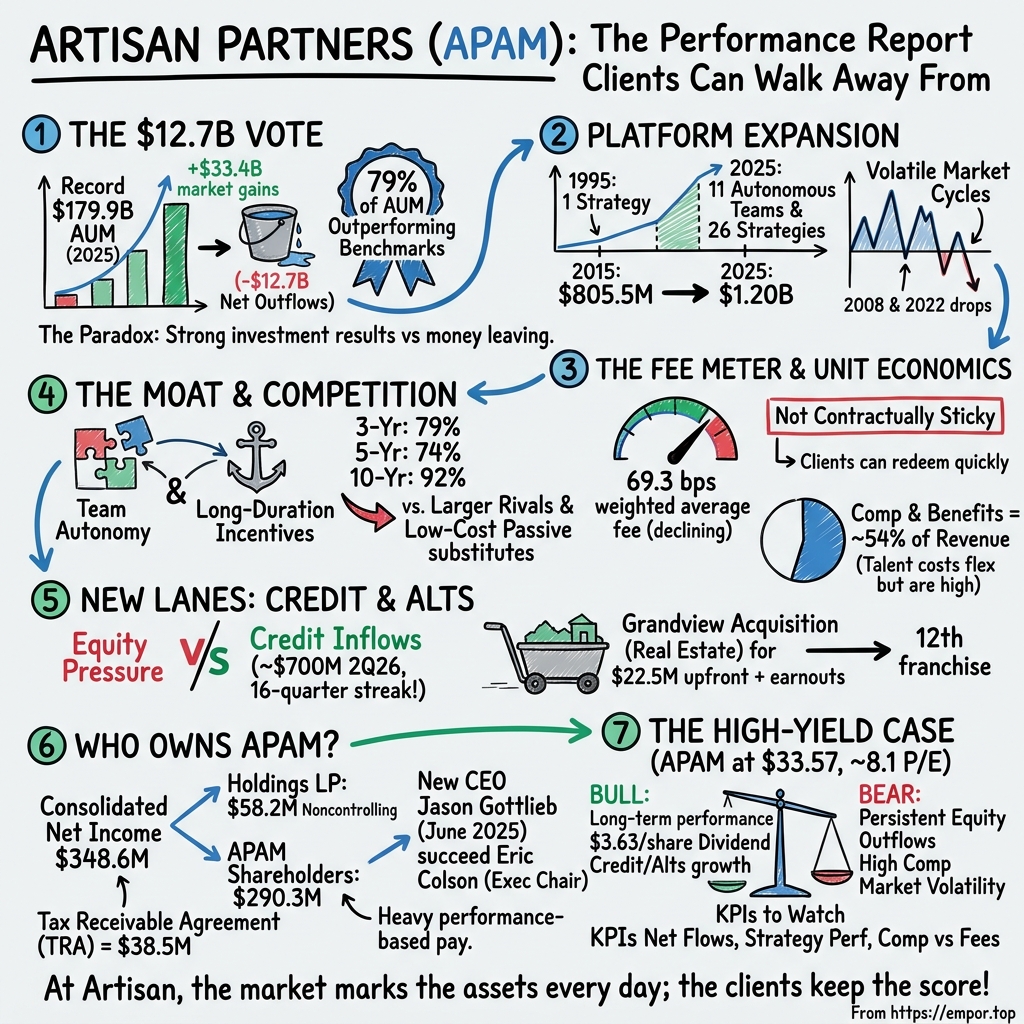
On February 3, 2026, Artisan Partners put out the kind of year-end release most asset managers would frame. Assets under management closed 2025 at $179.9 billion, the highest year-end figure in the firm's history.1
Revenue rose to almost $1.2 billion, operating income reached about $400 million, and net income attributable to the public company climbed to $290 million.1 On the business-update call the next day, Chief Executive Jason Gottlieb pointed out that the firm's strategies had earned more than 20% for clients, net of fees, across the whole platform.2
There was another figure in the same release. Over the year, clients had taken out $12.7 billion more than they put in.1 That is not a rounding error. And it left during a year of powerful gains in global stock markets.
The two facts fit together once you see how an asset manager's balance changes. Artisan started 2025 with about $161 billion. Its portfolios earned about $33.4 billion for clients, Artisan's mutual funds paid out roughly $2 billion in distributions that investors did not reinvest, and the $12.7 billion of net withdrawals came off the top.3
The market did more than all the work. Investment gains covered every dollar that left and still pushed the total to a record. That is why assets rose 12% in a year when clients, taken together, voted with their feet against the firm.3
None of this was because Artisan forgot how to invest. By its own measure, 79% of its assets sat in strategies that had beaten their benchmarks over the previous three years, 74% over five years and 92% over ten.4 Six equity strategies beat their benchmarks by more than five percentage points in 2025 alone.2 A firm with that scorecard, by the usual logic of active management, should be collecting money.
That logic is the puzzle at the centre of Artisan's story. The business sells investment judgment, and its long-run record of judgment is good. Yet the people who buy that judgment can stop buying it at almost any time, and in 2025 enough of them did so that the firm's organic growth rate was negative even as its returns were excellent. Equity strategies alone lost $15.6 billion to net outflows, while the newer credit and emerging-market debt teams brought in about $3.3 billion.21
Four questions run through everything that follows. The first is whether strong performance can reverse weak equity flows, or whether something about the market for active stock-picking has changed beneath Artisan's feet. The second is whether the firm's talent model, which hands autonomous teams a platform and gets out of their way, can keep producing durable returns as founders retire and teams age.
The third is whether credit, alternatives and a new private real estate business can grow fast enough to widen an earnings base that still depends heavily on stocks; equity strategies were about 88% of assets at the end of 2025.3 The fourth is how much of the resulting economics actually reaches the people who own APAM's listed shares.
That last question needs a boundary drawn at the start. Artisan Partners Asset Management Inc. is not anyone's subsidiary. It is the publicly traded general partner of Artisan Partners Holdings LP, the partnership that actually employs the investment teams and earns the fees.3 APAM consolidates Holdings, so the headline revenue and operating figures cover the whole business.
But APAM owned about 87% of Holdings at the end of 2025, and the remaining 13% belongs to limited partners, many of them current and former Artisan employees and the founding family.3 Some of every dollar of profit is theirs, not the public shareholder's, and there is no outside parent taking a management fee off the top.
The months since that February release have sharpened every one of those questions. Assets climbed to a new quarter-end record of $183.4 billion at the end of June 2026, then fell to $168.7 billion by the end of September, after Artisan shut down one of its oldest investment teams and a large client split another mandate among three managers.56
The stock closed on October 23, 2026 at $33.57, about 23% lower than a year earlier.7 The record has not changed, and the scorecard is still largely green. What changed is that the market is now asking the question this story is built around: when clients can walk away from a performance report, what exactly does an asset manager own?
To answer it, the story has to go back to a single small-cap fund in Milwaukee.
 Subscribe on LinkedIn
A single small-cap fund becomes a platform
In 1994, Andy and Carlene Ziegler set up Artisan Partners in Milwaukee around a bet about where the asset-management industry was heading.8 They saw two currents. Talented portfolio managers were becoming restless inside large institutions, where committees, central research departments and corporate priorities sat between them and their portfolios.
And distribution was opening up: consultants, retirement plans and mutual fund supermarkets were increasingly willing to hire outside managers, as long as the talent and the results were there.8 If a firm could offer gifted investors a home that left them alone and a sales engine that got their work in front of buyers, it could recruit people who would never join a conventional fund company.
The first product was modest. In 1995 the Growth team launched a U.S. small-cap growth strategy.8 The firm's second idea came a year later, when Mark Yockey's Global Equity team launched Non-U.S. Growth in 1996, starting a long Artisan tradition of investing outside the United States.8
A mid-cap growth strategy followed in 1997, a U.S. value team launched Mid-Cap Value in 1999, and in 2002 the team that would become the International Value Group launched International Value.8 By 2007, Artisan was running emerging markets, global opportunities and global value strategies too.8
What made this a platform rather than a collection of funds was the way the teams were organized. Artisan's 2012 registration statement described a model that gave investment teams "a high degree of investment autonomy without imposing a centralized research function."9 Each team ran its own process, from its own office if it wanted, and the firm supplied trading, compliance, operations and, crucially, distribution. The founders' bet was that this arrangement would attract a certain type of investor, and it did.
The growth was real. Artisan's assets rose from $15.6 billion at the end of 2001 to $64.1 billion by mid-2012, a compound rate of about 14% a year.9 By then, five investment teams managed 12 equity strategies, and 11 of the 12 had beaten their benchmarks since inception.9
The same document also shows how fragile that growth could be. Assets were $55.5 billion at the end of 2007. A year later they were $30.6 billion.9 From June 2008 to March 2009, Artisan's assets fell about 43%, mostly because markets collapsed, but not only that: clients also withdrew a net $1.8 billion in 2008.9
The firm survived without breaking, which says something about its cost structure. But the episode established a pattern that recurs throughout this story. The model can absorb a bad market. It cannot make asset values or client demand stable.
The prospectus said something else that matters to every later chapter. Clients, it warned, generally attribute Artisan's performance to a small group of long-tenured portfolio managers, and losing those people was among the business's biggest risks.9 Artisan had not built a brand that sold itself. It had built a home for people whose names sold the product.
On March 6, 2013, Artisan priced its initial public offering at $30 a share, above the $27-to-$29 range it had marketed, raising $332 million.10 The listing came with an elaborate reorganization of Artisan's partnership structure.9 Eric Colson, who had become chief executive in 2010, now ran a public company built on top of a partnership.4
The years after the listing are where the platform thesis was tested in earnest. Bryan Krug joined Artisan in 2013 to build a credit franchise, and in 2014 his team launched High Income, the firm's first fixed-income strategy.8[^11]
A Developing World team followed in 2015, a thematic team (later renamed Antero Peak Group) in 2017, and in 2022 an emerging-market debt team called EMsights Capital Group launched three strategies at once.8 The original teams added strategies too. In 2025 the Growth team launched a Franchise strategy and the International Value Group launched Global Special Situations.8
By the end of 2025, Artisan described 11 investment teams running 26 strategies, before the acquisition of a twelfth franchise closed in January 2026.34 Nine of the 26 strategies were in credit and alternatives, which hardly existed at the IPO.4
Here is where the conventional telling of the story goes too far. Artisan's admirers tend to describe the post-IPO decade as steady compounding. The firm's own numbers describe something lumpier. At the end of 2022, Chief Financial Officer C.J. Daley put the record plainly: assets had grown from $74 billion at the start of 2013 to $128 billion at the end of 2022, about 6% a year, while revenue had compounded at 7% and adjusted operating income at 5%.[^11] "Growth is not linear," he said.[^11] That decade included the 2013 starting point, a 2021 year-end high of almost $175 billion, and a 27% fall in 2022.11
Revenue tells the same story over a longer span. Artisan reported $805.5 million of revenue in 2015 and about $1.2 billion in 2025, which works out to roughly 4% a year over the decade.[^13]1 The profit comparison is harder.
The 2015 figure of $324.5 million was adjusted operating income, a non-GAAP measure, while the 2025 figure of $399.6 million was GAAP operating income; the two are not directly comparable, so the long history supports a claim of growth but not a clean claim of rising margins.[^13]1
That gives a calibrated verdict on the expansion story. Artisan did build a repeatable way to add investment teams: credit, emerging-market debt, thematic investing and global strategies all came from that machine, and several became meaningful businesses. But the platform never turned volatile markets into smooth compounding.
It grew in bursts when its teams were in favour and contracted when markets and clients turned. The idea that defines Artisan's strategy, then, is not growth itself. It is a method: recruit or develop investment talent, give it autonomy and long-term economic alignment, and put a distribution engine behind it.
That method has a price, and the price is paid every quarter through the way Artisan earns its money.
The fee meter runs on assets that can leave
Picture a portfolio manager at the end of a very good year. Her strategy has beaten its benchmark by several percentage points, and her clients' accounts are worth far more than they were in January. Then a pension consultant calls. The plan's equity allocation has grown so much that the trustees want to rebalance, and her mandate is the one they will trim. She has done everything right, and the assets leave anyway.
That scene is not hypothetical at Artisan. It describes, in broad strokes, much of what management said drove flows across 2025 and 2026.212 To see why it matters so much, it helps to understand the meter that runs Artisan's revenue.
An asset manager's main product is a percentage. Artisan charges each client a fee expressed in basis points, or hundredths of a percent, on the assets it manages for them. In 2025, the weighted average across the whole firm was 69.3 basis points, or about 0.69% a year.3
Multiply that rate by roughly $173 billion of average assets and you get most of Artisan's revenue.3 The meter is simple: revenue follows average assets, multiplied by a fee schedule that varies by strategy, vehicle and client.
The rate itself has drifted down slowly, from 70.4 basis points in 2023 to 69.3 in 2025.3 By the second quarter of 2026 it was 68 basis points.12 Each step down sounds trivial. On $170 billion of assets, one basis point is about $17 million of annual revenue.
The drift reflects mix more than outright fee cuts: a big institutional credit mandate at a lower rate, the loss of higher-fee equity money, and newer products with different price points.12 It is still the direction of travel in an industry where low-cost index funds set the reference price.
Performance fees add a second, smaller meter. Artisan earns them on a handful of accounts when returns clear agreed hurdles, and most are measured once a year at the end of December.2 They came to $29.1 million in 2025, up from $14.9 million in 2024 and $4.3 million in 2023.3
Even in a strong year, that was only about 2.4% of revenue, and only about 3% of assets were subject to such arrangements.32 Performance fees can make one quarter look exceptional; the December 2025 quarter set a revenue record partly because of them.2 They do not explain the business.
What makes this meter different from a software subscription is that almost nothing locks the customer in. Investors in Artisan's mutual funds can redeem on any business day. Institutional clients with separate accounts can reduce or terminate a mandate, and Artisan warns that they often can do so with minimal notice.3 There is no multi-year contract, no termination fee and no data that a client would lose by leaving. The fee recurs only for as long as the client keeps choosing to stay.
Nor does the meter only run backwards when clients are unhappy. Artisan's mutual funds paid out about $2 billion of distributions in 2025 that investors did not reinvest, $800 million more than the year before. The company says this was largely because two big equity funds had strong absolute returns and therefore large capital-gains payouts.2 Good results created a small leak of their own.
So far this sounds fragile. The other side of the ledger shows how Artisan was designed to live with it. The biggest cost in the business is people, and a large part of what Artisan pays its people moves with revenue. Compensation and benefits came to $649.6 million in 2025, about 54% of revenue, up from about 53% the year before.3 Investment teams receive incentive pay tied to the revenue their strategies generate, so when fees fall, the bonus pool falls with them.
The 2022 bear market showed the shock absorber working. Revenue fell 19% that year, from $1.23 billion to $993 million, as average assets dropped.11 Yet total adjusted expenses fell 5%, because incentive compensation dropped by about $74 million.[^11]
Daley said on the year-end call that the model had pulled almost $80 million out of variable expenses "without us announcing layoffs or bonus cuts."[^11] The operating margin still fell sharply, from 44% to under 35%, which shows the limits of the cushion.11 Variable pay protects the firm's survival. It does not protect its profit margin.
The cushion also has a stiffer layer underneath it. Long-term incentive compensation, which Artisan grants mostly to investment professionals as cash-based "franchise capital" awards and restricted stock that vest over years, rose to $97.0 million in 2025 from $73.1 million in 2024, partly because the value of those awards moves with markets.3
In January 2026, the board approved another annual grant of about $72 million, and management guided to roughly $85 million of long-term incentive expense for 2026 before market adjustments.2 Those awards are the glue that keeps talent in place. They also become a fixed claim on future revenue, whatever flows do.
The same machinery works in the other direction when average assets rise, even with clients leaving. In the second quarter of 2026, average assets were 9% higher than a year earlier, despite a long run of outflows, because markets had lifted the base.12 Revenue rose 9%, adjusted operating income rose 13%, and the adjusted operating margin widened to 32.9%.512
Daley called it evidence of "the operating leverage inherent in our business model."12 It is real leverage, but it is leverage to the market. The same arithmetic that turned higher average assets into faster profit growth will run in reverse if average assets fall, as they did after June.
Then there is the rest of the cost base, which is unusually light. Artisan spent only $0.7 million on property and equipment in 2025.3 It has no factories, no inventory and very little physical capital. Its reinvestment is people, data, technology and the seed money it puts into new funds. That is why a firm with negative flows can still produce substantial cash. It is also why the firm's competitive position lives almost entirely in the heads of a few hundred employees.
Put the pieces together and the unit economics are clear. Management fees recur only while assets stay, so revenue is exposed to market levels, client flows, investment results and product mix all at once. Performance fees are a small swing factor. Compensation is the dominant cost and partly flexes with revenue, but rising long-term awards and new hires mean the cost base also ratchets up in good years.
That leaves one question that the income statement cannot answer by itself. If clients can switch managers or move to a cheap index fund whenever they like, what keeps them at Artisan? The firm's answer is its investment teams. Whether that answer amounts to a moat is the most important argument in the story.
The moat lives in the teams—and has to be re-earned
Before he ran Artisan, Jason Gottlieb sat on the other side of the table. At Goldman Sachs he was a partner who led the Alternative Investment and Manager Selection Group, the unit that chose outside managers for Goldman's clients, and he helped run its multi-manager alternatives fund.13 His job, in other words, was to be the skeptical allocator: to listen to a manager's pitch, test the record and decide whether to hand over money or take it away.
Imagine an Artisan team in front of that kind of allocator today. On one side of the table is a long record of beating benchmarks, a team that has worked together for years and a clearly described process.
On the other side are cheaper index funds, much larger firms offering one-stop menus, and the allocator's own committee, which wants to know why it should pay 70 basis points for something it could approximate for a few. The question the allocator is really asking is whether Artisan's edge is durable, or whether it has to be won again in every meeting.
Artisan's case for an edge has four parts. The first is autonomy: teams set their own processes, without a central research department or house view telling them what to think.9 The second is long-duration incentives, such as franchise capital awards that tie a team's personal wealth to the revenue and longevity of its own strategies.2
The third is specialization: each team does one thing in one asset class and builds deep expertise there. The fourth is the platform itself, which handles trading, operations, compliance and distribution so investors can concentrate on investing. Gottlieb's summary in the 2025 annual report was that Artisan wants to be "the ideal home for investment talent."4
The affirmative evidence is substantial. Through 2025, Artisan's benchmark record was strong across three-, five- and ten-year periods.4 All 12 Artisan strategies with records longer than ten years had beaten their benchmarks since inception, net of fees, and on the first-quarter 2026 call management said they had done so by an average of about two percentage points a year.2[^11]
By mid-2026, the three-year figure had improved to 86% of assets.12 Track records like these are not common in active management, where large shares of managers trail their benchmarks over long periods.
The model has also attracted talent repeatedly. Colson, on the 2022 year-end call, described the credit franchise as a case study: Krug joined as an individual in 2013, built a team, and by early 2023 its High Income strategy had beaten its benchmark by an average of 1.78 percentage points a year after fees.[^11]
EMsights Capital Group, recruited as a team with 14 years together at a prior firm, launched three strategies in 2022 and by mid-2026 managed more than $5 billion.[^11]12 Those are real proofs that the recruitment machine works.
But the moat question is not whether Artisan can attract good investors. It is whether good investing keeps the assets. Here the firm's own history is the most important evidence, and it cuts the other way.
The prospectus had already flagged the firm's dependence on a small group of long-tenured portfolio managers.9 The 2008 outflows came during a market panic. In 2022, Artisan lost a net $9.8 billion, with 15 of its 25 strategies in net outflow.11
Colson said on that year's call that the gross outflow rate was in line with the firm's ten-year average; what had collapsed was new business.[^11] In 2025, the Growth team, whose small-cap strategy was the firm's first product, lost a net $11.0 billion, as short-term underperformance in Global Opportunities, shifting allocation preferences and profit-taking all hit at once.12 That team still had strong long-term records in several strategies.
The starkest test came in 2026. The U.S. Value team had been part of Artisan for almost 30 years, since it launched Mid-Cap Value in 1999.812 In June 2026, a U.S. sub-advisory client terminated its mandate, taking about $5.7 billion out of the Value Equity strategy in one month.14
After losing two large sub-advisory mandates, management decided to wind the team down entirely and redeploy its resources.12 By June 30, the team's three remaining strategies held less than $1.8 billion between them.14 A franchise that had once been a core part of the firm was being closed because a couple of institutional decisions removed its economic base.
Run Michael Porter's five forces through this business, and the shape of the problem becomes clear. Buyer power is the strongest force. Artisan's largest separate-account relationship was about 12% of total assets at the end of 2025, its two largest intermediaries were about 9% each, and its largest investment consultant was about 4%.3 No single customer exceeded 10% of revenue, but these are not small, captive buyers.3
They are sophisticated institutions that can reduce, split or terminate a mandate. In August 2026, a long-standing sub-advisory client told Artisan it was moving from a single-manager to a multi-manager structure for its Global Value mandate, rebalancing about $6 billion away in September, even though Artisan remained one of the three managers.15 The Global Value team had just been nominated for a Morningstar award.[^11] Performance did not prevent the client from diversifying.
Buyer behaviour also clusters by geography and regulation. On the second-quarter 2026 call, Gottlieb said Artisan had faced "a fair bit of concentration" of outflows in Australia over several years, not from any one client but from systemic challenges in that market, and that regulatory changes had caused similar pressure in parts of Europe.122
He added that he saw no "looming cliff of AUM that's at risk that would cause a cascade effect."12 Within weeks of that call, Artisan was notified that the Global Value client would split its mandate. Buyers do not have to be unhappy to exercise their power; they only have to change their own plans.
The threat of substitutes is the second-strongest force. On the first-quarter 2026 call, Gottlieb named the causes of equity outflows directly: clients de-risking, reallocating after periods of strong performance, and "some shifting to passive alternatives."[^11] An index fund does not have to beat Artisan; it only has to be good enough and far cheaper.
Rivalry is intense and asymmetric. Artisan competes with specialist boutiques that offer the same autonomy pitch and with giants that offer everything. T. Rowe Price managed about $1.86 trillion at the end of September 2026, and Franklin Templeton about $1.83 trillion at the end of August.1617 Each is roughly ten times Artisan's size.
Those numbers should not be read as market share, because the firms compete strategy by strategy and channel by channel, and companywide assets say little about who wins a given international value mandate. They do show who can afford bigger distribution teams, more vehicle formats and lower fees when a client wants a single relationship.
The supplier side is unusual. Artisan's critical supplier is its own talent, and portfolio managers have real bargaining power because their track records are portable in the client's eyes. That is why compensation absorbs more than half of revenue. The threat of new entrants is moderate: starting an asset manager is easy, but building a multi-decade record and institutional relationships is not.
Hamilton Helmer's Seven Powers framework sharpens the verdict. Artisan does not have network effects, scale economies of the kind enjoyed by index providers, or meaningful switching costs. Its brand matters to consultants and intermediaries but follows performance rather than leading it.
Its strongest candidate is a form of counter-positioning: large firms with central research, house views and product committees find it hard to copy a model that gives teams near-total autonomy and economics, because doing so would undermine their own structure. Its second candidate is process power in the recruiting and onboarding of teams, which Artisan has repeated across equities, credit and emerging-market debt. Neither power stops a client from leaving once a team is in place.
Weighing all this, the history does not reject the moat claim, but it narrows it substantially. Artisan has a durable advantage in attracting and keeping investment talent, and that advantage has produced strong long-term results. It does not have a durable advantage in keeping client assets.
That one has to be re-earned, strategy by strategy, every time a consultant reviews a mandate or a pension plan rebalances. The forward evidence that would confirm or falsify the revised claim is specific: long-horizon performance paired with net flows by strategy, especially in the large equity teams that have been losing assets.
That distinction turned from a theory into a crisis long before 2026. It started in 2022.
When performance stopped being enough
On February 1, 2023, Eric Colson opened Artisan's year-end call with an admission. "Outcomes in 2022 were difficult," he said.[^11] Assets had dropped from $174.8 billion to $127.9 billion during the year, a 27% fall.11 Markets had taken $36.6 billion off the total, and clients had withdrawn a net $9.8 billion, more than half of it in the fourth quarter alone.11[^11]
Colson's explanation was that uncertainty, from war, inflation, Chinese policy and regulation, had frozen decision-makers and reduced new allocations to risk assets.[^11] Then he made a forecast. "We don't believe that our 2022 or fourth quarter flows will prove to be representative of net flows going forward," he said.[^11] On the same call, asked about gross sales, he described the year as an "exchange of kicks" between growth and value, U.S. and non-U.S., active and passive, adding: "We lost the exchanges in 2022."[^11]
The following years tested that forecast directly, and it did not hold. Markets recovered, but Artisan's net outflows continued at $4.1 billion in 2023 and $3.7 billion in 2024.31 In 2025, with global markets rising strongly and Artisan's own strategies earning over 20% for clients, net outflows tripled to $12.7 billion.12 The market rebound did lift assets back to records. Organic demand never followed.
The breakdown within 2025 shows where the problem lay. Equity strategies lost $15.6 billion net, concentrated in Global Opportunities, U.S. Mid-Cap Growth and Non-U.S. Small-Mid Growth.2 The Growth team alone lost $11.0 billion.1
Gottlieb attributed the outflows to "challenging short-term performance, changing asset allocation preferences and profit taking on the back of strong long-term performance."2 In other words: some clients left because returns had weakened, and others left because returns had been so strong that their equity allocations were now overweight. Both kinds of client walked out of the same door.
Meanwhile, the diversification thesis was producing evidence. Artisan's credit-oriented franchises, the Credit team and EMsights Capital Group, grew assets 31% to $19.4 billion in 2025 with $3.3 billion of net inflows, an organic growth rate of 22%.1 It was the third straight year of organic growth above 20% for credit.4 Colson had described exactly this pattern back in 2023: the credit team was "right on schedule," moving from foundational growth into what he expected would be a compounding phase.[^11]
Why didn't that solve the problem? Because the numbers are on very different scales. Credit and emerging-market debt brought in about $3.3 billion in 2025, while equities lost about $15.6 billion.12 Equities were about 88% of assets.3 A business growing 20% a year from a small base cannot offset a business shrinking 10% a year from a base more than seven times larger.
The first quarter of 2026 brought a new kind of candour. Firmwide net outflows were $3.1 billion.18 Credit and EMsights together raised about $1.1 billion, and the Sustainable Emerging Markets team added $250 million, but the Growth team and International Value Group each lost about $1.5 billion.18
Gottlieb said that strong flows into credit-oriented businesses "were offset by attrition in our equity strategies" and that the firm expected "pressure on equity flows to persist."18 That was not a passing macro caveat. It was the chief executive acknowledging that the engine responsible for most of the firm's revenue was, for now, in reverse.
On the same call, an analyst asked whether management could see any large mandates preparing to leave. Gottlieb said he did not have "any direct line of sight when it comes to massive outflows or massive inflows."[^11] Within weeks, the June sub-advisory termination took $5.7 billion out of U.S. Value.14
The second quarter's numbers were the worst of the cycle. Net outflows reached $10.5 billion, of which about $9.2 billion, nearly 90%, came from two teams: $6.4 billion from U.S. Value and $2.8 billion from Growth.12 Against that, credit strategies brought in nearly $700 million, their sixteenth consecutive quarter of positive organic growth, at an annualized organic growth rate of 15%.5 Alternatives added about $300 million, growing at an annualized 25%.5
The sixteen-quarter streak is genuinely impressive, and it covers four years in which the rest of the firm was shrinking. But the arithmetic is unchanged. At about $700 million a quarter, credit would add roughly $2.8 billion a year. Artisan lost almost four times that in a single quarter. Credit is proving that the platform can build new businesses; it is not yet large enough to change the firm's direction.
Then came the late-summer surprise. In early August 2026, the Global Value client moved to a three-manager structure, and Artisan disclosed that about $6 billion would leave that strategy in September.15
Artisan said the revenue impact would be smaller than the asset drop because of the mandate's fee structure, a reminder that large institutional mandates often carry lower fees.15 By September 30, total assets were $168.7 billion, down from $183.5 billion at the end of August.615 Global Value, which had about $40 billion at the end of August, stood at $33.2 billion.156
The client mix explains why such swings are possible. At the end of 2025, Artisan Funds and Artisan Global Funds held 49% of assets, and separate accounts and other pooled vehicles held 51%.3 Fund investors can leave daily, but they tend to leave gradually.
Separate-account and sub-advisory clients can leave in single large decisions. One separate-account relationship alone was about 12% of total assets.3 Artisan does not name that client, and it does not say whether it is one of the sub-advisory relationships that changed in 2026.
Comparing what management said across these calls is revealing. In 2023, Colson blamed uncertainty and lost "exchanges" between styles, and predicted normalization. In 2026, Gottlieb named passive alternatives, rebalancing and performance as causes, predicted continued pressure, and then saw outflows worsen. By the second-quarter call he had distilled the challenge into a phrase: Artisan needed "to do a better job at selling more and losing less."12
Gross sales were improving, he said, helped by new distribution hires reaching "full fighting strength"; the problem was redemptions and "some select terminations."12 That is a sharper diagnosis than 2023's, and more candid. It also amounts to an admission that strong performance has not been enough to retain clients.
The calls also contain the strongest evidence for the bull's reading of the same flows. Gottlieb argued in July that strong markets themselves were feeding the outflows: "If markets didn't produce mid- to high teens returns, I think the rebalancing would be a lot less," he said, describing broad trimming across Artisan's largest institutional relationships, none meaningful on its own but significant in aggregate.12
Clients were also still awarding new business. In the second quarter, the Growth team's Global Discovery strategy won a $1 billion institutional mandate from a client willing, in Gottlieb's words, to "look through some of the short-term performance challenges."12 Sustainable Emerging Markets, nearing $4 billion, kept gathering money.126
Both readings can be true at once. Rebalancing is a real and partly temporary force, and it explains why outflows can rise in good markets. But rebalancing hits every active equity manager, and it does not explain the terminations, the sub-advisory losses or the drift toward passive products that management itself has named.
The honest conclusion is that some of Artisan's outflows are cyclical and some are structural, and the firm does not publish a split that would let an outsider measure which is which.
The time needed for new teams to scale is the final constraint. Colson explained in 2023 that institutional sales cycles are long, requiring consultants, gatekeepers and investment committees, and that complex strategies like emerging-market debt take time even after clients agree.[^11] EMsights needed four years to pass $5 billion.12 At that pace, the newer franchises can steadily diversify Artisan's mix, but they cannot rescue a year like 2025 or 2026 by themselves.
The verdict on diversification is therefore mixed but not negative. The credit streak is real evidence that the model can build a second engine. Firmwide flows have not confirmed a turnaround, and equity attrition remains the larger force. Which is why, in late 2025, Artisan did something it had never done in 31 years: it bought a company.
Grandview buys a new lane, not a new earnings base
On November 18, 2025, Artisan announced it would acquire Grandview Property Partners, a real estate private equity firm that invests in middle-market U.S. properties.19 Grandview was formed in 2019 through a spinout, led by chief executive Raj Menon and founding partners Dean Sotter, Eric Freeman and Jeff Usas, who had worked together for an average of 22 years.19
It managed about $940 million of institutional capital across three closed-end funds and a co-investment program, using a macro-driven approach that targeted growth markets shaped by demographics and regional supply and demand; its recent funds focused on industrial, residential and "powered land" themes.19 Since 2002, the partners had acquired or developed more than $2.8 billion of property and sold more than $3.3 billion.19
For Artisan, this was a departure. Artisan described Grandview as its first acquisition; every earlier team had been recruited or developed in-house.3 It was also Artisan's first move into private real estate, an asset class where money is raised in closed-end funds that lock up capital for years, rather than in vehicles clients can redeem tomorrow. Grandview became the twelfth autonomous franchise.4
The deal closed on January 2, 2026. Artisan paid $22.5 million in cash upfront and booked an estimated $25.9 million of contingent consideration, for a total acquisition cost of about $48.4 million.20 Most of that, about $40.3 million, was recorded as goodwill, and $8.2 million as intangible assets such as management contracts and the trade name.20
How should a price like that be judged? One rough yardstick is the price relative to assets managed. The upfront payment equals about 2.4% of Grandview's $940 million at announcement. Including the initial estimate of contingent consideration, the total is about 5.1%. But assets are not revenue.
A private real estate fund's management fees, carried interest and the timing of fundraising all matter far more than headline assets, and Artisan has not disclosed Grandview's revenue or fee rates. Those ratios cannot establish whether Artisan paid a fair price. They do establish that this was a small bet relative to a firm that pays out hundreds of millions of dollars in dividends a year.
The structure matters more than the number. The contingent payments depend on Grandview reaching committed-capital milestones for future funds, achieving certain revenue run rates for those funds, and on the funds' performance, over a period of up to seven years.20
Artisan pays more only if Grandview raises more money and earns more fees. Artisan also said the deal would be only "mildly accretive" to earnings per share, and only after the final close of Grandview's next flagship fund.19 The 2026 earnings impact was expected to be immaterial.2
This is a sensible way to buy optionality. It is also a way of admitting that most of the value depends on fundraising that had not happened. And the early signs on fundraising are mixed.
The base was smaller than it first looked. Grandview's assets fell from about $940 million at announcement to $782 million at the end of September. By the year-end call, a fully invested older fund had sold properties and returned capital.19256
Realizations in a harvesting fund are a sign of health in private markets, so some decline is natural. But Grandview's most recent fund, Fund III, had raised only about $150 million in commitments; Gottlieb said the team chose to stop taking commitments as the Artisan deal approached.212
The timeline for Fund IV has also moved. On the February call, Gottlieb said Artisan hoped for a first close "sometime in the early to mid part of the summer."2
By late July, he said Fund IV would launch "sometime later this summer, but likely early in the fall," with advanced discussions with an anchor investor and a newly hired business leader to drive fundraising.12 He said he expected Fund IV to be "multiples" of Fund III.12 As of late October, Artisan had not announced a first close.
What does Grandview say about capital allocation discipline? Management insists it will remain disciplined. On the second-quarter call, Gottlieb said Artisan had made proposals in some acquisition processes that went no further, and that deals shopped widely are "more about dollars and cents" and hard for Artisan to get excited about.122
Walking away from expensive auctions is good behaviour. But a single deal, in a new asset class, provides almost no history against which to judge the claim. The record that would validate it will be written by Fund IV.
There is also a deployment question that the fundraising headline hides. Private real estate fees depend not only on how much is committed but on how quickly the money is invested and how well it performs before it is returned.
Gottlieb told analysts that deployment "can be slow and then speed up really quickly" depending on interest rates, and argued that a higher-rate environment could help Grandview by forcing distressed owners who cannot refinance to sell at a discount.12 That is a coherent investment thesis. It is also a reminder that Grandview's economics will be set by a property cycle that Artisan's equity and credit teams have never had to navigate.
Management's appetite is clearly larger than Grandview. In April, Gottlieb told analysts there was "a strong possibility" Artisan could complete a deal to globalize its credit business by year-end, and named equity secondaries, real assets, private credit and hedged equity as areas of interest.[^11]12
Artisan also secured regulatory relief to offer exchange-traded fund share classes, though it had not decided what to launch.12 An investor should read this as a firm actively searching for new growth engines, which is a reasonable response to equity outflows, and also a firm whose acquisition discipline will soon be tested more than once.
It helps to place this in the context of how Artisan reinvests. Physical capital spending fell to $0.7 million in 2025 from $8.6 million in 2023.3 Artisan ended 2025 with 567 employees: 29% in investment teams, 19% in distribution and marketing, and 52% in business management and operations.3
Seed capital, the firm's own money placed into new strategies to give them a track record, stood at $152 million at the end of 2025 and was reduced to about $100 million by mid-2026 as maturing products no longer needed support.212
The right way to test those investments is commercialization, not launch count. By that measure, credit's sixteen-quarter streak and EMsights' $5 billion are proof that Artisan can turn new teams into revenue. Grandview is not yet such proof. It is a small possible growth lane whose importance will depend on fundraising, fee generation and performance, not on the announcement that it joined.
Small bets like this one matter most when the core is under pressure. To see how much of the core's economics actually belongs to public shareholders, the story has to open the partnership.
The partnership earnings that belong to someone else
Artisan's 2025 consolidated income statement ends with a number that looks straightforward: $348.6 million of net income.3 Below it, a line reallocates $58.2 million to "noncontrolling interests," leaving $290.3 million attributable to APAM.3 That reallocation is the visible trace of the partnership structure built at the IPO, and it is the first thing an investor needs to understand about what the listed share represents.
APAM is the sole general partner of Artisan Partners Holdings, and it owns about 87% of the partnership.3 The remaining 13% is held as partnership units by employee-partners and other holders, including Artisan Investment Corporation, the vehicle controlled by Andy and Carlene Ziegler, which still held about 3.5 million units in April 2026.321
Unit holders can exchange units for public shares one for one, which slowly raises APAM's ownership over time.21 There is no outside corporate parent, no royalty and no management fee flowing to a sponsor. The leak, such as it is, is to insiders who own a piece of the operating business directly.
The second adjustment is investment marks. Artisan puts its own money into new funds as seed capital, and because some of those products are consolidated, their gains and losses flow through the income statement. Net investment gains attributable to APAM were $58.0 million in 2025, up from $31.9 million in 2024 and $38.4 million in 2023.3
That is a meaningful slice of the $290 million bottom line, and it is the slice most likely to reverse in a bad year. Management excludes these marks from adjusted earnings, which were $3.93 per adjusted share in 2025 against $4.05 of GAAP earnings per share.13 The difference shows how much of a strong year's reported profit came from markets rather than fees.
The third puzzle is cash. Operating cash flow fell from $372.8 million in 2024 to $172.0 million in 2025, even as net income rose.3 At first glance that looks like a warning sign. The explanation is again the consolidated investment products: net cash used by those products, mainly new subscriptions into seeded funds, increased by about $213.8 million.3
Money moving into funds Artisan consolidates is counted as operating cash going out, even though it is not a deterioration in fee economics. The sensible reading is to look past the consolidated products to the fee business, while recognizing that reported cash conversion will be lumpy.
Receivables deserve a measured glance. They rose to $154.5 million at the end of 2025 from $118.7 million a year earlier, mostly earned advisory fees, including the December performance fees.3 Artisan said none was considered uncollectible and carried no allowance for doubtful accounts.3 The company does not publish an ageing table, so the increase is worth watching against revenue, but nothing in the disclosure points to a collection problem.
The structure's most important claim on cash is the tax receivable agreement. When partners exchanged their units for public shares, APAM received a step-up in the tax basis of Holdings' assets, which lowers its future tax bills. Under the agreements signed at the IPO, APAM pays 85% of those tax savings to the partners who made the exchanges.21 APAM carried a liability of about $303 million for these agreements at the end of 2025.3
It paid about $38 million under the agreements in 2025, of which about $4.5 million went to current executive officers and large employee-partners, and expected to pay about $40 million in 2026.321 These payments are real cash going to former and current insiders. They are not an operating cost, and they reflect a tax benefit APAM keeps 15% of. But they compete with dividends, seed capital and acquisitions for the same pool of cash.
Debt is modest. Holdings had $190 million of unsecured senior notes and an undrawn $100 million revolving credit facility at the end of 2025.3 In August 2025, it issued $50 million of notes at 5.43% and used the proceeds and cash on hand to repay $60 million of notes at 4.29%, trading a lower rate for a higher one as rates normalized.3
The interest coverage covenant requires at least 4.0 times; Artisan reported 60.3 times.3 One covenant detail ties the debt to this story's central theme: Holdings must offer to prepay the notes if average quarterly assets fall below $45 billion.3 At $168.7 billion, that is far away, but it is a reminder that even lenders measure Artisan by the assets clients leave with it.
Three smaller items complete the picture. A change in tax law in 2025 forced a $10.7 million deferred-tax charge.3 About half of client assets were invested in securities denominated in currencies other than the dollar, but Artisan says its own foreign-currency revenue, expenses, assets and liabilities do not materially affect its results.3 And Artisan recorded no loss contingencies in 2023, 2024 or 2025, while PricewaterhouseCoopers issued clean opinions on the financial statements and internal controls.3
All of this feeds Artisan's dividend policy, which is unusually explicit. The firm pays a variable quarterly dividend of about 80% of the cash generated in each quarter, then a special dividend at year-end from what is left.5 For 2025, dividends declared on the year's cash generation came to $3.87 per share, about 98% of adjusted earnings.2 In practice, the public shareholder is buying a claim on almost all of the firm's distributable cash, minus what is retained for seed capital and acquisitions.
The policy is old, and so is its main weakness. By the end of 2022, Artisan had paid more than $32 per share in cash dividends since its IPO at $30, and Daley put the average annual dividend yield over that period at about 8%.[^11] That is a remarkable record of returning cash.
It also means the dividend has always moved with the business. In 2022, dividends declared on the year's cash generation fell to $2.82 per share as revenue dropped 19%.[^11]11 An investor who treats Artisan's yield like a bond coupon is misreading the contract: the payout is a fixed share of a variable stream.
The verdict for this section is straightforward. The public company produced substantial earnings, but consolidated income overstates what public shareholders own, and investment marks add volatility that the fee business does not. The 2025 cash-flow drop was largely about money moving into Artisan's own funds, not a collapse in the core. What the structure gives investors, in exchange for the leakage, is a management team that owns a lot of the same economics. Who runs that team changed in 2025.
A new CEO inherits a performance business
On March 4, 2025, Artisan announced that Jason Gottlieb would succeed Eric Colson as chief executive after the annual meeting on June 4, with Colson becoming executive chair.13 Colson called the appointment "the culmination of our long-term leadership succession plan."13 It was a quiet transition by the standards of public companies, and that was the point. Colson had led the firm since 2010, through the IPO, the post-2013 expansion and the 2022 drawdown.4
Gottlieb arrived in October 2016 as managing director of investment operations, became chief operating officer of investments in February 2017 and president in January 2021.13 His background is unusual for an asset-management chief executive: he came from the business of choosing managers rather than being one.
That shows in his language. He talks about "lift-outs," about "first or second generation" talent, and about whether a team has the resources to be "at full fighting strength."12 He speaks like an allocator who knows exactly what makes another allocator walk away.
Artisan's pay structure is designed so that executives share the shareholders' experience. The 2026 proxy reported that 95% of Gottlieb's 2025 total direct compensation, about $5.5 million, was performance-based; his base salary was $300,000.21 Total performance-based pay for executives was capped at 8% of a version of adjusted operating income.21
At year-end, his holdings of Artisan stock and partnership units were worth 35 times his base salary, against a guideline of 8 times.21 Shareholders approved the 2025 pay program with about 97% support, and at the June 2026 meeting the say-on-pay resolution again passed by a wide margin.2122
There is a second side to that alignment. The same incentive culture binds executives and investment teams to the firm, but it also keeps compensation as the largest cost.3
The design aligns people with the investment franchise. It also means a large share of every strong year's revenue is paid out to employees before shareholders see it. That is not a governance failure; it is the price of the model. But it should not be described as costless.
Governance has some distinctive features. A stockholders committee of Gottlieb, Colson and Daley votes the shares of employee-partners and held about 9% of combined voting power in early 2026.213 Seven of nine directors were independent, and when Colson became chair, Stephanie DiMarco moved from chair to lead independent director.2113 Long-time director Tench Coxe, who had served since the firm's founding, retired from the board in 2025.4
One year into the new regime, the record is too short to judge guidance discipline in any statistical sense. But a few behaviours are visible. Gottlieb was candid early: in April 2026 he said equity pressure would persist, and it did.18 He also acted decisively when the U.S. Value franchise lost its economic base, choosing to wind the team down rather than subsidize it.12 Those are signs of a manager willing to deliver bad news and act on it.
There is an earlier example of how hard it is to read client intentions. On the February 2026 call, an analyst asked why International Value, long one of Artisan's strongest-flowing strategies, had another quarter of elevated outflows. Gottlieb answered that he would not "put too much emphasis" on them, that the outflows were rebalancing by clients whose equity books had outperformed, and that there was nothing "that gives us concern."2
He also said he expected some of that rebalancing to continue into the first quarter. It did: the International Value Group lost about $1.5 billion in the first quarter of 2026.18 Management was right that the cause was rebalancing rather than a loss of confidence. It was also a reminder that "nothing concerning" can still cost more than a billion dollars of assets.
Two other moments cut the other way. His April statement that he saw no line of sight to massive outflows was overtaken within weeks by the U.S. Value termination.[^11]14 And the Grandview first-close target moved from early summer to early fall.212 Neither is a broken promise, but both show that management's visibility into client decisions and fundraising timetables is limited, which is precisely why investors should weight evidence over guidance.
Capital returns sit at the centre of the shareholder relationship. Artisan distributed $3.63 per share in dividends during calendar 2025.3 The quarterly dividend for the June 2026 quarter was $0.80, 10% higher than a year earlier.5 After funding it, Artisan said it retained more than $180 million of excess capital for growth, acquisitions or a year-end special dividend.12 Every dollar of that has competing claims: the dividend, tax receivable payments, seed capital, the Grandview earnout and whatever acquisition comes next.
When analysts pressed Gottlieb in July about whether more large equity mandates might leave, especially in the Growth team, he described changes that had already been made: a second decision-maker added to Mid-Cap Growth, another to Global Opportunities, new analysts and associate portfolio managers.12
"It's very early days," he said. "So I don't want to say that we're through the worst of it."12 That is the right tone. It also means the new chief executive's credibility will be judged on outcomes that have not happened yet: whether the equity teams stabilize, and whether credit and alternatives grow into a real second engine.
Which brings the story to the price the market is putting on all of this.
The high-yield case has two sides
On October 23, 2026, APAM closed at $33.57.7 At that price, the stock traded at about 8.1 times trailing earnings and about 9.2 times forward estimates, with a trailing dividend yield of roughly 12%.7 Against the $3.63 per share Artisan actually distributed in 2025, the yield on today's price is a little under 11%.3 The shares were about 23% lower than a year earlier.7 The third-quarter results were still four days away.
For comparison, T. Rowe Price, a much larger active manager also fighting outflows, traded at about 10.5 times trailing earnings with a dividend yield of about 5%.23 Franklin Templeton traded at about 21 times trailing earnings, distorted by charges, but about 10 times forward estimates, with a yield of about 4%.24
By either measure, APAM is priced below its larger peers, and its yield is more than twice theirs. The market is paying less for each dollar of Artisan's earnings and demanding more cash in return.
The peer comparison also shows that Artisan's problem is not unique. T. Rowe Price reported $28.3 billion of net outflows in the third quarter of 2026 alone, including a large target-date withdrawal.16 Active equity managers across the industry are fighting the same current.
Franklin Templeton, by contrast, reported $8 billion of long-term net inflows in August, helped by a far broader product range that includes alternatives and fixed income at scale.17 The question for Artisan is whether it looks more like the specialists losing ground or more like the diversified platforms that have found new sources of demand. Today, its flow record looks like the former, and its strategy aims at the latter.
The bull case starts with the scorecard. Through mid-2026, 86% of Artisan's assets had beaten their benchmarks over three years, 77% over five and 99% over ten.12 The talent platform has repeatedly produced new franchises, and credit has grown organically for sixteen straight quarters.5
The cost structure flexes with revenue, the balance sheet carries little debt, and almost all distributable cash goes to shareholders. Adjusted operating margin was 32.9% in the second quarter of 2026, up from a year earlier.5 If equity flows merely stabilize, a bull would argue, a business throwing off a double-digit cash yield at eight times earnings is cheap.
The bear case is just as specific. Outflows persisted through one of the strongest equity markets in years, which undermines the idea that better markets will fix them. Management itself said in April 2026 that equity pressure would continue, and the second quarter was worse than the first.185
Two separate sub-advisory decisions in 2026 removed or diverted more than $11 billion from strategies with long records.1415 Assets ended September about 8% below where they stood at the end of June.56 Incentive compensation takes more than half of revenue, and long-term awards are rising. And earnings remain exposed to markets, investment marks and the partnership structure.
A short stress test through Porter's lens reinforces the tension rather than resolving it. Buyers can redeem or split mandates. Passive products offer a cheaper substitute that clients are actively using. Larger managers have distribution scale that Artisan cannot match. Against those forces, Artisan's evidence of differentiation is its performance record and its teams' expertise, an advantage that, as the U.S. Value and Global Value episodes showed, does not guarantee retention.
Three numbers will decide which case is closer to the truth. The first is net client flows by strategy, and above all in the large equity teams. Its latest reading is a $10.5 billion net outflow in the second quarter of 2026, worse than the $3.1 billion of the first quarter, and following $12.7 billion for 2025: the direction is negative and deteriorating.5181 The second is long-horizon benchmark performance by strategy.
Its latest reading, 86% of assets ahead over three years, is improving from 79% at year-end 2025.124 The third is compensation relative to fee revenue, which rose from about 53% to about 54% of revenue in 2025.3 If performance keeps improving and flows do not, the bear case strengthens; if flows follow performance with a lag, as management hopes, the bull case does.
The valuation itself carries a caveat. A low trailing earnings multiple and a high dividend are not proof of undervaluation if earnings were near a market-cycle peak or if client assets keep leaving. Trailing earnings include a year in which average assets were near records and performance fees were high. Some of the current price likely reflects the market's assumption that assets and fees will be lower in 2027 than in 2025. The multiple alone cannot settle which outcome is more likely.
What will settle it is the next set of facts.
Epilogue
Tonight, Artisan is a firm with a record scorecard and a shrinking client base. Its most recent quarter-end assets were $168.7 billion, down from a record in June.6 It has wound down a team that was part of the firm for almost three decades, absorbed a $6 billion rebalancing from a client that still trusts it with part of a mandate, and added a private real estate team whose next fund has not yet closed. On October 27, 2026, after the market closes, Artisan will report its third-quarter results, and on October 28, Gottlieb and Daley will take questions.25
The first thing to watch is equity flows against the warning management gave in April that pressure would persist.18 Much of the third quarter's decline is already known: the U.S. Value wind-down and the Global Value rebalancing. Management has already said the wind-down would cut third-quarter earnings by about $0.03 a share compared with the second quarter, and that fixed expenses would fall as severance and seasonal costs roll off.12
The more telling figure is everything else. If the Growth team's outflows slow and International Value, Global Equity and Sustainable Emerging Markets show net inflows outside those two known events, it would be the first evidence that improving performance is starting to show up in client behaviour. If outflows continue across the rest of the equity book, the bear case that active equity demand is in structural retreat gains ground.
The second is credit. A seventeenth consecutive quarter of positive organic growth would extend a remarkable streak, but the more important question is size. Credit needs to grow from hundreds of millions of dollars a quarter toward billions before it can offset equity attrition at today's scale. A completed credit acquisition, which Gottlieb said was possible by year-end, would accelerate that, and would also test the acquisition discipline he has promised.[^11]
The third is costs. As Artisan adds distribution staff, new vehicles and new teams, compensation and other costs should be measured against fee revenue, not against assets. If revenue shrinks with assets while fixed compensation and long-term awards keep rising, margins will compress, and the dividend, which tracks cash generation, will follow.
The fourth is Grandview. The meaningful milestone is not an announcement but a first close for Fund IV: how much was raised, from whom, and at what terms. Then come realized fees and, eventually, a contribution to APAM's earnings. Artisan has said the deal will be mildly accretive only after the fund's final close.19 Until then, Grandview is an option with an earnout attached.
Each of these will be measurable within a few quarters. Together they will answer the question this story opened with: whether Artisan can again grow by persuading clients, rather than by riding markets.
Outro
Go back to the February morning when Artisan reported its record. Assets were at an all-time high, and clients had pulled out $12.7 billion. Both statements were true because two forces were moving in opposite directions: markets were raising the value of every portfolio, and clients were deciding, one mandate at a time, to take some of that value elsewhere.13
That is what makes Artisan unlike a conventional asset gatherer. It does not sell scale, convenience or a low price. It sells the judgment of a few hundred people organized into autonomous teams, and its long-term scorecard says that judgment has been good: 79% of its assets beat their benchmarks over three years even in the year clients withdrew $12.7 billion.41 The public-company story is whether enough clients keep trusting that judgment with their capital.
At Artisan, the market marks the assets every day; the clients keep the score.
References
-
Artisan Partners Asset Management Inc. Reports 4Q25 and Year-End 2025 Results — SEC, 2026-02-03 ↩↩↩↩↩↩↩↩↩↩↩↩↩↩↩↩
-
Artisan Partners Asset Management Inc. (APAM) Q4 2025 Earnings Call Transcript — Seeking Alpha, 2026-02-04 ↩↩↩↩↩↩↩↩↩↩↩↩↩↩↩↩↩↩↩↩↩↩↩↩↩↩
-
Artisan Partners Asset Management Inc. 2025 Form 10-K — SEC, 2026-02-20 ↩↩↩↩↩↩↩↩↩↩↩↩↩↩↩↩↩↩↩↩↩↩↩↩↩↩↩↩↩↩↩↩↩↩↩↩↩↩↩↩↩↩↩↩↩↩↩↩↩
-
Artisan Partners Asset Management Inc. Reports 2Q26 Results and Quarterly Dividend — SEC, 2026-07-28 ↩↩↩↩↩↩↩↩↩↩↩↩
-
Artisan Partners Asset Management Inc. Reports September 2026 Assets Under Management — SEC, 2026-10-09 ↩↩↩↩↩↩↩
-
Artisan Partners Asset Management (APAM) Statistics — Stock Analysis, 2026-10-23 ↩↩↩↩
-
About Us: Overview and History — Artisan Partners ↩↩↩↩↩↩↩↩↩↩
-
Registration Statement on Form S-1 — Artisan Partners Asset Management Inc., SEC, 2012 ↩↩↩↩↩↩↩↩↩
-
Artisan Partners prices IPO at $30, above the $27-$29 range — Renaissance Capital, 2013-03-06 ↩
-
Artisan Partners Asset Management Inc. 2022 Form 10-K — SEC, 2023-02-23 ↩↩↩↩↩↩↩
-
Artisan Partners Asset Management Inc. (APAM) Q2 2026 Earnings Call Transcript — Seeking Alpha, 2026-07-29 ↩↩↩↩↩↩↩↩↩↩↩↩↩↩↩↩↩↩↩↩↩↩↩↩↩↩↩↩↩↩↩↩↩↩↩↩
-
Artisan Partners Announces CEO Succession — SEC, 2025-03-04 ↩↩↩↩↩
-
Artisan Partners Asset Management Inc. Reports June 2026 Assets Under Management — SEC, 2026-07-10 ↩↩↩↩↩
-
Artisan Partners Asset Management Inc. Reports August 2026 Assets Under Management — SEC, 2026-09-10 ↩↩↩↩↩↩
-
T. Rowe Price Group Reports Month-End Assets Under Management for September 2026 — T. Rowe Price, 2026-10-12 ↩↩
-
Franklin Templeton Announces Preliminary Month-End Assets Under Management — Franklin Templeton, 2026-09-03 ↩↩
-
Artisan Partners Asset Management Inc. Reports 1Q26 Results and Quarterly Dividend — SEC, 2026-04-28 ↩↩↩↩↩↩↩↩
-
Artisan Partners Expands Into Private Real Estate With Acquisition of Grandview Property Partners — Artisan Partners, 2025-11-18 ↩↩↩↩↩↩↩
-
Artisan Partners Asset Management Inc. Form 10-Q for the quarter ended March 31, 2026 — SEC, 2026 ↩↩↩
-
2026 Proxy Statement — Artisan Partners Asset Management Inc., SEC, 2026-04-17 ↩↩↩↩↩↩↩↩↩↩
-
T. Rowe Price (TROW) Statistics — Stock Analysis, 2026-10-23 ↩
-
Franklin Resources (BEN) Statistics — Stock Analysis, 2026-10-23 ↩
-
Artisan Partners Asset Management Inc. to Announce 3Q26 Results on October 27, 2026 — GlobeNewswire via Finviz, 2026-10-13 ↩
 LinkedIn
 WhatsApp
 Reddit
 Hacker News
 Email
 Kindle
 RSS Feed
 Spotify
 Apple Podcasts
 Amazon Music
 Audible
 YouTube