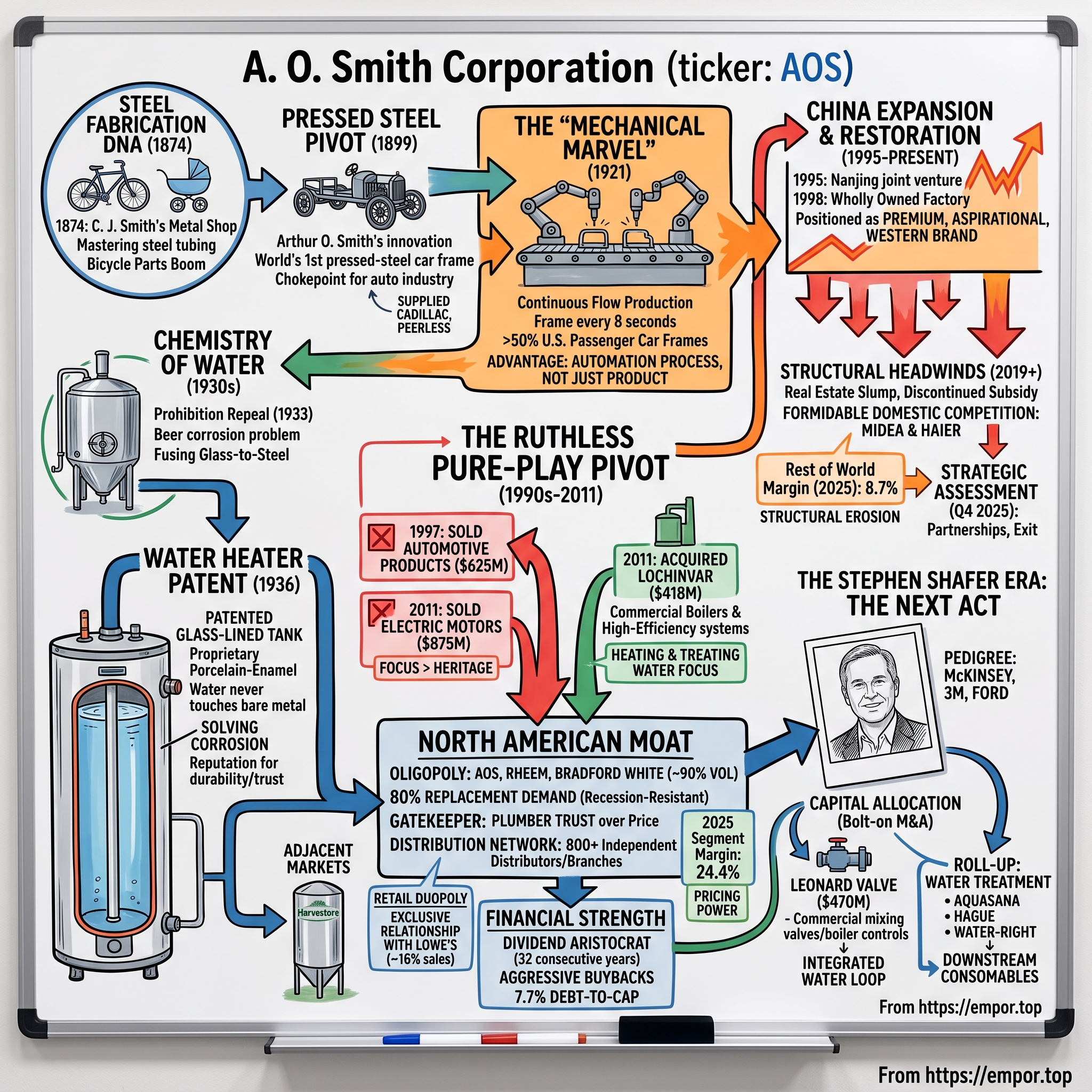
A. O. Smith Corporation: The Engineering of an Industrial Moat
I. Introduction & Episode Roadmap
Walk into any American basement or utility closet and you will find it: a tall steel cylinder, humming quietly, doing the least glamorous job in the house. It heats water. Nobody thinks about it until the morning it fails, and the shower runs cold, and suddenly it is the most important appliance a family owns. That silent cylinder is the beating heart of a company that has outlasted three industrial revolutions, two world wars, and the near-total reinvention of American manufacturing.
Here is the puzzle. How does a firm that began in 1874 making metal parts for baby carriages and bicycles in Milwaukee, Wisconsin, end up a $10-billion-plus water-technology company, throwing off cash with the reliability of a utility and raising its dividend for 32 straight years?1 The obvious answer — "they got lucky selling a boring product everybody needs" — is only half right. Plenty of companies sell boring, essential products and earn boring, unremarkable returns. A. O. Smith does not. In 2025 its North America business converted nearly a quarter of every sales dollar into operating profit, a margin that would make a branded consumer-goods executive blush.2
The thesis of this story is that A. O. Smith (NYSE: AOS) is a case study in something rarer than a good product: a durable, structural advantage in an industry most investors find too dull to examine. It sits inside a consolidated, non-discretionary, and genuinely quiet market. When a water heater bursts, the homeowner does not comparison-shop; they call a plumber and take whatever gets hot water flowing by nightfall. That single behavioral fact — repeated millions of times a year — underwrites a business with exceptional returns on capital and a balance sheet carrying almost no net debt.2
But a neutral observer has to hold two ideas at once. The North American engine is a fortress. The rest of the empire is not. The company's once-glittering China business, long its growth story, has become its problem child, and in early 2026 management was openly conducting a "strategic assessment" of what to do with it.3 A new chief executive, only in the chair since mid-2025, was already deploying nearly half a billion dollars on his first big acquisition.4 The safe, sleepy dividend aristocrat is, on closer inspection, a company at an inflection point.
There is one more layer to the puzzle worth flagging before we begin, because it colors everything. A. O. Smith is not a widely-held company in the ordinary sense. A dual-class structure hands effective control to the founding family through a voting trust, which means the people running the business answer to owners who measure time in decades, not quarters.18 For a certain kind of investor that is a feature — it is arguably why the company could make the patient, unpopular pivots that define its history. For another kind of investor it is a governance flag. Both readings are legitimate, and we will return to them. What it means for this story is that A. O. Smith has been able to behave less like a public company chasing the next print and more like a family enterprise stewarding a franchise. That temperament is the connective tissue running from a Milwaukee metal shop in the 1870s to a half-billion-dollar acquisition in 2026.
Here is the road we will travel:
- The Steel Fabrication DNA — from C. J. Smith to Arthur O. Smith's pressed-steel automobile frame and the legendary "Mechanical Marvel."
- The Chemistry of Water — how beer-tank technology led to the glass-lined water heater patent of 1936.
- The Ultimate Pivot — how management ruthlessly shed its historic auto-frame and electric-motor businesses to become a pure-play water company.
- The North American Moat — inside the oligopoly, the contractor gatekeeper, and the wholesale channel.
- The China Expansion and Retrenchment — the premium-brand playbook in 南京 Nanjing and the hard reckoning that followed.
- The Next Act — new leadership, the Leonard Valve acquisition, and the roll-up of water treatment.
Let us start where every good origin story starts: with a father, a son, and a piece of steel nobody thought could be bent.
 Subscribe on LinkedIn
II. The "Pressed Steel and Automation" Legacy (1874–1930s)
Charles Jeremiah Smith was a machinist, not a visionary, and in 1874 he opened a small metal shop in Milwaukee to make hardware for baby carriages.5 It was unremarkable work. But Smith had a knack for a specific craft — forming sheet steel into light, strong tubing — and as the 1890s bicycle craze swept America, that skill turned C. J. Smith and Sons into one of the largest bicycle-parts makers in the country.5 The company's entire competitive identity was already forming: it did not invent the bicycle, it figured out how to fabricate steel better and cheaper than anyone else.
The real inflection came from his son. Arthur Oliver Smith looked at the infant automobile industry and saw that carmakers were bolting their engines and bodies onto heavy, brittle frames made of structural iron. In 1899 Arthur developed the world's first pressed-steel automobile frame — lighter, more flexible, and far cheaper to produce at volume than the cast-iron alternative.6 This was the pivot the whole company would spend a century echoing: take a materials-and-fabrication competence honed in one dying business and aim it at a bigger, faster-growing one.
Before Ford, there were the luxury makers. A. O. Smith supplied pressed-steel frames to the Peerless Automobile Company, to Cadillac, and to a roster of early carmakers who quickly discovered that a lighter, more resilient frame was not a luxury but a competitive necessity.5 The company had, almost by accident, positioned itself at the chokepoint of an exploding industry — it did not build cars, it built the thing every car was built on.
The customer that changed everything was Henry Ford. Ford's obsession with mass-producing an affordable car required frames by the tens of thousands, and A. O. Smith won that business.5 Consider the bind this created. Ford's ambitions for the Model T were essentially unlimited, and no manufacturer forming frames one at a time by hand could hope to keep pace. A. O. Smith had two choices: turn the business away, or reinvent how metal is fabricated. It chose reinvention. The company did something conceptually radical for the era: it stopped thinking about building frames one at a time and started thinking about building them in a continuous flow — a river of steel rather than a series of discrete objects. That mindset culminated in 1921 in a Milwaukee plant that engineers around the world traveled to see and nicknamed the "Mechanical Marvel."
The Mechanical Marvel was, for its time, science fiction made real. Air-powered riveters, automated steel-pressing lines, and a choreographed sequence of machines produced a finished automobile frame roughly every eight seconds — on the order of 10,000 frames a day — with almost no direct human labor on the line.6 By the late 1920s the plant helped A. O. Smith capture more than half of the entire U.S. passenger-car frame market.6 It is worth pausing on how audacious this was. Ford's moving assembly line is the one that entered the textbooks, but A. O. Smith had built something arguably more automated: a factory that ran itself.
There is a subtler point in the Mechanical Marvel than raw speed. The plant embodied a philosophy — that the durable advantage in manufacturing is not any single product but the process by which products are made. A frame is a commodity; a factory that produces frames every eight seconds with almost no labor is not. That distinction between the object and the process is the intellectual seed of everything A. O. Smith would later become, because a company that thinks of itself as a master of process can, in principle, apply that mastery to any object worth making.
For an investor reading this history a century later, the point is not nostalgia. It is that two competencies were being forged here that still define the company. The first is advanced automated steel fabrication at industrial scale — the ability to press, form, and weld steel vessels cheaper and more reliably than rivals. The second is relentless materials-science engineering — the willingness to re-purpose a hard-won process from a shrinking market into a growing one. Those two muscles, built to make car frames, were about to be pointed at something no one at the time associated with A. O. Smith at all: the chemistry of glass.
III. Prohibition, Beer, and the Chemistry of Glass-Lining (1930s–1950s)
In December 1933, the United States repealed Prohibition, and overnight the nation's breweries faced a delicious problem: they needed enormous quantities of storage, fast. Beer is corrosive and easily spoiled; wooden and copper tanks were expensive, hard to clean, and prone to contamination. Into this gap stepped A. O. Smith's engineers, who had been experimenting with a process that sounded almost alchemical — fusing a layer of liquid glass onto the inner surface of a large steel vessel. The glass shielded the steel from corrosion while giving the tank a sanitary, easily cleaned interior. Suddenly a steel-fabrication company had a chemistry advantage in the beer business.
The genuinely important insight came next, and it is the sort of lateral leap that separates durable companies from one-hit fabricators. Management realized the corrosion problem plaguing beer tanks was the exact same problem quietly destroying America's residential water heaters. A domestic water heater is a brutal environment: a steel tank holding pressurized, mineral-rich, chemically active tap water, heated and cooled day after day. Bare steel tanks rusted through and failed, sometimes within months. If glass could protect a brewery's tank, it could protect a family's.
In 1936 the company patented the glass-lined water heater, fusing a proprietary porcelain-enamel glass formulation to the inner steel tank so that water never touched bare metal.7 It helps to understand why this was so hard, because the difficulty is the whole reason it became a moat. Glass and steel expand at different rates when heated. Fuse them clumsily and the glass cracks the first time the tank cycles hot and cold, leaving the steel more exposed than before. Getting the chemistry right — a glass formulation that would bond to steel and flex with it across thousands of heating cycles without spalling — was a genuine materials-science achievement, not a manufacturing trick. It is the kind of know-how that lives in proprietary formulas and accumulated process knowledge, the sort a competitor cannot simply reverse-engineer from a teardown.
It is difficult to overstate how central this single idea would become. Everything A. O. Smith sells today still rests on the marriage of two competencies — precision steel fabrication and glass-to-steel chemistry — that were joined in that patent. The glass lining was not a feature; it was the reason a plumber could trust the tank not to leak, and trust, as we will see, is the entire game in this industry.
The timing could hardly have been better. After the Second World War, American families poured into new suburbs, and the suburban home came with an appetite for reliable, on-demand hot water that the prewar housing stock never had. A. O. Smith scaled water-heater production into a genuine consumer business, using the glass lining as its quality signature — the thing that let it charge a little more and last a little longer than a bare-steel competitor.
The economics of that quality premium are worth naming plainly, because they are the same economics that drive the business today. A glass-lined tank costs a bit more to build and lasts meaningfully longer than bare steel. That combination lets the maker charge more and build a reputation for durability — and in a product a homeowner replaces perhaps once a decade and never thinks about in between, reputation for durability is nearly the entire purchase decision. A. O. Smith was, in effect, selling peace of mind wrapped around a steel cylinder. That is a far better business than selling steel cylinders.
The company also stretched the glass-fused-to-steel process into adjacent industrial and agricultural markets. In 1949 it launched the deep-blue Harvestore silo, a glass-lined structure that sealed silage away from oxygen and became an icon of the American farm landscape for decades.5 For a time the Harvestore was as recognizable a symbol of A. O. Smith as any water heater — proof that the glass-to-steel process was a platform, not a single product. That platform logic, of taking one hard-won capability into every market where corrosion is the enemy, is a pattern the company would return to again and again.
So by mid-century the company had, remarkably, reinvented itself once already — from a maker of car frames into a diversified materials-science firm spanning water heaters, industrial tanks, and farm silos. What it had not yet done was face the harder question every industrial conglomerate eventually confronts: which of these businesses actually deserves the company's capital, and which should be sold before they drag the whole enterprise down? That reckoning would take another forty years, and when it came, it would be ruthless.
IV. The Ruthless Pure-Play Pivot (1990s–2011)
By the 1980s and 1990s, A. O. Smith looked like exactly what management-science professors warned against: a sprawling industrial conglomerate whose crown-jewel legacy business was quietly rotting. The automobile frame — the product that built the company, the reason for the Mechanical Marvel — was being engineered out of existence. Carmakers were abandoning body-on-frame construction for lighter unibody designs, and the frames that remained had become a brutal, low-margin, capital-hungry commodity fought over by suppliers racing each other to the bottom.
There is a behavioral finance lesson buried in this moment. Most management teams — and most families — cannot bring themselves to sell the business that made them. The frame operation was not just a product line; it was the company's self-image, the source of a century of institutional pride, the reason engineers had once traveled to Milwaukee to gawk at the Mechanical Marvel. The sunk-cost instinct, the emotional attachment, the fear of the internal reaction — all of it pulls toward "just one more turnaround plan." A. O. Smith resisted that pull.
What management did next was genuinely counterintuitive, and it is the single most important strategic decision in the modern history of the company. Rather than defend the business that carried the family name for over a century, in April 1997 A. O. Smith sold its automotive frame operations — the Automotive Products Company — to Tower Automotive for roughly $625 million in cash.8 The unit made frames, frame components, engine cradles, and suspension modules for the North American car and truck industry — real, substantial businesses, not stubs being dumped.8 Read that again: the company chose to exit the identity it had held since Henry Ford was a customer, and to redirect that capital toward water. It takes a rare kind of institutional self-awareness to sell your own origin story while a buyer still values it highly.
That left the second problem: electric motors. Over the decades A. O. Smith had built a large, respectable electric-motor business, making the motors that spun inside air conditioners, pumps, and — usefully — its own water heaters. It was profitable. But it was also increasingly exposed to a flood of low-cost imported motors, and the pricing pressure was structural, not cyclical. A profitable business facing permanent margin erosion is exactly the kind of asset that quietly destroys shareholder value if held too long.
The year 2011 became the hinge on which the modern company turned, because management executed an exit and an entry almost simultaneously. First, the exit: A. O. Smith agreed to sell its Electrical Products Company to Regal Beloit for approximately $875 million — about $700 million in cash plus roughly 2.83 million Regal Beloit shares.9 (The stock component was a shrewd touch; it let A. O. Smith participate in the upside of the very consolidation it was stepping away from.) With that sale, the company severed its last major tie to its diversified industrial past.
Then, in the same year, the entry: A. O. Smith deployed about $418 million to acquire Lochinvar Corporation, the premier maker of high-efficiency commercial boilers and water-heating systems.[^10] This was not diversification — it was concentration. Lochinvar pushed A. O. Smith deeper into water, and specifically into the higher-margin, more engineered commercial side of water heating, where a hospital or a school buys an entire heating system rather than a single tank.
The symmetry of 2011 is almost too neat to be accidental, and it wasn't. Management sold a mature, margin-pressured business for roughly $875 million and, in the same window, spent about $418 million buying a growing, higher-margin one — recycling capital out of a business the market was commoditizing and into a business it could dominate. This is capital allocation as a discipline rather than an afterthought: the point of selling motors was never simply to raise cash, it was to redeploy that cash where returns were higher and more defensible. The Lochinvar deal also quietly changed the company's growth math, because commercial water heating and boilers carry more engineering content, stickier customer relationships, and better pricing than the residential tank that had been A. O. Smith's bread and butter.
Step back and the fifteen-year arc snaps into focus. Between 1997 and 2011, A. O. Smith sold the two businesses that had defined it for a hundred years and rebuilt itself around a single idea: heating and treating water. The analytical lesson is not merely "focus is good." It is that management repeatedly chose margin quality and durability over revenue and heritage — walking away from businesses that were still generating cash because it could see their competitive position eroding. That willingness to sell the past to fund a better future is the throughline of everything that follows. And what it bought was a seat at the head of one of the cosiest tables in American manufacturing.
V. The North American Moat: Structure, Channels, and Economics
Picture the scene most homeowners never see. In an unremarkable industrial park outside almost any American city sits a plumbing wholesale branch — think of a Ferguson counter — stacked floor to ceiling with water heaters. A plumber's van pulls up at 8 a.m., a technician walks in, grabs a 50-gallon gas unit off the rack, and is back out the door in fifteen minutes. No purchase order, no negotiation, no waiting. That mundane, invisible logistics ballet is where A. O. Smith's real moat lives — not in the product, but in the system that puts the product within arm's reach of the person who installs it.
Start with the market structure, because it is unusually favorable. The North American tank water-heater market is effectively a three-player oligopoly: A. O. Smith, the privately held Rheem Manufacturing (owned by Japan's Paloma), and the employee-owned Bradford White collectively control roughly 90% of market volume.10 Three rational competitors, high barriers to entry, and a product too heavy and too low-value-per-pound to ship economically from overseas — this is the kind of industry structure that produces pricing discipline rather than price wars.
The financial evidence backs that up. In 2025, A. O. Smith's North America segment generated $2,984.2 million in sales — more than three-quarters of the company's total — and $727.9 million in operating earnings, for a segment margin of 24.4%, up from 24.0% the year before.2 A near-25% operating margin on what is, at bottom, a steel tank is the single most important number in the whole A. O. Smith story. It tells you this is not a commodity manufacturer competing on price; something is protecting those economics. And note the direction: the segment held and even nudged its margin higher in 2025 even as residential water-heater volumes softened, with the mix carried by pricing actions and higher commercial water-heater and boiler volumes.2 A business that can raise price and lean on its higher-margin commercial mix to offset soft residential volume is, almost by definition, a business with pricing power.
Why does the margin persist? Because water heating in North America has a rare characteristic: the regulator, not just the market, keeps raising the technical bar. Successive federal energy-efficiency standards — the kind that periodically force higher minimum efficiency across the installed base — tend to help the incumbents. Each new standard makes the product a little more engineered, a little harder for a marginal player to build, and gives the established brands a reason to reprice the whole line upward as they roll out compliant models. What sounds like a cost of doing business is, in practice, a recurring excuse to raise price across a captive replacement base.
Several things are, and they compound. The first is demand that barely flinches in a recession. Roughly 80% of water-heater sales are replacements — a unit that has failed and must be replaced now.10 A homeowner with no hot water cannot postpone the purchase to next quarter or wait for a sale. That single behavioral fact turns what sounds like a cyclical building-products business into something closer to a consumables business with a recession-resistant volume floor. New construction adds cyclicality at the margin, but the replacement base is the ballast.
The second and deepest source of advantage is the contractor. This is a textbook case of what strategy writer Hamilton Helmer would call high switching costs, but the switching costs sit with the plumber, not the homeowner. The homeowner does not choose a brand; they call a plumber, and the plumber installs the brand he trusts. And plumbers are ferociously risk-averse for a rational reason: a water heater that leaks does not just mean a warranty claim, it means a flooded basement, ruined flooring, an angry customer, and a hit to the contractor's reputation and insurance. A brand that has never embarrassed him is worth more to a plumber than a brand that is 10% cheaper. A. O. Smith's ProLine, State, and Lochinvar lines are entrenched in those contractor habits — and habits, in a trade learned through apprenticeship, change slowly.
The third is the distribution channel itself. A. O. Smith reaches those contractors through a network of roughly 800 independent wholesale plumbing distributors operating thousands of local branches.10 Those branches carry deep local inventory of a heavy, bulky product so that a plumber can pick one up within hours. Replicating that dense, capital-intensive, locally-stocked network is a genuine barrier — it is precisely why a low-cost foreign entrant with a cheaper tank cannot simply parachute into the market. You cannot email a homeowner a water heater by nightfall.
Alongside wholesale sits a retail channel with its own quiet duopoly. A. O. Smith holds a large exclusive relationship with Lowe's, which on its own represents around 16% of total company sales, while Rheem occupies the equivalent position at Home Depot.11 That symmetry is telling: even the retail shelf, the one place a consumer might browse, has been carved into stable, brand-exclusive territories. A big-box retailer generally does not want two national water-heater brands fighting on the same aisle; it wants one reliable partner to manage the category, guarantee supply, and stand behind the warranty. Once that partnership is set, it tends to endure — which is a double-edged sword, as the concentration risk it creates will show up later in this story.
It is also worth noting what A. O. Smith does not have to do to sustain these margins: it does not run expensive national consumer advertising campaigns, does not fight for fickle brand loyalty, and does not depend on any single hit product. Its marketing budget effectively flows to contractors and distributors — training, availability, warranty support, technical service — the audiences that actually decide which brand gets installed. That is a structurally cheaper and more durable way to defend a market than shouting at consumers who will forget your name the moment their shower runs hot again.
Add it up and you have the anatomy of the moat: a consolidated structure, non-discretionary replacement demand, a risk-averse gatekeeper who prizes reliability over price, and a distribution web that is expensive to build and easy to defend. The obvious question a skeptic should ask is whether this fortress can grow. Mature North American tank volumes track roughly with GDP and household formation; you do not double a market like this. Which is exactly why, decades ago, management went looking for growth on the other side of the world.
VI. The China Expansion and the Reality of Restructuring
In the mid-1990s, A. O. Smith made a bet that looked, for nearly twenty years, like one of the smartest international expansions any American industrial company ever executed. It entered China in 1995 through joint ventures, then bought out its local partner in 1998 to establish a wholly owned factory in 南京 Nanjing.5 The genius of what followed was in the positioning. Rather than fight cheap domestic brands in a race to the bottom — the very trap it had fled in auto frames and motors — A. O. Smith did the opposite.
Under long-time China president Wei Ding, the company positioned itself as a premium, aspirational, ultra-reliable Western brand, and it engineered products specifically for Chinese urban life: compact water heaters sized for apartments, refined aesthetics, and multi-stage reverse-osmosis water-filtration systems tuned to a market where tap-water quality was a live consumer anxiety. This last point mattered enormously. In a country where many households did not trust what came out of the tap, a Western brand promising clean, safe water was selling something closer to health insurance than an appliance — and health insurance commands a premium. For a rising middle class, an A. O. Smith unit in the kitchen or bathroom became a small, visible statement of having arrived.
The playbook was, in its way, the mirror image of the North American one. In the United States, the moat was invisible plumbing and contractor trust; the consumer never even saw the brand. In China, the moat was the brand itself, marketed directly to aspirational consumers who chose A. O. Smith on purpose and paid up for the badge. For nearly two decades this worked spectacularly. China became the company's high-octane growth engine, delivering fast-growing, high-margin revenue at a time when the North American core was maturing, and it gave investors a genuine growth story to attach to an otherwise sleepy industrial. That is precisely what made the eventual reversal so painful: China was not a side bet, it was the growth thesis.
Then the music slowed. Beginning around 2019 and intensifying through the early 2020s, A. O. Smith China ran into a wall of structural headwinds that no amount of premium branding could fully offset. A persistent, multi-year slump in Chinese real estate — the ultimate driver of appliance demand — sapped volumes. Consumer confidence weakened, and a government subsidy program that had propped up appliance purchases was later discontinued.3 Worse, the local competition was no longer cheap and crude. Technically formidable domestic champions like 美的集团 Midea Group and 海尔集团 Haier Group had climbed the quality ladder and could now credibly contest the premium tier that had been A. O. Smith's private preserve.
One bright spot inside the gloom deserves mention: India. Grouped within Rest of World, A. O. Smith's Indian business has been growing off a smaller base, riding the same middle-class-formation and water-quality dynamics that once powered China — a reminder that the premium-brand-in-an-emerging-market playbook is not dead, just no longer working in the country where it was perfected. Whether India can grow large enough, fast enough, to offset a shrinking China is one of the quieter swing factors in the story.
The financial reckoning is stark when set beside North America. In 2025 the Rest of World segment — overwhelmingly China, with a growing India business — generated $880.4 million in sales but only $76.4 million in operating earnings, an 8.7% margin.12 Put the two segments side by side and the story writes itself: the same company earns 24.4% in North America and 8.7% in the rest of the world.2 That gap is not a rounding error; it is the difference between a fortress and a business fighting for its life. Management had already taken $11.3 million in severance and restructuring charges in 2024 simply to size the China operation down to the smaller market it now faces.12
There is also a subtler competitive dynamic at work, worth spelling out because it reframes the whole China chapter. A. O. Smith's Chinese success was built on a specific arbitrage: a Western brand premium in a market where local players could not yet match it on quality or cachet. Arbitrages close. As 美的集团 Midea and 海尔集团 Haier — and a long tail of capable domestic brands — climbed the technology curve, the quality gap that justified the premium narrowed, and Chinese consumer nationalism gave home-grown brands a tailwind that a foreign name could not enjoy. The premium-brand playbook did not fail because A. O. Smith executed it poorly; it faded because the conditions that made it work — a quality gap plus a trust deficit in local brands — eroded. That is a more sobering diagnosis than mere cyclical weakness, because cyclical weakness reverses and structural erosion does not.
What makes this chapter genuinely interesting — and a test of management credibility — is that leadership stopped pretending restructuring alone was the answer. On the Q4 2025 earnings call, new CEO Stephen Shafer described an ongoing "strategic assessment" of the China business, including "the quality of discussions we are having with a number of potential partners," while declining to prejudge the outcome.3 His most candid line cut to the heart of it: over long periods, "the answer in China is not continuing to restructure and cut costs" and not be able to grow.3 Management guided that 2026 China sales would decline mid-single digits, and pointedly excluded any outcome of the strategic assessment from that outlook.3 Shafer also framed the pace deliberately — moving with urgency because employees and customers deserve certainty, but "thoughtful to do it in the right way."3 That is the language of a management team preparing stakeholders for a structural decision rather than another round of cost-cutting.
For a neutral observer, this is the right posture — and also an admission. Refusing to throw endless capital at a structurally shrinking market is disciplined. But the very existence of a "strategic assessment" with outside "partners" is management conceding that the crown jewel of its old growth story may need to be restructured, partnered, or exited outright. Investors pushing analysts on whether China is permanently impaired are asking the correct question, and as of mid-2026 the honest answer was: not yet resolved. That unresolved question is precisely the backdrop against which a new chief executive had to define his own agenda — and he wasted no time doing it.
VII. The Stephen Shafer Era: Capital Allocation & M&A Playbook
Succession at a family-influenced dividend aristocrat is usually a slow, choreographed affair, and A. O. Smith's was no exception — until the new man moved fast. On April 25, 2025, the board announced that long-time chairman and CEO Kevin J. Wheeler would step back to executive chairman effective July 1, 2025, with Stephen M. Shafer taking over as president and chief executive — the 11th CEO in the company's then-151-year history.13 A year later, effective July 1, 2026, Wheeler retired from the executive-chairman role and Shafer added the chairman title, consolidating the top of the house.14
Shafer's résumé is worth dwelling on, because it signals how the board wants the next chapter run. He came up through McKinsey as an associate principal, spent time as a manager at Ford, and then logged fourteen years at 3M — a company practically synonymous with operational discipline and materials science — where his last role was president of its Automotive and Aerospace Solutions division, including stints in China.13 That is a very particular pedigree: strategy consulting, disciplined operations, materials-science depth, and direct China experience. For a company whose two open problems are squeezing more out of a mature North American core and deciding the fate of China, it is hard to design a more on-the-nose hire.
There is a governance signal in the pace of the handoff, too. Wheeler did not vanish; he stepped to executive chairman for a year, staying close to M&A, investor relations, and executive-talent development, before retiring from that role and letting Shafer consolidate the chairman title in mid-2026.1314 For a family-controlled company, that measured, overlapping transition is characteristic — continuity prized over rupture. It also means Shafer inherited both a mandate and a mentor, and it puts a spotlight on whether the new CEO uses his fresh authority to make the hard China call his predecessor deferred.
His first major act as CEO put the playbook on display. In November 2025, A. O. Smith agreed to acquire Leonard Valve Company, and the deal closed on January 6, 2026, for $470 million in cash — roughly $412 million after adjusting for estimated tax benefits, funded with borrowings under a new credit agreement.154 Founded in 1911 and based in Cranston, Rhode Island, Leonard Valve makes commercial water-temperature control valves, thermostatic mixing systems, digital monitoring devices, and — through its Heat-Timer line — boiler controls, selling to hospitals, schools, and industrial and commercial customers.4 Management framed the price as approximately 12x forecast 2026 EBITDA, or roughly 10x after tax benefits.15
The strategic logic is the entire point, and it rhymes with Lochinvar. Picture the mechanical room of a large hospital: a bank of boilers, a web of pipes, and a set of valves that must blend scalding water down to a precise, safe temperature before it reaches a patient's sink — too hot and you scald, too cool and you risk bacterial growth like Legionella. That temperature control is not a trivial afterthought; in a hospital it is a regulated safety function. A. O. Smith already sells the boilers (Lochinvar) and the boiler controls (Heat-Timer); Leonard Valve adds the mixing valves and digital temperature controls that regulate water once it leaves the boiler. Bolt them together and A. O. Smith can sell a school or hospital a complete, integrated water-management loop — heat it, control it, mix it, monitor it — rather than a single box.
The financial elegance is that each piece plugs into the same commercial distribution relationships and the same specifying engineers the company already reaches, so the acquisition deepens wallet share among existing customers rather than chasing new ones — the cheapest, lowest-risk growth there is. A skeptic should still ask whether ~12x forward EBITDA is a full price for a business of Leonard Valve's size,15 and whether "integrated water loop" is genuine cross-selling synergy or a slide-deck phrase. But the shape of the deal — adjacent, on-platform, commercial-focused, margin-accretive — is exactly the disciplined pattern the company has rewarded shareholders for before, and it is a coherent way to buy growth in commercial water that the maturing residential tank market cannot supply.
The same instinct drives A. O. Smith's second, quieter growth engine: rolling up the fragmented North American water-treatment industry — the softeners and filtration systems that sit downstream of the heater. Because tank volumes grow only at a GDP-like rate in mature markets, management has spent a decade using cash flow to buy its way into a faster-growing adjacency. The trail of deals is deliberate: Aquasana in 2016 (about $87 million, roughly 2x sales),[^17] Hague Quality Water in 2017, Water-Right in 2019 (about $107 million), Atlantic Filter in 2022, and Impact Water Products in 2024.[^18] It has also bought scale in tank manufacturing itself, acquiring the Canadian water-heater maker Giant Factories in 2021 to deepen its North American footprint.[^18] None of these is enormous. Collectively they are an attempt to manufacture organic growth where the core market offers little.
The strategic logic is sound — water treatment is a larger household penetration opportunity than water heating, it recurs (filters and softener media are consumables), and A. O. Smith can push these products through the very plumbing and retail channels it already dominates. But a neutral observer should hold the strategy to a hard standard. Whether the roll-up is truly compounding value — versus simply buying revenue at ever-higher multiples and calling the result "growth" — is one of the key things a skeptical investor should keep score on. Water treatment is a crowded, fragmented, and brand-fragmented category; a string of small deals can flatter the top line while quietly consuming capital and management bandwidth, and the returns on these acquisitions have not been disclosed with the granularity that would let an outsider verify the thesis. The burden of proof sits with management, and it is not yet fully discharged.
Underpinning all of it is a balance sheet built like a bank vault. A. O. Smith ended 2025 with a total debt-to-capitalization ratio of just 7.7%, and as a Dividend Aristocrat with 32 consecutive years of increases it directs a meaningful slice of cash flow to dividends while buying back stock aggressively.161 The pattern of capital returns is itself a tell about how management thinks: a steadily rising dividend signals confidence in the durability of the cash flows, while opportunistic buybacks — funded by the free cash the asset-light-ish tank business throws off — shrink the share count and quietly lift per-share results even when the underlying business grows slowly. This is the financial machinery of a mature compounder: modest organic growth, high margins, heavy cash conversion, and disciplined return of that cash to owners.
The conservatism is real and, for once, not merely rhetorical: even funding the Leonard Valve deal with fresh borrowings barely dented the leverage. The trade-off worth naming is that a fortress balance sheet is also, arguably, an under-optimized one — a company earning 24% margins with almost no debt is leaving financial firepower unused, which is a luxury shareholders tolerate precisely because someone with a very long horizon is steering. An activist would look at that pristine balance sheet and see lazy capital: room to lever up, buy back far more stock, or make a transformational acquisition. Management's answer, implicitly, is that optionality and survivability are worth more than squeezing the last point of return — a defensible view, but one that only a controlled company can hold so comfortably. That someone doing the holding has a name, and a voting trust.
VIII. The Skeptical-Investor Stress Test
Every great business eventually attracts a great skeptic, and A. O. Smith's arrived in the spring of 2019. On May 16, 2019, the short-seller J Capital Research published a report on the company as part of its Clunker series, titled "In Hot Water," aimed squarely at the crown jewel — the fat-margined China business.17 For a stock that had spent years being valued on the durability of its Chinese growth, it was a direct strike at the heart of the bull case.
J Capital's allegations were specific and, if true, serious. The report claimed A. O. Smith was propping up its China results through an undisclosed distributor-financing arrangement involving an entity called "Jiangsu UTP Supply Chain," effectively channel-stuffing — pushing product into distributors to inflate reported sales and margins while masking a real slowdown in end demand. It further questioned whether the cash A. O. Smith reported holding in China was genuinely available, suggesting some of it was restricted or tied up in loans to those very distributors.17 Channel-stuffing and questionable cash are the two accusations most likely to detonate an industrial company's credibility, because they attack the reliability of both the income statement and the balance sheet at once.
A. O. Smith's response was fast and unambiguous. The company issued a detailed rebuttal, "A. O. Smith Sets the Record Straight," arguing that Jiangsu UTP was a legitimate, independent third-party logistics provider rather than a captive financing vehicle, and defending both its revenue recognition and the accessibility of its cash.17 For a neutral observer, the swiftness and specificity of the rebuttal mattered: management engaged the substance rather than hiding behind boilerplate.
The verdict, delivered by time rather than by press release, largely favored the company. In the years that followed, A. O. Smith repatriated substantial cash from China to the United States to fund domestic buybacks and dividends — a hard-to-fake demonstration that the money was, in fact, real and movable.16 Cash that can be dividended out of a country and handed to shareholders is, almost by definition, not trapped in phantom distributor loans. The short thesis on accounting fraud did not gain lasting traction.
Here, though, intellectual honesty requires a subtle point that neither the bulls nor the short-seller like to hear. J Capital was wrong about fraud but directionally early about the China business itself. The demand slowdown the report insinuated did, in the fullness of time, arrive — just for ordinary structural reasons (a property bust, a stronger local competitive set) rather than fabricated ones. This is the recurring irony of well-timed short reports: the specific allegation can be false while the underlying anxiety proves prescient. The accounting was clean; the growth story really was fragile. An investor who dismissed the entire report because the fraud claim failed would have missed the more important signal — that China's contribution was more cyclical and more contestable than the bull case assumed.
Myth versus reality. It is worth pausing to fact-check the consensus narrative that grew up around A. O. Smith in its glory years — the idea that it was a "China growth story with a stable American cash cow attached." The reality turned out to be closer to the inverse. The American business, long dismissed as boring and ex-growth, proved to be the crown jewel: high-margin, defensible, and remarkably steady. The China business, celebrated as the engine, proved to be the volatile, contestable, and ultimately structurally challenged piece. The market's error was not in valuing the two segments, but in mislabeling which one was the safe compounding asset and which was the speculative bet. Boring, it turns out, was beautiful; exciting was fragile.
The episode also spotlights the governance structure that lets A. O. Smith weather such attacks — and that a governance-minded critic would scrutinize. The company operates a dual-class share structure in which the Smith family voting trust holds roughly 96.9% of the Class A common stock and about 66.8% of total combined voting power.18 In practice, no hostile activist can force the company's hand; management answers to a family that thinks in decades. The bull reading is that this insulation is what allowed the ruthless, patient pivots — selling auto frames, exiting motors, right-sizing China — that a quarter-driven board might have flinched from. The bear reading is that concentrated control with a fraction of the economic stake is a permanent check on accountability: minority holders cannot vote for change, and must simply trust that the family's interests stay aligned with theirs. Both readings are true at once, which is exactly why it belongs in a stress test rather than a sales pitch.
IX. Playbook: Business & Investing Lessons
Strip away the 150 years of steel and glass and a handful of transferable lessons remain — the kind a long-term investor can carry to the next company they analyze.
Lesson 1: Pure-play focus beats conglomeration — when you sell early. The instructive part of A. O. Smith's transformation is not that it focused, but when. It sold auto frames and electric motors while those businesses were still profitable, because management could see their competitive position eroding. Exiting a good-enough business before it becomes a bad one is far harder, and far more valuable, than cutting a business that is already bleeding. The reward was a structural re-rating: a cyclical subcontractor became a specialized champion with a permanently higher margin profile and, with it, a permanently higher valuation.
Lesson 2: Control the gatekeeper, not the consumer. In residential and commercial water heating, the plumber is the real customer, and A. O. Smith wins by owning that relationship rather than by outspending rivals on consumer advertising. The lesson generalizes: in any market with a trusted intermediary between the maker and the end user — contractors, pharmacists, financial advisors, specifying architects — the durable advantage belongs to whoever the intermediary trusts, not to whoever the end user has heard of. Trust earned through never failing is cheaper to maintain than brand awareness bought with marketing dollars, and it compounds.
Lesson 3: The best acquisitions expand the core platform. Lochinvar (2011) and Leonard Valve (2026) are the template: premium, adjacent brands that plug directly into distribution the company already owns, letting it sell more to the customers it already serves. The contrast with "diworsification" — buying unrelated businesses in the name of growth — is the whole point. On-platform M&A raises the odds that the acquirer actually realizes the synergies it underwrites, because it already understands the customer, the channel, and the product.
Lesson 4: Capital allocation is mostly the discipline to stop. The China chapter is the real test of management quality, precisely because it is unresolved and painful. When a former growth engine hits a structural downturn, the tempting move is to keep spending to defend volume — to protect the story you have been telling investors for years. A. O. Smith's willingness to run a formal strategic assessment, take restructuring charges, and openly discuss partners or exit — rather than chase empty volume — is the behavior a shareholder should want, even though it means admitting a prized asset has lost its shine. Knowing when to stop investing is as important as knowing when to start, and it is far rarer, because stopping requires publicly conceding that a past thesis was wrong.
Lesson 5: A boring market can be a great market — if it is structurally protected. Perhaps the deepest lesson is the one investors most often miss because it is unglamorous. A market does not need to be growing quickly to be wonderful. It needs to be defensible, non-discretionary, and consolidated enough to sustain rational pricing. A. O. Smith's North American business grows slowly and will never be exciting, yet it compounds shareholder value year after year because its economics are protected by trust, distribution, and replacement demand. The temptation — the one that hurt the company in China and could hurt it again — is to chase a faster, sexier growth market and discover it lacks the very protections that made the boring business great. Growth without a moat is a trap; a moat without much growth is a compounder.
None of these lessons, though, guarantee the next decade looks like the last. So it is worth wargaming, coldly, both what could keep this machine compounding and what could break it.
X. Analysis: Risk Radar & Bull vs. Bear Case
Risk Radar — the mechanisms, not the buzzwords.
The first and most genuinely strategic risk is decarbonization, and specifically the heat pump. To see why it matters, understand how a conventional water heater works: it makes heat, either by burning gas or running current through a resistance element, and dumps that heat into the water. It is a simple, cheap, high-margin device, and A. O. Smith's advantage in it — the glass lining, the fabrication scale, the contractor trust — is a century deep. A hybrid heat-pump water heater (HPWH) works on a completely different principle: instead of making heat it moves heat, pulling warmth out of the surrounding air with a compressor and refrigeration loop, exactly like a refrigerator running in reverse. It is two to three times more energy-efficient, which is why regulators and electrification advocates love it.
Here is the strategic problem. The value and the technical difficulty in an HPWH sit in the compressor and refrigerant loop — not in the glass-lined tank where A. O. Smith is strongest. If mandates or incentives push the market toward heat pumps faster than expected, the center of gravity of the product shifts toward refrigeration expertise, which is the home turf of HVAC giants like Daikin or Carrier. Those companies make millions of compressors a year and could, in principle, encroach on a market A. O. Smith has had largely to itself. A. O. Smith does sell heat-pump models and is not standing still, but the honest framing is that this transition partially neutralizes its inherited advantages and invites in competitors who are stronger precisely where the product is heading. The mechanism to watch is not "green regulation" in the abstract, but whether the value in a water heater migrates from the tank to the compressor — and how quickly.
The second is customer concentration, and here the numbers are pointed. The top two North American customers — Lowe's at roughly 16% and Ferguson at roughly 12% — account for about 28% of total net sales, and the top five for roughly 41%.11 That is real leverage in the hands of a few buyers. A decision by Lowe's to reallocate shelf space, or a hard renegotiation of wholesale margin by a distributor of Ferguson's scale, would hit the income statement directly. The moat protects A. O. Smith from foreign entrants; it does less to protect it from its own biggest customers. The counterargument — and it is a fair one — is that the relationship runs both ways: Lowe's needs a reliable, in-stock, warranty-backed water-heater partner as much as A. O. Smith needs the shelf, and switching a national category partner is disruptive for the retailer too. But mutual dependence is not the same as safety, and a concentration this high is a legitimate item on any bear's ledger.
The third is the China structural drag already dissected: if the Chinese property sector stays depressed for years, further write-downs or a costly exit could weigh on consolidated results and management attention. There is also an execution risk hidden inside the "strategic assessment" itself — a partnership or divestiture of a business the company built from scratch over thirty years is delicate, and a botched or fire-sale exit destroys value just as surely as clinging on does. The fourth risk is prosaic but persistent — steel. Hot-rolled steel is the single largest input into a tank, and a sharp price spike compresses margins in the window before price increases can be pushed through the wholesale channel. It is a timing risk more than a permanent one — the company has repeatedly shown it can pass steel inflation through, just with a lag — but the lag is real, it recurs, and in a bad quarter it is exactly what turns a beat into a miss.
The Bull Case. Read through the lens of Porter's five forces, the North American business is about as well-defended as an industrial business gets. Rivalry is muted by a rational three-player structure; the threat of new entrants is blunted by the capital-intensive local distribution web and the contractor's trust; buyer power is real but partly offset by the non-discretionary, must-have-it-today nature of replacement demand; supplier power is limited to input-cost timing; and there is no close substitute for hot water. In Hamilton Helmer's 7 Powers vocabulary, A. O. Smith holds at least two clear powers — switching costs (lodged in the contractor's habits and risk-aversion) and cornered resource / scale economies (the distribution density and brand entrenchment that a new entrant cannot cheaply replicate). Layer on an 80% replacement floor, a 7.7% debt-to-cap balance sheet, 32 years of dividend increases, and a new CEO whose 3M-and-McKinsey pedigree is tailor-made for squeezing a mature core and integrating bolt-ons, and the case for durable compounding is coherent.161
The Bear Case. The mirror image is equally coherent. Strip out China and the growth story thins: mature North American tank volumes are roughly flat, so consolidated growth leans heavily on price increases and a steady drip of small acquisitions — neither of which is guaranteed to compound indefinitely. Pricing power is real but not infinite; push it too hard and you invite either private-label substitution at the retail shelf or a more aggressive posture from the two rational competitors on the other side of the oligopoly. The Rest of World segment is, on the evidence, structurally impaired, and no one yet knows the cost of fixing or exiting it. And the one place the market could grow quickly — the heat-pump transition — is precisely where A. O. Smith's traditional advantages transfer least well and where deep-pocketed HVAC players are most dangerous. A bear would argue you are paying a premium multiple for a company whose fortress is fully built, whose fastest-growing end market invites stronger competitors, and whose remaining growth options each carry a meaningful asterisk. The unresolved governance question — a controlling family with a fraction of the economic interest — sits underneath all of it as a reason minority holders cannot force a change if the case deteriorates.
The most intellectually honest synthesis is that the bull and bear are arguing about different time horizons. Over the next few years, the North American moat is almost certainly intact and the cash flows are almost certainly durable — the bull wins the near term. Over the next decade, the questions the bear raises — China's terminal value, the heat-pump transition, the ceiling on price-led growth — are genuinely open, and the answers are not yet knowable from the outside. A neutral observer does not resolve that tension; the observer's job is to make sure both halves of it stay in view.
A word on management credibility. Judged by behavior over time rather than rhetoric, the record is mostly reassuring with one open question. On the positive side of the ledger: the company has done what it said it would across multiple decades — it promised focus and delivered two clean, well-priced divestitures; it promised disciplined bolt-on M&A and has largely stuck to adjacent, on-platform deals rather than empire-building; and it has raised the dividend for 32 consecutive years without the balance-sheet stress that usually eventually breaks such streaks.1 When challenged by a short-seller, management engaged the substance and was later vindicated on the facts. The narrative has been consistent across filings and calls. The open question is China: the willingness to name the problem honestly on the Q4 2025 call is a credibility positive, but the assessment is unresolved, and how management ultimately handles the exit or partnership — the price it accepts, the write-downs it takes, the candor it shows — will be the real test of this leadership team, and specifically of a CEO barely a year into the job.3
The KPIs that actually matter. An investor does not need to track everything; three numbers carry most of the signal. First, North America segment margin — the 24.4% mark is the proof of pricing power, and any sustained slippage would be the earliest sign the moat is leaking.2 Second, Rest of World margin and the resolution of the China assessment — whether restructuring (or a partnership/exit) stabilizes profitability above single digits, or whether the drag deepens.123 Third, water-treatment and commercial growth as a share of the mix — the tangible test of whether the Leonard Valve and treatment roll-ups are genuinely manufacturing organic growth, or merely buying revenue to paper over a flat core. Watch those three, and you are watching the real business.
XI. Epilogue & Outro
There is a certain poetry in a company that has spent a century and a half making the same essential promise in different forms: that steel, properly engineered, will not fail you. It began with the promise that a pressed-steel frame would hold a Model T together at speed. It continued with the promise that a lining of glass would keep a tank from rusting through. Today it is the promise that when a family's water heater dies on a cold morning, a trusted brand will be sitting on a wholesaler's shelf a few miles away, ready to make it right by nightfall.
A. O. Smith is a masterclass in corporate longevity precisely because it never confused its products with its purpose. It sold the baby carriages, then the bicycles, then the car frames, then the motors, then the silos — shedding beloved businesses again and again — while carrying forward the two competencies that never went out of style: fabricating steel at scale and mastering the chemistry that protects it. That is how a 19th-century metal shop becomes a modern compounding machine. The through-line is not a product at all; it is a temperament — patient, unsentimental about the past, and willing to sell what it loves when the numbers say it should. A company culture that can do that repeatedly, across five generations of products, is itself a kind of durable asset, harder to copy than any glass formula.
But this is not a victory lap, and a neutral observer should resist the urge to write one. The fortress in North America is real and, for now, intact. The question marks — a structurally challenged China, a mature core that grows only with price and acquisition, and a decarbonization transition that could reshape the product itself — are equally real, and they are the story of the next decade, now in the hands of a CEO barely a year into the job. Whether Stephen Shafer's tenure is remembered as the era that extended the moat or the era that defended a peak is, as of this writing in mid-2026, genuinely unknown. What is knowable is that the same discipline that built this company — the willingness to sell the past to fund the future — is exactly the discipline it will need to navigate what comes next. For downstream readers, the primary record lives in the SEC filings, acquisition disclosures, and earnings transcripts cited below.
References
-
A. O. Smith Corporation Investor Relations Portal — A. O. Smith ↩↩↩↩
-
A. O. Smith Corporation Form 10-K, FY2025 — SEC, 2026 ↩↩↩↩↩↩
-
A O Smith (AOS) Q4 2025 Earnings Call Transcript — AOL/Motley Fool, 2026 ↩↩↩↩↩↩↩↩
-
A. O. Smith Completes Acquisition of Leonard Valve Company — PR Newswire, 2026-01-06 ↩↩↩
-
A.O. Smith Corporation — Encyclopedia of Milwaukee, University of Wisconsin-Milwaukee ↩↩↩↩↩↩
-
A.O. Smith: 150 Years — Supply House Times / BNP Media, 2024 ↩↩↩
-
A. O. Smith Corporation SEC Filings (EDGAR CIK: 0000091142) — SEC ↩
-
Tower Automotive Inc. Form S-3 (acquisition of A.O. Smith Automotive Products Company for $625 million) — SEC, 1997 ↩↩
-
A. O. Smith Reaches Agreement to Sell Electric Motor Division to Regal Beloit Corporation for $875 Million — A. O. Smith Corporation, 2011 ↩
-
A. O. Smith Corporation Form 10-K, FY2025 (business, markets, distribution) — SEC, 2026 ↩↩↩
-
A. O. Smith Corporation Form 10-K, FY2025 (customer concentration) — SEC, 2026 ↩↩
-
A. O. Smith Corporation Form 10-K, FY2025 (Rest of World segment) — SEC, 2026 ↩↩↩
-
A. O. Smith Announces Kevin Wheeler to Become Executive Chairman, Stephen Shafer Named President and Chief Executive Officer — PR Newswire, 2025-04-25 ↩↩↩
-
A. O. Smith Announces Kevin Wheeler Retirement; Stephen Shafer Named Chairman — ASPE Pipeline / A. O. Smith, 2026 ↩↩
-
A. O. Smith to Acquire Leonard Valve Company, a Leader in Water Temperature and Flow Solutions — PR Newswire, 2025-11-12 ↩↩↩
-
A. O. Smith Reports Third Quarter EPS of $0.94, a 15% Year-Over-Year Increase, and Updates Full Year Guidance — PR Newswire, 2025 ↩↩↩
-
J Capital Research Short Report Archive ("In Hot Water," Clunker series) — J Capital Research, 2019-05-16 ↩↩↩
-
A. O. Smith Corporation proxy and governance filings (Smith family voting trust), EDGAR CIK 0000091142 — SEC ↩↩
 LinkedIn
 WhatsApp
 Reddit
 Hacker News
 Email
Email Kindle
 RSS Feed
 Spotify
 Apple Podcasts
 Amazon Music
 Audible
 YouTube