Anthropic: The Story of the Safety-First Lab That Became a Trillion-Dollar Contender
I. Cold Open & Episode Roadmap (~10 min)
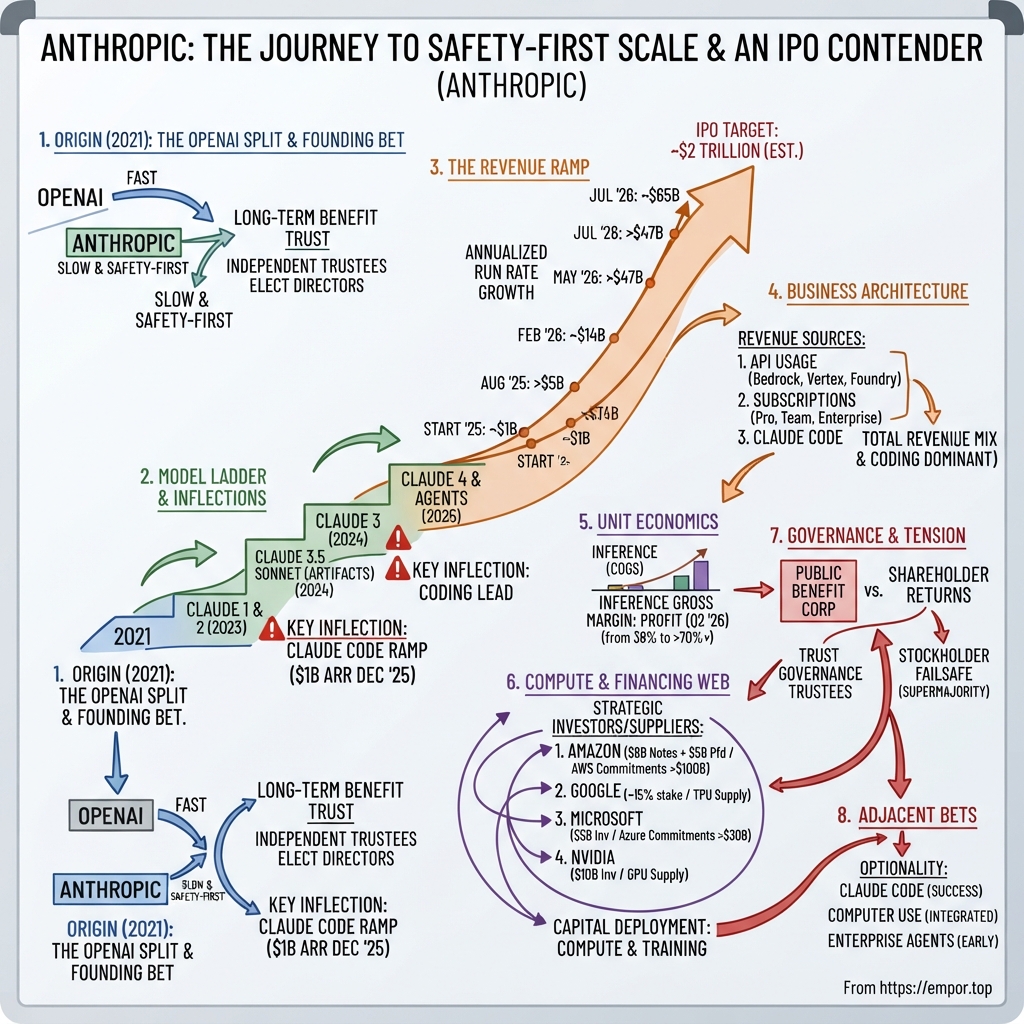
In mid-August 2026, a company that did not exist six years earlier told its investors that its annualized revenue run rate had reached $65 billion at the end of July. That was roughly seven times the figure of a year earlier. It also shared preliminary second-quarter revenue of about $11.5 billion, which it described as a fourteen-fold rise from the same quarter of 20254. The company had started 2025 with a run rate of roughly $1 billion and passed $5 billion by August 20255. By May 2026 the figure was above $47 billion, the month it raised $65 billion at a $965 billion post-money valuation6.
The founders are not the people anyone would have picked to build this machine. In 2021 they left OpenAI because they thought it was moving too fast and too commercially on a technology they believed could be dangerous. They incorporated as a public benefit corporation, wrote a governance trust into the charter to give a body of independent trustees the power to elect directors7, and published a policy committing them to hold back models that crossed defined danger thresholds. Five years later they run a business whose private valuation is close to $1 trillion and whose backers, press reports say, are looking for about $2 trillion in a public listing38.
That contrast sets up the question for a public-market investor, and it is not whether Claude is a good model. The question is which of two businesses Anthropic is. The first is an enterprise-software-like franchise with pricing power, a trusted brand, falling unit costs and a coding product so embedded in developer workflows that it behaves like a utility. The second is a capital-intensive model factory. On that reading its lead lasts months, it rents much of its compute from companies that are also its shareholders and its rivals, and it faces a price war with Google, OpenAI and a stream of open-weight models from China that cost far less.
The evidence supports parts of both descriptions. Revenue is real and enormous. Reported gross margins on inference have risen sharply. The company reported its first adjusted operating profit in the second quarter of 20269. Against that, the profit is preliminary and non-GAAP. A critic argued it coincided with discounted compute pricing10. Multi-year compute commitments exceed $130 billion with two cloud providers alone9. The most important customers include coding tools that are building their own models11.
The episode runs in this order: the founding split and the safety bet, the model ladder and the coding inflection, then the core of the underwriting, meaning how Anthropic makes money, what it costs, and what the market is paying for it. After that come the compute-financing web, capital deployment, management and governance, optionality, risks, and a bull-versus-bear stress test that ends with the few numbers that will decide the case after listing.
 Subscribe on LinkedIn
II. Origin: The OpenAI Split & the Founding Bet (2016–2021) (~15 min)
The Anthropic founding team first formed inside OpenAI. Dario Amodei, a Princeton-trained biophysicist, joined OpenAI in 2016 and rose to run research. His sister Daniela ran safety and policy teams. Around them was a group that included Jared Kaplan, a Johns Hopkins physicist whose work with Sam McCandlish formalized the "scaling laws" relationship between compute, data and model performance, along with Tom Brown, lead author of the GPT-3 paper, interpretability researcher Chris Olah, Ben Mann and Jack Clark12. They left in 2021 and founded Anthropic that year12.
The public explanation for the split has always been a disagreement about direction: how fast to commercialize, how much safety work to do before release, and what the 2019 Microsoft partnership meant for OpenAI's independence. The founders' shared insight was a paradox. If scaling laws held, then capabilities would arrive on a predictable schedule for whoever had the most compute. Staying out of the race would not slow it; it would only remove safety-focused people from the frontier. So the plan was to build frontier models, earn enough to stay at the frontier, and use that position to shape norms. That logic is essential to understanding everything that followed, because it lets Anthropic justify racing as a safety measure. It is also the logic a skeptic finds most convenient.
The corporate form reflected the tension. Anthropic incorporated as a Delaware public benefit corporation, which lets directors weigh a stated public benefit alongside shareholder returns. In 2023 it added the Long-Term Benefit Trust, a body of five independent trustees holding a special Class T stock that lets them elect a growing share of directors, reaching a board majority within four years7. Crucially for later investors, the design includes "failsafe" provisions that let large stockholder supermajorities amend the trust without trustee consent, with the required supermajority rising as trust power grows7. The trust constrains management, but it is not absolute.
Early money came partly from people drawn to the safety thesis, and partly from a source that became an embarrassment. The largest early check in the 2022 round came from Sam Bankman-Fried's orbit. After FTX collapsed, its bankruptcy estate held about 8% of Anthropic and in March 2024 sold roughly two-thirds of that stake for $884 million, with a unit linked to Abu Dhabi's Mubadala buying close to $500 million of the shares13. The episode matters less for the money than for what it shows. First, a safety-branded lab accepted capital from an ideologically aligned but poorly scrutinized source. Second, the unwinding put a Gulf sovereign fund on the cap table two years before Anthropic's own reversal on Gulf capital, discussed in Section VII.
Falsification pass: is "safety-first" an advantage or a slogan? The strongest evidence for it is behavioral. The brand helped Anthropic recruit researchers who might otherwise have stayed at OpenAI or Google. It also plausibly helped with regulated enterprise buyers, although that effect is hard to isolate from coding quality. The strongest disconfirming evidence is in Anthropic's own policy documents. Its Responsible Scaling Policy, first published in 2023 and repeatedly revised, was once presented as a commitment to pause development if safety measures could not keep pace. Version 3.0, effective February 24, 2026, added risk reports, frontier safety roadmaps and external review14. Critics, including detailed analysis on the rationalist blog Don't Worry About the Vase, argued that the revision dropped or softened the flagship pause pledge and replaced hard commitments with judgment-based processes15. The timing, during a public confrontation with the Pentagon (Section III), fed the charge that the commitments bend under pressure.
The history narrows the claim rather than rejecting it. Safety as research culture and as a brand is real: Anthropic publishes interpretability work, misuse disclosures and risk reports that rivals do not match in volume. Safety as a binding constraint on the business is weaker than the 2023 documents implied. Each revision has given the company more room to keep shipping. For an investor that is not necessarily bad, since a lab that paused unilaterally would lose share. But investors should not pay a premium for a self-imposed brake that the company has shown it will loosen.
III. The Model Ladder & Inflection Points (2022–2026) (~25 min)
In the summer of 2022, Anthropic had a working chatbot and chose not to release it. A few months later OpenAI launched ChatGPT and captured the consumer imagination and a lead in usage that Anthropic has never closed. The decision became the founding myth of the company's caution, and it remains contested. Was it prudence, or a missed window worth hundreds of billions of dollars?
The case that it was costly is straightforward. Consumer habit formed around ChatGPT, and OpenAI's consumer base remains far larger. The case that it was not fatal is written in Anthropic's revenue mix. The company never needed consumer scale to reach a $65 billion run rate; it reached it through developers and enterprises. The delay cost Anthropic the consumer market and pushed it toward the business that has paid it. Whether that was strategy or making the best of a setback is impossible to prove, and the honest reading is some of both.
Claude 1 and Claude 2 (2023) were respectable but not frontier-leading. The first model family competitive with the best was Claude 3 in March 2024, followed in June 2024 by Claude 3.5 Sonnet, which with the Artifacts interface made Claude the preferred model of many software developers12. That was the first real inflection. Developers choose tools by output quality, and coding output is unusually easy to judge: the code runs or it does not. A model that is modestly better at coding wins a disproportionate share of developer usage, and developers bring enterprise budgets with them.
The second inflection was Claude Code, a command-line agent that lets the model read a codebase, edit files and run tests on its own. It launched in 2025 and by December 2025 had reached a $1 billion annualized run rate, the same announcement in which Anthropic disclosed its first acquisition, the JavaScript runtime Bun16. Model Context Protocol, the open standard Anthropic released in late 2024 for connecting models to tools and data, became a distribution layer that rivals adopted. The Claude 4 family and its successors then pushed toward longer autonomous tasks. By September 2026, company-linked reporting described Claude as leading about a quarter of Anthropic's own R&D work and said its newest model was cheaper and faster than its predecessor3.
The inflection points, ranked by economic consequence:
- The coding-model lead. It turned a research lab into a business. Menlo Ventures, an Anthropic investor and therefore a partisan source, estimated Anthropic's share of enterprise LLM API spend at 32% by mid-2025, ahead of OpenAI at 25% and Google at 20%17, and about 40% by year-end 2025 with roughly 54% of coding-related spend18.
- The enterprise API tilt and multi-cloud distribution. Claude is sold directly and through Amazon Bedrock, Google Vertex AI and, since November 2025, Microsoft Foundry19. Anthropic is the only frontier lab available on all three large clouds. That breadth helps sales. It also means a slice of revenue is shared with channel partners who are also competitors, a point Section IV returns to.
- The 2025–26 revenue explosion, covered in Section IV.
- The government dispute. It is now confirmed and still unresolved. Anthropic signed a Pentagon contract worth up to $200 million in July 2025. Talks over deploying Claude on the Defense Department's GenAI.mil platform collapsed after Anthropic sought limits on use for fully autonomous weapons and domestic mass surveillance20. On February 27, 2026, President Trump ordered federal agencies to stop using Anthropic's technology, and Defense Secretary Pete Hegseth designated the company a "supply chain risk"21. A federal district judge ruled in August that the designation was unlawful retaliation22. On September 25 an appeals court upheld it23. The direct federal revenue at stake is small against a $65 billion run rate. The larger exposure is indirect: defense contractors and regulated customers may avoid a vendor under a federal risk label, and the dispute will almost certainly appear in the S-1's risk factors.
The moat test: does Anthropic lead on model quality? The answer depends on the date. Benchmarks such as SWE-bench Verified, the LMArena leaderboard and Artificial Analysis's aggregate indices have each shown the lead change hands among Anthropic, OpenAI and Google several times since 2024. This piece does not reproduce dated leaderboard snapshots because they change faster than an article can, and a single snapshot would overstate precision. The durable pattern is that Anthropic's lead has been most persistent on agentic coding and on the less measurable "does it finish the task" quality developers report. It has been less persistent on general chat, multimodal and consumer benchmarks. That is a narrower moat than "best model," and it rests on repeatedly winning the next model release rather than on anything customers cannot leave.
History narrows the moat claim to this: the coding lead is intact but unproven as durable. It has survived several competitor releases, but no structural barrier stops a rival from overtaking it with one strong model. The confirming evidence after listing would be a coding share that holds through a quarter in which a competitor model tops the coding benchmarks. The falsifying evidence would be a benchmark loss followed within one or two quarters by a visible slowdown in API revenue growth.
IV. The Core Business: How Anthropic Makes Money (~35 min)
Picture two invoices. One is an engineering team's Claude Code bill: a fixed monthly fee per seat on a Max or Team plan, plus overage. The other is a Cursor bill to Anthropic: millions of dollars a month for tokens, the units in which text is metered, consumed by Cursor's users when they choose a Claude model inside Cursor's editor. Both show up as Anthropic revenue. They have very different durability. The first belongs to Anthropic's customer. The second belongs to Cursor's customer, who can switch models from a drop-down menu.
Revenue architecture
Anthropic sells in three broad ways. API usage is metered per million input and output tokens and sold directly or through Bedrock, Vertex and Foundry. Subscriptions are Claude Free, Pro, Max, Team and Enterprise, which bundle chat, Claude Code and agent features at flat monthly prices with usage limits. Claude Code straddles the two, since it can be paid through a subscription or through API tokens.
The segment split is not disclosed. The S-1 should, for the first time, show revenue by product or channel, and that disclosure matters more to the underwriting than the headline number. What is public is partial. Claude Code alone was at a $1 billion run rate in December 202516, a small share of total revenue then. Reporting throughout 2026 has described the business as dominated by enterprise and developer usage rather than consumer subscriptions, consistent with Menlo's estimate that coding was the largest single use case for enterprise API spend18. A best estimate, labeled as an estimate: API and enterprise usage account for well over half of revenue, and coding-related usage across API, Claude Code and subscriptions is probably the largest single workload. Neither proportion can be confirmed until the filing.
The revenue record itself has a consistency problem that an investor should notice. One widely circulated account put first-half 2026 revenue at about $9.6 billion3. Separately, reports put first-quarter revenue near $4.8 billion10 and preliminary second-quarter revenue above $11.5 billion4, which together imply more than $16 billion for the half. The explanations could include different definitions (gross versus net of partner revenue share), mixing projections with actuals, or simple reporting error. The point is not that one number is wrong. It is that nobody outside the company can yet reconcile them, and a $1 trillion valuation rests on figures of this quality.
Why the run rate overstates, and understates
"Run rate" annualizes a recent period, often a month. For a company growing this fast it understates the level a year out. It also overstates the durability of the base, because it treats a peak month as permanent and makes no distinction between a seat contract and a burst of tokens. Anthropic's run rate went from about $1 billion at the start of 2025 to over $5 billion in August 20255, $14 billion in February 2026, $30 billion in April10, above $47 billion in May6 and $65 billion in July4. Full-year 2025 revenue was about $10 billion4. A February-to-July increase of more than four times in five months is not how enterprise subscription software grows. It is how consumption grows when a new workload (agentic coding) arrives, when each task consumes far more tokens than a chat reply, and when supply constraints lift as new compute comes online.
This is the most important revenue-quality question in the case. Consumption revenue can fall as quickly as it rises. A developer running agents overnight burns tokens on a scale no chat user does, and that burn responds to price, to agent efficiency and to competing models. Recurring software revenue has contractual floors. Consumption revenue has floors only where usage is embedded in workflows that would be costly to change. Before listing, investors cannot see contract duration, committed-spend agreements, the share of revenue under multi-year enterprise commitments, or net dollar retention. Each is a first-order disclosure for the S-1.
Concentration
The concentration risk has two layers. The first is customer concentration: tools such as Cursor and GitHub Copilot resell access to Claude inside their products, and reporting since 2025 has treated them as among Anthropic's largest API customers. The exact shares are not public. The second is workload concentration in coding.
The disconfirming evidence here is specific. Cursor's parent, Anysphere, trained its own coding model, Composer, which it said reached frontier-level coding results at four times the generation speed of similar models11. Cursor now offers its own models in a pool alongside Anthropic's, OpenAI's and Google's24. Every token Cursor routes to Composer is a token that does not pay Anthropic. Anthropic itself has shown how brittle these relationships are. In June 2025 it cut most of Windsurf's direct access to Claude models with less than a week's notice amid reports that OpenAI would acquire Windsurf. Co-founder Jared Kaplan said it "would be odd for us to be selling Claude to OpenAI"25. The decision was defensible, but it teaches the whole reseller ecosystem to keep an alternative model ready. Anthropic is simultaneously a supplier to its coding-tool customers and, through Claude Code, their competitor.
The strongest counter-evidence is that growth continued after Composer shipped and after rivals released strong coding models. Direct Claude Code usage also reduces reliance on intermediaries: every developer who moves from Cursor-with-Claude to Claude Code moves from a reseller relationship to a direct one. The S-1 should show whether any customer exceeds 10% of revenue, which would require disclosure. The number to watch is the share of revenue from the top ten customers and whether it falls as direct products grow.
Unit economics
The economics of a model lab have two ledgers. Inference is the cost of serving customers: running the model on chips for every token requested. It behaves like cost of goods sold. Training is the cost of building the next model: large, lumpy, run-ahead compute spent before any revenue from that model exists. It behaves more like R&D crossed with capex, and with model lifetimes of months rather than years it depreciates brutally fast.
Reporting in August 2026 said Anthropic's gross margin on inference infrastructure had risen from about 38% to above 70%, with its most recent flagship model above 85%9. Other reporting put gross margins above 80% before revenue shared with Amazon and other distribution partners and before training costs, though that claim could not be traced here to a primary source. The direction is plausible. Newer chips, better batching and smaller distilled models cut the cost of serving a token faster than list prices fell. But usage per task has risen even faster, because agents consume vastly more tokens than chat. Rising per-task consumption is good for revenue and neutral for margin only if Anthropic charges per token. Flat-fee subscriptions such as Max, whose heaviest users consume far more than they pay, are where margin is most at risk. Anthropic's 2025 introduction of weekly usage limits for heavy Claude Code subscribers was a visible sign of that pressure.
Pricing history cuts both ways. Anthropic has generally held flagship prices at a premium to OpenAI and Google and cut prices through new, cheaper model tiers rather than by discounting the best one. September 2026 reporting said its newest model was about 40% cheaper to run than its predecessor3; whether that saving is passed on to customers or kept as margin is exactly the kind of choice that shows pricing power. No retention, cohort or net-dollar-retention data has been published. Any valuation that treats Anthropic like high-retention software is, before the S-1, an assumption.
The first profit, examined
Anthropic reportedly told investors that second-quarter 2026 adjusted operating profit was about $559 million, a margin near 5%9. The word "adjusted" carries weight. The basis was described as non-GAAP10, and it is not public whether stock-based compensation, which at frontier labs is very large, or the amortization of training compute is excluded. A critic, Ed Zitron, argued that the profitable quarter coincided with a compute contract worth about $1.25 billion a month at full rate that was significantly discounted in May and June, and suggested training spending may have been dialed back10. That argument comes from a persistent skeptic of AI economics, and the discount's size is not public. But the question it raises is the right one: was the quarter a trend or a trough in costs? Anthropic's own reported projection, that a $120 billion run rate would produce about $6.2 billion of annualized operating profit9, implies margins in the mid-single digits even at twice today's scale. That is a business that is profitable at the operating line only after enormous scale, with training still consuming most of the gross profit.
Industry structure and named competitors
- OpenAI remains the largest consumer AI company. It closed a round with $122 billion of committed capital at an $852 billion post-money valuation on March 31, 202626, and its run rate reportedly passed $40 billion by August 20264. Anthropic has overtaken it on reported run rate, which is remarkable given ChatGPT's consumer reach. It suggests enterprise and coding usage are richer per user than consumer chat.
- Google DeepMind/Gemini has distribution across Search, Workspace, Android and Cloud, and designs its own TPU chips. It is also an approximately 15% owner of Anthropic and one of its most important compute suppliers3.
- Microsoft is OpenAI's largest partner, an Anthropic investor since November 2025, and a channel for Claude through Foundry and Copilot19.
- Meta and xAI spend heavily on frontier models. Meta's open-weight releases put a floor under what "good enough" costs.
- Chinese and open-weight models such as DeepSeek, Qwen and Kimi sell capable models at a fraction of Western prices or give them away. They matter less as direct competitors in regulated Western enterprises than as a price anchor: a customer with a cheap, adequate open model has leverage in every renewal. Cursor's Composer, reportedly built on a Qwen coding base24, is the plainest example of an open model becoming a customer's substitute for Anthropic.
Menlo's share estimates (40% of enterprise LLM API spend for Anthropic, 27% OpenAI, 21% Google at the end of 2025)18 are the most cited, but a partisan source measuring a narrow category should not be read as the market. They exclude consumer subscriptions, where OpenAI dominates, and they measure a period when Anthropic's coding lead was at its most pronounced.
Why Anthropic may win, and why it may not
Why win. First, coding leadership that has persisted through several model generations. Second, a direct product, Claude Code, that converts API resellers' customers into Anthropic's own. Third, the only frontier model sold natively through AWS, Google Cloud and Azure. Fourth, a brand regulated buyers are comfortable approving. Fifth, a product-plus-model loop in which Claude Code usage produces feedback on real software tasks that helps train the next model. The evidence for the first four is concrete: share estimates, the Claude Code ramp, the three channel agreements and adoption by regulated industries. The fifth is plausible but not demonstrated in public.
Why not. First, the lead has always been one release deep. Second, switching costs at the API layer are low: changing a model is often a configuration change. Third, the largest resellers are building substitutes. Fourth, flat-fee subscriptions expose margins to heavy users. Fifth, open-weight models keep compressing what customers will pay for "good enough."
Porter and Helmer, used sparingly
Porter's Five Forces explains why margins could compress. Supplier power is very high: Nvidia's GPUs, TSMC's fabrication, high-bandwidth memory from a handful of makers, power, and three hyperscalers who own most of the rentable compute. Buyer power is moderate and rising, because large buyers multi-source and resellers own the customer relationship. Substitutes are rising (open-weight models, customer-trained models). Rivalry is intense among four or five well-funded labs. Entry barriers are high at the frontier because of capital, but lower one tier below it.
Helmer's 7 Powers is more useful for identifying what could make margins durable despite this. Scale economies are real in training (the fixed cost of a frontier model spread across more tokens) but they are shared by every lab that raises enough money. Process power, meaning the hard-to-copy craft of post-training, reinforcement learning and evaluation for agentic coding, is the most credible power Anthropic has, and the most perishable, because people move between labs. Branding, as trust and safety, is real among enterprise buyers but has not been shown to command a price premium independent of model quality. Counter-positioning, an enterprise-and-developer focus that consumer-first rivals find awkward to copy, was real in 2024–25 and is weakening as OpenAI and Google go after the same buyers. Switching costs are low at the API layer and rising for Claude Code seats and enterprise deployments. Network effects are weak. Cornered resources should be treated skeptically: neither talent nor data is cornered, and the Bartz settlement (Section V) shows that the data advantage came with a liability.
The section's verdict: Anthropic has built a business with extraordinary demand and improving serving economics, but its revenue is consumption-heavy, its customer base includes future competitors, and its structural powers rest on execution rather than on anything a rival cannot eventually buy.
V. Compute, Capital & the Financing Web (~25 min)
In November 2025, three companies announced a deal. Microsoft would invest up to $5 billion in Anthropic. Nvidia would invest up to $10 billion. Anthropic would commit to buy $30 billion of Azure compute capacity and up to one gigawatt of capacity on Nvidia's Grace Blackwell and Vera Rubin systems1927. Money went in one direction as equity and came back the other as purchase commitments. That structure is the pattern of Anthropic's entire capital base.
The circular web
Amazon is the largest outside shareholder, with a reported stake near 21%3. Amazon's own SEC filings describe the investment precisely: $8.0 billion of Anthropic convertible notes bought between the third quarter of 2023 and the end of 2025, some of it converted into nonvoting preferred stock, plus a further $5.0 billion of nonvoting preferred bought after March 31, 202628. Amazon recorded $16.8 billion of pre-tax gains on Anthropic in the first quarter of 2026 alone, and at March 31 carried the nonvoting preferred at about $32.0 billion28. Anthropic in turn trains on Amazon's Trainium chips through Project Rainier, sells through Bedrock, and has reportedly committed more than $100 billion to AWS over ten years9. Its Series H announcement said Amazon would add up to five gigawatts of new capacity6.
Google owns roughly 15%3, supplies TPUs, and agreed with Broadcom to provide five gigawatts of next-generation TPU capacity6. The value of that agreement has not been disclosed9. Microsoft and Nvidia, as above, are investor-suppliers. The Series H also listed memory makers Micron, Samsung and SK hynix as strategic partners, and said $15 billion of the round came from hyperscalers, including $5 billion from Amazon6. It also named SpaceX as a supplier of GPU capacity at its Colossus 1 and 2 data centers6.
The fair description is circular financing, and it cuts both ways. In Anthropic's favor, strategic investors lock in supply that money alone could not buy in a chip shortage, and they give it bargaining power as the scarce frontier customer every cloud wants. Against it, a meaningful share of the equity raised returns to the investors as revenue, which flatters their reported cloud growth and inflates the apparent independence of Anthropic's valuation. Amazon's large mark-to-market gains show that the investor-supplier has every reason to see a high mark. The nonvoting preferred also means Amazon's economic stake is not a governance stake, which suits Anthropic's structure and Amazon's antitrust posture alike.
Funding rounds as a staircase
The post-money valuations trace a staircase that few companies have climbed. The Series F in September 2025 raised $13 billion at $183 billion, led by ICONIQ with Fidelity and Lightspeed as co-leads5. The November 2025 Microsoft–Nvidia deal was reported to value the company in the range of $350 billion27. The Series G in February 2026 raised $30 billion at $380 billion, led by GIC and Coatue29. The Series H in May 2026 raised $65 billion at $965 billion, led by Altimeter, Dragoneer, Greenoaks and Sequoia, with co-leads including Capital Group, Coatue, D1, GIC, ICONIQ and XN6.
Several things about these marks need care before they are used as anchors:
- They are primary rounds of preferred stock. Each sold a new class of senior security. Liquidation preferences, whether any class is participating, anti-dilution terms and conversion ratios are not public. Public common stock will not carry those protections, so a preferred share and a common share at the same headline price are not economically equal. In most US IPOs, preferred converts to common at listing and the difference disappears for the future; the protection matters only in a scenario where the IPO fails or prices below the last round.
- They are large, not small, transactions. The Series H's $65 billion was about 7% of the post-money value, which makes it a more meaningful price signal than a small round extrapolated to the whole company. But it was priced in a competitive process among investors who needed exposure to frontier AI, and several of them are also counterparties.
- Strategic money has non-financial motives. A hyperscaler that expects compute revenue from its investee can rationally pay more than a financial investor would. That $15 billion of hyperscaler money in the Series H is a reason to discount its price signal slightly.
- Secondary sales and tender offers for employees have been reported in past years, but their prices and volumes are not public enough to use here.
At $965 billion post-money, the Series H valued the company at about 20 times the $47 billion run rate at announcement and about 15 times the $65 billion July run rate. The multiple compressed through revenue growth, not through a lower price. Press reports of a roughly $2 trillion IPO target3 would put it at about 31 times July's run rate and, using the investors' reported year-end run-rate projection of $100 billion to $120 billion, 17 to 20 times forward run rate9.
Capitalization: what can and cannot be built
The public record does not support a fully diluted share count. Not disclosed: the number of common and preferred shares, the size of the option and RSU pools, any warrants, the terms of remaining convertible notes (Amazon's filings show some notes still outstanding as of March 202628), the Class T shares held by the trust, and any shares planned for issuance in the IPO. Ownership percentages such as Amazon's 21% and Alphabet's 15% are press-reported and may be on different bases, such as fully diluted versus outstanding, or pre- versus post-Series H. The "$965 billion" and "$2 trillion" figures are total equity value on the investors' assumed share count. Free float at IPO will be a small fraction. If Anthropic raises something like the $20 billion-plus reported3 at $2 trillion, the new float would be about 1% of the company, with the rest locked up or held by strategic investors.
An enterprise-value bridge cannot be built reliably either. Cash is not disclosed, although Anthropic raised $95 billion in 2026's two rounds9 and must have a very large balance. Debt and debt-like obligations are not disclosed, and the largest liabilities are off the balance sheet in the form of purchase commitments. Every multiple in this piece is therefore an equity-value multiple on revenue and should not be compared with enterprise-value multiples of public peers without that caveat.
Commitments versus revenue: the financial-strength test
The known compute commitments are more than $100 billion to AWS over ten years and $30 billion to Azure, plus an undisclosed multi-gigawatt Google–Broadcom deal and the SpaceX capacity910. That is at least $130 billion against a $65 billion run rate. Measured by years of current revenue, it is about two years. By the standard of the industry that is not extreme. OpenAI is reported to have committed about $1.15 trillion of infrastructure spending between 2025 and 2035 against a smaller run rate30. Measured against an uncertain growth rate, it is a large fixed claim on variable revenue. If revenue kept compounding, the commitments would look cheap. If it plateaued at, say, $70 billion and prices fell, commitments sized for a $150 billion business would turn fixed costs into losses.
The comparison with CoreWeave is useful because it shows what the other side of these contracts looks like. Neoclouds finance GPU fleets with debt secured against contracts with labs like Anthropic and OpenAI. When a lab's commitments look strong, that debt looks safe. When a lab's growth slows, stress travels both ways. Anthropic's own cash burn and free cash flow have not been disclosed. One reported projection suggested roughly $60 billion of 2026 revenue9. The critic cited above estimated annual compute spending of around $45 billion10. Neither figure can be verified, and together they illustrate the range: free cash flow could be modestly positive or deeply negative depending on how much training compute is counted and when.
Copyright: a concrete price for data
In September 2025, Anthropic agreed to pay $1.5 billion to settle Bartz v. Anthropic, a class action by authors over books it had downloaded from pirate libraries including LibGen. The settlement covers almost 500,000 works. On July 20, 2026 the court granted final approval, overruling all 53 objections31. At about $3,000 per work it is the largest copyright recovery in US history. Earlier in the case the court had found that training on lawfully acquired books could be fair use, while the pirated copies were not.
The economic lesson is narrower than the headline. $1.5 billion is about nine days of July's run rate, affordable in isolation. The precedent is what matters: data acquired from unlicensed sources carries a price, and that price now has a per-work benchmark. Music publishers' claims over song lyrics and Reddit's claims over scraped content remain pending, and their outcomes and amounts are not established here. The durable effect is that training data becomes a licensed input cost, which favors well-capitalized labs over smaller rivals and open-weight developers, and modestly raises the cost of every future model.
VI. M&A and Capital Deployment (~10 min)
In December 2025, Anthropic made the first acquisition in its history. It bought Bun, the fast JavaScript runtime created by Jarred Sumner in 2021, which had become a foundation of its coding products. Terms were not disclosed and Bun stayed open source1632. Earlier deals were smaller: the hiring of the team behind Humanloop, an LLM evaluation platform, in 2025 and a handful of acqui-hires. No material 2026 acquisitions were identified in this research, although the absence of disclosed deals in a private company is weaker evidence than it would be for a public one.
The comparison set is dramatic. OpenAI agreed to acquire io, Jony Ive's device startup, for about $6.5 billion; its planned $3 billion Windsurf acquisition collapsed, and Google then paid to license Windsurf's technology and hire its leaders. Meta paid about $14 billion for 49% of Scale AI. Anthropic's restraint is partly discipline and partly lack of need. It has had more demand than it can serve and no obvious capability to buy. The honest verdict is that it has had no large deals on which to overpay, which means its M&A judgment is untested rather than proven.
The largest capital-allocation decisions are compute. On that record the evidence is mixed. In 2025 Anthropic under-provisioned: it rationed access through rate limits, imposed weekly caps on heavy Claude Code users and suffered public outages, while cutting off Windsurf partly, as Kaplan said, to preserve capacity for "lasting partnerships"25. Under-provisioning in a demand boom has a real cost: every rate-limited customer is a customer invited to test a rival. In 2026 the pendulum swung. The company committed to hyperscale capacity across four suppliers69. The risk has flipped to over-provisioning if demand slows. The capital-allocation record is therefore that management has reacted to scarcity with speed but has not yet been tested by a downturn, which is the only condition in which compute commitments reveal whether they were well sized.
VII. Management, Governance & Credibility (~20 min)
In July 2025, Wired published a Slack message from Dario Amodei to staff. It explained why Anthropic would, after all, seek investment from the United Arab Emirates and Qatar. "There is a truly giant amount of capital in the Middle East, easily $100B or more," he wrote. Without it, staying at the frontier would be "substantially harder." He acknowledged that the move would likely enrich "dictators," and wrote that "'No bad person should ever benefit from our success' is a pretty difficult principle to run a business on"33. Less than a year earlier, his essay "Machines of Loving Grace" had warned that AI-powered authoritarianism was "too terrible to contemplate"33. The Series G later counted the Qatar Investment Authority among its investors, and the Series H included MGX, the Abu Dhabi AI investment vehicle629.
The memo is a good window into management because it is candid. It shows a CEO who states principles, then explains to staff why commercial reality requires bending them. Public investors can read that two ways: as honesty they can underwrite, or as a pattern in which each principle holds until it costs enough.
The team
Dario Amodei is CEO and the company's public intellectual; Daniela Amodei is President. Jared Kaplan is Chief Science Officer. Mike Krieger, co-founder of Instagram, joined as Chief Product Officer in 2024. Krishna Rao is CFO. Current titles should be verified in the S-1, which will also list directors, trustees and executive pay for the first time. This piece could not confirm current board composition or which directors the trust has elected.
Shareholding and incentives
Founder stakes, executive equity, the option pool, any dual-class structure beyond Class T, and employee tender-offer history are not public. The main structural facts known are these. Amazon holds nonvoting preferred28, so its economic stake does not come with proportionate votes. The trust's Class T stock gives it power to elect directors regardless of economic ownership7. The stockholder failsafe lets a supermajority amend the trust7. Whether the S-1 will add a dual-class common structure for founders is unknown and is a central diligence item.
What the trust means for public shareholders
The Long-Term Benefit Trust is unusual for a public company, though not unprecedented in spirit. It resembles foundation-controlled companies such as Novo Nordisk or dual-class tech founders, except that the controlling body is a group of trustees selected for expertise in safety and policy rather than for ownership. In a conflict between mission and profit, a trust majority on the board can choose mission, and a public-benefit corporation's directors are legally permitted to weigh it. The practical questions for the S-1 are three. How many seats does the trust elect today? What are the "protective provisions" requiring the trust be notified of actions that could substantially alter the company? What supermajority would public shareholders need to amend the trust after listing? A trust that a coalition of Amazon, Google and the major venture holders could override is a different governance risk from one that public shareholders cannot touch.
Credibility: forecasts versus outcomes
Dario Amodei is among the most publicly specific AI executives. In interviews, including on Dwarkesh Patel's podcast and Lex Fridman's, and in essays, he has said "powerful AI," a "country of geniuses in a datacenter," could arrive around 2026–27, and warned that AI could eliminate a large share of entry-level white-collar jobs within a few years. On timelines, the record is not yet settled. September 2026 reporting said Claude was leading about 26% of Anthropic's own R&D work, up from under 1% in February, and that the company ran about 30,000 concurrent agents on research and engineering3. That is striking progress toward his thesis, but it is company-reported and not a completed forecast.
On revenue, the record is favorable. Earlier internal projections reported by The Information were overtaken by actual results. The company went from about $1 billion of run rate at the start of 2025 to $65 billion by July 202645, beyond what even bullish 2025 projections contemplated. A management team that has repeatedly beaten its own revenue forecasts is a real positive. It also sets a trap: an IPO priced on continued outperformance leaves no room for the first miss.
Trust-damaging patterns
Three patterns need weighing.
Policy positions that match commercial interest. Anthropic has argued strongly for tighter export controls on advanced chips to China. That is defensible on security grounds and also disadvantages Chinese competitors who price below it. It backed some state AI-safety legislation that would impose compliance costs, which a well-funded incumbent can more easily absorb than a startup.
Safety messaging versus racing behavior. The RSP revisions1415, the Gulf reversal33 and the pace of releases all show the company moving toward the behavior it once criticized, while maintaining that its presence makes the race safer.
Principles that did cost money. The counter-evidence is significant. Anthropic accepted a federal blacklisting rather than drop two usage restrictions, autonomous weapons and domestic mass surveillance2021. It took the fight to court and won at the district level before losing on appeal2223. Whatever one makes of the merits, a management team that accepted government retaliation over a stated principle has shown that some of its principles are not for sale. That is rare evidence and should be given its due weight. A public investor should also note the other side: a CEO willing to fight the federal government on principle may do so again, and a public company's shareholders will bear the cost.
Reporting also noted a September 12 essay by Amodei titled "We Must Pace the Frontier," an antitrust suit filed September 18 (Buist et al. v. Anthropic), and a broader political climate in which the President called AI safety a "hoax"2. The antitrust claims' substance was not reviewed here. Their timing, during the pre-filing window, is another reason the S-1 may have slipped.
VIII. Adjacent & Optionality Bets (~10 min)
Anthropic's history offers a useful test for its optionality: which earlier "future" products became revenue?
Claude Code is no longer optionality. It was at a $1 billion run rate in December 202516 and has since become central to the revenue base, although its current size is not disclosed. It began as an internal tool and a research preview. Its success is the clearest example of Anthropic turning a capability into a business.
Computer use, the ability for Claude to operate a desktop by viewing screenshots and moving a cursor, was announced in October 2024 as a beta. Two years later it has not been reported as a material revenue line on its own; its capabilities have instead been absorbed into agent products. Artifacts, launched in 2024, helped make Claude the developers' model but was a feature, not a business. The lesson from the record is that Anthropic's demos convert to revenue when they plug into an existing, measurable workflow, as coding did. They convert poorly when they need customers to invent a new workflow.
Enterprise agents for finance, customer support and operations are the logical next step, and Anthropic has launched vertical offerings such as Claude for Financial Services and Claude for Life Sciences. They are early. No revenue has been disclosed for either, and in both verticals incumbents with data and distribution (Bloomberg, specialist software vendors) are building their own agents on multiple models. This is real optionality, but it should be valued as a call option, not as a pipeline.
Interpretability and model-welfare research are strategic to the brand and potentially to safety, not revenue lines. They deserve a mention for completeness and no more weight in a valuation.
The distinction that matters: benchmark wins and agent demos are capabilities. Durable revenue needs a buyer who changes a budget line. Anthropic's record is one outstanding conversion (coding), several features absorbed into the core product, and a set of vertical bets not yet proven.
IX. Current Risk Radar (~10 min)
Model commoditization and price compression. The mechanism is straightforward. Open-weight and Chinese models approach frontier quality at a fraction of the price; customers route easy tasks to them and reserve Anthropic for hard ones; the blended price per task falls. Cursor's Composer is the live example1124. The early warning signal would be revenue growth slowing faster than token volume growth.
Compute supply and financing. Anthropic depends on Nvidia GPUs, Google TPUs, Amazon Trainium and SpaceX capacity, on power availability for new data centers, and on memory supply. More than $130 billion of commitments9 become a burden if growth slows. The same commitments give suppliers leverage in renegotiation.
Customer and workload concentration in coding. A strong coding model from a rival, or a large reseller shifting volume to its own model, would hit the most important workload first.
Regulatory and legal exposure. The federal supply-chain-risk designation, upheld on appeal on September 2523; copyright claims beyond Bartz; the new antitrust suit2; state AI laws; and export controls that shape where Anthropic can sell and whom it can raise money from.
Security and misuse. In November 2025, Anthropic disclosed that a Chinese state-sponsored group had used Claude Code, orchestrated through MCP, to attempt intrusions into about 30 organizations, with the AI performing most of the work autonomously34. Anthropic detected and disrupted the campaign and published it, which strengthens its credibility on security. The disclosure also shows the risk surface: a more capable agent is a more capable tool for attackers. Theft of model weights would be a serious commercial and national-security event.
Cyclical funding risk. Anthropic's valuation rests on an AI capex cycle that could correct. A listing near $2 trillion3 would leave little room for disappointment, and a price that falls after the IPO would affect employee retention and the currency for future deals.
X. Playbook: Business & Investing Lessons (~10 min)
Mission as a go-to-market wedge. Anthropic's safety identity helped it recruit and sell to careful buyers. Whether it translated into pricing power is not proven. The better evidence is that Anthropic won by being best at a specific, valuable task. The brand helped close deals; the coding quality made them.
Focus versus breadth. OpenAI chose consumer scale plus everything else: devices, search, enterprise and more. Anthropic chose developers and enterprises. Anthropic's run rate overtaking OpenAI's4 is the strongest evidence yet that focus on high-value workloads can beat breadth, at least for a period. The risk of focus is concentration, which is the same thing described from the other side.
Multi-cloud neutrality. Being available on AWS, Google Cloud and Azure widened distribution and let Anthropic play suppliers against one another for compute. It also means the three largest channel partners are also shareholders, suppliers and, in Google's and Microsoft's case, direct model competitors. Neutrality works while each partner prefers having Claude to not having it.
Valuing hypergrowth with unclear terminal margins. History offers three templates. Amazon in the early 2000s looked unprofitable because it reinvested heavily in a business whose unit economics were already sound. Early Google reached very high margins quickly because its marginal cost of serving a query was low. The late-1990s fiber and telecom buildout shows the third template: real, exploding demand, financed by commitments that assumed growth would continue, which ended in overcapacity and price collapse even though traffic kept growing. Anthropic has pieces of all three: Amazon-like reinvestment, Google-like improvement in serving margins, and a telecom-like commitment base. The investor's job is to decide which template dominates, and the answer depends on data the S-1 has not yet provided.
XI. Bull vs. Bear & the IPO Stress Test (~20 min)
The bull case
The bull case is built on facts, not hopes. Anthropic reportedly went from about $10 billion of revenue in 2025 to a $65 billion run rate by July 20264, which may be the fastest revenue ramp any software company has recorded. Reported inference gross margins rose from about 38% to over 70%9. The company reported its first adjusted operating profit9. It leads enterprise LLM API spend and coding on the most cited, albeit partisan, estimate18. It is the only frontier model on all three clouds. Its revenue projections have repeatedly been beaten. Token demand keeps compounding as agents replace chat. In the bull view, Anthropic is becoming the default engine of software development and then of knowledge work generally, a position that justifies a valuation comparable with the largest companies in the world.
The bear case
The bear case is also built on facts. A $2 trillion listing would be about 31 times July's run rate and 17 to 20 times the projected year-end run rate39, for a company with a single-digit adjusted operating margin in its best quarter. The model lead has been one release deep for three years. Circular financing inflates both the valuation's apparent independence and the investors' motive to mark it up. Commitments exceed $130 billion9. Governance gives an unelected trust board power that public holders cannot easily remove. A federal blacklisting is standing after appeal. And the growth rate is almost certainly not the steady state: consumption revenue that quadrupled in five months can decelerate just as abruptly.
The stress test: what must be true for $1–2 trillion
A transparent, deliberately rough framework is more useful than a precise one. Assume the business reaches maturity in 2035. Value it then on its free cash flow, discount that value back nine years, and reduce it for dilution from stock compensation and future raises. The inputs are assumptions, not forecasts:
- Bear scenario. Revenue of $150 billion in 2035 (price compression and share loss offset volume growth), a 15% free-cash-flow margin (training and compute stay expensive), and 15 times free cash flow at maturity. Terminal value about $340 billion. Discounted at 12% for nine years, that is about $120 billion, and after roughly 15% cumulative dilution around $100 billion. That is a tenth of the Series H price.
- Base scenario. Revenue of $350 billion (a durable top-three position in a large market), a 25% free-cash-flow margin (training costs fall as a share of revenue as the model cycle matures), and 20 times free cash flow. Terminal value $1.75 trillion, discounted to about $630 billion, and after dilution about $540 billion. At a 10% discount rate the base case rises to about $740 billion before dilution.
- Bull scenario. Revenue of $700 billion (Anthropic becomes a general-purpose labor platform), a 30% free-cash-flow margin, and 22 times free cash flow. Terminal value about $4.6 trillion, discounted to about $1.67 trillion, and after dilution about $1.4 trillion.
The sensitivities matter more than the outputs. The valuation is most sensitive to the terminal free-cash-flow margin, which depends on whether training costs keep growing as fast as revenue; to the discount rate, where each percentage point moves the base case by about 10%; and to revenue share in a market where the leaders swap places. The framework ignores interim cash burn and the cash already raised, which offset each other to an unknown degree.
What the framework says is plain. The $965 billion Series H price sits between the base and bull cases: it assumes Anthropic becomes something like a $350–700 billion revenue business with margins comparable to mature software. A $2 trillion listing sits above the bull case as constructed here. It requires either revenue approaching $1 trillion, margins well above 30%, or a discount rate below 10%, which the market would grant only if it treated Anthropic as a low-risk utility. None of those is impossible. Each requires evidence the public record does not yet contain.
Comparables, carefully
A genuinely direct peer set barely exists. OpenAI is the only direct operating peer, with a similar business, customers, capital intensity and growth. At its March 2026 raise it was valued at $852 billion26 against a run rate reported at about $25 billion then and over $40 billion by August430. On those figures, Anthropic at $965 billion and a $65 billion run rate priced more cheaply per dollar of revenue than its closest rival. That is a relative observation between two private marks, not evidence of absolute value.
Aspirational category leaders, such as Nvidia, Microsoft and Alphabet, trade on mature earnings, and their multiples should be measured on the same basis, enterprise value to forward revenue or earnings, at the date of any IPO pricing. They are highly profitable and generate cash, which Anthropic does not yet reliably do, so applying their earnings multiples would be misleading. High-multiple software, such as Palantir or Snowflake, shares the enterprise customer and consumption pricing (Snowflake in particular), and Snowflake's history of consumption slowdowns is a useful warning. But neither has Anthropic's capital intensity; their gross margins are structurally higher and do not depend on the next training run. Recent IPO comparables, such as CoreWeave, share the AI infrastructure exposure but not the business model; CoreWeave is a lessor of compute, with debt and contracts that make it a leveraged play on labs like Anthropic.
Specific current public multiples are deliberately not quoted here, because they move daily and must be measured at pricing. The rule to apply: compare Anthropic's equity value to revenue only with peers' equity-value multiples, or rebuild its enterprise value once the S-1 discloses cash and debt. Do not borrow the highest revenue multiple in the peer set.
Reconciling intrinsic value and the market price
The intrinsic framework's central range, roughly $500 billion to $750 billion depending on the discount rate, sits below the Series H mark, which sits well below the reported IPO ambition. Why might the market still pay $2 trillion? Scarcity: there is no other pure frontier-AI stock, and index inclusion and fund mandates will force buying. A small float, perhaps 1% of shares, amplifies demand. Momentum and narrative: a company growing revenue several-fold in a year is the most compelling story in markets. Those forces can set the price for months or years. They do not change the cash the business will produce, and if the underlying growth slows they reverse quickly.
The KPIs that matter after listing
- Net dollar retention and revenue per enterprise customer. The first test is whether spending from existing customers keeps expanding, especially among customers not selling Claude on to others. Confirmation: NDR well above 120% for enterprise customers, and a falling share of revenue from resellers. Falsification: NDR drifting toward 100% while headline growth relies on new customers.
- Gross margin, including revenue share and inference. The second test is whether serving margins keep rising or at least hold as prices fall. Confirmation: stable or rising gross margin through a quarter with a major rival model launch. Falsification: price cuts without enough volume to offset them.
- Free cash flow against compute commitments. The third is whether operating cash covers commitments without new equity. Confirmation: positive free cash flow on a GAAP basis, including training costs, within two to three years of listing. Falsification: continued equity or debt raises to fund commitments while growth slows.
The events that would force a reckoning are a quarter of sequential revenue decline, a coding-benchmark loss that shows up in revenue, or a large customer disclosing a switch to its own model.
Verdicts on the thesis claims
The coding lead: intact but unproven as durable. It has survived several competitor releases and made Anthropic the largest enterprise API vendor, but it has no structural barrier to protect it.
Safety as a moat: a brand, not proven pricing power. It recruits people and eases enterprise approvals. The policy revisions show it is also a constraint the company loosens under pressure.
Financial strength: unproven pending the S-1. Revenue is remarkable, but profit is adjusted, preliminary and possibly helped by discounted compute. Cash flow and the full commitment schedule are not public.
XII. Epilogue & Outro (~10 min)
At some point, perhaps within weeks and perhaps later, a public S-1 will appear on EDGAR under Anthropic, PBC35. It will replace most of the numbers in this piece with audited ones. The first pages worth reading are not the growth charts. They are these:
- revenue by product and channel, including gross versus net treatment of partner revenue share;
- the top-customer concentration disclosure;
- the full schedule of purchase obligations by year;
- stock-based compensation and the reconciliation from GAAP operating loss to the adjusted profit investors were shown;
- the share-class structure, including any founder high-vote shares;
- the trust's current board seats, protective provisions and the override threshold;
- the risk factors on the Pentagon designation, copyright and antitrust.
After listing, the first 10-Q will be the first document Anthropic files under the full weight of public-company liability. The first earnings call will be the first time analysts can ask Dario Amodei, on the record, why a quarter's growth slowed. Then the lock-up expiry, typically about six months after listing, will show how much of the private-market enthusiasm employees and early investors want to turn into cash.
The biggest surprise of the story is not that Anthropic built a great model. It is that a lab founded on caution became the fastest-growing commercial software business on record, and did so by winning at one practical task: writing code. The biggest lesson for founders is that a narrow, measurable wedge can beat a broader consumer lead. The biggest lesson for investors is the one this piece has repeated: private marks and IPO demand are prices, and prices are not value. Anthropic may deserve a price near $1 trillion or more. The evidence that would show it does is in the documents that have not yet been filed.
Reading list. Anthropic's announcements of its confidential S-11, its Series F, G and H rounds5296 and the Long-Term Benefit Trust7; the Responsible Scaling Policy and its v3.0 revision3614; Amazon's 10-Q disclosures on its Anthropic investment28; Menlo Ventures' market reports, read with their conflict of interest in mind1718; the Bartz settlement record31; and the court record of the Pentagon dispute2223.
References
-
Anthropic confidentially submits draft S-1 to the SEC — Anthropic, 2026-06-01 ↩
-
The Anthropic S-1 That Was Expected After Labor Day Still Hasn't Arrived — Yahoo Finance/Forkast, 2026-09-25 ↩↩
-
Anthropic IPO 2026 Explained, From $965 Billion to a Possible $2 Trillion Listing — GraniteShares, 2026 ↩↩↩↩↩↩↩↩↩↩↩↩
-
Anthropic tells investors annualized revenue run rate climbed to $65 billion in July — CNBC, 2026-08-17 ↩↩↩↩↩↩↩↩↩
-
Anthropic raises $13B Series F at $183B post-money valuation — Anthropic, 2025-09-02 ↩↩↩↩↩
-
Anthropic raises $65B in Series H funding at $965B post-money valuation — Anthropic, 2026-05-28 ↩↩↩↩↩↩↩↩↩↩
-
Anthropic Files Confidential S-1: Joins $3 Trillion AI IPO Race — Yahoo Finance, 2026 ↩
-
Anthropic backers eye $2 trillion valuation. Its projected Q2 revenue was $10.9B — R&D World, 2026-08-14 ↩↩↩↩↩↩↩↩↩↩↩↩↩↩↩↩↩
-
Anthropic's "Profitability" Swindle — Where's Your Ed At, 2026-05-21 ↩↩↩↩↩↩↩
-
Composer: Building a fast frontier model with RL — Cursor, 2025-10 ↩↩↩
-
FTX estate selling majority stake in AI startup Anthropic for $884 million, with bulk going to UAE — CNBC, 2024-03-25 ↩
-
Responsible Scaling Policy Version 3.0 — Anthropic, 2026-02-24 ↩↩↩
-
Anthropic Responsible Scaling Policy v3: A Matter of Trust — Don't Worry About the Vase, 2026-04-01 ↩↩
-
Anthropic acquires Bun as Claude Code reaches $1B milestone — Anthropic, 2025-12 ↩↩↩↩
-
2025 Mid-Year LLM Market Update: Foundation Model Landscape + Economics — Menlo Ventures, 2025-07-31 ↩↩
-
2025: The State of Generative AI in the Enterprise — Menlo Ventures, 2025-12 ↩↩↩↩↩
-
Microsoft, NVIDIA and Anthropic announce strategic partnerships — Microsoft, 2025-11-18 ↩↩↩
-
Anthropic gets its first court win over the Pentagon's supply-chain risk label — TechCrunch, 2026-08-28 ↩↩
-
President Trump orders federal agencies to stop using Anthropic after Pentagon dispute — TechCrunch, 2026-02-27 ↩↩
-
Judge says the Pentagon can't designate AI company Anthropic a 'supply chain risk' — NPR, 2026-08-28 ↩↩↩
-
U.S. appeals court upholds Pentagon designation of Anthropic as supply chain risk — CNBC, 2026-09-25 ↩↩↩↩
-
What Is Cursor's Composer Model? How a Coding Tool Became a Frontier AI Lab — MindStudio, 2026 ↩↩↩
-
Anthropic co-founder on cutting access to Windsurf: 'It would be odd for us to sell Claude to OpenAI' — TechCrunch, 2025-06-05 ↩↩
-
OpenAI raises $122 billion to accelerate the next phase of AI — OpenAI, 2026-03-31 ↩↩
-
Anthropic valued in range of $350 billion following investment deal with Microsoft, Nvidia — CNBC, 2025-11-18 ↩↩
-
Amazon.com, Inc. Form 10-Q for the quarter ended March 31, 2026 — SEC, 2026 ↩↩↩↩↩
-
Anthropic raises another $30B in Series G, with a new value of $380B — TechCrunch, 2026-02-12 ↩↩↩
-
Court Grants Final Approval of $1.5 Billion Anthropic Copyright Settlement — The Authors Guild, 2026-07 ↩↩
-
Anthropic to seek Gulf state investments, according to CEO's leaked memo — DatacenterDynamics, 2025-07 ↩↩↩
-
Disrupting the first reported AI-orchestrated cyber espionage campaign — Anthropic, 2025-11-13 ↩
 LinkedIn
 WhatsApp
 Reddit
 Hacker News
 Email
Email Kindle
 RSS Feed
 Spotify
 Apple Podcasts
 Amazon Music
 Audible
 YouTube