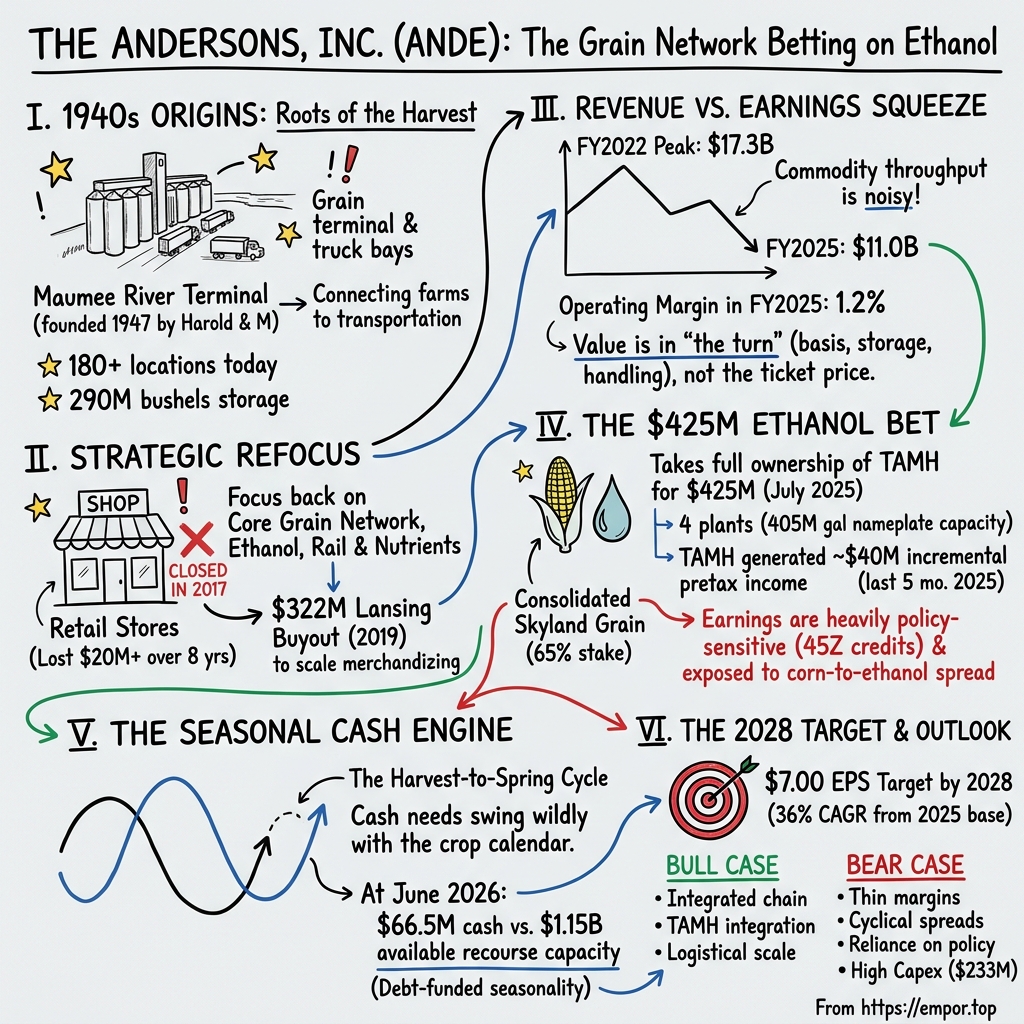
The Andersons, Inc.: The Grain Network Betting on Ethanol
I. The $425 Million Bet on Four Ethanol Plants
On July 31, 2025, a grain company from Maumee, Ohio, wrote the largest single cheque in its recent history. The Andersons paid $425 million to Marathon Petroleum's side of a long partnership for the 49.9% of The Andersons Marathon Holdings, or TAMH, that it did not already own.1 The deal gave it all four of the ethanol plants that the two companies had run together, in Michigan, Indiana, Ohio and Iowa, with a combined nameplate capacity of 405 million gallons a year.1 Nothing new was built that day. No farmer delivered an extra bushel because of it. What changed was who kept the profit once a bushel of corn had become fuel, animal feed and corn oil.
The plants had been on the company's books for years, because TAMH was already consolidated. So the accountants treated the purchase as a transaction between shareholders rather than an acquisition, and no new goodwill appeared on the balance sheet.1 The economics were plain enough all the same. Before July, almost half of every dollar the plants earned belonged to Marathon. After July, all of it belonged to The Andersons' own shareholders. In the five months that followed, the company said full ownership added nearly $40 million of pretax plant income attributable to it.1
The price of that extra income showed up in the bank account. The Andersons began 2025 with about $562 million of cash and finished it with about $98 million, and it leaned more on its revolving credit line to get there.1 For a business whose borrowing swings with the harvest, that is not a trivial shift. It means a company that once carried a cash cushion through the year now carries much more of its flexibility in its credit agreements.
Why would a grain merchant make that trade? To see the size of the bet, look at the size of the company. The Andersons reported about $11 billion of revenue in 2025, a figure that sounds like a giant until the margin is applied. Operating profit was about 1.2% of sales.1 Adjusted EBITDA, the measure management prefers, came to $337 million, down from $363 million the year before.2 The ethanol purchase was therefore larger than an entire year of the company's adjusted cash earnings. It was a vote, made with borrowed money as well as saved money, that ethanol would be a durable second engine and not a temporary windfall.
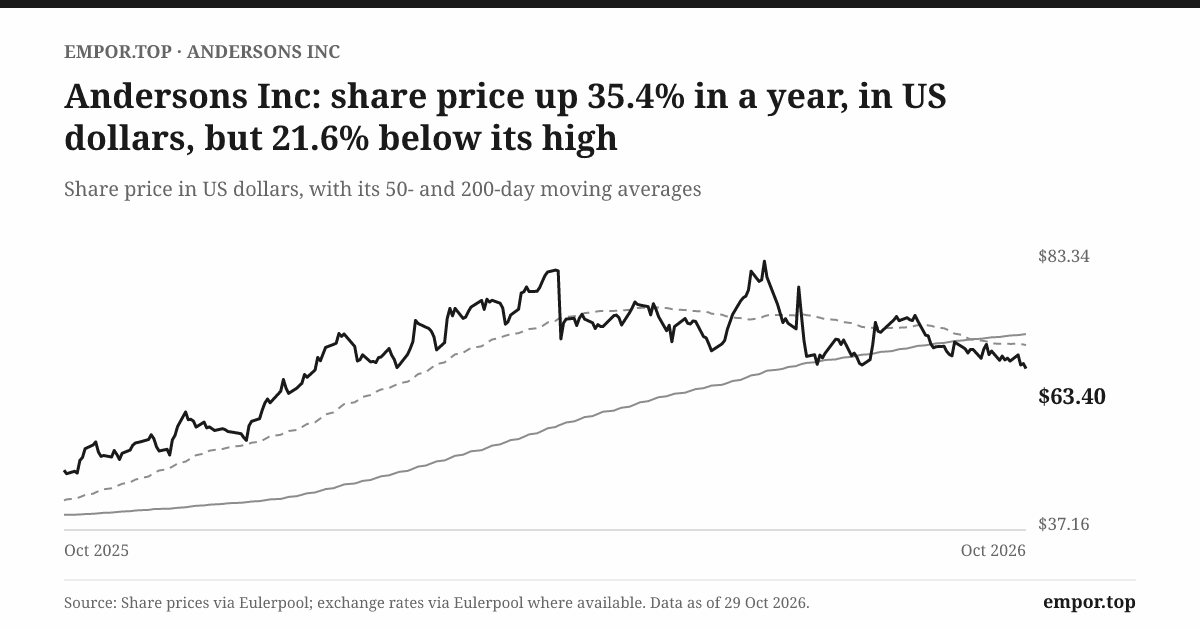
The early returns flattered that vote. Renewables delivered its best year as the plants ran at record volumes, and early 2026 brought the strongest first quarter in the company's history followed by a record quarter for the segment.34 By the twelve months to June 2026, earnings per share had reached about $5.18, against $2.80 for calendar 2025.51 Yet on October 29, 2026, the shares sat at about $63, roughly 22% below their 52-week high of nearly $81.6 The market had seen the rebound. It had not fully paid for it.
That gap is where this story lives. Four questions run through it. The first is whether a network of elevators, terminals and fertilizer plants can turn the enormous volume of crops it handles into margins and cash that last, or whether its fortunes simply rise and fall with the weather and the futures market. The second is whether ethanol earnings can last once the help of federal policy is subtracted, because a meaningful share of recent profit came from clean-fuel tax credits rather than from the spread between corn and fuel. The third is whether the Marathon buyout will earn back its price over a full cycle, not just over five good months. And the fourth is whether a company that must borrow every winter to carry the crop can also fund growth projects, a dividend and buybacks when conditions turn.
There is no easy verdict here, and the reason is built into the business. Revenue at The Andersons mostly measures the dollar value of crops passing through its hands. When corn is expensive, sales balloon; when corn is cheap, they shrink, often with little change in how much work the company actually did. The earnings sit in much narrower places: the difference between what a farmer is paid and what an end buyer pays, the rent charged for storing grain, the spread a plant earns turning corn into ethanol, the policy credits that ride on top, and the working capital needed to own the crop in the meantime. Full ownership of four plants immediately raised the company's share of plant earnings. Whether that share is worth $425 million depends on a full cycle the company has not yet lived through as sole owner.
To judge that bet, it helps to go back to where the company's instincts were formed: a truck terminal on a river in northwest Ohio, built around a single idea about speed.
 Subscribe on LinkedIn
II. A Truck Terminal Built Around the Harvest
The Andersons began in 1947 in Maumee, Ohio, a small town on the Maumee River just upstream from Toledo and Lake Erie.7 Harold and Margaret Anderson founded The Andersons Truck Terminal as an operating partnership with their six children, which is why the company's name has always been plural.8 The family's first big asset said a great deal about what they thought farmers needed. They built a grain terminal with nine truck bays, designed for rapid turnaround.8
That detail matters more than it sounds. At harvest, a farmer's scarcest resource is time. Combines are running, weather is closing in, and every hour a truck spends waiting in line at an elevator is an hour it is not hauling the next load out of the field. A terminal that could unload nine trucks at once was a promise of service: bring us your crop and we will get you back to work. The Andersons then added the other half of the equation. They established rail transfer and ship loading on the Maumee River, so grain arriving by truck or train could move onto vessels and out toward buyers far away.8 When the St. Lawrence Seaway opened in 1959, giving Great Lakes ports a route to the Atlantic, a terminal at the western end of Lake Erie suddenly sat on a road to the world.8
From that core, the business grew by adding adjacent ways to touch the crop. In the 1950s the family began blending fertilizer, at first, according to the company's own history, in a cement mixer.8 The same decade brought the first Andersons retail store, a warehouse market that grew into a much-loved regional chain.8 In the 1960s came the first deep-water grain loading facility on the American side of the Great Lakes, and later an elevator in Champaign, Illinois, that could load 100-car unit trains.8 Each step answered the same question: once the company had a relationship with a farmer and a place to put grain, what else could it sell or handle along the way?
The family kept control for a long time. The company was incorporated and listed on Nasdaq on February 20, 1996, by which point annual sales had reached about $1 billion.8 In the same era it built a railcar repair shop and moved into railcar leasing, a business that rhymed with grain because it was about moving bulk products efficiently.8 Anderson family members still sit among the shareholders today; Gerard Anderson held about 1.1% of the stock in early 2026, while directors and executive officers as a group held about 4.3%.9 Influence, in other words, has passed from the family to a professional management team and to large index and institutional funds.
The store history deserves one clear sentence because it is what many people in Ohio still associate with the name. For decades, The Andersons was as well known for its general stores in Toledo and Columbus as for its elevators, and that local recognition still clings to the brand. But the listed company is not a retailer. It closed the last of its stores in 2017, a decision that becomes its own chapter later in this story.10
What remains is the physical network. At the end of 2025, The Andersons operated roughly 180 locations across the United States and Canada, with smaller operations in the United Kingdom, Switzerland, Mexico, Romania and Singapore.1 Its grain storage stood at about 271 million bushels, down from roughly 291 million a year earlier as the company closed several underperforming locations.1 It describes itself as an originator, handler, marketer and processor: it buys crops from farmers, stores and moves them, sells them to food makers, feed mills, exporters and ethanol plants, supplies fertilizer and other inputs, and now owns four ethanol plants outright.1
The enduring asset, then, is not a brand or a patent. It is a set of physical connections between producers, storage, transport and buyers. That footprint gives the company reach in the eastern Corn Belt and, since the Skyland deal, in the western plains. It is also modest beside the global merchants. Lansing Trade Group alone, before The Andersons bought it, was trading more than a billion bushels a year, and companies such as ADM, Bunge and Cargill operate on a scale several times larger again.7 Owning elevators gives The Andersons a seat at the table. It does not by itself prove the company can set the price.
Which raises the question that defines the next part of the story: what do commodity-price swings really mean for the business?
III. The $17 Billion Revenue Peak That Wasn't a Peak in Earnings
Picture a single grain shipment. Months before harvest, a farmer agrees to sell corn to The Andersons at a price tied to the futures market plus or minus a local adjustment called basis. On the other side, a buyer, perhaps an exporter on the Gulf or a feed mill in the South, agrees to take that corn later. Both promises are recorded as derivatives and marked to market as prices move. The revenue is finally recognized when the deal settles, usually when the grain ships or is delivered.1 By the second quarter of 2026, about 83% of the company's sales contracts were accounted for this way, as derivatives; only 17% were ordinary product sales.5
That accounting choice tells a listener almost everything about how to read The Andersons' income statement. Its revenue is the full value of the crops and products it sells, so it rises and falls with commodity prices. In 2022, as the war in Ukraine and tight global supply pushed grain prices toward record levels, revenue hit about $17.3 billion.1 By 2025, with crops abundant and prices low, revenue had fallen to about $11.0 billion.1 That is a decline of more than a third. Yet operating profit in 2022 was about $204 million and in 2025 about $128 million, and in between, in 2023, it peaked at about $340 million on revenue that was already shrinking.1 The revenue peak and the earnings peak arrived in different years.
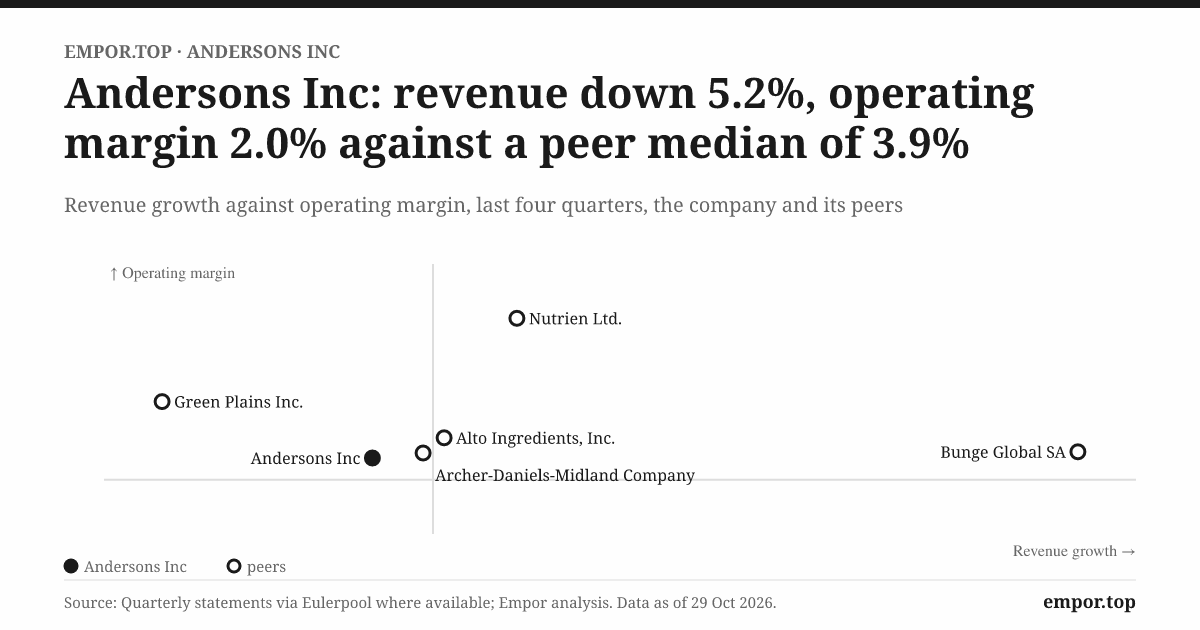
The reason is that the company does not earn a markup on the full value of the grain. It earns on the slices. Think of the difference between a toll road and a car dealer. A car dealer's revenue is the sticker price of the cars. A toll road's revenue is the fee per car, and doubling the price of cars does not double the toll. The Andersons reports like a car dealer and earns like a toll road. Its operating margin was about 1.2% in 2025 and has not reached 3% in any recent full year.1 Gross profit, the money left after paying for the grain and the direct costs of handling it, is a far better signal of how the business is actually doing.
The 2025 numbers show why. Revenue fell by about $249 million from 2024, yet gross profit rose by about $20 million, helped by the Skyland acquisition.1 Profit still fell, because operating and administrative expenses climbed by about $82 million and the company booked about $18 million of impairments as it shut underperforming locations and dealt with a facility damaged in a grain explosion.1 In this business the line items in the middle of the income statement matter more than the top line ever will.
Two segments, one bushel
Since the exit from rail, The Andersons reports two segments. Agribusiness is the grain and fertilizer network: origination, storage, merchandising, export, plant nutrients and premium ingredients for food and pet-food makers. It generated about $8.3 billion of revenue in 2025, roughly three-quarters of the total.1 Renewables is the ethanol plants plus the trading desks that market ethanol, distillers grains, corn oil and feedstocks for renewable diesel. It produced about $2.7 billion of revenue.1
The common telling is that Agribusiness is the big business and Renewables the smaller sidecar. By revenue, that is right. By earnings, 2025 turned it upside down. Agribusiness pretax income fell to about $57 million from about $109 million in 2024 as low prices and muted volatility starved its merchandisers of opportunities.1 Renewables pretax income attributable to the company rose to about $116 million from about $83 million, helped by full ownership of the plants.1 For the first time in the current structure, the smaller segment earned roughly twice as much as the larger one. The company had become, in profit terms, an ethanol producer with a grain business attached, at least for one year.
To see how the two connect, follow a bushel of corn grown near one of the eastern plants. The Andersons may buy it at harvest, earning a basis margin if it buys at a discount to where it can later sell. It may store it, earning space income for holding the grain until buyers want it. It may carry the corn by truck or rail to a terminal for export, earning an elevation margin. The farmer who grew it probably bought nitrogen from an Andersons fertilizer location in the spring. And the bushel might end up at Clymers, Indiana, where it is ground, cooked, fermented and distilled into roughly three gallons of ethanol, with the leftover protein dried into distillers grains for cattle and the oil skimmed off for renewable diesel makers. At each step, the company tries to take a sliver. None of the slivers is large. Together they are the business model.
Some slivers are fatter than others, and management has been steering capital toward them. Premium ingredients, the cleaned corn and wheat sold to large packaged-food and pet-food manufacturers, is a small part of Agribusiness, but Krueger told analysts in May that its returns are generally higher and that first-quarter results had roughly doubled from a year earlier as new cleaning capacity came online.11 A mineral processing plant in Carlsbad, New Mexico, and upgrades to clean-corn capacity at Mansfield, Illinois, follow the same logic.11 The fertilizer business, meanwhile, had a strong 2026 season, with Valentine crediting improved margins and operating efficiency.12 These are attempts to move a commodity handler a little way toward a specialty supplier, where customers care about specifications and reliability rather than only the lowest price. They are promising, but they are still too small to change the economics of the whole segment.
That model works best when markets are moving. On the first-quarter 2026 call, CEO Bill Krueger described the trade-off plainly. When corn and wheat prices rally, basis tends to weaken, which delays the appreciation the company hopes to earn on grain stored in its elevators; but the same price spikes create volatility that the merchandising desks can trade.11 In 2025, conditions were the opposite of helpful. Krueger called the year low in volatility with a burdensome supply balance, so the opportunities simply did not appear.11 On the second-quarter call, the company reported that higher prices had again produced limited space income from its asset footprint even as merchandising improved.12 The network can earn in more than one kind of market. It cannot earn equally well in all of them.
The limits of the advantage
So is this a moat? The honest answer is that the evidence is thin in both directions. The Andersons says no single customer accounted for 10% or more of its revenue, which reduces the risk that one buyer can dictate terms.1 But the company does not publish its top-five or top-ten concentration, and it does not quantify how dependent it is on the limited number of suppliers it uses for some crop inputs.1 It publishes no series on customer retention, lost bids, regional market share or price realization. Without those, nobody outside the company can show that a farmer or a feed mill would struggle to switch to a rival.
The economics suggest they mostly would not. A farmer near an Andersons elevator usually has other places to sell, from cooperatives to a rival merchant to an ethanol plant run by someone else, and can store grain on the farm to wait for a better price, as many did in 2025 when prices were poor.13 Industrial buyers source from many merchants. The futures market sets most of the price for everyone, so the company's freedom to charge more than competitors is limited to the local premiums that come from location, timing and service. Storage, terminals, rail access and execution genuinely matter, because a bushel in the right place at the right time is worth more than the same bushel stranded. But nothing in the company's disclosures establishes exclusive access to a region or high switching costs for its customers.
The competitive set reinforces the point. ADM, Bunge and Cargill are the global merchants that shape grain flows and prices, and CHS is the farmer-owned cooperative that competes for the same bushels across much of the Midwest and plains. Green Plains is the more focused comparator on the ethanol side. These are not like-for-like peers; most are far larger and differently built, and the company does not publish a credible market-share ranking against them. The useful conclusion is narrower. The Andersons is a meaningful regional operator with a well-placed network, competing in markets where the biggest players have more scale and where much of the price is set by forces no one controls.
That leaves a structural vulnerability. In a business earning a penny or two on each dollar of sales, small shifts carry large consequences. A modest change in basis across millions of bushels, a quieter futures market, a jump in natural gas costs at the ethanol plants, or a swelling of the working capital needed to own the crop can each matter more than a double-digit move in revenue. Which brings the story to the part of the business that now does most of the earning, and that carries its own, sharper version of the same risk.
IV. Ethanol: From a Side Bet to the Earnings Swing Factor
In the early 2000s, a grain handler in northwest Ohio watched a new kind of customer appear in its backyard. Federal policy was pushing ethanol into the nation's gasoline, and a plant that grinds corn needs a steady supply of it. The Andersons decided it would rather be a partner in that demand than merely a supplier to it. It entered the business by overseeing the construction and operation of three ethanol plants.8 Later, through an affiliate, it added a plant in Denison, Iowa.8 By 2015, the four plants had a combined nameplate capacity of 330 million gallons.14 A decade of upgrades since has pushed that to 405 million gallons, with the Michigan plant at 130 million, Indiana and Ohio at 110 million each and Iowa at 55 million.1
The logic of the plants is simple to state and hard to manage. Each plant buys corn and natural gas and sells three things: ethanol, distillers grains used as livestock feed, and distillers corn oil used in renewable diesel and feed. The profit is the spread between what comes out and what goes in, an idea the industry calls the crush margin. Run the plant hard, keep yields high, and the fixed costs spread over more gallons. When ethanol and coproduct prices rise faster than corn, plants print money. When corn climbs or ethanol sags, the same plant can lose money on every gallon and still have to run.
The company's own history shows how quickly the spread can turn. In 2014, the old Ethanol Group earned about $105 million before tax. In 2015, it earned about $30 million.14 The plants had not suddenly forgotten how to operate; ethanol prices had fallen, only partly offset by cheaper corn, and earnings from the affiliates that owned most of the plants collapsed.14 Strong production did not protect profit when the market moved against the margin. That single year is the most important piece of disconfirming evidence for anyone tempted to treat the 405 million gallons as a stable annuity. Capacity is an operating asset. It is not proof of stable returns.
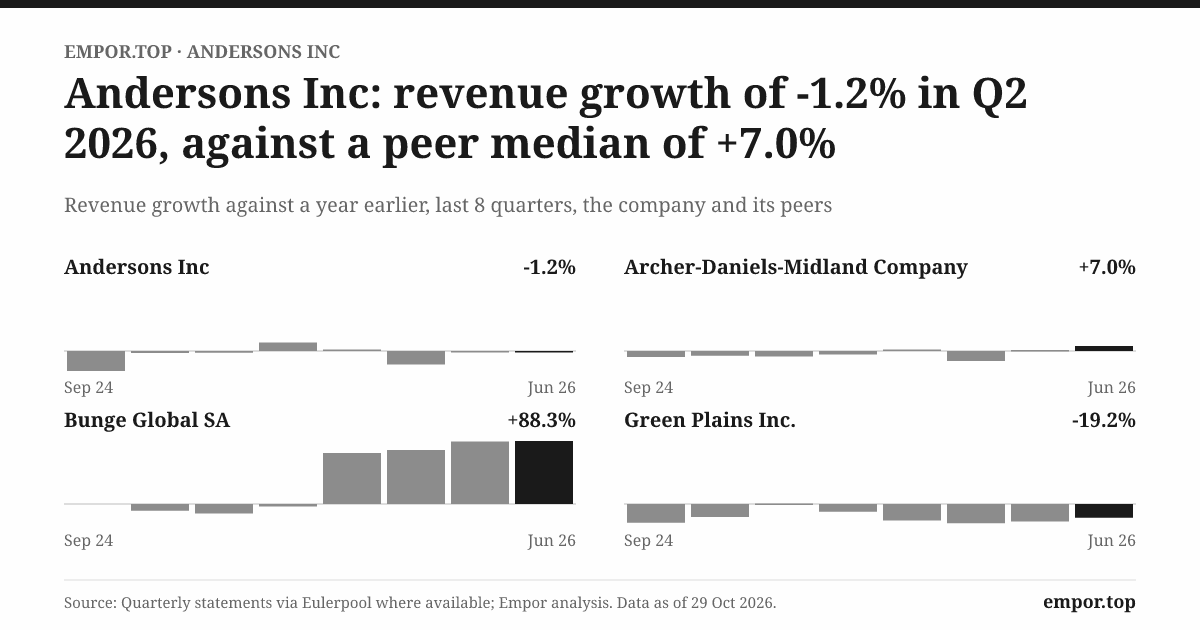
Against that history, the present looks remarkable. In 2025 the plants set production records and benefited from strong export demand, with board crush margins up about 15 cents a gallon in the fourth quarter.13 Renewables' adjusted EBITDA rose to about $203 million.13 The first quarter of 2026 brought record first-quarter production, and the second quarter brought record segment earnings, with adjusted pretax income of about $88 million, nearly nine times the year-earlier figure.12 Management credited efficient operations, higher margins on strong domestic and export demand, and better coproduct values.12 Krueger said on the first-quarter call that the plants were running well above nameplate capacity after spring maintenance.11
It helps to size that capacity against the industry. The United States had about 18.5 billion gallons of fuel ethanol capacity across 191 plants at the start of 2025.[^15] The Andersons' 405 million gallons is about 2% of that. It is a respectable fleet of large, efficient plants, and management calls them among the best in the industry.13 It is not a cornered market. Dozens of producers, from farmer-owned plants to large public companies, compete to sell the same commodity, and the industry's price is set by gasoline blending demand, exports and government mandates far more than by any single producer.
The policy layer
The richest vein of recent profit sits on top of the plant economics rather than inside them. The Section 45Z clean fuel production credit, created by federal law, pays producers for fuel with lower carbon intensity. In 2025, The Andersons recorded $35 million of these credits in other income.1 In the same year, it also booked about $27 million of insurance recoveries.1 Other income as a whole reached about $78 million, roughly 55% of the company's $141.5 million of pretax income.1 Strip out the credits and the insurance, and 2025 pretax income falls by more than 40%. That does not make the plant earnings fake. It means a large part of the reported result rested on a tax policy and a one-off claim.
The scale of the credit grew in 2026. The company qualified for the next tier of 45Z credits, recording $26 million in the first quarter and $24 million in the second.1112 CFO Brian Valentine told analysts in February that the company expected $90 million to $100 million of 45Z credits for the full year, and reaffirmed the range in August.1312 Put that against trailing pretax income of roughly $212 million, and the credits could represent something like two-fifths of the earnings base. They are also nontaxable, which is why management guides to an effective tax rate well below the statutory rate.11 Every dollar of that depends on rules that the IRS and Congress can change, on the carbon-intensity models used to score each plant, and on the credit's future after its current authorization.
Management's tone on the calls is worth tracking because it reveals how the company itself views the durability question. In May, analysts pressed on whether record ethanol margins would persist. Krueger explained that the company had hedged part of the first quarter at historically favorable levels, which capped some upside, and that it does not normally hedge production beyond the first quarter.11 He was confident about demand: crude oil near $100 a barrel had made ethanol much cheaper than gasoline, and several countries were raising blend rates.11 By August, the questions had sharpened. An analyst noted that board crush margins had weakened sequentially; Krueger acknowledged the drop and pointed to potentially higher coproduct values as an offset, while warning that U.S. ethanol was priced near parity with Brazil and that Brazilian exports had begun to compete.12 When asked about small refinery exemptions, which can reduce the effective mandate for blending, he declined to speculate on regulators' thinking and said he did not expect the outcome to be material.12
That is a reasonable, measured posture. It is also an acknowledgment that conditions are unusually favorable and that management cannot promise they will last. The margin story in 2026 rests on high oil prices tied to Middle East tension, finalized record renewable volume obligations for 2026 and 2027, the higher 45Z tier, and plants running above nameplate.11 Any of those can reverse.
There is a deeper capability-versus-monetization distinction here too. The company is spending to raise output and lower carbon intensity: a $60 million project at Clymers is expected to add 30 million gallons by mid-2027, and a carbon sequestration well at the same site is in regulatory review.1512 If approved, it would lower the plant's carbon score and generate more credits.12 These are sensible projects. But a permit application is not a credit, and a lower carbon score is not cash until the gallons are sold at a margin and the credits are claimed under rules that still exist. The only proof of commercial success will be realized output, margins and cash returns.
So the verdict on ethanol is a narrowed one. The plants have become a real second engine, adding processing earnings and monetizing the grain network's corn. But they amplify the commodity cycle rather than escaping it, and the current amplitude is boosted by policy. The question that matters for investors is not whether the plants are good. It is whether the company's managers know when to stop investing in a business that has stopped earning its keep. On that, the company's record offers one very public case study.
V. The Retail Stores That Had to Close—and the Lansing Deal That Followed
On January 15, 2017, The Andersons announced that it would close its four remaining retail stores.10 For people in Toledo and Columbus, it was the end of something familiar. The stores had been a fixture for 65 years, places where a homeowner could buy birdseed, lawn fertilizer, fresh produce, wine and hardware under one roof, and they employed about 1,050 people, most of them part-time.10 The company had already closed three stores over the preceding eight years while trying to reinvent the format.10
The investment meaning of that day is more important than the nostalgia. The Retail Group had lost more than $20 million before tax over those eight years, including earlier impairments.10 The company expected a further impairment of about $6.5 million and $9 million to $14 million of severance and closing costs.10 Management concluded there was no credible path back to profitability. Declining customer counts and competition from big-box chains had worn down the business, and repeated attempts at reinvention had not turned it around. Then-CEO Pat Bowe acknowledged that the decision was not easy for anyone involved.10
What does this say about discipline? The bull reading is that a company with deep family and community ties to a visible business was willing to shut it once the numbers made the case. That is rarer than it should be. The bear reading is that it took eight years of losses and multiple closures to reach that point. Both are true. The retail exit was a real correction, made late.
It was not the only sign around that time that capital had been mispriced. In 2015, the grain business took a $46.4 million goodwill impairment, and the plant nutrient business took about $9.7 million more.14 The company tied the grain write-down to margins that had been compressed for several years and to unfavorable expectations for operating conditions.14 Goodwill impairment is an accountant's way of admitting that past acquisitions will not earn what was paid for them. The grain network that sits at the heart of the company had, in part, been bought at prices its subsequent profits did not justify.
The Lansing bet
With retail closed, the company went looking to make the grain business bigger. On October 15, 2018, it announced that it would buy the 67.5% of Lansing Trade Group it did not already own.7 The Andersons had first invested in Lansing in the 2000s and had known the business for years as a partner.87 Lansing, founded in Lansing, Michigan, in 1922 and later based in Overland Park, Kansas, was a grain merchandiser with about 550 employees, more than 20 facilities, roughly 55 million bushels of storage, and trading volumes of more than a billion bushels in 2017.7 The deal also consolidated Thompsons Limited, an Ontario grain business the two had jointly owned.7
The announced price was about $305 million in cash and stock: roughly $175 million of cash and about $130 million in newly issued shares.7 The Andersons also agreed to take on about $166 million of debt.7 The company said the implied price was less than nine times Lansing's EBITDA for the twelve months to August 2018, promised at least $10 million of annual cost synergies by the end of 2020, and said the deal would add to earnings per share within the first full year.7 It closed in January 2019, with about 4.4 million new shares issued as partial consideration.16
On the entry multiple alone, the price was not obviously excessive. Paying under nine times trailing EBITDA for a merchandiser with a broad trading footprint is not the sort of number that makes headlines. But the announced multiple was only the first test. The 4.4 million new shares were about 13% of the enlarged share count, so existing shareholders gave up a meaningful slice of the company.7 The assumed debt added to a balance sheet that would soon be stretched; borrowings nearly tripled from 2017 to 2020 as the company absorbed Lansing and other deals.1 And the following years did not show an immediate payoff. Net profit was about $18 million in 2019 and about $7 million in 2020, with return on equity below 2% in both years.1 The company does not publish a dedicated post-deal return on the Lansing investment or a final accounting of the promised synergies, so the deal cannot be called a bargain. A fair reading is that the merger gave The Andersons the trading scale it now relies on, but did not translate into strong per-share returns until the grain boom of 2021 to 2023 lifted the whole industry.
There is a human thread too. Bill Krueger, Lansing's chief executive at the time of the deal, is now The Andersons' CEO.79 He arrived as a merchant from a trading business rather than from the family culture in Maumee, and his calls with analysts carry a trader's vocabulary: board crush, basis breaking, the forward book, volatility as opportunity. His ascent is itself one of the most lasting results of the Lansing deal.
So the record on capital allocation is mixed. The retail exit shows the company can stop. The 2015 impairment shows it has overpaid before. Lansing shows a strategic move at a reasonable price whose returns were slow to arrive and diluted by new shares. The 2025 purchase of Marathon's stake tests whether those lessons apply when the asset is not a struggling store but a strategic, currently profitable plant fleet. And that purchase did not arrive alone.
VI. Skyland and TAMH: Two Ways to Buy Growth
In November 2024, The Andersons reached west. It took a 65% stake in Skyland Grain, a grain and agronomy business with elevators across southwest Kansas and the Texas and Oklahoma panhandles, and consolidated it into Agribusiness.1 Eight months later came the Marathon buyout. The two deals look alike on a corporate timeline, both labelled growth, but they are different bets. Skyland bought a new regional operating presence: storage, distribution, farmer relationships and sorghum and wheat export flows in a part of the plains where the company had been thin. The TAMH purchase bought nothing new at all. It bought a larger share of assets the company already ran, knew intimately and had consolidated for years.
Skyland's first full year shows how much a consolidated acquisition can add to the top line and how little that says about value. In 2025, it added about $468 million of revenue and about $392 million of cost of sales, leaving roughly $76 million of gross profit before the costs of running it.1 The more revealing number came on the February call. When the deal was announced, management had talked about a run-rate EBITDA contribution of $30 million to $40 million a year; during 2025 it had already guided that down to about half that range; and Skyland finished the year just shy of $20 million.13 For 2026, the CFO expected $25 million to $35 million, with a return to the original range only as conditions normalize to mid-cycle.13 Then the weather intervened. By August, Krueger was describing Kansas as having one of its lowest hard-wheat crops in recent memory, with the Skyland footprint not immune to the drought, while noting that the region had grown its forward book.12
There is a second gap between what Skyland reports and what it delivers to The Andersons' shareholders. Because the company owns 65%, the other 35% of Skyland's earnings belong to minority partners, and the consolidated statements count all of Skyland's revenue and assets while only part of the profit is attributable to The Andersons.1 Cash generated inside a partly owned subsidiary also has to be distributed before the parent can use it for dividends or debt reduction. The company does not publish Skyland's standalone distributions to the parent, so outsiders cannot yet track how much of its earnings actually travels up to Maumee. For a deal that has so far run below its original promise, that is a material gap in disclosure.
Putting a return on $425 million
TAMH is the cleaner case and the larger one. Here, the right test is not five months of earnings but a return over several years: the incremental income and cash distributions from the extra 49.9%, set against the $425 million price, after separating maintenance spending from growth spending and stripping out transient items such as credits and insurance recoveries.
The first five months give a starting point, and a flattering one. Nearly $40 million of incremental pretax plant income over five months annualizes, crudely, to something like $95 million a year, or more than a fifth of the purchase price before tax.1 If that pace held through a cycle, the buyout would look like an excellent use of capital. But the window was close to ideal. The plants were setting production records, fourth-quarter board crush was up year on year, and the half of the 45Z credits that previously belonged to Marathon now flowed to The Andersons.13 The company does not separate how much of the incremental income came from credits rather than from crush margins. And the 2015 collapse in ethanol earnings shows how quickly a strong year can be followed by one with a fraction of the profit.14 A through-cycle return might be half the five-month pace or less. That would still be respectable on $425 million, but it would be a very different story from the one the first five months suggest.
The investment does not end with the price. Total capital spending rose to about $233 million in 2025 from about $149 million in 2024, and management planned $200 million to $225 million of spending on property and equipment in 2026, about half growth and half maintenance.1 A share of that goes to the plants, including the $60 million Clymers expansion.15 So the true cost of the ethanol bet is the purchase price plus a continuing stream of reinvestment, and the true return has to be measured after both.
The $7 promise
At its investor day on December 11, 2025, the company put a number on the future. It targeted run-rate earnings per share of $7.00 exiting 2028, which it described as a 36% compound annual growth rate from $2.56 a share over the twelve months to September 2025.15 The plan rested on completing the Port of Houston export expansion in 2026 to ship soybean meal, the Clymers investment, maximizing 45Z credits, and leveraging the Skyland integration; management said it did not require substantial new acquisitions.15 The target replaced an earlier one, $4.30 of run-rate EPS exiting 2026, which management said in February it expected to exceed.13
Thirty-six percent a year is an extraordinary rate for a commodity merchant. It assumes that projects come in on time and on budget, that commodity markets normalize rather than slump, that demand for low-carbon fuel stays firm, and that tax credits arrive on the expected schedule. The early evidence has been encouraging; by August, the company said trailing earnings had exceeded $6 a share on an adjusted basis.12 But a target set near the bottom of the agricultural cycle and measured on a run-rate basis is easier to approach in a year when oil, mandates and credits all line up. The test is whether $7 survives a year when they do not.
How credible is this team's capital allocation? The fair test compares the promise with the record. Management's language is consistent across calls: disciplined, responsible spending, long-term debt below 2.5 times EBITDA, acquisitions only if they meet strategic and financial criteria.131112 The record is more varied. It includes the late but real retail exit, the 2015 goodwill write-down on earlier grain acquisitions, Lansing's dilution and slow-arriving returns, Skyland's undershoot against its original EBITDA range, and now a $425 million buyout made at a moment of strong plant earnings. Management has also said repeatedly that it would like to add more ethanol gallons if the price is right.1213 None of that convicts the team of poor judgment. It does mean the burden of proof sits with the projects.
Incentives point in the right general direction. Krueger owned about 1.5% of the company's shares in March 2026, a meaningful personal stake.9 His reported compensation was about $5.47 million in 2025, up from about $4.84 million in 2024, in a year when net income attributable to shareholders fell to about $96 million from about $114 million.9 The proxy ties annual and long-term pay to performance measures, and shareholders approved the pay plan overwhelmingly in May 2026, with about 27.9 million votes for and 0.3 million against.917 Owners did not push back. Whether pay keeps moving with per-share returns rather than with scale is something to watch as the larger company emerges.
The analyst questions on the calls trace the shift in investor focus across 2026. In February, the questions were about how much Skyland contributed and whether ethanol's momentum would carry into the new year.13 By May, they had turned to whether record margins were sustainable, the role of hedging, the timing of 45Z rules and why Houston mattered.11 By August, analysts were asking about sequential margin weakness, the risk from small refinery exemptions, and where the next 18 months of earnings growth would come from.12 Valentine answered that last question by pointing first to more gallons and plant projects and then to an agribusiness recovery whose slope was uncertain.12 Management's own map of the path to $7, in other words, runs mostly through ethanol.
That puts the spotlight on the one resource every one of these plans needs: cash, at the right moment in the crop year.
VII. The Cash That Disappears Between Harvest and Spring
At June 30, 2026, after the strongest first half in its history, The Andersons had about $66.5 million of cash.5 For a company with roughly $11 billion of annual sales, that is the cash a household would keep in its wallet. Yet the same filing reported $1.15 billion of available recourse borrowing capacity and compliance with every financial covenant.5 Both facts are true at once, and the gap between them is the whole story of how this company funds itself.
The seasonal engine works like this. At harvest, farmers deliver crops, and The Andersons pays for the grain it buys. In winter and spring, it buys and positions fertilizer before planting. Inventories swell, receivables from buyers build up, and payables to farmers and suppliers come and go. Because the company owns the crop between harvest and sale, a rise in grain prices directly increases the money it needs to finance the same physical volume. The company says it is typically a net short-term borrower in the first two quarters of the year.1 Cash is not meant to sit idle; the credit lines are the shock absorber.
That makes profit-to-cash look strong over a long horizon but anything but smooth year to year. Across the twelve years from 2014 to 2025, operating cash flow totalled about $2.2 billion against about $758 million of net profit attributable to shareholders.1 Some of that gap is depreciation in a capital-intensive business, and some reflects earnings that belong to minority partners. But the path was wild. Operating cash flow peaked at about $946 million in 2023, as falling grain prices released working capital that the boom had absorbed, then fell to about $176 million in 2025 as earnings declined and the company used about $109 million more cash for working-capital changes than a year earlier.1 Operating cash flow was negative in four of those twelve years.1
Where the cash went is the more important part. After capital spending, cumulative free cash flow over the same twelve years was only about $72 million. Dividends over the period totalled about $249 million, more than three times that.1 The cash pile fell by about $211 million from the end of 2013 to the end of 2025.1 The difference was filled by borrowing and, in effect, by the business's capacity to carry more debt as it grew. That does not make the dividend reckless: the payout was about 27% of 2025 earnings, and the company has paid a dividend for more than 25 consecutive years.115 But it means the dividend, the buybacks and the growth projects have historically been funded by more than what the business produced after reinvesting in itself.
Management prefers a different cash measure, and it has a point. Cash from operations before working-capital changes strips out the swing of owning the crop. On that basis, the company generated about $278 million in 2025, down from about $323 million in 2024, and $113 million in the second quarter of 2026 alone.1312 Valentine has repeatedly said that readily marketable grain inventories exceed short-term debt throughout the cycle.1211 Grain in an elevator can be sold within days, so borrowing against it is closer to inventory financing than to the kind of debt that keeps a lender up at night. The bear's rejoinder is that working capital is not a rounding error here; it is the cost of doing business, and in a high-price year it can consume most of the cash the company earns.
Receivables add a quieter risk. At the end of 2025, net receivables were about $653 million, after a $43 million allowance for doubtful accounts, and the company had sold about $244 million of receivables without recourse during the year.1 Debtor days improved from a peak of about 29 in 2020 to about 22 in 2025.1 The allowance is large relative to annual write-offs of about $10 million, which suggests caution rather than stress, and receivables selling reduces exposure.1 But the company does not publish an aging table or quantify overdue balances, so outsiders cannot see how much of the book is late.
Liquidity, then, is real but contingent. At the end of 2025, short-term credit capacity was about $2.05 billion, with about $1.80 billion available.1 By June 2026, available recourse capacity had narrowed to about $1.15 billion, as volatility drove up seasonal borrowing.512 The balance sheet carried about $249 million of short-term debt, $63 million of current maturities and $560 million of long-term debt at year-end, with variable-rate notes maturing between 2027 and 2031 and fixed-rate notes due in 2026 and 2034.1 Long-term debt was about 1.8 times EBITDA at the end of 2025 and 1.3 times by June, comfortably inside management's 2.5 times ceiling.1312 The Andersons does not disclose a current credit rating from a major agency, so its creditworthiness has to be read from covenant compliance and the size of its lines.
The pressure points are visible. Variable-rate debt means higher interest rates feed straight into costs. Seasonal borrowing peaks just as fertilizer and grain inventories are most expensive. The TAMH-funded draw on the revolver sits in the same pool of borrowing as the growth capex, the dividend and the share repurchase authorization, of which about $17.7 million of $100 million had been used by the end of 2025.1 In a high-price grain year paired with a weak ethanol year, those claims could all arrive at once.
Management's own explanation of the borrowing pattern shows the trade-off clearly. On the first-quarter call, Valentine said short-term borrowings were higher than a year earlier for two reasons: the company had funded the purchase of its partner's share of the ethanol plants, and market volatility had increased the cost of carrying grain.11 By the second quarter, he attributed the increase mainly to volatility.12 Put plainly, the TAMH purchase moved The Andersons from a company that used its own cash to absorb the seasonal swing to one that leans on its lenders for more of it. That is a manageable position for a profitable company with large committed lines. It is a less comfortable one if a downturn in ethanol coincides with a spike in grain prices and the lines are needed at the same time as the plants stop producing surplus cash.
Three measures cut through the noise. The first is Agribusiness gross profit, the clearest read on whether the grain network is earning on its throughput; the segment's pretax income roughly halved in 2025 before improving year on year in both quarters of 2026.14 The second is Renewables pretax income excluding discrete policy and insurance items, which shows whether the plants earn on their own; at roughly $88 million of adjusted pretax income in the second quarter including $24 million of credits, it is currently at record levels.12 The third is operating cash before working-capital changes, the cash the business throws off before the crop calendar intervenes, which fell in 2025 and has rebounded sharply in 2026.1312 Together they answer the question the market is weighing now: is this a cheap stock or a cyclical one priced correctly?
VIII. Analysis & Bear vs. Bull Case
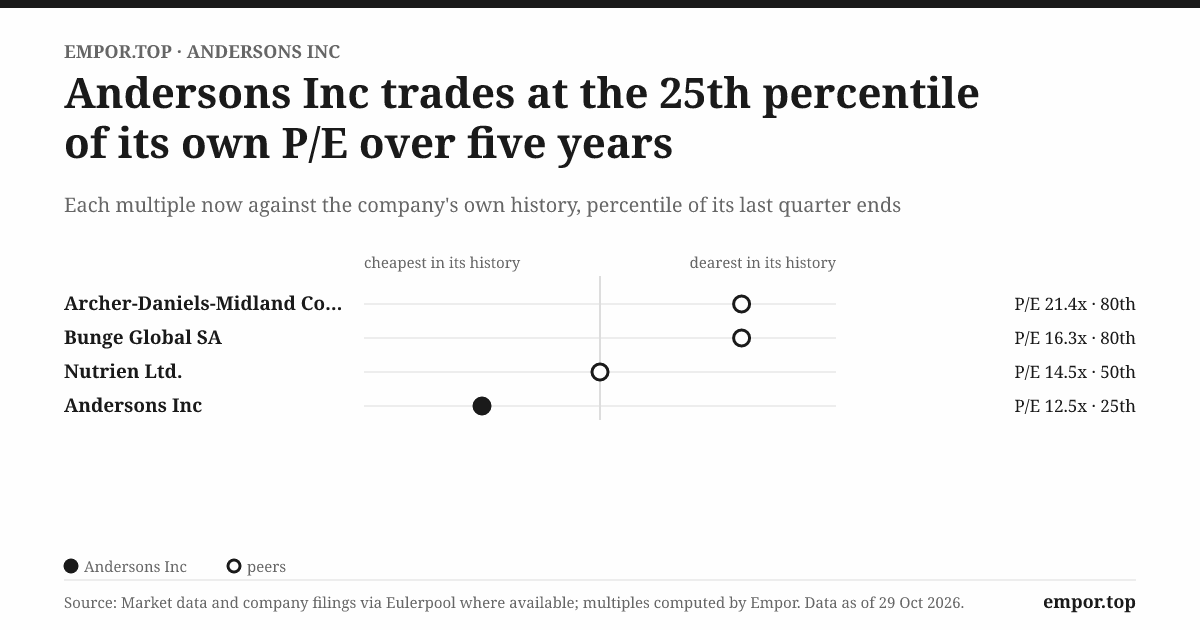
In late October 2026, The Andersons traded at about 12.5 times trailing earnings, below its own five-year median of about 15.3 times, and at about 8.9 times enterprise value to EBITDA.61 The dividend yield was about 1.3%.6 The shares sat about 22% below their 52-week high even though trailing earnings had nearly doubled from calendar 2025.65 On the surface, that looks like a market slow to believe a rebound. Underneath, it may be a market that has seen this movie before.
The bull case begins with the network: elevators, terminals, fertilizer and merchandising give the company several ways to earn from a crop, while its ethanol plants add processing income. Run that system through the lens of Hamilton Helmer's seven powers and the strongest candidate is cornered resource in a narrow, local sense: a terminal on deep water or a unit-train elevator in the right place cannot be quickly replicated. Scale economies help a little, in the sense that more bushels spread fixed costs, but The Andersons is not the scale leader. There is some process power in the company's trading and risk management, the ability to keep merchandising profitable in volatile markets, which showed up in early 2026 when merchandising improved even as asset income lagged.1112 There is little evidence of network effects, switching costs, brand power or counter-positioning in the commercial sense. On the bull reading, the TAMH buyout and elevated capex will lift per-share earnings further if crush margins merely normalize and Houston and Clymers deliver.
The bull would add one more argument, and it is a good one: diversification inside the portfolio. Recent results show the segments offsetting each other in some conditions.1112 Krueger made exactly this point to analysts in May, describing a portfolio built over five or six years to take advantage of most market conditions.11 A business that earns in more than one kind of weather deserves a steadier multiple than one that earns in only one. The record supports the claim in a narrower form than management states it: the segments have offset each other in recent years, but the company has not yet faced a year in which grain, ethanol and policy all turned against it at once.
The bear case starts in the same place and draws a different conclusion. Physical assets are a precondition for competing, not a guarantee of pricing power. Porter's five forces explain why. Buyer power is meaningful: industrial buyers and exporters can source from larger merchants and smaller firms, while farmers can store grain or sell elsewhere. Supplier power also matters: fertilizer supply depends on a limited number of producers exposed to geopolitical shocks.131 The threat of substitutes is low for grain handling but real in fuel, where electric vehicles and policy shifts could erode ethanol demand over time. Rivalry is intense and largely price-based. Barriers to entry are moderate: building a new terminal is costly, but rivals already have their own. In that structure, thin spreads are the equilibrium, not an anomaly.
War-game the competitors and the picture sharpens. If ADM or Cargill decides to bid harder for corn around one of The Andersons' eastern plants, the company has no tool to stop it except paying more itself, which squeezes either the elevator margin or the plant's crush. If a well-capitalized ethanol rival such as Green Plains or a farmer-owned cooperative expands nearby, the same corn is contested by more grinders. If Brazilian ethanol becomes cheaper on world markets, as management warned it was approaching parity in August, export demand that has propped up U.S. margins can soften.12 None of these moves requires a rival to do anything unusual. That is what makes the advantage contestable. The company also depends on seasonal credit and policy-sensitive ethanol economics, which means two of its biggest earnings drivers sit partly outside its control.
A skeptical activist would ask the obvious question. Should management prioritize debt reduction and cash returns until the $425 million buyout and roughly $233 million of 2025 capex produce measured returns? The case for patience is that the company has only had a year of full ownership and that projects such as Houston are still ramping. The case for discipline is that the company has a history of acquisitions that took years to earn their keep, including one that ended in a goodwill impairment. The fair test for further buybacks or acquisitions would be disclosed incremental returns on TAMH, Skyland and Houston that clear the company's cost of capital, measured in cash rather than in run-rate EPS.
Peer valuations help only as context. In late October 2026, ADM traded around 20.8 times earnings and 15.0 times EV to EBITDA, while Green Plains traded around 8.2 times and 6.5 times.1819 The Andersons sits between them, and its mix explains why: ADM is a much larger, more diversified processor; Green Plains is concentrated in ethanol. That spread illustrates how differently the market prices merchant and processing earnings, not a clean range for valuing The Andersons.
The company's own history can also mislead. A five-year median multiple covers a period that includes the grain boom, the 2023 earnings peak and the 2025 trough. Current earnings are cycle-sensitive and include large 45Z credits. The company's adjusted figures exclude notable items, including about $18.7 million of legal settlement costs and about $15.7 million of impairments in the first half of 2026, mostly in Renewables; the company does not describe the legal matter in its results release.4 And the investor-day target assumes a favorable mix of operations and policy. A low multiple on peak-condition earnings is not necessarily cheap.
What would falsify the bull case? Weak segment gross profit despite stable volumes would suggest the network has less pricing power than hoped. Declining ethanol spreads after stripping out credits would show the plants' recent strength was mostly policy and oil prices. Persistent cash absorption by working capital would undermine the idea that earnings convert to spendable cash. Delays or cost overruns at Houston or Clymers would weaken the path to $7. What would falsify the bear case? Sustained operating profit through a commodity downturn, stronger cash conversion before working capital in a weak year, and disclosed returns on Skyland, Houston and TAMH consistent with the company's cost of capital. Until one of those arrives, the discount reads as a price on uncertainty about earnings quality, and the evidence does not show it to be an obvious mispricing in either direction.
Weighing it all, the moat claim survives only in a reduced version. The history does not reject the idea that the network has value; the company has stayed profitable at the operating level in most recent years in a business where losses are common, and its segments have cushioned each other. But it narrows the claim from pricing power to positional and execution advantage, the kind that earns a fair return in good years and thin ones in bad years. The measures that would confirm or falsify the revised claim are the ones already named: Agribusiness gross profit through the next downturn, plant earnings after credits, and cash before working capital.
IX. Playbook: Business & Investing Lessons
Picture the company's whole history laid out on a single map. On the riverbank, the nine-bay terminal built to empty a farmer's truck fast. A few miles away, the empty storefronts of the retail chain. Across Michigan, Indiana, Ohio and Iowa, four ethanol plants now owned outright. Each is a different answer to the same question: where in the chain should a company stand to earn more than the cost of standing there?
The first lesson is that in a commodity business, the value is in the turn, not the ticket price. The gap between the revenue and earnings peaks showed why: revenue growth is a weather report, not a performance review.1 A merchant should be judged by the slice it keeps, not the size of the pie it carries.
The second lesson is that a strategic asset still has to pay rent. The ethanol plants are central to the strategy, consume a large share of capital and now produce most of the profit. The 2015 earnings collapse and the role of 45Z credits today show that being strategic does not exempt an asset from the cycle. A plant earns on a spread and a subsidy, and both can shrink. For founders building around a policy incentive, the lesson is to design the business so it can survive the day the incentive is withdrawn, and for investors, to price it as though that day will come.
The third lesson is that discipline is clearest when the business is beloved. The retail chain carried the family name and the community's affection, and lost money for years before it closed.10 The value of eventually stopping was a company focused on the businesses it understood. Investors should ask, of any company, which beloved business is today's version of the stores. Sentiment is a cost of capital that never appears on the balance sheet.
The fourth lesson is that a good acquisition price is only the first test. Lansing's entry price and TAMH's first five months are starting points, not verdicts.71 The company's twelve-year cash record, set against far larger capital spending and dividends, is the reminder that returns on invested cash, sustained across a cycle, are the only acquisition metric that compounds.1
X. Epilogue
As of October 29, 2026, the company stands six days from its next report. The Andersons scheduled its third-quarter call for November 4, 2026.12 The harvest is under way across the Corn Belt. The Houston soybean meal export expansion, delayed by heavy rain, was due to be fully operational in the fourth quarter.12 The Clymers expansion is aimed at mid-2027, and the carbon sequestration permit is still in regulatory review.1512 Management reaffirmed its capital spending plan and the $7 run-rate target for the end of 2028.12 The first half's record Renewables earnings came with legal and impairment charges.4
Picture the scene on November 4. Analysts will dial in, as they did in February, May and August, and the first questions will almost certainly be about ethanol. Third-quarter board crush weakened from the second quarter, and management told analysts in August that it nonetheless felt confident about the quarter, pointing to coproduct values and strong demand.12 The answer to that question, and the size of the 45Z line within it, will show whether 2026's record pace has survived the summer.
The next few quarters will answer the story's central questions one at a time. Agribusiness gross profit and cash before working capital will show whether the grain network can earn as export flows shift and as Houston begins shipping meal. If Houston loads its first cargoes and gross profit climbs while working capital stays in check, the network thesis gains real support. If the terminal ramps slowly and gross profit stalls, the case for the grain business narrows to a utility-like role with thin returns.
Renewables needs to be read two ways: with and without credits, insurance recoveries and legal or impairment adjustments. The company has reiterated its 2026 45Z guidance.12 If plant pretax income stays strong after those items are stripped out, the plants are earning on their own. If it falls back toward the levels of weaker years, the bet on ethanol is mostly a bet on policy.
The policy calendar matters too. Final 45Z rules, the treatment of small refinery exemptions, year-round E15 and the next round of renewable volume obligations will all shape the industry's margins. So will oil prices, which recently made ethanol cheap relative to gasoline. Management has said conditions have been unusually strong; the question is how long they last.
Then there are the deals. Investors will want to see Skyland return to the $30 million to $40 million EBITDA range management first promised and begin to send cash to the parent.13 They will want an accounting of the actual incremental cash return from the TAMH stake, net of credits and maintenance spending, rather than a run-rate estimate. And they will want to see the $7 target judged against quarterly milestones and capital spending, not just headline run-rate EPS.
The company has clear milestones, and in 2026 it has beaten its own near-term earnings markers even as Skyland has lagged its original promise. But the story remains open until the projects produce recurring, cash-backed returns and the business proves it can perform through a less favorable commodity and policy cycle. The plants have been running at full tilt. The question is what happens when the tailwinds turn.
XI. Outro
Go back to the river in Maumee. A farmer's truck pulls into one of the nine bays, unloads, and heads back to the field. For nearly eight decades, The Andersons has kept adding ways to handle that crop.
What makes the company distinctive is not its size or a single asset. It is the conviction that owning more of the physical middle of the agricultural chain, from the farm gate to the fuel tank, is itself a strategy. The nine bays promised speed; the four plants, more value from corn. Between them lie the stores that did not keep their promise and were closed, and the acquisitions whose promises are still being measured. The unresolved question, the one the next cycle will answer, is whether each added step earns its cost, or whether The Andersons has simply found more ways to stand in the middle of a river that keeps rising and falling on its own.
References
-
The Andersons, Inc. 2025 Form 10-K — SEC, 2026-02-18 ↩↩↩↩↩↩↩↩↩↩↩↩↩↩↩↩↩↩↩↩↩↩↩↩↩↩↩↩↩↩↩↩↩↩↩↩↩↩↩↩↩↩↩↩↩↩↩↩↩↩↩↩↩
-
The Andersons, Inc. Reports Fourth Quarter and Full Year 2025 Results — The Andersons, Inc. via SEC, 2026-02-17 ↩
-
The Andersons, Inc. Reports First Quarter Results — The Andersons, Inc., 2026-05-05 ↩
-
The Andersons, Inc. Reports Second Quarter Results — The Andersons, Inc., 2026-08-03 ↩↩↩↩
-
The Andersons, Inc. Q2 2026 Form 10-Q — The Andersons, Inc., 2026-08-04 ↩↩↩↩↩↩
-
The Andersons, Inc. to Acquire Lansing Trade Group, LLC — The Andersons, Inc., 2018-10-15 ↩↩↩↩↩↩↩↩↩↩↩↩
-
The Andersons, Inc. 2026 Proxy Statement — SEC, 2026-03-11 ↩↩↩↩↩
-
The Andersons to Exit Retail Business — The Andersons, Inc. via PR Newswire, 2017-01-15 ↩↩↩↩↩↩↩↩
-
The Andersons Q1 2026 Earnings Call Transcript — The Motley Fool, 2026-05-06 ↩↩↩↩↩↩↩↩↩↩↩↩↩↩↩↩↩
-
The Andersons Q2 2026 Earnings Call Transcript — Stock Analysis, 2026-08-04 ↩↩↩↩↩↩↩↩↩↩↩↩↩↩↩↩↩↩↩↩↩↩↩↩↩↩↩↩↩↩↩↩
-
The Andersons Q4 2025 Earnings Call Transcript — Yahoo Finance, 2026-02-18 ↩↩↩↩↩↩↩↩↩↩↩↩↩↩↩↩↩
-
The Andersons, Inc. Announces Growth Target for 2028, Form 8-K Exhibit — SEC, 2025-12-11 ↩↩↩↩↩↩
-
The Andersons, Inc. Annual Meeting Results, Form 8-K — SEC, 2026-05-07 ↩
 LinkedIn
 WhatsApp
 Reddit
 Hacker News
 Email
 Kindle
 RSS Feed
 Spotify
 Apple Podcasts
 Amazon Music
 Audible
 YouTube