AMN Healthcare: The Nurse Strike That Made a Quarter Look Like a Recovery
I. The $1.4 Billion Quarter
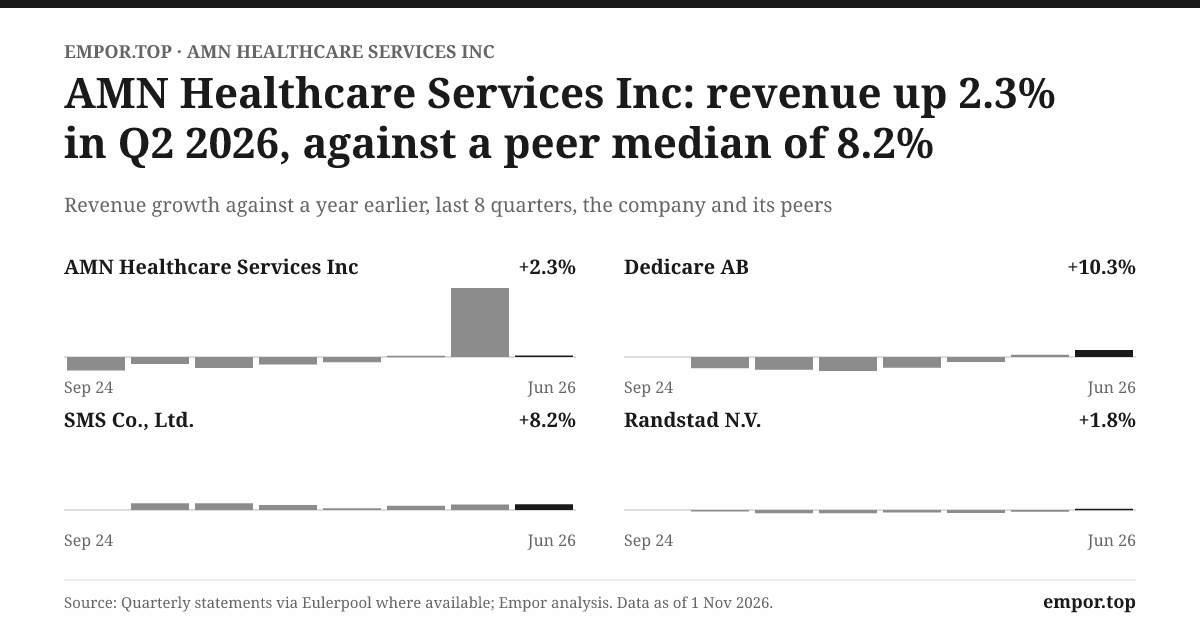
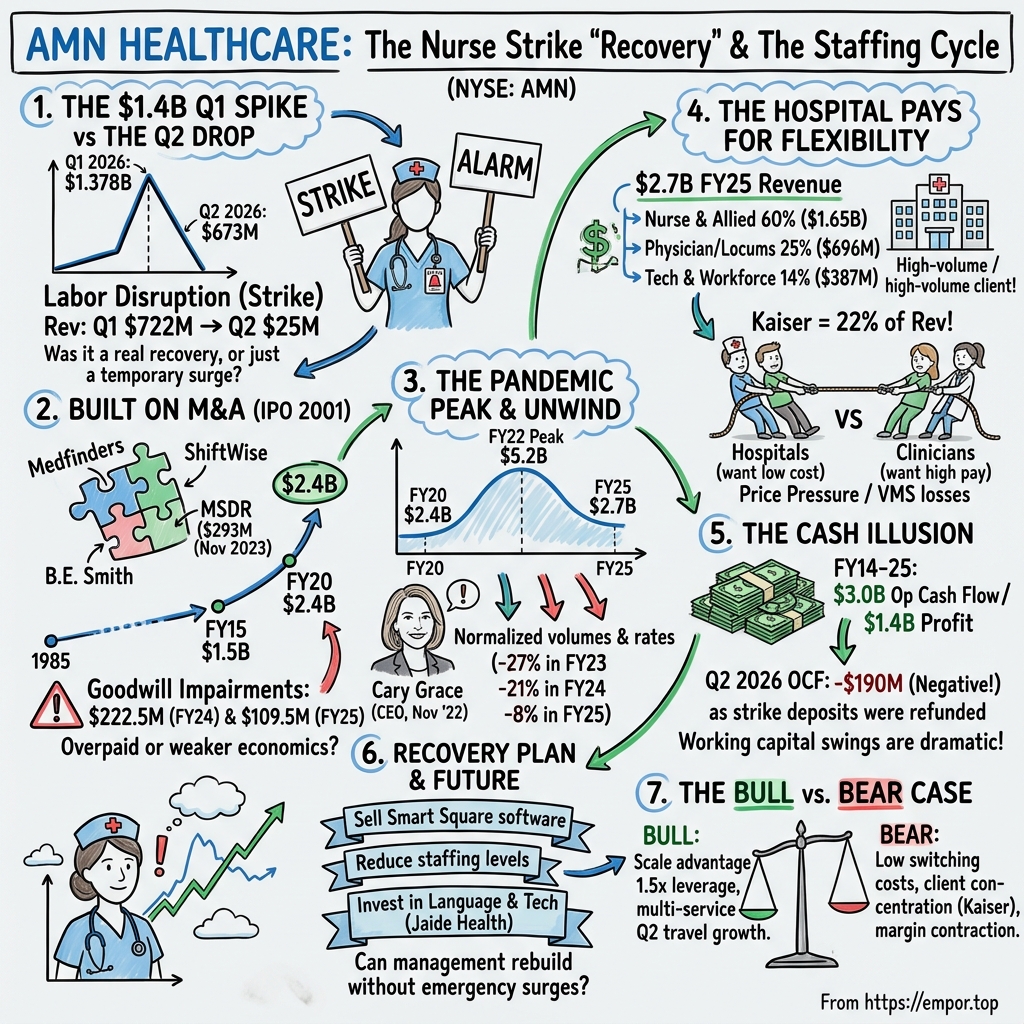
Picture the revenue line of a staffing company that has been shrinking for three straight years. Every quarter since the middle of 2023 the number has come in lower than the year before, sometimes by a quarter, sometimes by a fifth, a slow deflation that shareholders had learned to brace for. Then, in the first three months of 2026, the line jumped. AMN Healthcare Services reported $1.378 billion of revenue for the quarter, double what it had booked a year earlier and more than any quarter since the height of the pandemic staffing boom.1 For a moment, the chart looked like a company that had found its footing and then some.
Three months later the same line fell to $673 million.2 Nothing had broken. Nothing had been sold. The difference between those two quarters had a name in AMN's own disclosures: labor disruption revenue. In the first quarter, the company earned $722 million from supplying clinicians to hospitals whose own staff had walked out or were about to. In the second quarter, that figure was $25 million.12 Take the strike work away and the first quarter was a roughly $656 million business, almost exactly the size of the second.
That is the puzzle at the centre of AMN today. A strike is about the most urgent order a staffing company can receive. A hospital facing a walkout must keep its intensive care unit, its emergency department and its operating rooms running, so it pays for nurses who can be flown in, credentialed, housed and on the floor within days. AMN can do that at a scale few companies can match, which is exactly why the quarter was so large. But a strike also ends. When it does, the nurses fly home, the revenue stops and the question that mattered before the strike returns: is the everyday business growing?
There is a real case that it is, and it deserves a fair hearing before the skepticism. In the second quarter, with strike revenue down to a rounding error, consolidated revenue still rose 2% from a year earlier.2 The core nurse and allied staffing segment grew 11%. Travel nurse revenue rose about 10% and allied revenue, which covers therapists, imaging technologists, lab staff and similar clinicians, rose about 8%.2 It was the second quarter in a row in which travel nursing and allied grew year over year, and on the second-quarter call chief executive Cary Grace said travel nurse orders had turned positive in May, accelerated in June, and by early August were running about 40% above the prior year.3 For a company whose order book had been shrinking since 2022, those are not trivial signals.
Yet the other two segments told a different story. Physician and leadership revenue fell 6% and technology and workforce revenue fell 15% in the same quarter.2 Management's own guidance for the third quarter, published alongside those results, called for nurse and allied to keep growing while both of the other segments kept shrinking.2 The recovery, in other words, is real in one part of the company and absent in the rest.
That sets up the three questions this story will keep returning to. The first is whether AMN can restore the economics of ordinary staffing, the travel nurses and therapists placed week after week without a crisis to inflate the bill. The second is whether it can protect its client relationships and its cash as the strike work settles, because emergency assignments arrive with deposits, receivables and refunds that make the cash flow statement swing wildly. The third is the deepest: whether AMN's scale gives it a durable advantage in a market where hospitals can, and regularly do, change vendors.
The company's size frames all three. In 2025 AMN generated about $2.73 billion of revenue.4 About three-fifths came from nurse and allied solutions, about a quarter from physician and leadership solutions, which includes locum tenens doctors, interim executives and search, and the remainder from technology and workforce solutions, which includes vendor management software and language interpretation.4 It is, by most descriptions including its own, one of the largest healthcare staffing companies in the United States. It also ended 2025 with a net loss of about $96 million.4
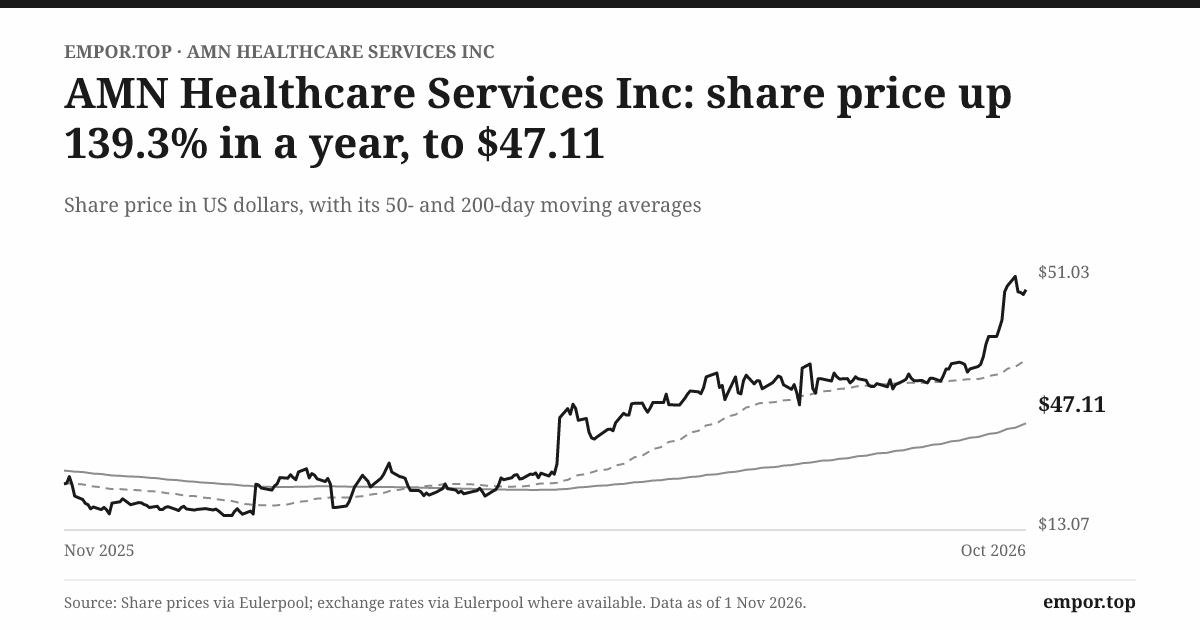
The share price has already moved on the story. As of the first of November 2026, AMN's stock sat at about $47, within a few percent of its 52-week high and roughly three times its 52-week low of about $15.5 Over the past five years, the shares had at one point fallen 88% from their peak.5 The market has priced in a turn. Whether it priced the strike or the recovery is the question.
The next piece of evidence is close. AMN scheduled its third-quarter results for November 5, 2026, which means the latest numbers anyone can examine tonight are the second quarter's.6 Before reading those numbers as a verdict, it helps to know how a travel-nurse recruiter became a $5 billion company and then shrank to roughly half that size, because the road there explains why one quarter can look so different from the next.
 Subscribe on LinkedIn
II. From Travel Nurses to a Public Company
The company began in March 1985 as American Mobile Nurses, a business built around a simple observation: hospitals had seasonal and unpredictable gaps in their nursing staff, and some nurses wanted to travel, earn more and move between assignments.7 Matching those two needs was the whole idea. A nurse in Ohio could spend thirteen weeks in Arizona during the winter census surge, the agency would handle the paperwork, housing and payroll, and the hospital would pay a premium for not having to hire someone permanently.
The firm started in Las Vegas and moved to San Diego in July 1987, where it is still rooted.7 In 1994 it merged with American Mobile Therapists to become American Mobile Healthcare, an early sign that the model was not just about nurses but about any clinician a hospital might struggle to hire.7 Through the late 1990s it bought complementary recruiters, including Medical Express in 1998 and Nurses Rx in 2000, and launched the AMN Healthcare brand at the end of 1998.7
Those deals assembled regional and specialty brands under one roof, and in late 2001 the company took the assembled business public on the New York Stock Exchange. Its preliminary prospectus, filed in October 2001, offered 10 million shares.[^8]7 For a travel-nurse recruiter, the listing was a statement that the company was no longer a niche agency but a national supplier with ambitions to keep buying.
What mattered about this period was not any single acquisition. It was the logic that took hold. A hospital that needed nurses also needed therapists, and later doctors, executives and permanent hires. If one vendor could supply all of them, the hospital would have fewer contracts to manage and AMN would see more of the hospital's open roles. AMN kept adding offerings in that spirit. It bought a physician search firm, MHA Group, now Merritt Hawkins, in October 2005, the same year Susan Salka, who had joined in 1990 as the company's first chief financial officer, became chief executive in May 2005.7 It launched recruitment process outsourcing in 2008, in which AMN would run a hospital's permanent hiring rather than merely fill temporary gaps.7
The most consequential addition was managed services. In a managed service program, AMN does not just supply its own nurses. It runs the hospital's whole contingent labor operation, taking orders, distributing them to other agencies and managing the billing and compliance. That made AMN both a competitor and a coordinator of competitors, a position that could deepen a client relationship far beyond what one agency's recruiters could achieve.
Salka's long tenure gave the company stability. By 2015 revenue had reached roughly $1.5 billion, up about 41% in a single year as acquisitions and a strong staffing market combined.89 The company had gone from a single idea about traveling nurses to a broad workforce supplier with a stock exchange listing, a physician search arm and a growing set of services wrapped around the core staffing business.
The tension that would follow AMN for the next two decades was already visible. Each new offering promised to make a hospital relationship stickier. But each one also had to earn its place. A permanent placement business is lumpy. A search business depends on hiring cycles. Managed services can bring large programs but at thinner fees, and they expose AMN to the risk that a client rebids the whole program at once. More offerings do not automatically mean more value; they mean more ways to win and more ways to lose a client.
The acquisition record that AMN publishes on its own website is long, and it shows energy and ambition. It does not, on its own, show which deals created lasting value. The filings do not provide deal-by-deal returns for most of that history. So the right way to read the early decades is as context: AMN built breadth on purpose. Whether breadth became a moat is a question for the customer evidence, the contract losses and the impairments that came later.
And in the decade that followed the listing, AMN would not slow down. It would speed up.
III. The Platform Built by Acquisition
The 2010s were AMN's shopping decade, and the shopping list reveals the strategy. In September 2010 it bought Nursefinders, which operated as Medfinders, adding a large network of local per diem staffing offices.7 In November 2013 came ShiftWise, a vendor management software platform that hospitals use to place and track orders for contingent staff.7 In late 2014 it bought Avantas, a workforce planning and scheduling business, and in January 2015 it added Onward Healthcare, Locum Leaders and Medefis.7 In January 2016 it bought B.E. Smith, an interim healthcare leadership and executive search firm, followed by Peak Health Solutions later that year.7 In 2018 and 2019 it added MedPartners, Silversheet and Advanced Medical Personnel Services.7 And in February 2020, weeks before the pandemic upended hospital staffing, it bought Stratus Video, a video remote interpretation business that would become AMN Healthcare Language Services.7
Laid side by side, the acquisitions look like a chess player building a position across the board. Local staffing offices brought short-notice per diem shifts. Software brought a seat in the hospital's procurement workflow. Leadership and search brought relationships with hospital executives, the very people who decide which staffing vendors to use. Language services brought a recurring, usage-based revenue stream tied to patient care rather than to labor shortages. The idea was that a hospital could come to AMN for almost any workforce problem, and that each touchpoint would give AMN early sight of more open roles.
Revenue followed the strategy upward. It grew from about $1.5 billion in 2015 to about $2.4 billion in 2020, almost doubling in five years.9 It would be easy to credit that entirely to deals. The record does not support that. The healthcare labor market was tight through much of the decade, travel nursing grew as an industry and AMN's organic business expanded alongside the acquired ones. The filings mix both sources of growth in a way that does not allow a clean split.
What the record does show is the cost. Through the 2010s, cash used in investing activities ran heavily negative in acquisitive years, and borrowings rose from about $160 million at the end of 2014 to about $955 million at the end of 2020.98 AMN financed its platform mostly with debt and cash flow, not with new equity. That choice amplified returns in good years and made the balance sheet more sensitive when the cycle turned.
The deal that best tests the strategy came later, at the end of 2023. AMN announced in October 2023 that it would buy MSDR, two locum tenens and advanced practice staffing firms, Medical Search International and DRW Healthcare Staffing, for $300 million.10 Locum tenens means temporary physicians and advanced practice clinicians such as nurse anesthetists, covering a hospital's gaps in specialties like anesthesia, psychiatry, radiology and surgery. MSDR had generated $104 million of revenue in 2022, and AMN said its annualized 2023 revenue was running at about $155 million.10 AMN paid an initial $292.8 million in cash and recorded $184.1 million of goodwill on the deal.8
Goodwill is the part of a purchase price that cannot be pinned to physical or identifiable assets. It is essentially the premium paid for expected future cash flows. When those expectations fall, accounting rules require a write-down, an impairment. And AMN's goodwill did not hold. In 2024 the company recorded $222.5 million of goodwill impairment across its nurse and allied and its physician and leadership reporting units.8 In 2025 it recorded another $109.5 million, this time in physician and leadership alone.49
Those write-downs are a serious warning. They mean that AMN's own forecasts of future cash flows in the units carrying acquired goodwill fell far enough that the carrying value could not be justified. But they need to be read in proportion. AMN does not disclose MSDR's results separately after the acquisition, so the impairments cannot be traced dollar for dollar to that deal. A goodwill charge in a reporting unit reflects the whole unit's prospects, including businesses AMN had owned for years. The impairments show that the physician and leadership business was worth less than AMN had assumed. They do not, by themselves, measure MSDR's realized return.
Nor do the filings provide the deal-level revenue and comparable transaction data needed to say whether AMN overpaid against what other buyers were paying for locum firms at the time. A purchase price of roughly twice MSDR's annualized revenue run rate was substantial for a staffing business, which typically earns single-digit operating margins on revenue. Whether it was excessive depends on growth and margins that AMN does not publish for MSDR.
So the verdict on the roll-up is mixed rather than damning. The platform widened, and AMN became a supplier that could serve a hospital in many ways. But the widest parts of that platform, the physician business and the technology business, are the ones that have shrunk most recently, and the impairments are the company's own admission that the acquired value was overestimated. From here, acquisitions have to prove themselves in the evidence a long-term owner can see: client wins that are recurring, retention that holds when a contract is rebid, and margins that survive a bad year in the staffing cycle.
Before MSDR, though, came the strangest years in the history of healthcare staffing, years when it seemed AMN could not buy capacity fast enough.
IV. The Pandemic Peak and the CEO Who Inherited It
In the spring of 2020, hospitals faced a problem no workforce plan had imagined. Patients arrived in waves that moved from city to city, and the nurses needed to care for them were exhausted, infected, quarantined or quitting. Hospitals turned to travel nurses in numbers the industry had never seen. Nurses who had earned a steady hourly wage could suddenly earn several times as much on a crisis assignment, and the agencies that placed them charged hospitals bill rates that drew national attention and congressional scrutiny.11
AMN was built for this moment. Its recruiting operation, its database of clinicians who had already been credentialed, its housing and travel logistics and its managed service programs that sat inside hospitals' procurement let it fill urgent orders faster than most. Revenue rose from about $2.4 billion in 2020 to about $4.0 billion in 2021 and about $5.2 billion in 2022.9 In two years the company more than doubled.
Profit grew even faster, because staffing is a business of spreads. AMN bills the hospital an hourly rate and pays the clinician a wage, and the gap between the two covers recruiting, housing, insurance, overhead and profit. When demand is desperate, the hospital tolerates a wider gap and AMN's fixed costs are spread over far more hours. Operating margin peaked at about 12.3% in 2022, compared with about 6.2% in 2020.9 Net profit rose from about $70 million in 2020 to about $444 million in 2022, and return on equity reached more than 40%.9
It was the best financial performance in the company's history, and it was a shortage premium, not a permanent step-change. The same mechanism that inflated the spread in 2021 and 2022 would compress it once hospitals stabilized their own staffing. Permanent nurses who had left returned or were replaced. Travel nurses became more plentiful as wages normalized. Hospitals, hit by losses of their own, set out to cut contract labor spending, which had become one of their most visible costs.
The decline came in three steps, each telling a slightly different story. In 2023 revenue fell about 28%, the sharp first leg as crisis volumes evaporated and bill rates came down.9 In 2024 it fell another 21%, as the industry moved from a crisis to a glut of clinicians chasing fewer assignments.9 In 2025 it fell about 8%, a slower decline that suggested the bottom was near but not yet passed.94 From about $5.2 billion at the peak, revenue had fallen to about $2.7 billion in 2025, roughly where it had been in 2020 before the pandemic began.9
The losses of 2024 and 2025 need careful reading. They were dominated by the goodwill impairments, which are non-cash. But the impairments were not the whole story. Average health professionals on assignment in the fourth quarter fell from about 9,200 in 2024 to about 8,700 in 2025, and the company's underlying margins compressed.9 Even before impairments, AMN was a smaller, less profitable business in 2025 than it had been in 2019, despite having bought many more capabilities in between.
There is one more piece of evidence that explains why the old economics may not return. On the second-quarter 2026 call, Grace said the premium hospitals pay for contingent labor over the cost of their own permanent staff had narrowed to the mid to high single digits in percentage terms, down from the mid to high teens before COVID.3 That is a remarkable statement for a staffing company to make about its own market. It means the price of flexibility, the very thing AMN sells, has fallen. Hospitals are paying less extra for a travel nurse than they did in 2019, not just less than they did in 2022.
Into this unwind walked a new chief executive. AMN selected Cary Grace as president and chief executive in October 2022, and she took office in November, succeeding Salka after a tenure of more than seventeen years.712 The timing could hardly have been worse for a new leader's reputation, or more instructive for anyone trying to judge one. Grace inherited a company at its peak revenue and peak margin, with a cost base, an acquisition appetite and investor expectations built for a world that was already ending.
That makes her record harder to judge than a simple chart allows. Most of the revenue decline would have happened under any chief executive, because it was the pandemic premium leaving the industry. What Grace and her team controlled were the responses: how fast they forecast the decline, how they cut costs, what they bought and sold, how they spent cash and whether their explanations held up from one call to the next. The MSDR deal, a year into her tenure, was one of those choices. So were the buybacks, the capex cuts and the sale of a software business.
The credibility test is specific. When management talks about recovery, does it mean ordinary staffing growth or numbers swollen by strike work? Do the forecasts it gives match what it delivers, and when they miss, are the explanations consistent? The answers to those questions require understanding what AMN actually sells and how much a hospital really depends on it.
V. The Hospital Pays for Flexibility
Start with a scene that happens thousands of times a week. A nurse manager in a medical-surgical unit looks at the schedule for the next three months and sees holes. Two nurses are going on maternity leave. One has resigned. Winter is coming, and with it the respiratory season that fills beds. She cannot hire permanent staff fast enough, and even if she could, she does not want permanent salaries for a temporary surge. So the hospital opens an order: one registered nurse, medical-surgical specialty, thirteen weeks, night shift, starting in a month.
That order is where AMN's business begins. In a direct relationship, AMN's recruiters search the company's network of clinicians for someone qualified and available, check licenses and credentials, verify the nurse's skills and health requirements, arrange travel and housing and submit the candidate. If the hospital accepts, the nurse works, and AMN bills for every hour. Revenue follows hours worked for nurses and allied staff, days filled for locum physicians, fees for permanent placements and program fees for managed services.9
That simple mechanism explains why the company's three segments behave so differently. Nurse and allied solutions, at about $1.65 billion of revenue in 2025, is the core and about 60% of the business.4 It is the most cyclical, the most sensitive to hospital budgets and labor supply, and the source of most of the current recovery. Physician and leadership solutions, at about $696 million, roughly a quarter of revenue, includes locum tenens physicians and advanced practice clinicians, interim executives such as a temporary chief nursing officer, and permanent physician and executive search.4 Technology and workforce solutions, at about $387 million, about 14%, includes the vendor management software, language interpretation services and other technology.4
The mix matters because the segments earn very different margins. In the second quarter of 2026, nurse and allied earned a gross margin of about 28%, physician and leadership about 27%, and technology and workforce about 49%.2 The technology segment is small but profitable per dollar, which is why its decline, down 15% in that quarter with vendor management revenue down about 20%, weighs more on profit than its share of revenue suggests.2
The distinction between direct staffing and managed services is the key to understanding AMN's competitive position. In a managed service program, AMN takes over the hospital's whole contingent labor function. Orders flow through AMN, which fills some with its own clinicians and distributes others to subcontracting agencies, often including AMN's direct competitors. Vendor management software, the ShiftWise platform among it, is the technology layer that lets hospitals post orders, compare candidates and track spending. When AMN runs a program, it sees the hospital's demand first and becomes part of its procurement operations.
That sounds like a lock-in, and to a degree it is. A hospital system that has trained its managers to use AMN's software, routed its contingent spending through AMN's program and built its compliance processes around AMN's systems faces real costs in switching. But the record shows that hospitals do switch. AMN's 2025 annual report describes several vendor management client losses during the year.9 Managed service contracts come up for renewal, and a hospital can rebid the program, bring the function in-house or shift to another provider. In 2025, that is exactly what some clients did.
The clearest evidence on bargaining power is concentration. Kaiser Foundation Hospitals and its affiliates accounted for 22% of AMN's revenue in 2025, up from 16% in 2024 and 17% in 2023.9 No other healthcare system or facility exceeded 5%.9 Kaiser's share rose partly because the rest of the business shrank, which makes it a measure of dependence as much as success. On the second-quarter call, Grace said the Kaiser contract runs to the end of 2026 and that the system was in what she called the long-expected request-for-proposal process; asked about terms, she acknowledged that procurement would strive for better ones.3 A single client whose renewal can move a fifth of revenue, and which is openly negotiating for better pricing, is about as clear a picture of buyer power as a staffing company can present.
Language services show buyer power in a different form. AMN provides interpreters over video and phone for patients who do not speak English, a service hospitals are generally required to offer. Minutes of interpretation were flat year over year in the second quarter of 2026, but the price per minute fell about 8%.3 Hospitals were buying the same amount of service and paying less for it. Management said pricing would remain a headwind as new clients and renewals came through.3
The competitive set is crowded and largely private. AMN competes with Aya Healthcare, CHG Healthcare, Jackson Healthcare and Medical Solutions, among others, and with Cross Country Healthcare, the closest listed pure-play rival, which was acquired and delisted in July 2026.139 AMN describes itself as a leading provider, and Staffing Industry Analysts named it the nation's largest healthcare staffing company in November 2020.7 But the private competitors do not publish comparable figures, and Aya in particular grew aggressively during the pandemic. There is no reliable, apples-to-apples market share figure to settle who leads today.
The industry's two-sided pressure completes the picture. Hospitals want dependable coverage at a manageable price, and they have options: their own internal float pools, their own travel programs, multiple agencies and managed service rivals. Clinicians have options too. A nurse can work for any of dozens of agencies, take a permanent role or join a hospital's internal agency. AMN has to win twice for every assignment, once with the hospital and once with the nurse, and it competes on price with both.
The moat, then, is narrower than the size of the company suggests. AMN's breadth, its recruiter network, its clinician database and its embedded programs are real operating assets. They likely help it fill orders faster and more reliably, and management said on the second-quarter call that rising fill rates on vendor-neutral business, where AMN competes for orders alongside other agencies, typically implied it was taking share.3 That is a meaningful claim, but it is a claim, unaccompanied by retention rates, fill rate data or price realization figures. The disclosed evidence of client losses, the rising dependence on one buyer and the price compression in language services narrow the claim from locked-in customer to useful platform.
What would prove the stronger version is specific: renewal of the Kaiser contract on terms that do not erode margin, stable or growing vendor management client counts, and price realization in nurse staffing as demand recovers. On that last point, chief financial officer Brian Scott said average nurse and allied bill rates were nearly flat year over year in the second quarter, and Grace said that despite rising orders, bill rates had been stable.3 Demand is coming back. Pricing power has not followed yet.
The weakness in physician staffing brings the story back to the biggest acquisition of the Grace era and the question of whether AMN bought at the wrong moment.
VI. The $300 Million Bet Meets a Shrinking Market
When AMN announced the MSDR deal in October 2023, the language was confident. The company said the acquisition positioned it for substantial revenue growth in locum tenens, and Grace said it would expand the workforce solutions available to clients across the country, giving health systems streamlined access to clinicians and a broader candidate pool.10 MSDR brought deep benches in psychiatry, anesthesia, radiology and surgery, specialties where temporary physicians and nurse anesthetists are hard to find. Chris Wang, chief executive of DRW, stayed on to run the combined unit.10 AMN said the deal would be modestly accretive to adjusted earnings in its first twelve months and that it would fund the purchase with cash and borrowings under its revolving credit facility.10
The rationale was coherent. Locum tenens had been one of the steadier corners of healthcare staffing, less exposed to the pandemic boom and bust than travel nursing, because physician shortages in rural hospitals and specialty services are chronic rather than seasonal. Buying MSDR let AMN deepen a business that seemed to offer stability while nurse staffing was falling.
The deal closed at the end of November 2023.8 By then the broader staffing market was well into its decline, and AMN had just reported quarters in which revenue was down by a quarter or more.5 AMN cited about $121 million of 2024 locum tenens revenue associated with the acquisition.8 That was below the annualized run rate of about $155 million cited at announcement, a gap that may reflect timing, integration or softer demand; AMN does not break it down.108
Then the operating record and the accounting record began to diverge from the thesis. In 2024, AMN recorded about $99 million of goodwill impairment in physician and leadership solutions as part of the $222.5 million total.8 In 2025, physician and leadership revenue fell about 4%.4 Locum tenens days filled fell about 8%, partly offset by an 8% increase in revenue per day filled.9 Fewer physician days at a higher price is the signature of a market where hospitals are pickier about how much temporary physician coverage they buy. And then came the second impairment, $109.5 million in the physician and leadership unit in 2025.4
The second quarter of 2026 showed no turn yet. Locum tenens revenue was about $131 million, down 8% from the year before; days filled were about 47,000, down from about 51,000, while revenue per day was essentially flat.2 On the call, management suggested that locum fill rates were lagging demand and that it wanted several consecutive quarters of sustained demand before calling the trend durable.3 The physician and leadership segment was guided to decline again in the third quarter.2
There were bright spots inside the segment. Scott said physician new searches were up about 40% year over year and executive searches up about 30%, and search revenue grew 27% in the second quarter.32 Search is permanent placement, which often leads temporary staffing as hospitals rebuild teams. If it is a leading indicator, it is pointing in the right direction. But search is the smallest part of the segment, and its fees are one-off.
The accounting signal should be kept in proportion. A goodwill impairment does not mean that all of MSDR's value disappeared. It means that forecast cash flows in the reporting unit that includes MSDR fell enough that the goodwill could no longer be supported at its carrying value. The unit also includes AMN's legacy locum business, Merritt Hawkins search and B.E. Smith interim leadership, so the charge is a verdict on the segment's outlook as a whole. Even so, two years of write-downs in the unit that absorbed AMN's largest recent acquisition is the kind of evidence an investor should weigh heavily, because it comes from management's own forecasts.
What would an investor need to call the deal a bargain or a mistake outright? The purchase multiples of comparable locum deals at the time, and MSDR's own revenue and margin since 2023. AMN discloses neither. The fair conclusion is that the timing and the impairments weaken the deal thesis materially, without proving that the price was excessive relative to comparable transactions. The segment's next test is not acquisition rhetoric but organic days filled and margin recovery.
That makes the latest deals worth watching closely. In 2026 AMN bought Jaide Health, which adds AI-enabled language support before and after clinical encounters, and ESSENTIAL Leadership Assessment, which supports search and advisory work. Grace said the two cost about $3 million in total.3 Those are capability purchases, not a return to large-scale roll-ups, and their financial contribution is not yet material in disclosed results. But Scott also said on the call that more assets were coming to market and that, with leverage lower, AMN was now a more active participant in consolidation.3 An investor who remembers MSDR will want to know how the next large deal is priced, and what return it is expected to earn, before it is signed.
Acquisitions are one place to test capital discipline. The cash flow statement is another, and in 2026 it has been more dramatic than the income statement.
VII. Cash Is Not the Same as a Normal Quarter
When a hospital braces for a strike, it does not just place an order with a staffing company. It often pays in advance. The staffing company must recruit hundreds of clinicians, fly them in, book hotels, arrange orientation and guarantee shifts, sometimes on a few days' notice. Deposits from the client cover those costs and the risk that the strike is averted and the assignments never happen. If the strike is shorter than planned, or the deployment smaller, the unused money goes back to the client.
That mechanism explains AMN's 2026 cash flows. In the first quarter, operating cash flow was about $563 million, boosted by favorable working-capital timing from labor disruption events, and AMN ended March holding about $367 million of client deposits that it said would be settled in the coming months.1 Cash on hand rose to about $561 million at the end of March, from about $34 million at the end of 2025.14 Then, in the second quarter, as AMN returned deposits, operating cash flow turned negative by about $190 million.2 At the end of June, about $117 million of deposits remained to be settled.2
Read quickly, those numbers could flatter or alarm. The first quarter's inflow was not a repeatable earnings stream; much of it was other people's money waiting to be returned or applied. The second quarter's outflow was not a sign of distress; it was the deposit coming home. What matters is the residue, the cash AMN keeps once every deposit is settled and every strike receivable is collected. For the first half of 2026, operating cash flow totaled about $373 million, but some of the $117 million still owed will flow out before the year is done.2
The longer record shows that AMN usually converts profit into cash better than its income statement suggests. Across the twelve years from 2014 to 2025, cumulative operating cash flow was about $3.0 billion, more than twice cumulative net profit of about $1.4 billion, and free cash flow after capital spending totaled about $2.4 billion.98 The gap is not magic. It reflects non-cash charges, especially depreciation, amortization of acquired intangibles, share-based compensation and the impairments of 2024 and 2025, as well as working capital moving in AMN's favor when the business shrinks.9
That last point is the uncomfortable one. A staffing company that is shrinking collects receivables from last year's larger revenue while paying a smaller payroll today, which releases cash. AMN's free cash flow stayed at about $234 million in 2025 even as it reported a net loss, partly because of that release.9 A growing staffing company does the reverse: it pays nurses weekly and waits for hospitals to pay, so growth consumes cash. If the recovery is real, normalized cash flow could look weaker for a while even as earnings improve.
Receivables tell the same story in a different language. Days sales outstanding, the average number of days AMN waits to be paid, improved to 47 days at the end of 2025 from 55 days a year earlier and 70 days in 2023.9 It was 52 days at the end of June 2026, or about 54 days excluding the effects of labor disruption work.143 That improvement since 2023 freed hundreds of millions of dollars, and it partly reflects better collections and partly a smaller, less frantic business. The drift from 47 to 54 days on an underlying basis is worth watching as growth returns.
Credit losses add a smaller caution. In 2025 AMN wrote off about $19.6 million of receivables, which it attributed to one significant customer and several smaller balances that had already been reserved.9 The company did not name the customer or publish a detailed aging schedule of its receivables, so investors cannot see how much is overdue. It is not a large number against $2.7 billion of revenue, but it is a reminder that hospitals under financial pressure can become slow or bad payers.
The balance sheet has improved substantially through all of this. AMN reduced total debt by about $285 million during 2025, ending the year with about $775 million of debt and net leverage of about 3.3 times under its credit agreement.4 By June 2026, debt was $750 million of notes, $350 million due 2029 and $400 million due 2031, with the revolver undrawn and about $430 million of capacity available; cash was about $362 million and leverage was about 1.5 times.142 Scott said cash at the end of the second quarter was above the company's expectation and that it expected at least $225 million at the end of the third quarter.3
Fitch, which rated AMN at BB, revised its outlook from negative to stable in May 2026, citing the company's leading position, moderate leverage and strong free cash flow, while noting that the outlook was supported partly by labor disruption revenue it expected to normalize.15 Fitch then withdrew its coverage for commercial reasons.15 The rating agency's caveat is the same one this story keeps making: the cash pile is real, but part of it came from a strike.
So the cash verdict is cautiously favorable. Over a long history, AMN's cash conversion has exceeded its accounting profit, and the strike windfall has lowered leverage meaningfully. But the timing of cash in this business can be dramatic enough to mislead, and the decisive test is the free cash flow AMN produces after the remaining deposits settle and ordinary growth starts to absorb working capital. That test also bears directly on the people who run the company, because cash is the scoreboard their recovery plan will be judged on.
VIII. Grace's Recovery Plan and Its Proof
In AMN's 2025 annual report, Grace presented a path back to revenue growth, describing a company that had gained nurse and allied market share and was positioned for recovery.164 The same report recorded a GAAP net loss of about $96 million for the year, the second annual loss in a row.4 That juxtaposition, an optimistic letter on top of a loss, is common in corporate America. It is also exactly the moment to test whether a management team's words match its record.
The leadership team is compact. Grace has been chief executive since November 2022. Brian Scott was appointed chief financial officer and chief operating officer in October 2024, a combination of roles that puts the numbers and the operations under one executive.712 Douglas Wheat, who was elected chairman in 2008, gave the board continuity across the Salka and Grace eras.7 On calls, Grace's style is measured rather than promotional; she tends to describe demand in terms of orders, fill rates and utilization rather than sweeping claims. Scott's answers are granular, full of margin bridges and one-time items. That precision is useful to investors, and it also makes their claims easier to check.
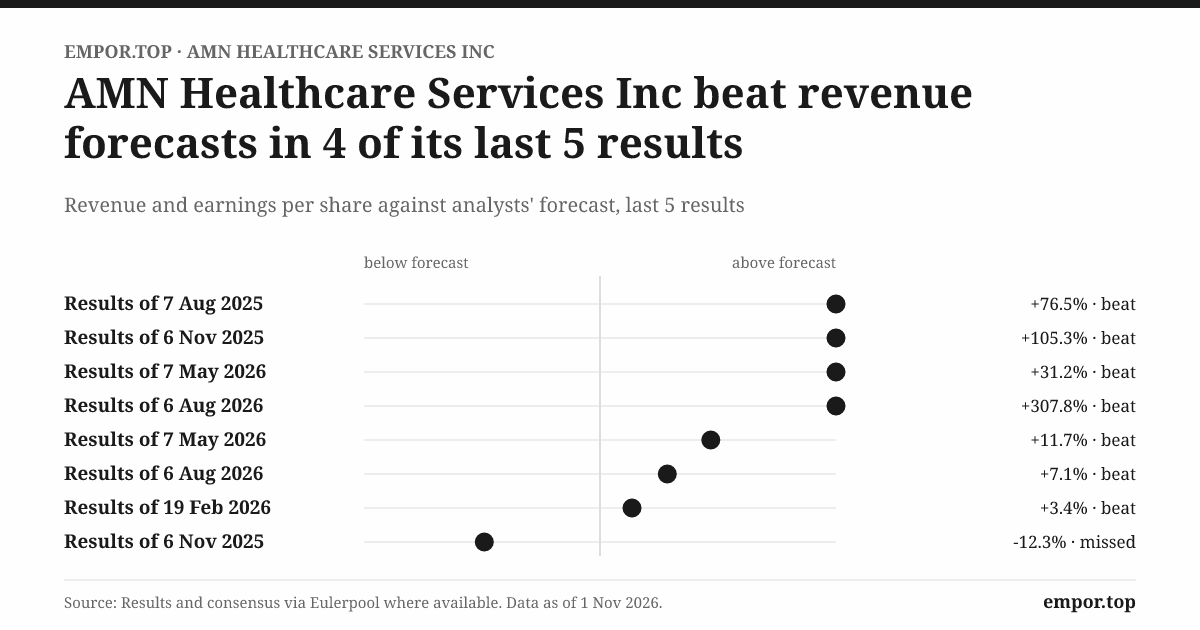
Start with what they forecast and what happened. For the first quarter of 2026, management guided revenue of $1.225 billion to $1.240 billion, assuming about $600 million of labor disruption revenue.4 Actual revenue was about $1.378 billion, with $722 million of disruption work.1 The beat was real, but it came almost entirely from more strike revenue than planned. For the second quarter, management guided $620 million to $635 million, and actual revenue was about $673 million.12 Scott explained that about $27 million of revenue came from items not expected to recur, and that excluding those items, adjusted EBITDA margin would have landed at the top of the guidance range rather than above it.3 That candor is to management's credit. It also means the second-quarter beat was smaller than the headline.
The pattern across 2025 calls was different in tone. Through that year, the language centered on weak demand and normalization, and guidance repeatedly called for year-over-year declines.4 By the second quarter of 2026, the conversation had moved to orders up about 40% and travel and allied growth for a second quarter.3 The shift in narrative was supported by the reported numbers in nurse and allied. It was not supported in physician and leadership or technology and workforce, and management guided both to keep declining. That consistency, describing the weak segments as weak, is a credibility point in management's favor.
The compensation record is more contested. Grace's total compensation for 2025 was about $10.67 million, including about $8.36 million of stock awards.12 In a year with a net loss and an operating margin near 1%, that number will strike many shareholders as high. The counterpoint lies in the design: the performance stock awards for the 2023 to 2025 cycle paid out at zero, because adjusted EBITDA and relative total shareholder return fell short of the plan's thresholds.12 Much of the stock awarded in 2025 is likewise contingent on future performance. The plan did punish weak results. The question is whether the target-setting and the size of new grants reward a recovery that may owe much to circumstance.
Shareholders answered in measured dissent. At the 2026 annual meeting, the say-on-pay vote received about 22.7 million votes in favor and about 7.1 million against, so close to a quarter of the votes cast opposed the pay plan.17 A shareholder proposal for an independent board chair failed, with about 7.5 million votes for and 22.3 million against.17 Eight of nine directors were deemed independent.12 Most shareholders were not prepared to change the governance structure, but a significant minority signaled discomfort with pay.
The ownership register explains who those shareholders are. BlackRock held about 15.1% of the shares and Vanguard about 9.4% as of March 2026.12 Both are large index and institutional holders, not controlling owners; BlackRock's stake had fallen from about 6.4 million shares in the 2024 proxy to about 5.9 million.1812 AMN has no controlling shareholder. Executives and directors as a group own a small fraction of the company, so management's personal stake in the outcome comes mostly through equity awards rather than founder-scale ownership.12
Capital choices are the sharpest test of whether management's actions matched its words. Capital spending fell from about $104 million in 2023 to about $81 million in 2024 and about $36 million in 2025.9 Corporate headcount fell from about 2,970 to about 2,660 during 2025.9 Those cuts protected cash in a downturn. They also raise the question of whether AMN is underinvesting in the technology and recruiting tools it says differentiate it. AMN does not disclose research and development spending separately, so investors cannot measure that directly.
The buyback record invites the most scrutiny. AMN repurchased about $425 million of its own shares in 2023, the year revenue fell 28%, and about $1.12 billion cumulatively since 2016.9 Some of that buying happened while the share price was far above where it later fell; over the past five years, the stock at one point lost 88% of its value from peak.5 An activist would ask why the company spent heavily on buybacks and on MSDR in 2023, then had to cut capex and staff in 2024 and 2025 to reduce leverage built up partly by those decisions. The repurchases have now slowed to a trickle: about 85,000 shares in the second quarter of 2026, with management saying future buybacks would be modest and aimed mainly at offsetting dilution.143
There is real counterevidence of course correction. The performance awards paid zero. Staffing levels were reduced. AMN sold its Smart Square scheduling software at the beginning of the third quarter of 2025, recording a gain of about $39 million, and used the period to cut debt substantially.14 Those are the moves of a management team taking the downturn seriously. Whether they protected returns or shrank future capability depends on what the technology business can do without one of its assets.
So the verdict on management is that confidence must be earned rather than assumed. The guidance record in 2026 has been honest about the role of strike work and about the weak segments, and the pay plan did not pay for failure. But the capital allocation choices of 2023 look poor in hindsight, the compensation drew real dissent and the recovery claim rests on one segment. The measurable proof will be organic revenue growth outside strike work, margins in the shrinking segments and the cash left after deposits settle. And nowhere is the gap between promise and proof wider than in the smallest of AMN's three businesses.
IX. The Smaller Technology Business Has to Earn Its Promise
Technology was supposed to be the part of AMN that made the rest of the company stickier. The idea was persuasive. A hospital that uses AMN's software to plan its workforce, order contingent staff and manage its supplier network becomes a hospital that sees AMN every day, not just when it has a gap. A hospital that uses AMN's interpreters for patients speaking Spanish, Mandarin or Haitian Creole has a relationship with AMN that runs through the clinical floor, not just the human resources office. Software and services like these could, in theory, defend the core staffing business against rivals and earn higher margins than staffing alone.
The scale of the technology and workforce segment keeps that promise in proportion. Its revenue was about $387 million in 2025, down from about $439 million in 2024, roughly 14% of the company.94 Its gross margin is far higher than staffing, but it has been falling: about 49% in the first half of 2026 compared with about 55% a year earlier.14 Language services, at about $70 million a quarter, is the largest piece; vendor management software brought in about $15 million in the second quarter, down about 20% from the year before.2
Three forces have worked against the segment. The first is the vendor management client losses that AMN disclosed in 2025, which removed high-margin fee revenue.9 The second is language services pricing, where hospitals are paying less per minute for the same volume.3 The third is the decision to sell Smart Square, which took revenue out of the segment in exchange for cash and a gain.14 Excluding the Smart Square divestiture, management said technology and workforce revenue fell about 11% in the second quarter rather than 15%.3 That is a better number. It is still a decline.
Management's response has been to lean on AI and global delivery. Grace said AMN plans to expand its workforce globalization in language services, meaning more interpreters based outside the United States at lower cost, to stabilize and improve gross margin.3 The Jaide Health purchase adds AI-enabled language support before and after clinical encounters, such as appointment reminders and discharge instructions.3 The Passport app, AMN's platform for clinicians to find and manage assignments, had more than 400,000 users, up about a third from a year earlier, with monthly active users up more than half.3 Scott said vendor management revenue should stabilize at its current level through the second half of 2026.3
Those are capabilities, not commercialization. AI in language services cuts two ways: it may help AMN lower its own costs, but it may also let hospitals and competitors automate interpretation more cheaply, which is the price pressure AMN is already seeing. AMN itself flags technology and AI as risks to service delivery and to the fees intermediaries can charge.9 A growing app user base is a sign of clinician engagement, but AMN does not disclose how it translates into placements or revenue. The company has not disclosed technology revenue retention, renewal rates or the cross-selling of software clients into staffing, so the claim that technology deepens relationships remains unproven by AMN's own figures.
The history here matters. AMN built its technology portfolio through acquisitions such as ShiftWise, Avantas, Silversheet and Stratus Video, and some of those capabilities have since shrunk, been folded in or been sold.74 The rate at which the company has converted technology milestones into durable, growing revenue is not encouraging on recent evidence. That does not mean the segment is worthless; at a gross margin near 49%, it remains a valuable cash contributor. It means the optionality claim, that technology could become a growth engine, should be discounted until the segment returns to growth.
What would change that view is visible and measurable: technology segment revenue growth, disclosed renewal rates in vendor management and language services, stable or rising gross margins and evidence that software clients buy more staffing. Until that evidence appears, the segment is too small and its trend too weak to carry the investment case. The case rests on staffing, and staffing is where the bull and bear arguments must be fought out.
X. Frameworks and the Bull Versus Bear Case
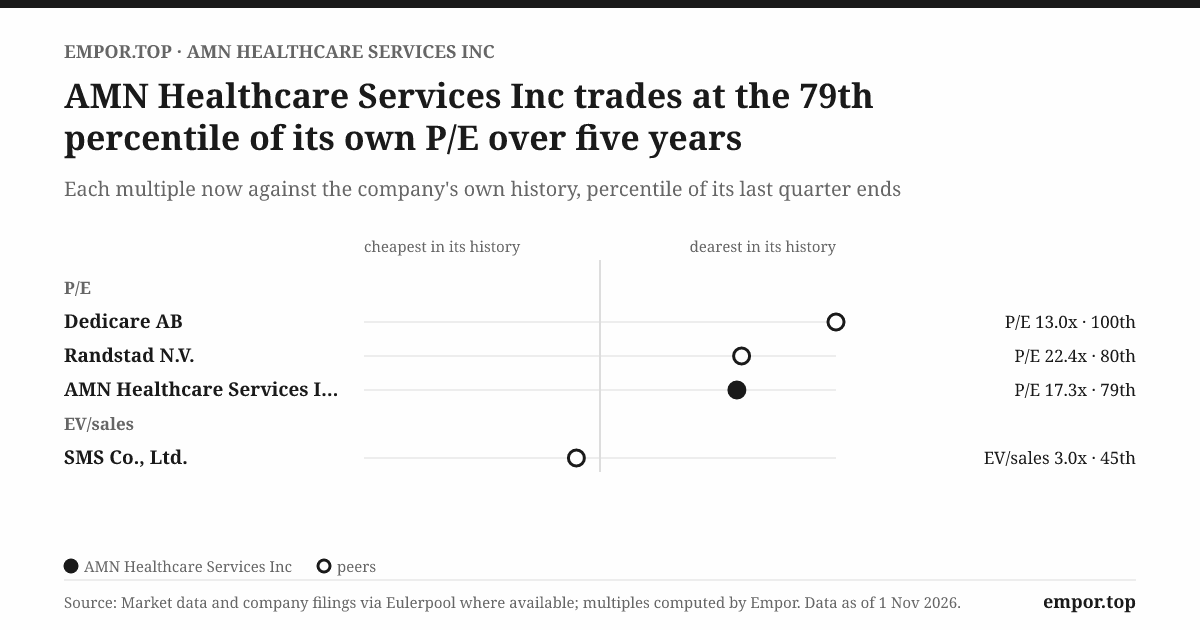
Tonight the market values AMN at about $1.8 billion, with an enterprise value, which adds debt and subtracts cash, of about $2.2 billion.5 The shares trade near their 52-week high. On trailing earnings, which include the strike-swollen first quarter, the price-to-earnings ratio is about 17 times, above the company's own five-year median of about 13 times.5 On revenue, the stock trades at about half a times sales, and on EBITDA at about 6.4 times.5 Those numbers describe a market that has stopped pricing AMN for collapse and started pricing it for recovery, while still treating it as a staffing company rather than a platform.
There is no clean listed peer to compare against. Cross Country Healthcare, the closest specialist, was acquired and delisted in July 2026.13 The largest rivals are private. So the valuation question comes down to AMN's own history: what earnings power can it sustain once the strike work, the deposit timing and the impairments wash out?
Michael Porter's five forces framework gives the structure. Buyer power is the strongest force. Hospitals and health systems multi-source, run internal float pools and travel programs, rebid managed service programs and negotiate hard, as Kaiser's request-for-proposal process shows. Supplier power, here meaning clinicians, is also high. Nurses and physicians can choose among dozens of agencies, direct hospital employment and internal agencies, and they move to whoever pays more. Rivalry among existing competitors is intense: large private rivals such as Aya and CHG contest the same assignments, often through the same vendor-neutral programs. The threat of substitutes is real, because hospitals can substitute permanent hiring, internal staffing pools and technology-enabled scheduling for agency labor, and the narrowed premium for contingent labor shows how much they have already done so.3 The threat of new entrants is moderate. Starting a local staffing agency is easy, but building a national network with credentialing, compliance, housing and managed service capabilities at AMN's scale is not.
Hamilton Helmer's seven powers framework asks a sharper question: what lets a company earn persistently higher returns than rivals? Scale economies are the most plausible candidate for AMN. A larger clinician network and recruiting operation can fill more orders, and a fixed technology and compliance base spread over more revenue lowers unit cost. But the evidence of scale advantage is mixed: AMN's operating margin before impairments in recent years has been thin, and private rivals have grown to comparable scale. Process power, the accumulated know-how of rapid deployment, is visible in the strike work: few companies could supply hundreds of millions of dollars of emergency labor in a single quarter. That is a genuine capability, though it is episodic. Switching costs may exist in embedded managed service and vendor management relationships, but the disclosed client losses and the absence of retention data leave that power unproven. Brand and network effects are useful assets, but neither has been shown to stop a hospital from choosing a cheaper vendor. Counter-positioning and cornered resources do not apply in any meaningful way.
Why might AMN win from here? The bull case starts with demand. Travel nurse and allied revenue grew for a second consecutive quarter, orders were up strongly into August and average travelers on assignment rose to about 9,200 in the second quarter from about 8,700 a year earlier.23 Grace said client utilization of contingent labor was at or slightly below pre-COVID levels, which suggests the market has finished deflating rather than still being propped up.3 Physician and executive search, often a leading indicator, is growing quickly.3 AMN's breadth lets it meet many kinds of workforce need, and its leverage at about 1.5 times gives it room to invest and to participate in consolidation.2 If bill rates follow volume with the lag Grace described, margins in nurse and allied could expand meaningfully, because the fixed cost base has already been cut.3
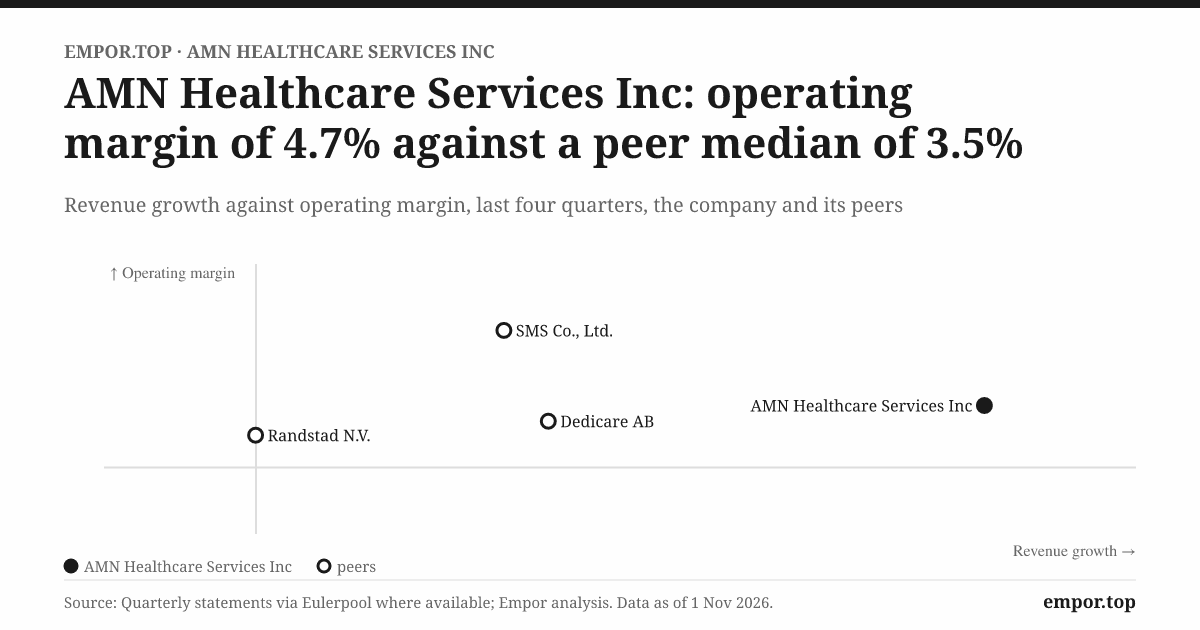
Why might it not? The first-quarter surge depended on strike work, and the strike-adjusted business is only beginning to grow. Kaiser's concentration rose to a fifth of revenue, and its contract is under rebid as this is written.93 Vendor management and language economics weakened, and physician staffing is still shrinking. The narrowing of the contingent premium to the mid to high single digits suggests that even a full volume recovery may not restore pre-pandemic margins, let alone pandemic ones. And the business has already shown how quickly margins can reverse: from about 12% operating margin in 2022 to an operating loss in 2024.9
A skeptical long-short investor would press on capital discipline. Over the past decade AMN generated substantial free cash flow, which is a genuine positive. But it spent heavily on acquisitions whose goodwill it later wrote down by more than $330 million in two years, it bought back about $425 million of stock in 2023 as revenue fell, and it then cut capex to about a third of its 2023 level.98 That sequence does not look like a disciplined capital allocator. The skeptic would also note that the trailing earnings behind the 17 times multiple include a quarter that will not repeat, so the multiple on normalized earnings is likely higher than it looks.
Three measures will tell investors which case is winning. The first is ordinary staffing growth: average travelers on assignment and nurse and allied revenue excluding labor disruption, which most recently rose about 6% and 11% respectively.2 The second is margin quality: segment gross margins and vendor management revenue, with technology and workforce gross margin most recently down from about 55% to about 49% over a year.14 The third is cash after the strike: free cash flow once deposits settle, and net leverage, most recently about 1.5 times and falling.2
The fairest conclusion is that AMN has a credible reason to win through scale, breadth and service relationships, but its own record narrows that advantage to a useful platform rather than a proven moat. The bull case needs a broad recovery across segments and pricing that follows demand. The bear case is that post-pandemic economics settle at lower margins while hospitals and clinicians keep the bargaining power they have shown. The valuation, above its own history on distorted earnings, assumes more of the former than the evidence yet proves.
XI. Playbook: Business & Investing Lessons
Go back to the hospital facing a strike. It calls AMN, wires a deposit, and within days hundreds of nurses are walking through its doors. For a few weeks, AMN is indispensable. Then the union and the hospital reach a deal, the replacement nurses fly home, the unused deposit goes back and the hospital's procurement team starts asking why contract labor costs so much. The strike quarter shows what AMN can do. It also shows where AMN's profit comes from: moments when someone has no choice. Most of AMN's lessons sit in the space between those two facts.
The first lesson is about urgency. AMN's revenue more than doubled from 2020 to 2022 and then fell back to roughly where it started by 2025.9 The company did not lose its clinicians or its recruiters along the way. It lost the moment. Hospitals paid a premium when they were desperate and stopped paying it when they were not, and the contingent premium has since fallen below where it stood before the pandemic.3 When customers buy urgency, the margin belongs to the moment unless the relationship survives it. Founders who sell into emergencies should ask what share of their profit they would keep if every customer had time to shop around.
The second lesson is about breadth. AMN spent two decades building a company that could serve a hospital in almost any workforce situation, and it remains one of the broadest suppliers in its industry. Yet its largest client is negotiating for better terms, some vendor management clients left in 2025 and language customers are paying less per minute.39 A broader platform is only a moat when clients keep choosing it after the crisis. For investors, the evidence of a moat is not the list of services but the renewal rate, and AMN does not publish that figure.
The third lesson is about acquisitions. AMN paid about $293 million for MSDR, recorded most of that as goodwill and then wrote down the unit that absorbed it twice within two years.84 The impairments did not destroy cash on the day they were taken; the cash left on the day of the purchase. The write-downs were simply the moment the accounting caught up with the economics. Acquisition goodwill is a promise written in future cash flows, and an impairment is the moment that promise gets repriced. Any acquirer should be asked, at the time of the deal, what return it expects and how investors will be able to check.
The fourth lesson is about cash. In one quarter AMN generated more than half a billion dollars of operating cash; in the next it gave back nearly $190 million.12 Neither number described the underlying business, and both were real. Cash can be real and still arrive on a schedule the income statement cannot explain. A deposit is a promise, not a profit, and the only cash that measures a staffing company's earning power is what remains once every client has been made whole.
XII. Epilogue
Tonight AMN stands at an unusual point. Its balance sheet is the strongest it has been in years, with leverage near 1.5 times and hundreds of millions of dollars of cash.2 Its core nurse staffing business is growing again. Its share price has tripled from its low.5 And yet the company's most recent full year was a loss, two of its three segments are still shrinking and its biggest client is putting its business out to bid.43
The next moment of evidence arrives on November 5, 2026, when AMN reports third-quarter results.6 Management guided revenue of $640 million to $655 million, about 1% to 3% above the prior year, with nurse and allied up roughly 9% to 11% and physician and leadership and technology and workforce down mid to high single digits and low double digits respectively.2 Only about $7 million to $8 million of strike revenue was expected in the quarter, so this will be close to a clean reading of the ordinary business.3 The guidance implied an operating margin of less than 1% and an adjusted EBITDA margin of about 6.5% to 7%, lower than the second quarter because the one-time items will not repeat.23
If AMN lands at or above that range with nurse and allied growth intact, it will be the third consecutive quarter of travel and allied growth, and management's case that the market has turned will have a longer record behind it. Investors should listen for whether orders kept rising after August, and above all whether bill rates have finally begun to follow volume. If bill rates are still flat, the recovery is a volume story with thin margins. If they rise, the fixed-cost cuts of the past two years could show up sharply in profit.
The bigger moment comes at the end of the year. Kaiser's contract runs to the end of 2026.3 A renewal on similar terms would remove the largest single risk in the business. A renewal on harsher terms would test whether AMN's scale gives it any pricing leverage at all. A partial or full loss would remove a sizable share of revenue at a stroke and would answer the moat question in the most painful way. Any of those outcomes will be the most important piece of customer evidence AMN has produced in years.
Physician staffing and technology will be watched for a floor. Locum days filled have been falling, and management wants several quarters of steady demand before calling a turn; vendor management revenue is supposed to stabilize.3 Language services pricing will reveal whether global delivery and AI can protect margins or whether hospitals simply capture the savings.
Then comes the cash. Once the remaining deposits settle, AMN's free cash flow will show what the business earns without the strike, and how much working capital a growing staffing business really consumes. Investors will want to see what management does with that cash: whether it pays down more debt, resumes larger buybacks or returns to acquisitions at a time when, by Scott's account, more assets are coming to market.3
The tension that remains is the one the first quarter created. AMN proved it can mobilize an army of clinicians for a hospital in crisis. It has not yet proved that its ordinary business, without a crisis, can grow and earn the returns its valuation now implies.
XIII. Outro
Somewhere a hospital is filling its schedule tonight. Perhaps it once needed hundreds of nurses within days, and AMN sent them. Now the walkout is long over, and the hospital needs just one nurse for thirteen weeks on nights in the medical-surgical unit. It can call AMN. It can call a dozen other agencies. It can post the job on its own internal pool. The difference between those two calls, the frantic one and the ordinary one, is the whole story of this company.
AMN's defining skill is organizing a workforce that hospitals cannot always keep on their own payroll, at a scale few companies can match. Its defining risk is that urgency can look like durable growth until the emergency passes. The company that supplied hundreds of millions of dollars of emergency labor in a single quarter still has to show that it can turn each urgent placement into a client who comes back on an ordinary Tuesday, for an ordinary nurse, at a price that still leaves something for the intermediary.
References
-
AMN Healthcare Announces First Quarter 2026 Results — AMN Healthcare, 2026-05-07 ↩↩↩↩↩↩↩↩↩
-
AMN Healthcare Announces Second Quarter 2026 Results — AMN Healthcare, 2026-08-06 ↩↩↩↩↩↩↩↩↩↩↩↩↩↩↩↩↩↩↩↩↩↩↩↩↩
-
AMN Healthcare Q2 2026 Earnings Call Transcript — Stock Analysis, 2026-08-06 ↩↩↩↩↩↩↩↩↩↩↩↩↩↩↩↩↩↩↩↩↩↩↩↩↩↩↩↩↩↩↩↩↩↩↩↩
-
AMN Healthcare Announces Fourth Quarter and Full Year 2025 Results — AMN Healthcare, 2026-02-19 ↩↩↩↩↩↩↩↩↩↩↩↩↩↩↩↩↩↩↩↩↩↩
-
AMN Healthcare to Hold Third Quarter 2026 Earnings Conference Call on Thursday, November 5, 2026 — AMN Healthcare, 2026-10-07 ↩↩
-
History of AMN Healthcare — AMN Healthcare ↩↩↩↩↩↩↩↩↩↩↩↩↩↩↩↩↩↩
-
AMN Healthcare Services, Inc. Form 10-K for FY2024 — SEC, 2025-02-20 ↩↩↩↩↩↩↩↩↩↩↩
-
AMN Healthcare Services, Inc. Form 10-K for FY2025 — SEC, 2026-02-25 ↩↩↩↩↩↩↩↩↩↩↩↩↩↩↩↩↩↩↩↩↩↩↩↩↩↩↩↩↩↩↩↩↩↩
-
AMN Healthcare to Acquire MSDR — AMN Healthcare, 2023-10-23 ↩↩↩↩↩↩
-
Contract Nurse Agencies Are Making Big Money in the Age of COVID-19 — TIME, 2022-02-16 ↩
-
AMN Healthcare Services, Inc. 2026 Proxy Statement — AMN Healthcare, 2026-03-18 ↩↩↩↩↩↩↩↩
-
Cross Country Healthcare Delisting Notice — Nasdaq Trader, 2026 ↩↩
-
AMN Healthcare Services, Inc. Form 10-Q for Q2 2026 — SEC, 2026-08-07 ↩↩↩↩↩
-
Fitch Affirms AMN Healthcare at BB, Revises Outlook to Stable — Traders Union, 2026-05-21 ↩↩
-
AMN Healthcare Services, Inc. Annual Meeting Results, Form 8-K — SEC, 2026-05-01 ↩↩
-
AMN Healthcare Services, Inc. 2024 Proxy Statement — SEC, 2024 ↩
 LinkedIn
 WhatsApp
 Reddit
 Hacker News
 Email
 Kindle
 RSS Feed
 Spotify
 Apple Podcasts
 Amazon Music
 Audible
 YouTube