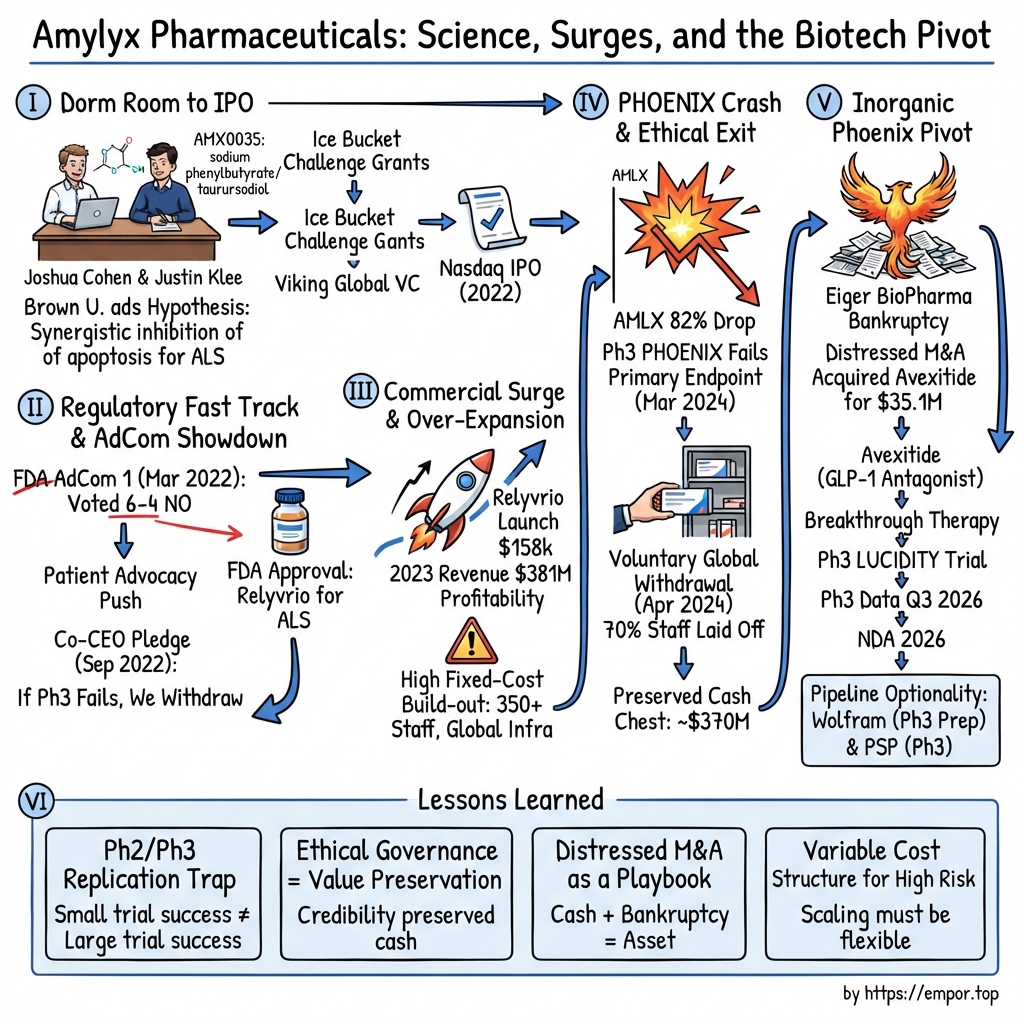
Amylyx Pharmaceuticals: Science, Surges, and the Biotech Pivot
I. Introduction & The $300 Million Promise
On the morning of August 18, 2026, a small Boston-area biotechnology company that most generalist investors had written off two years earlier issued a 7:00 a.m. press release and saw its market capitalization surge by roughly $1.5 billion before midday.
The announcement detailed results from LUCIDITY, a Phase 3 trial evaluating a once-daily injection across 78 patients at 21 sites. The drug reduced the rate of severe low-blood-sugar episodes in post-bariatric hypoglycemia patients by 55% compared to placebo, yielding a p-value of 0.000003.1 In clinical testing, where therapies often achieve statistical significance by narrow margins near the standard 0.05 threshold, a p-value of 0.000003 indicates that the probability of observing such a result by chance is roughly three in a million. Shares of Amylyx Pharmaceuticals closed that day at $35.11, up nearly 64% from the previous close of $21.43, with trading volume approaching 24 million shares — roughly 20 times its daily average.2
The following evening, Amylyx capitalized on the stock rally to raise capital. Originally announced as a $350 million public offering, the deal was upsized to $500.2 million — selling 14.09 million shares at $35.50 apiece — led by bookrunners Leerink Partners, Morgan Stanley, Guggenheim Securities, and LifeSci Capital.3 Combined with the $250.8 million in cash and marketable securities reported six weeks prior, the transaction expanded the company's cash position from approximately eight quarters of operational runway to the largest balance sheet in its history.4
The sudden resurgence highlights a striking corporate trajectory. Four and a half years earlier, Amylyx achieved one of the fastest commercial rollouts in rare-disease history with a different drug for a different condition. Relyvrio, an oral powder for amyotrophic lateral sclerosis (ALS), generated $380.8 million in net product revenue in 2023 — its first full year on the market — and delivered $49.3 million in net income, placing Amylyx among the rare newly public biotechs to reach profitability within 12 months of launch.5
Then, on March 8, 2024, results from the confirmatory Phase 3 trial arrived. The drug failed across every key metric: showing no statistically significant difference from placebo on the primary functional endpoint (p=0.667), overall survival, breathing capacity, or even within the patient subgroup matching the original Phase 2 trial criteria.6 Amylyx stock collapsed from $18.97 to $3.36 in a single trading session — an 82% loss of market value on 61 million shares traded, marking one of the sharpest single-day declines in recent biotech history.7 Four weeks later, the company voluntarily withdrew its sole commercial product from both the United States and Canadian markets and eliminated roughly 70% of its workforce, downsizing from nearly 400 employees to just over 100.8
The withdrawal was not mandated by the U.S. Food and Drug Administration (FDA), but rather fulfilled a public commitment. In September 2022, during a webcast advisory committee hearing, co-chief executive officers Joshua Cohen and Justin Klee pledged to voluntarily withdraw the drug if the Phase 3 trial failed.[^9] Following that pledge, the advisory committee reversed its previous negative vote, and the FDA granted accelerated approval. When the trial ultimately failed, management honored the commitment.
The governance paradox. The case presents a dual lesson for biotech governance. Did Amylyx demonstrate that founder-led management can act with integrity under severe financial pressure, or did it expose the risks of a regulatory framework willing to approve a $158,000-per-year terminal-disease therapy based on a single small Phase 2 trial?
The evidence points to both, though the regulatory lesson carries greater weight for how investors underwrite the company today. Fulfilling the withdrawal pledge preserved vital corporate assets: regulatory standing, scientific credibility, a public listing, and residual capital. However, it did not shield shareholders from catastrophic losses, nor did it prevent a securities class action regarding commercial launch disclosures, which the company subsequently agreed to settle for $6.5 million.9 Maintaining corporate integrity preserves access to capital, but it does not substitute for clinical efficacy.
Key narrative themes. This analysis examines the dorm-room origins of AMX0035 by two undergraduates without doctorates or laboratory facilities; the 2022 regulatory showdown involving back-to-back advisory committees, patient advocacy campaigns, and the withdrawal pledge; and the commercial windfall generated prior to the Phase 3 readout. It further traces the subsequent collapse and strategic pivot: acquiring avexitide, a Phase 3-ready asset, out of bankruptcy court for $35.1 million in cash.10 Finally, it evaluates the remaining pipeline — including a post-pivot program failure — and addresses the core question facing Amylyx over the next five years: whether a company without a track record of commercializing an effective drug can construct a specialty endocrinology franchise around a little-known disease.
That operational challenge represents the ultimate test. Amylyx has generated strong preliminary clinical signals twice — first with a finding that failed to replicate, and now with data that has held up in Phase 3. However, it has yet to commercialize a drug that survives confirmatory trials. The company's trajectory began with two founders pursuing an unconventional hypothesis without formal scientific training.
 Subscribe on LinkedIn
II. The Founders & The Dorm Room Hypothesis (2013–2019)
In 2013, two Brown University undergraduates proposed an unconventional approach to neurodegenerative research, arguing that the field was addressing cellular decay in isolation.
Their thesis centered on dual cellular failure mechanisms in diseases like amyotrophic lateral sclerosis (ALS). Neuronal death, they contended, does not stem from a single defect. Instead, two internal systems break down simultaneously. The endoplasmic reticulum, responsible for protein folding, becomes overwhelmed by misfolded proteins and triggers a chronic stress response ordering the cell to self-destruct. Concurrently, the mitochondrion — the cell's energy source — opens a permeability pore under stress, releasing cytochrome c into the cytoplasm and initiating programmed cell death.
Existing neuroprotective programs typically targeted only one of these pathways. Justin Klee and Joshua Cohen — then 21 and 22 years old, studying neuroscience and biomedical engineering — argued that protecting one organelle while leaving the other exposed left neurons vulnerable. Rudolph Tanzi, a Harvard Medical School neurology professor who became founding chair of Amylyx's scientific advisory board, later described their goal as constructing a comprehensive shield for neurons.11
Rather than inventing new molecules, the co-founders combined two existing compounds with established human safety profiles: sodium phenylbutyrate, an FDA-approved therapy for urea cycle disorders that reduces endoplasmic reticulum stress, and taurursodiol, a bile acid derivative that reduces mitochondrial membrane permeability. In 2013 cell culture experiments, the combination, designated AMX0035, produced over 90% neuronal survival and consistently outperformed either agent alone.11
The credibility problem, and how they solved it. Without doctorates, institutional affiliations, or private laboratories, Cohen and Klee faced significant skepticism from the biopharmaceutical establishment. To build scientific authority, they assembled an academic advisory network around Tanzi and established a preclinical collaboration with Fumihiko Urano's laboratory at Washington University in St. Louis — a partnership that later yielded their second pipeline indication.25
To fund clinical development without early venture capital dilution, the founders sought non-traditional financing. Following the viral 2014 Ice Bucket Challenge, the ALS Association awarded $2.2 million toward AMX0035 in mid-2016: a $750,000 grant directly to Amylyx in June 2016 for a trial pilot, followed by a $1.46 million grant in July 2016 to the Northeast ALS Consortium to support Phase 2 testing.13 Non-dilutive capital of that scale allowed the early-stage team to advance from hypothesis to clinical testing.
Under the grant terms, Amylyx agreed to repay the ALS Association up to 150% of its funding from future product sales.13 While standard for nonprofit startup investments, the royalty structure gave the advocacy organization a direct financial interest in commercial success — an alignment that critics later cited when the Association mounted an aggressive advocacy campaign before the FDA on the drug's behalf.
From virtual company to venture-backed. Amylyx operated as a virtual company for its first six years, maintaining a lean internal team, outsourcing laboratory functions, and deploying capital almost entirely into clinical execution. This low-fixed-cost structure allowed the startup to absorb development delays without downsizing. By contrast, the commercial organization Amylyx built by 2023 — with 384 employees, global infrastructure, and manufacturing commitments — proved far less flexible, amplifying the financial shock of the 2024 trial failure.
Institutional capital arrived after initial clinical signals emerged. Morningside Ventures led a $30 million Series B financing round in mid-2020. In July 2021, Viking Global Investors led a $135 million Series C round alongside Bain Capital Life Sciences, Perceptive Advisors, Rock Springs Capital, Marshall Wace, Tybourne Capital Management, and aMoon, reserving funds for late-stage development and commercial preparation.14 On January 6, 2022, Amylyx priced its initial public offering at $19.00 per share, raising $190 million through bookrunners Goldman Sachs, SVB Leerink, and Evercore ISI, with trading commencing on the Nasdaq under the ticker AMLX on January 7.15
Assessing the people who run it today. Cohen and Klee have served as co-CEOs for more than a decade, preserving shared executive leadership through a product withdrawal, a 70% workforce reduction, shareholder litigation, and a strategic pivot to specialty endocrinology. Their public communications remain consistently mechanism-focused, emphasizing preclinical rationale and biochemical pathways.
Disclosed executive compensation shows that each co-CEO received a base salary of $686,200 in 2025 with a target bonus of 75% of salary, with the board scoring corporate goal achievement at 106.5%. Each executive also received 270,177 stock options vesting over four years alongside one-time performance share units tied specifically to avexitide Phase 3 clinical milestones and FDA approval targets.16 While aligning executive incentives with pipeline execution, this structure also heightens management's incentive to advance avexitide regardless of interim clinical complexity.
Governance metrics reflect lingering shareholder scrutiny following the 2024 collapse. The company's 2025 say-on-pay vote received 58% shareholder support, prompting executive outreach to major institutional holders.16 While exceeding the simple majority required for approval, a vote in the 50s sits well below the typical 90% threshold seen in corporate governance, signaling investor dissatisfaction with the alignment between executive rewards and shareholder returns.
On the financial side, Amylyx recruited James Frates as chief financial officer in January 2021. Frates previously served roughly 22 years as CFO of Alkermes — one of the longest financial leadership tenures in biotechnology — bringing extensive capital markets experience to guide Amylyx through its IPO and subsequent capital raises.17
This financial footing set the stage for 2020, and the clinical trial that initially validated the platform before triggering its greatest crisis.
III. The CENTAUR Trial & The FDA AdCom Showdown (2020–2022)
There is a specific kind of scene that recurs in ALS drug development, and it is not a scientific one. It is a hearing room, or in the pandemic years a Zoom grid, filled with people who have 18 months to live making the case that regulators should accept less certainty than they normally would.
The data that put Amylyx in that room came from CENTAUR: a randomized, placebo-controlled Phase 2 trial of 137 participants run through the Northeast ALS Consortium, published in The New England Journal of Medicine in September 2020.18 The primary endpoint was the ALS Functional Rating Scale–Revised, a 48-point scale measuring whether a patient can still swallow, speak, walk, breathe, and dress independently. Over 24 weeks, patients receiving AMX0035 scored an average of 2.32 points higher than those on placebo — a statistically significant difference and the first time a combination therapy had slowed functional decline in a controlled ALS trial.18
Then came the figure that altered the commercial calculus entirely. In a long-term follow-up analysis of participants originally randomized in CENTAUR, patients who started on AMX0035 lived a median of 4.8 months longer than those originally randomized to placebo.18 In a disease with a typical post-diagnosis survival of two to five years, 4.8 months represents a meaningful extension of life.
Testing the efficacy claim before the regulators did
An independent reading of the data reveals that disconfirming evidence was already visible in 2022 — before approval, before commercial launch, and before public investors bid up the stock.
First, trial size presented a major vulnerability. A 137-patient study is small even by rare-disease standards, leaving results statistically fragile: confidence intervals remain wide, and minor baseline imbalances in patient disease severity can skew outcomes. Second, the p-value on the primary endpoint sat just inside conventional statistical significance rather than comfortably beyond it — a result consistent with a modest therapeutic effect, but equally consistent with clinical noise. Third, the reported survival benefit did not originate from the randomized, double-blind portion of the trial. Instead, it emerged from long-term follow-up analyses layered atop an open-label extension in which all participants knew their treatment status. That constitutes hypothesis-generating evidence rather than confirmatory proof.
Fourth, structural regulatory standards presented a hurdle: the FDA typically requires substantial evidence from adequate and well-controlled investigations, generally interpreted as two successful trials or a single exceptionally persuasive study. CENTAUR was a single modest Phase 2 trial. The FDA's own reviewers highlighted these exact vulnerabilities in briefing materials prepared for the advisory committee.[^9]
On March 30, 2022, the Peripheral and Central Nervous System Drugs Advisory Committee voted 6–4 against recommending approval, concluding that a single small Phase 2 study did not establish efficacy in ALS.13 Under standard regulatory precedent, that vote would have concluded the review.
The second bite, and the pledge
Instead, institutional dynamics intervened — demonstrating how patient advocacy operates as a powerful market force in ALS drug development.
The ALS Association — which had helped finance the trial and held a right to receive up to 150% of its funding back from future sales — mounted an aggressive campaign of FDA petitions, congressional lobbying, and organized testimony.13 In response, the FDA took the unusual step of scheduling a second advisory committee meeting on the same application for September 7, 2022.
Reconvening an advisory committee on an unchanged drug application is exceedingly rare. Advisory panels exist to provide independent scientific evaluation; re-running a panel following a negative vote implicitly questioned the initial regulatory outcome. Amylyx presented an updated survival analysis and additional follow-up data that offered incremental rather than transformative evidence. In contrast, the ALS advocacy community mobilized significant public testimony, presenting petitions and personal accounts from patients and families regarding what a few extra months of independence would mean.13
This dynamic highlighted a core regulatory tension. While patient testimony reflected genuine clinical need, advisory committees are tasked with evaluating whether empirical evidence establishes statistical and clinical efficacy. The second hearing implicitly shifted the policy question from whether efficacy was proven to whether the available evidence was sufficient given the absence of alternative treatments.
The turning point of the hearing was organizational rather than scientific. Co-CEOs Joshua Cohen and Justin Klee stated publicly on the record that if the ongoing 664-patient Phase 3 PHOENIX trial did not confirm clinical benefit, Amylyx would voluntarily withdraw the product from the market.[^9] This commitment converted an abstract pledge into a public, falsifiable promise. It also provided committee members with a risk-mitigation rationale, allowing them to vote favorably without endorsing the underlying strength of the Phase 2 dataset.
The committee reversed its prior decision, voting 7–2 in favor.13 On September 29, 2022, the FDA granted full approval — rather than accelerated approval — for Relyvrio in ALS.21 Health Canada had previously cleared the compound as Albrioza in June 2022 under its Notice of Compliance with Conditions framework, explicitly conditioning market access on the submission of confirmatory PHOENIX data.
This discrepancy created a structural asymmetry. Health Canada issued a conditional approval matching the preliminary state of the evidence, formalizing a requirement for confirmatory trial results. Conversely, the FDA granted full approval paired with a voluntary corporate promise. A voluntary commitment lacks statutory enforcement mechanisms, formal timelines, or legal remedies beyond reputational damage. While Amylyx ultimately fulfilled its pledge, the structure underscored regulatory vulnerabilities in oversight.
What the episode should have told investors
The core lesson available in September 2022 was that market clearance relied on a single modest trial supplemented by unblinded follow-up data, and that management had acknowledged the evidentiary gap by committing to a voluntary withdrawal if confirmatory testing failed. Management's willingness to pledge a potential product withdrawal signaled that the probability of Phase 3 confirmation was far from guaranteed.
Capital markets, however, focused on immediate commercial potential: a full FDA approval, an unserved terminal indication, broad label coverage, and strong patient demand. Within weeks of regulatory clearance, Amylyx established commercial pricing and prepared for market launch.
IV. Commercial Windfall & Premature Scale-Up (2022–2023)
In early October 2022, Amylyx set the commercial price of Relyvrio at $158,000 per year — roughly $12,500 for each 28-day course of an oral powder that patients mixed with water twice a day.22
Management framed the cost as below market alternatives, noting it came in about $10,000 per year less than Radicava, the intravenous edaravone therapy from Mitsubishi Tanabe that had entered the U.S. market five years earlier. The Institute for Clinical and Economic Review, an independent U.S. cost-effectiveness body, disagreed emphatically, concluding in its final report that a value-based price for Relyvrio sat somewhere between $9,100 and $30,600 per year.22 That created a gap of five to seventeen times between commercial pricing and cost-effectiveness benchmarks. Amylyx paired its price with a robust access program: zero copays for commercially insured patients, and free drug for uninsured and underinsured patients meeting financial criteria.22
Market reactions reflected deep divisions across the clinical and investment communities. Rick Bedlack, director of the Duke ALS Clinic, observed that the only thing more frustrating than having no options was having an option insurers refused to cover. Meanwhile, venture investor Bruce Booth called the regulatory approval "a win for advocacy over data" and described the price as "egregious."22
The launch, and what it actually revealed
The commercial result was, by conventional financial measures, exceptional. Revenue expanded from $22.2 million in the stub period of 2022 to $380.8 million in 2023, capped by fourth-quarter revenue of $108.4 million.5 Reaching full-year profitability in its first full commercial year placed Amylyx among a rare tier of newly public biotechs, enabling the company to finish 2023 with $371.4 million in cash and short-term investments and zero debt.5
Beneath the headline figures, however, the commercial rollout exhibited a highly concentrated structure. On a February 22, 2024 earnings call, management disclosed that roughly 80 prescribers, mostly at major ALS centers, accounted for about half of all Relyvrio prescriptions.23 Gross-to-net adjustments ran 12% to 15%, while free drug accounted for 10% to 15% of U.S. prescriptions.23 The metric that proved most telling was six-month persistence in the U.S., which stood at approximately 60%, compared to roughly 80% in Canada.23
That persistence gap served as a primary operational signal during the Relyvrio era. Four in ten American patients discontinued a therapy purported to extend survival within six months of starting treatment. Management attributed the disparity to differences in physician education and side-effect management, asserting that Canadian prescribers were more effective at preparing patients for gastrointestinal tolerability issues and framing clinical benefits.23 An alternative interpretation was that a substantial proportion of patients observed no tangible therapeutic effect and concluded that the gastrointestinal side effects outweighed the perceived benefit — a view that gained strong retrospective support when PHOENIX results were announced.
Amylyx also declined to release detailed prescription counts, a decision Chief Financial Officer James Frates defended on the same earnings call as normal for rare disease.23 While common among specialty biotech companies, withholding prescription data removed the primary independent check available to investors evaluating whether commercial adoption was broadening or saturating.
The competitive picture, and the label advantage
The ALS market Amylyx entered in 2022 was structurally unusual: high unmet need, no curative options, and only two previously approved therapies — generic riluzole, originally from Sanofi, and Radicava. In 2023, Biogen's Qalsody (tofersen) received accelerated approval, but only for the roughly 2% of ALS patients carrying SOD1 mutations. Amylyx's primary edge was label breadth: Relyvrio was the only new therapy indicated for the general ALS population without a genetic gate.
That broad label provided an immediate commercial advantage, but it represented the weakest form of market protection because it was entirely contingent on maintaining regulatory approval. It relied neither on proprietary manufacturing scale, unassailable formulation patents, high prescriber switching costs, nor head-to-head clinical superiority. It was a regulatory position with an explicit expiration date tied to a specific trial readout.
The structural characteristics of the ALS market also aided the initial launch in ways that did not generalize to broader disease categories. Because the disease progresses rapidly and care is concentrated within specialized multidisciplinary centers, a new therapy can capture significant market share through a small cohort of physicians — as reflected by the 80-prescriber concentration.23 While this structure made the launch inexpensive to run and quick to scale, it also heightened commercial fragility. When the clinical narrative shifted, the same concentration that accelerated adoption drove rapid discontinuation, as key opinion leaders adjusted treatment practices simultaneously. Frates informed investors in May 2024 that prescriptions and refills began declining immediately after the March 8 trial announcement, before the company had reached a decision regarding product withdrawal.25
In parallel, Amylyx expanded international operations throughout 2023. The company utilized managed-access and early-access pathways in Europe and Israel, launched commercially in Canada, and opened discussions with Japan's Pharmaceuticals and Medical Devices Agency about a regulatory path.23 Frates framed the global opportunity as substantial, noting that the company retained worldwide rights and that ALS affects populations globally.23 Although international expansion represented logical strategy for an effective therapy, building out multiple global workstreams consumed cash and executive focus prior to receiving confirmatory Phase 3 data.
Testing the "disciplined scaling" claim
While management did not explicitly label its operational expansion as disciplined, the corporate record demonstrates how executive leadership deployed capital when well funded.
In 2023, selling, general, and administrative expense reached $188.4 million while research and development spend totaled $128.2 million — generating combined operating expenses exceeding $316 million against $380.8 million of revenue.5 Headcount grew to 384 full-time employees, of whom 151 were in R&D.19 Concurrently, the company opened early-access channels in Europe and Israel, launched commercially in Canada, and conducted active discussions with Japan's regulator about a path forward.23
On February 22, 2024 — fifteen days before the trial readout that would end commercial operations — management informed investors that its target was to maintain at least 10,000 people on Relyvrio in the U.S. at any point in time, that it expected R&D expenses to grow quarter by quarter, and that SG&A would rise as it launched growth initiatives and prepared for international expansion "should the PHOENIX study be supportive."23 Chief Medical Officer Camille Bedrosian, who had joined months earlier following executive medical roles at Ultragenyx, Alexion, and ARIAD, told investors that PHOENIX "has the potential to be the largest Phase 3 study in ALS to demonstrate a treatment benefit."23 Co-CEO Joshua Cohen addressed potential speculation by confirming that management had received no early look at the data.
This expansion strategy illustrates the central operational risk of Amylyx's commercial scaling. Management constructed global sales and regulatory infrastructure and guided toward increased R&D and SG&A spending ahead of a single binary clinical outcome. Because the conditional nature of market access was known from approval — as embodied by the voluntary withdrawal pledge — building fixed operating overhead against a probabilistic revenue stream created severe exposure. When trial efficacy resolved to zero, fixed operating expenses remained intact.
The entire commercial revenue stream disappeared on a Friday morning in March 2024.
V. The PHOENIX Crash, Restructuring, & Ethical Credibility (March–April 2024)
The investor call was scheduled for 8:00 a.m. Eastern on Friday, March 8, 2024, but the outcome was already clear before executives spoke, as the press release had crossed the wire before equity markets opened.
The Phase 3 PHOENIX trial enrolled 664 ALS patients across the United States and Europe, randomizing participants three-to-two between AMX0035 and placebo over 48 weeks — nearly five times the enrollment and twice the duration of the CENTAUR study.6 The primary endpoint relied on the same functional rating scale.
The trial returned a p-value of 0.667 on that primary endpoint, indicating no statistically meaningful difference from placebo. Secondary endpoints — including overall survival, quality of life, and respiratory function measured by slow vital capacity — similarly showed no therapeutic benefit. Crucially, an analysis of the subgroup of participants matching CENTAUR's original inclusion criteria also failed to show a separation from placebo.6
"We are surprised and deeply disappointed by the PHOENIX results following the positive data from the CENTAUR trial," co-CEOs Joshua Cohen and Justin Klee said in a joint statement.6 Management paused commercial promotion and gave itself eight weeks to consult with regulators and patient advocacy groups before deciding whether to voluntarily withdraw the therapy.
Investors did not wait for that review. Amylyx stock plummeted more than 80% in a single trading session, falling from roughly $19 to just over $3 per share and continuing to slide over subsequent weeks.19 The collapse erased approximately $1 billion in market valuation overnight.
Keeping the promise
On April 4, 2024, Amylyx formally notified the FDA and Health Canada that it was voluntarily relinquishing its marketing authorizations for Relyvrio in the U.S. and Albrioza in Canada.7 Concurrently, management announced a corporate restructuring that halted commercial operations, initiated a 70% workforce reduction, and established a free-of-charge access program for existing patients who elected to remain on the drug.7 Details of the workforce reduction and restructuring charges were disclosed in a Form 8-K filing that day.20 Total headcount dropped from nearly 400 employees to slightly more than 100.19
The financial mechanics of the wind-down illustrated how rapidly commercial biotech operations can reverse. First-quarter 2024 revenue reached $88.6 million, but virtually all sales occurred prior to the March 8 trial announcement, after which new prescriptions and refills halted immediately, prompting management to guide toward zero ongoing commercial revenue.8 Cost of sales for the quarter expanded to $116.4 million, driven by $110.5 million in non-cash inventory write-downs and contract manufacturer commitment losses.8 Consequently, Amylyx reported a first-quarter net loss of $118.8 million, or $1.75 per share, alongside $19.1 million in expected cash severance and restructuring expenses.8
Crucially, cash and marketable securities totaled $373.3 million as of March 31, 2024.8 That capital reserve preserved the company's operational solvency. Unlike clinical-stage biotechs that exhaust liquidity during trial failures, Amylyx proved cash-generative during its commercial phase in 2023, while the largest accounting losses during the product withdrawal stemmed from non-cash inventory adjustments rather than immediate cash drain.
What the calls actually revealed
While Wall Street might have been expected to press management on whether the initial CENTAUR trial was a statistical false positive, the tone of the May 9, 2024 earnings call proved far more reserved.
Only four analysts participated in the question-and-answer session: Goldman Sachs analyst Corinne Jenkins inquired about cash runway and upcoming readout schedules; Leerink's team asked about trial endpoint selection in Wolfram syndrome; Mizuho analyst Graig Suvannavejh questioned calpain-2 target selectivity and potential interim data shifts; and Baird asked about FDA meeting timelines.25 Notably absent were inquiries regarding why CENTAUR's preliminary signal failed to replicate in Phase 3, or whether the company's core scientific framework faced broader validity issues.
On the call, Klee reiterated that PHOENIX results were "deeply disappointing and surprising given the prior CENTAUR trial results," while pivoting the strategic narrative toward early-stage pipeline assets focused on well-defined disease mechanisms and objective biomarkers.25 Simultaneously, Frates guided quarterly combined research, development, and administrative expenses down to between $30 million and $40 million, aligning projected spending with pre-commercial operating levels.25
That spending target serves as an operational benchmark when evaluated against subsequent performance. By the second quarter of 2026, quarterly operating expenses reached $45.7 million.4 While total spending exceeded the initial post-crash range, the expenditure structure shifted from commercial wind-down costs to pipeline development and included a one-time legal settlement charge.26 The operational record indicates that while restructuring reduced expenses immediately following the trial failure, operating expenditures expanded as new clinical programs advanced.
The credibility ledger
Fulfilling the voluntary withdrawal commitment preserved regulatory standing. By removing a failed drug promptly rather than challenging regulatory findings, Amylyx maintained institutional credibility with the FDA, facilitating subsequent interactions regarding new clinical trial protocols.
However, the commercial wind-down did not eliminate legal and governance liabilities. A shareholder class action in the U.S. District Court for the District of Massachusetts, Shih v. Amylyx Pharmaceuticals, alleged that management issued materially misleading disclosures regarding the stability and growth of Relyvrio's commercial launch between November 2022 and November 2023. Following the court's denial of a motion to dismiss in September 2025, Amylyx agreed to a $6.5 million settlement, which received preliminary court approval on May 11, 2026, with a final approval hearing scheduled for September 10, 2026.9 The litigation focused on commercial disclosures rather than scientific integrity, highlighting potential disconnects between public management commentary and underlying prescription persistence metrics disclosed prior to the trial readout.
What followed marked an unprecedented corporate transition in the company's history.
VI. The Inorganic Pivot: Distressed M&A and the Avexitide Acquisition (July 2024–Present)
In the spring of 2024, two biotechs were failing at the same time, in different ways.
Amylyx had a treasury and no product. Eiger BioPharmaceuticals had products and no treasury: its lead program, lonafarnib for hepatitis delta virus, had run out of road, and on April 1, 2024 the company filed for Chapter 11 protection in the Northern District of Texas.
Sitting in the Eiger estate was a peptide called avexitide. On June 26, 2024, the bankruptcy court authorized Amylyx as winning bidder; on July 9, 2024 the acquisition closed for $35.1 million in cash plus cure costs and assumed liabilities, along with a 3% royalty on future post-bariatric hypoglycemia sales payable to academic institutions.10
Consider what $35.1 million bought: a first-in-class molecule with five completed clinical trials, FDA Breakthrough Therapy Designation in two separate indications, Orphan Drug Designation, Rare Pediatric Disease Designation in congenital hyperinsulinism, and a Phase 3-ready development package.10 The total Eiger spent developing avexitide across five trials was not separately disclosed, so any multiple-of-development-cost framing is an estimate rather than a fact. What can be said with confidence is that a bankruptcy auction is a forced-seller mechanism, and forced sellers do not capture the full value of orphan assets.
What the disease is, and why the drug should work
Post-bariatric hypoglycemia is a condition almost nobody had heard of a decade ago, and understanding it requires understanding what gastric bypass surgery actually changes.
In a Roux-en-Y gastric bypass, surgeons reroute food past most of the stomach directly into the small intestine. That is what makes the operation work for weight loss. It also means that when a patient eats, food hits the gut wall fast and undiluted, and the gut responds by dumping an enormous surge of GLP-1 — the same hormone that the entire obesity drug industry has spent a decade trying to mimic. GLP-1 tells the pancreas to release insulin. Too much GLP-1 means too much insulin, which strips glucose out of the blood far below where it should sit.
The result is that one to three hours after eating, patients crash. Level 2 hypoglycemia, defined by the American Diabetes Association as blood glucose under 54 mg/dL, is where the brain begins to be starved of fuel. Level 3 is where the patient loses consciousness, seizes, or requires another person's help. As Cohen has explained, these levels travel together — patients rarely have one without the other.26 Patients describe living in permanent fear of eating.
Avexitide is the mirror image of a GLP-1 drug. Where semaglutide and tirzepatide activate GLP-1 receptors, avexitide blocks them — a 39-amino-acid peptide, injected once daily, that turns down an over-amplified signal rather than turning one on. It is a rare instance of a mechanism that is genuinely obvious once the pathophysiology is understood, which is why the FDA granted Breakthrough Therapy Designation on Phase 2 data.
The evidence base that Amylyx bought, and why it was different from CENTAUR
Here is the part that separates avexitide from AMX0035, and it is the crux of the investment question.
In the Phase 2 PREVENT crossover study of 17 evaluable patients, the 60 mg once-daily dose reduced Level 2 hypoglycemic events by 60% (p=0.004) and Level 3 events by 56% (p=0.014).10 In a Phase 2b study of 16 patients, the 90 mg once-daily dose reduced Level 2 events by 53% (p=0.004) and Level 3 events by 66% (p=0.0003).10 Two independent trials, different dose regimens, effect sizes in the same range, p-values an order of magnitude tighter than CENTAUR's.
The contrast with the ALS program is instructive. AMX0035 rested on one modest trial with a marginal p-value and a survival claim derived from unblinded follow-up. Avexitide arrived with repeated, independent, placebo-controlled reductions in a hard, objectively measurable endpoint — blood glucose readings, not a clinician-rated functional scale. It also targets a mechanism where the causal chain is short and legible: surgery causes excess GLP-1, excess GLP-1 causes excess insulin, excess insulin causes hypoglycemia, blocking the receptor should break the chain. ALS neurodegeneration involves no such short chain.
LUCIDITY: the confirmation, and its limits
The Phase 3 LUCIDITY trial enrolled 78 adults with post-bariatric hypoglycemia following Roux-en-Y gastric bypass at 21 U.S. sites, randomized 3:2 to 90 mg avexitide once daily or placebo, after a six-week screening period including a three-week run-in, with 16 weeks of double-blind treatment followed by a 32-week open-label extension.1
It hit. The 55% reduction in the composite Level 2 and Level 3 event rate at p=0.000003 was accompanied by all secondary endpoints being met — Level 2 events by self-monitored blood glucose, Level 2 events by continuous glucose monitor, and independently adjudicated Level 3 events. Adverse events were mostly mild to moderate, with no serious adverse events attributed to the drug; the most common were diarrhea, injection-site redness and injection-site bruising, and there was no change in body weight in either arm.1 That last detail matters commercially: a drug that blocked GLP-1 signaling and caused weight regain in bariatric surgery patients would be a much harder sell.
Two design choices in that protocol deserve attention, because they show a company that had learned something from CENTAUR. The first is the three-week run-in before randomization: patients had to demonstrate at least three qualifying hypoglycemic events, including at least one Level 3 event, before they could enroll.26 That does two things — it screens out patients whose events are too infrequent for a 16-week trial to measure, and it filters for people who can actually comply with a demanding protocol. Klee described the team paying "particularly close attention during the run-in period" to whether participants would be consistent trial participants.26 The second is that Level 3 events were independently adjudicated rather than self-reported, which removes the most obvious source of bias in a symptom-driven endpoint.1
Management had set expectations conservatively, and the record supports that characterization. On the August 6, 2026 call — held twelve days before the readout, with the database not yet locked and the company still blinded — Klee told Leerink's Marc Goodman that the trial was powered at 90% to detect a 35% treatment effect while assuming a placebo effect of up to 50%, well above anything seen in prior studies.26 The trial then delivered 55%. Powering conservatively and beating the assumption is the opposite of what happened with CENTAUR, where a marginal result was extrapolated forward.
So does LUCIDITY resolve the replication question? Largely, for this indication. Three separate placebo-controlled trials now show reductions in the same range, and the Phase 3 used an FDA-agreed primary endpoint with independent adjudication of the severe events. That is a materially stronger evidentiary position than Amylyx has ever occupied. What LUCIDITY does not resolve is durability beyond 16 weeks in a chronic condition, or effect in patients whose hypoglycemia followed sleeve gastrectomy rather than gastric bypass.
Testing the "turnkey commercial asset" claim
This is where independence matters, because the market's reaction on August 18 priced a good deal of commercial success into a company that has approved-drug commercial experience only from a product it withdrew.
The label may be narrower than the market. LUCIDITY enrolled only Roux-en-Y gastric bypass patients. Klee's position is that "PBH is PBH, regardless of the surgery that leads to PBH," and he noted that in the Phase 2b, patients whose hypoglycemia followed other surgeries — including gastrectomy and esophagectomy for cancer — responded as well.26 But he also conceded on the same call that the FDA could confine the indication to gastric bypass, in which case Amylyx would need an additional study. Of the roughly 160,000 U.S. patients the company estimates have the condition following the two most common bariatric procedures, about 120,000 had gastric bypass, based on prevalence work Klee attributed to Stanford researchers.26 So a narrow label still addresses a large population — but it caps roughly a quarter of the opportunity behind further clinical work.
The market has to be built, not captured. There is no existing PBH prescriber base to convert. Chief Commercial Officer Dan Monahan — who joined from Otsuka in late 2023 to run the Relyvrio launch, and stayed through the collapse — has described a concentrated launch strategy: centers with 50, 70, sometimes 100 identified patients, found through claims analysis and validated by medical science liaisons.26 The company launched a disease-education campaign at the ENDO 2026 meeting in June under the banner "Uncover the Mystery of Post-Bariatric Hypoglycemia," and a dedicated ICD-10 diagnostic code for the condition takes effect on October 1, 2026 — which Monahan was careful to describe as a recognition milestone rather than a reimbursement one, since payers do not require an ICD-10 code to reimburse.26
Stifel's James Condulis asked the right question on that call: does a launch like this produce a bolus at the big centers and then stall before reaching the next tier? Monahan's answer was that the market builds over time with education.26 That is the correct strategy and also an unfalsifiable answer at this stage. It is exactly the kind of claim the Relyvrio persistence data should make investors want to see proven rather than asserted.
Manufacturing and supply. Bank of America's team asked about the $35 million of contract manufacturing commitments through 2028 disclosed in the filings, and whether a positive readout would trigger more. Cohen confirmed the company makes commitments to secure capacity and expects to continue doing so.26 The August offering's stated use of proceeds explicitly included "securing additional manufacturing capacity."3 A peptide inherited from a bankrupt company's estate carries genuine chemistry, manufacturing and controls risk at the point of NDA review — this is the most common cause of a Complete Response Letter for an otherwise clean application.
Pricing is undetermined. Monahan has stated that pricing research would begin only after the data, benchmarked against rare disease and endocrinology analogs.26 Given that Amylyx's last pricing decision drew an ICER assessment five to seventeen times below list, this is a decision worth watching closely rather than assuming away.
One quiet asset worth tracking. In May 2026 Amylyx opened an Expanded Access Program for adults with post-bariatric hypoglycemia — initially for LUCIDITY participants rolling out of the open-label extension, then for patients from prior avexitide trials, with their treating centers requiring separate activation.4 Guggenheim's Seamus Fernandez pressed management on how it was progressing and noted, correctly, that it represents an opportunity to put the company on a strong commercial footing; Bedrosian's answer was that enthusiasm was high but it was "early days yet."26 Expanded access programs are how rare-disease companies pre-build the referral map: every activated site is a site that already knows how to identify, enroll and monitor these patients on day one of a commercial launch. It is not revenue, and Amylyx has not disclosed patient numbers, but the pace of site activation is a leading indicator of launch readiness that will be visible before any sales are.
The calibrated conclusion: the claim that avexitide is a de-risked clinical asset now has strong support and should be treated as substantially confirmed for gastric-bypass PBH. The claim that it is a turnkey commercial asset remains entirely unproven and rests on a management team whose only completed launch showed 60% six-month persistence and ended in withdrawal. Those are two different claims and the market on August 18 arguably paid for both.
VII. Pipeline Optionality: Repurposing AMX0035 in Wolfram & PSP
On April 4, 2024 — the same day Amylyx announced the voluntary withdrawal of Relyvrio — the company also released interim data from a small trial in a rare condition affecting roughly 3,000 people in the United States.
That study was HELIOS, evaluating AMX0035 in Wolfram syndrome: a monogenic disorder, typically driven by mutations in the WFS1 gene, that causes childhood-onset diabetes, progressive optic nerve atrophy resulting in blindness, hearing loss, neurodegeneration, and premature death by early adulthood.25 Mechanistically, the rationale for evaluating AMX0035 in Wolfram syndrome is more direct than in ALS. The WFS1 protein resides in the endoplasmic reticulum membrane, where it regulates calcium balance and protein folding. Literature characterizes Wolfram syndrome as a classic disorder of endoplasmic reticulum stress — the specific cellular pathway AMX0035 was designed to address. Amylyx and Fumihiko Urano's laboratory at Washington University had collaborated on the program for nearly seven years before initiating clinical testing.25
The open-label HELIOS trial enrolled 12 adult patients. Week 24 and Week 48 findings published in The Journal of Clinical Investigation in May 2026 demonstrated sustained improvements in pancreatic beta-cell function, measured by C-peptide response during a mixed-meal tolerance test, alongside reductions in HbA1c levels, improved time-in-range glucose readings, and visual acuity metrics trending toward stabilization.27 Follow-up Week 96 data presented in early 2026 indicated continued stabilization or improvement across glycemic and visual markers.4 Amylyx remains in ongoing discussions with the FDA regarding a pivotal Phase 3 trial design. Co-CEO Joshua Cohen noted the structural complexity of designing the study, given that Wolfram syndrome affects multiple organ systems and no Phase 3 trial has ever been conducted in the indication.26
The program that no longer exists
Before late 2025, corporate strategy included a second repurposing initiative alongside Wolfram syndrome: ORION, a Phase 3 trial of AMX0035 in progressive supranuclear palsy (PSP), a rare tauopathy affecting eye movement, balance, speech, and cognition. That program has since been terminated.
On August 27, 2025, Amylyx announced the complete discontinuation of the ORION program. At Week 24 in the Phase 2b portion, AMX0035 demonstrated no statistically significant difference from placebo across primary or secondary endpoints, including the PSP Rating Scale, brain atrophy metrics, quality-of-life scores, and fluid biomarkers. Consequently, management halted the Phase 2b study and its open-label extension before initiating the Phase 3 segment.28 Chief Medical Officer Camille Bedrosian attributed the decision to a commitment to align capital allocation with comprehensive empirical data.28 The decision marked a rapid termination of a trial that had begun dosing in December 2023 and was originally designed to enroll nearly 600 patients.
This outcome directly informs how investors must evaluate the Wolfram program, providing critical context for AMX0035's broader clinical profile.
Testing the "mechanism is validated beyond ALS" claim
Management's central premise has been that AMX0035's dual-pathway mechanism applies broadly across neurodegenerative and metabolic disorders. The human clinical record evaluating that premise over the past decade presents a clear pattern.
In ALS, a modest Phase 2 signal failed to replicate in a confirmatory Phase 3 study five times its size. In Alzheimer's disease, the PEGASUS trial demonstrated exploratory biomarker shifts — including reductions in tau proteins — that management cited to justify entering PSP, though it never pursued a registrational trial. In PSP, where the tau rationale underwent rigorous controlled testing, the candidate failed across all primary and secondary endpoints. In Wolfram syndrome, early findings show signal in 12 patients within an open-label trial lacking a placebo control group.
Across controlled clinical settings, AMX0035 has failed to demonstrate efficacy in two large randomized studies, while its sole active clinical signal relies on an uncontrolled, open-label dataset. Although the underlying biological hypothesis remains scientifically coherent, the combination therapy has failed to achieve statistical significance in both instances where it was evaluated against a placebo.
This track record does not automatically preclude success in Wolfram syndrome. The mechanistic foundation in Wolfram is structurally stronger than in ALS or PSP because the condition is monogenic, with the mutated gene operating directly within the pathway AMX0035 targets — creating a shorter, more defined causal link. Furthermore, C-peptide levels provide an objective biochemical readout rather than a subjective clinical rating scale, mitigating observer bias, though still subject to the limitations of an uncontrolled study.
The broader assertion that AMX0035 offers a universal neuroprotective platform is unsupported by clinical trial data. However, the narrower hypothesis — that the drug may alter disease progression in a monogenic disorder driven directly by endoplasmic reticulum stress — remains viable but unconfirmed. Validating that hypothesis requires a double-blind, placebo-controlled Phase 3 trial measuring C-peptide preservation and visual acuity. Until such data exist, the HELIOS trial remains a 12-patient open-label study, an evidence tier that historically exhibits functional stabilization that placebo-controlled studies frequently fail to reproduce.
The rest of the bench
Beyond AMX0035, Amylyx is advancing early-stage pipeline assets. AMX0114 is an intrathecally administered antisense oligonucleotide designed to downregulate calpain-2, an enzyme associated with axonal degeneration and neurofilament cleavage. In June 2026, the company presented initial Cohort 1 safety results from the Phase 1 LUMINA multiple-ascending-dose trial in ALS at the ENCALS meeting, reporting no treatment-related serious adverse events; Cohorts 1 and 2 are fully enrolled, while Cohort 3 continues enrollment.4 These initial data reflect early-stage safety profiles rather than therapeutic efficacy.
In metabolic disease, Amylyx is developing AMX0318, a long-acting GLP-1 receptor antagonist licensed through a peptide discovery partnership with Danish biopharmaceutical firm Gubra. The asset remains in IND-enabling studies, with an Investigational New Drug application target scheduled for 2027.29 In July 2026, Amylyx expanded its relationship with Gubra through a second collaboration to identify peptide candidates for an undisclosed rare endocrine condition.26 The commercial logic is direct: if excessive GLP-1 signaling drives post-bariatric hypoglycemia, a longer-acting antagonist provides both a potential next-generation therapy and a strategic hedge against future market competition.
The Gubra partnerships illustrate an operational shift in Amylyx's research and development strategy. Rather than constructing an internal peptide discovery platform, the company is outsourcing early-stage chemistry to a specialized partner. This structure limits fixed R&D overhead while retaining rights to novel candidates — a capital-efficient approach that reflects risk mitigation following the 2024 commercial restructuring.
Sizing the pipeline. Valuation metrics indicate that enterprise value is heavily concentrated in avexitide, which possesses Phase 3 clinical data and an upcoming NDA submission. The Wolfram syndrome program represents a prospective long-term asset pending pivotal trial design and regulatory alignment. Meanwhile, early-stage programs AMX0114 and AMX0318 remain preclinical or early Phase 1 assets that maintain research diversification. For investors, Amylyx functions primarily as a commercial-stage avexitide vehicle with minor pipeline optionality.
VIII. Playbook: Business & Investing Lessons
The trajectory of Amylyx Pharmaceuticals offers four strategic lessons for biotechnology investors and corporate leaders, alongside three persistent market misconceptions that require correction.
Lesson 1: The Phase 2 to Phase 3 replication trap is a structural feature, not bad luck. In the 137-patient CENTAUR study, AMX0035 demonstrated a 2.32-point functional score separation over placebo. Yet in PHOENIX, enrolling 664 patients over twice the timeframe, the trial yielded a p-value of 0.667—showing no therapeutic effect overall or within the CENTAUR-matched patient subgroup.6 This outcome underscores a classic statistical vulnerability in clinical development. Small trials carry wide confidence intervals, meaning positive results are frequently amplified by favorable random variation. Furthermore, in highly variable neurodegenerative conditions, a small trial's control group may not accurately reflect true disease progression. The core investment takeaway is straightforward: a single modest trial showing marginal statistical significance represents an unconfirmed hypothesis that must be heavily discounted against high Phase 3 failure rates in neurodegeneration. By contrast, avexitide entered Phase 3 with a fundamentally different evidentiary profile: two independent placebo-controlled trials, an objective biochemical biomarker, statistical significance far beyond chance, and a short, direct physiological causal chain.
Lesson 2: Ethical governance preserved standing, not value. Co-CEOs Joshua Cohen and Justin Klee honored their commitment by voluntarily removing a revenue-generating therapy following confirmatory trial failure—a rare corporate action in commercial biotechnology.7 This decision delivered tangible strategic benefits: preserving regulatory credibility, avoiding extended disputes with regulators, maintaining public exchange listing status, and safeguarding a substantial treasury balance. A complete assessment of the corporate ledger, however, reveals significant equity destruction. Shareholders endured an overnight market value loss exceeding 80 percent. A securities class action alleging misleading disclosures during the commercial rollout survived a motion to dismiss, culminating in a $6.5 million settlement.9 In addition, executive compensation received only 58 percent support in the subsequent say-on-pay vote.16 Maintaining ethical integrity during a clinical setback preserved regulatory standing, but operational optionality ultimately depended on cash reserves—reserves accumulated from early commercial sales and insulated because the largest wind-down charges were non-cash accounting adjustments.
Lesson 3: Distressed M&A is a real second-act playbook — but the record is one deal old. Acquiring avexitide—a Phase 3-ready orphan asset featuring two Breakthrough Therapy designations—for $35.1 million in a bankruptcy auction represented a highly opportunistic transaction.10 This purchase illustrates a broader structural opportunity in biotechnology finance: bankruptcy court proceedings force estates to liquidate clinical programs on strict court timelines, often leaving viable drugs stranded by a corporate parent's unrelated failure. A cash-rich acquirer possessing clinical development capabilities is uniquely positioned to exploit these forced-seller dynamics. Nevertheless, celebrating this strategy as a repeatable corporate model requires caution. The transaction represents a single uncommercialized asset that has not yet generated revenue, while Amylyx's history of expanding global commercial infrastructure prior to a binary Phase 3 outcome reflects prior capital allocation vulnerabilities.
Lesson 4: Fixed cost against binary risk is the recurring error. Amylyx demonstrated in early 2024 that a biotechnology company can reduce headcount by 70 percent within weeks when survival requires it.7 Rapid restructuring, however, is a symptom of structural misallocation rather than operational discipline. The necessity of sudden downsizing stemmed from building fixed operational overhead against a binary clinical outcome. Corporate filings reveal that the largest single expense during the wind-down comprised inventory write-offs and long-term contract manufacturing purchase obligations.8 While sales teams and administrative headcount can be rapidly reduced, take-or-pay supply contracts remain binding liabilities. Consequently, the $35 million in contract manufacturing commitments running through 2028 for avexitide represents a key financial obligation requiring careful monitoring.26
Myth versus reality
Myth: Amylyx avoided equity dilution following the 2024 trial failure. Reality: The company executed three equity offerings across nineteen months to fund operations and clinical development. In January 2025, Amylyx issued 17.1 million shares at $3.50 per share, raising approximately $60 million in gross proceeds.30 In September 2025, it raised $175 million by issuing 17.5 million shares at $10.00 per share.31 Following the LUCIDITY Phase 3 readout in August 2026, the company completed a $500.2 million offering, selling 14.09 million shares at $35.50 per share.3 Together, these transactions expanded total shares outstanding to approximately 125.5 million.24 While issuing shares at $3.50 and $10.00 diluted existing shareholders, Chief Financial Officer James Frates successfully scaled capital raises as clinical milestones de-risked the pipeline, capitalizing on positive trial results to execute the August 2026 offering at ten times the early 2025 issue price. The narrative that Amylyx funded its post-crash pivot entirely from existing cash reserves is inaccurate.
Myth: The Relyvrio launch demonstrated commercial execution capability. Reality: The commercial rollout of Relyvrio succeeded within a unique market structure—a concentrated, highly motivated specialty prescriber network where just 80 physicians generated roughly half of all prescriptions, and where four out of ten patients discontinued therapy within six months.23 Commercializing avexitide for post-bariatric hypoglycemia presents a fundamentally different challenge: engaging a widely dispersed endocrinology community, raising clinical awareness for an underdiagnosed condition, and operating without an established patient advocacy organization to drive demand.
Myth: FDA approval in 2022 validated the underlying scientific platform. Reality: Regulatory clearance for Relyvrio occurred only after an initial 6–4 advisory committee vote against approval, a second advisory panel convened following intensive patient advocacy lobbying, and an explicit executive pledge to voluntarily withdraw the drug if confirmatory testing failed.13 Regulatory approval reflects a policy decision based on risk tolerance and unmet medical need, whereas the Phase 3 PHOENIX trial provided the definitive scientific evaluation.
IX. Strategic Position, Bull vs. Bear Case, & Risk Radar
Following its August 2026 public offering, Amylyx Pharmaceuticals holds a market valuation of approximately $4.4 billion across 125.5 million shares outstanding, backed by a pro-forma cash balance of roughly $730 million after adding offering proceeds to the $250.8 million reported on June 30 — yet it operates without a single approved commercial product.24 Every dollar of that valuation represents a claim on clinical and commercial execution that has not yet occurred.
Seven Powers, honestly applied
Cornered resource — partially present, with an expiry date. Avexitide's Breakthrough Therapy Designation, Orphan Drug Designation, and positive Phase 3 LUCIDITY trial data constitute a proprietary clinical asset that no competitor currently holds.1 Statutory orphan exclusivity, if granted upon approval, would provide a defined window of market protection. However, as demonstrated during the Relyvrio commercial period, regulatory exclusivity is only as durable as the underlying clinical claim and the statutory clock. The asset does not represent a cornered resource in the strict strategic sense because the target pathway is not proprietary; Amylyx's development of a second GLP-1 antagonist demonstrates that competing developers can target the same pathway.
Counter-positioning — temporary strategic breathing room. Major biopharmaceutical companies with metabolic expertise remain focused on GLP-1 receptor agonists, pursuing addressable markets measured in tens of billions of dollars. Building a business around blocking the same receptor in an estimated population of 160,000 post-bariatric hypoglycemia patients represents a niche that large incumbents are structurally unlikely to prioritize.26 That dynamic provides genuine near-term room to maneuver. However, that advantage is not permanent; if avexitide establishes a lucrative, well-reimbursed specialty market, major developers with deep peptide chemistry expertise could redirect resources toward competing antagonists.
Process power — absent. Amylyx lacks an established commercial apparatus, having dismantled its infrastructure following the 2024 product withdrawal. Rebuilding a specialized field medical affairs team, market access function, and commercial organization drove selling, general, and administrative expenses from $15.6 million in the second quarter of 2025 to $21.9 million in the second quarter of 2026, even as research and development spending fell.4 Whether this newly reconstituted organization can successfully execute a specialty endocrinology launch remains the central operational question facing the company.
Scale economies, network economies, switching costs, and branding. None of these classic strategic advantages apply meaningfully to a pre-commercial, single-asset biotechnology firm.
Porter, on the market avexitide would enter
Threat of substitutes: currently low. No FDA-approved therapies exist for post-bariatric hypoglycemia. Current clinical management relies on dietary adjustments and off-label medications — such as acarbose, diazoxide, and octreotide — none of which were developed for the condition and all of which carry significant tolerability constraints. Chief Medical Officer Camille Bedrosian has noted that physicians currently lack targeted options for these patients.26 However, substitution risk would rise materially if a competitor introduces a longer-acting antagonist, a transition implicit in Amylyx's own development of AMX0318 to succeed once-daily dosing.
Buyer power: moderate to high. In the U.S. healthcare system, purchasing authority rests with pharmacy benefit managers and commercial payers rather than treating endocrinologists. Securing a rare-disease price point will require definitive evidence of severe-event reduction and downstream healthcare cost savings. To support payer negotiations, Amylyx commissioned burden-of-illness studies presented at the ENDO 2026 conference that detailed the clinical, economic, and humanistic impact of the disease, including healthcare utilization and lost productivity.26 The primary historical precedent urging caution remains Relyvrio, which was launched at a list price five to seventeen times higher than independent cost-effectiveness benchmarks.22
Supplier power: elevated by historical constraints. Avexitide was acquired from a bankruptcy estate. Industry-wide manufacturing capacity for specialized peptides has remained tight due to the surging demand for GLP-1 agonists, prompting Amylyx to allocate a portion of its public offering proceeds specifically toward securing dedicated manufacturing capacity.3
Rivalry and new entrants: low in the short term, uncertain over the medium term. The market currently features no approved competitors. A new entrant would need to conduct a full Phase 3 development program against a first-mover holding orphan exclusivity and established specialty center relationships — a significant hurdle, though not insurmountable for an established pharmaceutical firm with metabolic capabilities.
Material risk radar
Regulatory and CMC transfer risk. With Phase 3 efficacy established, primary regulatory risk shifts to manufacturing and controls — the technical module where inherited manufacturing processes, analytical methods, and stability data from a bankrupt predecessor must satisfy FDA reviewers. Bedrosian stated that the 16-week dataset represented the final major requirement and highlighted ongoing interactions under Breakthrough Therapy Designation.26 A Complete Response Letter based on manufacturing deficiencies would not invalidate the clinical science, but it would delay market launch by approximately a year while burning capital without generating revenue.
Label scope risk. If the FDA limits the approved indication strictly to post-bariatric hypoglycemia following Roux-en-Y gastric bypass, approximately one-quarter of the total addressable patient population would remain outside the initial label pending additional clinical studies.26
Commercial execution risk. Building a specialty endocrinology commercial channel for an underdiagnosed condition with a newly established ICD-10 code, no existing referral pathways, and no dedicated patient advocacy infrastructure presents substantial operational complexity. Executing this strategy with a commercial team whose previous product launch experienced a 60% six-month persistence rate underscores the execution challenge.23 Furthermore, the launch model relies heavily on key assumptions: that specialized centers hold concentrated cohorts of 50 to 100 identified patients, and that broader physician education will unlock a second wave of prescribers.26
Cash and dilution risk. A pro-forma cash position of roughly $730 million against a second-quarter 2026 operating cash burn of approximately $29 million per quarter provides near-term financial stability. However, commercial launch expenditures will increase operational burn in 2027. Moreover, executing three public equity offerings within nineteen months demonstrates management's ongoing willingness to tap capital markets when conditions allow.
The activist stress test. A critical long/short equity analysis highlights several operational and corporate governance vulnerabilities. First, operational expenditures diverged from prior guidance, rising to $45.7 million in the second quarter of 2026 compared to the $30 million to $40 million quarterly target set in May 2024.25 Second, executive compensation received modest support in the 2025 say-on-pay vote, while performance equity remains concentrated on regulatory approval targets rather than long-term commercial execution.16 Third, past disclosure practices — including withholding prescription counts during the Relyvrio rollout, which led to a $6.5 million class-action settlement — place a heightened burden on management to provide transparent reporting during the avexitide launch.9 Fourth, financial reports reflected combined one-time legal charges and rising administrative expenses within single reporting periods with limited itemization.4 These factors do not invalidate the core thesis, but they highlight the need for rigorous operational metrics as the commercial rollout approaches.
Bull and bear
The bull case rests on the premise that clinical de-risking is complete. The LUCIDITY Phase 3 trial delivered a 55% reduction in severe hypoglycemic events with high statistical significance (p=0.000003), confirming results from two prior controlled studies.1 With a planned New Drug Application submission by year-end 2026 and Breakthrough Therapy status supporting expedited review, potential market approval in 2027 would enter a landscape with no approved competitors and an estimated addressable population of 160,000 patients, including 120,000 within the primary expected label.26 Concentrated patient cohorts at major surgical centers allow for an efficient specialty sales deployment, while the August 2026 capital raise provides full funding through launch. Meanwhile, the Wolfram syndrome program offers early pipeline optionality, AMX0318 provides lifecycle protection, and a commercial-stage specialty endocrinology business commands a higher valuation multiple than a speculative clinical entity.
The bear case does not depend on clinical failure, but on commercial adoption falling short of prevalence estimates. High prevalence does not automatically translate into treated patients, as individuals must be diagnosed, referred, prescribed, cleared by insurance, and maintained on daily injections. Historical persistence data from Relyvrio provides empirical evidence that patients may discontinue daily therapy over time. A restricted initial label would exclude 25% of the market, while any manufacturing-related regulatory delay would defer revenue by a year. Concurrently, commercial payers may resist rare-disease pricing for a condition arising as a post-surgical complication. In the pipeline, Wolfram syndrome requires an unbuilt Phase 3 protocol in an indication where AMX0035's dual mechanism failed controlled trials across two other neurodegenerative diseases.28 Finally, at a $4.4 billion valuation against zero current revenue, the equity already prices in a smooth regulatory approval and rapid commercial adoption.24
The three KPIs that matter
-
Avexitide regulatory milestones through the NDA cycle. Key progress markers include filing the New Drug Application by the year-end 2026 target, formal agency acceptance, priority review status, and the precise scope of the approved label — specifically whether coverage extends to post-bariatric hypoglycemia broadly or is restricted to Roux-en-Y gastric bypass patients.1
-
Reimbursed patient volume and treatment persistence. The key commercial metric is the number of patients receiving paid therapy and their continuation rate over time, rather than initial prescription numbers or center activations. Management's willingness to regularly disclose detailed patient persistence metrics will provide a critical test of operational transparency.
-
Quarterly net operating cash burn relative to cash reserves. Second-quarter 2026 operating burn stood at roughly $29 million per quarter against an existing cash runway into 2028 prior to the August capital raise.4 Monitoring cash burn as commercial pre-launch spending accelerates will indicate whether the company can achieve self-sustaining cash flow or will need to return to equity markets.
X. Epilogue & Episode Wrap-Up
Thirteen years separate a Brown University dorm room from the trading floor reaction of August 18, 2026, and almost nothing about the path between them was linear.
Two undergraduates without doctorates proposed that neurons die from two distinct cellular failures at once and combined two existing drugs to target both. The viral Ice Bucket Challenge helped fund their clinical testing. A 137-patient study generated an early signal, patient advocates persuaded an advisory committee to grant a second hearing, and two young co-CEOs offered a voluntary withdrawal pledge that regulatory frameworks never required. The FDA approved the drug, Amylyx priced it at $158,000 per year, and product sales generated $380.8 million in a single calendar year. Then a fully powered Phase 3 trial showed no therapeutic benefit, and management honored its commitment — at the cost of an 82% market cap collapse in a single trading session and a 70% workforce reduction.
What remained was a team and a substantial cash reserve. Amylyx deployed $35.1 million of that capital in a Texas bankruptcy court to acquire a peptide that blocks the very GLP-1 receptor the broader pharmaceutical industry was racing to activate. Two years later, that candidate reduced severe hypoglycemic events by 55% in a Phase 3 study designed with strict entry criteria and independent endpoint adjudication.
It would be tempting to frame this trajectory as a classic corporate redemption story. It is more accurate to view it as a case study in the valuation of clinical evidence. The initial ALS program failed because management, regulators, and investors all accepted a preliminary Phase 2 signal that ultimately proved unreplicable — and executive pledge-making, however ethical, served as a temporary surrogate for empirical proof. The avexitide program has delivered different results for structural reasons: the physiological causal chain is short, the primary endpoint relies on objective glucose meter measurements rather than subjective functional rating scales, and efficacy has now replicated across three independent controlled studies.
The remaining unknown is whether Amylyx can commercialize an effective therapy. The company's sole commercial experience involved launching a drug into a concentrated network of specialty ALS centers before withdrawing it, with four in ten U.S. patients discontinuing therapy within six months. Post-bariatric hypoglycemia offers no pre-assembled prescriber network and no established advocacy movement — only an underdiagnosed patient population, a newly assigned diagnostic code, and a sales model that must be built from the ground up.
Biotechnology's rarest maneuver is not the initial scientific discovery, but a successful second act following a high-profile corporate setback, navigated by the same executive leadership, in a new therapeutic area, under the scrutiny of the same capital markets. Amylyx has completed the clinical phase of that transition. The commercial phase begins in 2027, and its outcome will be determined by real-world patient persistence and payer coverage — not by preclinical rationales or management commitments.
References
-
Amylyx Pharmaceuticals Announces Positive Topline Results from Phase 3 LUCIDITY Clinical Trial of Avexitide in Post-Bariatric Hypoglycemia — Amylyx Pharmaceuticals, 2026-08-18 ↩↩↩↩↩↩↩
-
Why is Amylyx Pharmaceuticals stock surging today? — Investing.com, 2026-08-18 ↩
-
Amylyx Pharmaceuticals Announces Pricing of an Upsized $500 Million Underwritten Public Offering of Common Stock — Amylyx Pharmaceuticals, 2026-08-19 ↩↩↩↩
-
Amylyx Pharmaceuticals Reports Second Quarter 2026 Financial Results — Amylyx Pharmaceuticals, 2026-08-06 ↩↩↩↩↩↩↩↩
-
Amylyx Pharmaceuticals Reports Fourth Quarter and Full Year 2023 Financial Results — Amylyx Pharmaceuticals, 2024-02-22 ↩↩↩↩
-
Amylyx Pharmaceuticals Announces Topline Results From Global Phase 3 PHOENIX Trial of AMX0035 in ALS — Amylyx Pharmaceuticals, 2024-03-08 ↩↩↩↩↩
-
Amylyx to Pull ALS Drug from US, Canadian Markets After Trial Failure — Reuters, 2024-04-04 ↩↩↩↩↩
-
Amylyx Pharmaceuticals Reports First Quarter 2024 Financial Results — Amylyx Pharmaceuticals, 2024-05-09 ↩↩↩↩↩↩
-
Shih v. Amylyx Pharmaceuticals, Inc. Securities Class Action Settlement — ClaimDepot, 2026 ↩↩↩↩
-
Amylyx Pharmaceuticals Announces Acquisition of Phase 3-ready GLP-1 Receptor Antagonist (Avexitide) with FDA Breakthrough Therapy Designation — Amylyx Pharmaceuticals, 2024-07-10 ↩↩↩↩↩↩
-
Amylyx "Bulletproof Vest for Neurons" Tested as Potential Alzheimer's Therapy — Being Patient ↩↩
-
Patient advocacy groups should stay out of drug approvals — The Baltimore Sun, 2024-05-10 ↩↩↩↩↩↩↩
-
Amylyx Pharmaceuticals Closes $135M Series C Financing Led by Viking Global Investors — Amylyx Pharmaceuticals, 2021-07-20 ↩
-
Amylyx Pharmaceuticals Announces Pricing of Upsized Initial Public Offering of Common Stock — Amylyx Pharmaceuticals, 2022-01-06 ↩
-
Amylyx Pharmaceuticals, Inc. Definitive Proxy Statement (DEF 14A) — StockTitan, 2026-04-23 ↩↩↩↩
-
Trial of Sodium Phenylbutyrate–Taurursodiol for Amyotrophic Lateral Sclerosis (CENTAUR Study) — The New England Journal of Medicine, 2020-09-03 ↩↩↩
-
Amylyx at a Crossroads: Can the Company Overcome the Loss of Relyvrio? — BioSpace, 2024 ↩↩↩
-
Form 8-K Restructuring and Workforce Reduction Disclosure — Amylyx Pharmaceuticals, Inc., 2024-04-04 ↩
-
U.S. FDA Approves Amylyx's ALS Drug RELYVRIO — Reuters, 2022-09-29 ↩
-
Amylyx sets ALS drug price at $158,000 per year, opening new debate on cost — BioPharma Dive, 2022-09-29 ↩↩↩↩↩
-
Amylyx Pharmaceuticals, Inc. (NASDAQ:AMLX) Q4 2023 Earnings Call Transcript — Yahoo Finance, 2024-02-22 ↩↩↩↩↩↩↩↩↩↩↩↩↩
-
Amylyx Pharmaceuticals (AMLX) Stock Price & Overview — StockAnalysis.com, 2026-08-28 ↩↩↩
-
Amylyx Pharmaceuticals, Inc. (NASDAQ:AMLX) Q1 2024 Earnings Call Transcript — Yahoo Finance, 2024-05-09 ↩↩↩↩↩↩↩↩
-
Earnings call transcript: Amylyx misses Q2 2026 EPS forecast as stock slips premarket — Investing.com, 2026-08-06 ↩↩↩↩↩↩↩↩↩↩↩↩↩↩↩↩↩↩↩↩↩↩↩
-
Amylyx Pharmaceuticals Announces Peer-Reviewed Publication of Phase 2 Open-Label HELIOS Trial Data for AMX0035 in The Journal of Clinical Investigation — Amylyx Pharmaceuticals, 2026-05-14 ↩
-
Amylyx Pharmaceuticals to Discontinue ORION Program of AMX0035 for Progressive Supranuclear Palsy (PSP) — Amylyx Pharmaceuticals, 2025-08-27 ↩↩↩
-
Amylyx Pharmaceuticals Reports Fourth Quarter and Full Year 2025 Financial Results — Amylyx Pharmaceuticals, 2026-03-03 ↩
-
Amylyx Pharmaceuticals Announces Pricing of Public Offering of Common Stock — Amylyx Pharmaceuticals, 2025-01-10 ↩
-
Amylyx Pharmaceuticals Announces Pricing of $175 Million Underwritten Public Offering of Common Stock — Amylyx Pharmaceuticals, 2025-09-10 ↩
 LinkedIn
 WhatsApp
 Reddit
 Hacker News
 Email
Email Kindle
 RSS Feed
 Spotify
 Apple Podcasts
 Amazon Music
 Audible
 YouTube