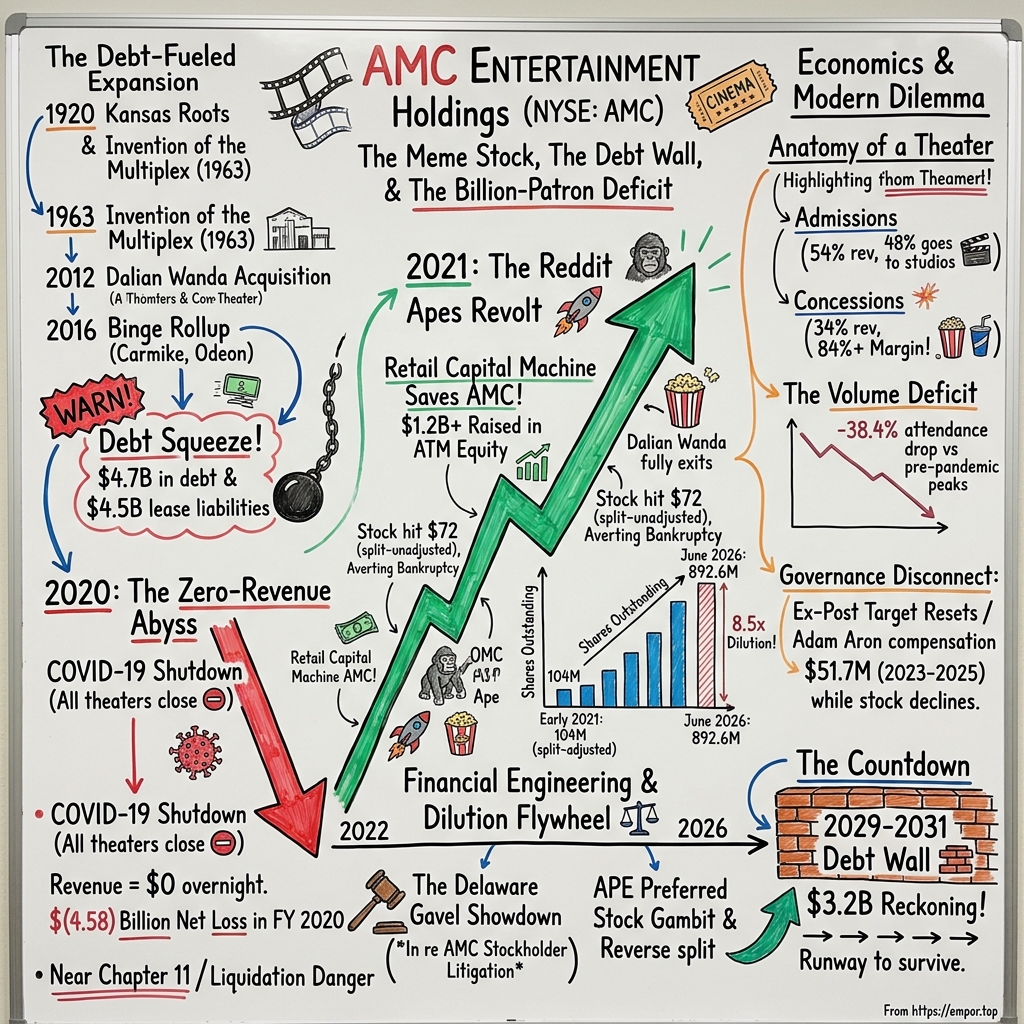
AMC Entertainment Holdings, Inc.: The Meme Stock, The Debt Wall, and The Billion-Patron Deficit
I. Introduction & Episode Roadmap
On June 2, 2021, a cinema chain founded in Kansas City a century earlier touched $72.62 a share.1 Eight months before, the same company had told regulators its cash might run out by the new year. Its theatres had sat dark for months, its debt had been restructured at punishing rates, and at least one analyst had called bankruptcy all but certain.2 Then a loose army of retail traders, who called themselves "Apes," discovered the stock on Reddit and YouTube, and turned a distressed debt story into internet folklore.
The man at the centre of it was Adam Aron, a hotel-and-cruise-ship executive who had never run a movie theatre before he took over AMC. He did something no chief executive of a company that size had really done before. He spoke directly to the crowd buying his shares, thanked them, offered them popcorn, and then sold them stock as fast as they would take it. In the space of a few weeks, AMC raised more than a billion dollars from people who mostly wanted to stick it to the hedge funds betting against the company.3
That is the version of the story most people remember. The version in the filings is harder, and more interesting.
Five years on, AMC is still the largest theatre operator on earth, with 855 theatres and 9,640 screens across the United States and Europe at the end of 2025.4 Yet in 2025 it sold about 219 million tickets, roughly 38% fewer than in 2019.4 Between 2020 and 2025 it lost more than $8 billion under generally accepted accounting principles.4
And the company that had about 104 million shares outstanding before the pandemic had close to 893 million by the middle of 2026, after a one-for-ten reverse split along the way.56 Put those last two facts side by side and the arithmetic is brutal: a shareholder who owned 1% of AMC in February 2020 and never sold now owns a little over one-hundredth of 1%.
This is the story of how that happened, and of whether it was worth it. It runs in six movements. First, the Kansas City family business that helped invent the modern multiplex, and the Chinese conglomerate that turned it into a debt-fuelled global rollup. Second, the spring of 2020, when revenue went to zero and the debt did not. Third, the meme-stock summer and the retail capital machine it created.
Fourth, the strange legal saga of a preferred-equity security named after the shareholders it diluted, fought out in the Delaware Court of Chancery. Fifth, what actually happens inside a theatre today, from the popcorn margin to the studio's cut of your ticket. And sixth, the governance fights, the moat question, and the countdown to 2029, when more than $3 billion of debt will come due.
The question that runs through all of it is simple to state. AMC survived. But did it survive as a business that can pay its own way, or as a machine for turning retail enthusiasm into rent and interest payments? To answer that, the story has to start where the company did, with a tent show and a family of brothers in the middle of America.
 Subscribe on LinkedIn
II. The Wanda Rollup and the $3 Billion Debt Trap (1920–2019)
In late 2016, AMC's leadership in Leawood, Kansas, closed two deals within three weeks of each other. On November 30 the company completed its purchase of Odeon & UCI, the largest cinema operator in Europe, from the private-equity firm Terra Firma for roughly $1.2 billion, picking up 244 theatres and 2,243 screens across Britain, Italy, Spain, Germany and beyond.7
On December 21 it closed the roughly $1.1 billion acquisition of Carmike Cinemas, including Carmike's debt, which made AMC the largest exhibitor in the United States, in Europe and in the world.8 Three months later it added Nordic Cinema Group of Stockholm for about $652 million in cash, and AMC's release that day boasted of roughly 1,000 theatres and 11,000 screens.9
It was a triumphant moment. It was also, as it turned out, a moment of maximum exposure, three years before the industry would be shut by law.
From a Kansas City twin to a Chinese-owned colossus
The company's roots go back to 1920, when the Dubinsky brothers, who had worked the Midwest with a travelling tent show, went into the theatre business in Kansas City; Edward Dubinsky later took the surname Durwood, and the business became Durwood Theatres.10 It was his son Stanley Durwood who made it matter. Stanley took over a small chain of about ten theatres in 1961 after his father's death, and on July 12, 1963, the company opened the Parkway Theatres One & Two in a Kansas City shopping centre, with The Great Escape playing on both screens: two auditoriums sharing one box office and one concession stand.1011
Whether it was literally the first multiplex is disputed, since Manhattan had a twin a year earlier, but the insight behind it was Durwood's and it was durable.11 If you split one building into several screens, you can staff it with the same crew, sell popcorn to every audience through the same counter, and hedge the risk that any single film flops. Durwood kept adding screens per building, renamed the company American Multi-Cinema, and eventually bet it on the megaplex: in 1995 AMC opened the Grand 24 in Dallas, the first megaplex in the United States.12
That logic, of fixed costs spread across more screens and more tickets, is the logic of the whole AMC story. It works beautifully when the auditoriums are full. It works in reverse when they are not.
In 2012 the Durwood-era company passed to China. 大连万达集团 Dalian Wanda Group, the property and entertainment conglomerate built by 王健林 Wang Jianlin, completed its purchase of AMC in a transaction valued at about $2.6 billion, at the time the largest overseas acquisition by a private Chinese company.13 Wanda took AMC public on the New York Stock Exchange in December 2013 while keeping control through Class B shares that carried three votes each.14 And in late 2015 the board turned to Adam Aron, who became chief executive in January 2016.15
Aron was not a movie man. He was a marketer and a leisure operator: senior marketing jobs at Hyatt and United Airlines, then chief executive of Norwegian Cruise Line, a decade as chairman and chief executive of Vail Resorts, a stint running and co-owning the Philadelphia 76ers, and most of 2015 as chief executive of Starwood Hotels.15 He had a Harvard MBA and a hospitality executive's instinct that the experience is the product. Under Wanda, he also had a mandate to grow, and the capital markets in 2016 were happy to lend to anyone buying cinemas at the top of a record box-office run.
What the rollup bought
The rollup bought scale, and for a while the numbers rose accordingly. Revenue went from about $2.9 billion in 2015 to about $5.5 billion in 2018 and 2019, as the acquired circuits were folded in.5 Attendance peaked in 2018 at about 359 million patrons.14 By the end of 2019, AMC ran 1,004 theatres with 11,041 screens.5
But scale is not the same as profit. AMC lost about $487 million in 2017, earned about $110 million in 2018, and lost about $149 million again in 2019, its last normal year.5 Revenue almost doubled across the decade; the bottom line went backwards. The reason sits in the balance sheet. By the end of 2019 AMC carried roughly $4.7 billion of corporate borrowings, plus several billion dollars of long-term theatre leases that a new accounting rule had just forced onto the balance sheet.5 On that broader definition, leases included, AMC's obligations topped $10 billion.5
Here is the comparison that matters. Cinemark, the Texas-based chain that is the closest listed peer, grew more slowly and has carried far less debt relative to its earnings.16 AMC chose the other road: buy screens with debt, lean on the lease market, and trust the box office to keep rising. It was a bet that the late 2010s were the new normal.
There is one more detail from this era worth keeping. In 2018, AMC paid out about $258 million in dividends, more than twice that year's net profit, in a year when the company also took $600 million of convertible notes from the private-equity firm Silver Lake.1417 Money borrowed at the top of the cycle was going out the door to shareholders at the top of the cycle. When the music stopped, there would be no cushion.
So was the Wanda-era expansion an enduring capture of scale or a leveraged rollup that crippled the balance sheet? The honest verdict is that it was both, but the second half dominates. AMC really did become the world's largest exhibitor, and that scale still gives it prime locations, a large premium-screen footprint and some leverage in buying popcorn and seats.
But it bought that scale at peak prices with fixed obligations, so the company entered 2020 needing well over a billion dollars a year just to pay landlords and lenders before it sold a single ticket. Any business can survive a bad quarter. A business built that way cannot survive a year without revenue, and that was exactly what was coming.
III. The Zero-Revenue Abyss: March 2020 and the Edge of Chapter 11
On March 17, 2020, AMC suspended operations at every one of its theatres in the United States; its European theatres had already begun closing as governments there locked down.18 The projectors went dark across roughly a thousand buildings. Ticket revenue that had run to tens of millions of dollars a weekend fell, within days, to essentially nothing.
What did not fall was the bill. Leases still demanded rent. Bonds still demanded coupons. Studios still held contracts. A movie theatre is a strange asset in that respect: almost everything it costs to run, the building, the screens, the projectors, the debt that paid for them, is the same whether one person walks in or a thousand do. The industry calls this operating leverage when it is going well. In the spring of 2020 it looked more like a guillotine.
Fighting the studios with an empty building
Even before the money ran out, AMC found itself in a fight over its future relevance. In April 2020, with theatres shut, Universal released Trolls World Tour directly to premium video-on-demand at home. Aron's response was to declare that AMC would no longer play Universal films, and that it would treat any studio the same way if it abandoned the theatrical window without negotiation.19
The threat did not hold. In July 2020 AMC and Universal announced a deal that let Universal move films to premium home rental after as few as 17 days, or three weekends, in theatres, compared with the roughly 90 days of exclusivity that had been the industry custom; AMC would share in the home revenue.19
It was an elegant compromise on paper. In practice it was the moment the theatrical window, the single most important protection an exhibitor has, began to collapse, and other studios pressed for the same terms. Exhibitors had spent decades insisting that if consumers could watch a film at home soon after its release, they would stop coming. AMC, under duress, conceded the principle.
That concession is worth pausing on, because it says something about bargaining power that will matter later. When the biggest theatre chain in the world, with its largest supplier's product in hand, threatened a boycott, the boycott lasted about three months and ended with the theatre giving up ground. Whatever moat AMC has, it is not leverage over Hollywood.
The shadow bankruptcy
The money question was more urgent. In April 2020 AMC sold $500 million of first-lien notes due 2025 at a 10.5% coupon, a rate that told you exactly what lenders thought of its chances.18 In July it struck a deal with bondholders and with Silver Lake that cut its debt by somewhere between about $460 million and $630 million through a bond exchange, raised $300 million of new money, and pushed roughly $1.7 billion of maturities out to 2026.17 The second-lien notes that came out of that exchange carried payment-in-kind features, meaning interest could be paid by issuing more debt rather than cash: survival bought with a bigger future bill.
It was not enough. In October 2020 AMC told the Securities and Exchange Commission that, at its existing burn rate, its roughly $418 million of cash would be largely depleted by the end of 2020 or early 2021, and that there was substantial doubt about its ability to continue as a going concern.2 Attendance at reopened American theatres was running about 85% below the prior year.2 One analyst quoted by Bloomberg called bankruptcy "an almost foregone conclusion."2
The 2020 numbers that followed were the worst in the company's history. Revenue fell about 77%, to about $1.2 billion. Operating cash flow was negative by about $1.1 billion. AMC wrote down about $2.5 billion of theatre assets and goodwill, effectively admitting that much of what it had paid for in the rollup was no longer worth the price, and posted a net loss of about $4.6 billion.18 Capital spending, which had run above $500 million in 2019, was cut to the bone.5
So, could a fixed-cost theatre network survive revenue going to zero? The evidence says that, under its pre-pandemic capital structure, it could not. AMC was insolvent in every sense but the legal one by late 2020, surviving on emergency debt at double-digit rates, landlord forbearance and deferred rent, and small equity sales into a falling market.18 What happened next was not a turnaround plan. It was a phenomenon nobody in Leawood could have planned.
IV. The Meme Stock Rebellion: Retail Capital Rewrites Corporate Finance (2021)
In January 2021, a cluster of stocks with heavy short interest, GameStop, the most famous among them, began to rise for reasons that had nothing to do with their businesses. On the Reddit forum WallStreetBets and on YouTube, individual traders had found a cause: the hedge funds that were betting these companies would fail. Buying the stock, holding it, and forcing short sellers to cover became something between a trade, a protest and a team sport. AMC, heavily shorted and nearly bankrupt, became one of the movement's flags.
The cash came at exactly the moment AMC needed it. Through January the company sold shares into the rally and raised enough to push the immediate threat of bankruptcy off the table.18 Then, in late May and early June, the stock went vertical. On June 2 it hit its all-time high of $72.62.1
Aron finds his audience
The most consequential thing Adam Aron did in 2021 was not a deal. It was a change in who he talked to. Public companies traditionally speak to institutional investors, through analysts and earnings calls. Aron started speaking to the Apes directly, on Twitter as @CEOAdam and in online interviews, following hundreds of retail accounts and adopting their language; on June 2, 2021, AMC launched AMC Investor Connect, a programme that promised its individual shareholders direct communication, special screenings and a free large popcorn.20 The effect was to turn a bankrupt-adjacent cinema chain into a community with a cause, and a CEO into something close to a folk hero.
It is worth being precise about what that relationship was, commercially. The retail investors gave AMC a market price that bore no relation to its cash flows. Aron gave them recognition and popcorn. And AMC sold them shares.
The sale that captured the moment came on June 1, 2021. AMC sold 8.5 million new shares to the distressed-debt investor Mudrick Capital for $230.5 million, about $27.12 a share.21 By the next day, reports said, Mudrick had already sold its entire stake at a profit, on the view that the stock was overvalued.22
Two days later, on June 3, AMC launched and completed an at-the-market offering of 11.55 million shares at an average price of about $50.85, raising about $587 million in a matter of hours.3 Aron said that brought the equity raised in the second quarter alone to about $1.25 billion.3 The stock fell about 18% that day. The Apes, mostly, did not sell.
At-the-market offerings deserve a brief explanation, because they become the engine of the rest of this story. In a traditional offering, a company sells a big block of stock to investors at a fixed price in a single event. In an at-the-market programme, it simply drips new shares into the ordinary trading on the exchange through a bank, day after day, at whatever price the market will pay. For a company with an enthusiastic crowd of buyers and a stock price disconnected from fundamentals, it is like having a tap.
Wanda walks out the door
The rally also gave AMC's long-time owner its exit. In early 2021 Wanda converted its high-vote Class B shares into ordinary stock, ending its control; then, in mid-May 2021, it sold almost all of what was left through ordinary trading on the NYSE, to what AMC called "a widely dispersed array of buyers."23 Nine years of Chinese ownership ended not with a strategic sale but with a dribble of shares into a retail frenzy. Wanda's two representatives were to step down from AMC's board.23
It is easy to miss what that meant for governance. Until 2021 AMC had a controlling shareholder who could approve anything the board wanted. After 2021 it had millions of small holders and no anchor, and as later fights would show, a crowd that will buy a stock is not the same as a crowd that will turn up to vote it.
Underneath the stock chart, the business was still a theatre chain recovering from a pandemic. AMC sold about 129 million tickets in 2021, barely a third of its 2018 peak.18 Operating cash flow was negative by about $615 million, and the company lost about $1.27 billion.18 The cash raised from the Apes went to fund those losses and to keep the lenders whole, not to build anything.
That is the verdict on 2021. Management executed a genuinely brilliant liquidity manoeuvre. It turned a cultural moment into more than a billion dollars of equity at prices the business could never have justified, and it did so at precisely the moment when the alternative was a restructuring that would almost certainly have wiped out common shareholders. Anyone holding AMC equity in 2020 owes their remaining stake to that decision.
But the episode cured AMC's liquidity, not its solvency. The debt that the Wanda rollup and the pandemic had stacked up was still there, and the business was still burning cash. The question for 2022 was how long the tap could stay open, and AMC was about to run into a hard limit on how many shares it was allowed to sell.
V. The APE Gambit, the Delaware Courtroom, and the 8.5x Dilution Engine (2022–2026)
On August 11, 2023, Vice Chancellor Morgan T. Zurn of the Delaware Court of Chancery approved a revised settlement in In re AMC Entertainment Holdings, Inc. Stockholder Litigation.24 A month earlier she had rejected the first version, writing that "the settlement cannot be approved as submitted," because it would have released claims belonging to people who were not part of the case; the parties stripped out that language and came back within days.24 Her approval lifted a court order that had frozen AMC's plans in place. Within weeks, AMC executed a one-for-ten reverse stock split and converted a strange security called APE into ordinary common stock.2425
To understand why a Delaware judge was deciding when a movie theatre chain could print shares, it helps to go back a year.
By 2022 AMC had sold nearly every share its charter allowed. Raising more equity required shareholders to vote to authorise more shares, and the retail base, having watched the share count balloon in 2021, would not reliably do so. The company needed money, and the obvious tap was closed.
The workaround lay in a piece of corporate plumbing that had been sitting in the charter since the Wanda years: "blank-check" preferred stock that the board could issue without a shareholder vote. In August 2022 AMC used it to distribute a dividend of AMC Preferred Equity units, one for every common share, trading on the NYSE under the ticker APE.25
The name was a nod to the retail holders. The structure was the point: each APE unit carried the same economic and voting rights as a common share, but it did not count against the cap on common stock. AMC could sell APEs through an at-the-market programme as freely as it had once sold common shares.
The APE units traded at a steep discount to the common, and AMC sold them anyway. The decisive transaction came in December 2022. The hedge fund Antara Capital agreed to buy $110 million of APE units at an average of about 66 cents each, and to swap $100 million of AMC's second-lien notes for about 91 million more units.26 In return, Antara agreed to vote its units in favour of the two proposals AMC most wanted: converting APE into common stock and executing a reverse split.26
The second tranche of Antara's purchase, about 106.6 million units for about $75 million, closed in February 2023, once antitrust waiting periods had passed.26 The company had, in effect, sold a voting block to an investor that would support it, at a price well below the common stock, to win a vote that its common shareholders were unlikely to give it.
The Delaware showdown
Common shareholders sued. The class action, filed in Delaware as Civil Action No. 2023-0215-MTZ, argued that the APE structure had been designed to disenfranchise them and that the board had breached its fiduciary duties.4 The vote passed with APE support in March 2023; the court then froze its implementation while it weighed a settlement under which AMC would give common shareholders extra shares as compensation.24
The settlement that Zurn finally approved delivered about 6.9 million post-split shares to the class, for which AMC recorded a $99.3 million non-cash charge.4 The outcome was legally clean and economically underwhelming. After conversion the stock fell sharply, so the settlement shares were worth far less by the time they arrived; an objector appealed, and later rulings went on rejecting challenges to the conversion.
In October 2024 the same vice chancellor dismissed a separate suit by former APE holders who argued the conversion had violated their anti-dilution protections, saying from the bench that they "got exactly what they were entitled to."24 AMC is still suing its directors-and-officers insurers in Delaware Superior Court for up to $80 million of reimbursement for the APE litigation, and 16 of the 17 insurers have settled confidentially.4
Strip away the courtroom drama and the APE episode reveals something important about management's priorities. Faced with shareholders who would not authorise more stock, the board found a structure that let it issue stock anyway, then sold enough of that stock to friendly holders to secure the vote it needed. It was legal, and a Delaware court ultimately blessed the settlement. It was also a demonstration that, at AMC, the ability to issue equity was treated as a survival tool too important to leave to the shareholders being diluted.
The flywheel
After the conversion, the tap reopened in earnest. AMC raised about $833 million net from equity sales in 2023, about $255 million in 2024, about $170 million in 2025, and about $335 million more in the first half of 2026: roughly $1.6 billion in all.46 Every year the dollars were smaller, because every year the price was lower. In June 2026 the company completed a $150 million at-the-market programme by selling about 105 million shares, an average of roughly $1.42 each.27
The share count tells the rest. From about 263 million at the end of 2023, it rose to about 414 million at the end of 2024, 513 million at the end of 2025, and nearly 893 million by mid-2026.6 That last jump, more than 70% in six months, came from three sources at once: the at-the-market sales; a $200 million registered direct offering used to retire subordinated notes due in 2027; and the conversion in May 2026 of about $156 million of exchangeable notes into roughly 142 million new shares.286 Shareholders had approved doubling the authorised share count from 550 million to 1.1 billion in December 2025, which made room for all of it.4
Notice the price implied by that last swap. Retiring $156 million of debt with 142 million shares works out to roughly $1.10 of debt per share. The trade cut a coupon bill, and the exchangeable notes it removed carried a low cash rate, so it was cheap financing for the company in one sense. For the existing shareholder it was permanent: the debt was gone forever, and so was a slice of their claim on any future profit.
There were stranger uses of capital too. In March 2022, in the middle of all this, AMC put about $28 million into Hycroft Mining, a struggling Nevada gold and silver miner, for roughly a fifth of the company and warrants.4 For a cinema company fighting for solvency, it was a distraction, and the swings in its value have since added noise to AMC's other income line every year.4
Now the dilution as a whole. Most accounts describe AMC's share count as rising several-fold after the 2023 reverse split, but the split itself hides the real scale. Before the pandemic AMC had about 104 million shares.5 After the one-for-ten split, each of those became a tenth of a share, so on today's basis AMC had only about 10.4 million shares in early 2020. It now has nearly 893 million. That is an increase of more than 85 times. The company survived. The pre-pandemic shareholder, in economic terms, mostly did not.
So how did AMC get around its shareholders' votes, and what did it cost? It used preferred-stock authority, sold voting units to a friendly hedge fund, settled the lawsuit with a small grant of shares, and then ran a continuous issuance programme that raised about $1.6 billion after 2022. That money funded operating losses and paid down expensive debt, which genuinely kept the company alive. But every dollar of it came out of the per-share value of the people who had saved AMC in 2021. Which raises the obvious question: what is the business those shares now own actually capable of earning?
VI. Anatomy of a Modern Movie Theatre: Popcorn Economics, Studio Splits, and the 38% Volume Deficit
Picture a family of four at an AMC on a Saturday night in 2025. At the company's average American ticket price of about $12.09, admission costs them roughly $48; at the average spend of about $7.62 a head on food and drink, the popcorn, sodas and candy add another $30 or so.4 Behind the counter, those two piles of money have very different fates. Roughly half of the ticket money goes straight back to the studio that made the film.4 Most of the popcorn money stays.
That split is the most important thing to understand about how a cinema makes money, and it explains almost every strategic choice AMC has made since the pandemic.
Three revenue streams, one engine
AMC earned about $4.85 billion of revenue in 2025.4 A little over half, about $2.65 billion, came from admissions. About a third, roughly $1.67 billion, came from food and beverage. The remaining tenth, about $525 million, was everything else: on-screen advertising, private theatre rentals, the AMC Stubs loyalty programme and a bagged-popcorn line sold in grocery stores.4
Admissions are the volume driver and a thin-margin business. The film exhibition cost, which is the studio's share of the box office, came to about $1.28 billion in 2025, about 48% of admissions revenue, almost exactly where it had been in 2023 and 2024.4 On the biggest films the studio's share is higher, particularly in the opening weeks, and on smaller films it is lower; the average conceals a negotiation in which the studio holds most of the cards.
Food and beverage is the engine. The cost of the popcorn, soda and candy itself is a small fraction of the price, so AMC keeps the large majority of every concession dollar before labour and rent.4 And concessions are where AMC has pushed hardest. American spend per patron on food and drink rose from about $5.35 in 2019 to about $7.62 in 2025, a gain of about 42%, through bigger menus, hot food, more alcohol and simply higher prices.54 The average ticket rose too, from about $9.45 to about $12.09, helped by a growing share of seats in premium formats like IMAX and Dolby Cinema.54
That is the good news. The bad news is the number of people. AMC admitted about 356 million patrons in 2019; in 2025 it admitted about 219 million, roughly 156 million in the United States and 64 million in Europe.54 Attendance actually fell in 2025 from about 224 million in 2024.4 Roughly 137 million annual visits that existed before the pandemic have not come back.
Do the arithmetic and you see why price rises have not been enough. Between the ticket and the concession stand, an American patron in 2025 was worth about a third more to AMC than one in 2019. But there are about 38% fewer of them, and the costs of a theatre do not shrink in proportion to the crowd. So revenue in 2025 was still about $600 million below 2019, while rent, utilities and interest kept running at full price.54 Pricing power, in other words, has partly offset the loss of volume, and only partly.
Why have the crowds stayed away? Some of it is supply. Hollywood's release slate shrank during the pandemic and again during the 2023 writers' and actors' strikes, and it has only partly recovered. Some of it is the window. The 17-day deal with Universal was the first breach; across the industry, many films now reach premium home rental within 30 to 45 days, which teaches audiences that, for a comedy or a mid-budget drama, waiting a month is a reasonable option.194 Those mid-budget films used to be the steady weekday business of a multiplex. What is left is a more extreme, more seasonal business that lives on a few dozen tentpoles a year.
Even the smallest of the three revenue streams carried a shock. On April 11, 2023, National CineMedia, the company that sells the pre-show advertising on AMC's American screens, filed for Chapter 11; the advertising agreement between the two was restructured that August and amended again in April 2025.294 The accounting for that relationship is peculiar.
AMC carries a liability of about $459 million tied to the agreement, on which it books tens of millions of dollars of non-cash interest each year, about $65 million in 2025.4 No cash leaves the building for it, but it inflates the interest line, and it reflects the fact that advertising money AMC received years ago is being "earned back" by showing ads today.
Europe adds a second layer. About 23% of AMC's 2025 revenue, roughly $1.1 billion, came from the Odeon circuit in Britain and ten other European countries, so a weaker pound or euro shrinks reported results even when attendance holds.4 AMC does not hedge that exposure with derivatives.4 Odeon's own debt has been a pressure point too: in 2026 AMC replaced $400 million of 12.75% Odeon notes due 2027 with new borrowing that runs four years longer.286
Harvesting the asset
AMC's response to fewer customers has been to shrink and to spend less. The circuit fell from 1,004 theatres and 11,041 screens at the end of 2019 to 855 theatres and 9,640 screens at the end of 2025, as unprofitable leases were surrendered or allowed to lapse.54 Full-time staff fell from about 3,950 to about 2,930, a cut of roughly a quarter, alongside a smaller reduction in part-time staff.54 Capital spending, which ran between about $520 million and $630 million a year in 2017 to 2019, was about $246 million in 2025, below the roughly $313 million of depreciation and amortisation.54
That last comparison is the quiet alarm in the accounts. When a company spends less on its assets each year than those assets wear out, it is consuming its capital base: seats, carpets, projectors, air-conditioning. It can do that for a while, and AMC has argued that targeted spending on premium screens, such as large-format conversions that management says can earn returns of 30% to 50% or more, is a better use of scarce money than spreading it thin.30 But a cinema is a place people choose to visit, and a tired cinema is one they visit less. Underinvestment is a cost deferred, not a cost avoided.
So can ticket and popcorn price inflation permanently compensate for a 38% loss of attendance? The record so far says no. AMC has pushed per-head spending to all-time highs and still produced negative operating cash flow every year from 2020 through 2025.4 What price rises have done is keep theatre-level margins alive while the company waits for volume. The verdict is therefore narrower than either bulls or bears usually state it: AMC's unit economics are healthier than they were in 2019, and its scale economics are worse, because the fixed costs were sized for a crowd that no longer comes.
That gap between what the company earns per customer and what it owes per year sits on the desk of the people who run it, and how they have been paid while sitting there is its own story.
VII. The Governance Disconnect: Ex-Post Target Resets and Shareholder Rebellions
On September 24, 2026, AMC's annual meeting closed with two results that, taken together, describe the company's governance better than any proxy-statement prose. Shareholders rejected the advisory vote on executive pay, with about 203 million shares against and about 168 million for.31 And a board-backed proposal to declassify the board, so that every director would face election every year, failed even though it won about 362 million votes for and fewer than 10 million against.31
How can a proposal win by thirty-six to one and still fail? Because a charter amendment at AMC needs a majority of all outstanding shares, not just of the votes cast, and with nearly 893 million shares outstanding, 362 million is not enough.316 About 180 million more shares were held by brokers who could not vote them without instructions, and something like 340 million shares did not take part at all.31 The same arithmetic sank two other governance reforms that day: allowing shareholders to act by written consent and removing limits on calling special meetings.31 An earlier attempt to declassify the board had failed for the same reason at the December 2025 meeting.32
This is the retail governance paradox. AMC's owners are angry enough to vote down executive pay, but too dispersed and too disengaged to change the rules under which the board operates. The anger has an outlet. The reform does not.
What the pay buys
Adam Aron's reported compensation was about $25.4 million in 2023, about $11.4 million in 2024 and about $15.0 million in 2025, roughly $52 million over three years.32 In those same three years AMC lost about $1.38 billion and roughly doubled its share count.4 Chief financial officer Sean Goodman's reported compensation rose to about $4.9 million in 2025 from about $2.2 million the year before.32 Shareholders had already rejected the pay plan once before, at the June 2024 meeting, when about 61% of votes cast went against it.33
Executive pay at a large company in a turnaround is not by itself a scandal. Turnarounds are hard, and boards pay to keep people who can manage them. The question is whether the pay is tied to outcomes that matter to the owners. Here the proxy statements raise a harder problem.
On February 22, 2024, February 19, 2025, and February 19, 2026, the compensation committee modified the performance stock units it had previously granted to senior executives.326 In accounting language these were "Type 3" modifications, a term for changes that take an award from improbable to probable, meaning that, under the original terms, the executives were unlikely to earn the shares, and after the change they were likely to. The changes lowered the adjusted EBITDA and free-cash-flow hurdles that the awards depended on, after it became clear the original targets would not be met, and set payouts that could reach as much as 200% of target.32
Boards reset targets for defensible reasons. When a strike shuts down Hollywood, as the 2023 strikes did, targets set before it may no longer measure management's performance. But doing it three Februaries in a row is a pattern rather than an exception, and it changes what the incentive means. A performance target that moves whenever performance falls short is not a target. It is a forecast that gets revised.
Owners in name only
The other half of alignment is ownership. As of the 2026 proxy, all 17 executive officers and directors together held about 5.3 million shares, less than 0.6% of the company; Aron held about 2.4 million, roughly a quarter of 1%.32 The largest outside holders were event-driven funds rather than long-term owners: Pentwater Capital at about 7.1%, Discovery Capital at about 6.2% and UBS at about 3.6%.32 The rest, the great bulk of the equity, sits with individual investors and index funds.
The same ballot contained a telling contradiction. The shareholders who rejected the pay plan approved, by about 347 million votes to 24 million, an amendment doubling the share pool of the 2024 equity incentive plan from 25 million to 50 million shares.31 Ordinary-majority proposals, which need only a majority of votes cast, passed easily at AMC when the board asked for them; the advisory protest vote failed; the binding reforms died for lack of turnout. The rules reward the side that can organise, and that side is the board.
So the executives running AMC own a sliver of it, their equity awards have been made easier to earn three years running, and the shareholders who own the rest keep voting no, without being able to turn that no into anything binding. A skeptical activist looking at AMC would not start with the theatres. They would start here: the people deciding how many shares to issue are paid in a currency they have little of and that their own issuance keeps cheapening, and they are judged against targets they can renegotiate.
In fairness to management, the counter-argument is real. The same team kept AMC out of bankruptcy, raised billions in conditions when lenders would not, and has extended the debt so that no major maturity arrives before 2029. Survival was the goal, and survival was achieved. But a board that rewards survival on a per-company basis while shareholders are diluted on a per-share basis has drawn the finish line in a place the owners did not choose. Whether the business underneath can ever earn enough to make that dilution worthwhile depends on a different kind of question: whether being the world's largest cinema chain confers any advantage at all.
VIII. Strategic Moat Stress Test: Porter's Five Forces & Hamilton Helmer's Seven Powers
Every year the biggest films arrive at AMC's door with terms attached. For a tentpole like a new Avatar or Avengers, the studio often expects the film on the best screens for a set run; it knows that AMC's whole weekend of concession sales depends on having the film.
AMC can negotiate at the margins. It cannot walk away. Seven distributors, Disney, Warner Bros., Universal, Sony, Paramount, 20th Century Studios and Lionsgate, supplied films that accounted for about 83% of AMC's American admissions revenue in 2025; in Europe, five distributor groups accounted for about 76%.4 When the supplier list is that short and the product is that unique, the supplier sets the price.
That is the place to begin a proper test of whether AMC has a moat. Hamilton Helmer's framework asks whether a company has any of seven sources of durable advantage, each of which lets it earn more than its cost of capital for a long time. Porter's five forces ask the complementary question of who in the industry captures the profit. Together they give a clear answer for AMC, and it is not a flattering one.
The biggest chain, with nothing to lock in
Start with scale economies, the power AMC would most obviously claim. Scale does help in some places: buying popcorn, seats and projectors in bulk, negotiating advertising deals, running a national loyalty programme. But the biggest costs of a cinema are local. Rent is set building by building; staff are hired town by town; a screen in Kansas City costs the same to run whether its owner has one theatre or a thousand.
And on film rent, the largest single cost, scale offers little. The film-cost ratio has stayed around 48% of admissions at AMC through 2023, 2024 and 2025.4 Being largest has not bought AMC a better split than smaller chains. Scale, then, is a modest purchasing advantage, not a power.
Network economies do not exist in this business. One person buying a ticket at an AMC in Manhattan makes the experience no better for someone at an Odeon in London. Counter-positioning, the power a challenger gains by adopting a model the incumbent cannot copy without hurting itself, belongs to the streaming services, not to AMC; AMC is the incumbent with billions in long-term lease obligations defending a century-old format.6
Switching costs are close to zero. A moviegoer chooses by film, showtime, location and format, and if the nearest Cinemark or Regal has the better seat at the better time, they go there. AMC's best attempt at creating a habit is Stubs A-List, a subscription that lets members see several films a week for a monthly fee of about $20 to $25 after a three-month commitment.4 It creates genuine loyalty among its members, but it is a small share of revenue and can be cancelled. A habit is not a lock.
Branding is the interesting case. AMC's brand is unusually famous for a theatre chain, partly because of the meme stock and partly because of a commercial. In September 2021, AMC began running a spot in which Nicole Kidman walks into an empty theatre and declares that "heartbreak feels good in a place like this," a line that audiences turned into a ritual of mock-applause and cheering.34
That is cultural awareness most retailers would kill for. But people do not buy tickets to see AMC. They buy tickets to see a film owned by a studio, and they would see the same film at a competitor. A brand that does not raise price or volume is fame, not a moat.
Cornered resources are narrow. AMC has long partnerships with IMAX and Dolby to run premium large-format screens, and those screens earn the highest prices in the building. But the formats are licensed, not owned, and competitors run IMAX screens and their own premium formats too. Finally, process power: operating a cinema well is a real skill, but it is a known skill. Ticket scanning, digital projection, popcorn popping and staffing models are well understood across the industry and are copied quickly.
Seven powers, then, and AMC can claim none of them in full. It has partial scale benefits and a famous brand that does not translate into price. That is not a moat. It is a large position in a commodity business.
Where the money goes instead
Porter's lens shows where the money goes instead. Supplier power is extreme, as the studio concentration shows. Buyer power is real in a different sense: each customer is tiny, but collectively they have an endless menu of alternatives for an evening's entertainment and very little reason to choose one cinema chain over another. The threat of substitutes is severe and growing, as large home televisions, streaming libraries, gaming and short-form video compete for the same evening and the same dollar.
The threat of new entrants is low, but only because the industry's returns are too poor to attract anyone; nobody is raising capital to build a new national cinema chain. And rivalry with Cinemark, Regal and regional operators is steady.
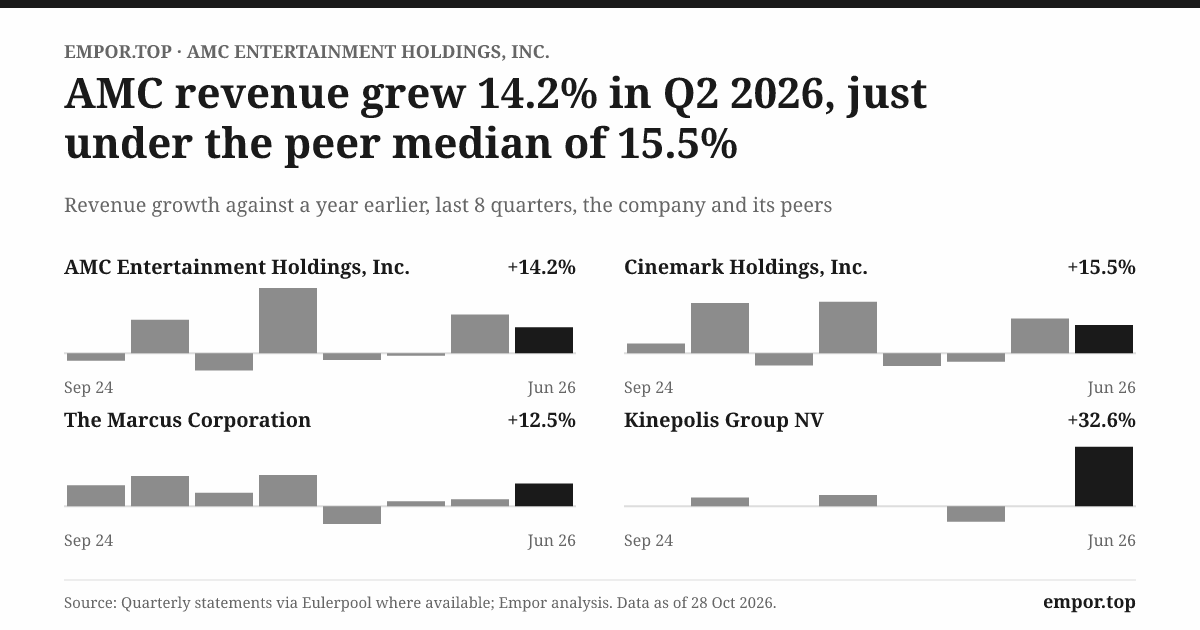
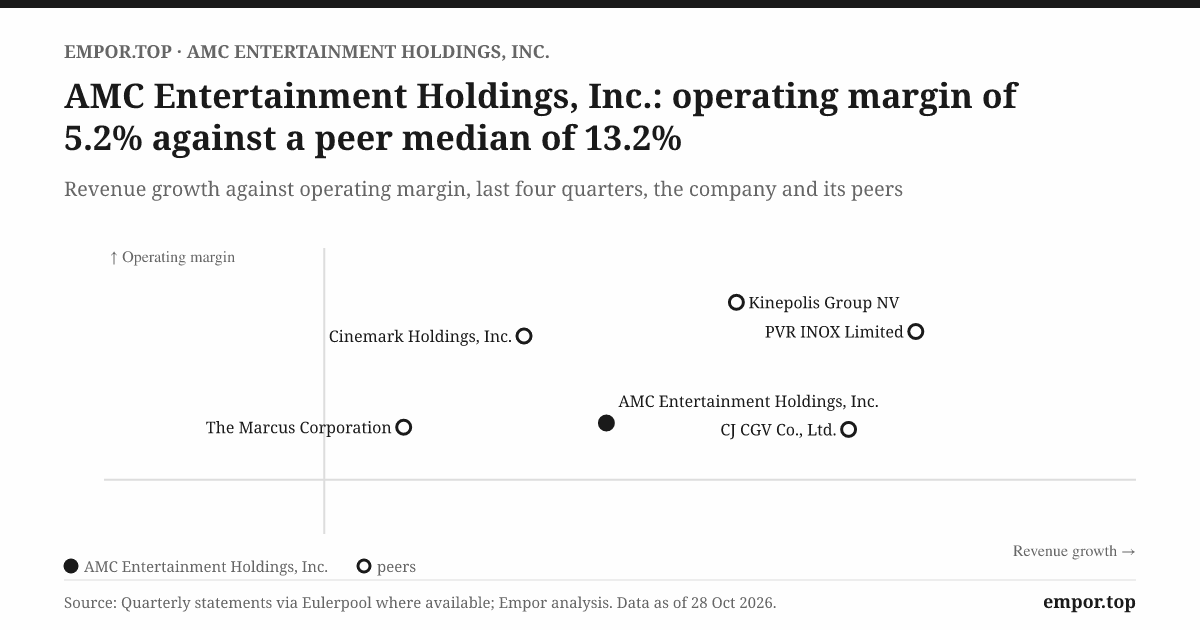
The peer comparison makes the point sharpest. Cinemark operates in the same industry, with the same suppliers, the same substitutes and the same customers. It earned about $138 million of net income in 2025 while carrying far less debt.16 AMC lost about $632 million in the same year.4 Cinemark also turned about $3.1 billion of revenue into about $578 million of adjusted EBITDA in 2025, a margin of a little under 19%, compared with roughly 16% for AMC on its own adjusted EBITDA of about $780 million on $4.85 billion of revenue.354
The smaller circuit earns more on each dollar of sales. The difference is not the moat, because neither company has one. The difference is the balance sheet. Cinemark entered the pandemic with less debt and fewer expensive leases, and emerged with its shares largely intact. AMC entered with the rollup's debt and emerged with its shareholders diluted almost out of existence.
That is the core verdict. AMC possesses no durable structural advantage over its competitors, and the industry structure hands most of its economic surplus to studios on one side and consumers on the other. What AMC does have is the largest collection of premium screens and prime locations in a business where a few blockbusters a year decide everything. That is valuable when the films come. It is a liability when they do not. Which leaves one question for anyone thinking about the company: will enough films come, for enough years, to pay what AMC owes?
IX. Bull vs. Bear Case & The Skeptical Investor Stress Test
At the end of July 2026, S&P Global Ratings lifted AMC's credit rating to B- from CCC+, citing better operations and stronger credit metrics; Moody's followed in September with an upgrade to B3.363738 For a company that, six years earlier, had warned it might not survive the winter, that is a real milestone. It is also worth remembering what the letters mean. B- and B3 are firmly in speculative territory. The agencies were not saying AMC was safe. They were saying it was no longer close to default.
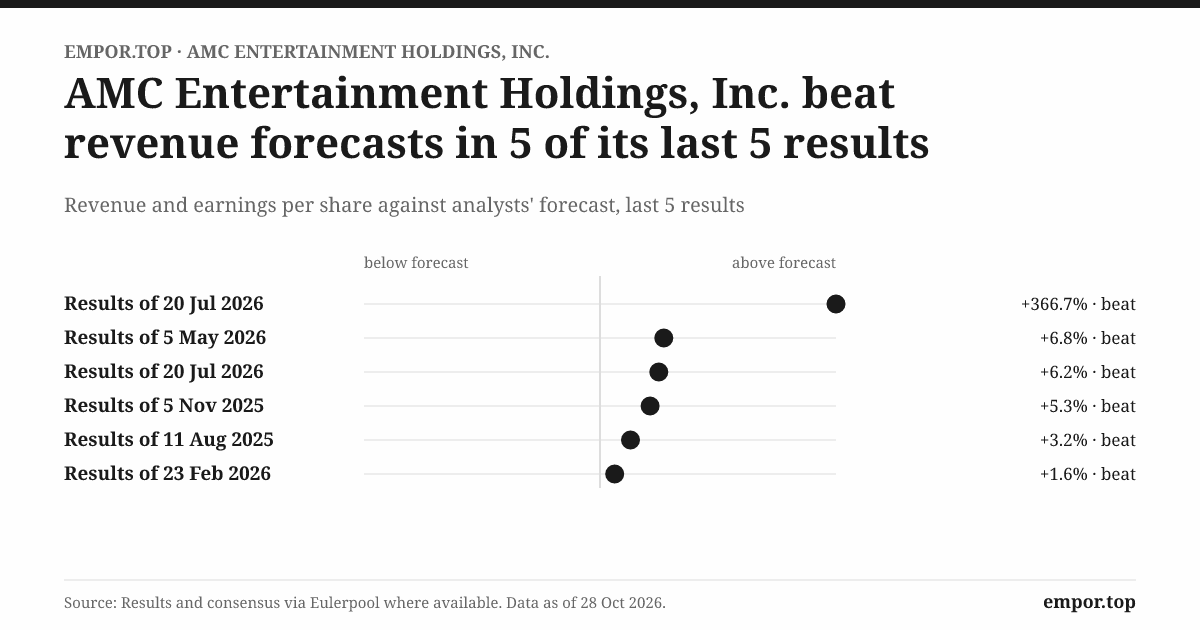
The trigger was a strong quarter and a cleaned-up maturity schedule. In the second quarter of 2026, AMC earned record revenue of about $1.6 billion, admitted more than 71 million guests, up about 13.5% from a year earlier, and generated about $321 million of adjusted EBITDA and about $190 million of free cash flow.28 It still recorded a small net loss.28 It refinanced $400 million of 12.75% notes due 2027, extending them by four years, and redeemed its 6.125% subordinated notes due 2027 with the proceeds of a $200 million share sale.28 Management said it did not expect material debt maturities before 2029.28
The strongest bull argument is that AMC has bought itself time, and time is what a recovering box office needs. After the July 2024 refinancing, which pushed about $1.6 billion of debt due in 2026 out to 2029 and 2030, and the 2026 transactions, AMC's next large maturities are three to five years away.3928 On the second-quarter call, Aron said 2026 should be the industry's strongest post-pandemic year, pointing to a slate that includes Spider-Man: Brand New Day, Dune: Part Three and Avengers: Doomsday.30 He also put a number on the bar AMC has to clear: about $10.4 billion of North American box office a year to break even on trailing free cash flow.30
The second quarter showed why that bar matters. North American box office in the quarter was about $2.99 billion, the best second quarter in seven years, yet still about 7.5% below the same quarter of 2019; AMC's revenue, thanks to higher prices and more premium seats, was about 6% above it.30 Put differently, AMC can now earn pre-pandemic revenue from a box office that is still smaller than before the pandemic.
It cannot yet earn pre-pandemic cash flow, because the cost of carrying the debt it took on to survive is far higher than in 2019. Management said leverage had come down from double digits to below 6.5 times EBITDA, with a long-term goal of about three times.30
The second bull argument is operating leverage in the good direction. On the call, management said about $200 million of extra revenue in the second quarter turned into about $132 million of extra adjusted EBITDA.30 That is what a fixed-cost business looks like when the crowd comes back: most of each additional dollar falls to the bottom line. First-half operating cash flow was positive, about $107 million, compared with negative cash flow of about $232 million a year earlier.28
Analysts on the call pressed on how durable that was, and management's answers were careful. Aron said whether the margin gain would repeat every quarter "remains to be seen."30 The chief financial officer reminded listeners that working capital normally helps AMC's cash flow in the second and fourth quarters and hurts it in the first and third, so a strong first half partly borrows from the second; he also warned against reading 2026's capital spending as a run rate for future years.30
Management said the refinancings and an interest-rate step-down on roughly three-quarters of its debt should lower annual cash interest by around $67 million.30 That is meaningful, and also a reminder of scale: it trims roughly a twentieth off the fixed bill described below.
The third is optionality around content. In October 2023 AMC distributed Taylor Swift's The Eras Tour concert film itself, cutting out the studio entirely; it opened to about $93 million in North America and became the highest-grossing concert film in domestic history.40 That was proof that, for the right event, a theatre chain can be a distributor too, keeping more of the box office. And finally there is the retail shareholder base, which has supplied capital in conditions when nobody else would.
A $1.4 billion bill before the lights come on
The bear case begins with a single number. AMC paid about $530 million of interest in 2025, including about $65 million of non-cash interest on its advertising agreement with National CineMedia, and about $887 million of operating lease rent.4 Together that is more than $1.4 billion a year in fixed obligations, owed before the company pays a single usher or buys a single bag of popcorn kernels. Against that, operating cash flow was negative in 2025, by about $120 million, continuing a pattern that began in 2020.4
The second bear argument is the price of the debt itself. At the end of June 2026, AMC owed about $3.9 billion of principal, almost all of it secured.6 The largest pieces were about $2.0 billion of term loans due 2029 at an interest rate around 10.6%, and about $903 million of senior secured notes due 2029 paying 9% in cash plus another 6% in kind, a 15% total cost.6 Payment-in-kind interest is like a credit card where the unpaid interest is added to the balance: the coupon does not hurt today's cash flow, but the debt grows. The refinancings removed the near-term cliffs. They did not make the debt cheap.
The third is the balance sheet as a whole. AMC has an accumulated deficit of about $9.0 billion and stockholders' equity of about negative $1.9 billion.4 Its tax assets are almost entirely written off because the company cannot show it will earn the profit needed to use them.4 The deferred maintenance bill continues to grow.4
The fourth is the dilution engine running out of fuel. With nearly 893 million shares outstanding and 1.1 billion authorised, AMC has about 200 million shares of headroom left.64 At recent prices of one to three dollars a share, that is a few hundred million dollars at most, and every sale makes the next one cheaper. The retail tap was a remarkable resource in 2021. It is a much smaller one in 2026.
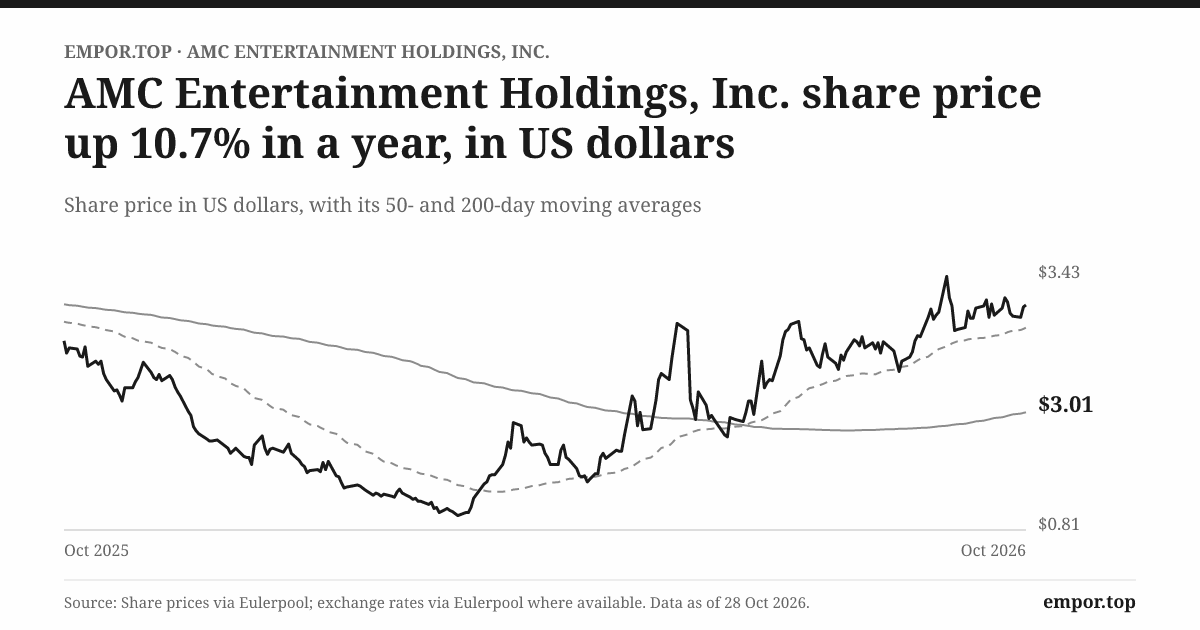
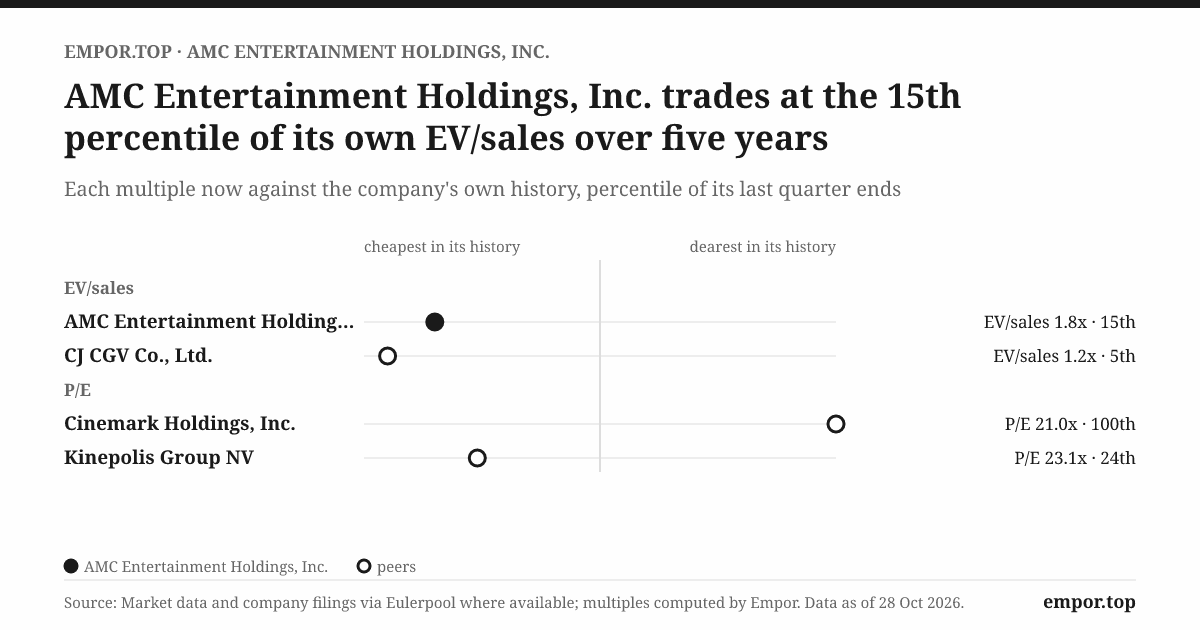
At the end of October 2026, with the stock near three dollars, the market valued AMC's equity at about $2.7 billion. Add roughly $2.9 billion of net corporate debt at the end of June and the enterprise is valued at about $5.6 billion, before counting leases.6 AMC reported about $780 million of adjusted EBITDA for 2025, a figure that is measured after rent.4 On that basis the business trades at around seven times last year's adjusted EBITDA. That is not a distressed multiple. It is the kind of price usually paid for a cinema business that earns money, which Cinemark does, with far less debt and almost no dilution, and AMC, on a reported basis, does not.16
Add the roughly $3.8 billion of operating lease liabilities and the total claim on the business rises to around $9.4 billion.6 What the price appears to assume is that 2026's recovery is the new floor rather than a good year: that attendance keeps climbing, the slate keeps delivering, and the cash flow of the second quarter becomes the cash flow of the year.
Weighed against each other, the bull case is an option on two things outside management's control: the volume of hit films coming out of Hollywood and the continued willingness of capital markets to fund AMC. The bear case rests on arithmetic that the company's own record supports: across the whole cycle since 2020, the business has not covered its fixed charges without new equity. The history does not reject the bull case. It narrows it, from "AMC has recovered" to "AMC can cover its obligations in a strong box-office year," which is a much smaller claim.
Three numbers will decide which version is true. The first is full-year operating cash flow against capital spending: AMC has not generated positive free cash flow over a full year since 2019, and the first half of 2026 was positive; the full year will show whether that survives the weaker third and first quarters.28 The second is total attendance: 219 million in 2025, falling slightly from 2024, and running about 13% higher in the second quarter of 2026.428
The third is the share count: nearly 893 million in mid-2026, up more than 70% in six months.6 If the first rises, the second climbs and the third stops moving, the bull case is working. If the share count keeps climbing, the company is still paying its bills with its shareholders.
X. Playbook: Business & Investing Lessons
The first lesson is the one the Wanda era taught: never enter a cyclical downturn with a balance sheet built for a secular boom. In December 2016, AMC celebrated becoming the world's largest exhibitor with a stack of borrowed money and a portfolio of long leases. Nobody in Leawood could have predicted a pandemic. But the reason AMC ended up nearly bankrupt while Cinemark ended up merely bruised was not the virus; it was the debt that was waiting for the virus. A cinema is already a bet on fixed costs. Financing it with fixed obligations doubles the bet. Debt turns an operational crisis into an existential countdown.
The second lesson lives at the concession stand. By 2025 AMC was getting about $7.62 out of every American patron for food and drink, a record, and about 42% more than in 2019.4 It made almost no difference to the outcome, because there were 137 million fewer patrons. Management did everything a good retailer can do to raise spend per head, and the company still burned cash. In a business with fixed rent and fixed debt, volume is the only thing that covers the overhead. In theatrical exhibition, price per head is vanity; bodies through the turnstile are sanity.
The third lesson is the one AMC will be remembered for: cult equity is an extraordinary financing bridge and a terrible operating strategy. In June 2021, Adam Aron sold $587 million of stock in three hours to people who loved the company.3 Five years later those same people owned a company whose share count had risen more than eighty-fold from its pre-pandemic level. The meme rally saved AMC; the habit it created, of solving every problem with a new issue of stock, consumed the people who had done the saving. A company that survives by printing shares eventually makes its equity the product, and its business the side hustle.
The fourth lesson is about incentives. Three Februaries in a row, AMC's compensation committee lowered the bar on executive stock awards after the original targets slipped out of reach, and three times the awards became achievable again.32 In between, shareholders voted against the pay plan by large margins. The lesson for any board is not that targets can never move. It is that once they move every year, the incentive is no longer measuring performance; it is measuring the board's willingness to move it. Lowering the high-jump bar after the athlete lands in the pit does not prove the athlete can jump.
XI. Epilogue: The Countdown to 2029
Tonight, AMC is in the best financial shape it has been in since 2019. It ended June 2026 with about $778 million in cash.28 It posted the strongest quarter in its history.28 Its credit ratings have climbed out of the deeply distressed CCC tier.3638 And on its last earnings call, management said it was "within sight" of positive cash flow for a full year.30
But the next three years are a countdown, and several moments along the way will decide how it ends.
The first comes early next year, when AMC files its annual report for 2026. That document will answer the question this whole story has circled: in a year the industry expects to be its strongest since the pandemic, did AMC's operations cover its capital spending without help from the equity market? If the answer is yes, it will be the first time since 2019, and the bulls will have their proof of concept. If the answer is no, even in a strong year, it will be hard to argue that the business can ever pay its way at its current debt load.
One useful way to read that report is through attendance. AMC admitted about 219 million people in 2025.4 A year of 250 million or more would suggest the recovery is broadening beyond a handful of blockbusters; a year stuck near 220 million, even with record prices, would suggest the pandemic reset audience habits for good, and that every gain from here has to come from charging the remaining customers more. The difference between those two numbers is roughly 30 million visits, each worth about $20 in tickets and popcorn, which is the margin between a company that can service its debt and one that cannot.
The second is the share authorisation. AMC has roughly 200 million shares left under its 1.1 billion cap.64 If the company comes back to shareholders asking for more, that will be an admission that the dilution engine is still the plan. Aron told analysts in July that the issuance of stock is "a precious commodity" and that AMC does not issue it lightly.30 The next proxy will show whether that commodity is being rationed or replenished.
The third is the 2027 say-on-pay vote, and whether the compensation committee resets executive performance targets for a fourth straight February. The owners have voted no twice. A board that changes course would be listening. A board that does not would be telling them the vote is advisory in more than name.
The fourth, and the one that matters most, is 2029. That is when roughly $2.0 billion of term loans, about $903 million of 15% secured notes and $360 million of first-lien notes all come due, more than $3.2 billion in a single year.6 AMC can meet that wall in one of three ways. A fully recovered box office could generate enough cash, and enough credit confidence, to refinance on better terms.
A partial recovery could force another expensive refinancing that pushes the problem further out at a higher price. Or a stalled recovery could end in the same place AMC nearly reached in 2020, with lenders taking the equity, the outcome that the Apes, the APE units and the at-the-market programmes were all built to avoid.
The unresolved tension is the one the story began with. AMC proved that a century-old cinema chain could mobilise internet culture to outmanoeuvre the distressed-debt funds that were circling it. What it has not yet proved is that the business underneath can generate real cash, year after year, in a world of big home screens and short theatrical windows. The first proof bought the time for the second. The clock on that time reads 2029.
XII. Outro
Go back to Kansas City in the summer of 1963. Stanley Durwood opened two screens under one roof.11 That idea carried his family's company from a regional chain to the largest cinema business in the world.
Sixty years later, AMC's most famous image is not a theatre at all. It is Nicole Kidman, alone in a darkened auditorium, telling the camera that "heartbreak feels good in a place like this."34 The shareholders who helped finance the company's survival might hear it differently.
AMC did not survive the pandemic and the streaming wars because of Hollywood. It survived by selling stock to its audience.
References
-
How to Cope With the Steep Price of Admission for AMC Stock — InvestorPlace, 2021-07 ↩↩
-
AMC Theatres could run out of money by the end of the year — WTOP, 2020-10-13 ↩↩↩↩
-
AMC Entertainment Holdings Inc. Completes 11.550 Million Share At The Market Equity Offering Raising $587.4 Million in Additional Equity Capital — Business Wire, 2021-06-03 ↩↩↩↩
-
AMC Entertainment Holdings, Inc. Form 10-K for the Fiscal Year Ended December 31, 2025 — SEC EDGAR, 2026-02-23 ↩↩↩↩↩↩↩↩↩↩↩↩↩↩↩↩↩↩↩↩↩↩↩↩↩↩↩↩↩↩↩↩↩↩↩↩↩↩↩↩↩↩↩↩↩↩↩
-
AMC Entertainment Holdings, Inc. Form 10-K for the Fiscal Year Ended December 31, 2019 — SEC EDGAR, 2020-02-28 ↩↩↩↩↩↩↩↩↩↩↩↩↩↩↩
-
AMC Entertainment Holdings, Inc. Form 10-Q for the Period Ended June 30, 2026 — SEC EDGAR, 2026-07-23 ↩↩↩↩↩↩↩↩↩↩↩↩↩↩↩↩
-
AMC Entertainment Holdings, Inc. Completes Acquisition of Odeon & UCI Cinemas — Odeon Cinemas Group, 2016-11-29 ↩
-
AMC Entertainment Holdings, Inc. Completes Acquisition of Carmike Cinemas, Inc., Becomes Largest U.S. Movie Exhibitor (Form 8-K Exhibit 99.1) — SEC EDGAR, 2016-12-21 ↩
-
AMC Entertainment Holdings, Inc. Completes Acquisition of Nordic Cinema Group — Boxoffice Pro, 2017-03-28 ↩
-
Wanda and AMC Announce Completion of Acquisition (Form 8-K Exhibit 99.1) — SEC EDGAR, 2012-09-04 ↩
-
AMC Entertainment Holdings, Inc. Form 10-K for the Fiscal Year Ended December 31, 2018 — SEC EDGAR, 2019-03-01 ↩↩↩
-
AMC Entertainment Holdings, Inc. Form 10-K/A for the Fiscal Year Ended December 31, 2025 (Directors and Executive Officers) — SEC EDGAR, 2026 ↩↩
-
Cinemark Holdings, Inc. Form 10-K for the Fiscal Year Ended December 31, 2025 — SEC EDGAR, 2026-02 ↩↩↩
-
AMC Reaches Agreement to Reduce Debt By At Least $460 Million and Secures $300 Million in New Funding — Business Wire, 2020-07-13 ↩↩
-
AMC Entertainment Holdings, Inc. Form 10-K for the Fiscal Year Ended December 31, 2021 — SEC EDGAR, 2022-03-01 ↩↩↩↩↩↩↩
-
AMC, Universal agree to shrink theatrical window to 17 days — KSTP / Associated Press, 2020-07-28 ↩↩↩
-
AMC to give retail investors free popcorn, other perks — Axios, 2021-06-02 ↩
-
AMC Entertainment Holdings, Inc. Form 8-K (Mudrick Capital Equity Issuance) — SEC EDGAR, 2021-06-01 ↩
-
Mudrick Capital bought 8.5 million shares of AMC, then reportedly sold them off for a profit — CNBC, 2021-06-01 ↩
-
AMC Entertainment Praises Wanda's Near Decade Long Ownership (Form 8-K Exhibit 99.1) — SEC EDGAR, 2021-05-21 ↩↩
-
AMC's Saga Over APE Settlement With Investors: Explained — Bloomberg Law ↩↩↩↩↩
-
AMC Entertainment Holdings, Inc. Form 10-K for the Fiscal Year Ended December 31, 2023 — SEC EDGAR, 2024-02-28 ↩↩
-
AMC Entertainment Holdings Inc. Announces $110 Million Equity Capital Raise, a $100 Million Debt for Equity Exchange and a Proposed Vote to Convert APE Units — Business Wire, 2022-12-22 ↩↩↩
-
AMC Entertainment Holdings, Inc. Form 8-K (Completion of ATM Equity Offering) — SEC EDGAR, 2026-06-11 ↩
-
AMC Entertainment Holdings, Inc. Reports Second Quarter 2026 Results (Form 8-K Exhibit 99.1) — SEC EDGAR, 2026-07-20 ↩↩↩↩↩↩↩↩↩↩↩↩
-
AMC Entertainment Holdings, Inc. Form 10-K for the Fiscal Year Ended December 31, 2024 — SEC EDGAR, 2025-02-26 ↩
-
Earnings call transcript: AMC posts record Q2 2026 results — Investing.com, 2026-07 ↩↩↩↩↩↩↩↩↩↩↩
-
AMC Entertainment Holdings, Inc. Form 8-K (2026 Annual Meeting Voting Results) — SEC EDGAR, 2026-09-24 ↩↩↩↩↩↩
-
AMC Entertainment Holdings, Inc. Definitive Proxy Statement (Schedule 14A) — SEC EDGAR, 2026-08-10 ↩↩↩↩↩↩↩↩
-
AMC Entertainment Holdings, Inc. Form 8-K (2024 Annual Meeting Voting Results) — SEC EDGAR, 2024-06-07 ↩
-
Nicole Kidman to remain face of AMC movie theaters: 'Heartbreak feels good in a place like this' — TODAY ↩↩
-
Cinemark Holdings, Inc. Reports Fourth Quarter and Full Year 2025 Earnings Results (Form 8-K Exhibit 99.1) — SEC EDGAR, 2026-02-18 ↩
-
AMC Stock Eyes $3 After Credit Upgrade and Record Revenue, but Dilution Risk Remains — FX Leaders, 2026-07-31 ↩↩
-
AMC Rating Action and Debt Exchange Assessment — S&P Global Ratings, 2026-07-28 ↩
-
Moody's Upgrades AMC Entertainment CFR to B3 Following Comprehensive Debt Refinancing — Moody's Ratings, 2026-09-24 ↩↩
-
AMC Entertainment Holdings Inc. Announces Collaborative Refinancing Transactions that Extend Up To $2.45 Billion of Debt Maturities from 2026 to 2029 and Beyond — AMC Investor Relations, 2024-07-22 ↩
-
Box Office: Taylor Swift's 'Eras Tour' Concert Film Dazzles With Estimated $95 Million to $97 Million Opening Weekend — Variety, 2023-10-15 ↩
 LinkedIn
 WhatsApp
 Reddit
 Hacker News
 Email
 Kindle
 RSS Feed
 Spotify
 Apple Podcasts
 Amazon Music
 Audible
 YouTube