Alarm.com: The Invisible Tollbooth of Connected Real Estate
I. The Tollbooth Nobody Sees
Picture a quiet suburban street at the end of 2000. A burglar walks around the side of a house, finds the grey telephone box bolted to the siding, and cuts the copper pair with a cheap set of wire cutters. Inside, the alarm panel is still armed. It still has its siren, its keypad and its sticker in the front window. But the line it used to call the monitoring centre is now dead, and nobody will hear about the break-in until the family comes home. For decades, that was the weak point in American home security: the whole system relied on a wire anyone could reach.
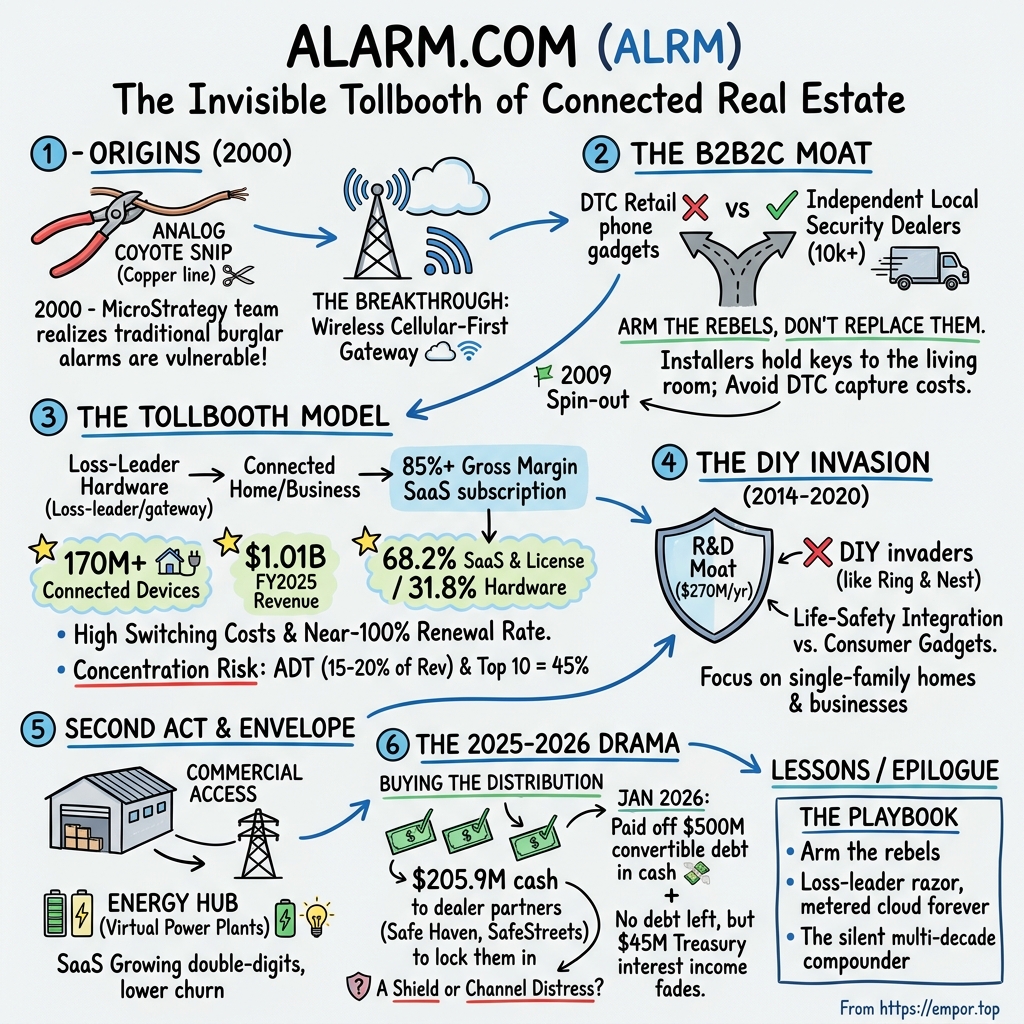
A small team working inside MicroStrategy, the Northern Virginia software company, saw that weakness as an opening.3 Its answer was to replace the copper line with a cellular radio that talked to a cloud server, so cutting a wire no longer cut the alarm off from the outside world. That fix grew into Alarm.com. A quarter of a century later, the company says its platform connects more than 170 million devices, and it handles hundreds of billions of data points a year.1 In fiscal 2025 it passed $1 billion of revenue for the first time, at about $1.01 billion.1
Most of the homeowners who use Alarm.com every day could not tell you its name. They know the logo on their security company's truck, the brand on the window sticker, the app their installer put on their phone. Behind those brands sits Alarm.com's software, collecting a monthly fee on every connected property. Silicon Valley spent the 2010s pouring money into owning the smart home through gadgets sold in shops. Meanwhile a company in Virginia quietly collected recurring software fees on millions of properties without selling a single subscription directly to a consumer. That is the tollbooth in this story's title. It is real, it is profitable, and almost nobody sees it.
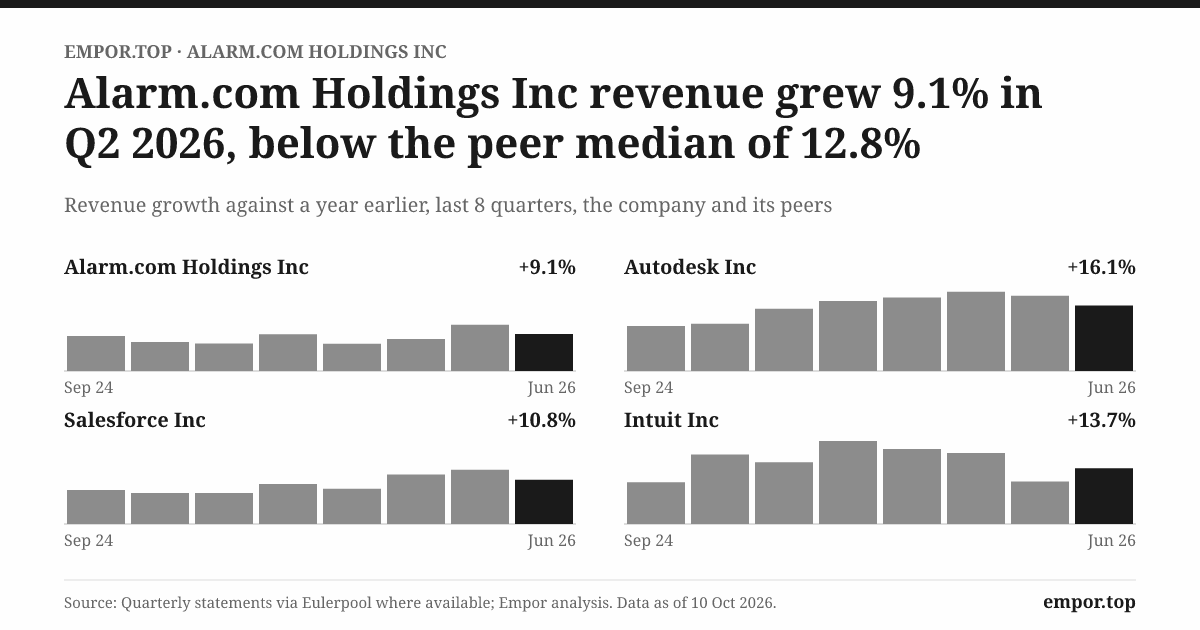
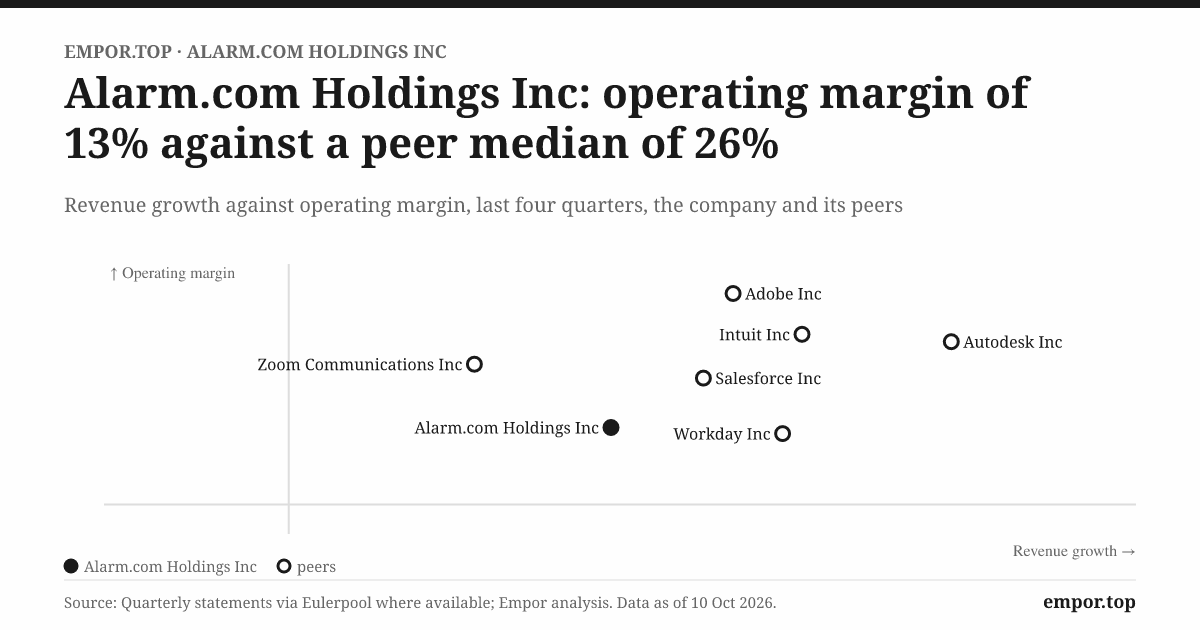
The tollbooth has a problem, though, and it shows up in the growth rate. Over the ten years to fiscal 2025, revenue compounded at about 17% a year. Over the last three years it compounded at about 6%.1 The business that once grew a fifth a year now grows at a mid-to-high single-digit pace, with a recent pickup to about 9% in the second quarter of 2026.2 Profit tells a happier story, because margins widened while growth slowed. Operating margin reached about 13% in fiscal 2025, roughly double where it stood two years earlier.1
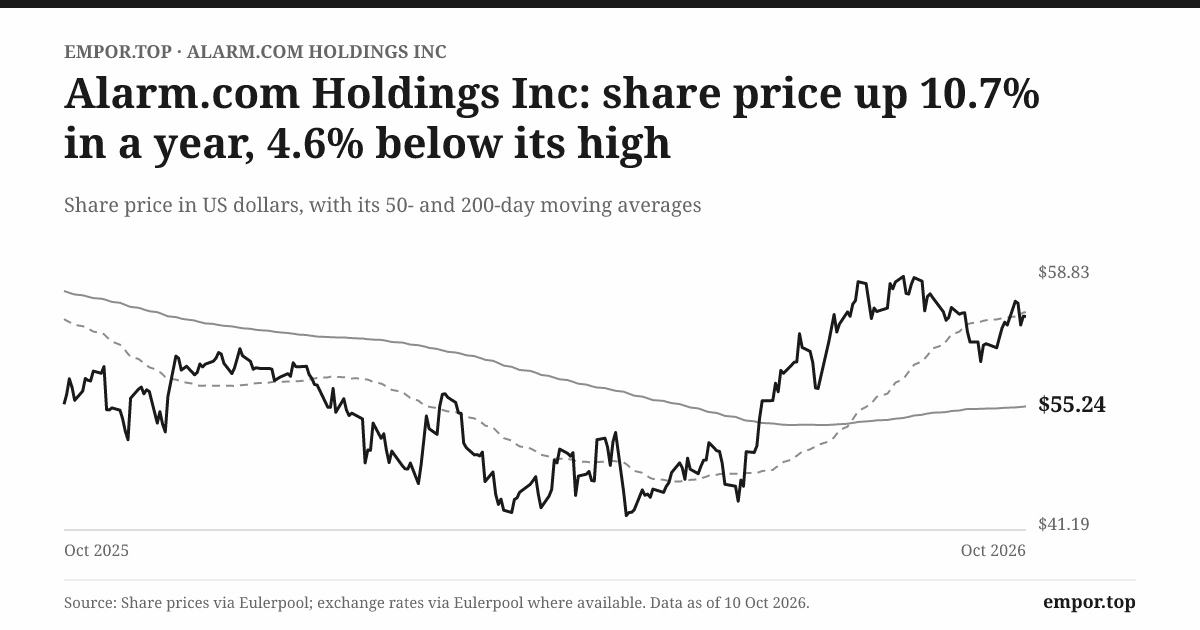
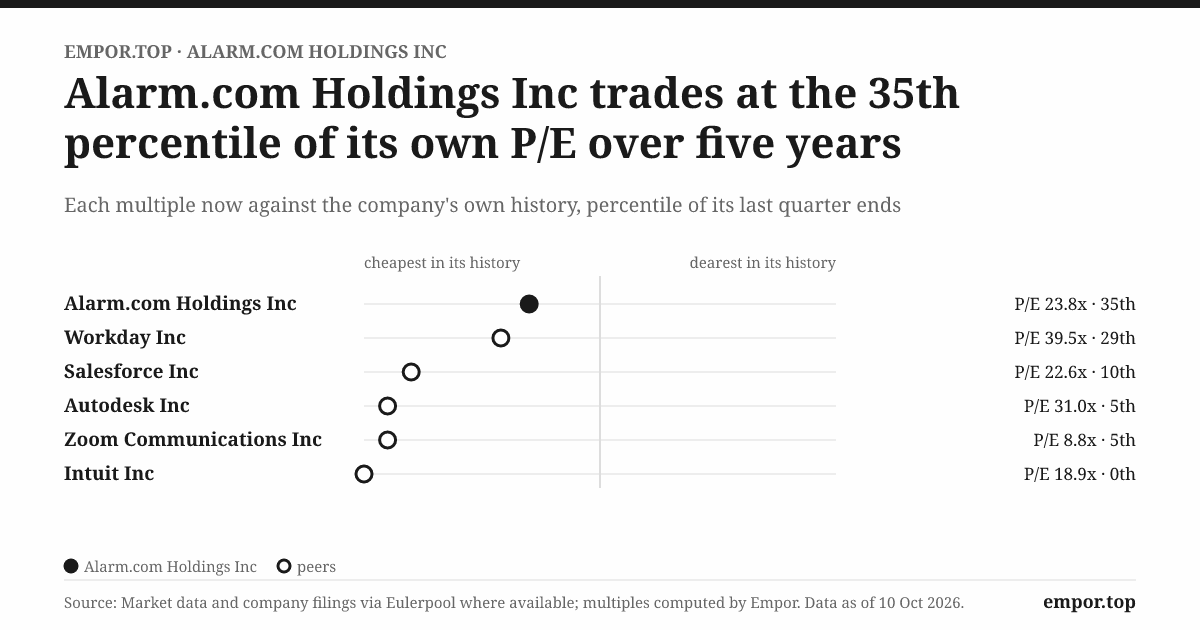
The stock market has made its own call. At $55.24 on October 10, 2026, the shares trade at about 24 times trailing earnings, against a five-year median of about 40 times.1 That is roughly a 41% discount to the company's own recent history. Put plainly, investors have stopped paying for Alarm.com as a high-growth software platform and started pricing it like a mature utility that throws off cash.
So this story has three questions to answer. The first is whether Alarm.com can push its software growth back above the mid-single digits now that American homes with professional security are mostly already connected. The second concerns the roughly $206 million the company spent in 2025 buying minority stakes in its own dealers. Is that a clever way to defend distribution, or a sign that the channel is under strain? The third is how much of recent earnings was really operating profit. For two years a large pile of cash earned high interest, and in January 2026 most of that pile went to repay $500 million of convertible notes.2
To answer any of them you have to go back to the decision that made Alarm.com invisible in the first place: the choice not to sell to consumers at all.
 Subscribe on LinkedIn
II. Cutting the Copper: The MicroStrategy Spin-Out (2000–2009)
Alarm.com did not come from a garage. It came from a corporate research group at MicroStrategy, Michael Saylor's business-intelligence company in the Washington suburbs, at the moment the dot-com bubble was bursting.3 The money was drying up, MicroStrategy itself was in trouble, and side projects were the first thing a struggling parent cut. This one survived because it fixed a problem an existing, unglamorous industry already paid to have fixed.
In 2003 the project got the leader who would define it. Stephen Trundle, an engineer who had come up through MicroStrategy, became chief executive.3 He has held the job ever since, which means he has now run the company for 23 years.4 Trundle does not fit the image of a founder-showman. He is a product-minded engineer who talks about protocols, dealer economics and installation workflows rather than grand visions, and the company he built reflects that temperament: patient, technical and allergic to splashy consumer marketing.
The fork in the road he faced was simple to state and hard to choose. Alarm.com could build a consumer brand, put boxes on retail shelves and sell subscriptions directly to homeowners. Or it could sell its technology to the security companies that already had trucks, technicians and monitoring contracts, and let them put their own names on it. The first path offered glory and margin. The second offered distribution.
Trundle chose distribution. The reasoning starts with a fact about American homeowners that technology optimists kept forgetting. Most people do not want to drill into door frames, pair sensors, set up cellular radios or work out which motion detector will set itself off when the dog walks past. They pay a local professional to do it, sign a contract and expect someone to answer the phone when something goes wrong. Those dealers already owned the customer relationship, the monitoring revenue and the installation labour. Alarm.com did not need to win the customer. It needed to win the dealer.
The economics of what came to be called B2B2C follow from that choice. Alarm.com writes the firmware, runs the cloud, builds the mobile app and keeps the devices talking to each other. The dealer does everything that costs real money to acquire a customer: marketing, door-to-door sales, the truck roll, the installation, customer service and billing. End customers typically sign three-to-five-year contracts with their dealer, while Alarm.com's own contracts with dealers run for an initial year and renew automatically.1 The arrangement looks modest on paper. In practice it meant Alarm.com never had to fund the most expensive part of consumer hardware: buying the customer.
That turned out to be the strategic insight of the decade. Over the following years, consumer hardware start-ups would learn that acquiring a household one advertisement at a time is ruinously expensive and that customers who buy a device on impulse leave on impulse. Alarm.com avoided both lessons by letting dealers, who were already paying that cost for their monitoring business, carry the burden.
In 2009 the company separated from MicroStrategy when ABS Capital Partners led an investment that recapitalised Alarm.com as an independent business.3 Technology Crossover Ventures later joined as a backer. The spin-out gave Trundle a cleaner shareholder base, growth capital and the freedom to build the dealer network without a struggling parent hovering over the budget. Six years later, on June 26, 2015, Alarm.com listed on Nasdaq at $14 a share.3 Both venture backers have since sold out completely.4
The investor lesson from the founding years is that the moat was chosen before it was built. Alarm.com's distribution depends on thousands of independent businesses that own the truck and the customer. That makes the platform resilient, because no single retail channel can shut it off. It also makes Alarm.com dependent on those dealers' health, and that dependence comes back, expensively, in 2025. First, though, it is worth seeing how a dealer's installation turns into a decade of software revenue.
III. The Trojan Horse in the Door Frame: The Platform Architecture
Go down to a basement in any American suburb on installation day. A technician opens the alarm panel, clips in a cellular communicator, mounts a few door contacts and motion sensors, and fixes a camera above the garage. He opens an app on his phone, registers the panel with the cloud, and within minutes the homeowner's phone can arm the system, see the front porch and unlock the door for a dog walker. The homeowner sees their dealer's brand. Behind it, that panel is now tied to Alarm.com's cloud for as long as the system stays on the wall.
That moment is the whole business model. Alarm.com sells two things. The first is software: SaaS and licence revenue, which reached about $689 million in fiscal 2025, or 68% of revenue.1 The second is hardware: cameras, communicators, video recorders, thermostats and sensors, which brought in about $322 million, or 32%.1 The numbers look like a two-business company. The economics say otherwise.
Hardware is barely profitable. In fiscal 2025 it cost Alarm.com about $246 million to supply about $322 million of hardware, a gross margin of about 23.5%.1 That is thin for anyone, and especially for a company priced as software. But hardware is not there to make money. It is the Trojan horse. Every camera and communicator a dealer installs runs Alarm.com firmware and connects to Alarm.com's servers, and from the day it goes live it generates a monthly software fee. Selling the device at a slim margin is the price of planting a recurring toll in the wall.
The toll itself is simple. Dealers pay a monthly fee for each connected property, billed in advance.1 Basic interactive security sits at the bottom. Video, video analytics, home automation, energy management and commercial access control add tiers on top, each raising what a dealer pays per property. The dealer passes those costs into the end customer's monthly bill, so a household paying its security company every month is, without knowing it, paying Alarm.com a slice.
Why don't dealers simply switch to a cheaper platform? Because switching means more than signing a new contract. A dealer with tens of thousands of customers has those customers' panels, cameras and communicators running Alarm.com's firmware and provisioned on Alarm.com's cellular arrangements. Moving them means rolling trucks to homes, swapping equipment and retraining technicians and call-centre staff on new tools. Alarm.com does not require large minimum commitments, and it does not need to.1 The installed hardware does the locking.
There is one caveat to that picture, and it is worth stating now rather than later. Switching costs protect the installed base. They do not protect new accounts. A dealer can choose a different platform for tomorrow's installations without touching yesterday's, so the moat is strongest on retention and weaker on new business. That distinction matters a great deal when this story reaches the largest dealer of all.
The cash mechanics reinforce the model. Alarm.com bills dealers rather than consumers, and dealers pay steadily. Debtor days, the average time customers take to pay, have stayed in a band of roughly 49 to 54 days for five years, at 51 days in fiscal 2025.1 A business with deteriorating customers usually shows it here first, with collection times stretching out, and Alarm.com's have not. The cash cycle has lengthened, though, because inventory has grown from about a month of hardware costs in fiscal 2014 to more than three months.1 That is the price of a supply chain that, after the shortages of 2021 and 2022, now carries more stock to keep dealers supplied. It ties up cash, but in hardware, not in risky credit.
So what does the architecture tell an investor? The value of Alarm.com sits in the software line and in the count of connected properties underneath it, and the hardware line should be read as a customer-acquisition cost the dealer partly pays for. The open question is whether that architecture could survive the arrival of the richest companies on earth on the same front porch.
IV. The Great Threat: Big Tech's Front-Porch Invasion (2014–2020)
By the late 2010s, the front door had become one of the most fought-over pieces of real estate in technology. Amazon bought the video-doorbell maker Ring in 2018. Google had bought Nest a few years earlier and was selling thermostats, cameras and an alarm system of its own. Television ads promised that a $99 camera and a phone app would make the old alarm company obsolete. Every few quarters, the question came back to Alarm.com's shareholders: why would anyone pay a dealer a monthly contract when they could buy a camera at the hardware store?
The consensus answer at the time was that do-it-yourself security would eat professional security from the bottom. The record shows something more nuanced. Alarm.com grew revenue by more than 20% in almost every year from fiscal 2014 to fiscal 2021, the very years the gadget wave peaked.1 Revenue went from about $167 million to about $748 million over that stretch.1 Whatever the DIY boom took, it did not take Alarm.com's growth.
The reason lies in the gap between a gadget and a safety system. A consumer camera pings your phone when a parcel arrives. A professional security system has battery backup and a cellular path, so it works when the power or internet fails. It connects to a monitoring centre staffed around the clock, it can dispatch the fire brigade and police, and it often earns the homeowner an insurance discount. Those features matter most to the households with the most to lose: owners of larger single-family homes and small businesses. Renters who wanted a doorbell camera bought one at a shop. Families who wanted someone to call the fire department went to a dealer.
Big Tech also ran into the parts of security that do not scale like software. Local permits, false-alarm fines from police departments, licensing rules for installers and the sheer labour of sending technicians to houses all favour local professional businesses. A trillion-dollar company could sell a million cameras. It could not easily roll a truck to a million basements. In effect, Alarm.com counter-positioned against the tech giants: its whole model was built around a channel the giants were structurally unwilling to serve.
Alarm.com did not rest on that structural advantage. It spent heavily to keep the dealer's product better than what a consumer could buy off the shelf: video analytics that can tell a person from a car, object detection, edge computing and integration across hundreds of device types. Research and development consumed about $270 million in fiscal 2025, or roughly 27% of revenue.1 Of the company's 2,058 employees at the end of 2025, about 1,150 worked in R&D.1 That is an unusually engineering-heavy company. For comparison, the sales and marketing staff numbered about 600, which makes sense for a business that lets dealers do most of the selling.
The honest verdict on the Big Tech threat is a split decision. Alarm.com did lose the bottom of the market: renters, gadget buyers and households that never wanted a monthly contract. It kept, and arguably strengthened, its hold on monitored homes and small businesses. The DIY wave probably even helped by teaching consumers to expect video and app control, features dealers could then sell on Alarm.com's platform.
But the strongest test of the moat did not come from Big Tech selling to consumers. It came when Big Tech tried to buy its way into Alarm.com's largest customer.
V. The King Customer Problem: The ADT Entanglement
On August 3, 2020, Google announced it would invest $450 million in ADT, America's largest security company, for a stake of about 6.6%, and that the two would build smart-home security products together.6 For Alarm.com's investors, the logic was alarming. ADT was Alarm.com's largest customer. Now it had a new partner with the deepest pockets in technology and every reason to build an alternative platform.
The scale of the exposure explains the panic. In each of fiscal 2023, 2024 and 2025, a single service provider partner accounted for between 15% and 20% of Alarm.com's revenue, and that partner is historically ADT.1 The ten largest partners together accounted for about 45% of revenue in fiscal 2025, down from about 50% two years earlier.1 That is a concentrated customer list for a company priced as a platform. When one customer controls a fifth of your revenue, that customer has a voice in every pricing negotiation.
What happened next is the best evidence available on how strong Alarm.com's switching costs actually are. ADT did build products with Google and began moving new customers toward them. But it did not tear out the existing base. In October 2022, ADT and Alarm.com announced an extension of their long-term relationship, including an agreement covering intellectual property.7 The accounts already running on Alarm.com stayed on Alarm.com. Two years later, ADT still sits in the same 15%-to-20% band of Alarm.com's revenue.1
Part of the reason is the cost of migration: rolling trucks to millions of homes to swap hardware that already works is expensive and annoys customers. The other part is patents. Alarm.com has built a dense portfolio around interactive security and cellular communication, and it has defended it. Rivals and partners have more often ended up in licensing arrangements than in clean replacements, which raises the cost of building a competing platform from scratch.7
Weighing the evidence, the history narrows the moat claim rather than rejecting it. Alarm.com's installed base proved hard to move even when its largest customer had a motive, a partner and money. That supports the switching-cost thesis for existing accounts. But ADT also showed that a big enough customer can steer new accounts elsewhere, and that is exactly where growth comes from. The concentration that once read as a sign of a big partner now reads as a cap on pricing: a company whose biggest customer has a credible alternative cannot push prices on new accounts very hard.
The share of revenue from the top ten partners is the number to watch here. It has drifted down from about half to about 45%, which is healthy diversification. But a large customer drifting away would look exactly the same in that number. Disclosure does not settle which it is. What the drift does show is that Alarm.com needed growth from places ADT does not reach, which is why the company went looking outside the living room.
VI. Moving Upmarket and Out of the Living Room: Commercial & EnergyHub
Imagine a regional facilities manager on a Monday morning. A warehouse gate needs opening for a delivery, a contractor's badge needs revoking across three sites, and someone wants the camera footage from Friday night's alarm at the loading dock. On Alarm.com for Business, that is all one screen. This is the second act Alarm.com has been writing for a decade: taking the same dealer-delivered cloud platform out of homes and into offices, shops, warehouses and apartment buildings.
The commercial push has several pieces. Alarm.com sells commercial security and access control through its dealers. It owns OpenEye, a video management business aimed at enterprise and multi-site customers, which puts it in direct competition with cloud-video upstarts such as Verkada.[^10] It owns Shooter Detection Systems, which sells gunshot-detection sensors to schools and businesses, and PointCentral, which serves property managers.1 It has also bought smaller businesses including Vistacam, EBS, CHeKT and BTR, mostly tuck-ins that fill product gaps.1
The appeal is easy to see. A commercial customer typically pays more per site, buys more cameras and sensors per installation and leaves less often than a homeowner who moves house. If residential is mature, commercial looks like fresh ground.
Then there is EnergyHub, which Alarm.com bought in 2013.9 Its pitch has aged better than almost anything else in the portfolio. EnergyHub links thermostats, home batteries and electric-vehicle chargers to utility demand-response programmes, letting a utility nudge thousands of devices to use less power at peak times rather than fire up an expensive power plant. That is a virtual power plant, and as grids strain under electrification and data-centre demand, utilities have reasons to pay for it.
All of this requires remarkably little physical capital. Capital spending in fiscal 2025 was about $16 million, under 2% of revenue.1 The investment goes into engineers, not buildings, which is why so much of the profit turns into cash.
Here, though, the evidence asks for caution. Alarm.com does not report revenue for commercial, video or EnergyHub as separate segments with their own growth rates, so the claim that these are the fast-growing parts of the business rests largely on management's description. What can be measured points to a modest effect. SaaS revenue grew about 9% in fiscal 2025 and about 11% in the second quarter of 2026.12 That is healthy, and better than the consolidated figure, but it is not the kind of acceleration you would see if a fast-growing second act had become large. Hardware revenue, which tracks new installations, grew only about 4% in fiscal 2025.1
The verdict on the second act is that it is real but not yet big enough. Commercial and EnergyHub are plausibly growing faster than the residential core and may well carry higher margins. But residential still produces most of the cash, so the blend moves slowly. The optionality has not yet shown up in a way that could lift total growth back toward the 17% ten-year base rate. That gap between ambition and arithmetic helps explain the most unusual move in Alarm.com's history.
VII. Buying the Distribution: The Dealer Equity Bet (2025)
For two decades, Alarm.com's pitch to investors had a clean edge: it was an asset-light software company that let others own the trucks. In 2025 it started buying pieces of the trucks.
Over the course of the year, Alarm.com spent about $206 million in cash on minority stakes in four of its dealer partners.1 The largest cheque, about $119 million, bought 32.5% of Safe Haven Security Services. About $30 million bought 20.3% of Pronet, about $29 million bought 24.7% of SafeStreets USA, and about $19 million bought 32.5% of All Access Holdings.1 These are not small software tuck-ins. They are stakes in installation and sales businesses, the very part of the value chain Trundle chose not to own back in 2003.
Alarm.com also lent money. It extended a $21.5 million senior secured term loan to SafeStreets, priced at SOFR plus 3 percentage points and maturing in January 2030, with interest paid in kind for the first two years.1 Paid in kind means SafeStreets does not pay its interest in cash; the interest is added to the loan balance instead. By the end of 2025, Alarm.com's receivables from these four investees came to about $24 million, and the stakes sat on the balance sheet at about $232.5 million.1
There are two ways to read this, and both deserve a fair hearing.
The bull reading is that Alarm.com locked up some of the most productive dealers in North America. A dealer partly owned by its platform is unlikely to move new installations to a rival. The investees brought in about $17.4 million of revenue in fiscal 2025, up from almost nothing a year earlier, and paid out about $7.8 million in cash distributions.1 If these dealers keep growing, Alarm.com collects twice: a software fee on every account they add, and a share of their profits.
The bear reading starts with the loan. A healthy company with good access to credit does not usually need its software supplier to lend it money with the interest deferred. The PIK feature suggests SafeStreets preferred to keep its cash, or needed to. The timing fits a strained channel. High interest rates have raised the cost of financing the upfront expense of signing a security customer, which dealers recover over years of monthly fees, and slow housing turnover has reduced the stream of new homeowners who sign up when they move. If dealers struggle to fund growth, the platform that depends on their growth has a reason to fund them.
The receivables offer a further clue. Alarm.com's allowance for credit losses, the reserve against customers who may not pay, rose from about $5.2 million at the end of 2025 to about $8.0 million by June 30, 2026, as gross receivables climbed to about $172 million.12 In absolute terms that is small for a billion-dollar company. But the direction matters. Debtor days had been steady for years. The reserve growing by more than half in six months is the first sign in the accounts that collecting from the channel is getting harder.
So which reading is right? The evidence does not reject the bull case, but it narrows it. The deals do bind important dealers to the platform, and revenue from them is real. They also move Alarm.com into a new kind of risk: as a minority owner and lender, it now shares in its dealers' credit problems rather than just billing them. That is a meaningful change for a company that built its reputation on letting others carry the capital. The test arrives on a clear timetable. If SafeStreets starts paying cash interest when the PIK period ends in early 2027, and the $232.5 million of stakes avoid impairments, the bull reading strengthens. If the loan is restructured or the stakes are written down, the asset-light story will need rewriting.
To understand how Alarm.com could write $206 million of cheques without blinking, you need to look at the treasury that funded them.
VIII. The Balance Sheet Engine: Cash, Convertibles, and the $500M Payoff
On January 14, 2026, a day before the notes came due, Alarm.com wired $500 million to the holders of its 2026 convertible notes and retired them entirely in cash.2 No new shares were issued and no new debt was raised to do it. The money came from a cash pile that had stood near $1 billion at the end of 2025.1 It was the tidy ending to a piece of financial engineering that began in the cheap-money era and paid off handsomely in the expensive-money one.
The story starts in January 2021, when interest rates were near zero and investors would lend to growing tech companies at almost nothing in exchange for the right to convert into shares. Alarm.com sold $500 million of convertible notes with a 0% coupon, due in January 2026.1 Then, in May 2024, it sold another $500 million of convertibles due June 2029, this time at 2.25%.8 Alongside that second deal it spent about $63 million on capped calls, contracts that offset dilution from conversion up to a share price of about $105.74, a 75% premium to the price at the time.18
Between those two issues, interest rates rose sharply, and Alarm.com's cash, parked in money-market funds and Treasury bills, started earning real money. Interest income was about $47 million in fiscal 2024 and about $46 million in fiscal 2025.1 Against the 0% coupon on the first notes, that was close to free money. It was also a big share of profit: in fiscal 2025, interest income came to about 27% of pre-tax profit, and in fiscal 2024 about a third.1
That brings up the earnings puzzle. Pre-tax profit in the first half of 2026 fell about 20% compared with a year earlier, even as operating profit held roughly level and revenue grew.12 The reason is not that the business got worse. After the $500 million repayment, cash dropped to about $479 million by June 30, 2026, and interest income in the first half fell to about $9 million.2 Meanwhile the 2029 notes still cost about $11 million a year in coupon.1 A rough calculation shows the scale of the swing: interest income heading from about $46 million a year toward something nearer $18 million is a loss of close to $30 million of pre-tax profit, set against an operating profit of about $134 million in fiscal 2025.1 Core operating profit has to grow by about a fifth just to stand still at the pre-tax line.
Underneath the treasury noise, the operating engine converts profit to cash well. Over the twelve years from fiscal 2014 to 2025, Alarm.com produced about $984 million of operating cash flow against about $659 million of net profit, roughly 149% conversion.1 Non-cash charges such as stock compensation and depreciation explain much of the gap. The flow was lumpier in fiscal 2025, when operating cash fell to about $153 million from about $206 million despite higher profit, because the company paid down suppliers and its receivables and tax balances rose.1 Free cash flow still came to about $137 million.1
What did Alarm.com do with all that cash? It did not pay dividends, apart from a single $19 million distribution in fiscal 2015 around the IPO.1 It bought back shares: about $27 million in fiscal 2023, $75 million in fiscal 2024, $42 million in fiscal 2025 and $45 million in the first half of 2026.12 Treasury stock reached about 4.9 million shares at a cost of roughly $273 million, and the share count fell to about 49 million.2 For most of the buyback era, those repurchases mainly offset the dilution from stock compensation. Only recently has the share count begun to shrink meaningfully.
The investor conclusion is that management handled the convertible cycle well: it borrowed cheaply, earned more on the cash than it paid, and repaid in cash without diluting shareholders. But the reported earnings of fiscal 2024 and 2025 flattered the operating business, and the decline in 2026 profits is largely the reversal of that flattering. A balance sheet that now holds roughly as much cash as debt, with nothing due until 2029, is comfortable.2 It is no longer a fortress, and it has already been tapped for $206 million of dealer stakes. Whether the people running it are as disciplined as that record suggests is the next question.
IX. Management, Governance, and Credibility
On June 3, 2026, Alarm.com's shareholders cast their votes at the annual meeting. Every director was re-elected, the auditor was ratified with more than 99% support and the say-on-pay vote passed with about 96%.5 Trundle himself received about 39.3 million votes for and only about 0.4 million against.5 Annual meetings are rarely dramatic. This one was a measure of how little friction exists between this management team and its owners.
Trundle's pay is modest for a chief executive of a billion-dollar software company. His reported compensation was about $3 million in 2025, made up of a salary of about $0.8 million plus stock, options and a cash bonus.4 Under the SEC's measure of "compensation actually paid", which marks equity awards to the share price, the figure was about $1.2 million in 2025, down from about $4.6 million in 2023.4 That decline tracks the share price. When shareholders lose, the CEO loses. He also owns about 2 million shares, about 4.1% of the company, so his own wealth rises and falls with everyone else's.4
The finance chair changed in 2025. Steve Valenzuela retired after eight years as chief financial officer, and Kevin Bradley took over.4 Bradley is an insider: he joined in 2009 and ran financial planning and analysis from 2017.4 That kind of succession signals continuity rather than a new direction, for better and worse. The board has eight directors, seven of them independent, and PwC gave an unqualified opinion on the fiscal 2025 accounts with no material weaknesses or restatements.14 The only critical audit matter PwC flagged was revenue recognition across software, licences and hardware, which is normal for a company that bundles all three.1
There is mild dissent in the vote tallies, and it is worth noting. Director William McAdam received the weakest support, with roughly 4.9 million votes against out of about 39.7 million cast, more than ten times the opposition Trundle faced.5 That is not a revolt, but it is a signal that some institutions have reservations about at least one board seat.
The capital-allocation record is mostly clean. Over more than a decade, Alarm.com's acquisitions have been small, product-focused deals, and the company has taken no large goodwill write-offs from them.1 The 2026 note repayment was executed without dilution. But "disciplined" is not the whole picture. The same caution that kept Alarm.com from overpaying also kept it out of the consumer smart-home market, which Amazon and Google captured. And the 2025 dealer stakes are the largest and riskiest capital deployment in the company's history, made by the same team that built its reputation on avoiding that kind of exposure. Their record has earned the benefit of the doubt. Their biggest bet has not yet earned a verdict.
X. Playbook: Business & Investing Lessons
The first lesson goes back to 2003 and Trundle's refusal to put a box on a shop shelf. Alarm.com could have competed with the local installer. It chose to arm him instead, writing the software that made his truck more valuable and letting him own the customer. In a fragmented service industry where someone has to physically turn up at the door, the platform that makes the people in the vans more profitable wins more surely than the platform that tries to put them out of work. Arm the rebels, don't replace them. Alarm.com's whole history is the proof, and Big Tech's struggles at the front door are the counter-proof.
The second lesson lives in the basement on installation day, in the camera sold at a 23% margin. Hardware gross profit, in this model, is close to a vanity metric. What matters is that each device carries firmware that ties it to a monthly fee for years. Alarm.com shows that in connected devices, the hardware is the hook and the software is the fish. A founder building an Internet-of-Things company should measure success by how many devices are bound to a recurring service, not by the margin on the box.
The third lesson comes from the convertible years. For two years, interest on a billion dollars of borrowed cash accounted for more than a quarter of Alarm.com's pre-tax profit, and the earnings that came from it looked like operating leverage. They were not. When a cash-rich company reports record earnings in a high-rate regime, investors should first subtract the treasury yield and look at what remains. Alarm.com's 2026 profit decline is that subtraction happening in public. A float is a loan from the rate cycle, not a profit from the business.
The fourth lesson is the newest and the least settled. In 2025, the asset-light platform found that it could not stay entirely apart from the capital needs of its own channel. When dealers face higher financing costs and slower housing turnover, the platform either becomes their partner and lender or watches rivals move in. Alarm.com chose to write $206 million of cheques. For any platform that relies on independent distributors, the lesson is that asset-light is a condition granted by your channel's health, not a permanent property of your business model. Distribution you do not own can still send you the bill.
XI. Strategic Analysis: Moat & Bull vs. Bear Case
Put two investors in a room and give them the same Alarm.com data. The value investor points to a free cash flow yield of about 8.6%, a P/E near 24 and a share price far below its own five-year history.1 The growth investor points to three straight years of mid-to-high single-digit sales growth, a fifth of revenue riding on one customer and a new habit of lending money to dealers. Both are describing the same company. The question is which description wins over the next five years.
Start with the moat, argued once and in full. Hamilton Helmer's 7 Powers framework names seven durable sources of advantage, and two clearly apply here. The dominant one is switching costs. A dealer's installed base runs on Alarm.com firmware, its technicians are trained on Alarm.com tools and its customers use Alarm.com's app. Moving off the platform means truck rolls, new hardware and retraining. ADT's experience after its 2020 Google deal is the strongest test of that power on record, and the installed base stayed put.67 The second power is a two-sided network: hundreds of device makers build to Alarm.com's specifications because dealers use it, and dealers use it because so many devices work with it. Counter-positioning against Big Tech belongs on the list too, since the tech giants had little appetite for a truck-based channel. Scale economies in R&D help as well: spending about $270 million a year on engineering is easy for Alarm.com and hard for a smaller rival platform.1
Michael Porter's five forces explain the limits of that moat. Buyer power is the biggest threat. With the top ten partners at about 45% of revenue and one partner at 15% to 20%, Alarm.com's largest customers can negotiate hard.1 Substitutes are a moderate threat: DIY systems cap the low end of residential, while in commercial video Verkada and Motorola Solutions' Avigilon push from the enterprise side.[^10] Supplier power is low, since hardware comes from contract manufacturers in Asia, though tariffs and component shortages have shown that the supply chain can squeeze margins, as in fiscal 2022. The threat of new platform entrants is low, given the patents and integration work involved. Rivalry with other dealer platforms exists but is contained by switching costs.
The verdict on the moat is that it is genuine but has a specific shape. It protects existing accounts very well and new accounts less well, and it does little to give Alarm.com pricing power over its largest customers. That is a profitable position, and a slow-growing one.
The bull case rests on three arguments. First, valuation: a P/E near 24 and an 8.6% free cash flow yield are near the cheapest Alarm.com has ever traded, and its EV-to-EBITDA multiple of about 13 is far below vertical-software norms.1 Second, commercial operating leverage: if commercial, video and EnergyHub grow fast enough, blended growth could climb back toward double digits, and SaaS growth of about 11% in the latest quarter is a hint in that direction.2 Third, capital return: with the 2026 notes gone, cash can go into buybacks, and steady buybacks plus mid-single-digit sales growth can still compound earnings per share at a decent clip.
The bear case also rests on three arguments. First, residential saturation: high interest rates, depressed home sales and already-high penetration of professional security in single-family homes could keep growth trapped at 5% to 7%. Hardware growth of about 4% in fiscal 2025 is the clue that new installations are slow.1 Second, channel capital creep: the $206 million of dealer stakes and the PIK loan to SafeStreets could be the start of a pattern of propping up capital-starved installers, turning an asset-light software business into a lower-return channel financier. Third, the optical earnings cliff: with tens of millions of dollars of interest income gone, reported earnings will look weaker for at least a year even if operating profit grows, and a market that buys on reported earnings could keep the multiple low.
Weighing these honestly, the multiple has probably de-rated for good from high-growth software to something closer to mature specialty software, because the growth that justified 40 times earnings is no longer there. The market price appears to assume that Alarm.com stays a mid-single-digit grower with stable margins, not that it collapses. Future returns therefore depend less on the multiple and more on whether capital allocation, buybacks and the dealer stakes earn more than they cost.
Three numbers will tell which investor in the room is right. The first is SaaS and licence revenue growth, which was about 9% in fiscal 2025 and about 11% in the second quarter of 2026, and moving up.12 Holding above 10% would undercut the value-trap thesis. The second is the carrying value and impairment status of the dealer stakes, now about $232.5 million with no write-downs reported.1 The third is the credit-loss allowance, which rose from about $5.2 million to about $8.0 million in the first half of 2026.2 If it keeps rising, the channel is in more trouble than the revenue line shows.
XII. Epilogue
Tonight, Alarm.com sits in an unusual place for a software company. It is profitable, cash-generative and close to debt-neutral, with about 49 million shares outstanding, an installed base of more than 170 million devices and a CEO who has been in the chair for 23 years.12 It also faces the quietest and most important transition of its public life: the shift from growth company to compounder that has to earn its returns through discipline rather than expansion.
The first moment that will shape the story is the fiscal 2026 annual report, expected early in 2027. It will show the full-year effect of operating without most of the interest income from the convertible years. If operating profit grows fast enough to cover most of the lost interest, the "earnings cliff" will turn out to be a footnote. If pre-tax profit falls sharply for the year, the market will have to decide whether to look through it or to price the lower number.
The second moment is quieter but may matter more. Around the start of 2027, the PIK period on the SafeStreets loan ends, and SafeStreets is due to start paying interest in cash.1 A dealer that pays on time would support the bull reading of the 2025 stakes. A restructuring, an extension or an impairment on any of the four investments would confirm the bear reading that Alarm.com bought into a stressed channel.
The third moment is spread across the next several quarterly reports. If SaaS growth holds in double digits while hardware growth picks up, the commercial and energy businesses are doing what management says they will. If SaaS growth slips back toward the consolidated rate, the second act will look like a supporting role.
The tension that remains is the one this story started with. Alarm.com outmanoeuvred the largest technology companies in the world by playing a long, quiet game through partners nobody in Silicon Valley wanted. Now its original playground is largely full, its partners need capital, and its largest customer has options. It has to prove it can keep compounding when the easy growth is behind it.
XIII. Outro
Go back to that telephone box on the side of a house in 2000, its copper pair cut, the alarm inside still armed and silent. The fix was a radio and a server, and the business it created was one that almost no homeowner has ever noticed.
For twenty years, the tech giants fought for the front door with cameras, doorbells and Super Bowl adverts. The company that actually won the monitored home was the one that made the technician in the work truck better at his job and charged a small fee every month for the privilege. Alarm.com's proof was that the smartest way to build a software tollbooth on millions of homes is to make sure nobody knows the toll is being collected. Its test now is whether a toll that nobody sees can keep growing when there are fewer new homes to put it on.
References
-
ALRM Form 10-K Annual Report for Fiscal Year Ended December 31, 2025 — SEC EDGAR, 2026-02-19 ↩↩↩↩↩↩↩↩↩↩↩↩↩↩↩↩↩↩↩↩↩↩↩↩↩↩↩↩↩↩↩↩↩↩↩↩↩↩↩↩↩↩↩↩↩↩↩↩↩↩↩↩↩↩↩↩
-
ALRM Form 10-Q Quarterly Report for Period Ended June 30, 2026 — SEC EDGAR, 2026-08-06 ↩↩↩↩↩↩↩↩↩↩↩↩↩↩
-
ALRM Form S-1/A Initial Public Offering Registration Statement — SEC EDGAR, 2015-06-19 ↩↩↩↩↩
-
ALRM DEF 14A Definitive Proxy Statement — SEC EDGAR, 2026-04-23 ↩↩↩↩↩↩↩↩
-
ALRM Form 8-K Report of Voting Results of 2026 Annual Meeting of Stockholders — SEC EDGAR, 2026-06-08 ↩↩↩
-
Google to Invest $450 Million in ADT to Create Next-Generation Smart Home Security — Reuters, 2020-08-03 ↩↩
-
ADT and Alarm.com Extend Long-Term Technology Partnership and Intellectual Property Agreement — Security Week, 2022-10-18 ↩↩↩
-
Alarm.com Pricing of $500 Million 2.25% Convertible Senior Notes Due 2029 — PR Newswire, 2024-05-29 ↩↩
-
Alarm.com Acquires Majority Stake in Smart Grid Pioneer EnergyHub — Greentech Media, 2013-05-02 ↩
 LinkedIn
 WhatsApp
 Reddit
 Hacker News
 Email
Email Kindle
 RSS Feed
 Spotify
 Apple Podcasts
 Amazon Music
 Audible
 YouTube