AAR Corp. (NYSE: AIR): The Quiet Giant of Aviation Aftermarket
I. Introduction & Episode Roadmap
At around three o'clock on a weekday morning in Oklahoma City, a Boeing 737-800 that carried passengers to Dallas the previous evening sits in a hangar with its floor panels lifted, its interior stripped to the frame, and roughly a hundred technicians crawling through it with borescopes and torque wrenches. It will remain there for three weeks. The airline that owns the aircraft is not performing the work; a contractor is. That contractor's ability to return the aircraft to service on the promised date — not a day later — determines whether the airline's summer flight schedule holds.
This is the part of commercial aviation that rarely makes headlines. Industry coverage usually centers on aircraft manufacturing and airline operations: Boeing's production challenges, Airbus's order backlog, and quarterly load factors. Yet an aircraft spends roughly thirty years in service and only a few months being built. Over those three decades, it consumes a continuous stream of parts, inspections, overhauls, and regulatory documentation — all legally required. The global market for keeping existing aircraft airworthy reached approximately $136 billion in 2025, up 8% in a single year, and is projected to approach $193 billion by the end of the decade.1
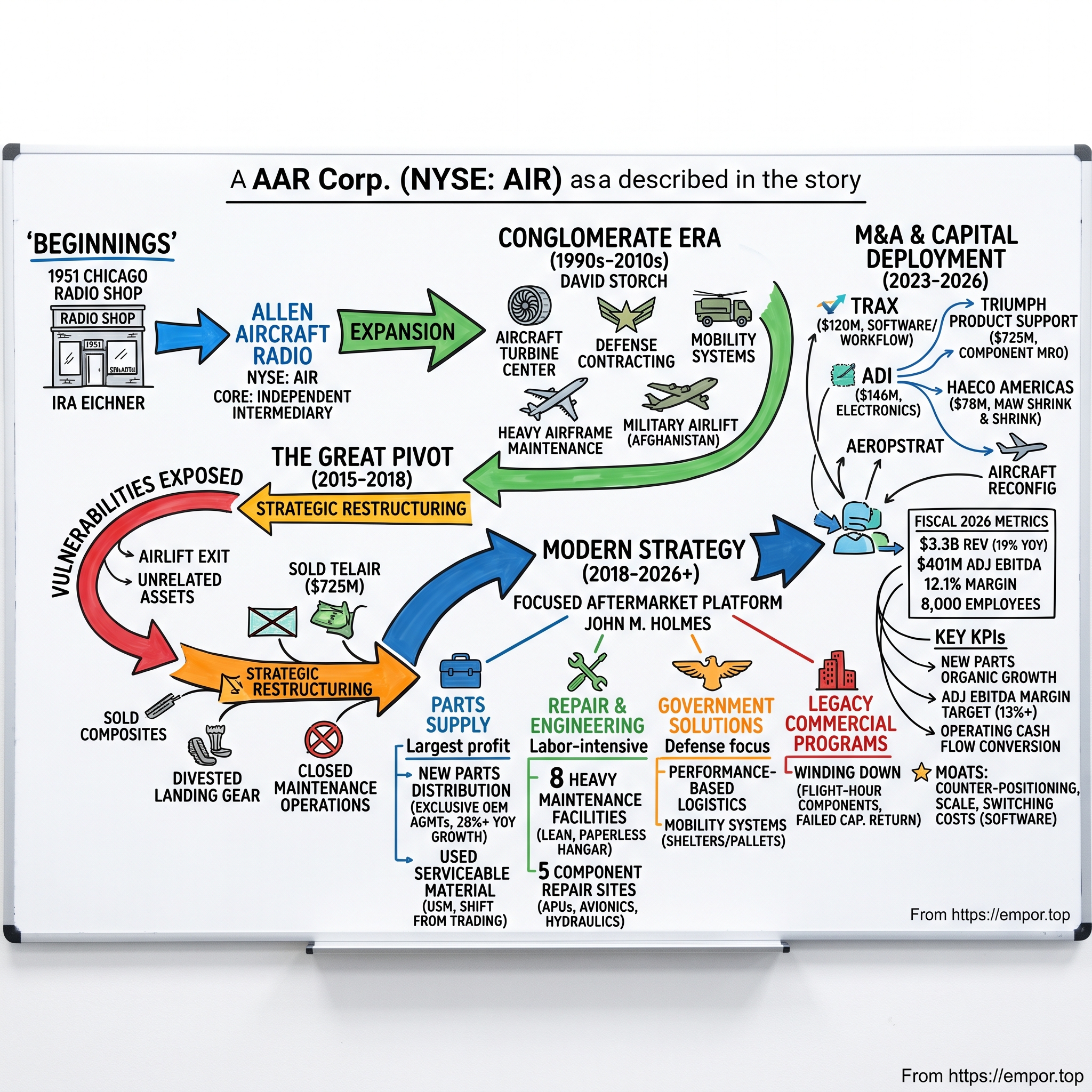
AAR Corp. operates at the center of that ecosystem. In its fiscal year ended May 31, 2026, the company reported revenue of $3.3 billion — a 19% year-over-year increase — along with adjusted EBITDA of $401 million and an adjusted EBITDA margin of 12.1%.2 It is the largest independent provider of heavy airframe maintenance in North America, the largest independent distributor of new aftermarket parts, and a leading independent source of used serviceable material — certified components harvested from retired aircraft. The company employs roughly 8,000 people.3
To put that scale in context, AAR's entire annual revenue equals roughly eight days of total global maintenance spending. The company does not dominate the broader aviation industry. Instead, it is the largest independent participant in a market so fragmented that "largest independent" and "small market share" describe the exact same reality — a structural tension that defines its operational model.
AAR's customer base is also broader than it first appears. The company sells to commercial airlines, distributes parts on behalf of manufacturers, and serves the U.S. government across nearly every operating division. Roughly 28% of fiscal 2026 revenue came from government customers.2 That commercial-defense mix is rare in the aerospace aftermarket, where most providers specialize in one domain. Whether this combination acts as a cycle-smoothing hedge or an operational distraction remains an ongoing debate among industry observers.
The central descriptor across these operations is independent. AAR does not manufacture the parts it distributes, nor does it hold proprietary intellectual property on the engines it services. It lacks proprietary designs to defend or a captive aftermarket monopoly to harvest. Its business relies on physical facility capacity, regulatory certifications, distribution networks, and enterprise software used by airline maintenance departments. Whether this asset and service combination forms a durable competitive moat or simply represents a well-managed service business in a cyclical market is the core investment question.
The core thesis, and what would falsify it. The bullish case for AAR rests on a strategic transformation: founded in 1951 as a trader of surplus military radios, the company accumulated a range of unrelated industrial assets over several decades before spending the past eight years divesting non-core operations. Management redeployed that capital into higher-margin parts distribution, component repair, and software services, positioning AAR as a focused platform in a supply-constrained market. The financial metrics reflect this transition: adjusted sales compounded at approximately 8% annually from fiscal 2018 through 2026, adjusted EBITDA margin expanded by roughly 370 basis points, and adjusted earnings per share grew at about 14% per year.3
The bear case highlights persistent structural headwinds. Operating cash flow has consistently lagged reported net profits. Return on invested capital remains in the high single digits, trailing dedicated aerospace aftermarket peers. Heavy maintenance operates primarily on labor arbitrage — executing maintenance tasks more efficiently than airlines can internally, an operational skill that remains vulnerable to competition. Furthermore, in May 2026, management determined that its long-term flight-hour component management programs failed to earn their cost of capital, prompting a planned exit from the business.4 That decision offers a clear window into the economics of AAR's contract portfolio and remains a central touchstone for this analysis.
The company's profile shifted significantly in the twelve months leading to August 2026. AAR acquired its largest domestic competitor in heavy maintenance, bought a sizable electronics distributor, reorganized its reporting segments, and initiated a multi-year wind-down of a flight-hour business that previously generated over $250 million in annual revenue. Consequently, historical depictions of AAR as a four-segment company built around flight-hour contracts are outdated.
How this story unfolds. The narrative begins with the company's origin as a Chicago radio trading operation focused on quick-turn spare parts delivery for airlines. It traces AAR's conglomerate expansion, the subsequent decade of asset sales, and the strategic restructuring under Chief Executive John Holmes. A segment-by-segment review evaluates profitability across operating divisions, followed by an analysis of six acquisitions completed over three years — valued from $15 million to $725 million — comparing transaction prices against delivered returns. Strategic positioning is evaluated through competitive frameworks, including Helmer's 7 Powers and Porter's Five Forces. The analysis also reviews a $55.6 million foreign bribery settlement and its corporate governance implications, concluding with the key financial metrics that will determine whether the company's transformation thesis holds.
 Subscribe on LinkedIn
II. Origins & Early History: From Radio Shop to Aftermarket Pioneer (1951–1990s)
In 1951, Ira Eichner, an undergraduate at Chicago's Roosevelt University, started a business trading military surplus radios with roughly $2,500 in capital. Originally named I.A. Allen Industrial Sales, the business was incorporated in 1955, renamed Allen Aircraft Radio in 1962, and re-branded as AAR Corp. in 1969.5 The company's shares trade on the New York Stock Exchange under the ticker symbol AIR.6
The founding premise was simple, yet structurally enduring. Post-war commercial aviation was expanding faster than original equipment manufacturer (OEM) supply chains could adapt. When an airline faced an aircraft on the ground late at night needing a specific avionics box, manufacturers often quoted lead times measured in weeks. Eichner offered an immediate alternative: inventory ready on the shelf. Everything AAR subsequently built — distribution networks, used-parts teardowns, maintenance hangars, and flight-management software — stems from this core proposition: independent intermediaries create value by holding critical inventory near customers and responding rapidly.
Eichner served as chairman from 1966 onward and remained the defining executive well into the 1990s.7 Under his leadership, AAR expanded internationally, built overseas distribution hubs, and acquired FAA-certificated repair stations — the regulatory approvals required to legally return components and airframes to service.
These certifications represent significant operational entry barriers. An FAA repair station approval is not a blanket authorization to fix aircraft; it is an itemized authorization tied to a specific facility, defined part numbers, approved technical data, specialized tooling, and qualified technicians. Adding even a single capability requires proving compliance to regulators and enduring lengthy approval processes. Accumulated across thousands of parts over decades, these certifications form an operational moat that competitors cannot quickly replicate through capital deployment alone.
In the aerospace aftermarket, time-in-market functions as a distinct form of capital. Competitors can raise funding rapidly, but regulatory approvals and operational track records take years to build.
Storch and the widening of the aperture. In 1979, David Storch, Eichner's son-in-law, joined AAR and established Aircraft Turbine Center to trade engines and engine components.5 Storch became chief executive in 1996 — only the second CEO in the company's history — and led AAR for twenty-two years until 2018.7
Storch's tenure tested whether AAR's core inventory and logistics strengths could expand horizontally. Management applied the model across new domains: extending commercial inventory distribution into defense contracting, expanding component overhaul into heavy airframe maintenance, moving into cargo loading equipment manufacturing, and operating rotary-wing airlift for defense missions in combat zones.
While each expansion appeared logical in isolation, collectively they created a complex conglomerate that was difficult for public markets to value. By the mid-2010s, AAR's portfolio spanned parts distribution, heavy airframe maintenance, composites manufacturing, cargo equipment production, defense logistics, and military helicopter airlift in Afghanistan. These units operated with disparate margin profiles, capital requirements, and cyclical dynamics.
The vulnerability that the boom concealed. The airlift operation illustrated the risks of this broad diversification. Post-9/11 defense activity generated substantial revenue and high cash flows transporting personnel and supplies in Afghanistan. However, the business carried structural vulnerabilities: it depended entirely on a single government customer, required capital-intensive aircraft stationed in active conflict zones, and remained subject to sudden contract re-awards. When the Department of Defense restructured its Afghanistan rotary-wing requirements in the late 2010s, AAR failed to secure task orders under the follow-on contract, completed its remaining Afghanistan work, and exited.8 AAR now lists the airlift business in investor disclosures among the non-core operations it divested or exited.3
This outcome underscored a critical distinction in government contracting: contract-driven services often resemble recurring revenue during expansion phases, but function as finite project work with abrupt termination risk. That distinction fundamentally shapes how efficiently capital can be committed to such assets.
The broader challenge with the Storch-era portfolio was a lack of operational synergy. A composites manufacturing plant and a heavy maintenance hangar served different buyers within an airline, operated on distinct cost structures, and offered few cross-selling benefits. AAR's primary asset — deep relationships with airline and defense procurement teams — was stretched across fragmented product lines. Without compounding synergies, product diversification generated operational complexity rather than long-term value.
The strategic pivot began in February 2015, when AAR agreed to sell its Telair Cargo Group — a cargo loading equipment manufacturing business generating EBITDA margins near 20% — to TransDigm for approximately $725 million in cash.9 The transaction closed in March 2015.10 Rather than divesting a failing unit, AAR sold a profitable, high-margin asset to reduce debt and streamline operations. This willingness to monetize non-core assets to fund strategic focus marked the beginning of AAR's multi-year portfolio transformation.
III. The Great Pivot: Pruning Complexity & Modernizing Strategy (2010s–2018)
Evaluating AAR from an equity analysis perspective in 2016 presented a distinct valuation challenge. The company's parts distribution business was growing steadily at attractive incremental margins with minimal capital required beyond inventory. Heavy maintenance hangars ran near capacity under multi-year airline agreements. The composites plant operated as a manufacturing business with industrial economics, while the airlift operation functioned as a declining asset. Meanwhile, the mobility systems unit sold pallets and shelters to government buyers on irregular order cycles.
To value the consolidated company, analysts had to evaluate five distinct business models and apply a discount for divided management focus. Most analysts applied a blended valuation multiple to aggregate earnings, resulting in a low valuation. This outcome reflected a classic conglomerate discount: a portfolio of unrelated businesses is worth less than the sum of its parts when the holding company generates minimal operating synergies across units and allocates capital away from higher-return opportunities.
What actually got cut. The portfolio restructuring unfolded over roughly a decade, often without major announcement. Beyond exiting airlift, AAR closed a Lake Charles airframe maintenance operation, sold its aerospace composites manufacturing business in 2020, and divested its Miami-based landing gear overhaul operation.311 Each exit followed a consistent rationale: the business either required disproportionate capital, generated structurally lower margins, or sat outside the parts-repair-software core the company was assembling.
The cumulative effect reshaped AAR from a diversified aerospace conglomerate into a focused aftermarket platform. In fiscal 2015, adjusted EBITDA stood at approximately $105 million on a 7.2% margin. By fiscal 2025, adjusted EBITDA reached $324 million as the margin expanded to 11.8%.12 This margin expansion stemmed primarily from strategic portfolio shifts rather than organic operating leverage within legacy units.
The 2018 handover. John M. Holmes became AAR's third chief executive in 2018. Having joined the company in 2001 and served as chief operating officer, he inherited neither a mandate to reinvent the company nor the position of an outside reformer. Alongside a new chief financial officer, he assembled a leadership team that AAR describes as averaging more than twenty-five years of industry tenure.3
Holmes adopted a procedural, highly structured communication style on earnings calls, opening with numbered key messages and reviewing them systematically. His disclosures emphasized operational granularity. When AAR acquired a heavy maintenance competitor in late 2025 and integration costs temporarily compressed margins, management informed investors of the specific quarter that would mark the margin trough, identified the facility slated for closure, and outlined the target quarter for margin recovery.13 This level of detailed pre-commitment provided investors with concrete, verifiable metrics.
Management defined the Holmes mandate as building a focused aftermarket platform with higher margins, expanded intellectual property, and disciplined capital allocation. In investor presentations, AAR explicitly contrasted this strategy with its past "less capital allocation discipline" and "transactional customer experience."3 While this candid self-assessment highlighted a strategic shift, its operational reality must be evaluated against cash flow performance, as examined in Section VIII.
The tailwind that arrived on schedule. Post-2021 market dynamics reinforced this corporate restructuring. Delivery delays at Boeing and Airbus, combined with durability issues on new-generation engines that required unscheduled shop visits, forced airlines to extend the operating lives of existing fleets.
An aging commercial fleet creates favorable operating conditions for AAR. Older aircraft require more frequent, extensive heavy maintenance checks and consume greater volumes of replacement parts. They also drive the used serviceable material market, where certified components harvested from retired aircraft offer operators savings estimated by AAR at 30% to 70% compared with new OEM parts.12
Determining the degree to which AAR's performance resulted from operational execution versus broader market tailwinds requires careful examination. Near-capacity utilization across AAR's heavy maintenance hangars reflected industry-wide supply constraints rather than exclusive market share gains. Full facilities in a constrained market demonstrate strong demand but do not inherently prove superior competitive positioning.
A clearer distinction appears in relative operational performance. When AAR acquired the continent's second-largest heavy maintenance provider in late 2025, the target company held a revenue base that AAR immediately identified as insufficiently profitable and chose to shrink.13 Facing the same tight market conditions, the two operators generated materially different financial outcomes, pointing to an underlying gap in operational execution rather than pure market tailwinds.
The most decisive evidence of operational differentiation, however, lies in divisions where AAR's growth significantly outpaced the broader market — specifically in parts distribution, which the next section examines.
IV. Segment Economics: Unpacking the Revenue & Profit Engines
For most of the period covered in this story, AAR reported four segments: Parts Supply, Repair & Engineering, Integrated Solutions, and Expeditionary Services. In fiscal 2025, Parts Supply generated $1,099.6 million in sales (about 40% of the total), Repair & Engineering contributed $931.0 million (roughly 32%), Integrated Solutions accounted for approximately 25%, and Expeditionary Services comprised roughly 3%. Consolidated revenue reached $2,780.5 million, up from $2,318.9 million in fiscal 2024, while operating income rose from $129.2 million to $185.2 million.6
On May 6, 2026, AAR reorganized its financial reporting structure into four new segments: Parts Supply; Repair, Engineering and Software; Government Solutions; and Legacy Commercial Programs.4 This resegmentation was more than a cosmetic shift; it signaled management's explicit determination to isolate lower-return operations while focusing capital on higher-margin, core platforms.
Parts Supply: the engine that actually works. In fiscal 2026, Parts Supply generated $1,487.7 million in sales and $186.2 million in operating income, solidifying its position as the company's largest and most profitable division.2 The segment encompasses two distinct business models: new parts distribution and used serviceable material.
In new parts distribution, AAR enters into two-way exclusive agreements with component manufacturers. Under these arrangements, AAR agrees to represent only a single manufacturer's product within a given category, while the manufacturer commits to using AAR as its sole aftermarket distributor in that market.3 Approximately 90% of these distribution contracts are long-term and exclusive, with renewal rates running near 100% in recent years.123
This structure solves a key operational challenge for original equipment manufacturers. Because component makers specialize in engineering and production, building global sales forces, managing regional inventory, and servicing smaller operators requires capital that earns lower returns. AAR absorbs those logistics functions. In turn, two-way exclusivity protects manufacturers from competing products within AAR's channel, enabling AAR to scale distribution revenue with minimal fixed-asset investment beyond inventory holdings.
The resulting growth trajectory represents a primary driver of AAR's recent expansion. Distribution sales grew more than 700% between fiscal 2012 and the twelve months ended February 2026, compounding at roughly 17% annually and accelerating to about 28% per year since fiscal 2022.3 In the quarter ended February 28, 2026, new parts distribution expanded 62% overall and 36% organically.13 Responding to analyst inquiries regarding the source of organic growth, Chief Executive John Holmes noted that approximately two-thirds came from volume expansion under existing contracts, roughly one-third from new contract wins, and a minor portion from price increases.13 While volume expansion within an established customer base provides predictable revenue, it also indicates that top-line performance remains closely tied to customer flight schedules rather than market share gains alone.
Sales into defense channels grew 55% organically in that same quarter, driven by elevated federal focus on military fleet readiness.13 AAR supports platforms including the C-17, P-8, C-40, F-16, and C-130, and established a supply chain alliance with the Defense Logistics Agency during fiscal 2025.14 Although government distribution involves distinct risks — including budget appropriations cycles, contract protests, and shifting defense priorities — defense distribution sales outpaced commercial growth during fiscal 2026.
The second division within Parts Supply is used serviceable material (USM). Unlike conventional equipment resale, every harvested aviation component must undergo rigorous inspection, testing, and regulatory certification before returning to service. A certified component with complete maintenance traceability serves as an economical substitute for a new OEM part, whereas a component lacking paper certification carries no commercial value.
Operationally, AAR acquires retired aircraft and engines, disassembles the airframes, recertifies the harvested components, and resells them. Financial returns depend on buying assets at prices that allow profitable parts sales — making USM trading a forecasting exercise subject to supply lumpiness. Because airlines have extended aircraft operating lives during recent supply constraints, aircraft retirements have remained low, constraining available teardown inventory.
Consequently, management has deliberately reduced the company's reliance on USM trading. In July 2025, Holmes confirmed that USM accounted for 15% or less of consolidated sales, stating that AAR was intentionally shifting portfolio weight away from volatile trading activities toward businesses offering predictable growth, steadier margins, and consistent cash flows.14 This shift reflects a strategic transition away from the trading operations that formed AAR's original foundation.
Repair, Engineering and Software: capacity, labor, and a software business hiding inside. This segment generated $1,080.8 million in sales and $84.6 million in operating income in fiscal 2026.2 While contributing roughly one-third of total revenue, the division produced under one-quarter of segment operating profit — a disparity highlighting the labor-intensive economics of heavy airframe maintenance.
AAR operates eight heavy maintenance facilities and five component repair facilities.12 Heavy airframe maintenance requires removing aircraft from service for scheduled comprehensive inspections, structural repairs, and systems testing. Because unscheduled downtime costs airlines significant daily revenue, turnaround speed and execution quality serve as primary competitive differentiators. To improve hangar throughput, AAR introduced lean operating methods and a digital "paperless hangar" initiative replacing traditional paper work cards; as of late 2025, that implementation was approximately one-third complete across its network.12
Component repair covers auxiliary power units, avionics, fuel systems, hydraulics, engine gearboxes, and interior components.12 It generates higher margins than structural airframe work by focusing on specialized systems capabilities and leveraging proprietary repair procedures approved under Designated Engineering Representative (DER) authority, which allows certified repairs alternative to OEM-designed procedures.
Following the May 2026 organizational realignment, software operations were integrated into this segment. AAR's Trax enterprise platform functions as the maintenance and engineering system of record for airlines and maintenance facilities, tracking regulatory compliance, task scheduling, and parts inventory across fleets. Trax serves over 130 customers representing more than 6,000 aircraft.12 Management estimates the addressable aviation maintenance software market at $3 billion, growing at a mid-single-digit annual rate, and highlights the platform's high switching costs and extended replacement cycles as key strategic assets.3
Government Solutions: the segment that got carved out. In fiscal 2026, Government Solutions generated $502.3 million in sales and $56.7 million in operating income.2 The division provides performance-based logistics, supply chain support, and mobility systems manufacturing for the U.S. Department of Defense and allied foreign militaries.
Carving Government Solutions into a standalone segment improved reporting transparency. Defense contracting operates under distinct economic drivers compared to commercial aviation: contracts are awarded through competitive procurement cycles, revenue depends on congressional appropriations rather than commercial flight hours, and profitability is dictated by contract structure rather than commercial pricing power.
AAR positions its competitive advantage around applying commercial supply chain efficiency to defense sustainment, citing a $48 billion ten-year pipeline of addressable government opportunities.3 However, contract pipelines represent uncommitted bidding targets rather than committed backlog, and actual capture rates in defense procurement historically represent a small fraction of identified prospects.
Recent contract awards provide a clearer measure of execution. A joint venture with KIRA secured a U.S. Navy E-6B pilot training contract; while modest in size, management noted the agreement established past-performance credentials required to bid on larger military awards.14 Additionally, the mobility business secured a multi-year contract valued at approximately $450 million to supply shelters and pallets for forward-deployed military units amidst heightened overseas operational tempo.13
Offsetting these gains, management cautioned in its fiscal 2026 outlook that U.S. State Department budgetary reductions would compress aviation support revenue under its Worldwide Aviation Support Services (WASS) contract in Iraq, requiring offsetting growth in other government programs.14 This reliance on political budgeting underscores the recurring volatility inherent in defense service contracts.
Legacy Commercial Programs: the segment created in order to be killed. Legacy Commercial Programs comprises asset-heavy, flight-hour component management agreements. Under these "power-by-the-hour" contracts, airlines pay a fixed fee per operating hour while AAR maintains dedicated inventory pools to guarantee component availability.
While multi-year contracts and embedded customer relationships initially suggested strong business quality, the program's capital intensity severely impaired returns. In the twelve months ended February 28, 2026, the division generated $252.4 million in sales, a GAAP operating loss of $0.2 million, and $5.0 million in adjusted operating income, while tying up approximately $160 million in net assets.4
Tying up $160 million in capital to generate $5 million in adjusted operating income represented an unsustainable return profile. Chief Executive John Holmes acknowledged that the business required excessive asset backing and failed to meet corporate capital return targets.4 Consequently, AAR initiated a three-to-four-year exit from flight-hour contracts, intending to monetize parts inventory, realize periodic asset sale gains, and redeploy personnel into higher-margin segments.4
This exit highlights a key lesson in aftermarket economics: customer switching costs do not guarantee profitability if contracts fail to cover their cost of capital. Furthermore, while the voluntary wind-down demonstrates capital discipline, it also confirms that a business line previously promoted as a core growth driver had eroded capital returns for several years prior to management intervention.
AAR's consolidated fiscal 2026 performance reflects this operational repositioning, delivering $3.3 billion in revenue, $401.1 million in adjusted EBITDA at a 12.1% margin, and adjusted diluted earnings per share of $5.05 compared to $4.86 on a GAAP basis, with commercial clients generating 72% of sales and government accounts contributing 28%.2 The business model driving these results evolved substantially over the preceding two years, driven primarily by an aggressive series of strategic acquisitions.
V. M&A & Capital Deployment: Benchmarking Trax & Triumph
Between March 2023 and April 2026, AAR closed six acquisitions with announced transaction values ranging from $15 million to $725 million, and completed one significant divestiture. In an industry where aerospace aftermarket assets have traded at eye-watering multiples for a decade, the striking thing about AAR's record is what it did not pay.
Trax, March 2023: buying a distribution channel disguised as software. AAR paid $120 million for Trax USA Corp., a Miami-based maintenance software company with roughly 110 employees and about $25 million of revenue, supporting approximately 5,000 aircraft at acquisition.1514
On the surface this was a small deal that made little sense for a parts-and-hangars company. The strategic logic becomes clearer once you understand what maintenance software actually is. Trax's eMRO product is the enterprise system that tracks aircraft maintenance: work orders, materials planning, engineering, scheduling, regulatory compliance, personnel qualifications. Its eMobility suite puts task cards, digital manuals, and electronic logbooks in a mechanic's hands on the hangar floor.15 Replacing it is roughly equivalent to an airline replacing its accounting system while continuing to fly — technically possible, organizationally traumatic, and rarely attempted.
AAR's thesis had two parts. First, own the system of record and you own the workflow in which every parts purchase and repair decision is made. Second, AAR's existing airline relationships could open doors Trax could not open alone. The evidence on the second point is unusually clean: Delta Air Lines selected Trax to modernize Delta TechOps' maintenance and engineering systems, replacing legacy platforms with eMRO and eMobility in what AAR described as the largest implementation of its kind in the maintenance ERP space.14 Holmes called it "a perfect example of our Trax acquisition thesis, whereby AAR can leverage its customer relationships to open doors for Trax."14
The financial results have followed. Trax revenue doubled from roughly $25 million at acquisition to more than $50 million, with management describing a path to doubling again toward $100 million.13 The mechanics of that growth are worth understanding, because they are not primarily about new customers: Holmes explained that a legacy Trax user paying a $200,000 to $300,000 annual license fee can see that fee rise four or five times upon upgrading to the current suite.14 That is an installed base being monetized, which is a higher-confidence growth path than net-new sales.
The Delta implementation is instructive about the pace of software in this industry. As of March 2026, roughly one year in, Trax had been deployed to more than 2,000 Delta users of an eventual 6,000-plus, completing only the first of three modules; the full three-year rollout would see the material revenue ramp begin in later phases.13 Enterprise aviation software does not scale like consumer SaaS. It scales at the speed of regulatory validation and mechanic retraining.
AAR added two more software assets: Aerostrat, a long-range maintenance planning company, for $15 million in August 2025, and it has been building toward a parts marketplace embedded in the Trax interface — the logical endgame, in which a maintenance planner sees a required part and can buy it from AAR without leaving the software.312 That marketplace was still pending launch as of the March 2026 call, meaning the most valuable part of the software thesis remains unproven.13
Triumph Product Support, March 2024: the big one. AAR announced in December 2023 and closed on March 1, 2024 the acquisition of Triumph Group's Product Support business for $725 million in cash — the same figure, coincidentally, that TransDigm had paid AAR for Telair nine years earlier.1617
The target was a specialized component MRO business generating approximately $280 million of revenue and $55 million of EBITDA, a roughly 20% margin, with more than 700 employees.17 Including estimated tax benefits with a present value of about $80 million, AAR characterized the effective multiple as 11.7 times fiscal 2024 EBITDA, falling to 9.9 times including $10 million of estimated run-rate synergies.17 Financing came from a $550 million senior notes offering plus revolver borrowings.17
Set that against the aerospace aftermarket comparison set. HEICO and TransDigm — the two companies most often held up as the gold standard of aftermarket economics — have persistently traded at enterprise-value-to-EBITDA multiples of roughly 20 times and higher.18 Paying under 12 times for a 20%-margin component MRO asset was, by the standards of the 2023–24 aerospace M&A market, notably restrained.
Restraint at signing means nothing if execution fails, so the more useful question is what actually happened. AAR consolidated the acquired Long Island component repair site into facilities in Dallas, Texas and Wellington, Kansas, absorbing stranded fixed costs in the interim that visibly depressed segment margins in the June 2025 quarter before the exit completed.14 The company originally targeted $10 million of cost synergies. By its May 2026 investor day, it reported $21 million saved — more than double the original target.3 Overdelivering on a publicly stated synergy number is one of the more reliable signals of integration competence available to an outside investor, precisely because the original number was in the public record and could not be quietly revised.
Fiscal 2026: three more deals, and a change in posture. In August 2025 AAR bought Aerostrat. In September it acquired ADI, a distributor of electronic components and assemblies, for $146 million in cash funded from the revolver — a business generating $149 million of revenue and $15.2 million of EBITDA in the twelve months to June 2025, implying roughly 9.6 times trailing EBITDA, with about 400 employees across six locations in the United States, United Kingdom, and India.19
Then in November 2025 came the most strategically loaded transaction: HAECO Americas, the second-largest heavy maintenance provider in North America behind AAR itself, for $78 million in cash — described as a high-single-digit multiple of trailing EBITDA before synergies.2012 The business had more than 1,600 employees across Greensboro, North Carolina and Lake City, Florida.12 Alongside the acquisition, AAR secured multi-year heavy maintenance contracts with key customers worth more than $850 million.20
Buying your closest competitor in a capacity-constrained market for less than a tenth of a billion dollars is either a coup or a warning. The purchase price relative to the business's scale — 1,600 employees for $78 million — tells you the acquired operation was not making money. AAR was explicit that the plan was to shrink it: management described "rightsizing the revenue base" by ending unprofitable customer relationships, cutting the workforce to match, and then deploying AAR's own processes and paperless systems.13 The accounting confirmed the distress; AAR recorded a bargain purchase gain, meaning the fair value of the acquired assets exceeded what it paid.13 The company excluded that gain from adjusted results, which is the appropriate treatment and worth noting because it would have been easy not to.
The integration was genuinely painful in the near term. In the quarter ended February 2026, Repair & Engineering adjusted EBITDA margin fell 190 basis points year over year; excluding HAECO Americas, consolidated adjusted EBITDA margin would have been 70 basis points higher.13 Management identified that quarter as the trough and committed to a specific recovery timeline — segment margins back to pre-acquisition levels by the third quarter of fiscal 2027, with further improvement after exiting the Indianapolis facility, AAR's highest-cost site, in the fourth quarter of fiscal 2027.13 That is a commitment an investor can hold them to, quarter by quarter.
April 2026 brought Aircraft Reconfig Technologies for $35 million — an interiors engineering company with more than 100 employees, adding self-certification capabilities.3
The capital allocation framework, and one broken promise worth examining. AAR's stated priorities run in order: organic investment, M&A, maintaining a flexible balance sheet at 2.0x–2.5x net leverage, and only then returns to shareholders through opportunistic buybacks.3 The M&A screens are specific — accretive to growth or margin, after-tax internal rate of return exceeding cost of capital, improved long-term cash flow, and a clear path back into the leverage range.3 AAR reports that Trax and Triumph have cleared the return hurdle, with the four newer deals still marked "on track."3
Now the uncomfortable part. On the July 2025 earnings call, with leverage at 2.72 times, the chief financial officer told investors that "absent any M&A," AAR would delever into its 2.0x–2.5x target during fiscal 2026, and that if leverage reached the low end, share repurchases rather than a reinstated dividend would be the preferred return of capital.14 AAR then spent roughly $259 million on acquisitions during fiscal 2026 and repurchased no stock.212
Two readings are available. The charitable one: management explicitly flagged M&A as part of the growth strategy and caveated the delevering path accordingly, and it still ended fiscal 2026 at 2.03 times net leverage — inside the target range despite the spending.2 The skeptical one: "absent any M&A" is a caveat that does a great deal of work, and an investor who took the July 2025 commentary as guidance toward capital returns was disappointed. On the evidence, AAR is a compounder that reinvests, not a company that returns cash, and investors should price it that way regardless of what the fourth capital allocation priority says on a slide.
The debt itself deserves a brief second-layer note. The Triumph acquisition was funded substantially with a $550 million senior notes issue, and AAR's interest burden rose accordingly — cash interest paid climbed from roughly $11 million in fiscal 2023 to about $32 million in fiscal 2024 and roughly $74 million in fiscal 2025 as the notes carried a full year.6 That is real money against an adjusted EBITDA base in the $300–400 million range, and it is the mechanism by which leverage constrains strategic freedom. It also explains why deleveraging has been such a prominent theme on every earnings call since: at those interest levels, the cost of the next acquisition is not merely the purchase price but the option value of a balance sheet that stays flexible. The company has since taken leverage from 2.72 times to 2.03 times while completing three acquisitions, which is the more relevant fact — but the sensitivity to a growth stumble is higher today than it was before March 2024.
VI. Competitive Moats: Hamilton Helmer's 7 Powers & Porter's Five Forces
Strip away the strategy language and ask the only question that matters: if a well-funded competitor decided tomorrow to take AAR's business, what specifically would stop them?
Scale economies — real, but narrower than they appear. AAR runs the largest independent heavy maintenance network in North America and, after acquiring its nearest competitor, an even larger share of it. Fixed-cost absorption across eight heavy maintenance facilities and five component shops is genuine, as is the buying power to acquire whole aircraft for teardown.12
But scale in this business is regional, not global. A narrowbody aircraft in scheduled service must be maintained within reasonable ferry distance of where it operates, which is why AAR's own materials note that narrowbodies "need to be maintained in region."12 That geographic constraint means AAR's North American scale confers limited advantage in Europe or Asia, and it means a determined regional competitor with two hangars in the right city faces a lower barrier than the aggregate numbers suggest. The HAECO Americas purchase price is itself evidence: the second-largest player in the market was available for $78 million, which is not what a scale-advantaged industry looks like from the loser's side.
The more interesting scale question is on the distribution side. AAR holds roughly a 4% share of a $25 billion new parts distribution market and under 4% of the roughly $80 billion combined parts and repair addressable market.3 A 4% market share is not a scale monopoly. It represents a large runway — a bullish framing — but it also means AAR is not currently large enough to dictate terms to industry counterparties.
Counter-positioning — the strongest of the seven. This is where AAR's independence does real work. A component manufacturer's aftermarket strategy is to capture the highest possible margin on proprietary spare parts. That is a rational and highly profitable position, and it is precisely why manufacturers cannot easily replicate what AAR offers: an airline-facing model built on used serviceable material at 30% to 70% below new-part prices, multi-brand distribution, and repairs developed independently.12
Counter-positioning in Helmer's framework requires that the incumbent be unable to respond without damaging its existing business, and that condition genuinely holds here. A manufacturer that started aggressively promoting used parts and independent repairs would cannibalize its own most profitable revenue. Holmes made the practical version of this point on the March 2026 call, observing that when fuel costs rise and airlines look to cut spending, AAR wins business "as an alternative to OEMs."13 Counter-positioning tends to be strongest exactly when customers are under cost pressure, making it a partial hedge against the cycle rather than an amplifier of it.
Process power — plausible, hard to verify from outside. AAR claims proprietary asset evaluation methods for pricing end-of-life aircraft, an operating model delivering industry-leading turnaround times, and a paperless hangar system.12 Process power is by construction difficult for outsiders to confirm, but there is circumstantial support: the Triumph synergy overdelivery, the specificity of the HAECO integration plan, and the fact that acquired underperforming operations are expected to reach AAR's existing efficiency levels within a defined window.313 The counter-evidence is that AAR's overall returns on capital do not yet look like those of a company with a decisive process advantage.
Switching costs — genuine in software, overstated elsewhere. Trax is a true system of record; replacing it is a multi-year project. That creates real switching costs, and AAR's own market framing identifies the core maintenance-and-engineering software layer as structurally attractive precisely because of high switching costs and long replacement cycles.3
The heavy maintenance relationship is stickier than a spot market but weaker than a contract implies. What Holmes actually described in July 2025 is more nuanced than a lock-in claim: he said core customers had told AAR they would "remove maintenance work from others long before they would remove it from us."14 That represents preference earned through service quality — a real asset, but one that must be re-earned continuously rather than a structural switching cost.
And the flight-hour component programs, the classic switching-cost story? AAR is exiting them because the capital they consumed exceeded the returns they produced. Contractual stickiness turned out to be an expensive asset to maintain.
The three powers AAR conspicuously lacks. Helmer's framework has seven powers, and the absences are as informative as the presences.
There is no cornered resource. AAR owns no proprietary engine design, no patented component, and no exclusive access to a scarce input. Its distribution agreements are exclusive but contractual — renewable, and therefore in principle losable. This is the single sharpest structural difference from HEICO and TransDigm, whose economics rest on owning approved part designs that customers must buy from them.
There are no meaningful network economies. AAR's value to an airline does not increase because other airlines use AAR. The one place a network could emerge is the Trax parts marketplace, where more suppliers would make the platform more useful to more buyers and vice versa — which is precisely why that unlaunched feature is the most strategically interesting item on the roadmap and also the most speculative.13
There is essentially no branding power in the sense of customers paying a premium for the name. Airlines buy on turnaround time, quality, price, and reliability, evaluated on spreadsheets by procurement departments. AAR's reputation matters enormously — Holmes's claim that customers would pull work from competitors before pulling it from AAR is a reputational asset — but it operates as a tiebreaker and a retention mechanism, not as pricing power.14
Four powers present in varying strength, three absent. That is a fair characterization of a defensible business rather than an exceptional one, and it is broadly consistent with where public markets have priced the shares relative to proprietary-IP peers.
Porter's Five Forces, briefly and with the disagreements flagged.
Buyer power is higher than the constrained-capacity narrative suggests. AAR's customers are consolidated airlines and the U.S. government — sophisticated, price-conscious, and capable of insourcing. The current environment tilts pricing toward suppliers because hangar capacity is short, but that is a cyclical condition, not a structural one. It is worth remembering that AAR itself recently bought a competitor's operation whose revenue base was unprofitable, demonstrating what happens to pricing power when a provider lacks operating advantage.
Supplier power is genuinely high in the proprietary-parts layer, where manufacturers control the intellectual property. AAR's mitigations — exclusive two-way distribution arrangements, used material as an alternative channel, and independently developed repairs — are real but partial. The distribution relationship in particular is symbiotic rather than adversarial: AAR does not represent competing products and functions as an extension of the manufacturer into the aftermarket.12 That framing explains why the arrangements renew, and also why AAR's leverage over its partners remains limited.
Threat of new entrants is genuinely low for the reasons the industry routinely cites — capital requirements, regulatory certification, technical talent, and a safety record measured in decades. The binding constraint deserves emphasis: skilled mechanics. Oliver Wyman projects an annual shortfall of 12,000 to 18,000 aviation maintenance workers.1 A labor shortage functions as a barrier to entry and a ceiling on growth simultaneously, and it remains uncertain which effect will dominate for AAR over the medium term.
Threat of substitutes is close to nil. Maintenance intervals are mandated by regulation rather than dictated by customer preference. An airline cannot choose to skip a scheduled C-check.
Competitive rivalry is intense and segmented rather than uniform. In component repair and proprietary parts, HEICO and TransDigm operate with intellectual property positions AAR does not possess and margins AAR cannot match. In engine material and leasing, FTAI Aviation competes for the same used-parts supply — and is simultaneously a partner, having extended an exclusive agreement for AAR to distribute CFM56 engine material through 2030.14 In heavy airframe maintenance, rivalry has consolidated in North America but remains fragmented globally, with Lufthansa Technik and regional independents competing aggressively. In distribution, Boeing's Aviall and other broadline distributors compete for the same manufacturer relationships.
The synthesis. AAR possesses one strong power (counter-positioning), one real but geographically bounded power (scale), one that is emerging and valuable but small (switching costs in software), and one that is asserted more than demonstrated (process power). That defines a defensible business — meaningfully better positioned than a generic services contractor — but not the fortress that aerospace aftermarket peer comparisons imply. The most objective summary is that AAR's advantage is real at the level of individual customer relationships and thin at the level of broader industry structure. That brings the analysis directly to whether leadership has earned the benefit of the doubt.
VII. Management Credibility, Governance & The FCPA Settlement
Sometime in 2019, leadership at AAR made a decision that cost the company roughly $55 million and likely saved it far more: after discovering how certain overseas deals were won, the company disclosed the findings to the U.S. government before regulators uncovered them independently.
Self-reporting a bribery problem is one of the genuinely hard calls in corporate governance. The disclosure guarantees an investigation, guarantees a penalty, and guarantees years of legal expense and management distraction. The alternative — saying nothing and hoping — carries a small probability of costing nothing and a meaningful probability of costing far more, including the criminal charges and compliance monitorship that regulators reserve for companies that concealed. Most boards understand the math. Not all of them act on it.
On December 19, 2024, AAR announced that it had resolved multi-year investigations by the Department of Justice and the Securities and Exchange Commission into violations of the Foreign Corrupt Practices Act.[^22] The conduct was not ambiguous. Between 2015 and 2020, AAR — through various individuals and third-party intermediaries — participated in schemes to pay bribes to government officials in order to win and keep business with state-owned airlines in Nepal and South Africa, generating profits of approximately $23.9 million.22
The financial resolution totaled roughly $55.6 million: a criminal penalty of $26,363,029 under a non-prosecution agreement with the DOJ, and $29,236,624 in disgorgement and prejudgment interest to the SEC under a cease-and-desist order.22[^22] The SEC separately charged a former executive of an AAR subsidiary.22
Several features of the resolution matter for assessing governance today. AAR self-reported the conduct to both agencies in 2019 and cooperated through a multi-year investigation.[^22] The DOJ resolved with a non-prosecution agreement rather than a deferred prosecution agreement or a guilty plea — the most favorable of the standard outcomes. And critically, no independent compliance monitor was imposed, which is the single most expensive and operationally intrusive remedy in the FCPA toolkit and one that regulators routinely require when they doubt a company's remediation.[^22]
The honest assessment cuts both ways. On the negative side, this was five years of bribery across two countries, and the conduct continued into 2020 — meaning it overlapped substantially with the current chief executive's tenure, which began in 2018. Self-reporting in 2019 was the correct decision, but the misconduct occurring at all reflects a control environment that failed, and the cost to shareholders was real: $55.6 million against approximately $23.9 million of illicit profit means the scheme destroyed roughly $32 million of value beyond simply giving back what it earned. On the positive side, the pattern of behavior after discovery — self-disclosure, cooperation, remediation sufficient to avoid a monitor — is what a functioning governance system looks like once a problem is found.
Judging management by the record, not the rhetoric. The more useful credibility test is whether AAR does what it says it will do. Here the evidence is mixed but leans favorable, and the interesting cases are the specific ones.
Targets set and beaten. Triumph synergies were guided at $10 million and delivered at $21 million.173 Trax revenue doubled from $25 million to over $50 million within roughly two and a half years of acquisition.13 Net leverage came down from 3.06 times in the December 2024 quarter to 2.72 times by May 2025 to 2.03 times by May 2026, and did so while funding roughly $259 million of acquisitions.14221
Targets set and revised upward mid-year. Entering fiscal 2026, management guided organic sales growth to "approach the 9% level" delivered in fiscal 2025.14 By the March 2026 call, the full-year organic expectation had been raised to approximately 12%, with total growth of approximately 19%.13 Raising guidance is preferable to cutting it, though it also suggests the initial framing was conservative.
Narrative consistency across calls. The strategic language has been notably stable across three years of earnings calls: market share capture, cost efficiency and synergy realization, increasing intellectual property, disciplined portfolio management. The same four pillars appear in the fiscal 2025 year-end call, the fiscal 2026 objectives slide, and the 2026 investor day framework.14123 Consistency is not the same as correctness, but strategy that gets rewritten every year is usually a sign that none of it is working.
Willingness to explain a miss. The HAECO Americas margin dilution is the best available example. Management did not bury it in a footnote; the chief financial officer quantified the exact drag — 70 basis points of consolidated adjusted EBITDA margin — named the trough quarter, and specified the recovery timeline by fiscal quarter.13 Compare that to the more common corporate approach of attributing margin compression to "integration costs" without a number attached.
The unflattering entry. The capital-return signaling discussed earlier, and the fact that the Legacy Commercial Programs business was allowed to consume roughly $160 million of capital for minimal return well into the tenure of a management team whose entire stated identity is capital discipline.4 Exiting was right. Exiting in 2026 rather than 2021 is a fair question for any investor to put to management.
Key personnel and second-layer signals. AAR churned its finance leadership during a period of heavy transaction activity. Sean Gillen, chief financial officer for nearly seven years, departed for an opportunity outside aviation, effective around the start of 2026.23 Sarah Flanagan served as interim CFO, and in February 2026 the board appointed Dylan Wolin — who had led AAR's corporate development, treasury, and investor relations functions from 2017 to 2024 before a two-year stint running operating businesses at Federal Signal.24 Holmes described Wolin as "instrumental in developing the strategy we are executing today."13
A CFO transition during an acquisition-heavy stretch is a genuine risk, and losing an experienced finance chief mid-integration is not a positive. The mitigating factor is that the replacement is an insider who architected the current portfolio strategy and returned with additional operating experience. Investors should watch whether disclosure quality and guidance precision hold at the standard set under the prior regime.
Executive compensation is tied to performance measures including adjusted EBITDA, return on invested capital, and organic sales growth, with the mix disclosed in the annual proxy.25 The inclusion of return on invested capital is the meaningful detail, because it is the metric most directly at odds with empire-building — and, not coincidentally, the metric that justifies winding down a $252 million revenue segment.
That last point deserves to be stated plainly rather than buried in a compensation discussion, because it is one of the rare cases where an incentive structure can be observed doing its job. A management team paid primarily on revenue or adjusted EBITDA would have every reason to keep a $252 million business that broke roughly even at the operating line — it adds scale, it adds EBITDA, and shutting it down means explaining a revenue decline to the market for three consecutive years. A team measured on return on invested capital has the opposite incentive. AAR's decision to wind it down is consistent with the second incentive structure and inconsistent with the first, which is modest but genuine evidence that the compensation design is influencing behavior rather than decorating a proxy statement.
The corresponding caution is that the same framework will now be tested in the other direction. A company measured on return on invested capital that is also pursuing programmatic acquisitions faces an obvious tension: acquisitions add invested capital immediately and returns gradually. Watching whether AAR continues to publish specific, checkable return commitments on deals it has already closed — rather than quietly retiring the "on track" designations — is a reasonable ongoing governance test.
VIII. Investment Story Spine, Risk Radar & Bull vs. Bear
Every investment case eventually reduces to a single sentence about why the future will be different from, or the same as, the past. For AAR the sentence is: a fragmented, capacity-short aftermarket is consolidating, and the largest independent player is shifting its mix toward higher-margin parts, component repair, and software while exiting the capital-hungry businesses that dragged on returns. Here is what supports that and what breaks it.
Why AAR wins from here. The demand backdrop is both favorable and highly visible. The global commercial fleet is expanding and aging at the same time, new aircraft deliveries remain constrained, and airlines continue to outsource maintenance.3 AAR's addressable parts and repair market is projected to expand from roughly $80 billion in 2026 to $90 billion by 2029. Because AAR holds under 4% of that total, market expansion alone is not the core thesis; market share gain is.3
Evidence of share gain appears strongest in distribution, where 36% organic growth in a single quarter against a market expanding at low single digits stands out as a performance that acquisitions alone cannot explain.13 The accompanying mix shift is financially significant: Parts Supply generated roughly 45% of fiscal 2026 revenue and approximately 57% of total segment operating profit.2 Because parts distribution and software carry higher margins than labor-intensive airframe maintenance, revenue growth in those divisions expands consolidated profitability. Management's three-year framework targets an adjusted EBITDA margin of 13% or higher overall — and 13% to 14% excluding the legacy wind-down segment, up from roughly 12% in fiscal 2026 — alongside adjusted earnings per share compounding at about 15% annually.3
For fiscal 2027, management projected revenue growth in the low double digits to low teens, expecting first-quarter sales to rise 21% to 23% excluding Legacy Commercial Programs and delivering an adjusted EBITDA margin between 12.25% and 12.75%.2
Why it may not. The counter-thesis begins with cash generation. AAR generated operating cash flow of $23.3 million in fiscal 2023, $43.6 million in fiscal 2024, and $36.1 million in fiscal 2025, while annual capital expenditures ran at roughly $30 million during each of those years.6 Operating cash flow rose to $98.7 million in fiscal 2026.2 Yet compared against $401.1 million in reported adjusted EBITDA, the cash conversion gap remains wide.
The underlying driver is working capital, specifically inventory. Expanding a parts distribution franchise requires purchasing components upfront and holding them in stock, and AAR's cash flow statements show inventory absorbing substantial cash each year — roughly $90 million in fiscal 2024, $109 million in fiscal 2025, and $69 million in fiscal 2026.621 Management explicitly acknowledged this dynamic, noting that cash conversion will "vary period-to-period based on strategic growth investments in inventory."3 Furthermore, the company's target of converting 30% or more of adjusted EBITDA into operating cash flow over three years serves as an implicit admission that the model requires heavy working capital.
This requirement forms the core of the bear case. Purchasing inventory ahead of demand is standard practice for a parts distributor, but it introduces two distinct risks. If demand slows, inventory turns into illiquid assets carrying write-down exposure. If demand continues expanding, the business must continuously fund inventory holdings, explaining why net debt remains elevated despite rising operating profit.
A second concern centers on capital returns. AAR's return on invested capital remains in the high single digits, trailing TransDigm's mid-teens performance and HEICO's low double digits.18 For executive leadership emphasizing capital discipline, closing this return gap is a critical hurdle. Exiting Legacy Commercial Programs addresses the issue directly by liberating approximately $160 million in net assets that generated negligible operating income. However, reallocating $160 million against an invested capital base measured in billions offers a modest percentage improvement relative to management's positioning.
Third, labor availability places a ceiling on growth. Throughput in heavy airframe maintenance depends strictly on the number of certificated technicians working in hangars. Facing an estimated annual industry shortage of 12,000 to 18,000 technicians, labor availability and wage inflation constrain facility output irrespective of customer demand.1 AAR's regulatory disclosures explicitly highlight technician shortages as a primary operational risk factor.12
Fourth, OEM supply chain disruptions create conflicting operational effects. Delays in new aircraft deliveries force airlines to operate older fleets longer, expanding demand for heavy maintenance and replacement parts. However, prolonged fleet retention prevents aircraft retirements, depriving the used serviceable material market of teardown inventory — a bottleneck management cited for subdued growth in used parts trading.14 If aircraft deliveries normalize, retirements will rise and increase used parts supply, but heavy maintenance demand for older airframes will simultaneously taper. This structural dynamic acts as a natural operational hedge, ensuring that neither market condition provides an unmixed tailwind.
Fifth, geopolitical tensions and trade policy present direct operational friction. International trade in aviation components requires frequent cross-border shipments, where import tariffs increase landed inventory costs for distributors. When asked in July 2025 whether airlines were accelerating orders to front-run potential tariffs, Chief Executive John Holmes reported that purchasing patterns remained standard, with one notable exception: sales to select Chinese counterparties contracted due to tariff adjustments earlier that quarter.14 While the immediate financial impact was contained, the outcome illustrates how international trade friction can affect both inventory holding costs and customer order volumes.
Sixth, digital expansion increases cybersecurity exposure. As AAR integrates software platforms into its core operations, its risk profile shifts. Managing the system of record for airline maintenance — tracking compliance records, work orders, and fleet airworthiness data across thousands of commercial jets — carries higher operational liabilities than operating traditional warehouses. AAR identifies cybersecurity vulnerabilities among its primary risk disclosures,12 and operational disruptions would carry broader liabilities as software adoption grows among tier-one carriers.
Seventh, the restructured portfolio remains untested through an industry downturn. During the March 2026 earnings call, as Middle Eastern conflicts elevated jet fuel prices, equity analysts questioned whether prospective airline capacity reductions would compress AAR's order book. Holmes stated that airline customers reported strong booking trends and that minor schedule adjustments had not impacted overall maintenance requirements. He added that approximately two-thirds of commercial revenue now derives from long-term, backlog-supported agreements in parts distribution and heavy maintenance rather than short-term spot transactions.13 Although long-term contracts enhance revenue visibility compared to AAR's legacy model, the resilience of this portfolio structure during a broad commercial downturn remains unverified.
Myth versus reality: three consensus claims worth checking.
Myth: AAR is a pure-play beneficiary of the aging-fleet supercycle. Reality: fleet aging delivers mixed financial impacts across business lines. While older aircraft drive higher demand for heavy maintenance checks and factory-new replacement parts, they simultaneously constrain the supply of used serviceable material. Harvesting certified used parts requires aircraft retirements, but delivery delays for new jets force airlines to keep older aircraft operating rather than sending them to teardown yards. Executive leadership attributed modest growth in used material sales to feedstock shortages rather than weak demand, observing that when teardown assets became available in the June 2025 quarter, transactions closed rapidly at attractive margins.14 Consequently, extended fleet retention supports heavy repair and new parts distribution while constraining used parts trading.
Myth: long-term flight-hour contracts represent the highest-quality revenue stream in the aerospace aftermarket. Reality: AAR is unwinding its flight-hour component management portfolio because those agreements required approximately $160 million in dedicated net assets while generating only $5.0 million in annual adjusted operating income.4 Applying internal capital return hurdles led management to exit a business line once categorized as a core recurring revenue platform.
Myth: AAR's consolidated margins are permanently constrained because heavy airframe maintenance relies on commodity labor. Reality: airframe maintenance remains labor-intensive with modest margins, but its contribution to consolidated results is shrinking. In fiscal 2026, Parts Supply accounted for approximately 45% of total revenue and roughly 57% of segment operating profit,2 while enterprise software was integrated into the repair and engineering reporting segment. Rather than relying on margin expansion within airframe maintenance, overall profitability relies on higher-margin parts distribution and software expanding as a proportion of total revenue.
The activist stress test. What would a skeptical investor put to this board?
The first issue centers on cash conversion and reported earnings quality. Generating $98.7 million in operating cash flow from $401.1 million in adjusted EBITDA raises questions regarding whether adjusted earnings serve as an appropriate valuation metric. A critical evaluation requires a multi-year projection detailing when inventory accumulation will align with earnings growth. Furthermore, GAAP net income of $188 million in fiscal 2026 was elevated by an accounting bargain purchase gain on the HAECO Americas acquisition, although management excluded that gain from adjusted figures.213
The second issue involves integration risk from sequential acquisitions. Executing six transactions across three years — with four still in early integration stages — introduces operational complexity, particularly alongside a chief financial officer transition.324 While roll-up strategies can sometimes obscure underlying operational trends, AAR's organic sales expansion in parts distribution outpaced acquired growth during fiscal 2026, differentiating its trajectory from typical acquisition-driven platforms.
The third issue concerns valuation peer comparisons. AAR is frequently benchmarked against HEICO and TransDigm, trading at a substantial valuation discount relative to both.18 Skeptics argue that this discount reflects structural differences, as AAR's operating margins are a fraction of TransDigm's due to its reliance on third-party products and maintenance services rather than proprietary intellectual property. Conversely, proponents contend that comparing AAR to proprietary manufacturers represents a category mistake, arguing that AAR operates as a distribution and service platform whose portfolio shift toward software and parts distribution can expand blended margins toward the 13% to 14% target range.3 Demonstrating consistent margin expansion over subsequent quarters remains necessary to validate the bullish valuation thesis.
The fourth issue involves valuation expectations. Trading near $140 per share in late July 2026 — up from a 52-week low of $71.43, representing an equity market capitalization of roughly $5.6 billion18 — AAR's stock price reflects substantial anticipation of management's margin expansion targets. Consequently, tolerance for operational or integration delays has diminished.
IX. The 1–3 Critical KPIs to Watch
Most companies generate more metrics than any investor can usefully track. For AAR, three numbers carry nearly all the essential information, with each mapping directly to a core assumption in the investment thesis.
1. Organic sales growth in new parts distribution. Rather than focusing on total revenue growth or aggregate organic figures, analysis should center on the parts distribution line that AAR breaks out quarterly. This metric serves as the purest test of whether AAR is actively expanding market share or merely benefiting from broader industry tailwinds. New parts distribution sales expanded at roughly 17% annually from fiscal 2012 through 2026 and approximately 28% annually since fiscal 2022, reaching 36% organic growth in the quarter ended February 2026 compared to an addressable market growing in the low single digits.313 The spread between those two rates reflects direct market share expansion.
Within this metric, management discloses the breakdown between revenue expansion from existing contracts and gains from new client wins.13 A shifting balance—where growth relies excessively on new contract wins rather than volume expansion from established accounts—would signal that the existing customer base is maturing. Conversely, a slowdown toward broader market growth rates would indicate that the two-way exclusive distribution model is approaching its ceiling, weakening the primary driver of AAR's margin expansion thesis.
2. Adjusted EBITDA margin, benchmarked against management's 13% target. AAR generated an adjusted EBITDA margin of 12.1% in fiscal 2026 and committed to reaching more than 13% within three years, or 13% to 14% when excluding the legacy commercial programs segment.23 This margin trajectory provides a consolidated scorecard for evaluating management's primary operational initiatives: integrating HAECO Americas, closing the high-cost Indianapolis facility, deploying paperless hangar systems, scaling the Trax software platform, and winding down legacy flight-hour contracts.
Near-term operational guidance provides clear benchmarks. Management projected that Repair & Engineering margins will return to pre-acquisition levels by the third quarter of fiscal 2027, followed by additional margin expansion once the Indianapolis facility closure completes in the fourth quarter.13 These dated targets establish verifiable milestones: achieving them would demonstrate genuine process discipline, whereas falling short would indicate that integrated assets present greater operational complexity than anticipated.
3. Operating cash flow as a percentage of adjusted EBITDA. Cash conversion distinguishes underlying operational improvements from accounting earnings, representing an area where AAR's historical performance has lagged. To address this gap, management incorporated an explicit cash conversion target of 30% or more of adjusted EBITDA into its three-year financial framework.3
This conversion rate must be evaluated alongside net leverage, which stood at 2.03 times EBITDA at the end of fiscal 2026 within a target range of 2.0 to 2.5 times.2 The two metrics are directly linked: persistent cash drag combined with debt-funded acquisitions keeps leverage elevated, restricting capital returns to shareholders and increasing the financial risk of subsequent deals. Conversely, robust cash generation would provide strategic flexibility. If cash conversion strengthens while distribution growth and margins hold, the core elements of the bear case weaken. If conversion remains depressed, AAR will remain a growth company dependent on continuous debt financing to support its working capital.
Metrics to discount. Headline revenue growth will remain distorted over the coming years as acquisition-driven gains conflict with top-line reductions from the Legacy Commercial Programs wind-down. Reflecting this dynamic, AAR shifted its operational guidance to isolate sales growth excluding the legacy commercial segment.2 Consequently, consolidated top-line figures will offer limited signal regarding underlying business performance.
Similarly, quarterly margin fluctuations in Parts Supply warrant careful interpretation. Management noted that profitability in used serviceable material moves significantly based on the timing of individual aircraft teardown acquisitions, which occur unpredictably.14 A high-margin quarter in used parts trading does not confirm structural operational gains, nor does a softer quarter signal fundamental weakness. Instead, organic distribution growth and consolidated margin trajectory remain the primary indicators of long-term performance.
X. Playbook & Durable Business/Investing Lessons
Contractual stickiness is not economic value. The single most transferable lesson from AAR's trajectory is the decision to exit Legacy Commercial Programs. A business can feature multi-year contracts, deep customer integration, high switching costs, and predictable revenue, yet still fail to earn its cost of capital if the required asset base is too large.4 Investors frequently treat recurring revenue as a proxy for business quality, but recurring revenue creates value only relative to capital efficiency. The vital metric is recurring revenue per dollar of capital employed; when management teams tout customer stickiness, the essential follow-up is what that stickiness costs to maintain.
Portfolio pruning is a repeatable process, not a single event. AAR did not undergo a single transformative divestiture. Instead, it sold Telair in 2015, exited airlift, sold its composites business in 2020, divested landing gear in 2025, closed facilities in Long Island, Indianapolis, and Lake Charles, and initiated a multi-year wind-down of a $252 million revenue segment.93114 Sustainable capital discipline requires an ongoing willingness to prune operations—including profitable units and legacy businesses built by current leadership. Companies that treat portfolio cleanup as a one-time initiative inevitably reaccumulate operational complexity.
Independence serves as a strategy when incumbents face structural constraints. AAR cannot outspend original equipment manufacturers on engineering or match their proprietary intellectual property. Instead, it occupies a strategic space that manufacturers cannot profitably claim: a low-cost, multi-brand, flexible service provider. This counter-positioning succeeds because an incumbent cannot match the model without cannibalizing its own high-margin parts business. The strategic imperative for the independent operator is maintaining this distinct identity rather than attempting to emulate the incumbent.
Acquire the workflow, then distribute through it. AAR paid $120 million for Trax when the software provider generated roughly $25 million in revenue, a valuation that appeared elevated on standalone metrics.15 However, the strategic value rested in controlling the core platform where airline maintenance decisions occur, allowing AAR to leverage established relationships and expand into accounts that a standalone software vendor could not access.14 In industrial sectors, software embedded in customer workflows frequently functions as an integrated distribution channel rather than a simple SaaS subscription. The key constraint is pace: enterprise aviation software deploys over multi-year cycles, and AAR's integrated parts marketplace remained unlaunched as of mid-2026, three years after the acquisition.13
Distressed assets in a capacity-constrained market present distinct opportunities. The acquisition of HAECO Americas provides a compelling case study. In an industry characterized by tight hangar capacity and elevated demand, North America's second-largest heavy maintenance provider was acquired for $78 million—less than one-tenth of what AAR paid for a component repair business eighteen months earlier.2017 Scarce capacity offers little value if an operator cannot execute profitably. AAR's advantage lay not in capital scale, but in possessing an established operating model and demonstrating a willingness to shrink unprofitable acquired revenue rather than defend top-line figures. Acquirers that insist on preserving legacy revenue frequently overpay twice: first at transaction signing, and subsequently through ongoing subsidies for unprofitable contracts.
In regulated industries, growth constraints center on supply rather than demand. A key insight from AAR's expansion is that hangar additions in Oklahoma City and Miami were fully committed to customers prior to facility completion.14 A business with pre-committed capacity operates under supply constraints—specifically, certificated floor space and licensed technicians—rather than demand limitations. Evaluating regulated service providers requires identifying physical limitations on capacity expansion rather than relying solely on total addressable market projections. For AAR, construction timelines and technician availability define those boundaries, making the acquisition of existing certificated operations a faster, more economical path to expansion than greenfield development.
Maintain entry valuation discipline, then establish verifiable synergy targets. AAR acquired Triumph Product Support at an effective multiple below 12 times EBITDA, whereas premium aerospace aftermarket peers traded near 20 times EBITDA or higher.1718 Management subsequently announced a $10 million cost synergy target and delivered $21 million in realized savings.3 Disciplined acquisition multiples provide a margin of safety, while specific, publicly stated synergy goals establish verifiable management accountability. When assessing serial acquirers, the crucial test is whether leadership discloses concrete operational expectations upfront and subsequently reports verifiable results.
XI. Epilogue & Final Outlook
There is a distinct irony in AAR's position seventy-five years after Ira Eichner started trading surplus radios with roughly $2,500 in capital. The company that spent the past decade streamlining its portfolio now operates in an industry that has become increasingly complicated for everyone else. Aircraft manufacturers are missing delivery schedules, new-generation engines require unscheduled shop visits earlier than promised, and airlines are flying jets past their originally planned retirement dates. Every one of those operational bottlenecks routes demand toward the independent providers responsible for keeping existing aircraft airworthy.
The commercial fleet AAR serves is projected to continue expanding and aging through the middle of the next decade, while its addressable parts and repair market is expected to grow from roughly $80 billion toward $90 billion by 2029 — with AAR holding less than 4% of that total.3 That represents a substantial runway, but it is also a reminder that AAR remains a well-positioned participant in a fragmented market rather than an industry-dominating force.
The company's transformation also carries a structural implication that is easily overlooked in near-term margin comparisons. AAR is transitioning from a traditional heavy maintenance operator into a supply chain and software platform that also runs hangars. Parts distribution and enterprise software generate the majority of segment operating profit, a mix management highlighted by reorganizing financial reporting. If that trend continues, AAR's relevant peer group will shift from labor-intensive MRO facilities toward specialty distributors, whose financial performance depends on inventory velocity, supplier relationships, and working capital discipline. That reframing presents a dual prospect for investors: distribution platforms generally earn higher margins with lower capital expenditure, but their performance hinges on inventory management — the exact area where AAR's cash conversion gap originates.
The ultimate outcome depends on three concrete, measurable questions. Can parts distribution maintain organic growth well above market rates as comparisons become tougher? Can consolidated adjusted EBITDA margins reach management's 13% target while the largest integration in company history proceeds? And can a business that generated $98.7 million in operating cash flow on $401 million in adjusted EBITDA convert profits into cash fast enough to fund its own working capital needs?2 Those questions will be answered quarter by quarter against public commitments management has already established.
Over the past eight years, AAR has demonstrated that a diversified industrial conglomerate can be successfully focused, that a services organization can absorb distressed acquisitions and improve their margins, and that an exclusive distribution model aligned with component manufacturers can compound top-line growth. Those operational achievements are clearly visible in the financial results reported since fiscal 2018.
What remains unproven is whether this streamlined platform can translate operating profit into free cash flow and returns on invested capital that consistently cover its cost of capital — and how the business performs when commercial flight schedules eventually contract. The portfolio facing the next industry downturn is less asset-heavy, longer-cycle, and better positioned as a cost-saving alternative for cash-constrained airlines than the legacy conglomerate tested in prior cycles. That structure should provide downside resilience, but it has not yet been stress-tested in a severe commercial downturn.
Eichner's founding premise — that independent intermediaries create value by holding critical inventory near customers and responding rapidly — remains one of the most durable concepts in commercial aviation. Decades of industry history suggest that keeping existing aircraft flying is a structurally resilient business. Whether it can become an exceptional business, earning returns well above its cost of capital through a complete industry cycle, is the central question AAR's ongoing transformation has set out to answer.
References
-
Global Fleet and MRO Market Forecast 2026–2036 — Oliver Wyman, 2026-02 ↩↩↩
-
AAR reports fourth quarter and fiscal year 2026 results — AAR Corp., 2026-07-21 ↩↩↩↩↩↩↩↩↩↩↩↩↩↩↩↩↩↩
-
AAR CORP. 2026 Investor Day Presentation — AAR Corp., 2026-05-12 ↩↩↩↩↩↩↩↩↩↩↩↩↩↩↩↩↩↩↩↩↩↩↩↩↩↩↩↩↩↩↩↩↩↩
-
AAR announces segment realignment and wind-down of Commercial Programs business — AAR Corp., 2026-05-06 ↩↩↩↩↩↩↩↩↩
-
History of AAR Corp. — FundingUniverse (International Directory of Company Histories) ↩↩
-
AAR CORP. Form 10-K for fiscal year ended May 31, 2025 — U.S. Securities and Exchange Commission, 2025-07-22 ↩↩↩↩↩
-
AAR CORP. news release on board succession and management — U.S. Securities and Exchange Commission, 2005 ↩↩
-
AAR CORP. Form 10-Q for the quarter ended February 28, 2018 — U.S. Securities and Exchange Commission ↩
-
AAR to Sell Telair Cargo Group to TransDigm for $725 Million — AAR Corp., 2015-02-23 ↩↩
-
TransDigm Completes Acquisition of Telair Cargo Group — TransDigm Group via PR Newswire, 2015-03-26 ↩
-
AAR completes sale of Landing Gear Overhaul business — AAR Corp., 2025-04-03 ↩↩
-
AAR CORP. Investor Presentation — AAR Corp., 2025-12-05 ↩↩↩↩↩↩↩↩↩↩↩↩↩↩↩↩↩↩
-
AAR CORP. Third Quarter Fiscal Year 2026 Earnings Conference Call — AAR Corp. Investor Events & Presentations, 2026-03-24 ↩↩↩↩↩↩↩↩↩↩↩↩↩↩↩↩↩↩↩↩↩↩↩↩↩↩↩
-
AAR CORP. Fourth Quarter Fiscal Year 2025 Earnings Conference Call — AAR Corp. Investor Relations, 2025-07-16 ↩↩↩↩↩↩↩↩↩↩↩↩↩↩↩↩↩↩↩↩↩↩
-
AAR acquires Trax, a leading provider of aircraft MRO and fleet management software — AAR Corp., 2023-03-20 ↩↩↩
-
AAR announces agreement to acquire Triumph Group's Product Support business — AAR Corp. via PR Newswire, 2023-12-21 ↩
-
AAR completes acquisition of Triumph Group's Product Support business — AAR Corp. via PR Newswire, 2024-03-01 ↩↩↩↩↩↩↩
-
AAR Corp. (AIR) Market Data & Financial Overview — The Wall Street Journal ↩↩↩↩↩
-
AAR acquires leading parts distributor ADI American Distributors — AAR Corp., 2025-09-25 ↩
-
AAR acquires HAECO Americas and signs multi-year contracts with key customers — AAR Corp., 2025-11-03 ↩↩↩
-
AAR CORP. Form 8-K, Exhibit 99.1 — fourth quarter and fiscal year 2026 results — U.S. Securities and Exchange Commission, 2026-07-21 ↩↩↩
-
Global Aerospace Company AAR and Former Executive of its Subsidiary Settle Charges for Bribing Nepalese and South African Officials — U.S. Securities and Exchange Commission, 2024-12-19 ↩↩↩
-
AAR announces Chief Financial Officer transition — AAR Corp., 2025 ↩
-
AAR appoints Dylan Wolin as Chief Financial Officer — AAR Corp., 2026-02-12 ↩↩
-
AAR CORP. Definitive Proxy Statement (DEF 14A) — U.S. Securities and Exchange Commission ↩
 LinkedIn
 WhatsApp
 Reddit
 Hacker News
 Email
Email Kindle
 RSS Feed
 Spotify
 Apple Podcasts
 Amazon Music
 Audible
 YouTube