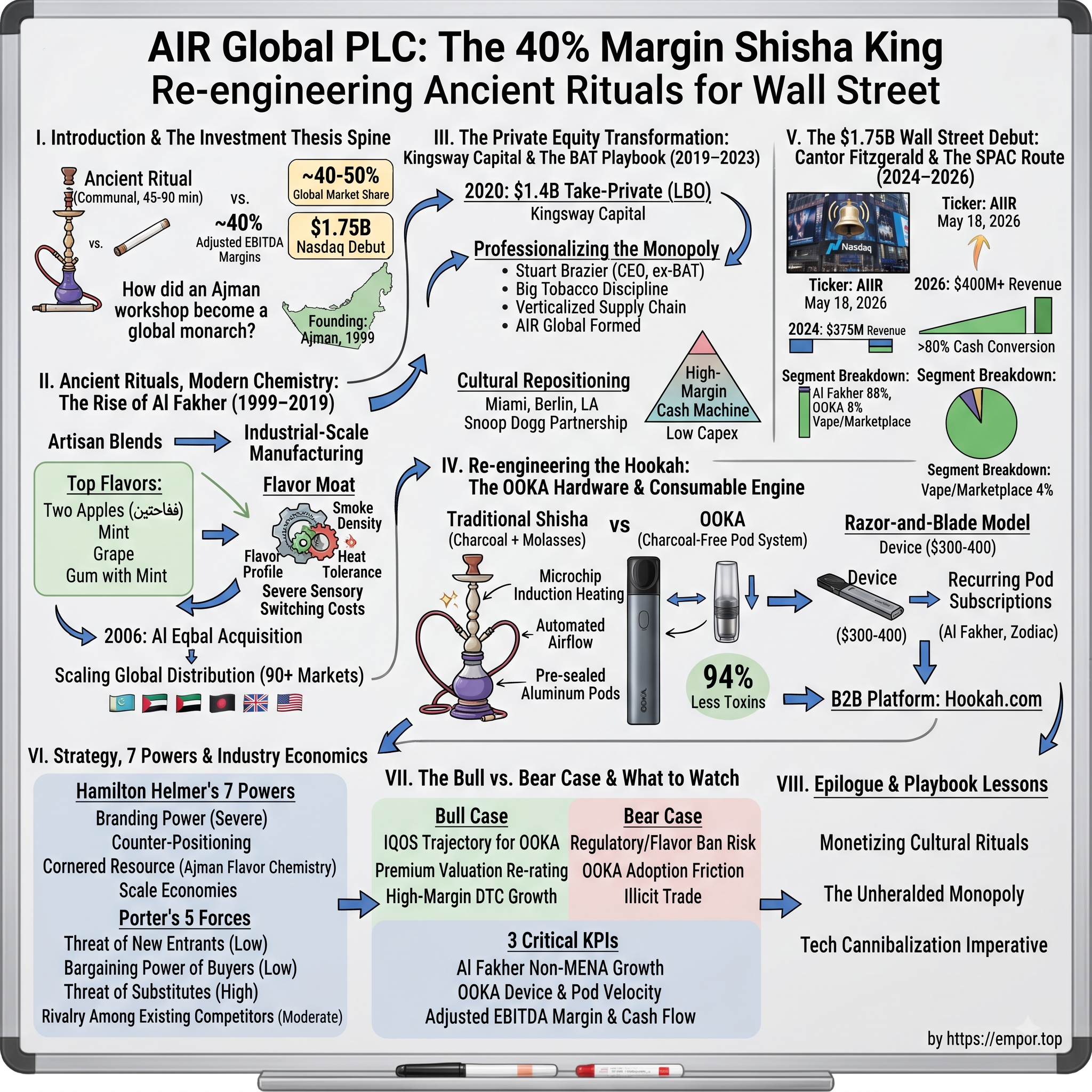
AIR Global PLC: The 40% Margin Shisha King Re-engineering Ancient Rituals for Wall Street
I. Introduction & The Investment Thesis Spine
On the morning of May 18, 2026, a company unfamiliar to most American investors began trading on the Nasdaq under the ticker AIIR. It did not manufacture software or semiconductors. Instead, it produced flavored molasses — a sticky, glycerin-soaked blend of tobacco leaf, sugar syrup, and fruit flavoring traditionally heated with charcoal and inhaled through a water pipe.
The company was AIR Global PLC, and its flagship brand was الفاخر Al Fakher — a household name across Beirut, Cairo, Berlin-Neukölln, and the hookah lounges of Dearborn, Michigan, even if it remained largely unknown on Wall Street. Two days later, audited financial figures for the year ended December 31, 2025, showed that AIR generated approximately $399.7 million in revenue, $139.3 million in adjusted EBITDA, and a net profit of $46.8 million.1 Its core molasses division alone delivered roughly $158 million in adjusted EBITDA on about $397 million in revenue, reflecting an operating margin of nearly 40%.1
That margin profile rivals major tobacco conglomerates like Philip Morris International, produced by a footprint of eight manufacturing facilities and approximately 550 workers at its flagship plant in a category Big Tobacco spent three decades largely ignoring.2
The Core Paradox
AIR represents an unusual proposition among publicly traded consumer equities. The traditional investment thesis for Big Tobacco majors — Philip Morris International, British American Tobacco, Japan Tobacco, and Altria — relies on a predictable defensive dynamic: declining cigarette shipment volumes in mature markets offset by steady pricing power and aggressive capital allocation into non-combustible alternatives. Investors essentially underwrite a slowly melting ice cube equipped with robust pricing leverage.
AIR operates under a fundamentally different commercial dynamic. الشيشة shisha — also known as نرجيلة narghile, waterpipe, or hookah — does not compete on individual convenience or rapid nicotine delivery. Instead, it functions as a social ritual. Unlike a five-minute cigarette break, a typical shisha session lasts between 45 and 90 minutes, shared among several people in a café setting with food and conversation. In consumer behavior terms, the product functions more like a shared bottle of wine than a solitary pack of cigarettes: consumed communally, ordered by brand, and selected for specific flavor profiles.
This ritual-driven consumption underpins the franchise's commercial resilience. AIR estimates it reached roughly 14 million consumers worldwide and powered more than 2.5 million daily sessions in 2025.1 The global shisha market was valued between $15 billion and $20 billion at retail in 2025, with independent industry projections cited in listing filings forecasting annual retail value growth of approximately 3.6% through 2030 against volume growth of just 1.6% — indicating that value expansion is driven primarily by pricing and premium product mix rather than sheer consumer additions.13
The Strategic Pivot
The strategic question facing public markets is whether chief executive Stuart Brazier — a veteran finance executive who spent over two decades at British American Tobacco before joining AIR — and majority shareholder Kingsway Capital, the London-based emerging-markets asset manager, can transition a high-margin cash generator into a diversified consumer platform.
The primary vehicle for that strategy is OOKA, a charcoal-free, pod-based electronic shisha system launched in 2023 that prompted AIR to reclassify its core identity from a traditional tobacco manufacturer to an "inhalation technology" company.23 Alongside OOKA, management has assembled a broader portfolio of growth assets: Hookah.com, a North American business-to-business e-commerce platform; German retail brands and digital platforms acquired since 2024; a proprietary vapor system developed with a Canadian technology partner; a tobacco-free herbal molasses line; and modern oral nicotine pouches.
Disclosed financial segment data, however, highlights the near-term cost of this transition. While the legacy molasses business generated roughly $158 million in adjusted EBITDA in 2025, consolidated group adjusted EBITDA was $139.3 million — indicating that new growth initiatives, including OOKA, nicotine pouches, vapor products, and the VANT functional inhalation line, incurred an aggregate EBITDA drag of nearly $19 million while contributing only nominal revenue.1 For now, the company's innovation pipeline remains a net operational expense.
Roadmap
This analysis examines the operational and financial trajectory of AIR: how a regional molasses workshop in عجمان Ajman expanded into a dominant global shisha producer; how private equity investors acquired the business from a thinly traded Middle Eastern exchange for more than $1.4 billion; why earlier efforts to divest the asset to Big Tobacco stalled; how management engineered a proprietary electronic device to address traditional shisha's core logistical frictions; and how the group ultimately completed its Nasdaq debut via a Cantor Fitzgerald-sponsored special purpose acquisition company at an enterprise value of $1.749 billion.4
It also evaluates the company's performance and market reception since listing. As of mid-August 2026, AIR shares traded near $7, down from the SPAC trust's $10 reference price, with the company yet to report quarterly financial results as a publicly listed entity.5 With its inaugural public earnings release scheduled for August 20, 2026, public markets are only beginning to evaluate whether AIR's high-margin legacy cash flow can successfully subsidize its broader technology ambitions.6
 Subscribe on LinkedIn
II. Ancient Rituals, Modern Chemistry: The Rise of Al Fakher (1999–2019)
In a café in Amman, Cairo, or the Bronx on a warm evening, the shisha ritual remains essentially unchanged from four centuries ago. A tall, glass-based pipe sits on the table. Above the water bowl rests a clay or ceramic head packed with a dark, wet, aromatic paste, covered by a sheet of perforated aluminum foil. On top sits a lit coconut-shell charcoal coal, glowing orange, tended periodically with tongs by a dedicated lounge attendant.
When the smoker draws on the hose, suction pulls heat down through the foil, warming rather than burning the molasses. Glycerin vaporizes into a thick, sweet cloud that bubbles through the water before inhalation. Sessions are unhurried, the pipe is shared between companions, and conversation unfolds over tea.
The underlying economics of AIR's commercial model—and its long-term vulnerabilities—are rooted in this consumption pattern.
The Anthropology of the Occasion
The economics of any habit depend on its social structure. Cigarettes represent a solitary, high-frequency, low-ceremony product; the brand functions as a badge, but consumption is largely private and brief. Shisha is the inverse: low frequency, high ceremony, and communal. This dynamic creates three distinct commercial characteristics.
First, while the initial purchasing decision is made by hospitality venues rather than end consumers, venue inventory is dictated strictly by customer demand; patrons who ask for a specific flavor will readily leave if a lounge does not carry it. Second, because a session is sold as an extended leisure experience lasting over an hour, it commands significantly higher effective gross margins per gram of tobacco than a conventional cigarette. Third, because the ritual is hospitality-linked and social, it expanded alongside diaspora communities before establishing a foothold in mainstream nightlife across Germany, France, the United Kingdom, and the United States.
The underlying bill of materials is comparatively inexpensive. معسل mu'assel—literally "honeyed"—consists of roughly one part tobacco leaf blended with glycerin, molasses or sugar syrup, and flavoring agents. The tobacco input represents a modest portion of total product cost; the proprietary flavor profile defines the commercial product.
1999: The Ajman Genesis
Al Fakher was founded in 1999 in Ajman, the smallest of the United Arab Emirates' seven emirates and an industrial base primarily known for manufacturing and building materials rather than global consumer brands.78 Its core innovation was not culinary, but operational.
Prior to Al Fakher's expansion, shisha molasses was predominantly produced regionally in small artisanal batches with substantial batch-to-batch variation. Lounges across Beirut or Kuwait City purchasing identical flavor labels frequently received inconsistent products across delivery cycles. Moisture levels varied, altering thermal behavior under charcoal; cut consistency fluctuated, altering the draw; and flavor intensity shifted from batch to batch.
Al Fakher introduced standardized industrial quality control to flavored molasses, enforcing tight tolerances for moisture, leaf cut, flavor formulation, and thermal performance under heat at industrial scale. The approach mirrored the industrialization strategies historically deployed in packaged beverages and dairy.
The resulting core portfolio established category benchmarks: Mint, Grape, Gum with Mint, and تفاحتين Two Apples—a blend of sweet and sour apple notes with an anise undertone that became the standard global flavor profile for shisha. Al Fakher's three leading flavors have consistently ranked among the top five globally by volume in the category.3
The Flavor Moat and Sensory Switching Costs
Flavored shisha paste maintains durable pricing power because switching costs in the category are sensory rather than contractual.
A shisha consumer accustomed to a specific Two Apples blend calibrates bowl packing, charcoal management, and flavor progression against that baseline. Competing formulations do not function as direct substitutes, creating brand loyalty closer to single-malt spirits than commoditized raw materials.
This dynamic alters bargaining power across the distribution chain. While mass retailers in conventional consumer packaged goods categories often extract margin concessions by threatening delisting, shisha lounge operators face immediate patron attrition if they remove Al Fakher.
Listing filings reflect this market presence. In initial merger marketing materials, AIR stated that Al Fakher was larger than its next four competitors combined and held more than 60% of the U.S. market by sales volume as of 2024.4 That specific figure represents a company-attributed estimate without independent verification in the filings.9 In audited disclosures, the group reported a 36% to 44% market share across its active operating geographies, excluding Russia and Turkey, as of December 31, 2025.10 The variance reflects differing geographic perimeters and definitions between investor presentations and formal regulatory filings.
The Al Eqbal Era and the Distribution Conquest
Ownership of Al Fakher subsequently transferred to الإقبال Al Eqbal Investment Company, a Jordanian holding company listed on the بورصة عمان Amman Stock Exchange.11 Under Al Eqbal, the business expanded formal distribution networks: registering formulations across regulatory jurisdictions, establishing wholesale partnerships across the Middle East and Levant, and building commercial operations across Western Europe and North America.
Germany served as a key proving ground. The market combined an active shisha lounge culture with strict tobacco regulation and structured retail oversight, demonstrating that the brand could operate effectively within formal compliance frameworks rather than relying on informal distribution channels. Germany later became the initial rollout market for AIR's electronic devices and vapor portfolio.
By the late 2010s, Al Fakher represented the predominant share of Al Eqbal's operating earnings and intrinsic value. However, the asset remained housed within a domestic holding company characterized by thin institutional trading liquidity and limited international equity research coverage.
That structural discrepancy between a globally distributed consumer staples asset and a regional listing vehicle laid the groundwork for private equity intervention in 2020.
III. The Private Equity Transformation: Kingsway Capital & The BAT Playbook (2019–2023)
In November 2020, in the middle of a pandemic that had shuttered cafés across the Middle East and Europe — which is to say, at the precise moment the entire consumption occasion for shisha had been switched off — a London firm most people in the tobacco industry had never heard of announced it was taking Al Eqbal private.
The timing tells you something about conviction. Buying a hospitality-linked consumer business during a global shutdown of hospitality is either reckless or a signal that the buyer believed the demand was structural and the disruption temporary.
The 2020 Take-Private
Kingsway Capital, an emerging-markets specialist founded by Manuel Stotz and with Tamir Saeed as a managing partner, led the transaction, valuing Al Eqbal at more than $1.4 billion including debt.1112 Latham & Watkins' London team advised on the financing, including the refinancing of Al Eqbal's existing indebtedness, and Slaughter and May advised Kingsway on the take-private itself.11 It was one of the first public-to-private transactions ever executed on the Amman exchange.11
The thesis was straightforward and, in hindsight, correct in its first half. Buy an under-monetized regional cash machine with global monopoly characteristics; institutionalize it; redirect a torrent of free cash flow into the next generation of product. What Kingsway was really buying was a mispricing born of location, not of business quality.
The reorganization that followed produced Advanced Inhalation Rituals — AIR — headquartered in Dubai, with the eventual listing entity incorporated in Jersey.210 The renaming was not cosmetic. "Al Eqbal Investment Company" describes a Jordanian holding vehicle. "Advanced Inhalation Rituals" describes an ambition to be a category-defining consumer technology business, and it was chosen by people who intended to sell that story to Western institutional investors.
The BAT Diaspora Arrives
The operating transformation ran through a specific and identifiable talent pipeline: British American Tobacco.
Stuart Brazier joined AIR in 2019 as chief financial officer, arriving from more than twenty years at BAT where he had risen through finance and general management to become CFO of the Europe and North Africa division — a business with roughly £6 billion of net turnover delivering about £2.3 billion of profit.3[^13] On January 3, 2024, he was appointed chief executive, succeeding Reinhard Mieck, who had led the company since 2021 and moved to chairman of the board.[^13] Bassem Lotfy, who had joined AIR in July 2020 after a long BAT career culminating as finance director for Central Europe North, stepped up to CFO.[^13] The chief regulatory officer, Ronan Barry, also came from BAT.13
This concentration is analytically significant in both directions. On the positive side, it imported capabilities that a family-scale manufacturer simply does not possess: how to build a route-to-market in dozens of jurisdictions, how to manage excise regimes that differ in every country, how to file a premarket application with the U.S. Food and Drug Administration, how to run a global brand under advertising restrictions. Running a nicotine business is substantially a compliance and logistics exercise, and BAT is one of the best schools in the world for it.
On the cautionary side, a management team drawn overwhelmingly from one company tends to import that company's assumptions along with its skills — including, potentially, the assumption that the answer to a maturing combustible franchise is always a device. Whether that assumption holds in shisha is the central open question in this story.
The Mieck-to-Brazier handoff also deserves a note on continuity. Mieck's tenure was the period in which OOKA was developed and launched; Brazier's is the period of commercialization and capital markets execution. The company did not change strategy at the handover, which is a point in favor of narrative consistency. It did, however, change the top job twice in the run-up to a public listing, which is a point worth watching.
The Anatomy of a 40% Margin
Where does the money actually come from? Strip away the branding and the margin structure is almost mechanical.
The input basket — tobacco leaf, food-grade glycerin, molasses or honey, and flavor compounds — is cheap and, critically, commoditized and multi-sourced. Manufacturing flavored molasses is a mixing, curing and packing operation, not a precision process; the plants require modest maintenance capital. Meanwhile the output is sold into a fragmented base of distributors and lounge operators who cannot easily refuse it. Low input cost plus low capital intensity plus channel pull equals a margin that looks like a luxury goods business attached to an agricultural input.
The cash conversion evidence backs this up. Across 2020 to 2024, AIR reported that revenue compounded at about 5% and adjusted EBITDA at about 9%, with average cash conversion above 88%.4 In 2025 specifically, operating cash flow was $115.9 million against $139.3 million of adjusted EBITDA — roughly 83% conversion — with net debt to EBITDA of about 2.1 times.1
The right conclusion to draw is narrower than the bull case usually states. EBITDA grew faster than revenue over that five-year window, which means the business took price and mix ahead of cost inflation — genuine pricing power, not just volume. But conversion drifted from the high-80s average to 83% in 2025, and consolidated margin sits below the core margin. Both facts point the same way: the legacy business is performing, and the new business is spending its cash.
The Sale That Did Not Happen
Now for the episode that most retellings of this story skip, and that any serious investor should weigh.
In June 2023, Kingsway was reported to be in talks with British American Tobacco and 日本たばこ産業 Japan Tobacco about selling a stake in AIR, while simultaneously exploring an initial public offering in the Middle East — potentially on Saudi Arabia's تداول Tadawul or the Abu Dhabi Securities Exchange.12 It was a classic dual-track process: run a trade sale and a listing in parallel and take whichever clears at the better price.
Neither happened. Three years later, the asset came to market through a Nasdaq blank-check merger instead.
Investors should hold both readings of that outcome. The charitable one: Kingsway wanted a public currency, U.S. institutional access, and continued control rather than a clean exit at whatever price a strategic would pay for a category the strategics have historically undervalued. The skeptical one: two of the most sophisticated buyers of nicotine assets on earth looked at this business with full diligence access and did not transact, and a Gulf IPO — in a region where shisha is culturally native and the brand is a household name — also did not clear. The eventual route to public markets was the one that requires no book of institutional demand at a fixed price.
Neither reading is provable from public information. But the sequence is a fact, and it is a fact that belongs in the analysis.
Repositioning the Ritual
Alongside the financial engineering ran a deliberate cultural campaign to move shisha from ethnic-adjacent niche into mainstream nightlife. The evidence that it worked shows up in the sales mix: Western markets grew from 21% of total sales in 2019 to 32% in 2024.13 In the United States, the lounge base itself expanded, with roughly 3,410 hookah lounge businesses counted in 2025.1
The most visible expression of the strategy arrived on November 3, 2025, when AIR launched a line of five Al Fakher flavors co-created with Snoop Dogg — Cloud 92, Dogg's Delight, Midnight Blues, Tha G'z Mix and Money Honey — sold globally through Hookah.com and, in Germany, through shisha-world.com.14 A collaboration with the Cookies brand followed a similar logic.3
Celebrity collaborations in nicotine categories are a genuinely double-edged instrument. They accelerate mainstream adoption and command a price premium, which is the point. They also attract precisely the regulatory and public-health attention that flavored tobacco marketing draws in the United States and Europe, where youth appeal is the single most reliable trigger for restrictive action. Announcing a rapper-branded flavored tobacco line four days before announcing a Nasdaq listing was a choice about which audience to optimize for.
Which brings us to the hardware — the bet that is supposed to make all of this regulatory anxiety obsolete.
IV. Re-engineering the Hookah: The OOKA Hardware & Consumable Engine
At the center of traditional shisha consumption sits the coconut-shell coal. Roughly the size of a sugar cube, it burns at several hundred degrees Celsius, requires an open flame or electric burner to ignite, demands rotation every ten minutes, sheds ash, scorches surfaces, triggers indoor smoke alarms, and largely explains why luxury hospitality venues routinely exclude waterpipes from indoor lounges and rooftop terraces.
It also represents the most toxic component of the consumption occasion.
The Problem With Charcoal
The technical insight underpinning AIR's hardware pivot centers on a counterintuitive feature of the waterpipe ritual.
In a conventional cigarette, the tobacco leaf combusts directly at the tip, producing tar, carbon monoxide, and polycyclic aromatic hydrocarbons. In a traditional waterpipe, the tobacco molasses does not burn. Instead, it is heated indirectly through perforated foil by a burning coal resting above it. The consumer inhales aerosolized glycerin and flavor compounds combined with the exhaust gases of the burning fuel drawn down through the pipe.
As a result, a substantial portion of the inhaled particulate matter and gas derives from the fuel rather than the underlying tobacco blend. Carbon monoxide, in particular, originates almost entirely from the burning charcoal. Consequently, conventional shisha sessions can generate carbon monoxide exposures significantly higher than standard cigarettes, even though the tobacco paste itself never reaches combustion.
AIR's engineering strategy focused on that specific dynamic: eliminating combustible charcoal in favor of an electronically regulated thermal delivery system.
The Invention of OOKA
OOKA launched in 2023 as a pod-based, charcoal-free electronic shisha device.213 The engineering challenge centered on thermal replication: replacing a fluctuating lump of burning coal with an electronic heating cycle capable of vaporizing flavored molasses without scorching the leaf, which alters the sensory profile for experienced consumers.
AIR's design utilizes a closed, cartridge-based system. Each pod integrates a near-field communication (NFC) microchip that identifies the specific flavor formulation and calibrates temperature and power delivery in real time, maintaining the molasses within its optimal vaporization window.1516 The unit reaches operating temperature within minutes—bypassing the traditional fifteen-to-twenty-minute preparation ritual of lighting and settling coals—while operating without open heat, ash, aluminum foil, or tongs.16
The system's harm-reduction profile has undergone independent laboratory evaluation. A peer-reviewed study published in Scientific Reports in April 2025, based on emissions testing conducted by ASL Analytic Service Laboratory—an ISO 17025-accredited testing facility in Germany—assessed 37 toxic compounds across OOKA, conventional charcoal-heated shisha, and standard reference cigarettes.1516 The findings showed that OOKA produced approximately 94% lower overall toxicant levels compared to traditional shisha, reductions in aldehydes of up to 96%, and non-detectable levels of major combustion by-products including carbon monoxide, benzene, toluene, and benzo[a]pyrene.1516
Two analytical qualifications apply to those findings. First, aerosol emissions testing measures machine-captured output under standardized laboratory regimes rather than long-term clinical health outcomes in human populations. Second, while the testing laboratory and publishing journal operated independently, the underlying research was commissioned by the manufacturer. The core physical premise—that eliminating combustible fuel removes combustion-derived by-products—remains mechanically sound, though long-term epidemiological data has not yet accumulated.
The Razor-and-Blade Model, and Its Real Prize
The commercial structure follows a standard razor-and-blade model: deploying proprietary hardware to establish an ongoing stream of high-margin consumable sales. The consumable lineup includes nicotine-containing Al Fakher and Shisha Kartel molasses cartridges alongside Zødiac, a tea-based, tobacco-free, and nicotine-free line designed to enter hospitality environments and jurisdictions where tobacco products face statutory restrictions.617
The resulting unit economics diverge sharply from bulk molasses. In its initial launch markets—the United States, the United Arab Emirates, and Germany—OOKA has generated approximately 20 times the revenue and roughly 15 times the gross profit per kilogram of molasses compared to legacy bulk packaging.113 The hardware's closed architecture, governed by the onboard chip, prevents third-party refilling and enforces exclusive consumable attachment.9
That margin differential forms the core financial rationale for the hardware program. Rather than competing as a bulk commodity, each gram of tobacco processed through a proprietary cartridge captures a substantial pricing premium. Converting even a modest share of the group's estimated 2.5 million daily shisha sessions to the electronic ecosystem would materially alter consolidated revenue density.
Beyond unit margins, the hardware strategy targets commercial real estate access. Conventional waterpipes remain barred from most indoor hospitality venues across North America and Western Europe due to municipal clean-air laws, fire codes, ventilation mandates, and commercial lease covenants. A charcoal-free, low-emission device offers a compliance pathway into previously inaccessible venues, including hotel lounges, restaurant dining rooms, cruise lines, and private clubs.
Whether that institutional distribution strategy will achieve broad scale remains unproven. While the device operates commercially in Germany and select rollout territories, regulatory recognition across wider international jurisdictions remains nascent.9 AIR has not yet reported separate disclosures for installed hardware unit volume, pod reorder frequency, or device-specific revenue. Consequently, the 20-fold revenue multiple reflects current unit realization rather than total market penetration.
Developing the platform required considerable capital deployment: AIR directed more than $115 million into research and product innovation between 2019 and late 2025, assembling an intellectual property portfolio cited as over 100 patents across 18 families at the time of the November 2025 transaction announcement, and subsequently reported as 175 granted and pending patents across 26 families.34
Adjacent Bets: Vapes, Pouches and the Pipe to the Consumer
Alongside the OOKA platform, management has built adjacent commercial positions aimed at establishing an integrated inhalation business.
The primary hardware partnership involves Greentank Innovations, a Canadian vaporization technology developer. Following an initial commercial agreement in 2023, AIR invested $20 million on July 29, 2026, to acquire preferred shares in Greentank at a pre-money valuation of approximately $170 million, securing a board seat, commercial supply protections, and long-term intellectual property access.17 The transaction included a 24-month warrant allowing AIR to acquire an additional 20% equity interest at a $250 million valuation.17 The partnership's first retail product is Crown Switch, a rechargeable pod-based vapor device utilizing Greentank's Quantum Chip heating technology, currently sold in Germany.17
The investment structure balances capital commitment against strategic optionality. AIR secured operational governance and hardware access upfront while fixing the valuation terms on a future expansion right, capping near-term capital outlay at $20 million without absorbing the operational overhead of a standalone hardware manufacturer.
Simultaneously, AIR has moved to consolidate digital distribution channels. In North America, the group operates Hookah.com, a dominant business-to-business e-commerce portal for waterpipe hardware and consumables.2 In Germany, AIR acquired digital distributors Emtrada GmbH and Finis Direct GmbH in 2024, followed on December 10, 2025, by the acquisition of NameLess, a leading German premium shisha molasses brand known for its Black Nana grape-mint blend, which AIR plans to distribute across its broader international network.1318
Controlling specialized business-to-business distribution provides direct channel visibility into wholesale purchasing patterns and competitor sales trends across a fragmented independent lounge sector. However, operating both the leading marketplace and the dominant product brand also places the company in the dual role of platform operator and primary vendor—a dynamic that introduces potential channel friction with competing manufacturers.
Collectively, AIR's device pipeline and brand acquisitions represent a coordinated effort to modernize a centuries-old ritual. Yet as the company prepared for its public debut, these initiatives remained net operational investments rather than major earnings contributors, setting up the valuation debate that unfolded on Wall Street.
V. The $1.75B Wall Street Debut: Cantor Fitzgerald & The SPAC Route (2024–2026)
By 2025, AIR faced a capital allocation dilemma common to mature private equity holdings: the core business generated substantial free cash flow, but its controlling sponsor had reached the limits of conventional exit avenues.
Strategic acquisition discussions with Big Tobacco had stalled, and a Gulf public listing had not materialized. Kingsway Capital had held the asset for five years—a typical private equity holding horizon—and was overseeing an entity generating well over $100 million in adjusted EBITDA. Meanwhile, AIR needed a public acquisition currency, higher visibility in the United States, and access to capital markets independent of syndicated bank lending.
The Deal Mechanics
On November 7, 2025, AIR Limited announced a definitive business combination agreement with Cantor Equity Partners III, Inc., a special purpose acquisition company sponsored by Cantor Fitzgerald and chaired by Brandon Lutnick.4 The transaction implied a pro forma enterprise value of $1.749 billion, based on estimated 2025 year-end net debt of approximately $293 million.4
Cantor Fitzgerald & Co. served as financial adviser to the SPAC, with DLA Piper as legal counsel; Barclays advised AIR, with Latham & Watkins in London acting as legal counsel and WilmerHale representing Barclays.4
The regulatory timeline progressed swiftly by SPAC standards. The Form F-4 registration statement was filed on March 30, 2026, declared effective on April 23, 2026, approved by CAEP shareholders at an extraordinary general meeting on May 12, 2026, and closed on May 15, 2026, with Nasdaq trading commencing three days later under the ticker AIIR.192010
Opting for a SPAC combination over a traditional initial public offering carries structural implications. A conventional IPO requires underwriters to build an institutional order book to clear market demand at a specific price. In contrast, a SPAC combination establishes valuation with a single sponsor counterparty before public trust shareholders decide whether to redeem their capital. While this route allows companies to disclose forward-looking operational projections that standard IPO prospectuses generally avoid, it frequently results in higher post-listing share turnover and lower initial aftermarket liquidity.
What the Redemptions Revealed
The transaction's initial public market test emerged through shareholder redemptions.
Ahead of closing, holders of 22,373,640 CAEP shares redeemed their stock for approximately $234.7 million.10 In practical terms, the vast majority of capital held in the SPAC trust elected to withdraw at the $10-plus benchmark rather than hold equity in the combined operating business.
High redemption rates have been standard among 2026-vintage SPAC transactions, reflecting capital structure dynamics rather than purely operational fundamentals. Nevertheless, the withdrawal rate indicated that early-stage SPAC arbitrage investors chose not to fund the combination, heavily concentrating the initial shareholder base.
Following completion of the business combination, AIR had 160,386,602 ordinary shares issued and outstanding against 600 million authorized.10 Entities affiliated with Kingsway Capital held 97,404,379 shares, or 60.73%, while all directors and executive officers as a group controlled 62.00%.10 Other major shareholders included KIM AIR Limited and Khaleel Mamoori at 9.64%, affiliates of the Acacia funds at 6.33%, and Bank of Jordan plc at 6.18%—a legacy of the group's earlier Jordanian public listing.10
The resulting distribution established a tightly concentrated ownership structure. Accounting for corporate insiders and the four largest disclosed institutional blocks, the public float stood at approximately 15%.1 AIR effectively debuted on the Nasdaq as a controlled company rather than a widely held public corporation.
The Aftermath: Price, Buybacks and a Register in Motion
Secondary market trading following the May debut reflected sustained downward pricing pressure.
By June 5, 2026, AIR shares closed at $6.91.20 By mid-August 2026, the stock traded near $7, within a 52-week range whose high of $15.30 reflected pre-merger speculative trading in the SPAC shell rather than an operating valuation of the business.5 Relative to the $10 SPAC trust benchmark, the equity traded at a discount of roughly 30%.
Two transaction mechanics continue to shape the stock's market dynamics.
The first is a prepaid forward purchase agreement executed on May 11, 2026, with Harraden Circle Investments covering approximately 5 million shares—an instrument used by SPAC sponsors to curb redemptions by compensating a counterparty to hold shares through closing.20 Under the contract, if the market price exceeds $10.00, the seller may sell shares and AIR receives an agreed redemption price of $10.49 per share; below $10.00, the seller is generally restricted from selling.20 With the stock trading near $7, that mechanism remains well out of the money ahead of its valuation date roughly six months post-closing.20
On August 5, 2026, AIR scheduled an extraordinary general meeting for August 24, 2026, in Richmond upon Thames, seeking shareholder approval to repurchase the 5,000,000 Harraden shares and to grant the board recurring authority to repurchase up to 20% of outstanding shares annually through 2031.21 Regulatory filings associated with the meeting estimated the initial share repurchase at approximately $52.45 million, matching the $10.49 contractual price.6
The proposed repurchase effectively unwinds a pre-closing financing facility at a contractual price set above prevailing secondary market levels, utilizing cash that could otherwise fund leverage reduction or the device rollout. Meanwhile, the broader 20% annual buyback mandate provides future capital allocation flexibility, though discretionary repurchases will compete with balance sheet management given net debt levels near twice EBITDA.
Shareholder filings in mid-August 2026 highlighted an evolving investor base. Between August 11 and August 14, 2026, Schedule 13G filings confirmed Kingsway's 60.7% stake, Bank of Jordan's 6.2%, and KIM AIR's 9.6%, while Conifer Management disclosed a new 6.0% holding of roughly 9.67 million shares, Harraden Circle reduced its position below the 5% threshold to 3.12%, and Meteora Capital fully exited.6 The turnover illustrates a standard post-merger transition: short-term arbitrage funds exiting while select fundamental asset managers establish initial positions.
The Financial Teardown
Beyond capital markets engineering, the audited financial disclosures demonstrate steady legacy earnings generation.
Revenue grew from roughly $375 million to $377 million in 2024 to $399.7 million in 2025, representing annual top-line growth of about 6%.149 Reported profit for the year increased 37% from $34.1 million to $46.8 million, driven by operating leverage and reduced financing costs.19 Adjusted EBITDA rose 7.5% to $139.3 million, lifting consolidated EBITDA margin from 34.4% to 34.8%.19
Two disclosure details frame the underlying operating reality.
First, the 40% operating margin cited in transaction marketing describes the core molasses division rather than the consolidated company. While management disclosed both metrics, the variance between the core division margin and the 34.8% consolidated margin represents the operating expense of the broader growth portfolio, which remains pre-revenue at scale.19
Second, audited net debt at December 31, 2025, closed at approximately $268 million, outperforming the $293 million estimate provided in the November 2025 transaction announcement.204 Delivering year-end balance sheet leverage approximately $25 million below preliminary merger forecasts represents an initial data point in favor of conservative guidance.
The Segment Question
AIR's long-term operating target envisions traditional molasses generating roughly 88% of net sales, next-generation hardware contributing 8%, and digital commerce and vapor products comprising 4%. However, the 2025 financial disclosures reflect an earlier baseline.
With the core business generating approximately $397 million of the $399.7 million consolidated revenue total, adjacent categories contributed low single-digit revenue while generating an adjusted EBITDA drag of roughly $19 million in 2025.1 In formal financial reporting, AIR presents results across "core business" and "new growth markets" rather than publishing standalone unit economics for device hardware.1
Consequently, AIR remains predominantly a high-margin molasses producer funding the commercial rollout of an adjacent electronic inhalation platform. The valuation debate on Wall Street centers on whether that legacy cash flow can comfortably subsidize the hardware transition until proprietary consumables achieve commercial scale.
VI. Strategy, 7 Powers & Industry Economics
A classic thought experiment highlights where AIR's durable competitive advantages reside—and where they do not: if a well-funded entrant were provided $500 million to challenge Al Fakher's market share, where would it begin?
A competitor could match the recipe, as flavor chemistry lacks patent protection. It could construct a manufacturing facility, given the modest capital intensity of molasses production. It could even recruit experienced blenders. Yet none of those steps would secure immediate lounge distribution. Café operators in Berlin stock what patrons request by name; distributors in Michigan prioritize brands with reliable inventory turnover; and regulators in Washington enforce premarket authorization processes that span years.
That dynamic illustrates where the company's structural advantages sit across industry frameworks.
Hamilton Helmer's 7 Powers, Applied Honestly
Branding. This represents the strongest and best-evidenced power in the portfolio. The evidence lies not merely in aggregate market share, but in ordering behavior: consumers specify flavors by brand, converting an ordinary wholesale relationship into one where the manufacturer retains pricing leverage. Al Fakher being larger than its next four competitors combined is the commercial outcome of that consumer pull rather than its initial cause.4 The operational test for this power is observable over time: if AIR's Western volume growth stalls while regional challengers such as Adalya, Fumari, or Starbuzz gain lounge presence, brand equity is eroding.
Counter-Positioning. This describes the strategic position management aims to build, though the distinction requires qualification. The classic counter-positioning thesis—that incumbents cannot respond because doing so cannibalizes their core economics—applies only partially. Traditional shisha producers and charcoal accessory suppliers lack the semiconductor engineering, thermal modeling, and regulatory infrastructure required to develop a chipped electronic device. However, global tobacco majors like Philip Morris and British American Tobacco possess extensive heat-not-burn engineering capabilities built through billions of dollars in research and development. If the electronic shisha category reaches meaningful scale, those conglomerates face no structural barrier to entry; they simply have not prioritized the niche. Counter-positioning against regional artisanal producers does not guarantee protection against well-capitalized multinational tobacco majors.
Cornered Resource. Partially present. Proprietary flavor formulations, master blenders, the Ajman manufacturing footprint, and OOKA's patent portfolio represent tangible assets. However, flavor formulations function as trade secrets rather than statutory monopolies, leaving them vulnerable to talent turnover. A more defensible cornered resource is the group's regulatory estate: AIR's U.S. product lineup is authorized by the FDA through premarket applications or substantial equivalence pathways, and the company reported no FDA warning or enforcement actions since 2023, along with no recalls or product safety issues.13 Regulatory authorizations confer legally protected market access in a manner that unpatented flavor recipes cannot replicate.
Scale Economies. Present, primarily in regulatory compliance rather than manufacturing. Producing flavored molasses at scale offers modest operational leverage. In contrast, managing product registrations, excise compliance, track-and-trace systems, and marketing constraints across more than 90 jurisdictions provides substantial scale advantages, as those administrative costs are largely fixed. This structural dynamic mirrors the moat protecting global tobacco majors and explains why the broader shisha category has historically remained fragmented among regional operators unable to fund multinational compliance.
The framework powers AIR does not possess are equally informative: no network effects, no contractual switching costs in its legacy portfolio, and no unique process power that cannot eventually be replicated. While OOKA's closed-pod architecture could generate meaningful switching costs, that mechanism depends entirely on establishing a substantial installed hardware base.
Porter's Five Forces
Threat of new entrants: low, driven by regulatory barriers rather than production economics. The FDA's deeming rule, finalized on May 5, 2016, and effective August 8, 2016, brought hookah tobacco under federal authority, requiring premarket tobacco product applications for new or modified formulations, ingredients, or delivery mechanisms.22 In Europe, the Tobacco Products Directive enforces equivalent registration and labeling mandates. These frameworks prevent new entrants from launching novel flavors with the speed of standard consumer packaged goods.
Bargaining power of buyers: low. Direct consumer demand limits wholesale distributor leverage. This advantage is reinforced by AIR's ownership of Hookah.com, which provides direct market visibility and purchasing data across independent wholesale channels.
Bargaining power of suppliers: low. Tobacco leaf, food-grade glycerin, and flavor compounds remain commoditized and multi-sourced. Genuine supplier concentration risk resides in electronic hardware rather than raw agricultural inputs—an exposure AIR sought to mitigate through its Greentank investment and long-term commercial supply agreements.
Threat of substitutes: high and expanding. This dynamic represents the category's primary long-term headwind. AIR competes not only against rival molasses producers, but also for social occasions and nicotine share of wallet against disposable vaporizers, modern oral pouches, legalized cannabis, and broader demographic shifts toward reduced alcohol and tobacco consumption among younger adults. Notably, AIR's entry into oral nicotine pouches represents an explicit hedge against this substitute risk.4
Rivalry: moderate. The group's primary institutional competitor is نخلة Nakhla, acquired by Japan Tobacco in a transaction announced in 2012 and completed in 2013, which holds approximately 70% of the Egyptian market and exports to roughly 85 countries.23 Nakhla demonstrates that a global tobacco major can manage a shisha asset, yet it has not successfully challenged Al Fakher's international market leadership. Beyond Nakhla, competition remains fragmented among regional brands competing primarily on price.
The Force That Is Not On Porter's List
The most consequential commercial factor in the category sits outside traditional competitive frameworks: illicit trade.
The European Commission's July 16, 2025 proposal to revise the Tobacco Taxation Directive estimated that approximately 60% of waterpipe tobacco consumed within the European Union originates from illicit channels.24 In its largest Western market, AIR's compliant, tax-paid product competes against an untaxed shadow market roughly one and a half times its size.
This dynamic creates conflicting commercial incentives. Higher excise tax rates widen retail price differentials, expanding the illicit market and pressuring legal volumes. Conversely, establishing waterpipe tobacco as a distinct statutory excise category—as envisioned across all three policy options under the Commission's proposal, with amendments scheduled to take effect from January 1, 2028—establishes clear legal and enforcement frameworks that assist member states in combating contraband supply.24 As an established, compliant market leader, AIR stands to benefit substantially from effective regulatory enforcement, even as it bears the immediate commercial cost of persistent illicit competition.
That tension between entrenched legacy cash flow, illicit market friction, and capital-intensive technology bets frames the central debate surrounding the company's valuation.
VII. The Bull vs. Bear Case & What to Watch
Every controlled company that enters public markets through a special purpose acquisition company eventually encounters the same operational reality: promotional presentations conclude, the lock-up countdown begins, and reported financial results must substantiate the valuation. For AIR, that test arrives on August 20, 2026, when Stuart Brazier and Bassem Lotfy are scheduled to host the group's inaugural earnings webcast as a publicly traded entity, reporting results for the six months ended June 30, 2026.6
Until then, the strategic narrative remains untested by live public market scrutiny, as management has not yet fielded questions from equity research analysts in a public forum.
The Bear Stress Test
Flavor is the foundational product, and flavor is what regulators restrict. This represents the central regulatory exposure facing the business. The waterpipe category is almost entirely defined by characterizing flavors. In the United States, the FDA has banned characterizing flavors in conventional cigarettes and continues to scrutinize flavor profiles across alternative categories; across the European Union, the anticipated revision of the Tobacco Products Directive is expected to focus heavily on flavoring agents, nicotine pouches, and disposable systems. A comprehensive flavor ban encompassing waterpipe tobacco would not merely suppress sales volumes—it would effectively eliminate the legal category in affected jurisdictions, as no meaningful unflavored shisha market exists. While waterpipe tobacco has historically been treated as a distinct cultural tradition and exempted from conventional cigarette flavor prohibitions, that status may reflect historical regulatory oversight rather than deliberate statutory protection. By pursuing a high-profile Nasdaq listing alongside celebrity-endorsed product lines, AIR has deliberately increased its public and regulatory visibility.
Hardware adoption remains unproven at scale. OOKA offers clear operational advantages for active consumers: reduced emissions, rapid startup, and no combustible charcoal. However, traditional shisha remains an inexpensive leisure activity, the manual preparation ritual forms an integral part of consumer appeal, and a premium countertop appliance requires meaningful upfront consumer capital expenditure for an occasion that typically costs a few dollars per session. Crucially, AIR has not disclosed installed device volumes, unit pricing, or consumable cartridge replenishment rates in its formal disclosures. Without those operational metrics, the reported twenty-fold revenue premium per kilogram reflects favorable unit economics rather than demonstrated commercial adoption. Comparisons to Philip Morris International's IQOS platform require careful qualification: PMI deployed billions of dollars over a decade across markets with tens of millions of daily cigarette consumers before achieving platform profitability. AIR is attempting a comparable hardware transition with approximately $140 million in annual EBITDA within a global category encompassing single-digit millions of daily sessions.
Capital structure and float constraints create technical trading pressure. With a public float of roughly 15% and a controlling shareholder holding 60.73%, the equity trades with limited secondary market liquidity and restricted index eligibility, leaving share prices vulnerable to liquidity-driven volatility. The six-month post-closing lock-up governing sponsor and legacy shareholder stock expires in mid-November 2026, with limited early waivers already granted for 1,000,000 sponsor shares and 10,400 shareholder shares.10 Concurrently, approximately 8.69 million earnout shares vest only if the stock reaches price hurdles of $12.50 and $15.00 prior to May 31, 2031; with shares trading near $7, those targets remain distant, mitigating near-term share dilution while leaving a significant portion of management and sponsor performance incentives out of the money.20
Illicit trade and trademark infringement directly pressure margins. Beyond the untaxed shadow market that comprises the majority of European waterpipe consumption, AIR faces active intellectual property challenges. On May 6, 2026, the Dubai Court of First Instance granted AIR injunctive relief in a trademark infringement proceeding against Al Fakher Tobacco Factory LLC, but denied AIR's $20 million monetary damages claim, with both parties holding 30-day appeal rights.10 Securing an injunction without damages illustrates the ongoing commercial reality of brand protection in the sector: legal remedies can restrict unauthorized supply, but rarely recover lost revenue.
Corporate governance and capital allocation reflect sponsor control. Several operational decisions highlight the influence of the controlling shareholder: a board featuring Kingsway partners Manuel Stotz and Tamir Saeed;10 a proposed $52 million above-market share repurchase from a SPAC financing counterparty while the equity trades 30% below that contractual price;621 a $20 million minority equity investment in a private hardware developer completed within ten weeks of listing;17 and an expanding operating footprint across molasses, electronic devices, vaporizers, nicotine pouches, functional inhalation products, digital marketplaces, and regional brand acquisitions. While legally compliant, this capital deployment reflects substantial spending on corporate optionality before demonstrating the commercial scalability of the core hardware transition—a strategy that public float investors holding 15% of the shares have limited governance leverage to alter.
The Bull Case
The cash-generative core business is valued at a defensive multiple. At the transaction's implied enterprise value, AIR listed at approximately 12.6 times trailing adjusted EBITDA and 4.4 times trailing net sales, compared to valuation multiples near 17 times EBITDA for peers such as Philip Morris International and Turning Point Brands.113 While that discount reflects structural factors—including controlled ownership, low trading liquidity, and category concentration—the underlying franchise has expanded adjusted EBITDA faster than revenue over a five-year period, maintains strong cash conversion, and serves a ritualized consumption occasion that does not face the secular volume erosion affecting combustible cigarettes. Between 2019 and 2024, Western markets expanded from 21% to 32% of total sales, demonstrating continued geographic expansion outside traditional core markets.13
Hardware unit economics offer substantial operating leverage. The bullish thesis does not require OOKA to displace traditional waterpipes entirely. Rather, capturing a modest share of the group's daily sessions at twenty times higher revenue density would materially transform consolidated earnings, while enabling market entry into indoor hospitality venues, hotels, and cruise ships where open charcoal is legally prohibited. If accredited emissions data gains regulatory and commercial acceptance, the addressable commercial footprint expands beyond the roughly 3,410 specialized U.S. hookah lounges into broader hospitality environments.115
Proprietary distribution channels strengthen category control. Direct ownership of Hookah.com in North America alongside specialized German e-commerce platforms provides AIR with proprietary wholesale transaction data and dedicated route-to-market access in an industry where conventional commercial advertising remains heavily restricted. In a dark-market regulatory environment, controlling direct wholesale and retail distribution represents a significant competitive advantage.
Favorable demographic exposure supports long-term volume. Unlike traditional cigarette categories characterized by an aging consumer base in developed economies, core waterpipe consumption skews toward younger demographic cohorts across emerging markets experiencing steady population growth and expanding disposable income.
Myth vs. Reality
Myth: AIR operates as a 40% EBITDA margin business across its entire portfolio.
Reality: The legacy molasses division generates roughly a 40% operating margin, but consolidated group adjusted EBITDA margin was 34.8% in 2025 due to operational investment and developmental drag across the new growth portfolio.1
Myth: AIR is already a diversified next-generation inhalation platform.
Reality: Audited financial disclosures for 2025 show that traditional flavored molasses generated nearly all consolidated revenue, with alternative platforms remaining in developmental or early commercial rollout phases.1
Myth: The Nasdaq transaction validated a $1.75 billion public equity valuation.
Reality: The transaction valuation was negotiated bilaterally with the SPAC sponsor, after which the vast majority of public trust capital elected redemption rather than equity participation, and the shares have traded consistently below the $10 reference benchmark post-listing.105
Myth: Al Fakher commands 60% of the global waterpipe market.
Reality: The 60%-plus figure represents a company-attributed estimate specific to the U.S. market, while audited annual disclosures cite an overall market share between 36% and 44% across active operating territories, excluding Russia and Turkey.4109
The Three KPIs That Matter
For investors evaluating the sustainability of the business model, three primary operational metrics warrant continuous monitoring:
1. Core molasses volume and revenue expansion across Western markets. The investment thesis relies on shisha successfully expanding into mainstream Western nightlife rather than remaining confined to regional diaspora demographics. Tracking Western sales mix trajectory provides the cleanest indicator of whether brand equity is expanding internationally or reaching commercial saturation.
2. OOKA installed device base and consumable replenishment frequency. Disclosing active hardware units alongside cartridge re-order rates will indicate whether early hardware adoption translates into recurring high-margin consumable demand or represents one-off novelty purchases.
3. Consolidated adjusted EBITDA margin and cash conversion discipline. The spread between core division margins and consolidated group margins measures the running operational cost of the technology transition. If that margin spread widens without corresponding growth in device adoption, legacy cash generation will increasingly be diverted toward unproven ventures, placing pressure on a balance sheet managing debt near two times EBITDA and capital commitments including the pending $52 million share repurchase.
Management's commentary and disclosure detail on these three operational drivers during the August 20 webcast will provide the first substantive measure of the company's execution discipline as a public issuer.
VIII. Epilogue & Playbook Lessons
There is an instructive contrast in a business built on a four-century-old habit debuting on the Nasdaq in 2026, during a market cycle dominated by capital flows into artificial intelligence infrastructure.
Monetizing Cultural Rituals
The first lesson highlights the structural difference between the durability of an established cultural habit and the lifespan of a consumer product. Technology platforms routinely spend heavily to acquire users for behaviors that emerged only recently and may fade just as quickly. In contrast, AIR sells into a social ritual that predates modern corporate structures. Consumers do not need to be persuaded to adopt waterpipe smoking; the commercial task is simply ensuring they choose a specific brand.
That dynamic provides a durable moat, provided the manufacturer does not confuse ownership of a brand with ownership of the underlying ritual. The social tradition of shisha will outlast any single corporate entity; the enduring commercial question is whether AIR's flavor portfolio remains its default expression.
The Art of the Unheralded Monopoly
The second lesson concerns where dominant market positions emerge. Over two decades, an Ajman-based manufacturer built market leadership in a global consumer category while international institutional investors largely looked elsewhere, deterred by cultural unfamiliarity, category stigma, and geographic distance from primary financial centers. It took an emerging-markets investment firm to recognize that a Jordanian-listed holding company housed a high-margin global franchise and commit more than $1.4 billion to take it private.
The broader takeaway is that substantial consumer returns often reside in categories that are culturally specific, unglamorous, and overlooked by mainstream capital. The absence of competition for the asset over two decades explains why it could be acquired at an attractive entry multiple.
The corollary is that the same stigma that depressed the initial acquisition price continues to limit its public market valuation. The category's regulatory profile and social perception explain why the company pursued a blank-check combination rather than a traditional underwritten IPO, and why its equity trades at a valuation discount relative to multinational tobacco peers facing steeper combustible volume declines. In public markets, valuation discounts reflect not only informational inefficiencies, but also the reality of a narrower pool of eligible institutional investors.
The Technology Cannibalization Imperative
The third lesson centers on product transition strategy.
The primary commercial constraint on AIR's legacy business was never the flavored molasses itself, but the burning charcoal required to heat it—a third-party accessory that generated no revenue for the company while accounting for the vast majority of toxic emissions, indoor fire restrictions, and regulatory scrutiny. By directing more than $115 million into proprietary heating technology, AIR sought to eliminate that operational bottleneck, even though the resulting closed-pod system will ultimately compete against its core loose-molasses revenue base.
Incumbents rarely initiate format transitions independently, often defending legacy cash flows until forced to adapt by regulatory mandates or external disruption. Developing a substitute format internally from a position of commercial strength represents a disciplined strategic choice, even as it creates a visible near-term margin drag.
Executing a strategic pivot, however, does not ensure commercial success. While AIR has validated aerosol emissions in independent laboratory testing, secured an extensive patent portfolio, acquired vapor capabilities with structured financial protections, and consolidated specialized distribution channels, it has not yet disclosed core device adoption metrics. The company remains a controlled entity with a limited public float, trading roughly 30% below its SPAC reference benchmark ahead of its public reporting debut.
AIR's evolution from a regional molasses facility into a Nasdaq-listed inhalation company illustrates how disciplined pricing power and category dominance can bring traditional rituals to modern public markets. Whether public markets reward that transition will depend on the operational data management delivers—starting with its inaugural earnings report on August 20, 2026.
References
-
AIR Global PLC: Global Shisha Leader Expands Into Premium Device-Led Inhalation Markets – Initiation Report — Yahoo Finance, 2026 ↩↩↩↩↩↩↩↩↩↩↩↩↩↩↩↩↩↩↩
-
AIR Taking its Shisha Public on Nasdaq in 2026 — Tobacco Reporter, 2025-11-10 ↩↩↩↩↩
-
Advanced Inhalation Rituals: Interview With CEO Stuart Brazier About The Global Social Inhalation Leader — Pulse 2.0 ↩↩↩↩↩↩
-
AIR, the World's Largest Flavored Hookah Producer and Owner of the Iconic Al Fakher Brand, to Become a Public Company through a Business Combination with Cantor Equity Partners III — Business Wire via Yahoo Finance, 2025-11-07 ↩↩↩↩↩↩↩↩↩↩↩↩
-
Air Global PLC Stock Price Today | NASDAQ: AIIR Live — Investing.com, 2026-08 ↩↩↩
-
AIIR SEC Filings — Air Global PLC Filing Index — StockTitan, 2026-08 ↩↩↩↩↩↩
-
Cantor Equity Partners III, Inc. Form 425 Business Combination Communication — StockTitan / SEC, 2025 ↩↩↩↩↩↩↩↩
-
AIR Global PLC Files Annual Report (Form 20-F) — Details SPAC Merger, Market Share and Lock-Ups — StockTitan / SEC, 2026-05-21 ↩↩↩↩↩↩↩↩↩↩↩↩
-
Latham Advises on Financing for Kingsway Capital's Take Private of Leading Global Producer of Branded Shisha, Al Fakher — Latham & Watkins, 2020-11-20 ↩↩↩↩
-
Kingsway Capital in Talks with Big Tobacco over AIR Stake Sale — Reuters via Yahoo Finance UK, 2023-06-08 ↩↩
-
Partake in Hookah Boom Profits with AIR Global's Public Debut — IPO Edge, 2026 ↩↩↩↩↩↩↩↩
-
AIR Partners with Snoop Dogg for New Hookah Flavors — Tobacco Reporter, 2025-11-04 ↩
-
Charcoal-Free Shisha Significantly Less Harmful Than Traditional Shisha and Cigarettes, New Study Reveals — Silicon UK, 2025-04-29 ↩↩↩↩
-
OOKA — Scientifically Proven Cleaner Alternative: The First Charcoal-Free Shisha ↩↩↩↩
-
AIR Announces Strategic Investment in Greentank Innovations to Accelerate Growth — Greentank Technologies, 2026-07-29 ↩↩↩↩↩
-
AIR Strengthens Global Footprint with Acquisition of Leading German Hookah Brand NameLess — Business Wire via Yahoo Finance, 2025-12-10 ↩
-
AIR and Cantor Equity Partners III Announce Effectiveness of F-4 Registration Statement Ahead of Planned Merger and Nasdaq Listing — Business Wire, 2026-04-23 ↩
-
AIR Highlights Key Financial Details Following Nasdaq Listing — StockTitan, 2026-06-08 ↩↩↩↩↩↩↩
-
AIR Announces Extraordinary General Meeting of Shareholders — GlobeNewswire via The Manila Times, 2026-08-05 ↩↩
-
Hookah Tobacco (Shisha or Waterpipe Tobacco) — U.S. Food and Drug Administration ↩
-
JTI Completes Acquisition of a Leading Waterpipe Tobacco (Shisha) Company — Japan Tobacco International ↩
-
Revision of the Tobacco Taxation Directive (Proposal) — European Commission, Directorate-General for Taxation and Customs Union, 2025-07-16 ↩↩
 LinkedIn
 WhatsApp
 Reddit
 Hacker News
 Email
Email Kindle
 RSS Feed
 Spotify
 Apple Podcasts
 Amazon Music
 Audible
 YouTube