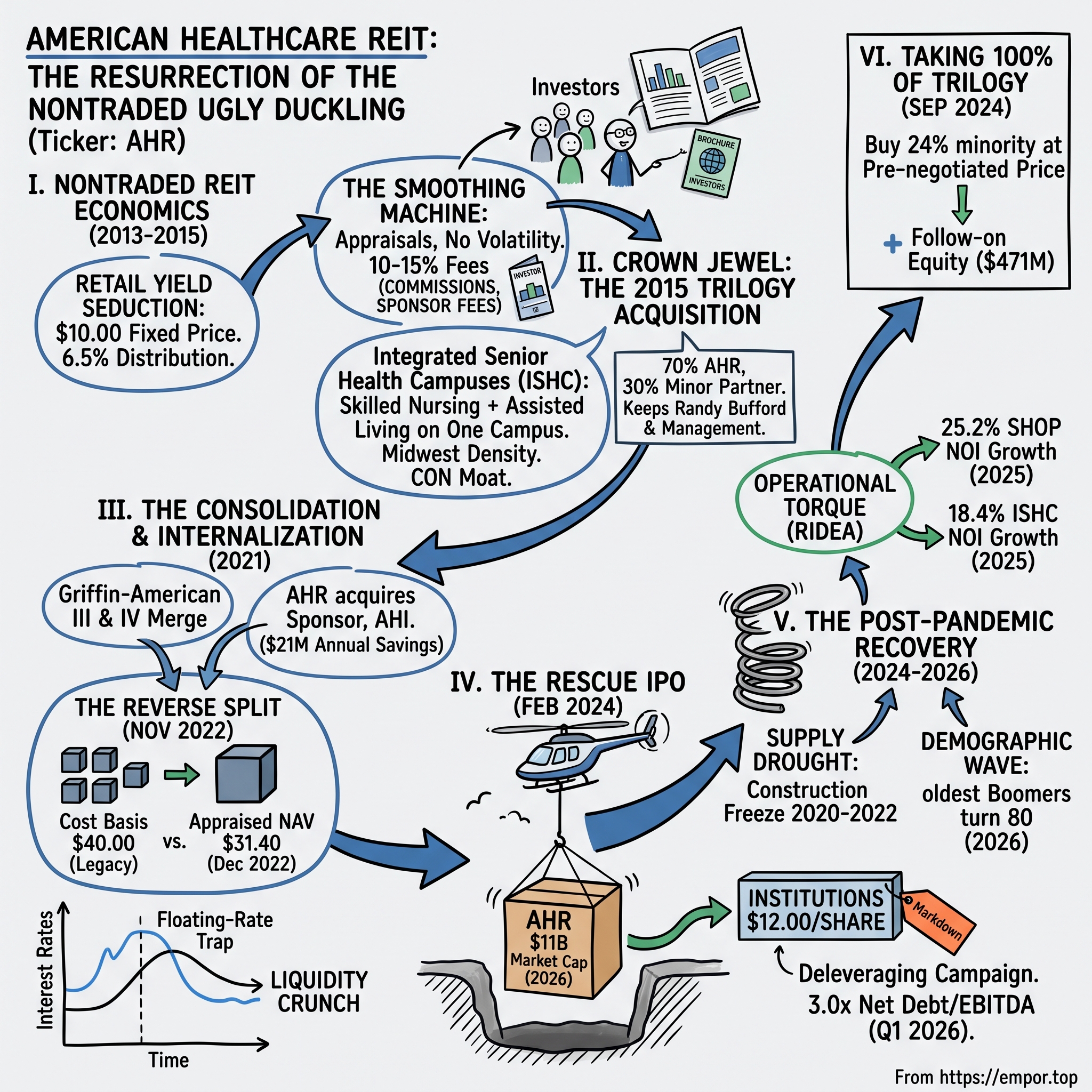
American Healthcare REIT: The Resurrection of the Nontraded Ugly Duckling
I. Episode Introduction & The Trillion-Dollar Demographic Wave
On the morning of February 7, 2024, a small crowd gathered on the floor of the New York Stock Exchange to watch a company begin trading that almost nobody in the public markets had ever heard of — and that tens of thousands of American retail investors already owned.
The ticker was AHR. The name was American Healthcare REIT. And the opening price was $12.00 a share.
For the institutional investors buying that morning, $12.00 was simply a price — the bottom of a marketed range, a number arrived at through the usual bookbuilding rituals of Wall Street. For the legacy shareholders who had owned this company for years, $12.00 was something closer to a verdict. Most of them had bought in at a nominal $10.00 per share through a financial advisor at an independent broker-dealer, in a product that had never once traded on an exchange and whose price had, for years, simply been asserted rather than discovered. After a one-for-four reverse stock split executed in November 2022, that original $10.00 basis had become an effective $40.00 per share.1 And the company's own board had told them, in March 2023, that their shares were worth $31.40 apiece as of the end of 2022.2
The market's answer was $12.00. That was a 62% discount to the board's own estimate of net asset value, and roughly a 70% haircut against the split-adjusted price legacy holders had actually paid. The offering raised $672 million at pricing — later grossing $772.8 million once underwriters exercised their overallotment option in full — and it did so by handing institutions the equity at a level that made a decade of nontraded-REIT marketing look, in retrospect, like a very expensive story.3
Two and a half years later, the story reads differently.
As of mid-July 2026, AHR traded in the high $50s, with a market capitalization above $11 billion.4 The company reported full-year 2025 revenue of $2.26 billion, total portfolio same-store net operating income growth of 14.2%, and normalized funds from operations of $1.72 per diluted share.5 In the first quarter of 2026, it posted its ninth consecutive quarter of double-digit same-store NOI growth and reported net debt to annualized adjusted EBITDA of 3.0x — down from 3.4x just one quarter earlier, and less than half where the balance sheet sat when the IPO was being negotiated.6
Here is the paradox worth sitting with. The same assets, run by substantially the same people, under the same corporate structure, were valued at $12.00 a share by sophisticated institutional buyers in February 2024 and at more than four times that level by the summer of 2026. Nothing about the physical real estate changed. The buildings did not move. The nurses did not become fundamentally different nurses.
What changed was the interaction of three things: an operating recovery in senior housing that was under-forecast by nearly everyone; a capital structure that went from constraint to weapon; and a business model — RIDEA — that converts operating improvement into shareholder value with far more torque than a traditional landlord structure ever could. The $12.00 price was not obviously wrong given what was knowable in February 2024. It was priced for a leveraged company in a recovering-but-unproven sector. The recovery then proved out faster and further than the underwriting assumed.
That distinction matters enormously for how you read this story. The bull case is not "management is brilliant and the market was stupid." The more defensible reading is that AHR was a highly levered call option on senior housing recovery, sold at a discount because the leverage made the option's expiry uncertain — and the IPO itself removed enough of that leverage to let the option run. The subsequent returns were real. Whether they are repeatable is an entirely different question, and it is the question this piece keeps returning to.
The road we will travel: the strange economics of the nontraded REIT channel that birthed this company; the 2015 acquisition of Trilogy Health Services that became its crown jewel and its greatest complication; the 2021 consolidation that internalized management; the 2022–2023 balance sheet squeeze; the rescue IPO; the operational surge; the buyout of Trilogy's minority partner; the competitive terrain against Welltower and Ventas; the abrupt leadership change of February 2026; and finally, the honest bull and bear cases, including what would have to go wrong for this to unwind.
Start where the money came from.
 Subscribe on LinkedIn
II. The Anatomy of a Nontraded REIT: Griffin-American & the Retail Investor Yield Seduction (2013-2015)
Picture a financial advisor's office in a suburban office park in 2014. A retired couple sits across the desk. They have $400,000 in savings, a ten-year Treasury yielding about 2.5%, and a bank certificate of deposit paying less than that. They want income. They are not sophisticated; they are prudent.
The advisor slides a glossy brochure across the desk. Healthcare real estate. Medical office buildings leased to hospital systems. Senior housing serving an aging population. A 6.5% distribution. And — here is the part that sells the product — a share price of $10.00 that does not move.
That last feature was the entire commercial genius of the nontraded REIT.
The Illusion Machine
A nontraded REIT owns real assets and pays real distributions, exactly like a listed REIT. The difference is that its shares do not trade on an exchange. There is no continuous market price. Instead, the shares are sold at a fixed offering price during a capital-raising period, and thereafter the board publishes a periodic "estimated per-share NAV" based on third-party appraisals.
The consequence is that the reported value is smooth. Listed healthcare REITs fell violently in March 2020, in the 2022 rate shock, in every liquidity panic. Nontraded REITs, on paper, did not — not because their assets were less volatile, but because nobody was allowed to vote on the price. Volatility was not eliminated; it was made invisible. For an investor who conflates the two, that is an extremely attractive product. For an investor who understands the difference, it is a warning sign.
The second feature was the fee architecture. In the classic 2010s nontraded REIT, the $10.00 an investor handed over did not all buy real estate. Selling commissions to the registered representative, dealer-manager fees to the sponsor's broker-dealer affiliate, and organizational and offering costs typically absorbed something in the range of 10–15% of gross proceeds before a single building was purchased. On top of that sat ongoing asset management fees paid to an external advisor, plus acquisition fees on every deal and, often, disposition and financing fees. The sponsor got paid for buying, for holding, and for selling.
Notice the incentive geometry. An external advisor earning fees as a percentage of assets under management is paid to accumulate. Whether the accumulation creates value per share is, from the advisor's cash-flow perspective, a secondary consideration. This is not a hypothetical critique — it is the structural reason why so many nontraded REITs of that vintage eventually converted to self-management, and it is the specific problem AHR would later spend real money to solve.
The Sponsor: American Healthcare Investors
The sponsor here was American Healthcare Investors, founded by three men whose names recur throughout this story: Jeff Hanson, Danny Prosky, and Mathieu Streiff.
Hanson was the deal architect and the public face — the executive who had come up through healthcare real estate capital markets and who understood the broker-dealer distribution channel intimately. Prosky was the operator's operator: a healthcare real estate specialist whose instinct ran toward the assets themselves, toward occupancy and reimbursement and the messy operational reality of buildings full of frail people. Streiff was the lawyer, the structurer, the man who made complex joint ventures and cross-entity mergers actually close.
Together they sponsored a series of healthcare-focused nontraded REITs. Two matter for this narrative: Griffin-American Healthcare REIT III, which launched its offering in 2013, and Griffin-American Healthcare REIT IV, which followed in 2015. Both raised capital through the independent broker-dealer channel. Both bought healthcare real estate. And both would eventually be merged together.
It is worth being precise about what the founders were genuinely good at, because it is easy to be dismissive of the entire nontraded category and miss the operating skill underneath. Hanson, Prosky and Streiff were not simply fee harvesters. They bought some genuinely excellent assets — most consequentially, Trilogy — and they bought them at prices that, from the vantage of 2026, look defensible. The critique of the nontraded structure is a critique of distribution economics and governance, not necessarily of asset selection. Both things can be true: investors paid too much friction, and the underlying portfolio was good.
The Reverse Split and the Frozen Market
By late 2022, the accumulated problems of the structure came due. On November 15, 2022, the company effected a one-for-four reverse stock split, mechanically converting four old shares into one new share.1 The stated purpose was to prepare the share count and price for an eventual listing. The practical effect was to reset the legacy investor's mental cost basis from $10.00 to $40.00.
In March 2023, the board published an estimated per-share NAV of $31.40 as of December 31, 2022 — already a meaningful markdown against that $40.00 reference — and the company also reduced its distribution and suspended its distribution reinvestment plan as the rate environment bit.27
And here the structural trap closed. The company's share repurchase mechanisms in nontraded vehicles are typically limited and can be suspended at the board's discretion. There is no exchange to sell into. Secondary markets for nontraded REIT shares exist, but they are thin and price at deep discounts to stated NAV — which is itself the market's quiet verdict on the reliability of appraisal-based valuation.
So investors sat with an asserted $31.40, no liquidity, a cut distribution, and a rate environment torching the value of levered real estate everywhere. The gap between what an appraiser will write down and what a buyer will actually pay had been papered over for a decade. It was about to be settled in public, on an exchange, in a single morning.
But before we get to that morning, we need to understand what was actually inside the portfolio — because one asset came to matter more than everything else combined.
III. The Crown Jewel: The 2015 Trilogy Health Services Joint Venture
Drive an hour outside Indianapolis and you will find a building that does not look like a nursing home.
It looks like a small hotel crossed with a country club: a covered portico, a bistro with an actual chef, a therapy gym with parallel bars and a mock car door for practicing transfers, a memory care wing built around a secure courtyard. A resident might move into an independent living apartment at 78, transition to assisted living at 84 when the medication management gets complicated, spend three weeks in the skilled nursing wing after a hip fracture at 87, and end life in memory care — all without ever leaving the campus, and often with the same staff who have known them for a decade.
That is a Trilogy campus. And in December 2015, Griffin-American Healthcare REIT III bought most of the company that built them.
The Deal
On December 2, 2015, GAHR III completed the acquisition of approximately 96% of Trilogy Investors, LLC — the parent of Trilogy Health Services — at a total company valuation of roughly $1.125 billion.8 The buyer was not GAHR III alone. It was a joint venture: GAHR III took 70% and acted as manager, while NorthStar Healthcare Income, Inc. took 30%. Trilogy's founder and chief executive, Randy Bufford, and other members of Trilogy management retained roughly a 4% equity interest and continued to run the business.8
That last detail is easy to skim past and important to dwell on. A REIT buying a $1.1 billion operating healthcare company is not buying real estate. It is buying payroll, clinical liability, state survey exposure, food service, therapy contracts, and Medicare and Medicaid billing. Keeping the founder and management team with skin in the game was not a nicety; it was the only plausible way for a real estate sponsor to own an operating business it could not itself run.
What Trilogy Actually Is
Trilogy was founded in 1997 and built a concentrated footprint across Indiana, Ohio, Michigan and Kentucky.8 The model is what AHR now reports as Integrated Senior Health Campuses — the ISHC segment.
The distinction from ordinary senior housing is worth explaining plainly, because it drives most of the economics later in this story.
A conventional senior housing operator sells hospitality with support: an apartment, meals, activities, some help with medication and bathing. It is paid almost entirely in private dollars, out of the resident's savings or the proceeds of a sold house. Margins are decent, regulation is light, and the main risks are occupancy and wage inflation.
A skilled nursing facility sells post-acute clinical care: rehabilitation after a stroke or a joint replacement, wound care, IV therapy, complex medication management. It employs registered nurses around the clock, is surveyed by state health departments, and is paid substantially by Medicare (for short post-hospital stays), Medicare Advantage plans, and Medicaid (for long-stay custodial residents whose money has run out).
Trilogy does both, on one campus, under one local leadership team. That integration creates a genuine internal referral engine — the assisted living resident who needs rehab does not go to a competitor's building — and it lets the campus capture a resident across the full arc of decline rather than at one stage of it.
Did They Overpay?
The honest answer is that the 2015 price looks good in hindsight and looked reasonable at the time, and the reasons those two things are true are different.
At the time, roughly $1.1 billion for a vertically integrated regional operator with a defensible Midwest position was not an aggressive multiple relative to where public healthcare REITs and skilled nursing operators traded in 2015 — a period when the sector was, if anything, over-loved. Welltower and Ventas were both actively consolidating; capital was cheap; senior housing was a consensus demographic trade.
In hindsight, the price looks better than it should have for a reason nobody was underwriting in 2015: the pandemic destroyed the sector's near-term economics, killed new construction starts for years, and then handed the survivors a supply-constrained recovery. A 2015 buyer of senior housing endured five brutal years to reach that. Calling the 2015 purchase prescient overstates it. Calling it a durable asset bought at a fair price, held through catastrophe, and revalued by a supply shock nobody planned for is closer to the truth.
There is, however, one genuine structural advantage that was knowable in 2015 and remains real: Certificate of Need.
The CON Moat — and Its Limits
Several states, including Indiana and Kentucky, require regulatory approval before anyone can build new skilled nursing beds or, in some cases, expand existing ones. The rationale is health-policy vintage 1970s: unconstrained bed supply drives up utilization and therefore public expenditure, because Medicaid ultimately pays for a large share of long-stay nursing care.
The commercial effect is a government-administered barrier to entry. A well-capitalized competitor who decides Trilogy's Fort Wayne market looks attractive cannot simply buy land and build. They have to persuade a state agency that the beds are needed — in a state whose fiscal interest runs the other way.
This is a real moat, and it is unusual in real estate, where the default competitive dynamic is that success invites a crane. But be precise about its scope. CON protects the skilled nursing beds. It does not protect independent living or assisted living, which in most states can be built freely. And it is a policy moat, which means it exists at the pleasure of state legislatures. CON regimes have been repealed or narrowed in a number of states over the past two decades under pressure from antitrust economists and free-market advocates who argue they entrench incumbents and raise costs. If Indiana or Kentucky moved that direction, a piece of the barrier erodes — not overnight, since building takes years, but structurally.
The Operational Reality
The deeper point about Trilogy is that owning it made AHR something other than a REIT in the way most investors use the word.
A traditional net-lease healthcare REIT is a bond-like instrument wearing a real estate costume. It buys a building, leases it to an operator for fifteen years with annual escalators, and collects rent. If the operator's margins compress, that is the operator's problem until it becomes a default. The REIT's income statement is beautifully simple.
Owning Trilogy means AHR's income statement carries the wages of thousands of nurses, aides, therapists, cooks and housekeepers. It carries food costs and utility costs and workers' compensation and professional liability insurance for clinical care. It carries the risk that a state survey finds a deficiency and imposes a remediation plan. It carries the risk that Medicare's payment rules change.
Investors who bought AHR believing they owned real estate owned, in economic substance, a healthcare operating company with real estate attached. That was the source of the extraordinary upside from 2024 to 2026. It is also, precisely and symmetrically, the source of the downside risk if labor or reimbursement turns.
Which brings us to the moment the sponsors decided to stop being sponsors.
IV. The Consolidation and External Manager Buyout (2021): Creating American Healthcare REIT
By 2021, the founders of American Healthcare Investors faced a problem that every successful nontraded REIT sponsor eventually faces: the exit.
They had raised billions from retail investors through the broker-dealer channel. Those investors had been promised, implicitly and sometimes explicitly, an eventual "liquidity event" — a listing, a sale, a merger with a public company. That promise had been outstanding for years. Meanwhile the sponsors themselves owned a management company whose value depended entirely on continuing to manage those REITs, which meant that any liquidity event was also, potentially, the destruction of their own franchise.
The solution they chose was to merge the vehicles together and sell themselves into the result.
The Merger
On October 1, 2021, Griffin-American Healthcare REIT III and Griffin-American Healthcare REIT IV completed a stock-for-stock merger, creating a combined company with a gross investment value of approximately $4.2 billion in healthcare real estate.9 The combined entity took the name American Healthcare REIT, Inc. At the time, the company described itself as the eleventh-largest healthcare-focused REIT globally.9
Simultaneously — and this was the more consequential half of the transaction — the combined company acquired American Healthcare Investors itself. All of AHI's more than 100 employees, including the three founders, became employees of the REIT. American Healthcare REIT became self-managed, with an internal, fully integrated management platform, and the company projected roughly $21 million in annual operational cost savings from eliminating external advisory arrangements.9
Why Internalization Actually Matters
The $21 million is the headline number, and it is the least interesting part.
The real change was to the incentive gradient. Under the external advisory model, the managers' compensation was mechanically tied to the size of the asset base. Buy more buildings, earn more fees. Under internalization, the founders' economic outcome became a function of the share price and of per-share cash flow — because they were now employees and shareholders of a company that would, eventually, have a public stock price attached to it.
This is the difference between being paid on AUM and being paid on FFO per share, and it changes what deals look attractive. An acquisition funded with dilutive equity that grows the portfolio but shrinks per-share earnings is good for an external advisor and bad for an internalized management team. AHR's later behavior — most notably the 2024 Trilogy minority buyout, and the pattern of forward equity sales funding accretive acquisitions — is only coherent if you understand that this incentive flip had already happened.
The Skeptic's Read
An activist investor looking at this transaction would ask an uncomfortable question, and it deserves airing: internalizations are transactions in which a company's management sells its own management company to the shareholders it works for. The buyer and the seller are, in economic substance, negotiating with a substantial overlap of interest. Nontraded REIT internalizations have a long and not entirely happy history of being priced generously to sponsors.
The offsetting argument here is that the founders took a large portion of their consideration in equity and remained with the company through the crisis that followed — including the humiliation of a $12.00 listing that marked their own holdings down alongside everyone else's. That is not the behavior of a team that extracted maximum value and left. But shareholders evaluating governance quality at AHR should understand that the company's origin includes a related-party transaction of exactly the type that warrants scrutiny, and that the board approving it was a board appointed under sponsor influence.
The Stated Purpose
Management framed the consolidation as a scaling exercise with a clear terminal objective: build a portfolio large enough and diversified enough to support a national exchange listing, and thereby finally deliver liquidity to legacy retail holders.
They achieved the listing. Whether they delivered "liquidity" in the sense their investors understood the word is a matter of some interpretation, because between October 2021 and February 2024, the macro environment did something that made the terms of that liquidity brutal.
V. The Balance Sheet Crisis and the $12.00 Rescue IPO (February 2024)
In March 2022, the federal funds rate sat at effectively zero. By July 2023, it was above 5.25%. That was the fastest tightening cycle in four decades, and it functioned as a controlled demolition of the levered real estate business model.
For AHR, the demolition had a specific mechanism, and it is worth walking through slowly because it explains both the crisis and why the IPO was priced the way it was.
The Floating-Rate Trap
A REIT is a leveraged spread business. It buys assets yielding, say, 7%, funds them partly with debt costing 4%, and the difference accrues to equity. That works beautifully when the cost of debt is stable or falling.
AHR had funded its growth — the Trilogy stake, the portfolio accumulation, the consolidation — with substantial debt, and critically, a meaningful portion of that debt was floating-rate bank borrowings, including lines of credit. Floating-rate debt is cheap and flexible. It is also a direct, undamped transmission line from the Federal Reserve to a company's interest expense.
When short rates rose by more than five percentage points, AHR's interest expense rose with them, in near-real time, on debt that could not be simply refinanced away because every lender was repricing simultaneously. Cash flow that would have gone to distributions or reinvestment went instead to interest. And because leverage ratios are measured against EBITDA, and EBITDA was still recovering from a pandemic that had emptied senior housing buildings, the ratio deteriorated from both directions at once: the numerator was expensive and the denominator was depressed.
Net debt to annualized adjusted EBITDA climbed into a range that, for a company with meaningful operating exposure rather than pure net-lease income, was genuinely uncomfortable — in the vicinity of 6.5x to 7.0x heading into the listing. For context on where that sits: by the first quarter of 2026, that same metric was 3.0x.6
The company was not, on the evidence available, on the edge of insolvency. But it was on the edge of optionality loss. A company at 7x leverage with floating-rate exposure cannot acquire, cannot easily refinance on good terms, and cannot absorb a negative surprise. It becomes a passenger.
The Decision
There were three ways out. Wait for rates to fall — but nobody knew when, and the forward curve had been wrong repeatedly. Sell assets — but the transaction market for healthcare real estate in 2023 was largely frozen, with bid-ask spreads too wide to clear, and selling good assets into a bad market is how you permanently impair a portfolio. Or raise equity.
Raising equity meant listing, because there was no longer a functioning nontraded capital-raising channel to tap at scale. And listing meant that, for the first time in the company's history, someone other than an appraiser would set the price.
The Reality Check
When AHR took its story to institutional investors in late 2023 and early 2024, the response was not enthusiasm. Public market buyers looked at a company with high leverage, significant floating-rate exposure, an operating business rather than a clean net-lease income stream, meaningful government reimbursement exposure through skilled nursing, and an occupancy recovery that was real but not yet demonstrably durable.
They also knew something that gave them enormous negotiating leverage: AHR needed the money more than they needed the deal.
The marketing range was set at $12.00 to $15.00. The book cleared at the bottom.
The Pricing
On February 6, 2024, AHR priced its offering at $12.00 per share, raising approximately $672 million. Trading began on the NYSE on February 7, and the offering closed on February 9, ultimately comprising 64,400,000 shares — including full exercise of the underwriters' 8,400,000-share overallotment option — for total gross proceeds of $772.8 million.310
The trade press captured the retail-investor reaction immediately: the pricing was reported as a disappointment for nontraded holders, and as a listing that landed at the low end of an already conservative range.11[^12]
What the $12.00 Actually Meant
Two readings of that price are both defensible, and holding them simultaneously is the beginning of understanding this company.
Reading one: the retail investors were treated badly. They paid a nominal $10.00 with 10–15% of it consumed by fees before it bought anything. They were told for years that the shares were worth $31.40 on a split-adjusted basis. They had no ability to exit. And then, at the moment liquidity finally arrived, it arrived at a price that crystallized a devastating loss. Nothing in the subsequent share appreciation undoes the fact that any holder who sold in February 2024 — which is exactly what a decade of illiquidity had primed many of them to do — locked in that loss permanently.
Reading two: the IPO was the thing that saved the company. The $672 million of fresh common equity went straight against high-cost floating-rate debt. That single action converted AHR from a company with a leverage problem into a company with a leverage trajectory. It restored the ability to acquire, to refinance, to absorb surprise. It bought time for the operating recovery to arrive. Without it, the company would have spent 2024 and 2025 managing its balance sheet instead of compounding its NOI.
The uncomfortable synthesis is that the discount legacy investors suffered was, mechanically, part of the mechanism that made the recovery possible — the equity was cheap enough that institutions were willing to fund the deleveraging. That is not a comforting conclusion. It is, however, roughly what happened.
And what happened next surprised nearly everyone, including the people who set the price.
VI. The Turnaround: Deleveraging and the Post-Pandemic "Coiled Spring" Recovery
To understand the two years after the IPO, you have to understand what COVID-19 did to senior housing — and, more importantly, what it did to senior housing supply.
The Coiled Spring
In early 2020, senior housing communities became the most dangerous places in America. Occupancy, which had run in the high 80s, collapsed toward the low 70s in the worst-hit segments. Move-ins stopped. Families pulled residents home. Buildings that had been sold to investors as recession-resistant demographic plays became, briefly, uninvestable.
Three things then happened in sequence, and their combination produced the recovery.
First, construction stopped. Development of new senior housing requires construction financing, and no lender in 2020 or 2021 was writing construction loans against a product category whose occupancy had just fallen off a cliff. Then rates rose, making the math worse. Senior housing starts fell to levels not seen in a decade and stayed there. Because a senior housing community takes roughly two to three years from groundbreaking to stabilized operation, a construction freeze in 2020–2022 guaranteed a supply drought in 2023–2026.
Second, demand did not stop. The oldest Baby Boomers turned 80 in 2026. The 85-plus cohort — the actual customer base for assisted living and skilled nursing, since the average age of entry into assisted living sits in the mid-80s — began growing at rates the sector had been forecasting for twenty years. Nobody's dementia was cured by a pandemic. Demand was deferred, not destroyed.
Third, the deferred demand came back into a market with no new buildings. Occupancy recovered, and because supply was fixed, the recovery came with pricing power attached.
Add high general inflation, which gave operators social license to raise resident rates by mid-to-high single digits annually without triggering rebellion — families were experiencing price increases everywhere. And add the normalization of labor: during the pandemic, staffing shortages forced operators to hire contract nurses through agencies at punishing hourly rates, sometimes double the cost of permanent staff. As the labor market loosened in 2023 and 2024, operators converted agency positions to permanent hires, and a large cost line simply deflated.
Rising revenue per unit, rising occupancy, and falling cost per unit, arriving simultaneously. That is the coiled spring.
Why RIDEA Turned Recovery Into Torque
Here is where AHR's structure mattered more than its assets.
Under a traditional triple-net lease, a REIT collects a contractual rent with a fixed escalator — typically 2–3% a year. If the operator's business booms, the REIT still collects 2–3%. The upside accrues to the tenant. The lease is a cap on participation.
RIDEA — named for the REIT Investment Diversification and Empowerment Act of 2007, which changed the tax rules to permit it — lets a REIT own the operating income of a healthcare property through a taxable subsidiary, hiring a third-party manager rather than leasing to a tenant. The REIT takes the revenue and the expenses. It has no rent floor. It has no rent ceiling.
The layman's version: a net-lease REIT is a landlord who charges rent. A RIDEA REIT is the owner of the business, who pays a manager a fee to run it.
Now do the arithmetic of operating leverage. A senior housing community with roughly 25–35% operating margins has, by definition, 65–75% of its revenue going to costs — and most of those costs are largely fixed in the short run. The building's mortgage, its utilities, its core staffing, its management overhead do not scale with the eleventh resident in a hundred-unit building. So an incremental dollar of revenue from filling an empty unit drops toward the bottom line at a rate far above the average margin.
This is why occupancy gains of a few hundred basis points, combined with mid-single-digit rate increases, produce NOI growth in the high teens or twenties rather than the mid-single digits. It is not magic. It is fixed-cost absorption in a business with a low margin base.
The Results
The numbers that came out of this were, by REIT standards, unusual.
For full-year 2025, AHR reported total revenue of $2.26 billion, of which $2.09 billion was resident fees and services and $165.6 million was real estate revenue.5 Total portfolio same-store NOI grew 14.2%. The SHOP segment grew 25.2%. The ISHC segment — Trilogy — grew 18.4%. Outpatient medical grew 2.1%, and triple-net leased properties grew 0.5%.5 Normalized FFO reached $1.72 per diluted share, up more than 20% year over year.5
The momentum carried into 2026. First-quarter total same-store NOI grew 12.1%, with ISHC at 14.5%, SHOP at 19.7%, outpatient medical at 1.6%, and triple-net at 4.6%. Normalized FFO was $0.50 per diluted share, up 30% year over year. Trilogy occupancy reached 91.2%, SHOP occupancy 88.6%, and management noted that both segments exceeded 20% NOI margins for the first time since COVID.612
What This Evidence Does and Does Not Prove
It proves the operating leverage thesis. When you see 12–25% NOI growth from a business whose revenue is growing at high single digits, the mechanism is unambiguous: fixed-cost absorption plus margin expansion.
It proves that AHR captured that leverage rather than giving it away — a company with the same buildings under triple-net leases would have reported roughly 2–3% growth on the same underlying operations.
It does not prove durable competitive advantage. The sector-wide supply-demand imbalance lifted essentially every senior housing owner with RIDEA exposure. AHR's growth rates were strong on an absolute basis, but the question that matters analytically is how much of the outperformance is structural versus how much is beta to a sector cycle that has already run for three years.
And it does not prove the growth is repeatable. Margins that have gone from depressed to 20% cannot repeat that journey. Occupancy at 91.2% at Trilogy has meaningfully less room to run than occupancy at 82% did. The arithmetic of a recovery is that it gets harder as it succeeds — which is precisely why management's own 2026 guidance, at 9–12% total same-store NOI growth, sits below 2025's realized 14.2%.65 That is not a warning sign; it is honest math. But investors extrapolating 2025 into 2028 are extrapolating a recovery, not a run rate.
The other half of the turnaround had nothing to do with operations, and everything to do with the capital structure.
VII. Taking 100% of the Crown Jewel: The September 2024 Trilogy Buyout & Capital Allocation
Seven months after listing at $12.00, AHR's management team faced a decision that would define their reputation as capital allocators.
They owned 76% of Trilogy REIT Holdings. The remaining 24% belonged to a joint venture partner — the successor interest to the NorthStar Healthcare stake taken in 2015. And under the terms of the joint venture, AHR held the right to buy that interest at a pre-negotiated base price.
That pre-negotiated price had been set in an earlier world. Trilogy's same-store NOI was, at the time, compounding at roughly 20% annually. The stake was, in effect, an in-the-money option struck years before the recovery.
The Transaction
On September 20, 2024, AHR completed the acquisition of the remaining 24% minority membership interest in Trilogy REIT Holdings for approximately $258 million in cash — comprising the pre-negotiated base purchase price of $247 million plus approximately $11 million in pro-rata distributions owed to the joint venture partner.13[^15] AHR became the sole owner of Trilogy Holdings and, therefore, of its Integrated Senior Health Campuses.
The Funding — and Why the Sequencing Was the Skill
The elegant part was not the purchase. It was the funding.
On the same day the acquisition closed, AHR completed a follow-on public offering of 20,010,000 shares, generating gross proceeds of $471,236,000.14 Of that, $258 million funded the Trilogy buyout. The remaining net proceeds retired approximately $194.0 million of borrowings on the company's lines of credit.13
Think about what that single day accomplished. AHR bought a growing asset at a stale, pre-negotiated price using equity issued at a share price that had substantially recovered from the $12.00 listing. It simultaneously eliminated a minority interest that had been siphoning off nearly a quarter of Trilogy's economics. And it paid down floating-rate revolver debt with the change.
The accretion math is straightforward. If you buy an incremental claim on cash flows growing near 20% at a price fixed before that growth materialized, and you fund it with equity that the market is valuing at a multiple reflecting that growth, the transaction is accretive to FFO per share on day one and increasingly accretive thereafter. That is the textbook definition of good capital allocation: exercising a cheap option with expensive currency.
The offsetting question a skeptic should ask is whether the pre-negotiated price genuinely reflected an arm's-length outcome, or whether AHR simply inherited a favorable term from a 2015 negotiation and the counterparty had limited ability to renegotiate. The honest answer is largely the latter — this was an option exercised, not a deal won. That is still valuable. It is just a different kind of skill: the skill of structuring an option in 2015 and having the balance sheet to exercise it in 2024. The second half is not trivial. A company still at 7x leverage could not have written that check.
The Deleveraging Campaign
Combine equity issuance, debt paydown, and rapidly compounding EBITDA, and the leverage ratio collapses. AHR's net debt to annualized adjusted EBITDA moved from the mid-4x range in early 2025 to 3.4x at the end of 2025 and 3.0x as of March 31, 2026.56
This is arguably the most important number in the entire story, and it is worth explaining why in plain terms.
Leverage determines what a company is allowed to do. At 7x, AHR was a company managing a problem. At 3.0x, it is a company with an $800 million unsecured revolver carrying zero drawn borrowings and the ability to move on acquisitions without asking permission.12 On the first-quarter 2026 call, management explicitly framed the goal as maintaining "essentially investment-grade ratios" — not primarily to reduce borrowing cost, but because a fortress balance sheet supports the equity valuation multiple, which in turn lowers the cost of the equity it keeps issuing.12
That is a self-reinforcing loop, and it is genuinely how the best-run REITs compound: low leverage supports a high multiple, a high multiple makes equity cheap, cheap equity funds accretive acquisitions, accretive acquisitions grow FFO, growing FFO supports the multiple.
The loop also runs in reverse. It is worth naming that explicitly. If the multiple compresses — because growth decelerates, or because reimbursement policy turns, or simply because the sector falls out of favor — then equity becomes expensive, the acquisition machine stalls, and growth becomes dependent on internal operations alone. AHR's 2026 activity depends on this loop functioning: the company closed $249.2 million in SHOP acquisitions during the first quarter, reported a roughly $650 million awarded pipeline with approximately 80% involving existing operating partners, and had 10.5 million shares under forward sale agreements for $527.4 million as of early May.612
Forward equity sales are a sophisticated tool — they lock in a share price today for capital delivered when an acquisition actually closes, eliminating the mismatch between raising and deploying. They are also, unavoidably, a bet that the current share price is a good price at which to issue.
Growth funded by continuously issuing equity is only value-creating while the equity is expensive relative to the assets being bought. Every serially acquisitive REIT in history has learned that lesson eventually. AHR has not yet had to.
VIII. Inside the Core Business: RIDEA Operations vs. Traditional Real Estate Economics
Strip away the ticker and the REIT tax election, and ask a simple question: what does this company actually do all day?
As of March 31, 2026, AHR's portfolio comprised 325 properties totaling roughly 22.65 million square feet across the United States and the United Kingdom, generating approximately $525 million in annualized cash net operating income.1516 But the property count obscures the more important fact, which is that AHR is four quite different businesses stapled together.
The Four Segments
Integrated Senior Health Campuses (ISHC). This is Trilogy — the largest and most operationally intensive exposure. Revenue comes from private-pay residents, Medicare, Medicare Advantage plans, and Medicaid. Costs are dominated by clinical labor. AHR owns 100% of the economics following the 2024 buyout. On the first-quarter 2026 call, management emphasized that Trilogy's quality mix improved and highlighted alignment with payors — particularly Medicare Advantage plans — that reward superior resident outcomes.12 That framing is worth noting: it is an argument that clinical quality is becoming a commercial asset, not just a compliance obligation.
Senior Housing Operating Properties (SHOP). Senior living communities operated under RIDEA by third-party managers. AHR owns the operating economics and pays a management fee. Same structural torque as Trilogy, but with less clinical complexity and less government reimbursement exposure. This has been the fastest-growing segment — 25.2% same-store NOI growth in 2025 and 19.7% in the first quarter of 2026 — and it is where the acquisition pipeline is concentrated.56
Outpatient Medical. Classic real estate. Medical office buildings leased to health systems and physician groups on multi-year leases. Stable, boring, high-margin at the property level, and growing at 1–2%. In 2025 it grew 2.1%; in the first quarter of 2026, 1.6%.56
Triple-Net Leased Properties. Passive real estate leased to third-party healthcare operators. Contractual rent, contractual escalators, minimal operational involvement.
The Revenue Mix Tells the Real Story
In 2025, resident fees and services accounted for $2.09 billion of $2.26 billion in total revenue — roughly 93% — while rental revenue contributed $165.6 million, about 7%.5
Read that ratio again, because it is the single most clarifying fact about this company. Ninety-three cents of every revenue dollar comes from operating a healthcare business. Seven cents comes from being a landlord.
An investor who buys AHR as a diversified healthcare REIT and expects bond-like stability has misunderstood the instrument. The correct comparison set for most of AHR's revenue is not net-lease REITs; it is senior housing and post-acute operating companies.
The Margin Knife-Edge
The margin structure deserves careful explanation because it cuts both ways with equal force.
A medical office building generates NOI margins north of 80% — the tenant pays most operating costs, and the landlord's expenses are modest. A RIDEA senior housing community generates operating margins in the 25–35% range, because AHR pays for everything: nursing wages, aide wages, therapy staff, food, utilities, insurance, marketing, and the management fee.
The consequence is asymmetric sensitivity. On a business with, say, 30% margins, a 5% revenue increase with flat costs expands NOI by roughly 12%. But a 5% increase in the 70% cost base with flat revenue would compress NOI by more than 11%. The same operating leverage that produced 25% NOI growth in a favorable environment produces violent compression in an unfavorable one.
This is not theoretical. It is precisely what happened in 2021 and 2022, when agency labor costs spiked while occupancy was still depressed, and it is why senior housing operating companies were among the worst-performing assets in the sector during that window.
So the honest framing of AHR's business model is this: it is a high-operating-leverage bet on the spread between what you can charge a resident and what you must pay the person who cares for them. Between 2024 and 2026, that spread widened dramatically — rates rose faster than wages, and agency costs deflated. Both of those tailwinds are cyclical, not structural. On the first-quarter 2026 call, management described Trilogy's expense deceleration as a proactive response to Medicare headwinds rather than a reactive scramble.12 That is a reasonable framing, but it also confirms that headwinds exist and that costs require active management rather than benign drift.
The outpatient medical and triple-net segments serve as ballast — a stable, low-growth cash flow floor that dampens the volatility of the operating segments. At roughly 7% of revenue, though, they are a modest keel on a large ship.
The question that follows naturally: in a business this operationally exposed, what actually protects AHR from competition?
IX. Competitive Landscape & Strategic Moats: The 7 Powers and Porter's 5 Forces Analysis
If you want to understand AHR's competitive position, start with a fact about geography that most investors overlook.
Senior housing is a hyperlocal business. A family choosing a community for their mother is not comparison shopping nationally. They are looking within a fifteen-to-thirty minute drive of where they live, because they intend to visit weekly. Referrals come from local hospital discharge planners, local physicians, local clergy, and — most powerfully — from other families in the same community.
This means national scale, per se, buys you very little on the demand side. What buys you something is regional density. And that is exactly what Trilogy has.
Hamilton Helmer's 7 Powers
Scale Economies — but regional, not national. Trilogy's concentration across Indiana, Ohio, Michigan and Kentucky creates real cost and capability advantages that a nationally dispersed operator cannot replicate. A regional cluster supports a dedicated recruiting pipeline with local nursing schools; a shared float pool of nurses who can cover across nearby campuses rather than resorting to agency; consolidated purchasing for food and clinical supplies; regional marketing that builds a brand a family recognizes; and regional management that can actually visit buildings weekly rather than quarterly.
The nurse float pool deserves emphasis, because it connects directly to the biggest cost line in the business. When you operate one building in a market, a call-out means calling an agency at a premium. When you operate fifteen buildings within an hour, you can cover internally. That is a durable structural cost advantage — and it is why density, not total size, is the relevant scale metric here.
Switching Costs — high, and unusually so. Moving a frail 88-year-old with early dementia from one facility to another is genuinely traumatic: disorientation, loss of familiar caregivers, measurable clinical decline. Families know this. The practical consequence is that once a resident is settled, the family will absorb meaningful annual rate increases rather than move. This is what gives operators pricing power in an inflationary period — and it is a real, evidenced mechanism, visible in the sector's ability to push mid-to-high single-digit rate increases through 2023–2025 without triggering occupancy loss.
The limit: switching costs bind the existing resident, not the next one. Every resident eventually leaves, in the most permanent sense. Senior housing has structurally high annual turnover, which means the business must continuously re-win demand. Switching costs reduce churn; they do not create an annuity.
Process Power — plausible but hard to verify. Trilogy's integrated campus model — post-acute rehab, assisted living, memory care and independent living under one local leadership team — is genuinely difficult to replicate, because it requires simultaneously operating a clinical business and a hospitality business with a single P&L and a single culture. National passive landlords do not have the organizational capability. Pure skilled nursing operators do not have the hospitality DNA.
The honest caveat: process power is the most frequently claimed and least frequently verified of Helmer's powers. The evidence that it is real here is Trilogy's occupancy — 91.2% in the first quarter of 2026, above the sector's typical levels — and its ability to reach 20%-plus segment margins.12 The evidence that it might be partially cyclical is that essentially every senior housing operator improved over the same window.
Cornered Resource — the CON licenses. State-issued skilled nursing bed licenses in CON states function as a cornered resource: finite, non-replicable by capital alone, and held disproportionately by incumbents.
Branding, Counter-Positioning, Network Effects — largely absent. Senior housing brands carry modest consumer equity. There is no network effect. And AHR is not counter-positioned against incumbents; it is an incumbent using a conventional model.
Porter's Five Forces
Supplier Power: high, and the dominant risk. The critical supplier is clinical labor — registered nurses, licensed practical nurses, and certified nursing assistants. This is a labor market with structural shortage, an aging workforce, meaningful unionization in some geographies, and — as the pandemic demonstrated with brutal clarity — the ability to reprice violently when demand spikes. Agency staffing firms function as an opportunistic middle layer that captures enormous margin exactly when operators are most desperate. AHR has essentially no bargaining power against a genuine nursing shortage. It can only manage exposure through recruiting, retention and density.
Threat of New Entrants: low for skilled nursing, moderate for senior housing. CON regimes make new skilled nursing beds difficult in key Trilogy states. But assisted living and independent living are far easier to build, and the current supply drought is a financing and rate phenomenon, not a permanent barrier. Rates fall and margins stay at these levels, cranes return. The supply constraint that has driven the last three years is temporary by construction — the only question is the lag.
Buyer Power: high, and structurally so. For the private-pay portion, the buyer is a family with alternatives, though bound by switching costs once committed. For the skilled nursing and post-acute portion, the buyer is the government and its contractors: Medicare, state Medicaid programs, and increasingly Medicare Advantage plans. These buyers set prices administratively. They do not negotiate in any meaningful sense. Medicaid rates are set by state legislatures balancing budgets, and Medicaid long-stay reimbursement has historically run at or below the cost of care in many states. Medicare Advantage plans, now covering a majority of Medicare-eligible seniors, are aggressive about length-of-stay management — every day they shave off a post-acute stay is revenue removed from the operator.
Management's response on the first-quarter 2026 call — that Trilogy aligns with quality-focused payors including Medicare Advantage plans that value superior resident outcomes — is a coherent strategy.12 It is also, essentially, an argument that the best operators will be squeezed last rather than not squeezed. That is a meaningful advantage, not immunity.
Competitive Rivalry: moderate, and unusually differentiated. The giants of healthcare REITs are Welltower and Ventas, both of which dwarf AHR in scale and both of which have built substantial RIDEA senior housing platforms.[^19]17 Their portfolios skew toward private-pay senior housing and outpatient medical in higher-income coastal and urban markets, and they have largely avoided direct operational exposure to post-acute skilled nursing.
On the other side, Omega Healthcare Investors and Sabra Health Care REIT have deep skilled nursing exposure — but predominantly as triple-net landlords, collecting contractual rent from operators rather than owning the operating economics.
AHR sits in a category with few direct comparables: an owner-operator of integrated post-acute and senior housing campuses at meaningful scale. That is a genuine differentiation. Whether it is an advantage depends entirely on which way the cycle runs. Owning the operating economics means capturing all the upside — which is what happened. It also means absorbing all the downside, which is exactly what the net-lease structures at Omega and Sabra are designed to avoid.
An investor should be clear-eyed about this: AHR is not a better-constructed version of Welltower. It is a higher-beta, more operationally exposed, more reimbursement-sensitive vehicle that has been rewarded for that exposure during a favorable phase of the cycle.
Which raises the question of who is steering, and how much that matters.
X. Management, Incentives, and the 2026 Leadership Transition
On February 3, 2026, American Healthcare REIT's board convened on short notice to address a situation no succession plan fully anticipates.
Danny Prosky — chief executive officer and president, one of the three founders of the original sponsor, the man who had run this portfolio through the pandemic, the consolidation, the balance sheet crisis and the listing — had suffered a medical event and needed to step away.
The board acted the same day. Jeffrey T. Hanson, chairman of the board and Prosky's co-founder, was appointed interim chief executive officer and president effective February 3, 2026. The announcement was made publicly on February 4.1819
Why the Market Barely Flinched
Sudden CEO departures usually reprice a stock, and for good reason: they raise questions about strategy continuity, about whether the departure is truly what it is stated to be, and about whether the bench is deep enough.
AHR's transition was, by the standards of these events, unusually clean — and the reason is structural rather than lucky. Hanson was not a caretaker parachuted in from outside. He co-founded American Healthcare Investors, chaired the board through every major decision in this narrative, and had been present for the Trilogy acquisition, the merger, the internalization and the listing. There was no learning curve because there was nothing to learn.
The company also had a functioning executive team. Gabriel Willhite as chief operating officer and Brian Peay as chief financial officer both presented on the first-quarter 2026 call, with Willhite handling the operational detail on Trilogy and SHOP and Peay handling the balance sheet and guidance.12 A company where the CEO is the only person who can explain the business is fragile. A company where the COO and CFO can carry a call unaided is not.
Hanson used the first-quarter call to give a direct health update, noting that Prosky had undergone a medical procedure that "went exceedingly well" and that he was "in good spirits."12 As of this writing in July 2026, the company has not announced a date for Prosky's return, and the interim arrangement remains in place. That is the honest status: not resolved, but not deteriorating.
The Governance Question a Skeptic Would Raise
A skeptical investor should notice something about this arrangement that the smoothness obscures: the board chairman became the interim CEO. That combines the oversight function and the executive function in one person, at a company whose founders already occupy multiple senior roles and whose origin includes an internalization transaction between the founders and the company.
That is not an accusation of wrongdoing. It is a description of concentrated influence. Boards exist to supervise management; when the chairman is management, the supervision loop is weakened for as long as the arrangement lasts. Investors should watch how long "interim" remains interim, and whether the board has articulated a permanent succession plan — because at a company now valued above $11 billion, indefinite interim leadership by the chairman is a governance posture, not a stopgap.
There is also plain key-person risk. AHR's competitive story rests substantially on relationships with operating partners — the first-quarter pipeline was roughly 80% with existing operators, which is a relationship business by definition.12 Those relationships were built by specific individuals over decades.
Incentives and Alignment
Executive compensation at AHR has been weighted toward long-term equity. For fiscal 2023, Prosky's reported total compensation was approximately $3.78 million, comprising $750,000 in salary, $949,500 in bonus, roughly $2.0 million in stock awards, and about $85,000 in other compensation — meaning more than half of total pay came in equity.20
Equity-weighted compensation aligns management with shareholders in the direction that matters most for a REIT: it makes per-share value the objective rather than portfolio size. Combined with the internalization, which removed AUM-linked advisory fees entirely, the incentive structure points toward FFO-per-share growth.
The caveat every investor should apply: equity compensation aligns management with the share price, which is not identical to aligning them with long-term intrinsic value. A management team paid in stock during a period of multiple expansion is being rewarded partly for the multiple. The relevant test of alignment is what happens in a drawdown.
The Credibility Record
Assessing management by behavior rather than rhetoric, the record through mid-2026 is genuinely strong on three specific dimensions.
Guidance discipline. AHR raised full-year guidance repeatedly through 2024, 2025 and into 2026 — the first-quarter 2026 release increased NFFO per diluted share guidance to $2.03–$2.09 and lifted total portfolio same-store NOI growth guidance to 9.0–12.0%.6 A pattern of setting achievable targets and beating them is more informative than any single result, because it reveals a forecasting posture. The mild counterpoint is that consistently beating raised guidance in a strongly favorable cycle is easier than doing it in a hostile one, and AHR has not yet been tested that way as a public company.
Narrative consistency. The story told at the IPO — deleverage, capture RIDEA operating upside, consolidate ownership of Trilogy — is the story told on the first-quarter 2026 call. There has been no unexplained strategic pivot, no rebranding of the thesis, no quiet abandonment of prior targets. That consistency is worth something.
Capital allocation. The Trilogy minority buyout and the funding structure around it represent a genuinely well-executed sequence. The forward equity program is a sophisticated tool used for its intended purpose.
The thing that has not been tested: how this team behaves when things go badly as a public company. Every management team looks disciplined during an upcycle. The informative moments are the misses — and AHR, as a listed entity, has not really had one.
XI. The Bull vs. Bear Case & Key Performance Indicators to Watch
Set the narrative aside and state the two cases as cleanly as possible.
The Bull Case
Demographics are arriving, not projected. The senior housing industry has spent twenty years promising that the Baby Boomers were coming. The 85-plus population — the actual customer cohort, given that entry into assisted living typically happens in the mid-80s — is now genuinely in its high-growth phase. This is the rare investment thesis where the demand forecast is close to arithmetic rather than opinion, because the customers are already born.
The supply response is structurally delayed. Construction financing froze in 2020, rates rose in 2022–2023, and construction costs inflated. Even if development capital returned tomorrow, a community takes years to build and lease. The imbalance has visible runway.
RIDEA converts sector recovery into shareholder returns with unusual efficiency. Owning operating economics rather than contractual rent is the reason AHR's segment growth runs in the teens and twenties while net-lease peers report low single digits.
The balance sheet is now a weapon. At 3.0x net debt to EBITDA with an undrawn $800 million revolver, AHR can act on opportunity rather than react to constraint.612 For a company that was nearly a passenger in 2023, that is a transformation of strategic position, and it is the least cyclical of the bull arguments.
Trilogy's density and CON position are real and hard to attack. Regional concentration in states with regulatory barriers to new skilled nursing supply, plus an integrated campus model national competitors have not replicated, is a defensible position rather than a rhetorical one.
The Bear Case
Labor is the single point of failure. With RIDEA operating margins in the 25–35% band, a sustained reacceleration in nursing wages or a return to agency staffing dependence compresses NOI hard and fast. The 2021–2022 experience is the template. Nothing structural prevents its recurrence; the current benign labor environment is a cyclical condition, not an achievement.
Government reimbursement is a price the company does not set. Trilogy's post-acute and skilled nursing exposure means a meaningful revenue share depends on Medicare rules, state Medicaid budgets, and Medicare Advantage utilization management. A federal rate action or a state budget crisis can compress margins with no operational offset available. Management has acknowledged Medicare headwinds directly.12 This is an unhedgeable political exposure sitting inside what many investors treat as a real estate holding.
The growth is cyclical arithmetic, and the arithmetic decays. Trilogy occupancy at 91.2% and SHOP at 88.6% have less recovery runway than they did at 80%.12 Margins that crossed 20% cannot repeat that expansion. Management's own 2026 guidance implies deceleration from 2025.6 Investors extrapolating recent growth are extrapolating the steep part of a recovery curve.
The valuation embeds success. A share price in the high $50s against 2026 NFFO guidance of $2.03–$2.09 implies a multiple far above where healthcare REITs have historically traded, and one that requires sustained high growth to justify.46 The re-rating from $12.00 to the high $50s is not only earnings growth; it is substantial multiple expansion. Multiples that expand can compress, and compression would break the accretive-equity-issuance loop the current growth model depends on.
Perpetual equity issuance is a model, not a windfall. With over half a billion dollars of forward equity outstanding and a pipeline to deploy it into, AHR's growth algorithm requires the market to keep paying a premium.612 That works until it doesn't.
Governance and key-person risk are live, not theoretical. The chairman is the interim CEO, with no announced return date for the permanent CEO and no disclosed permanent succession plan.18
Portfolio complexity resists clean analysis. A company where 93% of revenue is operating fees and 7% is rent, spanning four segments across the US and UK, with a large operating subsidiary and third-party managers, is difficult for any outside investor to model precisely.515 Complexity is not fraud, but it does mean investors are relying more heavily on management's characterization than they would with a simpler net-lease REIT.
The Activist's Question
What would a skeptical investor press management on today?
Probably this: at 3.0x leverage with an undrawn revolver and a share price near all-time highs, what is the highest-return use of capital — buying more SHOP assets at prices that have already risen with the sector, or returning capital? The pipeline stands at roughly $650 million, and management stated on the first-quarter call that it is "still buying below replacement cost."12 That claim is testable over time by watching whether acquisition-year yields hold up as the sector's transaction market normalizes. If asset prices have caught up with the recovery, continuing to buy converts a re-rating story into a scale story — which is precisely the behavior the internalization was supposed to eliminate.
The second challenge would be disclosure: given the operating intensity, investors would benefit from more granular visibility into labor cost per occupied unit, agency utilization, and payor mix trends at Trilogy. These are the variables that will determine outcomes, and they are less transparent than the headline same-store NOI figures.
The KPIs That Actually Matter
Three metrics, tracked over time, will tell an investor nearly everything about whether this thesis is holding.
1. Same-store NOI growth in the SHOP and ISHC segments. This is the master metric. It captures occupancy, rate, and cost control in one number, for the segments that generate the overwhelming majority of revenue. The specific thing to watch is not the absolute level but the trajectory of deceleration. Growth will slow — that is arithmetic. The question is whether it decelerates gracefully toward a sustainable mid-single-digit rate or falls off abruptly.
2. The spread between RevPOR and OpExPOR growth. Revenue per occupied room versus operating expense per occupied room. This is the pricing-power-versus-wage-inflation contest expressed as a single spread, and it is the direct measure of whether AHR can pass rising costs to residents. When this spread is positive and widening, margins expand. When it inverts, the operating leverage runs in reverse, hard. Analysts pressed management on RevPOR deceleration on the first-quarter 2026 call — the answer involved same-store pool composition and intentional referral fee reductions.12 Whatever the explanation, this spread is the variable to track.
3. Net debt to annualized adjusted EBITDA. The discipline test. Management has driven this to 3.0x. The informative moment will be what happens when a large acquisition opportunity appears and the choice is between maintaining the ratio and pursuing the deal. Balance sheet promises are easy to make in good times.
Everything else — occupancy, FFO per share, the pipeline, dividend growth — is downstream of these three.
The final observation is the one this whole story keeps circling. American Healthcare REIT went public at $12.00 because the market judged that a highly levered operator of senior housing and post-acute campuses, emerging from a pandemic with an unproven recovery, was worth that and no more. The market was wrong about the magnitude and speed of what followed. The company then executed well: it deleveraged aggressively, exercised a valuable option on Trilogy at a stale price, and captured operating leverage that a net-lease structure would have forfeited.
But the underlying business did not change its nature. It remains a high-operating-leverage bet on the spread between resident rates and caregiver wages, with meaningful government reimbursement exposure, in a sector whose current supply constraint is temporary by construction. The last two years demonstrated what that structure does when everything goes right. The structure is symmetric.
References
-
American Healthcare REIT, Inc. — Form 10-K, FY2022 (reverse stock split effected November 15, 2022) ↩↩
-
American Healthcare REIT, Inc. — Form 10-Q, FY2023 (estimated per-share NAV of $31.40 as of December 31, 2022) ↩↩
-
American Healthcare REIT Announces Closing of Public Offering — PR Newswire, 2024-02-09 ↩↩
-
American Healthcare REIT (AHR) Stock Price & Overview — StockAnalysis ↩↩
-
American Healthcare REIT ("AHR") Announces Fourth Quarter 2025 and Full Year 2025 Results; Issues Full Year 2026 Guidance — PR Newswire, 2026-02 ↩↩↩↩↩↩↩↩↩↩
-
American Healthcare REIT Announces First Quarter 2026 Results; Increases Full Year 2026 Guidance — PR Newswire, 2026-05-07 ↩↩↩↩↩↩↩↩↩↩↩↩↩
-
American Healthcare REIT Reduces NAV and Suspends DRIP — Blue Vault Partners ↩
-
Griffin-American Healthcare REIT III, Inc. — Form 8-K, Trilogy acquisition completion, 2015-12-02 ↩↩↩
-
American Healthcare REIT, Inc. — Form 8-K, merger closing and AHI internalization, 2021-10-01 ↩↩↩
-
American Healthcare REIT Raises $672M in IPO, On Low End — Skilled Nursing News, 2024-02 ↩
-
American Healthcare REIT (AHR) Q1 2026 Earnings Call Transcript — The Motley Fool, 2026-05-08 ↩↩↩↩↩↩↩↩↩↩↩↩↩↩↩↩↩
-
American Healthcare REIT Acquires Remaining Minority Membership Interest in Trilogy REIT Holdings — PR Newswire, 2024-09-20 ↩↩
-
American Healthcare REIT, Inc. — Form 10-Q, period ended September 30, 2024 ↩
-
American Healthcare REIT, Inc. — Form 10-Q, period ended March 31, 2026 ↩↩
-
American Healthcare REIT Announces Chief Executive Officer and President Danny Prosky to Take Medical Leave of Absence — PR Newswire, 2026-02-04 ↩↩
-
American Healthcare REIT, Inc. — Form 8-K, Exhibit 99.1, leadership update, 2026-02 ↩
-
American Healthcare REIT, Inc. — Form DEF 14A, filed 2024-08-28 ↩
 LinkedIn
 WhatsApp
 Reddit
 Hacker News
 Email
Email Kindle
 RSS Feed
 Spotify
 Apple Podcasts
 Amazon Music
 Audible
 YouTube