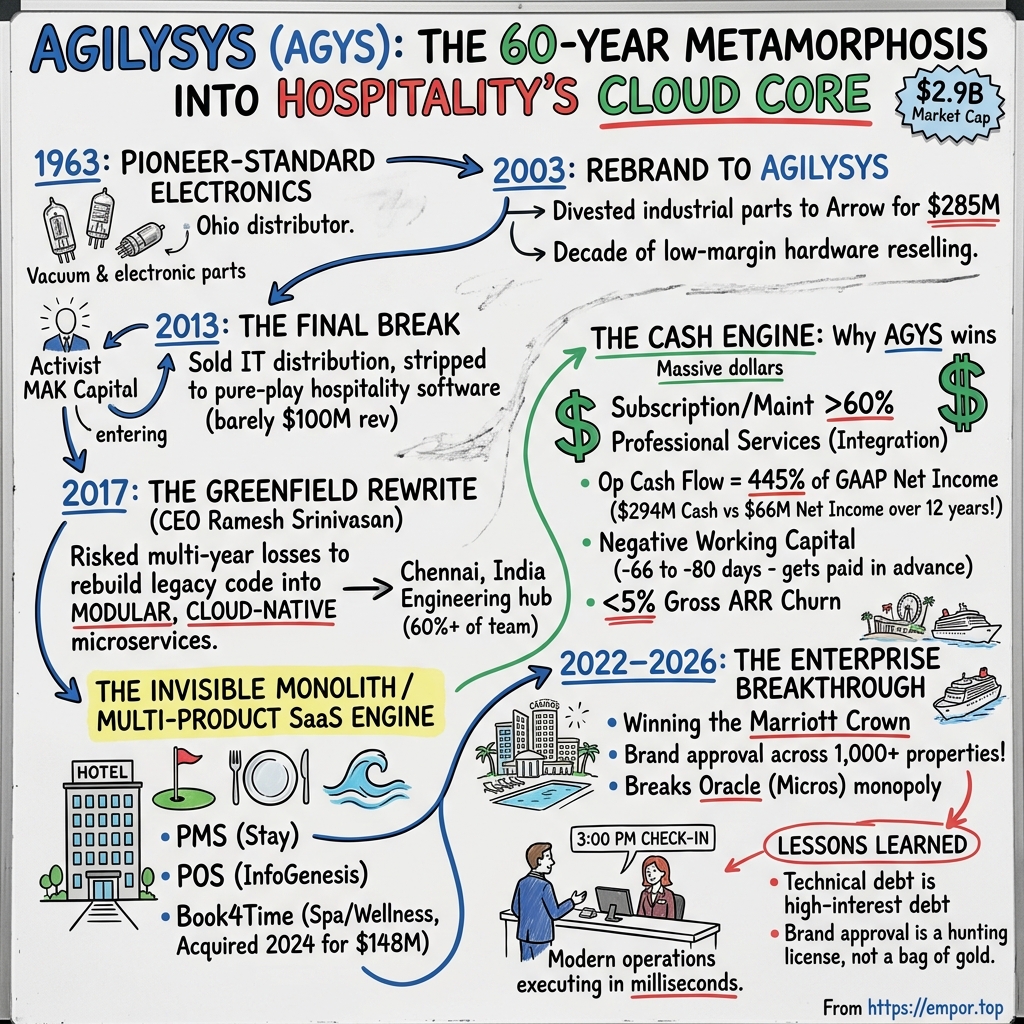
Agilysys: The 60-Year Metamorphosis into Hospitality's Cloud Core
I. The Check-in at 3:00 PM: The Invisible Monolith of Hospitality Tech
It is three o'clock on a Friday afternoon at a big resort on the Las Vegas Strip, and the line at the front desk curls back toward the slot machines. A couple from Chicago steps up. The clerk smiles, types a name, and in the second or two before keys slide across the marble, a surprising amount of machinery goes to work. The system has to find a clean room of the right type and confirm housekeeping has released it. It has to tokenize a credit card without storing the number anywhere a thief could reach. It has to check whether the husband is a high-tier casino player whose comps should land on the room folio rather than his card. It has to remember the 7:40 tee time booked last week, the couples' massage at four, and the table for two at the steakhouse that is already overbooked. If any of that fails, the line backs up, a guest posts a furious review, and a property earning millions a day in non-room spending starts bleeding money.
Almost nobody in that lobby knows the name of the company whose software often sits behind the screen. It is Agilysys, a Nasdaq-listed vendor based in Alpharetta, Georgia, which sells property management, point-of-sale, inventory, spa, golf, dining and guest-experience software to casinos, resorts, hotels, cruise lines and stadium food operators.1 It describes its offering as a portfolio of modular applications, more than thirty of them, that can be bought one at a time or stitched together into a whole operating system for a property.2
The strange part of the story is the company's birth certificate. Most enterprise software companies trace their founding to a garage or a dorm room in the 1990s or 2000s. Agilysys traces its lineage to 1963 and to Ohio, where it was incorporated as Pioneer-Standard Electronics, a distributor of electronic components.2 For four decades it moved other people's parts through warehouses. For another decade it resold other people's computers. Only in the last dozen years did it become, purely and narrowly, a hospitality software company, and only in the last five did that company start to make money.
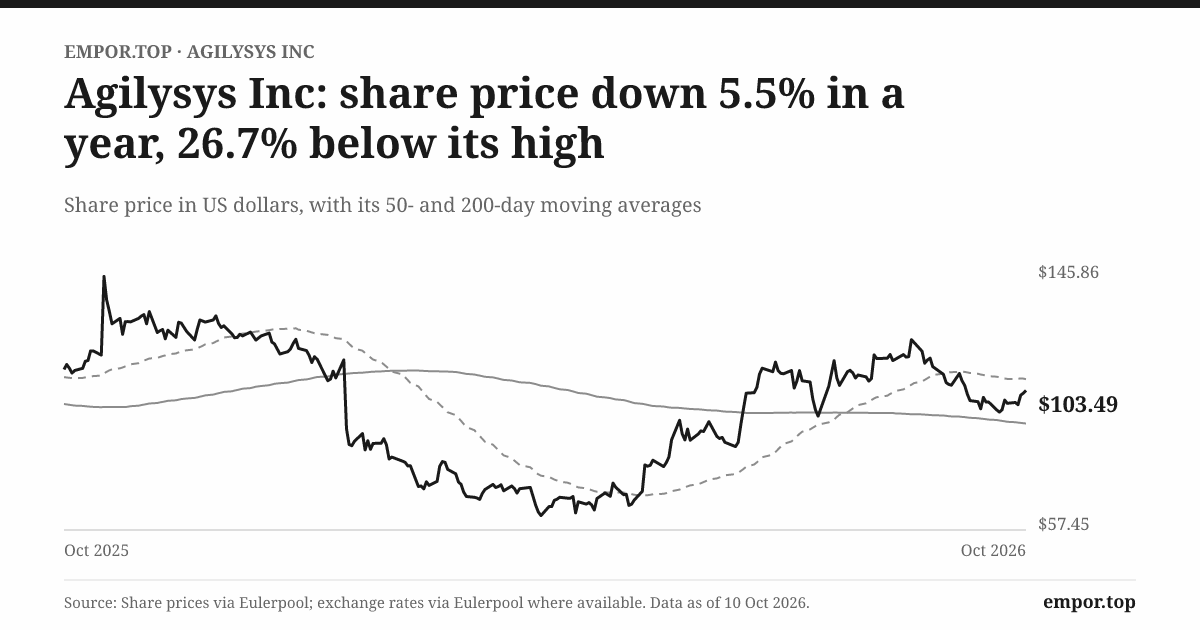
The market has noticed. On October 10, 2026, the shares closed at about $103, valuing the company at roughly $2.9bn, with an enterprise value of about $2.8bn once its net cash is netted off.2 That price is about 73 times the last twelve months of earnings and almost nine times revenue. Those are not multiples that investors pay for a sleepy maintenance business. They are multiples paid for a company expected to keep compounding for years, and they are also multiples that punish a stumble. The shares are already about 27% below their high of the past year, which is a reminder of how quickly enthusiasm can drain.2
The company today runs on a fiscal year ending March 31. In the twelve months to June 2026 it booked about $328m of revenue, and it ended its latest fiscal year with more cash than bank debt.2 That is a remarkable place to be for a business that, as recently as fiscal 2020, lost more than $34m at the operating line on $160m of sales.3
How did a component distributor become the cloud backbone of luxury hospitality, and is the transformation durable enough to justify the price? Three questions run through the rest of this story. The first is about adoption velocity. Agilysys has won a seat inside Marriott International, the largest hotel company in the world, but a brand approval is not the same thing as a thousand property owners writing checks, and the pace at which franchised hotels actually switch will decide how fast revenue grows. The second is about the margin ceiling. Agilysys spends more than a fifth of its revenue on product development, and the question is whether operating margins can climb from the low teens toward the 20%-plus levels that mature software companies earn, or whether that research bill is a permanent toll. The third is about capital allocation. MAK Capital, the investment firm of chairman Michael Kaufman, which anchored the shareholder register for most of two decades, has sold most of its stake. With free cash flow rising, what does management do with the money once its patient sponsor has stepped back?
To understand why those questions matter, it helps to understand how long it took Agilysys to find out what it was.
 Subscribe on LinkedIn
II. Pioneer-Standard and the Fifty-Year Identity Crisis (1963–2013)
Cleveland in the early 1960s was an industrial city with an appetite for parts. Factories needed relays, connectors, tubes and semiconductors, and somebody had to buy them by the crate from manufacturers and sell them by the box to engineers. Pioneer-Standard Electronics was one of those somebodies.2 Distribution is an honest business, but it is a hard one: the distributor owns inventory it did not design, competes on availability and price, and earns a sliver of margin on every unit. Scale is the only lasting advantage, and there is always a bigger rival.
For decades Pioneer-Standard did what distributors do. It grew, added computer systems to its catalogue alongside industrial components, and by the turn of the century had become a substantial, if unglamorous, enterprise whose revenue at its peak ran into the billions. But size did not change the physics of the trade. When the technology bust of 2001 crushed component demand, the weakness of a middleman model became obvious: a distributor with thin margins and heavy inventory has very little room to absorb a downturn.
In 2003 the company made the first of its great amputations. It sold its Industrial Electronics Division, the component distribution heart of the old business, to Arrow Electronics.5 What remained took a new name, Agilysys, and a new identity as a reseller of enterprise computer systems: servers and storage from the big hardware vendors of the day, wrapped in services. The new name was meant to sound like the future. The economics still looked like the past. Reselling a server built by someone else gave Agilysys little more pricing power than reselling a capacitor had.
Somewhere in that drift, almost by accident, the company assembled the seed of what it would become. Through a series of bolt-on purchases in the mid-2000s, Agilysys picked up hospitality software: the InfoGenesis point-of-sale system that ran bars and restaurants inside casinos and resorts, the Visual One property management system, and LMS, a property management product built for gaming operators.4 At the time these were side dishes on a hardware reseller's plate. Nobody was writing about Agilysys as a software company. But those products had something the server business lacked: customers who could not easily leave.
The next decade was a slow, painful process of selling everything else. The company divested its technology solutions business and then, in 2013, its retail solutions business, leaving a hospitality software company of barely $100m in revenue.6 It was an odd outcome for a firm that had once been a billion-dollar distributor. Agilysys had spent half a century selling the pieces of other people's computers, and what survived the purge was a small collection of aging software products for casinos and hotels.
That leftover was not obviously a prize. In fiscal 2015, the first full year of the modern company, Agilysys lost about $12m at the operating line on roughly $103m of revenue.4 The software was largely on-premise and client-server, written for an era when every property ran its own servers in a back room. The company was too small to outspend its rivals and too old-fashioned to outmaneuver them.
What it did have was a patient shareholder. Michael Kaufman's MAK Capital had accumulated a large stake and a seat at the head of the board.8 The bet, as an outsider could reconstruct it, was simple: underneath the clutter of a holding company in decline sat an installed base of casino and resort operators whose software was woven into their daily operations, and installed bases like that are worth far more than their current profits suggest, provided someone modernizes the product before customers defect.
So here is the verdict on the first fifty years. The distribution and reselling businesses carried almost no pricing power, and shedding them was necessary. But shedding them did not make Agilysys a good business. It made Agilysys a small, unprofitable one with a sticky customer base and an obsolete product. The question entering 2017 was whether anybody could turn that stickiness into a modern company before the customers ran out of patience.
III. The Turnaround: Ramesh Srinivasan and the Greenfield Rewrite (2017–2021)
In January 2017, Ramesh Srinivasan walked into the Alpharetta headquarters as the new chief executive.8 He was not a Silicon Valley software founder. His résumé ran through the less glamorous corners of technology that touch physical operations: he had been chief executive of Bally Technologies, the slot machine and casino systems maker, and before that chief executive of Innotrac, a fulfillment and call center company.8 That background mattered. Srinivasan knew casino operators, knew how long it takes them to replace a system that touches regulated gaming floors, and knew what it feels like to run a company whose products are tied to physical hardware and frontline staff.
What he inherited was not pretty. Agilysys had lost money at the operating line in fiscal 2015, 2016 and 2017, and it would keep losing money for four more years under his leadership: about $11m in fiscal 2017, $12m in 2018, $13m in 2019, and then a far deeper $34m in fiscal 2020.34 The product portfolio was a collection of separate codebases, acquired at different times and written for different eras, that did not share a common foundation. Customers in gaming and resorts were loyal largely because switching was hard, not because they loved what they had. Oracle, which had bought Micros Systems in 2014, was pushing its own hospitality suite into the cloud.16 Newer cloud-native vendors were starting to court independent hotels.
There were two obvious paths. The first was to harvest. A small software company with high switching costs can raise maintenance prices, cut development spending, and throw off cash for a decade while the product slowly ages. Plenty of private equity firms run exactly that play, and it often works for a while. The second path was to rebuild. That meant spending heavily, for years, to rewrite the products on a modern architecture, accepting losses while the new versions caught up with the old ones in features, and betting that customers would eventually pay more for the cloud versions.
Srinivasan chose to rebuild, and he chose the hard version of rebuilding. Instead of wrapping the legacy software in a web front end, which is the software equivalent of putting a new facade on a building with crumbling foundations, Agilysys rewrote its core products as modular, cloud-native applications.2 The concept is worth pausing on for a listener who has never thought about software architecture. An old client-server system is like a house where the plumbing, wiring and walls were built as one structure: change the kitchen and you risk flooding the bathroom. A modular microservices system is closer to a set of prefabricated rooms that plug into common utilities. A hotel can add a spa booking module, or a mobile check-in module, without ripping out the reservation system. That modularity would become the heart of the company's competitive pitch.
Rebuilding is expensive, and the company found a way to make it less so. Agilysys built out an engineering organization in India through its subsidiary, Agilysys Technologies India, with large teams in Chennai and Gurgaon.15 By the company's account, more than 60% of its engineering and development headcount now sits in India.2 That is not unusual in enterprise software, but for a company of Agilysys's size it was decisive: it allowed a sub-$200m revenue business to fund a product rewrite that would otherwise have required the budget of a much larger firm.
The losses of fiscal 2020 deserve a closer look, because they are where the strategy was most exposed. Revenue that year actually grew, by about 14%, to roughly $160m.3 The operating loss widened anyway, because the company was spending on development and implementation capacity ahead of the revenue that would eventually pay for it. A skeptic at the time could reasonably ask whether this was investment or simply a company that could not control its costs. The honest answer is that nobody could know yet. The rewrite only justifies itself if customers adopt the new products and pay more for them, and in 2020 that proof had not arrived.
Then the world shut down. When COVID-19 closed casinos, emptied hotels and docked cruise ships in 2020, Agilysys's customers lost most of their revenue overnight. Fiscal 2021 revenue fell about 14% to roughly $137m, and the operating loss was about $21m.3 This was the moment when the harvest-or-rebuild choice was tested hardest. A company in that position could have slashed engineering to protect the income statement. Agilysys kept building, and its products in that period, contactless check-in, mobile ordering, kiosks, happened to match exactly what reopening properties needed.3 It also helped that customers barely left: the company has said churn stayed low through the crisis, which is the strongest early evidence that the installed base was as sticky as MAK had bet.2
There is a second, quieter piece of the turnaround: how management was paid. The board tied the large majority of the chief executive's pay to performance-contingent stock units linked to recurring revenue growth, subscription milestones and operating margin targets.78 Srinivasan's base salary has been $600,000, while his total reported compensation has run in the range of roughly $4.5m to $6.8m, more than 85% of it at-risk equity.7 Dave Wood, the chief financial officer since 2019, has worked under a similar structure.7 An investor should read this with a little care. Equity-heavy pay aligns management with shareholders, but it also means the stock-based compensation bill is real, and later in this story it shows up as one of the reasons cash flow looks so much better than profit.
By fiscal 2022 the strategy had flipped the sign on the income statement: an operating profit of about $6m on $162m of revenue.3 It was not a large profit. It was proof that the rebuild had not bankrupted the company. The verdict on the Srinivasan years so far is that he took the riskier path and it paid off, but the payoff came only because the customer base held through four years of losses and a pandemic. That stickiness was the hidden asset. The next question is how a business like this actually turns stickiness into cash.
IV. The Engine Room: Software Architecture, Economics, and the Flow of Cash
Follow a single evening at a resort casino and you can watch the money move. A guest orders a cocktail at the pool bar, and the drink is rung up on an InfoGenesis terminal. She charges it to her room, so the point-of-sale system talks to the property management system that holds her folio. Later, her husband is comped a dinner by a casino host because his play qualifies, and that comp flows to the same ledger. The next morning, she books a facial through the spa system and a late checkout through the hotel app. Every one of those transactions touches Agilysys software, and the resort pays Agilysys for the privilege, not per transaction like a payments company, but per room, per terminal or per module, every month.2
That pricing unit is the first clue to the economics. Agilysys makes money in three ways. The largest and most important is subscription and maintenance, which together account for well over half of revenue.2 Subscription is the cloud business, billed per room per month for the property management system, per terminal for point-of-sale, and per module or user for spa, golf, dining and the rest.2 Maintenance is the legacy business: customers running older on-premise versions pay annual support fees. The company has been steadily converting maintenance customers into subscription contracts, and management has described those conversions as lifting what each customer pays, which is the core of the rewrite's economic logic.12 Contracts typically run three to five years, with automatic renewal and price escalators.2
The second stream is professional services: implementation, data migration, configuration and project management, billed by milestone or by the hour.2 It is a lower-margin business, but it is also the best leading indicator in the company. A new module or a new property does not generate subscription revenue until it goes live, and going live typically takes six to eighteen months.2 When services revenue grows, subscription revenue tends to follow. When services capacity is stretched, the subscription backlog waits.
The third stream is products: terminals, tablets and peripherals sold alongside the software at modest margins.2 They matter mainly because a point-of-sale system does not work without something to tap.
Now comes the puzzle that makes Agilysys interesting to a forensic investor. Over the twelve fiscal years from 2015 through 2026, the company's cumulative net profit was about $66m. Its cumulative cash from operations over the same span was about $294m, almost four and a half times as much.234 Usually, when cash dwarfs profit by that margin, an investor should check whether the company is hiding something. Here the explanation is benign, and it comes in three parts.
The first part is that customers pay in advance. Subscription and maintenance contracts are billed annually or quarterly up front, so Agilysys collects money before it has earned it in an accounting sense. That prepaid money sits on the balance sheet as deferred revenue, which grew from about $45m in fiscal 2020 to more than $105m by fiscal 2026.2 The result is negative working capital: in fiscal 2026 the company's operating working capital was equal to minus 66 days of revenue, and in fiscal 2025 minus 80 days.2 Put simply, Agilysys's customers are financing its operations, interest-free. As the business grows, that float grows with it, and every year of growth throws off extra cash that never appears as profit.
The second part is that Agilysys spends very little on physical assets and expenses almost all of its software development. Capital expenditure runs at roughly $2m a year, under 1% of revenue.2 Product development, about $73m in fiscal 2026, flows straight through the income statement as an expense rather than being capitalized onto the balance sheet.2 This is the conservative choice. Some software companies capitalize a large share of their development spending, which flatters reported profit. Agilysys largely does not, so its reported profit understates the economic earnings of a business that is investing for growth.
The third part is non-cash charges, and here a skeptic should push back a little. Stock-based compensation rose from about $7m in fiscal 2020 to roughly $24m in fiscal 2026.2 That expense is added back in the cash flow statement, which makes operating cash flow look stronger, but it is a real cost paid by shareholders through dilution. An investor who wants to compare Agilysys's free cash flow with a company that pays its engineers in cash should mentally subtract that figure. Do so, and fiscal 2026 free cash flow of about $68m becomes something closer to $44m of owner earnings, still healthy but noticeably less dazzling. There is one more distortion running the other way: in the quarter to December 2023, Agilysys released a valuation allowance against its US deferred tax assets, booking a non-cash tax benefit of about $68m and producing a fiscal 2024 net profit of about $86m that had nothing to do with that year's operations.4 Anyone who reads fiscal 2024's earnings at face value will badly overstate the company's earning power.
Receivables tell the same story about customer behavior. Debtor days, the average time it takes to collect, have fallen from about 90 in fiscal 2015 to 58 in fiscal 2026, after dipping into the mid-40s in recent years.2 The recent uptick is worth watching but is consistent with a larger mix of enterprise contracts and milestone billing. The allowance for credit losses has stayed small, between about $1m and $2m, and write-offs have been negligible.2 The reason is almost physical. If a hotel stops paying for its property management system, it cannot check guests in. Software that is operational oxygen gets paid.
So the engine room reveals a business with exceptional cash conversion and a conservative accounting posture, but with a heavy research bill that suppresses reported margins and a growing stock-compensation line that flatters cash flow. The quality of the engine is clear. The size of the eventual profit pool depends on how many more properties plug into it, which brings the story to the biggest customer win in the company's history.
V. The Enterprise Breakthrough: Winning the Marriott Crown (2022–2026)
For decades, the shape of hospitality technology was simple. The big global hotel brands ran on Oracle, through the Opera property management system and Micros point-of-sale that Oracle acquired when it bought Micros for about $5.3bn in 2014.16 Agilysys lived in the neighborhoods Oracle did not prioritize: tribal casinos, regional gaming companies, independent luxury resorts, cruise ships, stadium concessions. It was respected in those niches, but it was not invited to the big table.
That changed in December 2022, when Marriott International selected Agilysys to deploy its cloud-native property management system across Marriott's luxury, premium and select-service hotels in North America.29 In May 2024, Marriott added Agilysys's point-of-sale product as an approved brand standard.9 For a company that had spent fifty years searching for an identity, this was the moment of arrival: the world's largest hotel company had put its name next to Agilysys's.
Management has reported that more than a thousand properties had moved onto the platform by 2026.12 That number, more than any press release, is what makes the Marriott relationship real rather than ceremonial. It is also what lies behind much of the revenue growth of the past few years, which ran at roughly 15% to 20% a year from fiscal 2023 onward.23
There is a fear that often travels with a win like this: that one giant customer will come to dominate the revenue line and then squeeze the vendor. Agilysys has a clean answer to that. In every annual report from fiscal 2022 through fiscal 2026, it has disclosed that no single customer accounted for 10% or more of revenue.2 The reason is structural. Marriott does not buy software for its hotels the way a single company buys software for its offices. Most Marriott hotels are owned by someone else, a real estate investment trust, a private equity fund, a family office, and operated under a franchise or management agreement. The contracts and the checks are spread across many owners.
That same structure is also the strongest evidence against the most bullish reading of the Marriott story. The popular version goes like this: once a vendor becomes a brand standard at Marriott, Hilton or Hyatt, it has a captive pipeline that locks out competitors. The record suggests something more modest. A brand approval is a hunting license, not a purchase order. The individual owner of a Marriott hotel controls the capital budget for that property. If the owner is satisfied with an existing system, whether Marriott's older in-house platform or Oracle, the owner can wait. Replacing a property management system means paying installation fees, buying hardware, retraining staff, and risking disruption during the switch. When interest rates are high and owners are watching every dollar of capital spending, waiting is an easy decision.
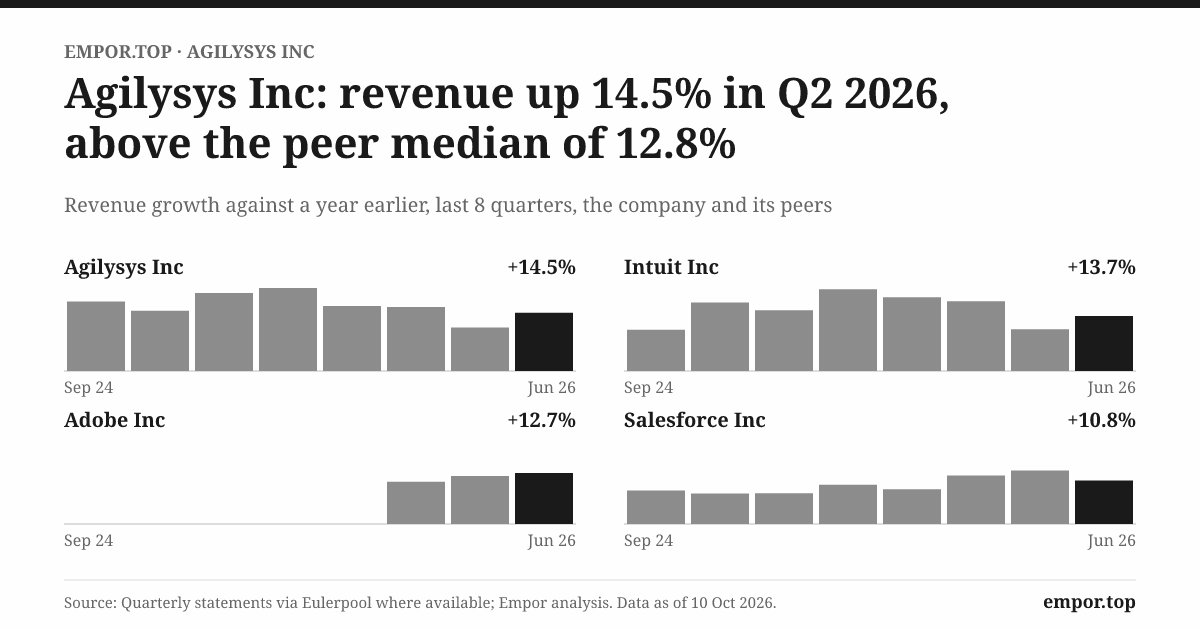
The company's own numbers carry the evidence of that friction. Quarterly revenue growth reached 20.6% in the quarter to June 2025, then slowed to 16.2%, 15.9% and 10.8% over the next three quarters before recovering to 14.5% in the quarter to June 2026.2 Part of that pattern reflects the anniversary of the Book4Time acquisition, which boosted growth for a year and then dropped out of the comparison. But it also shows that the Marriott rollout is an S-curve, not a step function. Professional services teams can only deploy so many properties a quarter, and owners schedule migrations around their own calendars. On recent calls, management has described the hotel pipeline as strong while acknowledging that the timing of go-lives drives quarterly results.1213
So what does the evidence say about the claim that the Marriott win is an unassailable moat? It narrows it. The win is a real, hard-won validation that Agilysys's cloud products can meet the standards of the most demanding hotel operator in the world, and it has broken Oracle's grip on the top tier of global hotel brands. But it has not produced a captive pipeline. It has produced the right to compete for each property, one owner at a time, with an advantage that is meaningful but not decisive. The figure that will confirm or falsify the stronger version of the claim is subscription revenue growth: if it can hold at around 18% or higher year over year as the Marriott rollout scales, the hunting license is turning into a franchise. If it settles in the low teens, the rollout is slower than the story implies.
Meanwhile, Agilysys had already decided not to wait for the rollout to fill the growth gap. In the summer of 2024, it went shopping.
VI. M&A and Capital Discipline: The $148M Book4Time Acquisition (August 2024)
By the summer of 2024, Agilysys was sitting on roughly $145m of cash, more money than it had held in years, accumulated from those advance billings and rising operating profit.4 In August 2024 it spent nearly all of it, and then some. The company agreed to acquire Book4Time, a cloud software provider for spa, wellness and activity booking used by luxury hotels and resorts, for about $148m in cash.10
The strategic logic is easier to understand if you think about how a luxury resort makes money. Room revenue is the headline, but the margin often lives in the extras: the massage, the thermal pools, the yoga class, the cabana by the pool, the guided hike. Those ancillary bookings are complicated to manage, because they involve staff schedules, treatment rooms, equipment and packages, and they need to talk to the property management system so the charge lands on the guest's folio. Book4Time had built a strong position in exactly that niche, with about 120 employees and customers among some of the world's best-known luxury brands.10 For Agilysys, it filled a gap in its module catalogue with a product already proven at the high end, and it gave the company a fresh set of luxury hotel customers into which to cross-sell everything else.
Was the price sensible? Agilysys did not publish a precise revenue multiple for the deal, so any multiple an outsider calculates is an estimate. What can be said is that the company paid a price consistent with buying a pure software business with recurring subscription revenue, and that the alternative, building a spa and wellness platform from scratch, would have taken years of engineering time that the company was already spending on its core rewrite. The more relevant test of the deal is not the multiple paid on day one but whether the business keeps growing inside Agilysys, and here the evidence so far is mixed in the sense that it is incomplete: the acquisition clearly lifted revenue growth for a year, but the company does not break out Book4Time's results separately, so investors cannot see how fast it is growing on its own.
The financing is the part of the story that says the most about management. To close the deal, Agilysys signed the first syndicated bank credit facility in its modern history: a five-year, $75m senior secured revolving line led by Bank of America, with an option to expand it to $125m.11 It drew $50m to fund part of the purchase price.11 The covenants were loose relative to the company's size, a leverage ceiling of three times and an interest coverage floor of three times, which tells you the bank saw little risk.11
Then the company paid the money back, quickly. Free cash flow of about $52m in fiscal 2025 and $68m in fiscal 2026 allowed it to cut the revolver to about $25m by March 2025 and to zero by March 2026.23 One detail is worth correcting because it is easy to misread. The balance sheet at March 2026 still shows about $19m of borrowings, but that figure is lease liabilities on offices in Georgia, India and Canada under the accounting standard that puts leases on the balance sheet, not bank debt.2 On a cash basis, Agilysys ended fiscal 2026 with about $117m in cash and no funded borrowings.2 It had digested an acquisition worth almost half its annual revenue in about a year and a half without issuing a single new share.
That last point invites the obvious question about dilution over a longer span. Agilysys has not raised money through public equity offerings or rights issues in the past decade.2 Its diluted share count has crept up from about 24m in fiscal 2021 to about 26.5m in fiscal 2026, driven by employee equity awards.2 That works out to roughly 2% a year of dilution, which is not nothing. It is the cost of the equity-heavy compensation structure described in the turnaround years, and it means the company's per-share returns are somewhat lower than its total-company returns. The company does maintain a share repurchase authorization, but it has used it opportunistically rather than as a large, systematic program, and it suspended its small dividend in fiscal 2025 to prioritize the acquisition.3
So the verdict on Book4Time is favorable but bounded. The financing and deleveraging were genuinely disciplined: a single, well-defined deal, paid for mostly with internally generated cash, repaid within eighteen months, with no equity dilution. That is a clean first data point. It is only one data point, though. Agilysys has no long record of large acquisitions under the current management, so there is not yet a pattern to judge, and the company does not disclose enough about Book4Time's standalone performance for outsiders to see whether the strategic logic has paid off. The next acquisition, if it comes, will tell investors more than this one did.
And the next acquisition will be decided without the shareholder who shaped the company for two decades.
VII. The Activist Sunset and the Governance Stress Test
There is a particular kind of shareholder that every turnaround needs and few companies get: one with enough ownership to insist on change, enough patience to wait for it, and enough restraint not to treat the company as a piggy bank along the way. For most of Agilysys's modern history, that shareholder was MAK Capital One, the investment firm founded by Michael Kaufman, who has served as chairman of the board.7 At its peak, MAK held more than a fifth of the company's shares.7
Kaufman's tenure spanned the whole messy arc of this story: the sell-offs of the non-hospitality businesses, the years of losses, the hiring of Srinivasan in 2017, and the slow climb back to profitability.78 When a single shareholder chairs the board and owns that much of a company, a governance-minded investor should ask the uncomfortable question. Did the sponsor extract value on the side? Did MAK collect advisory fees, consulting arrangements, special dividends or preferential deals?
The filings say no. Agilysys's proxy statements and annual reports disclose no management fees, advisory fees or other payments to MAK or entities controlled by Kaufman beyond standard director compensation, and no loans, guarantees or preferential trading arrangements with affiliates.78 That is not a trivial statement. A concentrated sponsor who chairs the board has every opportunity to charge for the privilege, and many do. Within the record of the company's recent proxy filings, MAK's rewards came from the same place as every other shareholder's: the share price.
And the share price did reward it. The stock rose from the mid-teens in 2020 to above $100 by 2026.2 Starting in 2024, MAK began selling under pre-arranged Rule 10b5-1 trading plans, which set the timing and size of sales in advance to avoid any suggestion of trading on inside information. By mid-2026 its stake had fallen to around 1.2m shares, roughly 4.5% to 5% of the company.7 That is a reduction of about three-quarters from its peak.
Who bought? Large institutional asset managers absorbed the selling. BlackRock is now the largest holder with around 15% of the shares, followed by Vanguard at around 9%, and growth-oriented managers such as Neuberger Berman and Wasatch Advisors with stakes in the mid-to-high single digits.7 The shareholder register has shifted from one dominated by a single activist sponsor to one dominated by index funds and institutional growth investors. That is the normal shape of a mid-cap public software company, and it brings both benefits and costs. Index funds rarely make trouble. They also rarely provide the kind of focused, patient pressure that a twenty-percent holder can apply when management drifts.
So far, there is no sign of drift. At the annual meeting held on September 2, 2026, every management proposal, including the election of directors, the advisory vote on executive pay and the ratification of the auditor, passed with more than 92% support.14 Grant Thornton has issued clean, unqualified audit opinions, including on internal controls, for fiscal 2024 through 2026, and the company has reported no material weaknesses in that period.234 The legal and tax overhang is small: no material litigation, and reserves for uncertain tax positions of under $1.5m.2 The board, of six to seven members, is independent except for the chief executive.7
A skeptic would raise two points. The first is that a 92% approval rate on say-on-pay is healthy but not unanimous, and that a compensation package of up to roughly $6.8m for the chief executive of a company with $40m of operating profit is generous relative to profits, even if most of it is performance equity.7 The second is that the absence of the anchor shareholder changes the incentive structure around the big decisions that lie ahead. A chairman who owned a fifth of the company had a direct interest in avoiding an expensive acquisition. A board whose largest owners are index funds has weaker direct pressure. That does not mean management will make a bad decision. It means the guardrails are now made of process and reputation rather than a large, engaged owner.
The verdict is that the transition from activist sponsor to institutional ownership has so far been clean: no related-party leakage, no audit problems, no governance revolt. But clean history is not the same as a tested future. The real stress test of the post-MAK governance structure will come the first time management proposes a major use of the company's growing cash pile. Before that, it is worth asking a more basic question: how strong is the competitive position that is generating that cash?
VIII. Moat Analysis: 7 Powers and Porter's Five Forces
Picture the IT director of a large casino resort being pitched by a rival point-of-sale vendor. The demo looks good. The price is lower. And then the director starts counting what it would actually take to switch. There are hundreds of terminals across dozens of bars, restaurants and kiosks that would need to be replaced or reconfigured. Thousands of frontline employees would need retraining. Interfaces to the property management system, the casino player-tracking system, the kitchen display systems and the payment processors would need to be rebuilt and tested. In a regulated gaming environment, some of that would need to be reviewed by compliance staff. And during the cutover, every mistake means a guest charge that does not post, a comp that goes missing, or a bar that cannot take orders on a busy Saturday night. The director thanks the vendor and keeps the existing system.
That scene is a fair summary of Agilysys's strongest competitive advantage. In Hamilton Helmer's framework of seven powers, the dominant one here is switching costs. Hospitality property management and point-of-sale systems sit at the center of a property's operations and revenue, and replacing them means disruption, retraining and integration work. The company has reported that gross churn of recurring revenue has remained below 5%, including through the pandemic, which is the most direct evidence that the advantage is real.2 The test that would break the claim is customers multi-sourcing or leaving for cheaper cloud alternatives, and the record does not show that happening in material numbers. But switching costs cut both ways: they also slowed the Marriott rollout, because the same inertia that keeps Agilysys customers in place keeps Oracle customers in place.
The second power is counter-positioning, and it is more contested. Agilysys's modular architecture lets a property adopt a single module, a spa system or mobile check-in, without replacing its core system. Historically, the large legacy suites were sold as integrated packages, which made piecemeal adoption harder. This gives Agilysys a way in that incumbents found awkward to copy without undermining their own bundled sales. The caveat is that counter-positioning fades as incumbents adapt. Oracle has been moving its hospitality products to the cloud, and a modern Oracle offering with open interfaces would narrow this advantage.16 This power is real today but it is time-limited, and its durability depends on whether Agilysys's product velocity keeps it ahead.
The third power is a partial cornered resource: deep domain knowledge in gaming integrations and a large, lower-cost engineering base in India.15 The gaming expertise is genuinely hard to replicate, because casino systems involve regulation and integrations that generalist software vendors rarely bother to learn. The India engineering base is a cost advantage but not a cornered one, because any competitor can build an offshore team.
Scale economies are developing but not yet decisive. Agilysys spreads its development budget of roughly $73m across thirty-plus modules and a growing base of properties.2 That is a lot of money for a company of its size, but it is a small fraction of what Oracle can spend across its enterprise businesses. Agilysys's advantage is focus, not scale. The other powers, network effects, branding and process power, are weak. A hotel's software does not become more useful because another hotel chain uses it, and while brand reputation helps the company qualify for requests for proposals, it does not create independent pricing power.
Porter's five forces fill in the rest of the picture. Buyer power is high. Large hotel brands negotiate hard on volume pricing and implementation timelines, and owners of individual hotels control capital spending. The absence of any customer above 10% of revenue limits the damage any single buyer can do, but the industry's structure means price realization will always be negotiated rather than dictated.2 Supplier power is low: the company's main inputs are engineers and cloud computing capacity, both of which are available from multiple sources. The threat of substitutes and new entrants is moderate. Restaurant-focused point-of-sale companies such as Toast are formidable in restaurants but lack the property management integrations, multi-outlet ledgers and gaming compliance that big resort casinos need. Cloud-native property management startups such as Mews and Cloudbeds have done well with independent and smaller hotels but have less experience with the complexity of large integrated resorts. Rivalry among existing competitors is high. Oracle remains the incumbent at most large chains, and other vendors including PAR Technology and Amadeus compete in parts of the market.16
Then there is the question every software investor now asks: does artificial intelligence threaten this business? The bear version is that large language models make software cheaper to build, lowering barriers to entry. The more realistic view is that the hard part of Agilysys's business is not writing code but integrating with physical devices, payment terminals, door locks, kitchen systems and gaming compliance systems, and convincing a property to risk its operations on a new vendor. Those barriers do not vanish because code becomes cheaper to write. Agilysys has incorporated AI-driven features such as automated waitlists and personalized upsell engines into its modules, but whether those features earn higher prices is not separately disclosed.2
The verdict is that Agilysys has a real moat built mainly on switching costs, with a supporting but time-limited advantage from its modular architecture. The moat is strongest in complex full-service properties, resort casinos, cruise ships and large luxury hotels, and weaker in select-service hotels where simpler cloud systems compete. The key number to watch is the research spending ratio, which has run at roughly 23% to 24% of revenue.2 If the company can hold its competitive position while that ratio drifts lower, the moat is deepening. If it needs to keep spending at that level to stay even, the moat is real but expensive to maintain. That distinction is exactly what the stock price is debating.
IX. Valuation and the Bull vs. Bear Case
On the call for the fourth quarter of fiscal 2026, analysts were trying to reconcile two things at once. Management was upbeat about the subscription pipeline and the pace of hotel deployments.12 But headline revenue growth in that quarter had slowed to about 11%, down from about 21% a year earlier.2 The share price, which had peaked above $140 in the preceding twelve months, had already been sliding, and it has kept sliding since, to about $103 today.2
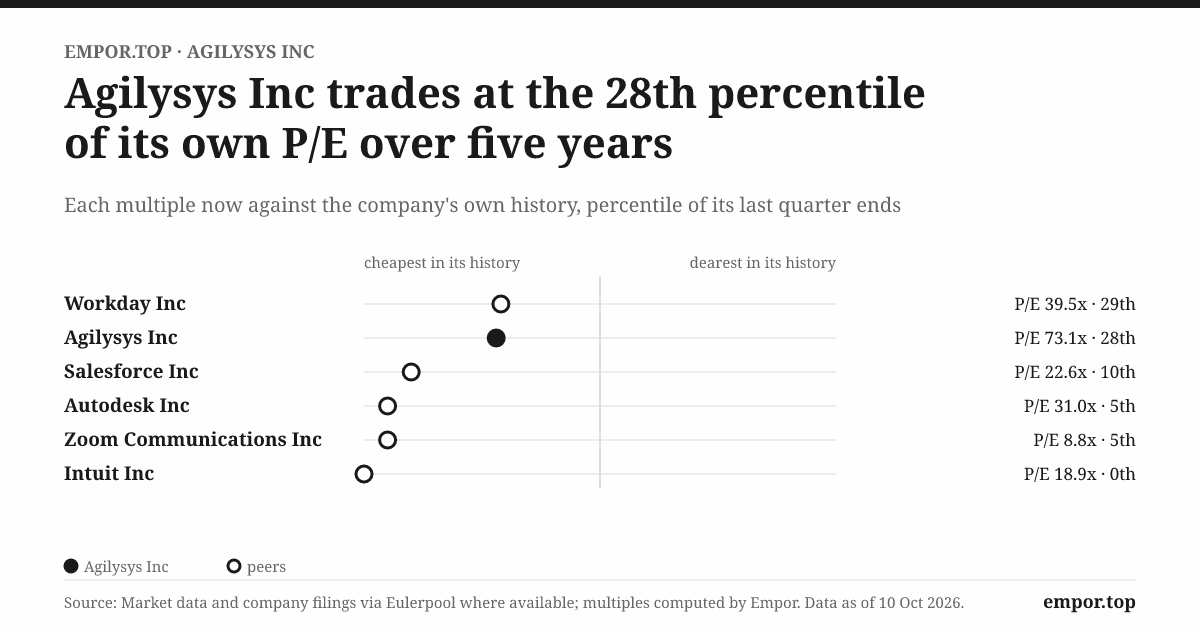
At that price, the market values Agilysys at about 73 times trailing earnings, about 8.6 times enterprise value to sales, and about 43.5 times enterprise value to EBITDA, with a free cash flow yield of about 2.8%.2 Those numbers can be read two ways. Against Agilysys's own history, the stock looks less expensive than it has been: its median price-to-earnings ratio over the past five years was about 149, though that figure is inflated by years when earnings were tiny.2 Against its peers, it looks expensive. PAR Technology trades at about 2 times sales and Toast at roughly 3.5 to 4.5 times, partly because their revenues include lower-margin payment processing and hardware.2 Oracle trades at a similar sales multiple to Agilysys, but on far higher margins.2
What does the price assume? A rough way to see it: a free cash flow yield under 3% only makes sense if cash flow keeps growing at a strong double-digit rate for many years. If Agilysys can grow revenue in the mid-teens and lift operating margins toward 20%, the earnings multiple compresses quickly as profits rise. If growth slows to the low teens and margins stall, the multiple looks very high for a long time. The market is pricing in something closer to the first scenario than the second.
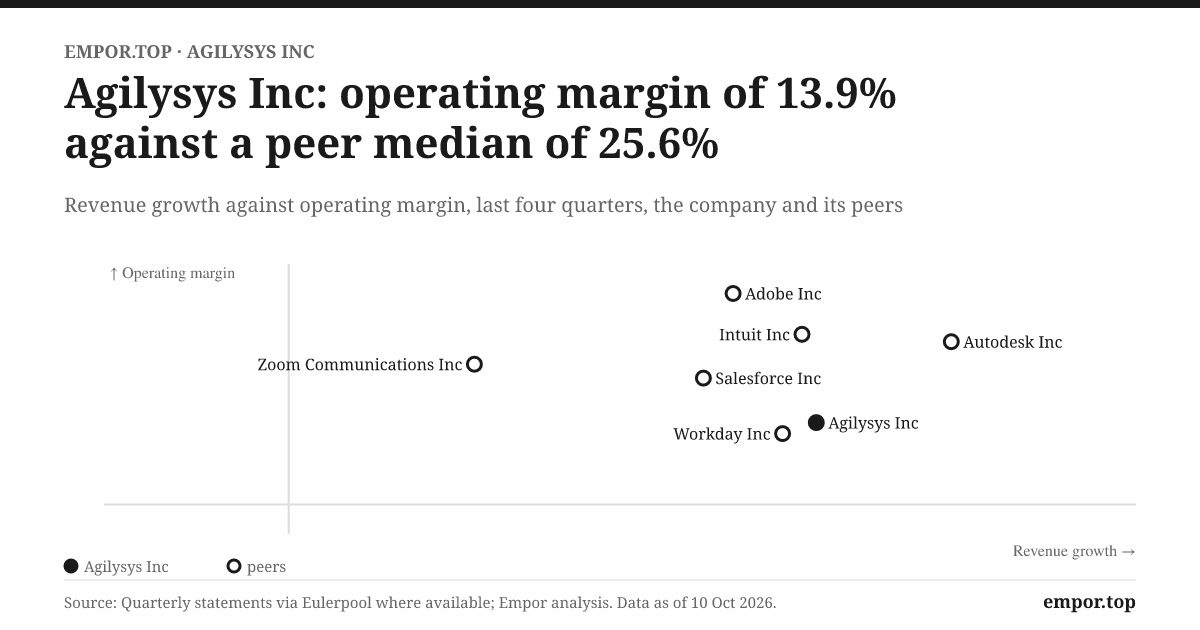
The bull case rests on three supports. The first is that the Marriott rollout accelerates. Many hotels operate on refresh cycles, and as more owners come up for system replacement, the pace of migrations could climb, pushing subscription growth back above 20%. The evidence for this is the scale of the pipeline management describes and the more than a thousand properties already live.12 The second is cross-selling. A property using one or two Agilysys modules can add spa, mobile check-in, dining reservations or inventory management without any new customer acquisition cost, and every added module raises revenue per property. The Book4Time acquisition expanded the catalogue for exactly that purpose.10 The third is operating leverage. Operating margin climbed from about 7% in fiscal 2024 to about 12.6% in fiscal 2026, and reached nearly 18% in the quarter to September 2025.2 If recurring revenue keeps growing faster than engineering costs, margins could reach 20% or more, and earnings would roughly double.
The bear case also has three parts. The first is franchisee inertia. Hotel owners facing high interest rates and softening revenue per available room may keep postponing system replacements, which would slow deployments and keep growth in the low teens. The quarterly growth slowdown over fiscal 2026 is consistent with that risk, even if it does not prove it. The second is the research treadmill. If Agilysys has to keep spending more than a fifth of its revenue on development just to keep pace with Oracle and newer cloud vendors, the margin expansion story has a ceiling. The company's own spending pattern supports caution: product development rose from about $57m in fiscal 2024 to about $73m in fiscal 2026, roughly in line with revenue, so the ratio has not yet fallen meaningfully.2 The third is multiple compression. If growth slows below about 12%, the stock could be re-rated toward the multiples of a broader enterprise software group, which would mean a much lower price even if the business keeps performing reasonably well. The stock's history illustrates the point: its largest fall over the past five years was about 56%.2
An activist looking at Agilysys today would probably not attack the balance sheet, which has net cash, or the governance record, which is clean. The challenge would focus on two things. First, stock-based compensation is now about $24m a year, a meaningful share of operating cash flow, and an activist would ask whether that dilution is being offset by buybacks or simply absorbed by shareholders.2 Second, an activist would push for clearer disclosure of the metrics that matter, especially subscription growth by product and the pace of Marriott property go-lives, so that investors are not forced to infer the health of the business from consolidated numbers.
The verdict is that Agilysys is priced as an elite vertical software compounder. That price is defensible only if both of the key questions resolve in its favor: subscription growth must stay in the high teens, and operating margins must keep expanding even as research spending stays heavy. The evidence so far supports the direction of travel but not yet the speed the price implies. That tension leads naturally to the lessons this story has to offer.
X. Playbook: Business and Investing Lessons
Go back to the boardroom in 2017. Agilysys had a small, aging product line and an installed base that was not going anywhere. The easy choice was to raise maintenance fees, cut development and harvest cash. The board and its new chief executive instead chose to spend years rebuilding the products from scratch, losing money every year until fiscal 2022, including the $34m operating loss of fiscal 2020.3 The first lesson comes from that decision. Legacy software is not an asset that holds its value; it is a liability that compounds. A browser wrapper over client-server code buys a few years and then fails at the worst possible moment. Agilysys paid the toll up front, and by the time cloud-native competitors were circling its customers, it had a cloud-native product to offer. The founder's version of the lesson is that the cheapest time to rebuild is when customers are still loyal; the investor's version is that years of losses can be the price of survival rather than a sign of failure, if retention holds. Technical debt is like margin debt: you either refinance it with a rebuild, or one day it calls in your moat.
The second lesson comes from the Marriott win. When the world's largest hotel company chose Agilysys, it looked like the end of a long climb. It was really the start of another one, property by property, owner by owner, migration by migration. The lesson for enterprise software investors is that a headquarters approval measures technical credibility, while the people who sign the checks determine revenue. In a franchised industry, those people are scattered across hundreds of owners, each with their own budget and calendar. Celebrate the master agreement if you like, but count the go-lives. Corporate headquarters gives you permission to sell; the franchisees decide whether you eat.
The third lesson is about cash. Over twelve years, Agilysys reported cumulative net profit of about $66m and generated about $294m of operating cash.2 A large part of that gap came from customers paying in advance, so that the company's own customers funded its growth. That float is what allowed it to buy Book4Time for about $148m and repay the borrowing within eighteen months without issuing shares.1011 The wider lesson is that in subscription businesses billed up front, growth itself produces cash, and a company with negative working capital can fund expansion that would otherwise require dilution. The caveat is that this works only while growth continues; if the business shrinks, the float unwinds. Deferred revenue is interest-free capital that turns your customers into your bank, but a bank that expects to be repaid in service.
The fourth lesson is about the activist. MAK Capital stayed for nearly two decades, chaired the board through the darkest years, hired the chief executive who turned the business around, and took no fees or side payments beyond standard director pay.7 Then it sold in an orderly way once the transformation was visible. The lesson for investors is that concentrated, engaged ownership can be the scaffolding a fragile turnaround needs, and the test of a good sponsor is not just what it builds but whether it extracts anything along the way. The lesson for boards is that the sponsor's departure removes a guardrail, and the institutions that replace it must be given the disclosure they need to hold management accountable. Patient capital is a turnaround's best friend, right up until the day it leaves and the company has to prove it can behave without a chaperone.
XI. Epilogue: The Next Moments on the Board
Tonight, Agilysys sits in an interesting spot. It is profitable, cash-generative and debt-free on a bank basis. It is embedded in some of the most demanding hospitality operations in the world. And its share price has fallen by about a quarter from its peak, as investors weigh slowing headline growth against the promise of a long enterprise rollout.2
The next few quarters will start to settle the three questions this story began with. The first moment is the fiscal second-quarter report, covering the three months to September 2026, due in the coming weeks. A year ago, that quarter produced the company's best operating margin of the modern era, almost 18%.2 Investors will be watching whether that performance can be repeated or whether it was a peak, because a margin that cannot be sustained tells a very different story about the research treadmill than one that becomes the new floor.
The second moment is the subscription growth rate through fiscal 2027. If subscription revenue grows at around 18% or more year over year as Marriott properties keep going live, the hunting license is becoming a franchise and the adoption question is answered in the company's favor. If it slows to the low teens, the bear case on franchisee inertia gains weight. Management's commentary on the pipeline has been consistently positive; the test now is whether the reported numbers keep pace with the commentary.1213
The third moment is the full-year margin in the fiscal 2027 annual report. If operating margin settles at 16% or above while research spending stays above 20% of revenue, the margin ceiling question is answered: the company can invest heavily and still earn software-like returns. If margins stall around the low teens, investors will have to accept that the research toll is permanent.
The fourth moment is the capital allocation decision. With cash of about $117m and rising, and MAK largely gone, management will face pressure to do something with the money.2 A large buyback, a sizeable new acquisition or simply accumulating cash each sends a different signal. A repurchase program large enough to offset stock-based dilution would show discipline. An acquisition larger than Book4Time would test whether the clean first deal was skill or luck.
And on the longer horizon, there is the question of whether other global hotel brands, Hilton, Hyatt, IHG, follow Marriott in certifying Agilysys as a standard. Each such approval would broaden the pipeline, though, as the Marriott experience shows, each would also be a hunting license rather than a guaranteed revenue stream.
Agilysys has proven it can survive and rebuild. What it has not yet proven is that it can scale its enterprise wins quickly enough to justify the price the market is asking investors to pay. That is the tension that remains.
XII. Outro
Go back to the front desk at three in the afternoon. The couple from Chicago gets their keycards, books a massage, adds a dinner reservation and heads for the elevators. They will never know that the software that just did all of that belongs to a company that began life in 1963 moving electronic components through a Cleveland warehouse.2
That is the strange beauty of Agilysys. In an era obsessed with consumer apps and splashy AI demos, some of the most durable value in technology compounds in plumbing that nobody notices until it breaks. Pioneer-Standard spent fifty years trying to sell the pieces of other people's computers before discovering that its real fortune lay in becoming the operating brain of the hotels and casinos where the cost of failure is measured in angry guests and lost revenue by the minute. Whether that brain is worth $2.9bn is a question the next few years will answer. That it exists at all is one of enterprise software's more improbable stories.
References
-
Agilysys Investor Relations Overview & Regulatory Filings — Agilysys, Inc. ↩
-
Agilysys, Inc. Form 10-K for the Fiscal Year Ended March 31, 2026 — U.S. Securities and Exchange Commission, 2026-05-21 ↩↩↩↩↩↩↩↩↩↩↩↩↩↩↩↩↩↩↩↩↩↩↩↩↩↩↩↩↩↩↩↩↩↩↩↩↩↩↩↩↩↩↩↩↩↩↩↩↩↩↩↩↩↩↩↩
-
Agilysys, Inc. Form 10-K for the Fiscal Year Ended March 31, 2025 — U.S. Securities and Exchange Commission, 2025-05-20 ↩↩↩↩↩↩↩↩↩↩↩↩
-
Agilysys, Inc. Form 10-K for the Fiscal Year Ended March 31, 2024 — U.S. Securities and Exchange Commission, 2024-05-21 ↩↩↩↩↩↩↩
-
Pioneer-Standard Electronics Announces Completion of Sale of Industrial Electronics Division to Arrow Electronics — Business Wire / Arrow Electronics, 2003-03-31 ↩
-
Agilysys Agrees to Sell Technology Solutions Group to Onex — Reuters, 2013-05-14 ↩
-
Agilysys Definitive Proxy Statement (DEF 14A) — U.S. Securities and Exchange Commission, 2025-07-18 ↩↩↩↩↩↩↩↩↩↩↩↩
-
Agilysys Definitive Proxy Statement (DEF 14A) — U.S. Securities and Exchange Commission, 2024-07-26 ↩↩↩↩↩↩
-
Marriott International Selects Agilysys to Deploy Cloud-Native PMS and POS — Agilysys, Inc., 2024-05-09 ↩↩
-
Agilysys Completes Acquisition of Book4Time — Agilysys, Inc., 2024-08-20 ↩↩↩↩
-
Agilysys, Inc. Form 8-K: Credit Agreement with Bank of America, N.A. — U.S. Securities and Exchange Commission, 2024-08-20 ↩↩↩↩
-
Agilysys Q4 and Full Year Fiscal 2026 Earnings Conference Call Transcript — Agilysys Investor Relations, 2026-05-21 ↩↩↩↩↩↩
-
Agilysys Q3 Fiscal 2026 Earnings Conference Call Transcript — Agilysys Investor Relations, 2026-01-22 ↩↩
-
Agilysys Form 8-K: Results of 2026 Annual Meeting of Stockholders — U.S. Securities and Exchange Commission, 2026-09-04 ↩
-
Agilysys Technologies India Private Limited Corporate Overview — Agilysys, Inc. ↩↩
-
Oracle Hospitality OPERA Cloud Property Management Platform Overview — Oracle Corporation ↩↩↩↩
 LinkedIn
 WhatsApp
 Reddit
 Hacker News
 Email
Email Kindle
 RSS Feed
 Spotify
 Apple Podcasts
 Amazon Music
 Audible
 YouTube