Argan, Inc.: The Quiet Powerhouse Wiring the AI Data Center Grid
I. Introduction & Episode Roadmap
There is a company headquartered in a modest office suite in Arlington, Virginia, that owns almost nothing you can photograph. It has no factories worth touring, no fleet of yellow cranes stenciled with its logo, no signature skyscraper, no consumer product, no patent portfolio to speak of. Its most valuable asset does not appear on any construction site at all: it is a bank balance. As of April 30, 2026, Argan, Inc. sat on roughly $973.6 million in cash, cash equivalents, and short-term investments, carried zero funded debt, and had a total stockholders' equity of just $474 million.1 Read that again. The company holds about half a billion dollars more in liquid securities than its entire book value of equity — because a large slice of that cash belongs, in an accounting sense, to its customers. That single, strange fact is the key to the whole business.
Argan is one of the least-known critical suppliers to the most-hyped story in global capital markets: the build-out of electricity to feed artificial intelligence. Wall Street spent 2024 and 2025 obsessing over Nvidia's chips and the hyperscalers' capital budgets. But a graphics processor is a paperweight without power, and the dirty secret of the AI boom is that the binding constraint has quietly migrated from silicon to substations. A modern AI data center campus can demand a gigawatt or more of continuous, uninterrupted electricity — the output of a serious power station — and it wants that power 24 hours a day, 365 days a year, regardless of whether the wind is blowing or the sun is up. Somebody has to physically build the plants that generate it. Argan, through its principal subsidiary Gemma Power Systems, is one of a very small number of American firms that actually can.
This is a classic "pick-and-shovel" story, but with a financial twist that makes it genuinely unusual. Argan is an engineering, procurement, and construction (EPC) contractor — the firm that takes a customer's plan for a power plant and delivers a finished, running facility for a fixed price. The economics of that business, done well, produce something close to a paradox: the company gets paid before it spends. Customers advance cash against construction milestones, so at any given moment Argan is holding hundreds of millions of dollars of other people's money on its balance sheet, money it will eventually convert into steel and turbines and wages. In the meantime, it parks that float in Treasuries and money-market instruments and collects the interest. In the first quarter of fiscal 2027 alone, that "other income, net" — essentially interest on the float — came to $8.4 million, a run rate approaching $33 million a year of almost risk-free income that helps fund the dividend and buybacks without touching operating cash.1
So the honest way to frame Argan is not "a construction company." It is closer to a disciplined project-management brain wrapped around a large, self-funding pool of customer capital. The interesting question — the one this article exists to test — is whether that combination constitutes a durable competitive advantage or merely a well-run participant in a violently cyclical, historically treacherous industry. Because for every EPC contractor that got rich building power plants, there is a graveyard of rivals that a single catastrophic fixed-price contract dragged into bankruptcy. The whole game is not winning work. It is refusing the wrong work.
The numbers behind the transformation are worth sitting with, because they are the kind that make a value investor look twice. For the full fiscal year ended January 31, 2026, Argan reported record revenue of $944.6 million, up 8.1% year over year, and record net income of $137.8 million, or $9.74 per diluted share — nearly doubling the $85.5 million, or $6.15 per share, it earned the year before.3 That is not the trajectory of a sleepy contractor; it is operating leverage flexing as high-margin projects rolled to completion. And it happened at a company that has quietly compounded value for a very long time: management is fond of noting that since 2007 — the first full year after the Gemma acquisition — Argan has grown its tangible book value per share and cumulative dividends to record levels, the boring arithmetic of a business that keeps more than it spends.3 The market has noticed. A stock that traded in relative obscurity for years re-rated sharply as the AI-power thesis crystallized, which introduces its own risk: expectations, once low, are no longer.
The paradox at the center deserves one more turn before we move on, because it is genuinely counterintuitive. Most companies that grow fast are cash-hungry — expansion eats working capital, and the faster you grow the more you must borrow or raise. Argan is the mirror image. When it wins a large power contract and construction ramps, it collects cash ahead of the costs it will incur, so a growing backlog actually swells the cash pile rather than draining it. Growth funds itself, and then some. That is why a company can pay out a rising dividend, buy back its own shares, make acquisitions, and still watch its cash balance climb toward a billion dollars. It is also, as we will see, the single most important thing to understand about the risk profile: the same mechanism that generates the float means that if the backlog ever stops replenishing, the cash machine idles in reverse.
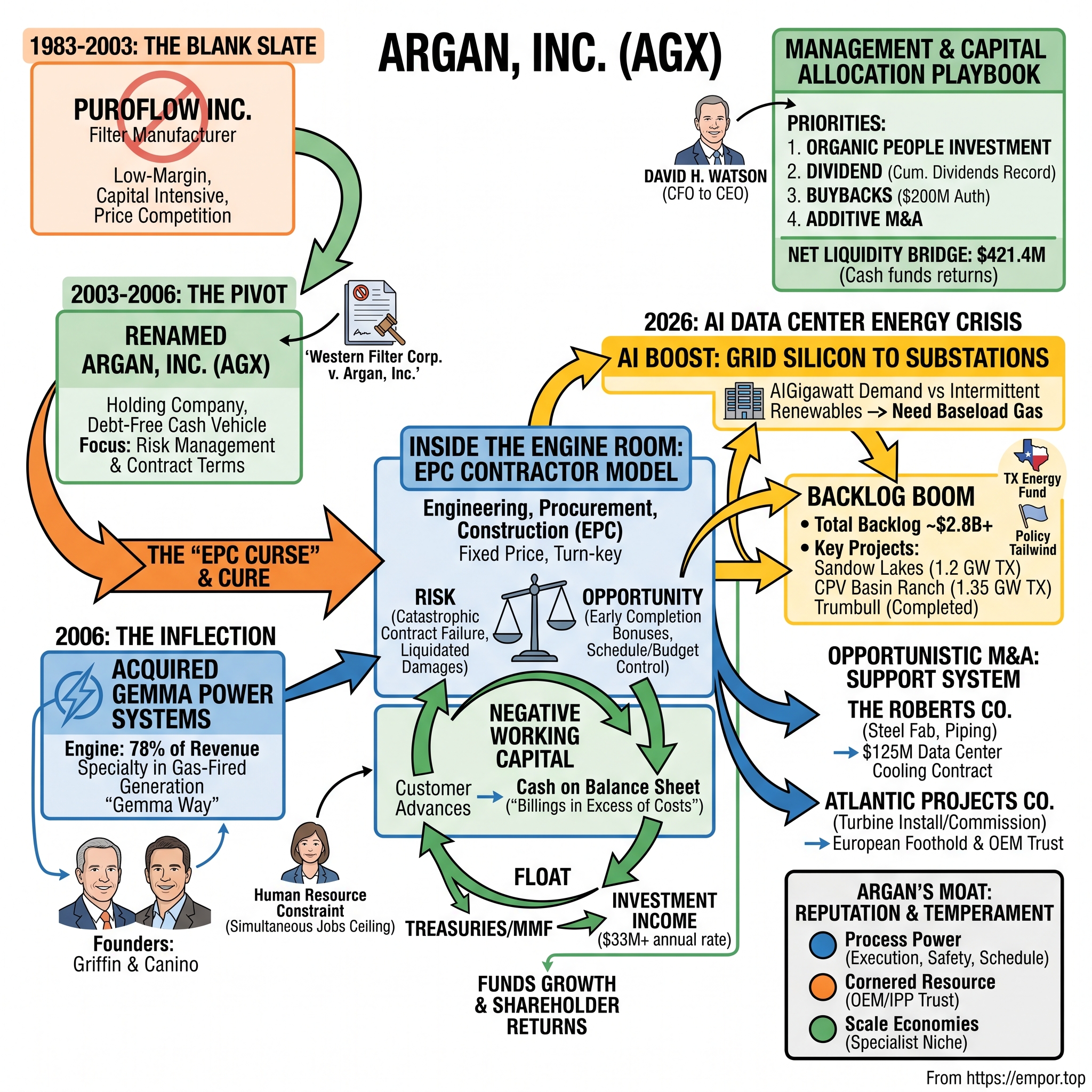
Here is the roadmap. We start in the early 2000s, when a debt-free holding company called Puroflow decided that manufacturing air filters was a dead end and reinvented itself as a blank-slate acquirer under a chairman scarred by a lawsuit. We trace the pivotal 2006 acquisition of Gemma Power Systems, the New England contractor that became the engine driving roughly 78% of revenue. We open up the mechanics of power EPC — why a gigawatt gas plant is a high-stakes game where one bad contract can end a company. We examine the 2026 AI inflection, where the realization that intermittent renewables cannot power a 24/7 data center has triggered a multi-decade renaissance for natural gas baseload. And we stress-test David Watson's capital-allocation playbook against the wreckage of larger competitors who forgot the industry's oldest rule. Let us begin where Argan began — not with a power plant, but with an air filter and a lawsuit.
 Subscribe on LinkedIn
II. The Blank Slate: Puroflow, Rainer Bosselmann, and the Pivot
Every reinvention needs a founder who is willing to kill the thing that made the company. For Argan, that person was Rainer H. Bosselmann, a German-born executive with the bearing of an old-world industrialist and a career spent buying, fixing, and selling businesses. When he took the reins of the entity that would become Argan, it was a tiny, unglamorous manufacturer trading under the name Puroflow Incorporated — a maker of specialty filtration products for aerospace and automotive applications, the kind of company that supplies precision air and fluid filters to jet-engine makers and defense programs. It was a legitimate business. It was also, in Bosselmann's assessment, a trap: low-margin, capital-intensive, forever reinvesting cash into equipment just to stand still, competing on price against larger players. The corporate shell itself had a long and winding lineage, having changed its name from Ultra Dynamics Corporation to Puroflow Incorporated back in 1983.11
The decisive act came in October 2003. Puroflow sold its filtration operations to Western Filter Corporation for roughly $3.5 million and, three weeks later, formally rechristened itself Argan, Inc.511 On paper it was a small divestiture of a small business. In practice it was a statement of intent: management was not interested in running a manufacturing operation at all. It wanted to become a holding company — debt-free, cash-rich, deliberately vague about its industry — that could hunt for a genuinely good business to buy. The name change was the tell. "Puroflow" described a product. "Argan" described nothing in particular, which was precisely the point.
Then came the lesson that arguably shaped the company's character more than any acquisition. The sale of the filtration unit did not end cleanly. Western Filter disputed the post-closing valuation of the inventory it had bought, and the fight escalated into litigation — Western Filter Corp. v. Argan, Inc. — that ground through arbitration and into the federal courts, ultimately reaching the U.S. Court of Appeals for the Ninth Circuit, which issued its decision in 2008.5 For a company with a market capitalization measured in the tens of millions, a multi-year legal brawl over the fine print of a $3.5 million sale was an expensive, distracting ordeal. But it left a residue that would define the culture: a near-religious attention to the exact terms of a contract, to what is being represented and warranted, to the difference between the price on the headline and the cash that actually changes hands.
That obsession — read the contract, quantify the risk, protect the balance sheet — is easy to caricature as mere conservatism. It is more accurate to call it the intellectual foundation of the entire investment case. An EPC contractor lives and dies by contract terms it agrees to years before it knows the outcome. A firm run by people who were once bled by a valuation clause in a small-business sale is a firm that will read the liquidated-damages provisions in a billion-dollar power contract very, very carefully. Bosselmann emerged from the Western Filter episode with a temperament perfectly suited to the business he was about to enter, even though he did not yet know he was going to enter it.
It is worth dwelling on how unusual Bosselmann's chosen structure was, because it explains the DNA of everything that followed. Most executives who inherit a struggling manufacturer either try to fix it, milk it, or sell the whole thing and walk away. Bosselmann did something rarer: he treated the public listing itself as the asset — a clean, debt-free vehicle through which patient capital could be assembled and redeployed into whatever business offered the best risk-adjusted returns. This is the logic of a permanent-capital holding company, closer in spirit to a small-scale Berkshire or a Danaher than to a conventional industrial. The implication for shareholders is profound. A holding company built this way does not fall in love with any particular product or industry; it is agnostic, opportunistic, and ruthless about capital. When the air-filter economics soured, there was no sentimentality — the business was sold and the shell repurposed. That same unsentimental posture would later let the company pivot decisively from a renewable-heavy backlog toward natural gas as the market demanded, without any ideological attachment to how it made its money.
The flip side of that agnosticism is a dependence on management judgment that investors must underwrite directly. A holding company with no fixed industry is only as good as the person deciding where the cash goes. In 2003, betting on Argan meant betting on Bosselmann's eye for a business — and, later, on his ability to find and retain the operating talent to run it. The Western Filter litigation, whatever its cost, functioned as an early demonstration that this was a management team that would litigate rather than roll over, count every dollar of inventory, and treat the fine print as sacred. Those are precisely the traits you want in the steward of a permanent-capital vehicle, and precisely the traits that would prove indispensable in the contract-driven, risk-laden world of power construction the company was about to enter.
By late 2003, then, Argan was a curious object: a public company with a clean balance sheet, a few million dollars in cash, essentially no operations, and a chairman looking for a highly cash-generative, capital-light service business to serve as its new core. It was, in the most literal sense, a search fund with a stock listing. What it lacked was the engine. That engine was operating quietly up in New England, building gas-fired power plants, and it was about to change everything.
III. The 2006 Inflection: Acquiring the Engine
To understand what Argan bought in 2006, you have to appreciate the reputation it was buying. Gemma Power Systems had been founded in 1997 by two men who had already spent twelve years building power plants together at another contractor: Bill Griffin and Joel Canino. The name "Gemma" was not a person; it came from the Latin for a bud that separates from the parent plant to grow on its own — a fitting metaphor from two founders who shared the same June birthday, fifteen years apart, and who were quite literally budding off to start something independent.4 (Popular investor lore sometimes attributes the company to a couple named "Wilcox"; the firm's own history tells the Griffin-and-Canino story, and it is worth getting right, because the founders' operating philosophy is the actual asset.)
Gemma's very first job set the template: the 160-megawatt Dighton combined-cycle power project in Massachusetts. From that New England base the firm built a reputation as a specialist in gas-fired generation, the kind of contractor that independent power producers trusted with complex, high-consequence builds. By 2002 — four years before Argan ever showed up — Gemma was already running annual revenues near $250 million with roughly 125 permanent staff and hundreds of craft workers in the field.4 This is a crucial and under-appreciated point: Gemma was not a startup that Argan scaled. It was an established, respected operator that Argan had the good sense to acquire and the discipline not to ruin.
The deal closed on December 21, 2006.10 What is most instructive is the structure and the philosophy rather than the price, which was never a headline-grabbing sum. Argan did not swagger in as a corporate acquirer intent on stamping its culture onto Gemma. It behaved instead like a decentralized financial sponsor — a patient balance sheet that kept the operating founders and managers in place and highly incentivized, while providing the one thing a mid-sized contractor most needs to win bigger work: financial credibility. A utility handing a contractor a billion dollars and years of schedule risk wants to know the firm will still be solvent at the end. Argan's clean, debt-free balance sheet was, in effect, a bonding and credibility instrument that let Gemma bid on larger utility-scale contracts than it could have reached alone.
This is where Argan's approach to M&A diverges sharply from the roll-up playbook that has destroyed so much shareholder value elsewhere. The classic roll-up overpays for acquisitions, funds them with debt, piles up enormous goodwill, and then discovers that the acquired businesses do not integrate and the synergies were imaginary. Argan did the opposite. It paid modestly, used its own cash rather than borrowings, kept goodwill on the balance sheet small relative to the size of the businesses it bought, and left the operating cultures largely intact. The acquisitions were bolt-ons to a decentralized federation, not forced marriages.
The customer base is what made Gemma valuable, and it is worth understanding who actually buys a power plant. The buyers fall into two broad camps: regulated utilities, which build plants to serve captive ratepayers and can often recover cost overruns through the rate base, and independent power producers — merchant developers who build plants to sell electricity into wholesale markets and who finance those plants with project debt from banks. That financing distinction turns out to matter enormously for a contractor. Because a bank lending against a merchant plant wants certainty about the construction cost, IPPs are typically forced down the fixed-price, turn-key route — they cannot get financed otherwise. This is precisely the contract structure Gemma had spent years mastering, which made it a natural partner for the IPPs who were, in the 2000s and 2010s, building the bulk of America's new gas capacity. Gemma did not just build plants; it made itself bankable to the lenders standing behind the developers.
Gemma's portfolio through the 2010s reads like a tour of the American gas build-out — from the Panda Liberty and Panda Patriot plants in Pennsylvania to a string of combined-cycle facilities across the PJM interconnection, the sprawling grid region stretching across the mid-Atlantic and Midwest where Gemma became a fixture. Along the way it kept a foot in renewables, forming a dedicated renewable-power division as solar and biomass work grew, so that when the energy mix shifted the company could shift with it. The point is continuity of reputation: each successfully completed plant became a reference for the next bid, and in a business where owners are terrified of picking a contractor who might fail mid-project, an unbroken chain of on-time deliveries is worth more than any marketing budget.
The results validated the restraint. Within a few years of the acquisition, Gemma had grown from an indispensable regional player into a national one, and Argan — a company that had recently been debating the merits of the air-filter business — found itself an essential partner to the independent power producers building America's gas fleet. The 2006 purchase transformed a listed cash shell into a real operating company with a real moat. But a moat around what, exactly? To answer that, we have to go inside the engine room and understand how power EPC actually makes — and loses — money.
IV. Inside the Engine Room: The Core Power Segment & Industry Structure
Picture a muddy 100-acre site in rural Texas. Over three years, it will be transformed into a combined-cycle natural gas power station: two enormous gas turbines the size of locomotives, a steam turbine capturing their exhaust heat, cooling systems, a switchyard, miles of high-pressure piping, and a control room, all engineered to convert methane into roughly 1.2 gigawatts of electricity at world-leading efficiency. The customer — an independent power producer, or IPP — does not want to manage the thousands of moving parts, the hundreds of subcontractors, or the terrifying risk that any one of them fails. So it does something that looks, at first, insane: it hands the entire job to a contractor for a single fixed price, turn-key, with a hard completion date. That is EPC — engineering, procurement, and construction — and it is the business that generated $227 million, or 78% of Argan's total revenue, in the first quarter of fiscal 2027 alone, while the Power segment carried roughly $2.5 billion of the company's $2.8 billion backlog.12
The fixed-price, turn-key structure is the source of both the opportunity and the terror. Consider what "fixed price" means when the project spans three or four years. The contractor commits today to a number, then absorbs whatever happens next: steel prices spike, a key subcontractor goes bankrupt mid-job, a hurricane floods the site, a design flaw surfaces during commissioning. Worse, most contracts carry liquidated-damages clauses — pre-agreed penalties for finishing late that can run to six figures per day. On a large plant, a serious schedule slip does not dent the margin; it can vaporize the entire profit on the job and then keep eating. This is the "EPC curse," and it is not hypothetical. The upside is the mirror image: bring the plant in ahead of schedule and under budget, and the contractor keeps the savings and often earns early-completion bonuses. The difference between a triumph and a disaster on the same contract can be a matter of months.
The middle letter of EPC — procurement — is where a lot of the quiet money is made, and it is under-appreciated by anyone who pictures the business as merely pouring concrete. On a combined-cycle plant, the single largest cost items are the major equipment: the gas turbines, the steam turbine, the transformers, the heat-recovery steam generators. A contractor who has built dozens of these plants knows the OEMs, understands lead times, and can sequence orders and manage logistics in ways a first-timer cannot. Buy the right equipment at the right time, manage the supply chain so that a $50 million transformer arrives exactly when the site is ready for it rather than sitting in storage accruing cost, and the procurement function becomes a margin engine rather than a pass-through. Conversely, mismanage it — order late into a supply-constrained market, get caught by a lead time that balloons from eighteen months to four years — and procurement becomes the thing that blows the schedule and the fixed price together. The vertical integration of the Roberts fabrication business fits precisely here: by making high-pressure piping and pressure vessels in-house, Argan captures a slice of procurement margin that would otherwise leak to a vendor, while removing a supply-chain dependency on the most schedule-critical components.
Argan's answer to this brutal asymmetry is a business model built around variability. Gemma does not carry a massive standing army of unionized craft labor that must be paid whether or not there is work — the fixed cost that turns an industry downturn into an existential crisis. Instead, it operates as the elite project-management "brain": a relatively lean core of engineers, project leaders, and superintendents who design the job, procure the equipment, sequence the work, and manage quality and safety, while hiring local trade subcontractors — the welders, pipefitters, and electricians — on a project-by-project basis. When a job ends, that variable cost rolls off. This is why the company can talk, as management repeatedly does, about a capacity ceiling measured not in dollars but in simultaneous jobs — on recent earnings calls, David Watson has pegged it at roughly 10 to 12 major projects at once, constrained less by capital than by the supply of experienced project leaders steeped in "the Gemma way."2
There is a subtle second layer to the model that only surfaces when you listen closely to how management talks about capacity. On the first-quarter fiscal 2027 call, an analyst pressed Watson on whether Argan could handle $2 billion of annual revenue a few years out — double its current run rate. Watson's answer was revealing. The constraint, he explained, is not capital and not even revenue; it is the number of jobs the organization can execute simultaneously — that 10-to-12 ceiling — because each job consumes a scarce resource: seasoned project leadership trained in the Gemma method.2 But revenue per job is climbing steeply, because inflation and the sheer scale of modern gigawatt plants mean each build is a far bigger dollar figure than it was a few years ago. So the same 10-to-12 job capacity can, over time, carry far more revenue — Watson conceded $2 billion was achievable "down the road" as the platform's people and experience deepen.2 The bottleneck, in other words, is human, and it is why management treats training and retention of non-craft staff as a core capital-allocation priority rather than an afterthought; on the year-end call it noted its non-craft workforce was at the highest level in company history and still growing.3
Another nuance emerges on pricing. Analysts often assume merchant IPP work carries fatter margins than utility work because fewer contractors will take the fixed-price risk. Watson pushed back on that framing directly: price is driven by the project — its scope, complexity, size, and location — far more than by the identity of the customer, and he would not concede that IPP contracts are systematically richer than utility ones.2 What he would say is that the company prices every contract off the same disciplined model, building in explicit allowances for inflation, labor, supply-chain risk, and the specific hazards of each scope, and working collaboratively with the customer from the outset to avoid the disputes that wreck margins later.3 It is an unglamorous answer, and its consistency across calls is exactly the point: this is a management team that treats pricing as risk management, not salesmanship.
The competitive landscape explains why that discipline matters. Argan competes for work against far larger names — Kiewit, Burns & McDonnell, Fluor, Bechtel, and Quanta Services among them. It cannot outspend them. What it can do is out-select them: bid only on the familiar, high-efficiency natural gas and utility-scale solar projects it knows how to execute, and walk away from the exotic, first-of-a-kind work where fixed-price risk becomes unquantifiable. The industry's cautionary tales are instructive here. Chicago Bridge & Iron and Westinghouse were effectively destroyed by disastrous fixed-price commitments on nuclear megaprojects whose costs spiraled beyond any contingency. The lesson Argan seems to have internalized is not "avoid risk" — a fixed-price contractor cannot avoid risk — but "only accept risk you have priced a hundred times before." On the fiscal 2027 first-quarter call, Watson made the point almost as a boast, noting that Gemma had not suffered a single "lost job" — a project that loses money to completion — since Argan acquired it two decades ago.2
That claim deserves the skeptic's scrutiny rather than the fan's applause, because it is the load-bearing wall of the entire bull case. A twenty-year run without a money-losing large project is genuinely rare in this industry, and if true it is powerful evidence of a real capability. But it is also a backward-looking statistic assembled during a period when Gemma largely stuck to a narrow band of well-understood gas and solar work. The relevant question for an investor is whether that record survives contact with the current backlog — bigger plants, tighter labor, longer supply chains — a question we return to in the stress test. For now, the takeaway is that Argan's edge, to the extent it exists, is less a technology than a temperament: the operational muscle memory to deliver complex plants on time, married to the institutional willingness to say no. The next move in the company's history shows that discipline applied to acquisitions rather than contracts.
V. Opportunistic M&A: Building the Support System
By 2015, Gemma had a recurring headache that only shows up when you build enough power plants: it kept having to buy, from outside vendors, the specialized high-pressure steam piping and fabricated steel components that go into every combined-cycle plant. Every dollar of that work was margin flowing to someone else, and every external supplier was a potential bottleneck or point of failure on a schedule where failure costs six figures a day. So Argan did what a vertically minded operator does — it bought the capability rather than renting it.
In December 2015, Argan acquired The Roberts Company, a North Carolina-based heavy industrial firm specializing in steel fabrication, piping, and industrial maintenance. The financial terms were the purest possible illustration of Argan's acquisition style: the purchase price was a mere $500,000, alongside the assumption of roughly $17 million of Roberts' debt obligations, which Argan expected to retire almost immediately using its own cash.6 In other words, Argan bought a real industrial business — plant, equipment, skilled workforce, customer relationships — for a headline price smaller than a suburban house, because it was willing to take on and clean up a balance sheet the seller could not manage. Roberts gave Argan in-house fabrication for the very piping and pressure vessels Gemma had been sourcing externally, folding a supplier's margin into the family and hardening the supply chain on the most schedule-critical components.
The same year brought a second, more strategic bolt-on: Atlantic Projects Company, or APC. APC's pedigree is unusual. It was founded in Ireland in 1974, originally as an entity associated with General Electric, and had spent decades installing and commissioning turbines, boilers, and large rotating equipment for OEMs, EPC contractors, and plant owners across the Republic of Ireland and the United Kingdom.11 For Argan, APC accomplished two things at once. It planted a flag in the European and Irish power markets — a genuine international footprint rather than an export sideline — and it deepened the company's working relationship with the turbine manufacturers whose machines sit at the heart of every plant Gemma builds. Turbine installation and commissioning is delicate, specialized work; owning a firm the OEMs already trust is a quiet competitive asset.
For years, Roberts looked like the least interesting part of the Argan story — a solid, cyclical industrial-services and fabrication business that supported the power engine but rarely moved the needle. That changed abruptly. Over the course of fiscal 2026, the Industrial segment's quarterly revenue climbed from roughly $29 million in the first quarter to $53 million in the fourth, and its backlog nearly quintupled from about $53 million to $253 million.23 The catalyst was the same one lifting the power business — data centers — but arriving through a different door. AI campuses do not only need power plants; they need vast thermal-management and cooling infrastructure, and that means large, precision-fabricated pressure vessels and storage tanks. Roberts, it turned out, already knew how to make exactly those. On the year-end call, Watson singled out the segment's turnaround as one of the year's genuine surprises and flagged a "multiyear runway" for data-center fabrication work.3 A supporting player had, almost overnight, become a growth story in its own right — the kind of optionality that a decentralized acquirer occasionally stumbles into precisely because it kept a specialized capability in-house rather than outsourcing it.
Rounding out the portfolio is the smallest of the three reportable segments, the telecommunications and infrastructure business — reported as the Teledata segment — which contributes only about 2% of consolidated revenue, on the order of $6 million in the first quarter of fiscal 2027.12 It is a localized contractor for power-distribution and data-network work, serving commercial and industrial customers, federal government sites, and military installations requiring security clearances, as well as data centers. It is not material to the investment case on its own, and it would be a mistake to dwell on it; its role is to be a small, stable, cash-flowing utility-adjacent business that occasionally rides the same electrification tailwind as its bigger siblings.
The through-line across all of this M&A is what did not happen: none of it required funded debt, none of it diluted shareholders through stock issuance, and none of it saddled the company with the kind of goodwill that later gets written off in a bad year. Argan financed its expansion the boring way, out of the cash its negative-working-capital model threw off. That is a genuinely differentiated capital-allocation record — and it is worth pausing to note that the discipline is easy to praise in hindsight and hard to maintain when a hot market tempts a management team to overpay just to keep growing. The real test of that discipline arrives precisely when demand explodes. And in 2025 and 2026, demand exploded.
VI. The AI Data Center Energy Crisis & The Backlog Boom
For roughly two decades, the American electricity grid barely grew. Efficiency gains offset population and economic growth, utilities planned for flat demand, and the smart money assumed the future of power was a slow, subsidized transition toward wind and solar. Then, almost overnight, the assumption broke. The cause was a new kind of customer whose appetite for electricity is effectively unlimited and whose tolerance for interruption is zero: the AI data center. Training and running large AI models requires racks of power-hungry chips that must run continuously, and the hyperscalers building these campuses are requesting connections measured not in megawatts but in gigawatts — the scale of entire cities.
This collided with an uncomfortable physical truth that the energy-transition narrative had glossed over. Solar panels produce nothing at night; wind turbines produce nothing when the air is still. For a residential grid, that intermittency can be managed with backup and demand-shifting. For a data center that must run its AI workloads at 3 a.m. in a windless January, intermittent generation alone is not a solution — it is a liability. The grid needs baseload: power that is available on demand, 24 hours a day, dispatchable at the flip of a switch. And the cheapest, fastest-to-build, most reliable source of large-scale baseload power available in the United States today remains the combined-cycle natural gas plant. Nuclear is cleaner but takes a decade and tends to blow its budget; batteries shift power but do not generate it. Gas is the bridge, and by management's own framing on recent calls, the bridge is expected to carry the load for the near and mid-term.3
The financial evidence of this shift shows up directly in Argan's backlog, the single most important leading indicator of its future revenue. Over the course of fiscal 2026, the company added $2.5 billion in new contract value, lifting consolidated backlog above $2.9 billion at the January 31, 2026 year-end; it stood at $2.8 billion three months later, a slight, mechanical decline as completed work rolled off faster than new megaprojects were formally booked.13 By the first quarter of fiscal 2027, the composition told the whole story: roughly 79% of backlog was natural gas projects, about 13% renewable, and 8% industrial — and the Power segment's backlog alone included four gas-fired plants in the United States totaling more than 4.1 gigawatts of capacity.2 A company that a few years earlier had a meaningful renewable mix had been pulled, by the market, decisively toward gas.
The marquee projects read like a map of the American gas renaissance. In Texas, Gemma is building the Sandow Lakes Energy Center for Sandow Lakes Energy Company — a 1.2-gigawatt ultra-efficient combined-cycle plant in Lee County, powered by two of Siemens Energy's most advanced SGT6-9000HL high-output gas turbines, with construction advancing toward a targeted 2028 completion.812 Also in Texas, in October 2025, Gemma received full notice to proceed on the CPV Basin Ranch Energy Center in Ward County — a 1,350-megawatt combined-cycle facility developed by Competitive Power Ventures, built around GE Vernova 7HA.03 turbines, and notable as the largest project financed to date by the Texas Energy Fund, the state's program to backstop new dispatchable generation.913 Add the 950-megawatt Trumbull Energy Center in Ohio — which Gemma completed ahead of schedule, reaching substantial completion in December 2025 — an 860-megawatt Texas project, a 700-megawatt plant elsewhere in the U.S., and two thermal projects in Ireland, and the shape of the boom is clear.23
Behind the individual project announcements sits a policy tailwind that a careful investor should track, because government programs are increasingly pulling projects forward. Texas created the Texas Energy Fund, a state-backed low-interest loan program designed to backstop new dispatchable generation after the grid failures of recent years, and the CPV Basin Ranch financing was its largest to date — a concrete example of public money accelerating private plant-building.13 On the year-end call, Watson drew the parallel explicitly: he is watching whether the PJM region's contemplated emergency capacity auction could have "that TEF effect" — pulling forward a wave of projects the way the Texas fund did in ERCOT.3 The mechanism matters because it addresses the single biggest uncertainty in Argan's model: not whether demand exists, but when developers clear the permitting, gas-supply, interconnection, and financing hurdles that let a project reach the contract stage. Argan does not control that timing — management says so on every call — which is why backlog can look lumpy even when the underlying demand is a flood.
That lumpiness is why management's guidance is deliberately conservative and phrased in ranges of quarters rather than promises. At the fiscal 2027 first quarter, Watson said the company had eight power jobs actively under construction — six thermal and two renewable — against its 10-to-12 capacity, with a "handful" more expected to sign over the next 10 to 18 months.2 He was careful not to over-promise, noting that the gap between finishing one megaproject and booking the next is a normal feature of the business, not a warning sign. A skeptic hears a company that cannot control its own order flow; a bull hears a company with visible headroom to add work into a demand environment management describes as the strongest in its history.23 Both are hearing the same fact.
Internationally, the story is smaller but real. Through APC and Gemma, Argan is building two projects in Ireland — the Tarbert Next Generation Power Station, a 300-megawatt biofuel plant for SSE Thermal, and a separate 170-megawatt thermal facility — evidence that the firm's capabilities travel, and that its all-of-the-above stance extends to biofuel and thermal work abroad.23 It is not the center of the investment case, but it is a hedge against over-concentration in the U.S. gas cycle.
There is a quieter, less-obvious beneficiary hiding inside the Industrial segment. The Roberts fabrication business, long treated as a supporting player, won a $125 million contract in November 2025 to fabricate thermal-expansion and energy-storage tanks — the kind of large pressure vessels used in data-center cooling and thermal management.2 To meet the demand, Argan broke ground on an additional fabrication facility in North Carolina, roughly 20 miles from its existing plant, expecting to complete it later in the year at a modest capital cost of $10 million to $13 million.2 The Industrial segment, which management once discussed almost apologetically, grew into roughly 20% of consolidated revenue by the first quarter of fiscal 2027 — a "hidden" business that AI-driven demand has made materially relevant.12 The boom, in other words, is not confined to the turbines; it reaches all the way down to the steel tanks.
VII. Management, Incentives, and the Cash Machine
The most consequential leadership transition in Argan's history happened without drama. On August 16, 2022, Rainer Bosselmann — the founder-chairman who had spent nearly two decades turning a filtration shell into an energy-infrastructure company — retired as Chairman and CEO. The board named David H. Watson, who had served as the company's Chief Financial Officer for almost seven years, as President and CEO, and elevated the long-time corporate controller to the CFO chair.7 It was the opposite of a palace coup: a CFO who knew every contract and every line of the balance sheet stepping smoothly into the top job, with the founder handing over an institution built in his own conservative image.
Watson's background matters because it tells you what kind of company Argan intends to be. A CEO who came up through operations tends to chase revenue and scale; a CEO who came up through the finance function tends to obsess over risk, cash conversion, and the terms of the deal. Watson is emphatically the latter, and his public posture is strikingly consistent across every earnings call: prioritize risk management over revenue growth, refuse to bid low-margin work merely to "fill the backlog," and select "the right projects with the right partners in the right geographies."23 That language is nearly identical from quarter to quarter, which is itself a signal — management is not improvising a new story each period; it is repeating a discipline. For a fixed-price contractor, narrative consistency across cycles is not boilerplate; it is the evidence that the risk culture is real.
Now to the cash machine, and the mechanism the whole business rests on: negative working capital. In a normal manufacturing business, growth consumes cash — you buy inventory and pay workers before the customer pays you. Argan's model inverts this. Its power contracts are structured so that customers make progress payments in advance of, or in step with, the costs Argan incurs. On the balance sheet this appears as "billings in excess of costs" — a liability representing work the company has been paid for but not yet performed. Functionally, it is an interest-free loan from customers that grows as the project pipeline grows. This is why the company can hold nearly a billion dollars of cash against a much smaller equity base: a big portion of that cash is customer float, temporarily in Argan's custody, waiting to be spent on the very projects it was advanced for.
The float does two things simultaneously, and both are important. First, it funds the business's growth without debt or dilution — the source of the acquisition and dividend firepower discussed earlier. Second, in a higher-interest-rate world, it generates real income. Parked in Treasuries and money-market instruments, the float threw off investment income — reported as "other income, net" — of $7.7 million in the fourth quarter of fiscal 2026 and $8.4 million in the first quarter of fiscal 2027, a pace approaching $26 million a year of nearly risk-free earnings that arrives before a single welder is hired.13 That income essentially subsidizes the shareholder-return program.
Watson lays out capital allocation in four explicit priorities, and the ordering is itself a statement of philosophy. First comes organic investment in people — the training, retention, and headcount that expand the true capacity constraint — plus the rare bit of physical capex, like the $10-to-$13 million North Carolina fabrication facility, in a business that otherwise spends almost nothing on property and equipment.2 Second is the dividend. Third is the opportunistic buyback, which management is careful to describe as opportunistic rather than programmatic — a lever pulled when the price is right, not a mechanical commitment. Fourth is M&A, evaluated continually but only where a target is genuinely additive to capabilities or geography.23 Notably absent from the list is any appetite for leverage or for empire-building acquisitions; the discipline that defined the Roberts and APC deals is presented as permanent policy, not a phase.
Management has a favorite piece of internal jargon for how it demonstrates the cash engine to investors: the "net liquidity bridge," a walk that shows how little capital the business actually consumes. The punchline of that bridge in fiscal 2027's first quarter was almost comically clean — net liquidity of $421.4 million was essentially unchanged from the prior year-end even after the company returned $33.6 million to shareholders, because the operating business and the float refilled the tank as fast as distributions drained it.12 Over the full prior year, net liquidity had actually grown by $120 million despite $43 million of shareholder returns.3 This is the tangible proof of the negative-working-capital thesis: a company can hand cash back to owners quarter after quarter and end up richer, not poorer. Watson also frames the balance sheet itself as a commercial weapon, not just a comfort — its size expands the surety bonding capacity that large owners require, and it makes Argan a "bankable" EPC partner that risk-averse developers and their lenders prefer.2 In an industry where counterparty solvency is an existential concern for the buyer, being conspicuously over-capitalized is a feature, not a bug.
And that program is deliberate. Argan carries zero funded debt. As of April 30, 2026, it held $973.6 million in cash and investments against net liquidity of $421.4 million.1 Under Watson, the company raised its quarterly dividend by 33% in September 2025 to $0.50 per share — a $2.00 annualized run rate and the third consecutive annual increase, cumulatively doubling the dividend.12 In the first quarter of fiscal 2027, the board expanded the share-repurchase authorization to $200 million from $150 million and extended it through January 31, 2030; since the program's inception in November 2021, Argan has returned roughly $116.7 million to shareholders through buybacks.2 In that single quarter, the company returned $33.6 million to shareholders while its net liquidity barely moved — the clearest possible illustration of a business that can fund generous distributions out of the float and the interest it earns, rather than by drawing down the operating engine. The skeptic's fair question is whether a balance sheet this liquid is too conservative — whether idle capital is a drag on returns — and we take that up next.
VIII. Strategic Frameworks: Helmer's 7 Powers & Porter's 5 Forces
Strip away the AI-boom excitement and ask the harder question: what, precisely, prevents a well-capitalized rival from doing what Gemma does? Frameworks help discipline the answer, and the honest verdict is that Argan's moat is real but narrow — a set of process and relationship advantages, not a structural fortress.
Start with Hamilton Helmer's 7 Powers. The most defensible power Argan holds is Process Power — the accumulated, hard-to-copy capability to deliver massive fixed-price plants on time and on budget. This is not a single patent or trade secret; it is the compound of two decades of bidding judgment, safety systems, subcontractor-scheduling networks, and the tacit "Gemma way" of running a job that management explicitly says takes years to train into new project leaders.2 The evidence for this power is behavioral: the claimed twenty-year record without a money-losing large project, and the repeated early completions at Trumbull and the Midwest solar projects that let Gemma avoid the carrying costs of extra months on site.2 Process Power is genuine, but it is also the slowest and most fragile power — it lives in people, and people can be hired away or retire.
A secondary and more debatable power is Cornered Resource, which the bull case locates in Gemma's deep relationships with the turbine OEMs — Siemens Energy and GE Vernova. There is something to this: Gemma is trusted to install the newest, most sensitive high-output turbines, and its APC subsidiary has decades of OEM commissioning pedigree. But one should be careful not to overstate it. Building plants around both Siemens HL-class and GE HA-class machines is evidence of a strong, collaborative supplier relationship — not of an exclusive, contractually cornered resource that competitors are barred from accessing. It is a preference and a track record, not a lock. There are also modest Scale Economies in procuring structural steel, piping, and electrical equipment across several gigawatt-scale projects at once, though at 10-to-12 simultaneous jobs, Argan is not large enough for scale to be a dominant advantage against the Kiewits and Bechtels of the world.
Now Porter's 5 Forces, which reframes the same picture as an industry-structure problem. Rivalry in general construction is fierce, but in the specific niche of gigawatt-scale, ultra-efficient combined-cycle EPC, the field narrows to a handful of firms willing and able to take fixed-price risk on that scale — Watson's recurring point that "only a limited number of firms" can execute these builds.2 Bargaining power of buyers is real — large utilities and IPPs are sophisticated and deep-pocketed — but it is blunted by the fact that they cannot afford schedule failure and will pay a premium to transfer execution risk to a proven contractor. Bargaining power of suppliers is genuinely high: turbine OEMs hold enormous leverage, and multi-year turbine lead times can dictate a project's entire schedule, a dependency no contractor relationship fully neutralizes. Threat of substitutes — nuclear, batteries, geothermal — is a long-term rather than near-term concern for baseload gas. And the threat of new entrants is the crux: capital is not the barrier, since the work is customer-funded; the barrier is reputation and the fixed-price track record, which cannot be bought, only earned over years of not blowing up.
It helps to fact-check one consensus narrative directly, because both bulls and management occasionally lean on it: the idea that Argan enjoys a near-monopoly on gigawatt-scale gas EPC. The reality is more contingent. It is true that the set of firms willing and able to take fixed-price risk on a 1.2-or-1.35-gigawatt combined-cycle plant is small — but "small" is not "one," and the names in that set are giants. Kiewit and Bechtel are private construction behemoths with far larger balance sheets and workforces; Fluor and Quanta Services are public companies many times Argan's size; Burns & McDonnell is a deep-bench engineering firm. Argan's edge over these rivals is not scale or resources — it is the opposite: a lean, variable-cost structure and a specialist's focus that lets it price sharply and avoid the overhead drag that can make a diversified giant uncompetitive on a single well-understood gas plant. That is a real and defensible position, but it is a niche advantage within a competitive field, not a toll booth. The honest framing is that Argan competes, and wins its share, in a narrow segment where its discipline and reputation are worth a premium — not that it has cornered the market.
The synthesis is more sober than the boom narrative suggests. Argan's advantages are concentrated in reputation, process discipline, and OEM trust — powers that protect the franchise it already has but do not guarantee it will win the next wave of contracts, and that could erode if key project leaders leave or a single high-profile failure dents the record. It is a good moat for a mid-sized specialist. It is not the impregnable monopoly the most enthusiastic framing implies. Which is exactly why the bear case deserves a full and fair hearing.
IX. Skeptical Investor Stress Test: Bull vs. Bear Case
Every great business story eventually meets the short-seller in the room, and Argan's is no exception. Before weighing the cases, it helps to fix on the handful of metrics that actually decide this company's fate — because with an EPC contractor, most of the noise is noise, and only a few numbers are signal.
The first KPI is backlog and the implied book-to-bill ratio — the pace at which new contract value is booked versus revenue burned. Backlog is the company's windshield; a book-to-bill sustainably above 1.0x means the revenue base is growing, while a stretch below it signals a coming air pocket. This is why the slight dip from $2.9 billion to $2.8 billion in early fiscal 2027 is worth watching without panicking: management was candid that backlog "moves around" quarter to quarter as jobs complete and new megaprojects sign on their own lumpy schedule, with a "handful" of new projects expected over roughly 10 to 18 months.2 The second KPI is Power segment gross margin, which sat at an elevated 23.6% in the first quarter of fiscal 2027 and touched 29% in the prior quarter as Trumbull wrapped up early.2 Investors should expect this to normalize toward the mid-to-high teens as newer projects, still early in their risk-laden construction phases, dominate the mix — management itself has repeatedly declined to guide margins higher, calling elevated levels a function of execution rather than a new baseline.23 The third KPI is billings in excess of costs, the balance-sheet line that powers the entire negative-working-capital cash machine; if it shrinks, the float and its interest income shrink with it.
Now the bear case, and it is not frivolous. The core vulnerability is structural: this is a fixed-price business, and fixed-price businesses die from single events. One catastrophic subcontractor failure, one undiscovered design defect, one force-majeure disaster on a multi-billion-dollar plant could erase years of cumulative profit — the "EPC curse" that ended Chicago Bridge & Iron and mauled Westinghouse. The twenty-year clean record is reassuring but backward-looking, and it was built on smaller, more familiar jobs than the 1.2-and-1.35-gigawatt behemoths now in the backlog. Compounding this, supply-chain lead times for large transformers and advanced turbines have stretched past three to four years, injecting schedule risk that is largely outside Argan's control, and the severe shortage of specialized trade labor — welders, pipefitters, high-voltage electricians — in the very Texas and North Carolina markets where the work is concentrated could drive execution costs above the fixed prices already locked in. A skeptic would also press on governance and capital allocation from the other direction: is a near-billion-dollar cash pile against a $474 million equity base evidence of prudence, or of a management team so risk-averse it is under-deploying capital and depressing returns on equity in the name of an "impregnable fortress"?
There is a genuine activist-style critique worth articulating, because it is the sharpest version of the bear argument and it targets the very thing bulls celebrate. A pointed long/short investor might argue that Argan's fortress balance sheet is a form of lazy capital allocation dressed up as prudence. Nearly a billion dollars in cash and securities, a meaningful chunk of which is the customers' own float, still leaves a substantial pile of true corporate cash earning a Treasury yield rather than being deployed into higher-returning growth or returned more aggressively to shareholders. The counter-question writes itself: if management genuinely believes it sits at the center of a multi-decade infrastructure supercycle, why is it hoarding rather than investing to expand that scarce project-leadership capacity faster, or pursuing larger, needle-moving acquisitions? The bonding-capacity and bankability arguments justify some excess capital, but a skeptic would push management to quantify how much is genuinely required for surety and how much is simply idle. It is a fair challenge, and the honest answer is that Argan's return on equity is structurally capped by carrying so much low-yielding cash — the price it pays for never, ever risking insolvency. Whether that trade is wise depends entirely on how much weight one places on avoiding the EPC curse.
A related governance note, kept brief because it is not a red flag so much as a watch item: Argan's guidance culture is deliberately opaque on the metric investors most want pinned down — forward gross margin. On both recent calls, management explicitly declined to say where fiscal 2027 margins would land, citing the lumpy, execution-dependent nature of construction, and noted that quarterly gross margins had ranged from roughly 11% to 25% over the prior two years.23 That is intellectually honest — a fixed-price contractor genuinely cannot forecast the outcome of a job still in its risky early innings — but it also means investors are asked to trust the process rather than the projection. For a management team with a long track record of under-promising and over-delivering, that trust has so far been earned; it is not, however, a substitute for watching the results.
The bull case answers each point without denying it. The secular demand for baseload power to feed AI is not a quarter's fashion; it is a multi-decade re-industrialization of the grid, and Argan sits in the small club that can actually build the plants. The fortress balance sheet is not idle timidity but a competitive weapon — it wins bonding capacity and makes Argan a "bankable" counterparty that risk-averse IPPs prefer, while throwing off $30-million-plus of annual interest income as a bonus. And the variable-cost structure that caps the upside during booms also removes the operating-leverage downside during busts: when the work dries up, the subcontractors roll off and the company does not bleed. The bull would argue that Argan has engineered away precisely the fixed-cost fragility that killed its larger rivals.
The neutral reading holds both truths at once. Argan is a genuinely well-run, disciplined operator riding a powerful and probably durable tailwind, with a balance sheet that makes bankruptcy nearly unthinkable. It is also a fixed-price contractor whose entire equity story rests on a clean execution record that has never been tested at the current scale, in the current labor and supply environment, on projects this large. The bull case is not that the risk is absent; it is that this particular management, with this particular balance sheet, is better positioned than anyone to survive the risk being present. Whether that holds is not a matter of narrative. It is a matter of watching those three KPIs, quarter after quarter, as the megaprojects move from groundbreaking to commissioning.
X. Epilogue & Lessons for Founders and Investors
Step back from the turbines and the backlog and the float, and Argan resolves into something rarer than a construction company: a case study in corporate evolution executed with almost monastic discipline. A business that started life making air filters looked honestly at its own poor economics, sold the core, absorbed a bruising lawsuit, and reinvented itself as a debt-free acquirer — then found, in Gemma Power Systems, an operating engine it had the wisdom to buy and the restraint not to break. Two decades later it is one of a handful of American firms capable of building the gigawatt-scale plants that will decide whether the AI boom has the electricity to run. That is a remarkable arc, and it was authored not by a visionary product but by a temperament: read the contract, price the risk, protect the balance sheet, say no.
For founders, the lessons are unglamorous and durable. The first is the willingness to abandon a legacy core business when its economics are structurally unfavorable — the hardest decision in business, because the legacy is usually the founder's own creation. The second is a model of acquisition that inverts the roll-up: pay modestly, integrate in a decentralized way that keeps operating talent incentivized and in place, protect the balance sheet above all, and let the acquired culture keep doing what made it worth buying. The third is the quiet financial insight at the center of the whole story — that negative working capital, a business model in which customers fund your growth, is one of the most powerful and least appreciated engines in corporate finance, turning a contractor into something closer to a self-funding compounder.
There is a final, practical discipline the Argan story teaches the investor: separate the mechanism from the mood. In 2026, the mood around anything touching AI and power is euphoric, and euphoria has a way of pricing a decade of good outcomes into the present. The mechanism, by contrast, is knowable and specific. It is a negative-working-capital cash engine that only runs while the backlog replenishes; a fixed-price execution record whose value depends entirely on remaining unbroken; a project-leadership capacity constraint that money alone cannot relax; and a set of KPIs — backlog trajectory, Power-segment margin normalization, and the billings-in-excess-of-costs line that powers the float — that will quietly report, quarter after quarter, whether the mechanism is still working. An investor who watches those three numbers will learn more about Argan than one who watches the AI headlines, because the headlines describe the demand and the numbers describe the execution, and in a fixed-price business execution is the only thing that has ever mattered.
For investors, the deeper lesson is to distrust the label on the tin. Filed under "engineering and construction," a generic industry classification that the market reflexively assigns a low multiple and a cyclical discount, Argan behaves in important respects like something else entirely: a capital-light, cash-generative operator earning what looks almost like a royalty on the electrification of the economy, with a balance sheet that pays it to wait. But the same independence of mind that lets an investor see past the label must be applied to the story itself. The bull narrative of an "impregnable, secular monopoly" is management's framing, not a proven fact; the real edge is a narrower, more human thing — process discipline and reputation that protect today's franchise without guaranteeing tomorrow's contracts, riding a demand wave that is powerful but not permanent, on fixed-price terms that have never yet been stress-tested at this scale. The company that built its identity on refusing the wrong work now faces its largest, most complex slate of work ever. Whether the record survives the test is the one question worth watching — and the answer will be written, quarter by quarter, in the backlog, the Power margin, and the float that funds it all.
References
-
Argan, Inc. Reports First Quarter Fiscal 2027 Results — Argan, Inc. / Business Wire, 2026-06-04 ↩↩↩↩↩↩↩↩↩↩
-
Argan (AGX) Q1 2027 Earnings Call Transcript — The Motley Fool, 2026-06-05 ↩↩↩↩↩↩↩↩↩↩↩↩↩↩↩↩↩↩↩↩↩↩↩↩↩↩↩↩↩↩
-
Argan, Inc. Reports Fourth Quarter and Fiscal Year 2026 Results — Argan, Inc. / Business Wire, 2026-03-26 ↩↩↩↩↩↩↩↩↩↩↩↩↩↩↩↩↩↩
-
Western Filter Corp. v. Argan, Inc. — U.S. Court of Appeals for the Ninth Circuit (via FindLaw), 2008 ↩↩
-
Argan, Inc. Completes Acquisition of The Roberts Company — MRO Magazine, 2015-12 ↩
-
Argan, Inc. Announces Founder, Chairman and CEO Retirement and Succession — Argan, Inc. / Business Wire, 2022-08-18 ↩
-
Argan, Inc.'s Gemma Power Systems Executes EPC Contract for a 1.2 GW Power Project in Texas — Business Wire, 2025-02-06 ↩
-
Argan, Inc.'s Gemma Power Systems Receives Full Notice to Proceed on EPC Contract for 1,350 MW Combined-Cycle Power Plant in Texas — Business Wire, 2025-10-30 ↩
-
Argan Buys Gemma Power Systems — Ethanol Producer Magazine, 2006-12 ↩
-
Gemma Power Systems Leads EPC on SLEC's 1.2-GW Texas Power Plant — Turbomachinery Magazine, 2025 ↩
-
Governor Abbott Announces Texas Energy Fund Loan to 1,350 MW West Texas Natural Gas Power Plant — Office of the Texas Governor, 2025-10-30 ↩↩
 LinkedIn
 WhatsApp
 Reddit
 Hacker News
 Email
Email Kindle
 RSS Feed
 Spotify
 Apple Podcasts
 Amazon Music
 Audible
 YouTube