Federal Agricultural Mortgage: The Balance Sheet Behind Rural America
I. The $37 Billion Question
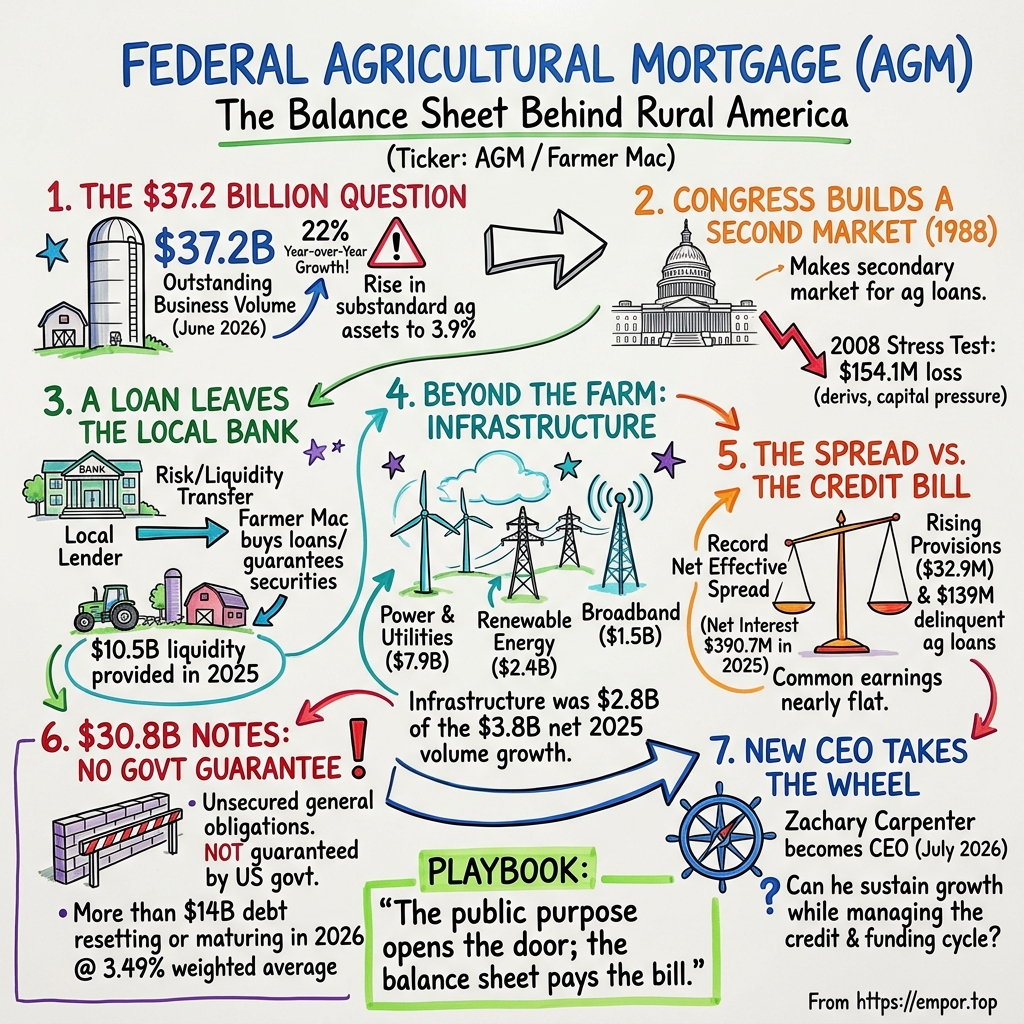
On the last Thursday of July 2026, Zachary Carpenter had been chief executive of the Federal Agricultural Mortgage Corporation for exactly thirty days. The numbers he took to investors that afternoon were the kind a new CEO dreams of inheriting. Outstanding business volume, the sum of every farm mortgage, utility loan, guaranteed security and standby commitment the company carried, had crossed $37.2 billion, a record.1
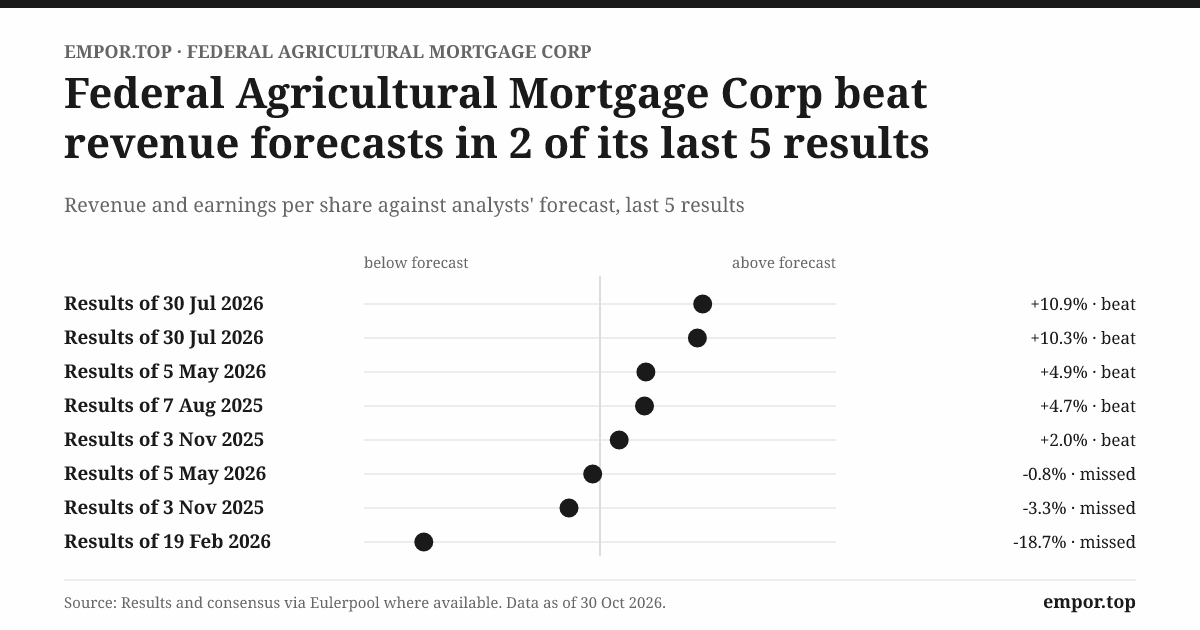
Net effective spread, the company's preferred measure of what it earns between the yield on its assets and the cost of its debt, also hit a record at $117.4 million for the quarter.2 Carpenter called them "record second quarter results," and on the narrow evidence of that quarter he was right.2
The growth was not a rounding error. A year earlier the portfolio had been roughly a fifth smaller; by June it had grown about 22% year over year, and it had added almost $4 billion in the first six months of 2026 alone.1 For a company most investors know only by its four-letter ticker, AGM, or its funny nickname, Farmer Mac, that is a lot of new credit to put to work in a short time.
Buried a few dozen pages deeper in the quarterly filing was a quieter set of figures, and they are where this story really starts. At the end of June, $139.1 million of agricultural loans were ninety days or more past due.1 Measured against the whole book, that was a small number, about 0.37% of outstanding volume.1 But a second gauge was moving the wrong way.
Substandard assets in the agricultural portfolio, the loans that lenders' own examiners would describe as showing well-defined weaknesses even if borrowers are still paying, had risen to 3.9% of that portfolio, up from 3.5% six months earlier.1 Delinquency tells you who has already stumbled. Substandard tells you who is wobbling. The first number was calm; the second was creeping up.
That tension, record volume on one side and slowly migrating credit on the other, is the whole investment question in miniature. Farmer Mac is a lending business with a public charter. It makes money by holding or guaranteeing rural credit and funding it more cheaply than the assets yield.
When that works, a bigger book means bigger earnings. When credit turns, a bigger book means bigger losses, and the losses arrive later than the growth did. The question this story tries to answer is which of those two futures the record volume is actually buying.
The calendar adds urgency. On October 22, Farmer Mac announced that it would release third-quarter results after the market closes on Thursday, November 5, 2026, with a call at 4:30 p.m. Eastern time.3 That will be the first full quarter of Carpenter's tenure as CEO, and the first look at whether the credit migration of the spring continued through the summer harvest season.
Before going further, it is worth being exact about what Farmer Mac is, because the name invites confusion. It is a federally chartered government-sponsored enterprise, created by Congress, regulated by the Farm Credit Administration, and listed on the New York Stock Exchange under the ticker AGM.4 It is not part of the Farm Credit System, the network of cooperative lenders such as CoBank and AgriBank that shares the same regulator.
The company is explicit that Farmer Mac and Farm Credit System institutions are separate, and that neither is liable for the other's debts.4 Most important of all, Farmer Mac's notes are not guaranteed by the United States government.4 The "Federal" in its name describes where its charter came from, not who stands behind its bonds.
So three questions will run through the rest of this story. First, what does Farmer Mac actually do that a rural lender needs badly enough to pay for it? Second, which parts of the portfolio are driving the growth, and are they the same parts driving the earnings?
Third, can a new leadership team manage a credit cycle that, on the evidence of the past eighteen months, has already begun to turn? To answer any of them, it helps to go back to a farm crisis, an act of Congress and the first time the balance sheet nearly broke.
 Subscribe on LinkedIn
II. Congress Built a Second Market for Farm Loans
The 1980s were a brutal decade on the American farm. Land values that had soared through the 1970s collapsed when interest rates spiked and commodity exports slumped, and the lenders who had financed the boom found themselves holding mortgages worth more than the land beneath them.
The Farm Credit System itself needed a federal rescue. Out of that wreckage came an idea borrowed from the housing market: if Fannie Mae and Freddie Mac could make home mortgages more liquid by buying them from banks and packaging them for investors, why not do the same for farmland?
In 1988, Congress chartered Farmer Mac as a government-sponsored enterprise "to create a secondary market for agricultural loans."5 The logic was simple. A small-town bank in Iowa or a cooperative lender in California can only make as many long-term farm mortgages as its own deposits and capital allow. If that lender could sell those loans, or insure their credit risk with someone else, it could make more of them. Outside capital, from bond investors who would never otherwise lend to a corn grower, would flow into rural credit through a national middleman.
The first years were slow, and the charter had to be rewritten repeatedly to make the business work. In 1990, an amendment let Farmer Mac buy the guaranteed portions of loans backed by the U.S. Department of Agriculture, a safer asset class that gave the young company something to hold.5 In 1996, Congress allowed Farmer Mac to purchase loans directly rather than only guaranteeing securities issued by others, which turned it from an insurance-like pass-through into a lender with its own balance sheet.5
In 1999, the company listed on the New York Stock Exchange.5 And in 2008, another amendment opened the door to rural infrastructure, letting Farmer Mac purchase and guarantee loans to cooperative lenders financing rural electrification and telecommunications.4 That last change, small as it looked at the time, is the seed of the company Farmer Mac is becoming today.
Each of those amendments widened the menu, and each also widened the ways the company could lose money. A government watchdog noticed. In October 2003, the Government Accountability Office published a review of Farmer Mac with a title that read like a report card: some progress made, but greater attention to risk management, mission and corporate governance needed.6
Its findings were pointed. Farmer Mac's net income had risen from $4.6 million in 1997 to $22.8 million in 2002, but impaired loans had gone from zero to $75.3 million over roughly the same stretch, and the ratio of loss reserves to impaired loans had fallen by more than half.6
GAO concluded that the company's risk-management practices had "not kept pace with its more complex risk profile," noted that its loss model was built on loans unlike its own, and observed that it had no formal contingency funding plan for stressed farm conditions.6 The concentration was startling: ten financial institutions generated 90% of Farmer Mac's business.6 And GAO said the charter itself "lacks specific or measurable mission-related criteria," which made it hard for anyone to judge whether the company was serving farmers or simply serving itself.6
That critique is more than two decades old, and it should be weighed as history rather than as a current verdict. But it is useful because it names the exact failure modes an investor should still be watching: credit models that lag the portfolio, funding plans that assume calm markets, and business that comes from a handful of very large counterparties. As the story moves forward, each of those three will reappear in modern form.
Five years after the GAO report, the stress arrived, and it did not come from farms at all.
In September 2008, Farmer Mac held $50 million of Fannie Mae floating-rate preferred stock and $60 million of Lehman Brothers senior debt in its investment portfolio.7 These were supposed to be the safe, liquid assets that backed up the risky farm book. Then Fannie Mae was placed into conservatorship and Lehman filed for bankruptcy in the same month.
Farmer Mac took impairment charges of $44.7 million on the Fannie Mae preferred in the third quarter, on top of $5.3 million earlier in the year, and another $52.4 million on the Lehman bonds.7 In a single quarter the company lost $106.1 million.7 The release reporting that loss went out under Michael Gerber, then acting president and chief executive, which tells you something about how unsettled the top of the company was at the worst possible moment.7
The real danger was capital. On September 30, 2008, Farmer Mac sold $65 million of senior preferred stock to shore itself up, and even after that its core capital exceeded the statutory minimum by just $30 million.7 For a company with billions of dollars of obligations, that is a margin you could lose on a bad week of derivative marks. Gerber's message to investors was blunt and defensive: the company was "focused on continuing to strengthen our capital position."7
By the end of the year the damage was fully counted. Farmer Mac reported a 2008 net loss of $154.1 million, or $15.40 per diluted share, the worst result in its history, driven by the Fannie Mae and Lehman write-downs and by losses on the fair value of its interest-rate derivatives.8
It raised $124.2 million in total through preferred stock offerings in the third and fourth quarters, and it cut its quarterly common dividend in half.8 The core farm lending book had held up. It was the treasury, the part of the business meant to be boring, that nearly sank the ship.
The lesson of 2008 is the one that frames everything that follows. A congressional charter gives Farmer Mac a role and a market. It does not give it a backstop. When markets broke, there was no federal guarantee to call on, and the company survived by selling senior claims to friendly buyers at a moment when it had little bargaining power. Its public mission was intact; its shareholders still took the hit.
How different is the company now? In some ways, almost unrecognizable. At the end of June 2026, Farmer Mac's core capital stood at $1.87 billion, $730.7 million above its regulatory minimum, a cushion more than twenty times the one it had in the autumn of 2008.1 The 2003 complaint about ten institutions supplying 90% of the business has also softened: in 2025, the ten largest sellers accounted for about 55% of agricultural loan purchase volume.4 But other products are still highly concentrated.
Three institutions issued 90.6% of the company's AgVantage securities, and two institutions accounted for nearly all of its infrastructure volume.4 The history does not reject the claim that Farmer Mac has learned its lessons; it narrows it. Capital is far stronger and agricultural sourcing broader, while concentration in its wholesale products remains a feature rather than a bug. To see why lenders keep coming back, though, the story has to leave Washington and go to a small bank with a full loan book.
III. A Loan Leaves the Local Bank
Picture a community bank in central Nebraska. Its loan officer has known the family across the county road for twenty years: they want to buy the neighboring quarter section before an outside investor does, and they need a thirty-year fixed-rate mortgage to do it. The bank likes the borrower. What it does not like is the loan.
Its deposits are short-term and reprice whenever the Federal Reserve moves; a thirty-year fixed mortgage does not. Its regulators are already asking about agricultural concentration. And every dollar it ties up in this farm is a dollar it cannot lend to the implement dealer or the grain elevator down the street.
This is the problem Farmer Mac was built to solve, and the solutions it sells come in a few shapes. The bank can sell the mortgage outright to Farmer Mac, which holds it on its own balance sheet and funds it with long-term debt. It can keep the loan but buy a long-term standby purchase commitment, a contract in which Farmer Mac promises to buy the loan if it goes bad, so the bank keeps the customer and the yield while transferring the tail risk.
A large lender can issue Farmer Mac a secured note, called an AgVantage security, backed by a pool of its farm loans, effectively borrowing wholesale at a rate it could not easily get on its own. And for USDA-guaranteed loans, Farmer Mac buys the guaranteed portion, which frees up the lender's balance sheet with little credit risk on either side.4
In each case Farmer Mac earns one of two things: a spread between what the asset yields and what Farmer Mac pays to borrow, or a guarantee and commitment fee for standing behind credit it does not fund.4
It then manages the mismatch between its assets and its debt with an extensive book of interest-rate swaps; at the end of 2025, the notional value of its cleared swaps alone was $19.4 billion.4 Think of it as a wholesaler of rural credit: it buys long-dated loans from retailers that cannot hold them comfortably, and finances that inventory in the bond market.
The scale of the service is real. During 2025, Farmer Mac provided $10.5 billion of liquidity and lending capacity to rural lenders.4 And demand, at least as lenders describe it, has been rising. In the 2025 Ag Lender Survey that Farmer Mac runs with the American Bankers Association, conducted among more than 450 loan officers, managers and executives during the summer of 2025, 77% of lenders reported using Farmer Mac, up from 67% in 2024.9
Those respondents were not in a cheerful mood: they expected only 52% of their farm borrowers to be profitable in 2025 and fewer than half in 2026, the lowest share since 2020, and nearly 93% expected farm debt to rise.910 When lenders expect borrowers to borrow more and earn less, a place to sell long loans or offload their credit risk becomes more valuable, not less.
Seven businesses under one charter
Since 2024, Farmer Mac has organized itself into a structure that maps neatly onto the story of where it has been and where it is going.5 On the agricultural side sit two lines. Farm & Ranch is the original business: mortgages on farmland and ranches, the standby commitments behind them and the AgVantage securities issued by large farm lenders. Corporate AgFinance lends to larger agribusinesses, from food processors to storage operators, a step further from the family farm and closer to commercial credit.
On the infrastructure side sit three lines descended from the 2008 charter change: Power & Utilities, which finances rural electric cooperatives; Broadband Infrastructure, which finances rural telecommunications and, increasingly, data centers; and Renewable Energy, which finances solar, wind and storage projects. Two more reporting segments, Funding and Investments, capture the treasury: how cheaply the company borrows and what it earns on its liquidity portfolio.
The scale and the earnings of these businesses are not proportional, and that is the first important clue. Farm & Ranch is still the giant. At the end of 2025 it carried $19.6 billion of volume and produced $98.3 million of segment core earnings.4 The three infrastructure segments together carried about $11.8 billion and produced roughly $37.9 million.4 Corporate AgFinance carried $2.0 billion and produced $8.3 million.4 Then comes the surprise. The Funding segment, which lends nobody anything, contributed $94.9 million of core earnings in 2025, nearly as much as Farm & Ranch.4
What does that mean? It means a large share of what Farmer Mac reports as earnings comes from how cleverly it finances itself, from the timing of its debt issuance, its use of callable bonds and the value of interest-free funding sources, rather than from the credit spread on any individual loan. That is not a red flag in itself; for any wholesale lender, treasury execution is part of the product.
But it means investors should not imagine Farmer Mac as a simple spread machine in which each new loan mechanically adds profit. A good part of the profit depends on funding conditions the company does not control, a point that will matter a great deal when the story reaches the $14 billion of debt that came due in 2026.
The field of competitors
Who else could the Nebraska bank call? Plenty of people. Farmer Mac's own annual report lists commercial and investment banks, insurance companies, Farm Credit System institutions, financial funds and certain government programs as competitors, and it adds the most important competitor of all: lenders that simply choose to keep their loans.4
For borrowers, the dominant rivals are the Farm Credit System cooperatives and community banks themselves. For the assets Farmer Mac wants to buy, the rivals are anyone else with long-term money, from life insurers that have financed farmland for a century to private credit funds that have discovered infrastructure.
Lenders feel that competition from their own side of the table too. In the 2025 survey, "lender competition" ranked as their second-biggest concern, behind only credit quality and farm-loan deterioration.9 But the survey does not publish market shares, and Farmer Mac does not either, so it is impossible to say with any precision whether Farmer Mac is gaining or losing ground against Farm Credit lenders or insurers in any specific market.
That leaves the moat claim in an awkward place, and it is worth testing once, here, with the evidence available. The bull version goes like this: Farmer Mac is the only federally chartered secondary market for agricultural mortgages, rural utility loans and USDA-guaranteed securities, and that charter, combined with a product range that runs from outright purchases to standby guarantees to wholesale funding, gives lenders a toolkit nobody else assembles in one place.4 The rising share of lenders using the company is a real adoption signal; ten points of penetration in a single year is not noise.9
The bear version is just as easy to state. Nothing in the charter forces a lender to sell anything. A bank can keep the loan, sell it to an insurer, or ask a Farm Credit cooperative for a participation. Farmer Mac does not disclose customer retention rates, how often lenders shop its pricing against alternatives, or whether it has been able to raise fees without losing volume.
And that concentration cuts both ways: those customers have at least as much bargaining power over you as you have over them.4 The evidence supports a useful distribution role built on a charter and a breadth of products. It does not yet prove pricing power or a customer base that cannot leave.
One final caution about the yardsticks. Ordinary measures of a company's health, such as operating margin, free cash flow or the number of days customers take to pay, are close to meaningless here. In 2025, Farmer Mac reported net income of about $207 million but only about $80 million of cash from operations, a gap that would alarm anyone analyzing a manufacturer.4
For a lender, it mostly reflects the timing of interest, derivative collateral and loan flows, while the real deployment of capital, nearly $4 billion of new business that year, shows up in investing and financing lines instead.4 The right tests are spread, credit quality and capital, which is why the next part of the story follows the portfolio itself, and watches where the new dollars are going.
IV. The Growth Is Moving Beyond the Farm
If you had to pick one year when Farmer Mac stopped being primarily a farm mortgage company in its growth, if not yet in its size, it would be 2025. The portfolio grew by $3.8 billion that year, a 13% increase to $33.4 billion.4 Only about $1.0 billion of that came from agricultural finance.
The other $2.8 billion came from infrastructure.4 Power & Utilities added about $1.1 billion, Renewable Energy about $1.0 billion and Broadband Infrastructure about $0.7 billion.4 Three businesses that did not exist in Farmer Mac's charter until 2008 produced nearly three-quarters of the year's growth.
The growth rates tell the same story from a different angle. Farm & Ranch grew about 5% in 2025 and Corporate AgFinance about 3%.11 Power & Utilities grew about 15%. Renewable Energy grew about 72%, and Broadband Infrastructure about 91%.11 When one part of a lender's book grows at single digits and another nearly doubles in a year, the second part is where both the opportunity and the scrutiny belong.
It is worth pausing to notice how far this is from the scene that opened the last chapter. The secondary market Congress designed for Nebraska farmland now finances the electric cooperatives that keep the lights on in rural counties, the fiber that connects them, the solar farms built on their fields and, more and more, the data centers that consume their power. In a sense the charter has followed the money: rural America's biggest capital needs in this decade are not only tractors and land but transmission lines, generation and bandwidth.
The newest twist is the data center. On the first-quarter 2026 call, management said nearly 70% of Broadband Infrastructure volume growth was data-center related and that 87% of newly approved broadband deals were tied to data centers.12 By the second quarter, Broadband had grown to about $1.9 billion, with data centers still around 70% of new volume.13
Management told analysts that more than 80% of the data-center tenant exposure was to large investment-grade hyperscalers, and when pressed on pricing, said data-center spreads were roughly in line with the rest of the broadband book.1213 That answer matters. A lender that is rushing into a hot asset class usually has to accept thinner spreads to win deals; Farmer Mac's claim is that it has not. The claim is plausible, but it rests on management's characterization, and the loans are too young to have been tested by a downturn in data-center demand.
Renewable Energy has its own clock. In the first quarter of 2026 the segment grew $445 million, or 18%, to $2.9 billion, and management linked part of the burst to developers racing to meet construction deadlines in the federal tax legislation enacted on July 4, 2025.12 By June it stood at about $3.0 billion.13
Growth driven by a policy deadline is real growth, but it is also, by construction, growth with an expiry date. Management has said it expects the renewable pipeline to keep producing growth into 2027; an investor should read that as a statement about the next year or two, not about the next decade.13
What stayed at the core
None of this means the farm has been left behind. Farm & Ranch remained the largest line by far at $19.6 billion at the end of 2025, against $7.9 billion in Power & Utilities, $2.4 billion in Renewable Energy, $2.0 billion in Corporate AgFinance and $1.5 billion in Broadband Infrastructure.11 And in 2026, the farm business woke up. Net growth in Farm & Ranch loan purchases reached $384 million in the first quarter alone, against $54 million a year earlier, and loan approvals approached $1 billion, almost 30% above the previous record.12
Over the first half, net loan purchase growth in the segment was nearly double the prior year's pace, and AgVantage securities grew $1.1 billion in the second quarter, including a $750 million issuance from a new counterparty.13 Carpenter had told investors in February that AgVantage had "reversed the runoff trend" in the fourth quarter of 2025, after a stretch of shrinking balances.14
There is a link between the farm stress described in the lender survey and this revival. When farm incomes fall and borrowers lean harder on debt, the lenders that serve them need more balance-sheet room. That is good for Farmer Mac's volume. It is not necessarily good for Farmer Mac's credit, because some of the loans flowing to it in a tightening farm economy are being written precisely when borrowers are under the most strain. Infrastructure growth was 2025's story; agricultural growth in a weakening farm economy is 2026's.
The economic trade-off of diversification is easy to describe and hard to prove. On the plus side, a power cooperative's revenue does not move with corn prices, and a hyperscaler-leased data center does not care about a drought in Kansas. Spreading the book across agriculture, electricity, telecommunications and renewables should mean that a single bad year in one sector does not overwhelm the whole.
On the minus side, every one of these businesses still depends on the same things: careful underwriting, long-lived physical assets whose value can change, a small number of large counterparties, and Farmer Mac's continuous access to the bond market. Diversification across sectors is not diversification across those risks.
The cleanest test available today is earnings per unit of balance sheet, and there the evidence is mixed. In 2025, the infrastructure segments together carried about three-fifths as much volume as Farm & Ranch but produced well under half its core earnings.4 Management has pointed out that the newer lines earn wider spreads, roughly 2.25% to 2.35% on Broadband and 1.65% to 1.75% on Renewable Energy on a trailing basis, compared with thinner margins on wholesale products such as AgVantage.13
But spread is earned before credit costs and before the capital each loan consumes. The year's credit losses came partly from Broadband. On the evidence through mid-2026, diversification is financially material and a genuine growth vector. It is not yet proof that these newer lines earn superior returns once losses and capital are counted across a full cycle.
A servicing purchase, not a buying spree
One more piece of the expansion record deserves a brief note because it is easy to overstate. In August 2021, Farmer Mac bought the servicing rights to a sizeable portion of its Farm & Ranch and USDA-guaranteed loans from Conterra Ag Capital, one of its main central servicers, and hired key members of Conterra's servicing team; Conterra stayed on as a loan originator.15
Then-CEO Brad Nordholm called the expansion of internal servicing "an incredible opportunity for Farmer Mac."15 Neither the filing nor the accompanying release disclosed a purchase price.15 This was an operational move to bring loan servicing, and the borrower data that comes with it, in-house. It was not the start of a broad acquisition strategy, and without a price there is no way to judge whether Farmer Mac paid well or badly.
That leaves the central management question for this chapter. Zachary Carpenter, who joined Farmer Mac in 2019 as its chief business officer, was the executive the board credited with building out Renewable Energy, Broadband Infrastructure and Corporate AgFinance.16 The diversification is, in a real sense, his creation.
The question for him as CEO is not whether he can find new markets; he plainly can. It is whether the business volume he built produces core earnings and credit outcomes that justify the capital it absorbs. The early data, unfortunately for the narrative, show that the bill for growth has already started to arrive.
V. The Spread Grew; So Did the Credit Bill
In February 2026, Farmer Mac's management walked onto its fourth-quarter earnings call with a set of records and a problem. The records were genuine. Net effective spread for 2025 had reached $383.0 million, up from $339.6 million, and as a percentage of the book it had widened from 1.15% to 1.20%.4 Core earnings, the company's preferred profit measure that strips out the noise from derivative fair-value swings, rose about 7% to $182.9 million.4 Net interest income on a GAAP basis climbed from $353.9 million to $390.7 million.4
The problem was the line below. Net income attributable to common shareholders, the profit that actually belongs to owners of the AGM shares, rose from $180.4 million to just $182.5 million, an increase of about 1%.4 A business that grew its portfolio 13% and its spread income by double digits delivered almost no growth in common earnings. Where did the difference go?
Most of it went into credit. Farmer Mac's provision for credit losses, the money set aside to cover loans it expects to go bad, nearly tripled, from $11.6 million in 2024 to $32.9 million in 2025.4 Charge-offs, the loans actually written off, jumped from about $4.5 million to $20.9 million, most of them in the fourth quarter.4
The allowance for losses at year-end rose to $38.0 million from $23.7 million.4 In plain terms: the company earned tens of millions of dollars more from its bigger book and gave a large share of it back to the borrowers who could not pay.
The filing traced $19.6 million of the year's provision to "individually significant" deterioration in two places: Corporate AgFinance and Broadband Infrastructure.4 Those are, notably, two of the three newer business lines Carpenter had been credited with building. On the call, management described the problems as specific to a few borrowers rather than systemic, and pointed to a "very positive outcome from recent property sales for a distressed borrower" as evidence that recoveries were possible.14
The rest of the provision, management explained, was the mechanical cost of growth: under the accounting standard known as CECL, every new loan comes with an up-front reserve for expected lifetime losses, so a fast-growing lender books provisions even when nothing has gone wrong.14
That explanation is reasonable as far as it goes. It is also, on the transcript, not quite consistent: two executives on the same call gave different figures for how much of the provision was growth-driven, and the gap was never reconciled.14 When the analysts pushed, the answers stayed general.
Seaport's Bill Ryan asked whether the problem credits were a sign of something broader; management said no but offered little detail. KBW's Bose George asked what a normal run-rate of provisions should look like and how the spread would hold up; the answers were qualitative, without numbers.14 An investor listening for a specific plan heard reassurance instead.
The migration keeps moving
The first quarter of 2026 brought a smaller provision, $4.3 million, of which $3.4 million was attributed to new volume and $0.9 million to credit migration.12 But Matthew Pullins, the new chief financial officer, was more specific than management had been in February about where the stress lay. "Certain credits experienced deterioration," he said, "specifically in agricultural storage and processing and select permanent plantings exposures," meaning orchards and vineyards, and they required additional reserves.12
Across the whole portfolio, substandard assets rose from 1.71% to 1.87%, with the increase concentrated in agricultural downgrades; infrastructure substandards actually fell as renewable energy credits improved.12 Ninety-day delinquencies rose to 52 basis points, which Pullins attributed to the seasonal pattern of farm payments due in January and July.12 When Sidoti's Brendan McCarthy asked about the right long-term level of reserves, management declined to give a target.12
The second quarter brought a $7.0 million provision.2 Part of it, management said, reflected two collateral-dependent Farm & Ranch loans in foreclosure where updated appraisals had cut the value of the land behind them.13 That is a detail worth dwelling on, because it is exactly the mechanism by which a farm credit cycle bites: borrowers fall behind, the lender goes to the collateral, and the collateral is worth less than it was when the loan was made.
The same quarter also brought good news from the problem pile. A delinquent permanent-planting exposure was resolved, and Farmer Mac recovered $7.4 million of previously unpaid interest, which flowed straight into spread.2 By June 30, the allowance had grown to $47.2 million, and first-half provisions totaled $11.3 million, against $9.4 million a year earlier.1
Put the pieces side by side and the picture is nuanced. Delinquency remained low, with no ninety-day delinquencies in infrastructure.1 On the July call Carpenter could point to improvement in that measure from the seasonal spike in the spring.13
But the earlier-stage gauge kept worsening. Agricultural substandard assets, which stood at $494.2 million at year-end 2025, continued to rise by June.41 Low delinquency is reassuring. It does not erase migration, and migration is what tends to precede the next round of provisions.
That spring quarter also produced a striking quirk. Strong second-quarter spread was flattered by the one-time interest recovery, and when George asked whether the jump in Corporate AgFinance's spread was really just one credit, management agreed that it was, and that underlying spread excluding the recovery was roughly flat.13 Credit that goes bad depresses spread when it stops paying and then inflates it when it is resolved. Investors trying to read the underlying trend need to look through both.
It is worth being clear about how this record should be judged against management's narrative. Across three calls, the story has been consistent in its broad strokes: problems are borrower-specific, provisions are driven by growth, and the portfolio is fundamentally sound. The answers did become more specific over time, from "a few borrowers" in February to named sub-sectors in May to foreclosure appraisals in July. That is to management's credit. But consistent framing is not the same as proof.
The evidence so far narrows the growth claim rather than rejecting it: Farmer Mac has expanded its business and its spread, but in 2025 credit costs absorbed the gain in common earnings, and by mid-2026 early-stage credit indicators were still rising. The confirming evidence would be provisions and substandard assets that level off as the 2024 and 2025 loans season; the falsifying evidence would be a second year in which a bigger book produces flat common earnings.
A brief word on one misleading figure. Third-party data services that compile standardized financial statements show Farmer Mac's "revenue" falling almost 19% in 2025. That is an artifact of how those services classify a lender's interest income and expense, which can swing with derivative accounting and gross-versus-net presentation.
It conflicts with the company's own GAAP net interest income, which rose about 10%, and with its rising volume and spread.4 The economics of this company are better read through its spread, its credit costs and its business volume than through any headline revenue number. And the spread itself depends on the other side of the balance sheet, which is where the next chapter goes.
VI. Thirty Billion Dollars of Notes, No Government Guarantee
Every lender is really two businesses glued together: one that lends and one that borrows. For Farmer Mac, the borrowing business is enormous. At the end of 2025 it owed $30.82 billion in notes payable, and by June 2026 that had grown to $34.7 billion, against shareholders' equity of under $2 billion.41 On ordinary industrial measures, that is a debt-to-equity ratio of nearly eighteen to one, the kind of number that would end a manufacturer's credit rating.4
It would be wrong to read it that way. The debt is not funding factories or acquisitions; it funds loans, guaranteed securities and liquid investments that, in aggregate, are themselves claims on other borrowers. A bank funded by deposits looks just as leveraged. But it would be equally wrong to wave the number away.
Leverage of this size means that small changes in the cost of borrowing translate into large changes in the return to shareholders. If Farmer Mac's funding costs rise by a tenth of a percentage point on $30 billion of debt and it cannot pass that on to borrowers, it gives up roughly $30 million a year, about a sixth of 2025's common earnings.
Now consider the calendar. At the end of 2025, Farmer Mac had $14.35 billion of debt scheduled to reset or mature during 2026, at a weighted-average rate of 3.49%.4 That is close to half of its notes payable rolling over or repricing in a single year. Much of that is by design: Farmer Mac issues a large volume of short-term discount notes and floating-rate debt, and it matches much of it against floating-rate assets or hedges it with swaps, so a reset is not automatically a loss.
It also uses callable debt as a tool. In 2025 it called $2.2 billion of callable medium-term notes, refinancing them when rates moved in its favor, and it called about $500 million more early in 2026, which management said would add roughly $3 million a year to spread.412 When it works, this is the treasury earning its keep, and it explains why the Funding segment produced so much of the company's 2025 core earnings.
The boundary that matters here is the one drawn at the start of this story. Farmer Mac's notes are unsecured general obligations of the company. They carry no government guarantee.4 And unlike most large issuers, Farmer Mac says its discount notes and medium-term notes are not rated by a nationally recognized statistical rating organization.4
Investors buy the paper because of the company's status as a government-sponsored enterprise, its regulator and its track record of steady market access, not because an agency has assigned a grade. Farmer Mac also competes for those investors with far larger issuers: the Farm Credit System, the Federal Home Loan Banks, Fannie Mae, Freddie Mac and highly rated corporations.4
In calm markets that rarely matters. In a market panic, an unrated issuer with no explicit guarantee is the kind of name buyers can quietly stop bidding for. That is precisely what happened, in a different form, in the autumn of 2008.
Management's language is confident. Pullins described Farmer Mac's "differentiated funding advantage" as "a key strength" on the first-quarter call.12 The evidence supports the claim as a description of recent experience: Farmer Mac reported steady capital-market access through 2025 and grew its debt by billions while widening its spread.4 It cannot prove what will happen in a stressed market, because those are exactly the conditions under which a funding advantage is tested.
The cushions
Against the refinancing exposure stand real buffers. At the end of 2025, Farmer Mac held $0.93 billion of cash and $17.55 billion of investment securities, including Treasuries, agency-guaranteed securities and USDA-backed securities.4 At June 30, 2026, its dedicated liquidity portfolio was $8.16 billion.1 Its core capital remained well above the regulatory minimum, and its Tier 1 capital ratio was 13.2%, which management described as within its 12% to 14% target range.113
The Farm Credit Administration, through its Office of Secondary Market Oversight, examines the company every year on capital, asset quality, earnings, liquidity and interest-rate sensitivity, as well as on whether it is fulfilling its mission.17 That is a far wider cushion than in 2008.
But capital is not just a number; it is a series of decisions, and Farmer Mac has been making several at once. It bought back 78,481 Class C shares in 2025 for about $12.9 million, and in August 2025 its board raised the buyback authorization to $50 million.4
It raised its quarterly common dividend 7%, to $1.60 a share, for 2026, its fifteenth consecutive annual increase.414 And it went to the preferred market twice in roughly a year: $100 million of Series H preferred in 2025, then, in May 2026, 4.0 million shares of 6.875% non-cumulative Series I preferred stock, raising another $100 million before costs.41
Each of those choices is defensible on its own. Together they raise an obvious question. A company that buys back common stock and raises its common dividend, while simultaneously issuing preferred stock that pays 6.875% and ranks ahead of common shareholders, is using expensive senior capital to fund its growth while handing cash back to the junior owners.
In the second quarter of 2026 alone, preferred dividends cost $8.1 million, which, annualized, is more than $30 million a year that comes off the top before any common shareholder sees a cent.2 That is roughly the size of the entire 2025 credit provision.
There are two ways to read the preferred raises. The benign reading is that preferred stock counts as regulatory capital without diluting the common, so issuing it lets Farmer Mac grow its book faster and keep its Tier 1 ratio within range, at a cost lower than issuing new common shares at ten times earnings. Fourth-quarter Tier 1 had slipped to 13.3% from 14.2% a year earlier as the book grew, and by the first quarter it was 13.0%; the Series I raise helped push it back up.14121
The skeptical reading is that the company's appetite for growth has outrun its ability to fund that growth from retained earnings, and that the preferred market is covering the gap. In the second quarter, after paying about $25 million of common and preferred dividends, Farmer Mac retained only about $42 million of earnings.13 A business growing its assets by billions a year cannot fund that growth from $42 million a quarter without leaning on outside capital or on leverage.
The evidence does not settle which reading is right; it makes capital allocation a live question rather than a solved one. The things to watch are capital surplus as the book grows, the spread on new debt relative to maturing debt, and whether the company keeps returning cash to common shareholders while issuing senior paper. Those are decisions that now belong to a new chief executive and a new chief financial officer, which brings the story to the people.
VII. A New CEO Takes the Wheel
On September 25, 2025, Farmer Mac's board announced two things at once. Brad Nordholm, chief executive since October 2018, would retire on March 31, 2027. And Zachary Carpenter, then the company's executive vice president and chief business officer, was promoted to president and chief operating officer, effective immediately, and named as Nordholm's successor after what the board called "a thorough, year-long process."16
It was, by the standards of corporate succession, about as orderly as these things get: an eighteen-month runway, a named heir, an outgoing chief executive praising his successor for having "delivered on that vision with exceptional skill."16
Then the runway got shorter. On June 3, 2026, the board and Nordholm agreed to move his retirement up to July 1, nine months ahead of plan, with Nordholm staying on as a senior adviser carrying the honorary title of CEO Emeritus through September 30.18 Board chair Lowell Junkins praised the "thoughtful, cooperative, and seamless handoff between Brad and Zack."19
The company did not explain publicly why the date moved, and when a trade publication asked, it reported no answer.19 On the May earnings call, Nordholm had already signaled the shift, telling analysts the succession was running "a bit ahead of schedule," and closing with a line that doubled as a farewell: Farmer Mac, he said, "has never been in a stronger position than it is today."12
Nordholm's legacy is a substantial one on the numbers. When the board announced his retirement, it credited him with doubling annual earnings and growing business volume to more than $30 billion.16 The fair qualification is that the final full year of his tenure, 2025, was also the year credit provisions nearly tripled and common earnings barely moved.
The man who inherits the job is a financier rather than a farmer. Carpenter came to Farmer Mac in May 2019 after a career that ran through Johnson & Johnson, Goldman Sachs, where he was a vice president in finance and corporate strategy, and CoBank, the Farm Credit System's big wholesale lender, where he spent roughly seven years and rose to managing director and sector vice president in its corporate agribusiness banking group.16195 He holds an economics degree from Wharton and an MBA from NYU Stern.5
At Farmer Mac he was given a newly created role, chief business officer, and the board's own account of his record is essentially the diversification story told in the last three chapters: renewable energy, broadband infrastructure and corporate agribusiness, plus growth in farm lending and power and utilities.16 His background explains the strategy. A banker who spent years underwriting large agribusinesses at CoBank naturally sees Farmer Mac not as a farm mortgage conduit but as a wholesale lender to the whole rural economy.
The CoBank connection has a second edge, and it is worth naming plainly. CoBank is not only Carpenter's former employer; it is one of Farmer Mac's largest voting shareholders and one of its biggest sellers of loans, a relationship that the next part of this chapter takes up. Nothing in the record suggests any impropriety, and the relationship long predates Carpenter. It simply means the new CEO knows his most important counterparties from the inside, for better and for worse.
He is not doing it alone, and he is not doing it with the team that built the book. Chief financial officer Aparna Ramesh left in July 2025, and Matthew Pullins was appointed CFO in December 2025, which means both the top executive and the top finance officer are new to their roles in the same year the credit cycle turned.11 The organization behind them is also growing fast. Farmer Mac ended 2025 with 212 employees, up 11%, with about a third of them working fully remotely.4
In July, management guided that compensation expense in 2026 would run 20% to 22% above 2025, while keeping its efficiency ratio, operating costs as a share of revenue, between 27% and 29%, better than its 30% long-term target.13 Carpenter also described a project called FLX as "a significant technology modernization initiative," and when an analyst asked whether lenders were adopting it, the answer was that it was "a little too early to tell."13
How the pay is built
Executive pay at Farmer Mac is designed around metrics that sound sensible on paper. The proxy lists business volume, total revenue, core earnings before credit, net charge-offs, ninety-day delinquencies, the ratio of substandard assets to regulatory capital and compliance with capital requirements among the measures the board uses.11 Long-term equity is split half into time-vesting restricted stock units, a quarter into stock appreciation rights and a quarter into performance shares that pay out between zero and twice target based on three-year cumulative core earnings before credit.11
That last phrase deserves a second look. The longest-dated, most performance-sensitive slice of executive pay is tied to earnings measured before credit costs. In a year like 2025, when credit was precisely what separated a record spread from flat common earnings, that design rewards the volume and spread side of the business more directly than the loss side. Credit measures do appear among the annual metrics, so the board has not ignored credit; but a skeptical shareholder could reasonably ask why the multi-year incentive does not include it.
CEO pay itself has been moderate for a company this size: Nordholm's reported total compensation was $5.63 million in 2023, including a one-time retention award, $3.26 million in 2024 and $4.03 million in 2025, and the CEO-to-median-employee pay ratio was 21 to one.11 None of that history belongs to Carpenter, whose results as CEO will only begin to show in the 2027 proxy.
Shareholders have mostly been content. The 2025 say-on-pay vote drew 99% support.11 At the May 2026 annual meeting, support was lower but still solid: about 918,000 votes for and roughly 102,000 against, or about nine to one.20 Notably, only Farmer Mac's voting Class A and Class B shares cast those ballots, and directors were elected by cumulative voting, which is how one Class B director candidate could receive a fraction of the votes of the others.20
That points to the most unusual feature of Farmer Mac's governance. The company has three classes of common stock. Class A voting shares are held by banks, insurers and other eligible financial institutions; Class B voting shares are held by Farm Credit System institutions; and only Class C, which carries no vote, trades as AGM.4
Voting shareholders elect ten of the fifteen directors, and the rest are presidential appointees, from among whom the President of the United States designates the chair.411 Many lenders must hold voting shares to participate in Farmer Mac's agricultural programs.4 So the people who own the votes are, to a large degree, the same institutions that sell loans to Farmer Mac, buy its guarantees and service its assets. Public investors who own the economics own no say at all.
The two largest examples make the point concrete. Zions Bancorporation held about 21% of voting common stock at the end of 2025; it sold Farmer Mac $148.1 million of loans that year and retained $11.6 million in servicing fees. CoBank held about 10.7%; it sold $529.2 million of loans and retained $4.1 million in servicing fees.4 Among Class B holders, AgriBank alone held about 40% of the class.11 Together the Zions and CoBank servicing fees came to about $15.7 million, roughly 13% of Farmer Mac's 2025 operating expenses of $119.8 million.4
Those are costs and asset purchases, not revenue; Farmer Mac does not depend on these shareholders for a disclosed share of income. The company says such transactions are conducted on terms comparable to those with unrelated parties.4 What it does not publish is a multi-year comparison of related-party pricing against unrelated counterparties, which is the only disclosure that could confirm that claim rather than assert it.
One operational thread runs through all this: servicing. The 2021 decision to bring Conterra's servicing team in-house was meant to give Farmer Mac better data, closer oversight of borrowers and better servicing economics.15 Five years later, much of the portfolio is still serviced by the institutions that sold it, including the related parties above, and the company's annual report continues to warn that it depends on third-party servicers to perform.4 The servicing acquisition's cost was never disclosed, so its return cannot be judged; its effect on credit outcomes, in a year when foreclosure appraisals began to bite, is worth tracking.
Carpenter inherits a growing franchise with a strong capital cushion. He also inherits the 2025 divergence between portfolio growth and common earnings, a new CFO, a rising cost base and an ownership structure in which public shareholders vote on nothing. The record is too short to judge him as chief executive. What can be judged is the business he is running, and what the market is paying for it.
Analysis & Bear vs. Bull Case
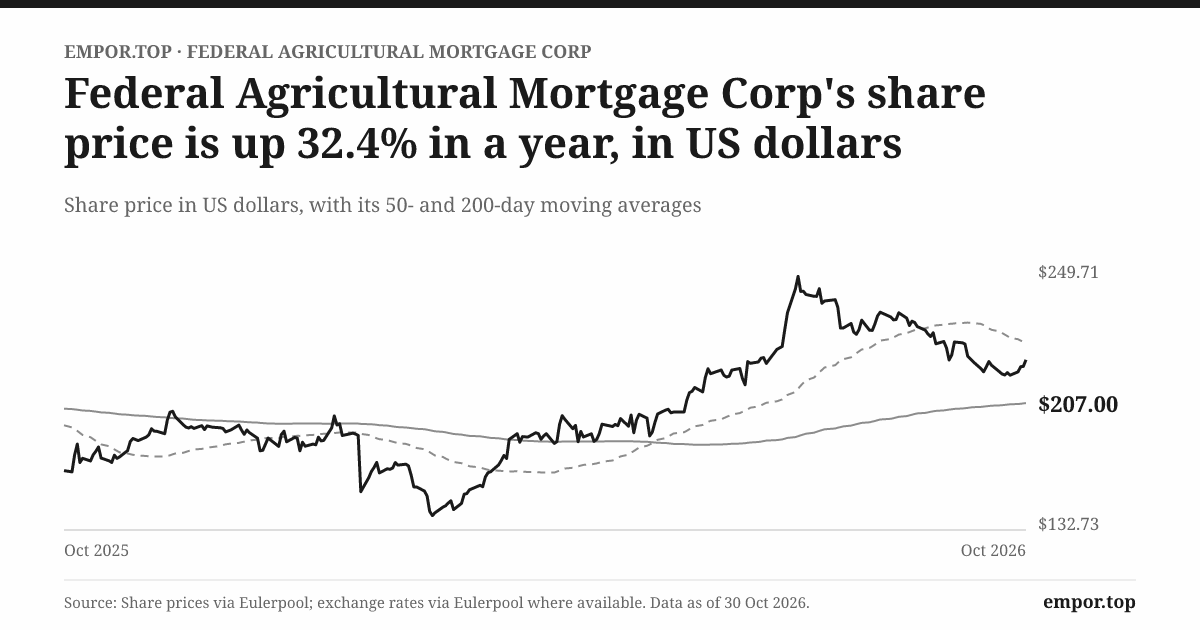
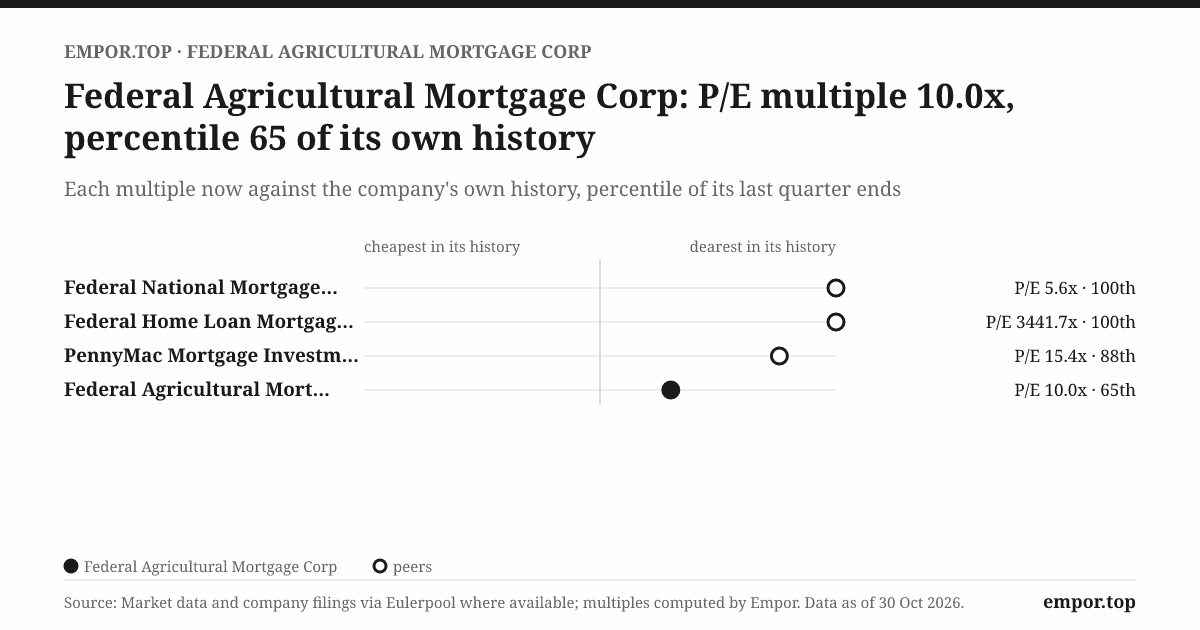
On October 30, 2026, AGM's Class C shares closed at $207.01, about 15% below their 52-week high of $243.44 and well above the low of $139.00.21 At that price the market valued Farmer Mac's common equity at about $2.3 billion, or roughly ten times its trailing twelve months of diluted earnings of $19.56 a share.211
That compares with a median of about 9.3 times over the past five years. Put differently, an investor buying today pays about a dollar of market value for every ten cents of annual earnings, an earnings yield of about 10%, plus a dividend yield of about 3%, and pays about 1.2 times book value.21
What does that price assume? Not much heroism. A multiple near the company's own five-year range implies the market expects Farmer Mac to keep doing roughly what it has done, growing earnings at a mid-single-digit to low-double-digit pace with occasional credit hiccups, and does not price in either a breakout or a blow-up.
The stock's own history is a reminder that the range is wide: within the past five years it has fallen as much as 36% from a peak, and its one-year volatility is above 30%.21 This is not a bond proxy, whatever its charter suggests.
The return on that equity is respectable but not spectacular, and the measure depends on the denominator. On total shareholders' equity including preferred stock, return on equity over the latest twelve months was about 12%.41 Management prefers core return on common equity and reported 17% for the first quarter and 19% for the second, flattered in the second by the one-time interest recovery.122
The gap is largely the preferred stock: Farmer Mac's common shareholders earn a higher return precisely because senior capital that is not theirs supports part of the balance sheet. That is a legitimate structure, but it means the common return carries some of the preferred's leverage.
The case for
The bull case begins with demand. Lenders are using Farmer Mac more, not less: 77% of surveyed lenders reported using it in 2025, up ten points in a year.9 The farm economy those lenders describe, with falling profitability and rising debt, is one in which balance-sheet relief is worth paying for.9 Farmer Mac grew volume 13% in 2025 and roughly another 12% in the first half of 2026, while widening net effective spread from 1.15% to 1.20% for the year.41
Management says it is "not conceding spread" to win new volume, and the trailing segment spreads it has disclosed for broadband and renewables, above 1.6%, support the idea that diversification has added higher-margin assets.13 Capital is far stronger than in any previous stress, with core capital more than $700 million above its minimum, and delinquencies remain low.
If credit costs plateau as the 2024 and 2025 vintages season, a larger, wider-spread book should translate into earnings growth well above the 1% of 2025, and the first half of 2026, with common net income up sharply year over year, is at least consistent with that.2
The case against
The bear case begins with the 2025 income statement. A bigger book with a wider spread produced almost no growth in common earnings because credit provisions nearly tripled.4 The problems came partly from the very segments that are driving growth, and in 2026 the migration spread to agricultural storage and processing, permanent plantings and foreclosed farmland whose appraisals had fallen.1213 Agricultural substandard assets were still rising at the last report.1
On the funding side, close to half of the company's notes reset or matured during 2026, and Farmer Mac borrows without a federal guarantee or a credit rating, competing for investors with far larger issuers.4 Meanwhile it is issuing 6.875% preferred stock, buying back common and raising the dividend, a combination that a skeptic would read as stretching capital to fund volume.14 And compensation expense is guided up more than 20% in 2026 as the company invests in people and technology whose payoff is not yet visible.13
Michael Porter's five forces help explain why Farmer Mac's economics look the way they do. Rivalry is real but indirect. The Farm Credit System cooperatives and community banks are the largest lenders to farmers, and Farmer Mac is both a partner to them and a competitor for the same assets; insurers and private credit funds compete for long-dated loans; and every lender has the option to keep its loans rather than sell them.4
Buyer power, meaning the power of Farmer Mac's lender customers, is significant: three institutions issue more than 90% of its AgVantage securities and two account for nearly all of its infrastructure flow, so those customers can shop terms.4
Supplier power sits with bond investors and, to a degree, with servicers; Farmer Mac must pay whatever the market demands for unrated, unguaranteed paper. The threat of new entrants is low in the narrow sense, because nobody else can obtain this charter, but higher in the broad sense, because private credit can finance the same infrastructure assets without one.
Substitutes are abundant: retaining the loan, a Farm Credit participation, a bank's own securitization. The summary is that Farmer Mac sits in an industry where the charter keeps direct copycats out but does not stop customers from taking their business elsewhere.
Hamilton Helmer's seven powers sharpen the point. Farmer Mac's clearest power is a cornered resource: its federal charter, with eligibility rules and a status as a government-sponsored enterprise that lets it borrow in size at competitive rates. Some scale economics follow from that, since its operating costs are small relative to a $37 billion book and its efficiency ratio sits below 30%.13 There is a modest element of switching costs for lenders that have built their processes around Farmer Mac's programs or hold its voting stock.
But there is little evidence of network effects, counter-positioning, brand power or process power that would let it charge more than rivals for equivalent credit. Farmer Mac does not disclose customer retention, price realization or share shifts, so the commercial side of the moat cannot be measured. The honest verdict is that the moat is structurally useful and commercially unproven: the charter gives Farmer Mac a seat at the table, and lenders' rising usage shows they value it, but nothing in the record shows the company can dictate terms.
A skeptical long-short investor or activist would press on a short list of points. Why buy back common stock and raise the dividend in the same year you issue two series of preferred? Why tie the long-term incentive to earnings before credit when credit is the variable that decided 2025?
Does infrastructure growth earn returns commensurate with the capital it consumes, or does it mainly add volume? And would public shareholders, who own the economics without a vote, be better served by a capital policy that held back more earnings until provisions and refinancing costs settle?
Three measures will answer most of those questions. The first is net effective spread, which stood at 1.26% in the second quarter of 2026, or about 1.18% excluding the one-time recovery, against 1.20% for 2025 and 1.15% for 2024: the direction has been up, and the test is whether it survives the 2026 refinancing cycle.2134
The second is credit cost read together with its leading indicators: provisions of $11.3 million in the first half of 2026, up from $9.4 million a year earlier, alongside agricultural substandard assets that rose from 3.5% to 3.9% over the same six months.1 The third is business volume by segment, especially whether the infrastructure book, now about $13.1 billion, produces core earnings in proportion to its size.13 Spread, credit and segment earnings: if all three move the right way, the bull case is working; if any one breaks, the story changes.
Playbook: Business & Investing Lessons
The first lesson is about what a charter can and cannot do. Farmer Mac's experience in 2008 showed that a federal mandate did not protect its balance sheet from loss or guarantee help.87
Nobody in Washington came to help, because nobody had promised to. Founders and investors who look at government-sponsored franchises, licensed monopolies or regulated utilities should remember that a public role and a private balance sheet are two different things. The public purpose opens the door; the balance sheet pays the bill.
The second lesson is about time. In 2025 Farmer Mac grew its book and widened its spread, but common earnings barely grew as provisions rose.4 Lending businesses book their growth immediately and their losses later, and the faster they grow, the longer the gap between the celebration and the bill. Investors who judge a lender on volume alone are judging the promise, not the outcome. A larger book is a promise until the credit seasons.
The third lesson is about diversification. Farmer Mac's expansion beyond agriculture has been real and material.4 But the first serious credit trouble of this cycle came partly from one of those new lines, and the newer segments still earn less per dollar of book than the old farm business.4 Diversification is a means, not a result. It counts only when it improves returns after losses and after the capital it consumes. New markets count when the spread survives the cycle.
The fourth lesson is about capital as a habit. Farmer Mac's capital cushion is far larger than it was in 2008.17 That cushion was not inevitable; it was built by choices, and every year brings new choices that can erode it, from shareholder distributions to preferred issuance.41 For any leveraged financial company, the strength of the balance sheet is not a fact but a policy, renewed every quarter. Dividends, buybacks and preferred stock all compete with the next dollar of capacity.
Epilogue
Tonight, Farmer Mac stands at an unusual juncture. It has a chief executive four months into the job, a chief financial officer less than a year into his, a $37 billion book that has never been larger, and a credit cycle that, by its own early indicators, has not finished turning.118
It has spent much of 2026 rolling over a large share of its debt, the $14.35 billion that was scheduled to reset or mature during the year, and it has done so without a government guarantee or a rating, relying on the market's confidence in a federal charter and a long record of steady access.4
The next moment of evidence is six days away. On November 5, after the market closes, Farmer Mac will report its third-quarter results, and at 4:30 p.m. Eastern its executives will take questions.3 Those results are not yet known, and nothing here should be read as a forecast of them. What can be said is what to listen for.
If the story is working, the quarter will show net effective spread holding near its recent range even after the one-time recovery of the spring falls away, which would mean the debt rollover cost less than the new assets earn. It will show provisions that reflect growth rather than deterioration, and agricultural substandard assets that stop climbing from 3.9%.
And it will show the infrastructure book, now Carpenter's signature, contributing earnings in proportion to its rising share of the portfolio. That combination would suggest the 2025 credit bill was a one-time toll on the way to a larger, more profitable franchise.
If the story is breaking, the signals will be just as clear: further migration into substandard, more collateral-dependent farm loans with falling appraisals, provisions that keep rising as a share of spread, refinancing costs that squeeze margins, or growth concentrated in segments whose earnings trail the capital they absorb. Any of those would make 2025 look less like a toll and more like the opening of a credit cycle that a bigger book will magnify.
Beyond November lies the full-year report in early 2027, Carpenter's first year-end account as CEO, and with it the first chance to judge his promises against his outcomes. The central question of this story will not be answered in one quarter. But the next quarter will show which way it is leaning: whether the company Congress built to carry rural credit farther can carry this much of it safely.
Outro
Go back to the bank in central Nebraska, and the family that wanted to buy the quarter section across the road. Somewhere in Farmer Mac's book, a loan like theirs has made a remarkable journey. It began with a handshake between a farmer and a loan officer who has known them for twenty years.
It passed from a small bank to a federally chartered company in Washington, was funded by a bond sold to an investor who has never seen a cornfield, and was hedged with a swap traded in New York. At every step it carried the same promise to pay, and at no step did the United States government agree to stand behind it.
That combination makes Farmer Mac unusual on the exchange. It is a public mission and a leveraged credit business on a single balance sheet, owned in its economics by public investors and in its votes by the lenders it serves.
When the farms and the power lines and the data centers pay, the mission and the shareholders win together. When they do not, the balance sheet absorbs the loss, as it did in 2008 and began to in 2025. The question is how much risk Farmer Mac carries along the way.
References
-
Quarterly Report on Form 10-Q for the period ended June 30, 2026 — Federal Agricultural Mortgage Corporation (SEC), 2026-07-30 ↩↩↩↩↩↩↩↩↩↩↩↩↩↩↩↩↩↩↩↩↩↩↩
-
Farmer Mac Reports Second Quarter 2026 Results — Federal Agricultural Mortgage Corporation (SEC), 2026-07-30 ↩↩↩↩↩↩↩↩
-
Farmer Mac to Announce Third Quarter 2026 Financial Results — Farmer Mac, 2026-10-22 ↩↩
-
Annual Report on Form 10-K for 2025 — Federal Agricultural Mortgage Corporation (SEC), 2026-02-19 ↩↩↩↩↩↩↩↩↩↩↩↩↩↩↩↩↩↩↩↩↩↩↩↩↩↩↩↩↩↩↩↩↩↩↩↩↩↩↩↩↩↩↩↩↩↩↩↩↩↩↩↩↩↩↩↩↩↩↩↩↩↩↩↩↩↩
-
About Farmer Mac — Federal Agricultural Mortgage Corporation ↩↩↩↩↩↩↩
-
Farmer Mac: Some Progress Made, but Greater Attention to Risk Management, Mission, and Corporate Governance Is Needed (GAO-04-116) — U.S. Government Accountability Office, 2003-10-16 ↩↩↩↩↩
-
Farmer Mac Third Quarter 2008 Results, Press Release — Federal Agricultural Mortgage Corporation (SEC), 2008-11-10 ↩↩↩↩↩↩↩↩
-
2008 Annual Report — Federal Agricultural Mortgage Corporation (SEC) ↩↩↩
-
ABA, Farmer Mac Survey Results Released at ABA Agricultural Bankers Conference in St. Louis — Farmer Mac, 2025-11-12 ↩↩↩↩↩↩
-
Only Half of US Farmers to Be Profitable in 2025, Ag Lenders Say — Farm Policy News, University of Illinois, 2025-11-20 ↩
-
Definitive Proxy Statement 2026 — Federal Agricultural Mortgage Corporation (SEC), 2026-04-13 ↩↩↩↩↩↩↩↩↩↩
-
Farmer Mac (AGM) Q1 2026 Earnings Call Transcript — The Motley Fool, 2026-05-05 ↩↩↩↩↩↩↩↩↩↩↩↩↩↩↩
-
Earnings Call Transcript: Farmer Mac Q2 2026 — Investing.com, 2026-07-30 ↩↩↩↩↩↩↩↩↩↩↩↩↩↩↩↩↩↩↩
-
Earnings Call Transcript: Federal Agricultural Mortgage Q4 2025 — Investing.com, 2026-02-19 ↩↩↩↩↩↩↩
-
Strategic Acquisition and Expansion of Loan Servicing, Form 8-K — Federal Agricultural Mortgage Corporation (SEC), 2021-08-18 ↩↩↩↩
-
Farmer Mac Announces Retirement of CEO Bradford Nordholm and Appoints Zachary N. Carpenter President and COO — Federal Agricultural Mortgage Corporation (SEC), 2025-09-25 ↩↩↩↩↩↩
-
CEO Succession, Form 8-K — Federal Agricultural Mortgage Corporation (SEC), 2026-06-03 ↩↩
-
Farmer Mac's CEO Succession Plan Sped Up Nine Months — National Mortgage News, 2026-06-09 ↩↩↩
-
2026 Annual Meeting Voting Results, Form 8-K — Federal Agricultural Mortgage Corporation (SEC), 2026-05-18 ↩↩
 LinkedIn
 WhatsApp
 Reddit
 Hacker News
 Email
 Kindle
 RSS Feed
 Spotify
 Apple Podcasts
 Amazon Music
 Audible
 YouTube