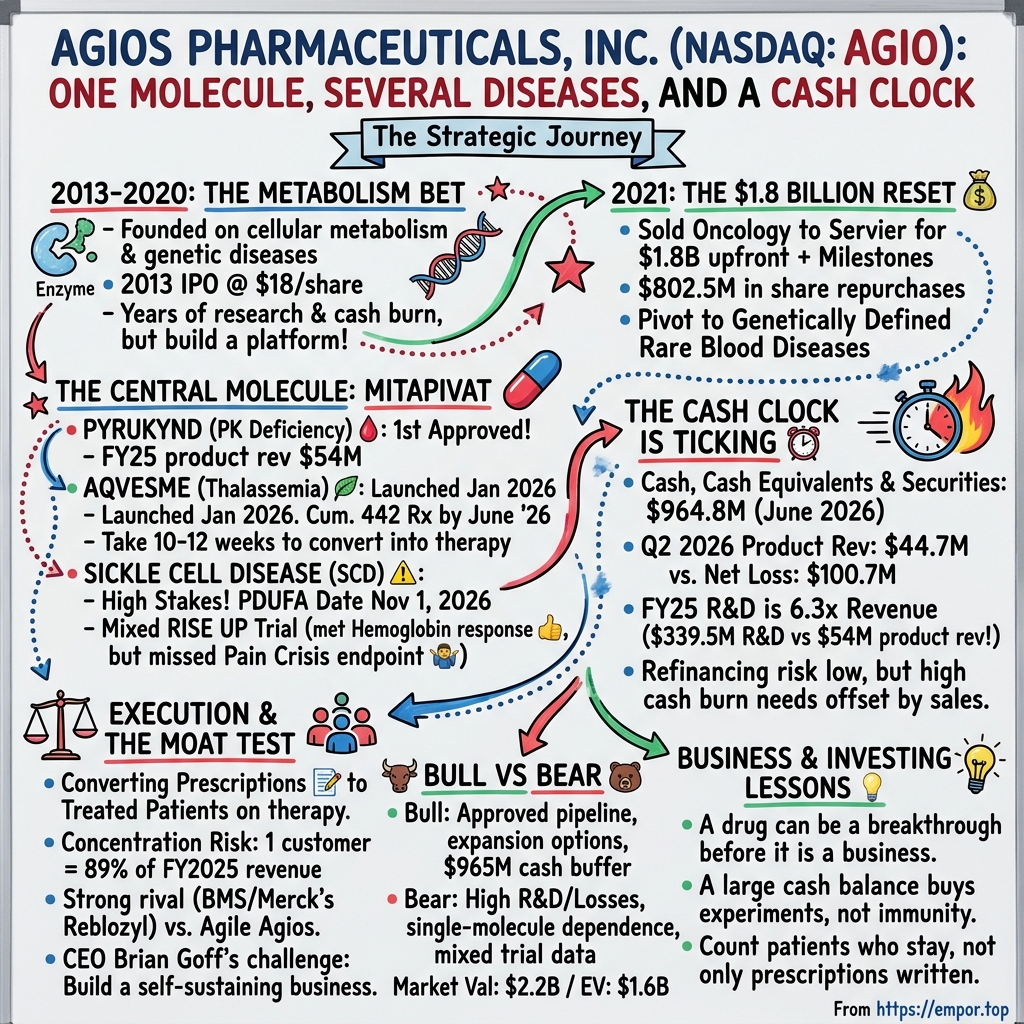
Agios Pharmaceuticals, Inc. (NASDAQ: AGIO): One Molecule, Several Diseases, and a Cash Clock
I. The Quarter Before the FDA Decision
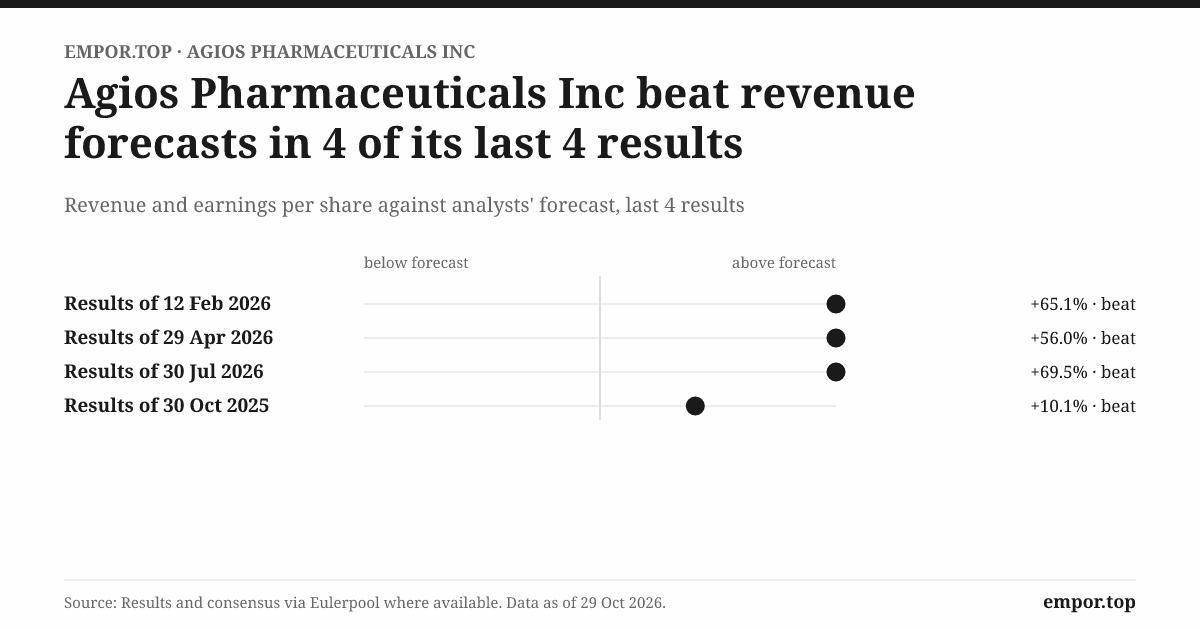
On the morning of July 30, 2026, Agios Pharmaceuticals put out a set of numbers that, for the first time in its post-oncology life, looked like a real drug company. Mitapivat, the single molecule the company sells under two brand names, brought in $44.7 million of net product revenue in the second quarter, against $12.5 million in the same quarter a year earlier.1 That is better than a tripling in twelve months. Of that money, $40.9 million came from the United States, and most of the jump came from a launch that had started only six months before: AQVESME, mitapivat for adults with thalassemia.1
The same press release carried the other half of the story. Agios lost $100.7 million in the quarter.1 It spent more on research and development in those three months, about $101 million, than it earned from selling its drug in the entire first half of the year.1 And its pile of cash, cash equivalents and marketable securities had fallen to $964.8 million at the end of June, from about $1.16 billion six months earlier.1 Put those two facts side by side and the shape of the company becomes clear. The engine is turning over. It is not yet carrying the weight of the vehicle.
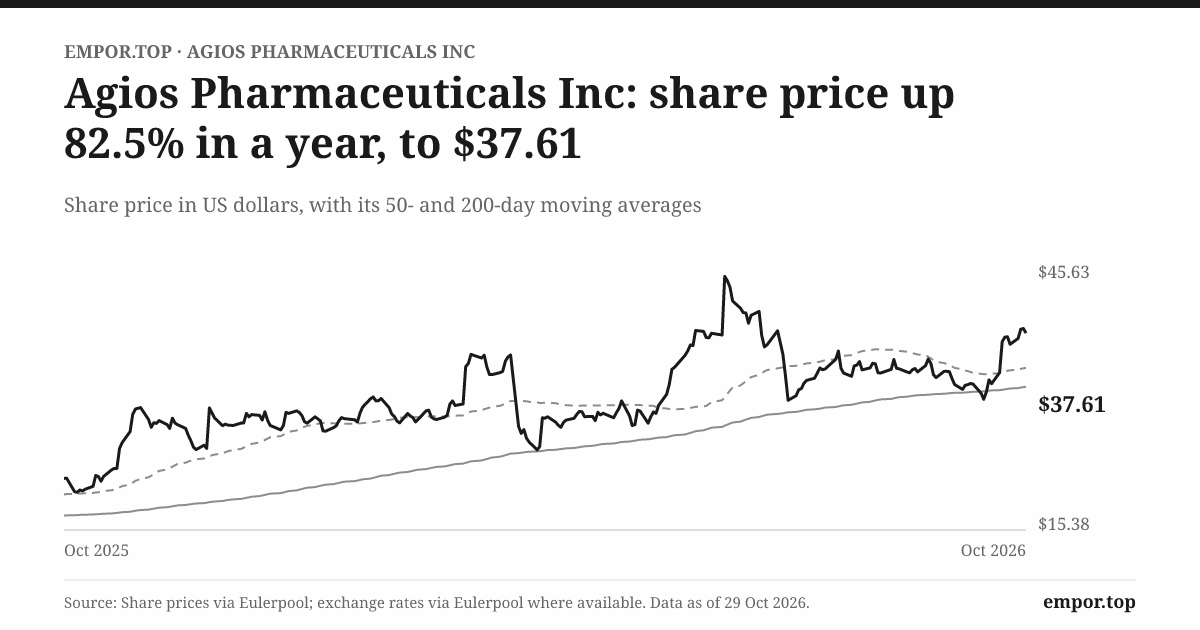
Then there was the calendar. Three months after those results, on November 1, 2026, the U.S. Food and Drug Administration is due to rule on Agios's application to sell mitapivat for sickle cell disease, under a Priority Review that compresses the usual ten-month review to six.2 Sickle cell disease is, by patient count, the largest market mitapivat has ever approached. It is also the indication where the company's own pivotal trial produced the most mixed result in its history, a split decision that cut the share price roughly in half on the day it was announced. Tonight, three days before that FDA deadline, the market values Agios at about $2.2 billion, with the shares around $37.61, well above where they landed after that trial result but some way below their 52-week high of about $44.
So this story has three questions running through it, and they are tangled together. The first is scientific and commercial: can one molecule, which works by giving red blood cells more energy, become a durable franchise across several rare blood diseases, or is each new disease a fresh gamble that happens to use the same pill? The second is financial: can Agios turn that possibility into cash before the reserves it built from selling its cancer business run thin? And the third is the one the FDA is about to weigh in on: what does a sickle cell trial that hit one main goal and missed the other actually mean for the company's next growth claim?
It helps to see the company as it stands. Agios today has two commercial brands that are really one drug. PYRUKYND is mitapivat for pyruvate kinase deficiency, a rare inherited anemia, approved in the United States in 2022 and also sold in Europe and the Gulf. AQVESME is mitapivat for thalassemia in the U.S., approved in December 2025 with a boxed warning for liver injury and a mandatory safety program that requires doctors to be certified and patients to have their liver tests checked every four weeks for the first six months.23 Everything else on the company's books is a pipeline: early drugs licensed from other companies or discovered in-house, none of them close to producing revenue.
The cost structure follows from that. In 2025, product revenue was $54 million, while research and development spending was $339.5 million, about six times as much.3 Selling, general and administrative costs added roughly another $200 million on top.3 That is not a business that runs on its sales. It is a research organisation with a commercial arm attached, funded by a balance sheet that came, ultimately, from selling the work of its first decade.
Agios has no funded debt, so the clock that matters is not a bond maturity but the gap between what it spends and what it brings in.4 In the first half of 2026 that gap consumed about $200 million of reserves, including a $25 million upfront payment to license a new drug from the Korean biotech Oscotec.1 Management has said its cash, together with expected product revenue and interest income, gives it the "financial independence" to run the thalassemia launch and prepare for sickle cell.1 That is a claim about adequacy, not about self-sufficiency. Those are different things, and the gap between them is the subject of this story.
The right way to read the July quarter, then, is as a genuine inflection that does not yet answer the question it raises. Revenue grew fast enough to change the conversation. It did not grow fast enough to change the arithmetic. Whether it eventually does depends partly on a regulatory decision days away, and partly on something much less glamorous: whether the patients who started taking AQVESME in the first half of 2026 are still taking it in the second. To understand why a company that once looked like the future of cancer medicine is now counting refills in rare anemias, the story has to go back to a bet made in a Cambridge lab nearly two decades ago.
 Subscribe on LinkedIn
II. The Metabolism Bet
In the summer of 2008, three of the most decorated scientists in cancer biology lent their names to a new company. Lewis Cantley of Harvard Medical School, Tak Mak of the University of Toronto and Craig Thompson of the University of Pennsylvania were the scientific founders of Agios, which closed a $33 million Series A round that July, co-led by Third Rock Ventures, Flagship Ventures and ARCH Venture Partners.[^5] The idea they were backing was old and new at once. Nearly a century earlier, the German physiologist Otto Warburg had noticed that cancer cells burn sugar in a strange, wasteful way. The Agios founders believed that this altered metabolism was not a side effect of cancer but a lever, and that drugs aimed at the specific enzymes cancer cells depend on could shut tumours down.
The company that grew from that idea had an unusual identity for a biotech. Most young drug developers are built around a single molecule or a single disease. Agios was built around a field: cellular metabolism, the chemistry by which cells turn nutrients into energy and building blocks. In 2009 FierceBiotech named it one of its "Fierce 15" biotechs of the year, and it recruited David Schenkein, a senior oncology executive from Genentech, as chief executive.[^6] The pitch to investors and partners was that a company fluent in metabolism could find targets that conventional oncology groups would miss, and could match those targets to patients defined by their genes.
That pitch attracted a powerful partner early. Celgene, then one of the largest cancer-drug companies in the world, struck a collaboration with Agios and became a major shareholder. When Agios went public on Nasdaq in July 2013, it sold about 5.9 million shares at $18 each, roughly $106 million of stock, while a Celgene affiliate bought another $12.75 million in a concurrent placement and was expected to own 15.7% of the company afterwards.5 For a company with no approved product, it was a confident debut, and it said something about where the value sat. Agios's science was attractive enough that a large company wanted a seat at the table and a share of the upside.
The early financial record shows what kind of business that produced. Revenue in 2014 was $65 million, but it was collaboration money, payments from Celgene under their agreement, rather than sales of anything to patients.3 Over the following years revenue bounced around rather than compounding: lower in 2015, higher in 2016, down sharply in 2017, up again in 2018. Meanwhile losses widened, from about $53 million in 2014 to more than $400 million by 2019. Agios was doing what a successful research company does, which is to spend heavily on turning discoveries into clinical candidates. It was not building an operating base that could stand on its own.
The discoveries were real. In July 2018 the FDA approved TIBSOVO (ivosidenib), an Agios drug that blocks a mutated form of the enzyme IDH1, for adults with relapsed or refractory acute myeloid leukemia carrying that mutation; the agency described it as the first drug in its class.[^8] The metabolism thesis, in other words, had passed its hardest test. Enzymes that the founders thought mattered did matter, and drugs that hit them could help patients.
But a scientific platform and a commercial moat are not the same thing, and Agios's own record from those years shows the distance between them. Getting a cancer drug approved for a narrow genetically defined population is the start of a long, expensive commercial campaign, not the end of one. Agios kept raising money to run that campaign and the research behind it: about $250 million in a 2017 offering and about $294 million in 2019.[^9]6 Revenue rose to about $203 million by 2020, as TIBSOVO sales and collaboration income grew, but the company still lost more than $300 million that year.3 The business had become larger. It had not become self-funding.
Somewhere in the middle of all this, the company's scientists noticed that metabolism was not only a cancer story. Red blood cells are, in a sense, the simplest metabolic machines in the body. They have no nucleus and no mitochondria, the tiny power plants most cells use, so they depend almost entirely on a single chain of chemical steps to make energy. One enzyme near the end of that chain is pyruvate kinase. When it does not work properly, red cells run short of energy, become fragile and break apart early, and the patient becomes anemic. A molecule that could switch pyruvate kinase on harder, a "PK activator", might help people born with a faulty version of the enzyme, and possibly people whose red cells are under strain for other reasons, such as thalassemia or sickle cell disease. That molecule was mitapivat.
This is the hinge of the whole Agios story. The company's founding insight produced two very different kinds of asset. One was a set of cancer drugs, already approved or close to it, that needed a large and expensive oncology sales organisation. The other was a single rare-disease molecule with a plausible path into several blood disorders. Agios could not comfortably afford to build both at full speed. By the end of 2020, it had a buyer for one of them, and the decision about which to keep would define everything that followed.
The lesson the early years leave behind is a sober one. A brilliant scientific thesis can produce assets that larger companies will pay for, but it does not by itself produce durable economics. Patents, a first approval and an elegant mechanism matter only if they translate into patients who stay on treatment, payers who reimburse it, and cash that comes back faster than it goes out. Agios proved the first part spectacularly. The rest of this story is about whether it can prove the second.
III. The $1.8 Billion Sale That Reset the Company
In June 2020, at an industry conference, managers from Agios and from Servier, the privately held French drug company, started talking about a possible partnership. Later that month, Agios mentioned that it might be willing to separate its oncology business altogether.7 Over July and August it contacted 14 potential buyers; 12 signed confidentiality agreements, and four came back with preliminary offers. Some wanted only TIBSOVO. One was a financial sponsor offering cash plus stock in a public company. Servier's first indication was $2 billion in cash. By late November it had moved to $1.7 billion upfront plus milestones and royalties, then settled on a final package: $1.8 billion upfront, a $200 million payment if vorasidenib, an experimental brain-cancer drug, won regulatory approval, a 5% royalty on U.S. sales of TIBSOVO and a 15% royalty on U.S. sales of vorasidenib.7 The deal was signed on December 20, 2020, approved by shareholders on March 25, 2021, and closed on April 1, 2021.78
The common narrative about this sale is that Agios either sold its crown jewels too cheaply or pulled off a masterstroke. The record supports neither version cleanly. Goldman Sachs, advising the board, valued the oncology business at roughly $1.16 billion to $1.84 billion using discounted cash flows, and Morgan Stanley came in at about $1.11 billion to $1.75 billion. Both banks estimated the present value of Servier's whole package, including the contingent milestone and royalties, at about $2.11 billion.7 So the upfront cash alone landed near the top of the bankers' ranges, and the full consideration sat above them. But those ranges rested on management's own forecasts and on probability guesses about which drugs would succeed. They are a transaction benchmark, not proof. What the record does show is that the price was within a reasonable band, that Agios ran a real auction, and that Servier's opening number turned out to be higher than its final upfront payment.
What the sale bought, more than money, was a different company. Agios handed Servier the oncology portfolio and with it the cost of developing, launching and selling cancer drugs. It kept mitapivat and the rare-disease pipeline. In January 2021, weeks before the shareholder vote, management laid out what it called its "Agios 2025" vision. By the end of 2025, it said, mitapivat would be approved in three initial indications, PK deficiency, thalassemia and sickle cell disease, and the company would reach cash-flow positivity, with its cash runway extending to that point after the sale and the planned return of capital to shareholders.9 On the November 2021 earnings call, then-chief financial officer Jonathan Biller repeated the spirit of it, saying the company's roughly $1.4 billion in cash would fund the plan "through major catalysts to cash flow positivity without the need to raise additional equity."10
Hold those promises against the record. By the end of 2025 Agios had two of the three approvals, not three; the sickle cell application had not even been filed. And in 2025, the year it was supposed to turn cash-flow positive, it used $373 million of cash in its operations, with free cash flow of roughly minus $377 million.3 That is not a near miss. It is a business still burning cash at about the same rate it was burning four years earlier. In fairness, the promise was made under a different chief executive, Jacqueline Fouse, and before a series of clinical and regulatory timelines stretched out. It is best understood as a company-level forecast miss across management regimes. But it is a large one, and it matters because it shows how far commercial reality ran behind the plan.
The capital return was the part of the plan that happened on schedule. Agios agreed to buy back about 7.1 million shares from Bristol Myers Squibb, which had inherited Celgene's stake, for $344.5 million, roughly $48 a share, and the board authorised up to $1.2 billion of repurchases in total.8 By the third quarter of 2021 the company had used about $783 million of that authorisation and then paused, saying it wanted to keep money for pipeline acceleration and possible deals.10 By the end of 2022, Agios reported having repurchased about 16.2 million shares for $802.5 million, an average of about $49.50 each.11 Notably, the company did not need to touch the $250 million at-the-market equity facility it had set up in 2020, which remained unused at the end of 2021.12 Shares outstanding fell, and treasury stock of about 16.2 million shares still sits on the balance sheet today.3
Was that buyback well judged? The answer depends on what came next. The shares today trade around $38, below the average repurchase price, which means that, five years on, the buyback has not created value for continuing shareholders on a mark-to-market basis. More importantly, the money returned was money that would later have extended the runway. A company that expected to be cash-flow positive by 2025 could reasonably hand back its surplus. A company still burning hundreds of millions a year in 2025 would, with hindsight, have wanted that cushion. The buyback was not reckless, but it was sized to a forecast that did not come true.
The oncology sale then paid a second dividend, years later and in a form nobody had fully priced. In May 2024, Agios agreed to sell most of its vorasidenib royalty to Royalty Pharma for $905 million, payable if the FDA approved the drug, keeping only a 3% royalty on annual U.S. sales above $1 billion.[^17] The FDA approved vorasidenib that August, triggering both the $905 million payment and the separate $200 million Servier milestone.3 That is why Agios reported net income of $673.7 million for 2024, including an $889.1 million gain on the royalty sale.3 It is the most misleading number in the company's recent history. It looks like profitability. It was, in fact, the second instalment on the sale of the company's first decade of science.
Add it up and the oncology business delivered roughly $1.8 billion at closing, a $200 million milestone and $905 million from the royalty monetisation, or about $2.9 billion in cash, plus a small residual royalty and the TIBSOVO royalty stream. Against that, Agios returned roughly $800 million through buybacks and has spent the rest, along with interest income, funding a rare-disease business that is only now producing meaningful sales. The balance sheet still holds almost a billion dollars, so the money has not run out. But it has been converted, for the most part, into clinical trials, a commercial organisation and an approved drug in three indications across geographies, rather than into a self-sustaining business.
That leaves the capital-allocation question sharper than it was in 2021. Agios has now sold the oncology portfolio, returned cash, and monetised the most valuable piece of its royalty upside. There are no more large legacy assets to sell. From here, the company has to fund its next phase mostly from what mitapivat earns and what is left in the bank. Which brings the story to the molecule itself.
IV. One Molecule, Different Blood Diseases
On February 17, 2022, the FDA approved PYRUKYND for hemolytic anemia in adults with pyruvate kinase deficiency, under Priority Review, on the strength of two Phase 3 studies.[^18] In the main placebo-controlled trial, about 40% of patients who were not regularly transfused achieved a meaningful rise in hemoglobin, the oxygen-carrying protein in blood, while no one on placebo did.[^18] It was the first medicine to treat the underlying problem in this disease rather than its consequences. For a company that had just sold its cancer business, it was the proof that the rare-disease bet could produce an approved drug. It was also, commercially, a very small beginning.
To see why, picture how mitapivat actually reaches a patient. A haematologist, often in a community practice rather than an academic centre, diagnoses a patient with a rare inherited anemia, sometimes after a genetic test. The doctor writes a prescription. Agios does not ship the pill to the patient. It sells to a small number of specialty distributors and specialty pharmacies in the United States, and through partners such as Avanzanite in Europe and NewBridge in the Gulf.3 Revenue is recorded when those customers take delivery. So the number Agios reports each quarter depends not only on how many patients start therapy, but on how long they stay on it, what price it nets after rebates and discounts to insurers and government programmes, and how much inventory the distributors decide to hold. A quarter can rise because more patients are being treated, or because a pharmacy restocked its shelves. From the outside, those look the same.
PK deficiency turned out to be a very small market. Agios estimates the disease affects roughly 3,000 to 8,000 people across the United States and the five largest European countries, and many of them are either mildly affected, undiagnosed or not good candidates for therapy.3 Sales reflected that. Mitapivat generated about $26.8 million in 2023, $36.5 million in 2024 and $54 million in 2025.3 That is real growth, roughly doubling in two years. It is also a business smaller than many mid-sized hospital pharmacies. The guidance for 2026 makes the ceiling explicit: management expects U.S. PK deficiency revenue of $45 million to $50 million for the year.13
That is why the second indication mattered so much. Thalassemia is an inherited disorder in which the body makes too little of one of hemoglobin's building blocks, leaving red cells small, fragile and short-lived. Patients range from those who need blood transfusions every few weeks for life to those who are "non-transfusion-dependent" but chronically tired and anemic. Agios estimates about 18,000 to 23,000 people with thalassemia across the U.S. and the five largest European countries, several times the PK deficiency population.3 Mitapivat's two Phase 3 trials there led to U.S. approval in December 2025, under the AQVESME brand, and a European approval of PYRUKYND for thalassemia in May 2026.13
Then comes sickle cell disease, where the numbers change by an order of magnitude. Agios puts the U.S. and major European population at roughly 120,000 to 135,000 people.3 Management has said its initial U.S. target would be about 25,000 patients who are treated or need therapy, with about 4,000 in its first focus.14 If mitapivat could become a standard oral therapy for even a slice of that group, the franchise would look entirely different.
This is the bullish version of the mitapivat story, and it has a coherent logic. Each new indication reuses a molecule the FDA already knows, a manufacturing process that already works, a safety database that already spans many patients, and a sales force that already calls on haematologists. The company says its clinical dataset now covers more than 1,300 patient-years of exposure.2 In principle, that should make each expansion cheaper and faster than starting from scratch.
The record narrows that claim considerably. Each indication has needed its own Phase 3 programme, which is where much of the $339.5 million of 2025 R&D went.3 Each has produced a different label: five of 301 thalassemia patients treated in trials suffered hepatocellular injury, two seriously, and AQVESME carries the resulting boxed warning and safety programme that PYRUKYND does not.2 Each has its own payer negotiations, its own patient-identification challenge and its own competitive field. And the sickle cell trial, as the next chapters show, did not deliver a clean win. Shared molecule, yes; shared economics, only partly.
The competition makes the point even more plainly. In PK deficiency, PYRUKYND is the only approved drug-based therapy, which gives Agios a genuine first-mover position, though gene-therapy approaches aimed at curing the disease outright are in development.3 In thalassemia, mitapivat walks into a crowded room. Bristol Myers Squibb and Merck's Reblozyl, an injectable drug that helps red-cell maturation, is widely used in transfusion-dependent patients; gene therapies such as Casgevy, from Vertex and CRISPR Therapeutics, and Zynteglo offer a potential one-time cure for some patients.3 To grasp the difference in scale, Reblozyl generated about $2.3 billion of sales in 2025 across all its uses, including the blood cancer myelodysplastic syndromes, which is more than forty times Agios's entire 2025 product revenue.15 That is not a like-for-like market-share comparison, because Reblozyl's largest market is not thalassemia. It is a measure of the commercial muscle on the other side of the table.
What, then, is mitapivat's edge? It is a pill rather than an injection or an infusion, and it is designed to fix a mechanism, red-cell energy, rather than to manage symptoms. For a patient facing a lifetime of transfusions or regular injections, that matters. But the evidence in Agios's filings does not yet establish durable pricing power, low churn or a protected distribution advantage. The company does not disclose how many patients are on therapy, how long they stay, or what it nets per patient-year. Without those numbers, the moat is a hypothesis.
There is one more structural fact that shapes every revenue figure Agios reports. A single customer accounted for 89% of 2025 revenue, down from 96% in 2023, and for 55% of product receivables at the end of 2025, down from 92% a year earlier.3 The company does not name that customer in its concentration disclosure, though it is evidently one of the specialty distributors or pharmacies through which the drug moves; on the February 2026 call, management said a single specialty pharmacy distributes AQVESME.16 This concentration is common in rare-disease distribution and does not by itself signal trouble. It does mean that shipments, payment timing and inventory decisions at one counterparty can swing a quarter, which makes prescription counts and real patient demand harder to read from the revenue line. Receivables tell the same story from another angle: debtor days, the number of days of sales sitting unpaid, climbed to about 71 in 2025, close to their highest level in a decade.3
Run the forces once and the shape of the advantage is clear. Rare-disease focus and regulatory exclusivity, with patents on mitapivat running into the 2030s and a composition-of-matter expiry that management puts around 2035, support differentiation.314 Against that, payers can push back on price, established treatments such as transfusions and Reblozyl give doctors alternatives, new entrants are coming in sickle cell, and distribution runs through a handful of powerful intermediaries. The moat is plausible, indication-specific and not yet demonstrated at scale. The test of whether it becomes something more began in January 2026, when the thalassemia launch started.
V. AQVESME's First Six Months
In late January 2026, a few weeks after the FDA approval on December 23, AQVESME became available in the United States. It could not simply be prescribed like an ordinary pill. Because of the liver-injury risk, the FDA required a REMS (Risk Evaluation and Mitigation Strategy), adding steps that made the launch slower to start.316 It also gave Agios something most drug launches lack: a precise, real-time count of prescriptions written by certified physicians.
Management used that count from the first earnings call. By January 30, just days into the launch, certified physicians had written 44 prescriptions, mostly from community practices.16 By March 31 the cumulative total was 242.17 By June 30 it was 442, with about 200 added in the second quarter alone.114 On a call in July, chief commercial officer Tsveta Milanova confirmed that these were unique patients, each tied to an enrollment form, with no notable drop-off from the queue.14
Those are encouraging numbers for a rare-disease launch. They are not the same thing as patients on therapy, and Agios has been careful, in places, to say so. On the February call, management explained that converting a prescription into a patient actually swallowing the first pill would take an average of ten to twelve weeks, because of insurance authorisation and the baseline liver test.16 Early patients, the company said, were mostly transfusion-dependent ones; it expected non-transfusion-dependent patients, who make up most of the eligible adult population, to drive later growth.1614 It warned that payer coverage policies typically take six to nine months to put in place, so early access relied on medical exceptions.16 And it guided thalassemia gross-to-net, the gap between list price and what Agios actually keeps after rebates and discounts, at 10% to 20%, in line with PK deficiency.16
The first quarter of the launch showed revenue moving, but not in a way that could be dissected cleanly. Worldwide mitapivat revenue was $20.7 million, with $18.8 million in the U.S.17 Agios gave no split between PYRUKYND and AQVESME. Chief financial officer Cecilia Jones said the PK deficiency guidance was tracking in line, which implies the thalassemia contribution was only a few million dollars.17 Milanova cautioned analysts directly: "I wouldn't take Q1 to be the run rate for upcoming quarters."17 That is a fair warning in a launch where early patients are the most motivated, and it is the kind of statement that ages well if growth then slows.
The second quarter is where the numbers became interesting, and where the reading requires care. U.S. revenue of $40.9 million combines both brands.1 If PK deficiency sales are running at roughly a quarter of their $45 million to $50 million annual guidance, then thalassemia contributed something in the region of $28 million to $30 million in the quarter. That is an inference from the company's own guidance, not a figure Agios reports. On the call, management added an important qualifier: about $5 million of the quarter's U.S. revenue was a one-time stocking benefit in thalassemia, as the channel built inventory.14 Strip that out and the underlying thalassemia business was smaller, though still a sharp step up from the first quarter.
The pattern of questions on the July call tells you where the uncertainty lies. Analysts from Bank of America, Leerink, TD Cowen and Citi pressed, in different ways, on the same issue: how many of those 442 patients are actually on therapy, how many have refilled, and how many have stopped.14 Management declined to give on-therapy or refill counts. Instead, chief medical officer Sarah Gheuens pointed to clinical-trial persistence, noting that more than 90% of patients continued in the ENERGIZE study, and Milanova said real-world continuation was expected to be in line with that.14 Management also disclosed that about 75% of insured thalassemia lives were now covered by payer policies, which suggests the access barrier is easing.14
There are two ways to read this. The generous reading was that a launch only six months old could not yet produce meaningful persistence data, because the first cohort was then reaching the six-month mark when doctors would decide whether the drug was working. That was true. The skeptical reading was that the company had moved its emphasis from prescriptions to revenue just as prescriptions might start to decelerate: Milanova said Agios would stop reporting REMS prescriptions after the third quarter and use revenue as the main metric.14 Both readings were consistent with the evidence. The decisive data would come from revenue in the second half of 2026, after the stocking benefit had washed through and the first patients had either renewed or stopped.
The same caution applies outside the U.S. Ex-U.S. sales were $3.8 million in the second quarter, reflecting European demand after the May approval and early access in the Gulf.1 Management said it did not expect these to be material soon.14 In late 2025, a large part of ex-U.S. revenue had come from distributors stocking European inventory as patients moved from a managed-access programme to commercial supply.16 Stocking is not demand. It is a promise of demand that has to be paid off by actual patients later.
The concentration of the channel adds a final layer. That concentration can make ordering patterns another source of quarterly noise.3 Receivables tell the same story: at the end of June 2026, Agios had about $20 million of net receivables, and revenue-related reserves for rebates, discounts and returns had risen from about $2.5 million at the end of 2025 to about $8.5 million.4 That rise is what you would expect as government and commercial rebates catch up with a growing launch. It is also a reminder that the gross revenue booked today will be trimmed by deductions that arrive later.
So what has the first half of the AQVESME launch proved? It has proved that doctors want to prescribe the drug, that the REMS is a speed bump rather than a wall, and that payers are coming around. It has not yet proved that patients stay on the drug, what each patient is worth, or how much of the second quarter was channel fill. Those answers are due to start arriving with second-half 2026 revenue. Before they do, Agios faces a decision of a different kind, in a disease where the evidence was far more ambiguous.
VI. The Sickle Cell Result With Two Headlines
On November 19, 2025, Agios released the topline results of RISE UP, its Phase 3 trial of mitapivat in sickle cell disease, and the market rendered its verdict before most people had finished reading. The stock closed down about 50%, at $22.62.18 In one day, half the company's value disappeared. The cause was a single line in a results table.
RISE UP had two primary endpoints, the two outcomes the trial was designed to prove. The first was hemoglobin response: whether patients' hemoglobin rose by at least 1 gram per decilitre, averaged over weeks 24 to 52. The second was the annualised rate of sickle cell pain crises, the sudden, excruciating episodes when sickled red cells block small blood vessels. Pain crises are what send patients to emergency rooms; they are the disease's defining misery, and for many doctors and payers the outcome that matters most. The Phase 3 portion enrolled 207 patients aged 16 and over, randomised two to one to mitapivat or placebo for 52 weeks.2
The first headline was strong. About 40.6% of patients on mitapivat achieved a hemoglobin response, against 2.9% on placebo, a highly significant difference.19 Two key secondary endpoints tied to hemolysis, the destruction of red cells, also improved: average hemoglobin rose and indirect bilirubin, a by-product of broken red cells, fell.[^26]19 The drug did what its mechanism said it would do. It made red cells sturdier and patients less anemic.
The second headline was the one the market heard. Patients on mitapivat had about 2.62 pain crises a year, against 3.05 on placebo.19 That is roughly 14% fewer, a trend in the right direction, but the difference was not statistically significant.[^26]19 The fatigue endpoint, measured on a standard patient questionnaire, also missed across the full study population.20 In plain terms, the trial showed that mitapivat improves the blood. It did not show, across the whole population, that it makes patients' lives measurably less painful or less exhausting.
Agios's response was to look inside the data. In what it described as an analysis of hemoglobin responders, patients who achieved the hemoglobin response had a 26% lower annualised rate of pain crises and a 34% lower rate of hospitalisations for pain crises than non-responders.19 Responders also reported a clinically meaningful reduction in fatigue; non-responders did not.1920 Management's argument was that hemoglobin response is a marker that identifies patients who benefit clinically.
That argument deserves to be weighed, not repeated. A responder analysis compares patients who responded with those who did not, and those two groups can differ in many ways besides the drug, such as baseline disease severity or adherence. It can generate hypotheses. It cannot replace the result of a randomised comparison across the whole trial, which is what the pain-crisis endpoint was. The trial, as designed, did not prove the clinical benefit that matters most to patients. Analysts and investors understood that immediately, which is why the shares halved.
The regulatory path that followed is a story of adaptation. On the February call, management said it would seek a pre-filing meeting with the FDA and was hoping for a full-approval pathway, pointing to the agency's view that hemoglobin can serve as a surrogate endpoint.16 By April it had settled on accelerated approval, a pathway that lets the FDA approve a drug based on a surrogate marker reasonably likely to predict clinical benefit, on condition that a confirmatory trial proves that benefit later.17 Agios submitted the supplemental application on May 12, 2026.[^28] In July, the FDA accepted it with Priority Review and set the November 1 decision date.2
The confirmatory trial, REIGNITE, tells you something about how Agios and the FDA have chosen to measure benefit. It is designed to randomise about 159 patients aged 12 and over, two to one, to mitapivat or placebo for 52 weeks. Its primary endpoint is not pain crises at all, but the proportion of patients who remain transfusion-free from week 4 through week 52; the first key secondary is the number of red-cell units transfused.2 The first patient was dosed before the end of June.1 Choosing transfusion burden rather than pain crises may be sensible, because it ties directly to the anemia mitapivat improves. It also avoids re-running the endpoint that missed. On the April call, when analysts asked about the confirmatory design, management said only that it prioritised operational feasibility and probability of success.17 That is candid in its way, but it is not the same as explaining why the pain endpoint failed.
Priority Review is a review timeline, not a verdict. It means the FDA judged that the drug, if it works, could be a significant improvement for a serious condition. It does not mean approval is likely or that the label will be broad. The decision could take several forms: a full accelerated approval with a wide label, an approval restricted to certain patients, an approval with a boxed warning or safety programme similar to AQVESME's, or a rejection. On the July call, Gheuens said the liver injury seen in thalassemia had not been observed in sickle cell patients and that the product might not need a REMS, though the company was ready either way.14 That would make prescribing easier, if the FDA agrees.
The commercial picture adds two more complications. Sickle cell patients in the United States are disproportionately covered by Medicaid, which carries a mandatory rebate of at least 23%, so Agios has warned that gross-to-net in sickle cell will be worse than in thalassemia or PK deficiency.14 And the competitive field is moving. Novo Nordisk's etavopivat, another PK activator acquired through Novo's purchase of Forma Therapeutics, is in late-stage trials; Pfizer, Fulcrum and others are developing sickle cell drugs, and gene therapies such as Casgevy and Lyfgenia are already approved for the most severe patients.320 Being first to market with an oral PK activator in sickle cell would be meaningful. It would not be a monopoly.
Agios's own back-up option in this disease has also disappeared. Tebapivat, a newer and more potent PK activator, was meant to extend the franchise into sickle cell and lower-risk myelodysplastic syndromes, a group of bone-marrow disorders. In May 2026 Agios said tebapivat had not met the predefined threshold to continue in lower-risk MDS.21 By July, it had dropped the sickle cell programme too, saying the Phase 2 data did not show enough differentiation from other PK activators.1 Two years earlier, tebapivat had been presented as the next leg of the franchise. Now the platform rests on mitapivat alone.
So the honest verdict on RISE UP is that the trial supports mitapivat's anti-hemolytic effect but did not establish that it reduces pain crises or fatigue across the full population. That leaves the size of the sickle cell opportunity dependent on what the FDA writes on the label, what the confirmatory trial shows, and whether doctors prescribe a drug that improves blood counts without proven relief from the disease's worst symptom. Whatever the FDA decides, Agios will have to keep paying for the clinical, commercial and confirmatory work. And that brings the story back to the cash.
VII. The Cash Clock Behind the Pipeline
At the end of 2025, Agios held about $1.16 billion of cash, cash equivalents and marketable securities.1 Six months later, the figure was $964.8 million.1 In half a year, roughly $200 million left the building. Part of that was the $25 million upfront licence fee to Oscotec; most of it was simply the cost of running a commercial-stage biotech with a growing launch and a broad pipeline. The question for every investor is what that rate of spending means for the company's freedom of action.
The long record helps frame it. Across 2014 to 2025, Agios reported cumulative net losses of only about $484 million, yet used about $3.1 billion of cash in its operations over the same period.3 At first glance that gap looks alarming, as though profits are leaking. That is not what it means. The cumulative net loss is flattered by two enormous non-operating gains, the 2021 oncology sale and the 2024 royalty monetisation, whose cash shows up as investing inflows rather than operating cash. Strip those out and the company has done exactly what a development-stage biotech does: spend operating cash for over a decade, funded by equity raises, collaborations and asset sales. The gap is not a quality-of-earnings problem. It is a description of the business model.
What changed in 2025 is that the business model started, very slowly, to tilt. R&D rose to $339.5 million from about $296 million in 2023, while product revenue rose from about $27 million to $54 million.3 Put another way, research spending fell from roughly eleven times revenue to roughly six times. That is progress, but in the direction of a smaller multiple of a still-small number. The company's commercial line has not grown nearly fast enough to cover the cost of clinical development and two launches.
The first half of 2026 shows the same arithmetic at a larger scale. Product revenue for the half was about $65 million; R&D was about $182 million and selling, general and administrative costs about $100 million.1 Interest income on the cash pile contributed about $20 million, and the net loss for the half was about $200 million.1 Management guided full-year 2026 operating expenses to be roughly flat with 2025, excluding the Oscotec payment.14 If revenue keeps growing and costs stay flat, the burn will narrow. If revenue stalls, it will not.
There is also a subtler drag. Interest income has been an important cushion: $59 million in 2025, on a balance sheet of over a billion dollars.3 As cash shrinks, that income shrinks with it. In the second quarter of 2026, net interest income was $9.7 million, down from $14.5 million a year earlier.1 Every dollar of cash spent reduces future interest income, so the burn accelerates slightly as reserves fall unless revenue fills the gap.
The pipeline choices are where the cash is going, and they deserve to be judged on their own terms. In June 2026, Agios licensed global rights to cevidoplenib, an oral drug for immune thrombocytopenia, a disorder in which the immune system destroys platelets, paying Oscotec $25 million upfront.1 Management cites up to $1 billion of peak U.S. sales potential, but a Phase 3 trial is not expected to begin until the first half of 2028, after additional manufacturing work.1 In 2023 it licensed AG-236 from Alnylam, a gene-silencing drug for the blood disorder polycythemia vera, and paid a $10 million milestone in 2025; Agios could owe up to $130 million in further development and regulatory milestones, plus sales milestones and royalties.3 It also has an early drug for phenylketonuria, a metabolic disorder, in Phase 1b.1 These are investments in options, not acquisitions of revenue. None will generate sales for years, and each will consume cash in the meantime.
A skeptical investor would push hard here. After returning about $800 million to shareholders and spending the vorasidenib proceeds, Agios is now licensing new assets whose payoffs lie late in the decade, while its core franchise has not yet shown self-funding economics. The counter-argument is that a rare-disease company with one molecule needs a second engine, and that licensing early assets is cheaper than buying late ones. Both points are valid. The disciplined version of this strategy would keep pipeline commitments small until commercial conversion is clearer, which is roughly what management claims to be doing with "gated" sickle cell spending.16 Whether that discipline holds after an FDA approval, when the temptation to spend on a big launch will be strong, is a fair question to ask.
One correction belongs in any reading of the balance sheet. Data services list Agios as having about $40 million of borrowings at the end of 2025. That figure is the company's operating lease liabilities, mostly its offices, not funded debt; by June 2026 those leases had fallen to about $31 million, and Agios reports no bank loans or bonds.34 The company's financial buffer is its cash and securities, invested mainly in U.S. Treasuries, government and corporate debt and certificates of deposit.3 There is no refinancing cliff. The only clock is the burn rate.
How long does that clock run? At the first-half pace of roughly $200 million per six months, the cash on hand would last about two and a half years with no revenue growth at all. With revenue rising, it would last longer. With a large sickle cell launch layered on top, it could last less. Management has not given a breakeven date or a profitability revenue threshold; on the February call Jones spoke of "a clear path to profitability" from the existing thalassemia and PK deficiency businesses, but without a number or a timetable.16 Given that the 2021 promise of cash-flow positivity by 2025 did not come true, investors are entitled to treat that claim as an aspiration until it comes with figures.
The two measures to watch together are quarterly product revenue, ideally by brand, and operating cash use. Revenue growth alone can be misleading in a launch, especially one with stocking effects. Revenue growth accompanied by a narrowing cash burn is the signal that the business is actually changing shape. On the most recent reading, revenue has jumped while the quarterly loss has barely moved, from about $112 million a year ago to about $101 million.1 That is the gap the people now running Agios have to close.
VIII. Can the Current Team Convert Milestones Into Credibility?
When Agios announced in July 2022 that Brian Goff would become its chief executive, the choice said almost everything about how the board saw the company's future. Goff was not a scientist. He had spent four years as executive vice president and chief commercial and global operations officer at Alexion, the rare-disease company AstraZeneca acquired for $39 billion, and before that had been chief operating officer of Neurovance and had run Baxalta's hematology business.2223 He holds an MBA from Wharton. Jacqueline Fouse, who had led the oncology sale, moved to chair the board. The message was plain: Agios's next problem was not discovery. It was selling.23
Goff took over in August 2022 with PYRUKYND newly on the market and the thalassemia and sickle cell trials running.22 Around him, the leadership team today is a mix of continuity and newer arrivals: Cecilia Jones as chief financial officer, Sarah Gheuens as chief medical officer and head of R&D, who was already the company's chief medical officer when the oncology sale closed,10 and Tsveta Milanova as chief commercial officer.24 It is a team built for exactly the moment the company is in: a launch, a regulatory decision, and a balance sheet that has to stretch.
Goff's pay reflects that. His reported total compensation was about $3.4 million in 2023, $6.8 million in 2024 and $5.4 million in 2025, much of it in stock options and restricted shares; the summary compensation table shows no discretionary cash bonus, with annual cash incentives paid through the company's bonus plan.24 The proxy reports that he beneficially owns about 1.5% of the company, a figure that includes options he could exercise.24 That is a meaningful stake for a hired executive. It is also partly an option position, which pays off only if the stock rises and costs nothing if it falls. Equity-heavy pay aligns incentives in one direction. It does not, by itself, prove good judgement.
Shareholders have broadly endorsed the pay structure. At the June 2026 annual meeting, the advisory vote on executive compensation received about 43.4 million votes in favour against about 1.1 million against, roughly 97.5% support.25 One vote stood out. Director Cynthia Smith received about 31.5 million votes for and 14.6 million withheld, meaning nearly a third of the votes cast declined to support her.25 The company's filing records the tally, not the reasons. A withhold vote of that size is a signal worth investigating, often tied to committee roles or other board commitments, but not a verdict on the board as a whole.
The more useful test of this team is behavioural: how it sets expectations, how it reports misses, and whether its explanations hold up over time. Here it helps to separate the eras. The 2021 targets belonged to the previous leadership; Goff inherited them, and neither was met.9 His own record begins in 2022, and it has three tests so far.
The first is the thalassemia launch, and on this the current team's messaging has been reasonably disciplined. It set modest expectations, explained the lag, warned against extrapolating the first quarter, and disclosed the second-quarter stocking benefit.161714 Those are the habits of a team that expects to be held to its words. The weak spot is the refusal, so far, to disclose patients on therapy or refill rates, and the decision to stop reporting prescription counts after the third quarter. Those choices may be prudent in a young launch. They also reduce the ability of outsiders to test the story.
The second test is RISE UP, and here the record is more mixed. Management reported the failed pain endpoint plainly in the topline release, which is to its credit. But much of its public explanation since has focused on the responder analysis rather than on the missed endpoint or what it implies for how doctors will use the drug.1917 Its shift from seeking full approval in February to accelerated approval in April was a sensible regulatory adaptation, but it happened with little public explanation of what changed in the FDA dialogue.1617 And the confirmatory trial endpoint, transfusion burden rather than pain crises, was framed mainly around feasibility.17
The third test is portfolio discipline. In 2026 Goff described the company's posture as "strategic portfolio discipline", and the decision to stop tebapivat after disappointing data supports that description.121 Killing your own programmes when the data are weak is harder than it sounds, and many biotechs fail at it. At the same time, the team is adding new licensed assets with long timelines. The real proof of discipline will be whether those new commitments stay small until mitapivat's commercial economics are clearer.
So the verdict on management is necessarily provisional. Goff's commercial background and equity stake fit the job, and the launch messaging has been more careful than the promises the company made before he arrived. But compensation and ownership do not establish operating credibility. That will be earned, or not, in three places: whether prescriptions turn into sustained revenue, whether cash burn falls as revenue rises, and how candidly the team explains the next miss, because in a rare-disease company with one molecule, there will be one. Which leads to the question the market is pricing every day.
IX. Analysis & Bear vs. Bull Case
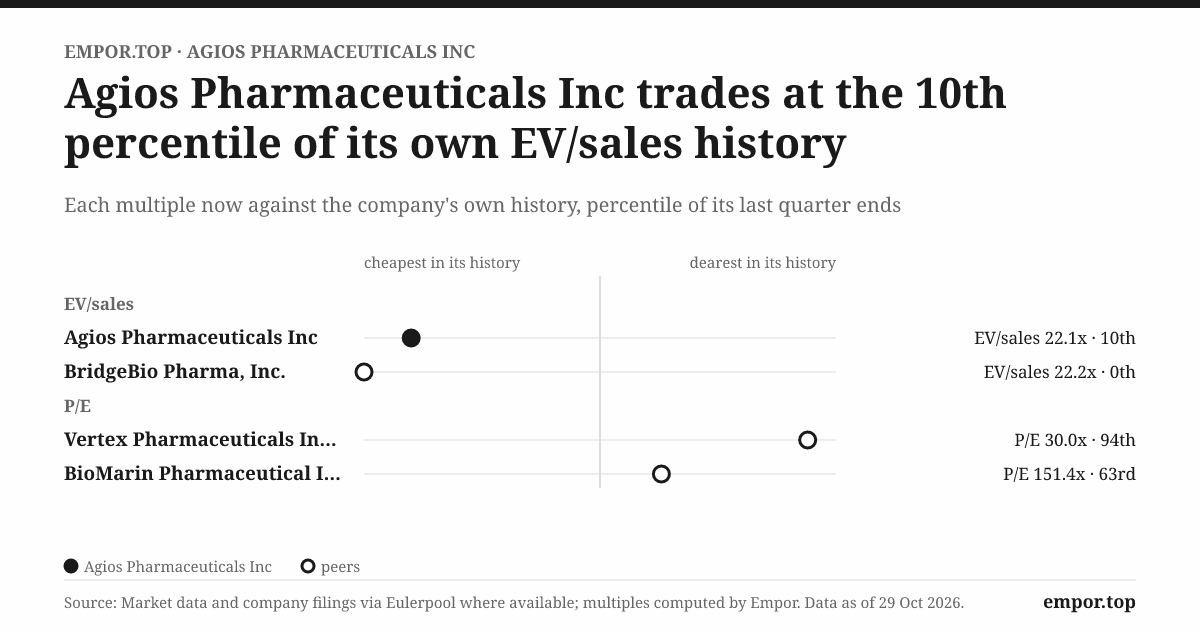
On October 29, 2026, the market values Agios at about $2.2 billion. Subtract roughly $965 million of cash and securities, and the enterprise value, what investors are paying for the business itself, is about $1.6 billion. Over the last twelve months, the company lost about $6.98 per share, and revenue was about $95 million, so the enterprise trades at roughly 22 times trailing sales. Those multiples look stretched, but they are backward-looking in a business that has just changed shape. If the second quarter's $44.7 million were simply annualised, revenue would be about $179 million, and the enterprise value would be roughly nine times that, though one quarter, including a stocking benefit, is a weak foundation for any run rate.1 The occasional "P/E of 3" that appears in data screens is a relic of the 2024 royalty gain and means nothing about current earnings.
What does the price seem to assume? Not profitability any time soon. An enterprise value of about $1.6 billion for a business with an approved molecule in two diseases, exclusivity into the 2030s, and a pending decision in a much larger market is a bet on future growth, not current earnings. It assumes the thalassemia launch keeps building, that sickle cell becomes a real, if modest, market, and that cash lasts long enough to get there. It does not assume a blockbuster. Nor does it leave much room for a launch that stalls or an FDA rejection.
The bull case starts with something Agios did not have five years ago: a commercial engine with momentum. Mitapivat is now approved for PK deficiency in the U.S., Europe and elsewhere, and for thalassemia in the U.S., the EU, Saudi Arabia and the UAE.1 Quarterly revenue has more than tripled in a year. Prescriptions have kept rising through two quarters of launch, and the company says payer coverage has reached about three quarters of insured thalassemia lives and gross-to-net is tracking at the favourable end of guidance.14 An FDA approval in sickle cell would make mitapivat the first oral PK activator in a disease affecting about 100,000 Americans, with a target treated population management sizes at about 25,000.2014 And the balance sheet, with no debt and almost a billion dollars, means Agios can fund the launches without an immediate equity raise.
The bear case is just as concrete. One customer still accounted for 89% of 2025 revenue, so shipment patterns can distort demand signals.3 R&D was more than six times product revenue in 2025, and quarterly losses have barely moved despite the revenue jump.31 Cash fell by about $200 million in the first half of 2026.1 In sickle cell, the pivotal trial missed its pain-crisis endpoint, leaving a label built on a surrogate marker and a confirmatory trial yet to deliver; Medicaid rebates will compress pricing, and competitors including Novo's etavopivat are coming.143 The PK activator platform has lost its second molecule, tebapivat. And management's history of company-level forecasts, particularly its 2021 promise of cash-flow positivity by 2025, gives investors reasons to discount promises about future profitability.
Porter's five forces help organise these facts. Buyer power is high: payers decide coverage and extract rebates, Medicaid takes a statutory cut, and distribution runs through a very small number of specialty channels. The threat of substitutes is significant: transfusions, Reblozyl, hydroxyurea in sickle cell and curative gene therapies all compete for the same patients, even if not identically. New entrants are real, particularly other PK activators. Supplier power is moderate; Agios relies on contract manufacturers but does not disclose a supplier concentration. Rivalry varies by disease, from near-monopoly in PK deficiency to crowded in thalassemia and sickle cell. The net effect is that mitapivat can command a premium for differentiation but cannot dictate terms.
Hamilton Helmer's 7 Powers framework sharpens the question of durability. Of the seven sources of lasting advantage, mitapivat clearly has only one in strong form: a cornered resource, in the shape of patents and regulatory exclusivity on an approved molecule. Some counter-positioning exists, an oral disease-modifying therapy against injections and transfusions, but incumbents can respond. There is little evidence of switching costs; a patient who stops responding can move to another therapy. Scale economies and network effects are largely irrelevant in rare disease. Brand power is too young to measure. Process power, the accumulated know-how of running hematology launches, is plausible but unproven. The honest conclusion is that Agios's moat is legal and temporary, scheduled to erode as patents expire in the 2030s, unless it builds something more durable around them.
An activist looking at this company would ask pointed questions. Why license new early-stage assets while the core franchise burns cash? Why return $800 million at prices above today's share price? Why stop disclosing prescriptions just as the launch matures? And why does a business of this size need more than $200 million a year of selling and administrative costs? None of these is a charge of mismanagement. They are the questions a cash-burning company with one molecule should expect, and the answers will come from results rather than presentations.
For tracking whether the bull or bear case is winning, three measures matter more than all the rest. The first is product revenue by indication, especially thalassemia: the latest reading is $40.9 million of combined U.S. revenue in the second quarter, rising sharply, but including about $5 million of one-time stocking.114 The second is real-world persistence: whether AQVESME patients stay on therapy after the six-month assessment point, which Agios has so far described qualitatively by reference to its trial experience.14 The third is operating cash use relative to revenue: about $200 million consumed in the first half of 2026 against $65 million of sales.1 If the first rises, the second holds, and the third falls, the bull case is working. If revenue rises while the burn does not, the bear case is.
X. Business & Investing Lessons
There is a moment in the Agios story that captures the whole arc. PYRUKYND's approval was a genuine medical breakthrough, the kind that justifies the existence of a research-driven company.[^18] Four years later, the drug remained a modest business while Agios was still burning cash. A drug can be a breakthrough before it is a business. Approval tells you a medicine works. It tells you almost nothing about how many patients exist, how many can be found, what payers will pay, and how long patients stay. Founders and investors who confuse the first question with the second tend to overpay for science and underestimate the slog of commercialisation.
The second lesson lives in the oncology sale. It gave Agios a large cash cushion, part of which the company returned to shareholders.8[^17] Five years later, the new company has an approved drug in three indications and almost a billion dollars in the bank, but it had also missed the self-funding target that justified the plan.93 A large cash balance buys experiments, not immunity. Money lets a company keep its options open. It does not make those options pay off, and every year it takes to find out costs another few hundred million dollars. The quality of a capital-allocation decision depends on the forecasts behind it, and Agios's forecasts were too optimistic.
The third lesson comes from the AQVESME launch. Its early prescription count showed how quickly interest can build, but prescriptions are an intention, not a revenue stream.161 Each has to survive insurance approval, a liver test, the first dose, the six-month check, and every refill after that. Count patients who stay, not prescriptions written. In rare-disease launches, persistence, not initiation, is what determines lifetime value per patient, and companies that report only the top of the funnel are telling only the most flattering part of the story.
The fourth lesson is the sickle cell trial. Mitapivat works by giving red cells more energy, and it has raised hemoglobin across diseases. But each disease asks a different question. In sickle cell, the trial could not prove that it prevents pain crises, the outcome patients care about most.19 A platform is a promise that has to be kept trial by trial. The same molecule, the same mechanism and the same company can produce a clean win in one disease and a split decision in the next. Investors who value a "platform" as if each new indication were a near-certain extension of the last will be repeatedly surprised. Each indication should be valued on its own evidence, its own label and its own competition.
Taken together, these lessons describe a familiar pattern in biotechnology, told with unusual clarity by one company's history. Scientific value can be monetised long before a company has built durable economics, and the act of monetising it can make the next business harder to finance. Agios sold its first business at a fair price, returned capital, and bet the remainder on a single molecule. Whether that bet pays off now depends less on science than on the mundane mechanics of patients, payers and persistence.
XI. Epilogue
Tonight, Agios stands three days from the most important regulatory decision in its post-oncology life. On November 1, the FDA is due to rule on mitapivat for sickle cell disease.2 Soon after, the company will report its third-quarter results, the first set to show the thalassemia launch without the second quarter's one-time stocking boost. The company enters that week with almost a billion dollars, two brands, one molecule, and a research budget several times larger than its sales.
A favorable decision could open the largest market Agios has addressed, though management has said sickle cell would not be a material revenue contributor in 2026, and the confirmatory REIGNITE trial would still have to show that patients need fewer transfusions.142 A restrictive label or rejection would leave Agios reliant on PK deficiency and thalassemia.
Beyond the FDA, the next few quarters will answer the launch question. The first AQVESME patients have passed the six-month mark, when doctors decide whether the drug is working. If revenue in the second half of 2026 holds up after stocking effects wash through, that is evidence that patients are staying. If it stalls, it suggests the early surge was the most motivated patients, and the harder work of reaching non-transfusion-dependent patients has only begun. Management has said it will stop reporting prescription counts after the third quarter, so revenue will have to carry the story on its own.14
The financial question runs in parallel. If quarterly revenue keeps climbing while operating costs stay roughly flat, the burn will narrow, and the 2021 promise of self-funding, late by years, might finally start to look achievable. If revenue grows but costs grow with it, through a sickle cell launch or new pipeline commitments, the gap will persist, and Agios will need to decide between spending its reserves faster or tapping the equity market. The next annual report will also show whether customer and receivable concentration loosens as the business grows, and whether reserves for rebates and returns rise faster than sales.
There is one more thread to watch. Agios is spending on new pipeline assets whose payoffs lie late in the decade.1 Their milestones will be judged as clinical progress. They should not be mistaken for commercial progress. The company has shown it can get drugs approved; what it has not yet shown is that it can make the economics of an approved drug self-sustaining.
So the question Agios carries into November is the same one it has carried since 2021, now made urgent by a launch and a deadline. Can a single molecule, approved across several blood diseases, generate enough recurring revenue from patients who stay on therapy to pay for the company that discovered it? The FDA can open a door. Only patients, refills and cash can walk through it.
XII. Outro
Go back to that July morning. Revenue had more than tripled year over year, while the loss had barely changed.1 Those two numbers sit side by side like the two headlines of the sickle cell trial: one that proves the molecule works, and one that asks whether that is enough.
Agios's metabolism bet has produced cancer drugs and a pill that gives red blood cells the energy to survive. Whether that pill can support a durable company is still being counted, one patient, one refill and one quarter of cash at a time.
References
-
Agios Reports Second Quarter 2026 Financial Results and Provides Business Update (Form 8-K Exhibit 99.1) — SEC, 2026-07-30 ↩↩↩↩↩↩↩↩↩↩↩↩↩↩↩↩↩↩↩↩↩↩↩↩↩↩↩↩↩↩↩↩
-
U.S. FDA Grants Priority Review to Agios' sNDA for Mitapivat in Sickle Cell Disease — BioSpace / Agios, 2026-07-07 ↩↩↩↩↩↩↩↩↩
-
2025 Form 10-K — SEC, 2026-02-12 ↩↩↩↩↩↩↩↩↩↩↩↩↩↩↩↩↩↩↩↩↩↩↩↩↩↩↩↩↩↩↩↩↩↩
-
Agios Announces Closing of Oncology Business Sale to Servier (Exhibit 99.1) — SEC, 2021-04-01 ↩↩↩
-
Agios Announces "Agios 2025" Strategic Vision and Highlights 2020 Milestones (Exhibit 99.1) — SEC, 2021-01-11 ↩↩↩
-
Agios Q3 2021 Earnings Call Transcript — The Motley Fool, 2021-11-03 ↩↩↩
-
Agios Reports Fourth Quarter and Full Year 2025 Financial Results and Provides Business Update — BioSpace / Agios, 2026-02-12 ↩
-
Agios Q2 2026 Earnings Call Transcript — Stock Analysis, 2026-07-30 ↩↩↩↩↩↩↩↩↩↩↩↩↩↩↩↩↩↩↩↩↩↩
-
Agios Q4 and FY2025 Earnings Call Transcript — The Motley Fool, 2026-02-12 ↩↩↩↩↩↩↩↩↩↩↩↩↩↩
-
Agios Q1 2026 Earnings Call Transcript — The Motley Fool, 2026-04-30 ↩↩↩↩↩↩↩↩↩↩
-
Agios Shares Plunge 50% After Mixed Phase 3 RISE UP Results for Mitapivat — RTTNews via finanzen.ch, 2025-11-19 ↩
-
New Pill Mitapivat Raises Hemoglobin in SCD Phase 3 Trial — Sickle Cell Anemia News, 2025-11-20 ↩↩↩↩↩↩↩↩
-
Agios Shares Slump on Sickle Cell Disease Data — pharmaphorum, 2025-11-19 ↩↩↩↩
-
Agios Provides Update on Phase 2b Trial of Tebapivat in Lower-Risk Myelodysplastic Syndromes — BioSpace / Agios, 2026-05 ↩↩
-
Agios Appoints Brian Goff as Chief Executive Officer (Form 8-K Exhibit 99.1) — SEC, 2022-07-12 ↩↩
-
After Pivot, Agios Names Alexion Vet Goff Its Next CEO as Fouse Transitions to Board Chair — Fierce Pharma, 2022-07-12 ↩↩
-
2026 Annual Meeting Results, Form 8-K — Agios, 2026-06-18 ↩↩
 LinkedIn
 WhatsApp
 Reddit
 Hacker News
 Email
 Kindle
 RSS Feed
 Spotify
 Apple Podcasts
 Amazon Music
 Audible
 YouTube