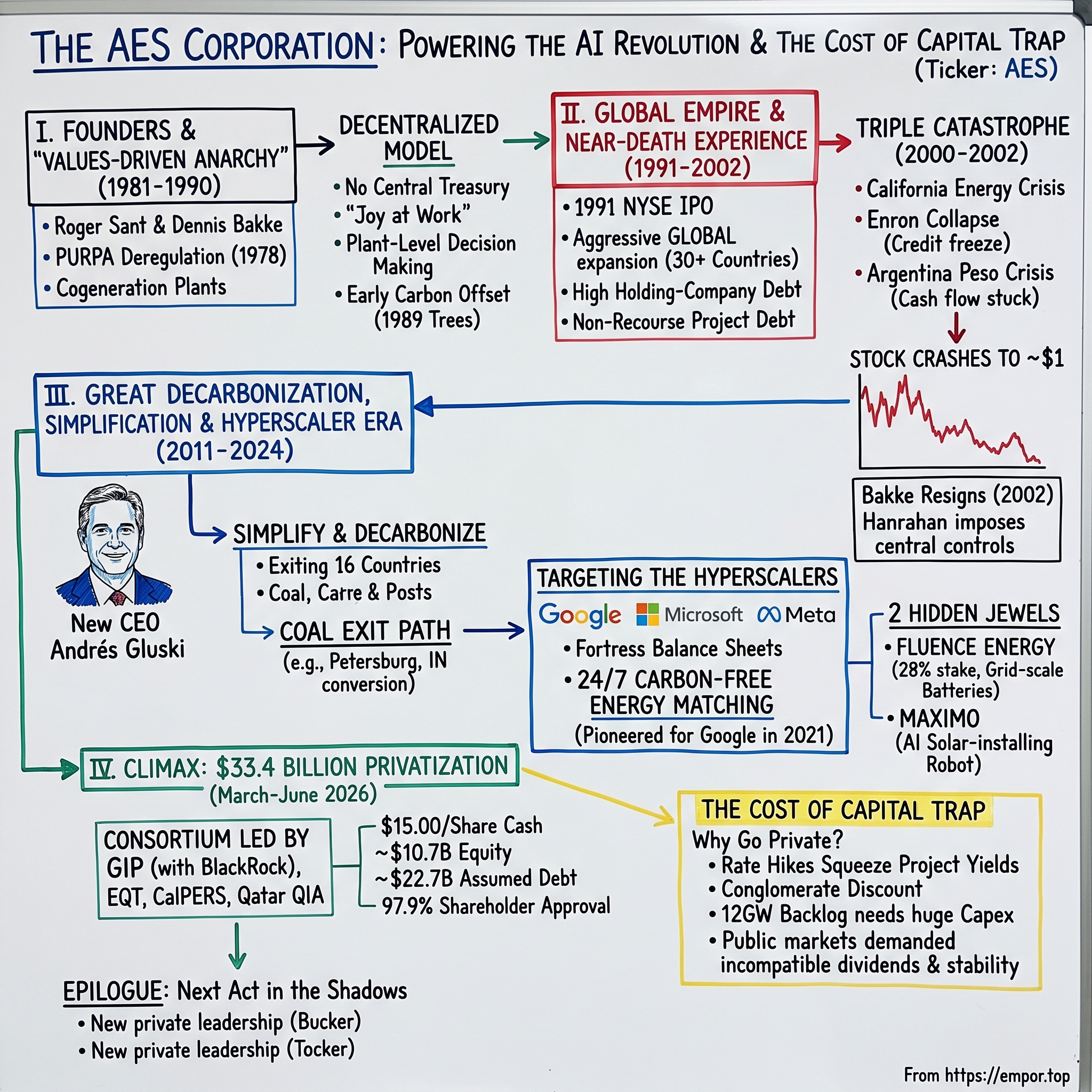
The AES Corporation: Powering the AI Revolution and the Cost of Capital Trap
I. Introduction & Episode Roadmap
There is a strange contradiction sitting at the center of the American economy in the summer of 2026, and The AES Corporation is the purest expression of it. On one side of the ledger, electricity demand is climbing at the fastest rate the United States has seen in a generation. After two decades of flat consumption — a stretch so long that utility planners had quietly written off load growth as a relic of the twentieth century — the grid is suddenly straining under the weight of artificial-intelligence data centers, cloud campuses, reshored factories, and the slow electrification of cars and heat. A single hyperscale AI cluster can draw as much power as a mid-sized city. The people who build power plants should, by any intuitive logic, be the most prized companies on earth.
To grasp the scale of the demand shock, consider what changed. For roughly twenty years, US electricity consumption was essentially flat — efficiency gains in lighting, appliances, and industry offset population and economic growth almost exactly, and utilities built their business plans around a world with no load growth at all. Then generative AI arrived, and with it a class of computing facility whose appetite for power dwarfs anything the grid had planned for. Training and running large AI models requires dense clusters of specialized chips that run hot and run constantly; a single large campus can demand hundreds of megawatts to more than a gigawatt of continuous power, the equivalent of a small city that never sleeps and never leaves. Multiply that across every hyperscaler racing to build capacity, layer on the electrification of transport and heating, and the flat line of two decades suddenly bends sharply upward. The people who can deliver firm, clean power at that scale should be the most valuable operators in the economy.
On the other side of the ledger sits the stock chart of the very companies doing the building — and it is a graveyard. Utility-scale renewable developers spent 2022 through 2025 getting pummeled: interest rates that tripled the cost of financing multi-decade projects, solar-panel tariffs, supply-chain snarls, and a public equity market that could never quite decide whether to price them as boring regulated utilities or as high-growth infrastructure plays. AES lived that contradiction in its share price. The company that had spent fifteen years reinventing itself into a clean-energy champion, signing landmark contracts with the richest corporations on the planet, watched its stock languish while its order book swelled.
The contradiction resolved itself on March 2, 2026, in the only way the math allowed. AES announced it had agreed to be taken private in a transaction valuing the enterprise at roughly $33.4 billion, led by Global Infrastructure Partners — the infrastructure arm of BlackRock — and EQT Infrastructure, with California's public pension fund and Qatar's sovereign wealth fund riding along as co-underwriters.1 The equity was priced at $15.00 a share, about $10.7 billion, and the rest — some $22.7 billion — was assumed debt.1 One of the most successful renewable developers of the twenty-first century was, in effect, fleeing the public markets. The question this article exists to answer is a simple one with an uncomfortable answer: why?
To understand it, you have to understand the whole arc. AES is not a young company chasing a fad. It was a true pioneer of the independent power business, born from the deregulation impulses of the late 1970s, that grew into a hyper-decentralized, debt-fueled global empire spanning nearly thirty countries — and then nearly died. In 2002 its stock traded for roughly a dollar. It rebuilt itself, painstakingly, first under a disciplinarian named Paul Hanrahan and then under the fifteen-year stewardship of Andrés Gluski, who tore out the company's coal, shrank its geography, and pointed the whole apparatus at the one customer set that would define the decade: the hyperscalers.
This is the roadmap. We will walk through the "ethical anarchy" of founders Roger Sant and Dennis Bakke, who ran a multibillion-dollar power company as a radical experiment in workplace freedom. We will relive the near-death experience of 2001–2002, when Enron's collapse and an Argentine currency crisis nearly took the whole edifice down. We will examine the Gluski turnaround, the pivot to 24/7 carbon-free power, and the two hidden jewels — Fluence Energy in grid-scale batteries, and a solar-installing robot named Maximo. And finally we will sit with the central lesson of the entire saga: the cost of capital trap, the reason the public stock market may simply be the wrong owner for capital-hungry, multi-decade energy megaprojects — and why private infrastructure funds have become the natural buyers of the energy transition. AES is the case study. Let's begin where it began, with two bureaucrats who thought the American energy system was broken.
 Subscribe on LinkedIn
II. The Founders & Values-Driven Anarchy (1981–1990)
Picture Washington in the mid-1970s: gas lines snaking around city blocks, thermostats mandated down, a nation traumatized by the oil shocks and convinced its energy system had failed. Inside the Federal Energy Administration — a hastily assembled crisis agency — two men were reaching the same heretical conclusion from adjacent desks. Roger Sant ran the conservation and environment office; Dennis Bakke worked under him. Both had come out of the Harvard Business School, both had spent time close to the machinery of federal energy policy under Nixon and Ford, and both had watched the regulated, vertically integrated electric utility up close and decided it was a monument to inefficiency — a monopoly with no reason to ever get cheaper.
Their timing was, in retrospect, exquisite. In 1978 Congress passed the Public Utility Regulatory Policies Act, or PURPA, a piece of legislation whose importance is hard to overstate and easy to miss. For the entire history of American electricity, the local utility had held a legal monopoly: it generated the power, it owned the wires, and no one else was allowed to sell an electron. PURPA cracked that open. It forced utilities to buy power from independent producers whenever that power was cheaper than the utility's own "avoided cost" — the cost it would have incurred generating the electricity itself. For the first time, an outsider could build a power plant and be guaranteed a buyer. A market appeared where a monopoly had stood.
Sant and Bakke founded Applied Energy Services in Arlington, Virginia, in 1981. It began as an energy consulting shop, but consulting was never the point — it was reconnaissance. Within a few years the pair pivoted to actually building and running cogeneration plants, facilities that squeezed two useful outputs, electricity and industrial steam, from a single fuel burn, often coal or waste gas. Cogeneration was efficient, PURPA made it bankable, and AES was suddenly a developer. The consulting firm had become a power company almost by stealth.
What made AES genuinely strange was not the plants. It was the philosophy Bakke built around them, later codified in his book Joy at Work. Bakke believed, with something close to religious conviction, that conventional corporate hierarchy was dehumanizing and that people did their best work when trusted with real responsibility. So he ran AES as a radical experiment in decentralization. There was no HR department. No central purchasing. No specialized corporate treasury. Individual plant managers and frontline teams — not executives at headquarters — negotiated multimillion-dollar fuel contracts, arranged their own insurance, set their own shifts, and in some tellings even helped decide how to invest the company's surplus cash. The organization ran on four stated values that Bakke insisted were ends in themselves, not means to profit: integrity, fairness, social responsibility, and fun.
To make the decentralization vivid: at a conventional utility, a decision to hedge a fuel contract or restructure a plant's insurance would climb a chain of approvals to a corporate risk committee. At AES, the person running the plant simply did it. Bakke's logic was that the people closest to a decision make it best, and that the psychological reward of genuine ownership — being trusted, being accountable — produced both better outcomes and happier employees. For a stretch it seemed vindicated: AES developed a reputation as one of the more admired employers in corporate America, a place where line workers spoke about the mission with an earnestness usually reserved for religious orders. The flip side, invisible in good times, was that a company with no central nervous system has no way to feel a systemic threat until it has already spread through every limb.
The environmental streak was equally ahead of its time. In 1989, to offset the carbon emissions of a coal-fired plant it was building in Connecticut, AES helped fund the planting of some 52 million trees in Guatemala — one of the earliest corporate carbon-offset programs anywhere, undertaken years before "carbon offset" was a phrase anyone used. Whatever one thinks of the accounting — and the science of whether tree-planting truly offsets a coal plant's lifetime emissions is genuinely contested — it revealed a company that took its stated social mission literally, and it prefigured, by three decades, the carbon-conscious identity AES would eventually make its whole strategy.
Here is the part worth holding onto, because it will matter enormously later. The "Joy at Work" model was not merely a nice culture; it was a capital allocation philosophy. A company with no central treasury and no purchasing discipline is a company that has decided, structurally, to trust the periphery over the center. That works beautifully when the money is flowing and every plant is a profit engine. It becomes an existential liability the moment the whole enterprise needs to be steered through a storm from a single bridge. In 1991, hungry for the institutional capital that would let it hunt bigger game, AES went public on the New York Stock Exchange. The decentralized experiment now had a currency — its own stock — and a mandate from public shareholders to grow. It was about to do exactly that, at a scale no one, least of all its founders, was prepared to control.
III. The Global Empire and the Near-Death Experience (1991–2002)
For a company like AES, the 1990s were less a decade than an open buffet. The Soviet Union had collapsed. Latin America was throwing off decades of statism and liberalizing. From Buenos Aires to Tbilisi to Karachi, governments that had spent a generation running electricity as a bankrupt arm of the state were suddenly desperate to sell — to hand off their decrepit power plants and leaky distribution grids to anyone with hard currency and the nerve to operate them. And AES, armed with public equity and an ideology that told its people to go seize opportunity wherever they found it, sent its developers out into the world like privateers.
The blitz was astonishing in its geographic reach. Over roughly a decade AES acquired or built power assets in nearly thirty countries — Argentina, Brazil, El Salvador, Kazakhstan, Cameroon, Georgia, Pakistan, and on and on. Each deal was struck, in true AES fashion, by relatively autonomous teams on the ground. There was a genuine entrepreneurial genius to it: AES got into markets years before its more cautious competitors, buying distressed grids and plants cheaply from motivated, cash-strapped sellers who were privatizing under duress. For a while it looked like the smartest strategy in the industry. The stock rewarded it lavishly, cresting above $70 a share in 2000.
But the diversification that looked like prudence on a map was something closer to its opposite in a spreadsheet. Owning power plants in thirty countries sounds like risk-spreading — surely no single event could hit them all. The hidden flaw was that AES's exposures were not independent of one another. They were chained together at the top by that holding-company debt, and, more subtly, they were correlated through the emerging-market credit cycle: the same global flight from risk that hammered Argentina also hammered Brazil, also froze the credit markets AES needed to roll its debt. A portfolio of thirty positions offers little protection when all thirty are levered to the same underlying factor. That is a lesson that generalizes well beyond power — the appearance of diversification is not the same as the fact of it — and AES was about to learn it in the most expensive way imaginable.
But underneath the empire was a capital structure that only worked if nothing ever went wrong. This is the technical heart of the story, so it is worth slowing down for. AES funded its global shopping spree with two kinds of borrowing. At the top sat holding company debt — money borrowed by the corporate parent in the United States. At the bottom sat non-recourse project debt — money borrowed against individual power plants, structured so that if a single plant failed, the lenders could seize that plant but could not come after the parent. In theory this was elegant: risk was walled off, plant by plant. In practice it created a lethal dependency. The parent's holding-company debt could only be serviced if cash from all those far-flung subsidiaries reliably flowed up to headquarters. The entire tower rested on the assumption that dollars would always make it home from Argentina, from Brazil, from wherever.
Between 2000 and 2002, three separate catastrophes proved that assumption false at exactly the same moment. The first was the California electricity crisis of 2000–2001, when merchant power markets — the deregulated spot markets AES and its peers had bet on — convulsed into rolling blackouts, price spikes, political fury, and regulatory investigations that tarred the entire independent power sector. The second, and most systemically devastating, was the collapse of Enron in December 2001. Enron had been the swaggering face of energy trading, and when it imploded amid accounting fraud, banks slammed the lending window shut on every independent power producer indiscriminately. Credit rating agencies went on a downgrade spree. The whole business model was suddenly radioactive, and AES, with its mountain of holding-company debt, was among the most exposed names in it.
The third blow was the one the decentralized model had no answer for. In late 2001 and 2002 Argentina's economy detonated: the peso, long pegged one-to-one to the dollar, was devalued and then floated, losing most of its value, while the government imposed capital controls. AES had significant Argentine operations earning pesos — pesos it now could neither convert into dollars nor send back to service its US parent debt. The cash that the whole tower depended on simply stopped arriving. Holding-company debt tumbled to junk status. And the stock that had touched $70 collapsed all the way down to roughly a dollar, a wipeout so total it is hard to overstate.7
The reckoning was cultural as much as financial. The "Joy at Work" ethos — the absence of central treasury, of currency hedging, of the boring risk-management plumbing that a global business needs — met the cold indifference of the capital markets and lost. There is a hard investing lesson buried here, and it is worth naming precisely: a decentralized organization optimizes for local upside but is structurally blind to correlated, system-wide risk. The California crisis, the Enron contagion, and the Argentine devaluation were not independent bad-luck events; they were the simultaneous failure of the single assumption the entire capital structure rested on — that subsidiary cash would always flow home. No individual plant manager could have seen or hedged that. Only a strong center could have, and AES had spent a decade dismantling its center on principle.
In June 2002 Dennis Bakke resigned as chief executive, taking public responsibility for a year he called "terrible."7 Roger Sant, the co-founder and chairman, stepped back from day-to-day leadership as well. The board reached for a very different kind of leader: Paul Hanrahan, a Naval Academy graduate and fifteen-year AES veteran, one of four operating chiefs, who set about restructuring billions in debt, selling assets to raise liquidity, imposing centralized financial controls, hedging currency exposure, and, in the process, quietly killing the radical anarchy that had defined the company.7 Under Hanrahan through the 2000s, AES clawed back from a dollar-a-share penny stock to a functioning, if still-complex, global generator. The era of ethical experiment was over. The era of financial engineering had begun — and, though no one could have known it in 2002, it would eventually deliver AES into the arms of the world's largest asset manager.
IV. The Great Decarbonization, Simplification, & Hyperscaler Era (2011–2024)
When Andrés Gluski became chief executive of AES in 2011, he inherited a company that had survived but not healed. It was still sprawling — operations scattered across more than two dozen countries — still heavily indebted, and still, at its core, a fossil-fuel generator with coal making up more than half its capacity. Gluski was an unusual figure to hand this to. Venezuelan-born, with a doctorate in economics and a résumé that included time at the International Monetary Fund and a deep grounding in Latin American public policy, he was less a power-plant operator than a macroeconomic strategist who happened to run power plants. That vantage point mattered, because the transformation he undertook was as much about capital and geography as it was about megawatts.
His playbook had two words on the cover: simplify and decarbonize. Simplification meant an unsentimental, years-long campaign of selling assets and exiting entire countries. AES had grown by saying yes everywhere; Gluski grew by saying no. The operating footprint was cut roughly in half, from around 28 countries down to a core of a dozen or so, concentrated in the United States, South America, and Central America and the Caribbean. The logic was that a smaller number of larger, better-understood positions would trade at a higher multiple and be far easier to finance than a confusing global grab-bag. Whether the public market ever fully rewarded that logic is a question we will return to — because it is, ultimately, the crux of the whole story.
Decarbonization was the more dramatic half. Gluski committed AES to phasing out coal, the fuel that had once been its backbone. Coal generation, which had represented well over half of AES's capacity, was placed on a path toward near-total exit by the middle-to-late 2020s. This was not virtue signaling; it was a read on where creditworthy demand was heading. And that read pointed directly at Silicon Valley.
The coal exit was concrete, expensive, and locally contentious in ways that reveal the real friction of the energy transition. Take the Petersburg Generating Station in Pike County, Indiana — for decades a coal-burning workhorse. AES Indiana committed roughly $1.1 billion to convert its two remaining Petersburg coal units to burn natural gas rather than coal, with the first unit's conversion outage beginning in February 2026 and the second slated for commercial operation by December 2026, a move that AES expected would make it the first Indiana utility to exit coal entirely.12 Note the nuance the headline "coal exit" obscures: the destination was not always renewables but often natural gas, a lower-carbon but still-fossil fuel. That is a pragmatic bridge, not a leap — and a fair reminder that AES's "decarbonization" was a gradient, not a switch. It also generated exactly the kind of local ratepayer scrutiny — regulators questioning the cost, the capacity implications, and who pays — that would resurface later as one of the sharper risks in the bear case.
Here is where AES made its most consequential strategic bet. Gluski's team recognized earlier than most that the technology giants — Google, Microsoft, Amazon, Meta — were becoming the most aggressive and, crucially, the most creditworthy buyers of clean power on the planet. These were companies with fortress balance sheets and public commitments to run on carbon-free energy, and they were building data centers that devoured electricity around the clock. Selling them power was like underwriting a loan to the safest borrowers in the economy.
But AES did something cleverer than just signing ordinary green contracts. It attacked the dirty secret of most "100% renewable" corporate claims. A typical renewable power-purchase agreement is an accounting exercise: a company buys enough solar output over a year to match its total consumption on paper, even though at 2 a.m., when the sun is down, it is actually running on grid power that may be coal or gas. AES pioneered a genuinely harder product: 24/7 carbon-free energy matching, which pairs solar and wind with battery storage to deliver clean power in every hour of the day, not just on an annual net basis. Think of it as the difference between claiming your household is vegetarian because you ate enough salad over the year to offset the steaks, versus actually being vegetarian at every single meal. The second is far harder, and far more valuable to a customer that genuinely wants to be clean in real time.
The landmark proof point came on May 4, 2021, when AES announced a first-of-its-kind agreement to supply Google's Virginia data centers with 24/7 carbon-free energy under a ten-year contract, assembling roughly 500 megawatts of wind, solar, hydro, and storage designed to keep those facilities about 90% carbon-free measured hour by hour.6 It was a template, and AES rolled it out across a growing roster of hyperscaler and industrial customers. By 2025 the customer names had become a who's-who of the AI build-out: in May 2025, for instance, AES and Meta signed long-term power-purchase agreements for 650 megawatts of new solar capacity in Texas and Kansas to feed Meta's data centers.13 The commercial machine Gluski built was, by then, running at full tilt — in 2024 alone AES signed or was awarded 6.8 gigawatts of new contracts, including 4.4 gigawatts of long-term renewable PPAs, and completed construction or acquisition of another 3.0 gigawatts of solar, storage, and wind.3
There is a second, quieter vector in this story that markets often overlook, and it runs through the boring regulated utilities. AES Indiana and AES Ohio are not just stable cash cows; they are the physical wires into which a data center actually plugs. When a hyperscaler wants to drop a billion-dollar computing campus into central Ohio, it needs a regulated utility to deliver the load — and AES Ohio is that utility. In 2024 AES signed agreements with data-center customers for roughly 2.1 gigawatts of new load growth at AES Ohio alone, a staggering figure for a mid-sized distribution utility, and the kind of demand that drives years of rate-base investment.311 To fund that growth without straining the parent, AES brought in Canadian pension giant CDPQ as a strategic partner in AES Ohio — an early, telling signal that even before the full buyout, the deep-pocketed private capital pools were the ones underwriting AES's expansion.14 The utilities, in short, were not the sleepy ballast the "utility discount" implied; they were a growth business hiding inside a value multiple, which is exactly the kind of mispricing that eventually attracts an acquirer.
By 2024 the reshaped company reported through three segments, and the way their economics differed tells you everything about AES's split personality. The Renewables business — over 16 gigawatts of operating wind, solar, and storage plus a signed-contract PPA backlog of 12.7 gigawatts (about 4.0 gigawatts of it already under construction), which management expected to bring roughly 85% online by the end of 2027 — contributed only about $552 million of adjusted EBITDA.23 Sit with that mismatch for a moment: the segment carrying the company's entire growth narrative, the one with the enormous contracted order book, threw off the smallest slice of current earnings. That is the signature of a business in its heavy-investment phase — spending cash today for cash flows that arrive years later — and it is precisely the shape of company that public markets, fixated on this quarter's earnings, find hardest to value fairly.2 The Utilities business — regulated monopolies including AES Indiana and AES Ohio — contributed about $792 million of adjusted EBITDA, the slow, dependable, rate-base cash flow that income investors prize, and, not coincidentally, the direct physical connection point for new Midwestern data centers.2 And Energy Infrastructure — the legacy natural gas, LNG, and remaining coal fleet — was still the largest single contributor at roughly $1,366 million, even as it was deliberately shrinking as coal plants were sold or retired.2
Now the number that reframes the whole picture. Add up those segments and 2024 adjusted EBITDA came to about $2,639 million.3 But that figure omits something enormous: the tax credits. Under the Inflation Reduction Act, building renewables generates Production Tax Credits and Investment Tax Credits — federal subsidies AES can monetize, effectively a second revenue stream flowing from every solar and wind project it energizes. Including those tax attributes, 2024 adjusted EBITDA jumped to roughly $3,952 million.3 In other words, government tax policy was contributing well over a billion dollars of economic value — more than a third of the total — and that dependence on the IRA was simultaneously AES's rocket fuel and one of its quieter risks. When a third of your earnings power rests on the durability of a specific act of Congress, your strategy is only as stable as the politics behind it. Which is a useful thing to remember as we turn to the two pieces of AES that the market arguably never priced at all.
V. The Hidden Jewels: Fluence & AI-Driven Construction
If you want to see the difference between owning a power plant and owning the technology that makes power plants smarter, look at Fluence. And to understand Fluence, you first have to understand why batteries are the missing piece that makes the entire 24/7 clean-energy promise physically possible. Solar panels make power when the sun shines; wind turbines when the wind blows. Neither cares whether a data center needs electricity at that particular moment. The battery is the shock absorber — it stores the midday solar surplus and discharges it at midnight, converting intermittent generation into something that behaves like a controllable, dispatchable power plant. Grid-scale storage is not a nice-to-have in the renewable world. It is the enabling technology.
AES had been integrating grid-scale lithium-ion batteries for roughly a decade, longer than almost anyone, accumulating hard-won expertise in a field most utilities barely understood. In 2018 it spun that expertise into a 50/50 joint venture with Siemens, the German industrial giant, creating Fluence — combining Siemens' global sales reach and industrial credibility with AES's deep operational battery know-how. Fluence went public on Nasdaq in late 2021, and following that listing AES retained a substantial economic stake, reported at 28.19% and accounted for under the equity method — meaning AES books its share of Fluence's results rather than consolidating the whole company.2
The financial trajectory has been a study in the difference between scale and profit. Fluence grew explosively: fiscal 2025 revenue reached about $2.26 billion, and management guided fiscal 2026 revenue to a range of roughly $3.2 billion to $3.6 billion, with the midpoint reportedly covered almost entirely by orders already in backlog.45 That backlog coverage is a genuinely bullish operational signal — it means the growth is contracted, not hoped for. And yet Fluence still lost money, posting a net loss of about $68 million in fiscal 2025 as it absorbed project-specific supply-chain and execution costs.4 This is the recurring theme of the energy transition in miniature: enormous top-line demand, brutally thin or negative margins, and a long, uncertain road to sustained profitability. A skeptic would note that a company can grow revenue toward $3.5 billion and still not have proven it can reliably make money — and that skeptic would, so far, be correct.
It is also worth being honest about the competitive weather Fluence operates in, because the "crown jewel" framing can flatter it. Fluence is an integrator — it buys battery cells, largely from Chinese and Korean manufacturers, and packages them into grid-scale systems with its own software and engineering. That means its cost position is only as good as its supply chain, and it sits downstream of the cell giants like 宁德时代 CATL and BYD who make the actual chemistry. It also competes head-on with 特斯拉 Tesla's Megapack and a widening field of rivals, several of whom enjoy vertical integration Fluence lacks. Add US policy pressure to reduce reliance on Chinese components — the "foreign entity of concern" compliance rules that hang over the whole storage industry — and Fluence's growth, impressive as it is, comes wrapped in real execution and geopolitical risk. The bull sees a scaled, backlog-covered leader in the fastest-growing hardware category of the grid; the bear sees a thin-margin middleman squeezed between Chinese suppliers and a policy vise. Both are looking at the same company.
Why does AES care so much about a battery integrator it doesn't even control? Because Fluence hands AES two edges its competitors lack: privileged insight into battery procurement and pricing, and sophisticated software for optimizing how those batteries are dispatched. Cheaper, smarter storage means AES can bid its 24/7 carbon-free contracts at prices rivals struggle to match. The jewel is strategic, not just financial — though whether that edge is durable, as battery costs commoditize and every developer gains access to cheap cells, is a fair and open question.
The second jewel is stranger and more literal: a robot named Maximo. Building a utility-scale solar farm is, at bottom, an act of staggering repetition — hundreds of thousands of heavy panels lifted, positioned, aligned, and bolted down by hand, under a hot sun, by a construction labor force that is chronically short-handed. Maximo is AES's proprietary, AI-enabled field robot designed to automate exactly that: it lifts, places, and fastens solar panels, working alongside human crews to roughly halve installation time on the tasks it handles. The materiality is not the novelty; it is the throughput. In a business where the binding constraint is how fast you can convert a signed contract into an operating, cash-generating asset, a machine that compresses construction timelines and blunts labor shortages is a direct lever on returns — potentially letting AES energize projects faster than larger rivals like Brookfield or NextEra. Whether Maximo scales from impressive demonstration to fleet-wide workhorse remains to be proven, but the strategic intent is unmistakable: attack the bottleneck, not the brochure.
It is worth being disciplined about Maximo's materiality, because AES's own marketing tends to oversell robots as a headline. In a company generating billions in EBITDA, a construction robot is not a needle-mover on its own; it is a marginal efficiency on one input to one part of the value chain. Its real significance is symbolic and directional — evidence that AES understood its binding constraint was execution speed, not demand, and was attacking that constraint with technology rather than just throwing labor at it. If the sector's problem for the next decade is turning signed contracts into energized megawatts faster than rates and tariffs erode their economics, then anything that compresses the build cycle compounds across a 12-gigawatt backlog. Maximo is a small bet on that thesis, not a business in itself, and an honest analyst files it under "optionality," not "earnings."
Two genuine assets, then — a storage technology leader and a construction-automation edge — buried inside a company the market valued as a struggling utility. Which brings us to the central puzzle. If AES owned all this, why was its stock a perennial disappointment? The answer is not about the assets at all. It is about the plumbing of the capital markets themselves.
VI. The Cost of Capital Trap: Why the Public Market Failed AES (2022–2025)
Here is a thought experiment that captures the developer's dilemma of the mid-2020s. Imagine you run a business that must spend enormous sums today to build assets that will generate reliable, contracted cash flows for the next thirty years. Your problem is entirely about the price of money. If you can borrow and raise equity cheaply, every project is wildly profitable and you build as fast as you can. If your cost of capital rises even a couple of percentage points, that same project's economics invert from attractive to marginal — because the future cash flows are fixed by long-term contracts, but the cost of the money to build them is not. This is the terrain AES was fighting on, and between 2022 and 2025 the terrain turned hostile.
To feel why the price of money is everything here, walk through a stylized project. Suppose a solar-plus-storage farm costs $1 billion to build and, once running, throws off a fixed $80 million a year of contracted cash flow for thirty years. If a developer can finance that billion at a blended cost of, say, 6%, the project comfortably clears its hurdle and creates value. Now raise the cost of capital to 9% — which is roughly what happened across the sector as rates climbed — and the same $80 million of fixed revenue no longer covers the higher cost of the money used to build it. The project that was a winner at 6% is a loser at 9%, and nothing about the sunshine, the panels, or the customer changed. The only thing that moved was the interest rate. This is why, in capital-intensive infrastructure, a two- or three-point swing in financing cost is not a headwind; it is the difference between a build-out and a fire sale. AES had a pipeline full of projects that pencilled at yesterday's cost of capital and drowned at today's.
The macro environment hammered every utility-scale green developer at once. Interest rates rose sharply, directly inflating the financing cost of capital-intensive projects. Solar-panel supply chains seized up, and the threat of anti-dumping and countervailing-duty tariffs on imported panels hung over every procurement decision. Project yields — the returns developers could actually earn — got squeezed from both ends: costs up, financing up. For a company whose entire model was borrowing to build, this was the worst possible weather.
But AES had a second, subtler problem that was uniquely its own, and it is the most interesting part of the story: the public market could not decide what AES was. Half the company was a regulated utility — AES Indiana, AES Ohio — the kind of slow, stable, dividend-paying business that income investors and utility mutual funds buy for defensive yield and hold for decades. The other half was a high-growth, high-capex renewable developer, the kind of business that growth investors value on long-dated cash-flow multiples and expect to plow every dollar back into expansion. These two investor bases want opposite things. The utility crowd wants a fat, protected dividend and no surprises. The growth crowd wants aggressive reinvestment and doesn't care about the dividend at all. A company that is both satisfies neither, and trades at a discount to both. Analysts call it the conglomerate discount or the split-identity problem; whatever the label, AES lived it, and its depressed valuation was the bill.
Now watch how that split-identity problem becomes a genuine trap when you overlay the capital requirements. To build out its roughly 12-gigawatt backlog of AI-era projects, AES needed to spend on the order of $3 billion to $4 billion a year in capital expenditure. That money had to come from somewhere, and as a public company AES faced three doors — all of them locked.
Door one: cut the dividend to fund the build. But AES was yielding something like 5% to 6% precisely because its stock price had languished, and a huge slice of its shareholder base owned it for that income. Cut the dividend and those income-oriented funds would dump the stock the next morning, triggering a fresh collapse in the share price — which would make everything else harder.
Door two: issue new equity. Sell fresh shares and use the proceeds to build. But the stock was trading at a depressed forward price-to-earnings multiple of only around 10 to 12 times. Issuing equity that cheap is like funding your growth by selling dollar bills for seventy cents — every new share dilutes existing owners at a punitive price, destroying value even as it raises cash. That is the definition of an expensive cost of equity, and it is the single most important concept in this entire article.
Door three: issue more debt. But the AES parent already carried an enormous debt load — the roughly $22.7 billion that would later be assumed in the buyout.1 Piling on more risked a credit-rating downgrade, and a downgrade would raise borrowing costs across the entire capital structure while threatening to trip covenants. The balance sheet had no more room.
That is the cost of capital trap in its full cruelty: every available financing path was blocked, not by bad management, but by the structural incompatibility between what public markets demand — quarterly EPS stability, a protected dividend, no dilution — and what a massive multi-decade capital-injection phase actually requires. The market wanted AES to act like a mature utility at the exact moment its opportunity set demanded it act like a growth-stage builder. On July 8, 2025, the first media reports surfaced that AES was exploring strategic options, including an outright sale, with Brookfield and GIP reportedly circling.1 The trap had a name now, and a way out. It just wasn't the way shareholders wanted.
VII. The Climax: The $33.4 Billion Privatization (March–June 2026)
The definitive agreement landed on March 2, 2026, and for a certain kind of shareholder it landed like a slap. A consortium led by Global Infrastructure Partners — now the infrastructure engine inside BlackRock — together with the EQT Infrastructure VI fund, and backed by CalPERS and the Qatar Investment Authority, agreed to acquire AES for $15.00 per share in cash.1 That put the equity at about $10.7 billion and the enterprise value, debt included, at roughly $33.4 billion.1[^11] The legal architecture was Delaware-standard; the price was anything but comfortable.
The discomfort came from the reference point you chose. AES had closed at $17.28 on February 27, 2026, the last trading day before the announcement, so the $15.00 offer was actually a discount of roughly 17% to the recent price — and the stock duly cratered by about that much on the news.9 Shareholders who had watched the stock recover into the high teens felt they were being cashed out below market, at the bottom of a cycle. The board's rebuttal pointed to a different, and more flattering, anchor: measured against the 30-day average price before the July 8, 2025 leak — before speculation inflated the shares — the $15.00 offer represented a 40.3% premium.1 Both framings were true. Which one was fair depended entirely on whether you believed the pre-leak, languishing price was AES's "real" value or an artifact of the very cost-of-capital trap the company was trying to escape.
The process behind the price matters as much as the number, and here a skeptic's antennae should go up. The strategic review had effectively been public since the July 2025 leak, giving any rival bidder — a Brookfield, a strategic utility, another infrastructure fund — the better part of a year to top the offer. None did at a higher price. That absence cuts two ways. The charitable reading is that the market was efficient: $15.00 was genuinely the clearing price for a $33 billion enterprise carrying $22.7 billion of debt in a high-rate world, and no one would pay more. The uncharitable reading is that a management team continuing to run the company post-close, alongside the very financial sponsors buying it, has muted incentives to squeeze out the last dollar for departing public shareholders. When incumbent executives roll into the private entity, the interests of the seller's agent and the buyer quietly converge — which is exactly why a fiduciary board is supposed to run a genuinely competitive process and disclose it. The merger proxy is the document where those questions get litigated, and dissenting shareholders read it precisely for signs that the auction was more coronation than contest.9
This is precisely the governance question a skeptical investor should sit with, because it is the moral center of the deal. Why would Gluski and a board with fiduciary duties accept a price below where the stock had recently traded? Their answer, in essence, was the capex wall. Management's position was that beyond 2027, staying public would force the company into one of the two value-destroying doors — gut the dividend or flood the market with cheap equity — in order to honor its multi-gigawatt commitments to hyperscalers. Seen that way, $15.00 in certain cash today was, they argued, worth more than the expected value of a public path that ran through dilution, a dividend cut, or a stalled build-out. That is a defensible argument. It is also, conveniently, an argument that lets management exit a hard problem, and shareholders were right to interrogate it rather than accept it on faith.
They did more than interrogate it. There was litigation — a challenge tied to AES's advance-notice bylaws, the procedural rules governing how dissident shareholders can nominate directors or contest corporate actions — but the Delaware courts were unmoved, and the challenge was dismissed, an outcome affirmed on appeal in the spring of 2026.10 With the legal path cleared and the Hart-Scott-Rodino antitrust waiting period expired on June 22, 2026, the matter went to a shareholder vote. On June 26, 2026, despite the vocal anger, the outcome was lopsided: roughly 97.92% of the votes cast, representing about 67.17% of all outstanding shares, approved the transaction.8 The apparent contradiction — furious shareholders, near-unanimous approval — dissolves on inspection. Once a fully financed, all-cash bid is on the table and no competing bidder emerges, most institutional holders will take certain cash over a contested future, whatever they grumble on the way in. The deal is now expected to close in late 2026 or early 2027, subject to remaining regulatory approvals.1
Leadership was realigned to lead the private company. Andrés Gluski was set to continue as CEO and chairman, with a direct stake reported around 0.31% of the company and 2025 compensation reported at roughly $9.15 million.10 Ricardo Falú was elevated to president, incentivized with a long-term performance package reported near $6.5 million against 2025 compensation of about $2.70 million, and Juan Ignacio Rubiolo was named executive vice president and chief operating officer.10 The continuity was deliberate: GIP and EQT were not buying AES to run it themselves; they were buying the management team that had already reshaped it, freed from the quarterly constraints that had boxed them in. Which raises the obvious next question — what does that freedom actually buy, and what does it cost? That is a question of principle, not just of AES, and it is where the general lessons live.
VIII. Playbook: Business & Investing Lessons
Strip away the specifics of megawatts and merger premiums, and the AES story delivers a handful of lessons that generalize far beyond one power company. They are worth stating plainly, because each one is a tool a long-term investor can carry to the next capital-intensive business they analyze.
Lesson one: in infrastructure, cost of capital is the ultimate moat. For an ordinary company, competitive advantage lives in brand, technology, or network effects. For an asset-heavy, heavily levered builder of long-lived assets, the deepest moat is boringly financial: who can access money most cheaply. A developer that can borrow at low spreads and raise equity at a premium can outbid, outbuild, and outlast one whose capital is expensive — even if their engineering is identical. AES did not lose because its projects were bad. It lost the public-market phase because its cost of capital rose while its valuation fell, and the two together made the math impossible. The winner of the energy transition may simply be whoever holds the cheapest capital, which is a sobering thought for any public developer competing against a BlackRock-scale balance sheet.
Lesson two: some assets are structurally mismatched with public equity. A development pipeline measured in decades, with long lead times and lumpy, upfront capital needs, is a poor fit for a market that reprices your entire enterprise every ninety days on the basis of quarterly earnings. Public shareholders demand smoothness; multi-decade infrastructure delivers lumpiness. Private, long-horizon infrastructure funds — with patient capital, no quarterly-EPS scoreboard, and an explicit mandate to hold illiquid assets for years — are arguably the natural owners of these businesses. The AES buyout is not an aberration; it is an early, visible instance of a broader migration of energy-transition assets from public to private hands. Investors should expect more of it.
Lesson three: values cannot substitute for controls. The near-collapse of 2002 is a permanent warning about the limits of decentralization. "Joy at Work" was a genuine and in many ways admirable philosophy, but a global business exposed to currency crises and credit shocks needs centralized treasury management, currency hedging, and rigorous risk controls — the unglamorous plumbing that a values statement cannot replace. Culture is not a substitute for a hedging desk. AES learned this at the price of near-bankruptcy, and the lesson generalizes to every founder-led company that mistakes its mission for its risk management.
Lesson four: originate for the customer, not the commodity. AES's most durable advantage came from being first to design products around what hyperscalers actually needed — hourly carbon-free matching, integrated storage, faster deployment — rather than selling undifferentiated electrons. By solving the customer's real problem before competitors understood there was a problem, AES built relationships that were stickier than any spot-market sale. The lesson is old but perennially underrated: deep customer intimacy, translated into purpose-built product, is harder to replicate than any physical asset.
There is a fifth lesson that hangs over all of these, and it is the one most useful to a long-term investor: management credibility is a behavior observed over time, not a claim made in a press release. Judge AES's leadership by its actual track record and the picture is genuinely mixed in an instructive way. On the positive side, Gluski's team set a decarbonization-and-simplification agenda around 2011 and then executed it for over a decade with unusual consistency — exiting countries, retiring coal, and building the hyperscaler franchise roughly as promised, a rare case of a management narrative that stayed stable across many years of filings and calls. On the other side, the same team paid a dividend it ultimately could not fund from a public balance sheet, and then resolved that contradiction by selling the company below its recent trading price — an outcome that, however well-reasoned, is hard to describe to a long-term holder as a triumph. Both things are true, and holding them together is what honest analysis requires. Whether that customer intimacy and operating record survive private ownership, when the pressure shifts from growth to cash extraction, is the open question the next section takes up.
IX. Analysis & Bull vs. Bear Case (The Consortium's Bet)
To war-game whether GIP and EQT made a smart bet, it helps to run AES through the frameworks investors use to judge durable advantage — Hamilton Helmer's 7 Powers and Michael Porter's five forces — and then to argue both sides honestly.
Start with the cornered resource, which in AES's case is not a patent or a brand but something more physical and more scarce: interconnection queue positions and land. To connect a new power plant to the US grid, a developer must wait in an interconnection queue run by regional grid operators like PJM and MISO — a process that can stretch five to seven years. Those queue positions, and the land rights near critical transmission nodes where data centers want to cluster (notably in Indiana and Ohio, on top of AES's regulated utilities), are genuinely hard to reproduce. You cannot simply will a new interconnection into existence; you have to have gotten in line years ago. AES did. That is a real, if underappreciated, cornered resource.
Next, counter-positioning: AES built utility-scale battery integration and 24/7 carbon-free matching years before traditional utilities or fossil-heavy developers took the technology seriously — and incumbents were structurally slow to copy it because it cannibalized their existing model. And scale economies: procurement leverage in battery modules and solar panels, now amplified by the purchasing heft of the BlackRock umbrella. Run through Porter's lens, the picture is mixed. Bargaining power of buyers is low in AES's favor when the buyer is a hyperscaler locked into a ten-year contract, but the threat of substitutes and rivalry is high — renewable development is a crowded field with Brookfield, NextEra, and a long tail of private developers all chasing the same queues. The moat is real but partial; it protects specific contracted positions more than it protects the whole enterprise.
The bull case for the consortium rests on two pillars. The first is what you might call AA-rated underwriting: the ultimate off-takers for AES's power are among the wealthiest, most creditworthy corporations on earth. A private owner collecting decades of contracted, often inflation-linked cash flows backed by hyperscaler balance sheets is, in effect, clipping high-quality utility rents with tech-fortress credit behind them. Consider what that actually means as an investment: a ten- or twenty-year contract to supply power to a Google or a Meta is, from a credit standpoint, close to owning a very long corporate bond issued by one of the strongest companies on earth — except the "coupon" often escalates with inflation and is secured against a physical asset the customer cannot do without. For a pension fund like CalPERS or a sovereign fund like Qatar's, matching multi-decade liabilities against exactly that kind of long, inflation-protected, high-grade cash flow is close to the ideal asset. That is why the buyer list looks the way it does; these are the institutions whose liabilities are shaped like AES's revenues.
The second pillar is vertical synergy — GIP and BlackRock sit on top of sprawling digital-infrastructure and data-center interests, and the tantalizing prospect is to marry AES's generation directly to their own data-center developments, pairing power and load behind the meter and sidestepping the very grid delays that plague everyone else. In a world where the scarcest input to AI is no longer chips but interconnected power, a firm that owns both the generation and the compute can, in principle, route around the five-to-seven-year queue that stops everyone else. If that synergy is real, the consortium bought not just a power company but a piece of an integrated compute-and-power machine — and paid a price that, against that vision, may look cheap in hindsight. If it is mostly slideware, they bought a levered utility at a full price. That gap between the two interpretations is the entire wager.
The bear case is equally concrete, and a short-seller would press three points. First, refinancing risk: assuming roughly $22.7 billion of debt in a still-elevated rate environment means that unless the new owners can meaningfully lower financing spreads, the very cost-of-capital problem that pushed AES private will keep squeezing returns — private ownership changes the shareholder base, not the interest expense. Second, execution and grid bottlenecks: the entire thesis depends on converting a 12-gigawatt backlog into operating assets on schedule, and if PJM, MISO, and their peers keep delaying interconnections, that backlog generates cost, not cash. Third, regulatory and political risk at the retail level: residential ratepayers in Indiana and Ohio are increasingly vocal about having their grids strained and their bills raised to serve data-center demand, and that backlash could translate into unfavorable rate cases or political intervention precisely where AES's regulated cash flows live. Layer on the IRA-tax-credit dependence noted earlier, and the bear has a coherent story: a leveraged bet on flawless execution, benign rates, and stable subsidy politics, any one of which slipping erodes the returns.
There is also an activist-style stress test worth applying to the whole structure, because a sharp-elbowed investor would have pressed it hard in AES's public years. The critique writes itself: a sprawling, three-segment conglomerate — regulated utilities, merchant renewables, and a melting legacy fossil fleet — stapled together under one holding company carrying north of $22 billion of debt, paying a dividend it could not comfortably afford while claiming it needed billions in growth capital it could not raise. An activist would have argued the parts were worth more than the whole: spin the regulated utilities to yield-hungry buyers, sell the renewables development platform to an infrastructure fund, and run off the fossil assets. In a sense, the GIP–EQT buyout is that break-up thesis executed privately and all at once — a validation, however uncomfortable, that the public conglomerate structure was inefficient. The counterpoint, which management would offer, is that the integration itself — utilities as the interconnection on-ramp, Fluence as the storage edge, renewables as the product — was the source of the customer advantage, and chopping it up would have destroyed the very thing that made AES valuable to hyperscalers. Which of those is right is, genuinely, the unresolved question the private owners are now betting real money on.
Where does that leave the honest analyst? With a genuinely balanced ledger rather than a verdict. The assets are real, the customers are real, and the cornered resources are real — but so is the leverage, so is the execution risk, and so is the possibility that the consortium is paying today for cash flows that arrive slower and thinner than the model assumes. The single most important thing an outside observer can now track is narrow and specific.
Myth versus reality on the "BlackRock owns everything" narrative. It is tempting, and popular, to read this deal as a sinister story of the world's largest asset manager buying up the power grid. The reality is more prosaic and more instructive. GIP is a specialist infrastructure investor that BlackRock acquired precisely because managing long-lived, illiquid, cash-generative physical assets is a distinct discipline that public-market index managers are poorly suited to. The consortium structure — GIP and EQT as leads, CalPERS and Qatar's sovereign fund as co-underwriters — is the tell: this is patient, pooled, decades-horizon capital of exactly the kind that a 30-year power asset wants as its owner.1 The genuinely interesting phenomenon is not concentration of power; it is the migration of an entire asset class — the physical infrastructure of the energy transition — out of the quarterly-earnings public market and into private, long-duration hands, because that is where its natural owners turned out to be. AES is a marquee example of a trend, not a one-off.
The KPIs that matter most. For a builder in AES's position, watch two things above all. First, the pace of backlog-to-operating conversion — how many gigawatts move from "signed contract" to "energized and generating cash" each year, because that single metric captures execution, grid access, and construction throughput all at once. Second, the cost of capital and refinancing spreads the private owners actually achieve on that $22.7 billion debt stack, because that is the variable that broke the public company and will make or break the private one. Revenue and EBITDA will follow from those two. Everything else is commentary.
X. Epilogue & Outro
So AES exits the public stage, more or less as it entered the modern era: reinventing itself to survive. The company that was born from a 1970s conviction that American energy was broken, that grew into a thirty-country empire and nearly died in the wreckage of Enron and the Argentine peso, that rebuilt itself into a coal-shedding, hyperscaler-courting clean-energy developer, will now do its next act in the shadows — a private mega-developer backed by the largest pool of infrastructure capital ever assembled. The quarterly scoreboard is gone. The dividend debate is gone. What remains is the pure, unglamorous work of pouring concrete, stringing wire, and converting a backlog into electrons before the interest clock runs it down.
What does the next act actually look like? Freed from quarterly earnings, the private AES can do the things the public one could not: cut or suspend the dividend without a shareholder revolt, plow every available dollar into the backlog, hold assets through their long development arcs without being marked down each quarter, and use the consortium's balance sheet to refinance debt on terms a standalone mid-cap could never command. Those are real, structural advantages, and they are precisely the ones the cost-of-capital trap denied the public company. But privacy is not a cure; it is a change of venue. The $22.7 billion of debt does not vanish because the shareholders changed — it must still be serviced and refinanced in whatever rate environment prevails. The interconnection queues do not shorten because BlackRock is on the cap table. And the ratepayer politics of Indiana and Ohio do not soften because the owner is now a fund rather than a public float. The private structure buys AES time, patience, and cheaper capital. It does not buy it out of the physics and politics of building power in America.
Andrés Gluski's legacy is genuinely double-edged, and worth leaving unresolved rather than tidied. He saved AES from the brink and spent fifteen years cleaning up its carbon and its geography — an operational achievement few executives can match. And then he executed the ultimate corporate-finance maneuver, delivering the company into private hands at a price many shareholders considered a surrender. Whether history reads that as visionary escape from a broken market or as capitulation at the cycle's low will depend on facts not yet in evidence: how fast the backlog converts, how cheaply the debt refinances, whether the hyperscaler demand that underwrites the whole thesis holds. The torch now passes to Ricardo Falú and Juan Ignacio Rubiolo to answer those questions away from public view.
The largest lesson AES leaves behind is not about power at all. It is about ownership. The energy transition demands more patient, more concentrated, and more expensive capital than the quarterly public market is built to supply — and when a business's needs and its owners' temperament diverge far enough, the business goes where the right capital is. AES followed the money into the private world. It will not be the last.
References
-
Consortium Led by Global Infrastructure Partners and EQT Agrees to Acquire AES — Global Infrastructure Partners / BlackRock, 2026-03-02 ↩↩↩↩↩↩↩↩↩
-
The AES Corporation Form 10-K for the Fiscal Year Ended December 31, 2024 — U.S. Securities and Exchange Commission, 2025 ↩↩↩↩↩
-
AES Achieves 2024 Strategic & Financial Goals — The AES Corporation / PR Newswire, 2025-02-28 ↩↩↩↩↩
-
Fluence Energy, Inc. Fourth Quarter and Full Fiscal Year 2025 Earnings Press Release (Form 8-K) — U.S. Securities and Exchange Commission ↩↩
-
Fluence Energy, Inc. First Quarter Fiscal Year 2026 Earnings Press Release (Form 8-K) — U.S. Securities and Exchange Commission ↩
-
AES Announces First-of-Its-Kind Agreement to Supply 24/7 Carbon-Free Energy for Google Data Centers in Virginia — The AES Corporation / PR Newswire, 2021-05-04 ↩
-
AES Changes Leadership Under Weight of Heavy Debt — The Washington Post, 2002-06-19 ↩↩↩
-
AES Stockholders Approve Acquisition by Global Infrastructure Partners and EQT-Led Consortium (Form 8-K, Exhibit 99.1) — U.S. Securities and Exchange Commission, 2026-06-26 ↩
-
The AES Corporation Definitive Merger Proxy Statement (Form DEFM14A) — U.S. Securities and Exchange Commission, 2026 ↩↩
-
The AES Corporation Definitive Proxy Statement (Form DEF 14A) — U.S. Securities and Exchange Commission, 2026 ↩↩↩
-
AES Reports Third Quarter Financial Results; Completes 1.2 GW of Construction and Adds 2.2 GW of Renewables PPAs and Data Center Load Growth at US Utilities — The AES Corporation / PR Newswire, 2024-10-31 ↩
-
AES Indiana Accelerates the Future of Energy with $1.1 Billion in Investments in Pike County — AES Indiana, 2024 ↩
-
AES and Meta Sign Long-Term PPAs to Deliver 650 MW of Solar Capacity in Texas and Kansas — The AES Corporation / PR Newswire, 2025-05-30 ↩
-
AES Announces Strategic Partnership with CDPQ to Support AES Ohio's Robust Growth Plans — AES Ohio, 2024 ↩
 LinkedIn
 WhatsApp
 Reddit
 Hacker News
 Email
Email Kindle
 RSS Feed
 Spotify
 Apple Podcasts
 Amazon Music
 Audible
 YouTube