Advanced Energy Industries, Inc. (NASDAQ: AEIS): The Power Behind the Silicon and the Cloud
I. Introduction & Episode Roadmap
There is a moment inside a plasma etch chamber that lasts about fifty microseconds and decides whether a wafer worth roughly the price of a suburban house becomes a tray of advanced logic chips or a tray of expensive glass.
Inside that chamber, a thin cloud of gas has been ionized into plasma — a soup of free electrons and ions glowing faintly purple. Radio-frequency energy is being pumped into it at 13.56 megahertz, or 60 megahertz, or 400 kilohertz, often several frequencies at once. The plasma is not a passive load. It is a living, breathing electrical thing whose impedance shifts as the chemistry changes, as material is removed, as the chamber walls warm. Feed it energy the way a wall socket feeds a toaster and the plasma will wander, arc, extinguish, or eat a nanometer too deep into a structure that is only a handful of atoms wide.
Somewhere in the rack beside that chamber sits a box. It costs a small fraction of what the tool costs. Nobody markets it. Nobody outside the industry can name its manufacturer. Its entire job is to sense what the plasma is doing and answer, faster than the plasma can drift, with exactly the right waveform.
That box is, with meaningful probability, made by Advanced Energy Industries.
Two thousand miles away, in a data hall in Northern Virginia, a different physics problem is unfolding. A rack of GPUs is running a large-model training job. Every few milliseconds the workload swings — thousands of accelerators lurching in near-unison from idle to full draw and back, because that is what synchronized gradient computation looks like from the electrical side. The rack pulls power in a jagged sawtooth. Legacy data center power architecture was never designed for this. It was designed for web servers, which sip steadily.
Somewhere in that rack sits a shelf full of rectifiers, converting building AC into stable low-voltage DC, absorbing the sawtooth, holding the bus voltage flat while the load thrashes. That shelf, too, has a meaningful chance of being made by Advanced Energy.
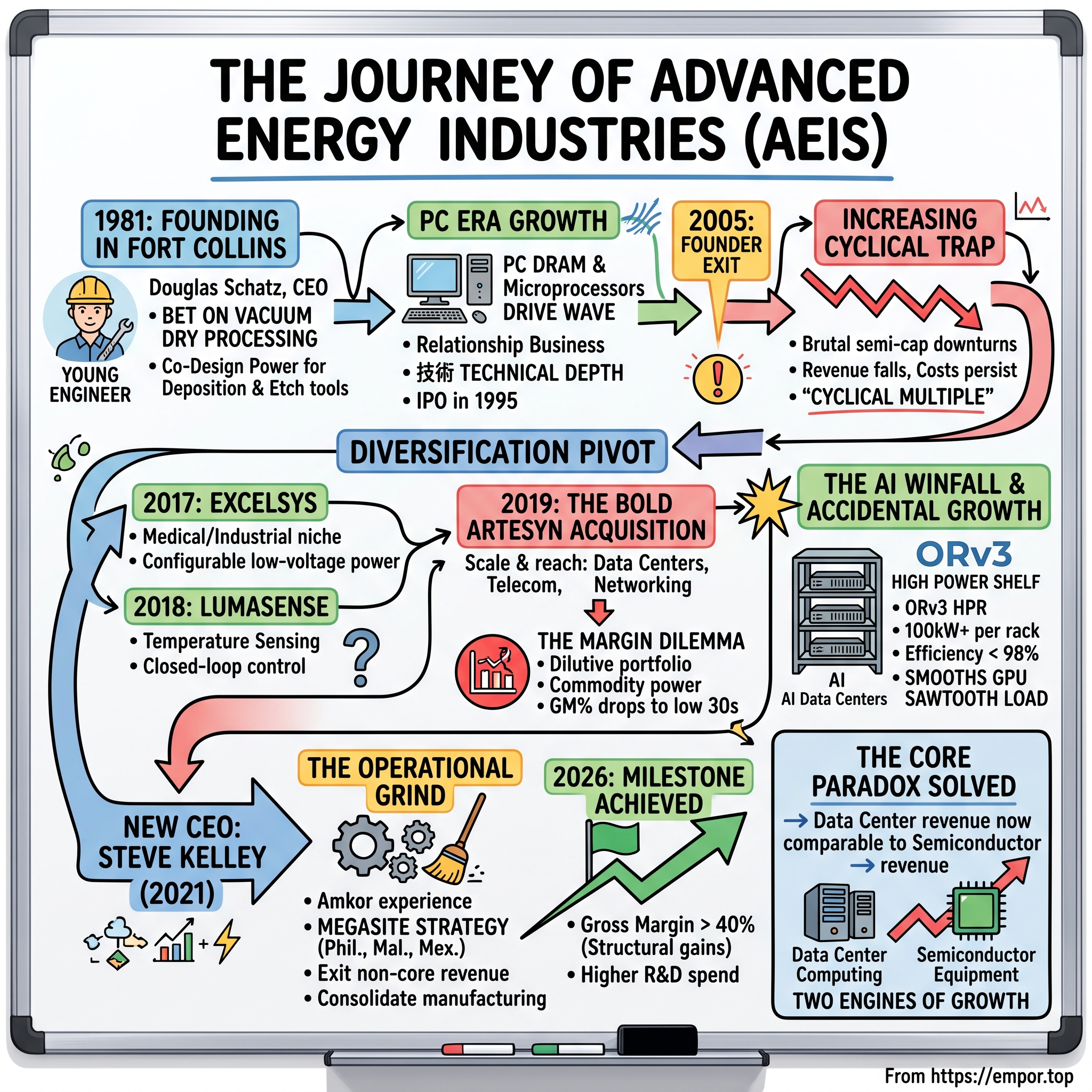
The core paradox of this story: how does a company started in 1981 in Fort Collins, Colorado — a company built on vacuum coating power supplies for thin-film deposition, run for two decades by a founder who was, by all accounts, an engineer's engineer — end up in 2026 as a business where the single fastest-growing product line is a power shelf for hyperscale AI racks, and where that data center segment has grown to sit essentially shoulder-to-shoulder with the semiconductor business that defined the company for forty years?12
The answer is not a story of visionary foresight. It is messier and more instructive than that. It runs through a badly-received $400 million acquisition that cut the company's gross margin by more than a third, a four-year operational grind to repair the damage, a founder-to-professional-management transition, a near-death cyclical trough, and then — arriving with no help from management's planning — the largest infrastructure buildout in the history of computing, which happened to land squarely on a capability the company had bought and had not yet figured out how to make money on.
Where we're going:
- The physics of plasma, and why grid power is useless for making a chip or feeding a GPU rack
- Fort Collins origins, compressed — and how the founder's greatest strength became the company's structural weakness
- The cyclical trap: what it does to a business, and to a multiple, when your customers can cut orders in half in one year
- The M&A campaign — Excelsys, LumaSense, and then the one that mattered, Artesyn
- Steve Kelley's operational playbook, and whether the margin recovery is durable or borrowed
- The AI windfall: inside the ORv3 power shelf, and the harder question of whether it is a moat or a commodity waiting to happen
- The competitive war-game — Helmer's 7 Powers, Porter's 5 Forces, and where the framework flatters the company more than the evidence does
- The bear case, seriously argued
- What to actually watch
One warning up front. This is a company in the middle of a very good stretch, and very good stretches are when narratives become least reliable. The interesting analytical work here is not cataloging the wins. It is separating what Advanced Energy has structurally earned from what the cycle has temporarily handed it.
 Subscribe on LinkedIn
II. The Physics & Economics of Precision Power
Start with an analogy, because the physics matters and the physics is not intuitive.
Think of the electricity coming out of a wall as a river. It is roughly the right volume, roughly the right direction, and full of sediment — voltage sag, harmonic distortion, transients from every motor and elevator on the same feeder. For a toaster, a river is fine. A toaster does not care.
Now imagine you need to carve a channel four atoms wide, and you have to do it with water pressure alone, and if the pressure varies by more than a fraction of a percent for more than a few millionths of a second, the channel comes out wrong and the entire slab is scrap. You do not want a river. You want something closer to a surgical injector: a device that takes the river in one end and delivers, out the other end, a stream whose pressure you control continuously and whose response time is faster than the material's ability to respond.
That is the business Advanced Energy is in. Its systems take raw utility AC and convert it into engineered DC, radio-frequency, or high-voltage output with control loops fast enough and accurate enough that the process, rather than the power supply, becomes the limiting factor.
The semiconductor core: deposition and etch
Modern chipmaking is a dry process. To remove material, you do not dip the wafer in acid — you turn gas into plasma and let energized ions do the cutting. To add material, you sputter atoms off a target and deposit them in films measured in single-digit nanometers. Both require plasma. Plasma requires RF power. And plasma is an electrically miserable load.
Here is the awkward part. When you drive RF energy into a load, you get maximum power transfer only when the source impedance and the load impedance match. Mismatch and energy reflects back down the cable toward the generator — wasted, and potentially destructive. But plasma impedance is not fixed. It changes as the etch proceeds, as gas chemistry shifts, as the chamber heats. So between the generator and the chamber sits a matching network: a tunable circuit whose job is to continuously re-match the impedance in real time.
Older matching networks were mechanical — physical variable capacitors driven by motors, retuning in tens or hundreds of milliseconds. Fine for older nodes. Increasingly not fine at the leading edge, where processes use pulsed plasma, multi-level pulsing, and rapid chemistry switching, and where the matching network needs to converge in microseconds rather than milliseconds. That is why the industry moved toward digital and solid-state matching, and why Advanced Energy's newer semiconductor platforms — the eVoS, eVerest and NavX families that management repeatedly flagged through 2025 and 2026 as its leading-edge product engines — are pitched to fab operators on yield and throughput rather than on price.2
On the Q1 2026 call, CEO Stephen Kelley described the pitch in exactly those terms — that the company was seeing "quite a bit of uptake" on the new leading-edge platforms because they gave fab operators improved yield and improved throughput.2 That framing is worth pausing on, because it explains the entire economic structure of the business.
Low cost, high consequence
A precision power system is a small share of the bill of materials for a multi-million-dollar deposition or etch tool. But its failure mode is not proportional to its cost. If the power drifts, you do not get a slightly worse wafer. You may get an entire lot of scrap, plus chamber downtime, plus an excursion investigation, plus a yield-learning setback measured in weeks.
This asymmetry — trivial cost, catastrophic consequence — is the single most important economic fact about this industry, and it reshapes buyer behavior completely. A purchasing manager who would grind a supplier over pennies on a sheet-metal enclosure will not grind the same supplier over the RF generator, because the expected value of saving money there is deeply negative. Price sensitivity collapses. Reliability, field track record, and the supplier's ability to support a process across a decade of node transitions become the decision criteria.
Investors should be precise about what this does and does not buy. It does not confer unlimited pricing power — the customers here are among the most sophisticated procurement organizations on earth, and they actively cultivate second sources. What it does is dramatically raise the cost of switching for reasons unrelated to price.
The design-in cycle: where the real lock-in lives
The lock-in mechanism is the qualification process, and it works in two stages.
First, the equipment maker and the power supplier co-develop. This is not catalog selling. Engineers from both sides spend years matching the power architecture to a specific chamber, a specific chemistry, a specific process window. By the time a tool platform ships, the power system is not a component in it — it is part of its behavior.
Second, and more powerfully: the chipmaker qualifies the tool. When a fab operator runs a production process on a tool, that entire configuration is locked into a process recipe. Changing a subsystem inside a qualified tool means re-qualifying the process — re-running split lots, re-validating yield, re-certifying for customers. No fab manager volunteers for that to save a few thousand dollars per chamber.
The consequence is a kind of ratchet. Winning a socket is slow and expensive. Losing one is also slow — which cuts both ways. It means Advanced Energy's installed base is genuinely sticky. It also means that when the company loses a next-generation design-in to a rival, the damage shows up years later and is equally hard to reverse. The moat has a moat-shaped hole in it: it protects incumbency on existing platforms, not on future ones. Every node transition is a fresh contest.
That distinction — protected on what you have, exposed on what's next — is the thread to hold onto. It explains why a company with genuinely defensible technology has nonetheless spent forty years unable to escape the brutal rhythm of its customers' order books.
III. Fort Collins Roots & The Early Semiconductor Waves (1981–2005)
Fort Collins, Colorado in 1981 was not an obvious place to start a power electronics company. It was a college town at the base of the Rockies, better known for beer and bicycles than for high technology. What it had was Colorado State University, and around CSU a small orbit of physicists and electrical engineers working on plasma and laser systems.
Out of that orbit came Douglas Schatz, who founded Advanced Energy Industries there in 1981 and would run it for the next twenty-four years.34
The founding insight was a bet on a manufacturing transition that had not fully happened yet. Semiconductor fabrication in the early 1980s was moving from wet chemistry — literally dipping wafers in baths — toward vacuum-based dry processing. Plasma etching. Sputter deposition. Physical and chemical vapor deposition. Each of these needed carefully controlled electrical energy delivered into a vacuum chamber, and the equipment makers building these new tools were, for the most part, mechanical and chemical engineering organizations. Power was somebody else's problem.
Schatz's company made itself into that somebody. It sold not a commodity but a capability: the ability to sit with a toolmaker's process engineers and co-design the electrical half of a deposition or etch system. That is a business built on relationships, patience, and a willingness to solve problems that are not strictly yours.
Riding the waves
The company grew, essentially, in lockstep with the volumes of the PC era. Every DRAM fab and every microprocessor line built through the late 1980s and the 1990s needed deposition and etch capacity, and every deposition and etch chamber needed power. Advanced Energy did not have to find its market. Its market found it, repeatedly, in expanding waves.
In 1995 the company took its shares public on Nasdaq, reincorporating in Delaware in the process.3 It was a conventional growth-company IPO: capital to expand manufacturing, build out service organizations near the fabs, and follow customers into Asia as the center of gravity of semiconductor manufacturing shifted decisively east.
By the early 2000s Advanced Energy had built something genuinely valuable and genuinely narrow. It was a premier boutique — technically excellent, deeply trusted by the handful of companies that mattered, and almost entirely dependent on them.
What the founder built, and what he didn't
Schatz stepped down as CEO in 2005, and it is worth being honest about the inheritance. He had built a company with real technical depth and durable customer intimacy. He had also built a company with an unhedged, concentrated exposure to the single most violently cyclical capital equipment market in the industrial economy.
That was not negligence. It was the natural output of a founder-engineer's priorities. If your organizing principle is "solve the hardest technical problem for the most demanding customer," you end up with a portfolio that is deep and undiversified, because diversification means spending engineering hours on customers whose problems are less interesting. The strengths and the vulnerability came from the same source.
Everything that follows in this story — two decades of acquisitions, an operational overhaul, and eventually an accidental arrival in the data center — is downstream of a single question the company has been trying to answer since Schatz left the chair: how do you keep the engineering culture that makes the boutique valuable while escaping the cycle that makes it un-ownable?
IV. The Cyclical Trap & The Diversification Pivot (2005–2019)
To understand why the next fifteen years unfolded as they did, you have to understand what a semiconductor capital equipment downturn actually feels like from inside a supplier.
It does not feel like a recession. Recessions are gradual. A semi-cap downturn is a light switch. When memory pricing cracks or a foundry pauses a node ramp, tool orders do not soften — they stop. Suppliers can see revenue fall by double-digit percentages in a single quarter, then again the next. And critically, the costs do not stop. The engineering teams you spent a decade assembling cannot be furloughed and rehired without destroying the very capability that makes you valuable. So you carry the cost base through the trough and watch operating leverage run violently in reverse.
The market prices this. A business with excellent technology and a whipsawing order book does not get a quality-industrial multiple; it gets a cyclical multiple, with all the discount that implies. Management teams find this maddening, and one response — the response Advanced Energy chose — is to go buy some earnings that are not on the same cycle.
The logic, and its trap
The diversification program that developed under professional management, culminating in the tenure of CEO Yuval Wasserman, was built on a coherent idea: precision power is a capability, not a market. The engineering discipline that produces a plasma RF generator can also produce a power supply for a surgical laser, a semiconductor test system, or an industrial coating line. If the capability travels, the company can attach it to end markets whose cycles do not rhyme with wafer fab equipment spending.
The idea is sound. The execution risk is that diversification tends to be purchased, and purchased diversification comes with somebody else's cost structure, somebody else's factories, and somebody else's margin profile.
The early acquisitions were modest and disciplined, which made them good tests of the thesis.
Excelsys Holdings (2017, $18.5 million). A Cork, Ireland electronics maker acquired for cash, bringing highly configurable low-voltage power supplies used in clinical medical equipment and specialized industrial applications.5 The economics of that niche are attractive in an unglamorous way: low volume, high configurability, long product lifecycles, customers who qualify a supply into a medical device and then do not want to hear about it again for a decade. It is boring, sticky cash flow — precisely the counterweight to a semiconductor order book.
LumaSense Technologies (2018, approximately $85 million). This one was more interesting strategically. LumaSense, acquired from Element Partners, made infrared pyrometers and fiber-optic temperature sensors, and had generated roughly $60 million of revenue in 2017.67 The strategic logic: in almost every high-energy industrial process, power and temperature are the same problem viewed from two angles. You deliver energy; the process converts it to heat; the heat determines the outcome. Owning both the delivery and the measurement lets you close a control loop that a pure power supplier cannot.
That is a genuinely differentiated idea, and it explains why the outline framing of LumaSense as a "sensing" deal undersells it. Advanced Energy was not buying a product line — it was buying a second sensory channel into its customers' processes.
Did it work?
Partially, and this deserves a clear-eyed answer rather than a generous one.
The pre-Artesyn financials show a company with beautiful economics and a rough ride. In 2017 revenue was $671 million with a gross margin above 53%; in 2018, $719 million at roughly 51%.8 Those are software-adjacent margins on a hardware business, and they tell you the semiconductor franchise was extraordinarily profitable at peak.
Then 2019 arrived. Revenue fell to $789 million — and that figure includes nearly four months of a large acquisition. Strip that out and the organic decline was severe, with gross margin falling to about 40%.8 Excelsys and LumaSense, at a combined purchase price of roughly $100 million, were simply too small to matter against a downturn of that magnitude.
The honest conclusion from the 2017–2019 period is that incremental, bolt-on diversification could not solve a structural cyclicality problem. The acquired businesses were high-quality and correctly chosen. They were also, in aggregate, a rounding error against a semiconductor segment that could swing by hundreds of millions of dollars in a year.
Management drew the obvious inference: if small deals cannot move the needle, do a big one. That inference was correct in arithmetic and, for the next several years, extremely painful in practice.
V. The Artesyn Dilemma: Scale vs. Margins
On May 15, 2019, private equity firm Platinum Equity announced it had agreed to sell the Embedded Power business of Artesyn Embedded Technologies — including the Artesyn and Astec brands — to Advanced Energy in a transaction valued at approximately $400 million.9 The deal closed on September 10, 2019, with Advanced Energy paying roughly $364 million in cash and assuming approximately $36 million of liabilities.9
It was, by a wide margin, the largest thing the company had ever done. It roughly doubled the business overnight: full-year 2020 revenue came in at $1.42 billion against $789 million in 2019.8
The case for the deal
The argument management made was scale plus reach. Artesyn was a serious embedded power business with real position in enterprise data centers, telecommunications infrastructure, networking, and industrial equipment. It brought volume manufacturing capability at a scale Advanced Energy had never operated. And it was cheap — the purchase multiple was widely characterized at the time as roughly 5x synergy-adjusted EBITDA, a price that in 2019 looked like a bargain for a billion dollars of adjacent revenue.
There was also a genuine strategic thread. Advanced Energy's semiconductor business was elite at low-volume, high-value, custom power. It had essentially no capability in high-volume power manufacturing. If precision power was going to become a broader franchise, that capability had to come from somewhere.
What actually arrived
The numbers tell the story faster than any narrative can.
Before Artesyn, Advanced Energy's gross margin ran in the low fifties. In 2020 it was 38.3%. In 2021, 36.6%. In 2022, 36.6%. In 2023, 35.8%. In 2024, 35.7%.8
That is not a transition dip. That is five consecutive years in the mid-to-high thirties, in a business that had been printing above fifty. Management would later describe the acquired business bluntly: on a subsequent earnings call, Kelley characterized Artesyn as having arrived with overall margins "in the low 20s" and described parts of that market as historically highly dilutive.10
Three things went wrong at once, and they compounded.
Product mix. A large slice of the Artesyn portfolio was standard and semi-standard power — AC/DC bricks and front-end supplies sold into telecom and enterprise infrastructure. These are catalog products competing on price and lead time against Asian manufacturers with structurally lower costs. There is no design-in ratchet, no qualification moat, no asymmetric-consequence economics. It is, essentially, the opposite business from the one Advanced Energy had spent forty years building.
Manufacturing footprint. The combined company inherited a scattered set of factories across China, Europe, and North America — sites of varying scale, varying automation, and varying cost position. Fragmented manufacturing is expensive in ways that do not show up cleanly in any single line item: duplicated overhead, subscale purchasing, inconsistent quality systems, and an inability to move production to wherever capacity or tariffs make most sense.
Organizational complexity. The company became, in effect, a holding structure for several previously independent power businesses with different engineering conventions, different ERP systems, and different cultures.
The investor verdict
Wall Street's reaction was skeptical, and in hindsight the skepticism was well-founded — though not for the reason most bears gave.
The common criticism was that Advanced Energy had diluted a premium semiconductor pure-play into a commodity power manufacturer. That framing was too simple. The deeper problem was that the company had bought a capability it needed (high-volume manufacturing, data center and networking channel access) bundled with a portfolio it did not want (commodity standard power), and the bundle came priced as though the whole thing were worth owning.
The cheap multiple was not a bargain. It was an accurate price for a mixed asset, and the work of separating the valuable half from the dilutive half was going to take years and cost real money — restructuring charges, factory closures, deliberately walking away from revenue.
That is the situation a new chief executive walked into in March 2021.
VI. Steve Kelley's Operational Playbook: The Turnaround
On February 10, 2021, Advanced Energy announced that Yuval Wasserman would retire as president and CEO and that Stephen D. Kelley would succeed him, effective March 1, 2021.11
The choice was a statement about what the board thought the problem was.
Kelley was not a power electronics technologist. He had spent the prior seven years as president and CEO of Amkor Technology, the semiconductor packaging and test company.11 Amkor is a high-volume, capital-intensive, thin-margin assembly business operating across a sprawling Asian factory network — precisely the kind of operation where value is created or destroyed by factory utilization, yield, footprint decisions, and the discipline to say no to bad revenue. It is about as far from a boutique RF engineering shop as you can get while remaining in semiconductors.
Hiring an Amkor operator to run Advanced Energy was the board conceding, in personnel form, that the company's central problem was no longer technological. The technology was fine. The manufacturing base was the problem.
The margin crusade
Kelley and CFO Paul Oldham set an explicit public target: get consolidated non-GAAP gross margin back above 40%. It was a deliberately uncomfortable number — roughly 400 to 500 basis points above where the company was actually running — and setting it publicly meant every subsequent quarter would be scored against it.
From a governance standpoint, this is worth noting on the credibility ledger. Management chose a single, hard, falsifiable metric and repeated it across years of calls rather than migrating to softer language when progress was slow. That is the opposite of the more common pattern, where an unmet target quietly disappears from the slide deck.
Progress was genuinely slow. Gross margin moved from 36.6% in 2021 to 36.6% in 2022 to 35.8% in 2023 to 35.7% in 2024.8 For three full years, an investor holding the company on the strength of the 40% promise had essentially nothing to show for it. The counterargument management offered — that a semiconductor downturn was masking underlying structural gains — was plausible but unverifiable in real time. It is exactly the kind of explanation that is either sophisticated or self-serving, and there was no way to tell which until the cycle turned.
Footprint: the megasite strategy
The core action was consolidating manufacturing.
The company systematically shut legacy, high-cost, subscale facilities and concentrated production into large modern sites. By the FY2025 annual report, major production was concentrated in the Philippines, Malaysia, and Mexico, with specialty manufacturing retained in the United States, the United Kingdom, and Europe.12 The Zhongshan, China facility was closed in the second quarter of 2025, and a new Thailand factory was under construction and expected to become operational in 2026.12
The logic behind megasites is not simply cheap labor — that framing misses most of the value. Large single sites allow serious automation investment, because the fixed cost of an automated line amortizes over volume that a small plant cannot supply. They allow one quality system rather than six. They allow production to be shifted between product lines as demand mix changes, which in a business serving both semiconductor and data center customers is worth a great deal. And they simplify the supply chain enormously.
The China exit carries a second meaning worth flagging as a risk item rather than an operational one. Advanced Energy notes in its FY2025 10-K that evolving export control regulations affecting China sales are a material risk, and roughly 70% of revenue comes from customers outside the United States.12 Consolidating out of China reduces one exposure while concentrating others — a company with megasites in Malaysia, the Philippines, Mexico, and now Thailand has traded diffuse geopolitical risk for concentrated geopolitical risk in a handful of specific jurisdictions and trade corridors.
Saying no to revenue
The less visible half of the playbook was subtraction. Kelley walked away from low-margin telecom contract manufacturing and commodity standard power inherited from Artesyn.
Shrinking revenue deliberately is one of the hardest things a public company can do, because the cost is immediate and visible while the benefit is gradual and contestable. That management did it anyway — through a period when the semiconductor cycle was already pressuring the top line — is a meaningful data point on capital discipline. It is also the single clearest piece of evidence that the Artesyn integration was being treated as a portfolio problem rather than a cost problem.
R&D, notably, was not cut. Research and development spending rose from $161.8 million in 2021 to $191.0 million in 2022, $202.4 million in 2023, $211.8 million in 2024, and $232.4 million in 2025.812 Increasing engineering spend through a downturn while closing factories is a specific and revealing choice: it says management believed the cost problem was in the plants, not the labs.
Refined M&A
Kelley did not abandon acquisitions. He narrowed them.
On April 4, 2022, Advanced Energy announced an agreement to acquire SL Power Electronics from Steel Partners Holdings, completing the transaction on April 25, 2022 for a base purchase price of $144.5 million subject to working capital adjustment.1314 SL Power made customized power solutions for medical and advanced industrial applications, and the deal was expected to be accretive to 2022 non-GAAP earnings and to generate over $4 million of annualized cost synergies.14
The contrast with Artesyn is the whole point. SL Power was small enough to absorb, sat in the high-margin application-specific niche the company actually wanted, and could be folded directly into the consolidating megasite footprint rather than adding another orphan factory.
The milestone
In the first quarter of 2026, Advanced Energy reported non-GAAP gross margin of 40.1% on revenue of $511.0 million — up 40 basis points sequentially and 220 basis points year-over-year, and, as Oldham put it on the call, the highest level since the Artesyn acquisition in 2019.12 GAAP gross margin was 39.3%, against 37.2% in the prior-year quarter.15
Five years after the promise, the promise was met.
The correct analytical response is neither applause nor dismissal. Some meaningful portion of that 40.1% is structural — closed factories do not reopen, and exited product lines do not come back. But a portion is unambiguously cyclical and mix-driven: Q1 2026 was a quarter of exceptional volume in a high-utilization environment, and utilization flatters gross margin in any manufacturing business. The test of whether Kelley's restructuring genuinely reset the cost base is not this quarter. It is the first quarter of the next downturn.
Which brings us to the thing that made the volume exceptional — and which nobody in Fort Collins planned for.
VII. The AI Windfall: Inside the 100kW Power Shelf
Here is the strangest twist in this story.
The Artesyn deal was criticized for dragging Advanced Energy into low-margin data center and telecom power. Six years later, data center power is the fastest-growing, and one of the more attractive, parts of the company. The asset that broke the margin story became the asset that made the growth story.
Management did not foresee this. Nobody did. The generative AI capital cycle was not on any 2019 deal model.
Why AI broke data center power
The physics is straightforward once you see the numbers.
A conventional CPU server rack drew something in the range of 10 to 15 kilowatts. Racks were designed around that. Power distribution, cooling, busbars, cabling — all of it assumed that envelope.
An AI rack densely populated with modern accelerators draws on the order of 100 kilowatts or more. That is not an increment. That is an order of magnitude, and it breaks things that were never designed to flex that far.
The specific thing it breaks is current. Power equals voltage times current. If you hold voltage constant and multiply power by ten, you multiply current by ten. Current through a conductor generates heat proportional to the square of the current — so ten times the current means a hundred times the resistive loss. At AI rack densities, conventional distribution architectures would require copper of absurd thickness, and would still waste an unacceptable fraction of the power as heat before it ever reached a chip.
The industry's answer was to change the architecture: move conversion closer to the load, distribute at higher voltage on DC busbars inside the rack, and standardize the mechanical and electrical interfaces so that hyperscalers are not locked to a single vendor. The Open Compute Project — the hyperscaler-driven open hardware consortium — codified this in its ORv3 rack specifications.
Note the strategic ambiguity here, because it matters enormously for the investment case. OCP standards exist precisely to prevent supplier lock-in. Buyers wrote them that way on purpose. Any moat in this segment has to come from execution rather than from proprietary interfaces.
The product
Advanced Energy's answer is the ORv3 high power rack shelf family. The company had been in ORv3 from the standard's early days, announcing an ORv3-compliant shelf with hot-swappable power supply units in May 2022.16
The current high-power version is a three-phase AC-DC shelf accepting nominal input from 347/200 to 480/277 VAC, housing six 5.5 kW power supply units operating in parallel to produce a 50V, 660A output — roughly 33 kW per shelf, with peak efficiency approaching 98%.[^17] Multiple shelves parallel together to support rack power in excess of 100 kW, in n+1 or n+n redundant configurations, with hot-swappable modules and Ethernet-based monitoring and control.[^17]
Two design points deserve translation into plain language.
Efficiency near 98% sounds like a marginal spec. It is not. At a gigawatt-scale campus, the difference between 96% and 98% efficiency is not two percent of a small number — it is two percent of the entire facility's power draw, converted into heat that must then be removed by cooling systems that themselves consume power. Efficiency compounds into both the electricity bill and the cooling capital budget. For a hyperscaler operating under a hard grid interconnection limit, higher efficiency directly translates into more compute deployed per megawatt available. That is why hyperscalers will pay a premium for it, and it is the single most credible source of pricing power in this segment.
Power factor behavior under dynamic load is the less-discussed feature and possibly the more important one. Advanced Energy explicitly designs the ORv3 HPR to hold a high power factor under dynamic loading, smoothing the peak pulse power demands characteristic of GPU workloads.[^17] Recall the sawtooth from the opening. An AI training cluster is an electrically violent load. The shelf's job is to absorb that violence so the facility upstream — and the grid beyond it — sees something closer to a smooth draw.
The financial sizing
In the first quarter of 2026, Data Center Computing revenue reached $194.2 million, up 101.9% year-over-year and 9% sequentially — the segment's second consecutive record quarter.152 Against total revenue of $511.0 million, that put data center at roughly 38% of the company. Semiconductor Equipment was $219.4 million, Industrial and Medical $72.0 million, and Telecom and Networking $25.4 million.15
Read that segment split carefully, because it is the single most important structural fact about Advanced Energy in 2026. The data center segment is now within striking distance of the semiconductor segment. A company whose identity was built entirely on wafer fab equipment now derives well over a third of revenue from a completely different customer set.
This was not a one-quarter phenomenon. For full-year 2025, Data Center Computing revenue grew 107%, total revenue rose 21% to $1.80 billion, and cash flow from continuing operations reached a record $235 million.178
What management is claiming next
On the Q1 2026 call, Kelley pointed past the current product to the next architectural shift: 800-volt-to-50-volt modules with 4,000 to 8,000 watt outputs achieving roughly 98% efficiency. He was careful about timing, saying initial production revenue would be "small this year" but would ramp significantly in 2027 and 2028, and — the commercially relevant part — that the transition increases dollar content per rack.2
That last claim is the one to interrogate. Higher voltage distribution means more conversion stages inside the rack, which means more power electronics sold per rack. If true and if Advanced Energy wins its share, the 800V transition is a content-growth event layered on top of a unit-growth event.
But "if Advanced Energy wins its share" is doing heavy lifting. This is an open standard, the customers are the most capable buyers in the world, and every serious power electronics manufacturer on the planet can read the same OCP specification. Under analyst questioning from Stifel's Brian Chin on whether power content per rack would remain a tailwind, Kelley's answer was notably about capability rather than protection — that winning requires simultaneous gains in power density, reliability, and efficiency within fixed space constraints.2 That is an honest answer. It is also an admission that the defense here is running faster, not owning a gate.
The capacity bet
Advanced Energy is spending against this. Management said current expansions in Malaysia, the Philippines, and Mexico would provide over $2.5 billion in revenue-generating capacity by year-end 2026, with a 500,000 square foot Thailand facility adding potential for more than $1 billion additional capacity once fully operational.2
Set against roughly $1.8 billion of 2025 revenue, the company is building toward substantially more capacity than it currently needs.817 That is a considered bet, and it should be labeled as such. If AI infrastructure demand holds, the capacity is the enabler and the operating leverage is enormous. If the cycle digests, that capacity becomes underutilized fixed cost — arriving precisely when volumes fall, which is exactly the mechanism that made this company's historical margin profile so violent.
Management has, in other words, taken the cyclicality it spent fifteen years trying to reduce and made a large, deliberate, capacity-based bet on a new cycle it does not control.
VIII. Competitive Moat & Strategic Positioning
Let's war-game this properly, because the frameworks that get applied to Advanced Energy tend to flatter it.
graph TD
    A[AEIS Competitive Position] --> B(7 Powers)
    A --> C(Porter's 5 Forces)

    B --> B1["Switching Costs — strong in semi, weak in data center"]
    B --> B2["Scale Economies — $232M R&D on $1.8B revenue"]
    B --> B3["Cornered Resource — RF plasma control IP, thermal sensing"]

    C --> C1["Barriers to Entry — high in semi, moderate in OCP power"]
    C --> C2["Supplier Power — moderate; magnetics, semis, copper"]
    C --> C3["Buyer Power — very high; 3 customers = 54% of 2025 revenue"]
Hamilton Helmer's 7 Powers, tested rather than asserted
Switching Costs — real, but strictly segment-specific. In semiconductor, this is the company's genuine structural advantage, for the qualification reasons detailed earlier. Third-party validation exists: Advanced Energy has been recognized with supplier excellence awards by Lam Research, which is not something a fungible vendor receives.18
In data center, switching costs are dramatically weaker. OCP shelves are designed to be interchangeable. That is the entire purpose of the standard. Applying the semiconductor switching-cost story to the data center segment — as bullish framings routinely do — is a category error. Notably, Oldham told Citi's Elizabeth Sun on the Q1 2026 call that manufacturing qualification for new data center customers typically requires six to nine months.2 Six to nine months is a real barrier, but it is roughly an order of magnitude shorter than a semiconductor design-in cycle. It slows competitors; it does not stop them.
Scale Economies — genuine and widening. Advanced Energy spent $232.4 million on R&D in 2025, up from $211.8 million in 2024, against revenue of $1.80 billion.812 Roughly 13% of revenue reinvested in engineering is a substantial number for a hardware company, and it is the kind of spend a subscale specialist power supplier simply cannot match. This power is real and, if anything, strengthening as the company grows.
Cornered Resource — real but narrow. The accumulated intellectual property and, more importantly, tacit engineering knowledge around high-frequency plasma generation, rapid impedance matching, and the pyrometry capability acquired with LumaSense constitutes something a competitor cannot buy. But note the scope: this is a semiconductor and industrial asset. It contributes very little to the data center franchise, which is where the growth is.
Powers the company does not have, and this is the more useful half of the exercise: no network effects, no counter-positioning (competitors face no structural reason they cannot copy the strategy), no branding power in the consumer sense, and no process power of the Toyota variety — megasite manufacturing is best practice, not a secret.
The honest summary: Advanced Energy has two-and-a-half of Helmer's seven powers, concentrated in the slower-growing half of the business.
Porter's Five Forces
Threat of new entrants — low in semiconductor, moderate in data center. Nobody is entering RF plasma power from a standing start; the physics, the patents, and the multi-decade field reliability record are prohibitive. But OCP-compliant power shelves are a different proposition. The specification is public. The buyers want multiple sources. Entry requires manufacturing scale and power electronics competence — both of which several large Asian manufacturers possess in abundance.
Bargaining power of buyers — very high, and the sharpest risk in the story. During 2025, three customers accounted for 23%, 19%, and 12% of total revenue respectively — 54% of the company in three relationships.12 In 2024, the FY2024 10-K disclosed that Applied Materials and Lam Research accounted for 26% and 11% of total revenue respectively.19
That 2025 disclosure deserves close reading. The emergence of a 19% customer alongside the traditional semiconductor anchors is consistent with a very large data center customer having become a top-three relationship. This is diversification of end market without diversification of counterparty risk. The company has swapped some semiconductor concentration for hyperscaler concentration, which is arguably worse on a single dimension: hyperscalers change suppliers faster than fabs do, and they are ruthless about second-sourcing.
The standard mitigation — that co-development creates mutual dependency — holds up reasonably well on the semiconductor side. It holds up considerably less well on the data center side, where a hyperscaler's leverage over a component supplier is close to absolute.
Rivalry — differentiated by segment.
In semiconductor RF power, the principal rival is MKS Instruments, which offers a broader vacuum-and-process-control portfolio and competes directly on power delivery and plasma sources.20 This is best understood as a rivalry between two credible specialists rather than a duopoly with comfortable economics — competition at the leading edge is intense, and each node transition reopens sockets. In Japan, 株式会社ダイヘン DAIHEN Corporation holds strong positions with Japanese toolmakers, benefiting from proximity to 東京エレクトロン Tokyo Electron and the domestic ecosystem, though without Advanced Energy's Western hyperscale presence.
In data center power, the competitive picture is materially less comfortable. 台達電子 Delta Electronics is a formidable competitor with its own ORv3 33kW power system,21 enormous manufacturing scale, and a cost position built over decades in high-volume power conversion. 光寶科技 Lite-On Technology and other Asian power majors have comparable capability. Legrand and others also participate in the OCP power ecosystem.22
The bull framing is that Advanced Energy wins at the premium end — the highest-density, most efficient, most electrically sophisticated shelves — while Delta and others take the volume commodity tier. There is evidence for this: the segment's growth has come alongside company gross margin rising, not falling, which would not happen if Advanced Energy were simply buying share on price.
But this is a narrow ledge to stand on. It requires Advanced Energy to stay a generation ahead in efficiency and density, permanently, against competitors with more manufacturing scale and lower cost structures, in a market governed by an open standard. The 800V transition is the near-term test.
Threat of substitutes — low. There is no alternative to power conversion. Physics does not offer a workaround.
Supplier power — moderate. Advanced Energy depends on semiconductors (including wide-bandgap devices like silicon carbide and gallium nitride, which enable the efficiency gains it markets), magnetics, high-grade capacitors, and copper. The FY2025 10-K identifies supply chain vulnerability as a material risk.12 The company is not uniquely exposed, but neither is it insulated.
The structural picture that emerges: a strong, defensible position in a mature cyclical market, and a strong current position in a fast-growing market where the defense is thinner than the narrative suggests.
IX. Activist Stress Test: Bull vs. Bear Case
Imagine an activist investor building a position and preparing a letter. What does the deck say?
The risk radar
Customer concentration, restated as a live threat. Half the company sits in three relationships.12 The mechanism of harm is specific and historically well-attested: semiconductor equipment makers manage inventory aggressively, and when they digest, orders do not taper — they stop. The same is now true of hyperscaler capital budgets, which can be revised between board meetings.
Commoditization of the AI power shelf. This is the central bear thesis and it deserves its strongest form. Advanced Energy currently earns above-average margins on a product built to a published open standard, sold to four or five buyers who are explicitly hostile to supplier lock-in and who have both the engineering capability and the volume to qualify alternatives. Delta and its peers are not going to concede this market. The bull answer — that efficiency and density leadership sustains a premium — is credible today and unproven for tomorrow, because it requires winning the same race every generation, forever.
Capacity risk, self-inflicted. The buildout toward $2.5 billion of capacity by end-2026 plus $1 billion-plus in Thailand is being financed and constructed against demand that has doubled in a year.2 Doubling is not a sustainable run rate. When growth normalizes — not collapses, merely normalizes — that fixed cost base has to be absorbed.
Geopolitical and trade exposure. Roughly 70% of revenue comes from outside the United States, and the megasite strategy concentrates production in Mexico, Malaysia, the Philippines, and Thailand.12 The Mexicali exposure ties directly to US–Mexico trade policy. The Asian sites sit in Southeast Asian supply corridors. Export controls on China remain a named risk in the 10-K.12 The China facility exit removed one exposure and increased dependence on the remaining nodes.
Balance sheet and refinancing. The company held $699.5 million in cash and equivalents at the end of Q1 2026, with $575.0 million principal of convertible notes due 2028 and an undrawn $600.0 million revolver.15 The convertible notes were reclassified as a current liability, and the company refinanced its credit facilities on May 8, 2025, establishing an unsecured term loan and revolving facility maturing in 2030.12 This is a manageable position rather than a stressed one, but the 2028 converts are a real event and are being navigated while funding a substantial capacity expansion.
One further item belongs on the radar as an accounting-judgment note rather than a red flag: the gap between GAAP and non-GAAP results is wide. In Q1 2026, GAAP EPS from continuing operations was $1.59 versus $2.09 non-GAAP.151 For full-year 2025, GAAP EPS was $3.87 against $6.41 non-GAAP.17 Roughly 40% of adjusted earnings sits in reconciling items — amortization of acquisition intangibles, restructuring, stock compensation. For a company that has spent seven years digesting acquisitions and closing factories, that gap is explicable. It also means the headline non-GAAP margin story and the GAAP economic reality are meaningfully different numbers, and investors should track both.
The activist's question
"You have a business with two genuinely attractive engines — leading-edge semiconductor power and AI data center power — bolted to an Industrial & Medical segment that generated $72 million in the quarter and a Telecom & Networking segment that generated $25 million.15 Together that is under 20% of revenue, structurally slower-growing, and it consumes management attention, engineering capacity, and factory slots. Why do you own it? Why not divest and concentrate capital and capacity on the two engines?"
The company's implicit answer is the original diversification thesis: these segments are the cyclical ballast, and their earnings are less correlated with capital equipment cycles.
There are two problems with that defense in 2026.
First, the ballast is now small relative to the ship. When the two growth engines together approach 80% of revenue and are both, in different ways, exposed to the same AI capital cycle, an 18% counterweight does not meaningfully dampen anything.
Second, there is direct evidence of internal resource competition. Needham's Jim Ricchiuti pressed management on the Q1 2026 call about why Industrial & Medical revenue declined despite strong bookings. Kelley's answer was candid: the factories had "pivoted to data center" during the Q1 surge, and the company would catch up over Q2 and Q3, with backlog described as robust.2
That is a straightforward admission that in a constrained quarter, the diversification segment loses. Which raises the fair question of whether it functions as ballast at all, or merely as a lower-return use of capacity that gets deprioritized precisely when it would be most needed.
To management's credit, the answer was specific and non-evasive — it named the cause, gave a timeline, and did not blame demand. On the credibility ledger, that pattern of concrete explanation for a miss is worth more than the miss costs.
The bull and bear cases, argued
On growth.
The bear argues that AI infrastructure spending is a capital cycle, and capital cycles digest. The 102% year-over-year data center growth15 is a comparison against a small base in a period of unprecedented buildout, and both conditions expire. Meanwhile the semiconductor segment was described as "flattish" year-over-year in Q1 2026 even as data center exploded2 — so the diversification that is supposed to smooth the ride is currently just one engine carrying the other.
The bull argues that this is not a normal capital cycle because the constraint is physical. Power density per rack is rising structurally, not cyclically, and each generation of accelerator raises the electrical difficulty. Even flat rack deployment growth would increase power content per rack. Kelley's guidance on 800V content growth in 2027–2028 is the mechanism.2 Additionally, management raised its full-year 2026 outlook to low-to-mid-20% revenue growth from prior high-teens guidance, with data center growth raised to the mid-30% range and semiconductor expected up over 30% year-over-year in the second half.23 Two engines firing, not one.
On margins.
The bear argues the 40.1% is peak-cycle. Factory consolidation savings are done and in the number. Utilization is running high. Input costs — copper, wide-bandgap semiconductors, high-grade magnetics — are under pressure from the same AI buildout driving the revenue. The path to management's stated long-term goal of greater than 43%2 requires mix improvements the company does not fully control.
The bull argues that the 40.1% understates the structural position because it was achieved with the new leading-edge semiconductor platforms still pre-ramp. Kelley told KeyBanc's Jacob Moore that eVoS, eVerest and NavX revenue becomes meaningful "starting late this year, but really into '27 and '28."2 These are higher-value products replacing older platforms. Layer that on top of Thailand and megasite operating leverage and the 43% target is reachable.
On cyclical protection.
The bear argues the diversification is partly illusory — as the Q1 Industrial & Medical shortfall demonstrated, and as a broad downturn would demonstrate more painfully, since semiconductor capex, AI infrastructure capex, and industrial capex are all capital spending and all respond to the same cost of capital.
The bull argues the segments genuinely do not move together on ordinary timescales. Q1 2026 is itself the proof: data center doubled while semiconductor was flat.215 Two large segments with different demand drivers is structurally more stable than one, whatever happens in a synchronized global recession.
The most defensible read sits between these. Advanced Energy has meaningfully improved its structural position over five years — the cost base is genuinely lower, the portfolio genuinely cleaner, the product set genuinely stronger. It has simultaneously taken on a large new cyclical exposure and levered into it with capacity. It is a better business than it was in 2021 and it is not a low-volatility business, and any framing that claims otherwise is selling something.
X. Playbook: Key Business & Investing Lessons
Lesson 1: There is no such thing as a cheap acquisition of a mixed asset.
Artesyn was acquired at roughly 5x synergy-adjusted EBITDA — a multiple that looked like a steal.9 What followed was five years of gross margin in the mid-thirties against a pre-deal level above fifty.8
The multiple was not wrong. The unit of analysis was wrong. Artesyn was not one business; it was a bundle of a valuable capability (high-volume manufacturing, data center channel access) and a dilutive portfolio (commodity standard power). The blended multiple was a fair price for the blend. The buyer's job — separating them — was going to take half a decade of restructuring charges, factory closures, and deliberately shrinking revenue.
The generalizable rule: when a target's segments have materially different economics, a blended multiple tells you almost nothing. Underwrite the segments separately, and price the cost and duration of the separation work as part of the deal.
The postscript is more interesting than the lesson. The half of Artesyn that broke the margins is also, six years later, the half that produced the growth. Whether that vindicates the deal or merely means the company got lucky is a genuinely open question — and the fact that it is open should make anyone cautious about confident M&A post-mortems.
Lesson 2: Look for asymmetric subsystems — but check where the asymmetry actually applies.
The strongest structural position in this story comes from the low-cost, high-consequence dynamic in semiconductor: a small share of tool cost, an enormous share of tool risk, protected by qualification cycles measured in years.
That is a genuinely excellent place to sit, and the pattern generalizes across industrials — aerospace fasteners, medical device components, industrial sensors.
The discipline is in the second half of the test. Advanced Energy's data center business does not have this property. Six-to-nine-month qualification, an open standard, and buyers who mandate second-sourcing2 produce a much weaker position. Investors who take the semiconductor moat story and apply it across the whole company are making the most common analytical mistake in the multi-segment industrial world: assuming a moat travels with a brand rather than with a specific set of customer conditions.
Lesson 3: The physical layer is a slower, more durable place to compete than the logical layer.
Chip architectures, model architectures, and software stacks turn over in years. The relationship between current and resistive heating does not turn over at all. A company anchored to power conversion, thermal management, and plasma physics is insulated from a great deal of technological churn above it.
But durability is not the same as safety, and the distinction is where investors lose money. Being anchored to physics guarantees your problem persists. It does not guarantee you remain the one solving it. Advanced Energy's semiconductor franchise survives node transitions because qualification creates inertia. Its data center franchise has no such inertia — it survives only by being technically better, generation after generation, against very capable competition.
The physical layer is a good neighborhood. It is not a gated community.
XI. Epilogue & 3 KPIs to Watch
Forty-five years after a small group around a Colorado university decided that the coming vacuum-processing wave would need better power supplies, the company that grew out of that bet occupies a position its founder would find almost unrecognizable.
The semiconductor franchise remains — deepened, running at the leading edge, still the largest segment at $219.4 million in Q1 2026.15 But sitting beside it is a $194.2 million data center business15 that did not meaningfully exist in the company's strategy five years ago, that arrived attached to an acquisition widely regarded as a mistake, and that now grows faster than anything else Advanced Energy owns.
The margin structure has been rebuilt from the mid-thirties back through 40%.28 The factory footprint has been consolidated into a handful of large modern sites.12 R&D has been protected and grown throughout.812
What has not changed is the fundamental character of the business. Advanced Energy sells capital-cycle-sensitive equipment to a small number of very large, very sophisticated buyers. It has replaced one concentrated cyclical exposure with two, and it has committed substantial capital to capacity on the assumption that the newer one persists. That is a defensible bet. It is not a hedge, and management has not claimed it is.
The interesting years are ahead, not behind. The 800V architecture transition, the leading-edge semiconductor product ramp, and the first genuine test of whether the restructured cost base holds through a downturn all land in the 2027–2028 window.
Three things to track, and only three:
1. Non-GAAP gross margin, quarter by quarter, with the cyclical context attached. This is the scoreboard for whether the operational turnaround is structural or cyclical. Holding above 40% and progressing toward management's stated 43% goal through a period of softening volume would be strong evidence that the megasite consolidation genuinely reset the cost base. Slipping back into the thirties when utilization falls would suggest that a good deal of the improvement was volume, not structure. Watch it against the GAAP figure too — a widening gap between the two deserves scrutiny.
2. Data Center Computing revenue growth, and the concentration behind it. The absolute growth rate matters, but the more diagnostic question is composition. Management flagged that second-wave data center customers were not in 2026 guidance and represented potential upside.2 Broadening the customer base while sustaining growth would demonstrate the ORv3 position is a genuine franchise. Growth that remains dependent on one or two hyperscalers means the segment is a large customer relationship rather than a market position — a materially different asset.
3. R&D as a percentage of revenue. In a business whose data center moat consists almost entirely of staying a generation ahead, sustained engineering reinvestment is the leading indicator of everything else. A company under margin pressure can flatter near-term results by letting R&D drift down as a share of a growing revenue base. That would be the earliest visible sign that the technical lead is being harvested rather than defended — and by the time it shows up in market share, the design cycles that determine 2029 will already have been lost.
References
-
Advanced Energy Reports First Quarter 2026 Results — Form 8-K Exhibit 99.1, SEC EDGAR, 2026-05-04 ↩↩↩
-
Advanced Energy (AEIS) Q1 2026 Earnings Call Transcript — The Motley Fool, 2026-05-05 ↩↩↩↩↩↩↩↩↩↩↩↩↩↩↩↩↩↩↩
-
Advanced Energy Industries, Inc. Form 10-K for fiscal year 2018 — SEC EDGAR ↩↩
-
Douglas S. Schatz — executive biography, The Wall Street Transcript ↩
-
Advanced Energy Industries, Inc. Form 10-K for fiscal year 2019 — SEC EDGAR, 2020-03-02 ↩
-
Advanced Energy Signs Agreement to Acquire LumaSense — SEC EDGAR press release exhibit, 2018-07-30 ↩
-
Advanced Energy Announces Acquisition of LumaSense — SEC EDGAR press release exhibit, 2018-09 ↩
-
Advanced Energy Industries annual income statement history (FY2016–FY2025), as reported in SEC filings — Financial Modeling Prep ↩↩↩↩↩↩↩↩↩↩↩↩
-
Platinum Equity to Sell Artesyn's Embedded Power Business to Advanced Energy — Platinum Equity, 2019-05-15 ↩↩↩
-
Advanced Energy (AEIS) Q2 2025 Earnings Call Transcript — The Motley Fool ↩
-
Advanced Energy Announces Retirement of President & CEO Yuval Wasserman and Appoints Stephen D. Kelley as Successor — Business Wire, 2021-02-10 ↩↩
-
Advanced Energy Industries, Inc. Form 10-K for fiscal year 2025 — SEC EDGAR, 2026-02-13 ↩↩↩↩↩↩↩↩↩↩↩↩↩
-
Advanced Energy to Acquire SL Power — Business Wire, 2022-04-04 ↩
-
Advanced Energy Completes the Acquisition of SL Power — Business Wire, 2022-04-25 ↩↩
-
Advanced Energy Industries, Inc. Form 10-Q for the quarter ended March 31, 2026 — StockTitan SEC filing summary, 2026-05 ↩↩↩↩↩↩↩↩↩↩
-
Advanced Energy's ORv3-Compliant Power Shelf with Hot Swappable PSUs Delivers Industry-Leading Efficiency — Business Wire, 2022-05-12 ↩
-
Advanced Energy Reports Fourth Quarter and Full Year 2025 Results — Business Wire, 2026-02-10 ↩↩↩
-
Advanced Energy Receives Lam Research's Supplier Excellence Award — Advanced Energy Investor Relations ↩
-
Advanced Energy Industries, Inc. Form 10-K for fiscal year 2024 — SEC EDGAR, 2025-02-18 ↩
-
Advanced Energy Q1 2026 slides: data center revenue doubles, outlook raised — Investing.com, 2026-05-04 ↩
 LinkedIn
 WhatsApp
 Reddit
 Hacker News
 Email
Email Kindle
 RSS Feed
 Spotify
 Apple Podcasts
 Amazon Music
 Audible
 YouTube