Aehr Test Systems: The High-Voltage Rollercoaster of Wafer-Level Burn-In
I. Introduction & The $1.5 Billion Micro-Cap Rollercoaster (00:00 – 15:00)
The Oven in the Clean Room
Picture a room in Fremont, California, that looks nothing like the popular image of a semiconductor facility. There are no glittering cleanrooms and no bus-sized extreme ultraviolet lithography scanners. What occupies the floor instead are rows of tall, humming cabinets—specialized industrial chambers engineered with integrated testing electronics. Inside, dinner-plate-sized silicon wafers are pressed against custom contactors, heated to blistering temperatures, and subjected to continuous electrical stress for hours. The objective is straightforward: force latent defects to fail inside the test chamber rather than on a highway inside an electric vehicle or inside a mission-critical data center rack.
That testing process forms the core business of Aehr Test Systems. The company has developed variations of this equipment since 1977, spending decades as a low-profile vendor to the memory market. Over the past five years, however, Aehr emerged as one of the most volatile stocks in the semiconductor capital equipment sector.
The Ride, in Three Acts
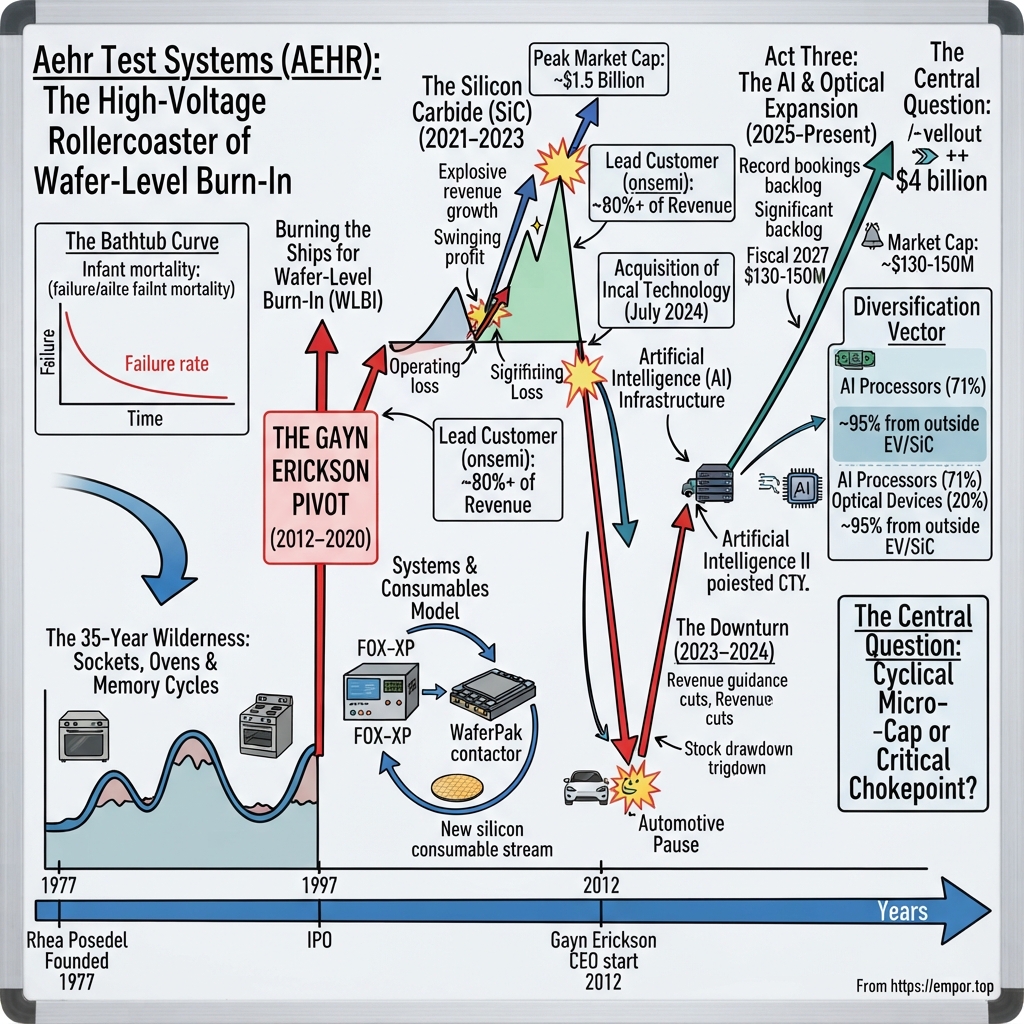
Act one was driven by the silicon carbide expansion. Aehr's revenue surged nearly fourfold, climbing from $16.6 million in fiscal 2021 to $65.0 million in fiscal 2023, while operations swung from an operating loss to a $14.6 million net profit.12 By 2023, the stock had nearly tripled year-to-date and commanded a multiple near 100 times earnings, propelled by a single customer, onsemi, which generated as much as 88% of quarterly revenue.3 At its summer 2023 peak, Aehr's market valuation reached approximately $1.5 billion—an extraordinary valuation for an equipment supplier whose annual sales had historically hovered between $10 million and $40 million.
Act two brought the downturn. As electric vehicle adoption cooled and automotive chipmakers paused capital additions, Aehr cut its fiscal 2024 revenue guidance twice, lowering its target from "at least $100 million" to "at least $65 million."24 Markets reacted swiftly: shares fell 16.8% after the initial revision and dropped another 22.4% following the second.56 Annual revenue then retreated for two consecutive years, sliding to $59.0 million in fiscal 2025 and $50.0 million in fiscal 2026, returning the company to GAAP net losses.78
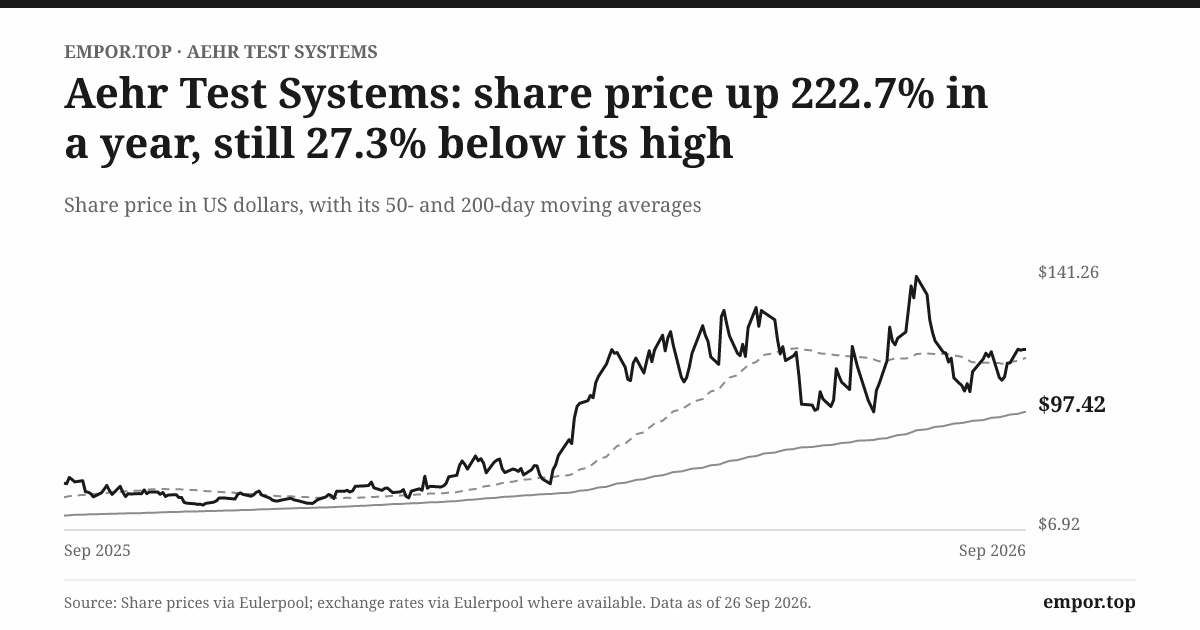
Act three is currently underway, fueled by a market shift few early models anticipated. Aehr identified a second growth wave in artificial intelligence infrastructure. In fiscal 2026, AI processors represented roughly 71% of revenue and optical devices accounted for about 20%, with management reporting that nearly 95% of total sales came from markets outside electric-vehicle silicon carbide.9 The company concluded fiscal 2026 with record quarterly bookings of $60.7 million, an effective backlog near $100 million, and fiscal 2027 revenue guidance of $130 million to $150 million—projecting a two-and-a-half to threefold increase over the year prior.8 Equity markets responded aggressively: shares reached a high of $126.70 on August 12, 2026, lifting market capitalization to roughly $4.05 billion, within a wide 52-week trading range spanning from $18.70 to $147.40.1011
The Central Question
These swings raise a fundamental question for investors: What type of business is Aehr Test Systems? Is it a critical equipment provider controlling an inescapable physical chokepoint—the only viable platform for burning in full wafers of high-power semiconductors at volume? Or is it a cyclical micro-cap supplier destined to ride dramatic customer-specific product ramps, only to falter when capital expenditure cycles peak?
Regulatory filings show the company has exhibited both characteristics over time. Aehr has established a proven record of securing complex technical validations, paired with an equally consistent difficulty in translating those technical wins into diversified, recurring revenue. The current AI expansion could signal a structural expansion of its customer base—or simply represent another concentrated cycle under a different industry banner.
The Roadmap
This analysis examines the operational history of commodity burn-in, Chief Executive Officer Gayn Erickson's strategic decision to center operations on full-wafer testing, the expansion and contraction of the silicon carbide cycle, and the 2024 acquisition of Incal Technology that facilitated entry into AI silicon. It concludes with an evaluation of competitive threats, capital allocation discipline, proprietary moats, and the key financial metrics that will determine whether this current growth cycle proves sustainable. Evaluating how a 49-year-old test equipment manufacturer achieved a multi-billion-dollar valuation begins with the underlying engineering: why high-power semiconductors must be thermally and electrically stressed before leaving the fab.
 Subscribe on LinkedIn
II. The 35-Year Wilderness: Sockets, Ovens, and Memory Cycles (1977–2011) (15:00 – 32:00)
A Founder and a Problem Nobody Wanted
In 1977, Rhea Posedel founded Aehr Test Systems in Silicon Valley. He ran it as chief executive for 35 years, until January 2012, stayed on as executive chairman until March 2013, and remains chairman of the board today at age 83, holding about 1.5% of the shares.12 That continuity established the company's operating DNA. For three and a half decades, Aehr was led by its founder, making the same category of equipment for an industry that treated the entire process as a necessary evil.
The product was burn-in equipment, and the necessary evil was infant mortality.
The Bathtub Curve, Explained Simply
Engineers describe the failure pattern of electronic components using the bathtub curve. Think of a batch of new light bulbs: a few fail almost immediately because of hidden manufacturing flaws, most run reliably for years, and eventually wear catches up, driving failure rates back up. Plot those failure rates over time and the line resembles the profile of a bathtub—high at the start, flat through the middle, and rising again at the end.
Semiconductor chips follow that exact pattern. A microscopic defect in a transistor's insulating layer or a fragile connection can pass standard factory testing on day one, only to fail after a few hours or days in real-world operation. Burn-in offers a way to fast-forward through that steep left edge of the bathtub. By heating the chips and running them at elevated voltage, test chambers accelerate latent defect mechanisms so that defective components fail in the factory. What ships to customers is the flat, reliable middle of the curve.
For decades, the standard approach was packaged-part burn-in. A finished wafer was cut into individual chips, each chip was sealed in a plastic or ceramic package, the packages were loaded into sockets on large burn-in boards, and those boards were slid into ovens. It worked, but it carried an obvious built-in inefficiency: manufacturers bore the full expense of packaging every defective chip before discovering it was flawed.
Memory, Cycles, and a Public Listing
Aehr built its early business around memory makers. By the time of its initial public offering on August 15, 1997, the company sold massively parallel test systems, burn-in systems, and a line of die carriers called DiePak, and about 70% of its sales came from outside the United States, including through a Japanese subsidiary that it largely owned.13 The IPO priced at $12.00 a share, with 3.6 million shares sold between the company and existing holders.13
The market timing proved difficult. Revenue of $42.0 million in fiscal 1997 and $40.8 million in fiscal 1998 fell by more than half to $18.1 million in fiscal 1999 as the Asian financial crisis and the memory downcycle hit.1314 Revenue recovered to $31.0 million in fiscal 2001 and then collapsed again by nearly 60% to $12.6 million in fiscal 2002, when the company lost $5.3 million.14
The concentration pattern that defines Aehr's history showed up clearly in fiscal 2008. Revenue climbed to $39.0 million and net income reached $10.6 million, but a single customer, the flash memory maker Spansion, accounted for 79.6% of sales.15 The vulnerability of that reliance became obvious within months: Spansion filed for Chapter 11 bankruptcy protection on March 1, 2009.16 Aehr's revenue, which had nearly touched $40 million, was back to roughly $10 million by fiscal 2015.17
That episode provides essential context. Long before silicon carbide and long before AI, Aehr had already lived through the defining risk of its business: relying on a lead customer for nearly 80% of revenue, followed by a sudden disappearance of demand.
Seeds of Something Different
Those volatile decades were not entirely wasted. In July 2001, Aehr introduced a product family called FOX, designed to test and burn in chips while they were still on the wafer.14 It released the FOX-1 in 2005 and the FOX-15 in 2007, and in fiscal 2008 it introduced a packaged-part system called ABTS.15 These were early bets on the idea that burn-in could move upstream, before packaging. For most of the 2000s they generated modest sales, with the company's revenue still swinging on the memory market. But they gave Aehr a proprietary technical foundation that incoming leadership would decide to stake the entire company on.
The takeaway from Aehr's first 35 years is not that the business was badly run. It survived, which many small equipment companies did not. The lesson is structural: a vendor that sells expensive, infrequent tools to a handful of large buyers will be whipsawed by those buyers' capital cycles unless it finds something that makes it harder to replace. In 2012, a new CEO arrived with a theory about what that something might be.
III. The Gayn Erickson Pivot: Burning the Ships for Wafer-Level Burn-In (2012–2020) (32:00 – 55:00)
The Memory-Test Veteran
On January 3, 2012, Aehr named Gayn Erickson its chief executive.18 He arrived from Verigy, the semiconductor test equipment supplier spun out of Agilent Technologies, where from 2006 to 2011 he served as senior vice president and general manager of the memory test division. Earlier in his career, Erickson held sales and marketing leadership roles within Agilent's memory test organization, having started out in the late 1980s inside Hewlett-Packard's automated test operations.12 He holds an electrical engineering degree from Arizona State University.12
That background shaped his strategic orientation. Erickson spent decades on the vendor side of automated test equipment, selling capital-intensive systems to major semiconductor manufacturers. He understood how test engineers at integrated device manufacturers evaluated cost per chip, throughput, and factory floor space. While Aehr had historically operated as a supplier of industrial burn-in ovens, Erickson reframed the company's pitch around the broader unit economics of the customer's manufacturing line.
On earnings calls, Erickson established a distinct communication style—delivering lengthy, technically dense explanations, relying on vivid manufacturing analogies, and adopting an openly combative posture toward short sellers. While that vocal optimism energized investors during cyclical expansions, it also yielded aggressive public projections that proved difficult to meet when demand softened.
Corporate filings indicate executive equity ownership remained modest compared to founder-led peers. As of the August 2026 proxy record date, Erickson beneficially owned 259,996 shares, or less than 1% of the company, including shares held in a family trust and restricted stock units vesting within 60 days.12 His total compensation for fiscal 2026 was approximately $3.23 million.12 Rhea Posedel, the company's founder and chairman, continues to hold a larger equity stake than the chief executive, while all directors and executive officers collectively hold about 4.6% of outstanding shares.12 While Erickson's compensation packages align his financial incentives with share performance, his personal holding does not represent a controlling owner-operator stake.
The Architectural Bet
Erickson's central strategic premise was that packaged-part burn-in had deteriorated into a commoditized, low-margin business, and that Aehr's competitive advantage lay in conducting stress testing directly on the full, uncut wafer. By contacting and electrically stressing every die on a wafer simultaneously for hours, manufacturers could weed out defective components before incurring packaging expenses. That economic argument strengthened as individual dies grew more valuable, particularly in advanced multi-chip modules where a single latent defect ruins an entire multi-die assembly.
The engineering challenge was formidable. Establishing simultaneous contact across an entire wafer requires aligning thousands of microscopic contact points—each demanding stable, low-resistance electrical connectivity—against a silicon disc that expands and warps under extreme thermal cycling. The contactor must deliver substantial electrical power across the surface and dissipate the resulting thermal load without damaging the wafer or the test fixture. The mechanical task resembled pressing a delicate bed of thousands of tiny pins against an expanding surface while conducting high currents through each individual connection.
Aehr addressed this challenge with a proprietary full-wafer contactor called the WaferPak, paired with its FOX family of test systems. The flagship FOX-XP was engineered as a high-density, multi-wafer test cell capable of processing multiple wafers concurrently. Its first production order, valued at more than $4.5 million, arrived in June 2016 from what Aehr described as one of the world's largest semiconductor manufacturers, for a configuration handling up to 18 wafers at once.19 Aehr shipped single-wafer FOX-1P systems to a lead customer that same year, followed by the introduction of the smaller FOX-NP in January 2019 and the FOX-CP in February 2019 to address engineering characterization and lower-volume production runs.2017
Selling Cost Per Good Chip, Not Ovens
This transition redefined Aehr's commercial pitch as much as its product architecture. A commodity burn-in oven sold on hardware price competes directly with regional sheet-metal fabricators and generic socket assemblers. In contrast, a wafer-level test system sold on the basis of cost per good die competes on total fabrication economics. Erickson framed the proposition around avoided downstream waste: because packaging accounts for a significant portion of a finished component's cost, packaging defective dies squanders capital, while shipping an infant-mortality failure to a customer risks catastrophic warranty and recall liabilities. By screening wafers before dicing, the capital expense of the test equipment could pay for itself through avoided packaging costs and eliminated field failures.
Yet that economic argument carried an essential caveat: it required that the downstream penalty of an escaped defect be high enough to justify the capital expense of universal wafer screening. For inexpensive commodity parts, statistical batch sampling and field replacements remained far cheaper than screening every die. Consequently, Aehr's wafer-level strategy was an explicit bet on semiconductor design trends—specifically, that market volume would shift toward high-value, safety-critical, and complex multi-chip packages where a single latent flaw ruins the entire end product. Throughout most of the 2010s, that industry transition was still in its early stages.
The Razor and the Blade
The central commercial appeal of Aehr's architecture, at least in concept, resided in the WaferPak contactor. Because contact arrays must match the precise bond-pad layout of a specific chip, every new silicon design requires a customized WaferPak. This dynamic converted what was historically an episodic capital equipment sale into an ongoing consumables stream: even if a chipmaker paused purchases of new FOX test chambers, each new device tape-out or product variant still required dedicated contactor tooling. Section VI examines how consistently this consumable model performed in practice across market cycles.
The False Dawns
Between 2016 and 2020, Aehr tested whether its proprietary wafer-level engineering could translate into sustainable commercial scale. The results were mixed.
Silicon photonics emerged as the company's first major growth target. Beginning in late 2017, Aehr announced a sequence of FOX-XP purchase orders for burning in silicon photonics transceivers—optical chips engineered to convert electrical signals into laser pulses for high-speed data links. While genuine, these purchase commitments remained modest: an initial follow-on contract in December 2017 with no disclosed value was followed by a $2.7 million order in September 2018 and additional follow-on tranches in 2019.2122 Although Aehr never named the customer in press releases, regulatory filings reveal that Intel represented 36% of Aehr's fiscal 2019 revenue and 43% of fiscal 2020 revenue, pointing strongly to Intel as the primary silicon photonics buyer.1723 That customer identification remains an analytical deduction rather than a direct corporate disclosure.
The financial results underscored the limitations of that early ramp. Even with those photonics bookings, Aehr's annual revenue moved from $18.9 million in fiscal 2017 to $29.6 million in fiscal 2018, before falling back to $21.1 million in fiscal 2019.17 In fiscal 2020, revenue stood at $22.3 million, with just three customers—Intel, ON Semiconductor, and STMicroelectronics—generating 43%, 16%, and 15% of total sales, respectively.23 Silicon photonics had been promoted as an expansive new growth driver; in practice, it materialized as a lumpy, single-customer niche that failed to break Aehr out of its historical $20 million revenue band.
The broader takeaway reflected a recurring historical pattern. Aehr's proprietary engineering repeatedly secured technical validation with sophisticated, tier-one manufacturers, but those design wins struggled to broaden into a diversified, multi-customer market. For investors, the crucial lesson of the 2016-to-2020 period was not a lack of technical capability, but an ongoing challenge in converting technical qualification into commercial scale.
Yet within that fiscal 2020 customer breakdown sat a pivotal detail: ON Semiconductor had emerged as a 16% customer, and its orders were not intended for silicon photonics.
IV. The Silicon Carbide Supercycle: 800V EVs and the Golden Age (2021–2023) (55:00 – 1:25:00)
A Crystal Grown in Fire
Understanding the boom requires understanding the material itself. Silicon carbide is a chemical compound of silicon and carbon characterized by extreme hardness and high thermal tolerance. For power electronics—the semiconductor devices engineered to switch high voltages and currents—it offers decisive physical advantages over conventional silicon. The material withstands significantly higher electric field strengths before breakdown, dissipates heat more effectively, and loses far less energy during each switching cycle.
In an electric vehicle, those characteristics matter most inside the traction inverter, the core subassembly that converts direct current from the battery pack into alternating current to power the electric motor. A more efficient inverter delivers more stored battery energy directly to the wheels, extending driving range. As automakers migrated toward 800-volt battery architectures to enable faster charging speeds, silicon carbide emerged as the preferred semiconductor substrate for high-efficiency inverters.
Manufacturing silicon carbide at commercial scale, however, presents severe crystallographic challenges. The material's crystal boules are synthesized under intense heat, yielding raw wafers with substantially higher defect densities than mature silicon substrates. Many of these structural imperfections trigger early component failures, particularly across the delicate gate-oxide insulating layers that control each transistor. Compounding this challenge, the end applications permit zero margin for error. A traction inverter integrates dozens of individual silicon carbide dies into a single sealed power module. A defect in even one die ruins the entire multi-chip assembly; an undetected failure on the highway leaves a vehicle stranded.
That combination—elevated defect rates alongside zero tolerance for field failures—made burn-in indispensable. Because packaged multi-chip power modules are costly to assemble and impossible to repair, conducting thermal and electrical screening upstream at the wafer level became the most cost-effective method to isolate weak dies. For Aehr, this industrial bottleneck matched the exact technical problem its FOX platform had spent a decade preparing to solve.
The Tipping Point
Substantial commercial commitments arrived in rapid succession throughout 2021. In July 2021, Aehr announced a $10.8 million purchase order from its lead silicon carbide customer, identified as a Fortune 500 supplier, for production test and burn-in of electric-vehicle silicon carbide devices.24 Two months later, that same buyer committed $19.4 million for multiple FOX-XP systems.25 In January 2023, the customer placed an additional $25.1 million order.26
While Aehr's press releases maintained customer confidentiality, mandatory regulatory filings told a clearer story. In fiscal 2021, ON Semiconductor's Korean subsidiary represented 23% of net revenue, and by fiscal 2022, ON Semiconductor accounted for approximately 82% of total company sales.127 Beginning in fiscal 2023, Aehr shifted to reporting major customers under anonymous alphabetical labels, yet historical procurement patterns left little doubt that "Customer A" remained ON Semiconductor.
The Financial Inflection
The influx of capital fundamentally reshaped Aehr's financial profile. Revenue expanded from $16.6 million in fiscal 2021 to $50.8 million in fiscal 2022, more than tripling top-line sales and lifting the business from an operating deficit to net income of approximately $9.5 million.127 That trajectory accelerated into fiscal 2023, when annual revenue touched a record $65.0 million, net income reached $14.6 million, and gross margin hovered near 50%.2 Annual bookings for fiscal 2023 climbed to $78.3 million.2
These figures illustrated the powerful operating leverage embedded in specialized capital equipment. Because Aehr's baseline research, engineering, and corporate overhead remained relatively fixed, a large portion of each incremental gross profit dollar dropped directly to the bottom line. For public market investors, this rapid margin expansion appeared compelling. Yet operating leverage functions symmetrically: when top-line volume recedes, fixed overhead endures, eroding profitability just as swiftly.
The Tesla Scare
The expansion encountered its first structural tremor in early 2023. During its Investor Day on March 1, 2023, Tesla disclosed that its next-generation electric powertrain would require 75% less silicon carbide material without sacrificing vehicle performance.28 The announcement triggered an immediate selloff across silicon carbide equities. Aehr issued an unusual public rebuttal the following day, contending that Tesla's reduction targeted a future low-cost vehicle platform and could reflect an architecture using fewer, larger dies—such as twelve 100-amp chips rather than twenty-four 50-amp chips, each incorporating roughly 50% greater silicon surface area.29 Management simultaneously reaffirmed its fiscal 2023 revenue guidance of $60 million to $70 million.29
While Aehr's technical defense was credible and fiscal 2023 closed within expectations, the disruption exposed an underlying vulnerability. Aehr's revenue depended on capital expenditure choices made by tier-one automakers multiple steps upstream from its own direct sales pipeline. A single engineering presentation from an automotive manufacturer proved capable of repricing the entire silicon carbide supply ecosystem overnight.
The Market Mania
By the summer of 2023, Aehr had become a market favorite for institutional investors seeking leveraged exposure to vehicle electrification. At its peak that year, the equity had nearly tripled year-to-date, commanding a valuation multiple approaching 100 times earnings.3 In July 2023, leadership raised expectations further, guiding fiscal 2024 revenue to "at least $100 million" and projecting GAAP net income of at least $28 million.2 A specialist vendor whose annual top-line had hovered near $20 million for decades was suddenly priced as an enduring secular compounder.
That valuation reflected a fundamental misunderstanding of semiconductor capital equipment dynamics. In capital equipment, annual revenue tracks the rate of customer capacity expansion rather than end-product manufacturing volume. A chipmaker planning to double its silicon carbide output across three years typically procures the bulk of its test infrastructure during the initial buildout phase, leaving minimal tool demand once installation finishes. Pricing Aehr as a recurring growth franchise mistook front-loaded capital installation for perpetual recurring revenue.
Customer concentration introduced an equally acute commercial asymmetry. When a single customer provides over four-fifths of an equipment vendor's revenue, commercial bargaining power tilts overwhelmingly toward the buyer. The lead customer can demand concessionary unit pricing, extended payment schedules, or deferred delivery timelines—terms a vendor cannot readily refuse without jeopardizing its financial guidance. The concentrated volume that supercharged Aehr's operating margins simultaneously capped its pricing power.
These structural risks were visible throughout the cycle. Investors paying peak multiples were betting that a single customer's initial capacity buildout would run uninterrupted for years, and that additional tier-one manufacturers would immediately step in to replicate it. The subsequent downturn revealed the fragility of both premises.
V. Anatomy of an 80% Drawdown: Customer Concentration & The EV Winter (2023–2024) (1:25:00 – 1:52:00)
Monday, October 30, 2023
The first crack did not appear on an Aehr earnings call. It appeared on onsemi's. In the last days of October 2023, onsemi guided to a weaker December quarter, and its stock fell nearly 20% in a day.3 Aehr fell 17% that week.3 For investors, the lesson was immediate: onsemi had accounted for about 88% of Aehr's sales in the previous quarter, so its outlook effectively was Aehr's outlook.3
The Concentration Trap
Aehr's annual reports spell out how exposed it was. In fiscal 2023, one customer accounted for about 79% of revenue and a second for about 10%.30 In fiscal 2024, the two largest customers were about 67% and 17%.30 The top five customers made up 93% of fiscal 2024 revenue.31 Wafer-level burn-in products provided about 98% of fiscal 2024 revenue, and electric vehicle and power semiconductor applications accounted for 92%.30
In practical terms, Aehr was not a diversified test equipment company. It was a specialized supplier to one silicon carbide production line, with a second customer attached.
The Broken Narrative: Tracking the Guidance
The sequence of statements over the following nine months is worth reading closely, because it shows how management's confidence held up against changing evidence.
In July 2023, Aehr guided to at least $100 million in fiscal 2024 revenue.2 On the call, Erickson said the company was confident enough to commit to that floor.32
In October 2023, reporting a strong first quarter with revenue up 93% to $20.6 million, Aehr reiterated the guidance of at least $100 million in revenue and at least $28 million in GAAP net income.33 On the call, Erickson told analysts the company was "sticking to our guns."32
On January 9, 2024, the company cut. Fiscal 2024 revenue guidance fell to $75 million to $85 million.34 In the press release, Erickson attributed the change to the prior sixty days, in which the slowing growth rate of the electric vehicle market had affected the timing of several current and new customer orders and capacity increases for silicon carbide.34 On the call, he said a very large customer running an automotive benchmark had changed its timing for multiple production systems, pushing them likely out of the fiscal year, and he stressed that the bulk of the reduction was not from the lead customer.32 He argued the silicon carbide market was not shrinking, only growing more slowly, and said the company was "not in DEFCON 5 position."32 He also claimed Aehr had never lost a full wafer-level burn-in evaluation.32 The stock fell 16.8% the next day.5
On March 25, 2024, Aehr pre-announced a weak third quarter, with revenue of about $7.6 million and a net loss, and cut fiscal 2024 revenue guidance again to at least $65 million.4 This time it cited softness in semiconductor capital spending, especially in automotive, tied to an inventory glut, alongside electric vehicle order pushouts, and suggested the weakness could last another quarter or two.4 The stock fell 22.4%.6
The full-year result, reported in July 2024, was $66.2 million in revenue, a record by a hair over fiscal 2023, but a third below the original guidance.35
What Actually Went Wrong
Three forces combined.
First, the automotive inventory bullwhip. When carmakers trimmed production targets, their suppliers cut component orders, and chipmakers who had been racing to add silicon carbide capacity suddenly had enough. A fab running below full utilization does not need more equipment. Capital spending is always the first thing to be cut, and equipment vendors feel it with an amplified lag.
Second, the timing of capacity purchases. Aehr's lead customer had bought heavily in fiscal 2022 and 2023 to prepare for expected demand. Once installed, those systems could serve growing volumes for some time without further purchases. Whether that constituted over-ordering is hard to determine from the outside. What is clear is that the customer's purchases had front-loaded several years of growth.
Third, the narrative shock. The Tesla remark in early 2023, combined with visible electric vehicle price cuts and slowing adoption in 2023 and 2024, made the entire silicon carbide investment case look less certain, which weighed on every company in the chain.
An Accounting Note on the Record Year
Investors skimming fiscal 2024 results would have seen GAAP net income of $33.2 million, more than double the prior year.35 About $20.8 million of that came from a one-time tax benefit when Aehr released the valuation allowance on its deferred tax assets, an accounting judgment that it expected future profits to be sufficient to use those assets.35 Stripped of that item, fiscal 2024 profit was lower than fiscal 2023's. The two following years of GAAP losses test that judgment, and investors should watch whether future filings revisit it.
The Stress Test
A skeptical investor would put three questions to management.
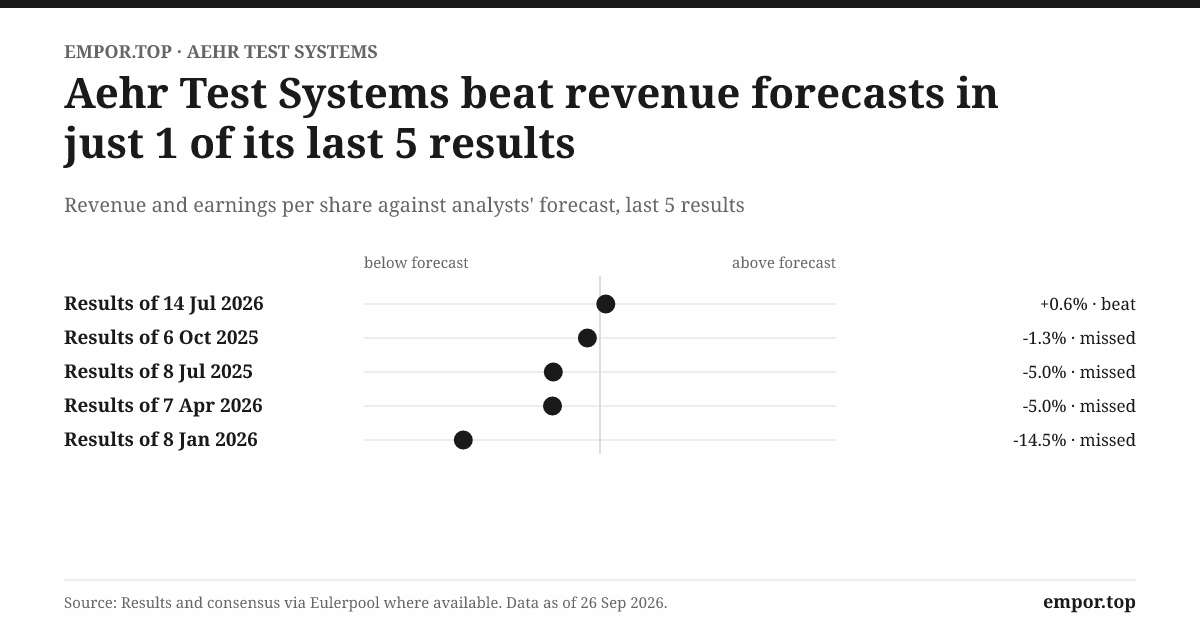
Did it overpromise? Yes, by any fair standard. In July and October 2023, management stood behind a $100 million floor while the risk that its concentrated customer base would slow was visible to outside observers, including in onsemi's own October guidance. The following year repeated the pattern. Fiscal 2025 guidance of at least $70 million was withdrawn in April 2025, citing the secondary effects of U.S. tariff announcements, and the year closed at $59.0 million.35367
Did management explain misses candidly? Largely yes. Erickson named the causes, electric vehicle growth, automotive inventory, and customer pushouts, rather than blaming vague macro factors, and the company did not issue fiscal 2026 guidance at all after withdrawing the fiscal 2025 figure.7 Declining to guide after two misses is a reasonable, if belated, reaction.
Was the lead customer's behavior predictable? Partially. Aehr's own history, from Spansion in 2008 to the silicon photonics years, showed how quickly single-customer demand could vanish. The lesson that should have been drawn is that no guidance built primarily on one customer's capital plans deserves a floor.
This matters now because Aehr is again guiding for a very large year. The difference this time, as later sections explain, is that the guidance rests on more than $100 million of effective backlog rather than on expected orders. That is a materially stronger foundation. It is not proof that the pattern has been broken. To see why, it helps to look at what Aehr actually sells.
VI. Product Architecture & Segment Economics: Systems vs. Consumables (1:52:00 – 2:12:00)
Two Kinds of Revenue
Inside a fabrication facility running Aehr equipment, the commercial footprint divides across two distinct hardware categories. The first is the FOX system itself—the multi-wafer burn-in chamber that represents a major capital purchase. The second is the WaferPak, the custom contactor plate that interfaces directly with each wafer. Because every WaferPak must match the precise bond-pad arrangement of a specific silicon layout, each new chip design requires dedicated contactor tooling.
Aehr does not report system and WaferPak revenue on a consistent annual basis, nor does it disclose gross margins for each category separately. Disclosures in quarterly regulatory filings and earnings calls, however, provide enough operational detail to evaluate how well that consumables model functions across market cycles.
What the Consumables Did in the Downturn
The classic razor-and-blade thesis suggests that recurring consumable sales should provide a stabilizing buffer when customer capital expenditure contracts. Aehr's recent results demonstrate both the initial presence of that buffer and its strict limits.
In the fourth quarter of fiscal 2024, WaferPak sales totaled approximately $12.4 million, accounting for 75% of total company revenue.35 In the first quarter of fiscal 2025, as system shipments ground to a near-total halt, WaferPaks generated about $12.1 million, expanding to 92% of net revenue.7 Over the following three quarters, however, consumable orders contracted sharply: by the fourth quarter of fiscal 2025, WaferPak revenue had fallen to roughly $4.2 million, or about 30% of sales.7 WaferPak revenue spiked as a percentage of total sales primarily because system deliveries vanished; in absolute dollar terms, quarterly consumable revenue dropped by roughly two-thirds within twelve months.
That trajectory challenges the simplest version of Aehr's recurring-revenue narrative. WaferPak demand does not operate as an automatic, predictable annuity like a printer cartridge. Instead, it remains tied to customer production ramps, device tape-outs, and active factory utilization. When Aehr's primary silicon carbide customer paused capacity additions, WaferPak reorders followed that slowdown with only a brief lag.
Margins Through the Cycle
Aehr's gross margin performance highlights the same cyclical reality. In fiscal 2023, at peak silicon carbide production volume, GAAP gross margin reached approximately 50%.2 That margin level held steady through fiscal 2024 before compressing to roughly 40.5% in fiscal 2025 and falling to 35.3% in fiscal 2026.78
That margin erosion reflected two operational headwinds: fixed manufacturing overhead distributed across significantly lower shipment volumes, and an unfavorable product mix containing lower-margin packaged-part burn-in equipment acquired from Incal Technology. As shipping volumes recovered late in fiscal 2026, fourth-quarter GAAP gross margin rebounded to 42.6%.8 Management's fiscal 2027 guidance—targeting non-GAAP pretax income of 18% to 22% of revenue—anticipates further operational leverage as volume accelerates.8 Nevertheless, the margin trajectory across fiscal 2025 and 2026 illustrates that Aehr's gross margins remain exposed to broader capital cycles. The thesis that proprietary engineering provides pricing power capable of sustaining 50% gross margins through an industry downturn is not borne out by the company's financial results.
The New Mix
Alongside overall volume swings, the underlying composition of Aehr's revenue underwent a structural shift. In fiscal 2024, wafer-level burn-in systems and contactors accounted for roughly 98% of total revenue.30 By fiscal 2025, wafer-level products dropped to 66% of net sales, while packaged-part equipment, largely derived from Incal, expanded to 34%.37 That balance persisted in fiscal 2026, with wafer-level products generating about $31.5 million, or 63% of sales, and packaged-part systems contributing roughly $18.5 million, or 37%.31
This shift marks the most consequential structural change to Aehr's product portfolio in recent years. It helped diversify the business away from a stagnant electric-vehicle silicon carbide sector. At the same time, it reintroduced a heavy weighting in packaged-part burn-in—a product category Aehr spent the preceding decade characterizing as less differentiated than its core wafer-level architecture. Whether that integration broadens Aehr's commercial opportunity or permanently dilutes its aggregate profitability profile remains an unresolved question.
The Real Lock-In Mechanism
Aehr's primary competitive moat does not stem from standalone WaferPak consumable demand; it arises from the procedural friction of semiconductor qualification. Once a chipmaker qualifies a burn-in workflow on Aehr's FOX platform for a production device, that process becomes an immutable element of the part's certified reliability baseline. Replacing the test platform requires full customer and end-market requalification—a drawn-out, costly exercise in automotive power electronics, and a disruptive hurdle even in high-performance artificial intelligence environments. The proprietary physical architecture of the WaferPak reinforces that lock-in, ensuring that installed FOX chambers can operate only with Aehr's custom contactors.
Yet that barrier to exit defends existing production programs far more effectively than it secures future design wins. As the transition from silicon carbide power devices to artificial intelligence processors revealed, incumbent qualification on an automotive line provided minimal leverage in capturing uncommitted AI compute architectures. Understanding that distinction leads directly to the competitive landscape: who else is competing for those next-generation test sockets, and how defensible Aehr's proprietary chokepoint truly is.
VII. Competitive Landscape & Industry Structure: David vs. Goliaths (2:12:00 – 2:32:00)
Two Different Games
Imagine two ways to evaluate whether a vehicle is reliable. One is a brief inspection at the dealership: confirm the engine starts, the lights illuminate, and the brakes engage. The other is a grueling endurance trial on a high-temperature test track for hours. Both represent testing, yet they require entirely different hardware, facilities, and operational economics.
Semiconductor testing divides along that exact fault line. The established leaders of the automated test equipment industry, Advantest and Teradyne, dominate functional test: high-speed, sophisticated systems engineered to verify whether a chip's digital logic operates correctly, typically within seconds and across only one or a few devices at a time. Burn-in, by contrast, functions as the endurance trial—subjecting hundreds or thousands of dies to sustained electrical stress and elevated thermal conditions for hours.
Management frames this distinction around test density. On Aehr's fiscal 2026 fourth-quarter earnings call, Erickson asserted that within the physical footprint of a high-end functional tester such as Advantest's 93000 platform, Aehr's system can test nine AI wafers concurrently.9 On an earlier call, he noted that system-level test equipment from suppliers like Advantest, Teradyne, and AEM is engineered to evaluate chips under standard operating conditions rather than endure high-stress burn-in environments.32 While that framing highlights Aehr's positioning, the underlying economic reality is direct: utilizing a multi-million-dollar functional tester to hold silicon wafers stationary for hours would prove commercially prohibitive. That cost disparity is precisely why a distinct category of dedicated burn-in hardware exists.
Named Rivals and Emerging Threats
In dedicated wafer-level burn-in, Aehr's most prominent challenger in recent years has been Semight, an equipment manufacturer based in China. Aehr initiated patent infringement litigation against Semight in Chinese court. In December 2025, a first-instance ruling from the Suzhou court dismissed Aehr's claims, citing insufficient evidence to establish infringement; Aehr filed an appeal on January 4, 2026, and Semight submitted a petition to invalidate Aehr's patents later that month.31 According to Aehr management, the company secured its initial silicon carbide customer in Taiwan in direct competition against Semight, which Aehr reported had reincorporated in Malaysia under the name Nexus Test.9
This legal dispute carries two significant implications for investors. First, it confirms the arrival of credible regional competition within Aehr's core market—particularly in China, the world's most rapidly expanding market for silicon carbide production. Second, it demonstrates that Aehr's intellectual property portfolio, at least within Chinese jurisdictions, may not provide the impenetrable commercial barrier some market models assumed.
Beyond Semight, the broader competitive periphery includes diversified test and burn-in suppliers such as Taiwan's Chroma ATE, probe and interface specialists including FormFactor and Micronics Japan, and wafer-prober manufacturers such as Tokyo Electron. While none of these vendors has publicly fielded a multi-wafer, high-power burn-in architecture matching Aehr's density at commercial scale, each possesses the engineering depth, balance-sheet scale, and established customer access required to contest the market should total demand expand sufficiently.
The Real Competitor Is Often "Nothing" or "Later"
Yet the most formidable competitor Aehr confronts is not an alternative equipment maker; it is the customer's operational discretion regarding whether, where, and for how long to conduct burn-in.
A semiconductor manufacturer can choose to perform burn-in at the uncut wafer stage, on packaged individual dies, at the assembled module or board level, or forgo burn-in entirely by relying on statistical process control and field warranty reserves. In artificial intelligence silicon, Erickson acknowledged on Aehr's fiscal 2026 third-quarter call that the majority of custom AI application-specific integrated circuits do not undergo burn-in today, and estimated that perhaps half of standalone AI accelerator chips do.32 That disclosure encapsulates both the commercial opportunity and the structural vulnerability. If comprehensive burn-in becomes an industry mandate for AI compute, Aehr's addressable market could expand significantly. Conversely, because burn-in remains a discretionary yield and reliability choice rather than an unalterable manufacturing step, chipmakers can shorten burn-in test cycles or bypass the process altogether when capital budgets tighten.
A similar dynamic governs silicon carbide. As crystalline manufacturing processes mature and substrate defect densities decline, automotive chipmakers may elect to truncate burn-in durations or shift from screening every wafer to statistical batch sampling. Either adjustment would materially depress the number of test chambers required per unit of factory output. Because Aehr has not publicly disclosed how average burn-in cycles have evolved at its lead silicon carbide customer, outside investors cannot yet quantify the extent of that volume compression.
Why Aehr Wins Its Niche, and Why the Niche Could Shrink
At present, Aehr's competitive moat remains genuine but tightly bounded. The company commands the industry's most established multi-wafer, high-power burn-in platform, supported by years of field characterization and an expanding roster of commercial qualifications. Tangible evidence of that operational lead includes its entrenched production footprint with its primary silicon carbide buyer, an AI processor customer that transitioned its entire production burn-in screening to Aehr's wafer-level systems, and recurring follow-on commitments from optical transceiver manufacturers.938
The structural constraints, however, are equally distinct. Regional competitors have surfaced and secured initial legal victories in key overseas markets. The dominant automated test conglomerates have avoided direct entry into high-power wafer burn-in to date, but their strategic incentives could shift rapidly if AI burn-in develops into a multi-billion-dollar equipment category. And the prevailing alternative—a customer choosing not to burn in at all—remains an ongoing risk. Aehr's competitive position is therefore best understood not as an enduring monopoly over an essential chokepoint, but as a specialized technical lead within an evolving, discretionary niche.
Recognizing that competitive vulnerability helps explain why Aehr's balance-sheet stewardship—specifically its equity financing history and its strategic acquisition strategy—has proved so critical to its trajectory.
VIII. Capital Allocation, Dilution & The Incal Technology Acquisition (2:32:00 – 2:47:00)
Nine Days in April
In the spring of 2026, as artificial intelligence bookings mounted, Aehr capitalized on surging market demand. On April 8, 2026, the company entered into an equity distribution agreement with William Blair and Craig-Hallum to sell up to $60 million in common stock through an at-the-market offering.39 Just nine days later, on April 17, the program was completed: Aehr had sold 812,185 shares at an average price of approximately $73.87, raising roughly $60 million in gross proceeds.4031 That velocity underscored both institutional appetite for the equity and management's readiness to tap public markets as valuations surged.
The ATM Habit
That April offering was part of an established operational pattern rather than an isolated event. Over the preceding five years, Aehr repeatedly turned to at-the-market facilities to bolster its liquidity. In September 2021, as the silicon carbide cycle gained momentum, the company established a $25 million at-the-market program with Craig-Hallum.41 In February 2023, near the crest of that first expansion, Aehr replaced it with a fresh $25 million facility managed by William Blair and Craig-Hallum.42 Remarks on subsequent earnings calls indicated the company raised roughly $7.3 million under that facility during fiscal 2023 and tapped nothing in fiscal 2024.32 Then, in October 2024, Aehr filed a $100 million shelf registration containing a $40 million at-the-market program through Jefferies.43 The company exhausted that entire $40 million allocation during fiscal 2026, issuing shares at an average price of about $35.38.31
Across fiscal 2026, Aehr generated net proceeds of approximately $97.4 million from at-the-market equity sales, lifting its cash balance to $116.5 million by year-end, up from $26.5 million twelve months earlier.318 Management sustained that financial flexibility into the new fiscal year, filing an automatic shelf registration in July 2026.44
That capital accumulation carried a clear cost in equity dilution. Aehr's weighted-average share count stood at approximately 22.9 million in fiscal 2020.23 By July 20, 2026, total common shares outstanding had expanded to 32,620,450—an increase of more than 42% over six years, driven by equity offerings, executive stock grants, and share consideration issued for the Incal transaction.44
Evaluating that dilution requires balancing financial resilience against capital discipline. On one hand, Aehr closed fiscal 2026 with an unencumbered balance sheet, zero long-term debt, and a cash reserve positioned to fund the working capital requirements of a projected $130 million to $150 million revenue year. Executing an equity sale at $73.87 per share in April 2026 demonstrated opportunistic timing, capturing more than twice the $35.38 average realization of its earlier fiscal 2026 issuance. On the other hand, Aehr's recurring reliance on equity sales reflects a structural reality: because top-line visibility proved fragile during cyclical contractions, public markets had to absorb recurrent dilution to finance operations between growth waves.
The Activist's Questions
An institutional investor or activist examining this financing trajectory would focus on three central governance issues:
First, issuance discipline. Raising equity at an average price near $35 during fiscal 2026, only to sell additional shares at more than double that valuation just months later, suggests that immediate operational cash requirements, rather than deliberate valuation optimization, governed earlier offerings.
Second, capital efficiency. Holding $116.5 million in cash represents more than two full years of Aehr's fiscal 2026 revenue. While scaling to $130 million or $150 million in annual shipments demands working capital for long-lead inventory, investors face an open question regarding how much of that balance serves productive working capital and how much represents an idle safety buffer against another cyclical downturn.
Third, incentive alignment. While executive compensation packages incorporate significant equity-based awards, the chief executive's personal equity ownership remains below 1%, meaning public shareholders have borne the overwhelming brunt of the 42% share-count expansion.
These observations do not imply corporate impropriety; rather, they frame the standard accountability questions for a capital equipment supplier that has leaned on equity offerings as its primary liquidity backstop across multiple cycles.
Insiders Selling Into Strength
Executive trading patterns during this equity recovery warrant equal scrutiny. On August 12, 2026—the same day Aehr publicly announced a $22 million artificial intelligence order—Erickson sold 40,000 shares through a family trust at prices between approximately $130 and $132 per share.4538 Across the preceding twelve months, Aehr corporate insiders executed aggregate share dispositions totaling roughly $62.7 million.11
Insider selling following an aggressive market rally is standard corporate practice, frequently dictated by portfolio diversification, estate planning, or tax obligations. Nevertheless, for an executive leadership team whose chief executive already holds less than 1% of outstanding shares, substantial insider dispositions executed into celebratory contract announcements provide a sobering counterweight to public expressions of long-term confidence.
The Incal Deal
While at-the-market equity programs expanded liquidity, Aehr's most consequential capital allocation decision involved an external acquisition. On July 16, 2024, alongside its fiscal 2024 earnings release, Aehr announced an agreement to acquire Incal Technology, a privately held Fremont neighbor specializing in high-power burn-in and reliability test systems for packaged semiconductor devices.46 The purchase consideration totaled $21 million, structured as $14 million in cash and 552,355 Aehr common shares valued at $12.673 apiece.46 With Incal generating approximately $12 million in trailing twelve-month revenue through June 30, 2024, the transaction implied an entry valuation of roughly 1.75 times sales.46 The acquisition formally closed at the end of July 2024.47
Strategically, the transaction offered Aehr an immediate commercial on-ramp into artificial intelligence silicon. Incal's proprietary Sonoma platform was engineered specifically to conduct thermal and electrical stress testing on high-power packaged AI accelerators. Commercial traction followed swiftly: in September 2024, Aehr booked its first multi-system Sonoma commitment, securing an order for six units from a major data center hyperscaler.48 That relationship broadened dramatically over the subsequent eighteen months, culminating in April 2026 with a landmark $41 million Sonoma production order from the same buyer.49 Erickson subsequently characterized this customer as a top-tier cloud hyperscaler, projecting that Sonoma platform deliveries could generate approximately $50 million in revenue in fiscal 2027.9
The Counter-Thesis
For a decade, Aehr's central thesis rested on the argument that wafer-level burn-in was technologically and economically superior to packaged-part testing. Purchasing a packaged-part equipment vendor initially looked like an ideological retreat—a defensive maneuver to capture non-automotive sales during the electric-vehicle downturn.
Two years later, the operating evidence supports a more favorable assessment. Incal was acquired at an attractive multiple, relative to both public automated test equipment peers and its subsequent contribution, and it opened commercial access to hyperscale AI accounts that Aehr's wafer-level platform had struggled to penetrate independently. Measured by the financial return on that $21 million outlay, it represents the most effective capital allocation decision in the company's recent history.
Two operational cautions qualify that success. First, the Sonoma business remains heavily concentrated in a single hyperscale buyer, whose second-generation processor release has encountered scheduling delays, according to Erickson on the fiscal 2026 fourth-quarter call.9 Second, Erickson noted that this same hyperscaler is actively evaluating wafer-level burn-in for its third-generation device, though not within the current fiscal year.9 While a migration toward wafer-level screening would validate Aehr's core FOX platform, it also demonstrates that Sonoma packaged-part revenue could eventually be displaced by Aehr's own systems.
Purchasing an operational bridge into artificial intelligence was an effective tactical maneuver; establishing an enduring, diversified franchise is an entirely different task. With a replenished balance sheet, a towering backlog, and customer demand once again heavily concentrated in a single lead buyer, the central question turns to valuation and cyclical durability: whether Aehr's $150 million ambitions represent a sustainable plateau or merely the crest of another volatile capital cycle.
IX. Strategic Moat Assessment: 7 Powers & Porter’s 5 Forces (2:47:00 – 3:05:00)
The War Game
Consider a test engineering manager at a semiconductor company planning production capacity for a new artificial intelligence accelerator. The company has a packaging partner in Taiwan, a tight qualification deadline, and a fixed capital budget. Aehr's systems are already validated at another AI customer. A Chinese rival offers lower-priced hardware. Meanwhile, internal reliability teams argue for conducting stress testing at the packaged module level, or bypassing burn-in entirely for a portion of total production.
The fundamental test of Aehr's competitive moat is how often that engineering manager selects Aehr, and how much pricing power Aehr commands in the transaction. Hamilton Helmer's 7 Powers framework and Michael Porter's Five Forces offer complementary structural lenses for evaluating that commercial decision.
7 Powers
Switching costs: meaningful, but program-specific. Once a chipmaker qualifies a burn-in workflow on Aehr's platform for a commercial device, replacing that equipment requires complete part requalification. In automotive power electronics, requalification is a protracted, highly regulated procedure that directly involves tier-one auto suppliers and carmakers. In artificial intelligence silicon, the protocol is less bureaucratic but still demands substantial engineering hours, line retooling, and operational risk.
This dynamic represents Aehr's most defensible power. Its critical limitation, however, is that it shields only active, committed production programs rather than future design wins. As the sudden downturn in silicon carbide demonstrated, installed-base lock-in could not prevent a severe two-year contraction in equipment orders once the lead customer completed its initial capacity additions.
Cornered resource: partial and contested. Aehr's proprietary WaferPak contactors, thermal management architectures, and decades of full-wafer contact data represent genuine technical assets. Its intellectual property moat, however, suffered a material legal setback when a Chinese court dismissed Aehr's patent infringement claims against Semight at first instance, while Semight pursued petitions to invalidate Aehr's underlying patents.31 Proprietary engineering know-how is more durable and harder to replicate than a standalone patent filing, but it falls short of an unassailable cornered resource in Helmer's strict economic definition.
Counter-positioning: plausible, but conditional. The dominant automated test equipment conglomerates generate the vast majority of their operating income selling rapid, multi-million-dollar functional test cells. Sponsoring a low-cost, long-duration burn-in chamber runs counter to their high-margin business models, leading them to historically cede the category to niche suppliers. That dynamic creates commercial runway for Aehr—yet only as long as total industry burn-in spending remains modest relative to the broader automated test market. If artificial intelligence stress testing expands into a multi-billion-dollar equipment segment, that counter-positioning shield will rapidly erode.
Scale economies: weak. Aehr remains a specialized vendor with fiscal 2026 revenue of $50.0 million, depending on external merchant suppliers for critical subcomponents. On the fiscal 2026 fourth-quarter earnings call, Erickson disclosed that suppliers of high-performance power components—who also allocate capacity to major semiconductor buyers such as NVIDIA—had implemented 40% price increases, underscoring Aehr's modest purchasing power in shared supply chains.9
Network effects, brand, and process power: minimal. Aehr enjoys no network effects: each customer deployment functions as an isolated hardware cell. Brand operates primarily as a professional reputation for hardware reliability among factory test engineers. Process power—defined by Helmer as an embedded, complex organizational capability that rivals cannot replicate—may gradually emerge through Aehr's ability to design and deliver complex, custom WaferPaks rapidly, but public filings offer little operational data to quantify that advantage.
The Helmer verdict: Evaluated through Helmer's framework, Aehr commands one authentic power: high switching costs at the individual program level, buttressed by an engineering lead that remains contested rather than cornered. That positioning is sufficient to harvest robust operating margins during cyclical expansions, but it has repeatedly failed to insulate the company from brutal cyclical drawdowns.
Porter's Five Forces
Bargaining power of buyers: very high, but moderating. Throughout most of Aehr's corporate history, a single lead buyer dictated financial performance. In fiscal 2026, customer diversity showed measurable improvement: three customers contributed more than 10% of revenue each—representing approximately 26%, 14%, and 11%—while the top five accounts generated roughly 70% of total sales, down from 93% in fiscal 2024.31 While that broadening marks meaningful progress, deriving 70% of sales from five accounts leaves buyer power exceptionally high. These semiconductor manufacturers command the commercial leverage to defer capital delivery schedules, demand aggressive pricing concessions, or explore alternate test workflows.
Threat of substitutes: high. The alternatives to Aehr's core wafer-level architecture are diverse and readily available. Chipmakers can route devices to packaged-part burn-in chambers, rely on system-level functional test racks, substitute 100% wafer screening with statistical batch sampling, or rely on maturing fabrication processes that reduce defect densities enough to render burn-in economically redundant.
Bargaining power of suppliers: moderate and rising. Because Aehr procures specialized power assemblies and electronic subcomponents from vendors that simultaneously serve massive artificial intelligence hardware providers, it faces meaningful input-cost vulnerability. The 40% component price increase cited by management illustrates the pricing pressure Aehr confronts when competing against tier-one hyperscalers and chipmakers for the same high-power electrical subcomponents.9
Threat of new entrants: moderate. Engineering high-density, multi-wafer contactors capable of handling intense thermal loads presents a steep technical hurdle. Nevertheless, Semight's commercial entry and subsequent legal victories demonstrate that regional challengers can cross that threshold. Furthermore, well-capitalized automated test giants maintain the engineering talent and balance-sheet capacity to field competing platforms should market demand expand into a multi-billion-dollar sector.
Rivalry among existing competitors: moderate today, intensifying ahead. In wafer-level burn-in for high-power artificial intelligence processors, Aehr currently encounters minimal direct competition. In automotive silicon carbide, however, regional rivalry in Asia has intensified. As the commercial opportunity in artificial intelligence stress testing becomes more widely recognized, competitive intensity across both segments will almost certainly escalate.
The Conclusion
Synthesizing these analytical frameworks reveals a business with an authentic engineering lead and durable program-level switching costs, operating in an industry defined by concentrated buyers, abundant technical substitutes, and rising regional entry.
The historical lessons of the silicon carbide cycle clarify the boundary of Aehr's competitive moat: the company is extraordinarily difficult to displace from a production program it has already won, but it remains remarkably easy for prospective customers to bypass or defer. Expanding beyond that structural constraint depends on whether burn-in transitions from an optional yield-screening step into an unavoidable industry mandate across emerging semiconductor architectures. That question turns directly to the frontier markets examined next.
X. The Frontier Optionality: Silicon Photonics, GaN, and AI Accelerators (3:05:00 – 3:22:00)
The Customer That Moved Burn-In Upstream
On Aehr's fiscal 2026 fourth-quarter earnings call, Erickson highlighted an operational shift at the company's lead wafer-level artificial intelligence customer. That buyer, he reported, moved all of its production burn-in screening to Aehr's wafer-level systems during the year, entirely eliminating the need for downstream system-level screening.9 In practice, the customer shifted stress testing from the end of the manufacturing line to the beginning—filtering out defective silicon before individual dies were bonded into expensive multi-chip assemblies with high-bandwidth memory.
This operational migration represents the most compelling empirical evidence supporting Aehr's expansion into artificial intelligence, demonstrating the underlying economic rationale of wafer-level test in complex packaging.
AI Accelerators
Modern AI processors are rarely monolithic chips. Instead, they are advanced multi-chip packages combining one or more large compute dies with stacks of high-bandwidth memory, often costing thousands of dollars per finished device. If a single compute die harbors an undetected latent defect, the entire multi-die module is ruined. As Erickson highlighted on the call, when one compute chip fails, the customer is forced to discard the companion compute silicon and all surrounding memory stacks.9 He estimated that across an assembly containing eight devices, identifying latent flaws before packaging delivers the economic equivalent of an 8% yield improvement, while the cost of wafer-level testing represents only a tiny fraction of one percent.9 While those metrics reflect management's promotional framing rather than independently audited data, the core manufacturing logic mirrors the silicon carbide experience: as the value of the finished assembly climbs, the economic penalty of packaging a defective die escalates exponentially.
The commercial ramp in artificial intelligence has been rapid. In December 2024, Aehr announced initial purchase orders exceeding $10 million from an undisclosed AI processor manufacturer for multiple high-power FOX-XP systems and WaferPaks.50 The company delivered the initial unit, configured to stress nine wafers simultaneously, in February 2025.51 In August 2026, that same customer committed to a $22 million follow-on order scheduled for delivery over six months to its contract manufacturing partner in Taiwan, with Aehr noting that the customer's expansion roadmap contemplated capacity requirements beyond this commitment.38 During the fiscal 2026 fourth-quarter call, Erickson reported that a second potential client—a diversified supplier of AI accelerators, central processors, and networking silicon—had completed an evaluation yielding test results superior to its existing packaged-part protocols, and intended to advance toward pilot production.9
Management projects that artificial intelligence applications will generate approximately 70% of fiscal 2027 revenue.9 On an earlier earnings call, when asked by an analyst whether AI revenue could ultimately reach hundreds of millions of dollars annually, Erickson affirmed that target.32
The falsification test. Aehr's artificial intelligence narrative already clears a hurdle its initial silicon photonics push failed to overcome: AI has expanded into the outright majority of top-line sales, backed by multi-million-dollar follow-on orders from an active production customer. Yet the business model repeats Aehr's familiar vulnerability: customer concentration. The lead wafer-level AI buyer remains anonymous, the lead Sonoma packaged-part customer remains anonymous, and each commands outsized influence over Aehr's operating trajectory. Meanwhile, the prospective second customer experienced qualification delays that Erickson attributed to a technical misunderstanding regarding test configurations.32 For investors, wafer-level AI burn-in is commercially validated across one or two lead accounts, but it remains unproven as a ubiquitous industry standard. Tangible validation of a broader secular shift would require a second and third wafer-level customer transitioning from evaluation trials into full volume production over the coming year.
Silicon Photonics, Round Two
Silicon photonics represents Aehr's second attempt to scale an enduring technical thesis. Modern artificial intelligence training clusters require massive bandwidth to transfer data between accelerator compute nodes and networking racks, where conventional copper cabling encounters severe physical limits in reach, power consumption, and signal attenuation. Optical interconnects, which transmit data via laser pulses, provide the standard architectural alternative. However, the microscopic semiconductor lasers embedded in optical transceivers are prone to early infant-mortality degradation. A laser failure inside an active optical transceiver can disrupt an entire networking switch or high-density server rack.
Unlike the modest purchase commitments of the late 2010s, current optical orders are arriving at greater scale and regular intervals. Optical applications—spanning data center transceivers, chip-to-chip optical interconnects, and laser-assisted hard disk drive manufacturing—generated roughly 20% of fiscal 2026 revenue.9 In June 2026, a major silicon photonics customer characterized as a global leader in networking products placed a follow-on commitment for a fully automated wafer-level burn-in tool.52 That momentum continued into late summer: in July and August 2026, Aehr's lead silicon photonics customer placed two additional follow-on orders, the latter covering a high-power configuration with nine test blades drawing up to 3,500 watts apiece, slated for shipment during the first half of calendar 2027.5354
The falsification test. The 2017-to-2020 cycle serves as the baseline benchmark. During that initial phase, a single buyer generated intermittent orders of a few million dollars annually, leaving the segment permanently sub-scale. Today, at least two tier-one accounts place recurrent production orders, driven by the structural bandwidth demands of hyperscale AI infrastructure. While this historical context urges caution, it also confirms that silicon photonics has transitioned into an active, repeatable product line. Whether it evolves from an auxiliary niche into an expansive growth engine hinges on expanding customer count beyond this core duo. For fiscal 2027, management projects optical products will contribute between 15% and 20% of net sales.9
Gallium Nitride and the Silicon Carbide Tail
Beyond silicon and photonics, gallium nitride represents another wide-bandgap frontier. Valued for its high switching frequencies and thermal efficiency, gallium nitride is increasingly adopted in consumer fast chargers, server power supplies, and onboard automotive electronics. In January 2025, Aehr secured its initial production contract from a major gallium nitride manufacturer, identified as a top-tier automotive semiconductor supplier.55 By the fiscal 2026 fourth-quarter call, Erickson indicated that Aehr had developed more than a dozen custom WaferPak designs for gallium nitride devices and had achieved full wafer-level burn-in on 300-millimeter gallium nitride substrates.9 The company does not break out standalone revenue for the category, leaving it as an unquantified technical foothold.
Meanwhile, the legacy silicon carbide business has demonstrated signs of stabilization after its steep cyclical contraction. In the weeks preceding its fiscal 2026 earnings release, Aehr booked approximately $8 million in new silicon carbide WaferPak orders, primarily from its lead automotive customer to support new electric-vehicle platform rollouts, with notable traction in China.8 Management also disclosed a direct WaferPak order from one of the world's largest automotive manufacturers.9 While silicon carbide now represents a modest fraction of consolidated revenue, these consumable bookings suggest that installed factory capacity continues to generate incremental retooling demand as carmakers refresh their vehicle architectures.
Memory: The Option That Keeps Slipping
Memory was Aehr's founding commercial focus, and leadership has spent years positioning wafer-level testing for high-bandwidth memory and advanced flash architectures. During the fiscal 2026 fourth-quarter earnings call, Erickson disclosed that Aehr was engaged in technical discussions with two to three flash memory producers and two DRAM manufacturers, but explicitly noted that the company projected zero memory revenue within its fiscal 2027 guidance range, even under its most optimistic scenarios.9 He specifically warned Wall Street analysts against incorporating meaningful memory contributions into forward financial models.9
Despite that near-term guidance discipline, Erickson characterized the technical opportunity in high-bandwidth flash memory as "a doozy," suggesting initial purchase orders could emerge during fiscal 2027 ahead of potential volume production ramps in fiscal 2028.9 The theoretical economic rationale aligns with AI compute logic: as memory dies are stacked vertically into dense 3D packages, catching a single defective layer before irreversible bonding avoids scrapping an entire high-value module.
Yet historical precedent demands analytical skepticism. Commercial qualification timelines across memory integrated device manufacturers have repeatedly extended, and Aehr's track record across speculative adjacent markets warrants treating memory as an unpriced call option rather than a reliable base-case cash flow driver.
With this technical frontier mapped, the central analytical task shifts to synthesis: balancing the structural opportunities of artificial intelligence against the recurrent cyclical risks that have defined Aehr's fifty-year history.
XI. Bull vs. Bear Case, Key Performance Indicators, and Playbook Lessons (3:22:00 – 3:45:00)
Two Investors, One Backlog
Picture two investors reviewing the same July 2026 earnings release. The first sees an effective backlog near $100 million, record quarterly bookings, a lead artificial intelligence customer that transitioned its entire production screening to Aehr's systems, and forward guidance projecting revenue to nearly triple.89 The second sees an equipment vendor that guided to at least $100 million three years earlier only to deliver $66 million, a chief executive who sold shares through a family trust on the day of a major contract announcement, gross margins that compressed by roughly 15 percentage points in two years, and a multi-billion-dollar valuation for a company that has not generated a full-year GAAP profit since fiscal 2024.23545 Both are evaluating disclosed corporate facts. The divergence lies in which set of facts proves predictive of the next capital cycle.
Why Aehr Wins
1. Burn-in is becoming economically essential where silicon is most expensive. In silicon carbide, high-power AI processors, and optical interconnects, the cost of an escaped latent defect inside an assembled module has grown large enough to justify universal upstream screening. The lead AI customer's decision to shift its entire stress-testing protocol to the wafer level provides concrete operational validation for that manufacturing thesis.9 While Erickson characterized burn-in as "by far the fastest growing segment in all of semiconductor test right now," that assertion represents executive framing rather than an independently audited benchmark; nevertheless, it aligns directly with the company's surging bookings.9
2. Customer and sector diversification has measurably broadened. In fiscal 2026, no single customer accounted for more than roughly 26% of revenue, down from 79% in fiscal 2023.3130 Rather than depending overwhelmingly on automotive silicon carbide, top-line sales now draw from AI accelerators, optical transceivers, silicon carbide, and gallium nitride devices.
3. The balance sheet provides ample liquidity to fund the operational ramp. Holding approximately $116.5 million in cash and short-term investments with zero long-term debt, Aehr possesses the working capital needed to procure long-lead components and finance its projected revenue expansion without resorting to emergency debt facilities or immediate follow-on equity dilution.8
Why Aehr May Fail
1. Customer concentration has rotated rather than disappeared. The top five accounts still generated approximately 70% of fiscal 2026 net revenue.31 Aehr's operating history—from Spansion in flash memory to Intel in optical transceivers and onsemi in silicon carbide—demonstrates how swiftly a capital spending pause at a single lead buyer can dismantle forward financial projections.
2. Burn-in remains an operationally discretionary screening process. In artificial intelligence compute, management acknowledged that the majority of custom ASICs do not undergo burn-in today, while only about half of standalone accelerators do.32 Furthermore, as wafer fabrication yields mature and defect densities fall, chipmakers can shorten burn-in dwell times or transition from universal wafer screening to statistical batch sampling—either of which would materially depress tool demand.
3. Forecasting shortfalls have eroded management's guidance credibility. Aehr missed its initial full-year targets in both fiscal 2024 and fiscal 2025 by wide margins, ultimately withdrawing guidance in the latter year.2357 While fiscal 2027 projections rest on a tangible foundation of contracted backlog rather than uncommitted pipeline expectations, the company's historical guidance record places the burden of proof squarely on quarterly execution.
4. A premium valuation leaves no cushion for operational slippage. With market capitalization hovering in the multi-billion-dollar range, the equity prices in not only flawless execution against fiscal 2027 targets, but sustained secular expansion beyond them. The stock's rapid pullback from its peak of $147.40 into the low $100s during late summer 2026 illustrates how swiftly market sentiment re-evaluates high-multiple capital equipment suppliers when order timing shifts.1156
Myth vs. Reality
Myth: Aehr operates a classic razor-and-blade model where consumables insulate the business from capital expenditure cycles. Reality: Consumables provide a brief operational cushion, but they remain tied to factory production volumes. During the silicon carbide contraction, quarterly WaferPak revenue fell by roughly two-thirds within twelve months as customer capacity additions paused.7
Myth: Aehr commands an unassailable commercial monopoly over wafer-level burn-in. Reality: Aehr fields the industry's most established platform, but credible regional challengers have emerged. China's Semight has actively contested customer sockets and successfully secured a first-instance dismissal of Aehr's patent infringement claims, while pursuing petitions to invalidate Aehr's underlying patents.31
Myth: Premium gross margins demonstrate durable pricing power across cycles. Reality: Gross margins remain heavily leveraged to factory volume and shipment mix. GAAP gross margin contracted from approximately 50% in fiscal 2023 to 35.3% in fiscal 2026 as production volumes receded and lower-margin packaged-part test hardware was integrated.28
Myth: The Incal Technology transaction was a defensive diversification into low-margin packaged testing. Reality: Acquired for $21 million, or roughly 1.75 times trailing revenue, Incal provided the commercial bridge to hyperscale artificial intelligence accounts that culminated in a $41 million production order less than two years later.4649 Measured by return on invested capital, it represents the most effective capital allocation decision in Aehr's recent corporate history.
The Three KPIs That Matter Most
1. Consumable revenue in absolute dollars, rather than percentage mix. Tracking quarterly WaferPak and DiePak sales in raw dollar amounts reveals whether installed chambers are actively being retooled for new silicon tape-outs and expanding production runs. Evaluating consumables solely as a percentage of net sales can be deceptive, as that ratio spikes artificially whenever capital system shipments stall.
2. Concentration metrics and the count of active production accounts. Investors should track the revenue share derived from the lead customer and the top five accounts, alongside the number of distinct buyers running volume production. The confirming signal of durable secular adoption is a second and third wafer-level AI customer transitioning from pilot evaluations into volume production orders. The primary warning sign is the lead customer's revenue concentration climbing back above 40%.
3. Gross margin trajectory through volume ramps and subsequent downturns. If Aehr possesses genuine technical pricing power rather than transient volume leverage, GAAP gross margin should rebound toward 45% to 50% as fiscal 2027 revenue accelerates, and sustain comfortably above fiscal 2026 trough levels during the next capital expenditure pause. A swift return to mid-30% margins during a future industry slowdown would confirm that the company's pricing power remains limited.
The Durable Lessons
The double-edged sword of single-customer hypergrowth. When a lead customer expands capacity, a specialized equipment vendor trades like an indispensable technology monopoly. When that customer pauses capital additions, the vendor trades like a volatile cyclical commodity. Aehr has navigated this exact boom-and-bust cycle across three distinct market eras: memory makers in the late 1990s, Spansion in 2008, and automotive silicon carbide in 2023 and 2024.141530
Technical qualification does not guarantee commercial permanence. Aehr has repeatedly proven its engineering prowess by securing complex technical qualifications with tier-one semiconductor manufacturers. Converting those isolated design wins into a diversified, multi-customer market has proved far more difficult. The current artificial intelligence backlog offers the strongest evidence to date that this dynamic may be expanding, but that validation remains concentrated within a narrow group of accounts.
Architectural counter-positioning allows a small specialist to dominate an overlooked niche. By focusing on long-duration, high-power, multi-wafer burn-in—an operational segment the dominant automated test equipment conglomerates had little economic incentive to pursue—Aehr established a defensible market lead. The durability of that positioning, however, depends on the niche remaining modest enough for industry giants to ignore. With management guiding revenue to nearly triple and thermal stress testing emerging as an indispensable step in advanced AI packaging, that structural insulation is now facing its first true test.
References
-
Aehr Test Systems Form 10-K for Fiscal Year Ended May 31, 2021 — SEC EDGAR, 2021-08-27 ↩↩↩
-
Aehr Reports Record Revenue and Profit for Fiscal 2023 and Guides for Over 50% Increase in Revenue for Fiscal 2024 — Aehr Test Systems, 2023-07-13 ↩↩↩↩↩↩↩↩↩↩
-
Why Aehr Test Systems Plunged 17% This Week — The Motley Fool, 2023-11-03 ↩↩↩↩↩
-
Aehr Announces Preliminary Financial Results for its Fiscal 2024 Third Quarter; Provides Updated Full Year Revenue Guidance — Aehr Test Systems, 2024-03-25 ↩↩↩
-
Why Aehr Test Systems Stock Plunged Today — The Motley Fool, 2024-01-10 ↩↩
-
Aehr Stock Plunges 22% on Weak Preliminary Fiscal Q3 Results and Annual Guidance Cut — The Motley Fool, 2024-03-26 ↩↩
-
Aehr Test Systems Reports Fiscal 2025 Fourth Quarter and Full Year Financial Results — Aehr Test Systems, 2025-07-08 ↩↩↩↩↩↩↩↩
-
Aehr Test Systems Reports Fiscal 2026 Fourth Quarter and Full Year Financial Results with Record Quarterly Bookings and $100 Million Effective Backlog (Form 8-K Exhibit 99.1) — SEC EDGAR, 2026-07-14 ↩↩↩↩↩↩↩↩↩↩
-
Aehr Test Systems (AEHR) Q4 2026 Earnings Call Transcript — The Motley Fool via The Globe and Mail, 2026-07-14 ↩↩↩↩↩↩↩↩↩↩↩↩↩↩↩↩↩↩↩↩↩↩↩↩
-
Aehr Test Systems stock hits all-time high at 126.7 USD — Investing.com, 2026-08-12 ↩
-
Aehr Test Systems (AEHR) Shares Surge 5.3%: What GF Score of 64 Tells Investors — GuruFocus, 2026-09-09 ↩↩↩
-
Aehr Test Systems Definitive Proxy Statement (Schedule 14A) — SEC EDGAR, 2026-09-09 ↩↩↩↩↩↩
-
Aehr Test Systems Form 10-K for Fiscal Year Ended May 31, 1998 — SEC EDGAR, 1998-08-28 ↩↩↩
-
Aehr Test Systems Form 10-K for Fiscal Year Ended May 31, 2002 — SEC EDGAR, 2002 ↩↩↩↩
-
Aehr Test Systems Form 10-K for Fiscal Year Ended May 31, 2008 — SEC EDGAR, 2008 ↩↩↩
-
Spansion Announces Strategic Actions to Strengthen Its Financial Position (Form 8-K Exhibit 99.1) — SEC EDGAR, 2009-03-01 ↩
-
Aehr Test Systems Form 10-K for Fiscal Year Ended May 31, 2019 — SEC EDGAR, 2019-08-28 ↩↩↩↩
-
Aehr Test Systems Appoints Gayn Erickson as New CEO — Aehr Test Systems, 2012-01-03 ↩
-
Aehr Test Systems Receives $4.5 Million Order for New FOX-XP Wafer Level Test and Burn-in System — GlobeNewswire, 2016-06-07 ↩
-
Aehr Test Systems Announces Shipment of FOX-1P Single Wafer Test Systems to Lead Customer — Aehr Test Systems, 2016-09-01 ↩
-
Aehr Test Systems Receives Follow-On Order for FOX-XP Test and Burn-in System for Silicon Photonics Devices — Aehr Test Systems, 2017-12-14 ↩
-
Aehr Receives Follow-On Order for FOX-XP Wafer Level Test and Burn-in System for Production Test of Silicon Photonics Devices — Aehr Test Systems, 2018-09-27 ↩
-
Aehr Test Systems Form 10-K for Fiscal Year Ended May 31, 2020 — SEC EDGAR, 2020-08-28 ↩↩↩
-
Aehr Receives $10.8 Million Order for Production Test and Burn-in of Silicon Carbide Power Semiconductors for Electric Vehicles — Aehr Test Systems, 2021-07-19 ↩
-
Aehr Receives $19.4 Million Order for Multiple FOX-XP Test and Burn-in Systems from Major Automotive Semiconductor Supplier — Aehr Test Systems, 2021-09-07 ↩
-
Aehr Receives $25.1 Million Order for FOX-XP Test and Burn-in Systems to Support Production of Silicon Carbide Power Devices for Electric Vehicles — Aehr Test Systems, 2023-01-20 ↩
-
Aehr Test Systems Form 10-K for Fiscal Year Ended May 31, 2022 — SEC EDGAR, 2022-08-26 ↩↩
-
Everything Elon Musk and execs shared (and skipped) at Tesla Investor Day — TechCrunch, 2023-03-01 ↩
-
Aehr Comments on Recent Tesla Statements — Aehr Test Systems via Yahoo Finance, 2023-03-02 ↩↩
-
Aehr Test Systems Form 10-K for Fiscal Year Ended May 31, 2024 — SEC EDGAR, 2024-07-30 ↩↩↩↩↩↩
-
Aehr Test Systems Form 10-K for Fiscal Year Ended May 29, 2026 — SEC EDGAR, 2026-07-27 ↩↩↩↩↩↩↩↩↩↩↩
-
Aehr Test Systems Investor Relations — Earnings Call Webcasts and Materials — Aehr Test Systems ↩↩↩↩↩↩↩↩↩↩↩
-
Aehr Reports Continued Strong Revenue and Earnings for the First Quarter of Fiscal 2024 — Aehr Test Systems, 2023-10-05 ↩
-
Aehr Reports Strong Revenue and Earnings Growth for the Second Quarter and First Six Months of Fiscal 2024 — Aehr Test Systems, 2024-01-09 ↩↩
-
Aehr Test Systems Reports Fiscal 2024 Fourth Quarter and Full Year Financial Results and Provides Fiscal 2025 Full Year Financial Guidance — Aehr Test Systems, 2024-07-16 ↩↩↩↩↩↩↩
-
Aehr Test Systems Reports Fiscal 2025 Third Quarter Revenue Growth and Solid Bookings and Backlog — Aehr Test Systems, 2025-04-08 ↩
-
Aehr Test Systems Form 10-K for Fiscal Year Ended May 30, 2025 — SEC EDGAR, 2025-07-28 ↩
-
Aehr Receives $22 Million Follow-On Order for AI Processor Wafer-Level Burn-In Systems — Aehr Test Systems, 2026-08-12 ↩↩↩
-
Aehr Test Systems Form 8-K: Equity Distribution Agreement with William Blair and Craig-Hallum — SEC EDGAR, 2026-04-08 ↩
-
Aehr Test Systems Form 8-K: Completion of At-the-Market Offering — SEC EDGAR, 2026-04-18 ↩
-
Aehr Test Systems Form 8-K: At-the-Market Equity Offering Sales Agreement with Craig-Hallum — SEC EDGAR, 2021-09-17 ↩
-
Aehr Test Systems Form 8-K: Equity Distribution Agreement with William Blair and Craig-Hallum — SEC EDGAR, 2023-02-07 ↩
-
Aehr Test Systems Registration Statement on Form S-3 — SEC EDGAR, 2024-10-15 ↩
-
Aehr Test Systems Automatic Shelf Registration Statement on Form S-3ASR — SEC EDGAR, 2026-07-27 ↩↩
-
Gayn Erickson Form 4 Statement of Changes in Beneficial Ownership — SEC EDGAR, 2026-08-13 ↩↩
-
Aehr Test Systems to Acquire Incal Technology, Expanding its Addressable Market Within the Rapidly Growing AI Semiconductor Market — Aehr Test Systems, 2024-07-16 ↩↩↩↩
-
Aehr Test Systems Completes Acquisition of Incal Technology — Aehr Test Systems, 2024-08-01 ↩
-
Aehr Secures First Multisystem Orders for Sonoma Ultra-High-Power Systems to Support Volume Production Test and Burn-in of AI Processors — Aehr Test Systems, 2024-09-05 ↩
-
Aehr Receives Record $41 Million Production Order from Lead Hyperscale AI Customer; Second-Half Bookings Exceed $92 Million — Aehr Test Systems, 2026-04-16 ↩↩
-
Aehr Test Systems Secures Initial $10 Million in Orders for Production Wafer-Level Burn-In of Advanced AI Processors — Aehr Test Systems, 2024-12-16 ↩
-
Aehr Announces Shipment of Initial FOX-XP Wafer Level Burn-In System for Advanced AI Processors — Aehr Test Systems, 2025-02-28 ↩
-
Aehr Receives Follow-On Order from Major Silicon Photonics Customer for Fully Automated Wafer-Level Burn-In System for Hyperscale Data Center Optical Interconnect — Aehr Test Systems, 2026-06-17 ↩
-
Aehr Receives Follow-On Production Order from Lead Silicon Photonics Customer for Fully Automated FOX-XP Wafer-Level Burn-In System — Aehr Test Systems, 2026-07-09 ↩
-
Aehr Test Systems Expands Silicon Photonics Production Momentum with Follow-On Production Order from Lead Customer — Aehr Test Systems, 2026-08-04 ↩
-
Aehr Announces Initial FOX-XP Multi-Wafer Test and Burn-in Production System Order from Major Gallium Nitride Power Semiconductor Supplier — Aehr Test Systems, 2025-01-07 ↩
-
Aehr Test Systems Sinks 10%, Teradyne Falls 5%, FormFactor Drops 6%: What's Hitting These Semiconductor Test Equipment Stocks — 24/7 Wall St., 2026-08-19 ↩
 LinkedIn
 WhatsApp
 Reddit
 Hacker News
 Email
Email Kindle
 RSS Feed
 Spotify
 Apple Podcasts
 Amazon Music
 Audible
 YouTube