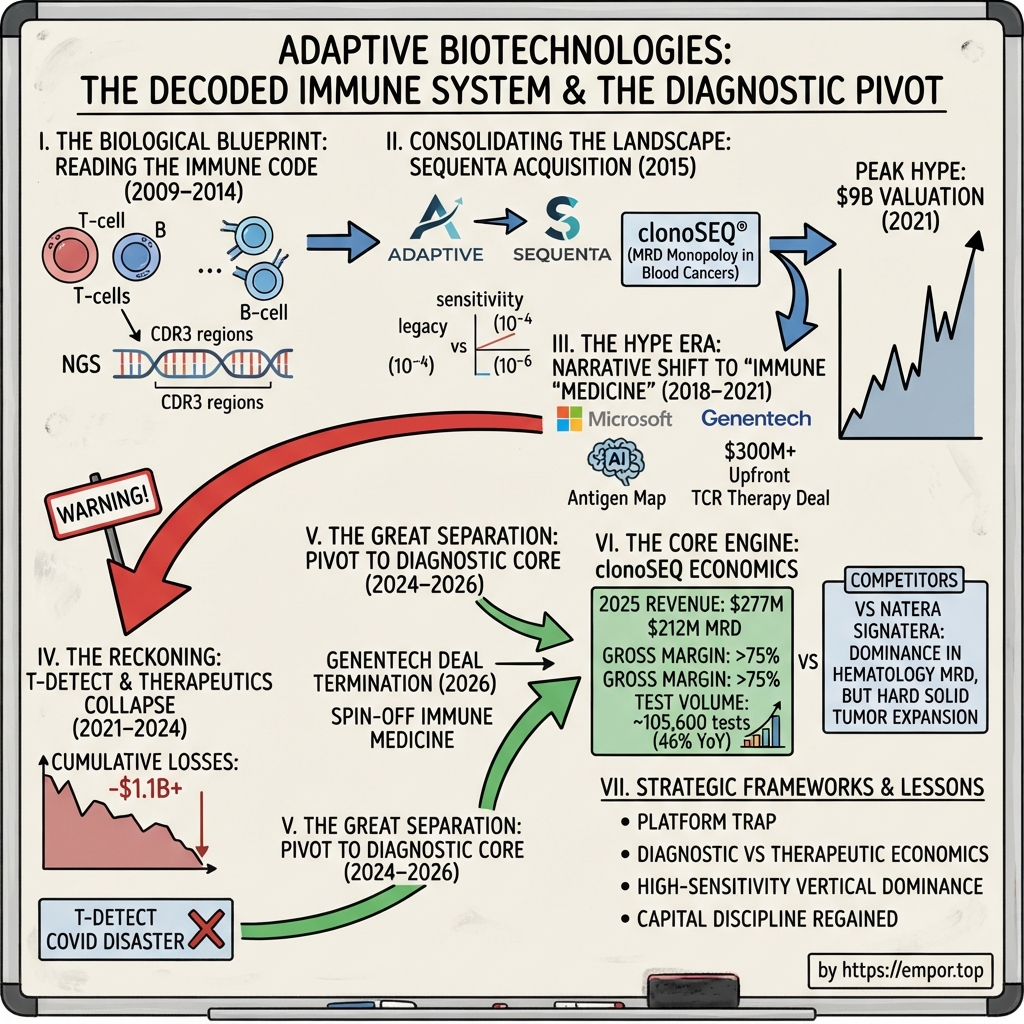
Adaptive Biotechnologies: The Decoded Immune System & The Diagnostic Pivot
I. Introduction & Episode Roadmap
There is a moment in the life of certain companies when the story they tell about themselves stops matching the story their income statement tells. For Adaptive Biotechnologies, that moment arrived slowly, then all at once—and the reconciliation took seven years, more than a billion dollars, and the quiet dismantling of nearly everything the company was originally known for.
The underlying premise was ambitious. Every human being carries an immune system that has already met and cataloged the diseases that person has encountered. T cells and B cells record what they have seen in the physical structure of their receptors. If those receptors could be read at scale—much like reading code—they could yield a diagnostic record of past infections and a therapeutic library of immune defenses. Harlan Robins, a computational biologist at Seattle's Fred Hutchinson Cancer Research Center, developed a methodology to sequence them. In September 2009, he and his older brother Chad—who brought a background in medical technology, investing, and real estate—co-founded Adaptive to commercialize the research.1
Seventeen years later, financial disclosures present a clear picture of what that vision cost and delivered. As of December 31, 2025, Adaptive carried an accumulated deficit of $1.4 billion.2 Its therapeutic ambitions have been abandoned. The Microsoft collaboration yielded no commercial product. The Genentech partnership—the single largest validation event in the company's history—was terminated by Genentech in August 2025.3 Meanwhile, the universal blood test designed to screen for dozens of diseases from a single blood draw was pulled from the market.
Yet the company enters late 2026 in a stronger operating position than during its expansion phase. Full-year 2025 revenue reached $277.0 million, up 55% year over year. The minimal residual disease business—anchored by the clonoSEQ blood-cancer test—contributed $212.3 million of that total, representing a 46% increase on 105,587 delivered tests.4 That minimal residual disease unit also turned adjusted-EBITDA positive and cash-flow positive in 2025 for the first time.4 The stock, which closed its first day of trading at $40.30 following its June 2019 initial public offering, traded as low as $12.00 over the past year before closing at $25.19 on August 28, 2026—giving Adaptive a market capitalization near $4.0 billion against a 52-week high of $26.87.5
This is not a narrative of corporate failure. Instead, it offers a case study in commercial focus: a specialized technology platform spent a decade pursuing broad application areas, while management delayed narrowing its strategic focus before eventually driving an operational turnaround in the single business with proven commercial demand.
The central dilemma has persisted since 2018. On one side sits a high-margin, reimbursed diagnostic embedded in clinical guidelines with meaningful switching costs. On the other sits capital-intensive therapeutic optionality—including the Immune Medicine segment, the Genentech neoantigen deal, the Microsoft antigen map, and the T-Detect franchise—whose projected value looked compelling in presentations but repeatedly dragged down cash flow. On June 15, 2026, Adaptive announced its intention to separate the two businesses.6
This analysis unfolds in seven parts: the underlying biology and founding; the 2015 Sequenta acquisition that established clonoSEQ; the expansion era marked by Microsoft, Genentech, and the 2019 IPO; the strategic reckoning from 2021 through 2024; an examination of core diagnostic economics and market structure; the corporate separation and capital allocation reset; and the operational playbook, key analytical frameworks, and critical metrics for investors to monitor going forward. It begins with a fundamental challenge in immunology that remained intractable until high-throughput sequencing became cost-effective.
 Subscribe on LinkedIn
II. The Biological Blueprint: Decoding the Adaptive Immune System (2009–2014)
Picture a locksmith who, at birth, is handed a machine capable of manufacturing between ten billion and a quadrillion distinct keys—and who then, over a lifetime, keeps a physical copy of every key that ever successfully opened a lock. That is roughly how the adaptive immune system functions.
The underlying mechanism is V(D)J recombination. Developing T cells and B cells shuffle a modest set of inherited gene segments—variable, diversity, and joining—into an astronomically large number of unique combinations, adding and deleting random bases at the junctions. The resulting receptor sits on the cell surface and binds one specific molecular shape. The hypervariable region at the binding site, called CDR3, acts as an immunological serial number: unique to that cell and every daughter cell it produces.
Harlan Robins's insight, developed while running computational biology work at Fred Hutch, was that next-generation sequencing had gotten cheap enough and parallel enough to read millions of those serial numbers at once from a single sample.1 Immunology, which had spent decades studying individual clones with painstaking cell-by-cell methods, could become a search-and-count problem. A lab could take blood, amplify the receptor regions, sequence them, and generate a complete census of the immune repertoire: which clones are present, in what proportions, and how those proportions shift over time.
Tracking those proportional changes over time eventually generated commercial revenue, though developing the model took a decade.
Harlan Robins's background helps explain much of Adaptive's early operational trajectory. He is not a biologist by training; he holds a bachelor's degree in physics from Harvard and a master's and doctorate in physics from the University of California, Berkeley, with a visiting appointment at Caltech, followed by postdoctoral positions in particle theory at the Weizmann Institute in Israel and the Institute for Advanced Study at Princeton.1 At Princeton, he began writing bioinformatics algorithms for micro-RNA targets and bacterial genome analysis. He joined the Fred Hutchinson Computational Biology Program as an assistant faculty member in 2006, eventually directing the program from April 2016 until June 2019.1
A particle theorist views immunology as a high-dimensional counting problem rather than a messy biological system. That perspective yielded the company's founding breakthrough, but it also fostered a core strategic assumption: that if the immune system could be measured with sufficient precision, commercial applications would automatically follow. Measurement capabilities and diagnostic commercialization, however, presented very different operational demands.
The division of labor between the founders was distinct. Harlan managed the technology and intellectual property as Chief Scientific Officer and Head of Innovation. Chad Robins—a Wharton MBA and Cornell economics graduate who had held executive roles in medical technology, investing, and real estate—managed capital formation and corporate strategy, serving as chief executive and a director since incorporation.1 It was a classic technical-founder and business-operator pairing. Seventeen years later, both co-founders remain in leadership, with Chad Robins continuing on the board he joined at inception.
The company's initial commercial product was immunoSEQ, a research-use-only service. Academic immunologists submitted samples; Adaptive sequenced the repertoires and returned the datasets. The service became a widely adopted tool in academic laboratories studying T-cell dynamics in oncology, autoimmunity, and infectious disease, building a large proprietary dataset in the process.
Yet a research-use-only service model presented structural financial limitations. Research-use-only tools lack regulatory clearance and cannot be used to guide clinical decisions. Consequently, they are ineligible for insurance reimbursement. The primary customers—principal investigators funding studies through fixed grants—operate with strict budgets and slow procurement cycles, capping willingness to pay based on academic publication value rather than clinical outcomes. Meanwhile, Adaptive bore the full overhead of maintaining a specialized sequencing laboratory. The resulting economics were structurally constrained: high fixed infrastructure costs, inelastic pricing, and no recurring clinical volume.
Adaptive funded this buildout through federal research grants and successive private financing rounds, culminating in a Series E round that funded a key acquisition.7 By 2014, the company was a recognized scientific innovator, but its commercial model required transformation.
Testing the platform-moat claim
The "pioneer platform moat" framing has followed Adaptive throughout its history, but the thesis requires stress-testing against the empirical record.
The claim: early immunosequencing intellectual property and first-mover status created a defensible, compounding competitive moat.
The record: the platform did not yield a traditional commercial moat. immunoSEQ was a scientific success but a modest commercial business. Research-use-only tools sold into academic labs suffered from grant-dependent budgets, long sales cycles, and an absence of insurance reimbursement. Adaptive's total revenue reached just $55.7 million in 2018, nearly a decade after founding, while its accumulated deficit swelled to $365.5 million by the end of 2019.8 The company carried the fixed operating costs of a CLIA-grade laboratory and a substantial research organization while deriving revenue primarily from low-margin research services.
The primary constraint was not the underlying science, but the absence of diagnostic economics. What Adaptive lacked in its first five years was a regulated, reimbursed, guideline-endorsed clinical product that physicians ordered as routine practice and payers covered reliably. Establishing such a product required clinical trials, regulatory submissions, Medicare coverage determinations, and multi-year clinical evidence generation—outcomes the research-use-only model could not deliver.
Securing a clinical diagnostic foothold ultimately required acquiring the single competitor building a clinical-grade pipeline in parallel.
III. Consolidating the MRD Landscape: The Sequenta Acquisition (2015)
By 2014, two venture-backed companies were pursuing the same clinical objective from opposite coasts using similar immunosequencing technology.
In Seattle, Adaptive possessed the foundational sequencing platform, an established research franchise, and an expanding dataset. In South San Francisco, Sequenta had spent years directing the same underlying technology toward a specific clinical application: measuring minimal residual disease in blood cancers. Founded by Tom Willis and Malek Faham, Sequenta had developed a platform called LymphoSIGHT and a clinical assay named ClonoSight.7 Both companies were burning venture capital while building overlapping intellectual property portfolios, and neither could easily reach clinical scale while competing directly against the other.
On January 7, 2015, Adaptive announced its acquisition of Sequenta, funded in part by a Series E financing round with J.P. Morgan acting as financial advisor.7 Reported transaction terms valued the deal at approximately $84 million in cash and stock, plus potential clinical milestone payments.9 Sequenta's founders joined Adaptive's leadership team, and the acquisition secured an exclusive, sublicensable license to patents owned by iRepertoire covering the diagnosis, prognosis, treatment, and monitoring of proliferative disorders across the United States, Europe, Australia, and China.10
The combined entity launched clonoSEQ, an assay whose clinical utility rested on distinct biological and technical advantages.
How clonoSEQ actually works
Blood cancers—including multiple myeloma, B-cell acute lymphoblastic leukemia, chronic lymphocytic leukemia, and several lymphomas—are malignancies of the immune cells themselves. This biology provides a distinct diagnostic advantage: because a malignant clone originates from a single mutated B cell, every descendant cancer cell in the patient carries an identical receptor serial number.
The testing workflow begins at diagnosis with a bone marrow aspirate or blood sample to sequence the patient's immune repertoire. Identifying the dominant clone establishes the unique sequence of the cancer, which serves as a permanent baseline identifier stored in Adaptive's laboratory. At subsequent clinical intervals—following induction therapy, stem cell transplantation, maintenance, or routine surveillance—a new sample is sequenced to count how many exact copies of that cancer sequence remain relative to healthy immune cells.
The primary commercial argument for clonoSEQ stems from its measurement sensitivity. Conventional diagnostic methods, such as flow cytometry and quantitative polymerase chain reaction (qPCR), typically detect residual disease down to one cancer cell in 10,000 or 100,000 healthy cells. By contrast, clonoSEQ routinely detects one malignant cell in a million, with management noting an FDA-cleared validated sensitivity reaching one in 1.5 million in both blood and bone marrow from as little as two milliliters of blood.11 This order-of-magnitude increase in depth is vital in modern hematology, where advanced myeloma treatments frequently reduce disease below the detection limits of legacy tools. When legacy assays register a false negative, they cease to provide actionable clinical value.
This additional sensitivity transforms clinical decision-making. Where an assay with a sensitivity of one in 10,000 indicates only that a patient is in apparent remission—leaving physicians to decide blindly whether to maintain toxic, costly therapies—clonoSEQ reveals whether residual disease is truly absent, steadily declining, or quietly resuming growth months before symptoms appear. This shift turns a static status report into an active decision-support tool, driving recurring test orders over the course of a patient's care.
Additionally, immunosequencing benefits from a physical advantage specific to blood cancers. Because lymphoid cells contain numerous copies of the rearranged receptor region relative to total input DNA, immunosequencing generates a higher signal-to-noise ratio per sample than methods searching for sparse point mutations. However, this same characteristic also explains why the technology does not readily translate to solid tumors, where target receptor sequences are far less concentrated.
Testing the "instant powerhouse" claim
While narrative accounts often suggest that the Sequenta acquisition instantly established Adaptive as a clinical minimal residual disease powerhouse, the empirical record tells a slower, more capital-intensive story.
Adaptive acquired Sequenta for roughly $84 million in 2015 when the asset generated virtually no clinical diagnostic revenue.9 The clonoSEQ assay did not receive its initial FDA authorization—a De Novo clearance for bone marrow samples in multiple myeloma and B-cell ALL—until 2018, followed by expanded clearance for blood and bone marrow in CLL on August 5, 2020.12 Securing Medicare coverage required submitting dedicated clinical dossiers to the MolDX program's local coverage determination process.[^13] Furthermore, inclusion in National Comprehensive Cancer Network (NCCN) treatment guidelines—the benchmark for community oncology practice—required years of indication-by-indication clinical validation. By 2023, eight years after the acquisition, the MRD business generated $103 million in annual revenue, while the parent company was still losing money at a rate above $200 million a year.6
In total, converting Sequenta's clinical concept into a profitable operating unit required roughly eight years. The acquisition proved strategically essential, but it was not immediately accretive. In diagnostic commercialization, developing the technology is often the least resource-intensive step; the greater burden lies in executing the multi-year regulatory, reimbursement, and clinical guideline strategy necessary to establish a test as a standard medical expense. Adaptive ultimately executed that commercial expansion, but did so while simultaneously allocating substantial capital to far broader, unproven platform initiatives.
IV. The Hype Era: Genentech Megadeal, Microsoft Partnership, & The 2019 IPO (2018–2021)
If you had walked into an Adaptive investor presentation in 2019, you would not have heard much about blood cancer testing.
You would have heard about immune medicine: the framing that the company was not a diagnostics lab but an engine for decoding the entire adaptive immune system, and that this engine opened two enormous markets at once. On one side, early detection of dozens of diseases from a single blood draw, because the immune system sees illness before symptoms do. On the other, drug discovery — a library of every receptor the human race has ever built against every disease, from which therapeutic candidates could be mined.
It was an extraordinarily good story. It was also, for the next several years, essentially the entire equity narrative.
Microsoft, January 2018
The collaboration announced with Microsoft in January 2018 gave the story computational credibility.[^14] The technical problem was real: knowing which receptors are present in a sample tells you nothing unless you know what each receptor binds. Mapping T-cell receptors to their antigen targets at population scale is a machine-learning problem of ferocious difficulty, and Microsoft brought Azure-scale compute and research talent to it. Microsoft also took an equity position, purchasing Series F-1 preferred stock that converted at the IPO.8
The intended product was T-Detect — a single blood draw that reads immune memory and reports back what the patient has been exposed to.
Genentech, December 2018
Eleven months later came the deal that repriced the company. On December 19, 2018, Adaptive entered a strategic collaboration and license agreement with Genentech to develop, manufacture, and commercialize individualized neoantigen-directed T-cell therapies across a broad range of cancers.313 Adaptive would find and characterize the T-cell receptors capable of recognizing a given patient's tumor-specific mutations; Genentech would handle clinical development, regulatory work, and commercialization.
The terms were the kind that make headlines: a $300 million upfront payment, received in February 2019, plus eligibility for approximately $1.8 billion in aggregate development, regulatory, and commercial milestones, plus tiered royalties.13
Note what that upfront actually was, in accounting terms, because it matters later. It was cash received against future performance obligations, recognized as revenue via amortization over the life of the collaboration. For years afterward, a meaningful slice of Adaptive's reported revenue was non-cash amortization of a payment banked in 2019 — a fact that flattered the top line and that the company would eventually have to strip out of its own comparisons to make the underlying business legible.
The IPO, June 2019
Adaptive listed on the Nasdaq Global Select Market on June 27, 2019. The offering priced at $20.00 per share and closed on July 1, selling 17,250,000 shares including the full over-allotment for aggregate gross proceeds of $345.0 million.8 The stock closed its first trading day at $40.30 — a clean double.8
The pitch to investors was elegant: a high-margin diagnostic business, growing fast and heading toward profitability, funding a portfolio of therapeutic and early-detection lottery tickets any one of which could be worth more than the whole diagnostic. Cash cow plus optionality. It is one of the most seductive structures in biotech investing, and it is worth asking why, so often, it does not work.
Part of the answer is that the "cash cow" half of the pitch was aspirational in 2019. Adaptive's total revenue that year was $85.1 million, a large share of which was Genentech amortization and research services rather than reimbursed clinical testing, and the company lost $68.6 million.8 The diagnostic was not yet funding anything. What was funding the therapeutic ambitions was the IPO proceeds and the Genentech upfront — which is to say, investor capital, described as though it were operating cash flow.
The other part of the answer is what happened to the spending. With $345 million of fresh equity and $300 million of partner cash on the balance sheet, Adaptive did what well-funded platform companies do: it built for the scale it expected rather than the scale it had. Purchases of property and equipment reached $61.7 million in 2021, more than three times the prior year's $18.8 million, as the company invested in laboratory and facility infrastructure sized for a multi-product future that never arrived.14 Cash used in operating activities that year was $192.7 million against a net loss of $207.3 million.14 A company consuming nearly $200 million of cash annually is not a diagnostic business with optionality attached. It is a research organization with a diagnostic attached, and the market eventually priced it that way.
Testing the optionality claim
The claim, as management and the sell side framed it in 2019: the Microsoft and Genentech relationships validated Adaptive's ability to generate large, recurring milestone and licensing revenue from the platform.
The record over the following seven years is the cleanest possible falsification test, because we now know how it ended.
The Genentech collaboration did produce scientific progress — an investigational new drug application for a neoantigen-directed T-cell therapy was accepted by the FDA — but the milestone economics never materialized at anything like the promised scale. Individualized cell therapy turned out to require manufacturing a bespoke product for each patient, a problem that has humbled far better-capitalized organizations than Adaptive. On August 13, 2025, the agreement was terminated, effective February 9, 2026, with the parties winding down activities.3 Adaptive was released from its exclusivity obligations on cell therapies in oncology and recognized $33.7 million of remaining non-cash amortization in the second half of 2025.3 Of the roughly $1.8 billion in potential milestones announced in 2018, the durable economic contribution to Adaptive was the $300 million upfront and the amortization schedule attached to it.
The Microsoft collaboration produced real data assets — the TCR-antigen dataset that survives today inside Immune Medicine — but no commercially viable therapeutic or diagnostic product. T-Detect, its intended commercial output, is the subject of the next section, and it did not go well.
The calibrated conclusion: the claim is rejected in its strong form and survives only in a much smaller one. Adaptive demonstrated it could attract marquee partners and collect large upfront payments — that is a genuine, repeatedly demonstrated capability, and it recurred in 2025 with two Pfizer data-licensing agreements. What it did not demonstrate, across seven years and two flagship collaborations, was the ability to convert technical milestones into recurring downstream revenue. That distinction — partnership formation is a skill Adaptive has; partnership monetization is a skill it has not proven — should temper how any investor prices the Immune Medicine data business today. The event that would falsify the pessimistic reading is specific: a partnership that delivers material, recurring milestone or royalty income rather than a one-time data license fee.
The bill for the optimistic reading came due starting in 2021.
V. The Failure of T-Detect & The Therapeutics Reckoning (2021–2024)
In March 2021, Adaptive received the regulatory authorization it had spent three years pursuing, though the commercial outcome proved negligible.
The FDA issued an Emergency Use Authorization for T-Detect COVID, a first-of-its-kind clinical test that confirmed recent or prior SARS-CoV-2 infection by reading the T-cell response rather than antibodies.15 The authorization represented a genuine scientific milestone: it was the direct commercial output of the Microsoft antigen-mapping collaboration and proof that the immune-memory-as-diagnostic concept could clear a regulatory hurdle.
Yet commercially, the launch was a failure—for reasons that explain the structural limitations of every broad diagnostic test Adaptive subsequently pursued.
By March 2021, the market for COVID testing belonged to low-cost, rapid antigen products that delivered home results in minutes. In contrast, T-Detect required a blood draw, shipment to a central CLIA-certified laboratory, high-throughput sequencing, and computational processing. The assay answered a retrospective question—whether a patient had been infected at some point in the past—that few clinicians needed to resolve and no insurance provider prioritized for reimbursement. The product was scientifically novel but clinically impractical.
Adaptive disclosed the limited commercial uptake in its annual filings: over its lifespan, T-Detect COVID was ordered by more than 30,000 consumers and providers.14 In a market where diagnostic volume was measured in the hundreds of millions of tests, 30,000 orders represented a small pilot rather than a viable commercial franchise.
The commercial retreat followed quickly. Adaptive launched T-Detect Lyme in June 2022, but paused sales of both T-Detect indications before the end of the year.16 In its 2022 annual report, management acknowledged that "the cost is high to commercialize and improve signals one indication at a time through self-pay customers," noting that commercialization "required more time and higher costs than anticipated."16 Consequently, additional test launches were deferred until Adaptive could demonstrate disease signals robust enough to alter clinical practice alongside an established path to insurance reimbursement.16
The broader lesson extended beyond pandemic diagnostics. Adaptive repeatedly designed assays based on what its sequencing platform could detect rather than the specific decision-making needs of physicians and payers. By contrast, clonoSEQ succeeded because evaluating whether to adjust or terminate maintenance therapy in a blood cancer patient is a high-stakes clinical decision tied to clear economic value. Determining prior exposure to an infectious disease lacked comparable clinical necessity or financial backing.
The financial abyss
The financial results during this phase highlight the operational drag that preceded the turnaround. Adaptive posted net losses of $225.3 million in 2023 and $159.6 million in 2024, bringing its accumulated deficit since inception to $1.4 billion by the end of 2025.2 The third quarter of 2023 illustrated the imbalance: revenue reached $37.9 million against operating expenses of $88.9 million, resulting in a quarterly net loss of $50.3 million.17
During that period, operating expenses ran at more than double total revenue. This deficit did not stem from scaling the diagnostic business; rather, it reflected the burden of supporting two distinct businesses on a single balance sheet: a therapeutics and drug-discovery division alongside a commercial diagnostics organization requiring its own sales force, CLIA laboratory, and reimbursement infrastructure.
The 2022 restructuring, and what it did and did not fix
In March 2022, amid a sharp decline in market valuation, executive management initiated a restructuring program. Adaptive reduced its headcount by approximately 100 employees—about 12% of the 858 full-time workforce reported at year-end 2021—deprioritized non-core initiatives, and reorganized operations into two distinct divisions: Minimal Residual Disease (MRD) and Immune Medicine.161814 Total restructuring costs reached $2.0 million in 2022, primarily covering severance and extended employee benefits.16
While the reorganization established the operational division that later enabled the corporate separation, it failed to eliminate the primary source of cash drain. The company reduced overhead around its therapeutics division without scaling back the core research ambitions of Immune Medicine.
Following the restructuring, the Immune Medicine unit retained the Microsoft T-cell mapping initiative, the T-Detect franchise, immunoSEQ, and drug-discovery partnerships with Genentech and Nykode.16 The reorganization ring-fenced loss-making research initiatives without resolving their long-term funding strategy, leaving a disconnect between management's public focus on profitability and the company's operating expense commitments.
Wall Street analysts increasingly questioned why cash flows from clonoSEQ were being used to subsidize early-stage research. Management responded that Immune Medicine was nearing key validation milestones, pointing to the discovery of a novel target in multiple sclerosis announced in late 2023.17 However, translating an early target in autoimmune disease into commercial revenue requires years of clinical development and substantial capital investment—resources Adaptive lacked without a major pharmaceutical partner following the wind-down of its Genentech alliance.
To extend its cash runway, Adaptive secured up to $250 million in royalty financing from OrbiMed in September 2022, drawing an initial $125 million in exchange for 5% of GAAP revenues. While non-dilutive to equity holders, the debt added substantial cash obligations, generating $11.6 million in interest expense in 2024 and $11.8 million in 2025.419 By November 2023, Chief Executive Officer Chad Robins announced that Adaptive had retained Goldman Sachs to conduct "a review of strategic alternatives to maximize the value of the MRD and Immune Medicine businesses." Concurrently, management ceased providing financial guidance for Immune Medicine, restricting future forward guidance exclusively to the MRD business.17
Testing management's capital-allocation claim
The claim: management exercised disciplined capital allocation while pursuing high-upside discovery.
The record reveals a multi-year delay between identifying structural friction and executing a capital reset. The strategic review initiated in November 2023 concluded in 2024 with a decision to maintain ownership of both divisions. As Robins later stated: "When we completed our strategic review in 2024, we decided to continue developing both MRD and Immune Medicine within Adaptive while increasing their operational independence."6 Consequently, Immune Medicine consumed approximately $30 million in cash during 2025 before management formally announced intent to separate the businesses in June 2026.206 This extended the timeline between the strategic review announcement and the formal separation plan to two and a half years, during which early-stage discovery continued to draw on corporate capital.
Conversely, management demonstrated incremental expenditure discipline within the segment over time. Immune Medicine's annual cash burn was curtailed to approximately $30 million in 2025—meeting management's internal target—and was guided lower to between $15 million and $20 million for 2026.20 Furthermore, after completing a preclinical data package in 2025 for its lead TCR-depleting antibody program in ankylosing spondylitis, management halted further pipeline spending rather than financing IND-enabling studies, electing to reallocate capital toward data generation and artificial intelligence modeling.20 Halting a lead drug candidate prior to clinical trials reflects a meaningful shift toward capital discipline.
Additionally, executive execution against long-term financial guidance supports management's operational record. In late 2022, following the initial corporate restructuring, Adaptive outlined a multi-year financial roadmap: achieving positive adjusted EBITDA by the end of 2025, reaching cash-flow breakeven by year-end 2026, and compounding revenue at an annual rate of 20% to 30% through 2027.16 The company met its first major milestone, generating positive full-year 2025 adjusted EBITDA of $12.2 million.4 The cash-flow breakeven target for late 2026 remains a key metric for tracking ongoing execution.
The conclusion: The capital-allocation claim holds in qualified form. Management moved slowly in making the structural portfolio decision advocated by public markets, contributing to the accumulated operational deficit. However, its record on setting and meeting specific operational and EBITDA targets has shown consistency since 2022. The key test moving forward is whether the corporate separation executes on management's stated timeline.
Throughout this multi-year therapeutics restructuring, Adaptive's core diagnostic business continued to expand its clinical adoption.
VI. The Core Business Engine: clonoSEQ, Hematology MRD, & Industry Structure
Somewhere in a Seattle laboratory, an automated system runs a bone-marrow sample from a myeloma patient in an Ohio community oncology practice against a DNA sequence cataloged when that patient was diagnosed four years earlier. The result that returns—whether residual disease is detected, and at what depth—directly informs the oncologist's next treatment decision.
That represents the core business: routine, highly repeated, and, after fifteen years, profitable.
The segment economics
In 2025, the Minimal Residual Disease (MRD) segment generated $212.3 million in revenue, a 46% increase year over year, while delivering $15.2 million in adjusted EBITDA—reversing a $41.2 million loss from the prior year.420 Delivered volume rose 39% to reach 105,587 clonoSEQ tests.4 By contrast, the Immune Medicine segment generated $23.4 million excluding Genentech amortization and posted an adjusted EBITDA loss of $31 million.20 In effect, one unit subsidized the other: every two dollars of MRD operating profit offset roughly four dollars of Immune Medicine losses.
The expansion in gross margin illustrates the underlying unit economics. Sequencing gross margin—which excludes milestones and licensing to isolate laboratory operations—reached 66% for full-year 2025, up 13 percentage points from 53% in 2024, and reached 71% in the fourth quarter.20 By the first quarter of 2026, it expanded further to 70%, up eight percentage points year over year.21 The underlying drivers were operational: lower sample processing costs driven by labor leverage, production efficiencies, and the transition to Illumina's NovaSeq X Plus sequencing platform, which enables higher sample density per run.20
Pricing expanded alongside volume. The average selling price per test in the United States rose 17% in 2025 to $1,307, exiting the fourth quarter near $1,350 and reaching $1,360 in the first quarter of 2026.2021 This growth resulted from direct commercial renegotiation: Adaptive updated terms across eight major commercial payers—including Humana, Aetna, Horizon, and multiple Blue Cross plans—signed new agreements with Anthem, Centene, Florida Care, and LA Care, and improved revenue-cycle processing to lift commercial payer cash collections 74% year over year.20
This performance demonstrates the operating leverage inherent in a diagnostic platform when volume, pricing, and unit costs move favorably at the same time. However, gains of this magnitude are largely non-repeatable. Gross margin cannot expand 13 percentage points annually, nor can average selling prices compound at 17% indefinitely. Management's forward guidance reflects this moderation: a targeted price of roughly $1,400 per test in 2026 represents about 7% growth—half the 2025 rate—toward a longer-term selling price target of $1,700 to $1,800 by 2029 and a gross margin target of approximately 75%.20
Why it wins in hematology
Three structural dynamics support clonoSEQ's market position, only one of which relates to the assay itself.
The baseline lock. The initial identification test—sequencing a patient's diagnostic sample to identify the malignant clone—establishes a permanent baseline sequence stored in Adaptive's database. All subsequent monitoring tests must be benchmarked against this initial sequence to remain comparable. An oncologist tracking a myeloma patient over a five-to-ten-year care cycle has little incentive to reset this longitudinal record using a competing assay with a different sensitivity threshold. This creates a high switching cost rooted in clinical logic rather than contract terms.
The shift into blood. Bone-marrow aspiration is invasive and typically performed once or twice a year, whereas a standard blood draw can occur during routine clinic visits. Adaptive's regulatory clearance for blood-based testing in chronic lymphocytic leukemia (CLL), alongside expanding clinical adoption in multiple myeloma, converts clonoSEQ from a periodic procedure into a recurring monitoring tool. The volume mix has shifted rapidly: blood-based samples accounted for 47% of clonoSEQ volume in the fourth quarter of 2025 and 49% by the first quarter of 2026, with multiple myeloma—a disease traditionally monitored via bone marrow—moving from 21% to 29% blood-based over the year.2021 In the community oncology setting specifically, more than 60% of myeloma MRD testing was already being done in blood by late 2025.20 Testing frequency, rather than per-test price, serves as the primary growth driver for the business.
Workflow embedding. Distribution relies heavily on clinical system integration. Adaptive ended 2025 with 173 electronic medical record (EMR) integrated accounts representing approximately 40% of test ordering volume, and launched an integration with Flatiron Health's OncoEMR system.420 The Flatiron integration enables automated serial-testing orders within oncology workflows. By the first quarter of 2026, 72% of due repeat orders were fulfilled, up from about 60% a quarter earlier.2120 An assay integrated into default clinical workflows operates with lower customer acquisition costs than one requiring manual physician re-ordering.
These commercial results stem from workflow adoption rather than sales force expansion. Active ordering clinicians grew 43% year over year to nearly 5,000 by the first quarter of 2026, while community oncology volume—the more fragmented distribution channel—grew 67% year over year to represent 35% of total testing.21 Adaptive generated this growth while maintaining a field sales team of 65 representatives split evenly between academic and community centers, with management stating it does not anticipate significant sales-force expansion in 2026.21 Achieving 40%-plus volume growth on a flat sales headcount provides empirical evidence of a structural distribution advantage.
The nature of physician engagement has evolved accordingly. On the first-quarter 2026 earnings call, Chief Commercial Officer Susan Bobulsky noted that community conversations had shifted over the prior year from introductory discussions regarding MRD utility toward implementing standardized testing protocols across community oncology networks.21 Standardized protocol adoption transitions a diagnostic test from an individual physician preference to an institutional standard of care, embedding switching costs across larger patient populations.
The biopharma business is not a side business
The pharmaceutical services division represents a key strategic component of the MRD business. Adaptive contracts with drug developers to incorporate clonoSEQ into clinical trials, generating approximately one-third of total MRD segment revenue in the first quarter of 2026.21
This division operates through a self-reinforcing model. When pharmaceutical sponsors utilize clonoSEQ as a trial endpoint, published study results demonstrate the test's predictive value. That evidence supports updates to National Comprehensive Cancer Network (NCCN) guidelines, which drive adoption among community oncologists. Clinical adoption expands patient volume, which in turn reinforces clonoSEQ as the standard assay for subsequent drug trials.
The composition of Adaptive's trial portfolio has increasingly shifted toward higher-value contracts. Biopharma backlog stood at approximately $210 million entering 2026 and reached $254 million by the end of the first quarter—up 24% year over year across roughly 190 active studies.2021 The proportion of contracted studies utilizing clonoSEQ as a formal trial endpoint rose to about 60%, up from roughly 40% in 2024, including 23 primary endpoint studies and 88 secondary endpoint studies.2021 Biopharma bookings across CLL and ALL more than tripled in 2025.20
Endpoint-driven studies carry higher economic value and greater commercial stability than general sample-processing contracts, as trial sponsors rarely alter diagnostic endpoints during active registrational trials. Regulatory updates have reinforced this trend, including FDA advisory committee recommendations and draft guidance supporting MRD as a primary endpoint for accelerated approval in multiple myeloma.20 In the first quarter of 2026, Adaptive recognized its first U.S. primary-endpoint milestone: $9 million linked to the Phase 3 CEPHEUS myeloma trial, while instructing investors not to expect further milestone revenue in 2026.21 That last disclosure highlights that milestone revenue is lumpy and non-recurring; adjusting for milestone timing, underlying MRD revenue growth was 33% at the midpoint of full-year guidance versus 25% on a reported basis.21
Transitioning biopharma clients toward recurring revenue structures remains a gradual process. Asked on the first-quarter 2026 call whether Adaptive is converting pharma partners from milestone-based contracts toward straightforward fee-for-service, Bobulsky was candid that because most contracts are multi-year, renegotiations occur as agreements expire: "it's going to take some amount of time, a number of years."21 Consequently, improvements in biopharma revenue quality will materialize over an extended horizon.
The competitive structure — and an important reframing
Adaptive's market position is frequently described broadly within minimal residual disease, though industry data indicates its reach is specific to hematologic malignancies.
Natera represents the largest operating benchmark in clinical MRD testing. In 2025, Natera's Signatera test—a tumor-informed circulating-tumor-DNA assay for solid tumors—processed approximately 769,700 clinical tests, generating total company revenue of roughly $2.3 billion.22 By comparison, Adaptive processed 105,587 clinical tests. Natera operates primarily in solid tumors—such as colorectal, breast, and lung cancers—where patient populations dwarf hematologic malignancies.
This operational boundary is biological rather than commercial. clonoSEQ functions by tracking rearranged immune cell receptors, an approach that applies specifically to blood-borne cancers derived from immune cells. Solid tumors lack these uniform immune receptors, requiring tests that detect somatic mutations shed as cell-free DNA—a distinct technology platform backed by a different evidence base and established distribution channels.
Guardant Health operates in adjacent liquid-biopsy territory in solid tumors, while companies like Personalis compete at a smaller commercial scale.
Within hematology, competitive dynamics center on alternative testing methodologies and emerging indications. During the fourth-quarter 2025 earnings call, analysts pressed management on two specific threats. Quest Diagnostics introduced a next-generation flow cytometry product positioned against NGS for myeloma MRD at a likely price advantage; Bobulsky argued that Quest's claimed sensitivity of five cells per million using ten milliliters of blood is five to seven times less sensitive than clonoSEQ in blood, noting that myeloma disease burden in blood averages roughly a hundredfold lower than in bone marrow—making high sensitivity most valuable precisely where the market is heading.20 Separately, analysts flagged "increased noise" and new entrants in diffuse large B-cell lymphoma (DLBCL), an indication where Adaptive's market penetration is approximately 3% of the addressable patient opportunity.20
Regarding competition in DLBCL, Bobulsky stated that increased competitive noise "has potential to really help expand the market," framing Adaptive's defense around data generation, guideline advancement, payer coverage, and reimbursement infrastructure rather than assay superiority alone.20 This positions Adaptive's defense around operational execution and market access rather than raw technical specifications alone.
The moat, honestly assessed
Adaptive reported owning or controlling 416 active issued patents and 64 pending applications in its 2025 annual report, covering sequencing methods and receptor-based diagnostics.2 Its commercial footprint covers more than 300 million lives across U.S. health plans, with over 175 EMR-integrated health systems and more than 180 active biopharma trial partnerships.6
However, the defensible moat is narrower than marketing narratives suggest. Defensibility relies on the combined accumulation of regulatory clearances, payer contracts, NCCN guideline endorsements, EMR workflow integrations, and stored baseline patient samples built over eight years. Sequencing chemistry itself remains licensable, and patient testing relies on individual baseline comparisons rather than shared database network effects.
This distinction emphasizes that Adaptive's long-term commercial value resides in its specialized diagnostic distribution engine—a strategic focus reflected in the corporate separation planned for 2026.
VII. The Strategic Split & Capital Allocation Turnaround (2024–2026)
The strategic review that Chief Executive Officer Chad Robins announced in November 2023 concluded the following year with a decision that disappointed sell-side analysts seeking an immediate breakup: retain both divisions.617
Management's stated logic was that both businesses were advancing and that increasing their operational independence—formally establishing Minimal Residual Disease (MRD) and Immune Medicine as separate reporting segments in 2024—would allow each to be evaluated on its own merits.6 While this segment structure eventually produced the disclosures that rendered a separation clear and enabled Immune Medicine to secure two Pfizer agreements in 2025, it also meant that corporate cash drain continued for two more years.
Then, over an eleven-month span, three sequential developments reshaped the company's trajectory.
August 2025: Genentech walked. Roche's Genentech terminated the 2018 collaboration amid a broader retrenchment in its own cell therapy pipeline. For Adaptive, the decision severed its last operational tether to internal therapeutic clinical development while mechanically accelerating all remaining deferred revenue recognition into the third quarter of 2025.3 Stripping out that non-cash legacy reveals the underlying operational trajectory: from the fourth quarter onward, Adaptive presented results excluding Genentech amortization, recasting reported 2025 total revenue growth from 55% down to a cleaner 42% on an ex-Genentech basis.4
June 2026: The separation. On June 15, Adaptive announced its intention to pursue a separation of MRD and Immune Medicine, evaluating strategic and structural alternatives for Immune Medicine with the goal of selecting a preferred path by year-end 2026.6 Robins framed the move as allowing Adaptive to focus exclusively on expanding its leadership in MRD diagnostics while pursuing an optimal structure for Immune Medicine outside the company. However, management explicitly cautioned that a transaction was not guaranteed and that no further disclosures would occur until warranted.6 Investors should view this statement clearly: this is an announced intention with a self-imposed deadline, not a completed transaction.
On the same day, Adaptive announced a convertible notes offering whose structure underscored management's capital allocation priorities. The company issued $345 million in zero-coupon convertible senior notes due in 2031, upsizing the offering from an initial $250 million plan.2324 Proceeds were allocated to extinguish the OrbiMed royalty obligation, fund capped-call transactions to limit equity dilution, repurchase up to $25 million in common stock, and support general corporate purposes and MRD initiatives.2324
Replacing a revenue-linked royalty—which cost roughly $12 million annually and scaled alongside top-line growth—with zero-coupon debt carrying a conversion price around $24.11 per share and a capped call struck at $34.44 represented an advantageous trade for a company anticipating continued revenue growth.24 The refinancing carried an immediate accounting cost: extinguishing the debt triggered a $23.7 million non-cash loss, widening the second-quarter 2026 headline GAAP net loss to $39.9 million, compared to $16.2 million excluding the item.24 Investors reviewing headline GAAP results for that period must adjust for this non-cash extinguishment.
July 2026: The leadership signal. Alongside second-quarter financial results, Adaptive disclosed that co-founder Harlan Robins was transitioning from Chief Scientific Officer to a strategic consulting role focused on key MRD research initiatives and the Immune Medicine separation.24 The transition of the co-founder whose scientific breakthroughs defined Adaptive away from executive management represents a clear signal of the company's shift toward commercial execution.
What is actually being separated
The Immune Medicine unit slated for separation in 2026 bears little resemblance to the broad therapeutic engine envisioned in 2019.
With internal drug development abandoned, the remaining business functions primarily as a data and discovery library. By the first quarter of 2026, the asset encompassed more than six million functional T-cell receptor (TCR)-antigen pairs spanning roughly 50,000 antigens and over 50 HLA types, derived from well-characterized datasets covering more than 10,000 patients.216 Commercialization has shifted entirely to data licensing. In 2025, Adaptive signed two non-exclusive agreements with Pfizer: one licensing a subset of TCR-antigen training data for Pfizer to train proprietary artificial intelligence models, and another utilizing Adaptive's platform to identify autoreactive T-cell receptors enriched in rheumatoid arthritis patients.420 The rheumatoid arthritis project launched in the first quarter of 2026, processing over 1,000 patient samples to prepare a data package targeted for the second half of the year.21 Management also reported that its computational model surpassed public benchmarks for predicting TCR-antigen binding published in machine-learning literature.21
The central question for investors is whether Immune Medicine represents a standalone operating business or a collection of intellectual assets. Financial evidence points toward the latter. Immune Medicine revenue totaled $23.4 million in 2025 excluding Genentech amortization, then declined 26% year over year in the first quarter of 2026 and 40% in the second quarter on a reported basis, fluctuations management attributed to the timing of sample receipts and processing.42124 On the fourth-quarter earnings call, Chad Robins noted that the Pfizer deals demonstrated an ability to repeat similar data licenses—a description that characterizes episodic transaction fees rather than a recurring revenue model.20 Management's separation announcement effectively validated this assessment, noting that the value of these assets "may be best realized outside of a diagnostic commercial model."6
Given Adaptive's history of establishing high-profile partnerships without converting them into recurring downstream revenue, Immune Medicine is best analyzed as a financial call option with an unknown strike price rather than a reliable secondary growth driver. The division's ultimate economic contribution will depend entirely on the final terms of any separation transaction.
The financial transformation
Underneath these structural changes, core operating performance improved significantly. Full-year 2025 adjusted EBITDA reached positive $12.2 million, reversing an $80.4 million loss in 2024, while annual cash burn decreased by 68%. This left Adaptive with $227 million in cash, cash equivalents, and marketable securities at year-end, excluding $13.1 million held by Digital Biotechnologies, a majority-retained sequencing-hardware venture Adaptive spun out.420 Following the convertible notes offering, cash stood at $371.7 million as of June 30, 2026.24
Management raised full-year 2026 financial guidance twice through the first half of the year. The initial MRD revenue target of $255 million to $265 million was increased to $260 million to $270 million after the first quarter, and raised again to $268 million to $278 million following the second quarter, representing projected annual growth of 26% to 31%.42124 Concurrently, operating expense guidance was tightened to between $350 million and $355 million.24 Executive leadership reiterated its target of achieving positive adjusted EBITDA and positive free cash flow for the consolidated company by the end of 2026.21
Prepared remarks versus Q&A
The shift in executive communication between late 2023 and 2026 reflects the company's operational repositioning. In November 2023, Robins opened earnings presentations by highlighting "we have two compelling businesses" before announcing a strategic review.17 By the first quarter of 2026, executive remarks focused almost exclusively on unit-level commercial metrics: sequential test volumes, active ordering clinicians, EMR integration counts, sample mix between blood and bone marrow, average selling prices, sequencing gross margins, and segment-level adjusted EBITDA.21 Broad scientific platform commentary was largely replaced by commercial and operational tracking.
Question-and-answer sessions during earnings calls highlight ongoing operational and regulatory risks. When questioned regarding average selling price durability under the CMS "CRUSH" initiative and potential exposure to Protecting Access to Medicare Act (PAMA) rate cuts, Robins detailed why clonoSEQ's episode-based MolDX billing structure sits outside the Clinical Laboratory Fee Schedule (CLFS), noting that while the Proprietary Laboratory Analyses (PLA) code for mantle cell recurrence monitoring is listed on the CLFS, it falls well under the 50% revenue threshold required for reporting.21 Regarding the potential expansion of Medicare coverage beyond four tests per patient, Robins declined to forecast, noting that "it's really hard to predict timing of kind of government contractors and agencies."21 Additionally, Chief Financial Officer Kyle Piskel conceded that "there's certainly some level of execution risk" while implementing two major commercial payer contracts covering 17% to 18% of test volume.20
This level of detail provides transparency compared to prior reporting periods when financial guidance omitted the Immune Medicine segment entirely. Nonetheless, improved disclosure and operating execution do not diminish the strategic importance of successfully closing the corporate separation.
VIII. Playbook: Business & Investing Lessons
Every long-running company story eventually distills into a handful of transferable lessons. Adaptive's are unusually clean, because the natural experiment ran for so long and the counterfactual—what the minimal residual disease business alone would have looked like—is now directly observable.
1. The platform trap. A technology platform capable of addressing many markets is, in practice, frequently a company that addresses none of them profitably. Adaptive's immunosequencing capability genuinely could be pointed at clinical diagnostics, early disease detection, autoimmune target discovery, and cell therapy. That optionality was real, but it also proved to be the mechanism by which more than a billion dollars of accumulated deficit was assembled.2 The trap is not that the adjacent opportunities were fake—the Pfizer data agreements and the T-cell receptor antigen dataset demonstrate they were not. The trap is that platform breadth defers the moment of commercial focus indefinitely, because there is always another application that justifies another year of funding. Focus arrived at Adaptive when the option to defer was removed: Genentech walked, and the board decided to separate the businesses.
2. Diagnostic economics and therapeutic economics are not the same business. This is the most practical lesson in the story. A diagnostics company wins through commercial execution: payer contracts, reimbursement operations, sales force productivity, electronic medical record plumbing, and unit-cost reduction in the laboratory. Success looks like the 74% improvement in commercial payer cash collections that lifted average selling prices in 2025—grinding, operational, and compounding.20 A therapeutics company wins through clinical trial execution and requires a balance sheet that can absorb a decade of negative cash flow alongside a high probability of program failure. The skills do not overlap, the capital profiles are actively hostile to each other, and executive attention spent on one is attention withheld from the other. Adaptive ran both inside a mid-cap balance sheet for six years, and it is difficult to identify any operational synergy that combination produced.
3. Vertical dominance beats horizontal presence. A commanding position in hematologic minimal residual disease—a market measured in low hundreds of millions of dollars—has proven more valuable to Adaptive's shareholders than a speculative sliver of multi-billion-dollar solid-tumor and cell-therapy opportunities. In a narrow vertical, Adaptive owns the mechanisms that compound: guideline inclusion, payer contracts, stored baseline clones, electronic medical record integration, and biopharma trial embedding. In broad markets, it owned none of them. The constraint remains the one identified in the bear case: a dominant position in a bounded market faces a ceiling, and Adaptive's ceiling is bounded by the incidence of blood cancers.
4. Credibility is restored by cutting, not by explaining. Adaptive's management spent 2022 and 2023 defending the dual-business structure against sustained analyst pressure, and the stock price reflected that friction. What changed the market narrative was not better articulation. It was halting the lead ankylosing spondylitis program, reducing Immune Medicine cash burn from roughly $30 million to a guided $15 million to $20 million, retiring the royalty obligation, and announcing the business separation.20236 The market re-rated the company on concrete operational decisions rather than strategic framing. For investors, the lesson is clear: when a management team counters a challenged thesis with a refined explanation rather than structural action, the explanation itself is a warning signal.
IX. Strategic Frameworks: Helmer's 7 Powers & Porter's 5 Forces
Analytical frameworks add value only when applied with sufficient rigor to score a business critically where warranted. Evaluated as a standalone minimal residual disease franchise following its planned separation, Adaptive presents a distinct strategic profile across both models.
Hamilton Helmer's 7 Powers
Switching Costs — strong, and well-grounded. The baseline malignant sequence identified at diagnosis remains stored in Adaptive's database, anchoring every subsequent measurement over a patient's multi-year treatment course. Switching diagnostic providers mid-treatment requires clinicians to forfeit longitudinal tracking across uniform sensitivity thresholds, creating high operational and clinical switching costs.
Scale Economies — moderate to strong, and demonstrably operating. The 13-percentage-point expansion in sequencing gross margin in 2025 reflected increased sample volume processed on Illumina's NovaSeq X Plus platform alongside labor leverage over fixed laboratory overhead.20 While operating leverage is evident, its potential is bounded: management's long-term guidance caps sequencing gross margins at roughly 75%, establishing a clear ceiling on future margin expansion.20
Process Power — strong, but narrowing. Multiplex PCR chemistry and error-correction algorithms optimized for hypervariable receptor regions reflect years of proprietary laboratory refinement, maintaining a measurable sensitivity advantage over legacy flow cytometry.20 However, competitors are targeting the price-performance trade-off rather than raw sensitivity depth. Quest Diagnostics' entry into next-generation flow cytometry represents a bet that lower-cost, moderately sensitive assays can capture price-sensitive market segments.
Counter-Positioning — weak. While academic flow cytometry laboratories initially resisted next-generation sequencing assays, legacy providers possessed no structurally protected business model to defend. Inclusion in clinical guidelines and insurance coverage determinations largely neutralized institutional resistance, making counter-positioning irrelevant to the franchise's growth.
Network Effects — weak. The immunoSEQ repository and Immune Medicine dataset display data-scale attributes, encompassing over six million functional T-cell receptor-antigen pairs across more than 10,000 patients.6 However, these assets reside within the segment slated for corporate separation. Clinical MRD testing evaluates individual patient samples against their own baseline sequences rather than a shared database, meaning the core diagnostic business operates without data-driven network effects.
Cornered Resource — moderate. A patent portfolio spanning 416 issued patents, exclusive licenses covering V(D)J immunosequencing intellectual property, and formal FDA clearances form meaningful entry barriers.210 Nevertheless, these protections do not confer exclusive control over essential, non-replicable inputs.
Brand — moderate and functional. The clonoSEQ brand commands strong recognition among hematologist-oncologists. Yet clinical adoption is driven primarily by National Comprehensive Cancer Network guidelines, Medicare coverage determinations, and electronic medical record workflow integrations rather than commercial brand affinity.
Porter's Five Forces
Threat of new entrants — low. The primary obstacle to entry is not sequencing capability, but the multi-year timeline required to secure clinical validation, FDA clearance, Medicare MolDX coverage, guideline endorsements, commercial payer contracts, and electronic medical record integrations.[^13] Converting a technical assay into an established, reimbursed diagnostic demands substantial capital and regulatory persistence.
Bargaining power of buyers — high and structural. Commercial health plans and the Centers for Medicare & Medicaid Services represent the true economic buyers, operating with institutional mandates to control medical expenditure. Reimbursement rates are set through negotiations with concentrated buyers, with just two commercial contracts accounting for 17% to 18% of test volume.20 Consequently, pricing gains achieved through individual payer renegotiations remain subject to ongoing renewal risk.
Bargaining power of suppliers — high and concentrated. Disclosures in the 2025 annual report highlight single-source reliance on Illumina's NextSeq and NovaSeq X Plus sequencing platforms and proprietary reagents, noting that switching suppliers would require qualifying alternative hardware, validating new reagents, and potentially revalidating clinical assays.2 This operational dependency exposes the primary laboratory cost structure to single-vendor pricing power, even as platform consolidation enabled recent gross margin gains.
Threat of substitutes — moderate to high in blood cancers, prohibitive elsewhere. Lower-cost next-generation flow cytometry, digital PCR, and single-cell sequencing technologies present ongoing substitution risks within hematology. In solid tumors, substitution is a settled outcome: circulating tumor DNA platforms maintain dominant market share.
Competitive rivalry — moderate within hematology, prohibitive across broad oncology. Adaptive leads the market in blood-cancer minimal residual disease testing, but occupies a specialized niche within the broader oncology landscape, a contrast underscored by comparing its clinical volumes against solid-tumor leaders like Natera.22
Evaluating these frameworks yields a clear composite profile: a diagnostic provider anchored by strong customer switching costs and operating scale economies, yet constrained by capped gross margin targets alongside concentrated buyer and supplier power. Following its corporate separation, Adaptive emerges as a profitable business within a defined hematology niche rather than an expansive diagnostic platform.
X. Analysis, Bear vs. Bull Case, & Forward KPIs
Adaptive enters the second half of 2026 as a fundamentally different proposition than it was two years ago: a diagnostics company with a growing, profitable core, a repaired balance sheet, an intended separation of its loss-making segment, and a valuation that has recovered sharply from its lows. The core analytical question is what the empirical evidence supports from here.
The bull case
The core is compounding faster than expected. Management raised full-year 2026 financial guidance twice through the first half of the year, driven by broad-based adoption across clinical indications.2124 Second-quarter clonoSEQ volume reached 36,111 tests, representing a 43% year-over-year increase.24 Crucially, Adaptive is generating this volume expansion without a corresponding expansion of its field sales force, driving low incremental costs for each additional test.21
Market penetration remains in its early stages. As of late 2025, the clonoSEQ clinical volume mix comprised roughly 44% multiple myeloma, 30% acute lymphoblastic leukemia (ALL), 9% chronic lymphocytic leukemia (CLL), 9% diffuse large B-cell lymphoma (DLBCL), and 5% mantle cell lymphoma.20 Management estimated that DLBCL penetration represents approximately 3% of the addressable patient opportunity.20 Even within the bounded market for hematologic malignancies, significant runway for adoption remains.
Testing frequency drives recurring revenue. The structural transition toward blood-based testing and automated serial ordering via electronic medical record (EMR) integrations converts episodic diagnostic demand into predictable revenue streams. With 72% of due repeat orders fulfilled through integrated clinical workflows, test ordering increasingly resembles a recurring subscription model aligned with a patient's multi-year care protocol.21
The biopharma segment creates a self-reinforcing flywheel. Biopharma backlog expanded 24% year over year to reach approximately $254 million by the first quarter of 2026 across roughly 190 active clinical studies, with 111 using minimal residual disease (MRD) as a primary or secondary endpoint.21 Approximately 60% of contracted studies now incorporate MRD endpoints, up from roughly 40% in 2024, and Adaptive recognized its first U.S. primary-endpoint milestone in the first quarter of 2026 tied to the Phase 3 CEPHEUS myeloma trial.2021 Draft guidance from the Food and Drug Administration supporting MRD as an accelerated approval endpoint reinforces this dynamic: clinical trials utilizing clonoSEQ generate the evidence base that accelerates downstream adoption by community oncologists.
Post-separation financials provide operational clarity. Removing an annual cash drain of $15 million to $20 million from a company generating positive segment EBITDA leaves a pure-play commercial diagnostic business with clear financial visibility.
The bear case
The addressable market is biologically constrained. Hematologic malignancies account for a minor share of total cancer incidence, and clonoSEQ's receptor-sequencing mechanism cannot be applied to solid tumors. By comparison, Natera processed approximately 769,700 clinical MRD tests in 2025 using circulating tumor DNA in solid tumors, whereas Adaptive processed 105,587 tests.224 This differential reflects a permanent biological boundary rather than a commercial gap, nullifying valuation models that assume expansion into broader solid-tumor markets.
Reimbursement structures carry external policy risk. Average selling price gains accounted for a substantial portion of revenue growth in 2025.20 However, reimbursement terms remain vulnerable to regulatory shifts: the MolDX program could adjust coverage criteria, commercial health plans could restrict serial testing frequency, or the episode-based billing structure that exempts clonoSEQ from Protecting Access to Medicare Act (PAMA) reporting could be reclassified.[^13]21 While executive management presented a detailed regulatory defense, ultimate policy authority rests entirely with the Centers for Medicare & Medicaid Services.
Supplier concentration presents operational vulnerability. Illumina serves as a single-source supplier for essential sequencing platforms and proprietary reagents, representing a disclosed operational risk where switching suppliers would require costly assay revalidation.2
Corporate separation involves unresolved execution risks. Management's June 2026 announcement explicitly noted no guarantee that a transaction will materialize.6 A failure to find an acceptable structure by year-end 2026 could force Adaptive to continue funding Immune Medicine or incur restructuring costs to unwind it. The precedent established by the November 2023 strategic review—which concluded in 2024 with a decision to maintain ownership of both divisions—underscores this execution risk.176
Capital allocation decisions warrant scrutiny. Activist investors could challenge three key management choices: the two-and-a-half-year delay between announcing the strategic review and initiating the separation; the decision to retain a near-50% equity stake in Digital Biotechnologies, a hardware venture that introduces secondary operational focus; and the allocation of $345 million toward convertible notes, capped calls, and share repurchases relative to direct reinvestment in the high-growth diagnostic core.42324
The three KPIs that matter
1. clonoSEQ clinical test volume growth. Test volume serves as the cleanest indicator of whether clonoSEQ is penetrating broader community oncology networks rather than saturating academic medical centers. Following a strong start to the year, management guided to full-year 2026 volume growth of at least 35%.21 Volume performance cannot be inflated through accounting adjustments or price increases, making any sustained volume deceleration an immediate risk to the core thesis.
2. Sequencing gross margin. By excluding biopharma milestones and licensing fees, sequencing gross margin isolates core laboratory operating leverage, reflecting processing efficiencies on Illumina's NovaSeq X Plus platform and average selling price realization. Executive leadership targeted a sequencing gross margin above 70% for 2026 toward a long-term target of 75%.2021 Quarterly performance against this target demonstrates whether gross margin expansion represents sustainable operating leverage or a temporary gain.
3. Company-wide free cash flow and adjusted EBITDA post-separation. Executive management committed to achieving positive adjusted EBITDA and positive free cash flow for the consolidated company by the end of 2026.21 While Minimal Residual Disease segment profitability is established, consolidated cash generation without the Immune Medicine unit remains to be proven. Demonstrating positive consolidated cash flow is the essential benchmark for confirming a durable operational turnaround.
XI. Outro & Episode Wrap-Up
The arc is unusual in that both halves of the story are true simultaneously.
Adaptive Biotechnologies delivered a genuine scientific breakthrough. Reading the adaptive immune repertoire at scale was not a marketing narrative; it yielded an FDA-cleared diagnostic with a major sensitivity advantage over legacy tools, an emergency-authorized T-cell assay during the pandemic, a proprietary dataset that leading pharmaceutical companies paid to license, and a scientific foundation that reshaped how minimal residual disease is tracked in blood cancers.
Yet the company accumulated $1.4 billion in net losses along the way, allocating most of that capital to applications that never reached commercial scale.2 Genentech terminated the therapeutic partnership that once anchored the equity narrative, while management pulled the early-detection franchise from the market. In substance, the operating business remaining after the planned separation is the minimal residual disease company Adaptive acquired in 2015—finally brought to commercial scale.
What makes this case study instructive rather than merely cautionary is that operational discipline arrived while the company still had room to maneuver. The minimal residual disease unit is profitable at the segment level, expanding gross margins, delivering test volume growth above 40%, and moving toward a standalone structure free of secondary subsidies.2420 Refinancing has left the balance sheet with $371.7 million in cash and zero-coupon debt rather than an ongoing revenue royalty.24 The remaining challenges—executing the business separation on schedule, preserving reimbursement terms, and expanding within a bounded hematology market—represent standard commercial execution questions rather than threats to solvency. That marks substantial progress from the company's position in 2023.
Science discovers what is possible. Capital allocation determines what survives.
References
-
Form DEF 14A Definitive Proxy Statement (director and executive officer biographies) — Adaptive Biotechnologies Corp, 2026-04-24 ↩↩↩↩↩
-
Form 10-K Annual Report for Year Ended December 31, 2025 — Adaptive Biotechnologies Corp, 2026-02-26 ↩↩↩↩↩↩↩↩
-
Form 8-K, Item 1.02 Termination of Material Definitive Agreement (Genentech) — Adaptive Biotechnologies Corp, 2025-08-18 ↩↩↩↩↩
-
Adaptive Biotechnologies Reports Fourth Quarter and Full Year 2025 Financial Results (Form 8-K, Exhibit 99.1) — Adaptive Biotechnologies Corp, 2026-02-05 ↩↩↩↩↩↩↩↩↩↩↩↩↩↩
-
Adaptive Biotechnologies (ADPT) Stock Price and Key Metrics — StockAnalysis.com, 2026-08-28 ↩
-
Adaptive Biotechnologies Announces Plan to Separate Its MRD and Immune Medicine Businesses (Form 8-K, Exhibit 99.2) — Adaptive Biotechnologies Corp, 2026-06-15 ↩↩↩↩↩↩↩↩↩↩↩↩↩↩↩
-
Adaptive Biotechnologies Announces Acquisition of Sequenta, Inc. — PR Newswire, 2015-01-07 ↩↩↩
-
Form 10-K Annual Report for Year Ended December 31, 2019 — Adaptive Biotechnologies Corp, 2020-02-26 ↩↩↩↩↩
-
Adaptive Biotechnologies Acquires Sequenta in $84M Deal to Boost Cancer Monitoring — Fierce Biotech, 2015-01-08 ↩↩
-
Form S-1 Registration Statement (IPO Prospectus) — Adaptive Biotechnologies Corp, 2019-05-20 ↩↩
-
clonoSEQ Official Clinical & Provider Portal — Adaptive Biotechnologies Corporation ↩
-
Adaptive Biotechnologies Receives Expanded FDA Clearance for the clonoSEQ Assay in Chronic Lymphocytic Leukemia — Adaptive Biotechnologies Investor Relations, 2020-08-05 ↩
-
Genentech and Adaptive Biotechnologies Announce Strategic Collaboration to Develop Individualized Neoantigen Directed T-Cell Therapies — Genentech, 2018-12-19 ↩↩
-
Form 10-K Annual Report for Year Ended December 31, 2021 — Adaptive Biotechnologies Corp, 2022-02-15 ↩↩↩↩
-
Coronavirus (COVID-19) Update: FDA Authorizes Adaptive Biotechnologies T-Detect COVID Test — U.S. Food and Drug Administration, 2021-03-05 ↩
-
Form 10-K Annual Report for Year Ended December 31, 2022 — Adaptive Biotechnologies Corp, 2023-02-14 ↩↩↩↩↩↩↩
-
Adaptive Biotechnologies Reports Third Quarter 2023 Financial Results and Provides Business Update (Form 8-K, Exhibit 99.1) — Adaptive Biotechnologies Corp, 2023-11-09 ↩↩↩↩↩↩
-
Adaptive Biotechnologies Announces Restructuring to Align Costs with Core Growth Drivers — Business Wire, 2022-03-09 ↩
-
Adaptive Biotechnologies Reports Third Quarter 2022 Financial Results (Form 8-K, Exhibit 99.1) — Adaptive Biotechnologies Corp, 2022-11-03 ↩
-
Adaptive Biotech (ADPT) Q4 2025 Earnings Call Transcript — The Motley Fool, 2026-02-05 ↩↩↩↩↩↩↩↩↩↩↩↩↩↩↩↩↩↩↩↩↩↩↩↩↩↩↩↩↩↩↩↩↩↩↩↩↩
-
Adaptive (ADPT) Q1 2026 Earnings Call Transcript — The Motley Fool, 2026-05-06 ↩↩↩↩↩↩↩↩↩↩↩↩↩↩↩↩↩↩↩↩↩↩↩↩↩↩↩↩↩↩↩
-
Natera Announces Strong Preliminary Fourth Quarter and 2025 Financial Results Driven by Record Signatera Growth (Form 8-K, Exhibit 99.1) — Natera, Inc., 2026-01-11 ↩↩↩
-
Adaptive Biotechnologies Corporation Announces Proposed Convertible Senior Notes Offering (Form 8-K, Exhibit 99.1) — Adaptive Biotechnologies Corp, 2026-06-15 ↩↩↩↩
-
Adaptive Biotechnologies Reports Second Quarter 2026 Financial Results (Form 8-K, Exhibit 99.1) — Adaptive Biotechnologies Corp, 2026-07-29 ↩↩↩↩↩↩↩↩↩↩↩↩↩↩
 LinkedIn
 WhatsApp
 Reddit
 Hacker News
 Email
Email Kindle
 RSS Feed
 Spotify
 Apple Podcasts
 Amazon Music
 Audible
 YouTube