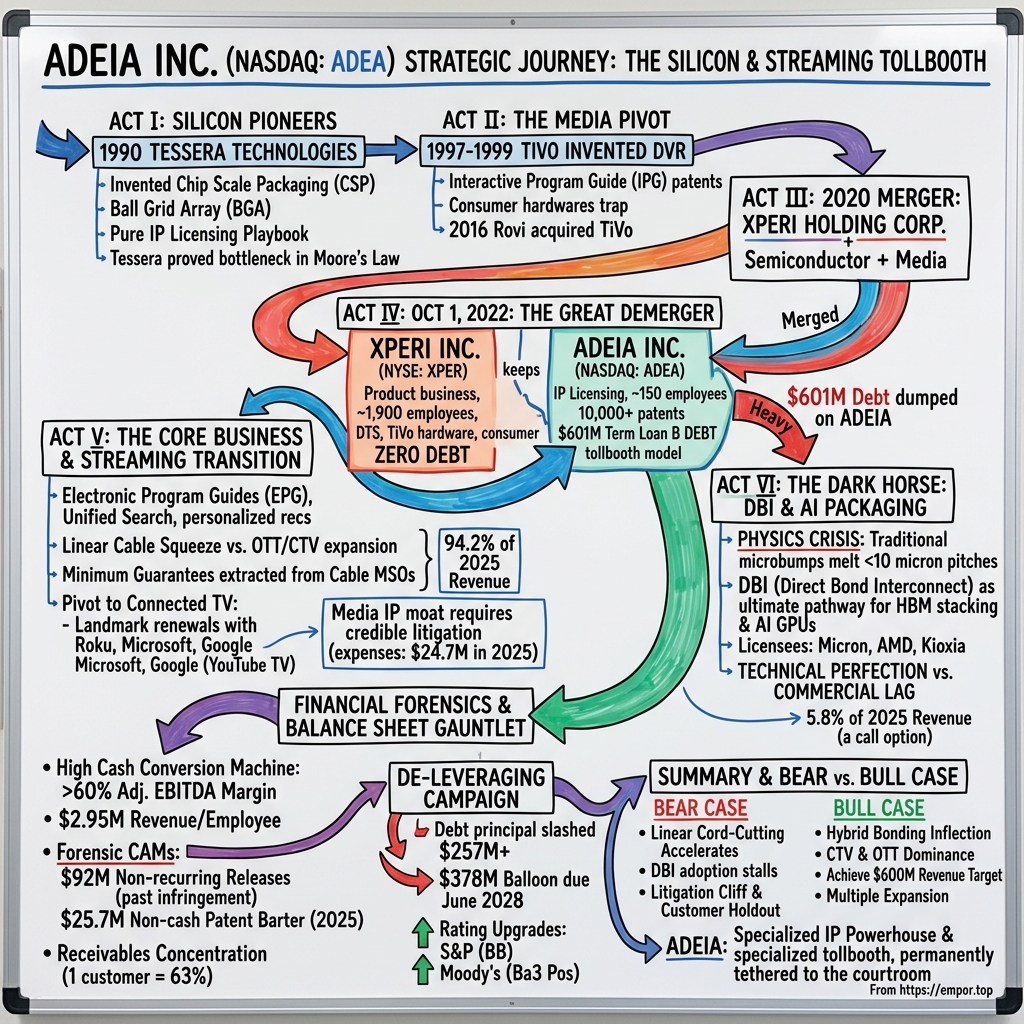
Adeia Inc. (NASDAQ: ADEA): The Silicon and Streaming Tollbooth
I. Prologue & Episode Roadmap (0:00 – 0:15)
On October 1, 2022, a company that most consumers had never heard of split itself in two. Xperi Holding Corporation took everything you could hold in your hand, box up, or ship to a retailer: DTS audio in car dashboards, the TiVo operating system for smart TVs, the consumer brands and the engineers who built them. It packed all of it into a new company, Xperi Inc., and listed it on the New York Stock Exchange.[^1] What stayed behind in the old legal shell got a new name, Adeia Inc., and kept its Nasdaq ticker.[^1]
Adeia kept almost nothing physical. It had about 150 employees, no factories, no inventory and no retail shelf space.[^1] What it did have was a library of patents covering how television guides, search, recommendations and recording work, along with a family of semiconductor packaging inventions. It also kept the debt: a senior secured Term Loan B that had been written in 2020 for the merged company, which now had to be repaid entirely from licensing fees.[^1]
The odd thing about Adeia is the arithmetic. In 2025 it reported about $443 million of revenue with roughly 150 people, close to $3 million of revenue per employee.[^1] It turned $111 million of GAAP net income into about $153 million of operating cash flow.[^1] Moody's credits it with EBITDA margins above 60%.[^6] All of this happened while the biggest single source of its historic royalties, the American linear cable subscriber, kept leaving cable.
The story turns on four questions.
The first is a substitution race. Can Media IP licenses with smart TV makers, streamers and social video platforms, along with semiconductor licenses for hybrid bonding in AI chips, grow faster than the shrinking pay-TV base?
The second is quality of earnings. Revenue jumped from about $376 million in 2024 to about $443 million in 2025.[^1] How much of that increase is recurring cash, and how much is one-time catch-up payments and patents taken in lieu of cash?
The third is the refinancing wall. A $378 million balloon payment on the term loan comes due in June 2028.[^1] Does it constrain the company, or is the cash machine strong enough to handle it routinely?
The fourth is customer holdout risk. Two licensees produced 36% of 2025 revenue, and one customer accounted for 63% of year-end trade receivables.[^1] Are renewal fights ordinary friction or a cash-flow cliff waiting to happen?
The roadmap runs from Tessera's silicon origins, through the TiVo and Rovi media lineage, the 2022 demerger, the fight against cord-cutting, and the long-promised hybrid-bonding business, to a forensic look at the accounts, the balance sheet, and finally the moat, the bull and bear cases, and the tension that remains. It starts with a company that decided it would never make a chip.
 Subscribe on LinkedIn
II. The Packaging Pioneers: From Tessera to the Silicon Tollbooth (0:15 – 0:40)
The bottleneck nobody was looking at
In 1990 the semiconductor industry was obsessed with transistors: how small, how fast, how cheap. A small San Jose company called Tessera Technologies was looking at the part everyone else ignored, which was the package. A silicon die is useless until it is wired to a circuit board. That wiring has to carry electricity in, carry heat out, and survive years of expanding and contracting. As transistors shrank, the package became the bottleneck. A brilliant chip in a clumsy package is like a race car on bicycle tires.
Tessera's bet was that a better way to package chips, one that let the package be barely larger than the die (what the industry came to call chip-scale packaging), would be worth more as an idea than as a factory. That bet defines everything Adeia is today. Adeia's own corporate history traces its semiconductor portfolio back to this packaging work, and the company still describes its technology lineage as decades of invention in interconnect and packaging.3
Licensing instead of manufacturing
The economics are simple to state and hard to execute. Tessera did not want to run assembly lines that compete on cents per unit with Asian contract packagers. It wanted every memory and logic maker that used its architectures to pay a royalty. That model has close to zero marginal cost: once a patent is granted, the next licensee's dollar costs nothing to produce. Tessera became a public company in 2003 and spent the following decade showing both how rich and how fragile this model is.
The fragility came from the counterparty. The companies that most needed Tessera's packaging ideas were the largest chipmakers in the world, and they had the least reason to pay voluntarily. Royalty fights with memory giants moved through federal district courts and the U.S. International Trade Commission for years. During those years the licensor carried legal bills and stalled revenue, and investors learned to treat its income as something that arrived in steps rather than as a smooth stream.
From Tessera to Xperi
By the mid-2010s, Tessera concluded that a single-portfolio licensing company was too exposed. In 2015 it bought Ziptronix, the developer of what became Direct Bond Interconnect (DBI) hybrid-bonding technology, for about $39 million. That purchase is the seed of Act V. Tessera also bought its way into products and other licensing streams, acquiring DTS audio and FotoNation imaging, and renamed itself Xperi in 2017. The holding-company structure that Adeia would later dismantle started here: a licensing engine paying for product ambitions.
Testing the claim: is packaging IP a tollbooth?
The bull case for any packaging patent portfolio is that it sits on a physical chokepoint and that physics makes the toll unavoidable. Tessera's own history supports a narrower version of that claim. The inventions were real and widely used. The money depended on contracts that expired, licensees who stopped paying at renewal, and litigation that could run for years before a settlement. Revenue moved with those cycles rather than with chip volumes.
The verdict carries forward to today. Packaging IP is defensible, but it is monetized in step functions, not like SaaS. Adeia inherited the patents and also an operating identity that is half research lab and half litigation practice. That identity reappears when the media portfolio goes through its own renewal fights in Act IV.
Before that, the second half of the family tree has to be told: the company that taught America to pause live television and then lost the hardware war.
III. The DVR Icon That Couldn't Own the Hardware: TiVo, Rovi, and the 2020 Merger (0:40 – 1:05)
A verb that couldn't hold a margin
At the end of the 1990s, TiVo did something few technology companies manage: it became a verb. "Just TiVo it" captured a real change in behavior. Viewers could pause live TV, skip ahead, and record a season without touching a VHS tape. For a short period the little box under the TV looked like the future of the living room.
The business problem was where that box sat. Cable and satellite operators owned the customer relationship, the billing and the wire into the house. They had no interest in letting a third-party device take the screen. Operators shipped their own DVRs, and retail TiVo boxes became a niche product. TiVo's lasting value turned out not to be the hardware. It was the patents describing how recording, guides and time-shifting work, and those patents could be licensed to the very operators who had pushed TiVo's boxes aside.
The quieter giant: Rovi
The other half of Adeia's media history is less glamorous and more important. Rovi, built out of Macrovision and Gemstar-TV Guide, owned a large collection of patents on the interactive program guide, the on-screen grid that tells you what is on, lets you search, sets parental controls and schedules recordings. Rovi was a licensing business, and operators paid it because every set-top box needed a guide. In 2016 Rovi bought TiVo and adopted the better-known name, combining guide patents with DVR patents and with a consumer product line that kept losing money.
2020: two licensing engines and a product dream
On June 1, 2020, Xperi Corporation and TiVo Corporation completed their merger, forming Xperi Holding Corporation.[^1] The logic was that two high-margin licensing businesses, semiconductor packaging and media, would generate cash to fund an ambitious product division: the TiVo operating system for smart TVs and the DTS connected-car platform. The same transaction is where Adeia's debt originated. The Term Loan B that Adeia still carries was issued under the June 2020 Credit Agreement that financed the combination.[^1]
Testing the claim: does owning the full stack create synergies?
The "full stack" thesis held that combining the patents, the operating system and the device would make each part stronger. The financial record says otherwise. When the product business was finally separated and reported as discontinued operations, it produced a GAAP net loss of about $437 million in 2022 alone.[^1] Over the same year the continuing licensing business earned about $138 million of net income from continuing operations.[^1]
That contrast settles the question. Hardware and consumer software burned the cash the patent engine generated, and the market valued the combined company like a struggling product business rather than a licensing franchise. The history does not merely weaken the synergy thesis. It rejects it. What management needed was a way to separate the two, and someone had to decide who would carry the bill.
IV. The Great Demerger: Discarding the Hardware to Carve Out Adeia (1:05 – 1:30)
Two bells, one balance sheet
The separation closed on October 1, 2022, with a pro-rata distribution of all Xperi Inc. shares to existing holders.[^1]4 Xperi Inc. moved to the NYSE with the product businesses. Adeia remained the continuing reporting company on Nasdaq, with two portfolios, Media IP and Semiconductor IP, and no manufacturing.[^1]
The split of assets and liabilities is the most revealing part. The product side took the large engineering staff, the supply chain and the consumer brands. Adeia kept the patents, roughly 150 people and all of the funded debt.[^1] It is easy to call that unfair. It is more accurate to call it rational: the only business able to service a leveraged term loan was the one with high-margin, contractually scheduled licensing cash flows. A hardware startup carrying several hundred million dollars of term debt would have been fragile from the first quarter. A patent licensor carrying the same debt was simply levered.
The knots that remain
Clean separations are rarely completely clean. The parties signed a Separation and Distribution Agreement, a Tax Matters Agreement, an Employee Matters Agreement and a Transition Services Agreement.[^1] One agreement has a long tail. Under a Cross Business Agreement, Adeia Media LLC guarantees an Xperi Inc. subsidiary's obligations under a pre-separation contract with a third party through 2031, with payments capped at $7.5 million a year.[^1] Adeia carries a $16.3 million guarantee liability for it, and reimbursements so far have been immaterial.[^1] It does not threaten the thesis, but it is a real off-core exposure: Adeia is partly underwriting a former sibling's commercial performance for nearly a decade after the split.
The two companies also still share space. Adeia recorded $1.5 million of sublease income from Xperi Inc. for facilities in Calabasas, California, in the first half of 2026.[^3] Beyond the separation agreements, Adeia reports no loans, guarantees or material commercial dealings with its directors, officers or major shareholders.[^4]
A licensing company run by licensors
The leadership choice made the strategy clear. Paul E. Davis, previously Chief Legal Officer and head of IP licensing, became CEO at the spin-off.[^4] Keith A. Jones, a finance executive with prior IP-licensing experience at Rambus, became CFO.[^4] The top of the company is staffed by people who negotiate and enforce licenses, not people who design products or market to consumers.
Pay is substantial but not out of line for a company of this size. Davis's reported total compensation was about $6.5 million in 2025, mostly stock.[^4] Shareholders have not objected: at the May 2026 annual meeting, say-on-pay received roughly 98% support, and a plan amendment adding 10.7 million equity-plan shares passed with about 96.5%.[^5] Six of seven directors are independent.[^4] The skeptic's point is not excess pay but dilution. Stock compensation reached about $35 million in 2025, and the basic share count rose from about 104 million in 2022 to about 110 million by mid-2026, even with buybacks.[^1][^3] Shareholders have approved more equity for a company whose growth narrative still needs to prove itself.
Management by licensors made sense for the asset Adeia kept. Most of that asset was a media portfolio whose original customers were losing subscribers every quarter.
V. The Pay-TV Squeeze and the Streaming Transition: Rewiring Media IP (1:30 – 2:00)
The renewal table
Consider a typical Media IP renewal as Adeia's history describes it. On one side are the licensing team, the outside litigators and a stack of patents on guides, search and recording. On the other is a large distributor whose video subscriber count is lower than when the last license was signed, and whose negotiators open with that fact. The distributor's argument is that it has fewer subscribers and should pay less. Adeia's argument is that the patents still cover every screen the distributor serves, including the streaming apps it is moving viewers onto.
That negotiation is the Media IP business, and it is most of Adeia. Media IP produced about $418 million in 2025, 94% of revenue.[^1]
What the portfolio covers
In plain terms, Adeia's media patents cover how a viewer finds something to watch and how the system manages it: the program guide, search across services, personalized recommendations, recording (including cloud DVR), moving a session from one screen to another, and related advertising and discovery features.[^1] The thesis is that you cannot build a modern video interface without using a significant number of these ideas. That is why the licensee list now extends well beyond cable to smart TV makers, streaming platforms and large technology companies, including names Adeia has announced such as Samsung, Roku, Microsoft and Google.[^1][^12]
Cord-cutting in the numbers
The headwind shows clearly in the post-spin figures. Revenue fell from about $439 million in 2022 to about $376 million in 2024, a decline of roughly one-seventh over two years.[^1][^2] Adeia did not lose its patents during that period. Its largest royalty base shrank, and per-subscriber royalties shrank with it.
Adeia's main defense has been contract structure. Moving distributors from variable per-subscriber fees to multi-year fixed-fee agreements, which ASC 606 recognizes straight-line over the term, insulates near-term revenue from subscriber losses.[^1] This is a real defense, but a temporary one. A fixed fee protects the current contract. The next renewal is priced against whatever subscriber base exists at that time.
The pivot toward streaming
The growth answer has been to follow viewers. Adeia has signed long-term agreements across connected TV, OTT and big tech, and announced a long-term renewal with Google in November 2025 that covers YouTube TV and Google's TV platforms.[^12] Management has paired these wins with a long-term goal of $600 million in annual revenue.[^9]
That goal is management's claim, not a demonstrated result, and the disclosures do not yet allow investors to verify the shift. Adeia does not report how Media IP revenue divides between traditional pay-TV and the newer connected-TV, OTT and social categories. The investor therefore sees the overall result, which has been strong recently, without the composition that would show whether the substitution race is being won.
Concentration risk
The customer list is heavily concentrated. In 2025, Customer A produced 20% of revenue, roughly $89 million, and Customer B 16%, roughly $71 million.[^1] In 2024 the top two together accounted for 28%.[^1] Receivables are even more concentrated: at the end of 2025, one licensee owed about $18 million of the roughly $29 million in billed trade receivables, or 63%.[^1] Adeia does not name these customers, so investors cannot tell which renewal dates carry the most risk.
Testing the claim: is the toll self-enforcing?
The core claim is that the media patents are so fundamental that every video distributor has to pay. The company's own costs argue against that. Litigation expense rose from about $9 million in 2023 to about $14 million in 2024 and about $25 million in 2025, as Adeia pursued licensees whose agreements had expired.[^1] Another $11 million followed in the first half of 2026.[^3]
The evidence narrows the claim without rejecting it. The patents are strong enough that holdouts eventually settle, often with large payments for past use, as Act VI shows. They are not strong enough that renewals happen without a fight. The moat exists because Adeia is willing and able to go to court. The key indicator here is concentration in the Note 16 disclosure: if new licensees push the two largest customers below 15% each, the cliff risk shrinks in a measurable way. If they do not, every renewal of a top customer stays a material event.
Media is the cash engine. The more exciting story, and the one that has disappointed for longest, is in silicon.
VI. Direct Bond Interconnect: The 3D Hybrid Bonding Dark Horse (2:00 – 2:25)
When solder stops working
Inside an advanced packaging line, the challenge is to stack memory directly on logic, or memory on memory, and connect the layers with as many electrical links as possible. For decades those links were tiny solder bumps, which work like microscopic drops of glue. As chips moved to chiplets and 3D stacks to get around the rising cost of shrinking transistors, the bumps became the constraint. They can only be made so small and placed so close together before they short, add electrical drag and trap heat.
Hybrid bonding takes a different approach. The two surfaces are polished flat, and copper pads and the surrounding insulator are bonded directly, with no solder. One way to picture it: instead of joining two Lego bricks with blobs of glue, you machine the surfaces so precisely that the bricks bond on contact. Without bumps, connections can sit far closer together, which means many more connections, less power per bit and shorter signal paths. This is the technology behind Adeia's Direct Bond Interconnect (DBI) and DBI Ultra families.3 Hybrid bonding is now used in stacked-cache processors and is widely expected to matter for future generations of High Bandwidth Memory.
Who is licensed
Adeia's semiconductor licensees include memory makers such as Micron, Kioxia and Western Digital, and AMD in logic. AMD expanded its license for advanced packaging technology in January 2024.[^12][^1] Semiconductor licensing is structured differently from media: fixed-fee or minimum-guarantee licenses are frequently recognized up front when control of the license passes, with any additional per-unit royalties recognized as reported.[^1] Semiconductor revenue therefore arrives in spikes. A large signing produces a strong year, often followed by a quieter one.
The scale problem
All of this generated about $26 million of revenue in 2025, under 6% of the total.[^1] Adeia spent about $68 million on R&D in the same year, about 15% of revenue, with that spending covering hybrid bonding, advanced packaging, direct-to-chip liquid cooling and AI-based content discovery.[^1] Excluding licensing, the semiconductor portfolio remains an R&D-funded option rather than a profit center.
Testing the claim: certification is not commercialization
The optimistic version says hybrid bonding becomes the default interconnect for AI memory and accelerators and Adeia collects royalties on all of it. The historical record needs to be read alongside that claim. The DBI technology entered the family in 2015 with the Ziptronix purchase. More than ten years later, as hybrid bonding has moved into commercial products, the segment still produces about one-seventeenth of company revenue.[^1] The conversion from technical leadership to licensing dollars has been slow, uneven and difficult to forecast.
Leadership changes add to the uncertainty. On March 13, 2026, Adeia terminated Dana Escobar, its Chief Licensing Officer and General Manager of the semiconductor business, as part of an organizational restructuring, and promoted Dr. Mark Kokes to Chief Revenue Officer.[^4] The company did not frame the change as a strategic shift. Still, changing the head of the unit that carries the AI narrative, during the period when that narrative is supposed to start paying, is a fact investors should note.
The conclusion is that the optionality is real and still unproven. Semiconductor IP is a call option attached to a media cash business, not a second engine. The milestone that would change that assessment is audited annual Semiconductor IP revenue of $75 million, roughly three times the 2025 figure, recurring rather than coming from a single signing.
Whether the option ever pays, the current story has a more immediate question: how much of the recent surge in revenue is real cash?
VII. Anatomy of the IP Tollbooth: Barter Patents, Catch-Up Releases, and Cash Conversion (2:25 – 2:50)
What the auditor flagged
Each annual audit has a section showing where the auditor's judgment was tested hardest. For fiscal 2025, PricewaterhouseCoopers issued a clean opinion with no material weaknesses and identified two Critical Audit Matters.[^1] Both concern the same issue: how Adeia determines how much revenue a settlement represents, and when.
Catch-up releases
When a licensee has gone without a license for two or three years and then settles, it pays for two things: a release for past use and a license for the future. Revenue for the past use is recognized immediately, because that obligation was satisfied in earlier periods. The future portion is spread over the term. How the total payment is split between the two depends on estimates of standalone selling price, which is the subject of PwC's first CAM.[^1]
In 2025 this mechanism had a large effect. Non-recurring revenue reached about $92 million, 21% of the total, and about $91 million of it came from obligations satisfied in prior periods, mainly past-infringement releases.[^1] Recurring revenue was about $351 million, up only modestly from about $339 million in 2023 and $341 million in 2024.[^1]
The implication is that most of 2025's growth came from settling holdouts, not from a broad increase in the royalty run rate. Recurring revenue grew about 3% year over year. The headline grew about 18%.
Patents in place of cash
The second CAM addresses something less common. Some licensees pay partly with their own patents. Adeia estimates the patents' fair value, records that value as revenue and as an intangible asset, and no cash changes hands.[^1] In 2025, non-cash consideration in the form of patents accounted for about 5.8% of revenue, roughly $26 million, while non-cash patent additions on the cash flow statement were about $53 million.[^1] The gap between those figures reflects how the patent value is allocated between revenue and other elements of a deal. In either case, a meaningful part of reported growth was paid in assets whose value depends on Adeia's own valuation judgments.
The fair interpretation is that bartered patents are not worthless. They add to the library Adeia licenses to others. But revenue booked this way cannot repay a term loan, and its valuation is a judgment the auditor singled out for extra scrutiny.
The cash is real anyway
The surprise is that cash flow is strong despite those caveats. Operating cash flow was about $212 million in 2023, $158 million in 2024 and $153 million in 2025, each time well above net income.[^1] In the first half of 2026, Adeia generated about $113 million of operating cash on $40 million of net income.[^3]
Two items explain the gap. The first is amortization of acquired patents, a non-cash charge declining from about $94 million in 2023 to about $57 million in 2025 as the merger-era intangibles run off.[^1] The second is stock compensation, about $35 million in 2025.[^1] The amortization decline has a counterintuitive effect: GAAP earnings increase mechanically as it falls, so part of the rise in net income is accounting rather than business improvement. The stock compensation is a real cost paid in shares, and treating it as costless would overstate free cash flow per share.
Unbilled revenue and backlog
One more item matters. Recognizing fixed fees up front, before contracts call for billing, produces unbilled contract receivables, revenue booked but not yet invoiced. At the end of 2025 these were about $179 million, roughly six times billed receivables of about $29 million.[^1] Allowances for credit losses have stayed at about $0.7 million, consistent with licensees that pay reliably.[^1] Against this, Adeia reported about $435 million of contracted fixed-fee obligations not yet recognized, with roughly $108 million scheduled for 2026 and smaller amounts each year after.[^1]
The conclusion is mixed in a useful way. Cash generation is strong and real. Reported revenue in 2025 overstated the ongoing run rate because catch-up and barter were included. Baseline recurring licensing is around $350 million a year and is growing slowly. That baseline is what has to carry the balance sheet, which is the subject of the next act.
VIII. The Balance Sheet Gauntlet: Repricing the 2028 Balloon and the Korean Tax Wipeout (2:50 – 3:15)
A ruling in Seoul
In 2025, a dispute that had sat on Adeia's balance sheet for years was settled by a court in South Korea. For a long time Adeia and other foreign licensors had argued that royalties paid by Korean manufacturers on patents registered outside Korea were not Korean-source income and that withholding tax should be refunded. Adeia had recorded a $112 million refund receivable on that basis at the end of 2024.[^2] A decision by Korea's Supreme Court adopted a "place of use" standard, under which royalties on foreign-registered patents used in Korean manufacturing are Korean-source. Korean tax authorities then denied the refund claims.[^1]
Adeia wrote off the entire $112 million receivable in the fourth quarter of 2025. At the same time, it released about $134 million of related unrecognized tax benefit liabilities, so the net charge was only about $1.6 million.[^1] Unrecognized tax benefits fell from about $229 million to about $96 million.[^1] The cash refund investors had once hoped for is gone. In exchange, a long-running accounting uncertainty has been resolved. One issue remains: if Korean licensees bear withholding going forward, that tax is an ongoing cost on Asian royalties. Asia accounted for about 13% of 2025 revenue.[^1]
Paying down the loan
Once separated, Adeia directed its cash to debt reduction first. It repaid about $148 million of term loan principal in 2023, $114 million in 2024, $60 million in 2025 and $34 million in the first half of 2026, reducing principal from about $601 million at the end of 2023 to about $390 million by mid-2026.[^1][^3] Cash and marketable securities of about $137 million bring net debt to roughly $249 million.[^3]
Lenders responded. Two amendments cut the interest margin by 50 basis points each, first in May 2024 and again in January 2025, taking it to SOFR plus 2.50%.[^1] The ratings agencies also moved. S&P upgraded Adeia to BB with a stable outlook in April 2026 and raised the term loan rating to BB+.1 Moody's revised its outlook on the Ba3 rating to positive and assigns an SGL-1 liquidity rating, its highest liquidity score.[^6]2 Net leverage is well under 1.5 times, far from the 3.00 times threshold the credit agreement uses to limit shareholder payouts.[^1]
The 2028 wall
Floating-rate debt is still expensive. Interest expense was about $40 million in 2025, an effective rate of about 7.3%.[^1] Required amortization is small, about $24 million in each of 2026 and 2027, with a balloon of about $378 million due June 8, 2028.[^1] The practical deadline is earlier: by mid-2027 the balloon becomes a current liability, and a company with that on its balance sheet negotiates from a weaker position. Adeia has not yet announced a refinancing.
With rating upgrades, low leverage and about $150 million of annual operating cash flow, refinancing looks manageable under normal credit conditions. That is a judgment about likelihood, not a guarantee. The bear case does not require Adeia to be in trouble. It requires the credit market to be in trouble at the moment Adeia needs to refinance.
Payouts to shareholders
After debt reduction, the dividend has been held at $0.05 per quarter, about $22 million a year.[^1] Open-market buybacks started in 2024 at about $19 million, rose to about $21 million in 2025 and reached about $20 million in the first half of 2026 alone.[^1][^3] Repurchases of shares withheld to cover employee taxes on vesting were larger, about $33 million in the first half of 2026.[^3] An activist would observe that much of the buyback effort offsets equity compensation rather than reducing the share count.
The broader point is that Adeia has replaced a balance-sheet concern with a scheduling task. What the company has accomplished, and how that should affect investors' thinking, is the subject of the playbook.
IX. Playbook: Business & Investing Lessons (3:15 – 3:35)
Lesson 1: Pure-play focus beats hardware conglomerates.
The defining moment is October 2022, when a licensing business that had been subsidizing a product division estimated to have lost about $437 million that year finally stopped.[^1] Removing the hardware did not change the patents. It changed which numbers investors saw: margins, cash conversion and the debt-paydown path became visible and stopped being blurred by product losses. The broader lesson for founders is that a high-margin business funding a low-margin one is not diversification. It is a subsidy, and the market values the combination at the lower multiple.
"Bolt a tollbooth to a factory and the market prices the factory. Cut the bolt and the tollbooth finally gets priced as a tollbooth."
Lesson 2: A patent is only worth what you will spend to defend it.
The moment is 2025: litigation spending close to $25 million, followed by roughly $91 million of revenue from licensees paying for past use.[^1] For an IP licensor, litigation is not a sign of something going wrong. It is the collection process. Investors who treat legal expense as a one-time item misunderstand the model, and investors who read every lawsuit as a crisis misunderstand it in the opposite direction.
"At Adeia, the courtroom isn't where deals go wrong. It's the checkout counter."
Lesson 3: Separate revenue from cash.
The moment is PwC choosing, as one of only two critical audit matters, the valuation of patents Adeia accepted instead of cash.[^1] In a business with 60%-plus margins, every dollar of non-cash revenue looks like profit, and none of it can be used to pay a lender. When a company's reported growth and its cash growth diverge, cash is the better guide.
"A patent swapped for a license can grow the library. It can't pay down the Term Loan B."
Lesson 4: A spin-off with debt has a deadline.
The moment is the sequence after the split: more than $320 million of principal repaid across 2023 to 2025, two margin cuts and an S&P upgrade.[^1]1 Adeia took on a leveraged balance sheet without a private equity owner, and the absence of a sponsor forced it to show discipline in public, one quarterly repayment at a time. That record is the strongest evidence of management quality in the story, and it covers balance-sheet discipline specifically, not success in growth investment.
"Inherit a buyout's debt without a buyout's owner, and deleveraging is the only exit you have."
X. Analysis & Bear vs. Bull Case: 7 Powers, 5 Forces, and the Stress Test (3:35 – 4:00)
How the market prices it
In early October 2026, ADEA trades at about $25 to $26 per share, a market value of roughly $2.8 billion and an enterprise value of about $3.0 to $3.1 billion including net debt.[^3] That is roughly 23 times trailing earnings and about 13 times EV/EBITDA. During 2022 to 2024, when debt, the Korean dispute and cord-cutting dominated the discussion, the stock traded at about 8 to 14 times earnings. Among licensing peers, InterDigital trades at a significantly higher earnings multiple, and Dolby trades close to Adeia on both earnings and EBITDA. The re-rating has already happened. The current price assumes the transition from media-dependent to diversified is underway, not merely possible.
Hamilton Helmer's 7 Powers
Cornered Resource (strong). The patent portfolio covering guides, search, recommendations and recording, together with the DBI family, is the asset. It took decades to assemble and is maintained through about $68 million a year of R&D.[^1] The limitation is that patents expire. The resource lasts only as long as invention keeps renewing it, which is why the R&D line, now about 18% of revenue in the first half of 2026, matters.[^3]
Switching Costs (moderate to high). Redesigning a video interface to avoid Adeia's patents means rewriting software and possibly making the product worse for users. That said, the recurring litigation shows licensees do test whether designing around or holding out is cheaper.
Scale Economies (moderate). A fixed cost base of about 150 people means each new license adds largely to profit.[^1] This is operating leverage more than a barrier that keeps rivals out.
Network Effects, Counter-Positioning, Branding, Process Power (weak or none). One licensee paying does not make the patents more valuable to another. Adeia is a B2B legal franchise, not a brand.
Porter's Five Forces
Buyer power: very high. This is the central issue. Two customers produced 36% of revenue, one customer holds 63% of receivables, and licensees include some of the best-funded legal departments in the world.[^1] Buyers cannot avoid paying indefinitely, but they can delay, and delay is expensive for a company with a 2028 maturity.
Threat of new entrants: low. Building a comparable portfolio that survives patent office challenges would take decades.
Threat of substitutes: moderate to high. In media, the linear guide itself is being replaced by streaming apps, which is the substitution race described above. In silicon, advanced microbumps and interposer-based packaging can delay the move to hybrid bonding in mainstream products.
Supplier power: low. The main inputs are inventors and law firms.
Rivalry: moderate. Competition is indirect, coming from other licensors such as InterDigital, Rambus, Dolby and Nokia competing for the same licensees' royalty budgets.
The bear case
- Cord-cutting accelerates faster than streaming licenses replace it. Because Adeia does not disclose the pay-TV versus non-pay-TV split, investors would see this only when renewal pricing declines.
- Hybrid bonding stays niche. DBI remains limited to premium accelerators and stacked cache, and Semiconductor IP stays near its 2025 level of about $26 million.[^1]
- A major renewal fails. If Customer A or B holds out through multi-year litigation, $70 to $90 million of annual revenue could be at risk while legal expense rises well above 2025's $25 million.[^1]
- The 2028 refinancing hits a bad market. A $378 million balloon repriced during a credit squeeze would reduce cash available for shareholders.[^1]
An activist would add two points: dilution from equity compensation offsets much of the buyback, and the disclosures do not let shareholders see the Media IP mix that the investment case depends on.
The bull case
- Hybrid bonding becomes standard for high-bandwidth memory and AI accelerators, and Semiconductor IP grows to several times its current size.
- Streaming licenses compound. The Google renewal and agreements with smart TV makers and OTT platforms show the toll extending to new screens.[^12]
- The $600 million target is reached, with operating leverage taking most of the incremental revenue to profit.[^9]
- Balance-sheet flexibility. An early refinancing at low leverage allows larger shareholder returns and possibly a multiple closer to the top of the peer range.
The three KPIs to watch
- Recurring revenue (Note 4). Most recently about $351 million in 2025, up slightly from about $341 million.[^1] The test is whether it rises toward $380 million without depending on catch-up payments.
- Semiconductor IP revenue (Note 4/16). About $26 million in 2025.[^1] Above $50 million would be a meaningful signal. Above $75 million, sustained, would change how the company should be assessed.
- Term loan principal (Note 10). About $390 million at mid-2026 and falling.[^3] The relevant milestone is a refinancing announcement before mid-2027.
XI. Epilogue (4:00 – 4:10)
As of today, Adeia is a roughly $2.8 billion licensing company priced near the top of its post-spin range, with revenue up about 16% in the first half of 2026 and net income up about 41%.[^3] It has shown that it can operate without the hardware that weighed on its predecessors for twenty years. It has not yet shown that it can grow without settling holdouts.
The coming milestones are clear. The 2026 Form 10-K will show the recurring and non-recurring split again, which will tell investors whether the first-half increase reflects new licensees or a second year of catch-up payments. The semiconductor unit under Dr. Mark Kokes will either sign hybrid-bonding agreements large enough to change the segment total or extend a decade-long pattern of slow conversion.[^4] Some time before mid-2027, the company will have to address the June 2028 balloon, preferably while its ratings are rising and credit is available.[^1]1
Each of those outcomes corresponds to one of the four central questions. A strong recurring number would show the substitution race being won. A clean refinancing would remove the debt wall. A renewal with a top customer without litigation would reduce the cliff risk. If all of those outcomes are favorable, the higher valuation is justified. If none are, the stock is valued like a growth company while the business is still a media-renewal cycle with a debt deadline.
The underlying tension remains. Adeia has built one of the most profitable small companies in American technology, and every few years it has to go back to its largest customers and show, sometimes in front of a judge, that its ideas are still worth paying for.
XII. Outro (4:10 – 4:15)
In the late 1990s, TiVo let a household pause live television, and Tessera helped chipmakers fit more silicon into smaller packages. Both breakthroughs ended up as low-margin hardware businesses. Both companies' inventions ended up in the same patent library.
Today about 150 people sit between Hollywood and the semiconductor fabs and send no products to either. When someone searches for a show on a smart TV, or when an AI chip stacks memory on logic using hybrid bonding, a small payment may flow to Adeia, provided the contract is current, the licensee agrees, and, when it does not, the court sides with Adeia.
Adeia's model in one sentence: it doesn't build the box, film the show, or pour the silicon. It owns the ideas that link them, and it is prepared to go to court to collect.
References
-
S&P Global Ratings: Adeia Inc. Upgraded to 'BB' on Debt Paydown and Consistent Operating Performance — S&P Global Ratings, 2026-04-22 ↩↩↩
-
Moody's Ratings: Research and Credit Opinion on Adeia Inc. — Moody's Investors Service, 2026-07-15 ↩
-
Adeia Technology & Direct Bond Interconnect Overview — Adeia Inc., 2026-09-18 ↩↩
-
Xperi Holding Corporation Form 8-K: Completion of Spin-Off of Xperi Inc. — U.S. Securities and Exchange Commission, 2022-10-03 ↩
 LinkedIn
 WhatsApp
 Reddit
 Hacker News
 Email
Email Kindle
 RSS Feed
 Spotify
 Apple Podcasts
 Amazon Music
 Audible
 YouTube