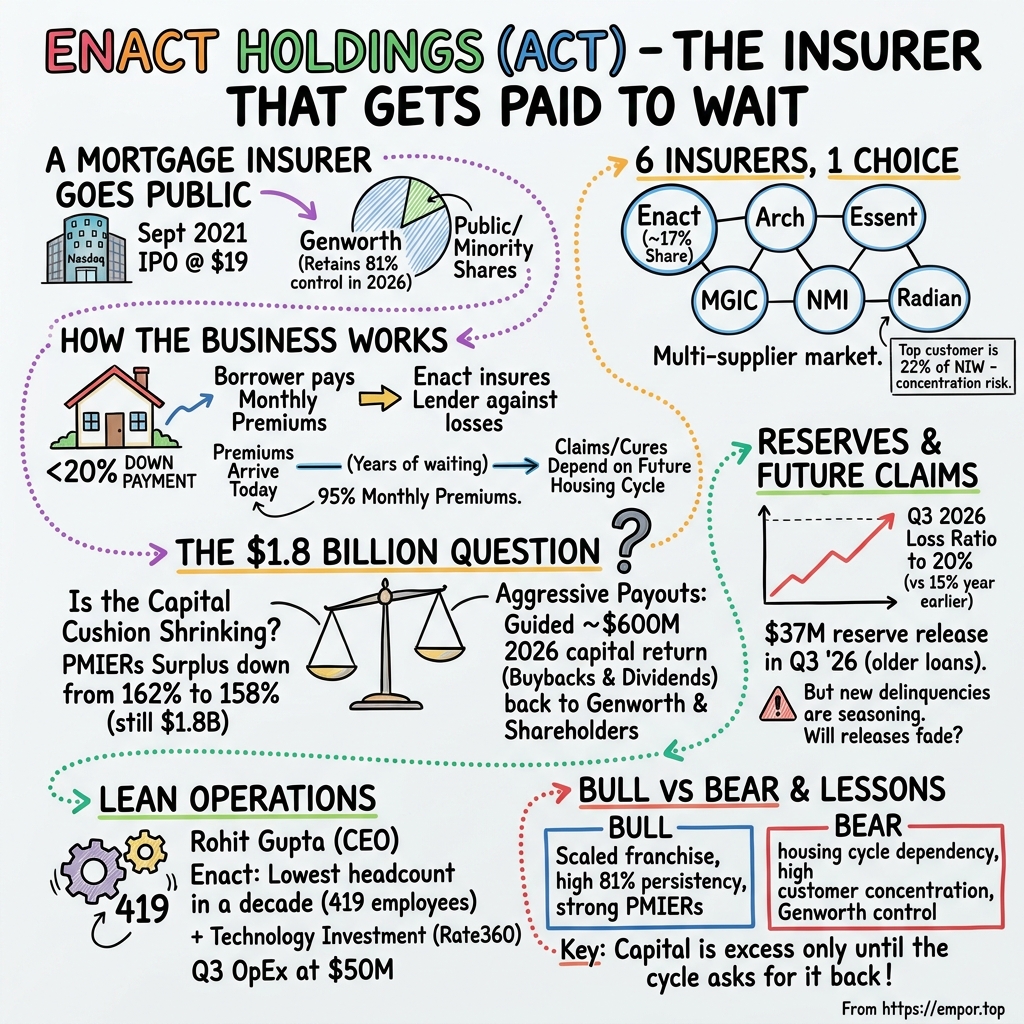
Enact Holdings: The Insurer That Gets Paid to Wait
I. The $1.8 Billion Question
On the first Tuesday of November 2026, a mortgage insurer most homebuyers have never heard of told its shareholders it would send them more money than it had planned. Enact Holdings raised its full-year capital-return guidance to about $600 million, a sum made up of dividends and share repurchases, and declared another quarterly dividend of 24 cents a share.1[^2] For a company that earns roughly two-thirds of a billion dollars a year, that is a generous handout. It is also a statement of confidence, because an insurer that gives away capital is saying, in effect, that it will not need that capital for the claims still on their way.
The same release carried two quieter numbers. The first was the cushion. Enact's mortgage insurers still held about $1.8 billion more in qualifying assets than the government-sponsored enterprises require, but the ratio of what they held to what they needed had slipped from 162% at the end of 2025 to 158%.1 The second was the loss ratio, the share of each premium dollar consumed by claims and expected claims. It rose to 20% in the third quarter, from 15% a year earlier, and it would have been higher still without a $37 million release of reserves set aside in earlier years.1
Put those numbers side by side and the puzzle of this company comes into focus. Enact is plainly profitable. It is plainly well capitalized by every outside measure that matters, and in September 2026 AM Best upgraded its operating insurers to A (Excellent).2 Yet the trend lines under the headline are moving in the direction a careful investor watches most closely. Losses are rising from a very low base. The reserve releases that flattered earnings for several years are getting smaller. And management itself said on the third-quarter call that the newer books of insured loans could keep seasoning into higher delinquencies through 2027.3
So the question that runs through this story is simple to state and hard to answer. Are those reserve releases the evidence of a well-run book, the reward for conservative estimates made in a frightening year? Or are they making a cyclical insurer look safer than it is, at exactly the moment a new generation of loans begins to show its true colors? And if the answer is somewhere in between, how much of the $1.8 billion cushion can safely leave the building?
Answering that requires four linked investigations. The first is how Enact actually makes money, which is less obvious than it looks. The second is what protects its position in a market where five other qualified insurers compete for every lender's business, and where the largest lender sends Enact more than a fifth of its new policies. The third is the capital question itself: how much is truly excess, and how should anyone know. The fourth is independence. Enact is a public company with its own ticker, board and filings, but Genworth Financial owns about 81% of it.4 That ownership shapes the board, the buybacks and the practical voice of everyone else on the register.
One boundary needs drawing early. This is a story about Enact Holdings and its mortgage-insurance subsidiaries. Genworth has other businesses, notably long-term care insurance, and other financial results. Those belong to Genworth's story, not this one. Where Genworth appears here, it appears as Enact's controlling shareholder, its service provider and the counterparty to many of its cash flows, nothing more.
The last thing to understand before going further is the strange clock this business keeps. Most companies sell something, deliver it and learn within weeks whether they made money. Enact sells a promise. The premium arrives month after month for as long as the policy stays in force, which can be years. The cost of that promise depends on whether a borrower, somewhere in the country, falls behind on a mortgage, and then on whether that borrower catches up, sells the house, refinances, or finally defaults. Some of those outcomes take years to resolve. In between, the insurer has to estimate what it owes, report a profit on the basis of that estimate, and decide how much capital to keep for the estimates that turn out to be wrong.
Enact, in other words, gets paid to wait. The rest of this story is about whether it is waiting with enough in reserve, and about how a mortgage insurer that once sat inside a struggling parent ended up as one of the steadiest cash machines in American finance.
 Subscribe on LinkedIn
II. A Mortgage Insurer Becomes a Public Company
In mid-September 2021, a ticker that had not existed a week earlier began trading on Nasdaq. ACT opened as the public face of a business that was already four decades old. The shares were priced at $19.5 The seller was not the company. It was Genworth Financial, which had spent years trying to find a way to raise money without giving up the steadiest earnings engine it owned.6
The operating lineage of the business runs back to 1981, and the corporate vehicle that became Enact was formed as Genworth Mortgage Holdings in 2012.5 Through those decades the franchise passed through several owners and names, but three things stayed constant, and they still shape Enact today. It has always been a mortgage-insurance franchise, a single-product business tied to American home lending. It has always had a larger parent above it. And it has always been exposed to the U.S. housing cycle, which periodically reminds mortgage insurers that their promises can come due all at once.
A sale, not a raise
The 2021 transaction is easy to misread, so it is worth slowing down. In a typical IPO, a company sells new shares and keeps the cash to fund growth. This was different. Genworth sold existing Enact shares it already owned, through the public offering and a concurrent private sale to Bayview, the mortgage investment firm.6 Enact did not raise primary capital for itself, and the proceeds went to the parent, which at the time was working through its own debt obligations.6 When the dust settled, Genworth had parted with roughly 18% of the company and kept roughly 82%.56
That detail matters because it tells you what the listing was for. It was not a growth financing. It was a way for Genworth to crystallize value, prove to creditors and regulators that the mortgage insurer had a market price, and create a currency in which the business could be measured separately from the parent's long-term care liabilities. In the years before the listing, Genworth's own financial difficulties had hung over the mortgage subsidiary; the GSEs had placed conditions on the insurer's capital tied partly to the parent's situation, conditions that were later lifted.7 A separately listed, separately reported Enact was a cleaner credit story than a subsidiary buried in a troubled parent.
What the listing delivered, and what it did not
Five years later, the outcome is a company with genuine public-company apparatus. Enact files its own 10-Ks and proxies. It has its own board, its own audit committee, its own capital-return policy and its own credit ratings. AM Best, in its September 2026 upgrade, said the separation between Enact and Genworth had meaningfully improved.2
But it is not a clean break. Genworth Holdings owned 114.2 million Enact shares, or 81.0%, at the March 2026 record date, and no other holder appeared above 5%.4 As long as Genworth owns more than half the shares, it has the right to nominate a majority of the board.4 Genworth still provides allocated administrative and IT services, still manages Enact's investment portfolio and still files the consolidated U.S. tax return in which Enact participates.8 And because Genworth has participated in Enact's buybacks to keep its percentage roughly constant, its stake has hovered around 81% since the listing, almost exactly where it began.89
The money that moves between the two companies through those service agreements is modest, and it has been shrinking. In 2025 Enact paid Genworth about $9.4 million for allocated administrative and IT services and $7.8 million for managing its investments, each well under 1% of Enact's revenue.8 The services bill had been $17.7 million in 2023, so it roughly halved in two years as Enact built out its own functions.8 These charges are cost allocations among Genworth's businesses, and Enact does not describe them as independently benchmarked prices, which is a governance point worth noting rather than a red flag. The trademark license granted at the listing was royalty-free, and Enact discloses no brand fee to its parent.58 The economic weight of the relationship, in other words, does not run through fees. It runs through dividends and buybacks, which is where this story will return when it follows the capital.
What the listing also revealed, for the first time in a clean public series, was the shape of the earnings engine. The prospectus showed a business in full growth mode before 2021: premiums compounding at about 10% a year from 2016 to 2020, insurance-in-force at 13% and new insurance written at 24%, although the early years of that series mixed a Genworth segment with the later holding company and are not strictly like for like.5 After the listing, growth flattened. Revenue rose from about $979 million in 2019 to about $1.24 billion in 2025, but net income in 2025, at $674.2 million, was almost exactly where it had been six years earlier.8 In the first nine months of 2026, profit was $501.5 million against $497.1 million a year before.9 The business that went public as a growth story has matured into an earnings plateau, very profitable and very steady, with almost all of its excess cash going out the door.
The paradox is that a public listing usually dilutes a parent's control over time. Here, the opposite mechanism has been at work. Every buyback round shrinks the share count, Genworth tenders its proportionate slice, and the ownership split barely moves. The result is that the minority shareholder owns a liquid, separately reported slice of a mortgage insurer, but does not own a vote that can change its direction.
What the market thinks that slice is worth is a separate question, and a slippery one. Investors price a mortgage insurer largely against its book value and its ability to earn a return on that book through a full housing cycle, not against a single good year. Whether the current price assumes the present returns persist, fade or collapse is the investor's judgment to make with current market data in hand. This story's job is to explain the machinery that will decide which of those assumptions proves right, and that machinery starts with a homebuyer who cannot quite afford a 20% down payment.
III. The Mortgage That Needs an Insurer
Picture a couple buying their first house. They have saved enough for a 5% or 10% down payment, not the 20% that conventional lending treats as the comfortable line. Their lender is happy to make the loan, but it wants to sell the mortgage to Fannie Mae or Freddie Mac, and those agencies' charters generally require credit protection on loans with less than 20% down. That is the opening Enact fills. Private mortgage insurance protects the lender or the investor holding the loan against a specified share of the loss if the borrower stops paying. The borrower usually pays the premium; the lender is the insured.8
The first thing to understand is that the insurer does not cover the whole loan. Coverage typically protects about a quarter of the loan's exposure, though the exact level varies by policy.8 So when Enact reported $275 billion of primary insurance-in-force at the end of the third quarter, it was describing the original balances of the mortgages it insures, not the amount it could lose.1 Its risk-in-force, the dollars actually at stake, is a fraction of that. And even that figure overstates real exposure, because a claim only materializes if the borrower defaults and the house sells for less than the loan.
How a premium becomes a profit
The economics unfold in a particular order, and the order is the whole story. It begins with new insurance written, the volume of fresh policies placed in a period. In the third quarter of 2026 Enact wrote $14 billion of it, and 93% came from home purchases rather than refinancing.1 Each policy is priced when it is issued, as a percentage of the original loan balance, adjusted for the risk of the loan, and the filed rate is then locked for the life of that coverage.8 Most borrowers pay monthly; monthly-premium policies made up 95% of third-quarter new business.1
Next comes insurance-in-force, the portfolio of policies still alive and still paying. This is the real annuity of the business. A policy written today may pay premiums for years, until the borrower builds enough equity to cancel it, refinances into a loan that no longer needs insurance, or sells the house. That is why the third key number is persistency, the share of in-force policies still on the books a year later. In the third quarter it was 81%.1 Roughly four in five policies that were paying a year ago are still paying.
Why do policies end at all? Because private mortgage insurance is designed to be temporary. Under federal law, a borrower with a qualifying loan can ask to cancel coverage once the loan balance falls to 80% of the home's original value, and coverage generally terminates automatically at 78%.8 The GSEs also allow cancellation based on rising home values in many cases. That means two forces quietly shorten the life of Enact's book: borrowers paying down principal, and home prices rising. The boom of 2020 to 2022 was a double-edged gift for exactly this reason. Soaring prices protected Enact from claims, but they also pushed many borrowers past the equity threshold where their insurance could be dropped. The insurer's best credit environment can also be its fastest runoff environment.
The final step, and the one that arrives last, is losses. A borrower misses payments. The loan becomes a delinquency on Enact's books. Many delinquencies cure as the borrower catches up or enters a modification. Some end with a sale in which the house's equity covers the loan. A minority become claims. Enact must reserve for that whole range of outcomes before it knows which one will happen. Profit, then, is premiums plus investment income minus expenses minus an estimate of claims that is constantly being revised.
There is a subtle accounting feature here that shapes everything that follows. Under the rules mortgage insurers use, Enact generally sets up a loss reserve when a loan is reported delinquent, plus an estimate for delinquencies that have occurred but not yet been reported.8 It does not book a reserve for the losses it expects, statistically, from loans that are still performing today. So a newly written book looks highly profitable in its first years, because premiums flow in while few loans have yet fallen behind. The losses appear later, as the book seasons and delinquencies are reported. This is not a flaw in Enact's accounting; it is how the industry reports. But it means a young book's early profit is partly a function of time, and that a period of rapid writing followed by a downturn can turn yesterday's earnings into tomorrow's reserves.
That sequencing explains why higher mortgage rates cut both ways. When rates rise, fewer people buy homes and almost nobody refinances, so new insurance written falls. But the borrowers who already have cheap mortgages hold on to them. They do not refinance, so their policies stay in force and keep paying. Enact's 81% persistency is partly a story about locked-in borrowers who would rather keep a 3% or 4% mortgage than trade it for today's rates. When rates eventually fall, the pattern flips: new business surges, and the old book starts to run off as homeowners refinance.
The float underneath
Like every insurer, Enact holds money between collecting premiums and paying claims, and it invests that money. In 2025 its portfolio earned $266.2 million of net investment income, set against total revenue of about $1.24 billion.8 That is a meaningful contribution, roughly a fifth of revenue, but it is not the engine. The investment portfolio is conservative, 99% investment grade with a pre-tax yield of 4.7% at the end of September 2026.19 The money is there to pay claims, not to speculate. The core economic question is still whether premiums cover losses and expenses with room to spare.
This is also why the usual industrial-company yardsticks mislead. A manufacturer's cash conversion compares profit with operating cash after capital spending on plants and machines. An insurer's biggest "capital spending" lines are purchases of bonds, and those show up as investing activity. Enact bought about $1.9 billion of fixed-maturity securities in 2025, which is portfolio management, not expansion.8 Its operating cash flow of $724.5 million comfortably exceeded net income of $674.2 million that year, which says the reported profit was backed by real cash.8 But the more informative signal sits in the reserve and premium lines, which is where the insurer's real timing risk lives.
So what kind of business is this? It is a capital-backed insurance business riding on the volume of low-down-payment mortgage lending. Technology helps it price and process risk faster, but software is not what the customer pays for. The customer pays for a balance sheet that will be there when the claim arrives. And that makes the competitive question sharper than it first appears, because Enact is not the only balance sheet a lender can call.
IV. Six Insurers, One Lender's Decision
Imagine the loan officer's screen at a large bank. A borrower with 7% down has been approved, and the loan needs mortgage insurance before it can be delivered to Fannie Mae. The lender's system can route that policy to any of six active private insurers: Arch Capital, Enact, Essent, MGIC, NMI Holdings and Radian.8[^11] Each has GSE approval. Each has a pricing engine that will return a quote in seconds. Each has a sales team that has been calling on this lender for years. The question for Enact, repeated hundreds of thousands of times a year, is why the policy should come to it.
At the end of 2025, Enact held about 17% of the industry's primary insurance-in-force, inside a peer range running from roughly 14% to 19%.8[^11] That is real scale. It puts Enact among the larger players, with the data, the lender integrations and the national sales force that come from writing business across many cycles. But it also describes an oddly balanced market. No insurer has a commanding lead, and the gap between the largest and the smallest of the established players is a few percentage points.
The test of share
The real test of any claimed advantage is not a snapshot. It is how share behaves over time, especially in new business, where lenders actually make choices. Enact's quarterly share of new insurance written has ranged from about 12.0% to 20.4% since 2012.[^12] Read that range carefully. A business with a widening moat would show share climbing and staying high. Enact's record shows something else: a strong competitor whose share moves up and down within a wide band as pricing appetite, product decisions and lender relationships shift. When Enact prices more aggressively, it wins more; when it holds back, lenders take the business elsewhere.
It helps to know how pricing changed. A decade ago, mortgage insurers largely priced from published rate cards: a grid of credit scores and down payments with a premium in each box, which made pricing visible and slow to change. Over the late 2010s the industry moved to risk-based pricing engines that quote each loan individually, using many more attributes of the borrower and the property. Enact's version is called Rate360.8 Engines let an insurer price risk more precisely and adjust its appetite quickly, which is valuable. But they also make it easier for a lender's system to compare six quotes on one loan and route each policy to the cheapest acceptable insurer, and they make it harder for outsiders to see whether any one company is quietly cutting price to buy volume. Precision and competition arrived together.
That is how a multi-supplier market behaves. Lenders can and do route loans to several insurers at once. Pricing engines make the comparison instant. And because every eligible insurer meets the same GSE capital standards, the lender is not choosing between a safe insurer and a risky one in any way that changes its delivery to Fannie or Freddie. Moody's, in a 2024 rating rationale, called the product commodity-like and flagged the industry's dependence on lenders, the GSEs and public policy.10 That is an outsider's verdict, not a criticism unique to Enact, but it bounds how much pricing power any one insurer can claim.
The customer list sharpens the point. Enact serves more than 1,800 lenders.[^12] Yet its single largest customer accounted for 22% of new insurance written in 2025 and 12% of revenue, and the top five together delivered a third of new business.8 That largest customer had been 19% of new business and 10% of revenue in 2023, so the relationship has grown in importance.8 At the IPO, the largest customer was 16% of new business in 2019 and 12% in 2020, with nobody above 10% of revenue.5 Enact does not name the customer. What the trend shows is that one lender's routing decisions now matter more to Enact's new business than they did at the listing, which gives that lender bargaining leverage it can use at any renewal of pricing or service terms.
Where the barrier really is
None of this means the business is easy to enter. The barriers are real, and they are worth naming precisely. An insurer must win approval from state regulators and from the GSEs, and it must hold enough risk capital to satisfy the GSEs' financial requirements. It must build underwriting expertise and loss data across cycles, integrate with lenders' origination systems, and, perhaps most of all, establish a record of paying claims when it counts. The youngest of the six active insurers, NMI Holdings, was founded in the aftermath of the financial crisis; no new national competitor has broken in since.
Those barriers protect the club. They do not, on the evidence, protect any single member from the others. Inside the club, a lender can switch volume from one insurer to another with a configuration change. The 81% persistency, which looks like a loyalty number, is really a borrower number. It reflects homeowners who keep their policies because they keep their low-rate mortgages, not lenders who are locked into Enact.1 It supports a durable premium base. It is not evidence that customers cannot switch.
The third-quarter call was revealing in what it emphasized. Management's prepared remarks leaned on the strength of the in-force portfolio, on persistency, on disciplined pricing and on the lowest headcount in more than a decade.3 When analysts pressed on new insurance written, which fell 7% from the second quarter, management attributed the decline largely to lower refinance activity and a smaller origination market, and framed its pricing as balancing returns against volume.31 What a skeptical listener wants, and what is harder to find, is a specific account of where Enact is winning share and why: which lender segments, which credit tiers, which service advantages. "We serve many lenders and price with discipline" describes every company in the industry.
The verdict here is not unkind. Enact is a scaled national competitor in a market with high entry barriers and real staying power. But the record does not show a widening moat. It shows a franchise whose share depends on choices it makes every quarter about price and risk, and on a few large lenders whose decisions can swing its volume. That puts the weight of the investment case where it belongs: not on market position, but on whether the business it chooses to write turns out to be profitable. And the best test of that is to go back to the year when the whole industry wondered whether its promises were about to come due.
V. The Pandemic Book and the Reserve Release
In the spring of 2020, millions of American homeowners stopped paying their mortgages almost overnight. Many of them were not in default in the usual sense. They had entered forbearance, a federally backed pause that let borrowers skip payments while the economy shut down. For a mortgage insurer, forbearance was a fog bank. A loan in forbearance counted as delinquent. Nobody knew how many of those borrowers would resume payments when the pause ended, how many would need modifications, and how many would eventually lose their homes.
Enact did what an insurer has to do in fog. It reserved for the risk it could not yet see. Net income fell to $370.4 million in 2020, from $677.6 million the year before, as losses rose.87 The 2019 figure itself was flattered by a $115.3 million after-tax gain on an unconsolidated affiliate, so the underlying drop was less dramatic than the headline, but it was still the sharpest earnings shock in the listed company's reported history.8 It is the single best counterexample to the idea that this business produces smooth earnings no matter what. In a genuine scare, the income statement absorbs the fear immediately, long before anyone knows whether the fear was justified.
When fear turns into earnings
Then the fog lifted, and it lifted kindly. Home prices rose sharply through 2021 and 2022, which gave even struggling borrowers equity they could use to sell rather than default. Servicers and the GSEs offered modifications that let borrowers fold missed payments into their loans. Most pandemic-era delinquencies cured. That meant the reserves Enact had set aside in 2020 were larger than the claims that eventually arrived, and when an insurer concludes it reserved too much for old delinquencies, it releases the difference back into earnings.
Favorable development of that kind helped lift net income to $704.2 million in 2022, and releases continued to support results in 2023.11[^15] Enact released $252 million of net reserves in 2024 and $200 million in 2025.8 Another $37 million came in the third quarter of 2026.1 It is important to be precise about what a release means. It is not a gift and it is not an accounting trick. It reflects an updated, lower estimate of what older delinquencies will cost. But it also means that part of recent profit came not from the business written this year, but from correcting assumptions made years ago.
That is the heart of the concern. Reserve releases are a finite resource. The pool of pandemic-era delinquencies is shrinking as those loans cure, sell or claim. As the releases shrink, reported losses will increasingly reflect the true cost of newer books, loans written in 2022, 2023 and 2024 at higher prices and higher interest rates, with less built-in equity than the loans of the boom years. The rise in the loss ratio from 15% to 20% between the third quarters of 2025 and 2026 is a first glimpse of that transition.1
Reading the clues
What evidence points the other way? Quite a lot, in fairness. Enact says its cure and loss-mitigation performance has been strong, and the record of the last five years supports that claim. AM Best described the company's five-year underwriting performance as strong when it upgraded the insurers.2 On the third-quarter call, management said recent vintages were performing in line with or better than pricing expectations, and pointed to a cure rate of about 50% and a claim rate of about 8% on new delinquencies.3 In plain terms, of each hundred loans that newly fall behind, Enact expects roughly half to catch up and only around eight to end in a claim.
Those are encouraging clues, but they are clues, not a verdict. A claim rate depends heavily on home prices. When a delinquent borrower has equity, the house can usually be sold for more than the loan, and the insurer pays nothing. If home prices stall or fall in particular markets, the same delinquency produces a claim instead of a sale. Cure rates depend on employment, and claims take a long time to emerge from the moment a loan first falls behind. The 50% and 8% figures describe a benign housing market. They are not proof of how the 2023 and 2024 books will look after a recession.
Management's own words bound the bullish reading. In the same call, executives acknowledged that delinquencies may continue to increase as newer books season, with that seasoning running through 2027.3 That is a candid admission, and to its credit it was offered rather than extracted. It is also exactly the statement that belongs next to any claim that the reserve record proves the underwriting is superior. What the record actually proves is narrower: Enact reserved prudently for a shock that turned out milder than feared, and it has been willing to recognize the good news. Whether it underwrote the post-pandemic books just as well remains unproven, because those books have not yet lived through a downturn.
The loss reserve stood at $617.3 million at the end of September 2026, and the company cautions that obligations could rise if delinquencies cure more slowly or progress to claims.9 The auditor issued a clean opinion on the 2025 statements with no emphasis-of-matter paragraph, and Enact reports no pending material legal proceedings.8 Nothing in the record suggests aggressive reserving. The judgment at stake is not about accounting quality. It is about the future of American house prices and household incomes.
AM Best's upgrade captures both sides neatly. The agency raised the operating insurers to A (Excellent) and the holding company's issuer rating to "bbb," citing very strong balance-sheet strength, the strongest level of risk-adjusted capitalization, programmatic reinsurance and compliance with the GSEs' requirements.2 In the same release it named the constraints: a limited, monoline U.S. mortgage-insurance profile, competition from other private insurers and government programs, sensitivity to the economy and to GSE policy, and some residual balance-sheet risk from Genworth, though less than in the past.2 An upgrade tells you the present is strong. The caveats tell you where the future could disagree.
The settling evidence will be annual reserve development and paid claims by book year. If releases fade gently while claims on the 2022–2024 books stay close to pricing assumptions, the underwriting story holds. If the 2023 and 2024 books start producing claims faster than older books did at the same age, the reserve releases of recent years will look less like proof of skill and more like the tail end of a lucky cycle. Which brings the story to the most consequential decision Enact makes each year: how much of the money that the good years produced it should give away.
VI. A $600 Million Capital-Return Plan
Every mortgage insurer that wants its policies accepted by Fannie Mae and Freddie Mac lives under a rulebook called PMIERs, the Private Mortgage Insurer Eligibility Requirements. Think of it as a capital test administered by the two biggest buyers of the insurer's product. The GSEs set a minimum level of "available assets" each insurer must hold, calculated from the risk in its insured portfolio, with heavier charges for riskier loans and for loans already delinquent.8 Fall short, and an insurer's eligibility, and therefore its business, is in question. Stay comfortably above, and everything above the line is, in theory, money that could be released to the holding company and paid out to shareholders.
At the end of September 2026, Enact's insurers held about 158% of what the GSE rules required, a surplus of roughly $1.8 billion.1 A quick piece of arithmetic makes those figures concrete. If $1.8 billion is the 58% above the requirement, the requirement itself is somewhere near $3.1 billion and the insurers hold roughly $4.9 billion of qualifying assets. That is a thick cushion. It is also a cushion that has been thinning, from 162% at the end of 2025, partly because Enact's flagship insurer paid a $200 million dividend up to the holding company during the period.1 Capital moving from the regulated insurer to the parent is the first step in any shareholder return.
From $100 million to half a billion
After the listing, Enact's capital-return story built steadily. Repurchase authorizations grew from $100 million in 2023 to $250 million in 2024 and $350 million in 2025, then to $500 million in February 2026.89 Quarterly dividends rose alongside them. In the first nine months of 2026, Enact bought back $304.5 million of shares and paid $96.2 million in dividends, about $400 million in total.9 The roughly $600 million guidance therefore implies something close to $200 million more in the final quarter, a pace that would make 2026 the largest year of returns since the listing.
There is a structural quirk in how those buybacks work. Because Genworth participates proportionally to keep its stake near 81%, most of every buyback dollar goes to Genworth. In 2025, Enact paid Genworth $309.5 million for repurchased shares and $98.0 million in dividends.8 For the minority shareholder, a pro-rata buyback in which the controlling holder sells its share functions much like a dividend paid mostly to the parent: the ownership split barely changes, and cash leaves the company. That is not inherently unfair, since everyone receives proportional value. But it means the capital-return program serves two masters, the minority investors who want returns and a parent that has its own need for cash.
The question a skeptical investor would put to the board follows directly. If buybacks do not change the ownership mix, and if a severe housing scenario could make today's cushion look thin, would a special dividend, or simply a slower pace of repurchases, protect minority holders better? A special dividend is honest about being a payout and can be skipped without signaling distress. A buyback program, once it becomes a quarterly habit, can be harder to slow without the market reading it as a warning.
What stands behind the payout
The counterweights are substantial. Enact's insurers transfer part of their risk to reinsurers through quota-share agreements, which cede a slice of premiums and losses, and through excess-of-loss coverage, which pays only if losses on a book exceed a set threshold.8 Both reduce the capital the GSE rules require, which is one reason the PMIERs surplus is as large as it is. Reinsurance costs money, and the third-quarter call touched on those costs, but it is the mechanism that lets a monoline insurer return capital without carrying the full weight of a catastrophe on its own balance sheet.3
The holding company itself is not overstretched. Enact has $750 million of 6.25% senior notes due in May 2029, which it issued to replace 6.5% notes due 2025 that it redeemed early in 2024, taking a $10.9 million loss to do so.89 It has an undrawn $435 million revolving credit line running to 2030 and reported compliance with its covenants.9 At the end of September 2026 the holding company held $286 million of cash and $427 million of invested assets.1 There is no near-term refinancing event, though the notes are a meaningful fixed obligation that will need to be addressed well before 2029.
A little arithmetic shows how the holding company's money actually circulates. The notes cost about $47 million a year in interest at 6.25% on $750 million. The quarterly dividend of 24 cents a share, across roughly 141 million shares, costs a little over $30 million a quarter, or about $135 million a year.[^2]4 Holding-company cash and investments of about $713 million therefore cover several years of interest and dividends even if the insurers sent nothing up. Buybacks are the swing item: they are funded by the subsidiary dividends that move up from the regulated insurers, such as the $200 million paid during 2026, and they can be scaled back without touching the debt or the dividend.1 That flexibility is a real strength. It also means the buyback is the first line where a more cautious board would show its caution, and the line where its absence would be most visible.
Investment in the business, meanwhile, is modest. Enact does not report a separate research-and-development line, and capital spending on property and equipment is not material enough to be presented separately.8 Nor does any material acquisition program appear in its record since the listing. That is not a criticism; a mortgage insurer's growth does not come from buying companies. It does mean the relevant benchmark for capital allocation is not the price paid for deals but the balance between capital retained for risk and capital returned to owners.
So how much can safely leave? The honest answer is that the decisive measure is not today's 158%, but the surplus that would remain after the planned distributions under a severe scenario: a recession that raises unemployment, a meaningful fall in home prices and slower cures on newer books. Enact does not publish that stressed figure. AM Best's view that its risk-adjusted capitalization sits at the strongest level is reassuring, as is the reinsurance program.2 The trade-off, however, is unavoidable. Each dollar paid out is a dollar not available in the downturn. The current pace is supported by current earnings; the question is what it assumes about the next cycle. Which is why the people setting that pace deserve a closer look.
VII. Rohit Gupta's Leaner Enact
On the third-quarter call, Rohit Gupta had a number he clearly wanted listeners to remember. Enact, its chief executive said, was operating with its lowest headcount in more than a decade, while still investing in the technology it uses to price and process mortgage insurance.3 It was a characteristic line. Gupta, who has run the mortgage insurer through its separation from Genworth and its public listing, tends to frame Enact less as a growth story than as a discipline story: price carefully, keep costs tight, give back what the business does not need.34
The numbers back the cost part of that story. Enact had 419 full-time U.S. employees at the end of 2025.8 Third-quarter 2026 operating expenses were $50 million, down from $53 million a year earlier.1 For a business insuring $275 billion of mortgages, that is a remarkably small organization, and it shows how much of a mortgage insurer's work is now automated through lender integrations and pricing engines. Gupta's finance partner, CFO Dean Mitchell, carried the numbers side of the same message on the call, walking through higher losses, the decline in new business, reinsurance costs and the increased capital-return guidance.34
What the call revealed
A call has two halves, and they often tell different stories. The prepared remarks were confident and consistent with prior quarters: strong credit performance, a resilient portfolio, disciplined pricing and excess capital to return.3 The analyst questions probed the soft spots. Why had losses risen? Management pointed to normal seasoning of newer books and a smaller benefit from reserve releases. Why was new insurance written down from the second quarter? Lower refinance volume and a smaller market. How sustainable was the higher capital return? Management tied it to earnings power, PMIERs capacity and the reinsurance program.3 The answers were coherent, and the acknowledgment that delinquencies could keep rising through 2027 was a sign of candor rather than evasion. What the call did not supply was a stressed view of capital after distributions, the one number that would let outsiders judge the payout for themselves.
The strategy, read through behavior rather than slogans, has three parts. Enact aims for profitable growth in its core market, which in practice means accepting lower volume rather than chasing share with price. It invests in cost and technology, through tools such as its Rate360 pricing engine and ELLA, which management discussed on the call.83 And it returns excess capital. The technology claims deserve a measured reading. Rate360 and ELLA may well improve pricing accuracy or service speed, but the filings do not disclose any separate revenue or profit attributable to them, and Enact reports no separate R&D expense.8 These are tools inside an insurance business, not a hidden technology franchise. Their value has to show up where it can be measured: in underwriting results, in a lower expense ratio, in service that wins lender volume, or in market share.
Pay, profit and the parent's vote
Then there is compensation. Gupta's reported pay was $8.08 million in 2023, $9.96 million in 2024 and $9.87 million in 2025.4 Over the same three years, Enact's net income went from $665.5 million to $688.1 million and then to $674.2 million.8[^15] In other words, the chief executive's pay rose by roughly a fifth while profit was essentially flat. Most of the 2025 package came in stock awards of $5.87 million and incentive pay of $2.61 million.4 Equity-heavy pay at least aligns some of the reward with the share price. The sharper question is what the incentive measures reward. If they lean on near-term earnings and return on equity, they can reward a period of reserve releases and generous buybacks as readily as genuine underwriting skill. A pay plan that also weighed risk-adjusted outcomes, such as how each book year ultimately performs, would line incentives up more closely with the long clock this business keeps.
Governance shapes how much any of this can be challenged. Enact's board describes its audit, compensation and nominating committees as fully independent, with an independent majority overall.4 But Genworth's 81% holding means any vote's outcome is effectively known in advance. At the May 2026 annual meeting, say-on-pay passed easily, with about 137.7 million votes for and 0.54 million against.[^16] The more interesting result was director Thomas McInerney, Genworth's chief executive, who received 10.28 million withheld votes.[^16]4
That figure is small against the full register but large against the part of it that is not Genworth. With roughly 141 million shares outstanding and Genworth holding about 114 million, the minority owns roughly 27 million shares. If Genworth voted for its own CEO, as a controlling holder normally would, then a substantial portion of the minority votes cast withheld support from him. It is a bounded signal, not an activist campaign, and nothing in the record suggests an organized challenge. But it shows that some independent holders are uncomfortable with the parent's presence on the board.
Taken together, the management record is mixed but testable. Costs have come down, leadership has been stable, and the company has delivered on its capital-return commitments without a visible stumble. Pay has stayed high while profits have been flat, and the parent's control limits the practical accountability that a fully independent public company would face. The next few years will test the most important claim this team makes, that its pricing discipline produces books that hold up when the cycle turns, and that test will be shaped by forces no management team controls.
VIII. What the Insurer Cannot Control
Suppose mortgage rates climb another half point next spring. Refinance applications, already thin, dry up further. Some would-be first-time buyers decide to keep renting. Meanwhile, in Washington, a new administration rethinks what Fannie Mae and Freddie Mac should look like, or the Federal Housing Administration cuts its own mortgage-insurance premium to make its government-backed loans more attractive. None of these decisions would be made in Enact's offices. All of them would change its economics.
Start with demand. In the third quarter of 2026, Enact wrote $14 billion of new insurance, down 7% from the second quarter, and 93% of it came from purchase loans.1 Its primary insurance-in-force grew only 1% from a year earlier, to $275 billion.1 That is a book that is roughly holding its size, not one that is expanding quickly. The mechanism is straightforward. Fewer home purchases, or fewer purchases that need private mortgage insurance, mean less new business. Low refinancing keeps old policies alive longer, which supports persistency, but it also slows the replacement of the book with newly priced risk. A portfolio held together by locked-in borrowers is stable, but it ages.
Interest rates also reach Enact through the other side of its balance sheet. As bonds bought in the low-rate years matured, Enact reinvested the proceeds at higher yields, and by September 2026 the portfolio's pre-tax yield stood at 4.7%.1 That higher investment income is part of why 2025 profit slipped only about 2% despite rising losses; the company itself attributed the decline chiefly to higher losses, partly offset by higher investment income.8 The hedge is real but partial. If rates fall sharply, new business would likely rebound and old policies would refinance away, while the yield on reinvested money would drift down. Enact's earnings are therefore tied to rates in three directions at once: through origination volume, through persistency and through the investment portfolio. Those effects partly offset one another, which is one reason the earnings have looked so steady, but the offset depends on the particular path rates take, and no management decision can choose that path.
Washington's thumb on the scale
Policy is the second force, and arguably the larger one. Private mortgage insurance exists in its current form because the GSEs' charters require credit enhancement on high loan-to-value loans, and because the GSEs set the PMIERs capital rules that every insurer must meet.8 Change those requirements, and the market changes with them. The FHA is the direct competitor: its government insurance serves many of the same low-down-payment borrowers, and when its pricing becomes more attractive, private insurers lose share of the total market.82 AM Best explicitly named competition from government programs and sensitivity to GSE policy among its constraints on the rating.2 Proposals to change the GSEs' status, adjust their pricing or alter their capital rules have circulated for years. Any of them could reshape private-MI penetration, for better or worse, without a single change in Enact's own execution.
The third force is the one this story has already circled: claims severity. A delinquent loan can cure, sell or become a claim, and the path it takes depends on employment and house prices. Slower cures or weaker home prices can raise losses even on a book of loans that looked profitable when they were written.9 That is why the reserve, not the premium line, is where the cycle eventually shows up.
Smaller signals worth watching
One smaller balance-sheet item deserves measured attention. Premiums receivable rose from $46.1 million at the end of 2025 to $66.2 million at the end of September 2026, a change that consumed about $20 million of operating cash.9 The amount is modest against Enact's earnings, and it could easily reflect billing timing. But Enact does not publish an aging schedule or a write-off history for premiums receivable, so outsiders cannot tell whether the increase is timing or slower collection. It is the kind of line that merits a glance each quarter rather than alarm.
The same nine-month cash statement holds a more instructive lesson about how insurers' cash can flatter. Operating cash flow was $526.5 million against net income of $501.5 million, which looks like comfortable cash backing.9 But part of that cushion came from a $44.8 million increase in loss reserves.9 A rising reserve is a non-cash expense: it reduces profit today, while the cash to pay those claims leaves only later. So when losses begin to rise, an insurer's operating cash flow can look stronger relative to earnings precisely because claims are building that have not yet been paid. Read the other way, the period when those reserves convert into paid claims will show weaker cash than earnings. For Enact, the amounts are modest relative to the business. The principle is what matters: in this industry, cash generation and claims risk can move in the same direction for a while before they part ways.
Some risks that loom large in other companies are secondary here. Foreign currency barely registers. Enact Re is a Bermuda subsidiary and the portfolio holds some non-U.S. securities, but translation losses were $5.7 million in 2025 and $2.2 million in the first nine months of 2026, trivial against earnings, and the company says its investment portfolio holds no derivatives.89 Technology risk is real in the ordinary sense, because cyber incidents or a failed system could disrupt underwriting and service. But nothing in the evidence makes AI disruption or a standalone technology product the central investment question. A pricing algorithm cannot replace the capital that stands behind a claim.
So the forces outside management's control are concentrated, and they are domestic: the housing market, mortgage origination volume, GSE and federal housing policy, and the severity of claims when borrowers default. A business this exposed to a few external levers needs either a durable structural advantage or a disciplined way of pricing the risk, ideally both. Which raises the question the whole story has been building toward.
IX. Analysis & Bear vs. Bull Case
Lay two pictures side by side. In the first, Enact holds about 17% of the industry's primary insurance-in-force, a national franchise with more than 1,800 lender relationships and a balance sheet AM Best ranks among the strongest in its sector.8[^12]2 In the second, the same company competes with five other insurers that hold the same approvals, quote through the same systems and chase the same loans, and its share of new business has wandered between about 12% and 20% for more than a decade.[^12][^11] Both pictures are accurate. The investment case depends on which one matters more.
The bull case and the bear case
The bull case is that Enact is a scaled, regulated, well-capitalized franchise at a point in the cycle that favors patience. Its persistency of 81% keeps a large premium stream in place.1 Its portfolio is 99% investment grade and earns enough to make investment income a meaningful second engine.1 Its reinsurance program and a PMIERs surplus of about $1.8 billion give it capacity to keep writing through a downturn rather than retreating.1 Its third-quarter adjusted operating return on equity was 12.4%, a respectable figure for a business carrying this much capital, and it achieved that while returning hundreds of millions a year.1 In that telling, the pandemic proved that Enact reserves prudently, and today's rising loss ratio is simply normalization from an unsustainably low level.
The bear case starts with the structure. Mortgage insurance is a concentrated, policy-dependent business with six credible suppliers and buyers who multi-source. Enact's largest lender sends it 22% of its new business, a dependence that has grown since the listing.8 Share moves with price, which suggests the product is closer to a commodity than a franchise. The reserve releases that supported recent earnings are fading, the loss ratio is rising, and management expects newer books to keep seasoning into higher delinquencies through 2027.13 Meanwhile, capital returns are accelerating, the PMIERs ratio is drifting down, and the parent that controls the board is also the largest recipient of the payout. In that telling, the stock has been priced on peak-cycle returns at the moment the cycle is turning.
Five forces and seven powers
Porter's five forces help weigh the two. The threat of new entrants is low: GSE approval, state licensing, risk capital and a claims-paying record keep newcomers out, and none has broken in since NMI's founding after the financial crisis. Supplier power is moderate and specific. Reinsurers are the key suppliers of risk capacity, and their pricing affects how cheaply Enact can satisfy capital requirements; the GSEs act as a kind of regulatory supplier of eligibility. Buyer power is high. Lenders choose among six insurers, and the largest customer's 22% share of new business gives it real leverage.8 The threat of substitutes is meaningful, mainly from FHA insurance and from any GSE policy shift toward other forms of credit risk transfer.2 And rivalry is intense but rational: the industry competes on price and service, yet has generally avoided ruinous price wars since the financial crisis, partly because PMIERs ties pricing to capital.
Hamilton Helmer's seven powers give a sharper verdict. Scale economies exist in a modest form: a large book spreads fixed costs and data across more loans, which shows up in Enact's lean expense base. But peers of similar size enjoy the same economics. Network economies do not apply. Counter-positioning does not apply; Enact runs the same model as its rivals. Switching costs are low for lenders, who can reroute business with a configuration change, though integration and service relationships add some friction. Branding matters only in the narrow sense of a claims-paying reputation, which all established players share. Cornered resources are limited to regulatory approvals and loss data, again shared across the club. Process power, an embedded way of underwriting that rivals cannot copy, is the most plausible claim, but it is unproven until the post-pandemic books pass through a downturn.
The moat test therefore narrows the bull case without rejecting it. Regulation, capital, underwriting data and service create barriers around the industry. Inside those barriers, Enact's persistent share within a wide historical range is evidence of a strong competitor, not a price-setting franchise. The claim that survives is smaller: Enact is a durable member of a protected oligopoly whose returns depend on how carefully it prices risk. The evidence that would strengthen that claim is a share of new business that stays stable or rises without a deterioration in loss experience on the same books. The evidence that would weaken it is share bought with price, followed by worse loss emergence.
Now imagine the skeptical long-short investor or activist who studies Enact without any loyalty to its management or its parent. That investor would likely start with the capital program. Pro-rata buybacks send most of the cash to the controlling shareholder, so the board should be able to explain why repurchases are a better tool for minority holders than an equivalent dividend, and at what PMIERs level it would slow them. The second target would be disclosure. Enact publishes a headline sufficiency ratio but no stressed capital figure after planned distributions, and an investor asked to trust the payout would want to see it. The third would be governance: the parent's chief executive on the board, service and investment agreements that are cost allocations rather than market-tested contracts, and incentive pay that rose while earnings stayed flat.48 The fourth would be the overhang. A parent holding 81% of the shares could one day decide to sell a large block, which would test the market's appetite and the stock's liquidity. None of these points is evidence of wrongdoing, and the record shows no related-party abuse. They are the questions a controlled company has to answer more convincingly than an independent one.
The management test leaves its claim intact but bounded. Stable leadership, lower costs and a consistent record of meeting capital-return commitments support the case. High CEO pay alongside flat earnings, and a controlling parent that limits accountability, warrant continuing scrutiny.4[^16] The capital test is the most decisive. Compare the roughly $600 million of guided returns with the $1.8 billion surplus, and the payout looks comfortable today. But the right comparison is the surplus remaining after distributions under severe claims and home-price assumptions, which Enact does not publish.
Valuation sits at the boundary of this analysis. The market prices a mortgage insurer largely against book value and the return that book can earn across a cycle. Whether the current price embeds a belief that today's double-digit return on equity persists, or already discounts its decline as reserve releases fade and losses normalize, is the essential question for any buyer, and it needs current price and peer data to answer. Nothing in the operating record makes Enact obviously cheap or obviously expensive on its own.
Three measures will tell the story as it unfolds. The first is new insurance written share alongside growth in insurance-in-force; today the book grew just 1% year on year while new business fell sequentially.1 The second is reserve development and claims emergence by book year, where releases are shrinking and the loss ratio has risen to 20%.1 The third is PMIERs surplus after distributions, now 158% and drifting down from 162%.1 Together they answer whether Enact is winning profitable business, whether that business is turning out as priced, and whether enough capital stays behind to absorb the surprise.
X. Business & Investing Lessons
The first lesson comes from the spring of 2020, when Enact's earnings nearly halved in a year as forbearance swept the mortgage market, and from the years that followed, when much of that fear was released back into profit. Both moves were accounting for the same loans. The only thing that changed was the forecast. In insurance, a good year is a forecast about a loss that has not finished arriving. Founders and investors in any business with deferred costs, from warranties to subscriptions with refund obligations, should treat a beautiful income statement as an estimate first and a fact second. The test of the estimate is the next downturn, not the last quarter.
The second lesson sits in the $600 million return plan and the 158% cushion that stands behind it. On paper, $1.8 billion of surplus is excess capital. But that surplus is calculated under today's delinquencies, today's home prices and today's GSE rules, and every one of those can change faster than a buyback program can be paused. Capital is excess only until the cycle asks for it back. The wider point applies to any regulated balance sheet, from banks to insurers to clearinghouses: a payout is a bet that the regulator's arithmetic and the economy's will stay friendly.
The third lesson belongs to the six insurers on that loan officer's screen. Enact's 17% share of insurance-in-force is real scale, yet its share of new business has ranged widely for more than a decade, rising when it priced for volume and falling when it did not. A large book is an advantage only when its price still pays for its risk. Scale in a commodity-like market is a cost advantage and a data advantage, but it can also be the record of underpriced business that has not yet shown its losses. Growth that looks impressive in a booming housing market should be judged by the claims it produces in a bad one.
The fourth lesson comes from Nasdaq in September 2021 and the ownership chart that has barely moved since. A public listing created a market price, a separate set of accounts and a board with independent directors. It did not transfer control. Every buyback since has preserved the parent's 81% stake, and the parent's chief executive sits on the board with the votes to stay there. A public listing can reveal a business without handing its shareholders the steering wheel. For investors in any controlled company, the question is not just how good the business is, but whose needs set the pace of its capital decisions.
XI. Epilogue
Tonight, Enact stands in an enviable and slightly precarious position. It is earning money, returning a great deal of it, carrying a capital cushion that rating agencies applaud, and operating with fewer people than at any point in more than a decade. It is also watching its loss ratio climb from historic lows as the reserve releases that padded recent years begin to fade, with management warning that newer books will keep seasoning into higher delinquencies through 2027.13
The next moment that matters is the fourth-quarter report in early 2027. It will show whether Enact delivered the roughly $200 million of further returns its guidance implies, and what the PMIERs ratio looks like after that payout. A ratio that holds steady near today's level would suggest the earnings engine is replacing what leaves. A ratio that keeps sliding would raise the question of how long the current pace can last without leaning on the cushion itself.
The more consequential test will unfold quietly across 2027 in the delinquency tables. If new delinquencies keep curing at around half and claim rates on the 2022–2024 books stay close to the single digits management described, the recent releases will look like the reward for prudent pricing, and the loss ratio will settle at a level the business can comfortably bear.3 If cures slow or home prices soften in the markets where those loans are concentrated, releases will vanish, reserves will build instead, and the story of disciplined underwriting will meet its first real exam.
Lender behavior is the third thread. Purchase originations dominate new business, refinancing is scarce, and one lender now provides more than a fifth of Enact's new policies.18 A drop in rates would bring a wave of new business and a wave of policy cancellations at the same time. A shift by the largest lender toward a rival could move Enact's share as quickly as it did in the past.
And above all of it sits Genworth. Any change in the parent's ownership, whether a reduction of its stake, a sale, or a complete handover of shared services and investment management to independent providers, would change how independent the listed company really is. AM Best has already noted that the separation has improved.2 The final steps of that separation, if they come, will be among the most important events in Enact's life as a public company. Until then, minority shareholders own a front-row seat on a business whose steering wheel sits in someone else's hands, and the waiting continues.
XII. Outro
Go back to that couple with 5% down, signing their mortgage papers. Their monthly payment includes a small line for mortgage insurance, a few dollars that flow to a company in Raleigh, North Carolina, they will probably never think about.8 To them, it is a fee. To Enact, it is the first installment on a promise that might last a decade, a promise that will be tested only if their lives, their jobs or their local housing market take a turn nobody expects today.
That is what makes Enact unlike most financial companies. It does not lend money and it does not trade it. It sells time and protection in a market shaped by housing policy, lender choice and the long wait between underwriting and claims. Each premium it collects is a bet that its price, its reserves and the capital it keeps will outlast the mortgage risk it agreed to carry. Enact gets paid to wait. The only question that has ever mattered is whether it waits with enough set aside.
References
-
Enact Reports Third Quarter 2026 Results — Enact Holdings, 2026-11-04 ↩↩↩↩↩↩↩↩↩↩↩↩↩↩↩↩↩↩↩↩↩↩↩↩↩↩↩↩↩↩
-
Credit Rating Action on Enact Holdings and Subsidiaries — AM Best, 2026-09-18 ↩↩↩↩↩↩↩↩↩↩↩
-
Enact Holdings (ACT) Q3 2026 Earnings Call Transcript — The Motley Fool, 2026-11-05 ↩↩↩↩↩↩↩↩↩↩↩↩↩↩↩
-
2026 Proxy Statement — Enact Holdings, SEC, 2026-03-25 ↩↩↩↩↩↩↩↩↩↩↩↩
-
Final IPO Prospectus, Form 424B4 — Enact Holdings, SEC, 2021-09-15 ↩↩↩↩↩↩
-
Genworth Financial Announces Completion of the IPO of Enact — Genworth Financial, 2021-09-20 ↩↩↩↩
-
Form 10-K for 2025 — Enact Holdings, SEC, 2026-02-27 ↩↩↩↩↩↩↩↩↩↩↩↩↩↩↩↩↩↩↩↩↩↩↩↩↩↩↩↩↩↩↩↩↩↩↩↩↩↩↩↩↩↩↩
-
Form 10-Q for the Quarter Ended September 30, 2026 — Enact Holdings, SEC, 2026-11-05 ↩↩↩↩↩↩↩↩↩↩↩↩↩
-
Rating Action on Enact Holdings Senior Notes — Moody's Ratings, 2024-05-22 ↩
 LinkedIn
 WhatsApp
 Reddit
 Hacker News
 Email
 Kindle
 RSS Feed
 Spotify
 Apple Podcasts
 Amazon Music
 Audible
 YouTube