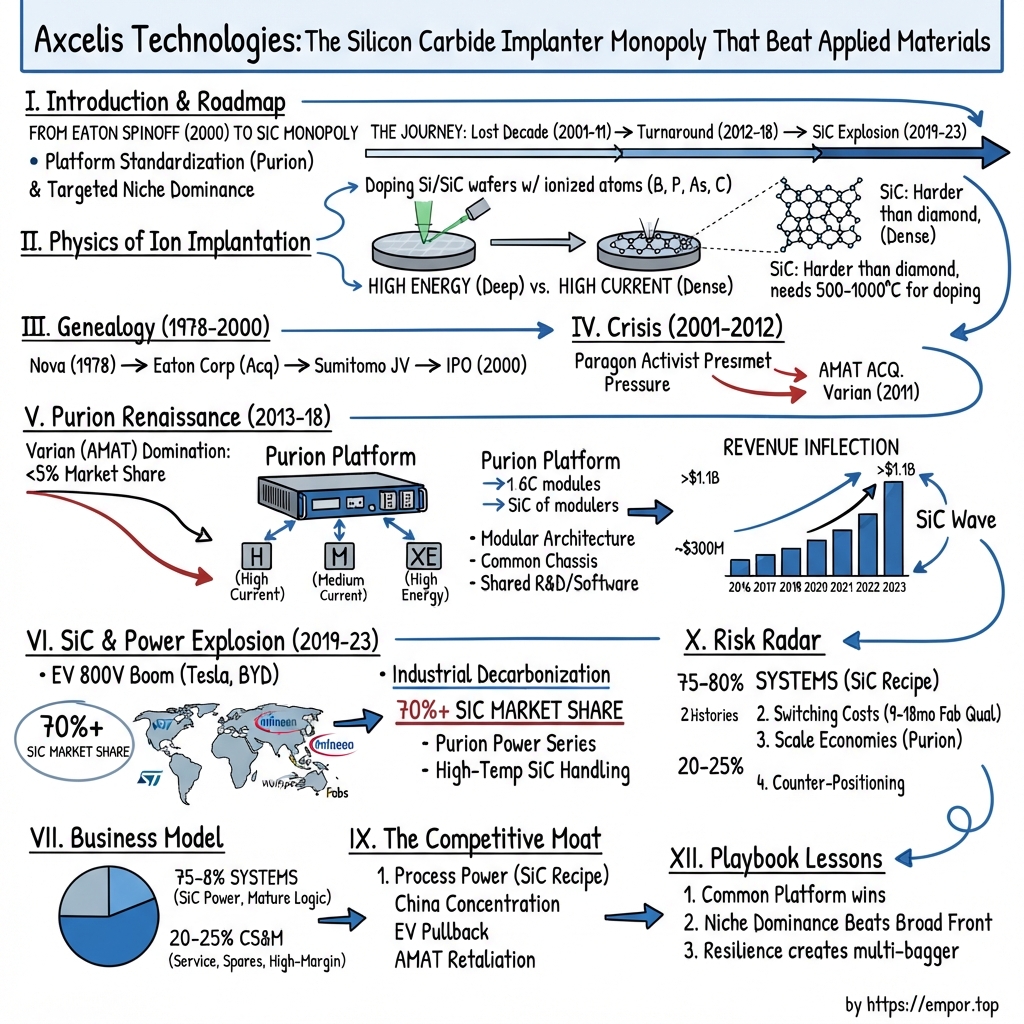
Axcelis Technologies: The Silicon Carbide Implanter Monopoly That Beat Applied Materials
I. Introduction & Episode Roadmap
On the morning of August 6, 2026, a Massachusetts semiconductor equipment manufacturer that few mainstream investors recognized twenty years ago opened an earnings call with a strict restriction. "Given the pending merger with Veeco, we will not be addressing questions related to the transaction," said David Ryzhik, the interim chief financial officer, before turning the call over to Chief Executive Officer Russell Low.1 Axcelis Technologies then reported second-quarter results that topped its own forecasts — generating $215 million in revenue and $1.06 in diluted earnings per share — while raising its full-year outlook from flat performance to mid-single-digit growth.12
The setup reflects a long-standing pattern. Axcelis has spent a quarter-century being underestimated, overlooked, and nearly liquidated before a decade of targeted engineering established it as a market leader. Now, just as its business model has achieved widespread recognition among generalist investors, the company is preparing to combine with Veeco Instruments in a merger of equals that will create a new corporate entity, name, and stock ticker.3
Testing the assumptions behind the company's reputation requires scrutinizing the core claims of its market positioning.
First, is Axcelis a true monopoly in silicon carbide ion implantation? Strictly speaking, it is not, and the company has never published precise market-share figures for this niche. What Axcelis has claimed publicly, and what commercial orders and product documentation confirm, is more specific: it was "first to market with a full portfolio of implanters" engineered for high-volume power device manufacturing, spanning high-current, medium-current, and high-energy systems across silicon carbide, silicon, gallium nitride, and gallium arsenide substrates.4 That assertion describes product breadth rather than absolute market ownership.
Unverified third-party estimates place Axcelis's silicon carbide implant market share anywhere from two-thirds to nearly the entire market. Because these estimates cannot be audited, investors should evaluate concrete operational signals instead: customer tool qualifications, repeat order velocity, and whether competitors are capturing the specific applications Axcelis targets.
Second, did Axcelis "beat" Applied Materials? Only within a specialized niche. Applied Materials established its dominance in ion implantation in 2011 by acquiring Varian Semiconductor for $4.9 billion — a transaction driven by Varian's market gains against Axcelis over the preceding decade.56 Fifteen years later, Axcelis remains an independent operator, significantly larger than before, and established as the reference supplier for high-energy implant and power devices. Yet Applied Materials maintains far greater overall scale and holds the leading position in front-end, leading-edge high-current implantation. Rather than a total victory, Axcelis survived a severe competitive contraction and carved out market segments that its larger rival chose not to prioritize.
The company's financial trajectory highlights its cyclicality. Revenue stood at $267 million in 2016, expanded to $1.13 billion by 2023, and then contracted to $1.02 billion in 2024 and $839 million in 2025 — an 18% single-year drop.[^7]2 Net income tracked this cycle, rising from $11 million in 2016 to $246 million in 2023, before falling back to $120 million in 2025.[^7] Return on invested capital peaked near 24% in 2023 before compressing below 9% in 2025.
These financials do not reflect a simple linear compounder. They describe a cyclical capital-equipment business whose structural trough has moved higher — making the cause of that elevated floor the central investment question.
Two common market assumptions also require clarification.
Myth: Axcelis is strictly an electric vehicle play. Reality: Although silicon carbide drives strong growth, mature-node applications more broadly — including power devices, microcontrollers, analog chips, and image sensors — represented approximately 84% of system shipments in the second quarter of 2026, while aftermarket services generated 39% of total revenue.1 Evaluating Axcelis solely against global EV adoption trends misjudges both growth opportunities and downside exposure.
Myth: The company relies dangerously on a handful of customers. Reality: Geographic concentration poses the primary risk. No single customer accounted for 10% or more of consolidated revenue in 2024, whereas China generated 42% of total revenue in 2025.1920 That geographic exposure presents distinct operational and regulatory risks.
Roadmap of the analysis: The study begins with ion implantation physics to establish the technical foundation of the company's moat. It then traces Axcelis's corporate history from its 1978 origins in Beverly, Massachusetts, through its corporate spinoff at the height of the dot-com bubble, its near-collapse in 2008–2009, the strategic Purion platform rollout, and the subsequent silicon carbide expansion. Finally, it examines segment economics, leadership performance, competitive positioning, key bear-case risks, and three core operational metrics, alongside an evaluation of the pending Veeco merger.
 Subscribe on LinkedIn
II. The Physics & Technology of Ion Implantation
Picture a particle accelerator operating inside a cleanroom 24 hours a day, seven days a week, shooting atoms into silicon discs at a rate of several hundred per hour without missing.
That is an ion implanter: a compact industrial particle accelerator and one of the most specialized tools in the semiconductor manufacturing chain.
Understanding why ion implantation matters requires examining how semiconductors function. Pure crystalline silicon is a poor conductor. It becomes useful only when deliberately contaminated through "doping" — inserting foreign atoms such as boron, phosphorus, or arsenic into the crystal lattice so specific regions carry a surplus or deficit of electrons. Those doped regions form the sources, drains, wells, and channels of a transistor. Doping is what transforms silicon into logic.
For decades, chipmakers relied on thermal diffusion: heating wafers in a furnace filled with dopant gas and allowing physics to drive the atoms inward. While functional, diffusion lacked precision. Ion implantation replaced it with a controlled physical process. Dopant atoms are stripped of electrons to form ions, sorted by mass through a magnetic filter to isolate the precise isotope required, accelerated through an electric field, and driven directly into the wafer. Controlling voltage determines energy depth, while counting the ions regulates the exact dose. This capability — known in the industry as dose repeatability — is the central metric chipmakers evaluate when purchasing implanters.
The equipment market falls into three distinct categories based on energy and beam current, a distinction central to Axcelis's corporate strategy:
High-current implanters fire large volumes of ions at low energy levels. They create the shallow, heavily doped junctions near the wafer surface that form the backbone of advanced logic and memory chips. This category represents the largest share of the ion implantation market by dollar value, and it historically represented Axcelis's weakest position.
Medium-current implanters prioritize precision over volume. They perform delicate threshold-voltage adjustments that dictate when a transistor switches on, making them critical for manufacturing image sensors and precision analog chips.
High-energy implanters accelerate ions to millions of electron-volts to drive dopants deep into the substrate, forming the isolation wells and deep structures essential for power devices. These systems use radio-frequency linear accelerator beamlines similar to laboratory particle accelerators. Axcelis's Purion XEmax reaches implant energies up to 15 MeV using a dual linear accelerator architecture and what the company calls its patented Boost technology.1 Although high energy is the smallest of the three market segments, it is where Axcelis holds its strongest market position — a deliberate alignment rather than a historical accident.
The physics becomes significantly more challenging when manufacturing silicon carbide power devices.
Silicon carbide is an extraordinarily tough compound. Its lattice bond is so rigid that room-temperature ion bombardment shatters the crystal structure rather than integrating dopants into it. Unlike silicon, silicon carbide cannot be repaired with a standard post-implant thermal anneal.
To bypass this physical barrier, the industry relies on high-temperature processing: heating the wafer to several hundred degrees Celsius during implantation so the crystal lattice repairs itself in real time under ion bombardment. This requirement demands a machine capable of holding a wafer at extreme temperatures, translating and rotating it with micron-level precision, maintaining a high vacuum, and suppressing particle contamination over years of continuous operation. What appears to be a physics challenge is fundamentally a complex mechanical engineering problem.
Silicon carbide power devices also demand a higher density of implant steps and deeper energy penetration than standard silicon logic chips. As device designs transition from planar to trench architectures and superjunction structures, Chief Executive Officer Russell Low has repeatedly highlighted this trend on earnings calls, noting that "as these devices become more complex, the density of implant steps goes up, and it also tilts towards high energy."1 That technical shift directly favors Axcelis: its weaker position in high-current tools against Applied Materials matters less in power applications, while its strength in high-energy tools becomes increasingly critical with each new device generation.
Beyond physics, equipment selection is governed by economic cost of ownership. Semiconductor fabs evaluate implanters as long-term capital assets expected to run for a decade or more. Operating economics depend on throughput — wafers processed per hour — and machine uptime. A tool delivering flawless implants is economically unviable if maintenance keeps it idle one week per month.
This operational reality explains why product specifications focus heavily on reliability and yield. When Axcelis launched its Purion H6 high-current platform in February 2026, it described advances "across the beam line, source, particle control and dosimetry subsystems," delivering dose repeatability alongside improvements in "purity, precision and productivity" and "lower overall cost of ownership."20 Chipmakers ultimately purchase predictable manufacturing capability rather than raw physics metrics.
A final physical principle explains a major strategic move made decades later. Ion implantation inherently damages the wafer's crystal structure. That damage must subsequently be repaired and the dopant activated through a thermal step, typically using laser or rapid thermal annealing to heat the surface for milliseconds. Implantation and annealing represent two halves of a single process sequence, performed on the same wafer but historically supplied by separate vendors. That structural process link underpins the strategic logic of Axcelis's pending merger with Veeco Instruments.
This technical specialization raises a central question: if ion implantation is so difficult, essential, and specialized, how did the company that helped pioneer the technology end up near bankruptcy?
III. Genealogy & Early History: From Eaton Corporation to Spinoff (1978–2000)
The story begins in 1978 in Beverly, Massachusetts — a coastal town north of Boston with a shipbuilding history and an improbable legacy as the birthplace of commercial ion implantation. A company named Nova Associates established operations there to build high-current implanters for a semiconductor industry that was beginning to prioritize doping precision.7
Nova's early performance attracted an unlikely acquirer: Eaton Corporation, an industrial conglomerate primarily known for hydraulics, truck transmissions, and electrical equipment. Although semiconductor capital equipment shared minimal operational overlap with Eaton's core businesses, conglomerate strategy in the 1980s favored broad diversification, leading Eaton to build a semiconductor equipment division around Nova and related acquisitions.
Eaton's most consequential strategic decision was forming a Japanese partnership. In 1983, Eaton and Sumitomo Heavy Industries established a joint venture called Sumitomo Eaton Nova, or SEN, to manufacture and sell ion implantation products in Japan.8 At the time, the move was commercially sound: Japanese semiconductor fabricators represented the fastest-growing customer base globally, and a domestic partner provided essential market access.
The partnership secured an entrenched position in a critical market, but it also created a structural liability. A 50% equity stake in an un-controlled joint venture leaves an industrial parent unable to manage the asset directly or replace the partner. While Eaton gained immediate entry into a restricted market, Sumitomo secured manufacturing rights and, more importantly, direct customer relationships across Japan. Over two decades, those commercial ties accrued to the local operator rather than the overseas parent holding a half-interest. When the joint venture was eventually unwound, the partner with direct customer access held the strategic leverage.
By the late 1990s, Eaton concluded that its semiconductor equipment division was undervalued inside a diversified industrial parent. In 2000, near the peak of the technology market, Eaton prepared the unit for independence. It renamed the business Axcelis Technologies, completed an initial public offering on NASDAQ under the ticker ACLS on July 11, 2000, and raised approximately $360 million.9 On December 29, 2000, Eaton completed the separation by distributing its remaining 82% stake to shareholders as a spinoff dividend of roughly 1.1 Axcelis shares for each Eaton share.7
The timing proved challenging for the newly independent company and its shareholders. Axcelis gained independence in the final weeks of a major technology market valuation peak, entering an industry immediately preceding one of its sharpest cyclical downturns.
The company's initial product portfolio reflected its conglomerate parentage: a core franchise of NV and GSD high-current implanters, alongside dry strip cleaning systems and thermal processing equipment for photolithography — product lines linked by customer overlap rather than shared engineering. The 50% SEN interest transferred to Axcelis as part of the separation. While dry strip and thermal processing were established niches, they remained subscale, shared no technical synergies with the ion implantation business, and consumed management focus during an intensifying competitive landscape. Axcelis spent the next fifteen years streamlining its portfolio, eventually scaling back or exiting non-core product lines until ion implantation generated 98.3% of total revenue by the 2020s, with the remaining 1.7% coming from legacy aftermarket support.19
This structural origin left Axcelis with a mismatched asset mix for the decade ahead. Its core strength lay in high-current implantation, which was becoming the most technically demanding and fiercely contested market segment as transistor gate lengths shrank below 130 nanometers. Meanwhile, its Japanese distribution remained locked inside a joint venture controlled by a partner with competing ambitions, its secondary product lines were subscale distractions, and it possessed no significant presence in the high-energy or medium-current segments that would later drive its recovery.
Axcelis entered independent life facing both structural product mismatches and an aggressive rival located forty miles away in Gloucester, Massachusetts.
IV. The Lost Decade & Existential Crisis: The Varian Juggernaut (2001–2012)
Varian Semiconductor Equipment Associates was itself a spinoff — cut loose from Varian Associates in 1999, one year before Axcelis. The two New England implanter vendors entered independence chasing identical customers, setting up an intense decade of head-to-head competition.
Varian bet early on single-wafer high-current architecture with its VIISta platform, a technical direction that proved correct. As feature sizes shrank, the batch-processing architectures that had served the industry for years encountered hard physical limits: gate uniformity requirements tightened, contamination tolerances contracted, and real-time wafer characterization became essential to fab yield. Varian's tools met the stringent requirements of leading-edge logic and memory manufacturers. Once qualified for a specific process node, equipment typically secures repeat orders for every subsequent fab build across a customer's global footprint.
Axcelis lost significant ground. Its overall ion implant market share contracted from a dominant position in the late 1990s to single digits by the early 2010s. Financial reports tracked the operational damage: revenue reached $203 million in 2012 alongside a net loss of $34 million, dropped to $196 million in 2013 with a $17 million loss, and edged up to $203 million in 2014 with an $11 million loss.[^7] Three consecutive years of roughly $200 million in revenue paired with persistent losses signaled a business struggling to justify its independent existence rather than enduring a routine cyclical trough.
The company's most acute existential crisis occurred earlier in the downturn.
In February 2008, Sumitomo Heavy Industries — Axcelis's joint venture partner — partnered with private equity firm TPG to submit an unsolicited acquisition proposal of $5.20 per share, valuing Axcelis at approximately $544 million.10 The Axcelis board unanimously rejected the offer. Sumitomo raised its bid to $6.00 per share in March; the board rejected that offer on March 17, 2008, arguing it failed to reflect market-share gains from new products.1112 Shortly thereafter, the global financial crisis severely depressed semiconductor equipment demand, sending Axcelis's stock price to a fraction of the rejected offers.
By early 2009, Axcelis defaulted on its 4.25% convertible senior subordinated notes, prompting the note trustee to file suit.13 Facing frozen credit markets and no viable refinancing options, the company monetized its primary asset. On February 26, 2009, Axcelis agreed to sell its 50% interest in Sumitomo Eaton Nova (SEN) to Sumitomo Heavy Industries for ¥13 billion, or approximately $133 million.13 The transaction closed on March 30, 2009, generating roughly $122.3 million in net proceeds, of which $86.4 million was immediately applied to settle the defaulted convertible notes.14
Evaluating that sequence illustrates the narrow margin between strategic conviction and fortune. Rejecting Sumitomo's $6.00-per-share buyout only to sell the Japanese joint venture at a distressed valuation thirteen months later damaged near-term shareholder value. While long-term equity holders eventually saw recovery over the following decade, Axcelis's survival depended less on board foresight than on holding an asset that a solvent partner urgently wanted to consolidate.
The competitive landscape shifted decisively on May 4, 2011, when Applied Materials announced an agreement to acquire Varian Semiconductor for $63 per share in cash — approximately $4.9 billion — describing Varian as "the leading supplier of ion implantation equipment used by chip makers around the world."5 The deal closed on November 10, 2011.6 At the time, Applied Materials estimated the annual market opportunity for ion implantation at nearly $1.5 billion.5
The prevailing market consensus was clear: the world's largest semiconductor equipment vendor had absorbed the market's leading implanter manufacturer, leaving Axcelis as a sub-$200 million standalone supplier burdened by recurring losses.
The primary risk for Axcelis was commercial rather than purely technical. Applied Materials sold deposition, etch, metrology, and now ion implantation to the same corporate procurement divisions. At leading-edge foundries and memory chipmakers — including TSMC, Samsung, and Intel — a vendor with such broad product reach could bundle toolsets, structure multi-year service agreements, and raise significant barriers against single-product competitors.
An independent single-product vendor lacked comparable commercial leverage, relying entirely on tool-by-tool performance evaluations. In 2012, Axcelis was failing to win those evaluations at the leading edge.
However, that bundling advantage had structural limits. Bundling is highly effective when customers purchase comprehensive leading-edge process flows, but far less decisive at specialized power device fabs in Europe or Asia buying targeted high-energy implanters for specific silicon carbide process steps. For those manufacturers, ion implantation is the core process enabler rather than one line item among dozens. Applied's scale advantage did not extend into those specialized niches, opening a strategic niche that Axcelis would exploit over the subsequent decade.
Activist investor pressure mounted soon after. In March 2015, Vertex Capital Advisors disclosed a 6.7% stake representing over $20 million invested, publicly criticizing the board for poor operating performance, weak corporate governance, and unsatisfactory multi-year shareholder returns.15 Vertex cited cumulative operating losses exceeding $153 million over ten years, substantial director compensation despite value destruction, and executive management holding less than 2% of outstanding shares.15 Axcelis responded by appointing three new independent directors, implementing cost cuts, and appointing an independent board chair, though Vertex called the response insufficient and nominated its own director slate.15
Chief Executive Officer Mary Puma resisted pressure to sell or liquidate the business. Instead, management committed to a major engineering initiative that had been quietly underway in its development labs — representing the largest strategic gamble in Axcelis's history.
V. The Purion Renaissance: Redesigning the Company on One Modular Architecture (2013–2018)
Around 2011, Axcelis faced a daunting operational challenge. The company was maintaining three separate legacy product lines — NV, Optima, and GSD — each with its own chassis, control software, spare parts inventory, field service training program, and research budget. Against a competitor backed by the scale of Applied Materials, this structural fragmentation meant that every research dollar was split across three separate platforms before reaching a customer problem.
Management chose to halt the fragmented approach completely. Rather than consolidating gradually or maintaining legacy tools while building a separate platform, Axcelis committed to rebuilding its entire product portfolio around a single common architecture: Purion.
The core engineering premise rested on a key physical reality: the three main ion implant categories differ primarily in the beamline — the subsystem that accelerates and shapes the ion beam — while sharing nearly all other functions. Subsystems such as wafer handling, vacuum environment, control electronics, software, dosimetry, particle control, and the single-wafer end station could be standardized. By developing a unified base platform capable of handling more than 500 wafers per hour, Axcelis could attach a high-current beamline, a medium-current beamline, or a radio-frequency linear-accelerator high-energy beamline based on specific customer requirements.16
Executing this transition presented significant organizational and commercial risks. Unifying three distinct product lines required reallocating engineering resources away from legacy tools, communicating product roadmap changes to existing customers, and weathering a multi-year period of heavy capital investment before the new platform generated meaningful revenue.
Axcelis executed this strategy while operating at a net loss, facing activist investor pressure, and competing against Applied Materials' newly expanded scale. Rather than harvesting legacy assets to protect near-term cash flow, management prioritized a comprehensive architectural rebuild.
The product rollout proceeded sequentially. In 2013, Axcelis placed its medium-current Purion M tool into evaluation with two new customers and introduced the high-energy Purion XE system. Management designated the architecture as "the foundation for all future generation Axcelis implanters," emphasizing shared ion-source technology and an ultra-pure beamline across the family.16 By early 2014, Chief Executive Officer Mary Puma informed investors that the full Purion product family was in place, positioning the company to capture market share as industry demand recovered; system sales rose 27% sequentially in the first quarter of 2014 on early customer acceptance.17
The economic advantages of this common architecture manifested across four key operational areas:
Cost efficiency: A single standardized chassis unified the supply chain, manufacturing flows, and assembly tooling, allowing volume across all three product lines to benefit from a common bill of materials.
Research and development leverage: Engineering enhancements in particle control, dosimetry, or wafer handling immediately deployed across the entire product suite, magnifying the operational impact of Axcelis's smaller research budget relative to Applied Materials.
Field service productivity: Service operations consolidated around a single training curriculum, spare-parts inventory, and diagnostic toolset, significantly reducing field maintenance overhead across global semiconductor fabs.
Customer qualification velocity: Tool qualification represents a primary commercial barrier in equipment sales. Once a semiconductor fabricator qualified the Purion platform for one manufacturing step, certifying a sibling system with a different beamline proceeded significantly faster because the underlying wafer handling, software, and contamination baselines were already established. This dynamic lowered customer adoption barriers while establishing high switching costs for prospective competitors.
Financial results tracked this product adoption with a standard capital-equipment lag. After revenue hit $203 million alongside net losses in 2014, sales rose to $301 million in 2015, dipped to $267 million in 2016 with $11 million in net income, and then expanded to $411 million in 2017 and $443 million in 2018. By 2018, net income reached $46 million and operating margins rose into the low teens.[^7] Gross margin — the clearest operational indicator of platform efficiency — expanded from approximately 35% in 2014 to the low 40% range by 2018.[^7]
Two analytical caveats provide necessary perspective on this turnaround.
First, the 2015–2018 recovery occurred during a broad industry-wide expansion in semiconductor capital expenditure. While isolating Purion's specific contribution from overall market growth is difficult, Axcelis expanded both its gross margins and market share within the cycle, retaining those structural gains through the subsequent 2019 industry downturn.
Second, the Purion platform did not displace Applied Materials in leading-edge high-current logic manufacturing. Instead, Purion established Axcelis as a cost-effective, technically differentiated supplier in mature-node segments and high-energy applications where Applied held a less dominant position.
That high-energy positioning ultimately positioned Axcelis to capture an emerging demand wave.
VI. The Silicon Carbide & Power Semiconductor Explosion (2019–2023)
In the late 2010s, the automotive industry confronted a physical constraint in electric vehicle design. Extending vehicle range and reducing charging times required higher powertrain voltages. Transitioning from a 400-volt to an 800-volt architecture allowed manufacturers to deliver equal power at half the current, reducing heat generation, cable weight, and charging duration. However, traditional silicon insulated-gate bipolar transistors lose operating efficiency at 800 volts. Silicon carbide semiconductors — featuring a wider bandgap, higher breakdown voltage, and superior thermal conductivity — overcome that limitation.
Chief Executive Officer Russell Low framed the transition plainly, noting that "when you get to 800-volt systems, you pretty much don't have a choice as to whether or not to use silicon carbide."1
For an ion implanter manufacturer, an 800-volt EV architecture creates compounding demand across multiple vehicle subsystems. The traction inverter represents the primary application, followed by the DC-to-DC converter, the onboard charger, and more recently, as Low highlighted, the electric air-conditioning compressor.18 Because each component requires multiple high-temperature, deep-energy implant steps, silicon carbide adoption increases the volume of implant steps required per vehicle alongside total EV production growth.
Through its earlier strategic pivot toward high-energy tools, Axcelis had developed an architecture directly suited to this market shift. The Purion XE was already established as a reference system for deep implant steps. Axcelis adapted these capabilities into the Purion Power Series, creating a dedicated tool family designed to process 150-millimeter and 200-millimeter wafers, maintain high-temperature implant environments, and handle fragile power-device substrates.
The commercial response drove rapid financial expansion. Annual revenue rose from $343 million in 2019 to $475 million in 2020, $662 million in 2021, $920 million in 2022, and $1.13 billion in 2023 — expanding more than threefold over four years.[^7] Net income scaled from $17 million to $246 million over the same period. Operating margin expanded from roughly 7% in 2019 to 23.5% in 2023, while gross margins reached the mid-40% range.[^7] Free cash flow expanded to $204 million in 2022 and $136 million in 2023, building a debt-free balance sheet.[^7]
These financial figures reflect the underlying capital structure of the business model. Axcelis nearly tripled revenue while maintaining capital expenditures at 1% to 2% of annual sales.[^7] The company outsources sub-assembly manufacturing, retaining only final assembly, beam calibration, and testing at its Beverly facility. Operating an asset-light model allowed return on invested capital to peak in the mid-20% range during high-volume periods, though this operational leverage also accelerates profit compression during demand contractions.
While electric vehicles represent the primary growth catalyst, management has sought to demonstrate broader silicon carbide adoption across industrial and energy sectors. On the fourth-quarter 2025 earnings call, executives outlined applications spanning solid-state transformers, industrial circuit breakers, solar and battery inverters, commercial HVAC systems, motor drives, and aerospace systems.20 On the first-quarter 2026 call, Low highlighted consumer appliance adoption — specifically high-end refrigerators, washing machines, and air conditioners operating near one kilowatt — driven by tightening regulatory efficiency standards.18
Although these non-automotive applications individually generate lower volume than vehicle manufacturing, together they broaden the customer base beyond a single end market. However, their smaller scale means they cannot fully offset an automotive downturn.
The customer base expanded to include major European and American integrated device manufacturers, alongside domestic Chinese fabricators building mature-node and silicon carbide capacity. Axcelis does not publicly disclose individual customer revenue allocations on earnings calls, and annual SEC filings show that no single customer accounted for 10% or more of consolidated revenue in 2024.19
By 2024, rapid expansion gave way to a cyclical contraction. Fab construction outpaced near-term end-market demand, global electric vehicle sales growth slowed, and Chinese fabricators entered a period of capital digestion following aggressive capacity expansion. Annual revenue contracted to $1.02 billion in 2024 and $839 million in 2025 — a 26% peak-to-trough drop over two years.[^7]2 By the fourth quarter of 2025, management reported that customers were taking "a disciplined approach to capacity investments following the significant build-out a few years ago," acknowledging that near-term demand for silicon carbide implanters would "remain muted."20
This downturn illustrates the distinction between secular semiconductor adoption and capital equipment demand. Equipment revenues track changes in customer capacity expansion plans rather than absolute end-market utilization. Consequently, long-term growth in silicon carbide adoption can coexist with sharp single-year contractions in implanter shipments.
By mid-2026, order activity showed early signs of stabilization. Power-segment orders through the first half of 2026 exceeded average levels from the preceding two years. In the second quarter of 2026, Axcelis secured orders from two new silicon carbide manufacturers in China and received commitments for high-energy channeling tools designed for next-generation superjunction architectures.1
VII. Segment Breakdown, Business Model, & Hidden Drivers
Behind Axcelis's headline financial figures lie two distinct operating segments: original equipment systems and the aftermarket service business.
The systems business sells new implanters. In the second quarter of 2026, systems generated $132 million of the company's $215 million in total revenue.1 Highly cyclical and tied directly to customer capital expenditure budgets, this segment depends heavily on a physical constraint: cleanroom floor space. Management highlighted this bottleneck throughout 2026, emphasizing that customer demand in memory is limited not by end-market appetite, but by available cleanroom square footage. As Chief Executive Officer Russell Low noted, customers were "mostly focused on solving bottleneck issues in their existing fabs" until new cleanrooms come online.1
The distribution of system shipments reveals the company's operational focus. In the second quarter of 2026, mature-node applications represented approximately 84% of system shipments, with memory and advanced logic constituting the remainder.1 Within the mature-node category, revenue rests on two pillars: power devices — encompassing silicon carbide and silicon power — and "general mature" applications, which cover automotive microcontrollers, analog chips, image sensors, and power-management integrated circuits manufactured at 28 nanometers and above. Advanced logic remains a modest, exploratory position: Axcelis shipped one system in the second quarter of 2026 for materials-modification applications supporting 2-nanometer production, followed by a second system in the third quarter.1 Rather than a core franchise, this represents an initial foothold in leading-edge manufacturing.
Memory served as the primary swing factor in 2026. Following a depressed 2025 baseline, artificial intelligence demand for DRAM and high-bandwidth memory lifted memory system shipments in the first quarter of 2026 to their highest level since the fourth quarter of 2023.18 Low provided analysts with a framework to calculate market potential: every 100,000 wafer starts of new DRAM capacity requires approximately $150 million to $200 million in ion implantation capital, heavily weighted toward high-current tools.20 That metric highlights both the addressable expansion and the reality that Axcelis's realization of this revenue depends directly on its market share in high-current implanters.
The cleanroom floor-space constraint directly dictates the timing of memory tool installations. DRAM manufacturers facing AI-driven demand surges cannot instantly add cleanroom square footage. Instead, they must insert individual tools into existing facilities to resolve immediate operational bottlenecks, producing uneven quarter-to-quarter shipment patterns. A structural step-change in shipments depends on the completion of new manufacturing facilities.
Low directed analysts to the clearest industry example — SK hynix's planned four-fab Yongin cluster — identifying 2027 as the period when customers will begin taking delivery of systems to outfit that capacity.20 While publicly announced mega-fab projects offer capital equipment suppliers unusual long-term visibility, revenue timing remains tied to third-party construction schedules.
Customer purchasing behavior further complicates financial forecasting. Axcelis builds memory systems against customer demand projections, but formal purchase orders frequently arrive within the same quarter as tool delivery — sometimes only days before shipment. Coogan walked analysts through this explicitly on his final call, noting that while the company receives multi-quarter customer forecasts that have historically proven reliable, legal purchase orders follow late in the cycle.20 Consequently, spikes in memory demand flow directly into quarterly revenue without appearing in prior backlog reports — meaning backlog and book-to-bill metrics primarily reflect demand across power and general mature nodes rather than the total business.
The second business unit is CS&I — Customer Solutions & Innovation — representing the company's aftermarket operations. CS&I generated $83 million in the second quarter of 2026, accounting for approximately 39% of total revenue.1 This division encompasses spare parts, beamline consumables, maintenance contracts, and equipment upgrades.
CS&I serves as the primary structural buffer against equipment industry cyclicality. In 2025, when total company revenue contracted by 18%, CS&I revenue grew 14% year over year, driven by record performance in upgrades and maintenance services.20 That growth momentum continued into the first quarter of 2026, expanding by more than 30% year over year.18 Executive leadership emphasized that this resilience resulted from strategic planning rather than market chance, stating that CS&I "has been a deliberate multiyear strategic focus for us to drive growth and stability through market cycles."1
Equipment upgrades represent a particularly capital-efficient driver within the CS&I unit. In the fourth quarter of 2025, a silicon carbide customer converted its manufacturing tools from 150-millimeter to 200-millimeter wafers by upgrading installed Axcelis systems to the Purion Power Series+ platform within their existing cleanroom footprint.20
This retrofit strategy allowed the customer to transition to larger wafer sizes without consuming additional cleanroom space or repeating a lengthy vendor qualification process. For Axcelis, the conversion delivered high-margin aftermarket revenue while securing the account for a subsequent production cycle. Low characterized the conversion as "an upgrade on top of an upgrade," noting that only a small fraction of the installed base has completed the 150-to-200-millimeter transition to date.20
While upgrades provide an ongoing growth runway, they also create an internal commercial trade-off. Each field upgrade dampens demand for a brand-new system sale. However, financial mix analysis indicates that this trade-off supports profitability: upgrades generate gross margins above the corporate average, whereas new memory system shipments carry below-average gross margins.1
Geographic concentration presents a central operational exposure. China accounted for 42% of total revenue in 2025 and expanded its share through 2026, representing 40% of revenue in the first quarter and 46% in the second.201 South Korea represented the second-largest market at 26% in the second quarter of 2026, propelled by memory shipments, followed by Europe at 11%, the United States at 6%, Taiwan at 2%, and Japan at 1%.1 Order backlog stood at $452 million at the end of the second quarter of 2026, supported by $131 million in new bookings and a book-to-bill ratio near 1.0 for three consecutive quarters.1
A book-to-bill ratio persisting near 1.0 indicates that incoming order volume is matching current shipments rather than expanding them — reflecting operational stabilization rather than accelerating growth. Management's commentary aligned with this baseline, describing bookings as having grown slightly and "suggesting greater stability."1 This steady-state booking level presents a more conservative operational picture than the company's upwardly revised full-year growth outlook might suggest, highlighting a gap between order replenishment and projected revenue acceleration.
VIII. Management, Governance, & Capital Allocation Record
On May 11, 2023, Mary Puma handed executive leadership to a physical chemist who had spent seven years at the company following roles at three of its principal competitors.21
Dr. Russell J. Low holds a PhD in Physical Chemistry from Oxford University, an Executive MBA from MIT, and a bachelor's degree from Southampton University.21 Before joining Axcelis, he held management positions at Veeco Instruments, Applied Materials, and Varian Semiconductor — giving him direct operational experience inside the company's primary historical competitor, its acquirer, and its pending merger partner.21 At Axcelis, he directed Global Customer Operations and Engineering and was, according to the company's succession announcement, "instrumental in developing and launching" the Purion product line, including the Power Series.21
Low's communication on earnings calls reflects his technical background, offering detailed engineering explanations. For example, he has detailed why NAND layer-count scaling does not drive incremental implant demand while wafer-start additions do, and why high-bandwidth memory is "essentially DRAM stacked" and therefore does not change implant intensity.118
He has also taken a cautious stance when addressing prospective market opportunities. Asked during the second quarter of 2026 about indium phosphide implantation for optical data center components, Low downplayed the near-term commercial impact: "I think the implant opportunities are relatively small. I think there's much bigger opportunities in other technologies such as MOCVD."1 Similarly, when asked on the fourth-quarter 2025 call about securing long-term memory supply contracts during industry shortages, he noted, "whenever I hear about long-term contracts being signed, it always makes me a bit worried because I've kind of seen these happen before."20
Mary G. Puma served as chief executive officer from 2002 to 2023, a 21-year tenure spanning the competitive losses to Varian, the 2009 financial crisis, an activist investor campaign, and the subsequent Purion platform rollout. Prior to Axcelis, she spent 15 years at General Electric in marketing and general management before joining Eaton. She served as board chair from 2005 to 2015, remained executive chair until the 2024 annual meeting, and subsequently transitioned to a senior advisor role.21 Her leadership record reflects both the market-share contractions of the 2000s that prompted activist intervention and the single-platform strategy that underpinned the company's subsequent recovery.
The chief financial officer transition introduces a key governance dynamic. James Coogan, who served as CFO during the Purion expansion and was named designated CFO of the combined Axcelis-Veeco entity in October 2025, departed in March 2026 to accept a position in the aerospace industry.183 David Ryzhik, previously senior vice president of investor relations and corporate strategy, assumed the role of interim CFO while the company conducts a search for a permanent successor.18 Executive leadership framed the departure as an amicable transition, but the exit of a designated CFO during a pending $4.4 billion transaction leaves an interim executive overseeing financial integration planning prior to deal close.
Executive compensation structures emphasize variable incentives. Low's total reported compensation reached approximately $4.3 million in 2024 and $5.1 million in 2025, against a base salary of roughly $600,000 — positioning the majority of pay in equity and performance-linked incentives.26 However, total reported compensation increased in 2025 despite an 18% decline in annual revenue and a roughly 40% drop in net income.
This expansion occurred because proxy disclosure rules require reporting the grant-date fair value of multi-year equity awards rather than cash realized for single-year performance. Axcelis conditions executive incentive payouts on operating margin thresholds, multi-year revenue targets, and relative total shareholder return.[^28] Evaluating compensation alignment requires examining actual performance payout tables against operating results, particularly as the pending merger alters multi-year target comparability.
Capital allocation displays a consistent pattern of disciplined cash deployment.
Axcelis avoided large acquisitions during industry expansion periods, directing capital toward share repurchases instead — buying back $50 million in 2021, $57 million in 2022, $52 million in 2023, $60 million in 2024, and $121 million in 2025, totaling roughly $341 million over five years.[^7]
This strategy produced a counter-cyclical pattern, with peak repurchases occurring during the 2025 revenue downturn when share prices were depressed. Weighted average diluted shares declined from 34.3 million in 2021 to 31.7 million in 2025 — an 8% net reduction, accomplished while stock-based compensation averaged approximately 2.5% of annual revenue.[^7]
The balance sheet ended the second quarter of 2026 with $577 million in cash, cash equivalents, and marketable securities — including $175 million in long-term securities — alongside minimal debt.1 Free cash flow reached $107 million in 2025 despite lower sales, demonstrating cash generation during a cyclical trough.20 Approximately $110 million remained authorized under the share repurchase program at year-end 2025, though Axcelis paused repurchases during the first quarter of 2026 while navigating the pending Veeco merger.2018
This capital allocation framework carries distinct trade-offs. Maintaining a $577 million cash balance on an asset-light, debt-free business model provides downside protection but creates a drag on return metrics during industry expansions. Management relies on this liquidity buffer to sustain research funding through cyclical downturns; research and development spending remained steady near $109 million in 2025 despite an 18% revenue decline.[^7]
The pending Veeco combination marks a fundamental shift from Axcelis's historic reliance on organic investment and share buybacks. Structured as an all-stock merger of equals, the transaction dilutes existing Axcelis shareholders' ownership to approximately 58% of the combined entity.24 Consequently, future capital efficiency depends on the earnings power of the merged product portfolio rather than standalone cash generation.
The cyclical volatility of the business model is evident in return on invested capital, which expanded to approximately 24% in 2023 before contracting to 16% in 2024 and falling below 9% in 2025.[^7] While the substantial cash balance depresses calculated returns, operating leverage drives profit margins higher during demand surges and compresses them during contractions. As Ryzhik noted in the second quarter of 2026, Axcelis retains structural manufacturing capacity to support revenue "higher than we are today," where fixed-cost absorption would expand gross margins.1
IX. The 7 Powers, Industry Structure, & Competitive Moat
Analyzing the company's long-term position requires separating durable structural advantages from temporary market tailwinds. Hamilton Helmer's 7 Powers framework provides a useful benchmark, defining a true power as both a strategic benefit and an entry barrier that a competent, well-capitalized competitor cannot easily replicate.
Counter-positioning represents Axcelis's strongest structural advantage. When Applied Materials acquired Varian for $4.9 billion to secure a leading position in ion implantation, it concentrated capital on high-volume, sub-5-nanometer logic and memory high-current tools to justify the transaction price. That strategic focus left high-energy implantation for power devices — a smaller, technically distinctive market requiring specialized high-temperature engineering — relatively unaddressed by the market leader. Having lost ground at the leading edge, Axcelis pivoted into power semiconductors without risking an existing legacy franchise. This counter-positioning created a genuine structural barrier: for Applied Materials, diverting engineering resources to chase a niche with different economics and distinct customer sets would have diluted its core focus. Whether that competitive disincentive persists as power semiconductor demand expands remains a key strategic question.
Process power provides a meaningful, if less easily quantified, secondary moat. Accumulated expertise in high-temperature wafer handling, beam purity, particle control, and lattice-damage management in silicon carbide reflects over a decade of joint engineering with customers. Axcelis's stated ability to deliver 15-megaelectron-volt implants with what it describes as industry-leading beam purity, alongside its high-energy channeling capability for superjunction devices, represents the primary tangible outcome of that technical development.1 Because internal process know-how cannot be independently audited, the most reliable evidence of process power is customer purchasing behavior — specifically, semiconductor fabricators placing orders for Axcelis high-energy channeling tools targeted at device architectures that have not yet reached volume production.1
Switching costs are substantial and supported by customer behavior. Requalifying an implanter in an operational fabrication facility requires running test wafers, dedicating engineering resources, assuming yield risks, and conducting months of process characterization. Empirical evidence of these high friction costs appeared in the fourth quarter of 2025, when Axcelis received a high-current tool order from a leading North American memory manufacturer before the customer had completed its evaluation of an existing system.20 Similarly, the adoption of 150-to-200-millimeter upgrade paths demonstrates customer preference for modifying installed Axcelis platforms over qualifying competing tools.
Scale economies represent the weakest element of the company's competitive position. While the Purion platform created operational scale relative to Axcelis's legacy product lines by spreading research, development, and service costs across three tool classes, it does not provide scale relative to Applied Materials. The market leader's annual research budget exceeds Axcelis's total annual revenue. For context, Axcelis invested $109 million in research and development in 2025, representing roughly 13% of revenue — a sustained commitment for a company of its size, yet a fraction of its primary competitor's resources.[^7] Common platform efficiency allows a specialized supplier to operate profitably across industry cycles, but it does not eliminate the broader scale gap.
Evaluating the broader industry structure through Porter's Five Forces reinforces these dynamics:
Threat of new entrants: Very low. Constructing an ion implanter requires advanced accelerator physics, ultra-high vacuum engineering, precision robotics, an extensive patent portfolio, and a multi-year customer qualification record. Consequently, no new commercial entrant has successfully established a global footprint in ion implantation in over two decades.
Threat of substitutes: Extremely low. Ion implantation remains indispensable for precision doping in semiconductor manufacturing. The primary technical risk stems from changes in implant intensity rather than direct technology substitution. Device roadmaps that reduce the required number of implant steps per wafer represent the key risk, a dynamic Chief Executive Officer Russell Low has repeatedly noted regarding NAND flash memory, where higher vertical layer counts do not increase implant intensity.20
Supplier power: Moderate. Components such as specialized vacuum chambers, high-voltage power supplies, and beamline optical assemblies rely on concentrated supplier networks, though alternative vendors are available. External supply chain friction, including trade tariffs, emerged as a visible expense in 2026, with management estimating a full-year gross margin impact of less than 100 basis points.20
Buyer power: Moderate to high, and asymmetric. Semiconductor fabricators are highly concentrated and technically sophisticated. While switching costs protect existing tool placements, buyer leverage compresses pricing on new equipment evaluations — particularly in memory, where Axcelis acts as a challenger and management acknowledges that system sales carry below-average gross margins.1
Competitive rivalry: A structured oligopoly. Applied Materials serves as the primary global competitor, while Nissin Ion Equipment and SEN — now wholly owned by Sumitomo Heavy Industries — maintain strong regional positions in Asia. In addition, domestic Chinese equipment manufacturers are developing implanters with state support under Made in China 2025 initiatives. This emerging domestic group represents a key competitive consideration, given that China accounts for Axcelis's largest regional revenue share while simultaneously funding domestic alternatives.
Management's perspective on Chinese customer behavior outlines the company's defense against domestic substitution. "Our Chinese customers behave like any of our other customers," Low told analysts. "They absolutely want the best technology. They want world-class service and support... they need cutting-edge technology to give them the benefit in their own businesses that they're looking for to survive."20 Under this view, commercial fabricators focused on yield and unit economics will prioritize leading-performance tools over domestic alternatives until local substitutes achieve technical parity.
While this commercial rationale has held throughout recent trade tensions, it carries long-term structural limits. Historical patterns across Chinese industrial policy in solar energy, battery manufacturing, and flat-panel displays indicate that domestic technical capabilities often lag behind market leaders before scaling rapidly. Assuming domestic substitution risks are permanently deferred relies on a decade of favorable market conditions rather than guaranteed future isolation.
A synthesis of both analytical frameworks indicates that Axcelis possesses one strong but contingent advantage in counter-positioning, an unquantified process advantage, well-documented switching costs, and negligible relative scale power. This combination creates a functional competitive moat, though its ultimate durability depends as much on competitor resource allocation as on Axcelis's internal execution.
X. Activist Stress Test, Financial Performance, & Current Risk Radar
Imagine a skeptical fund manager building the short case in mid-2026. It would sound like this.
"You are being asked to pay for a secular growth story that has produced two consecutive years of revenue decline. Peak revenue was 2023. Since then, sales are down 26%, net income is down more than half, and return on invested capital has fallen from the mid-twenties to single digits. Nearly half of revenue comes from a country actively funding domestic replacements for the product, subject to an export-control regime that has tightened four times in five years and could tighten again with a signature. The company's answer to the cycle is a merger with a company in different markets — the classic move of a business that cannot grow organically — and the CFO who was supposed to run the combined entity quit before it closed. Meanwhile the stock has traded between $73.60 and $193.78 in twelve months. You are not buying a compounder. You are buying a cyclical at an uncertain point in the cycle with geopolitical exposure priced as though it were solved."[^7]22
That case has teeth. Here is what the evidence does and does not support in response.
On the cyclical claim: substantially correct, and management does not dispute it. The 2023 peak reflected a silicon carbide and China mature-node build-out that was always going to digest. What is testable is whether the trough is structurally higher than prior troughs. The evidence says yes: 2025 delivered $839 million of revenue, non-GAAP gross margin of 45.2% — up 30 basis points year over year despite the revenue decline — adjusted EBITDA of $177 million at a 21.1% margin, and $107 million of free cash flow.20 Compare that to the last real trough: $203 million of revenue and a $34 million loss in 2012. The floor has moved, and it moved because of CS&I and mix discipline, not because the cycle got gentler.
On China: the risk is real, specific, and partially disclosed. Since SMIC (中芯国际) was placed on the U.S. Entity List in 2020, Axcelis has required export licenses to ship to mature-process SMIC fabs — licenses it has to date obtained.23 The October 2022 framework, supplemented in October 2023, prohibited equipment shipments to Chinese customers producing advanced logic, DRAM, and NAND above specified parameters.23 In December 2024, Commerce created a new Export Control Classification Number covering certain 300mm ion implanters and added further Chinese customers to the Entity List.19 Axcelis quantified the expected 2025 revenue impact of the late-2024 rules at $20–50 million, later guiding toward the low end.19 The company's own disclosure is appropriately blunt: sales to Chinese customers "represent a higher risk than sales to customers in other international locations."19
The nuance worth holding: the controls have been aimed at advanced nodes, and Axcelis's China business is overwhelmingly mature-node power and general-mature. That is why it has continued shipping to substantially all Chinese customers.19 The tail risk is a regime extension down to 28nm and above — which would not damage Axcelis at the margin but would reprice roughly 40% of its revenue base. No amount of company execution mitigates that.
On concentration: the consensus assumption is wrong. The 10-K discloses that no customer represented 10% or more of consolidated revenue in 2024.19 Axcelis's risk is geographic and end-market concentration, not customer concentration — a meaningfully different and, on balance, less acute exposure.
On automotive and EV capex digestion: this was the actual 2024–2025 damage, and it is only partly resolved. The mechanism is worth stating precisely, because "EV slowdown" is too blunt. Axcelis does not sell to automakers; it sells to the power chipmakers who sell to them. Those chipmakers built silicon carbide capacity in 2021–2023 against forecasts that assumed a steeper EV adoption curve than materialized. When growth moderated, they did not cancel their long-term plans — they paused purchases and prioritized technology transitions inside existing capacity, which is exactly what management described through 2025.20 By the first half of 2026, power bookings had recovered to exceed the average of the prior two years, and management characterized the market as having moved "into recovery."1 That is one to two quarters of evidence. It is encouraging and it is not yet a trend.
A note on disclosure quality, since activists usually probe here first. Axcelis reports GAAP and non-GAAP results with reconciliation, and the gap has been material in specific periods — fourth-quarter 2025 GAAP EPS of $1.10 against non-GAAP EPS of $1.49, with the difference driven by merger transaction expenses, share-based compensation, and a one-time voluntary retirement program.20 The adjustments are conventional and the drivers are named rather than buried, which is better practice than much of the sector. The item requiring ongoing attention is merger-related expense, which has been recurring quarterly for nearly a year and is excluded from non-GAAP every time. Recurring exclusions eventually stop being one-time. Investors should follow GAAP free cash flow through the close, which captures the cash cost regardless of presentation.
On the AI data center angle: promising, small, and honestly framed by management — which is itself informative. The pitch is that as server racks migrate to 800-volt architectures, the power conversion chain from the grid down to the rack becomes wide-bandgap territory. Low's technical read is specific: gallium nitride inside the rack, silicon carbide handling the step-down from grid voltages of 13 kilovolts or more toward the rack.18 What is notable is how carefully management sizes it. Asked directly how much installed silicon carbide capacity serves data centers, Low declined to guess, noting Axcelis does not know what products customers build with its tools.1 Ryzhik called it "still low volume relative to EVs" and the ultimate size "TBD."18 For a company whose stock benefits from AI adjacency, that restraint is a meaningful credibility signal — and a reminder that the data center story is optionality, not a current earnings driver.
On the Applied Materials counter-offensive: unproven either way. There is no public evidence of Applied launching a dedicated wide-bandgap high-energy implanter to reclaim power share. But the strategic logic that protected Axcelis is weakening in one direction: as silicon carbide, silicon power, and gallium nitride grow with AI data center electrification, the power implant market gets closer to a size worth a giant's attention. Counter-positioning is durable only while the incumbent's disincentive holds. Investors should treat this as a monitored risk with no current data, not a resolved question.
On the Veeco merger: this is the largest unpriced variable, and it cuts both ways. The industrial logic is better than most merger logic. Announced October 1, 2025, the all-stock combination gives Veeco holders 0.3575 Axcelis shares each, leaving Axcelis holders with approximately 58% and Veeco holders 42% on a fully diluted basis, at an enterprise value of about $4.4 billion.324 Pro forma 2024 revenue was $1.7 billion with 44% non-GAAP gross margin, $387 million of adjusted EBITDA, and over $900 million of cash at close, creating the fourth-largest U.S. wafer fabrication equipment supplier addressing a market above $5 billion.24 Expected run-rate cost synergies are $35 million within 24 months.24 Low leads the combined company, Thomas St. Dennis chairs the board, Veeco CEO Dr. Bill Miller chairs a technology committee, and headquarters remain in Beverly.24
Recall the physics: implant damages the lattice, and anneal repairs it and activates the dopant. Veeco's core franchise is laser annealing, alongside ion beam deposition, MOCVD, single-wafer wet processing, and advanced packaging lithography.24 Combining implant and anneal is one of the few genuinely complementary pairings available in this industry — it is process-adjacent rather than merely customer-adjacent, which is the distinction most equipment mergers fail.
The offsetting facts: $35 million of cost synergy on $1.7 billion of pro forma revenue is about 2% — modest, and revenue synergies remain unquantified. Merger costs have been real and recurring, at $12 million of cash transaction expense in the first quarter of 2026 and $6 million in the second.181 Both shareholder bases approved on February 6, 2026, but as of the second-quarter 2026 call the deal still awaited approval from China's 国家市场监督管理总局 State Administration for Market Regulation — the sole outstanding condition, and one being adjudicated by the government of the country supplying nearly half of Axcelis's revenue, in a deal between two American equipment makers, during an active technology trade conflict.251 Management has reiterated a second-half 2026 close at every opportunity. That is a specific, falsifiable commitment, and it will be tested within months of this writing.
XI. The Investment Spine: Why Win / Why Not & 3 Critical KPIs
Strip away the narrative, and the core thesis reduces to a fundamental question: does Axcelis possess structural competitive advantages, or did it merely benefit from a favorable market cycle?
The bull case rests on four pillars of concrete operational evidence.
First, incumbency in power implantation is being renewed rather than merely defended. The key signal is customer order behavior at technological transition points rather than third-party market share estimates. In the second quarter of 2026, Axcelis secured orders from multiple customers for high-energy channeling implants supporting next-generation superjunction architectures.1 The company also completed a successful Purion XEmax evaluation at a leading foundry for power management integrated circuit production.1 Customers commit capital to the specific architecture they are actively designing, and current design choices favor Axcelis.
Second, the 150-millimeter to 200-millimeter wafer transition provides an ongoing, monetizable growth runway. Executive leadership confirmed that only a small portion of the installed base has completed this transition, with fabricators outside China moving first to capture unit-cost advantages.20 Each wafer-size conversion generates high-margin upgrade revenue while solidifying customer lock-in.
Third, expansion into memory represents structural market-share gains rather than routine cyclical recovery. Axcelis's historical strength in memory was concentrated primarily in South Korea. Recent commercial wins with a leading North American memory manufacturer — spanning an initial tool evaluation, follow-on orders for new fab builds, and a multi-system high-current order in the third quarter of 2026 — mark a strategic expansion into the single largest implant segment by dollar volume.201 Management's historical benchmark underscores the magnitude of this shift: prior peak DRAM-only revenue stood at approximately $90 million, achieved before these North American wins were secured.20
Fourth, the Customer Solutions & Innovation (CS&I) unit has demonstrably raised the company's structural earnings floor. Expanding aftermarket revenue by 14% during a year when systems sales contracted provides concrete evidence that the structural trough is higher than in previous cycles.20
The counter-arguments are equally distinct.
First, the recovery in power devices remains early and unconfirmed by backlog expansion. The book-to-bill ratio has hovered near 1.0 for three consecutive quarters, signaling order stabilization rather than growth acceleration.1 Quarterly bookings of $131 million against $215 million in revenue indicate that the company is shipping backlog faster than it is replacing it.
Second, geographic concentration in China remains an unhedgeable risk. Generating 40% to 46% of revenue within a single country creates combined exposure: China is simultaneously Axcelis's largest market, its primary regulatory friction point, the approving authority for the pending Veeco merger, and an active funder of domestic equipment substitutes.
Third, memory system shipments dilute near-term gross margins. Management acknowledges this trade-off, arguing that initial memory placements generate high-margin CS&I revenue over a tool's multi-year operational life.1 That lifecycle thesis is economically sound, but its financial payback unfolds across years rather than quarters.
Finally, the pending Veeco transaction introduces execution risk for an organization whose principal strength has been single-platform focus. Over the past decade, Axcelis concentrated its engineering and sales resources on one core technology. Combining with Veeco expands the operating footprint across five distinct product lines. Managing a broader portfolio during an interim chief financial officer transition increases integration risk.
Three core operational metrics offer the clearest evaluation of this trajectory.
1. Bookings and the book-to-bill ratio. Reported revenue reflects past deliveries, whereas bookings serve as the primary leading indicator for capital equipment demand. The critical benchmark is a book-to-bill ratio sustained above 1.0 across consecutive quarters, driven specifically by power and general mature applications rather than memory. Because memory orders typically book and ship within the same quarter, they exert minimal impact on order backlog and offer limited visibility into 2027 demand.20 A sustained book-to-bill above 1.0 driven by power and mature nodes would provide the most reliable evidence that the cyclical trough has passed.
2. CS&I revenue in absolute dollars and as a percentage of total revenue. This metric measures the strength of the structural floor. It combines installed-base growth, fab utilization, and tool upgrade adoption into a single operational figure. Because CS&I represents the sole business unit that expands during system sales downturns, tracking whether aftermarket growth persists during an equipment recovery will indicate whether its high-margin revenue represents a permanent annuity or a temporary buffer during cyclical slowdowns.
3. Gross margin trajectory. For a business characterized by high operating leverage and shifting product mix, gross margin serves as the definitive measure of pricing power, manufacturing absorption, and product mix discipline. Axcelis maintained a non-GAAP gross margin of 45.2% during a cyclical downturn in 2025, before guiding to the low-to-mid 40% range for 2026 as lower-margin memory shipments increased.20 Sustaining gross margins above the low-40% range during a memory shipment expansion would confirm that Purion platform economics are structural. Conversely, persistent margin compression below that threshold would suggest the company is discounting system prices to capture memory market share.
Secondary factors — such as electric vehicle sales data, China trade headlines, or single-quarter earnings beats — remain subordinate to these three core indicators.
XII. Epilogue & Playbook Lessons
There is a version of this story that gets told as a triumph, and it is not quite right.
The accurate version is stranger and more useful. A company was spun out of an industrial conglomerate at the top of a bubble with the wrong products for the decade ahead. It was systematically outcompeted by a better-engineered rival. It rejected a takeover, then nearly went bankrupt, and ultimately sold its Japanese franchise to the very bidder it had spurned in order to pay off defaulted notes.
It watched that rival get acquired by the largest company in its industry for $4.9 billion. It absorbed an activist campaign that called its returns "miserable" — an assessment that was, on the evidence of the preceding decade, accurate. Then it rebuilt every product line on a single architecture and waited.
Three core lessons survive scrutiny.
Platform architecture is a cost strategy that becomes a competitive strategy. The Purion consolidation was undertaken to survive a research and development spending deficit. What it produced was faster customer qualification, lower field support costs, and the ability to enter adjacent segments at low marginal cost. Companies operating with a fraction of a market leader's resources do not win by spending better; they win by spending once and deploying three times. The mechanism is unglamorous, and it remains available to almost any multi-product industrial company willing to endure the transition pain.
Niche dominance beats broad-front warfare — as long as the market leader's disincentive holds. Axcelis prospered in high-energy power implantation largely because Applied Materials directed capital toward higher-volume opportunities. That counter-positioning created a real and durable advantage, but it remains contingent and decays as the niche expands. The analytical requirement for investors is to evaluate annually whether the reason the market leader stayed away still applies. As silicon carbide and gallium nitride extend into AI data center power architectures, that market isolation becomes less certain with each passing quarter.
Surviving is an outcome, not a repeatable strategy. The popular narrative — that enduring a severe downturn creates massive upside when market tailwinds return — is dangerously incomplete. Axcelis survived 2009 because it happened to hold a monetizable joint venture stake and found a willing buyer. Most distressed companies lack that balance-sheet option. The transferable lesson is narrower: turning survival into a sustainable franchise required deciding, while still unprofitable, to direct scarce engineering resources toward a unified product architecture rather than defending three declining legacy platforms.
A fourth lesson concerns how investors interpret turnaround narratives. The Axcelis trajectory contains compelling narrative elements — an underdog surviving near-collapse to achieve technological relevance. Yet dramatic turnarounds are precisely the scenarios where market participants most frequently mistake cyclical recovery for secular growth and treat contingent advantages as permanent moats. The appropriate response is disciplined specificity: evaluate competitive moats against empirical evidence, size market niches conservatively, and recognize that the same company that expanded revenue from $267 million to $1.13 billion also experienced a 26% contraction over twenty-four months.
Axcelis stands as a specialized supplier that transformed historical losses into a defensible market position, generating positive free cash flow through an industry downturn while maintaining heavy geographic concentration in China and awaiting regulatory approval for a $4.4 billion transaction. The company's multi-decade trajectory from an industrial conglomerate spinoff to a power semiconductor implanter supplier is well documented, as is the reality that its current positioning rests on a corporate recovery it barely survived to execute.
The next operational chapter will not occur under the Axcelis name. If the pending merger closes on management's projected schedule, the company will combine into a new corporate entity under a different name and stock ticker — led by a chief executive who previously worked at both historical rivals, overseeing a portfolio that pairs ion implantation with thermal annealing. Whether that combination expands the combined entity's market reach or dilutes the single-platform focus that drove Axcelis's recovery remains the primary operational question for the merged business.
References
-
Axcelis Technologies (ACLS) Q2 2026 Earnings Call Transcript — The Motley Fool, 2026-08-13 ↩↩↩↩↩↩↩↩↩↩↩↩↩↩↩↩↩↩↩↩↩↩↩↩↩↩↩↩↩↩↩↩↩↩
-
Axcelis Announces Financial Results for Second Quarter 2026 — PR Newswire, 2026-08-06 ↩↩↩
-
Axcelis Technologies and Veeco Instruments to Combine, Creating a Leading Semiconductor Equipment Company — Axcelis Technologies Investor Relations, 2025-10-01 ↩↩↩
-
Axcelis Announces the Launch of the Company's New Purion Power Series+ Ion Implant Platform Designed for Next Generation SiC Power Devices — PR Newswire, 2025-09-08 ↩
-
Applied Materials Agrees To Buy Varian Semi For $4.9 Billion — Forbes, 2011-05-04 ↩↩↩
-
Applied Materials Completes Acquisition of Varian Semiconductor Equipment Associates — Applied Materials Investor Relations, 2011-11-10 ↩↩
-
Eaton Corp. completes Axcelis spin-off — Semiconductor Digest, 2001-01 ↩↩
-
Sumitomo launches hostile bid to buy Axcelis — EE Times, 2008 ↩
-
Eaton announces 'Axcelis' as name of chip equipment spin-off, registers IPO — EE Times, 2000 ↩
-
Axcelis Technologies Board of Directors Unanimously Rejects Unsolicited Takeover Proposal By Japanese Company Sumitomo Heavy Industries and TPG — GlobeNewswire, 2008-02-25 ↩
-
Axcelis Technologies in Agreement to Sell Its Interest in Joint Venture SEN Corporation to Sumitomo Heavy Industries — GlobeNewswire, 2009-02-26 ↩↩
-
Axcelis Technologies Completes Sale of Its Interest in Joint Venture SEN Corporation to Sumitomo Heavy Industries — GlobeNewswire, 2009-03-30 ↩
-
Vertex Capital Advisors Comments on Recent Axcelis Technologies Letter to Stockholders and Appointment of Three New Directors — PR Newswire, 2015-03-03 ↩↩↩
-
Axcelis Technologies Inc — Form 8-K, Exhibit 99.1 (Q2 2013 results and Purion platform update) — U.S. Securities and Exchange Commission, 2013 ↩↩
-
Axcelis Technologies Inc — Form 8-K, Exhibit 99.1 (Q1 2014 results and Purion family update) — U.S. Securities and Exchange Commission, 2014 ↩
-
Axcelis Technologies Inc — Form 10-Q for the quarterly period ended March 31, 2026 — U.S. Securities and Exchange Commission, 2026 ↩↩↩↩↩↩↩↩↩↩↩
-
Axcelis Technologies Inc — Form 10-K for fiscal year 2024 — U.S. Securities and Exchange Commission, 2025-02-28 ↩↩↩↩↩↩↩↩
-
Axcelis Announces Financial Results for Fourth Quarter and Full Year 2025 — PR Newswire, 2026-02-17 ↩↩↩↩↩↩↩↩↩↩↩↩↩↩↩↩↩↩↩↩↩↩↩↩↩↩↩
-
Axcelis Technologies Announces CEO Succession — PR Newswire, 2023 ↩↩↩↩↩
-
Axcelis Technologies Inc (ACLS) Stock Market Data — The Wall Street Journal ↩
-
Axcelis Technologies Inc — Form 10-K for fiscal year 2023 — U.S. Securities and Exchange Commission, 2024-02-23 ↩↩
-
Axcelis and Veeco to merge, forming fourth largest US wafer fabrication equipment supplier — Semiconductor Today, 2025-10-02 ↩↩↩↩↩↩
-
Axcelis Stockholders Approve Merger with Veeco — PR Newswire, 2026-02-09 ↩
-
Axcelis Technologies, Inc. — SEC EDGAR company filings index (CIK 0001113232), including annual proxy statements — U.S. Securities and Exchange Commission ↩
 LinkedIn
 WhatsApp
 Reddit
 Hacker News
 Email
Email Kindle
 RSS Feed
 Spotify
 Apple Podcasts
 Amazon Music
 Audible
 YouTube