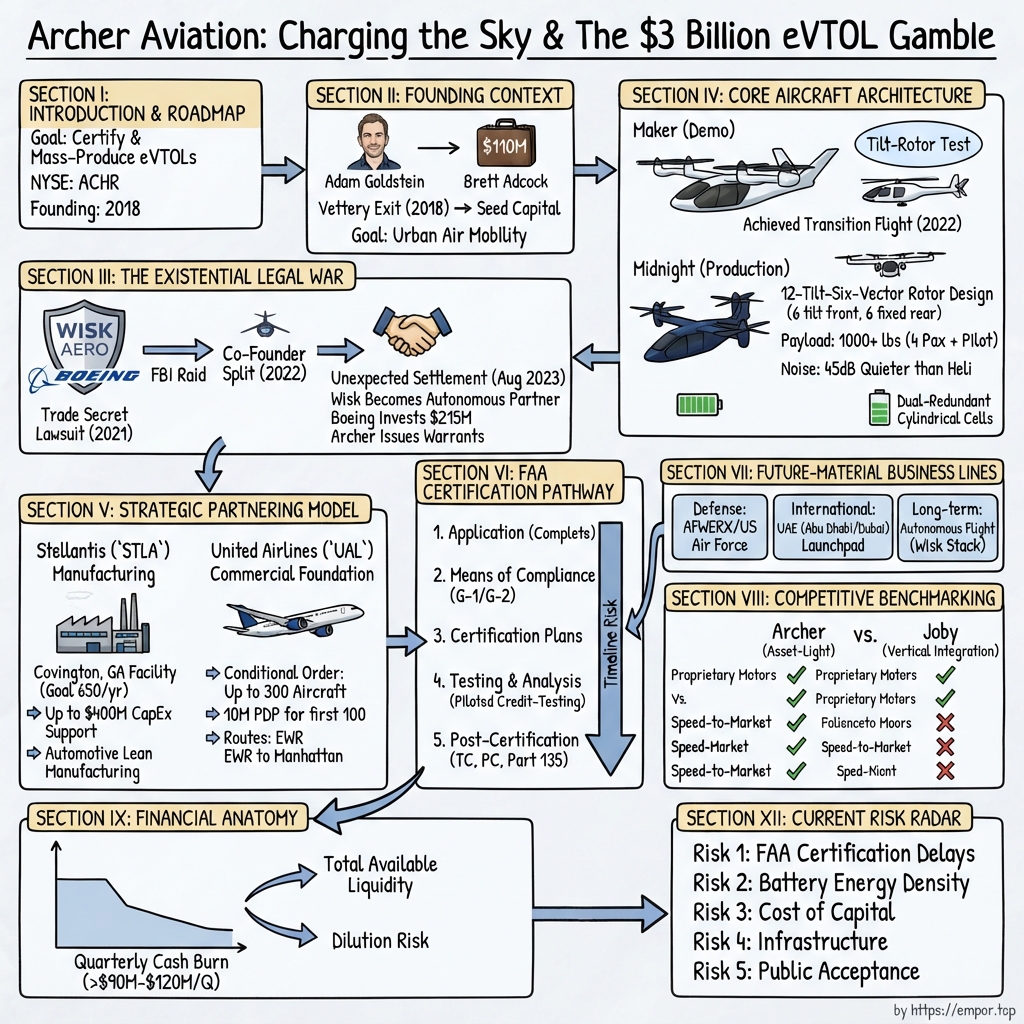
Archer Aviation: Charging the Sky & The $3 Billion eVTOL Gamble
I. Introduction & Episode Roadmap
On the morning of August 10, 2026, Archer Aviation issued an earnings release that appeared routine on its surface: a quarterly loss update, spending figures, and a note on certification progress. Buried near the top, however, was an announcement that altered the company's trajectory. Archer had signed definitive agreements to acquire three Boeing subsidiaries—Wisk Aero, Insitu, and SkyGrid—paying entirely in its own stock, handing Boeing roughly a fifth of the company and a seat on its board.12
That transaction carries deep corporate history. Wisk Aero is the entity that sued Archer in 2021 over allegations of trade-secret theft—a lawsuit that once threatened to derail Archer before it had flown a meaningful mission. Five years later, Archer agreed to acquire the company.
That single deal illustrates why Archer is one of the most complex businesses on the New York Stock Exchange to evaluate. Founded in 2018 by two software entrepreneurs with no aerospace background, Archer set out to design and certify an all-electric vertical takeoff and landing aircraft, or eVTOL. The vehicle was designed to carry four passengers plus a pilot on 20-to-50-mile trips at speeds up to 150 mph, turning an hour-long airport commute into a ten-minute flight.3 Archer went public in 2021 via a special-purpose acquisition company at an announced $3.8 billion enterprise value. After surviving the collapse of the broader SPAC market, it assembled a diverse roster of partners: Stellantis as contract manufacturer, United Airlines as launch customer, the United Arab Emirates as its initial international commercial market, Anduril as a defense partner, and now Boeing as its largest strategic shareholder.
Underneath that narrative lies a stark financial reality. Through the first half of 2026, Archer recorded a cumulative deficit of roughly $2.78 billion while generating just $5.3 million in lifetime revenue—almost all of it coming in the preceding two quarters, primarily from operating an acquired airport in Los Angeles rather than flying passengers.4 Against those cumulative losses, Archer held about $1.56 billion in cash and short-term investments while burning between $150 million and $190 million in free cash flow every quarter.4 The company has yet to deliver a certified aircraft, and its core product remains uncertified. In mid-August 2026, its stock traded around $6.62 within a wide 52-week range of $4.30 to $14.62—a volatility band reflecting deep market uncertainty over its valuation.5
The core debate for investors is not whether Archer's aircraft design is clever, but whether its asset-light, partner-dependent model can clear three formidable hurdles in sequence: the physical constraints of battery energy density, the Federal Aviation Administration's special-class airworthiness process under 14 CFR Part 21.17(b), and a nine-figure quarterly cash burn operating against a finite balance sheet.
This analysis examines those challenges in sequence. First, the founding: how a $100 million exit from a recruiting-software company funded an aerospace startup, and how aggressive hiring from competitors generated both Archer's early technical momentum and its existential legal battle. Second, the Wisk litigation—the sector's defining intellectual property clash—and its eventual settlement. Third, the aircraft design: explaining the "12-tilt-6" configuration and why rotor redundancy functions as a safety specification rather than a marketing angle. Fourth, the Stellantis and United partnerships that define Archer's capital strategy and operational dependency profile. Fifth, the FAA certification pathway, where enterprise value will ultimately be created or destroyed. Sixth, Archer's adjacent ventures—defense contracts, international launch markets, autonomous flight, and aviation artificial intelligence—which have evolved from speculative options into core strategic pillars. Finally, the analysis evaluates the competitive landscape against Joby, Beta, Eve, Vertical, and 亿航智能 EHang; details Archer's financial anatomy and dilution record; reviews the short-seller thesis and operational risks; and identifies the key performance metrics that will dictate the company's future.
Evaluating Archer requires a disciplined analytical posture. Management has proven adept at narrative, issuing frequent press releases that emphasize industry firsts. While several of these milestones are independently verifiable and substantial, others rely on self-defined criteria. In addition, a short seller has twice accused the company of misrepresenting its execution progress; Archer dismissed both reports as baseless without publishing line-by-line rebuttals.67 Sound analysis requires separating verified milestones—regulatory filings, cash movements, executed contracts, and delivered hardware—from corporate assertions. For a pre-revenue deep-tech enterprise, the gap between demonstration and assertion is the central investment question.
The story begins, improbably, with a website that helped software engineers find jobs.
 Subscribe on LinkedIn
II. Founding Context & The Vettery Liquidity Engine
In February 2018, the Swiss staffing conglomerate The Adecco Group announced its acquisition of Vettery, a New York online recruiting marketplace, for a reported price of around $100 million.8 Vettery matched job candidates with employers using algorithmic ranking rather than traditional headhunters. Co-founders Adam Goldstein and Brett Adcock, both in their early thirties, had built a successful business, though neither had designed an aircraft, earned a pilot's certificate, or worked inside an aerospace contractor.
By October of that year, they had launched Archer Aviation.[^9]
That background shaped Archer's corporate culture. The Vettery exit provided the founders with personal capital, venture credibility, and the confidence of entrepreneurs unencumbered by traditional aerospace development timelines. Goldstein has described the founding logic as defining the specific mission first, designing the aircraft around it, and avoiding iterative configuration changes. On Archer's first-quarter 2026 earnings call, he framed this as a day-one first-principles decision, noting that while legacy developers had spent a decade cycling through vehicle configurations, Archer committed early to a partial-tilt architecture optimized for short urban flights and certifiability.9
While this reflects management's perspective, it aligns with verifiable evidence: Archer's core configuration has remained fundamentally consistent since 2021, whereas several competitors have repeatedly altered theirs.
The central challenge for two software entrepreneurs was acquiring aerospace engineering capabilities at speed. Archer addressed this through aggressive recruitment, hiring engineers from leading electric-aviation programs, including Wisk Aero and its predecessors under Larry Page's Kitty Hawk, Boeing, Joby Aviation, and NASA. In a field where only a few hundred specialists worldwide had practical experience designing certifiable distributed electric propulsion systems, Archer sought to secure that scarce talent pool directly.
That aggressive hiring drive built early technical momentum, but it also planted the seeds of the sector's defining legal conflict in 2021.
The initial product vision was intentionally constrained. Rather than pursuing personal flying vehicles or long-range regional airliners, Archer focused on a specific, repeatable commute: carrying four passengers and a pilot on 20-to-50-mile routes at speeds up to 150 mph between city centers and airports, operating quietly over urban neighborhoods, and recharging rapidly between flights.3 Subsequent design choices—including rotor count, battery architecture, and cruise altitude—derived directly from this operational scope. Narrowing the initial design requirements simplifies the certification process, as every claimed operational capability requires formal regulatory validation.
The SPAC window
During the 2020–2021 boom in special-purpose acquisition companies, pre-revenue technology firms raised substantial capital based on long-term financial projections. Archer agreed to merge with Atlas Crest Investment Corp., a SPAC sponsored by Moelis & Company. Shareholders approved the transaction on September 14, 2021, with approximately 96% of cast votes in favor.10 The deal closed on September 16, and Archer shares began trading on the New York Stock Exchange under the ticker "ACHR" the following day.[^9]
The listing's underlying financial terms warrant scrutiny, as headline figures are frequently misstated. The transaction delivered approximately $857.6 million in gross proceeds, anchored by a $600 million private investment in public equity, or PIPE—falling short of the $1.1 billion totals cited in some accounts.[^9] That gap resulted from high redemptions: roughly 48.5% of eligible SPAC shareholders redeemed their shares rather than roll their equity into the combined company.10 Nearly half of the public vehicle's investors chose to exit rather than hold equity in an eVTOL developer valued at several billion dollars.
This redemption rate underscores early public market skepticism. However, the composition of the PIPE investors offered strategic support. Industrial and commercial partners including United Airlines and Stellantis took equity stakes alongside Baron Capital. Rather than purely speculative financial commitments, these positions represented strategic choices by corporate partners securing long-term supply and manufacturing relationships. Archer's ongoing strategy has relied heavily on converting these strategic relationships into broader capital backing.
Ultimately, Archer's early competitive edge lay in capital formation and talent acquisition rather than proprietary technology—skills well-suited to software founders, but subject to different constraints in a heavily regulated aerospace industry where regulatory proof supersedes speed of deployment. Within six months of listing, Archer faced the limits of that model.
III. The Existential Legal War: Wisk Aero & Boeing
On April 6, 2021—after Archer had announced its SPAC merger but months before the deal closed—Wisk Aero filed suit in the U.S. District Court for the Northern District of California.11 Wisk, a joint venture owned by Boeing and Kitty Hawk, alleged that Archer had misappropriated 52 trade secrets covering the designs and engineering documents underpinning Wisk's autonomous eVTOL program. The complaint's central allegation claimed departing engineers downloaded thousands of confidential files prior to joining Archer.
The timing created immediate operational vulnerability. Archer was mid-transaction, reliant on public-market capital, and facing public allegations that its core intellectual property was stolen. The lawsuit raised the prospect of an injunction that could freeze development. For an enterprise whose valuation depended on engineering momentum, an injunction represented an existential threat rather than a temporary delay.
Archer responded aggressively. It countersued, characterizing Wisk's allegations as a false smear campaign, and in 2022 sued Boeing directly seeking $1 billion in damages.12 Rather than mere bravado, the legal strategy served as leverage engineering: a defendant without counterclaims negotiates from weakness, whereas suing a plaintiff's corporate parent creates immediate strategic friction for a major aerospace contractor seeking to avoid high-profile litigation risk.
The dispute extended far beyond the courtroom. It absorbed leadership focus during a vulnerable period marked by declining eVTOL equity valuations, tightening capital markets for pre-revenue hardware developers, and the immediate operational necessity of building a demonstrator aircraft.
The co-founder split
In April 2022, Brett Adcock stepped down as co-CEO, ending his service on April 13 and announcing the transition on April 21.13 On May 9, he resigned from the board, stating publicly that his vision for Archer differed from that of the board.14 Adcock subsequently founded Figure, a humanoid robotics firm, leaving Adam Goldstein as sole CEO.
Co-CEO structures often prove fragile under corporate strain, particularly when an organization requires a single voice before regulators, investors, and industrial partners. Transitioning to a unified command provided executive clarity, but it also consolidated corporate governance. Goldstein retained super-voting Class B shares under Archer's dual-class equity structure, establishing a founder-centric governance model that, by 2026, enabled him to steer major strategic pivots.15 Concentrated control accelerates execution, but it also removes governance friction that might temper high-risk decisions.
The settlement, and what it actually bought
On August 10, 2023, Archer, Wisk, and Boeing reached a settlement without admitting liability.16 While complete financial terms were withheld, the transaction structure was significant: Wisk became Archer's exclusive autonomous flight technology provider for future uncrewed aircraft; Boeing joined a $215 million funding round alongside Stellantis, United Airlines, and ARK Investment Management; and Wisk received warrants to purchase up to 13,176,636 Archer shares at $0.01 per share.1217
Issuing warrants for 13.2 million shares at a penny apiece went beyond a routine settlement. It represented substantial equity compensation, effectively turning the plaintiff into a major shareholder with a direct interest in Archer's stock performance. Subsequent legal disputes over warrant exercise mechanics in 2024 revealed ongoing obligations, demonstrating that legal settlements do not always eliminate operational friction.
The relationship culminated three years later. On August 10, 2026, Archer agreed to acquire Wisk, Insitu, and SkyGrid from Boeing. In exchange, Archer agreed to issue Boeing Class A shares representing roughly 19.75% of Archer's pre-closing equity—about 16.5% of the post-transaction total—along with two warrants each granting rights to $100 million in stock.2 Boeing secured a board seat, agreed to share lockup terms, and maintained access to Wisk's autonomy software through a cross-licensing framework. The transaction remains subject to antitrust review under the Hart-Scott-Rodino Act, with closure targeted for late 2026.1
During an earnings call following the announcement, Goldstein framed the strategic alignment, stating, "If there ever were 2 eVTOL companies that could come together, it would be Archer and Wisk." He noted that both programs had independently selected a 12-tilt-6 rotor architecture, with Archer focusing on rapid commercialization and Wisk developing autonomous flight controls.4
Archer's path from 2021 to 2026 illustrates how intellectual property disputes in emerging technology sectors can evolve into structural consolidation. By leveraging its equity, Archer transformed an existential legal challenge into strategic partnerships, first through penny warrants and ultimately by ceding a sixth of the company to Boeing. However, neutralizing legal liability through share issuance converts litigation risk directly into equity dilution. The key question for investors shifts from legal survival to the underlying asset acquired through that equity: the aircraft itself.
IV. Core Aircraft Architecture: Midnight vs. Maker
Evaluating why electric vertical takeoff and landing aircraft present such steep engineering hurdles begins with the conventional helicopter. A standard helicopter relies on a single main rotor for lift, thrust, and directional control. That mechanical consolidation is mechanically elegant, but it creates a single point of failure: if the rotor mechanism fails, the aircraft must rely entirely on autorotation to land safely. While rigorous component inspection allows helicopters to operate routinely, they cannot match the statistical safety profile of commercial airliners, and their acoustic signature limits urban adoption.
Archer, along with much of the eVTOL sector, replaced that single large rotor with a distributed array of smaller ones—twelve in Archer's design.
The technology path began with a testbed. Maker was a two-seat demonstrator rather than a commercial product. Its primary objective was to validate three core parameters: tilt-rotor aerodynamics, acoustic models, and the critical transition phase—the moment when the aircraft shifts from vertical hover to wing-borne forward flight. Maker completed its first full transition in late 2022.
In eVTOL development, transition represents the primary aerodynamic hurdle. In hover, the rotors bear the entire weight of the aircraft at maximum power consumption. In cruise, the fixed wing provides lift while the rotors provide forward thrust. During the roughly 15-second transition window, aerodynamic forces shift rapidly, requiring flight control software to continuously blend two distinct flight regimes without creating instability or unexpected control forces for the pilot.
Midnight and the 12-tilt-6 logic
Archer unveiled its production aircraft, Midnight, in November 2022.3 Midnight features a "12-tilt-6" configuration: twelve total rotors mounted on wing booms, with the six forward rotors tilting to provide both vertical lift and forward thrust, while the six aft rotors provide vertical lift only before locking in a fixed, low-drag position during cruise.18
This architecture functions as a regulatory safety argument as much as an engineering choice. Distributing propulsion across twelve independent units ensures that the failure of a single rotor results in performance degradation rather than catastrophic loss. Power is distributed across six independent battery packs, each dedicated to a pair of electric engines, preventing a single electrical fault from disabling propulsion.19 For a regulator evaluating a novel powered-lift aircraft under commercial airliner safety standards, such redundancy is essential for airworthiness certification.
Midnight's published design parameters reflect a focus on short urban corridors: a maximum range of roughly 100 miles, cruise speeds up to 150 mph, an operating altitude around 2,000 feet, a maximum takeoff weight near 7,000 pounds, and a payload exceeding 1,000 pounds designed for four passengers, a pilot, and luggage.1819 The operational model prioritizes repeated 20-mile journeys with short charging intervals, making rapid recharging capability more vital to economic viability than maximum range.
Acoustic performance represents another core requirement of the distributed architecture. Twelve smaller rotors turn at lower tip speeds than a single large helicopter blade, reducing overall noise and shifting the acoustic spectrum to less intrusive frequencies. Archer targeted a noise level of roughly 45 A-weighted decibels at cruise altitude, which the company claims is substantially quieter than a conventional helicopter.3 A noise level of 45 dBA is comparable to quiet ambient sound in a residential neighborhood. However, operational noise levels under payload in urban environments remain to be independently verified.
The battery problem nobody has solved
The central physical constraint for eVTOL aviation is energy density. Jet fuel yields roughly forty times more energy per kilogram than commercially available lithium-ion battery cells. Consequently, an electric aircraft must devote a substantial portion of its maximum takeoff weight to batteries for modest range, without the benefit of becoming lighter as energy is consumed during flight.
Archer opted for a proprietary pack architecture using standard cylindrical lithium-ion cells rather than experimental chemistries—a pragmatic trade-off favoring supply-chain maturity and regulatory familiarity over peak energy density. The battery system incorporates dual-redundant power distribution paths designed to prevent thermal runaway in one module from propagating across the system.
Despite these safety features, energy density limits create ongoing operational trade-offs. Federal Aviation Administration rules require reserve energy margins upon landing. Accounting for these mandatory reserves, combined with battery efficiency loss in high ambient temperatures and a full passenger load, narrows the aircraft's usable mission envelope. Archer has not yet published verified payload-range performance metrics across adverse operating conditions.
By mid-2026, Archer had advanced its flight test program. On its second-quarter earnings call, management disclosed that the test fleet had completed over 150 piloted test flights, reached operational cadences of up to five flights per day, conducted flights exceeding 50 miles, and completed initial intercity flights in California, with full piloted transition planned for later in 2026.4 While these milestones demonstrate progress in flight testing, establishing commercial viability requires completing formal regulatory certification and scaling serial manufacturing.
V. The Strategic Partnering Model: Stellantis & United Airlines
Covington, Georgia, a city of about 15,000 people located roughly 40 miles east of Atlanta, was best known before 2023 as a filming location for television dramas. In 2024, Archer received the certificate of occupancy for a 400,000-square-foot aircraft manufacturing facility there, known as ARC.20 The building stands finished and equipped with tooling. What it lacks, as of mid-2026, is a type-certificated aircraft to build at commercial scale.
That gap—a complete factory awaiting regulatory approval—captures the central mechanism of Archer's corporate strategy.
The asset-light thesis
Early in its development, Archer made a foundational decision to forgo full vertical integration. Rather than manufacturing its own electric motors, operating its own commercial airline, or funding factory construction entirely out of its equity reserves, the company chose an asset-light framework. Archer opted to integrate proven components from tier-one aerospace suppliers, contract high-volume manufacturing to an established automaker, and rely on major airlines for distribution and customer access.
The strategic rationale for this approach is straightforward. Automotive manufacturers excel at high-volume production, building hundreds of thousands of complex assemblies annually at low unit costs through tightly managed supply chains. Traditional aerospace manufacturers, by contrast, build hundreds of units per year using capital-intensive, lower-volume processes. If the economics of urban air mobility are to succeed, production must achieve automotive scale while adhering to strict aviation safety standards.
However, contract manufacturing introduces distinct operational and financial risks. Delegating assembly surrenders long-term gross margin and creates ongoing operational dependencies. Archer does not fully control its manufacturing infrastructure, and its steady-state profit margins remain uncertain because the detailed commercial terms of its manufacturing arrangements have not been fully disclosed.
Stellantis: capital dressed as capability
Stellantis and Archer formally announced their manufacturing partnership in January 2023, designating Stellantis as the exclusive contract manufacturer for the Midnight aircraft.21 Construction on the Covington facility began later that year following an incentive agreement with local and state authorities.22
The partnership's financial framework, refined in August 2024, established terms for up to $400 million in support. This includes roughly $370 million to cover anticipated manufacturing labor costs funded by Stellantis, along with $20 million in capital expenditure support through 2030, designed to scale factory capacity toward 650 aircraft per year.23 Under the agreement, Stellantis receives compensation not in cash, but in Archer Class A shares issued quarterly based on labor costs incurred and Archer's prevailing stock price.23
This structure converts a substantial cash operating expense—factory labor—into ongoing equity issuance, conserving Archer's cash balance during its pre-revenue phase. By that point, Stellantis had invested nearly $300 million directly into Archer, including a $55 million equity injection in July 2024, establishing it as one of Archer's largest strategic shareholders.23
While this structure preserves liquidity during development, it introduces structural dilution risk. Every quarter of factory labor generates new share issuances tied to market prices. If Archer's stock price remains depressed, the volume of shares required to cover labor costs increases, shifting the long-term cost of factory operations directly onto existing equity holders.
United Airlines: validation, priced honestly
United Airlines entered the partnership in February 2021 through a commercial agreement, followed in April 2021 by a conditional purchase order for up to 200 Midnight aircraft valued at approximately $1 billion, alongside an option for 100 additional aircraft.24
Conditional purchase orders are common across early-stage aviation and carry minimal financial risk for buyers, serving primarily as indicators of commercial interest. However, United reinforced its commitment on August 10, 2022, by executing a $10 million pre-delivery cash payment for the first 100 aircraft.25
A $10 million deposit on a $1 billion order represents 1 percent—a modest outlay, but a rare cash deposit in the pre-revenue eVTOL sector. The initial planned routes align directly with United's hub logistics, connecting Newark Liberty International Airport to the Downtown Manhattan Heliport, and Chicago O'Hare International Airport to Vertiport Chicago. Both corridors feature severe highway congestion and existing demand for premium point-to-point transit.
By mid-2026, Archer had expanded its commercial network. Management told investors in May 2026 that the company was collaborating with seven airlines globally and cited an overall Midnight order book exceeding $6 billion.9 That headline figure, however, remains overwhelmingly composed of conditional commitments rather than binding contracts with cash deposits.7 Investors must distinguish between non-binding commercial interest and firm, revenue-generating backlog.
Archer's partnering strategy has secured relationships with major global institutions—an automaker, a major network carrier, sovereign wealth funds, and defense contractors. These alliances have lowered Archer's direct capital requirements. Yet every strategic partnership ultimately depends on a single external milestone that none of its partners can grant: formal FAA type certification.
VI. FAA Certification Pathway: Navigating Part 21.17(b)
At the heart of the electric air taxi industry lies a basic regulatory dilemma. Traditional U.S. aviation rules were established for fixed-wing airplanes (under Part 23 or 25) or traditional helicopters (under Part 27 or 29). An aircraft that takes off vertically using twelve rotors and transitions to wing-borne flight fits neither category. It is classified as a powered-lift aircraft, an area where the Federal Aviation Administration historically lacked a complete, unified rulebook for certifying passenger commercial operations.
To bridge this gap, the agency relies on Title 14 of the Code of Federal Regulations, Part 21.17(b), governing special-class airworthiness. Rather than forcing novel designs into legacy frameworks, the FAA drafts customized airworthiness criteria for specific aircraft and opens them to public comment. For Archer, the FAA published airworthiness criteria for its Model M001 in 2024.[^27] That document serves as a critical asset, converting an open-ended regulatory hurdle into a definitive, written list of compliance requirements.
The four phases, in plain English
The FAA evaluates type certification across four distinct phases, which industry observers track closely as the definitive gauge of a developer's technical progress.
Phase 1, Conceptual Design, establishes the aircraft's basic operational framework and verifies applicant capability—a stage Archer completed early in its development.
Phase 2, Requirements Definition, requires the applicant and the FAA to reach formal agreement on specific airworthiness standards and their corresponding means of compliance—defining not only required safety levels, but the exact testing methods used to demonstrate them. Unresolved disagreements at this stage surface as formal issue papers, signaling technical items that lack regulatory consensus. Archer reported becoming the first eVTOL developer to close Phase 2, with Chief Executive Adam Goldstein stating during the company's first-quarter 2026 earnings call that the milestone meant no unresolved compliance issues remained with the FAA.926
Phase 3, Compliance Planning, involves submitting detailed documentation covering software, hardware architectures, structural integrity, and flight controls—establishing the evidentiary blueprint for physical testing.
Phase 4, Implementation, represents the execution phase: conducting required ground tests, flight evaluations, and analytical modeling to earn formal FAA credit. This stage culminates in Type Inspection Authorization, or TIA, where FAA test pilots personally fly the aircraft to validate airworthiness.
By mid-2026, Archer stated that it was operating in Phase 4 with a fully accepted means of compliance. The company also announced that the FAA approved its quality management system during the second quarter of 2026—an essential administrative milestone, as formal for-credit testing requires a certified quality management system to validate results.4
Parsing these regulatory updates requires careful attention to sequence. Archer reported completing Phase 3 in April 2026 while concurrently advancing Phase 4 testing, having previously closed Phase 2 in the first quarter of 2026.926 Because these regulatory phases naturally overlap, declaring entry into the final phase is less definitive than it appears. The FAA does not publish percentage completion metrics, and formal type certification remains pending until all criteria are satisfied.
In addition to type certification, commercial passenger operations require two further regulatory approvals: a Production Certificate authorizing commercial assembly at the Covington facility, and a Part 135 Air Carrier Certificate for flight operations. Executive leadership confirmed in May 2026 that production certification efforts were underway in parallel with primary type certification testing.9
The global regulatory chessboard
International aviation regulators have taken divergent approaches, creating a complex global regulatory landscape.
While the FAA maintains rigorous verification timelines, the European Union Aviation Safety Agency developed its own distinct framework, known as SC-VTOL, establishing stringent safety standards for flights over densely populated urban areas. In contrast, the Civil Aviation Administration of China granted the world's first commercial eVTOL type certificate in 2023 to EHang for its EH216-S—an autonomous, two-passenger aircraft designed for restricted operations. However, certifying a light, pilotless aircraft for controlled sightseeing differs fundamentally from certifying a piloted, five-seat transport aircraft for regional passenger service.
Archer has also pursued a parallel regulatory path in the Middle East. On May 7, 2026, the UAE General Civil Aviation Authority transitioned the Midnight aircraft into a Restricted Type Certificate program, marking the first such framework established for an eVTOL manufacturer by the UAE authority.27 Archer highlighted the milestone on its first-quarter earnings call, framing it as an established international path to accelerate its Launch Edition program and initiate early commercial operations in Abu Dhabi alongside local operator Abu Dhabi Aviation.9
From an optimistic perspective, early international operations generate commercial revenue and operational flight data ahead of domestic approval. Conversely, industry analysts caution that a restricted type certificate imposes operational boundaries, and the specific scope of Midnight's permitted commercial activities under the UAE framework has not been fully disclosed.28 Furthermore, approval from foreign aviation authorities does not alter or expedite the FAA's independent certification process.
For investors, regulatory timing remains the decisive variable. Achieving type certification is the mandatory requirement that transforms Archer's physical assets, commercial agreements, and manufacturing partnerships into an operating business. At an adjusted EBITDA loss run rate of $170 million to $200 million per quarter, extended regulatory timelines directly compress cash reserves.4 Consequently, Archer spent the 2024–2026 period expanding strategic initiatives aimed at diversifying its operational pipeline.
VII. Hidden & Future-Material Business Lines
In July 2026, at the Farnborough International Airshow, Anduril Industries unveiled an aircraft named Thunder: a hybrid-electric, Group 5 autonomous tiltrotor designed as an armed loyal wingman for attack helicopters such as the AH-64 Apache. The following day, Archer introduced Halo—the same basic airframe, hybrid powertrain, and core systems, but configured for commercial cargo.2930
That published performance places Halo in a fundamentally different operational class than Midnight: a top speed of roughly 278 knots, a range of 800 nautical miles, and an operating ceiling above 18,000 feet.30 Battery-electric aircraft cannot achieve those figures; Halo and Thunder reach them by using a hybrid-electric system that pairs a turboshaft engine with electric propulsion.
This dual-use military and cargo platform represents more than a peripheral experiment; it marks a structural pivot in Archer's product strategy.
Defense: from Agility Prime to programs of record
Archer's military involvement began modestly. In 2023, the company entered into contracts with the U.S. Air Force through AFWERX's Agility Prime program valued at up to $142 million, covering the delivery of up to six Midnight aircraft for flight testing in personnel transport, logistics, rescue, and medical evacuation missions.[^33][^34] Archer delivered the first Midnight to the Air Force in August 2024 after the Department of Defense accepted the aircraft's military airworthiness assessment.31
The strategic rationale of defense contracts for a pre-revenue developer is clear: military engagements provide non-dilutive research-and-development capital, accumulate operational flight hours, and establish a military airworthiness certification pathway outside the FAA framework. Military airworthiness approvals are evaluated independently by the armed services under their own operational risk criteria. Tom Muniz, Archer's defense platform lead, noted on the second-quarter 2026 earnings call that the defense variant will seek military-specific airworthiness approval first, allowing Archer to expand capabilities into civil markets over time.4
The Anduril partnership—announced in December 2024 alongside a $430 million equity raise that included Stellantis, United Airlines, Wellington Management, and Abu Dhabi's 2PointZero—formalized that defense strategy into a distinct program.32 According to Goldstein, Anduril co-founder Palmer Luckey brought the loyal-wingman concept to Archer, selecting Archer to build the airframe while Anduril handles mission systems.4 Halo's launch customer, Japanese trading and aerospace group Marubeni Aerospace, is targeting applications in offshore energy resupply, time-sensitive freight, and disaster relief.29
Management projected a first flight in 2027, customer deliveries in 2029, and commercial scaling by 2030, while citing a potential market opportunity exceeding $100 billion.4 These long-dated projections remain unverified. A more immediate operational milestone is Archer's statement that it loaded Midnight's core flight-control software into the Halo simulator, where the aircraft flew without requiring platform-specific control modifications.4 If verified in physical testing, software reuse across airframes would support management's thesis that core engineering investments can be leveraged across multiple aircraft programs.
International launchpads
The UAE strategy extends beyond regulatory approval. Archer conducted an in-country flight test campaign in the Emirates in 2025 as part of its Launch Edition program, partnering with Etihad Aviation Training to recruit and train local pilots while coordinating with the General Civil Aviation Authority across eight operational workstreams, including airspace, maintenance, and vertiport infrastructure.2733 The Abu Dhabi Investment Office has supported the effort with infrastructure commitments.
The strategic rationale is clear: access to a supportive regulatory framework, government-backed infrastructure funding, and high-margin airport-to-city routes over water. However, the operational risks are equally pronounced, including revenue concentration in a single jurisdiction, reliance on a single operating partner, and the possibility that early adoption reflects sovereign subsidies rather than organic commercial demand.
Autonomy and aviation AI
The third pillar arrived in 2026 as Archer's software initiatives took clearer shape. Archer introduced ZEE, an aviation-specific foundation model trained on flight tracking data, air traffic control communications, navigation charts, aircraft telemetry, terrain, and weather, aiming to integrate fragmented aviation data into a single operational system.34 In early August 2026, Archer reported that ZEE demonstrated real-time predictions of airport surface aircraft trajectories several minutes in advance.34
The commercial thesis connects directly to public policy: federal initiatives target over $20 billion in air traffic control modernization, and Archer has positioned its software at the application layer alongside partners such as Palantir.9 The acquisition of SkyGrid provides an established airspace management platform to integrate with ZEE. On the second-quarter 2026 call, Chief Financial Officer Priya Gupta projected that AI software solutions could become revenue-generating and profitable by 2027, with potential scaling in the second half of that year.4
Investors should view software projections cautiously; software demonstrations and initial pilots carry long lead times before generating meaningful federal contract revenue. By contrast, the acquisition of Insitu provides immediate operating scale: an established defense business generating over $200 million in annual revenue across 35 countries, with a track record of building more than 4,000 uncrewed aircraft and accumulating nearly two million autonomous flight hours.14
That distinction highlights the strategic significance of the August 2026 acquisitions. By acquiring established defense revenue and cash flow, Archer is fundamentally altering its risk profile and business model.
VIII. Competitive Benchmarking & Industry Structure
For years, the eVTOL sector was viewed primarily as a contest between Joby Aviation and Archer Aviation. While that binary framework oversimplifies a shifting landscape, comparing the two remains instructive because they pursued opposite strategies across manufacturing, technology, and operations.
Joby Aviation prioritized vertical integration. Anchored by its acquisition of Uber Elevate and backed by Toyota Motor, Joby developed its own electric motors and flight software, built internal production capacity in Marina, California, and planned to operate a direct-to-consumer passenger service. It has also consistently led the industry in cumulative flight testing.
In March 2026, Joby began flight testing its first FAA-conforming aircraft—built to designs approved by FAA Designated Engineering Representatives—in preparation for Type Inspection Authorization, with FAA pilots expected to begin for-credit testing later in the year.35 Three months later, in June 2026, Joby and Toyota established a joint manufacturing venture in which Toyota holds a 51% majority stake, three of five board seats, and exclusive rights to build Joby's S4 aircraft.3637
This joint venture blurs the contrast between Joby's vertical integration and Archer's asset-light strategy. Joby, despite its vertically integrated positioning, surrendered majority control of its production subsidiary to an automotive partner. Meanwhile, Archer owns a 400,000-square-foot facility in Georgia and operates an acquired airport, while delegating contract assembly to Stellantis. Both developers ultimately concluded that automotive partners are indispensable for volume manufacturing, though they funded that support differently: Joby ceded control of a manufacturing entity, whereas Archer issued parent-level equity.
A second critical distinction involves aircraft conformity. Joby's preparation for Type Inspection Authorization relies on an aircraft constructed to approved production specifications. By contrast, Archer has reported its test fleet progress primarily through flight counts and distance milestones rather than formal conformity status, having secured FAA approval for its quality management system in the second quarter of 2026.4 Determining which company holds a true lead in certification depends on these regulatory milestones rather than promotional claims of leadership.
The broader competitive field has consolidated significantly as capital constraints mount.
Lilium, the German developer that pursued a ducted-fan architecture, expended more than $1.5 billion before liquidating its assets. In October 2025, Archer acquired approximately 300 of Lilium's patent assets through a competitive bid for €18 million, expanding Archer's intellectual property portfolio past 1,000 global assets.38 While the transaction allowed Archer to acquire years of research and development at a fraction of its original cost, it also highlighted the high rate of capital destruction across early eVTOL developers.
Other international developers face similar structural hurdles. UK-based Vertical Aerospace underwent extensive debt restructuring following balance-sheet distress. Eve Air Mobility, backed by Embraer, maintains a substantial conditional order book but continues to lag in prototype flight testing.
By contrast, Beta Technologies focused initially on conventional-takeoff electric aircraft and charging infrastructure. Beta has since aligned with Archer; in July 2026, the two companies teamed with Macquarie Capital to form America's Consortium for Electric Skyways (ACES), aiming to establish interoperable charging infrastructure across more than 250 aviation locations by 2030 using the open Combined Charging Standard.39
In China, EHang operates certified autonomous two-passenger aircraft under Civil Aviation Administration of China oversight. However, EHang's pilotless, light-vehicle model represents a separate operational class under a distinct regulatory regime, making it a poor direct comparison for piloted five-seat transport aircraft.
The unit economics question
Archer's commercial thesis relies on achieving a per-seat-mile operating cost that undercuts commercial helicopters and eventually competes with premium ground rideshare. Corporate disclosures suggest launch-era passenger pricing of several dollars per mile, declining as manufacturing scales.
However, no independently verified operating cost data exists for any certified commercial eVTOL. Current seat-mile projections rely entirely on theoretical models. The primary variables driving these models—volume aircraft acquisition costs, battery cycle life, pilot compensation, vertiport landing fees, insurance rates, and daily fleet utilization—remain unproven. Daily utilization is particularly sensitive: an aircraft flying six revenue hours per day amortizes its capital overhead across three times as many seat-miles as one flying two hours. Maximizing utilization depends on shared charging infrastructure and airspace access, explaining the strategic push behind initiatives such as ACES.
In sum, no developer has established an insurmountable competitive moat. Long-term advantage will depend on regulatory certification precedents, manufacturing scale, and infrastructure control—capabilities that no market participant has fully realized. Archer's primary differentiation lies in its adjacent revenue channels, which provide alternative commercial paths if urban air taxi deployment takes longer than expected. Whether those ventures reflect prudent diversification or an acknowledgment of certification delays is a question addressed by the company's financial structure.
IX. Capital Allocation, Burn Rate & Financial Anatomy
Behind the aircraft programs and corporate partnerships lies a stark financial reality: Archer operates as a cash-intensive enterprise converting equity into engineering at an accelerating rate.
The financial trajectory reflects escalating operational costs. Net losses totaled approximately $317 million in 2022, $458 million in 2023, $537 million in 2024, and $618 million in 2025.4041 In fiscal 2025, research and development costs reached roughly $494 million, while general and administrative expenses totaled approximately $235 million, offset by just $0.3 million in revenue.41 Spending accelerated through the first half of 2026, with Archer posting a net loss of $217.7 million in the first quarter and $263.2 million in the second quarter. Operating cash outflows reached $149.1 million in Q1 and $155.5 million in Q2, alongside capital expenditures of $32.6 million and $37.1 million, respectively.442
On its current trajectory, quarterly free cash outflows average between $180 million and $190 million, representing an annualized burn rate near $750 million. Management prioritizes adjusted EBITDA loss as its primary operational metric, reporting a Q2 2026 adjusted EBITDA loss of $177 million—within its guided range of $170 million to $200 million—and providing matching guidance for the third quarter.4
The variance between Archer's $177 million adjusted loss and its $263.2 million net loss highlights a major non-cash expense borne by equity holders: stock-based compensation. Compensation expenses issued in shares reached $85.6 million in the second quarter of 2026 alone, up from $51.8 million in the prior-year period, after totaling roughly $224 million across 2025.442 While management's adjusted figures exclude stock compensation, these equity grants represent a tangible cost through ongoing shareholder dilution.
Liquidity and the runway question
Archer closed the second quarter of 2026 with approximately $852.7 million in cash and cash equivalents, supplemented by $707.9 million in short-term investments—providing roughly $1.56 billion in total liquidity, which management rounds to $1.6 billion—against total debt of about $126 million.442 This balance sheet ranks among the strongest in the eVTOL sector. Low leverage provides a structural cushion, distinguishing Archer from debt-burdened pre-revenue competitors.
A simple calculation based on current quarterly cash burn suggests approximately eight quarters of cash runway. However, three key factors modify that operational window. First, Stellantis's agreement to fund factory labor with equity rather than cash conserves reserves, though it shifts costs into ongoing share issuance. Second, the pending Boeing transaction will add Insitu, which management projects will operate on a self-funding basis and generate positive free cash flow post-closing; Chief Financial Officer Priya Gupta noted that the company aims to keep overall cash burn relatively flat during integration.4 Third, managing three acquired subsidiaries while simultaneously developing two distinct aircraft platforms and an artificial intelligence product suite increases execution complexity and spending risks. Whether management can maintain flat cash burn during this integration phase represents a key test for upcoming quarterly reports.
The dilution record
Archer's funding strategy relies heavily on equity expansion, making share dilution a central consideration for long-term investors.
Weighted average shares outstanding expanded from approximately 240 million in 2022 to 270 million in 2023, 377 million in 2024, and 624 million in 2025.4041 By mid-August 2026, Archer's market capitalization of roughly $5.0 billion at a $6.62 share price implied approximately 760 million shares outstanding—a tripling of the share count over four years.5
This growth in share count stems from multiple capital raises and equity arrangements: a $430 million funding round alongside the Anduril partnership in December 2024, approximately $290 million raised in the first quarter of 2025, over $1.15 billion in the second quarter of 2025, and $639 million in the fourth quarter of 2025, alongside at-the-market offerings, warrant exercises, and recurring equity issuances to Stellantis.3242 The proposed Boeing transaction will add Class A shares representing approximately 19.75% of Archer's pre-closing share count.2
For a pre-revenue enterprise lacking operating cash flow, issuing equity represents a primary means of capital formation, and Archer has consistently raised capital from a position of relative financial strength rather than distress. However, sustainable value creation requires enterprise value growth to outpace share count expansion. Over the four-year period, Archer's share count roughly tripled while its overall valuation lagged behind that rate, meaning existing shareholders financed physical infrastructure, patent acquisitions, defense initiatives, and corporate partnerships by accepting smaller ownership stakes.
Additional balance sheet items merit close examination. Following the November 2025 purchase of Hawthorne Airport for $126 million in cash—an airport located three miles from Los Angeles International Airport—and the acquisition of Lilium's patent portfolio, Archer reported approximately $80.5 million in goodwill and $94.5 million in intangible assets.384243 Carrying substantial goodwill on a pre-revenue balance sheet introduces potential impairment risks if acquired assets underperform. Furthermore, integrating the Boeing entities will introduce extensive purchase accounting adjustments, reducing direct comparability between 2027 reported financials and historical periods.
Archer's capital allocation record presents contrasting signals. Acquiring Lilium's patent assets at roughly one percent of their original R&D cost demonstrates strategic discipline, while structuring labor costs through equity issuance preserves short-term cash reserves. Conversely, committing $126 million in cash for airport real estate and issuing roughly a sixth of the company for three acquired businesses—while burning $180 million per quarter and awaiting primary aircraft certification—greatly expands operational commitments for a developer yet to bring its initial core vehicle to market.
X. Strategic Frameworks: 7 Powers & Porter's 5 Forces
Evaluating Archer through established strategic frameworks helps distinguish between structural competitive advantages and temporary operational dependencies.
Hamilton Helmer's 7 Powers
Scale Economies — potential, unproven. The Covington facility is designed to scale toward 650 aircraft annually by 2030.23 If achieved, per-unit manufacturing costs would fall significantly below traditional aerospace volumes, supported by Stellantis's high-rate assembly expertise. However, scale economies do not constitute a competitive power until operational scale is realized. Archer has built an initial target production capacity of up to 50 aircraft per year in its current configuration and was operating a flight-test fleet of eight to ten aircraft as of mid-2026.9 At present, this scale advantage remains a theoretical proposition backed by physical infrastructure.
Cornered Resource — moderate, and improving. The company's strongest candidate for a cornered resource is its intellectual property portfolio, which exceeds 1,000 global patent assets and was enhanced by acquiring Lilium's assets and, pending transaction closure, Wisk's two decades of autonomy and flight-control development.38 This position is further supported by Boeing's technology-sharing agreement and Insitu's dataset of roughly two million hours of autonomous flight data—a training record that is genuinely difficult to replicate.4 By contrast, Archer's relationships with Stellantis and United Airlines are contractual rather than cornered; exclusivity is valuable, but it represents a negotiated commercial arrangement. Intellectual property and flight data constitute Archer's most durable cornered assets, both of which strengthened materially in 2026.
Counter-Positioning — real but conditional. Archer's value proposition against traditional helicopters is structurally grounded: lower acoustic levels, zero direct emissions, and a distributed rotor redundancy architecture that enables safety margins helicopters mechanically cannot match. Incumbent helicopter operators cannot respond to this positioning without retiring their existing fleets. However, counter-positioning creates competitive power only when the alternative model is operationally proven and commercially available, and Archer has yet to fly a paying passenger.
Network Effects — weak. Air taxi networks generate route-level density benefits, and vertiport access creates localized operational advantages. Neither constitutes a true network effect, as individual passengers derive no direct utility from additional users joining the service. Furthermore, the ACES charging consortium operates on an open-access model: it is interoperable and open, designed to grow the industry rather than corner it.39 Archer's emerging network dynamics reside instead in software, where its aviation foundation model improves through data feedback loops supported by Insitu's flight data at a scale competitors currently lack.
Switching Costs — low for passengers, high for partners. End consumers face minimal switching costs and can easily opt for ground transportation. In contrast, institutional partners such as United Airlines, Stellantis, and Abu Dhabi Aviation have committed capital, integrated operational workflows, and acquired equity stakes, creating high switching barriers. Archer's switching costs protect its partner ecosystem rather than its retail consumer base—a meaningful but narrow form of competitive power.
Process Power and Branding — absent. Process power requires proprietary, high-volume manufacturing capabilities that cannot be easily replicated, whereas Archer has yet to demonstrate serial production at scale. Similarly, Archer's brand functions primarily as a capital-markets asset rather than a consumer brand.
Porter's Five Forces
Threat of new entrants: low. Capital and regulatory barriers to entry are exceptionally high, requiring hundreds of millions to over a billion dollars in development funding, a multi-year regulatory certification process, and access to a scarce global talent pool. Paradoxically, these high barriers have already thinned the field of early developers, leading to asset liquidations such as Lilium's and corporate restructurings like Vertical's. While high barriers protect surviving developers from new entrants, they have also imposed heavy capital demands on the initial pioneers.
Supplier power: high. Key component suppliers—including battery cell manufacturers, carbon-fiber composite fabricators, and aerospace avionics vendors—primarily serve larger, established commercial and defense clients. Archer mitigates supplier leverage by using commercially available cylindrical battery cells and established tier-one aerospace supply chains. However, relying on off-the-shelf components caps performance capabilities at whatever the merchant market provides.
Buyer power: moderate, trending higher. Commercial airlines and fleet operators are sophisticated buyers demanding strict delivery schedules, performance guarantees, and operating-cost benchmarks. In defense markets, buyer power is structurally concentrated, as single-buyer government entities dictate procurement terms and pricing.
Threat of substitutes: high today, moderate later. For urban airport-transfer routes, established alternatives—including automobiles, express rail, traditional helicopters, and rideshare services—are readily available and significantly less expensive than uncertified aerial transport. Substitution pressure will decline only if eVTOL operators achieve the cost reductions projected in their economic models.
Rivalry: intense but reshaping. Industry rivalry is concentrated not on commercial market share, which remains prospective, but on securing regulatory certification precedents, specialized engineering talent, government defense contracts, and capital reserves. Archer's strategy of expanding into defense applications, autonomous flight systems, and aviation artificial intelligence alters its competitive axis relative to rivals such as Joby Aviation—reflecting a broader strategy to monetize core technologies across multiple aviation markets.
In summary, Archer's most defensible strategic power rests in its expanding intellectual property portfolio and autonomous flight dataset, both reinforced by the proposed Boeing transaction. Conversely, its principal vulnerability remains that every potential competitive advantage depends on securing FAA type certification—a regulatory milestone outside the company's direct control and the central focal point of market scrutiny.
XI. Skeptical-Investor & Activist Stress Test
On May 20, 2025, Culper Research published a short report on Archer with an unusually blunt thesis: that the company had "systematically misled, deceived, or outright lied" to investors about virtually every claimed milestone in Midnight's development and testing.6
The specific allegations were granular rather than rhetorical. Culper challenged the characterization of Archer's June 2024 transition flight, arguing it did not meet FAA definitions and was timed to unlock funding. It disputed the disclosed timeline for aircraft assembly and ground testing. And it asserted that Goldstein had told certain institutional investors that FAA certification was expected in 2028—a materially later date than the company's public guidance—with Midnight requiring substantial redesigns.6
Culper returned in February 2026 with a second report raising the stakes: alleging that flight logs indicated Archer had not conducted a single ground or air test in the preceding three months, that the company did not appear to have obtained an airworthiness certificate for a specific tail number, and that selective disclosure to institutional investors raised Regulation FD concerns.7
Archer's response both times was to call the reports baseless and attack the short seller's credibility, while pointing to its liquidity position, its Palantir and Anduril partnerships, the $142 million Air Force contract, its stated order book above $6 billion, and its progress toward for-credit flight testing.67
That response illustrates a recurring pattern in the sector: rebutting corporate framing rather than granular allegations. Archer has not published a detailed public rebuttal addressing the specific allegations point by point.7 For a company whose entire equity value rests on the credibility of its self-reported certification progress, declining to engage granularly creates an ongoing analytical friction. Because public filings do not enable investors to independently verify flight test cadence, airworthiness certificate status, or test-article conformity, management retains total control over disclosure.
At the same time, subsequent operational developments provide counter-evidence to a thesis of pure stagnation. Following the May 2025 report, Archer secured a UAE restricted type certificate pathway, was selected for the federal eIPP program, closed FAA certification phases, received quality management system approval, delivered aircraft to the Air Force, unveiled a second aircraft platform with Anduril, and negotiated a transaction in which Boeing accepted stock—with a lockup—for three of its subsidiaries.2427 Boeing's decision to accept equity rather than cash represents a diligence-backed endorsement by a major aerospace contractor. While not proof of ultimate FAA certification, it demonstrates that a sophisticated aerospace counterparty evaluated Archer's technology and books and selected equity exposure.
The timeline record
The most direct, least contestable criticism involves Archer's schedule execution. The company's SPAC-era materials projected commercial launch around 2024. That target slipped to 2025, then to 2026, with UAE operations positioned ahead of U.S. service. As of the second-quarter 2026 earnings call, management expected to begin flying under the eIPP program in Texas later in 2026, to complete piloted transition later in the year, and to begin regional flights out of Hawthorne Airport—while full FAA type certification remained without a set completion date.4
Multi-year slippage in a first-of-its-kind certification program is common across aerospace development. However, the pattern of setting a public date, approaching it, and reframing rather than explicitly retiring it is a management behavior investors must weigh. Over time, management disclosures have grown more cautious: recent calls emphasize regulatory phases and technical milestones rather than commercial launch dates—a shift that can reflect either enhanced operational discipline or reduced falsifiability depending on an investor's perspective.
What an activist would press
An activist investor evaluating Archer would focus on three structural issues. First, capital allocation scope: why an enterprise that has yet to certify an aircraft is simultaneously funding a second clean-sheet platform, an artificial intelligence foundation model, an airport facility, and a three-company acquisition—and whether management's commitment to maintain flat cash burn will survive post-closing integration.4 Second, corporate governance: a founder-controlled dual-class structure, an incoming strategic holder owning roughly 16.5 percent of equity with a board seat, and ongoing share issuances to an automotive manufacturing partner combine into a capital structure where common shareholders remain the residual claimant.215 Third, disclosure quality: primary guided metrics rely on adjusted EBITDA losses that exclude quarterly stock-based compensation running above $85 million, while headline order-book figures aggregate conditional commitments carrying minimal cash deposits.4
None of these issues is inherently disqualifying, but together they explain why the stock trades at its current valuation rather than on the strength of corporate press releases.
XII. Current Risk Radar
The risks that govern Archer's future are not generic macroeconomic concerns. They are specific, structural, and sequential—each milestone acting as a gatekeeper to the next.
1. Certification and execution risk — the primary hurdle. Everything depends on the Federal Aviation Administration accepting Archer's compliance demonstrations in Phase 4 and completing Type Inspection Authorization. Software qualification for flight-critical systems remains the most common source of delay in modern aircraft certification, and Archer's flight-control architecture must be validated to rigorous safety standards designed for powered-lift aircraft transitioning between vertical and forward flight. The financial implication is direct: each year of delay adds roughly $700 million or more in pre-revenue cash burn at current operational rates, which must be funded by issuing equity at prevailing market prices.4 Delay does not merely postpone corporate value; it dilutes existing shareholders to fund extended development.
2. Battery physics and thermal safety. Current lithium-ion cell chemistry constrains Midnight's payload-range envelope, and those physical limits tighten under high temperatures. Operating in hot ambient environments—such as Abu Dhabi, Dubai, Miami, or Los Angeles during peak summer months, precisely Archer's target launch markets—reduces usable energy capacity and slows battery recharging, directly cutting daily flight cycles and revenue generation per airframe. Mandatory energy reserve requirements further narrow the usable mission profile. While advances in solid-state or higher-density chemistries would ease these limits, qualifying a new battery chemistry for aviation use requires a multi-year regulatory process. Separately, thermal runaway in a passenger-carrying aircraft represents a catastrophic risk; while Archer's redundant pack architecture is engineered to isolate failures, proving thermal containment to regulators demands extensive validation.
3. Capital markets and cost of capital. Archer lacks an operating revenue base to cushion against tight capital markets. Its financing structure—combining primary equity issuances with rolling share payments to Stellantis for factory labor—is inherently pro-cyclical: it conserves capital when the share price is resilient, but penalizes existing shareholders when the stock trades lower. Sustained share price pressure increases the dilution cost of every dollar raised precisely when the company needs capital most. Balancing this exposure are notable mitigating factors: roughly $1.56 billion in total liquidity, minimal long-term debt, and strategic corporate investors who have repeatedly participated in capital raises.442
4. Infrastructure and grid capacity. Operating a high-density air taxi network requires megawatt-scale charging infrastructure at airports and urban vertiports. Securing utility interconnection upgrades at major transportation hubs—such as Newark, Chicago O'Hare, New York JFK, and Los Angeles International—typically takes years, requires coordination with local utilities and municipal regulators, and remains outside Archer's direct operational control. Grid capacity represents the operational bottleneck most likely to constrain fleet revenue after certification by capping daily flights per aircraft. The ACES consortium was formed because no single developer can fund grid infrastructure alone, and its goal of establishing over 250 charging locations by 2030 depends on securing third-party capital commitments.39
5. Public acceptance, acoustics, and safety events. Municipal zoning regulations, noise complaints, and community opposition can stall vertiport expansion even after an aircraft receives regulatory certification. The most acute systemic risk is an industry-wide safety event: a single fatal accident involving any eVTOL developer would likely trigger heightened regulatory scrutiny and public skepticism across the sector regardless of manufacturer. Archer's exposure to an industry safety incident is asymmetric and uninsurable.
6. Integration and diversification risk — newly material. This risk profile did not exist a year prior. Archer is now committed to absorbing three distinct entities with different customer bases, cost structures, and corporate cultures—including a defense contractor operating in 35 countries—while simultaneously developing two clean-sheet aircraft platforms and an aviation artificial intelligence product line.14 While Insitu's defense revenue provides immediate top-line support, navigating military procurement cycles, export control regulations, and government compliance introduces substantial operational complexity. Management's stated goal of keeping cash burn relatively flat during post-closing integration is a commitment that requires close tracking in upcoming quarterly filings.
7. Concentration and geopolitical exposure. Early commercial deployment is concentrated in the UAE alongside a single operating partner, while defense initiatives depend on military procurement decisions in the U.S. and U.K. that carry inherent political risks. Meanwhile, the Boeing transaction remains subject to antitrust review under the Hart-Scott-Rodino Act; a delayed or blocked closing would remove the defense revenue base, operational scale, and autonomous flight technology that the current corporate strategy assumes.1
What is notably absent from this list is immediate consumer demand risk. Whether passengers will adopt urban air mobility at scale remains an open question, but that market test lies years down the road. The constraints that dictate Archer's valuation today remain strictly technical, regulatory, and financial.
XIII. Playbook & Investing Lessons
Strip Archer of its aircraft, and what remains is an instructive case study in modern capital formation for deep-tech ventures. Four primary lessons emerge from its development.
Lesson 1: Deep tech gets funded by stacking non-substitutable capital sources. Archer has assembled funding from at least six structurally distinct pools: SPAC and PIPE capital in 2021, strategic industrial equity from Stellantis, airline pre-delivery payments from United, non-dilutive government research and development through AFWERX, institutional and sovereign capital alongside the Anduril partnership, and asset-for-equity consideration from Boeing.[^9]2325[^33]322 Each pool carries a distinct cost, investment horizon, and strategic motivation. A defense agency funding flight tests is not seeking a venture return multiple. An automaker funding factory labor is buying an option on an emerging manufacturing category. An airline issuing a pre-delivery deposit is securing future fleet supply. Founder execution in deep tech relies on recognizing that capital is not fungible—and that the lowest-cost capital comes from counterparties seeking specific operational outcomes for non-financial reasons. This capital-stacking framework offers a replicable playbook, explaining how Archer navigated a market contraction that broke several better-capitalized peers.
Lesson 2: Asset-light and vertical integration are a spectrum, and competitors converge toward the middle. The simplified narrative—that Archer partners while Joby builds—did not survive operational reality. Joby granted majority control of its manufacturing subsidiary to Toyota, while Archer constructed its own Georgia factory, purchased a municipal airport, and agreed to acquire Boeing's autonomous and defense subsidiaries.36431 What distinguishes these operational models is where control was ceded, not whether it occurred. For investors, the central question is not whether a developer is asset-light or vertically integrated, but rather which specific capabilities it controls, which it rents, and what price it pays for the rented ones. For Archer, the primary rented capability is high-rate vehicle assembly, paid for through recurring equity issuances. That structure conserves cash during development, but its impact on steady-state gross margins remains uncertain because the detailed commercial terms of that arrangement have not been disclosed.
Lesson 3: Existential legal adversaries can become strategic partners. The Wisk litigation arc—allegation, countersuit, settlement with penny warrants, technology partnership, and ultimate acquisition—is unusual in its completeness but logical in its incentive structure.1112162 Competing technology firms engaged in intellectual property litigation are often negotiating over the same scarce assets: engineering talent, patent rights, and time. Archer recognized that Boeing's interest in Wisk was strategic rather than operational, positioning Boeing as an eventual seller. In concentrated deep-tech sectors, an opponent in court can become a future corporate partner, with the party whose strategic value compounds faster dictating terms. The cost, again, was equity: Archer funded both legal peace and company acquisitions using its own shares.
Lesson 4: Surviving a valuation collapse requires converting narrative into verifiable artifacts. When rising interest rates eroded market patience for pre-revenue technology firms, what separated survivors from casualties was not corporate messaging, but the production of physical and regulatory milestones that outside parties could inspect, audit, and validate: a completed manufacturing facility, an aircraft delivered to the U.S. Air Force, published FAA airworthiness criteria, a closed certification phase, and an international regulator's certificate program.20[^27]2731 Developers that responded to market downturns by revising financial projections largely failed to navigate the contraction; those that focused on delivering verifiable operational progress survived.
A fifth lesson remains unresolved, requiring time to evaluate. Archer's 2025–2026 evolution—from an urban air taxi developer to what management describes as a diversified aerospace, defense, and physical-AI platform—represents either a strategic pivot toward viable near-term revenue or an expansion of corporate scope to offset extended primary vehicle certification timelines.4 Both strategies look identical at their inception; they diverge only when the core aircraft program either achieves commercial certification or fails to deliver. Investors evaluating the business must distinguish between proactive strategic diversification and deferred core execution.
XIV. Epilogue & Core KPIs to Watch
As of August 2026, Archer occupies a paradoxical position: further along in physical development and corporate scale than at any point in its history, yet years behind the commercial revenue timeline its SPAC-era projections originally promised.
The business currently undergoes three simultaneous transitions. Operationally, Midnight is advancing from experimental flight testing toward formal FAA for-credit testing, supported by a test fleet flying nearly daily, more than 150 completed piloted flights, a targeted full transition later in 2026, and planned initial flights under the federal eIPP program in Texas and from Hawthorne Airport in Los Angeles.4 Industrially, the Covington facility stands finished and tooled, awaiting a type certificate to justify serial production.20 Corporate-wide, the company is reshaping itself—pending antitrust clearance—to absorb an established $200 million defense revenue base, two decades of autonomy development, an air traffic management platform, and Boeing as a roughly 16.5% equity holder with a board seat.12
Whether this expansion reflects strategic resilience or diluted focus remains an open debate. The bull thesis holds that Archer has secured non-dilutive defense revenue, cash flow, and operational flight hours years ahead of civil certification, using military programs and uncrewed aircraft sales to cushion its cash burn while pursuing its air taxi objective. The bear thesis contends that an enterprise yet to certify its primary vehicle has now committed to four simultaneous development tracks, and that these acquisitions primarily generate corporate narrative rather than resolving the core regulatory bottleneck.
Three distinct metrics will dictate which outcome materializes:
1. FAA certification progression toward and through TIA. Type Inspection Authorization remains the single gatekeeper that unlocks domestic commercial operations, production certification, Part 135 air carrier approval, and United Airlines' conditional order book. Analytical focus belongs on verifiable regulatory milestones rather than management's phase descriptions: formal FAA acceptance of for-credit test data, full component conformity of production-spec test articles, and the official start of TIA flight testing with FAA pilots aboard. Executive declarations regarding entry into final regulatory phases convey far less analytical value than a confirmed TIA start date.
2. Quarterly cash burn against the flat-burn commitment. Management has projected a quarterly adjusted EBITDA loss of $170 million to $200 million while pledging that absorbing Wisk, Insitu, and SkyGrid will not increase overall cash burn.4 This commitment provides a clear, near-term test of operational discipline. Investors should measure progress on a free cash flow basis rather than relying on adjusted EBITDA, as stock-based compensation exceeding $85 million per quarter represents a direct cost borne by equity holders. Evaluating free cash flow alongside share count growth answers the central investment question: is enterprise value expanding faster than shareholder dilution?
3. Revenue conversion from non-air-taxi ventures. Key indicators include Insitu's post-closing financial performance, commercial operations under the UAE Launch Edition, defense contract awards for the Halo and Thunder platforms, and commercial adoption of the ZEE and SkyGrid software suites. Archer reported $5.0 million in second-quarter 2026 revenue—a 213% sequential increase generated almost entirely from airport operations.4 Converting these initial receipts into a sustained operating revenue stream will demonstrate whether strategic diversification represents genuine commercial traction or temporary narrative support.
Ultimately, Archer remains a high-beta investment positioned at the intersection of aerospace engineering and regulatory approval, with a wide distribution of potential outcomes. If type certification is achieved and serial manufacturing scales, the company secures a leading position in an emerging transportation category, backed by an intellectual property portfolio and flight-data asset that would be costly and difficult for competitors to replicate. Conversely, if certification encounters extended delays, ongoing cash burn will force further equity issuances, diluting share value and reducing corporate partnerships, factory assets, and conditional order books toward their liquidation baselines.
The key evolution in 2026 is that the investment case is no longer binary. Beyond full commercial success or severe capital dilution, a third trajectory has emerged: Archer transitions into a mid-tier defense contractor and autonomous systems developer that continues to pursue commercial eVTOL certification in the background. While that outcome may offer the most viable bridge to financial self-sufficiency, it differs fundamentally from the pure-play urban air mobility venture early public investors originally backed.
XV. Outro & Links
For investors tracking Archer's progress from this point forward, primary regulatory and financial disclosures offer far greater analytical value than media commentary. Archer's investor relations portal provides access to its shareholder letters, quarterly financial results, and webcast archive; notably, its shareholder letters deliver considerably more operational detail than routine press releases.4445 SEC filings under CIK 0001824502—specifically the annual report on Form 10-K and quarterly 10-Q filings—contain critical risk factors, share count reconciliations, and related-party disclosures omitted from executive summaries.4615 In addition, definitive Boeing transaction documentation and forthcoming proxy materials will outline the governing deal terms, warrant strike prices, share lockup mechanics, and board composition.1
On the regulatory front, the Federal Aviation Administration's published airworthiness criteria for the Model M001 remain the definitive benchmark for Archer's certification compliance, while the agency's eIPP program materials outline the regulatory scope for pre-certification commercial operations within the United States.[^27]47 For defense initiatives, documentation for AFWERX's Agility Prime program illustrates how the U.S. Air Force structures early-stage partnerships with commercial aircraft developers.[^52]
Finally, for analysts evaluating management execution against public commitments, the earnings call archive remains the most revealing resource in the dataset. While prepared remarks articulate corporate strategy, the analyst Q&A sessions require executives to specify operational timelines, translate abstract certification phase terminology into target dates, and delineate verified milestones from forward-looking corporate assertions.45
References
-
Archer to Shape Physical AI Future of Aerospace and Defense with Acquisition of Boeing's Wisk Aero, Insitu and SkyGrid Subsidiaries; Boeing to Invest in Archer and Collaborate — The Boeing Company, 2026-08-10 ↩↩↩↩↩↩↩↩
-
Archer buys former rival Wisk Aero — TechCrunch, 2026-08-10 ↩↩↩↩↩↩↩↩
-
Archer Unveils its Production Aircraft, Midnight — Archer Aviation Inc., 2022-11-16 ↩↩↩↩
-
Archer Aviation Second Quarter 2026 Financial Results Conference Call — Archer Aviation Investor Relations, 2026-08-10 ↩↩↩↩↩↩↩↩↩↩↩↩↩↩↩↩↩↩↩↩↩↩↩↩↩↩↩↩↩↩
-
Archer Aviation Inc. (ACHR) Stock Quote — NYSE, 2026-08-14 ↩↩
-
Culper Research short Archer Aviation, says company 'outright lied' to investors — Yahoo Finance, 2025-05-20 ↩↩↩↩
-
Culper Research claims Archer 'misled' backers over progress — AeroTime, 2026-02 ↩↩↩↩↩
-
Adecco acquires recruiting startup Vettery for $100M — TechCrunch, 2018-02-20 ↩
-
Archer Aviation First Quarter 2026 Financial Results Conference Call — Archer Aviation Investor Relations, 2026-05-11 ↩↩↩↩↩↩↩↩
-
Atlas Crest Investment Corp. Shareholders Approve Business Combination with Archer Aviation Inc. — Business Wire, 2021-09-14 ↩↩
-
Archer Aviation Inc. Form 10-Q, Q1 2022 (legal proceedings) — U.S. Securities and Exchange Commission, 2022-05 ↩↩
-
Wisk Aero, Boeing and Archer settle litigation battle — Airport Technology, 2023-08 ↩↩↩
-
Archer Co-founder Brett Adcock Quits Co-CEO Role, Leaving Adam Goldstein at the Helm — Aviation International News, 2022-04-21 ↩
-
Archer co-founder Adcock resigns from board weeks after leaving CEO post — FlightGlobal, 2022-05 ↩
-
Archer Aviation Inc. Annual Report on Form 10-K, FY2025 — U.S. Securities and Exchange Commission, 2026-03-02 ↩↩↩
-
Archer Announces Settlement of Wisk Litigation and Strategic Collaboration with Boeing — Archer Aviation Inc., 2023-08-11 ↩↩
-
Boeing-Backed Wisk Settles Electric Aircraft Suit With Archer — Bloomberg, 2023-08-11 ↩
-
Archer unveils production aircraft Midnight — CompositesWorld, 2022-11 ↩↩
-
U.S. Air Force Expands Partnership with Archer — Avionics International, 2023-08-03 ↩↩
-
Archer Completes Construction of High-Volume Manufacturing Facility — Archer Aviation Inc., 2024 ↩↩↩
-
Stellantis and Archer Join Forces to Manufacture Archer's Flagship eVTOL Aircraft — Archer Aviation Inc., 2023-01-04 ↩
-
Archer Closes Incentive Transaction; Begins Construction on First of its Kind High-Volume eVTOL Manufacturing Facility in Covington, GA — Archer Aviation Inc., 2023 ↩
-
Archer Announces Key Terms Of Contract Manufacturing Relationship With Stellantis — Representing Up To ~$400M To Help Scale Midnight Production To 650 Aircraft Annually — Archer Aviation Inc., 2024-08-08 ↩↩↩↩↩
-
United Airlines and Archer Announce Commercial Partner Agreement for eVTOL Aircraft — Archer Aviation Inc., 2021-02-10 ↩
-
Archer Receives $10 million Pre-Delivery Payment From United Airlines for 100 eVTOL Aircraft; Advances Path to Commercialization — Archer Aviation Inc., 2022-08-10 ↩↩
-
Archer Announces First Quarter 2026 Results, Highlighting Record FAA Certification Progress With Initial US Operations Expected In 2026 — Archer Aviation Inc., 2026-05-11 ↩↩
-
UAE Regulator And Archer Move To Streamlined Approach for Certifying Midnight in the UAE — Archer Aviation Inc., 2026-05-07 ↩↩↩↩
-
Archer's UAE 'restricted' type certificate plan poses questions over operational limitations — FlightGlobal, 2026-05 ↩
-
Introducing Halo: Archer's Commercial Variant of Dual-Use Autonomous VTOL Aircraft Platform Developed With Anduril — Archer Aviation Inc., 2026-07-22 ↩↩
-
Anduril and Archer Unveil Thunder Autonomous Tiltrotor Attack Drone at Farnborough — New Atlas, 2026-07 ↩↩
-
Archer Delivers First Midnight Aircraft To The United States Air Force — Archer Aviation Inc., 2024-08-15 ↩↩
-
Archer Announces Strategic Partnership With Anduril to Develop Hybrid VTOL Military Aircraft; Raises An Additional $430M — Archer Aviation Inc., 2024-12-12 ↩↩↩
-
Archer's Midnight Showcases In-Country eVTOL Flight Test Campaign in UAE as Part of Its Commercial Launch Edition Program — Archer Aviation Inc., 2025 ↩
-
Archer's ZEE AI Foundation Model Achieves Frontier Breakthrough for Aviation Safety: Demonstrating Real-Time 'Prediction' of Airport Surface Trajectories — Archer Aviation Inc., 2026-08-05 ↩↩
-
Joby's First FAA-Conforming Aircraft Takes Flight — Joby Aviation, 2026-03-11 ↩
-
Joby Aviation and Toyota Motor Corporation Launch Initial Phase of a Strategic Manufacturing Alliance to Realize Air Mobility for All — Joby Aviation, 2026-06-30 ↩↩
-
Joby expects to secure Toyota's second $250m investment before year-end — FlightGlobal, 2026-07 ↩
-
Archer Wins Competitive Bid Process to Acquire Lilium's Patent Portfolio — Archer Aviation Inc., 2025-10 ↩↩↩
-
Archer Aviation, BETA Technologies and Macquarie Capital Launch ACES: America's Consortium for Electric Skyways to Bring Interoperable Charging to 250+ Aviation Sites Across America by 2030 — Business Wire, 2026-07-16 ↩↩↩
-
Archer Aviation Inc. SEC EDGAR Filings (CIK 0001824502) — U.S. Securities and Exchange Commission ↩↩
-
Archer Aviation Inc. Annual Report on Form 10-K, FY2025 — U.S. Securities and Exchange Commission, 2026-03-02 ↩↩↩
-
Archer Aviation Inc. Quarterly Report on Form 10-Q, Q2 2026 — U.S. Securities and Exchange Commission, 2026-08-10 ↩↩↩↩↩↩
-
Archer To Acquire Los Angeles Airport As Strategic Air Taxi Network Hub and AI Testbed — Archer Aviation Inc., 2025-11-06 ↩↩
-
Archer Aviation Investor Relations Portal — Archer Aviation Inc. ↩
-
Archer Aviation Events and Earnings Webcasts — Archer Aviation Investor Relations ↩↩
-
Archer Aviation Inc. Annual Report on Form 10-K — U.S. Securities and Exchange Commission, 2026-03-02 ↩
-
THE FUTURE OF AVIATION IS HERE: Transportation Secretary Sean P. Duffy and FAA Unveil Eight Selections for Pilot Program Testing Next-Gen Aircraft in America's Skies — Federal Aviation Administration, 2026-03-09 ↩
 LinkedIn
 WhatsApp
 Reddit
 Hacker News
 Email
Email Kindle
 RSS Feed
 Spotify
 Apple Podcasts
 Amazon Music
 Audible
 YouTube