Acadia Healthcare: The Bed Machine Under Subpoena
I. The Subpoena in the Mailroom
The letters that changed Acadia Healthcare's story did not look like much. They were federal grand jury subpoenas, the first in the autumn of 2024 and a further round in December, and the questions they asked went to the centre of the business.1 Prosecutors from the U.S. Department of Justice's Criminal Division, working with a grand jury in the Western District of Missouri, wanted to know how Acadia's acute psychiatric hospitals decided whom to admit, how long those patients stayed, and how the company billed Medicaid and other government programmes for those days.112 The Securities and Exchange Commission opened its own inquiry alongside them.1
Inside the company's headquarters in Franklin, Tennessee, the timing could hardly have been worse. Less than a year earlier, in January 2024, Acadia had written a $400 million cash cheque to settle the litigation behind a $485 million jury verdict at Desert Hills, a youth residential treatment centre in New Mexico.113 That payment had already emptied most of the year's operating cash. Now the government was asking whether the problem was bigger than one facility.
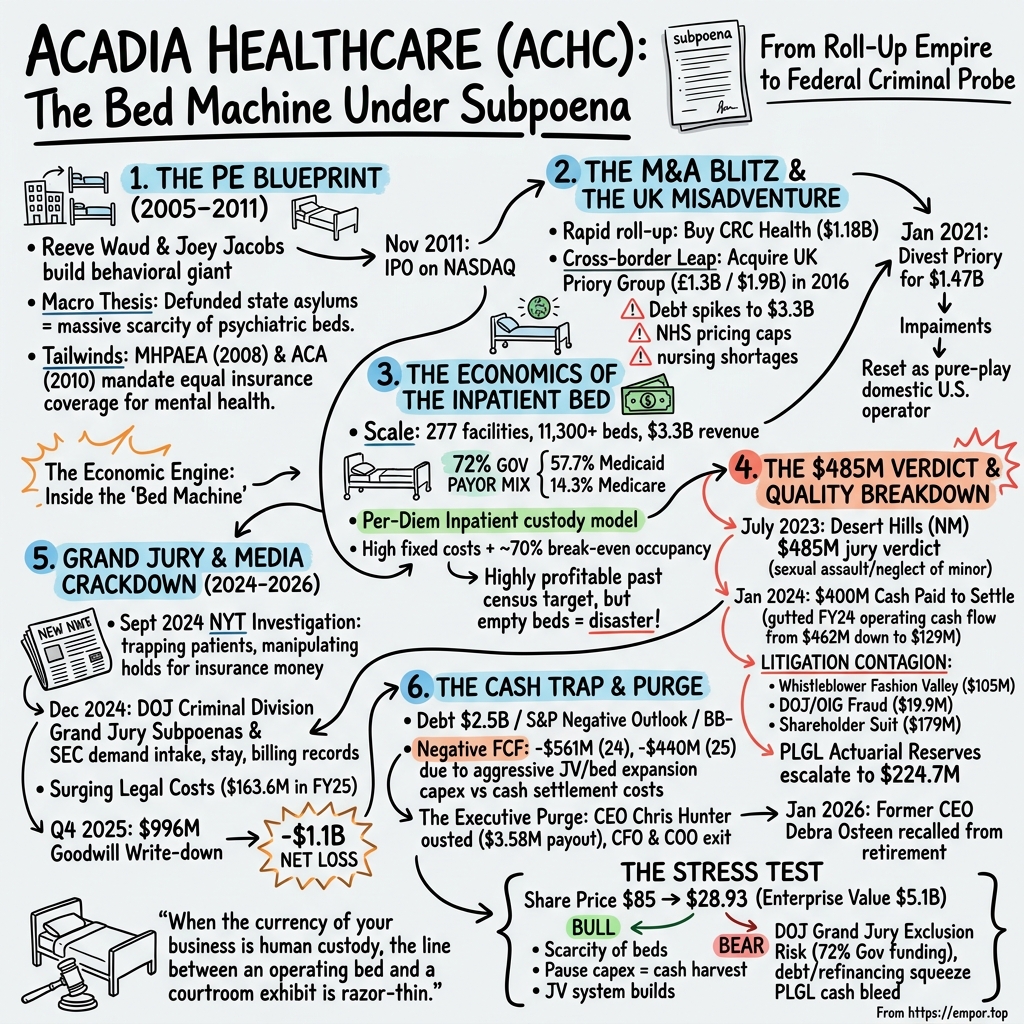
To see why these subpoenas mattered so much, start with what Acadia is. It is the largest pure-play operator of psychiatric and addiction treatment facilities in the United States: at the end of 2025 it ran 277 facilities with more than 11,300 beds across 38 states and Puerto Rico, and it booked about $3.3 billion of revenue that year.1 It does not make a drug or a device. It sells days and visits: a day in an acute psychiatric unit, a week in a residential programme for a troubled teenager, a morning dose of methadone at an opioid clinic. Nearly three of every four of those dollars come from Medicaid and Medicare.1
That combination is what makes the grand jury so dangerous. A company paid by the day has an obvious incentive to fill beds and keep them full. A company paid mostly by the government has an obvious duty to admit and keep patients only when it is medically necessary. Where those two forces meet, the operating model and the compliance question are the same question. Prosecutors were not asking about a stray invoice. They were asking about the engine.
This story turns on three questions. The first is whether the run of catastrophic jury verdicts, whistleblower cases and federal investigations is a set of operational accidents at a handful of rogue facilities, or the predictable output of a model built to maximise occupancy. The second is whether the cash this business throws off can carry about $2.5 billion of funded debt while management keeps pouring money into new beds; free cash flow was negative by about $561 million in 2024 and about $440 million in 2025.1 The third is whether the January 2026 decision to fire the chief executive and bring back the retired Debra Osteen signals a company stabilising, or a board in a defensive crouch while a criminal inquiry runs its course.7
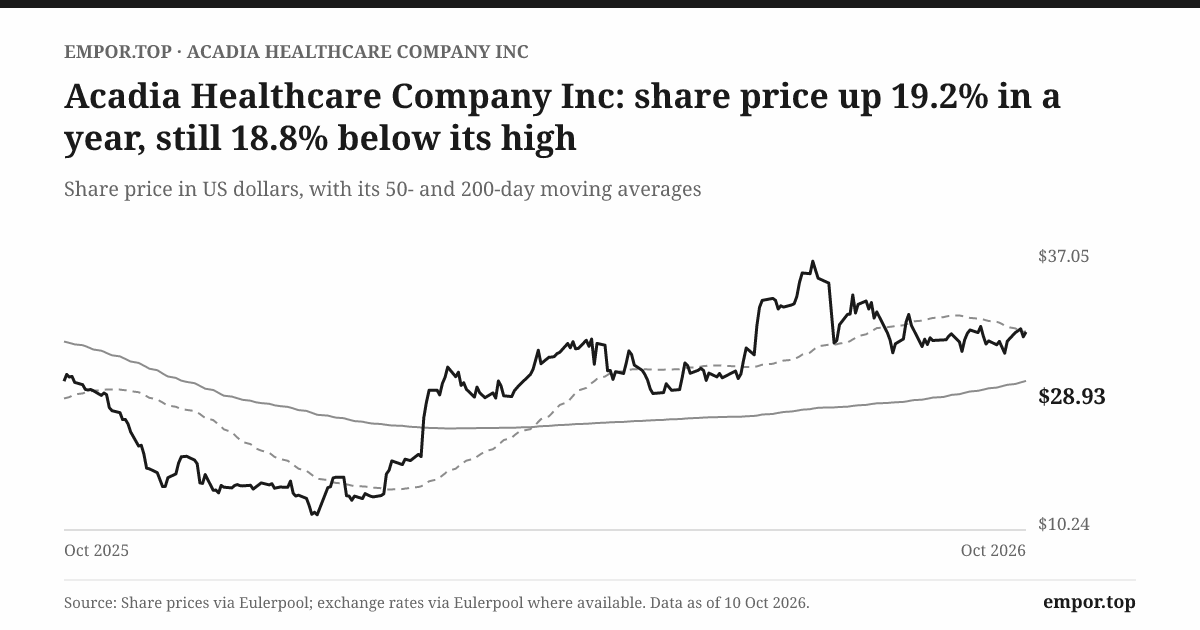
The market has already given its provisional answer. On October 10, 2026, Acadia's shares traded at $28.93, down from highs around $85 earlier in the decade and only a little above book value.[^20] The company's market value was about $2.7 billion and its enterprise value, counting debt, about $5.1 billion. Over the twelve months to June 2026, it lost $12.45 a share, almost all of it from a $996 million goodwill write-down taken at the end of 2025.12 At its worst point over the past five years, the stock had fallen about 87% from its peak.
Investors are now trying to decide whether that discount is a temporary risk premium on a business America badly needs, or the early pricing of something worse. To answer it, the story has to go back to where the beds came from, and why a Chicago private equity firm thought psychiatric hospitals were one of the best businesses in American healthcare.
 Subscribe on LinkedIn
II. Reeve Waud's Private Equity Blueprint (2005–2011)
In the middle of the 2000s, an American in a psychiatric crisis had fewer places to go than a generation earlier. Over the previous half-century, states had closed or shrunk most of their large public mental hospitals, a policy known as deinstitutionalisation. The promise had been that community clinics would take their place. Many never got the funding. The patients did not disappear; they turned up in emergency rooms, jails and homeless shelters, and hospital ERs found themselves holding suicidal teenagers and psychotic adults for days because there was no psychiatric bed to send them to.
To Reeve B. Waud, founder of the Chicago firm Waud Capital Partners, that shortage looked like an investment thesis.8 Here was a service with three unusual features. Demand was rising and did not depend on the economy. Supply was hard to add, because building a psychiatric hospital takes licences, local approvals and specialised staff. And the biggest buyers were the government programmes, Medicaid and Medicare, which might squeeze prices but would not go out of business. A private equity investor who could buy small, independent psychiatric hospitals cheaply, put them under one management system and finance them with debt could build something worth much more than the pieces.
Waud's firm began backing Acadia in the mid-2000s, and the company that emerged was led by Joey Jacobs, a hospital industry veteran who had already built and sold a behavioural health chain, Psychiatric Solutions, to Universal Health Services.8 Jacobs was the operator; Waud was the capital and, later, the chairman. The style they brought was one Jacobs had perfected before: buy freestanding psychiatric hospitals, often in the South, centralise billing and purchasing, add beds where the licences allowed, and repeat.
Washington then changed the arithmetic in Acadia's favour. The Mental Health Parity and Addiction Equity Act of 2008 required insurers that covered mental health and addiction treatment to do so on terms no more restrictive than for medical and surgical care.8 Two years later, the Affordable Care Act widened insurance coverage and expanded Medicaid in many states, putting millions more people into programmes that paid for psychiatric treatment.8 For an operator of psychiatric beds, these laws widened the pool of patients who arrived with a payer attached.
The structure of the deal that took Acadia public also tells you what kind of company it was. In November 2010 Acadia merged with PHC Inc., a small listed behavioural health company, which gave it a public listing. Then, in late 2011, it sold shares in a public offering on the NASDAQ Global Select Market, with its final prospectus dated December 2011.8 The prospectus was frank about the plan. Acadia intended to grow by acquisition, it depended heavily on government payers, and it carried a large amount of debt.8
Why go public at all? Because a listed share is a currency. Private equity can assemble a roll-up with borrowed money, but at some point the debt limits how fast it can buy. A public stock that the market values richly lets the company issue shares or borrow more cheaply against a larger equity base, and then use that firepower to buy hospitals at lower multiples than the market pays for Acadia itself. Every acquisition becomes accretive on paper. The danger, as every roll-up investor learns, is that the strategy works only as long as the stock stays expensive and the deals keep coming.
For a few years after the listing, both held. The thesis Waud had seen in 2005, scarce beds, durable demand and sovereign payers, looked like it was working. What nobody could yet see was how far the company would stretch it.
III. The M&A Blitz and the British Misadventure (2011–2021)
By the middle of the decade, Acadia was one of the hottest stocks in American healthcare, and its management behaved like it. Revenue rose from about $1 billion in 2014 to nearly $1.8 billion in 2015 and about $2.8 billion in 2016, growth of 79% and then 57% in successive years.1 Almost none of that was patients filling existing beds. It was acquisitions.
The biggest domestic move came in early 2015, when Acadia bought CRC Health Group for about $1.18 billion.[^20] CRC brought a large network of addiction treatment programmes, including comprehensive treatment centres that dispense medication such as methadone to people recovering from opioid addiction, and a set of residential programmes for young people. In one transaction, Acadia went from a psychiatric hospital chain to a broad behavioural health company with a large outpatient opioid business just as the American opioid epidemic was accelerating.
Then came the bold bet. In early 2016 Acadia bought Priory Group, the largest independent provider of mental health services in the United Kingdom, for roughly £1.3 billion.[^20] It had already bought a smaller British operator, Partnerships in Care. The combined business made Acadia the biggest private mental health provider in Britain. The pitch was that the American roll-up playbook could be exported: buy fragmented providers, centralise, grow.
The trouble was that Britain was a different market in ways that mattered. In the United States, Acadia dealt with dozens of state Medicaid programmes and many commercial insurers, which at least gave it some room to negotiate. In Britain, the main buyer was the National Health Service and the local bodies that commissioned care on its behalf, a single dominant purchaser with enormous pricing power. Staffing was tight, nursing costs rose, and the pound fell sharply after the 2016 Brexit vote, which shrank the dollar value of every British pound Priory earned. Regulators at the Care Quality Commission also cited some Priory facilities for quality failures, which brought both reputational damage and remediation costs.[^20]
The numbers show the price of the British detour. Borrowings, which had been about $1.1 billion at the end of 2014, rose above $3.2 billion by 2016 and stayed there for five years.1 Revenue stalled at about $2.8 to $3 billion from 2016 to 2018, and in 2018 Acadia reported a net loss, after writing down the value of its British assets.1 By 2020, debt was 1.7 times the shareholders' equity.1 The roll-up had become a leveraged conglomerate on two continents with weak growth in one of them.
The exit came in January 2021, when Acadia sold its UK business to Waterland Private Equity for about $1.5 billion.1 The company booked large losses in 2020, including a net loss of about $672 million, much of it impairment of the British operations it was selling.1 It used the cash to cut borrowings roughly in half, to about $1.6 billion by the end of 2021, and presented itself as a pure-play American behavioural health company.1
So what did the decade of deals create? Revenue in 2025 was about $3.3 billion, barely above the $3 billion of 2018, though 2018 included Britain and 2025 does not, so the American business grew a lot underneath.1 The more revealing figure is the one that adds up the whole period. From 2014 to 2025, Acadia's cumulative net result was a loss of roughly $737 million.1 Some of the hardest of those losses were the British write-downs: capital that went abroad, earned too little and came back smaller. The lesson for anyone weighing management's later promises about capital discipline is that this company has a documented history of spending big on a growth story and later writing much of it off.
The pure-play company that emerged in 2021 was smaller, less indebted and simpler. To understand what came next, it helps to understand exactly how that simpler business makes money.
IV. The Economics of the Inpatient Bed
Picture an intake unit at an acute psychiatric hospital in New Mexico in the middle of the night. A teenager arrives by ambulance from a general hospital emergency room, where staff decided they could not keep a suicidal patient safe. A nurse and a clinician assess them. If they decide the patient needs inpatient care, a bed is assigned, and a billing clock starts. From that moment, the hospital earns a fixed amount for each day the patient stays, set mostly by the state's Medicaid programme.
That is the whole business model in one admission. Acadia does not sell subscriptions or software. It bills a daily rate, known as a per diem, for a bed in an acute psychiatric hospital or a residential treatment centre, and a per-visit rate at its outpatient opioid clinics.1 There are no long-term contracts and no minimum commitments; a patient can be discharged at any time.1 What looks like recurring revenue is really a function of three numbers: how many patients are admitted, what share of beds are full, and how long each patient stays.
Who pays? In 2025, Medicaid accounted for about 58% of revenue, roughly $1.9 billion, and Medicare for about 14%, roughly $474 million.1 Commercial insurers paid about a quarter, and other payers the rest.1 Put simply, public treasuries fund about 72 cents of every dollar Acadia earns. No single facility accounted for more than 4% of revenue and no state for more than 14%, so the risk is not one hospital or one governor.1 It is the system of government payment itself.
This is where the economics become sharp. A psychiatric hospital is mostly fixed cost. The nurses, psychiatrists, therapists, security staff and building must be there whether the unit is half full or full. Below a certain occupancy, the facility loses money; above it, each extra patient-day brings in the daily rate while adding relatively little cost, mostly meals, medication and some overtime. The company does not publish a break-even census by facility, but the shape is familiar from any hospital: once the fixed costs are covered, incremental days are highly profitable. That is the operating leverage that made the roll-up attractive. It is also what makes an empty bed so painful, and a full bed so tempting.
Think of it like an airline with seats priced by a government agency. The airline cannot raise fares. It can only fill more seats and keep passengers on board longer. In an airline that would just be good business. In psychiatric care, keeping a patient one more day is a clinical decision with a person's liberty attached, and that is why prosecutors care so much about how those decisions are made.
The other place to look for strain is in how quickly Acadia gets paid. Hospitals do not record bad debts the way most companies do. Under the accounting rule for revenue, they estimate in advance how much of each bill they will never collect, an "implicit price concession," and book revenue net of it. That estimate rose from about $76 million at the end of 2024 to about $90 million at the end of 2025.1 Over the same period, receivables grew from about $394 million to about $469 million, and the cash tied up in them rose by about $75 million in a single year.1 Measured as days of revenue, the time it takes to collect stretched from about 49 days in 2024 to about 60 by the end of 2025, the slowest in the company's recent history.1
Management has attributed part of that to new facilities ramping up and to payment delays from commercial insurers.1 Both may be true. But the direction points the same way as the rest of this story. Insurers and managed Medicaid plans are increasingly questioning whether inpatient days were medically necessary, denying or delaying claims and auditing them after the fact. Acadia's auditors, Ernst & Young, flagged the estimation of these concessions as a critical audit matter, a signal that the judgment involved is large enough to affect the reported numbers.1
The conclusion is plain. Acadia runs a high-fixed-cost custody business whose prices it does not set, so its profits depend almost entirely on volume, occupancy and length of stay. That design is efficient when the beds are full and the care is good. It becomes fragile when the people who pay the bills, or a jury, start asking whether a stay was needed and whether the patient was safe. In 2023, a jury in New Mexico asked exactly that.
V. The $485 Million Verdict and the Quality Breakdown (2023–2024)
The courtroom in Bernalillo County, New Mexico, heard a case about a child. The lawsuit concerned a minor who had been placed at Desert Hills, an Acadia-owned residential treatment centre in Albuquerque for young people with serious behavioural problems, and who alleged sexual abuse and neglect while in the facility's care.13 The jury's answer in 2023 shocked the industry: $485 million, with the overwhelming majority, about $405 million, in punitive damages.131
Punitive damages are the jury's way of saying the defendant did not just make a mistake, but behaved in a way that must be punished and deterred. A verdict of that size against a company with roughly $3 billion of revenue at the time is a statement about how the jurors saw the institution, not only the individual staff on duty. The claims at the heart of such cases are about staffing: whether there were enough trained people on the floor to supervise vulnerable children, and whether the records showing they were checked on were accurate.13 Those allegations go to the same place the federal investigators would later look, the trade-off between labour cost and safety in a business paid per day.
Acadia did not let the case run through appeals. In January 2024 it paid $400 million in cash to settle the Desert Hills litigation.1 Insurance did not absorb the hit; this was the company's money. The accounting shows up in the third quarter of 2023, when Acadia recorded a pre-tax loss of about $287 million as it accrued for the liability.1 The cash showed up a few months later.
That one cheque shaped the entire 2024 financial year. In 2023 Acadia had generated about $462 million of cash from operations. In 2024 that fell to about $130 million, even though reported net income was about $265 million.1 Almost the whole gap was Desert Hills. If you wanted a single number that showed what one courtroom could do to this business model, it is that collapse in cash conversion: two-thirds of a year's operating cash gone in one payment.
Was it an isolated failure? The record after 2023 makes that harder to argue. In September 2024 Acadia agreed to pay about $20 million to resolve a federal investigation, begun in 2017, into allegations that several of its facilities had billed government programmes for services that were not medically necessary or not properly provided.151 The company did not admit liability, and the sum was small, but the subject matter, billing and medical necessity, foreshadowed the criminal inquiry.
In November 2025 it settled a long-running securities class action, brought by shareholders who alleged they had been misled about the company's operations between 2014 and 2018, for $179 million, of which about $147.5 million was paid in cash after insurance.1 In May 2026 a San Diego jury found Acadia's Fashion Valley comprehensive treatment centre subsidiary liable for retaliating against an employee and awarded $105 million, including $70 million in punitive damages.52 In June 2026 the company reached a settlement in principle of $15 million in a wrongful death case known as Sandoval.2 And in September 2026 it gave notice of a proposed $12 million settlement of shareholder derivative suits, which accused directors and officers of failing in their oversight duties.6
Read together, these are not the same kind of case. A sexual abuse claim at a youth facility, a billing investigation, a securities fraud claim, a retaliation verdict and a wrongful death suit touch different parts of the company. What they share is a theme: allegations that facilities did not have enough staff, did not tell the truth about what happened, or punished people who raised the alarm. One verdict could be bad luck. Five different kinds of liability over three years start to look like a pattern in how the company was run.
The clearest measure of that pattern is the reserve Acadia sets aside for professional and general liability claims, the malpractice and injury suits every hospital faces. It rose from about $182 million at the end of 2025 to about $225 million by the middle of 2026.12 Part of that increase came from actuaries revising their estimates upward, by about $29 million in the second quarter of 2026 alone, after more than $50 million of such revisions in 2025.21 When actuaries repeatedly find that past claims will cost more than they thought, it means the claims history is getting worse faster than the company's own models expected.
That is the verdict on Desert Hills. It shattered the assumption that liability insurance and reserves would cap the downside of running custodial care. A single facility cost the company $400 million in cash, and the claims that followed suggested the problem was broader than one campus. Then, in the autumn of 2024, the story moved out of the courtroom and onto the front page.
VI. Under the Microscope: The Grand Jury and the Media Reckoning (2024–2026)
On September 1, 2024, The New York Times published an investigation into Acadia that described patients being held in its psychiatric hospitals longer than they needed or wanted, sometimes until their insurance ran out.11 The reporting drew on former employees and patients and on public records, and it described a culture in which admissions and stays were pushed to fill beds.11 Acadia disputed the characterisation.11 But the story landed on the point where the business model and the law meet: who decides when a patient can go home, and on what basis.
Within weeks, the scrutiny became official. Acadia disclosed that it had received subpoenas from the Department of Justice, including a grand jury subpoena, and that the SEC was also investigating.121 In December 2024 came further grand jury subpoenas.1 The inquiry, run by the Criminal Division with a grand jury in the Western District of Missouri, focused on admissions, lengths of stay and billing practices in its acute inpatient business.1 Reuters reported the disclosures as they came.12
The difference between a civil and a criminal investigation is the heart of this story. A civil case, like the about $20 million settlement in 2024, ends with money and sometimes a corporate integrity agreement, a multi-year compliance programme supervised by the government. A criminal case can end with charges, and in healthcare the gravest consequence of certain convictions can be exclusion from federal programmes such as Medicare and Medicaid. For a company where those programmes pay about 72% of revenue, exclusion of the company as a whole would be terminal. Nobody has said that will happen, and companies under criminal investigation often settle without such outcomes. But that is the tail risk investors are pricing.
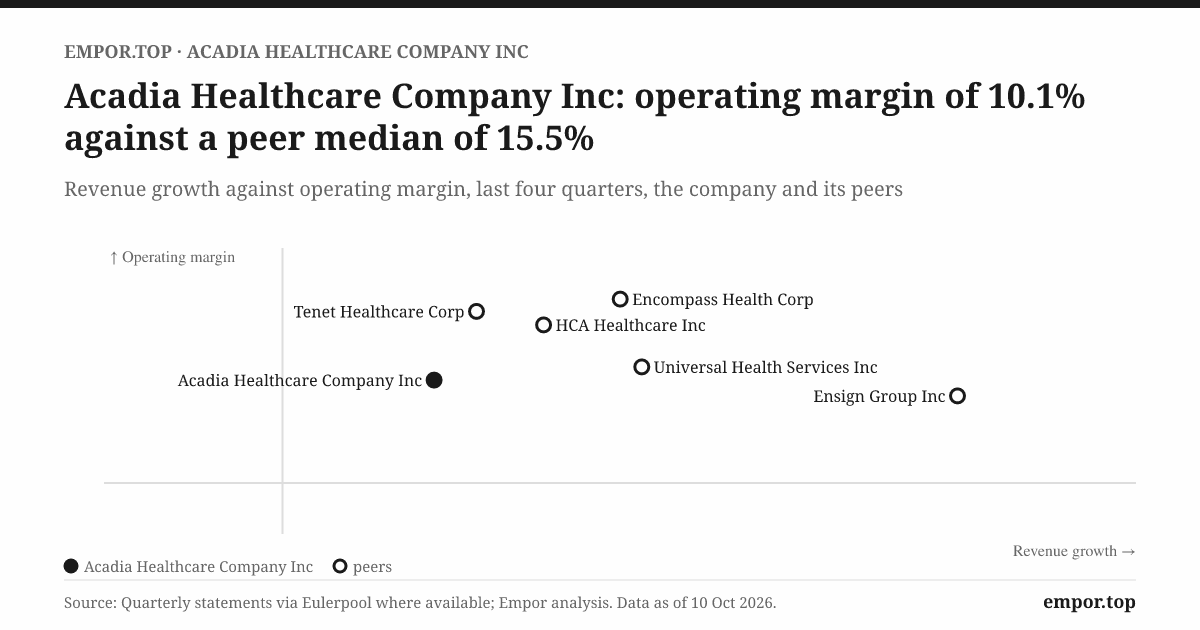
The investigation also became an expense line. In 2025 Acadia spent about $164 million on what it calls transaction, legal and government investigation costs, of which about $135 million related to the government investigations themselves.1 That was lawyers, forensic accountants and the work of responding to subpoenas, and it went straight through the income statement. Operating profit fell from about $522 million in 2024 to about $388 million in 2025, and the operating margin dropped from about 17% to about 12%.1 Most of that decline is explained by legal and investigation costs plus rising liability reserves, rather than a collapse in the underlying hospitals. That is either reassuring, because the core still earns, or alarming, because the core cannot be separated from what it costs to defend it.
Then came the write-down. With the share price far below the book value of the company's acquisitions, Acadia tested the goodwill on its balance sheet, the premium it had paid over the value of the assets it bought over the years. In the fourth quarter of 2025 it recorded a non-cash goodwill impairment of about $996 million.1[^9] Ernst & Young identified the valuation of goodwill as a critical audit matter.1 The write-down produced a net loss of about $1.1 billion for 2025 and cut shareholders' equity from about $3.1 billion to about $1.9 billion.1
It is worth being clear about what this means. An impairment is not cash leaving the company. It is the accounting system admitting that the past acquisitions are worth much less, on current expectations, than was paid for them. That is a judgment on the roll-up as a whole, and it echoes the British write-downs of 2018 to 2020. Twice in under a decade, Acadia has had to tell shareholders that a large part of what it bought was worth far less than it paid.
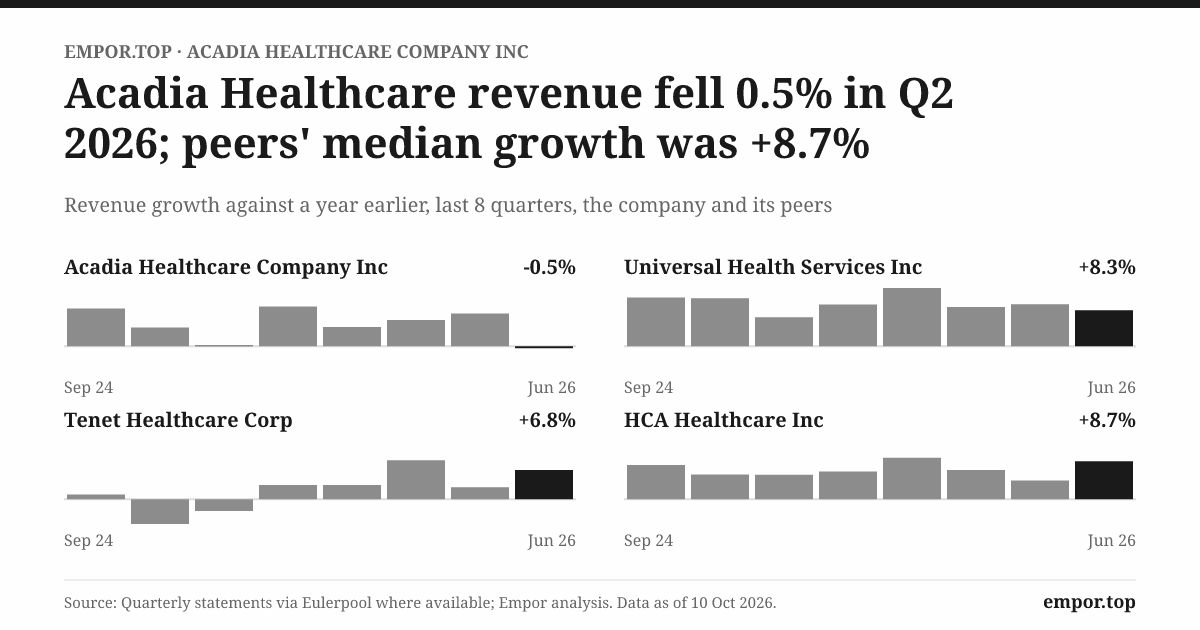
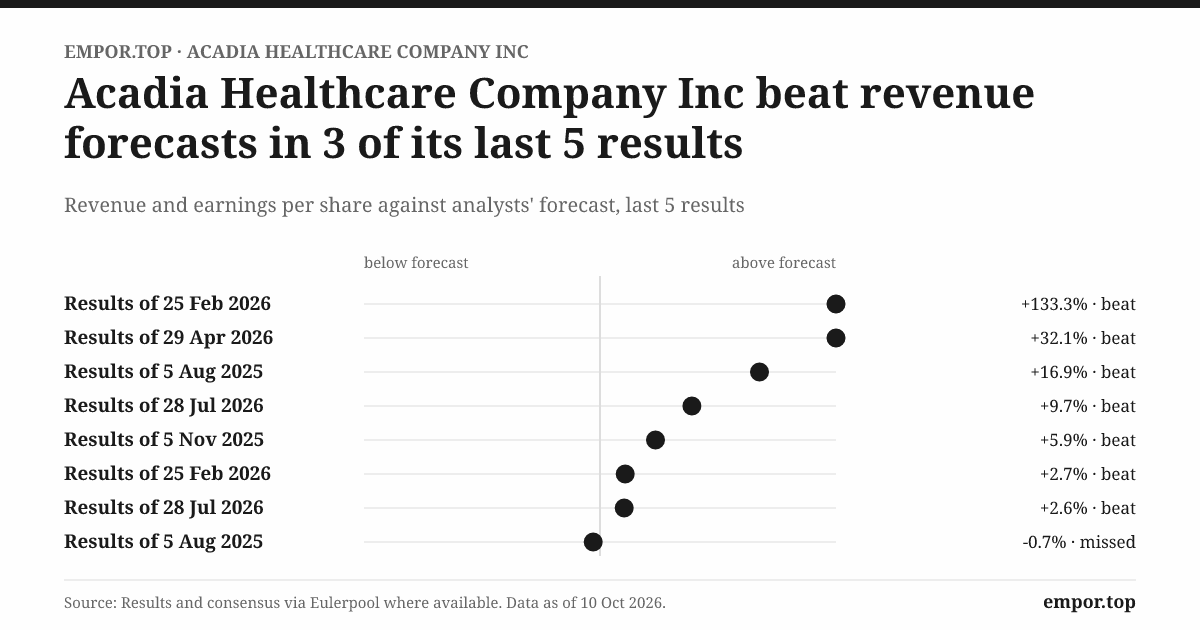
The early months of 2026 brought little relief. Revenue in the second quarter of 2026 was about $865 million, slightly lower than a year earlier, the first year-on-year decline in the recent record, and the company lowered its full-year guidance.[^10]2 On the earnings call, analysts pressed management on volumes, on payer pushback and on the investigation; management did not give a timeline for its resolution.9
So the DOJ and SEC investigations are not a threat of isolated fines. They test the admissions and discharge decisions that determine occupancy, which is the source of Acadia's profits. That makes the overhang existential in a way that ordinary malpractice suits are not. And it arrived just as the company was spending money it did not have.
VII. The Cash Flow Trap: Capex, Debt, and the Rating Agency Squeeze
Early in 2025, Acadia's board faced a capital allocation choice that would define the next two years. The company had just burned about $561 million of free cash in 2024, largely because of the Desert Hills payment and heavy construction.1 It could have paused building. Instead it kept going. In 2025 it spent about $572 million on capital projects, and in March 2025 it sold $550 million of new senior notes due 2033 at an interest rate of 7.375%, sharply higher than its older bonds.1 It also refinanced its bank facilities in February 2025 with a $1 billion revolving credit line and a $650 million term loan maturing in 2030.1
The puzzle is simple. How can a company that generated about $3.9 billion of operating cash between 2014 and 2025 have negative cumulative free cash flow of about $245 million over the same twelve years?1 The answer is that almost every dollar coming in went back out into construction, acquisitions and, lately, legal payments. Acadia has never paid a dividend.1 It has not been a cash machine for shareholders. It has been a cash machine for its own expansion.
How much of that spending was necessary? This is the most important question for the bull case, so it is worth working through. In 2025, total capital spending was about $572 million, about 17% of revenue.1 Of that, routine maintenance, the roof repairs and equipment replacement required to keep existing facilities running, was about $99 million, or about 3% of revenue.1 The remaining roughly $473 million was growth: new hospitals, new beds in existing facilities and joint-venture hospitals built with partner health systems.1 In 2024 the total had been even higher, about $690 million or 22% of revenue.1
Here is the arithmetic that follows. Strip out the legal payments and the growth construction, and the underlying business generates several hundred million dollars a year before growth spending; the company's own adjusted earnings figure for 2025, before interest, tax, depreciation and these special items, was about $600 million.[^9] Subtract maintenance capex and interest, and there is a meaningful amount left. That is the hidden cash flow the bulls point to. The bears respond that "strip out the legal payments" is doing a lot of work in that sentence, because the legal payments have been recurring for three years.
The financing tells the rest of the story. Funded debt rose from about $1.5 billion at the end of 2023 to about $2.5 billion at the end of 2025, or about $2.7 billion counting leases.1 It consisted of a term loan of about $638 million, about $404 million drawn on the revolver, and three bond issues: $450 million at 5.5% due 2028, $475 million at 5% due 2029 and the $550 million at 7.375% due 2033.1 The term loan and revolver carry floating interest rates. Net interest expense rose from about $82 million in 2023 to about $139 million in 2025.1 Because equity fell after the write-down at the same time that debt rose, debt to equity doubled from about 0.68 to about 1.36 in a single year.1
The rating agencies noticed. In August 2025 Moody's downgraded Acadia's senior unsecured notes to B1, citing negative free cash flow, heavy growth spending and operational challenges.[^14] In January 2026 S&P Global Ratings affirmed its BB- rating but revised the outlook to negative, pointing to litigation costs, rising liability claims and leverage above its 4 times threshold.10 A negative outlook is a warning that a downgrade is more likely than not if things do not improve.
The bonds are not due soon; the earliest matures in 2028 and the bank facilities run to 2030.1 So this is not a liquidity crisis today. The squeeze is subtler. The credit agreement contains a leverage covenant measured against earnings, and every legal payment or reserve increase that cuts earnings reduces the cushion.1 Higher borrowing costs on new debt reduce what is left for growth. And with the buyback authorisation dormant and no dividend, shareholders have no return of capital while they wait.1
The verdict is that management treated growth capital spending as untouchable at the very moment the legal bills arrived. Pairing roughly $500 million or more a year of construction with about $547 million of cash legal settlements over 2024 and 2025 is what turned a moderately leveraged company into a stretched one.1 The good news is that most of the construction is discretionary, so the company has a lever it can pull. Whether it pulls hard enough depends on who is running it, and in 2025 and 2026 that question became its own drama.
VIII. The Corner Office Purge and Debra Osteen's Return (2025–2026)
On January 20, 2026, Acadia announced that Christopher H. Hunter was out as chief executive.7 Hunter had run the company since 2022, through the Desert Hills settlement, the New York Times investigation, the subpoenas and the write-down. His departure entitled him to cash severance benefits of about $3.58 million.3 In his place, the board called back Debra K. Osteen, the executive who had run Acadia before him.7
The sacking was the last of a series. Chief financial officer Heather Dixon left in 2025; after an interim period under Timothy Sides, Todd S. Young became the permanent CFO in October 2025.31 Chief operating officer Nasser Khan also departed in 2025.3 Within roughly a year, the chief executive, the chief financial officer and the chief operating officer had all changed. In a company under a criminal investigation, that is a remarkable degree of turnover, and it raises an obvious question: was the board cleaning house, or running out of options?
Osteen's background explains both why she was chosen and why the choice was controversial. She spent decades at Universal Health Services, the largest operator of behavioural hospitals in the country, rising to run its behavioural health division, before joining Acadia and serving as its chief executive from 2018 until she retired in 2022.3 She knows the business, the regulators and the hospital partners. She also presided over Acadia during the years when many of the practices now under investigation were taking place. Bringing her back is continuity, not a clean break from the past.
For the board, the logic is understandable. Hiring an outsider into a company under federal grand jury investigation is hard; a capable candidate would worry about inheriting liabilities they did not create. Osteen requires no learning curve. But the choice also signals that the board did not, or could not, find a fresh leader who would represent a visible break with the old culture. That matters, because the most credible response to an investigation into corporate practices is usually a demonstrable change in who sets those practices.
Shareholders made their feelings known. At the annual meeting on May 6, 2026, the advisory vote on executive pay passed, but about 24.7% of votes cast went against it, roughly 20 million votes.4 For a say-on-pay vote, where support above 90% is common, a quarter in opposition is a strong rebuke. The context was a year with a loss of about $1.1 billion, in which Hunter's reported pay had been about $7.9 million, most of it in stock awards.3
The ownership structure explains why the rebuke stayed symbolic. Directors and executive officers together own only about 1.2% of the company.3 Reeve Waud, still the chairman two decades after his firm backed the original company, holds about 713,000 shares.3 The real power lies with institutions: Wellington Management held about 12.8%, BlackRock about 11.2%, Vanguard about 10.2%, Khrom Capital about 8.1%, Fidelity's parent about 6.8% and Goldman Sachs about 5.1% as of the 2026 proxy.3 The presence of Khrom, a concentrated value investor, among the top holders is notable; it signals that at least one fund with a focused portfolio sees the shares as mispriced. It does not tell you whether it is right.
There is one area where the governance record is clean. Acadia disclosed no material related-party transactions with its directors, officers or major shareholders in 2024, 2025 or the first half of 2026.31 Whatever the problems at Acadia, they are not about insiders extracting money through side deals.
The verdict is that the executive purge reflects real board anxiety about the criminal inquiry, and the return to Osteen underlines how hard it is to attract outside talent under a grand jury's gaze. A board that wants credibility with regulators eventually needs a permanent leader who can show the culture has changed. Until then, the question of whether Acadia has a durable advantage, or just good locations and good luck, becomes more pressing.
IX. Competitive Moats and Industry Structure
Imagine a state health planning hearing. Acadia and a nonprofit health system are jointly applying to build a new psychiatric hospital. Local general hospitals may object; planning officials weigh whether the region needs more beds. In many states, no one can build a new hospital, or add beds, without this kind of approval, known as a certificate of need. That process, slow and political, is the closest thing Acadia has to a moat. The question is whether it is enough.
Hamilton Helmer's framework of seven sources of lasting competitive advantage is a useful way to test this, because it forces a precise answer about where profits come from.
Start with what Helmer would call a cornered resource. Certificate-of-need laws and hospital licences make it hard for a competitor to open a rival psychiatric facility next door. Acadia's existing licences and buildings are genuinely hard to replicate, and that gives it local protection. But the resource is granted by the state, and states can change the rules. Several states have loosened or repealed certificate-of-need requirements in recent years, and the regulator that grants a licence can also restrict it. A moat that a legislature can drain is narrower than it looks.
Network effects and switching costs are almost nonexistent. A patient in crisis goes where an ambulance or an emergency room sends them. Referral coordinators send patients to whichever facility has a bed and a good reputation. Commercial insurers can and do change which hospitals are in their networks. There is no product lock-in.
Scale economies are real but modest. A large operator can buy supplies more cheaply, spread the cost of billing and compliance systems over many facilities, and negotiate with insurers from a position of size. But the largest cost is labour, and labour does not get cheaper with scale; nurses and therapists are hired locally, and in a shortage they cost more everywhere.
The most interesting source of advantage is the joint venture with nonprofit health systems, which is a form of counter-positioning. Many general hospitals find psychiatric care hard to staff, hard to make profitable and burdensome to run. Acadia offers to build and operate a psychiatric hospital together with them, sharing ownership, while the health system brings its brand and its referral stream of patients from its emergency rooms. The health system gets rid of a headache and keeps a stake; Acadia gets a steady flow of patients and the reputational cover of a respected partner. This is a large part of where the recent growth spending went.1 The caveat is that the health system's reputation can also be damaged by its partner's troubles, and partners may hesitate to sign new deals while a criminal investigation continues.
Porter's five forces give a similar answer from a different angle. The bargaining power of buyers is extreme: Medicaid and Medicare set rates by regulation and budget, and Acadia cannot negotiate them in any meaningful sense.1 Commercial insurers, the remaining quarter of revenue, are increasingly aggressive in denying and auditing claims, as the rising price concessions show.1 The bargaining power of suppliers, which here means clinical workers, is high, because psychiatric nurses and licensed therapists are scarce and can move to competitors or to less stressful jobs. The threat of substitutes is low today, because telepsychiatry and digital apps can help with mild depression or anxiety but cannot safely hold someone who is acutely suicidal or psychotic. Over the long term, better outpatient care could reduce the number of people who need a bed at all. The threat of new entrants is low to medium, restrained by certificates of need and the cost of building, but not zero.
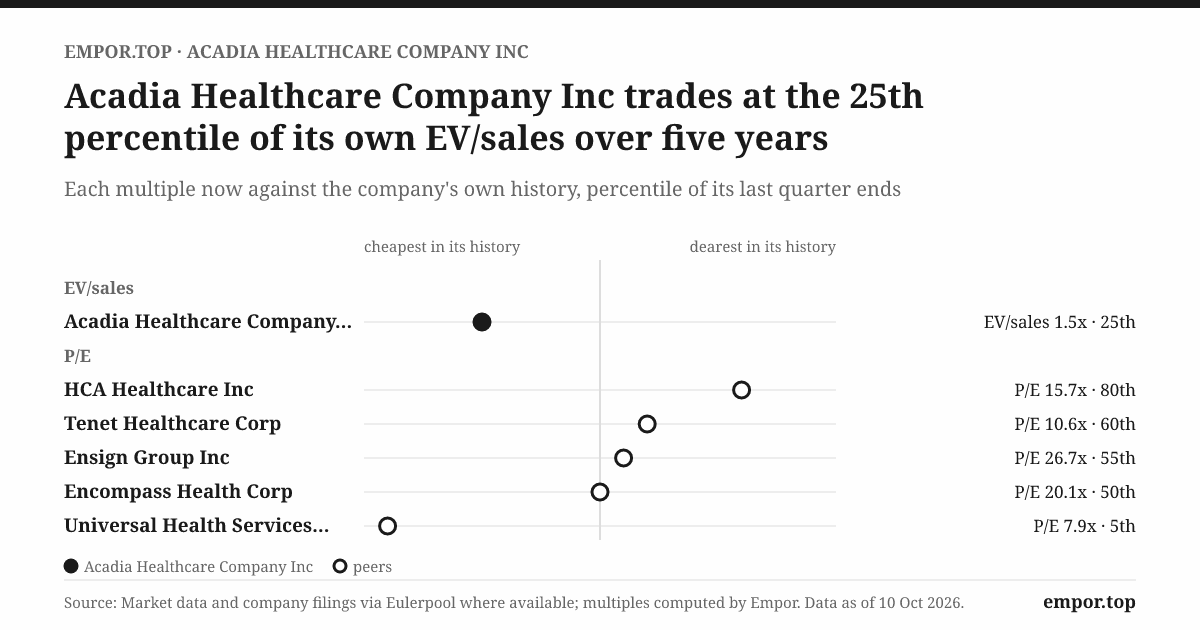
Rivalry with the main peer is the most revealing comparison. Universal Health Services, Osteen's former employer, runs a much larger behavioural health business alongside acute general hospitals.14 In October 2026 UHS traded at about 7 times earnings and about 5.5 times earnings before interest, tax, depreciation and amortisation, against roughly 9 times for Acadia on the same basis.14 In other words, the market values Acadia's hospitals more richly than its larger peer's, despite the legal overhang. One reading is that investors still see the pure-play behavioural franchise as valuable. Another is that Acadia's depressed earnings, flattered by adding back special items, make the multiple look higher than its true risk-adjusted value. Either way, the comparison suggests the market has not priced Acadia for disaster.
The conclusion of the moat test is that Acadia has a narrow, local, regulatory moat, reinforced by joint ventures with nonprofit systems, but no pricing power against the government payers who fund most of its revenue and no switching costs for patients. The strength of its moat depends on regulators who are now also investigating it. That is not the same as having no moat. It is a moat that the regulator can redefine. What that means for founders and investors is clearer than the moat itself.
X. Playbook: Business & Investing Lessons
The first lesson begins in a Desert Hills hallway. Per-diem operating leverage looks like financial engineering, but in custodial healthcare it is borrowed from clinical quality. Every extra patient on the same staff, every night shift run a little thinner, adds to the margin until a jury adds up the bill. Desert Hills cost $400 million in one cheque, a sum larger than several years of the profit that staffing savings could ever have produced.1 In acute healthcare, the margin achieved by maximising the census is a loan from patient safety, and the jury always collects the interest.
The second lesson starts in the grand jury room in Missouri. When roughly 72% of your revenue comes from Medicaid and Medicare, compliance is not a support function in the legal department. It is the operating model.1 The same decisions that create profit, admitting a patient, keeping them another day, are the decisions the government audits. A company that thinks of its regulator as one stakeholder among many has misunderstood its business. For Acadia, the government is its biggest customer, its price-setter and, now, its investigator.
The third lesson lives in the cash flow statement. Acadia generated about $3.9 billion of operating cash over twelve years and still ended the period with negative cumulative free cash flow.1 Growth capital spending can look like intrinsic value creation when the stock is rising and the beds are filling. When a liability arrives, it turns out that the company has nothing set aside, because everything went into concrete. Operating cash is a promise of value; free cash is the value. Acadia spent twelve years confusing the two.
The fourth lesson comes from January 20, 2026. A board that loses its chief executive, chief financial officer and chief operating officer within about a year and calls back a retired predecessor is not executing a succession plan. It is building a bunker.73 That may be the right defensive decision during a criminal investigation. But investors should recognise it for what it is: an attempt to hold the line, not a plan to change the culture.
The fifth lesson is the cleverest move in the playbook. If insurers and regulators distrust your per-diem billing, partner with the most respected hospital system in town, share the licence and let its emergency rooms feed your beds. The nonprofit joint venture turns a stigmatised business into a community service with a trusted name on the door. It is a genuinely smart way to grow. It is also a shield that works only as long as the partner is willing to stand behind it, and that willingness is what the coming years will test.
XI. Analysis: The Bear vs. Bull Stress Test
Picture the conference call after the second-quarter results in July 2026. The company had just lowered its guidance, revenue had slipped year on year, and the analysts wanted to know one thing above all: how much would the company cut capital spending to protect its balance sheet?[^10]9 Todd Young, the new chief financial officer, was the person answering. That question, whether this company can stop building long enough to show what it earns, sits at the heart of both cases.
The bull case begins with scarcity. Acadia owns more than 11,300 licensed psychiatric beds in a country that has too few.1 Building them again from scratch would require land, approvals and construction costs that, the bulls argue, would exceed the company's enterprise value of about $5.1 billion. The physical and regulatory assets are real, and demand for psychiatric care is not falling.
The second bull argument is the capital spending lever. Because maintenance capex is only about 3% of revenue, roughly $99 million in 2025, most of the spending is optional.1 If management stopped building new hospitals, the core business could produce several hundred million dollars of free cash a year to pay down debt. This is the argument that the negative free cash flow is a choice, not a verdict on the business.
The third is the joint-venture model, which can keep adding capacity with partners sharing the cost and bringing patients with commercial insurance. The fourth is valuation. If the federal investigation ends with a civil settlement and a corporate integrity agreement rather than criminal charges, the overhang lifts, and the stock could again trade closer to its own history: over the past five years its median price-to-earnings multiple was about 23 times.[^20]
Each bull claim can be tested against the company's own history, and the record narrows several of them. The replacement-cost argument is true but incomplete, because the market does not value hospitals at their replacement cost; it values them on the cash they produce after liabilities, and the past three years show that liabilities consume a lot of it. The capex lever is real, but management did not pull it in 2025 even after the 2024 cash collapse, so the history suggests a management team that prefers growth to repair. That leaves the argument intact but unproven until a budget shows it. The historic 23 times multiple belongs to a period before the investigation and before the impairment, so it is a ceiling, not an anchor.
The bear case begins with the grand jury. If prosecutors find systematic corporate pressure to hold patients longer or bill for unnecessary care, the outcomes range from a large fine to the far more serious risk of exclusion from federal programmes for some or all facilities.1 Even a non-criminal outcome would likely include years of government oversight that could constrain admissions and lengths of stay, which is precisely where the profits come from.
The second bear argument is that the litigation is not finished. The $105 million San Diego verdict in May 2026 came well after Desert Hills and involved a different type of claim and a different part of the business.5 The liability reserve is still rising, with actuaries repeatedly finding that past claims will cost more.2 That is a pattern that has not yet stopped.
The third is the debt. About $2.5 billion of funded debt, debt that is now larger than equity, a negative outlook from S&P and a downgrade from Moody's leave less room for error.110[^14] Floating-rate bank debt means higher rates feed straight into interest expense. The fourth is that payers are pushing back: collection times have stretched to about 60 days and price concessions are rising.1 Lower volumes, as the second quarter of 2026 showed, combine with all of the above.[^10]
Weighed together, the evidence points to a narrower version of both stories. The bull case is not that Acadia is a great business being mispriced; it is that the core hospitals still earn real money and that management has an available lever to prove it. The bear case is not that the business is worthless; it is that a criminal outcome, or simply years of court-imposed costs, could take most of what the core earns.
Three numbers will tell investors which story is winning. The first is consolidated free cash flow, which was negative by about $440 million in 2025; it would need to turn clearly positive, through capital spending cuts rather than one-off items, for the bull case to be proven.1 The second is the liability reserve and its quarterly actuarial adjustments, which stood at about $225 million in mid-2026 and rising; stabilisation would signal that clinical problems are being contained.2 The third is the terms on which the DOJ and SEC investigations end, which have not yet been announced. Everything else follows from those.
XII. Epilogue
Tonight, Debra Osteen is back running a company she thought she had left. In Franklin, Tennessee, the corporate team is running hospitals while answering subpoenas, managing insurers who want to see more paperwork and a grand jury whose findings have not been made public.1
The next decisions will settle much of the story. The first is the capital budget for 2026 and 2027. If management announces that growth spending will drop well below recent levels, it will be choosing balance-sheet repair over expansion, and the company will have the chance to show, for the first time in years, what its hospitals actually produce in free cash. If it keeps building at the same pace, investors will know that the board still sees growth as untouchable, regardless of what the courts and the credit agencies say.
The second is the conclusion of the federal investigations. A civil settlement with a monetary penalty and a corporate integrity agreement would hurt, but it would end the uncertainty that has hung over the stock since 2024. Criminal charges, or operational restrictions on admissions or lengths of stay, would hit the very engine of the business. Which of these outcomes arrives is the single largest determinant of what the equity is worth.
The third is the choice of a permanent chief executive. Osteen's return was a holding action. The person who follows her will signal whether the board believes the culture needs to change, or merely needs to be defended.
The tension at the centre of Acadia's story will not go away. America needs psychiatric beds; there are too few, and when a family has a child in crisis, there is often nowhere to go. Acadia built a business that answers that need at scale. But public markets want those beds to produce steady quarterly returns, and the easiest way to make a per-diem business produce returns is to keep more beds full for longer. The company now has to prove that it can do the first without crossing the line on the second.
XIII. Outro
In most industries, a roll-up is a story about logistics, purchasing power and software: buy many small operators, run them better, and capture the margin in between. Acadia followed that playbook, from a Chicago private equity office to NASDAQ to a hospital empire spanning 38 states. It worked, by its own measures, for years.
But the asset Acadia rolled up was not a warehouse or a dental chair. It was a bed in which a frightened person is held, sometimes against their will, at a rate the government pays. Acadia proved that you can build a large public company by institutionalising the treatment of America's mental health crisis. It also proved that when the currency of your business is human custody, the line between an occupied bed and a courtroom exhibit is very thin.
References
-
Form 10-K for the Fiscal Year Ended December 31, 2025 — SEC EDGAR, 2026-02-27 ↩↩↩↩↩↩↩↩↩↩↩↩↩↩↩↩↩↩↩↩↩↩↩↩↩↩↩↩↩↩↩↩↩↩↩↩↩↩↩↩↩↩↩↩↩↩↩↩↩↩↩↩↩↩↩↩↩↩↩↩↩↩↩↩↩↩↩↩↩↩↩↩↩↩↩
-
Form 10-Q for the Quarterly Period Ended June 30, 2026 — SEC EDGAR, 2026-07-28 ↩↩↩↩↩↩↩↩
-
Definitive Proxy Statement (DEF 14A) — SEC EDGAR, 2026-03-25 ↩↩↩↩↩↩↩↩↩↩
-
Form 8-K: Item 5.07 Submission of Matters to a Vote of Security Holders — SEC EDGAR, 2026-05-06 ↩
-
Form 8-K: Item 8.01 Litigation Verdict (Fashion Valley CTC) — SEC EDGAR, 2026-05-18 ↩↩
-
Form 8-K: Item 8.01 Notice of Pendency of Settlement of Stockholder Derivative Actions — SEC EDGAR, 2026-09-25 ↩
-
Form 8-K: Item 5.02 Departure of Christopher Hunter and Appointment of Debra Osteen as CEO — SEC EDGAR, 2026-01-20 ↩↩↩↩
-
Acadia Healthcare Q2 2026 Earnings Call Transcript — S&P Capital IQ / Seeking Alpha, 2026-07-29 ↩↩
-
S&P Global Ratings Research Update: Acadia Healthcare Co. Inc. Outlook Revised to Negative on Litigation Costs; 'BB-' Affirmed — S&P Global Ratings, 2026-01-20 ↩↩
-
How a Leading Chain of Psychiatric Hospitals Traps Patients for Insurance Money — The New York Times, 2024-09-01 ↩↩↩
-
Acadia Healthcare Discloses Federal Criminal Grand Jury Subpoenas — Reuters, 2024-10-18 ↩↩↩
-
Jury Awards $485 Million in Lawsuit Against New Mexico Youth Residential Treatment Center Desert Hills — Albuquerque Journal, 2023-07-15 ↩↩↩↩
-
Universal Health Services Peer Valuation Comparison — ValueInvesting.io, 2026-10-10 ↩↩
-
Department of Justice and OIG Settle Multi-State Fraud Allegations with Acadia Healthcare for $19.85 Million — U.S. Department of Justice Office of Public Affairs, 2024-09-20 ↩
 LinkedIn
 WhatsApp
 Reddit
 Hacker News
 Email
Email Kindle
 RSS Feed
 Spotify
 Apple Podcasts
 Amazon Music
 Audible
 YouTube