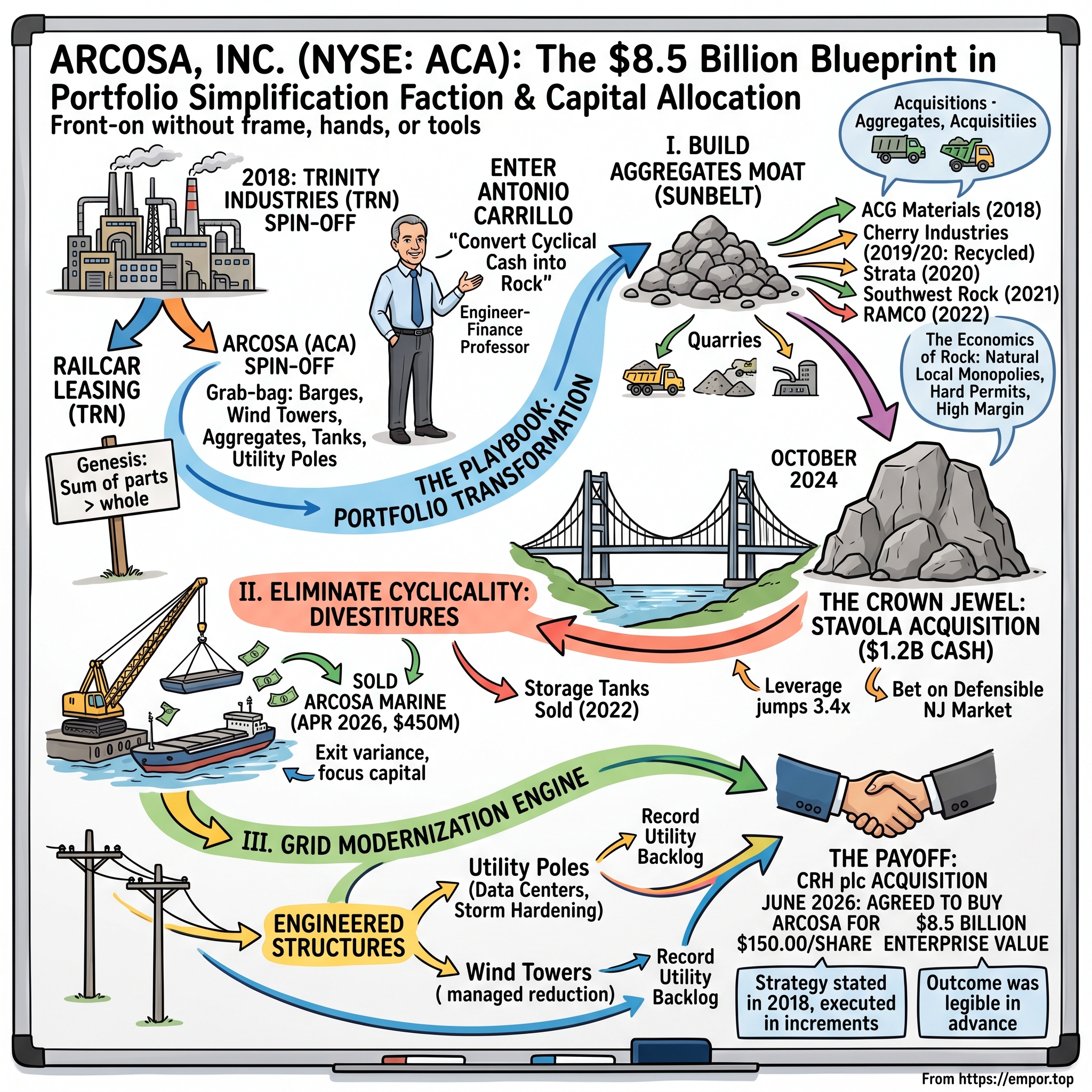
Arcosa, Inc. (NYSE: ACA): The $8.5 Billion Blueprint in Portfolio Simplification & Capital Allocation
I. Introduction & The $8.5 Billion End-Game
On the morning of June 22, 2026, a press release went out from Dublin that ended a story most public-market investors had never bothered to follow. CRH plc — the Irish-rooted, New York-listed giant that had spent the previous decade quietly assembling the largest building materials business in North America — announced it had agreed to buy Arcosa, Inc. for $150.00 per share in cash, valuing the Dallas company at roughly $8.5 billion in enterprise value.1 It was the largest acquisition in CRH's history.1
Rewind seven years and eight months. On November 1, 2018, Arcosa began trading on the New York Stock Exchange as a spin-off nobody asked for. Its first trade printed at $22.20.29 It was a grab-bag: barge manufacturing dating to 1903, wind towers whose order book rose and fell with the whims of Congress, a regional concrete and aggregates operation, steel castings, storage tanks, and utility poles. Sell-side coverage was thin. The "story stock" it was carved out of — Trinity Industries and its railcar leasing fleet — got the analysts, the models, and the attention.
The gap between those two moments is the whole episode. A company that opened life as an industrial leftovers bin was, less than eight years later, the object of a competitive bid from a global consolidator at a price that implied roughly fifteen times its own forward earnings power before any synergies.
Here is the roadmap.
First, the genesis: how Trinity Industries — a post-war Texan conglomerate that had bolted together railcars, barges, wind towers, and highway guardrails — concluded that the sum of its parts was worth less than the parts themselves, and how the resulting spin-off handed a new CEO a portfolio that was, by design, half-broken.
Second, the playbook. Antonio Carrillo did not invent the aggregates business model. What he did was recognize that Arcosa's cyclical manufacturing lines threw off cash that could be systematically converted into crushed stone reserves in fast-growing metros — assets with structurally better economics than anything else the company owned. Between 2018 and 2024 he ran that conversion trade roughly a dozen times.
Third, the economics of rock. Aggregates is one of the strangest and best businesses in the industrial economy, and understanding why — why a pile of gravel can carry a 35% EBITDA margin while a state-of-the-art factory struggles to clear 15% — is the analytical heart of this story.
Fourth, the bet. In October 2024 Carrillo put $1.2 billion of borrowed money into a single family-owned business in northern New Jersey, taking Arcosa's leverage to a level that made conservative holders visibly uncomfortable.1619
Fifth, the amputation. In April 2026, Arcosa sold the barge business — the oldest asset in the company, with roots stretching back more than a century — to a private equity firm for $450 million in cash, and deleted an entire reporting segment from its financials.22
And finally, the payoff, and the honest accounting of it. Because the CRH transaction has not closed. It requires an Arcosa shareholder vote and antitrust clearance, and both companies have targeted the first quarter of 2027.1 As of this writing, Arcosa remains an independent public company with a definitive merger agreement, a deal spread, and a regulatory process ahead of it. The $150 is an agreement, not a receipt.
What makes this worth two hours of attention is not the outcome. Plenty of companies get bought. What makes it worth studying is that the outcome was legible in advance — the strategy was stated publicly in 2018, executed in visible increments, and the scorecard was published quarterly. This is a story about whether a management team did what it said it would do, and about what kind of assets a global acquirer will pay a premium to own when it cannot build them.
Start where all spin-offs start: with a parent company that had run out of reasons to hold the pieces together.
 Subscribe on LinkedIn
II. The Conglomerate Split: Trinity Industries & The 2018 Spin-Off
Trinity Industries is one of those companies that only makes sense if you understand Texas industrial history. Headquartered in Dallas, it spent the second half of the twentieth century doing what American industrial conglomerates did: buying adjacent manufacturing businesses because they used similar steel, similar welders, and similar plants. By the 2010s, a single ticker — TRN — represented railcar manufacturing, one of North America's largest railcar lease fleets, inland river barges, wind turbine towers, highway guardrails and crash barriers, precast concrete, aggregates, storage tanks, and steel castings.
To a manufacturing executive, this was a portfolio of steel fabrication competencies. To an equity analyst, it was a nightmare.
The problem was not that any single business was bad. The problem was that they demanded incompatible things from the same balance sheet and the same valuation framework. Railcar leasing is a capital-markets business dressed as an industrial one: you buy an asset with a thirty-to-forty-year life, finance it with long-duration debt, and earn a spread. It rewards leverage, patience, and a low cost of capital. Wind towers are the opposite — a short-cycle, order-book manufacturing business whose demand was tied, for most of its history, to whether Congress had gotten around to renewing the federal Production Tax Credit that year. Barges rise and fall with grain exports, coal, steel prices, and, quite literally, how much water is in the Mississippi.
Ask an analyst to build one model that fairly prices a leasing annuity, a policy-dependent manufacturer, and a regional gravel business, and you get the conglomerate discount: a valuation that reflects not the assets but the difficulty of understanding them.
The Decision to Split
On December 12, 2017, Trinity's board announced its intention to pursue a tax-free spin-off of its infrastructure-related businesses, targeting the second half of 2018.2 The language in the accompanying investor presentation was standard corporate-finance boilerplate, but the three stated rationales were, in retrospect, unusually accurate: the split would enhance growth potential through focus, let each company optimize its own balance sheet and capital allocation, and allow each business to advance a differentiated investment thesis.3 The infrastructure company, Trinity said, would have "balance sheet strength and capital allocation flexibility to pursue growth through acquisitions."3
That last clause is the one that mattered. The whole point of the exercise was to create an entity with a clean balance sheet and permission to buy things.
The mechanics executed on November 1, 2018. Trinity holders of record as of October 17 received one share of Arcosa for every three Trinity shares they owned, distributed as a stock dividend effective at 12:01 a.m.4 Fractional shares were aggregated, sold into the market, and the proceeds distributed pro rata — the usual plumbing.4
The market's initial verdict is worth recording precisely, because it is often misremembered. ACA opened its first session at $22.20 and closed at $27.50, having traded as high as $30.50 on volume of roughly 3.2 million shares.29 That first-day pop tells you something: the shares were not universally dumped. But the composition of the shareholder base changed violently in the following weeks, as index funds and railcar-focused holders rotated out of a company that fit neither mandate.
Arcosa's opening capital structure was genuinely conservative. At separation it carried what Carrillo described as a nearly debt-free balance sheet, and it put in place a $400 million unsecured five-year revolving credit facility maturing in November 2023, priced at LIBOR plus 1.25%.5 Initial 2019 guidance called for $1.55–1.65 billion in revenue and $180–195 million of EBITDA.5 Scott Beasley was the launch CFO.5
The clean balance sheet lasted about five weeks. On December 5, 2018, Arcosa closed the acquisition of ACG Materials — a specialty materials and aggregates business — for $309.1 million, funded with cash and a $180 million revolver draw.6 By December 31, total debt stood at $185.5 million against $99.4 million of cash.6 The message to shareholders, delivered before the company had reported a single full quarter as an independent entity, was unambiguous: this balance sheet exists to be deployed.
Enter Antonio Carrillo
The person delivering that message was not an outsider brought in to shake things up. Antonio Carrillo had spent sixteen years at Trinity, rising to Senior Vice President and Group President of the Energy Equipment Group, and running Trinity's Mexico operations.9 He left in 2012 to become CEO of Mexichem, the Mexican chemicals company later renamed Orbia, where he served until February 2018 and pushed the business toward construction materials and building products.9 He then returned to Trinity in April 2018 as Group President of Construction, Energy, Marine and Components — a title that existed for exactly one reason: to give him seven months to prepare the businesses he was about to take public.9
His background is unusual for a heavy-industry CEO. He holds a bachelor's degree in mechanical and electrical engineering from Universidad Anáhuac in Mexico City and an MBA in finance from Wharton, and he taught finance at Instituto Tecnológico Autónomo de México.8 Engineer plus finance professor is a specific combination: someone who can walk a quarry and understand the crushing circuit, and who thinks natively in terms of return on invested capital rather than tons produced.
Carrillo's core insight was not complicated, which is part of why it worked. Arcosa owned two kinds of businesses. One kind — barges, wind towers, steel components — generated cash but earned poor returns through a full cycle and consumed enormous management attention during downturns. The other kind — aggregates and specialty materials — earned high returns, required modest maintenance capital, and got better with scale in ways the first kind never would. The job was to run the first kind for cash and convert that cash into the second kind, permanently.
Stated that plainly in 2018, it sounded like every spin-off CEO's opening pitch. The difference is what happened next.
III. The Carrillo Playbook: Portfolio Transformation & The Pivot to Aggregates
To understand what Arcosa was actually buying, you have to understand why crushed rock is a better business than almost anything with a microchip in it.
The Tyranny of Freight
Aggregates — crushed stone, sand, and gravel — are the most-consumed manufactured material on earth by weight. They are also nearly worthless per pound. A ton of crushed stone sold for roughly eighteen dollars at the quarry gate in Arcosa's network in 2025.21 Trucking that same ton fifty miles can cost as much as the rock itself.
This single fact — that transportation cost overwhelms product value within a few dozen miles — creates one of the cleanest natural monopolies in commerce. Economists call it a high freight-to-value ratio. In practice it means the market for any given quarry is a circle with a radius of roughly twenty-five to fifty miles, and inside that circle, the operator with the closest permitted pit wins on delivered cost, permanently, regardless of how efficient a distant competitor's plant is. A quarry in Fort Worth cannot compete for business in Phoenix at any price. This is Hamilton Helmer's scale economies operating at a local rather than national level: within the circle, the incumbent's fixed costs are spread over the largest volume, and nobody outside the circle can reach in.
The second layer is what makes the moat durable rather than merely real. Helmer's cornered resource power describes preferential access to a coveted asset that others cannot replicate. Hard-rock reserves near a growing metropolitan area qualify almost perfectly. Suitable geology exists only where it exists. And permitting a new quarry near a major metro requires environmental review, zoning approvals, water and air permits, and — the binding constraint in practice — the political consent of people who do not want blasting, dust, and gravel trucks near their homes. The process takes years, costs millions, and frequently fails outright.
The implication is counterintuitive but important: in aggregates, the scarce asset is not the rock. It is the permit. Reserves that were entitled decades ago, before the surrounding suburbs existed, cannot be recreated at any price. As a metro grows outward, existing quarries get more valuable precisely because the ring of politically feasible new sites keeps moving further away, lengthening every competitor's haul.
That is why the pure-play aggregates majors — Vulcan Materials and Martin Marietta — have historically traded at mid-to-high teens multiples of EBITDA while diversified industrials trade in the high single digits. The market is not paying for growth. It is paying for the near-impossibility of new supply.
The Conversion Trade, 2018–2024
Carrillo's arbitrage was to buy those assets one region at a time, from private families, at prices set by private-market negotiation rather than public-market comparables.
The campaign began before the ink on the spin-off was dry, with ACG Materials. It accelerated in December 2019, when Arcosa announced the acquisition of Cherry Industries — Houston's leading recycled aggregates and natural aggregates operator — for $298 million, against trailing twelve-month revenue of roughly $176 million and EBITDA of about $37 million.10 The deal closed in January 2020, weeks before the pandemic.
Cherry deserves a moment of explanation because it is genuinely different from a quarry. Recycled aggregate is made by taking demolished concrete — old highway decks, torn-down parking structures — crushing it, and selling it back as base material for new roadbeds. The economics are attractive for reasons that have nothing to do with environmental marketing. There is no reserve to deplete, so the asset never runs out. The feedstock is typically paid to the operator: contractors pay a tipping fee to dispose of rubble. And the plants sit inside the city, where no natural quarry could ever be permitted, giving them the shortest possible haul to urban job sites. It is, in effect, a quarry that gets restocked by the city itself.
The Sunbelt buildout continued methodically. In October 2020, Arcosa announced Strata Materials, a Dallas–Fort Worth recycled aggregates operator, for roughly $87 million — about 8.5 times trailing adjusted EBITDA of $10.2 million.11 In August 2021 it announced Southwest Rock Products, a natural aggregates business in the Phoenix corridor, for $150 million, or roughly 10.7 times EBITDA of about $14 million.12 In May 2022 it closed on RAMCO, a recycled aggregates operator in the Los Angeles metro, for $75.6 million, funded with an $80 million revolver draw.13 In late 2023 it added three smaller bolt-ons — stabilized sand in Houston, recycled aggregates in Florida and Phoenix — for $41 million combined.14
Reading the Multiples
The disclosed multiples are the most analytically useful thing in this entire sequence, because they reveal the actual source of value creation.
Strata at 8.5 times and Southwest Rock at 10.7 times were struck against a public comp set trading materially higher. Arcosa was, in the simplest terms, buying private assets at private prices and having them revalued at public prices the moment they landed inside a listed aggregates platform. That multiple arbitrage — not operational genius — was the primary engine. It is available to any acquirer with a listed currency, a fragmented target universe, and the discipline to walk away from auctions.
The word "discipline" is doing real work there, and it deserves scrutiny rather than applause. Multiple arbitrage is the most common way industrial roll-ups destroy capital, because the arbitrage disappears the moment you overpay, and overpaying is exactly what happens when a management team's incentive is to keep the deal cadence up. The evidence that Arcosa mostly avoided this is circumstantial but real: the disclosed entry multiples clustered in the eight-to-eleven range rather than drifting upward over time, and the company was willing to go quiet for stretches.
There is a second, less flattering reading available, and it should be stated. Aggregates roll-ups look brilliant during a construction upcycle and merely levered during a downturn. Arcosa's buying campaign ran from 2018 through 2024 — a period of federal infrastructure stimulus, Sunbelt migration, and a construction boom in exactly the metros it targeted. The strategy was never stress-tested against a genuine multi-year regional recession in Texas, Arizona, or California. That test simply did not occur on Carrillo's watch.
Meanwhile, the other half of the trade was running. In April 2022 Arcosa announced the sale of its storage tanks business for $275 million, closing that October and booking a pre-tax gain of $189.0 million.1728 Cash was flowing out of legacy manufacturing and into rock, exactly as advertised.
By 2024 the portfolio had tilted decisively. What Carrillo had not yet done was make a bet large enough to change the company's identity in a single stroke.
IV. The Crown Jewel: Betting the Balance Sheet on Stavola
Northern New Jersey is not where a Dallas company with a Sunbelt playbook goes looking for growth. It is dense, expensive, heavily unionized, and governed by some of the most demanding environmental regulation in the United States. It is also, for precisely those reasons, one of the most defensible aggregates markets on earth.
The rock underneath the region is traprock — hard volcanic basalt and diabase, ideal for high-spec road construction. The geology sits under one of the most densely populated corridors in the country, within trucking distance of Manhattan, and the practical odds of permitting a genuinely new hard-rock quarry there are close to zero. Every existing pit is therefore an option on decades of construction demand in a market where nobody can add competing supply.
Stavola Holding Corporation had been mining it since 1948.16
The Transaction
In July 2024, Arcosa announced an agreement to acquire Stavola's construction materials business for $1.2 billion in cash, and closed the deal on October 1.16 The asset base comprised five hard-rock natural aggregates quarries, twelve asphalt plants, and three recycled aggregates sites, primarily serving the New York–New Jersey metropolitan statistical area.16
The financial profile explains the price. For the twelve months ended June 30, 2024, Stavola generated $283 million of revenue and $100 million of adjusted EBITDA — a 35% margin, with aggregates contributing 56% of that EBITDA.16 For context, Arcosa's entire company was running at a 17.4% adjusted EBITDA margin in 2024.21 Stavola was, on a standalone basis, twice as profitable per dollar of revenue as the business acquiring it.
At $1.2 billion against $100 million of EBITDA, the headline multiple was twelve times — well above the eight-to-eleven range Arcosa had paid for its earlier Sunbelt deals, and a meaningful departure from the disciplined-buyer narrative. Two things partially offset that. The transaction was structured to generate tax benefits with an estimated net present value of roughly $125 million, which reduces the effective price.16 And the asset quality was categorically different: vertically integrated, aggregates-led, with an asphalt business that pulls the quarry's own stone through to a higher-value product sold to the same road contractors.
That vertical integration is worth a sentence of plain explanation. Asphalt is roughly 95% aggregates by weight bound together with liquid asphalt cement. An operator who owns both the quarry and the asphalt plant captures the margin on the rock and the margin on the mix, and — more importantly — guarantees an internal customer for quarry output regardless of what competitors do on price.
The Financing and the Pushback
Arcosa funded the purchase by issuing $600 million of 6.875% senior unsecured notes due 2032 in August 2024, and drawing a $700 million variable-rate senior secured Term Loan B due 2031 at closing.18 Simultaneously, on the same October 1 date, it sold its steel components business to Stellex Capital Management for total consideration of $110 million — $55 million cash, a $25 million seller's note, and a $30 million earnout — booking a pre-tax loss of $21.6 million on the sale.18
That loss deserves acknowledgment rather than a footnote. Arcosa took a real, disclosed hit to exit a business it did not want, in the same breath as its largest acquisition. Selling assets at a loss to fund a purchase is the kind of thing management teams usually bury. It also cuts the other way: it is evidence that the portfolio Arcosa inherited in 2018 contained genuine value destruction, not merely undervalued cyclicals.
The balance sheet consequence was immediate. Pro forma net debt to adjusted EBITDA jumped to 3.4 times as of the third quarter of 2024, from 1.2 times on a trailing basis before the deal.19 Management had projected 3.7 times at announcement, so 3.4 was an improvement against its own guidance — but a company that had spent six years marketing balance-sheet flexibility had just tripled its leverage in a quarter, at a coupon near seven percent, with a floating-rate term loan on top.1819
Arcosa's commitment was specific and time-bound: return to a net leverage target of 2.0–2.5 times within eighteen months.20 That is the kind of promise that is easy to make on an announcement call and very hard to hide from later. It became the single most useful test of management credibility in the story.
The pushback from analysts clustered around three questions, and they were the right ones. Could a Texas management team operate union labor and New Jersey environmental compliance without breaking something? Was twelve times the top of the cycle for Northeast construction? And what happens to a 3.4-times-levered materials company if rates stay high and infrastructure funding slows?
Carrillo's answer was consistent across calls: the cash conversion of quarry assets is high and stable, the margin profile resets the entire company upward, and deleveraging would come from free cash flow rather than asset sales.
What Actually Happened
The leverage trajectory is the cleanest available scorecard, and it is worth tracing because it is what management staked its credibility on. From 3.4 times pro forma in the third quarter of 2024, net leverage fell to 2.9 times by year-end 2024, 2.4 times by the third quarter of 2025, and 2.3 times at year-end 2025.1921 Arcosa retired $168.7 million of debt during 2025, including a $60 million term loan paydown in the fourth quarter, and finished the year with $914.6 million of liquidity.21
The company reached its target range roughly two quarters ahead of the eighteen-month commitment.21 Carrillo said as much on the fourth-quarter call.23
The operating result was equally clear. Full-year 2025 revenue reached $2.88 billion, up 12%, with adjusted EBITDA of $583.3 million, up 30%, and margin of 20.2% — an expansion of 280 basis points in a single year.21 A company does not expand margin by nearly three points organically. It does so by changing what it owns. Stavola was the change.
Which raised an obvious question about what was still holding the average down.
V. Eliminating Cyclicality: Divesting Arcosa Marine
There is a boat-shaped hull under construction somewhere on the Tennessee River right now that traces its corporate lineage to 1903. Arcosa Marine Products — operating under the Arcosa Marine, Nabrico, and Wintech brands — built inland barges, fiberglass covers, winches, and marine hardware for the American river system, and had been doing so, under various owners, for over 120 years.22
It was the oldest thing Arcosa owned. In February 2026, the company sold it.
Why the Barge Business Had to Go
The inland barge business is a study in demand variables no management team controls. Order books swing on grain export volumes, coal demand, steel plate prices, the age of the existing fleet, and — a genuinely uncontrollable input — how much water is in the Mississippi River in a given year. Drought conditions that reduce barge drafts can suppress freight economics and, with a lag, new-build orders.
The mechanical problem this creates for a company like Arcosa is not that barges lose money. In 2025 they made good money: the Transportation Products segment generated $383.3 million of revenue and $68.3 million of adjusted segment EBITDA, a 17.8% margin, with the fourth quarter up 19% on strength in tank barges.21 The inland barge backlog at year-end 2025 stood at $296.9 million, up 6%, with all of it scheduled for recognition in 2026.21
The problem is variance. A segment that swings from strong to weak on exogenous variables imposes a discount on the whole company, because investors cannot separate the durable cash flows from the volatile ones. It also consumes management bandwidth in inverse proportion to its contribution — downturn quarters generate the most questions about the smallest segment.
And it dilutes returns on invested capital. Barge manufacturing requires shipyards, heavy fabrication assets, and working capital, and through a full cycle it does not earn what a quarry earns.
The Clean Break
On February 24, 2026, Arcosa announced a definitive agreement to sell Arcosa Marine Products to Wynnchurch Capital, L.P. for $450 million in cash.22 Carrillo called it "a pivotal step in the strategic transformation and simplification of our portfolio."22 The transaction completed on April 1, 2026.
The valuation deserves a beat of analysis. At $450 million against $68.3 million of 2025 segment EBITDA, Arcosa exited at approximately 6.6 times — and it exited at what was, by the segment's own recent history, a strong point in the cycle rather than a weak one. Selling a cyclical asset near a peak to a financial buyer, at a mid-single-digit multiple, into a company that trades at a materially higher multiple, is textbook portfolio arithmetic. Every dollar of EBITDA removed at 6.6 times and every dollar of debt retired with the proceeds is accretive to the multiple the market applies to what remains.
The structural consequence was that the Transportation Products reporting segment ceased to exist. Arcosa became a two-segment company: Construction Products and Engineered Structures. Barge results moved to discontinued operations, which is why the 2026 guidance had to be restated on a continuing-operations basis — a genuine apples-to-oranges break in the reported numbers that investors reading a screening tool would easily misinterpret.
Management's handling of the proceeds is where the discipline claim gets tested again. Estimated after-tax net proceeds were approximately $370 million.25 In April, Arcosa applied $83 million to prepay the Stavola term loan, bringing net leverage to 1.9 times on a pro forma basis.25 On the fourth-quarter call, Carrillo had pre-committed to restraint, saying the money would not "burn a hole in our pocket," and ranking priorities as bolt-on aggregates M&A first, organic utility expansion second.23 On the first-quarter call he held the same line, describing buybacks as opportunistic and aimed at offsetting compensation dilution rather than a strategic priority.26 Arcosa had repurchased $17.5 million of stock in the first quarter, with $32.5 million remaining on the authorization.25
Two things to note for balance. First, the barge sale eliminated cyclicality in the specific sense of removing a volatile segment — but it did not make Arcosa acyclical. Construction materials demand is tied to public infrastructure budgets and private non-residential construction, both of which cycle. Second, the divestiture removed a genuinely profitable business generating meaningful free cash flow. Simplification has a cost, and the case for it rests on the claim that the multiple expansion exceeds the earnings foregone. That is a judgment, not a fact, and CRH's subsequent bid is suggestive evidence for it rather than proof.
By April 2026, then, Arcosa was two businesses. The one that gets the premium multiple is the rock. The one that was quietly doing more of the work was the other.
VI. The Grid Modernization Engine: Engineered Structures
If you drive between Dallas and Houston, you will pass under transmission lines carried on tapered steel poles the height of a fifteen-story building. Most people never look up. Those poles, and the tens of thousands like them going up across the American grid, are Arcosa's second business — and through 2025 and 2026, its faster-growing one.
The Segment Nobody Modeled
The framing that dominated Arcosa's story was aggregates. The financials tell a more balanced tale. In 2025, Construction Products generated $1,310.2 million of revenue and Engineered Structures generated $1,189.9 million — close to parity.21 Once barges left, Engineered Structures represented roughly half of continuing revenue. In the first quarter of 2026 it was, in fact, the larger segment: $295.4 million versus $276.3 million.25
More striking is the direction of travel. Construction Products revenue rose 5% in the first quarter of 2026 but adjusted segment EBITDA fell 2%, with margin down 150 basis points on asphalt weakness and downtime in specialty materials.25 Engineered Structures grew revenue 4% and adjusted segment EBITDA 21%, hitting a record 21.1% margin.25
That inversion is the single most important operating fact in Arcosa's recent history, and it complicates the clean narrative. For one quarter at least, the premium-multiple aggregates business was the margin laggard and the "boring" manufacturing business was the engine.
Utility Structures: Where the Growth Is
The utility and related structures business manufactures steel, concrete, and composite poles for electrical transmission and distribution, generating $834.7 million of the segment's 2025 revenue.21 Demand is being driven by a convergence of forces that would each individually be significant.
Grid modernization comes first: much of the American transmission network was built decades ago and is reaching the end of its design life. Storm hardening comes second — utilities in hurricane and wildfire-exposed regions have been systematically replacing wooden poles with steel and concrete, a regulatory-driven upgrade cycle. Third is load growth, and this is the new variable. Data centers built for AI training and inference draw power at densities that have forced utilities to revise long-term forecasts upward for the first time in a generation, which means new interconnections, new substations, and new transmission.
On the fourth-quarter 2025 call, Julio Romero of Sidoti pressed management on what was actually driving utility demand. The answer was concrete rather than thematic: data center load, manufacturing reshoring, and a structural shift toward larger poles, because utilities optimizing constrained rights-of-way increasingly want to carry more circuits on taller structures.23
The order book supports the story. The utility and related structures backlog stood at $434.9 million at the end of 2025, up modestly from $414.0 million a year earlier.21 By the end of the first quarter of 2026, it had jumped to a record $557.6 million — up 28% in three months.25 A backlog that expands by more than a quarter in a single quarter reflects genuine order intake acceleration, not price.
The competitive question is whether Arcosa has an edge here or is simply riding a tide. The honest answer is: partially. Utility structures do carry switching costs, because a transmission pole that fails is a catastrophic, potentially fatal event, and utilities run multi-year qualification processes before certifying a supplier. Once qualified, a manufacturer with a clean delivery record is not casually replaced over price. But Arcosa is not alone — Valmont Industries and Sabre Industries compete directly, and the barriers protect all incumbents roughly equally. Arcosa's specific advantages are physical: plant locations near demand centers, rail access for shipping structures too large for economical trucking, and steel procurement scale. Those are real cost advantages, not proprietary ones.
Management has been putting capital behind capacity. An Illinois facility was slated to come online in the second half of 2026, a Tulsa plant is being converted from wind tower production to utility structures, and a Mexico galvanizing facility took its first dip in the first quarter of 2026, with cost savings expected from 2027.23 CFO Gail Peck flagged that these conversions would create startup costs in the second quarter, abating in the back half — a specific, checkable claim of the type that separates credible guidance from hand-waving.26
Wind Towers: The Part the Story Usually Gets Wrong
Here the consensus narrative and the evidence diverge sharply, and it is worth correcting directly.
The common framing holds that the Inflation Reduction Act of 2022, by granting ten-year visibility on renewable tax credits, ended the historical boom-bust cycle in wind tower manufacturing driven by the on-again, off-again federal Production Tax Credit. That framing is not what Arcosa's numbers show.
Wind towers generated $355.2 million of revenue in 2025.21 The wind tower backlog fell to $627.8 million at year-end 2025 from $776.8 million a year earlier, with only 42% expected to convert in 2026 and 53% pushing to 2027.21 By the first quarter of 2026 the backlog had declined further to $600.0 million.25 Peck guided wind tower revenue down roughly 25% in 2026.23
More telling is the structural response. On the first-quarter call, Carrillo said plainly that by 2028 Arcosa would have only two wind tower plants left, retaining the optionality to flex those facilities to pole production.26 That is not the behavior of a company that believes policy has stabilized its wind business. It is a managed wind-down with an embedded option.
Carrillo did offer one genuinely interesting counterpoint on the fourth-quarter call: that for the first time since Arcosa began building wind towers, the grid actually needs the power they enable, independent of subsidy.23 Demand driven by electricity scarcity is more durable than demand driven by tax credits. Whether that thesis holds is unresolved, and the near-term evidence — a declining backlog and plant closures — argues that policy still dominates.
Ian Zaffino of Oppenheimer asked the right question on the fourth-quarter call: after divesting barges, what cyclicality remains? Carrillo's answer named wind directly, and framed the redeployment to utility structures as a move to a "higher multiple, higher margin" opportunity.23 That is an unusually candid admission that a segment the company still operates is the weak link.
The conversion of wind capacity into utility capacity is therefore the most consequential operational project inside Arcosa, and it is not yet finished. It also happens to be exactly the kind of half-completed transformation that makes a company attractive to an acquirer with deeper pockets.
VII. The Ultimate Payoff: CRH plc Agrees to Acquire Arcosa for $8.5 Billion
CRH is not a company most American investors could describe in a sentence, which is odd given that it is now one of the largest building materials businesses on the continent. Founded through an Irish merger, it relocated its primary listing to the New York Stock Exchange in 2023 and has spent the years since pursuing what it calls a "connected portfolio" strategy — owning aggregates, cement, asphalt, ready-mix, and increasingly the products and services layered on top, in the same geographies, so that each reinforces the others.
On June 22, 2026, CRH announced it had agreed to acquire Arcosa outright.1
The Terms
The offer was $150.00 per share in cash, valuing Arcosa at approximately $8.5 billion in enterprise value.1 The price represented a 25% premium to Arcosa's 60-day volume-weighted average price as of June 18, 2026 — a construction that matters, because a VWAP-based premium is harder to game than a premium to an unaffected single-day close, and suggests the parties were negotiating against a stable reference rather than a spike.1
CRH stated the transaction valued Arcosa at 11.5 times 2026 estimated adjusted EBITDA, including anticipated annual run-rate cost synergies of $175 million by year three.1 Financing would come from available cash and committed debt, including a $5.75 billion bridge loan, with pro forma net debt to adjusted EBITDA of 2.4 times, preserving investment-grade ratings.1 Both boards approved unanimously. Closing was targeted for the first quarter of 2027, subject to Arcosa stockholder approval and antitrust and other regulatory clearances.127
CRH chief executive Jim Mintern framed it as reinforcing the company's position as "the #1 infrastructure player in North America" and advancing its aggregates-led connected portfolio strategy.1 Carrillo's language was more revealing of the seller's mindset: the transaction "crystalizes the value we have built."1 Crystallizes, not accelerates. The word choice reads as an acknowledgment that this was an endpoint.
The Math, Honestly Done
The commonly repeated version of this story starts the clock at a $21 spin-off price. That number does not appear in the trading record. ACA's first trade was $22.20 and its first close was $27.50.29
Using the opening print, a holder who bought at the open on day one and receives $150 in cash would realize approximately 6.8 times their money over roughly 7.6 years, a compound annual return of about 28%. Using the first-day close — arguably the fairer mark, since $27.50 is where the market settled after price discovery — the return is roughly 5.5 times, or about 25% compounded. Both figures exclude dividends, which adds modestly to the total.
Either way, the conclusion holds and does not need inflating: a spun-off industrial conglomerate remnant compounded at roughly a quarter to a third per year for nearly eight years, comfortably ahead of the S&P 500 over the same span. The point of doing the math carefully rather than generously is that the disciplined version is still remarkable, and the exaggerated version invites the suspicion that the whole thesis is built on rounded-up numbers.
One more piece of honesty is required. Deal spreads exist for a reason. The transaction requires a shareholder vote and antitrust review, and CRH is a large existing participant in North American aggregates and asphalt. Regulators will examine geographic overlaps market by market, and remedies — divestitures of specific quarries or plants in overlapping metros — are a plausible outcome. The stated close is two quarters away as of this writing. Nobody has been paid yet.
Deconstructing the Multiple
The 11.5 times headline is a synergized number, and synergized multiples always flatter the buyer. The pre-synergy arithmetic is more informative.
Arcosa's own guidance for 2026 continuing operations, raised after first-quarter results, called for revenue of $2.6–2.7 billion and adjusted EBITDA of $545–585 million.2425 Against the midpoint of roughly $565 million, an $8.5 billion enterprise value implies approximately 15.0 times — squarely in the range where the pure-play aggregates majors have historically traded, and well above where Arcosa itself traded as a mixed industrial.
So the question is why CRH paid a full pure-play multiple for a company that is only half aggregates.
The most likely answer is scarcity of the alternative. CRH cannot permit new hard-rock quarries in the New York–New Jersey corridor any more than anyone else can. If it wants that position, it must buy an owner — and the owners are either private families who will not sell, or public companies that must be bought at a premium. Public-to-public consolidation at a premium is not CRH's preference; it is the only available route to a specific set of irreplaceable assets. The $175 million of expected cost synergies, roughly 6% of Arcosa's guided revenue, is the mechanism by which CRH converts a 15 times purchase price into an 11.5 times effective one — and the credibility of that number will not be testable for three years.
There is a less romantic reading worth holding alongside the first. CRH bought a company whose most attractive asset had been owned for less than two years, whose second segment was mid-transformation with plants still being converted, and whose largest remaining cyclical exposure was in structural decline. A buyer paying 15 times pre-synergy for that mix is expressing considerable confidence in an integration it has not yet performed.
Which turns attention to the person who assembled the thing being bought.
VIII. Management Assessment & Capital Allocation Scorecard
The most useful way to evaluate a management team is not to read what they say in the current year. It is to read what they said years ago and check.
Consistency, Tested
Arcosa's founding pitch in late 2018 promised a focused infrastructure company with balance-sheet flexibility to grow through acquisitions.35 Eight years later, the company had acquired at least ten construction materials businesses across Texas, Arizona, California, Florida, and New Jersey, plus a utility pole manufacturer, while divesting storage tanks, steel components, and barges.13141516171822 Every disposal moved the portfolio in the same direction: out of low-return cyclical fabrication, into materials and infrastructure products.
That consistency is the strongest single point in management's favor, and it should be weighed against a common alternative pattern. The failure mode for spin-off CEOs is drift: a stated strategy in year one, an opportunistic acquisition outside it in year three, a "platform expansion" in year five, and by year seven a portfolio no more coherent than the one they inherited. Arcosa's transaction log does not show that. Every major move fits the thesis stated at separation.
Where the record is less flattering is in the price paid at the top of the arc. Stavola at twelve times was materially above Arcosa's earlier entry multiples. Management defended it on asset quality and tax structure, and the subsequent margin expansion supports the defense — but an activist would fairly note that the "disciplined regional buyer" narrative and the largest deal in company history at the highest multiple in company history sit in tension.
Guidance Discipline
The behavioral test that matters most is what a team does with a specific, dated, public commitment when circumstances get difficult. Arcosa's was the pledge to return to 2.0–2.5 times net leverage within eighteen months of the Stavola close.20 It hit the range early, funded by operating cash flow rather than by selling assets under duress, and the CFO walked through the mechanics on the call rather than asserting the outcome.2123
Note also what management did not do. Free cash flow fell 39% in 2025 to $202.1 million, from $330.6 million, and operating cash flow declined 32%.21 A team inclined toward spin would have buried that. It is disclosed alongside the record EBITDA, and the divergence — record earnings, lower cash flow — is exactly the kind of thing a careful investor should interrogate, since it typically reflects working capital build, higher cash interest on the new debt, and elevated capital spending on capacity conversion.
The tone in Q&A has been notably specific rather than evasive. When Garik Shmois of Loop Capital asked about first-quarter seasonality, Peck did not deflect — she said the quarter would fall below the prior year's roughly 16% share of annual EBITDA because of cold and snowy Northeast weather affecting Stavola, and named the cause.23 When asked about diesel costs, Carrillo gave the consumption figure — roughly ten to eleven million gallons annually — and Peck quantified the exposure as a 4–5% headwind to cash unit profitability if unmitigated, then described the surcharge mechanism deployed against it.26 Naming a number that can later be checked is a form of accountability that vague guidance avoids.
When Brent Thielman of D.A. Davidson pushed on whether Engineered Structures margins could hold through the wind step-down, Peck's answer led with the concession — "wind is going to have an impact for sure" — before guiding to flat-to-slightly-up segment margin.23 Leading with the problem is a small signal, but a real one.
Incentives and Ownership
The compensation architecture disclosed in the 2025 proxy is unusually well-matched to the strategy, which is rarer than it sounds.
The annual incentive plan for Carrillo and the senior team weighted enterprise adjusted EBITDA at 50%, adjusted EBITDA margin at 30%, and execution of strategic initiatives at 20%.7 The margin component is the load-bearing element. Paying management on absolute EBITDA alone rewards buying anything accretive; paying 30% on margin makes a dilutive acquisition actively costly to the acquirer's own pay. It is the mechanism that made a 35%-margin asset like Stavola compelling and a low-margin fabrication business worth exiting even at a loss. For 2024, the plan paid out at 160% of target, with the margin metric alone earning 168%.7
Long-term incentives were split 60% performance-based and 40% time-based, with the performance awards measured over 2024–2026 on average pre-tax return on capital (40%), cumulative adjusted earnings per share (40%), and relative total shareholder return against the S&P SmallCap 600 (20%).7 The return-on-capital weighting is the discipline mechanism: it makes growth financed by overpayment mathematically self-defeating for the executive being measured. The proxy reported 2024 return on capital of 20.1%.7
Carrillo's beneficial ownership stood at 508,203 shares, or 1.0% of the class, as of March 21, 2025, including 78,670 shares acquirable within sixty days, with no shares pledged.7 At the CRH price, that stake is worth roughly $76 million. His 2024 total compensation was $7.30 million, of which $4.51 million was stock.7 The structure is heavily equity-weighted, which aligns him with the outcome — though it should be said plainly that equity-heavy pay also creates an incentive to sell the company, and a CEO holding $76 million of stock is not a disinterested party in evaluating a $150 offer.
Institutional ownership was concentrated in index funds — BlackRock at 15.7%, Vanguard at 11.4%, Dimensional at 5.9%, Neuberger Berman at 5.1% as disclosed in the proxy.7 That composition matters for the vote ahead: index holders typically follow proxy advisor recommendations rather than forming independent views on price adequacy.
Incentives explain choices. They do not explain durability. For that, the question is what actually protects the assets.
IX. Strategic Playbook: Moat & Competitive Power Analysis
Strip away the transaction history and ask the only question that matters for a long-term owner: what would stop a well-funded competitor from taking this business apart?
The Powers, Ranked by Durability
The strongest is the cornered resource, and it is concentrated rather than uniform. Arcosa's Northeast quarries sit on hard traprock in a market where new permits are, for practical purposes, unobtainable. That is not a competitive advantage in the ordinary sense — an advantage implies a competitor could catch up with enough effort. This is closer to a property right. Its value scales with construction activity within the haul radius and with the impossibility of adding supply, and both of those trend favorably as the metro densifies. The critical caveat: reserves deplete. A quarry is a wasting asset, and the durability of this power is a direct function of permitted reserve life, which is a disclosure item investors should track rather than assume.
Second is local scale economies, which operate differently from national scale. In most industries, scale means spreading R&D or brand spend over more units. In aggregates, scale means density: owning several sites in one metro so that whichever job wins, the shortest haul is yours. It also means fixed costs — crushing plants, permits, compliance staff, sales coverage — spread across more tons in the same market. This is why Arcosa's bolt-on strategy targeted geographic clusters rather than scattered assets, and why buying a fourth quarry in Houston is worth more than a first quarry in an unrelated city.
Third is switching costs, in Engineered Structures. As discussed, utility qualification is slow, technically demanding, and failure-intolerant. But the honest characterization is that this power protects the incumbent set collectively, not Arcosa uniquely. Valmont and Sabre enjoy the same protection. It raises the floor; it does not create a monopoly.
Fourth, and the most interesting, is a partial counter-positioning in recycled aggregates. Traditional quarry operators own depleting reserves and are structurally incentivized to mine them, because every ton of recycled material sold is a ton of owned reserve left unsold. A specialist without that conflict can build urban recycling capacity aggressively. Arcosa, through Cherry, Strata, RAMCO, and the 2023 bolt-ons, built exactly that position ahead of the majors.10111314 It is genuine counter-positioning, though bounded: recycled aggregates cannot meet the specifications for every application, so the addressable share is capped by engineering standards rather than by competitive dynamics.
Arcosa does not have meaningful network economies, branding power, or process power. Nobody specifies gravel by brand.
Five Forces, Applied
New entrants face the highest barrier in aggregates that exists in any commodity business, and it is regulatory rather than capital. Money can buy a crushing plant; it cannot buy a permit in a place that has decided not to issue one. In engineered structures the barrier is meaningful but surmountable — heavy capital plus multi-year utility certification.
Buyer power is more nuanced than the standard telling. Large utilities and highway contractors are sophisticated, concentrated purchasers who run competitive bids. What limits their leverage in aggregates is geography: a contractor pouring concrete on a Newark job site can negotiate hard, but cannot credibly threaten to source stone from a hundred miles away. Arcosa's own data shows this working — the company took 5% price and 2% volume in aggregates in the fourth quarter of 2025, and 2% price on 4% volume in the first quarter of 2026.2125 Positive pricing in a quarter of decelerating volume is evidence of real, if modest, pricing power.
Supplier power is low in aggregates for the obvious reason that the company owns the deposit. It is materially higher in Engineered Structures, where steel is the dominant input and its price is set globally. This is a genuine asymmetry between the two segments that the consolidated margin obscures.
Substitutes are close to absent. There is no economically viable replacement for aggregate-based concrete and asphalt in roads and bridges at the required scale, and no substitute for high-strength steel or concrete in high-voltage transmission structures. This is one of the few industries where technological disruption is not a serious medium-term risk.
Rivalry is structurally muted in aggregates because the markets are local and typically oligopolistic — two or three operators per metro who compete on service and delivered cost rather than destructive price wars, since a price war in a fixed-radius market with fixed supply hurts everyone. Rivalry in utility structures is more conventional and more intense.
The Honest Aggregate
Put together, the composite picture is a company with one genuinely exceptional asset class, one good-but-not-exceptional manufacturing business, and a declining legacy exposure. The exceptional part — permitted reserves in supply-constrained metros — is real, durable, and precisely the thing CRH was buying. The rest is a solid industrial business with cost advantages that are physical rather than proprietary.
That framing sets up the last unresolved question: what the standalone case looked like, and what could have broken it.
X. The Bull vs. Bear Case & Stress Test
Suppose the CRH deal had never happened, or suppose it fails to clear regulatory review. What would an investor own?
The Case For
The demand backdrop is the strongest it has been in decades, and it comes from three independent sources rather than one. Federal infrastructure funding under the Infrastructure Investment and Jobs Act flows to state highway programs, which are the primary consumers of aggregates and asphalt. Industrial policy — semiconductor fabrication plants, battery facilities, reshored manufacturing — generates heavy site work and, downstream, enormous electrical demand. And the AI buildout has done something no policy could: it has made electricity genuinely scarce in specific regions, forcing utilities into transmission investment cycles they had deferred for years.
Arcosa sits at the intersection of the first and third. That is an unusual position; most companies get exposure to one megatrend, not two uncorrelated ones.
The second pillar is mix-driven margin. The company demonstrated it can lift consolidated margin by nearly three points in a year through portfolio change, and the same arithmetic still has room to run as Stavola-quality economics scale across a larger asset base and as wind capacity converts to higher-margin utility production.21 Crucially, the utility backlog growth is observable, not projected.25
The third pillar is that the deleveraging is done. A company at 1.9 times pro forma leverage with the target range achieved ahead of schedule has restored optionality — for bolt-on M&A, for organic capacity, or for absorbing a downturn.25
The Case Against
Leverage and rates. The Stavola financing left Arcosa with a 6.875% coupon on $600 million of unsecured notes and a floating-rate term loan.18 Deleveraging fixed the ratio; it did not fix the cost. A construction slowdown that compresses EBITDA would re-lever the balance sheet arithmetically, without a single new dollar borrowed — the mechanism by which levered cyclicals get into trouble is almost always the denominator, not the numerator.
Free cash flow quality. The 2025 divergence between record EBITDA and materially lower free cash flow is the most legitimate bear talking point in the financials.21 Some of it is explainable — cash interest, working capital, growth capital spending on the Illinois and Mexico facilities. But an aggregates thesis rests fundamentally on cash conversion, and two consecutive years of declining free cash flow against rising earnings would falsify the thesis regardless of what the EBITDA line does.
Aggregates deceleration. The first quarter of 2026 showed a segment growing revenue while contracting EBITDA, with pricing at 2% — down from 5% in the prior quarter.2125 Management attributed it to asphalt weakness and specialty materials downtime.25 That explanation is plausible and specific. But aggregates pricing decelerating from 5% to 2% in a single quarter is exactly what the early stage of a construction slowdown looks like, and a skeptic would want two more quarters before accepting the operational explanation.
Integration and regional execution. Arcosa's institutional muscle memory was built in Texas, Arizona, and Florida. New Jersey brings union labor, denser regulatory oversight, and a materially different operating culture. The Northeast weather sensitivity flagged for the first quarter of 2026 is a small illustration of a broader point: the Stavola assets behave differently from the rest of the portfolio, and less than two years of ownership is a short track record for a $1.2 billion bet.23
Input costs. The diesel exposure quantified on the first-quarter call — a potential 4–5% headwind to cash unit profitability — is a reminder that quarry economics are energy-intensive.26 Surcharges recover cost with a lag and imperfectly, and steel exposure in Engineered Structures compounds the point.
Policy. Wind remains subject to federal incentive design, and the managed reduction to two plants by 2028 is a decision made under policy uncertainty rather than despite it.26 Separately, grid interconnection queues are a genuine bottleneck: a utility can want transmission and still be unable to build it on schedule, which converts firm demand into deferred backlog.
The Activist Lens
What would a hostile-minded investor have attacked?
Most plausibly, the sequencing. Arcosa raised leverage to 3.4 times to buy Stavola in October 2024, then sold a profitable barge business for $450 million sixteen months later and used part of the proceeds to pay down that same debt.192225 An activist could argue the barge sale should have preceded or accompanied the acquisition, avoiding the levered interval entirely. Management's counter — that the barge business was sold at a strong point in its own cycle, and that waiting captured a better price — is defensible, but it is a post-hoc justification for a sequence that carried real risk.
Second, the steel components loss.18 Selling an asset at a disclosed pre-tax loss raises a fair question about whether it was managed for value in the years before it was sold, or simply neglected as non-core.
Third, disclosure granularity. Arcosa discloses aggregate volumes, pricing, and cash gross profit per ton at the company level, but does not break out organic versus acquired contribution in a way that lets outsiders cleanly separate M&A-driven growth from underlying performance. For a company whose entire thesis is acquisition-driven, that is a meaningful gap.
What to Actually Watch
Three metrics carry the thesis, and only three.
The first is aggregates pricing and volume growth, and adjusted cash gross profit per ton. This is the single cleanest read on whether the cornered-resource story is real. Price should exceed cost inflation in a constrained market. Volume tells you about end-market demand. Profit per ton tells you whether the two are combining into actual economics rather than just revenue.
The second is the utility and related structures backlog. It is the forward indicator for the segment now carrying the growth, and it is reported quarterly with a clean comparison base.
The third is free cash flow conversion against adjusted EBITDA. It is the falsification test for the entire capital-allocation narrative. High-quality materials assets are supposed to convert earnings into cash at a high rate. If they stop doing so for reasons other than deliberate growth investment, something in the story is wrong.
XI. Epilogue & Concluding Lessons
There is a certain kind of company that quantitative screens hate and patient owners love. It has no proprietary technology, no brand equity, no network effects, and no story that fits in a headline. It sells the least glamorous product imaginable. And its competitive position is so structurally protected that a global consolidator will eventually pay fifteen times earnings before synergies to own it, because the alternative — building the same position from scratch — is not merely expensive but legally impossible.
Arcosa spent seven and a half years becoming that company, in public, on a quarterly schedule, in front of anyone who cared to look.
The compounding was extraordinary by any standard — roughly 25% to 28% annually depending on the entry mark, from a business whose products are gravel, asphalt, and steel poles.129 That is the surprising takeaway, and it is worth sitting with. The return did not come from inventing something. It came from correctly identifying which of the assets already in hand deserved capital and which deserved to be sold, and then executing that judgment repeatedly for eight years without deviation.
Three lessons generalize.
Radical simplification is usually undervalued by the people who have to do it. The barge business had been in continuous operation since 1903 and was profitable when it was sold. Every institutional instinct — heritage, employee loyalty, the sunk cost of a century — argued for keeping it. The financial logic did not. Management sold it anyway, at a strong point in its cycle, and used the proceeds to retire debt rather than to fund a new adventure. The general principle is that a portfolio's discount is set by its most confusing asset, not its best one, and the cost of complexity is paid continuously while the cost of exiting is paid once.
Incentives are strategy, expressed in a form that survives management turnover. Weighting 30% of annual cash pay on EBITDA margin rather than EBITDA alone did more to enforce acquisition discipline than any stated policy could.7 It made a low-margin deal personally costly to the person contemplating it. Pairing that with 40% of long-term equity on return on capital closed the remaining loophole — growth financed by overpayment. Companies that say they will be disciplined and pay on revenue growth are telling you which of the two statements to believe.
Localized moats end up consolidated. This is the least comfortable lesson for a long-term holder. The very properties that make a regional quarry network valuable — irreplaceability, geographic protection, stable cash generation — make it a strategic necessity for a global operator, and global operators have a lower cost of capital and synergies that a standalone cannot match. Over a long enough horizon, the assets migrate to the owner who can pay the most for them. That is a good outcome for the seller. It is also the reason a portfolio of high-quality small-cap industrials tends to shrink through acquisition rather than compound indefinitely.
The final note should be a temporal one, because it is easy to write this story as though it were finished. It is not. As of mid-July 2026, Arcosa remains an independent, NYSE-listed company operating two segments, executing a wind-to-utility capacity conversion, and integrating a New Jersey aggregates platform it has owned for less than two years. It has a signed merger agreement, a shareholder vote pending, an antitrust review ahead of it, and a targeted close two quarters out.1 Deals of this size in overlapping geographic markets attract genuine regulatory scrutiny, and remedies are a realistic possibility.
The story is written. The ending is agreed. It has not yet happened.
XII. Outro & Links
The arc, in one paragraph: a Texas conglomerate concluded in 2017 that its parts were worth more apart than together, and spun off everything that was not a railcar.2 The resulting company inherited a nearly clean balance sheet, a portfolio of unrelated manufacturing businesses, and a CEO who was an engineer by training and a finance professor by inclination.58 Over the next six years he ran the cyclical businesses for cash and converted that cash into permitted rock reserves across the American Sunbelt, then bet $1.2 billion of borrowed money on the most supply-constrained aggregates market in the country.16 He hit his deleveraging commitment ahead of schedule, sold the century-old barge business into strength, and deleted an entire reporting segment.2122 Eight weeks later, the largest building materials company in North America offered $8.5 billion for what remained.1
For investors tracking the situation from here, the operative questions are narrow and answerable. Does the antitrust review clear without material remedies, and on what timeline? Does aggregates pricing reaccelerate from the first quarter's 2%, or does the deceleration prove to be the leading edge of a construction slowdown? Does the utility structures backlog keep expanding as wind capacity converts, or do interconnection bottlenecks push orders to the right? And does free cash flow conversion recover toward the levels that the underlying asset quality implies?
Those four questions determine whether the last chapter of this story is the one that has been written, or a different one.
References
-
CRH to Acquire Arcosa; Leading U.S. Provider of Aggregates and Critical Infrastructure Products for $8.5B — CRH plc, 2026-06-22 ↩↩↩↩↩↩↩↩↩↩↩↩↩↩
-
Trinity Industries Announces Intention to Pursue Tax-Free Spin-Off of Infrastructure-Related Businesses (Form 8-K) — SEC EDGAR, 2017-12-12 ↩↩
-
Trinity Industries Spin-Off Investor Presentation — SEC EDGAR, 2017-12-12 ↩↩↩
-
Trinity Industries Completes Spin-Off of Arcosa, Inc. (Form 8-K Exhibit 99.1) — SEC EDGAR, 2018-11-01 ↩↩
-
Arcosa, Inc. Completes Spin-Off and Begins Trading on NYSE (Form 8-K Exhibit 99.1) — SEC EDGAR, 2018-11-01 ↩↩↩↩↩
-
Arcosa, Inc. Annual Report on Form 10-K for Fiscal Year 2018 — SEC EDGAR, 2019 ↩↩
-
Arcosa, Inc. Definitive Proxy Statement (Form DEF 14A) — SEC EDGAR, 2025-03-31 ↩↩↩↩↩↩↩↩
-
Antonio Carrillo — Board of Directors Biography, Arcosa, Inc. Investor Relations ↩↩↩
-
Arcosa, Inc. Announces Agreement to Acquire Cherry Industries (Form 8-K Exhibit 99.1) — SEC EDGAR, 2019-12-12 ↩↩
-
Arcosa, Inc. Announces Acquisition of Strata Materials (Form 8-K Exhibit 99.1) — SEC EDGAR, 2020-10-12 ↩↩
-
Arcosa, Inc. Announces Second Quarter 2021 Results (Form 8-K Exhibit 99.1) — SEC EDGAR, 2021-08-04 ↩
-
Arcosa, Inc. Annual Report on Form 10-K for Fiscal Year 2022 — SEC EDGAR, 2023 ↩↩↩
-
Arcosa, Inc. Announces Third Quarter 2023 Results (Form 8-K Exhibit 99.1) — SEC EDGAR, 2023-11-01 ↩↩↩
-
Arcosa Announces Agreement to Acquire Ameron Pole Products from NOV Inc. — Arcosa, Inc. Investor Relations, 2024-03 ↩
-
Arcosa, Inc. Announces Completion of Stavola Acquisition and Sale of Steel Components Business (Form 8-K Exhibit 99.1) — SEC EDGAR, 2024-10-01 ↩↩↩↩↩↩↩↩
-
Arcosa, Inc. Announces Agreement to Sell Its Storage Tanks Business for $275 Million — Arcosa, Inc. Investor Relations, 2022-04-24 ↩↩
-
Arcosa, Inc. Annual Report on Form 10-K for Fiscal Year 2024 — SEC EDGAR, 2025 ↩↩↩↩↩↩
-
Arcosa, Inc. Announces Third Quarter 2024 Results — Arcosa, Inc., 2024-10-30 ↩↩↩↩↩
-
Arcosa, Inc. Announces Completion of Stavola Acquisition and Sale of Steel Components Business — Arcosa, Inc. Investor Relations, 2024-10-01 ↩↩
-
Arcosa, Inc. Announces Fourth Quarter and Full Year 2025 Results — Arcosa, Inc., 2026-02-26 ↩↩↩↩↩↩↩↩↩↩↩↩↩↩↩↩↩↩↩↩
-
Arcosa, Inc. Announces Agreement to Divest Barge Business for $450 Million — Arcosa, Inc. Investor Relations, 2026-02-24 ↩↩↩↩↩↩↩
-
Arcosa (ACA) Q4 2025 Earnings Call Transcript — The Motley Fool, 2026-02-27 ↩↩↩↩↩↩↩↩↩↩↩
-
Arcosa, Inc. Announces First Quarter 2026 Results and Raises Full Year 2026 Guidance for Continuing Operations — Arcosa, Inc. Investor Relations, 2026-04-30 ↩
-
Arcosa, Inc. Announces First Quarter 2026 Results — Arcosa, Inc., 2026-04-30 ↩↩↩↩↩↩↩↩↩↩↩↩↩↩↩
-
Arcosa Q1 2026 Earnings Call: Complete Transcript — Sahm Capital, 2026-05-01 ↩↩↩↩↩↩
-
CRH to Acquire US Construction Materials Company Arcosa for $8.5 Billion — Reuters, 2026-06-22 ↩
-
Arcosa, Inc. Annual Report on Form 10-K for Fiscal Year 2023 — SEC EDGAR, 2024 ↩
-
Arcosa, Inc. (ACA) historical daily price data, 2018-11-01 — Financial Modeling Prep ↩↩↩↩
 LinkedIn
 WhatsApp
 Reddit
 Hacker News
 Email
Email Kindle
 RSS Feed
 Spotify
 Apple Podcasts
 Amazon Music
 Audible
 YouTube