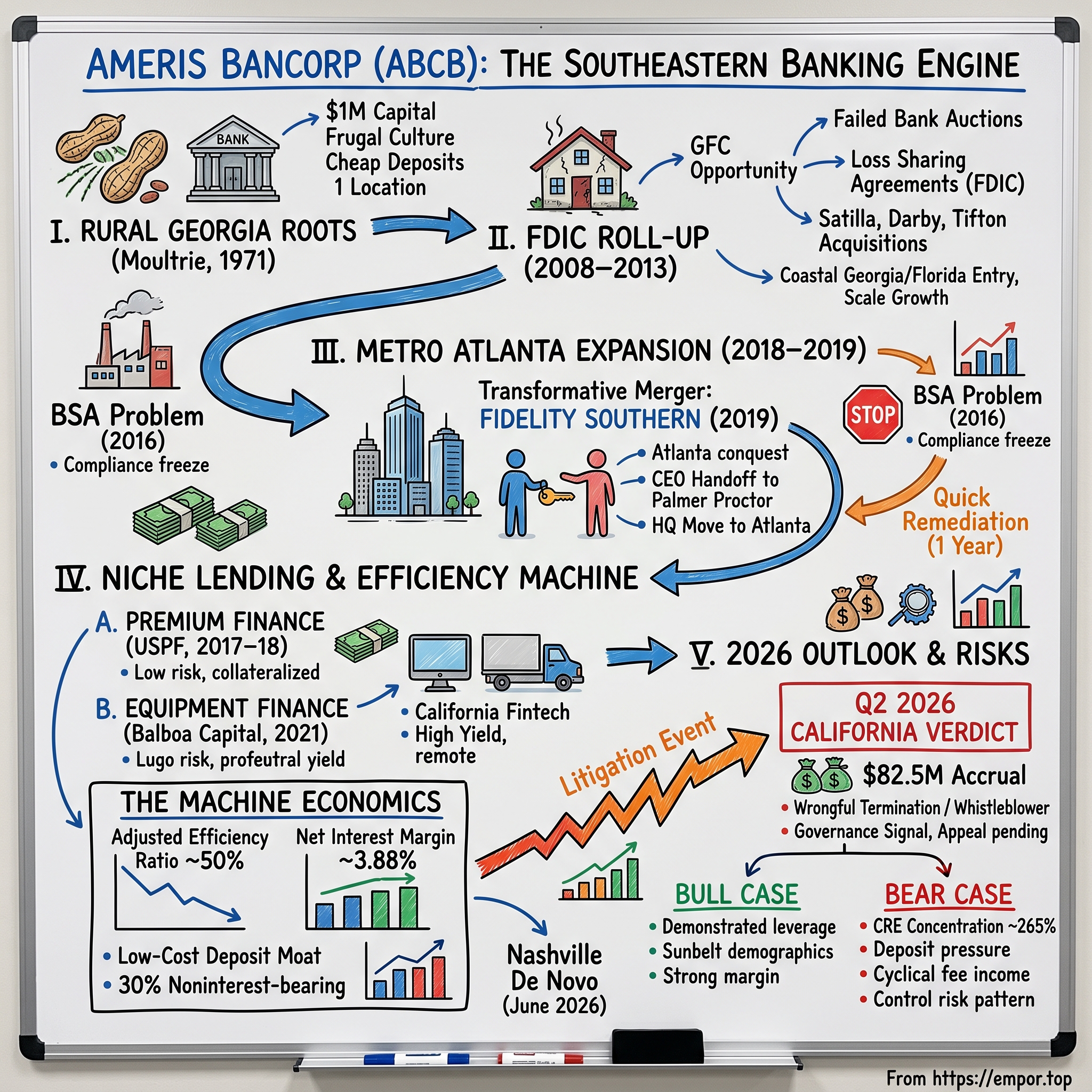
Ameris Bancorp: The Southeastern Banking Engine
I. Introduction & The $28 Billion Southeastern Fortress
On the morning of June 12, 2026, in a federal courtroom in the Central District of California — roughly 2,200 miles from the peanut and cotton country where this company was born — a jury came back with a verdict against Ameris Bank. The plaintiff was Patrick Byrne, who had run the bank's equipment finance division from December 2021 through June 2024. He alleged wrongful termination, whistleblower retaliation, unpaid wages, and breach of contract. The jury found for him on every count presented, awarding roughly $16.5 million in economic and non-economic damages plus statutory penalties, and then added approximately $62.9 million in punitive damages on top.1
Punitive damages are the part that should make an investor sit up. Compensatory damages measure what a plaintiff lost. Punitive damages measure what a jury thinks of the defendant's conduct. A ratio of nearly four-to-one is a jury saying something about behavior, not just about arithmetic.
Six weeks later, on July 23, 2026, Ameris reported second-quarter results that carried an $82.5 million litigation accrual — the full verdict plus related costs — booked despite management's stated intention to appeal.2 Reported net income fell to $51.4 million, or $0.77 per diluted share, against $109.8 million and $1.60 a share in the same quarter of 2025. Strip out the accrual and a gain on Visa Class B share conversion and BOLI, and adjusted net income was $107.3 million, or $1.60 a share — almost exactly flat year over year.2 The market took the point but not entirely: shares fell about 3% the day of the print.3
That single quarter is a compact version of the whole Ameris investment question. Underneath the headline was an operating machine performing at the top of its peer group. On top of it sat a governance and legal event that no spreadsheet had modeled.
What Ameris actually is
Start with the shape of the thing. As of June 30, 2026, Ameris Bancorp held roughly $28.5 billion in total assets, $22.6 billion in deposits, and $22.2 billion in loans.4 It trades on the NYSE under ABCB, with a market capitalization of roughly $5.9 billion in late July 2026.5 It is, by asset size, one of the larger banks in the American Southeast that is not a household name — bigger than most community banks, smaller than the regional champions it competes against daily.
The company began on October 1, 1971, as American Banking Company: one location in Moultrie, Georgia, and $1 million of starting capital.6 It has since done something on the order of 35 mergers and acquisitions and now serves customers across Alabama, Florida, Georgia, Maryland, North Carolina, South Carolina, Tennessee, and Virginia through a mix of branches and lending offices.7
The thesis management sells — and the one worth testing — is that Ameris is not a sleepy regional bank. It is an efficiency machine bolted to a low-cost Southeastern deposit franchise, with a set of national specialty lending platforms grafted on to lift asset yields. In the second quarter of 2026, the adjusted efficiency ratio was 50.4%, and the net interest margin was 3.88% with, as CFO Nicole Stokes repeatedly emphasizes, zero purchase-accounting accretion propping it up.4 Adjusted return on tangible common equity was 14.08%, achieved while carrying a tangible common equity ratio above 11% — a combination that is genuinely unusual, because high capital normally suppresses return on equity.4
For readers who don't spend their days inside bank filings, the efficiency ratio is simply operating expenses divided by revenue. Lower is better. It is the banking equivalent of a restaurant's food-and-labor cost as a share of the check. A bank running near 50% keeps roughly half of every revenue dollar before credit costs and taxes. Many regional peers operate closer to 60%. That ten-point gap, compounded over a decade, is the difference between a compounding franchise and a wasting one.
The central tension
Here is the question this article exists to work through. Ameris has compounded tangible book value per share at a genuinely impressive clip — $5.59 per share, or 14.5%, during 2025 alone, ending that year at $44.18 and reaching $45.10 by mid-2026 even after absorbing the litigation charge.84 Can it keep doing that?
Three things stand in the way, and each gets serious treatment later. First, concentration: commercial real estate and farmland loans stood at $9.24 billion at mid-2026, with construction and development at another $1.70 billion.4 Ameris runs a CRE concentration ratio around 265% of capital and construction around 46% — both above the informal regulatory guideposts that supervisors use as screening triggers.9 Second, funding: the entire margin story depends on noninterest-bearing checking accounts holding at roughly 30% of deposits, and management has said plainly that deposit growth is the governor on loan growth.4 Third, execution and governance: the California verdict is not a rounding error, and it arose inside the very acquisition — Balboa Capital — that was supposed to be the bank's high-yield growth engine.
The road from here runs chronologically. A rural Georgia origin story that explains the cost culture. A financial crisis in which Ameris turned other people's failures into cheap branches and deposits. A pivot from distressed buying to open-market M&A and national niche lending. The transformative and slightly strange Fidelity Southern merger, in which the acquirer's CEO left and the target's CEO took the chair. Then the machine itself, the people running it, the competitive terrain, and finally the bull and bear cases — with the specific evidence that would confirm or break each.
It starts, as most Southern bank stories do, in a town most people have never heard of.
 Subscribe on LinkedIn
II. Rural Origins & The Frugal Operating DNA (1971–2007)
Moultrie, Georgia sits in Colquitt County, deep in the southwest quadrant of the state, closer to Tallahassee than to Atlanta. Its economy in 1971 was peanuts, cotton, tobacco, pine timber, and hogs. Every October the town hosted the Sunbelt Agricultural Exposition — a farm-equipment show that drew tens of thousands of people to look at tractors. If you wanted to build a bank there, your customers were farmers with seasonal cash flows, the merchants who sold to them, and the families who banked their modest savings across the counter.
On October 1, 1971, Eugene M. Vereen Jr. opened American Banking Company with one office and $1 million in capital.6 To put that in context: a million dollars of equity in 1971 supported maybe $10 million of assets under the leverage conventions of the day. This was not a challenger bank. It was a country bank with a vault, a lobby, and a lending officer who knew whose peanut crop had come in short.
The country bank playbook
The economics of that model are worth understanding, because they explain a great deal about how Ameris behaves in 2026.
A rural bank has structurally cheap deposits. Its customers are not rate shoppers; they are neighbors who need a checking account, a place for the harvest proceeds, and someone who will answer the phone. Those deposits cost close to nothing. But a rural bank also has structurally limited loan demand — there are only so many farms and only so many Main Street businesses. The binding constraint is not funding; it is finding somewhere sensible to put the money.
That inversion produces a particular culture. When your deposits are cheap and your lending opportunities are scarce, the way you make money is by refusing to spend it. Overhead becomes the enemy. You do not build a marble headquarters. You do not hire a large staff. You do not chase loans outside your competence, because a single bad agricultural credit can wipe out a year of earnings in a town where you also have to see the borrower at church.
Ameris grew the way such banks grow: by buying neighbors. The first acquisition came in 1979, Toney Brothers Bank in Doerun, Georgia — a town of a few hundred people about ten miles up the road.6 A holding company, ABC Holding Company, was formed in 1980, renamed ABC Bancorp in 1986.6 Sixteen years after opening its doors, the company went public in 1987, and in 1994 the shares began trading on Nasdaq.6 In 2005, the collection of separately branded community banks was consolidated under a single name: Ameris.6
That 2005 rebranding is more consequential than it sounds. Multi-bank holding companies — where each acquired institution keeps its own charter, board, and brand — are expensive by design. Every charter carries its own compliance burden, its own core processing contract, its own executive layer. Collapsing them into one bank under one brand is precisely the kind of unglamorous overhead surgery that shows up years later in an efficiency ratio.
Why the Moultrie inheritance still matters
It is easy to over-romanticize founding culture. Plenty of banks tell an origin story about frugality and then spend like sailors. So the honest question is whether the Moultrie inheritance is visible in the numbers today, or whether it is just a nice line in the corporate history.
The evidence suggests it is at least partly real, and the mechanism is specific rather than mystical. Ameris's edge is not that its bankers are unusually thrifty individuals. It is that the company has repeatedly chosen structures that keep fixed cost low: one charter, one brand, a centralized back office, and — critically — a bias toward gathering operating accounts rather than buying deposits with rate. On the first-quarter 2026 call, CEO Palmer Proctor described the approach as inverting the standard bank sales motion: "So many times, banks have historically led with the loans and a cheap rate on the loan and then ask for deposits. We try and turn that on its head and ask for the deposits and then consider doing a loan."9 That is a rural banker's instinct expressed at $28 billion of scale.
There is a limit to how far this explains anything. The Ameris of 2026 has a nationwide equipment finance platform run out of California, a mortgage warehouse business, and an executive suite in Atlanta. Culture from 1971 does not underwrite a leasing portfolio. What the rural inheritance plausibly explains is the expense discipline and the deposit-first orientation. What it does not explain — and what the company has had to build separately, sometimes badly — is the risk management infrastructure for lines of business that a Colquitt County bank never imagined.
By the mid-2000s, Ameris was a roughly $2 billion bank with a decent franchise and no particular claim on anyone's attention. Then the Southeast's real estate market detonated, and the bank's boring balance sheet became, briefly, the most valuable asset in Georgia.
III. The Great Financial Crisis Playbook: The FDIC Roll-Up (2008–2013)
To understand what Ameris did between 2009 and 2012, you have to understand how completely Georgia broke.
Georgia led the nation in bank failures during the financial crisis by a wide margin. The mechanism was not subprime mortgage securitization — it was land. Through the mid-2000s, community banks across metro Atlanta and coastal Georgia had lent aggressively against raw land and residential development: acquisition and development loans, lot loans to builders, speculative subdivisions on the exurban fringe. These loans had a lethal property. They produced no cash flow. A finished, leased shopping center generates rent while you wait out a downturn. Fifty acres of scraped dirt outside Cartersville generates nothing but property tax bills and interest capitalized into the loan balance.
When housing starts stopped, the collateral did not decline in value gradually. It went bidless. Dozens of Georgia banks that had looked well capitalized in 2007 were insolvent by 2010.
The FDIC's Friday afternoon auction
The federal resolution process is one of the more elegant pieces of machinery in American finance, and it deserves a plain-English explanation because it is the engine of this chapter.
When a bank fails, the FDIC does not want to pay depositors out of the insurance fund and liquidate the assets — that is the most expensive outcome. Instead, it runs a quiet auction, usually resolved on a Friday afternoon so the acquirer can rebrand the branches over the weekend. Healthy banks bid for the right to assume the failed institution's deposits and buy some or all of its assets. The winning bid is the one that costs the insurance fund the least.
The critical feature during the crisis was loss sharing. Under a loss-share agreement, the acquirer takes the failed bank's loans onto its books, but the FDIC agrees to absorb the large majority of any credit losses on the covered portfolio. The acquirer's downside on the acquired assets is capped at a fraction of the loss; the upside — the deposits, the customer relationships, the branches, the fee income — is kept in full.
For a bank with clean capital and the operational capacity to absorb a failed institution overnight, this was as close to an asymmetric bet as commercial banking offers. The scarce resource was not capital. It was regulatory standing and integration capability. Most Georgia banks in 2010 had neither. Ameris had both.
Hortman's window
The executive who saw the opening was Edwin W. Hortman Jr., who had become CEO in 2005 and would hold the job until January 2018.10 Hortman was not an outsider parachuted in with a turnaround mandate. He had run Citizens Security Bank, a subsidiary of the company, from 1998 to 2003, served as a regional executive, then as president and chief operating officer before taking the top job.11 Before that, he had spent 1992 to 1998 at Colony Bankcorp, another south Georgia institution. His entire professional life had been spent underwriting credit in the same soil that was now collapsing.
That background matters for a reason that is easy to miss. The FDIC roll-up was not primarily a financial engineering decision. It was a credit judgment made at speed, on incomplete data, about loan books in towns Hortman's team knew personally. A bank buying failed institutions in an unfamiliar geography is buying a lottery ticket. Ameris was buying assets it could evaluate.
The deals came in waves. On May 14, 2010, Ameris agreed with the FDIC to assume the deposits and acquire certain assets of Satilla Community Bank, a single-office institution in St. Marys, Georgia on the Florida line — approximately $134.0 million of deposits and $142.3 million of assets.1213 Then on November 12, 2010, a double: Darby Bank & Trust Co., a seven-branch franchise spanning Vidalia, Lyons, Savannah, and Pooler, and Tifton Banking Company, a single office in Tifton.14 From Darby, Ameris assumed roughly $590.3 million in deposits and $402.4 million in loans; from Tifton, approximately $144.6 million in deposits and $118.9 million in loans.14 Both transactions carried loss-share protection from the FDIC.[^15]
The cost to the deposit insurance fund tells you what these franchises were actually worth on a standalone basis: the FDIC estimated Darby's failure would cost the fund $136.2 million and Tifton's $24.6 million.[^15] Someone had destroyed a great deal of capital in Vidalia. Ameris got the surviving deposit relationships and the branch network without inheriting the destruction.
What the roll-up actually bought
The strategic prize was geographic, not financial. Look at where the deals landed: St. Marys on the Georgia–Florida border, Savannah and Pooler on the coast, Vidalia in the middle. Ameris was a southwest Georgia bank. In eighteen months, at negative or trivial economic cost, it acquired a coastal Georgia franchise and a beachhead pointing toward Jacksonville — a metro area that would become central to the company's identity for the next fifteen years.
It also bought something less tangible: an institutional muscle for integration. A bank that converts several failed institutions in a two-year window builds systems, playbooks, and a staff that has done it before. That capability compounds. Ameris would use it repeatedly.
The honest caveats belong here too. First, this was a window, not a strategy — loss-share deals stopped being available once the failure wave ended, and the covered assets ran off over the following decade, taking their accounting benefits with them. Second, buying failed banks is not the same as building a franchise; Ameris still had to convert acquired customers into profitable relationships, and the disclosed record does not isolate how well that worked bank by bank. Third, the roll-up left Ameris with a lot of legacy credit and a lot of complexity relative to its size.
What it unambiguously did was change the scale of the company's ambition. By 2013, Ameris was no longer a small-town Georgia institution. It was a coastal Southeastern bank with an integration playbook and a management team that had been rewarded for acting decisively while competitors were paralyzed. The next question was what to do when the free assets stopped appearing.
IV. Metro Expansion & Niche Lending Engines (2014–2018)
The answer, it turned out, was to buy things nobody else in Georgia banking was buying — and to pay for them.
The mid-2010s presented Ameris with an uncomfortable structural problem. Its deposit franchise was cheap and sticky, which is wonderful, but its loan yields were ordinary. A community bank lending against south Georgia commercial real estate at prevailing spreads earns a perfectly respectable but unremarkable return. If Ameris wanted returns that stood out, it needed either better markets or better assets. It went after both.
Premium finance: lending against something that cannot run away
The first move is the more interesting one, and it requires a short detour into an unglamorous corner of finance.
When a commercial business buys property and casualty insurance — a trucking company insuring its fleet, a contractor buying liability coverage — the annual premium is often due up front and can run into six or seven figures. Most businesses do not want to write that check in one go. So a premium finance company pays the insurer on the customer's behalf and the customer repays over roughly ten monthly installments.
Here is why lenders like it. The collateral is the unearned premium sitting with the insurance carrier. If the borrower stops paying, the finance company cancels the policy, and the insurer refunds the unearned portion directly to the lender. The collateral cannot be hidden, moved, damaged, or sold to a third party. It is held by a regulated insurance company that is contractually obligated to return it. Recovery rates are, historically, extremely high — which is why premium finance books have carried near-zero credit loss experience across cycles.
The loans are also short — roughly ten months, amortizing — meaning the book reprices almost completely within a year. In a rising rate environment that is an enormous asset. In a falling rate environment it works against you.
Ameris entered this business not by building it but by partnering into it. In December 2016, the bank announced a joint venture with US Premium Finance under which Ameris Bank became the exclusive provider of credit on USPF's nationwide platform. At the time, USPF was the sixth largest provider of credit on property and casualty premiums in the country, with roughly 1,000 insurance agency customers across all 50 states and approximately $400 million of loans outstanding.[^16]
Then Ameris bought the whole thing, in pieces. Through three transactions closing on January 18, 2017, January 3, 2018, and January 31, 2018, the company issued a total of 1,073,158 shares with a fair value of $55.9 million and paid $21.4 million in cash to USPF's former shareholders — the final tranche taking out the remaining 70% stake.15
Note the structure: a joint venture first, full ownership only after the economics were proven on Ameris's own balance sheet. That is a disciplined way to enter an unfamiliar business, and it stands in useful contrast to what happened later with equipment finance.
The BSA problem nobody puts on the highlight reel
The same December 2016 press release that announced the USPF joint venture also announced something considerably less pleasant: an agreement with regulators concerning the Bank Secrecy Act.[^16]
On December 16, 2016, Ameris Bank stipulated to a consent order with the FDIC and the Georgia Department of Banking and Finance relating to weaknesses in its BSA compliance program. The bank neither admitted nor denied charges of unsafe or unsound practices. The order required strengthened board oversight of BSA activities, a revised compliance program, a full BSA risk assessment, effective training and testing, and the appointment of a qualified BSA officer.16
For a serial acquirer, a BSA order is not a compliance inconvenience — it is an existential constraint on strategy. Regulators do not approve bank acquisitions by institutions operating under anti-money-laundering enforcement actions. The order effectively froze Ameris's M&A pipeline.
To the company's credit, it moved fast. The FDIC terminated the consent order effective December 14, 2017, roughly a year after issuance.17 Anyone assessing management's ability to fix problems under pressure should weight that data point: a one-year remediation on a BSA order is quick, and Ameris resumed acquiring almost immediately afterward. Anyone assessing management's ability to scale controls ahead of growth should weight the fact that the order happened at all.
Metro Atlanta, bought at last
With the order lifted, Ameris moved on the market it had circled for years. In January 2018 it agreed to acquire Hamilton State Bancshares in a stock-and-cash transaction valued at nearly $406 million, closing on June 29, 2018.1819 Hamilton brought 28 full-service branches in Atlanta and its surrounding communities plus Gainesville, Georgia; holders received 0.16 Ameris shares plus $0.93 in cash per share.19
The logic was straightforward and, in the abstract, correct. Metro Atlanta's growth was concentrated on its northern arc — Cherokee, Forsyth, Hall, and Gwinnett counties — and Ameris had almost no presence there.20 Deposits in fast-growing suburbs are worth structurally more than deposits in shrinking rural counties, because they grow.
Ameris also closed on Atlantic Coast Financial in Jacksonville in May 2018, deepening its north Florida position.21 Two acquisitions in two months, months after exiting a regulatory order, is an aggressive cadence — and worth noting for anyone evaluating how quickly this management team moves when the brakes come off.
Crossing $10 billion
The Hamilton deal pushed Ameris decisively past $10 billion in assets, and that number is a genuine regulatory cliff rather than a round one. Above $10 billion, a bank becomes subject to direct Consumer Financial Protection Bureau supervision, loses the small-issuer exemption from the Durbin Amendment's cap on debit interchange fees, and picks up additional model risk management and compliance expectations.22
The Durbin hit is the concrete one. Debit interchange — the fee a merchant's bank pays the cardholder's bank on every swipe — gets capped, and the lost revenue simply disappears. There is no way to recover it other than to be bigger. This is precisely why the $10 billion threshold produces a bunching effect in bank M&A: institutions approaching it either stay well below or leap decisively past, because the middle ground destroys value.
Ameris chose to leap. Having done so, the pressure to add scale quickly — to spread newly fixed regulatory costs across a larger revenue base — became structural. Which set up the strangest and most important transaction in the company's history.
V. The Transformative Merger: Fidelity Southern & The Atlanta Conquest (2019–2021)
Most bank mergers end with the acquirer's CEO running the combined company. The Fidelity Southern deal ended with the acquirer's CEO resigning and the target's CEO taking the job.
That inversion is the single most revealing fact about this transaction, and it is worth sitting with before getting to the numbers.
The deal
On December 17, 2018, Ameris agreed to acquire Fidelity Southern Corporation, the Atlanta-based parent of Fidelity Bank, in an all-stock transaction then valued at approximately $751 million.23 Fidelity shareholders received 0.80 Ameris shares for each Fidelity share.24
Because the consideration was stock and Ameris's shares appreciated between signing and closing, the realized value rose. Ameris issued roughly 22.2 million shares to Fidelity holders, worth approximately $870 million based on the closing price on June 28, 2019 — the last trading day before completion on July 1, 2019.24 For a stock deal, that appreciation is not a windfall; it means Ameris paid more of itself away than the announcement headline implied.
The combined institution, based on March 31, 2019 data and before purchase accounting adjustments, held $16.4 billion in assets, $13.8 billion in deposits, and $12.5 billion in loans, operating 176 locations across Georgia, Alabama, Florida, and South Carolina — Fidelity contributing 62 branches.24
What Ameris actually bought was Atlanta. Fidelity Bank was a genuine metro Atlanta commercial franchise with treasury management relationships, middle-market lending, an indirect auto book, and a large mortgage operation. Ameris had spent a decade assembling coastal Georgia, north Florida, and suburban Atlanta pieces. Fidelity delivered the core.
The leadership handoff
The governance sequence deserves precision because it is unusual.
Ameris had already executed one CEO transition: Edwin Hortman handed the chief executive role to Dennis J. Zember Jr. effective July 5, 2018, remaining as executive chairman.10 Zember had been the company's long-serving chief financial officer and was widely credited internally with the operating discipline that produced the crisis-era roll-up returns.
Twelve months later, on completion of the Fidelity merger, Zember resigned as president, chief executive officer, and director of both Ameris Bancorp and Ameris Bank. H. Palmer Proctor Jr. — previously president of Fidelity Southern and CEO of Fidelity Bank — became chief executive officer of the combined company. James B. Miller Jr., Fidelity's long-time leader, was named executive chairman, and five Fidelity directors joined the Ameris board.24
Read that carefully. A CEO of one year departed on the day his largest-ever acquisition closed, and the acquired company's leadership took the chair, the CEO role, and a substantial share of the boardroom. In substance, this was closer to a merger of equals in which Fidelity's management won control than to a conventional acquisition. Ameris shareholders kept the ticker; Fidelity's team got the company.
Whether that was good or bad for shareholders is an empirical question, and seven years of subsequent results give a reasonable answer: the operating metrics have improved substantially under Proctor. But it should not be glossed over as a routine succession. It was a control transfer negotiated inside a deal, and it happened without a public explanation of why the incumbent CEO's tenure ended after twelve months.
The center of gravity followed the people. Ameris moved its corporate headquarters and senior executives to Atlanta on October 1, 2019, while retaining substantial operations in Jacksonville.25 The company that had been headquartered in Moultrie for nearly half a century was now run from Buckhead.
Balboa Capital: the engine and the fault line
Two and a half years later came the acquisition that most defines the current risk debate. In December 2021, Ameris Bank acquired Balboa Capital Corporation, a Costa Mesa, California-based online provider of equipment financing and working capital loans to small and mid-sized businesses nationwide.26
The strategic logic was clear enough. Ameris had a low-cost deposit base and a shortage of high-yielding assets. Balboa had a technology-enabled origination platform with a nationwide reach, credit scoring models built for rapid small-ticket underwriting, and originations expected to exceed $415 million in 2021 — but funded expensively, as non-banks are.26 Put a bank's funding cost behind a fintech's origination engine and, in theory, the spread expands dramatically.
The price was not disclosed. Ameris said it paid cash and characterized the acquisition as not material to its financial results.26 The 2021 annual report shows goodwill of $84.6 million and other intangibles of $68.9 million recorded in the transaction, none of the goodwill deductible for tax purposes.27 Those figures put a floor under the purchase price but do not establish it. Investors should treat any specific headline number for the Balboa purchase price with skepticism; the company did not publish one.
The absence of disclosure is itself a data point. A bank that discloses deal terms in detail for Hamilton and Fidelity chose not to for Balboa. Management's stated reason was materiality. A skeptic would note that non-disclosure also removes the ability to measure the return on that capital.
And equipment finance is a genuinely different animal from anything else Ameris does. Small-ticket equipment leases to small businesses nationwide are underwritten by model, not by relationship. There is no local banker who knows the borrower. Loss rates are structurally higher than on a bank's core commercial book and are compensated by much higher yields. The business works when credit models are calibrated correctly and controls are tight, and it fails quickly when they are not.
It is also where, several years later, Ameris's most expensive governance problem originated. The executive who ran that division from December 2021 through June 2024 is the plaintiff in the California case whose verdict reshaped the second quarter of 2026.1 That story belongs with the discussion of management credibility, and it gets full treatment there.
For now, note the pattern that emerges across this period: Ameris entered premium finance cautiously, through a joint venture, before buying it outright. It entered equipment finance by buying a California fintech outright and running it from 2,200 miles away. The first approach produced a portfolio with negligible credit losses. The second produced a growing loan book and an $82.5 million charge.
With those platforms in place, the machine was assembled. It is worth looking at how it actually works.
VI. Inside the Machine: Segment Breakdown & Economics
Imagine the Ameris balance sheet as a factory with two loading docks. On the inbound dock, deposits arrive from Southeastern businesses and households at a blended cost of funds of 1.91%.4 On the outbound dock, loans leave at yields well north of 6%. The width of that gap, multiplied by volume, minus the cost of running the factory, is essentially the whole business.
The asset side
At June 30, 2026, the loan book broke down roughly as follows. Commercial real estate and farmland was the largest bucket at $9.24 billion. Residential real estate came next at $4.33 billion. Commercial and industrial lending stood at $3.45 billion, construction and development at $1.70 billion, premium finance at $1.53 billion, and mortgage warehouse at $1.35 billion.4
Two observations matter more than the individual figures.
First, this is a real estate bank. CRE, residential, and construction together account for the clear majority of loans. That is normal for a Southeastern regional and it is the source of the concentration debate in Section IX.
Second, the specialty platforms — premium finance, equipment finance, mortgage warehouse — are meaningful but not dominant. On the first-quarter 2026 call, Stokes noted that equipment finance had come down to about 6.9% of total loans, having peaked around 7.2%.9 That is a deliberate cap. Management is not letting the highest-yielding, highest-risk book run away with the balance sheet, which is a reasonable discipline and one worth monitoring, because the temptation to let it grow when margins compress will be real.
Mortgage warehouse deserves a brief explanation since it confuses people. Ameris does not make these mortgages. It provides short-term secured credit lines to independent mortgage companies that originate loans and then sell them to investors within weeks. The bank's exposure is a few weeks long, secured by closed loans with committed takeout buyers. It is low-margin, low-risk, and highly rate- and volume-sensitive — a volume business that swells and shrinks with mortgage activity.
The funding side, which is the actual moat candidate
Everything interesting about Ameris's margin comes from the right-hand side of the balance sheet.
At mid-2026, noninterest-bearing deposits were 30.0% of total deposits, or $6.78 billion.4 Proctor described the balance sheet as funded with almost 50% checking accounts.4 Interest-bearing deposits cost 2.52%, and brokered deposits — wholesale funding purchased from intermediaries — were 6.7% of the total.4
A dollar in a business checking account paying nothing, in a rate environment where alternatives yield 4%, is worth an enormous amount. It is why the entire regional banking sector spent 2023 and 2024 obsessing over deposit betas. Ameris's 30% noninterest-bearing share is the reason its margin sits at 3.88% while many peers operate a full point lower.
But this is exactly where management is most candid about fragility, and the candor is worth quoting. On the second-quarter 2026 call, Stokes walked through the marginal math: total loan production came on at about 6.20% for the company and 6.39% for the core bank excluding the specialty platforms.4 In the first quarter, total deposit production including noninterest-bearing cost about 1.90% — but interest-bearing deposit production alone cost 2.74%.9 Her conclusion was blunt: growth is accretive to the margin only if roughly 30% of incremental deposits are noninterest-bearing. "That's a really tall standard to have," she said. Absent that, incremental funding is dilutive.4
That is the honest statement of the model's central dependency. Ameris does not have a magic margin. It has an operating-account franchise, and the margin lasts exactly as long as that franchise does.
There is also an early warning sign in the second-quarter data. Brokered deposits rose $174 million in the quarter. Stokes explained it as a tactical offset to seasonal public fund outflows and, notably, said the bank chose brokered funding because "we're seeing some of our peers actually pricing above brokered costs" — so rather than compete for what she called "hot deposits," Ameris bought wholesale money more cheaply.4 That is defensible tactics. It is also evidence that competition for deposits in Georgia and Florida is intense enough that irrational pricing has appeared.
Myth vs. reality: where the efficiency ratio actually comes from
The consensus story is that Ameris runs a sub-50% efficiency ratio because of frugal culture and a lean branch network. That is partly true and incomplete.
The efficiency ratio has a denominator. Ameris's revenue mix includes a substantial fee component — noninterest income represented a strong 22% of total revenue in the first quarter of 2026, driven by mortgage banking, equipment finance fees, SBA gains, and deposit service charges.9 Fee businesses that generate revenue without consuming balance sheet mechanically improve the ratio. So does a high net interest margin, which inflates revenue per dollar of assets.
In other words, a meaningful share of Ameris's efficiency advantage is a revenue advantage wearing a cost-discipline costume. That distinction matters enormously for forecasting: cost discipline is durable, but a margin-driven and mortgage-driven revenue advantage is cyclical.
The expense side is nevertheless real, and the year-over-year comparisons are the cleanest evidence. In the first quarter of 2026, revenue grew 10% year over year while expenses grew 4%, producing an efficiency ratio on incremental growth of roughly 21%.9 In the second quarter, adjusted revenue grew 6% against adjusted expense growth of 3%, improving the adjusted efficiency ratio by more than 130 basis points to 50.4%.4 For the full year 2025, the ratio improved to 50.0% from 53.2%, with revenue up 6% and expenses actually down 1%.8
Growing revenue while shrinking expenses is not something a bank does by accident. That is the strongest single piece of evidence for the operating-discipline thesis.
The AI question came up on the first-quarter call, and Proctor's answer was more interesting than the usual boilerplate. He described AI at Ameris as "more of an evolution than a revolution," aimed at building capacity rather than cutting cost — automating high-volume processes so the bank can grow without layering in headcount.9 He also noted that software vendors are "getting very aggressive right now and trying to lock you in for longer-term contracts," which Ameris resists because technology changes quickly.9 Whether that translates into measurable operating leverage is unproven; it is a statement of intent, not a result. But the framing — capacity, not headcount reduction — is at least internally consistent with a bank whose expense base is already lean.
What it adds up to
For the six months through June 2026, Ameris organically grew the balance sheet by nearly $1 billion while improving its margin — no acquisitions, no purchase accounting.4 Loan production reached $2.4 billion in the second quarter, up 24% year over year, with the pipeline at $2.7 billion.4
The reasonable read is that this is a genuinely well-run operating bank whose profitability rests on two legs: a deposit franchise that is real but under pressure, and an expense culture that is real and durable. The specialty platforms add yield and add risk in roughly equal measure. Nothing here is magic, and nothing here is fake.
Which turns the question toward the people making the calls.
VII. Current Management, Incentives & Capital Allocation
There is a particular tone to an Ameris earnings call. It is unhurried, specific, and slightly repetitive in a way that turns out to be a feature. Stokes gives the same guidance framework quarter after quarter, updates the numbers, and flags what changed. Proctor answers strategy questions with the same four or five sentences he used last quarter. Analysts occasionally tease them about it — KBW's Will Jones noted on the first-quarter call that "the messaging has really been the same" on margin compression, quarter after quarter, while the margin kept beating.9
Consistency of narrative is one of the more useful things an investor can observe in management, because it is hard to fake over multiple years and it makes deviations legible. When Ameris changes its story, you will notice.
H. Palmer Proctor Jr.
Proctor arrived at Ameris through the Fidelity merger rather than through the Moultrie lineage, and his framing of the business reflects a metro Atlanta commercial banker's priorities: relationships, operating accounts, treasury management, and selective talent acquisition over branch expansion.
His most consistent theme is that the bank grows by taking customers, not by buying institutions. Asked on the second-quarter 2026 call about hiring, he said Ameris is "probably a little more focused on hiring customers than we are bankers."4 Asked repeatedly about acquisitions, his answer has not moved: "It would take something pretty special for us to consider M&A just because we've got a lot of opportunities on the organic growth side."4 On the first-quarter call he put it more bluntly: "we just don't see the benefit in getting distracted with that."9
That is a striking stance for a company built on 35 acquisitions, and it is worth examining rather than accepting. Proctor's stated reasoning is specific: most available deals are dilutive to some degree, and Ameris's highest priority in any target would be deposits, which "narrows down the playing field pretty quickly."9 Pressed by Piper Sandler's Stephen Scouten on whether a 1.60% ROA should be leveraged across a bigger asset base through M&A, Proctor's answer was that he is fine with that — as long as the bigger base is generated organically.9
The evidence supports the claim in one important respect: Ameris has not done a bank acquisition since Balboa in 2021, a nearly five-year pause for a company with this history. Words and behavior match. The falsification test is straightforward — if Ameris announces a sizable bank deal, the discipline narrative fails and the market will reprice the multiple accordingly.
The Nashville expansion announced in June 2026 is the alternative to M&A made concrete. Ameris said it would open a Nashville office by year-end, hiring Justin McClain as market leader — a banker with nearly two decades in Middle Tennessee — reporting to Ameris Bank President Lawton Bassett, alongside bankers Charlie Ogden and Jesse Lee, with roughly 20 employees expected in the market by the end of 2027.28 Proctor was careful to frame it as talent-driven rather than map-driven: "We do not take lightly moving into a new market just for the sake of going into a strong growth market like Nashville. We like to find talent, and we were very pleased with the group that we brought on board."4
A skeptic should note that de novo market entry via lift-out teams is cheap to announce and slow to prove. Twenty employees in a metro of two million is a toehold. It will take three to five years to know whether Nashville produces deposits or just loans — and loans without deposits is exactly the outcome this management team says it is trying to avoid.
Nicole S. Stokes
Stokes runs the calls, which is itself unusual — most bank CEOs open. She opens, hands to Proctor, takes it back, and delivers the detail. Her guidance style has a recognizable structure: state the metric, state the direction, state the mechanism, quantify the range.
On margin, she has said essentially the same thing for several quarters: compression of a few basis points per quarter, five to ten basis points in total, driven by deposit costs funding balance sheet growth.48 On expenses, she level-sets against consensus explicitly, telling analysts in April 2026 that roughly $160 to $162 million per quarter looked reasonable and that the second and third quarters run cyclically higher on mortgage.9 On the efficiency ratio she guided to "slightly above 50%" for the remainder of 2026.4
She also discloses inconvenient details unprompted. In the second quarter, the securities yield jumped about 40 basis points, which flattered the margin. Rather than let it pass, she volunteered that roughly 3 basis points of margin came from a delayed inflation adjustment on Treasury Inflation-Protected Securities and would not repeat: "Margin would have actually declined had we not had that."4 In the first quarter, she noted that March's monthly margin was already running below the 3.88% quarterly figure.9
Volunteering the quality-of-earnings caveat before an analyst finds it is a meaningful credibility marker. It is the opposite of the pattern investors should worry about, where good quarters are attributed to execution and bad ones to the environment.
Chief Credit Officer Douglas Strange handles the credit questions and is similarly specific. Asked on the second-quarter call about reserve adequacy, he explained that the allowance is model-driven off Moody's scenarios, that the bank had shifted to a 60/40 weighting toward the downside scenario in the prior quarter — "with the war breaking out," as he put it — and had since returned to a 50/50 weighting.4 The reserve of 1.62% of loans rises to 1.86% including unfunded commitments, which he characterized as roughly nine years of coverage at current charge-off rates.4
That disclosure cuts two ways. It shows a reserve process responsive to macro conditions rather than a smoothing exercise. It also shows that the headline reserve stability across quarters was partly the product of an offsetting scenario-weight change — a reminder that CECL reserves are model outputs with discretionary inputs, not measurements.
The verdict, and what it says about governance
Which brings the discussion back to California.
The facts, as disclosed: trial commenced June 1, 2026, in the United States District Court for the Central District of California. On June 12, 2026, the jury returned a verdict against Ameris Bank in an action brought by Patrick Byrne, who served as chief executive officer of the bank's equipment finance division from December 2021 through June 2024. The complaint alleged wrongful termination, violations of whistleblower protection laws, nonpayment of wages and related penalties, and breach of contract. The jury found for Byrne on all counts presented, awarding $16.525 million in economic and non-economic damages plus statutory penalties and approximately $62.9 million in punitive damages. Ameris stated that it "disagrees with the verdict and believes that it is not supported by the facts or applicable law," and that it intends to appeal.1
In the second quarter, the company accrued $82.5 million — the verdict plus related costs — notwithstanding the planned appeal, in accordance with applicable accounting guidance.2 Proctor said on the call that ongoing litigation prevented further comment.4
Three analytical points, stated neutrally.
First, the accounting is conservative and appropriate. Under loss contingency rules, a company accrues when a loss is probable and estimable; an adverse jury verdict generally makes it both. Ameris could have argued for a lower number pending appeal. It did not. Punitive awards of this magnitude are frequently reduced on post-trial motion or appeal, so a partial reversal would flow back as a future gain. But the cash and capital effect today is real.
Second, the timing of Byrne's tenure — December 2021 through June 2024 — maps almost exactly onto the integration window of the Balboa acquisition. A whistleblower retaliation claim from the executive running a newly acquired, geographically remote, model-underwritten lending business is a specific kind of governance signal, and it is one that no amount of efficiency-ratio outperformance addresses.
Third, the disclosure has been minimal. The company has said what it is required to say. It has not explained what the underlying dispute concerned, what the whistleblower allegations were, or whether any operational remediation followed. An investor is entitled to note that "we cannot comment on ongoing litigation" is legally sound and analytically unsatisfying, and to weight the uncertainty accordingly until the appeal resolves.
This is not the first regulatory or legal overhang in the company's recent history. In October 2023, Ameris entered a consent order with the Department of Justice resolving redlining allegations in the Jacksonville, Florida metropolitan area covering 2016 to 2021. The terms included $7.5 million in mortgage loan subsidies over five years in majority-Black and majority-Hispanic census tracts, $900,000 for advertising and outreach, and $600,000 for community development partnerships, with no civil monetary penalty. Ameris denied the allegations; Proctor said the company "strongly disagree[s] with any suggestion that we have engaged in discriminatory conduct."29 The court terminated the order early in 2025 after the Justice Department told it that Ameris had disbursed the full subsidy fund and was substantially in compliance with the remaining terms.30
The pattern across the BSA order, the redlining consent order, and the California verdict is worth stating plainly without overstating it: Ameris has repeatedly remediated compliance problems efficiently once identified. It has also repeatedly had compliance problems to remediate. For a bank whose entire equity story rests on running leaner than peers, the question of whether control investment has kept pace with growth is a legitimate one, and the answer is not yet settled.
Capital allocation
The stated priority stack has been consistent across calls: organic growth first, opportunistic buybacks second, dividend maintenance third, M&A last.49
The buyback behavior is the most revealing capital signal, because it shows price discipline rather than just intent. In the first quarter of 2026, Ameris repurchased $74.9 million — 950,400 shares at an average price of $78.76, or 1.4% of the company, the largest single-quarter buyback in its history.31 In the second quarter, with the stock higher, it bought only $19.0 million at an average of $83.71.4 Year to date the company had repurchased approximately $93.8 million at a blended $79.72, roughly 1.7% of shares outstanding, with $65.4 million of authorization remaining.4
Stokes was explicit about the price sensitivity: "I certainly liked buying at $79 more so than today. But I think we also are accreting capital and growing into capital. So I think we have it in our pocket, but I don't think you're going to see as aggressive as what you saw in the first quarter."4 For reference, the 2025 program repurchased roughly $77 million, about 2% of the common, at an average price under $67.8
Buying more when cheap and less when dear is what shareholders should want and is less common than it should be. The capital position supports continued flexibility: CET1 finished the second quarter at 12.8% and tangible common equity at approximately 11%, against internal targets of roughly 12% CET1, 10.0% to 10.5% TCE, and 14% to 15% total risk-based capital.49 The company is running above every one of its own targets, which is either prudence or capital inefficiency depending on your view of the cycle.
The 2022–2023 mortgage rate shock offers a track record test on cost flexibility. When rates rose sharply and origination volumes collapsed industry-wide, Ameris compressed mortgage-related expense without dismantling the distribution capability — evident in the fact that expenses declined 1% in 2025 while revenue grew 6%, and in the platform's continued contribution to fee income through 2026 with roughly 90% purchase volume rather than refinance.89 A shop that survived the refinance drought at 90% purchase mix has a more durable mortgage franchise than the industry average.
The competitive landscape those choices play out in is the next question.
VIII. Strategic Positioning: Porter's 5 Forces & Helmer's 7 Powers
Banking is the most commoditized product in the developed world. A dollar of credit from Ameris is identical to a dollar of credit from Truist. Anyone claiming a durable competitive advantage in banking bears a heavy burden of proof, and most such claims collapse under examination into "we happen to be in a good market right now."
So let us apply the frameworks with appropriate skepticism.
Hamilton Helmer's 7 Powers, honestly scored
Scale economies — partially present, more limited than it appears. Ameris spreads a centralized back office, one charter, one brand, and one core processing relationship across $28.5 billion of assets and a national origination platform. Against a $5 billion community bank, that is a real cost advantage, particularly post-$10 billion when compliance costs are largely fixed. Against Truist, Regions, or Bank of America, Ameris has no scale advantage at all — it is the subscale player. The power is genuine but exists only within a band, and the band is defined by competitors Ameris is actively out-competing rather than by the ones that could hurt it most.
Switching costs — present and the most defensible power in the portfolio. This is where the real moat, such as it is, lives. A business operating account is not a rate product. It carries payroll files, ACH origination templates, positive-pay rules, lockbox arrangements, and integrations with accounting software. Moving it is a project, not a decision. That friction is precisely why Ameris can hold 30% of deposits in noninterest-bearing accounts while money market funds pay 4%. The evidence is behavioral: those balances did not run during the 2023 deposit scare or the subsequent rate cycle. Proctor's emphasis on treasury management investment over several years is the operational expression of this power.9
Process power — claimed, unproven, and now carrying a caveat. Management's implicit claim is that Balboa's scoring models and US Premium Finance's underwriting produce fast turnaround with controlled losses. The premium finance evidence supports it: collateral structure makes losses structurally low. The equipment finance evidence is thinner. Full-year 2025 net charge-offs were 18 basis points, with 2026 guidance of 20 to 25 basis points — good absolute numbers, but achieved in a benign credit environment.84 Process power is a claim that survives a downturn; this one has not been tested by a real one. The California verdict, arising from within that same division, does not establish anything about credit models, but it does argue against treating the platform as a well-oiled machine.
Counter-positioning, cornered resource, branding, network economies — absent. There is no incumbent that cannot copy what Ameris does. There is no proprietary asset. The Ameris brand carries no premium outside its footprint and modest recognition within it. There are no network effects in commercial lending. Anyone constructing a bull case on these is constructing fiction.
Net assessment: Ameris has one real power (switching costs on operating accounts), one conditional power (scale, versus smaller banks only), and one unproven claim (process power in specialty lending). That is a respectable but not formidable competitive position — enough to sustain above-peer returns while execution holds, not enough to survive sustained mismanagement.
Porter's Five Forces
Rivalry: high and intensifying. Georgia and Florida are among the most competitively banked markets in the country. Ameris faces Synovus, SouthState, Pinnacle Financial Partners, Cadence, and First Horizon in the regional tier, and Truist, Bank of America, Wells Fargo, JPMorgan, and Regions in the national tier — all with larger technology budgets. The evidence that rivalry is currently biting appears on the funding side, where peers have priced deposits above brokered market rates, effectively bidding uneconomically for balances.4
There is a countervailing dynamic Ameris is trying to exploit. Southeastern bank consolidation has produced what Proctor calls "disruption" — merger integrations that create dissatisfied customers and displaced bankers. His argument is that Ameris's advantage lies in already being present in those overlap markets: "We've already got the brand awareness. And a lot of times, we've also got some of the wallet share with some of the other banks."4 That is a plausible mechanism, and the loan production growth of 45% year over year in the first quarter and 24% in the second is consistent with it.94 It is not proof — production growth also reflects the rate cycle — but it is the right evidence to watch.
Buyer power (depositors): moderate to high and rising. Depositors learned in 2022–2023 that cash has a yield, and that lesson did not unlearn. Ameris's interest-bearing deposit cost of 2.52% against a loan yield above 6% describes a comfortable but narrowing spread.4 The company's own guidance for continued compression is the honest acknowledgment that this force is winning at the margin.
Supplier power: low. Banks' primary input is deposits, covered above. Capital markets access is adequate — Ameris carries investment grade ratings, with KBRA affirming BBB+ senior unsecured at the holding company and A- deposit ratings at the bank with a stable outlook as of November 2024.32 Technology vendors are a modest and growing exception; Proctor's comments about aggressive multi-year lock-in attempts describe a supplier group with more leverage than it used to have.9
Threat of substitutes: moderate and structurally increasing. Private credit funds now compete directly for middle-market commercial loans, offering speed and covenant flexibility that regulated banks cannot match. Non-bank equipment lessors compete with Balboa. Fintech payment platforms disintermediate deposit relationships at the small-business end. None of these threaten the core Southeastern commercial deposit franchise near-term, but each chips at the loan side, and private credit in particular has grown into a genuine structural competitor rather than a niche.
Threat of new entrants: low. De novo bank charters remain rare, capital-intensive, and slow. Nobody is starting a bank to compete with Ameris in Valdosta. The relevant entry risk is not new charters but existing large banks deciding to compete harder in Ameris's markets — which is a rivalry question, not an entry question.
The activist lens
What would a skeptical investor push on?
The clearest target is capital. Ameris sits above every internal capital target it publishes, generates roughly 14% return on tangible equity, and returned about $94 million through buybacks in the first half of 2026 against a market capitalization near $5.9 billion.45 An activist would argue the payout is too timid — that a bank with 12.8% CET1, no M&A intentions, and mid-single-digit loan growth is hoarding capital that should be returned. Management's counter is that capital optionality is valuable in an uncertain credit environment and that they intend to grow into it. Both positions are defensible; the disagreement is about the probability of a credit event.
The second target is disclosure. The Balboa purchase price was never published. The California litigation has been disclosed at the legal minimum. Segment-level profitability for the specialty platforms is not broken out in a way that lets outsiders compute returns on the capital deployed into them. For a company that discloses operating metrics generously, the gaps cluster suspiciously around the acquired non-bank businesses.
The third is portfolio coherence. Is a Southeastern commercial bank the right owner of a California equipment finance fintech? The synergy argument — cheap deposits funding high-yield assets — is real. The counterargument is that Ameris now carries the operational, cultural, legal, and credit risk of a business it manages remotely, and the most expensive event in its recent history came from exactly there. That is the "diworsification" question, and it is legitimately open.
Which sets up the final accounting.
IX. Investment Story Spine: Bull vs. Bear Case, Risk Radar & KPIs
Current risk radar
Commercial real estate concentration. Ameris runs a CRE concentration ratio of roughly 265% of total risk-based capital and a construction concentration around 46%.9 The relevant context: federal supervisors use 300% CRE and 100% construction as screening thresholds that trigger enhanced scrutiny rather than hard limits. Ameris is below both but not comfortably below the CRE line.
The composition matters more than the ratio. KBRA's assessment noted investor office exposure at approximately 6% of total loans, with minimal central business district concentration and a majority of the portfolio characterized as Class A, essential-use, or medical office — the segments that have held up best.32 Construction and development at roughly 11% of loans was flagged as higher than peers, though with encouraging absorption trends and conservative underwriting.32
The honest read: this is not a distressed-office story. It is a concentration story in a region where population growth has supported absorption. The risk is not that downtown Atlanta towers are empty; it is that a Sunbelt construction and CRE book underwritten during a growth boom faces a different test if migration slows or if refinancing at higher rates strains borrowers whose loans were sized at 2021 rates. Elevated CRE payoffs of more than $500 million in the fourth quarter of 2025 and again in the second quarter of 2026 — at weighted average rates around 5.04%, well below new production yields — show borrowers actively refinancing away, which relieves credit risk and pressures balances simultaneously.84
Deposit beta and margin compression. Covered in detail already; the mechanism is that incremental funding is dilutive to margin unless noninterest-bearing balances grow proportionally. Management guides to a few basis points of compression per quarter.4 The thing to watch is not the guidance but the noninterest-bearing percentage. If it slips meaningfully below 30%, the margin story degrades faster than guidance implies.
Regulatory thresholds — where the consensus narrative is simply wrong. A widely repeated claim holds that crossing $25 billion in assets triggers elevated Federal Reserve supervisory expectations and stress testing for Ameris. Under the current tailoring framework, that is not accurate. The Economic Growth, Regulatory Relief, and Consumer Protection Act of 2018 raised the enhanced prudential standards threshold from $50 billion to $250 billion, and the Federal Reserve's 2019 tailoring rule established Categories I through IV with Category IV — which carries supervisory stress testing, stress capital buffer requirements, and the associated regulatory reporting — beginning at $100 billion.22[^35]
The nearer threshold is $50 billion, where the FDIC's 2024 resolution planning rule imposed informational filing requirements, and even that is under active reconsideration: the FDIC has proposed raising the resolution planning applicability threshold from $50 billion to $100 billion with inflation indexing.33 Ameris at $28.5 billion is not approaching a cliff. It is in a comfortable regulatory band, and would need to roughly double before the next meaningful step-up. Investors carrying a "$25 billion threshold" concern in their models should retire it.
Litigation and governance. The $82.5 million accrual is booked, so the earnings damage is done. The residual exposure runs both directions: an appellate reduction would produce a recovery, while additional related claims or an unfavorable appeal outcome would not. The harder-to-quantify risk is what the verdict implies about controls in the acquired non-bank businesses. That cannot be modeled; it can only be monitored.
Execution risk in de novo expansion. Nashville is the first market entry of its kind. Lift-out teams sometimes deliver and sometimes produce expensive loan growth without deposits.
The bull case
The bull case has four legs, and they are of unequal strength.
The strongest is the demonstrated operating leverage. A bank that grew revenue 6% while shrinking expenses 1% in 2025, then grew adjusted revenue 6% against 3% expense growth in the second quarter of 2026, has proven something about cost control that most peers cannot.84 Cost discipline is the most durable of competitive advantages because it does not depend on the rate environment.
The second is the deposit franchise, and specifically the operating-account concentration that produces a 3.88% margin with no purchase accounting support.4 The absence of accretion matters more than it sounds: many acquisitive banks report flattering margins that are partly amortization of purchase discounts, which expires. Ameris's margin is what it earns.
The third is the Sunbelt demographic tailwind. Georgia, Florida, the Carolinas, and now Tennessee have absorbed corporate relocations and domestic migration for two decades. Banks are levered bets on regional economies, and this is a good region.
The fourth, and weakest, is the specialty platform yield lift. Premium finance and equipment finance do raise blended asset yields. They also raise risk, are capped as a share of loans by management's own choice, and in one case have generated a nine-figure legal event. Treat this leg as a real but modest contributor, not a thesis.
Underlying it all: tangible book value per share grew 14.5% in 2025 and continued to grow in the second quarter of 2026 despite absorbing the litigation charge.84 For a bank, compounding tangible book while paying a dividend and buying back stock below intrinsic value is the whole game.
The bear case
The bear case is not that Ameris is a bad bank. It is that Ameris is a good bank whose advantages are more cyclical and more fragile than the multiple implies.
Start with credit. The company's charge-off experience — 18 basis points in 2025, guided to 20 to 25 basis points for 2026 — has been achieved across a period of exceptionally benign commercial credit.84 Reserves at 1.62% of loans are genuinely above peer, and roughly nine years of coverage at current loss rates sounds like an enormous cushion.4 But nine years of coverage at a 20-basis-point loss rate is roughly eighteen months of coverage at a 1990s-style commercial real estate loss rate. Reserve adequacy is a statement about the assumed scenario, not a fortress.
Second, the margin is structurally exposed. Management has said explicitly that incremental growth funded with interest-bearing deposits is dilutive.4 Ameris is therefore in a position where growth and margin trade off against each other, and where competitive deposit pricing in its markets is already forcing tactical use of brokered funding.
Third, fee income is cyclical. Mortgage banking is heavily rate-dependent, and Proctor acknowledged on the second-quarter call that without rate relief, the industry will not get the second-half lift it expected.4 The efficiency ratio benefits from fee revenue; if that revenue softens, the ratio deteriorates through no fault of the expense base.
Fourth, and most difficult to quantify, is the governance question. A punitive damages award of nearly $63 million from a jury of ordinary citizens who heard evidence about how a division executive was treated is not a technicality. Combined with a BSA consent order in 2016 and a DOJ redlining consent order in 2023, it suggests an institution that has periodically grown faster than its control infrastructure.16291 Each individual episode was remediated. The pattern is the concern.
Fifth, the capital hoard cuts both ways. Excess capital protects against the bear case and suppresses returns in the bull case.
The three KPIs that matter
Everything above reduces to three things worth tracking each quarter.
1. Noninterest-bearing deposits as a percentage of total deposits. This is the master variable, and it is more informative than the margin itself because it is the cause rather than the effect. At 30.0% at mid-2026, Ameris earns an above-peer margin.4 Management's own arithmetic says growth is accretive only if incremental deposits maintain roughly that mix. Watch this number quarterly; it will move before the margin does, and it will tell you whether the franchise is winning operating relationships or renting balances.
2. The adjusted efficiency ratio, read alongside expense growth. The ratio has run near or just above 50%, with guidance for slightly above 50% through 2026.4 But read it with the expense line beside it. If the ratio holds because revenue is rising, the operating story is intact. If it holds only because expenses are being squeezed, or deteriorates while expenses grow, the cost culture claim is weakening. The 2025 combination — revenue up 6%, expenses down 1% — is the benchmark against which future quarters should be judged.8
3. Net charge-offs and criticized and classified loan migration. Charge-offs are the lagging confirmation; criticized and classified balances are the leading indicator, because loans are downgraded long before they are written off. Management has guided to 20 to 25 basis points of net charge-offs and has said criticized and classified remain well below peer.94 The concentration in CRE and construction means credit is where the equity value is genuinely at risk, and where an inflection would arrive quietly in the internal risk ratings before it appeared in the loss line.
Where the argument actually rests
The case for Ameris from here is that a demonstrably disciplined operating culture, attached to a genuine commercial operating-account franchise, in the fastest-growing region of the United States, compounds tangible book value faster than peers through a full cycle — and that management, having said M&A is off the table, actually keeps it off the table and returns the excess.
The case against is that the margin advantage is a funding-mix accident that competition is steadily eroding, that credit performance reflects an unusually benign environment rather than superior underwriting, that the specialty platforms import risks the core bank is not built to manage, and that the pattern of compliance and legal events reveals an institution running its controls as lean as its expense base.
Both readings fit the same facts as of July 2026. The evidence that would separate them is specific and observable: the noninterest-bearing deposit percentage, the direction of criticized loan migration, whether Nashville produces deposits or just loans, whether the M&A abstinence survives a tempting target, and whether the appellate outcome in California is accompanied by any account of what actually went wrong inside the equipment finance division.
For the transcripts most worth reading in full: the second-quarter 2026 call for the litigation framing and Nashville rationale, the first-quarter 2026 call for the fullest exposition of the deposit-cost mechanics, and the fourth-quarter 2025 call for the record-year context that preceded both.498 The December 2018 Fidelity Southern announcement materials and the 2021 Balboa disclosures remain the essential documents for understanding how this balance sheet was assembled — and, in Balboa's case, how much about it was never disclosed.2326
References
-
Ameris Bancorp Form 8-K — Jury Verdict in Byrne v. Ameris Bank, U.S. District Court, Central District of California — StockTitan, 2026-06-12 ↩↩↩↩
-
Ameris Bancorp Books $82.5M Accrual as Q2 Net Income Hits $51.4M — StockTitan, 2026-07-23 ↩↩↩
-
Ameris Q2 2026 slides show strong fundamentals despite EPS miss — Investing.com, 2026-07-24 ↩
-
Earnings call transcript: Ameris Bancorp posts Q2 2026 EPS miss as shares fall — Investing.com, 2026-07-24 ↩↩↩↩↩↩↩↩↩↩↩↩↩↩↩↩↩↩↩↩↩↩↩↩↩↩↩↩↩↩↩↩↩↩↩↩↩↩↩↩↩↩↩↩↩↩↩↩↩↩
-
Ameris Bancorp (ABCB) Q4 2025 Earnings Call Transcript — The Motley Fool, 2026-01-30 ↩↩↩↩↩↩↩↩↩↩↩↩
-
Earnings call transcript: Ameris Bancorp beats Q1 2026 earnings expectations — Investing.com, 2026-04-24 ↩↩↩↩↩↩↩↩↩↩↩↩↩↩↩↩↩↩↩↩↩↩↩
-
Ameris Bancorp Announces CEO Succession — Ameris Bancorp, 2018-05-30 ↩↩
-
Satilla Community Bank — Failed Bank Information, Federal Deposit Insurance Corporation, 2010-05-14 ↩
-
Ameris Bancorp Form 8-K, Exhibit 99.1 — Satilla Community Bank acquisition — U.S. Securities and Exchange Commission, 2010 ↩
-
Ameris Bank Announces Acquisition of Darby Bank & Trust Co. and Tifton Banking Company — Ameris Bancorp, 2010-11-12 ↩↩
-
Ameris Bancorp Form 10-K for fiscal year 2018 — U.S. Securities and Exchange Commission ↩
-
Ameris Bancorp Form 8-K, Exhibit 99.1 — Consent Order concerning Bank Secrecy Act compliance — U.S. Securities and Exchange Commission, 2016-12 ↩↩
-
Ameris Bancorp Announces Formal Exit From FDIC Consent Order — Ameris Bancorp, 2017-12-14 ↩
-
Ameris Bancorp Completes Acquisition Of Hamilton State Bancshares, Inc. — Ameris Bancorp, 2018-07-02 ↩
-
Ameris Bancorp Signs Definitive Merger Agreement to Acquire Hamilton State Bancshares, Inc. — PR Newswire, 2018-01-26 ↩↩
-
Ameris to make big Atlanta push with Hamilton acquisition — American Banker, 2018-01-26 ↩
-
Ameris Bancorp Completes Atlantic Coast Financial Buyout — Nasdaq, 2018-05-30 ↩
-
Over the Line: Asset Thresholds in Bank Regulation (R46779) — Congressional Research Service, Library of Congress ↩↩
-
Ameris Bancorp agrees to buy Fidelity Southern Corp. for $751 million in stock — Jacksonville Daily Record, 2018-12-17 ↩↩
-
Ameris Bancorp Completes Acquisition Of Fidelity Southern Corporation and Announces Appointment Of New CEO — Ameris Bancorp, 2019-07-01 ↩↩↩↩
-
Ameris Bank moves headquarters, top executives to Atlanta — Jacksonville Daily Record, 2019-10-24 ↩
-
Ameris Bank Acquires Balboa Capital Corporation, A Premier Online Provider Of Business Lending Solutions — PR Newswire, 2021-12-13 ↩↩↩↩
-
Ameris Bancorp Form 10-K for fiscal year 2021 — U.S. Securities and Exchange Commission ↩
-
Ameris Bank to Expand into Nashville Market — Business Wire, 2026-06-23 ↩
-
Ameris Bank Announces Settlement with Department of Justice — PR Newswire, 2023-10-19 ↩↩
-
Court ends Ameris Bank redlining order — Jacksonville Daily Record, 2025-08-21 ↩
-
Ameris Bancorp Announces First Quarter 2026 Financial Results — Ameris Bancorp, 2026-04-23 ↩
-
KBRA Affirms Ratings for Ameris Bancorp — Kroll Bond Rating Agency, 2024-11-01 ↩↩↩
-
FDIC Proposes Revisions to Insured Depository Institution Resolution Planning Rule and Deposit Insurance Assessments — Sullivan & Cromwell LLP, 2026-07 ↩
 LinkedIn
 WhatsApp
 Reddit
 Hacker News
 Email
Email Kindle
 RSS Feed
 Spotify
 Apple Podcasts
 Amazon Music
 Audible
 YouTube