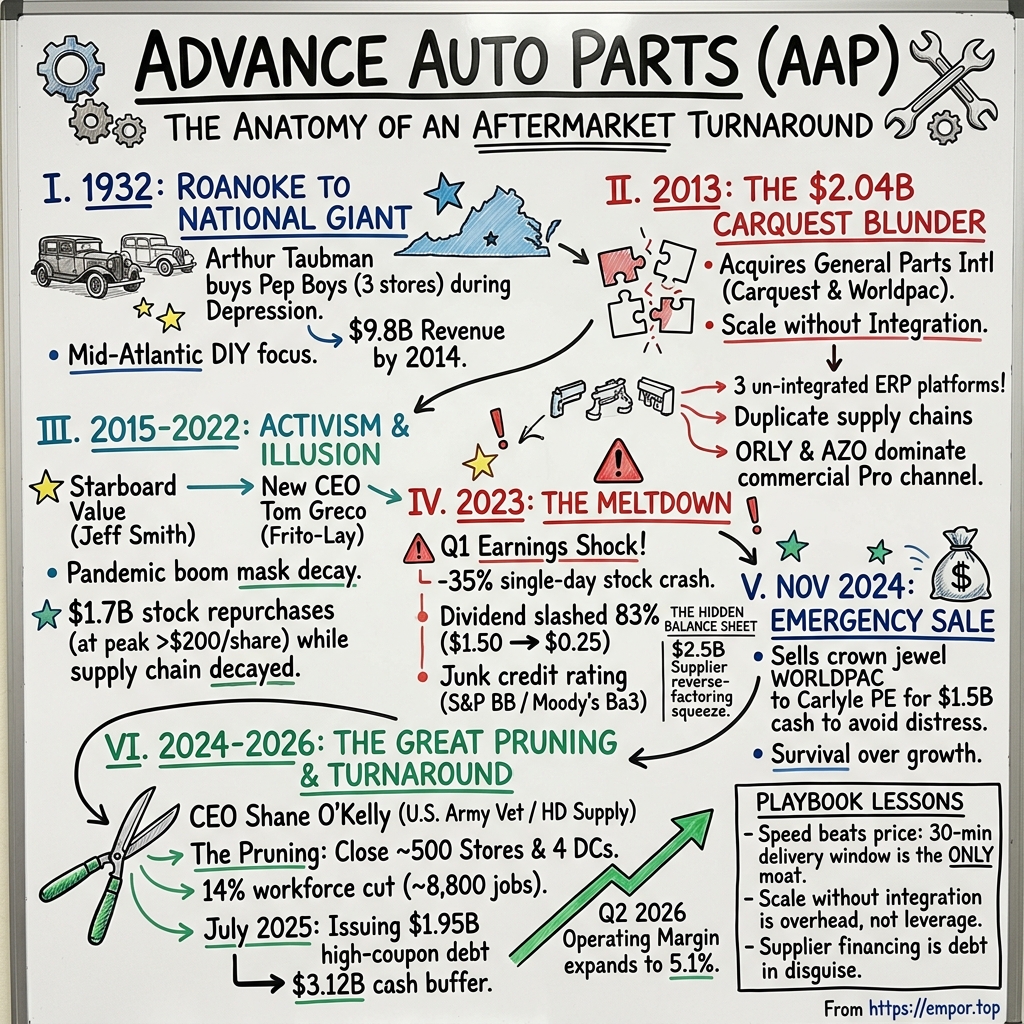
Advance Auto Parts: The Anatomy of an Aftermarket Turnaround
I. The $1.5 Billion Emergency Fire Sale
On November 1, 2024, Advance Auto Parts handed over the keys to Worldpac. The buyer was a set of funds managed by Carlyle, the price was $1.5 billion in cash, and after fees and adjustments roughly $1.44 billion of it landed in Advance's bank account.12 On paper it was an ordinary corporate divestiture, the kind of transaction that gets a press release, a conference call and a line in the next annual report. In practice it was something closer to a pawnshop visit. Shane O'Kelly, who had run the company for barely fourteen months, was selling the one business inside Advance that almost everyone agreed worked, in order to buy time for the businesses that did not.
Worldpac was a specialist. It distributed parts for imported vehicles, the BMWs, Hondas and Volkswagens that independent garages struggle to source quickly, and it served those garages with a catalog and delivery network that had a reputation for precision. Carlyle was not buying a turnaround. It was buying the healthiest limb of a sick patient. When Reuters reported the agreement in August 2024, the framing was simple: Advance needed the cash and needed to simplify, and Worldpac was the asset a buyer would actually pay for.3
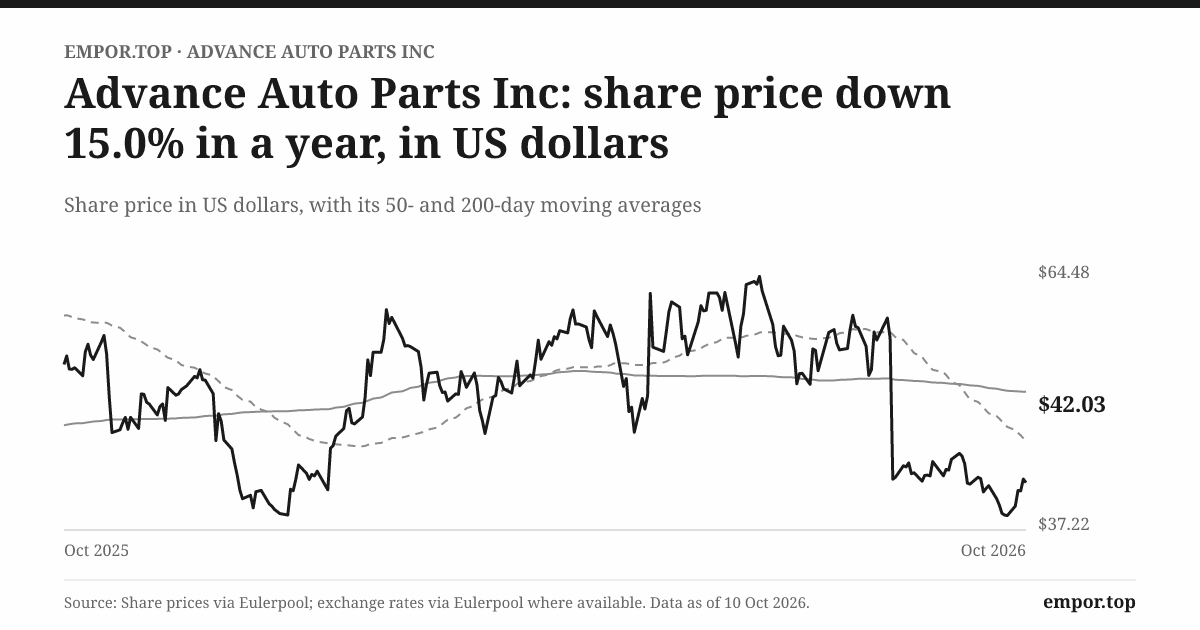
To understand why a company would sell its best growth engine, consider what had happened to its shareholders. Across the previous five years, Advance's share price fell about 81% from peak to trough.4 A stock that had traded above $200 during the pandemic boom sits at about $42 on October 10, 2026, giving the whole company an equity value of roughly $2.5 billion.4 That is a company with about $9 billion of annual sales being valued at roughly a third of a year's revenue and barely more than the accounting value of its net assets.4 Somewhere in that collapse, around $10 billion of shareholder value simply disappeared.
The dividend tells the same story in a single number. In May 2023, Advance cut its quarterly payout from $1.50 a share to $0.25, a reduction of 83%.5 Companies do not slash a dividend that hard unless the alternative is worse. And by late 2024 the alternative was visibly bad: cash from operations had shrunk from about $1.1 billion in fiscal 2021 to less than $100 million in fiscal 2024, and free cash flow had turned negative.16 The rating agencies had already taken the company out of investment grade. Today S&P rates Advance BB and Moody's rates it Ba3, both firmly in high-yield territory.78
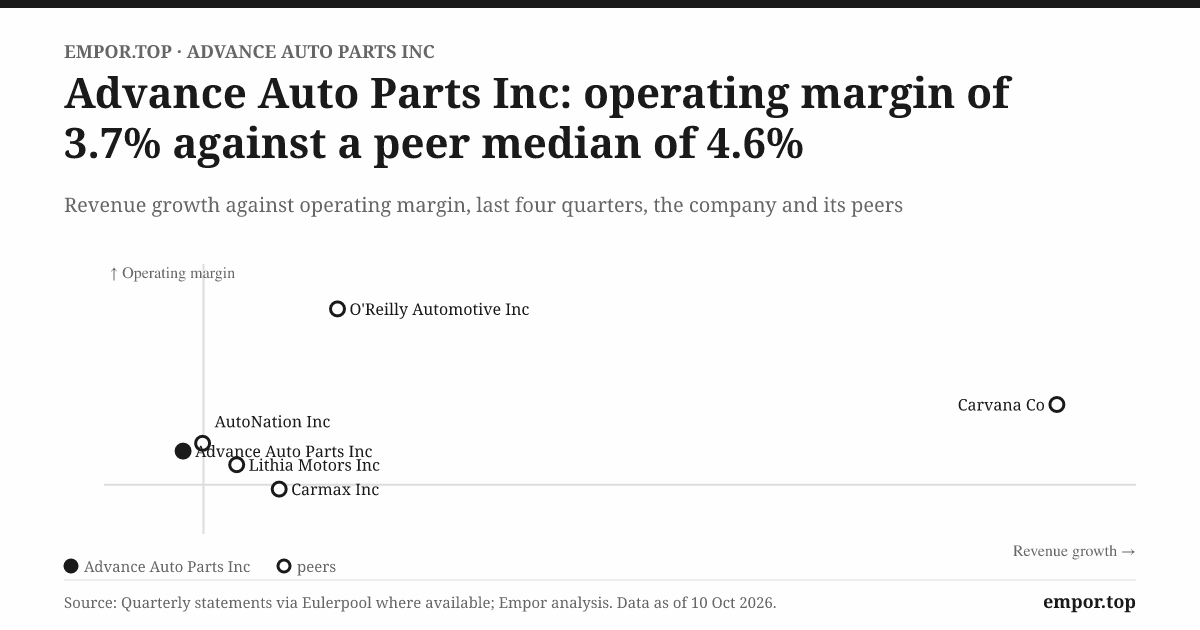
Now set Advance beside its rivals. O'Reilly Automotive and AutoZone sell the same brake pads, batteries and alternators to the same kinds of customers, and both earn operating margins in the high teens to around 20%, compounding into some of the most admired retail franchises in America.4 Advance, in its best recent year, earned about 7.5%. In its worst, fiscal 2024, it lost money at the operating line.6 Same industry, same aging vehicles, same tailwinds. Completely different outcome. That gap is the real subject of this story.
So the Worldpac sale was a lifeline, and it worked as one: it is the main reason Advance now sits on more than $3 billion of cash.9 But it came at a price that will not show up in any one quarter. Advance gave away its highest-quality commercial distributor and kept a retail network that, by its own subsequent restructuring, had hundreds of stores not worth keeping open.1
That leaves three questions hanging over the company in October 2026. Can Advance push its operating margin sustainably above 5% without Worldpac, or is the remaining store base structurally weaker than O'Reilly's and AutoZone's? Will the shrinking of a roughly $2.5 billion supplier-finance program, a form of borrowing that never appears as debt, keep draining the cash pile?9 And can a management team that inherited a decade of failed integrations finally get the right part to the right garage on time?
Today Advance operates more than 4,200 stores and employs about 28,000 full-time and 26,000 part-time workers after cutting roughly 14% of its workforce in a year.9 It is smaller, simpler and better capitalized than it has been in years. Whether it is also better at the one thing that matters in this industry is the question the rest of this story tries to answer. To answer it, the story has to go back to a Depression-era storefront in Virginia, where the founding formula was so simple it is easy to forget it was ever a formula at all.
 Subscribe on LinkedIn
II. From Roanoke General Store to Category Giant
In 1932, at the bottom of the Great Depression, Arthur Taubman bought three Pep Boys stores in Roanoke, Virginia.10 It was a peculiar time to bet on cars. Unemployment was heading toward a quarter of the workforce, banks were failing, and almost nobody was buying a new automobile. But Taubman saw what that last fact actually meant. If Americans could not afford new cars, they would have to keep the old ones running, and keeping an old car running meant buying parts.
His early stores were closer to general merchandise shops than to the clean, catalog-driven parts counters of today. They sold radios, hardware and household goods alongside spark plugs and fan belts, catering to cash-strapped families who fixed their own vehicles in the driveway.10 The business was renamed Advance Stores, and its economics were straightforward. A customer who needs a part needs it now, so the store that is closest and has the part in stock wins the sale. Density was everything.
That insight shaped Advance's growth for the next half century. Rather than planting a lonely flag in every state, the company filled in regions, clustering stores across Virginia, the Carolinas and the broader Southeast so that one warehouse could feed many shops and one brand could become a habit. The customer was the classic "do-it-yourself" mechanic, the person with a socket set and a Saturday afternoon. In industry shorthand, this is the DIY business: higher margins per sale, cash at the register, and a customer who walks in rather than calls.
By the 1990s Advance had become a large regional chain, and through acquisitions it pushed into new territories. In November 2001 it listed on the New York Stock Exchange under the ticker AAP, turning a long-private enterprise into a widely held Delaware corporation owned largely by institutions.1 Public money brought public expectations, and those expectations were set by a peer group that was getting very good, very fast.
The industry beneath Advance was also changing. Cars became computers on wheels. Fuel injection, electronic ignition, onboard diagnostics and sealed components made the driveway repair harder, which pushed more drivers toward professional garages. That second channel, which the industry calls "do-it-for-me" or simply Pro, buys differently. A repair shop does not wander the aisles. It calls or clicks, expects the part delivered to its door, buys on credit, and is ruthlessly loyal to whichever supplier gets the part there fastest.
AutoZone built its empire on DIY first and then layered on commercial. O'Reilly, out of Springfield, Missouri, did something more unusual: it designed its distribution from the beginning to serve both channels from the same stores, backed by deep regional hubs that could restock a store several times a day. That "dual-market" model meant an O'Reilly store could promise a garage almost any part within hours, which in turn won it the garage's first call.
Advance, by contrast, had grown up as a DIY retailer. Its commercial business existed, but it was subscale, and its supply chain had been designed to restock stores on a schedule rather than to chase same-day commercial orders. By the early 2010s the company was stuck in the middle: not the strongest DIY brand, not the best commercial supplier, and too big to be a nimble regional player. Revenue was growing, and margins were respectable, but management could see that the profit pool of the future was in Pro, and that its rivals were already there.
What it needed, in its own judgment, was commercial scale, and fast. That judgment led to the biggest deal in the company's history, and the deal that, more than any other single decision, explains why Advance would spend the next decade falling behind.
III. The $2 Billion Carquest Blunder
In October 2013, Advance announced that it would buy General Parts International, the privately owned Raleigh company behind the Carquest and Worldpac networks, for about $2.04 billion in cash. When the deal closed on January 2, 2014, Advance became the largest automotive aftermarket parts provider in North America by sales.11 It was a bold, clean headline: the DIY specialist had bought a commercial empire.
The logic was easy to sell. Carquest was a name repair shops knew, with a large company-operated store base and a long tail of independently owned stores that bought from it as a wholesaler. Worldpac was the import-parts specialist that garages relied on for European and Asian cars. Together, they gave Advance instant density in the commercial channel and a network that reached into regions it had never served well. The acquisition was the biggest reason revenue jumped about 52% in fiscal 2014, to roughly $9.8 billion, with an operating margin of 8.7%.6
That 8.7% margin, it turns out, was the high-water mark. Over the next three years it slid to about 6.1%, and operating profit fell from roughly $850 million to around $570 million even as revenue stayed broadly flat.6 The company had bought sales, but not profits, and certainly not the operating capability that makes sales profitable.
The trouble was integration, and in parts distribution integration is not an abstraction. A parts store lives and dies by its catalog, the database that tells a counter clerk which of thousands of near-identical brake rotors fits a 2009 Accord with a particular trim. Carquest and Advance ran different catalogs, different point-of-sale systems and different supply chains. Worldpac ran yet another. For years the combined company operated parallel systems side by side, with stores in the same town drawing from different warehouses and speaking different data languages.
Picture what that does to a single delivery. An Advance store runs out of a water pump that a nearby Carquest branch has on its shelf, but the two systems cannot see each other's inventory, so the store tells the garage the part is unavailable. Meanwhile trucks from two distribution networks cross the same roads, each half empty. Every duplicate warehouse is cost; every phantom stockout is a lost order. Neither shows up as a dramatic write-off. Both show up, year after year, as margins that refuse to rise.
Repair shops noticed. A garage does not care whose name is on the box; it cares whether the part arrives before the customer calls asking when the car will be ready. When Advance and Carquest struggled with mismatched part numbers and unreliable availability, the cost of switching was a phone call to O'Reilly or AutoZone. The commercial channel Advance had paid $2 billion to dominate became the channel where it was steadily losing share, a pattern that its own later filings tie to competitors' superior parts availability and delivery speed.9
The balance sheet carried the scars too. The acquisition was funded with cash and new borrowings, and the debt never really came back down; by fiscal 2020 total borrowings, including leases, were about three times their 2016 level.612 Advance had paid a full price for a business with lower margins and slower inventory turns than its own, betting that integration would close the gap. Integration never did.
The verdict on Carquest is not that commercial scale was the wrong goal. O'Reilly's success proves it was the right one. The verdict is that scale without a unified operating system is not leverage; it is overhead with a bigger logo. And by 2015 the gap between what Advance had promised and what it delivered was wide enough to attract a very particular kind of investor, one who makes a living by pointing at such gaps in public.
IV. Starboard Value, Tom Greco, and the Illusion of Margin Expansion
On September 30, 2015, Starboard Value published a presentation titled "Unlocking Value at Advance Auto Parts."13 Starboard, run by Jeffrey Smith, was among the most feared activist funds in America, known for long slide decks that dismantle a company's operations line by line. Its argument about Advance was blunt: the company's operating margin trailed AutoZone and O'Reilly by a wide gap, and there was no structural reason for it. Fix the supply chain, consolidate inventory, integrate Carquest properly, and hundreds of millions of dollars of operating profit should follow.13
The thesis was persuasive because it was mostly right about the diagnosis. Advance was not in a worse industry than its peers. It was simply less efficient at the same work. Within months Starboard won board seats, and in 2016 the company named Tom Greco as chief executive.10 Greco came from PepsiCo, where he had run Frito-Lay North America, one of the most sophisticated direct-store-delivery operations in consumer goods. On paper, a man who had run trucks to every convenience store in America seemed a reasonable choice for a business whose problem was getting goods to stores.
Greco brought a consumer-packaged-goods playbook: a strong corporate center, brand investments, store refreshes, a focus on productivity programs and the language of multi-year margin targets. Advance laid out an ambitious plan for margin expansion and returned to it at investor days. But a bag of chips and a brake caliper are different logistics problems. Chips are a few hundred fast-moving products pushed to shelves on a route. Auto parts are tens of thousands of slow-moving products that must be available on demand, in the right place, within the hour. The CPG approach optimized what could be seen from headquarters. The parts business is won in the local store's back room.
For a while the numbers seemed to vindicate the plan. Operating margin crept up from about 6.1% in fiscal 2017 to about 7.5% in fiscal 2021, when revenue topped $11 billion and operating profit reached roughly $820 million.6 Then the clue appears. That recovery coincided with the pandemic, stimulus checks, a used-car price surge and broad parts inflation, conditions that lifted every company in the industry. At its peak, Advance's margin was still barely a third of O'Reilly's.4 The gap Starboard had targeted had not closed; the tide had simply lifted everyone.
What management did with that tide is the part of the story that aged worst. In fiscal 2021 and 2022, Advance spent about $1.7 billion buying back its own shares, roughly $1.1 billion in the first year and $620 million in the second, at prices that frequently exceeded $200 a share.9 The dividend was raised sharply too, with cash dividends climbing from about $56 million in fiscal 2020 to roughly $336 million in fiscal 2022.12 Within two years the stock would trade near $40. Every one of those repurchased shares was bought at several times what it is worth today, using cash that could have rebuilt the supply chain or strengthened the balance sheet.
A useful test of any margin-improvement story is what happens when conditions turn. O'Reilly passed cost inflation through to customers quickly and expanded margins. Advance, with weaker availability and a less loyal commercial base, struggled to raise prices without losing orders, and its supply chain was still carrying the complexity it had inherited in 2014. The claim that Advance had achieved structural margin convergence did not survive contact with the first real test. History narrows it to a smaller and more honest version: Advance improved modestly in a boom and returned the proceeds to shareholders at the top.
That was the setup for the spring of 2023. The tailwinds were fading, the buybacks had thinned the cash cushion, and the operational weaknesses were still there. All that remained was for the numbers to say so out loud.
V. The 83% Dividend Squeeze and the 2023 Operational Meltdown
On May 31, 2023, Advance released its first-quarter results, and Wall Street did not see it coming. The company cut its full-year outlook, reported a collapse in profitability, and slashed its quarterly dividend from $1.50 a share to $0.25.5 The shares fell about 35% in a single day.5 For a company that only eighteen months earlier had been spending a billion dollars a year on buybacks, it was a stunning reversal.
The explanation management offered centered on pricing and costs. Advance had invested in lower prices to defend and win share, particularly with Pro customers, just as suppliers were pushing through steep cost increases. The company was paying more for parts and charging less for them. Commercial customers happily took the lower prices, but there is little evidence they rewarded Advance with the loyalty it was trying to buy; their urgent, high-margin orders still went to whoever had the part on the shelf.
The full-year numbers made the damage plain. Operating margin fell from about 5.7% in fiscal 2022 to just 0.6% in fiscal 2023, and net profit shrank from roughly $464 million to $30 million.6 Even after the cut, the dividends paid that year were nearly seven times net earnings, a sign of how far profits had fallen beneath a payout set for a different company.6 Then it got worse. In fiscal 2024, under the weight of restructuring charges, inventory write-downs and the costs of the Worldpac exit, Advance posted an operating loss of roughly $400 million and a net loss of about $336 million.6
The cash statement shows the problem was not merely accounting. Cash from operations fell from about $1.1 billion in fiscal 2021 to around $290 million in fiscal 2023 and to under $100 million in fiscal 2024.12 Revenue had barely moved over that span. That combination, stable sales and vanishing cash, is the signature of a business whose costs and working capital are out of control, not one whose customers have disappeared.
The leadership changed hands quickly. In August 2023 the board named Shane O'Kelly as president and chief executive, effective that September, ending the Greco era.14 A new chief financial officer, Ryan Grimsland, followed in November.15 Activist and value investors circled a stock that now looked cheap on any historical measure, and the shareholder register shifted toward contrarian holders such as Pzena Investment Management.15
The lawyers arrived too. In October 2023, two putative securities class actions were filed in the U.S. District Court for the Eastern District of North Carolina, alleging that former senior officers made false and misleading statements between November 2022 and May 2023 about pricing strategy, margins and the financial outlook.169 The cases remain pending, and Advance has recorded no reserve because it says a loss is not reasonably estimable.9 Allegations are not findings, and the plaintiffs must clear demanding pleading standards. But the overhang is real, and its timing matters: it covers precisely the months when management was still describing the strategy as working.
The credit agencies drew their own conclusion. Moody's cut Advance to Ba1 in November 2024 and to Ba3 in July 2025; S&P lowered it from BB+ to BB that same month.78 Losing investment grade does more than raise bond yields. It changes how banks, landlords and suppliers treat a company. For Advance, the most important of those relationships was with the suppliers who stock its shelves and the banks who quietly finance them.
The 2023 meltdown is often described as a macro event, a casualty of inflation. The record does not support that reading. AutoZone and O'Reilly faced the same inflation and reported strong results. Advance's crisis was the sum of its own choices: an under-integrated supply chain, a pricing gamble, and a capital return program sized for peak earnings. To see why those choices were so costly, it helps to look at how this business actually makes money.
VI. Under the Hood: The Mechanics of DIY, Commercial Pro, and Parts Availability
It is a Tuesday morning at an independent repair shop. A pickup truck is up on the lift, its alternator removed, its owner already texting to ask when it will be ready. The technician has diagnosed the problem in twenty minutes. Now everything depends on a delivery driver. If the new alternator arrives within half an hour, the job is done before lunch and the bay is free for the next car. If it does not, the most expensive asset in the building, a lift with a skilled technician standing next to it, earns nothing.
That scene, repeated thousands of times a day across America, explains the automotive aftermarket better than any spreadsheet. Advance serves two kinds of customers, and they want very different things.9 The DIY customer walks into a store, often comparison-shops, and pays at the register. These sales carry higher gross margins and need no credit, but they depend on foot traffic, convenience and a brand people trust. The Pro customer, the repair shop, buys on account, orders by phone or software, expects delivery, and is far less sensitive to price than to time. For a shop billing labor by the hour, a part that costs a few dollars more but arrives in twenty minutes is cheaper than a bargain that arrives tomorrow.
Demand for both is unusually resilient. Revenue in this industry is transactional, with no subscriptions or long-term contracts, but it rests on things that do not stop in a recession: brakes wear, batteries die, belts crack, and air conditioners fail every summer.9 And the American fleet keeps getting older. The average age of light vehicles in the United States now exceeds 12.8 years, a record that reflects expensive new cars and better-built old ones.9 Older cars need more repairs, and they are largely out of warranty, which pushes their owners toward independent shops and parts stores rather than dealers. It is one of the most reliable tailwinds in retail, and it blows on every competitor equally.
That last point matters. A rising tide of repair demand does not decide who wins; availability does. The leaders have spent years building tiered networks: large distribution centers, then regional hubs carrying a very wide range of slow-moving parts, then neighborhood stores restocked multiple times a day. The result is that an O'Reilly or AutoZone counter can promise a long-tail part quickly, and a garage learns to call there first. Advance, still operating a more traditional distribution structure as it untangled its legacy systems, more often had to say "we can get it tomorrow." In the Pro business, tomorrow is a polite word for no.
The inventory numbers hint at the cost of that weakness. Advance carries roughly eight to nine months of inventory relative to its cost of goods sold, a figure that has bounced around rather than steadily improved.4 Holding a lot of inventory is not a problem in itself; parts retailers must stock deep catalogs. The problem is holding a lot of inventory in the wrong places, so the company pays to carry stock while still missing sales.
The receivables tell a related story about the Pro channel. At the start of 2026, Advance had about $370 million of trade receivables, money owed largely by repair shops, against an allowance for credit losses of about $95 million.9 That is an unusually large cushion for losses, and the expense behind it rose from about $13 million in fiscal 2023 to $62 million in fiscal 2025.9 Part of that reflects a cleanup as stores closed and old accounts were written off; part reflects real stress among small independent garages. Either way, it is a reminder that the commercial channel is not just a delivery business. It is also a credit business, and Advance has been extending credit to some of the weaker customers in the market.
The meaning of all this is simple. The aftermarket rewards logistics far more than merchandising. Pricing power in the Pro channel is earned by being reliably first, not by being cheapest, which is exactly why Advance's 2023 price cuts did so little. And speed requires inventory in the right place, which requires working capital, which brings the story to the quietest and perhaps most dangerous line on Advance's balance sheet.
VII. The $2.5 Billion Hidden Balance Sheet: Supplier Reverse-Factoring
Every year, Advance's auditors at Deloitte have to decide which parts of the financial statements require the most judgment, and they disclose the hardest of these as a Critical Audit Matter. For Advance, the item they singled out was vendor incentives, the rebates and allowances suppliers pay the company based on how much it buys.9 It is an unglamorous choice, but it points directly at the financial machinery that keeps Advance's shelves stocked.
That machinery is called supplier finance, or reverse factoring, and it works like this. Advance buys parts from manufacturers on very long payment terms, often months longer than a supplier would normally accept. To make those terms tolerable, a bank steps in. The supplier can sell its invoice to the bank and get paid early, minus a small discount. The bank then waits and collects the full amount from Advance when the long term expires. Think of it as Advance borrowing from the bank, except that the borrowing is booked not as debt but as ordinary accounts payable, disclosed in a note to the accounts.9
The arrangement is legal, common and, in good times, very useful. It is how Advance's payables have historically been nearly as large as its inventory: the company carried roughly eight to nine months of stock while owing suppliers for about seven months of purchases.4 In effect, suppliers and their banks were financing most of Advance's shelves. The catch is that the arrangement depends on the banks' willingness to take Advance's credit risk. When Advance's credit was investment grade, that willingness was abundant. When the company fell to junk, it was not.
At the end of fiscal 2024, Advance's confirmed obligations under these programs were about $3.2 billion. A year later, they were $2.5 billion.9 That $700 million shrinkage was not a decision to pay suppliers faster out of generosity. It reflected less appetite for Advance paper, Worldpac leaving, and a smaller store base buying less. And because the money had to come from somewhere, it came out of operating cash flow. In fiscal 2025, falling accounts payable drained about $469 million of cash, and together with roughly $200 million of restructuring costs, it pushed cash from operations to minus $46 million.9 A company with positive operating profit generated negative operating cash.
The vendor-allowance judgment Deloitte flagged sits on top of this. Rebates are often tiered: buy more, earn a bigger percentage back. When Advance closes hundreds of stores, it buys less, and the rebates it can book shrink, which pressures gross margin. The timing of when those rebates are recognized is a matter of estimate, which is precisely why the auditors focused on it.9
Add it all up and Advance's true obligations look larger than its headline debt. The company has about $3.4 billion of senior notes and about $2.2 billion of lease liabilities on its stores and warehouses.17 On top of that sit the $2.5 billion of bank-financed supplier payables. Together those are close to $8 billion of commitments, against about $3.1 billion of cash.179
This is the core tension in the Advance story. The company is solvent and liquid, and its cash cushion is real. But its working capital depends on the confidence of parties it does not control. If supplier-finance balances stay at or above about $2.5 billion, the cash cushion is safe. If banks pull back further, Advance could face another drain of hundreds of millions of dollars, regardless of how many alternators it sells. That is the background against which Shane O'Kelly launched the most aggressive restructuring in the company's history.
VIII. The Great Pruning: Shane O'Kelly's Asset Carve-Out and Turnaround
Shane O'Kelly arrived at Advance in September 2023 with a resume built on distribution rather than retail glamour.14 He had run HD Supply, the industrial distributor that sells maintenance and repair products to contractors and facilities managers, a business whose customers, like repair shops, care above all that the right item arrives on time. He is also a U.S. Army veteran. His style, judging from his decisions, is subtraction first and growth later.
The subtraction came in November 2024, around the same time the Worldpac sale closed. Advance announced it would close roughly 500 underperforming company-owned stores, stop supplying about 200 independent locations, and shut four distribution centers.1 Most of the closures were completed in the first quarter of 2025.9 The workforce shrank accordingly. Between the end of 2024 and the start of 2026, full-time employees fell from about 33,200 to about 28,300 and part-time staff from about 29,600 to about 25,700, a cut of roughly 14%.9
The logic was that a store losing money is not a store at all; it is a subsidy. Every unprofitable location ties up inventory, rent and labor that could support a better store nearby. By concentrating inventory in fewer locations and fewer distribution centers, the company aimed to raise availability where it still operated, which is exactly the weakness that had cost it the Pro customer.
Then O'Kelly secured the balance sheet. In July 2025, Advance sold $1.95 billion of new senior notes in two equal pieces: $975 million paying 7.00% due 2030 and $975 million paying 7.375% due 2033.9 The coupons were expensive, a direct cost of the junk rating, and Moody's cut its rating the same month in part because of the new debt.8 But the money refinanced bonds coming due in 2026 and left the company with about $3.1 billion of cash, which it still held in July 2026.917 Interest expense now runs at about $139 million a year.17 It is a classic trade: pay a high price for certainty, and buy years of runway in exchange.
The early results suggest the pruning is working at the operating line. Operating profit climbed from a loss of roughly $400 million in fiscal 2024 to a profit of $161 million in fiscal 2025, and to about $367 million over the twelve months to mid-2026.6 The quarterly trend is the cleaner signal. In the second quarter of 2026, Advance earned about $101 million of operating profit on $2.0 billion of revenue, a margin of 5.1%, double the 2.5% of a year earlier.1817
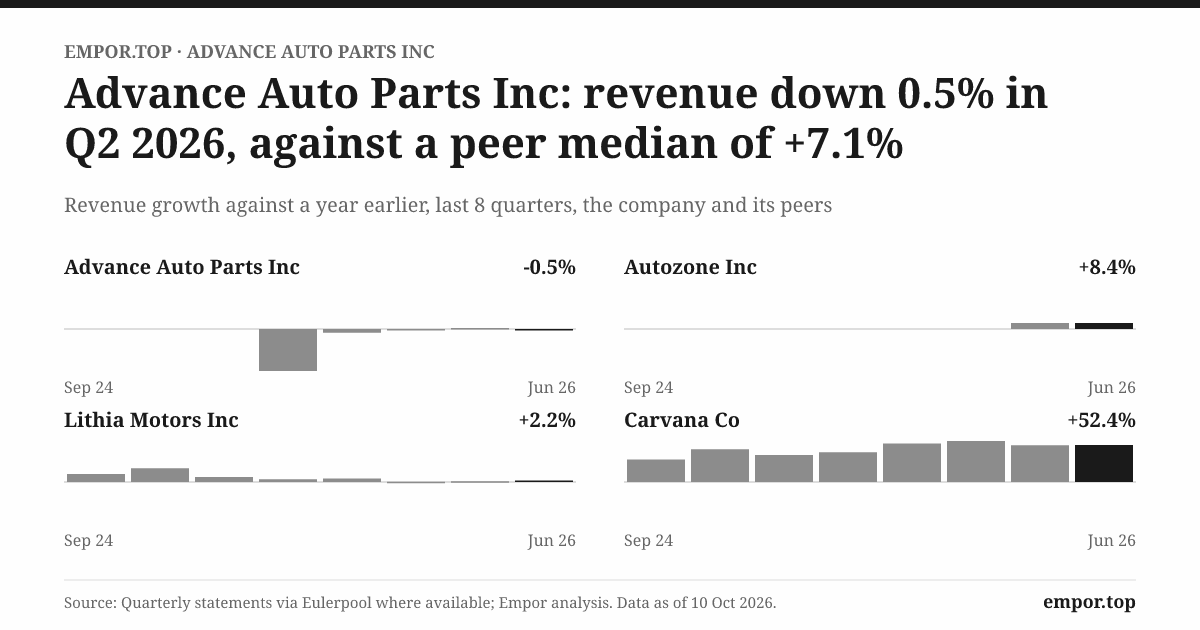
Look closer, though, and the reveal is more nuanced. Revenue in that quarter was flat to slightly down year on year.18 The margin improvement came from removing bad stores and costs, not from selling more parts. That is exactly what pruning should do first, but it cannot do it forever. A company can close its way to a better margin; it cannot close its way to growth. The rating agencies seem to agree on the progress and the limits. S&P revised its outlook to stable in July 2026, citing turnaround progress, while still rating the company BB.7
Shareholders have also softened. At the May 2026 annual meeting, about 96% of votes cast supported executive pay, with roughly 50.1 million votes for and about 2 million against, a recovery from the 2025 vote, when abstentions and opposition together were far larger.1915 O'Kelly's own pay was about $9.1 million in 2025, most of it in stock.15 The senior team has not been stable, however: the head of technology and the head of the Pro and Carquest business both departed in 2025.15 Those are the two jobs most central to the availability problem.
So the turnaround has passed its first test: Advance has stopped bleeding at the operating line. The second test, growing same-store sales in a smaller footprint against rivals who never stopped investing, has not yet been taken. To judge whether it can be passed, the story needs to step back and ask a harder question: what, if anything, protects Advance from its competitors?
IX. The Moat Assessment: Seven Powers and Five Forces in Aftermarket Retail
It is midnight at a regional parts hub. Conveyor belts carry boxes of brake pads, sensors and water pumps past scanners; pickers move between aisles stacked to the ceiling; routing software builds the morning's delivery runs to hundreds of garages. Everything in that building exists to do one thing faster than a competitor's building a few miles away. The question of whether Advance has a moat comes down to whether its building is any better than theirs.
The market's answer is in the price. Advance trades at about 0.3 times sales and roughly 29 times its trailing operating profit, a high multiple on depressed earnings rather than a vote of confidence.4 Its return on invested capital was under 3% in fiscal 2025, while O'Reilly and AutoZone routinely earn returns several times higher.4 A business with a durable advantage does not usually earn less than its cost of capital for years at a time.
Hamilton Helmer's 7 Powers framework sharpens the point. Scale economies should be Advance's strongest card: with around $8.6 billion of revenue, it is one of the largest parts buyers in North America.6 But scale only matters if it turns into lower costs or better service, and Advance's fragmented systems long prevented that; its peers convert scale into availability far more effectively. Network effects do not exist here, because one garage buying from Advance makes it no more valuable to another. Counter-positioning is absent, because Advance runs the same dual DIY-and-Pro model as its rivals, only less well. Switching costs are low: garages use parts-ordering software that shows several suppliers at once, so a late truck sends the next order elsewhere with one click. Branding helps on the DIY side, where Advance and Carquest are familiar names, but it earns no premium in Pro, where speed is the brand. There is no cornered resource, since catalogs, suppliers and storefronts can all be replicated. And process power, the hard-won operational know-how that rivals cannot copy, has historically worked against Advance rather than for it.
Michael Porter's five forces explain why that matters so much. Supplier power is high: parts makers and their banks shape Advance's working capital through payment terms and rebates, as the supplier-finance contraction showed. Buyer power is high in Pro, where shops multi-source and demand speed and volume pricing, and moderate in DIY, where consumers can compare prices online or at mass merchants. Substitutes are weak: every car, gasoline or electric, needs physical parts, though electric vehicles need fewer of the engine-related ones. New entrants face a steep wall, because building thousands of stores and same-hour delivery is enormously expensive, which is why e-commerce giants have not displaced this industry. Rivalry, however, is intense, with AutoZone, O'Reilly and Genuine Parts' NAPA all chasing the same garages.
Put together, the picture is of an attractive industry and an unprotected participant. The industry's high barriers to entry protect Advance from new competitors, but not from existing ones, and its existing ones are among the best operators in American retail. Advance's position is that of a structural price-taker in Pro and a respectable but undifferentiated player in DIY.
This does not mean Advance cannot earn a decent return. It means any return it earns must come from execution, not from a protected position. The question for investors, then, is not whether the moat exists, but whether the execution gap can be closed enough to earn a respectable margin. That makes the lessons of the past decade worth stating plainly before turning to the bull and bear cases.
X. Playbook: Business & Investing Lessons
The first lesson begins in January 2014, when Advance closed the Carquest deal and woke up as the biggest parts seller in North America. For the next decade it ran parallel catalogs, parallel trucks and parallel warehouses, and its margin shrank while its revenue stood still. The lesson is that in distribution, you do not own what you buy until your systems can see it. Scale that cannot share inventory is not scale; it is two smaller companies paying one set of bankers.
The second lesson comes from the pandemic boom. Advance's margin rose to its best level in years just as every parts seller enjoyed stimulus checks and inflating prices, and management spent about $1.7 billion buying back stock at prices above $200. Less than two years later, the dividend was cut by 83%. A rising tide does not tell you how well you swim. The time to test a margin story is when the wind is behind you, because that is when it costs nothing to be wrong and everything to act as if you are right.
The third lesson is written in a note to the accounts. Advance's supplier-finance balances were never called debt, yet when they shrank by $700 million, they took almost $500 million of operating cash with them. Payables that a bank is financing are borrowings wearing a supplier's uniform. Investors who look only at the debt line miss the creditor who can leave first.
The fourth lesson lives in that repair bay with the pickup truck on the lift. Advance tried to buy Pro loyalty with lower prices in 2023, and the shops took the discount and kept calling O'Reilly. In mission-critical logistics, the customer is not buying a part; they are buying back their own time. A discount cannot compensate for a part that is not there.
The fifth lesson is O'Kelly's. Closing 500 stores and four distribution centers looked like retreat, and it did shrink revenue. It also doubled the operating margin within a year. For a bloated retailer, walking away from bad revenue is the first growth strategy, because nothing good can be built on a store that loses money every day. But pruning is a beginning, not an ending, and the open question is what grows back.
XI. Analysis & Bear vs. Bull Case
Imagine two investors on the same conference panel in New York. The first, a value manager, puts up a single slide: a company with about $9 billion of revenue, worth roughly $2.5 billion, trading near book value and holding about $3.1 billion of cash.417 The second, a short seller, puts up a different slide: 7% coupons, a shrinking supplier-finance program, and a rival earning four times the margin. Both are describing the same company, and both are telling the truth.
The bull case starts with arithmetic. If Advance can reach a 6% operating margin on something like its current revenue, it would earn over $500 million of operating profit, against an enterprise value of about $4.6 billion.4 That is not a heroic assumption; it is below what the company earned throughout the 2015 to 2021 period.6 The cash cushion removes near-term bankruptcy risk and gives management years to execute. The pruning has already doubled the quarterly margin to about 5%.18 And the aging fleet means demand is unlikely to collapse while the work is done.
The bear case attacks each of those pillars. First, the margin recovery so far comes from subtraction, and the evidence that Advance can win back commercial customers is thin; revenue is still flat to falling.18 O'Reilly and AutoZone continue to invest in availability, and every garage that has learned to call them first is costly to win back. Second, the supplier-finance program remains the hidden lever: a further pullback by banks could drain hundreds of millions of dollars of cash, regardless of operating progress.9 Third, the new 7.00% and 7.375% notes lock in about $139 million of annual interest, which consumes a large share of current operating profit.17 Fourth, the North Carolina securities litigation remains unresolved, with no reserve recorded.9
An activist looking at Advance today would ask sharper questions. Why hold more than $3 billion of cash earning money-market rates while paying over 7% on recently issued bonds? Why do the departures of the technology and Pro leaders in 2025 not register as risks to an availability-led turnaround? And will the board resist the temptation to restart buybacks the moment the margin looks healthy, given what happened the last time? Management has, to its credit, kept the dividend at the reduced level and repurchased no stock under its plans in fiscal 2024 or 2025.9 That restraint is a promise kept so far. It has not yet been tested by good news.
Weighing the evidence, the claim that Advance can become a structurally competitive peer to O'Reilly is rejected by the company's own record; ten years of trying produced, at best, about a third of O'Reilly's margin. The narrower claim, that Advance can return to a mid-single-digit margin and earn a modest return on a smaller, cleaner base, is intact but unproven. Its proof needs a full year, not a quarter.
Three measures will decide which case wins. The first is consolidated operating margin, which reached 5.1% in the second quarter of 2026 and was rising; the test is whether the full year of fiscal 2026 and then fiscal 2027 can hold in the 4.5% to 5.5% range.18 The second is comparable-store sales growth, especially in Pro, which shows whether the smaller network can grow without discounting; total revenue was down about half a percent in the latest quarter.18 The third is the size of the supplier-finance program, which stood at $2.5 billion at the start of 2026 after falling from $3.2 billion; stability at that level would remove the largest hidden threat to cash.9
XII. Epilogue
Tonight, Advance Auto Parts is a different company from the one that cut its dividend in 2023. It is smaller, with hundreds fewer stores and thousands fewer employees. It is recapitalized, with no major bond maturity before 2027 and more cash than at any time in its modern history. And it is cautiously stabilizing, with margins rising quarter by quarter after the most turbulent period in its 94 years.
The next chapter has three deadlines. The first is February 2027, when Advance reports full-year fiscal 2026 results. Those numbers will show whether the margin held through the winter maintenance season, when batteries and wipers sell but many high-margin repairs wait, and whether the supplier-finance balance in the notes stayed near $2.5 billion. A full-year margin above 4.5% with stable supplier financing would confirm the narrower turnaround thesis. A slide back toward 3% would suggest the second quarter was the peak of a pruning effect rather than the start of a trend.
The second deadline is a decision rather than a date. At some point management must say what the $3.1 billion of cash is for. Using it to retire the expensive 7.00% and 7.375% notes would be the clearest signal that the company has learned the lesson of 2021, and would cut interest costs in a way that drops straight to profit. Restarting buybacks before the margin is proven would rhyme uncomfortably with the past.
The third is the courtroom in North Carolina, where a ruling on the defendants' motions or a settlement would remove, or crystallize, the last legal overhang from the Greco era.
Each of these maps onto the questions that opened the story. A disciplined use of cash and a stable supplier program would answer the liquidity question. A sustained margin above 5% would answer the competitiveness question, at least in its modest form. But the deepest question, whether Advance can match its rivals on availability, cannot be settled by any single report. It will be settled one garage at a time, one delivery at a time, over years.
XIII. Outro
Arthur Taubman understood something in 1932 that has never stopped being true: an old car on the road will eventually need a part. Ninety-four years later, Americans drive older cars than ever, and the demand he built a business on is stronger than when he started.
What changed was not the demand but the discipline required to meet it. The winners in this industry learned to deliver a brake caliper in twenty minutes instead of twenty hours, and they built every system around that promise. Advance spent a decade acquiring, rebranding, buying back stock and cutting prices, and lost track of the promise. Its customers never stopped repairing their cars. They simply stopped calling Advance first. The turnaround now underway is, in the end, an attempt to earn back that first phone call.
References
-
Advance Auto Parts, Inc. Current Report on Form 8-K (Sale of Worldpac to Carlyle) — SEC EDGAR, 2024-11-04 ↩↩↩↩↩
-
Advance Auto Parts, Inc. Form 10-K for the Fiscal Year Ended December 28, 2024 — SEC EDGAR, 2025-02-26 ↩
-
Advance Auto Parts to Sell Worldpac to Carlyle for $1.5 Billion — Reuters, 2024-08-22 ↩
-
Advance Auto Parts, Inc. Investor Relations Official Portal — Advance Auto Parts ↩↩↩↩↩↩↩↩↩↩↩
-
Advance Auto Parts Cuts Dividend by 83% as Margins Slump — Bloomberg, 2023-05-31 ↩↩↩
-
Advance Auto Parts, Inc. Form 10-K for the Fiscal Year Ended December 30, 2023 — SEC EDGAR, 2024-03-12 ↩↩↩↩↩↩↩↩↩↩↩↩
-
Research Update: Advance Auto Parts Inc. Outlook Revised To Stable From Negative On Turnaround Progress — S&P Global Ratings, 2026-07-10 ↩↩↩
-
Rating Action: Moody's Downgrades Advance Auto Parts to Ba3, Revises Outlook to Stable — Moody's Investors Service, 2025-07-15 ↩↩↩
-
Advance Auto Parts, Inc. Form 10-K for the Fiscal Year Ended January 3, 2026 — SEC EDGAR, 2026-02-13 ↩↩↩↩↩↩↩↩↩↩↩↩↩↩↩↩↩↩↩↩↩↩↩↩↩↩
-
Advance Auto Parts, Inc. Investor Relations Official Portal — Advance Auto Parts ↩↩↩
-
Advance Auto Parts Completes Acquisition of General Parts International — PR Newswire, 2014-01-02 ↩
-
Advance Auto Parts, Inc. Form 10-K for the Fiscal Year Ended December 28, 2024 — SEC EDGAR, 2025-02-26 ↩↩↩
-
Starboard Value Presentation: Unlocking Value at Advance Auto Parts — Starboard Value LP, 2015-09-30 ↩↩
-
Advance Auto Parts, Inc. Form 8-K (Appointment of Shane O'Kelly as CEO) — SEC EDGAR, 2023-08-22 ↩↩
-
Advance Auto Parts, Inc. DEF 14A Notice of 2026 Annual Meeting and Proxy Statement — SEC EDGAR, 2026-04-01 ↩↩↩↩↩
-
In re Advance Auto Parts, Inc. Securities Litigation (Case No. 5:23-cv-00600) — U.S. District Court for the Eastern District of North Carolina, 2023-10-31 ↩
-
Advance Auto Parts, Inc. Form 10-Q for the Quarterly Period Ended July 18, 2026 — SEC EDGAR, 2026-08-20 ↩↩↩↩↩↩↩
-
Advance Auto Parts, Inc. Current Report on Form 8-K (Item 2.02 Earnings Release Q2 2026) — SEC EDGAR, 2026-08-20 ↩↩↩↩↩↩
-
Advance Auto Parts, Inc. Current Report on Form 8-K (Item 5.07 Voting Results) — SEC EDGAR, 2026-05-22 ↩
 LinkedIn
 WhatsApp
 Reddit
 Hacker News
 Email
Email Kindle
 RSS Feed
 Spotify
 Apple Podcasts
 Amazon Music
 Audible
 YouTube