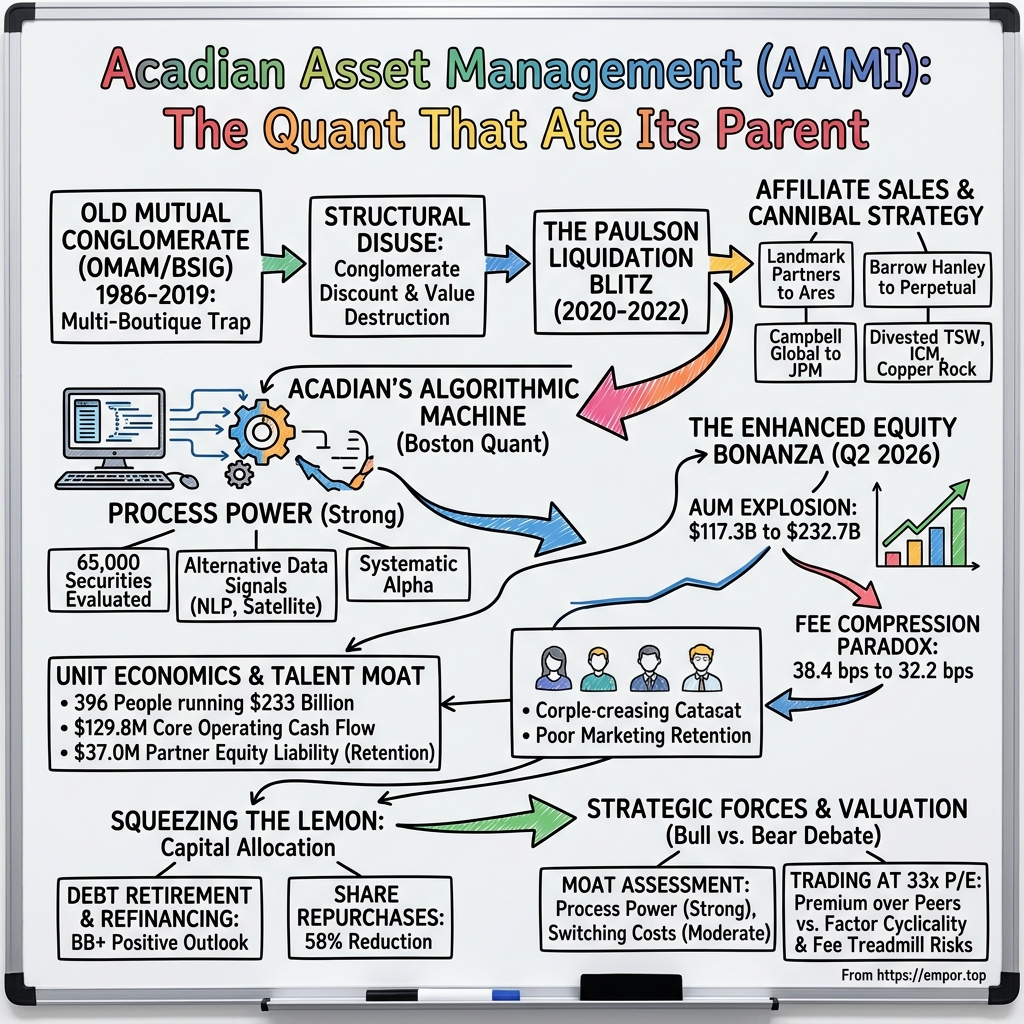
Acadian Asset Management: The Quant That Ate Its Parent
I. Introduction & Episode Roadmap (10 min)
Picture the shareholder register of a company called BrightSphere Investment Group at the end of the 2010s. It owned stakes in seven asset managers that had almost nothing to do with each other. One bought secondhand private equity stakes. One picked unloved value stocks in Dallas. One managed timberland in the Pacific Northwest. One, in Boston, ran computer models across stock markets most American investors couldn't place on a map. Above all of them sat a holding company with London roots, a corporate debt load, and a share count of more than 105 million1. Nobody loved it. The market priced it like a garage sale nobody had organised yet.
Now jump to tonight, October 3, 2026. Six of those seven businesses are gone. The share count is down to about 35.5 million2. The old name is gone too: since January 1, 2025 the company has been called Acadian Asset Management Inc. and trades as AAMI1. The one survivor, the Boston quant shop, managed $117.3 billion at the end of 2024 and $232.7 billion by June 30, 20262. It roughly doubled in eighteen months. The stock trades around $92 to $94, a market value of about $3.3 billion and a little more than 32 times trailing earnings3. In 2024 the same shares changed hands in the low $20s1.
That's the puzzle this story is built around. Is Acadian a 40-year-old systematic pioneer that finally got its own stock, riding a real institutional shift toward cheap, risk-controlled "enhanced" equity? Or is it mostly financial engineering, a masterpiece by its chairman, the billionaire hedge fund manager John Paulson, now running into the two forces that hurt every asset manager eventually: fees that keep falling, and investment factors that go out of favour for years at a time?
The answer isn't clean, and that's what makes it worth two hours. The story runs in this order. First, the Old Mutual empire and why multi-boutique holding companies tend to disappoint public shareholders. Second, Paulson's arrival and the liquidation blitz that turned the sale proceeds into buybacks. Third, inside Acadian's machine: what a quant manager actually does, and why non-U.S. markets are its home turf. Fourth, the Enhanced Equity boom and the fee squeeze that comes with it. Fifth, the forensic accounts: why a profitable company reported negative operating cash flow in 2025, and who really keeps the profits. Then governance and debt, the moat analysis, the bull and bear cases, and finally the lessons and what comes next.
One thread runs through all of it. Acadian's history tests a simple idea: that a conglomerate's discount can be removed rather than accepted. Whether what is left is worth 32 times earnings is a separate question, and the rest of this story answers them in that order.
 Subscribe on LinkedIn
II. The Old Mutual Conglomerate & The Multi-Boutique Trap (1986–2019) (18 min)
Two professors' kind of idea
In 1986, long before "quant" was a job title on Wall Street, Gary Bergstrom and Ronald Frashure founded Acadian in Boston4. Their bet sounds obvious now and was eccentric then. Instead of sending analysts to visit companies, they would rank thousands of stocks with computer models: cheapness, earnings quality, price trends. They would point those models mostly at markets outside the United States, where coverage was thin and prices were often slow to reflect information4.
The choice of non-U.S. markets was the important one. A model looking for mispriced stocks has more to find in fragmented, under-researched markets than in the S&P 500, where hundreds of analysts pick over every quarterly report. That focus on international and emerging markets, set in the 1980s, still defines the firm's biggest products today, as the strategy list later shows.
The roll-up
In 1992, the South African and British financial group Old Mutual bought Acadian5. Over the next two decades Old Mutual's U.S. asset management arm collected boutiques the way some people collect stamps. By the time of the 2014 IPO the stable included Acadian; Barrow, Hanley, Mewhinney & Strauss, a traditional value-equity house; Thompson, Siegel & Walmsley (TSW); Investment Counselors of Maryland (ICM); Copper Rock in international small caps; Campbell Global in timberland; and Heitman in real estate5. Landmark Partners, the private equity secondaries specialist, arrived shortly afterwards6.
The logic of a multi-boutique manager goes like this. Each affiliate keeps its own name, culture, and investment process, and its senior people keep a large cut of the economics. The parent supplies capital, distribution, and back-office support, and takes the rest of the profit. In theory, investors get diversification across asset classes, and talent gets independence plus a buyer for its equity.
Summer 2014: packaging the empire
In the summer of 2014, Old Mutual executives in London and Boston were drafting the registration documents for "OM Asset Management plc," known as OMAM. The S-1 was filed on June 30, 2014 and the final prospectus came on October 9, 20145. The structure said a lot about who it served. OMAM was an English public company, majority-owned by Old Mutual, which sold only part of its stake in the offering and planned to sell down over time5. For Old Mutual the listing was a way to turn a U.S. subsidiary into tradeable paper it could sell. That's a reasonable goal for a seller, but it's not the same thing as building a business.
At its peak, the group oversaw more than $240 billion and reported $904.3 million of revenue in 20176. Those are big numbers. The problem was what happened to them on the way to the shareholder.
Why the model disappoints
Multi-boutique structures run into three kinds of friction, and OMAM had all three.
First, the talent takes its cut before the parent does. Affiliate partners commonly keep a large share of their firm's profits through profit-sharing and equity arrangements. That's the price of keeping the people who generate the returns, but it means the parent's share of revenue is structurally thinner than a single integrated firm's.
Second, overhead piles up. A listed holding company carries its own board, auditors, investor relations, legal, and tax teams on top of each affiliate's. The OMAM structure added a UK listing and English corporate law to a business whose operations were almost entirely American.
Third, the portfolio fought itself. Traditional active value managers spent the 2010s losing assets to index funds, while the quant and alternatives businesses grew. Profits from the growers ended up offsetting shrinkage at the laggards, and the parent got valued on the blend.
The market's response was a persistent conglomerate discount. Investors who wanted Landmark's private equity exposure could buy a pure private markets firm. Investors who wanted quant could find other ways to own it. Few wanted all seven businesses in one bundle at a premium price.
Coming home to Delaware
In 2018 the company renamed itself BrightSphere, and on July 15, 2019 it redomesticated from England and Wales to Delaware1. By then Old Mutual had sold its stake6. The move removed a layer of UK complexity and made the company a normal U.S. corporation. But a change of address doesn't change the economics. BrightSphere still owned the same tangle of boutiques, partner pools, and holding company debt.
So did the multi-boutique model create durable diversification? The record mostly says no. The diversification was real at the affiliate level, but at the shareholder level it showed up as a discount, not a premium. The empire's most valuable asset, a scalable quant engine in Boston, was hidden inside a structure the market wouldn't pay for. Somebody with a large stake and a short temper was about to notice.
III. The Paulson Liquidation Blitz: Cannibalizing the Capital Structure (2020–2022) (22 min)
April 1, 2020
The timing was almost theatrical. On April 1, 2020, with global markets in the middle of the Covid crash, John Paulson became Chairman of BrightSphere's board1. Paulson had made his name, and a fortune, betting against subprime mortgages in 2007. He wasn't an asset-management operator. He was an investor who saw something mispriced and wanted it fixed. His firm, Paulson & Co., had built a large stake in BrightSphere and today owns 21.7% of the stock7.
Running the company was Suren Rana, a former Goldman Sachs and Wells Fargo banker who had become CEO, with a clear mandate: simplify6. In practice, simplify meant sell.
The auction block
What followed was one of the fastest dismantlings of a listed asset management group in recent memory.
Barrow Hanley went to Australia's Perpetual Limited in a deal that closed in November 20208. Landmark Partners, the secondaries business and arguably the crown jewel of the non-quant affiliates, went to Ares Management; Ares completed the purchase on June 2, 20219. Campbell Global, the timberland manager, went to J.P. Morgan Asset Management in 202110. TSW, ICM, and Copper Rock were sold or exited as well6. By the end of 2021 BrightSphere was a single-boutique company with Acadian as its only operating business6.
The sequence matters. Private markets and alternatives were in high demand in 2020 and 2021, and buyers like Ares were paying for growth. BrightSphere sold its alternatives exposure into that demand and kept the business it thought it understood best. That's a defensible strategic reading. It's also exactly what a seller trying to raise cash fast would do.
Where the money went
The proceeds didn't go to new acquisitions or empire-building. They went mainly to two places: paying down debt, and buying back stock.
The buybacks are the heart of the story. Between the start of 2020 and the end of 2025, the company retired about 58% of its outstanding shares1. The buying didn't stop once the big tender-style purchases were done. In 2024 the company bought 4.4 million shares at an average of about $21, about $94.9 million in total1. In 2025 it bought another 1.8 million shares at about $271, and in the first half of 2026 it spent another $23.8 million2.
Here's the investor's way to read those prices. In 2024, BrightSphere earned $85.0 million for its controlling shareholders1, and its market value at $21 a share was something like $850 million to $900 million. Buying back stock at roughly ten times earnings means each dollar spent buys about ten cents of annual earnings. When the shares later rerated to more than $90, the holders who stayed got both a bigger slice of the company and a much higher price on each slice. In hindsight, the 2024 buyback was the best capital allocation decision in the company's modern history.
Revenue down, per-share value up
On the income statement, this looked like decline. Revenue fell from $904.3 million in 2017 to $417.2 million in 202261. A casual reader would see a business cut in half.
The per-share reality was different. Revenue fell by a bit more than half; the share count fell even more. And the revenue that remained belonged to the growing, scalable piece of the old empire rather than the shrinking pieces. Fewer dollars, spread over far fewer shares, from a better business. That's the cannibal playbook in one sentence.
Testing the claim of flawless discipline
The tempting conclusion is that BrightSphere's management showed masterful capital allocation. The record supports a narrower version of that claim.
The harvest phase was disciplined. The company sold into strong markets for alternatives, kept the scalable asset, and bought back stock cheaply. Those were good decisions.
But the harvest was undoing a decade of decisions made by the same corporate lineage. The OMAM-era roll-up had built a portfolio the market refused to value, and some businesses that once looked like growth engines had faded into low-growth value shops by the time they were sold. The 2020–2021 sales were partly a salvage operation: they recovered value that the conglomerate structure had been hiding, and in some cases value it had let erode.
The fair verdict is that the Paulson regime, not the holding company as a historical entity, earned its reputation. It sold well and bought back well. Whether that discipline survives the next test, which is what to do with cash when the stock trades at 32 times earnings instead of ten, is still unproven. Buying back shares at a 3% earnings yield is a very different trade from buying them at 10%. The KPI to watch is simple: the average price paid per share in future buybacks against the earnings per share it buys.
With the empire sold off, what's left is a single machine in Boston. The next question is whether that machine is any good.
IV. Inside the Machine: Acadian LLC's Quantitative Architecture (20 min)
A trading floor that never sleeps
Most fund managers are asleep when Tokyo opens. Acadian's models are not. Every trading day, the firm's systems evaluate more than 65,000 securities across global markets1, scoring each one on dozens of characteristics and rebalancing client portfolios to tilt toward the stocks the models like and away from the ones they don't. Behind the models are more than 100 dedicated investment and research professionals1, and behind them the rest of the firm's people: 376 at Acadian LLC and 20 at the holding company at year-end 2025, 396 in total1.
How a quant manager actually makes money
For a non-technical reader, here's the simplest way to think about it. Imagine a casino card counter. They don't know which card comes next, but they know that when the deck is rich in high cards, the odds tilt slightly in their favour. They bet a little more when the odds are good, a little less when they're bad, and they play thousands of hands so the small edge shows up.
A quant equity manager does the same with stocks. Research over many decades suggests that certain characteristics, called factors, have tended to predict slightly better returns on average. Cheap stocks (value) have tended to beat expensive ones over long periods. Stocks that have been rising (momentum) have tended to keep rising for a while. Profitable, stable companies (quality) have tended to hold up better. No single stock pick is a sure thing. But a portfolio of thousands of small tilts, constantly rebalanced and tightly controlled for risk, can beat a benchmark by a modest, repeatable margin.
Acadian layers its own signals on top of these classic factors and combines them into forecasts for each stock4. Then a portfolio optimiser decides how much of each stock to hold, balancing expected return against risk, trading costs, and the client's benchmark. Acadian says it has refined this process for four decades4; the firm doesn't publish the specific signals or their weights, which is normal in the industry and also means outsiders can't independently assess how much edge remains.
Why non-U.S. markets matter
Acadian's centre of gravity is outside the United States. Four of its five largest strategies at the end of 2025 were Emerging Markets Equity, ACWI ex-U.S. Equity, Non-U.S. Small-Cap Equity, and Non-U.S. Equity1. That's not an accident. In smaller, less-researched markets, prices can take longer to reflect information, and a model that systematically reads thousands of companies may find more mispricings than in heavily analysed U.S. large caps.
That advantage comes with baggage. Clients' assets in those markets are priced in foreign currencies, so when the dollar strengthens, Acadian's reported assets and fees shrink even if the stocks themselves don't move1. Running money in 150 markets also means dealing with different settlement systems, taxes, and trading rules, which is a cost and a barrier at the same time. Rivals who want to compete in emerging-market quant have to build the same plumbing.
Scale without headcount
Here is the operating number that explains much of the bull case. At mid-2026, Acadian's roughly 376 operating employees oversaw $232.7 billion21. That's about $620 million of client money per person. Headcount barely moved, from 383 at the end of 2024 to 396 a year later, while assets grew by about half1.
That's what makes quant different from traditional stock picking. A fundamental manager who wants to cover more companies usually needs more analysts. A quant model that already scores 65,000 securities doesn't need a new hire to add another $10 billion of client money in an existing strategy. Data feeds and servers cost what they cost whether the firm runs $100 billion or $200 billion. As long as fees hold up, extra assets fall through to profit at high rates.
The reinvestment reality check
Investors used to technology companies might look for an R&D line. There isn't one. Acadian's capital spending on software, servers, and office fit-outs was just $11.9 million in 2025, about 2% of revenue1. Depreciation ran a bit higher, at $16.6 million1.
The real research budget is hidden in compensation. The data scientists, engineers, and researchers who build and maintain the models are paid through salary and bonus, and expensed as they go. That has two consequences. Reported profits are conservative relative to a company that capitalises development costs, because nothing is parked on the balance sheet. And the firm's most important asset, its research capability, walks out of the door every evening. That makes the compensation system, discussed later, central to whether the moat lasts.
The firm also uses its own money to seed new strategies. Corporate seed capital totalled $135.1 million at the end of 2025, down from $148.1 million a year earlier1. Seeding is how a quant firm builds a track record in a new product before clients will commit, and it's the closest thing Acadian has to a venture budget.
The verdict on the machine
Does Acadian have a durable edge? The evidence points to a real but bounded one. Forty years of continuous operation through several brutal quant drawdowns, a concentration in markets where models have more to work with, and the ability to absorb large inflows without hiring all point to genuine process strength. But the industry's history is full of quant signals that worked until everyone found them. Factor crowding, where too much money chases the same signals, has caused sharp, simultaneous losses across quant firms before. Acadian doesn't publish strategy-level performance in its filings, so the cleanest public proof of edge is the behaviour of clients: whether they keep giving the firm money.
In 2025 and 2026, they gave it a lot. Most of it went into one product category.
V. The Enhanced Equity Bonanza & The Fee Compression Paradox (25 min)
The pension board's dilemma
Imagine the investment committee of a large public pension fund in early 2025. Its consultants have shown, again, that most traditional active equity managers trailed their benchmarks after fees. The trustees could go fully passive, but many have policies, beliefs, or return targets that keep them from doing that entirely. What they want is something in between: a strategy that looks a lot like the index, costs not much more, and has a reasonable chance of beating it by a little.
That's the product Acadian was positioned to sell, and the scene repeated itself across the world's institutional allocators.
What "Enhanced Equity" actually is
Enhanced equity is a halfway house between index funds and traditional active management. The portfolio holds most of the stocks in a benchmark such as the MSCI World or ACWI, in roughly similar weights, but nudges positions using the quant model's forecasts. The goal is to beat the index by a modest margin while keeping "tracking error," the measure of how far the portfolio can drift from the benchmark, low.
Think of it as a car that mostly drives in the lane the index sets, with a slightly better driver at the wheel. It won't win a race by a mile. But it rarely ends up in a ditch, which is exactly what a pension trustee wants to hear.
The catch is price. Because the strategy hugs the index, clients won't pay traditional active fees for it. Acadian doesn't disclose its Enhanced Equity fee schedule, but the math in its filings makes clear that these mandates come in well below the firm's average.
The flood
The numbers are striking. Assets went from $117.3 billion at the end of 2024 to $177.5 billion a year later, and $232.7 billion by June 30, 20262. In the first half of 2026 alone, clients added a net $25.7 billion, and rising markets added another $29.5 billion2. Enhanced strategies rose from about 13% of assets in 2024 to about 23% at the end of 20251, and Enhanced Global Equity, at $18 billion, had become the firm's second-largest strategy1.
This is real demand. Clients choosing to hand Acadian tens of billions of new dollars is the most credible evidence available that its process is trusted. It's also concentrated in a low-fee product, which leads to the paradox.
The fee treadmill
The key number in Acadian's business is the average fee it earns on each dollar it manages, measured in basis points (a basis point is a hundredth of a percent). That rate was 38.4 basis points in 2024, 35.9 in 2025, and 32.2 in the second quarter of 202612. In two years, the firm's average price fell by about a sixth.
So far, volume has overwhelmed price. Management fees rose from $431.1 million in 2024 to $517.7 million in 2025, and hit $335.8 million in just the first half of 2026, up about 43% year on year12. Assets are growing much faster than fees are falling.
Here's a simple way to see how much growth the treadmill demands. At 32 basis points on $232.7 billion, the business has an annualised management fee run rate of roughly $745 million. Every further basis point of dilution removes about $23 million from that run rate, which is roughly what Acadian would earn on another $7 billion of assets at today's average fee. As long as the firm keeps adding tens of billions a year, this is a manageable headwind. If flows slow while the mix keeps shifting toward cheaper products, it becomes a problem quickly.
Less lumpiness, less upside
The mix shift has a quieter side effect. Performance fees, which Acadian earns when certain strategies beat their hurdles, fell from $71.4 million in 2024 to $31.4 million in 2025 and $12.4 million in the first half of 202612. Management fees now account for about 95% of revenue2.
That cuts both ways. Revenue is more predictable, because base fees follow assets rather than one-year outperformance. But the lucrative upside of good years is shrinking. An investor buying Acadian today is buying a toll road on institutional assets more than a share in investment winnings.
Myth vs. reality: pricing power
The myth: Acadian has pricing power because its quant alpha is superior.
The reality: the firm's own record argues against it. Institutional mandates are generally open-ended and can be ended on short notice, typically around 30 days1. The average fee fell from 38.4 to 32.2 basis points in two years. And in Enhanced Equity specifically, Acadian competes with very large systematic rivals, including BlackRock's systematic active equity team and AQR, for mandates where consultants compare fees line by line. Growth has come from volume and product fit, not from raising prices.
The evidence leaves a smaller, more accurate claim intact: Acadian has mandate-winning power in a growing product category, not pricing power. The KPI that will confirm or falsify the bigger claim is the blended fee rate. If it stabilises around today's low 30s while flows continue, the firm has found a sustainable equilibrium. If it keeps sliding toward 30 basis points, the volume engine will have to run faster just to stand still.
Volume, though, only matters if the cash it produces actually reaches shareholders. That's where the accounts get strange.
VI. Forensic Accounting: Peeling Back the HoldCo Onion (20 min)
The analyst's scare
Picture an equity analyst in late February 2026, reading Acadian's freshly filed annual report. Net income for 2025 was $106.6 million. Then they turn to the cash flow statement and find operating cash flow of minus $2.4 million1. A business that supposedly earns a hundred million dollars a year apparently burned cash.
In most companies, a gap like that is the first sign of trouble: aggressive revenue recognition, customers not paying, profits that exist only on paper. At Acadian, it's something else entirely.
The consolidation illusion
The explanation lies in fund consolidation rules. When an asset manager seeds a fund with its own money, or controls a fund in certain ways, U.S. accounting rules can require it to put the entire fund on its own balance sheet, including other investors' money. The fund's buying and selling of securities then shows up in the manager's operating cash flow, as if Acadian itself were trading stocks with its working capital.
In 2025, the consolidated funds bought $642.9 million of securities and sold $447.9 million1. That net buying, plus other fund flows, absorbed $132.2 million of operating cash1. None of that money was cash available to Acadian's shareholders, or lost by them; it was the funds' own investing.
Strip the funds out and the picture flips. Acadian's core business generated $129.8 million of operating cash flow in 2025, comfortably above the $80.0 million of net income attributable to its shareholders1. The pattern held in earlier years too: $108.9 million against $85.0 million in 2024, and $77.7 million against $65.8 million in 20231. Cash from the core business has consistently exceeded profit. The main reason is non-cash compensation: in 2025, $53.8 million of compensation expense was amortised or revalued rather than paid out in cash that year1.
That second point deserves a footnote of its own in an investor's mind. Non-cash compensation boosts operating cash flow now, but much of it represents real future obligations to employees. The headline gap between cash and earnings is not all free money.
Why net income differs depending on which line you read
The same consolidation explains another oddity. Total net income was $106.6 million in 2025, but only $80.0 million belonged to Acadian's shareholders1. The difference mostly belongs to outside investors in the consolidated funds: $26.6 million of fund income attributable to them, largely matching the $30.6 million of fund investment gains that flowed through non-operating income1. For valuation purposes, the controlling figure is the one that counts.
The related-party pipeline
Another number catches a forensic reader's eye: 28.7% of revenue in 2025, or $162.0 million, came from related parties1. In many companies that would be a red flag, suggesting deals with insiders on friendly terms.
Here it means something more mundane. The related parties are Acadian-sponsored investment funds and collective trusts that Acadian advises but doesn't consolidate1. The fees come ultimately from outside investors in those funds. The share is rising, from about 21% in 20231, which tells you that pooled vehicles are a growing distribution channel. It doesn't suggest money leaking to insiders. Paulson & Co., the largest shareholder, receives no advisory, monitoring, or transaction fees from the company7.
Do clients pay?
Advisory fees receivable rose from $164.7 million at the end of 2024 to $178.5 million a year later and $213.6 million at mid-202612. That growth tracks the growth in assets and billings, not a slowdown in collections. Acadian holds no allowance for credit losses, and says historical bad debts have been immaterial because its clients are creditworthy institutions and pooled funds that pay shortly after billing1. For a company whose customers are pension funds and sovereign wealth funds, that's credible. The company doesn't disclose an ageing schedule for its receivables.
The real constraint: the talent tax
If the cash flow scare is an illusion, what's the real economic constraint? It's the people.
In the first half of 2026, variable compensation and partner distributions consumed about $217 million, or roughly 62% of revenue2. That's the defining feature of Acadian's economics. Most of what clients pay goes to the employees who build and run the models. Shareholders get what's left after the talent has been paid.
That isn't a flaw unique to Acadian; it's how quant firms keep their people. But it bounds the bull case's "operating leverage" story. A larger share of each incremental fee may flow to profit, but the compensation pool rises with revenue, and in a competitive market for quant talent, it can't be squeezed without risk.
There's also a longer-dated obligation. Key employees hold equity and profit interests in Acadian LLC, and when they leave or retire the company may have to buy those interests back. At the end of 2025 the liability for these cash-settled awards stood at $37.0 million1. KPMG, Acadian's auditor, flagged its valuation as a Critical Audit Matter, because it rests on discounted cash flow projections of future earnings, discount rates, and assumptions about when employees will exercise their rights1. KPMG issued a clean opinion on both the financial statements and internal controls1; the CAM isn't a warning of error, but a signal that this number involves significant judgement. As Acadian's earnings grow, the value of those partner interests grows too, and so does the cash the company may eventually need to pay out.
The forensic verdict: the cash flow scare is an accounting artifact, and the core business converts profit to cash well. The real claims on that cash are the variable pool and the partner equity programme, which is the price of keeping the people who make the machine work.
Shareholders who get past all of that then have to ask a different kind of question: who controls the company, and how safe is its balance sheet?
VII. Governance, Debt Refinancing, and the S&P Upgrade (15 min)
October 28, 2025
The refinancing happened quietly, as good refinancings do. On October 28, 2025, Acadian LLC closed a new senior secured credit facility with Bank of America as administrative agent: a $200 million delayed-draw term loan maturing in October 2028, plus a $175 million revolving credit line that has stayed undrawn1.
Five weeks later, on December 1, 2025, the company used the term loan and its own cash to redeem all $275 million of its 4.800% Senior Notes due in 20261. The early repayment cost a $1.4 million pre-tax loss1, a small price for removing the one big maturity looming over the balance sheet.
A balance sheet built for comfort
The new loan floats at Term SOFR plus 1.5% to 2.0%1. Its covenants allow net leverage of up to 2.5 times and require interest coverage of at least 4 times; at the end of 2025, actual net leverage was 0.6 times and interest coverage was 85.7 times1. Those covenants are a long way from biting.
There's one trade-off worth noting. Swapping fixed-rate bonds for a floating-rate loan means interest costs now move with short-term rates. At this level of leverage, that's a minor exposure. The bigger point is that Acadian no longer has meaningful refinancing risk until 2028.
The credit view
On April 1, 2026, S&P Global Ratings affirmed Acadian's 'BB+' rating and revised its outlook from stable to positive11. S&P pointed to rapid asset growth, strong net inflows into quant strategies, the deleveraging from the refinancing, and an expectation that debt-to-EBITDA would stay well below 1.5 times11. BB+ is the top rung of speculative grade; a one-notch upgrade would make Acadian investment grade. Neither Moody's nor Fitch publishes a rating on the company11.
New faces at the top
The leadership changed as the conglomerate disappeared. Kelly Young became President and CEO of the public company in January 2025, after running Acadian LLC since 2023 and serving before that as its Chief Marketing Officer7. That background matters: the person in charge came up through client relationships and distribution, not portfolio construction, and the Enhanced Equity boom is above all a distribution success. Scott Hynes became CFO on May 19, 2025, succeeding interim CFO Christina Wiater7. Suren Rana, the architect of the liquidation, stepped down once his job was done7.
Young's 2025 pay totalled about $10.5 million, most of it a $9.1 million annual bonus7. Part of her incentive was deferred into equity: 48,748 service-based and 48,748 performance-based restricted stock units granted in February 20267. Shareholders approved the pay programme with 97.5% support in June 202612. For a company whose profits rose and whose shares quadrupled, that vote isn't surprising.
The governance stress test
Now the harder question. Paulson & Co. owns about 7.7 million shares, or 21.7% of the company7. Under a stockholder agreement it has the right to nominate one director, a seat held by Andrew Kim; Paulson himself was nominated by the board's nominating committee7. BlackRock holds another 11.9%, and Prudential and Jennison hold about 5% each7. Directors and officers other than Paulson own less than 1% of the company directly7.
At the June 11, 2026 annual meeting, every director was re-elected, but the vote revealed some friction. Andrew Kim drew about 4.7 million votes against, 15.0% of votes cast; John Paulson drew about 2.9 million against, or 9.4%12. Independent directors such as Robert Chersi and Barbara Trebbi drew less than 1% opposition12.
How should an investor read that? Fifteen percent dissent isn't a revolt. But it's an unusually large gap compared with the independent directors, and it suggests that a meaningful slice of institutional holders, quite possibly guided by proxy advisers' independence standards, are uncomfortable with how much influence the largest shareholder has on the board. Combine that with the near-unanimous pay vote and a pattern emerges: shareholders are happy with results and wary of control. That's a tolerable equilibrium while the stock rises. It would be tested quickly if returns faltered or if Paulson's interests as a seller diverged from those of long-term holders.
A clean balance sheet and a committed chairman make Acadian a sturdier company than BrightSphere ever was. Whether it's a better business than its rivals is a separate question, and the one the moat analysis has to answer.
VIII. Strategic Moat & Competitive Forces Analysis (20 min)
Every asset manager claims to have an edge. The job here is to test Acadian's against its own record and its rivals, using two frameworks: Hamilton Helmer's 7 Powers, which asks what lets a company earn persistently high returns, and Michael Porter's five forces, which asks how much of an industry's value its participants can keep.
Hamilton Helmer's 7 Powers
Process Power (strong, but perishable). Process power is an advantage embedded in how a company works that rivals can't copy quickly, even when they understand it. Acadian's four decades of research, data cleaning, signal libraries, and portfolio construction across many markets fit that description4. A new rival can hire smart PhDs but can't buy 40 years of lessons learned in the 1998, 2007, and 2020 quant shocks. The caveat is that this kind of power decays. Signals get crowded and stop working. Process power in quant is a treadmill: hold it only by reinvesting, which brings the analysis back to compensation.
Switching Costs (moderate). Contracts can be cancelled on short notice1, so on paper there are no switching costs at all. In practice, replacing a manager at a large pension fund means consultant reviews, a new search, board approval, and transition costs. Clients rarely move a mandate without a period of poor results. That buys Acadian time, but not loyalty. Switching costs here slow outflows; they don't prevent them.
Scale Economies (moderate to strong). The headcount data in Section IV is the evidence: assets roughly doubled with only a few dozen extra people. Data, technology, and research costs are largely fixed, so larger firms can spread them over more assets and charge less. That's exactly what makes Enhanced Equity work: only managers with scale can profit at low fees. The limit is market capacity. In small-cap and emerging-market strategies, too much money moves prices against the manager, which caps how big those products can get.
Counter-Positioning (weak). Counter-positioning is when a newcomer adopts a model incumbents can't copy without hurting their existing business. Acadian doesn't do this. Its delivery channels are the standard institutional ones its rivals use.
Network Effects (none). More clients don't make the models better. If anything, more money in the same signals hurts returns through market impact.
Cornered Resource (weak). Algorithms can't be patented, and quant talent moves. The partner equity programme, with its $37.0 million liability1, is the firm's main tool to keep people, which is a cost of retention rather than an exclusive asset.
Branding (moderate). In the institutional world, brand means reputation with the consultants who advise pension funds. Acadian's long record in international and emerging-market quant gives it standing in searches. That's an asset, but one that can be damaged by a few bad years.
The 7 Powers verdict. Acadian has two meaningful powers, process and scale, plus a modest brand and modest switching costs. That's a respectable position for an asset manager, but not an impregnable one. Neither main power stops a well-funded rival from competing on price.
Porter's Five Forces
Buyer power (very high). Acadian's clients are large, sophisticated, and advised by consultants whose job is to compare fees. The firm's top 25 clients account for about a third of its fee revenue1. No single client exceeds 10%1, which limits the damage from any one loss, but the falling fee rate in Section V is buyer power showing up in the numbers.
Supplier power (low). Data vendors and exchanges have some pricing power, but their costs are small relative to compensation. The suppliers who really matter are the employees, and their power is high: they take most of the revenue.
Threat of substitutes (high). The ultimate substitute is an index fund at a fraction of a basis point. Enhanced Equity exists because it sits close enough to indexing to be a credible alternative, which also means a disappointing year can push clients the rest of the way to passive. Direct indexing and rules-based "smart beta" products compete for the same budget.
Rivalry (intense). Acadian competes with some of the largest names in asset management: BlackRock's systematic team, AQR, Dimensional Fund Advisors, Two Sigma, PanAgora, LSV, and others. Many of these rivals are larger and better capitalised, and some can bundle quant with index products.
Threat of new entrants (low to moderate). A start-up can't win a multi-billion-dollar pension mandate without a long, audited performance record, compliance systems, and operations in many markets. That barrier protects incumbents from newcomers, but not from each other.
The overall picture. Acadian operates in an industry where buyers and the best employees capture much of the value, and where rivals are big. Its powers let it win business in that industry; they don't let it set prices. The firm's case rests on being one of a small number of scaled, trusted quant managers in a category that's growing. That's a good position to be in during a boom. The question is what it's worth if the boom pauses.
IX. Bull vs. Bear Case & Skeptical-Investor Stress Test (20 min)
The debate
It's October 2026, and the argument over Acadian has a familiar shape. Bulls point to first-half 2026: net inflows of $25.7 billion and net income for controlling shareholders up about 71% year on year2. Bears pull up two things: the long history of quant drawdowns, and a peer table showing traditional asset managers at around ten times earnings.
On trailing earnings per share of about $2.84 through June 2026, AAMI trades at roughly 32 to 33 times earnings, or about 1.4% of the assets it manages23. As recently as 2024 and 2025 it traded at roughly 10 to 12 times1. The market has done more than reward the growth; it has changed its mind about what kind of company this is.
The bull case
1. The scalability flywheel. Operating income rose about 55% year on year in the first half of 2026, to $74.3 million, on revenue growth of about 42%2. Profits growing faster than revenue is what operating leverage looks like. If headcount keeps growing slowly while assets compound, margins can keep rising.
2. A shrinking share count. With about 35.5 million shares left2 and a continuing buyback programme, each year's buybacks increase every remaining holder's slice. The caveat, already noted, is that buybacks at 32 times earnings are far less powerful than buybacks at 10.
3. A cleaner balance sheet. Net leverage of 0.6 times1 and a positive outlook from S&P11 mean the company is one notch away from investment grade, which would make future borrowing cheaper and widen its options.
4. A natural acquisition target. A debt-light, single-strategy quant manager with more than $230 billion of assets is the kind of business a larger asset manager or insurer might buy to add systematic capability quickly. This is speculative: no buyer has been named and the company has announced no process. But with a 21.7% holder who has every reason to want an exit eventually, it's a live option.
The bear case, tested against the record
1. The factor reversal trap. Five strategies held 46% of assets at the end of 2025, and four of them are international or emerging-market equity1. Quant factors run in cycles. Value, a core ingredient of many quant models, endured a long drought through the late 2010s and 2020. The industry's own history, including the August 2007 "quant quake" and the value collapse of 2018–2020, shows that systematic managers can underperform together and for years. Acadian has survived those episodes, which is evidence of resilience, but surviving isn't the same as avoiding outflows. Acadian's assets in the early BrightSphere years were well below today's levels, which is a reminder that its asset base has risen and fallen with these cycles.
2. The fee treadmill. Section V showed that each basis point of fee dilution costs about $23 million of annual run-rate revenue at today's asset levels. The bear's point is that this cost rises as assets grow, and the mix shift toward Enhanced Equity shows no sign of stopping. If flows slow, the treadmill keeps running.
3. Fragile mandates. Institutional separate accounts can leave on short notice1. Retail mutual funds have sticky investors who rarely switch; private equity has ten-year lock-ups. Acadian has neither. A consultant downgrade after two or three disappointing quarters can move billions within months.
4. The valuation gap. Artisan Partners trades at around 10 times earnings, Federated Hermes around 11 times, and Virtus between 8 and 14 times[^13]3. AAMI's multiple is roughly triple theirs. Some premium is easy to justify: Acadian is growing much faster, with net inflows while many active peers face outflows. But a 32-times multiple prices Acadian closer to a growth company than an asset manager, and asset managers' earnings fall hard when markets fall, because their revenue is a percentage of asset values.
What the price assumes
Put simply, the current price assumes that inflows continue at something like recent rates for several years, that the fee rate settles rather than keeps sliding, and that markets don't suffer a deep, extended downturn. All three are possible. None is guaranteed. The weakest link is the first: a business that doubled its assets in eighteen months is unlikely to keep doing so, and the multiple leaves little room for normal growth.
The activist's checklist
A skeptical activist looking at Acadian would ask four questions. Why keep buying back stock at more than 30 times earnings instead of holding cash for a downturn? How much of the employee equity liability will crystallise if senior researchers retire during a period of strong earnings? Why does the largest shareholder's nominee draw 15% opposition? And, most important, what does strategy-level performance look like, since that's the true driver of future flows and the filings don't break it out?
The three KPIs that matter
KPI 1: The blended fee rate. Latest reading: 32.2 basis points in the second quarter of 2026, down from 38.4 in 202421. Direction: falling. Stabilisation is what would show the mix shift has run its course.
KPI 2: Net client cash flows relative to starting assets. Latest reading: $25.7 billion of net inflows in the first half of 2026 on starting assets of $177.5 billion, an annualised organic growth rate in the high 20s2. Direction: strongly positive. This is the number that turns negative first if performance slips.
KPI 3: Operating margin excluding consolidated funds. The company's operating income of $74.3 million on $352.1 million of revenue implies a GAAP operating margin of about 21% in the first half of 20262. Direction: rising. The bull case needs it to keep rising despite the variable pool.
X. Playbook: Business & Investing Lessons (15 min)
Lesson 1: The conglomerate discount is a to-do list.
For more than two decades, Old Mutual and then OMAM accepted that the market would undervalue their bundle of boutiques. Then a shareholder with a fifth of the company and no attachment to the empire treated the discount as a problem to be solved rather than a fact of life. Landmark went to Ares, Barrow Hanley to Perpetual, Campbell to J.P. Morgan, and the cash went into buying back the remaining whole. The lesson for founders and boards is uncomfortable: if investors won't pay for the sum of your parts, it may be because the parts are worth more in someone else's hands.
"If the market won't pay for the sum of your parts, sell the parts and buy back the sum."
Lesson 2: The cannibal needs a core that can scale.
Retiring more than half the share count only made sense because what remained could grow without much new investment. Had the survivor been a traditional value shop leaking assets to index funds, buybacks would have concentrated shareholders in a shrinking business. Instead, they concentrated holders in a model-driven firm that added more than $100 billion of client money while adding barely a dozen people. Buybacks magnify whatever is left. They don't fix it.
"Financial engineering doesn't create alpha. It just decides who owns it when it shows up."
Lesson 3: Watch the price as well as the volume.
Acadian's headlines are about assets doubling. The quieter number is a fee rate down about a sixth in two years. So far the volume has easily won. But a firm whose prices fall each year needs its volume to keep rising just to stand still, and the moment flows slow, the price trend becomes the whole story. Investors in any business with this pattern, from asset management to cloud computing, should track the price per unit as closely as the units.
"Assets are the headline; basis points are the business."
Lesson 4: Follow the cash that can actually reach you.
In February 2026, a careless reader could have concluded that a profitable company had burned cash. The real story was that funds Acadian consolidates had been buying securities with other investors' money. The core business generated well over a hundred million dollars. The lesson applies far beyond asset managers: in any company that consolidates entities it doesn't fully own, the question isn't what the cash flow statement says, but what cash the parent can actually keep.
"Trust the cash you can sweep to the parent, not the cash passing through the fund's trading book."
Lesson 5: In a people business, shareholders eat second.
About six of every ten dollars Acadian earns goes to its employees through variable pay and partner distributions. That isn't a governance failure; it's the price of keeping a forty-year research edge from walking across the street to a rival. But it means every bull case built on "operating leverage" has to start from the share of revenue that's left after the talent is paid. The machine on paper belongs to shareholders. The people who keep it running get paid first.
"In quant, the algorithm belongs to the shareholders, but the people who rewrite it every year get paid first."
XI. Epilogue: The Next Inflection Points (10 min)
Tonight, Acadian Asset Management sits near the top of its trading range, around $92 to $94 a share3, with $232.7 billion of client money as of its last report2, no meaningful debt maturity until 20281, and a share count about a third of what it was when the company was still a conglomerate. It's the cleanest, most focused version of itself in its corporate history. It's also priced like it.
Three events over the next year will decide which version of the story is true.
The first arrives with the 2026 annual report, early next year. The fee rate is the tell. If the blended rate holds in the low 30s while assets keep growing, the bull case that scale beats price compression gets its strongest evidence yet. If it slips toward 30, the market will start doing the treadmill math in Section V for itself, and a 32-times multiple will be hard to defend for a company whose price per unit is falling every year.
The second could come at any time: a move by Paulson & Co. Its 21.7% stake7 is worth roughly $700 million at today's price. Paulson has been chairman for six years and has done what he came to do. The next amendment to his ownership filings will say a lot. A secondary sale would put a lot of stock on the market and test how much institutional demand there is at this valuation. A sale of the whole company would answer the valuation question directly, at whatever price a buyer is willing to pay. Continued holding would signal that he believes the rerating has further to run. Each path tells shareholders something different, and the 15% vote against his nominee suggests some holders are already preparing for the moment.
The third is the one nobody can schedule: the next factor shock. At some point, emerging markets will tumble, or the value and momentum signals at the heart of quant models will stop working for a while. Every systematic manager faces this eventually. What matters is how Acadian's performance holds up, and whether the pension funds that poured in during 2025 and 2026 stay patient. The firm's forty years suggest it can survive such a period. The new mandates are different: they arrived recently, during a strong run, and can leave on short notice.
Those three tests correspond to the three central questions in this story. Can scale outrun fee compression? What does the largest shareholder do next? And how sticky is this money when the models go cold? The answer to the first is being written every quarter. The second depends on one person's decisions. The third depends on markets. All three remain open.
XII. Outro (5 min)
Go back to April 2020. Markets were in free fall. A hedge fund billionaire who made his name betting against the housing bubble took the chair of a company nobody wanted: seven boutiques, a London past, a pile of debt, and more than a hundred million shares. He made one wager. Sell everything that isn't the machine. Buy back everything you can. Bet the company on a building full of researchers in Boston who had been ranking stocks by computer since 1986.
Six years later, the boutiques are gone, two of every three shares have disappeared, and the models that two Boston quants started in the 1980s are running almost a quarter of a trillion dollars for pension funds around the world. Whether the market is now paying too much for that machine is a question only the next downturn can answer. But this much is already history: Acadian didn't just survive the empire built around it. It sold the empire off and let the algorithm eat the cap table.
References
-
Acadian Asset Management Inc. Form 10-K for the Fiscal Year Ended December 31, 2025 — SEC EDGAR, 2026-02-27 ↩↩↩↩↩↩↩↩↩↩↩↩↩↩↩↩↩↩↩↩↩↩↩↩↩↩↩↩↩↩↩↩↩↩↩↩↩↩↩↩↩↩↩↩↩↩↩↩↩↩↩↩↩↩↩↩↩
-
Acadian Asset Management Inc. Form 10-Q for the Period Ended June 30, 2026 — SEC EDGAR, 2026-08-06 ↩↩↩↩↩↩↩↩↩↩↩↩↩↩↩↩↩↩↩↩
-
Acadian Asset Management Official Corporate Website — Acadian Asset Management ↩↩↩↩↩
-
OM Asset Management plc Form 424B4 Initial Public Offering Prospectus — SEC EDGAR, 2014-10-09 ↩↩↩↩
-
BrightSphere Investment Group Inc. Form 10-K for the Fiscal Year Ended December 31, 2021 — SEC EDGAR, 2022-02-28 ↩↩↩↩↩↩↩
-
Acadian Asset Management Inc. DEF 14A Notice of 2026 Annual Meeting and Proxy Statement — SEC EDGAR, 2026-04-29 ↩↩↩↩↩↩↩↩↩↩↩↩
-
Perpetual Limited Completes Acquisition of Barrow Hanley — Perpetual Investor Relations, 2020-11-18 ↩
-
Ares Management Corporation Completes Acquisition of Landmark Partners — Business Wire, 2021-06-02 ↩
-
J.P. Morgan Asset Management Completes Acquisition of Campbell Global — J.P. Morgan Press Release, 2021-08-16 ↩
-
S&P Global Ratings Research Update: Acadian Asset Management Inc. Outlook Revised To Positive; 'BB+' Rating Affirmed — S&P Global Ratings, 2026-04-01 ↩↩↩↩
-
Acadian Asset Management Inc. Form 8-K Voting Results of Annual Meeting of Stockholders — SEC EDGAR, 2026-06-11 ↩↩↩
 LinkedIn
 WhatsApp
 Reddit
 Hacker News
 Email
Email Kindle
 RSS Feed
 Spotify
 Apple Podcasts
 Amazon Music
 Audible
 YouTube