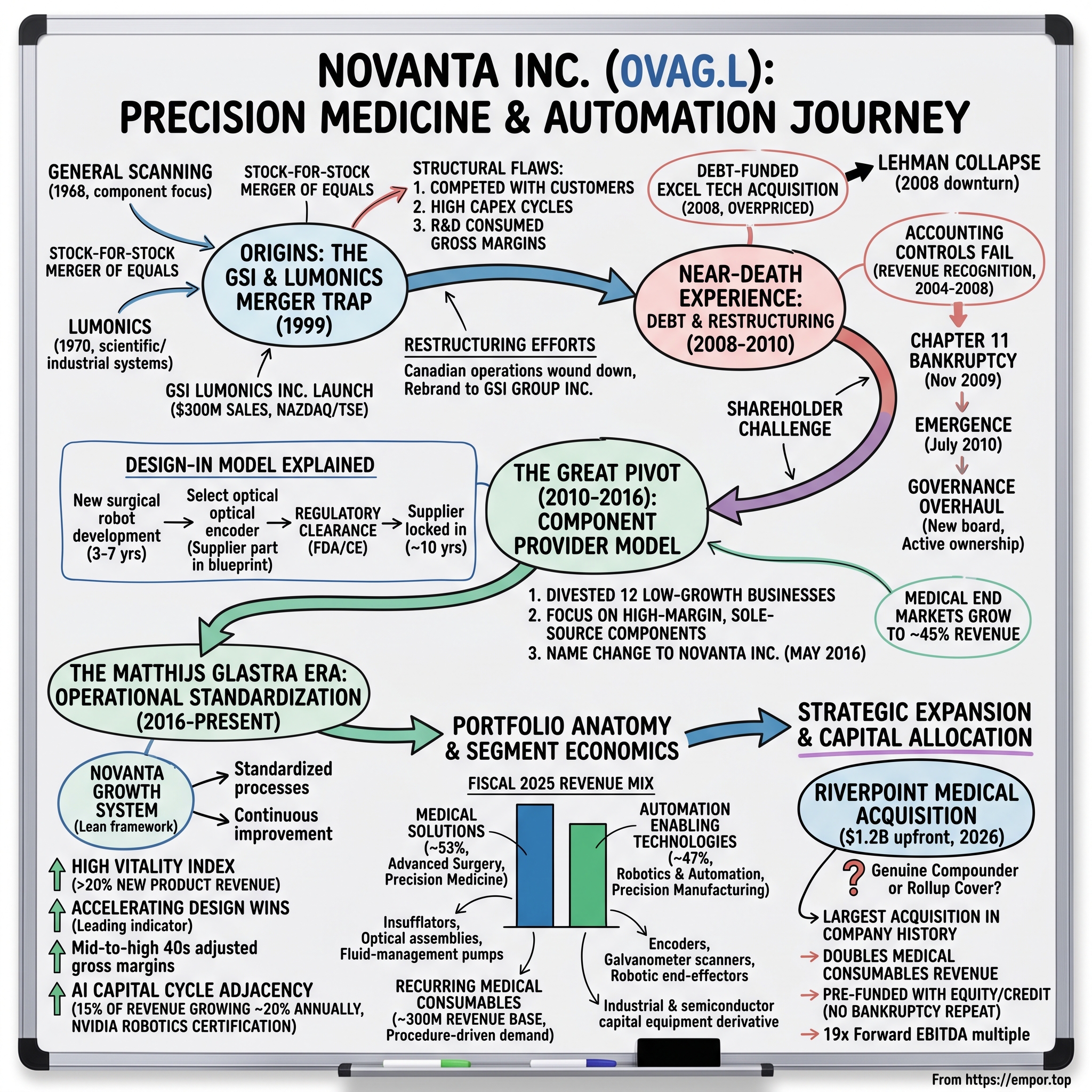
Novanta Inc.: The Pickaxe Engine Behind Precision Medicine & Industrial Automation
I. Introduction & The Hidden Giant in Medical & Industrial Tech
Somewhere in an operating room this morning, a surgeon inflated a patient's abdomen with carbon dioxide, threaded a camera through a one-centimeter incision, and repaired a torn rotator cuff without making a full incision across the shoulder. The pump regulating that gas, the sensor reading the pressure, the fiber carrying the light, and potentially the suture anchoring the tendon back to bone were all engineered by a company the surgeon has likely never heard of, whose logo appears nowhere in the room.
That quiet presence is the core business model.
Novanta Inc. trades principally on Nasdaq under ticker NOVT, with a secondary listing in London under 0VAG. It is not a household brand by design. The company supplies componentry to OEMs—the medical device manufacturers, semiconductor equipment makers, and robotics companies whose names do appear on the finished systems. Management quantified this position at the end of 2025, stating that Novanta's products typically represent "no more than 10% of customers' bill of materials, yet enable differentiation and innovation in their systems."1 That single dynamic summarizes the central investment thesis: remain small enough in total system cost to avoid price resistance, while remaining critical enough in performance to prevent substitution.
The operational scale is modest relative to its OEM client base. In fiscal 2025, Novanta reported revenue of $980.6 million, up 3.3% from the prior year, with adjusted EBITDA of $221.0 million and adjusted diluted earnings per share of $3.29.2 Profitability was relatively strong: nearly twenty-three cents of every dollar in revenue converted to adjusted EBITDA, supported by gross margins in the mid-forties. For a manufacturer producing hardware from optical glass, precision aluminum, and rare-earth magnets, these margins approach software-like unit economics—the result of a fifteen-year effort to divest commoditized lines where buyers held pricing leverage.
Yet this financial profile presents a structural tension. Novanta's reported revenue growth in 2024 and 2025 appeared stable on the surface, but its organic growth—the underlying sales performance excluding acquisitions and foreign exchange movements—was negative in both years.23 Revenue expansion relied heavily on capital deployment. In July 2026, after briefly reaching a net cash position for the first time in over a decade, management immediately re-leveraged the balance sheet. On July 22, 2026, a Novanta subsidiary drew $616 million on its credit facilities to help fund the $1.2 billion acquisition of Riverpoint Medical, a surgical consumables manufacturer purchased at roughly nineteen times forward EBITDA.45
The central strategic question is not whether Novanta commands high-margin technology—its financial returns demonstrate that it does. The question is whether Novanta operates as a genuine compounder driven by organic demand, or as an acquisition rollup where deal volume covers for slowing internal growth. Both interpretations align with recent financial results, but only one supports long-term value creation.
The origin of that question traces back through a 1999 merger of two ill-fitted laser manufacturers, a debt-laden 2008 acquisition that triggered a 2009 Chapter 11 reorganization, a six-year divestiture program under subsequent leadership, and a decade-long restructuring led by a Dutch physicist who modeled the portfolio on Danaher's operating system. The following analysis examines the durability of Novanta's economic moat, executive incentive structures, historical guidance accuracy, and the critical friction points evident in earnings call transcripts.
 Subscribe on LinkedIn
II. Origins: General Scanning, Lumonics, and the 1999 Merger Trap
Start with a mirror the size of a fingernail, mounted on a motor shaft that can stop dead and reverse direction thousands of times per second. Bounce a laser off that mirror, and light can be positioned anywhere with sub-micron precision. That device is a galvanometer scanner, and it is the technical ancestor of everything Novanta sells today.
General Scanning, Inc. was incorporated in Massachusetts in 1968 to make exactly this technology. For its first two decades, it sold components and subsystems for high-speed laser micro-positioning—the mirrors, motors, and control electronics that allowed an OEM's equipment to direct a beam.6 It operated as a quietly profitable component vendor embedded inside third-party machines. Then, in 1989, General Scanning made a fateful strategic shift: it began building complete laser-based manufacturing systems for the semiconductor and electronics markets.6 It stopped merely supplying shovels and started digging.
Two years after General Scanning's founding, and 300 miles north, Lumonics Inc. was incorporated in Ontario in 1970. It initially produced lasers for scientific and research applications before expanding into turnkey industrial marking and cutting machines.6 By the late 1990s, both companies had converged on the same model: building large, custom, capital-equipment laser systems for factories.
In October 1998, the two rivals agreed to merge, and shareholders approved the deal in March 1999. Structured as a stock-for-stock merger of equals, General Scanning holders received 1.347 Lumonics shares for each share held, leaving each shareholder group owning roughly half of the combined company. The new entity, GSI Lumonics Inc., launched with approximately $300 million in annual sales, listed on both Nasdaq and the Toronto Stock Exchange, and was led by Charles D. Winston as chief executive and Warren Scott Nix as president and chief operating officer.7 Management promised "significant synergies and new sales from substantial cross-selling opportunities" on an aggressive twelve-month integration timetable.7 It was boilerplate corporate messaging, and it aged accordingly.
One structural detail from that transaction resonates decades later: because General Scanning shareholders received Lumonics shares, the surviving legal entity was Canadian. Novanta remains a foreign private issuer today as a direct byproduct of a merger completed twenty-seven years ago.
The fundamental issue was not integration execution; it was the business model itself. A turnkey laser system integrator occupies a precarious position in the value chain, and GSI Lumonics suffered from three structural flaws:
It competed directly with its own best customers. Selling finished laser marking systems to semiconductor manufacturers placed GSI Lumonics in direct competition with system builders that bought General Scanning's component scanners. Every system sale risked damaging a high-margin component relationship.
It absorbed capital expenditure cycles without ballast. Factory capital equipment spending is notoriously cyclical. When a chipmaker delays a fab build, order volumes do not simply contract—they vanish. GSI Lumonics assembled its systems business just in time to face the dot-com collapse and the 2001 tech recession, with catastrophic timing.
It funded system-level R&D on component-level volumes. Custom machinery requires bespoke engineering for each client configuration, generating high fixed development costs across low unit volumes. The solid gross margins earned by the scanner business were consumed by the engineering hours required to build custom systems.
The 2000s consequently became a multi-year grind of restructuring and consolidation. Canadian operations were wound down, organizational gravity shifted decisively to Massachusetts, and by mid-decade the Lumonics name was dropped as the company rebranded to GSI Group Inc.8 The rebrand cleaned up the letterhead, but it did not fix the underlying model. GSI Group remained a builder of industrial laser machines in a sector where system integration offered structurally weak returns.
What the business needed was a clear strategic rationale to change. What it received first was a near-death experience.
III. Near-Death Experience: Debt, Restructuring, and Chapter 11 (2008–2010)
In August 2008, GSI Group appeared positioned for expansion, holding roughly $183 million in liquid assets with no debt on its balance sheet.8 Backed by a conservative financial profile and a decade of restructuring, management targeted Excel Technology, a laser and photonics group.
GSI acquired Excel Technology for approximately $360 million, spending nearly twice its total liquidity.8 To fund the transaction, the company issued over $210 million in 11% senior notes due in 2013.8 One executive later acknowledged that the acquisition was simply "overpriced."8
The timing proved disastrous. Lehman Brothers collapsed the following month, triggering a sharp decline in industrial capital expenditure—the primary end market for GSI's products. A cyclical, high-fixed-cost systems integrator had taken on heavy leverage just as the broader economy entered the severe 2008 downturn.
Heavy leverage compounded rapidly when internal accounting controls simultaneously failed.
In late 2008, GSI delayed its filings with the Securities and Exchange Commission after discovering improper revenue recognition in its semiconductor systems division, with errors dating back to 2004.8 Multi-element, custom equipment contracts required complex judgment regarding when control transferred, and quarterly reporting pressures compounded these discrepancies over several years. The SEC initiated a formal investigation in May 2009.8
A chain reaction followed. The delayed financial filings triggered reporting covenant defaults on the senior notes, granting noteholders the right to demand immediate repayment. With end markets contracting and audited financial statements unavailable, GSI could not raise equity or refinance its debt. The company was simultaneously locked out of capital markets and unable to verify its financial results.
On November 20, 2009, GSI Group Inc., alongside subsidiaries GSI Group Corp. and MES International, Inc., filed voluntary petitions for reorganization under Chapter 11.9
Most Chapter 11 reorganizations result in equity holders being eliminated while debt holders take ownership. Creditors initially agreed in principle to receive roughly 80% of the reorganized equity in exchange for debt reduction.8
However, shareholders successfully mounted a challenge. When GSI emerged from bankruptcy on July 23, 2010, after eight months, existing shareholders retained approximately 86.1% of the common stock, while senior noteholders received 13.9% in partial settlement of their debt and for backstopping a rights offering.98 Total debt was reduced from more than $210 million to approximately $107 million in 12.25% senior secured PIK-election notes due in 2014, secured in part by real estate held by subsidiaries Synrad, Control Laser, and Photo Research.8
Creditors accepted a minority equity stake because GSI's core component technologies—its scanners, encoders, optical intellectual property, and OEM customer relationships—retained substantial value beyond the debt obligations once demand recovered. The underlying business units were fundamentally sound; the failure lay in the capital structure and the custom systems strategy. Michael Katzenstein, brought in as restructuring officer, framed the exit in balance-sheet terms, stating, "We have strengthened our balance sheet, reduced our debt and created a structure that will allow us to grow our business."8
Emergence brought a comprehensive governance overhaul. Chief Executive Officer Sergio Edelstein resigned on May 25, 2010, receiving $779,000 in severance, alongside five board members. Stephen Bershad, a major shareholder, joined the reconstituted board.8 The new board represented active shareholder ownership rather than legacy management continuity, reshaping executive leadership over subsequent years.
GSI's bankruptcy demonstrated the danger of leveraging a cyclical, low-visibility business at the peak of a market cycle while managing weak accounting controls. While the underlying component assets remained valuable, combining high debt with accounting delays and a severe industry downturn forced a court-supervised reorganization. This historical vulnerability highlights why balance sheet management remains central to Novanta's evaluation, particularly following major capital deployments such as the $1.2 billion acquisition in 2026.
The board's next decision, in December 2010, would define the company's trajectory for the following fifteen years.
IV. The Great Pivot (2010–2016): From System Builder to OEM Component Provider
John Roush arrived at the end of 2010 to lead a company that had just been handed back to its shareholders. The conventional playbook was obvious and tempting: cut costs, ride the cyclical recovery in industrial capital spending, and claim credit for the rebound.
He chose a far more demanding path. Roush decided that most of what the company sold should no longer be sold at all.
The core insight was an explicit reversal of the 1989 decision that had pushed General Scanning into complete systems. Instead of selling finished machines to end-users, GSI Group—later renamed Novanta—would sell engineered components and subsystems to original equipment manufacturers, the companies that build the finished systems.10 Management surrendered top-line scale and brand visibility on the front panel to focus exclusively on high-value, sole-source components.
Execution required a systematic overhaul. Over Roush's tenure, management divested twelve businesses judged to have limited growth prospects, redirecting capital and management attention toward medical device and precision-technology markets.10 In a company of GSI's size, divesting twelve units was not routine portfolio pruning; it was an operational dismantling and rebuilding. Each divestiture sacrificed immediate revenue to secure higher long-term margins and stickier demand—a trade many public companies resist because quarterly revenue declines are immediate while the financial payoff takes years to materialize.
This restructuring was not merely a cost-reduction program. Management explicitly chose to prioritize long-term growth over near-term margins, redeploying capital into medical device acquisitions while shedding low-growth industrial units.10 By 2016, medical end markets accounted for roughly 45% of total revenue, transforming the company's core commercial focus.10
The design-in model, explained plainly
To understand how this pivot generated durable economic value, it is essential to examine the underlying mechanics of the design-in sales model.
Consider a medical device manufacturer developing a new surgical robot. The engineering process typically spans three to seven years. Early in development, the design team must select an optical encoder—the sensor that determines the position of a robotic arm to a fraction of a millimeter. The manufacturer evaluates suppliers, tests prototypes, and eventually specifies a single vendor's part into the design blueprints.
From that moment, the component supplier ceases to be a commodity vendor. It becomes an essential ingredient in a regulated medical product.
When the completed robot undergoes regulatory clearance—such as an FDA 510(k) submission in the United States or CE marking in Europe—the filing documents the machine as engineered, including its critical internal components. Replacing the encoder after clearance is not a simple purchasing decision; it is a major engineering change that can require extensive re-testing, fresh documentation, and potentially new regulatory submissions. The cost is measured in engineering-years and regulatory delays. Meanwhile, the robot itself will remain in production and sale for seven to ten years.10
As a result, winning a design-in secures roughly a decade of recurring revenue at pre-negotiated prices on a component that—representing no more than 10% of the customer's total bill of materials—is too inexpensive to justify the financial and regulatory burden of switching vendors. The customer is bound not by long-term legal contracts, but by regulatory requirements and engineering physics.
This dynamic explains why Novanta can maintain gross margins in the mid-forties while producing physical hardware, and why its revenue exhibits greater stability than cyclical end markets might suggest. Crucially, the model relies on the growth of the installed base rather than immediate unit sales: a design win secured in 2026 typically generates material revenue starting in 2029.
The name
On May 10, 2016, shareholders approved changing the corporate name; the change took effect on May 11, and the Nasdaq ticker moved from GSIG to NOVT.11 Roush framed the decision around future opportunities rather than past restructuring: "The corporate name represents more than just our strategic transformation over the last few years. It also represents our future strategic vision, our commitment to innovation and excellence, and our focus on driving profitable growth."11
Beyond executive messaging, the rebranding served a clear practical purpose. "GSI Group" remained associated with bankruptcy proceedings, accounting restatements, and SEC investigations. Changing the corporate name distanced the business from legacy search results and market discounts linked to its distressed past.
However, the rebrand did not alter the company's underlying exposure. In 2016, the business remained cyclical, with roughly half its sales still tied to semiconductor and industrial capital expenditures, and it continued to rely on acquisitions to scale its medical segment. The portfolio transformation was real and the balance sheet was repaired, but the new corporate identity was the packaging around that operational work.
With the portfolio restructured and the corporate identity reset, Roush prepared to hand over leadership. His successor was not another turnaround specialist, but an executive focused on systematic operational execution.
V. The Matthijs Glastra Era & The Novanta Growth System (2016–Present)
Matthijs Glastra, a Dutch applied physicist with degrees from Delft, ESPCI in Paris, and INSEAD, spent eighteen years at Philips before joining Novanta.12 That tenure provided direct preparation for Novanta's business model. Glastra ran technology divisions across industrial and medical end markets in Europe and Silicon Valley, serving as chief executive of Philips Entertainment Lighting and chief operating officer of Philips Lumileds.12 Lumileds operated as an OEM component supplier selling LEDs into third-party equipment, where commercial success depended on design-ins, long qualification cycles, and strict cost controls. In effect, Glastra had managed Novanta's underlying business model well before arriving at the company.
Glastra joined Novanta in 2012 as group president, became chief operating officer in February 2015, and was appointed chief executive effective September 1, 2016.12 He was an internal successor who had spent four years building the operational infrastructure he would inherit. Stephen Bershad, the activist shareholder who had joined the board following the bankruptcy reorganization, stated that Glastra was "uniquely qualified to build on the work that has been done in the past six years, while carrying forward the core values that John instilled."12 Retiring CEO John Roush signaled a clean transition, stating, "With this work now complete, it is the perfect time to pass the reins."12 Glastra subsequently assumed the role of board chairman alongside chief executive, consolidating executive and board authority in a single position.
The Novanta Growth System
Where Roush's primary contribution was structural divestiture, Glastra focused on operational standardization through the Novanta Growth System.
This Lean-rooted operating framework provides a standardized set of tools, templates, and processes across business units, covering sales, marketing, product management, manufacturing, quality, and supply chain management.13 While modeled on continuous-improvement frameworks popularized by diversified industrial operators like Danaher, the framework serves a specific strategic function within Novanta's M&A-driven strategy.
Novanta's acquisition strategy targets small, founder-led component suppliers with specialized engineering capabilities. These niche businesses frequently lack institutional scale in pricing discipline, procurement leverage, factory throughput, and commercial product launches. Applying a uniform operating framework aims to extract margin expansion from acquired business units, converting fragmented acquisitions into an integrated operating company.
Financial results offer a nuanced view of this operational framework. Adjusted gross margins remained in the mid-to-high forty percent range for multiple years, reaching 46.8% in 2023 and 46.5% in 2024—returns consistent with high-barrier design-in component economics.143 However, gross margins have plateaued rather than expanded over this period. In the first quarter of 2026, adjusted gross margin contracted by 60 basis points year-over-year to 45.6%, as rising freight, tariff, and input costs outpaced price adjustments.15 The operating system has successfully protected baseline profitability through economic softness, but it has not driven structural margin expansion.
The vitality index
To measure internal product innovation, management tracks the vitality index—the percentage of total revenue generated by products launched within the preceding three years. Unlike margin metrics, which can be temporarily influenced by cost reductions, the vitality index directly measures commercial adoption of newly engineered components.
This innovation pipeline showed significant momentum in recent reporting periods. In 2025, sales from new products grew more than 60%, pushing the vitality index to 22% of total revenue.1 In the first quarter of 2026, new product revenue increased 50% year-over-year, lifting the overall vitality index to 27%. Segment-level adoption was particularly pronounced, with Medical Solutions exceeding 30% and Automation Enabling Technologies topping 20%. Crucially, design wins—the primary leading indicator for revenue three to five years out—grew nearly 30% year-over-year in early 2026.15
These figures form a key pillar of the positive investment case. Although Novanta's headline organic revenue growth stagnated across 2024 and 2025, its underlying design-in indicators accelerated. This divergence presents a clear test for the business model: either the multi-year regulatory and qualification lag will convert these design wins into accelerated organic sales, or the pipeline metrics reflect customer qualification activity that yields lower commercial volume than anticipated.
Incentives, and what is actually disclosed
Market commentary often asserts that executive compensation is explicitly tied to achieving return on invested capital above 15%. However, official corporate disclosures present a more modest framework.
In discussing the $1.2 billion acquisition of Riverpoint Medical, management stated that it expects the transaction to generate "high single-digit returns on invested capital by year three."5 For an asset acquired at roughly nineteen times forward EBITDA, a high single-digit return aligns with standard transaction economics rather than a high return hurdle. Investors assessing capital allocation discipline must distinguish between market assumptions and disclosed targets.
Consequently, executive alignment is best evaluated through management's operational track record rather than assumed incentive hurdles. Glastra has maintained a consistent strategy for a decade, providing specific return expectations even when acquisition multiples compress near-term metrics.
This disciplined yet debt-funded acquisition approach highlights the importance of evaluating the specific operating segments and underlying technologies that constitute Novanta's portfolio.
VI. Portfolio Anatomy & Segment Economics
Novanta reorganized its financial reporting structure in 2024. The former categories—Photonics, Vision, and Precision Motion—classified the business by technology.14 The updated framework organizes the business by end market, dividing Novanta into two segments of roughly equal size.
In fiscal 2025, Automation Enabling Technologies generated $500.8 million in revenue, while Medical Solutions generated $479.8 million.2 Measured by end market rather than reporting segment, medical applications accounted for approximately 53% of sales and advanced industrial applications represented 47%.1 Four primary operating units sit within these two segments: Robotics & Automation and Precision Manufacturing on the industrial side, and Advanced Surgery and Precision Medicine on the medical side.
Medical Solutions: the razor-and-blade half
The products supplied by Medical Solutions illustrate the division's underlying economics.
Minimally invasive surgery requires inflating the patient's abdomen with carbon dioxide to create a working field. Novanta manufactures the insufflators—the pumps and pressure-control systems that stabilize the abdominal cavity during surgery—for device manufacturers that brand the finished units under their own names. The company also produces optical assemblies that transmit light and images through endoscopes, fluid-management pumps for arthroscopic procedures, and, following its acquisition of Keonn, RFID systems used by hospitals to track instruments, implants, and surgical consumables.
The strategic importance of this product line lies in its expanding recurring revenue. Consumables reached roughly 15% of total company sales in 2025, expanding at double-digit rates.1 Unlike capital equipment, consumables sales track surgical procedure volumes rather than hospital capital budgets. These procedure volumes benefit from steady demographic trends, including aging populations and the continued shift from open to minimally invasive procedures and from inpatient to outpatient settings.
This commercial dynamic creates an unusual competitive relationship. Novanta supplies major surgical device companies, including Stryker, Olympus, Karl Storz, and CONMED, several of which also produce competing subsystems in-house. Because every original equipment manufacturer represents a potential internal supplier, Novanta's primary protection is economic rather than contractual. A medical device maker has little incentive to develop an in-house insufflator pump if the component represents less than 10% of total system cost and Novanta's version offers superior performance at lower qualification costs. That defense remains effective as long as Novanta maintains its manufacturing scale advantage.
The segment delivered strong financial momentum in late 2025 and early 2026. Medical Solutions revenue increased 16% in the fourth quarter of 2025, supported by a book-to-bill ratio of 1.07, while Advanced Surgery grew 15% and Precision Medicine rose 16%, supported by a $9 million contribution from Keonn.1 That momentum continued into the first quarter of 2026, when Medical Solutions revenue rose 15% year-over-year and bookings surged 40%.15
Automation Enabling Technologies: precision, and the AI adjacency
The industrial segment produces components that provide precise positioning, energy delivery, and motion control for high-precision machinery.
Optical and inductive encoders provide micro-positioning feedback, allowing robotic arms and semiconductor wafer stages to determine location at sub-micron scales. Galvanometer scanners and beam-delivery systems direct laser light for industrial processing, while gas, solid-state, and ultrafast lasers supply the light source itself. In addition, the company's ATI product line manufactures robotic end-effectors, including automatic tool changers, force-torque sensors, and collision sensors that serve as the mechanical interface between a robotic arm and its tooling.
This segment aligns directly with capital spending in artificial intelligence infrastructure. During the fourth-quarter 2025 earnings call, Glastra stated that Novanta's air-bearing spindles were "currently the only qualified supplier for drilling AI-driven GPU boards," a position expanding at a strong double-digit rate.1 By the first quarter of 2026, management disclosed that applications tied to generative-AI data center infrastructure represented approximately 15% of revenue and were growing at roughly 20% annually, spanning DUV and EUV lithography, GPU board drilling, probe card manufacturing, advanced packaging, and precision robotics.15 Novanta was also selected as a servo drive supplier under NVIDIA's robotics certification program—noting it was "the only servo drive manufacturer as far as we are aware that actually got selected"—though management emphasized that adoption remains at the prototype stage, with meaningful revenue contributions not expected until 2027.15
That qualification underscores management's realistic assessment of an emerging commercial opportunity.
Despite AI-related tailwinds, the segment remains exposed to cyclical capital-equipment spending. Automation Enabling Technologies revenue grew just 2% in 2025 as industrial and semiconductor customers absorbed excess inventory, with Precision Manufacturing declining 3% year-over-year in the fourth quarter.1 When semiconductor manufacturers or factory operators reduce capital expenditures, order volumes in this segment decline rapidly.
What the mix tells you
In theory, Novanta's two segments provide natural counter-cyclical balance: elective surgical procedures continue during economic downturns, whereas industrial capital spending contracts. In practice, results in 2024 and 2025 demonstrated that this diversification is incomplete. Customers in life-science instrumentation, particularly DNA sequencing equipment manufacturers, behave like industrial capital equipment buyers rather than healthcare providers. When sequencing equipment manufacturers deferred component shipments in late 2024 due to weak end-user demand for instruments, Novanta's medical segment experienced cyclical pressure similar to its industrial operations.3
This exposure motivated management's strategic shift toward true surgical consumables—a product category largely insulated from capital equipment cycles—culminating in the $1.2 billion acquisition of Riverpoint Medical in 2026.
VII. Capital Allocation & M&A Benchmarking
For most of the past decade, Novanta's capital allocation followed a disciplined, predictable pattern: acquire niche technology component suppliers, integrate them into the Novanta Growth System to expand operating margins, and redeploy cash flow into the next deal. In mid-2026, however, management executed a major strategic expansion—and the multi-stage financing sequence behind that transaction provides essential insight into the company's capital allocation discipline.
Laser Quantum: patience as a strategy
The 2017 acquisition of Laser Quantum established the template for Novanta's preferred deal structure. Rather than purchasing the Manchester-based laser manufacturer outright, Novanta initially acquired a minority stake, gaining operational visibility before expanding its position. In January 2017, Novanta increased its equity interest from roughly 41% to approximately 76% for £25.5 million (about $31.1 million). In October 2018, it purchased the remaining 24% for $45.7 million in cash and stock, including $15.0 million in restricted shares.16
This phased approach delivered two strategic advantages. First, partial ownership allowed Novanta to evaluate the target's operating performance directly rather than relying solely on pre-closing due diligence. Second, structuring the final payment partially in restricted stock kept key executives financially aligned with Novanta. Lawrie Gloster, Laser Quantum's managing director, noted that the two companies shared "a common emphasis on providing mission critical technologies to OEMs with medical and life science applications," adding that joining Novanta had "accelerated our business growth."16 Laser Quantum's products—including solid-state continuous-wave lasers, femtosecond lasers, and optical light engines—supply the precision illumination required by complex medical diagnostic and DNA sequencing instruments.16
ATI: buying the robot's wrist
In contrast to Laser Quantum's phased entry, the July 19, 2021 acquisition of ATI Industrial Automation represented a larger, single-stage transaction. Novanta agreed to pay $172 million in upfront cash alongside contingent earnout payments linked to 2021 financial performance. Headquartered near Raleigh, North Carolina, ATI was founded in 1989, employed over 350 people, and was projected to generate more than $70 million in full-year 2021 revenue.17 Upon closing on August 30, 2021, net upfront cash consideration totaled $169.2 million after working capital adjustments, while the contingent earnout was recorded at an estimated fair value of $44.0 million, bringing total transaction value to roughly $213 million.18
The strategic rationale built directly upon Novanta's position inside OEM systems. Having established a leading position in optical encoders that measure robotic arm articulation, acquiring ATI allowed Novanta to supply the automatic tool changers and force-torque sensors installed at the end of the robotic arm. Chief Executive Matthijs Glastra described ATI as "a fantastic business with proprietary intellectual property in attractive and growing markets," with the transaction expanding segment revenue in Precision Motion (now Automation Enabling Technologies) to roughly $250 million.17
The structure of the deal reflected disciplined risk management. By conditioning $44 million of the purchase price on ATI's actual 2021 EBITDA, Novanta shared valuation risk during a period of unusually elevated robotics demand.
The capital raised before the deal
The strategic rationale behind Novanta's current capital structure traces back to a major financing sequence initiated in late 2025.
On November 7, 2025, Novanta priced a $550 million offering of tangible equity units, which was subsequently upsized to issue 12,650,000 units for net proceeds of $613.1 million.1920 Each unit combined a prepaid stock purchase contract with a senior amortizing note maturing in 2028 that paid a 6.50% annual coupon, structured as quarterly distributions of approximately $0.81 per unit. The purchase contracts automatically settle on November 1, 2028, converting into between 0.3729 and 0.4662 common shares per unit based on market prices, with a threshold appreciation price of $134.0842—a 25% premium over the November 6, 2025 closing price.19
This hybrid structure allowed Novanta to raise immediate capital while delaying equity dilution until 2028 and protecting against share issuance if the stock appreciated. Novanta used approximately $317 million of the proceeds to pay down its revolving credit facility,19 while simultaneously securing a new $1.0 billion credit facility maturing in June 2030.20
By the end of 2025, Novanta held $380.9 million in cash against $250.8 million in total debt, creating a net cash position of $121.3 million and a negative net leverage ratio.2 On the fourth-quarter earnings call, management highlighted this as the company's first net cash stance in over a decade, explicitly disclosing that it provided "nearly $1.5 billion in total acquisition capacity" and identifying acquisitions as "our top capital allocation priority."1
Rather than signaling a pivot toward permanent debt reduction, the balance sheet restructuring served as deliberate preparation for a transformative acquisition.
Riverpoint Medical: the biggest bet in company history
On June 9, 2026, Novanta announced an agreement to acquire Riverpoint Medical from Arlington Capital Partners for $1.2 billion in upfront cash plus a $250 million milestone payment contingent on early-2027 performance, representing a headline transaction value of up to $1.45 billion.4
Riverpoint manufactures minimally invasive surgical consumables, including suture anchors, specialized sutures, implantable materials, surgical fibers, and procedural instruments for sports medicine, trauma, and cardiovascular applications, operating out of facilities in Portland, Oregon, and San José, Costa Rica.45 The target brought a premium financial profile: approximately $150 million in annual revenue, adjusted gross margins exceeding 50%, adjusted EBITDA margins near 40%, and an expected long-term organic growth rate of 12–15%—roughly double Novanta's corporate average.4
The acquisition multiple reflected this financial profile. Novanta paid approximately 19 times estimated 2026 adjusted EBITDA excluding synergies, or approximately 17 times including projected year-five cost synergies.4
Strategically, the transaction doubles Novanta's recurring medical consumables revenue to approximately $300 million, expands its medical end-market exposure to 60% of total company sales, and unlocks an estimated $2 billion in additional addressable market opportunity.4 At closing, Glastra characterized Riverpoint as "a market-leading, high-growth surgical consumables business growing revenue and cash flow at twice Novanta's rate."5
Did Novanta overpay? At 19 times forward EBITDA, Novanta effectively underwrote a decade of Riverpoint's current earning power. Realizing an acceptable return requires Riverpoint to maintain its double-digit organic growth trajectory and deliver projected synergies; any demand slowdown in sports medicine consumables or insourcing by major surgical OEMs would compress returns. Management's disclosed target of high single-digit returns on invested capital by year three indicates that the purchase price was driven by strategic portfolio repositioning toward recurring consumables rather than near-term multiple expansion.5
Novanta funded the purchase through cash on hand, borrowings under its credit facilities, and a $300 million private placement completed in June 2026, in which the company issued 2,142,857 common shares at $140.00 per share.421 Equity markets reacted cautiously to the private placement, sending the stock down 6.3% following the announcement.21 On July 22, 2026, Novanta drew $616 million under its revolving and term loan facilities, raising total debt to $854.7 million, and formally completed the acquisition on July 27, 2026.5
Following the close, management guided pro forma net leverage to approximately 2.7 times EBITDA, with a target to reduce leverage below 2.3 times by year-end 2027—clarifying less conservative estimates in secondary market commentary.4 Supported by $145 million to $185 million in annual operating cash flow, this capital structure reflects the benefit of pre-funding with equity in 2025, avoiding the debt distress that followed the 2008 Excel Technology acquisition.
Management expects Riverpoint to contribute $0.18 to $0.25 in adjusted earnings per share in 2027, its first full year under Novanta ownership.5 That earnings contribution will serve as the primary benchmark for evaluating the success of the transaction.
VIII. Deep Dive: Core Moats, Helmer's 7 Powers, and Porter's 5 Forces
Frameworks are only useful when allowed to return an unflattering answer. Applied rigorously to Novanta, they reveal a mixed profile: one strong power, one plausible power, one narrow power, and four absent ones.
Hamilton Helmer's 7 Powers
Switching Costs — strong, and the foundation of everything. The underlying mechanics were established earlier: multi-year qualification cycles, regulatory filings, and long product lifespans make replacing a designed-in component far too costly and slow relative to its purchase price. What confirms this moat is its operational footprint in order backlog. On the fourth-quarter 2025 earnings call, management disclosed that Precision Manufacturing backlog equaled roughly two times revenue, Robotics & Automation ran at 1.5 times, and both Advanced Surgery and Precision Medicine stood at roughly two times quarterly revenue.1 Backlog of that duration in a component manufacturing business is a direct, observable consequence of customers who cannot easily switch suppliers. It is empirical evidence, not management narrative.
The structural boundary of this power, however, is that it protects the installed base rather than new platform wins. Every design cycle represents a fresh competition, and a lost design slot today translates into an organic growth gap several years later. Switching costs secure existing revenue; they do not generate new growth.
Process Power — plausible, but unproven. The strategic thesis holds that the Novanta Growth System systematically elevates the operating margins of acquired businesses. In support, company-wide adjusted gross margins held in the mid-forties across a two-year demand trough, with management attributing faster product launches, shorter lead times, and higher consumables margins to the system.13 The counter-evidence is that gross margins have remained flat rather than expanding, and 2025 exposed an operational friction point: fourth-quarter operating cash flow fell to $9 million from $62 million a year earlier, while full-year cash flow dropped to $64.1 million from $158.5 million, because the company ran duplicate manufacturing facilities and accumulated safety stock while transferring production regionally.12 Glastra's explanation—"We prioritized customer deliveries over the pace of our regional manufacturing transfers. That was the right call for our customers"—was defensible commercially, but it also acknowledged that the operating system failed to execute a footprint transfer smoothly.1 Process power that stumbles on its own factory integration remains a work in progress.
Cornered Resource — narrow but real. The clearest instance is Novanta's position in air-bearing spindles for GPU board drilling, where management asserts sole qualified-supplier status.1 Beyond that lies its historic galvanometer scanning technology and specialized optical and laser intellectual property. These represent genuine technical barriers, but they function as cornered resources in specific sub-niches rather than across the entire portfolio.
Scale Economies, Network Economies, Branding, Counter-Positioning — largely absent. As a roughly $1 billion manufacturer selling into markets dominated by larger industrial peers, Novanta enjoys no scale advantage over competitors like Coherent, Trumpf, or Heidenhain. Its components do not become more valuable as additional customers adopt them. Its brand remains deliberately hidden behind OEM logos. Nor is the company counter-positioned against incumbent models; it competes through operational execution in specialized niches—a viable strategy, but not a structural Power under Helmer's framework.
That yields an objective scorecard: one strong power, one contested power, one narrow power, and four absent ones. It describes a high-quality specialist supplier with defensible positions, not an impenetrable monopoly.
Porter's Five Forces
Threat of new entrants — low. Sub-micron engineering tolerances, medical quality certification, and multi-year qualification timelines require a new entrant to spend years before securing a single design win. Regulatory audit histories create an additional barrier, as OEM customers prioritize established suppliers with proven compliance records.
Bargaining power of buyers — moderate, and rising. Novanta sells to some of the largest, most sophisticated equipment manufacturers in healthcare and technology. While design-in status protects pricing during a product line's active lifecycle, initial selection rounds are intensely competitive, and major OEMs maintain the technical capacity to dual-source components or insource assembly for subsequent product generations. The 2026 tariff pressure highlighted these pricing limits: when input costs increased, Novanta could not immediately adjust prices because roughly two-thirds of its annual revenue was already bound by fixed-price orders.15 Contractual commitment restricts pricing flexibility in both directions.
Bargaining power of suppliers — low, with a specific exception. Standard industrial materials are widely available. The key risk lies in specialized inputs: management deliberately accumulated safety stock in electronic components and rare-earth materials in early 2026 to hedge against supply disruptions.15 Rare earths represent a concentrated, geopolitically vulnerable input for precision motor magnets—a manageable risk, but an enduring operational vulnerability.
Threat of substitutes — low to moderate. Replacing a component typically requires redesigning the host machine and updating regulatory filings. Consequently, substitution risks emerge during next-generation platform development rather than mid-cycle.
Competitive rivalry — moderate and fragmented. Novanta faces distinct competitors in each product line: Heidenhain and Renishaw in optical encoders, Coherent, IPG Photonics, and Trumpf in laser sources, and internal OEM engineering teams in medical subsystems. Market fragmentation prevents any single rival from targeting Novanta's broader portfolio, but it also means no single niche is large enough to achieve commanding scale.
In summary, Novanta's competitive position is strong and durable at the individual component level, but only moderately defensible across the enterprise as a whole. Its moat consists of hundreds of individual design wins, each requiring renewal on a rolling basis. That dynamic explains why leading indicators—such as the vitality index and design-win trends—provide a clearer measure of long-term value than short-term revenue fluctuations.
IX. Management Credibility, Conference Call Friction, and Q&A Analysis
Reviewing several consecutive fourth-quarter earnings calls side-by-side reveals a remarkably consistent corporate narrative. The underlying financial results, however, have varied, and the divergence between strategic commentary and operational execution offers the clearest measure of management's credibility.
The guidance record
A direct evaluation of management performance begins with comparing initial projections against final results.
In February 2025, alongside full-year 2024 financial results, Novanta issued 2025 guidance calling for approximately $1.0 billion in revenue—representing roughly 5% growth—an adjusted gross margin between 47.0% and 47.5%, adjusted EBITDA of $225 million to $235 million, and adjusted diluted earnings per share of $3.35 to $3.55.3
Full-year 2025 results fell short across each metric, yielding $980.6 million in revenue, $221.0 million in adjusted EBITDA, and $3.29 in adjusted diluted earnings per share.2
Revenue finished below target, while adjusted EBITDA and earnings per share fell beneath the lower bound of guided ranges. Operating cash flow dropped to $64.1 million, down by more than half from $158.5 million in 2024.23 While these shortfalls represented single-digit percentage variances rather than systemic failures, they occurred alongside organic revenue declines of 1.6% in 2024 and 0.5% in 2025.32
Two consecutive years of negative organic growth, paired with a full-year guidance shortfall across headline financial targets, establish the baseline for assessing executive execution before considering forward order momentum.
How management explained it
Management addressed these operational shortfalls with varying degrees of internal accountability. Chief Financial Officer Robert Buckley attributed the 2025 cash flow contraction directly to operational choices, citing "deliberate decisions to prioritize customer deliveries over the pace of regional manufacturing transfers," which incurred duplicate factory operating costs and increased buffer inventory.1 Acknowledging internally generated execution friction rather than relying solely on external macroeconomic headwinds represents a notable operational disclosure.
This posture contrasted with commentary following the prior year's performance, when Chief Executive Officer Matthijs Glastra described Novanta as "effectively navigating a persistently challenging environment"—a narrative focused primarily on broader industry conditions.3 The transition toward specific internal explanations on subsequent calls indicates increased transparency regarding operational execution.
Where analysts pushed
Analyst questioning during recent conference calls has centered on a recurring theme: why strong order momentum has not translated into higher near-term financial guidance.
During the fourth-quarter 2025 earnings call, following a 25% increase in bookings and a book-to-bill ratio of 1.11, analysts questioned why projected earnings growth remained modest. Buckley provided a detailed bridge, explaining that adjusting for 22 to 24 cents per share of dilution from late-2025 equity financing and a 14-cent first-half headwind from an all-employee equity grant revealed an underlying earnings growth rate of roughly 10%.1 While mathematically transparent, the explanation highlighted that both earnings drags stemmed from management's capital structure and compensation decisions.
Analyst scrutiny continued during the May 2026 call, when William Blair analyst Brian Drab questioned how 37% year-over-year bookings growth aligned with mid-single-digit organic revenue growth guidance. Glastra cited customer ordering patterns, explaining that first-quarter orders frequently cover full-year delivery schedules against a weak prior-year comparison, with a typical lag of two to three quarters between order booking and revenue recognition.15 However, when asked to rank specific end-market opportunities by expected 2026 revenue contribution, Glastra declined, stating, "It's not a single thing. It's not one that can turn back on you," noting that a wide range of niche applications drive overall results, with individual product lines remaining "roughly similar in size."15
This response supports two distinct interpretations. On one hand, a diversified portfolio of niche components reduces reliance on any single end market or emerging technology cycle. On the other hand, declining to quantify individual growth catalysts limits external visibility and makes tracking segment performance against management targets more challenging.
In response to questions from CJS Securities analyst Lee Jagoda regarding generative-AI exposure, management adopted a cautious posture: executives quantified AI-related applications at 15% of company revenue and highlighted selection for a key robotics certification, but immediately tempered expectations by noting that customer adoption remains at the prototype stage, with material financial contributions deferred until 2027.15 Addressing geographical reporting, Baird analyst Quinn Fredrickson questioned regional sales figures; Buckley clarified that reported regional revenue reflects the shipping location of Novanta's manufacturing plants rather than final end-market demand, explaining why reported U.S. sales declined even as underlying domestic customer demand expanded following client production shifts to Mexico and Costa Rica.15 This distinction provided essential context regarding supply chain logistics versus true customer demand.
The tariff episode as a live credibility test
Management's short-term forecasting accuracy faces an immediate test in trade policy execution. In May 2026, Buckley informed investors that aluminum import tariffs had increased from 25% to 50% within a four-week span, affecting both inbound raw materials and outbound shipments, while noting that because two-thirds of full-year revenue was already committed in backlog, passing cost increases to customers required time.15 Buckley offered two specific operational milestones: stating that net tariff impacts would be "completely muted" during the second quarter of 2026, and projecting that net price-cost realization would turn positive by the third quarter.15
Novanta is scheduled to report second-quarter 2026 financial results on August 5, 2026, with an executive earnings call scheduled for the following morning—four days after this August 1, 2026 publication date.22 Second-quarter gross margin performance will serve as a direct benchmark of management's supply chain forecasting. Furthermore, whether two planned facility closures conclude on schedule and whether second-half gross margin expansion materializes will provide verifiable evidence regarding operational execution.
The overhangs worth naming
Three key structural risks remain central to evaluating long-term execution. First is the company's historical accounting experience: while the mid-2000s financial restatements and SEC investigation involved predecessor leadership and an obsolete systems business model, the episode underscores that multi-element component contracts require complex revenue recognition judgments.8 Second is the Riverpoint contingent payment: a $250 million milestone obligation comes due in the first quarter of 2027, representing a significant cash commitment alongside the $616 million in credit facility borrowings drawn to fund the initial purchase price.45 Third is goodwill carrying value: assembling a specialized component platform through a decade of premium-multiple acquisitions has created a substantial intangible asset balance, making long-term valuation sensitive to sustained operational performance at acquired units like Riverpoint.
These factors establish the core tension between Novanta's expansion strategy and its operational execution.
X. Investment Spine: Bull vs. Bear Case & Skeptical Investor Stress Test
Why this wins from here
The bull case rests on three operational drivers, each supported by clear empirical evidence rather than narrative assertions.
The mix shift is arithmetically real. Expanding medical market exposure to roughly 60% with approximately $300 million in recurring consumables fundamentally alters Novanta's business profile. Consumables revenue tracks surgical procedure volumes rather than capital budget approvals. If the surgical consumables business sustains the 12% to 15% growth rate Riverpoint demonstrated, it will carry enough weight to offset flat performance in industrial markets.
The pipeline metrics are accelerating ahead of reported revenue. A vitality index of 27% and a nearly 30% increase in design wins serve as leading indicators in a business with a multi-year lag between design-in and commercial revenue. If historical conversion timelines hold, organic growth in 2027 and 2028 should prove structurally stronger than in 2024 and 2025.
The AI capital cycle arrived as a genuine adjacency, not a strategic pivot. Novanta did not attempt to rebrand as an AI company. Instead, its existing precision-manufacturing products—spindles, lithography components, and probe card tooling—sit directly in the supply chain for data center hardware. Having 15% of revenue growing at a 20% annual pace provides meaningful upside without creating existential dependence, representing a healthy form of exposure to an emerging technology cycle.
What breaks the case
The organic growth problem is not yet solved. This remains the central bear argument, and it withstands optimistic framing. Reported revenue growth of 7.7% in 2024 and 3.3% in 2025 masked organic contractions of 1.6% and 0.5%, respectively.32 Stripping out acquisitions reveals that Novanta's core business shrank for two consecutive years. Skeptics view the company's acquisition cadence—purchasing Keonn in April 2025 for $75.1 million and Riverpoint for $1.2 billion—as the mechanism masking a flat core.204 Strong bookings and vitality metrics provide a plausible rebuttal, but they represent future expectations rather than proven execution.
The Riverpoint price leaves no room for error. Purchasing the business at 19 times EBITDA requires sustained high-teens growth. Riverpoint operates in sports medicine and trauma, adjacent to highly competitive orthopedic supply chains where major device OEMs possess both scale and the option to insource production. An operational slowdown would not merely cause a missed forecast; it would trigger goodwill impairment testing on the largest asset Novanta has ever acquired.
Balance sheet flexibility is genuinely gone for now. Consolidated debt of $854.7 million against pro forma leverage near 2.7 times, paired with a $250 million milestone payment due in early 2027, means the acquisition engine that fueled the past decade's expansion is largely idled until deleveraging occurs.54 A growth algorithm reliant on M&A has effectively consumed its capacity on a single transaction.
Half the business remains a capital-equipment derivative. Automation Enabling Technologies grew just 2% in 2025.1 Semiconductor and industrial customers do not smooth their purchasing cycles, and geographic exposure to China adds policy risks that operational systems cannot mitigate.
Input costs and supply chain friction are active, not theoretical. Tariff-driven gross margin compression in the first quarter of 2026 demonstrated that Novanta's pricing power operates with a lag measured in quarters, while deliberate rare-earth stockpiling highlights a concentrated geopolitical vulnerability within its precision motor business.15
The activist stress test
What would a hostile shareholder argue?
First, they would target cash flow performance. Converting $158.5 million in operating cash flow in 2024 down to $64.1 million in 2025—while reporting top-line growth—indicates working capital and factory footprint execution challenges, regardless of strategic rationale.32 Fourth-quarter 2025 operating cash flow fell to $9 million from $62 million a year earlier, representing a material operational drop rather than a minor variance.1
Second, they would question the financing strategy. Novanta issued tangible equity units in November 2025 followed by a discounted private placement in June 2026—both dilutive equity offerings—with investors pushing shares down 6.3% following the second announcement.1921 Diluting shareholders twice within seven months to fund a single transaction raises questions about whether the acquisition accounted for the company's true cost of capital.
Third, they would raise governance concerns: chief executive Matthijs Glastra also serves as chairman of the board. While common, combining these roles eliminates independent board leadership at the exact moment the company is executing its largest capital allocation decision.
Fourth, they would point to self-inflicted earnings headwinds. An all-employee equity grant costing $0.14 per share in a single half-year represents a real transfer of value from shareholders, presented as a guidance headwind rather than evaluated as executive compensation.1
Finally, they would ask the fundamental strategy question: if the design-in moat is as durable as management claims, why did organic revenue decline for two consecutive years while installed customers were supposedly locked in for seven to ten years? The explanation is that switching costs protect market share within customer programs, not customer unit volumes—when a sequencing OEM cuts instrument shipments, a locked-in component vendor suffers immediate volume losses. That reality narrows the practical protection of the moat.
Myth versus reality
Three consensus claims require direct clarification:
Myth: Novanta's leverage spiked to 3.5 times following the Riverpoint acquisition. Reality: pro forma net leverage was guided to approximately 2.7 times, with a target below 2.3 times by year-end 2027, enabled by pre-funding through equity a year prior.4 The financing structure was more disciplined than headline valuation multiples suggest.
Myth: the vitality index represents a $50 million annual revenue target. Reality: it is a percentage-of-sales metric measuring revenue from products launched within the preceding three years, reported at 22% in 2025 and 27% in the first quarter of 2026.115 The distinction is critical because a percentage scales with total revenue while a fixed dollar target does not.
Myth: Novanta holds a monopoly on mission-critical components. Reality: the company maintains strong positions across specialized sub-niches, including at least one documented sole-qualified supplier role, but faces active competition—including potential insourcing by OEM customers—in most end markets. Describing the business as a "portfolio of defensible niches" is accurate; labeling it a "monopoly" is not.
XI. Playbook & Key Investing Lessons
Four transferable lessons emerge from Novanta's history, each testable against operational evidence rather than executive narrative.
1. In a value chain, position beats size. General Scanning was a profitable component manufacturer that decided in 1989 to build complete laser systems. That shift placed the company in direct competition with its own primary customers, exposed it to unpredictable capital spending cycles, and burdened its balance sheet with high system-level engineering costs on low unit volumes—a strategic error that took roughly two decades and a Chapter 11 reorganization to unwind. The lesson is not that component manufacturing is inherently superior to system integration. Rather, a business must occupy the precise link in the value chain where its specialized advantage is scarcest—and General Scanning's scarce asset was always the precision galvanometer scanner, not the metal enclosure built around it.
2. Regulated design cycles convert product quality into duration. The design-in model represents Novanta's most valuable structural advantage, derived from a demanding regulatory framework. Qualification documentation, regulatory filings, and extensive validation testing make replacing an installed component prohibitively expensive, protecting design wins against competing products. Investors should look for this pattern wherever low-cost components are embedded inside certified platforms—such as medical diagnostics, aerospace, and industrial automation—while recognizing its primary boundary: switching costs defend installed base volumes against substitution, but they do not generate new design wins on future equipment programs.
3. Surviving a restructuring requires changing the strategy, not just the balance sheet. GSI Group emerged from bankruptcy in mid-2010 with reduced debt but an unchanged systems business model. Instead of leveraging the balance sheet to chase an industrial recovery, a reconstituted board brought in new leadership that spent six years divesting twelve non-core or low-growth businesses. The debt restructuring bought time; the strategic pivot created long-term value. Companies that treat bankruptcy solely as a capital-structure problem frequently return to restructuring court.
4. An operating system determines whether acquisitions compound or merely accumulate. The distinction between an acquisition rollup and a true compounder depends on whether management can systematically improve the operational performance of acquired assets. The Novanta Growth System provides the framework, but its track record remains tested: while it protected baseline gross margins through a severe demand trough, plant consolidation friction and inventory accumulation significantly reduced 2025 operating cash flow. The integration of Riverpoint Medical—the largest and highest-margin asset Novanta has acquired—will serve as the definitive test of whether the operating system can drive margin expansion at scale.
Underlying each of these principles is a fundamental analytical lesson: investors must consistently separate reported revenue expansion from organic growth. Novanta's history demonstrates how an active acquisition cadence can obscure stagnant core operations, as well as how accelerating design wins and pipeline vitality metrics can remain invisible in reported financial statements for years. Evaluating long-term value creation requires tracking both dynamics simultaneously.
XII. Epilogue & The 4 KPIs That Matter Most
Consider the corporate trajectory. In November 2009, Novanta—then operating as GSI Group—filed for Chapter 11 bankruptcy protection with more than $210 million in unserviceable debt, an active SEC investigation, and financial statements marred by improper revenue recognition. By February 2026, the company reported the highest annual revenue in its history and a net cash balance sheet. Five months later, it completed the largest acquisition in its corporate history.
That transformation reflects a sixteen-year operational overhaul executed across two chief executives. Yet the turnaround remains incomplete in one measurable respect: while management repaired the balance sheet and restructured the business model, Novanta has not yet demonstrated sustained, independent organic growth. Two consecutive years of organic revenue contraction followed by a $1.2 billion acquisition present a sequence open to conflicting interpretations. The purchase of Riverpoint Medical represents management's strategic response: acquiring sufficient procedure-driven consumables revenue to reduce the company's dependence on cyclical capital equipment cycles.
Evaluating whether that strategy succeeds requires tracking a few essential performance metrics rather than complex financial models.
Organic revenue growth is the metric that settles the central argument. Reported revenue figures incorporate acquisitions and foreign exchange movements, masking core performance. Organic growth provides the cleanest measure of whether design wins, new product launches, and an expanding consumables mix are generating self-sustaining expansion. Management has guided to mid-single-digit organic growth for 2026 alongside a raised full-year revenue outlook of $1.04 billion to $1.055 billion.15 Additional years of sub-2% organic growth would challenge the thesis that Novanta operates as a genuine compounder, regardless of booking trends.
The vitality index is the primary leading indicator for future organic growth. Because it measures the proportion of total revenue derived from products launched within the preceding three years, the index moves ahead of top-line revenue. Its expansion from 22% to 27% in a single quarter provides the strongest evidence that internal product development is accelerating ahead of reported financial results.115 If the vitality index plateaus while organic growth remains weak, the argument that design wins involve extended commercial lag periods loses credibility.
Medical consumables as a share of total revenue measures the structural shift away from capital equipment cycles. Consumables accounted for roughly 15% of total sales prior to the Riverpoint transaction, and management expects the acquisition to double the recurring consumables revenue base to approximately $300 million.14 Tracking this proportion helps distinguish structural quality improvements from top-line expansion purchased through M&A, as consumables demand tracks surgical procedure volume rather than hospital capital budgets.
A fourth metric demands scrutiny over the medium term before relinquishing its importance: net debt to adjusted EBITDA. Management projects pro forma net leverage of approximately 2.7 times at closing, with a target to reduce leverage below 2.3 times by the end of 2027, alongside a $250 million milestone payment due in the first quarter of 2027.4 Unlike long-term operating KPIs, leverage functions as a transitional metric. It measures how effectively the company restores balance sheet flexibility—and whether an enterprise that previously over-leveraged prior to bankruptcy has instituted durable capital allocation discipline.
Second-quarter 2026 financial results, scheduled for release on August 5, 2026, will provide the initial test of management's tariff mitigation projections, followed by the first partial quarter incorporating Riverpoint Medical.22 Novanta's corporate narrative remains actively unfolding—written, for the first time in sixteen years, from a position of operational strength rather than financial repair.
References
-
Novanta (NOVT) Q4 2025 Earnings Call Transcript — The Motley Fool, 2026-02-24 ↩↩↩↩↩↩↩↩↩↩↩↩↩↩↩↩↩↩↩↩
-
Novanta Announces Financial Results for the Fourth Quarter and Full Year 2025 — Novanta Inc., 2026-02-23 ↩↩↩↩↩↩↩↩↩↩
-
Novanta Announces Financial Results for the Fourth Quarter and Full Year 2024 — Novanta Inc., 2025-02-25 ↩↩↩↩↩↩↩↩↩
-
Novanta Inc. Announces Acquisition of Riverpoint Medical — Novanta Inc., 2026-06-09 ↩↩↩↩↩↩↩↩↩↩↩↩↩↩
-
Novanta completes acquisition of Riverpoint Medical — Investing.com, 2026-07-27 ↩↩↩↩↩↩↩↩↩
-
GSI Lumonics Inc. Form 10-K — U.S. Securities and Exchange Commission ↩↩↩
-
General Scanning Inc. and Lumonics Inc. Merge — Photonics Online, 1999 ↩↩
-
Restructured GSI Group exits Chapter 11 — optics.org, 2010-07 ↩↩↩↩↩↩↩↩↩↩↩↩↩
-
GSI Group Emerges from Chapter 11 Reorganization — PR Newswire, 2010-07-23 ↩↩
-
Novanta (NOVT): From Chapter 11 to 11-Bagger in 11 Years — Andvari Associates ↩↩↩↩↩
-
GSI Group Announces Corporate Name Change to Novanta Inc. — Novanta Inc., 2016-05-11 ↩↩
-
Novanta Names Matthijs Glastra Chief Executive Officer — Novanta Inc., 2016 ↩↩↩↩↩
-
Novanta Inc (NOVT) Posts Full Year 2023 Revenue Growth Amidst Market Challenges — Yahoo Finance, 2024-02-28 ↩↩
-
Novanta (NOVT) Q1 2026 Earnings Transcript — The Motley Fool, 2026-05-12 ↩↩↩↩↩↩↩↩↩↩↩↩↩↩↩↩↩
-
Novanta Acquires Remaining Equity Interest in Laser Quantum — Novanta Inc., 2018-10-02 ↩↩↩
-
Novanta Announces Agreement to Acquire ATI — Novanta Inc., 2021-07-19 ↩↩
-
Novanta Inc. Form 10-K for Fiscal Year 2021 — U.S. Securities and Exchange Commission, 2022 ↩
-
Novanta Inc. Announces Pricing of $550,000,000 Tangible Equity Units Offering — Novanta Inc., 2025-11-07 ↩↩↩↩
-
Novanta Inc. Form 10-K for Fiscal Year 2025 — U.S. Securities and Exchange Commission, 2026-02-24 ↩↩↩
-
Novanta stock falls 6.3% on $300M equity raise for acquisition — Investing.com, 2026-06-10 ↩↩↩
-
Novanta Inc. Announces Schedule of Second Quarter 2026 Earnings Release and Conference Call — Business Wire, 2026-07-14 ↩↩
 LinkedIn
 WhatsApp
 Reddit
 Hacker News
 Email
Email Kindle
 RSS Feed
 Spotify
 Apple Podcasts
 Amazon Music
 Audible
 YouTube