Zetwerk: The "Foxconn Meets TSMC" of Custom Manufacturing
I. Prologue & Episode Roadmap (00:00 – 12:00)
The founding scene of Zetwerk was not a garage or a whiteboard. It was a conference room in an industrial park where four credentialed engineers were told, politely and then less politely, that their product solved a problem nobody was willing to pay to fix. In 2018, the pitch was software for industrial procurement: a dashboard through which an engineering, procurement, and construction firm or an equipment manufacturer could track a custom fabrication order from blueprint to dispatch. The response that reshaped the company was blunt. Buyers did not want visibility into a late delivery; they wanted the steel. If the software was smart enough to identify which job shop had idle capacity, buyers reasoned, then the software provider should take the purchase order directly and bear the financial consequences of missing the deadline.
Zetwerk took the purchase order. Eight years later, the consequences are visible in financial disclosures that public-market investors can finally interrogate. Zetwerk Manufacturing Businesses filed an Updated Draft Red Herring Prospectus with the Securities and Exchange Board of India for a fresh issue of Rs 2,600 crore and an offer for sale of 9.68 crore shares.1 For fiscal 2026, the company reported revenue from continuing operations of roughly Rs 15,913 crore — approximately $1.9 billion at prevailing exchange rates — across operations in India, North America, and the Middle East, alongside an order book exceeding Rs 12,000 crore.23 SEBI cleared the issue in July 2026.4
Scaling from an abandoned software tool to an industrial group generating nearly $2 billion in revenue within eight years is rare in Indian enterprise. The easy narrative casts this as a triumph of software orchestrating physical manufacturing. The financial statements tell a more complicated story. Those same filings showing Rs 15,913 crore in revenue disclose a consolidated adjusted EBITDA margin of just 2.65%, an adjusted profit before tax of Rs 45.7 crore, negative operating cash flow of Rs 681.5 crore in fiscal 2026, a Rs 453 crore impairment against an abandoned civil infrastructure business, and promoter shares pledged against debt lines.15 Furthermore, roughly 69% of the fresh issue proceeds is earmarked for debt repayment.1
The central question ahead of the listing is not whether Zetwerk achieved scale. It clearly did. The question is what kind of business model produced that scale. Under one interpretation, Zetwerk is an asset-light orchestration platform coordinating India's fragmented precision machine shops, capturing a structural shift in global supply chains away from China, where expanding volume yields procurement leverage, proprietary supplier data, and brand equity. Under the competing interpretation, Zetwerk is a financialized industrial aggregator that converted venture capital into balance-sheet working capital, accelerated revenue growth by extending credit terms, absorbed principal execution risk on third-party factories, and is now listing publicly primarily to de-lever.
Both interpretations find support in the regulatory disclosures. This analysis evaluates which view carries more weight by testing management's strategic claims against the company's multi-year operating record.
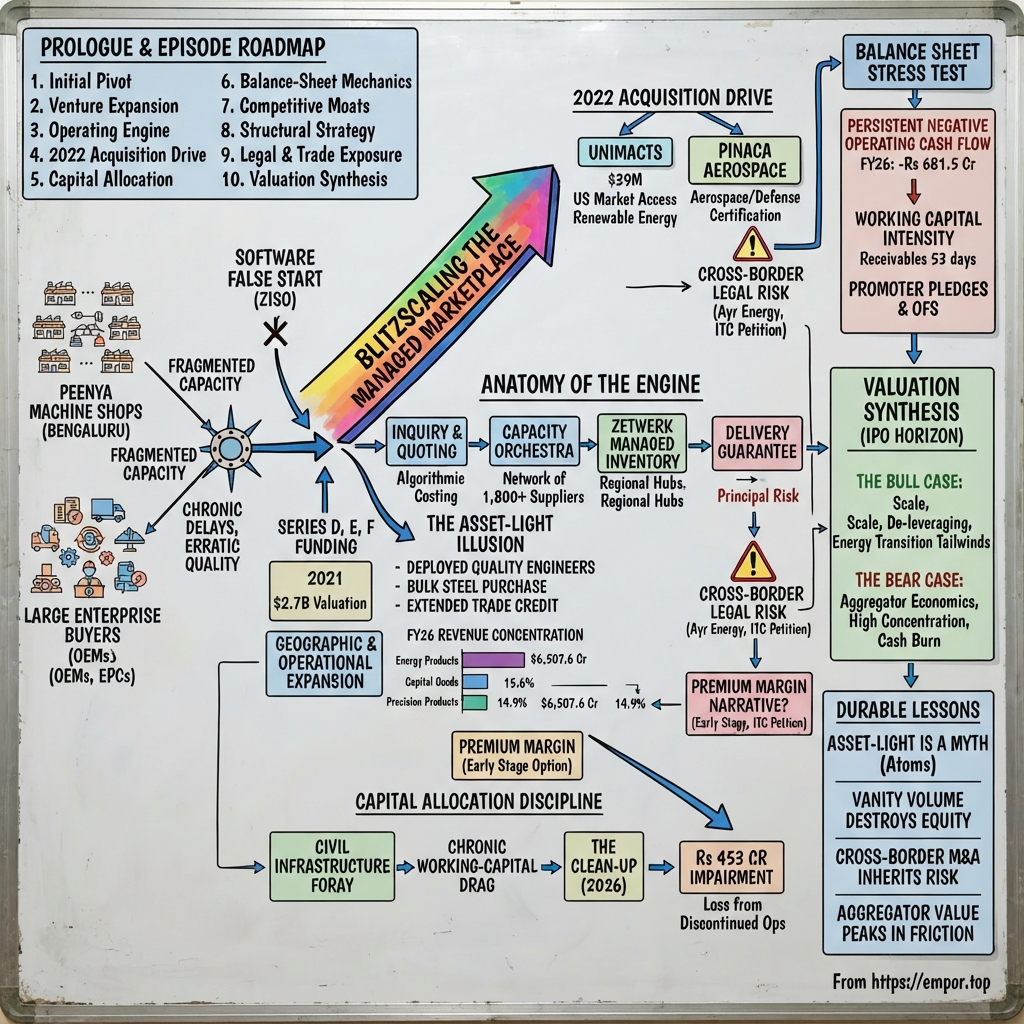
The inquiry proceeds in sequence. First, the initial pivot: what abandoning pure software demonstrated about industrial buyers' willingness to pay, and why that limits any technology-multiple valuation thesis. Second, the venture-funded expansion: how blitzscaling unfolded and why the asset-light premise collided with commercial liquidated-damages liabilities. Third, the operating engine: order routing, revenue concentration by end-market, and realized take rates. Fourth, the 2022 acquisition drive: evaluating the $39 million Unimacts transaction and assessing whether aerospace diversification has translated into commercial scale. Fifth, capital allocation discipline: the foray into civil infrastructure and the resulting Rs 453 crore write-off ahead of the filing. Sixth, balance-sheet mechanics: three consecutive years of negative cash flow from operations, working-capital cycles, debt obligations, and promoter encumbrances. Seventh, competitive moats: positioning relative to Xometry, Protolabs, Dixon Technologies, Kaynes Technology, Bharat Forge, and unlisted domestic B2B aggregators. Eighth, structural strategy: applying Hamilton Helmer's 7 Powers and Michael Porter's Five Forces frameworks to assess sustainable competitive advantage. Ninth, cross-border legal and trade exposure: the Ayr Energy dispute and the U.S. International Trade Commission petition touching the solar export channel. Finally, a valuation synthesis: framing the bull and bear cases alongside the critical operating metrics that will determine Zetwerk's post-listing trajectory.
One analytical discipline applies throughout. The company's peak private valuation — $2.7 billion in a 2021 Series F financing round — was a price established under specific market conditions with tailored governance terms.6 It does not serve as an intrinsic valuation floor. The same skepticism applies to the eventual public offering price band. Market prices measure prevailing capital sentiment; the financial statements measure the performance of the underlying business.
 Subscribe on LinkedIn
II. The Peenya Machine Shops & The Pivot From Software (12:00 – 32:00)
Peenya, on the northwestern edge of Bengaluru, is one of Asia's largest industrial estates: an expanse of thousands of small workshops handling turning, milling, sheet-metal fabrication, powder coating, and assembly. Many employ fewer than fifty workers, and most remain invisible to the procurement departments of the large corporations that ultimately need their output. Similar manufacturing clusters anchor cities like Coimbatore, Rajkot, Ludhiana, Pune, and Faridabad. The founders' shared observation was straightforward: these machine shops chronically operated well below capacity, while the original equipment manufacturers (OEMs) and engineering, procurement, and construction (EPC) firms that relied on custom components routinely complained of chronic delays, erratic quality, and supplier bases too fragmented to manage. That structural divide — idle production capacity on one side, impatient, unmet demand on the other — offered the classic foundation for a two-sided marketplace.
The founders. The founding team reflected a distinct operational pedigree. Chief executive Amrit Acharya earned an engineering degree from IIT Madras and an MBA from UC Berkeley, having managed shop-floor operations at consumer-goods conglomerate ITC before advising industrial clients at McKinsey. Chief operating officer Srinath Ramakkrushnan, also an IIT Madras alumnus, worked in supply chain roles at ITC before joining the trucking marketplace BlackBuck. Co-founders Vishal Chaudhary, an IIT Kharagpur graduate, joined from tech-logistics firm Rivigo, and Rahul Sharma, from IIT Roorkee, also worked at BlackBuck. This operational background shaped the company's trajectory: three of the four founders came from Indian freight and logistics marketplaces. Those platforms had learned a hard commercial lesson: in physical industries, an intermediary that merely connects buyers and sellers gets bypassed, whereas an intermediary that guarantees the final outcome gets paid. That operational instinct anticipated the pivot.
The ZISO false start. That original software product, known as ZISO, was designed as a procurement and project-tracking utility for EPC firms and machinery manufacturers. The goal was to provide buyers with real-time visibility across dozens of fragmented fabricators. Yet the software failed commercially on both sides of the transaction. Small machine shops, operating on paper ledgers and razor-thin cash flows, refused to pay subscription fees for digital tooling that primarily served their enterprise clients' convenience. Meanwhile, enterprise procurement teams resisted logging into a dashboard that offered visibility without enforcement: tracking precisely how late a shipment of structural steel would arrive did nothing to get that steel onto the construction site.
The moment of principal risk. The turning point came when a major infrastructure client rejected the software subscription outright, offering instead a purchase order — reportedly around Rs 15 lakh — for fabricated structural steel, provided Zetwerk assumed full commercial responsibility for delivery. Fulfilling that order fundamentally altered the startup's economic and legal posture. Zetwerk transformed into the principal contractor: it signed the master service agreement with the enterprise buyer, entered back-to-back supply contracts with local workshops, deployed its own quality engineers onto factory floors, and underwrote the delivery schedule. In an instant, revenue recognition shifted from a high-margin software fee to the gross merchandise value of fabricated industrial goods. The commercial liability shifted with it.
This distinction dictates every downstream financial metric. An intermediary operating on an agency model books a commission take rate and carries modest operational risk. An intermediary acting as a principal contractor books the full invoice value while absorbing working capital, credit, inventory, quality rejection, and delay-penalty risks. Zetwerk's headline top line — Rs 15,913 crore in fiscal 2026 — represents the gross invoice value of manufactured goods delivered, not a software fee pool.2 Evaluating that top-line figure against software multiples represents a fundamental category error, though it was an error venture investors repeatedly tolerated during the liquidity boom of 2019 to 2021.
Falsification test: the proprietary software moat. Throughout its fundraising presentations and executive interviews, Zetwerk has framed itself as the "Foxconn meets TSMC" of custom manufacturing, arguing that its proprietary manufacturing operating system establishes an intelligent coordination layer that drives durable customer lock-in and pricing power.
The sharpest counter-evidence to that narrative emerges from the company's own commercial origins. Software was not an afterthought added to an industrial base; it was the original product, marketed directly to the very industrial enterprises that underpin the moat thesis today. That software commanded essentially zero commercial pricing power. Rather than refining the tool toward product-market fit, the leadership team abandoned software as an independent revenue stream and pivoted entirely into contract manufacturing. That transition is not an incidental historical detail; it was an empirical market test demonstrating that industrial procurement heads would not pay standalone software fees for supply chain orchestration.
The company's audited margin structure confirms that reality. If platform software generated true defensibility or proprietary pricing power, those advantages would translate into software-like gross margins or premium take rates. Instead, Zetwerk generates single-digit gross margins and reported a consolidated adjusted EBITDA margin of just 2.65% in fiscal 2026 — the classic economic profile of an industrial fabricator and wholesale distributor rather than a technology platform.1 Furthermore, industry reporting indicates that early enterprise customer retention was secured through extended credit terms and a contractual willingness to shoulder liquidated damages for delays, tools rooted in balance-sheet subsidization rather than technological switching costs.7
This does not imply that Zetwerk's proprietary software lacks value. Internal systems for factory scoring, algorithmic cost estimation, and milestone tracking provide tangible operating efficiencies that lower the company's internal cost to serve. But the historical record rejects the stronger claim that software confers structural pricing power or customer lock-in. At best, the technology operates as internal workflow automation. For public-market investors to revise that assessment, post-listing disclosures would need to show two distinct trends: sustained gross margin expansion demonstrably driven by algorithmic procurement leverage rather than cyclical product mix, and a meaningful expansion in design-led contracts where Zetwerk captures intellectual property rents rather than simply fabricating components to client blueprints.
III. Blitzscaling The Managed Marketplace: From Peenya to Unicorn (32:00 – 54:00)
Once the pivot to contract manufacturing was completed, capital arrived at a velocity that reflected global venture investors' appetite for managed-marketplace narratives applied to massive physical categories. Kae Capital seeded the company with roughly $1.2 million. Accel and Sequoia Capital India — now Peak XV Partners — led a $9 million Series A. Lightspeed and Greenoaks followed with a $32 million Series B. Then came 2021.
In a compressed ten-month window during 2021, Zetwerk completed three successive funding rounds: a $120 million Series D led by Greenoaks, a $150 million Series E at a $1.33 billion valuation led by D1 Capital Partners, and a $210 million Series F at a $2.7 billion valuation co-led by Greenoaks and D1.68 During that same stretch, company leadership publicly outlined an acquisition roadmap targeting two to five transactions within the year, funded by the fresh equity.8
What those rounds do and do not establish. Each financing was a primary issuance, meaning the proceeds entered the balance sheet rather than cashing out founders, directly funding geographic and operational expansion. Yet three cautions apply before any of these private valuation marks can serve as an anchor for a public listing.
First, the 2021 rounds were priced in the most permissive private financing environment of the past two decades. They were underwritten by crossover investors — D1 Capital in particular — whose playbook at the time focused heavily on securing pre-IPO allocations with the expectation of marking them up at listing. Momentum-driven capital deployment does not constitute an appraisal of intrinsic business value.
Second, and far more consequential for the arithmetic: these financings consisted of preferred equity. Indian venture rounds of this vintage were typically structured as compulsorily convertible preference shares (CCPS), carrying liquidation preferences and anti-dilution protections. Zetwerk's fiscal 2026 filings reveal the structural impact of those instruments: the restated consolidated net loss of Rs 1,606.2 crore includes an Rs 835.8 crore non-cash adjustment relating to CCPS fair-value accounting upon conversion.1 A senior preferred instrument offering downside protection is economically superior to the common equity offered to public-market buyers. Carrying a $2.7 billion preferred valuation forward as if it represents common equity overstates the baseline, particularly because the specific preference stack, participation terms, and ratchet mechanisms remain undisclosed until the final prospectus is settled.
Third, those valuation marks are five years stale — set in 2021 before the Rs 453 crore civil infrastructure write-off, before three consecutive fiscal years of negative operating cash flows, and before cross-border litigation such as the Ayr Energy dispute emerged.
Expanding the mandate. The fresh capital funded diversification well beyond structural steel and foundry castings. Zetwerk expanded into consumer electronics assembly — manufacturing televisions, audio hearables, wearables, and IoT hardware — while pushing into the renewable energy supply chain by fabricating galvanized module mounting structures for utility-scale solar arrays and transmission towers. That push into energy proved decisive in hindsight: it became the category where the bulk of the company's revenue ultimately settled.
The asset-light illusion. The original pitch to global investors centered on an asset-light orchestration layer: zero factory capital expenditure, no owned machinery, no depreciation drag, and pure software monetizing idle third-party capacity. The operational reality diverged almost immediately. When an underlying job shop misses a dimensional tolerance or delivers late, the liquidated-damages clause in an enterprise master service agreement binds Zetwerk, not the sub-tier vendor. To manage that principal delivery risk, Zetwerk deployed its own quality-assurance engineers onto factory floors, purchased raw steel in bulk to secure volume pricing and guarantee material supply, and extended working-capital trade credit to small fabricators unable to fund large enterprise purchase orders on their own balance sheets. Industry reporting throughout this period documented the structural drift from software marketplace toward integrated manufacturer, including the strategic acquisition of owned production capability.97
Each of those operational adjustments was rational. Yet cumulatively, they dismantled the asset-light thesis, transforming Zetwerk into a working-capital-intensive industrial distributor and fabricator.
Falsification test: capital discipline and the asset-light claim. The core platform thesis asserts that a digital manufacturing network can scale without the heavy dilution and debt dependency that burden conventional industrial manufacturers.
The audited operating record contradicts that claim on both fronts. Between 2018 and 2024, Zetwerk raised more than $600 million in equity across seed through Series F and subsequent rounds.68 Revenue crossed Rs 11,000 crore by fiscal 2023 — a scale at which a genuine asset-light platform should have generated meaningful free cash flow. Instead, operating cash flows remained persistently negative, deteriorating further to negative Rs 681.5 crore in fiscal 2026.1 That operating deficit was bridged through short-term bank borrowings, receivables discounting facilities, and structured debt. The draft prospectus provides the definitive rebuttal: Rs 1,800 crore of the Rs 2,600 crore fresh issue — roughly 69% — is earmarked specifically to retire debt across the parent company and operating subsidiaries.1 A business that had scaled without debt dependency would not need to dedicate the vast majority of its IPO proceeds to de-leveraging.
The balanced conclusion sharpens rather than dismantles the underlying achievement. Zetwerk scaled far faster than an asset-heavy manufacturer could have, precisely because it rented idle production capacity rather than constructing every shop floor. That element of the thesis held. But it accomplished this by substituting working-capital intensity for fixed-capital intensity, and working capital scales linearly with gross merchandise revenue in a way that fixed assets do not. The operational test for public investors after listing is simple arithmetic: incremental net working capital divided by incremental revenue. Unless that absorption ratio declines materially from historical levels, revenue growth will continue to consume cash, regardless of how the balance sheet is framed.
IV. Anatomy of the Engine: How Zetwerk Actually Works (54:00 – 1:18:00)
Strip away the marketing framing, and Zetwerk's day-to-day operating engine performs four basic functions: it quotes, it decomposes, it supervises, and it guarantees.
Inquiry and quoting. An OEM submits computer-aided design drawings and technical specifications. Zetwerk's algorithmic costing engine estimates the raw material required, machine processing time, and necessary surface finishing, matching the job against a qualified supplier network spanning machining, casting, forging, stamping, fabrication, and extrusion. Speed is the decisive commercial variable: an industrial buyer seeking a quote within days rather than weeks will pay a premium for rapid turnaround. This initial quoting phase represents one of the few points in the workflow where the software layer performs visible, value-accretive work.
Capacity orchestration. Rather than single-sourcing a complex mechanical assembly to a single large vendor, Zetwerk decomposes the bill of materials into discrete manufacturing processes and routes each step to the geographic cluster best equipped to handle it — machining in one industrial estate, surface treatment in another, followed by final assembly and testing at a Zetwerk-managed facility. This orchestration represents the central operational insight of the business, enabling a network of sub-scale, specialized workshops to collectively bid on enterprise contracts that none could service alone. Yet it also serves as an operational choke point: every hand-off between sub-tier suppliers introduces schedule risk, and under its enterprise contracts, Zetwerk alone shoulders that schedule risk.
Zetwerk Managed Inventory. To buffer against supply volatility and enable short-lead-time replenishment, Zetwerk maintains regional delivery hubs positioned close to major client facilities. Operationally, this managed inventory program raises customer switching costs. Financially, it requires Zetwerk to hold substantial working capital on its own books — carrying Rs 1,249.6 crore of inventory as of March 31, 2026.1 In practice, client-facing service quality is financed directly by Zetwerk's balance sheet.
Margin structure. Regulatory filings for fiscal 2026 clarify the unit economics with unusual transparency for a pre-listing enterprise. Consolidated revenue from continuing operations reached Rs 15,913.3 crore.12 Within that top line, the core Manufacturing Business generated Rs 9,374.7 crore in revenue and an operating EBITDA of Rs 565.1 crore, translating to a segment margin of 6.03%.1 Across the entire consolidated enterprise, however, adjusted EBITDA came in at Rs 421.3 crore — a 2.65% margin — while adjusted profit before tax stood at just Rs 45.7 crore, or 0.29% of revenue.1
That 0.29% adjusted pre-tax margin demands close attention. It means that a minor two-percentage-point fluctuation in raw steel procurement prices, a single liquidated-damages penalty on a delayed delivery, or a modest rise in short-term borrowing costs would completely erase the pre-tax earnings of a Rs 15,913 crore enterprise. The business operates without a meaningful structural buffer. Operating profit represents a fragile residual captured between enormous gross merchandise flows — the classic margin profile of an industrial distributor or an EPC contractor rather than a high-margin technology platform.
The wide gap between the manufacturing segment's 6.03% EBITDA margin and the consolidated 2.65% adjusted EBITDA margin highlights this reality. The non-core revenue — roughly Rs 6,539 crore spanning industrial trading, consumer electronics assembly, and low-margin bulk aggregation — carries razor-thin economics that dilute overall profitability. Public-market investors must distinguish between two different operations: a Rs 9,375 crore precision manufacturing business generating a respectable 6% EBITDA margin, and a Rs 15,913 crore consolidated trading and assembly pipeline operating at 2.65%. The former resembles an established mid-tier industrial fabricator; the latter resembles a low-margin volume aggregator.
Where the revenue lives. Disclosures for fiscal 2026 show that revenue within the core manufacturing business was heavily concentrated across three product categories. Energy Products — comprising solar module mounting structures, wind turbine components, power transmission hardware, and substation equipment — contributed Rs 6,507.6 crore, representing 69.4% of core manufacturing revenue.1 Capital Goods, encompassing industrial machinery and process equipment, generated Rs 1,464.4 crore, or 15.6%. Precision Products, which covers aerospace, defense, and specialized precision machining, generated Rs 1,397.2 crore, or 14.9%.1
This breakdown fundamentally reframes the business. Zetwerk is not an all-purpose manufacturing marketplace that occasionally undertakes energy projects. By revenue, it is predominantly an energy infrastructure fabrication business with secondary arms in capital goods and precision engineering. Nearly seven out of every ten rupees in core manufacturing revenue depend directly on the pace of capital expenditure in utility-scale solar, wind, and electrical grid build-outs across India and North America. Forecasting Zetwerk's earnings is, in substance, an exercise in forecasting renewable infrastructure capex, filtered through the company's ability to protect its share in a sector where structural steel fabrication offers minimal technological differentiation.
The premium-margin narrative centers on Precision Products, yet that vertical remains the smallest of the three, contributing less than 15% of core manufacturing revenue and under 9% of total company revenue. This dynamic creates a core strategic tension: the aerospace and defense business capable of commanding premium specialist multiples is too small to move consolidated margins, while the energy vertical large enough to drive top-line scale competes in a commoditized, price-sensitive market.
Concentration. Customer and supplier concentration data highlight this operational shift. Zetwerk's top 10 customers accounted for 35.90% of total revenue in fiscal 2026, up from 26.89% in fiscal 2025 and 22.37% in fiscal 2024.5 That is not a static risk disclosure; it is an accelerating three-year trend moving in the opposite direction of platform diversification. On the procurement side, the top 10 suppliers accounted for 38.18% of total manufacturing procurement expense.5
The strategic implication outweighs the raw percentages. A classic marketplace thesis presumes that as a network expands, customer concentration declines as revenue diffuses across thousands of small and mid-sized buyers. Zetwerk's concentration has instead climbed sharply as management chased massive utility-scale energy contracts. In doing so, the company has largely traded a distributed marketplace model for a conventional enterprise contracting model. Large-scale utility contracts deliver rapid volume and visible order books, but they also empower sophisticated industrial buyers to enforce extended credit terms, demanding delivery schedules, and punitive liquidated-damages clauses. A rising top-10 customer concentration paired with compressed operating margins is the unmistakable signature of a supplier with limited commercial pricing power — an operational reality clearly reflected in Zetwerk's three-year financial trajectory.
V. Global Ambitions, Cross-Border M&A, & The Unimacts Bet (1:18:00 – 1:40:00)
Part of the capital raised in the 2021 Series F round was channeled directly into inorganic expansion. In 2022, Zetwerk completed four acquisitions, each designed to shortcut multi-year organic customer qualification cycles and enter specialized industrial verticals.
Unimacts, acquired for $39 million, was the largest and most strategically consequential: a U.S.-based supply chain and contract manufacturing specialist serving renewable energy, with capability in solar tracker components and wind turbine castings.101112 Pinaca Aerospace Solutions brought AS9100D-certified precision engineering for defense and aerospace components. Sharp Tanks added pressure vessels, storage tanks, and process equipment for oil, gas, and petrochemicals. Ward Infracorr added infrastructure fabrication and engineering services.
Benchmarking Unimacts. The strategic rationale was clear and specific. In the United States, utility-scale solar developers enforce rigorous, multi-year vendor qualification audits; acquiring an established, pre-qualified supplier bypassed those barriers immediately. The macroeconomic timing appeared equally favorable. The transaction closed just as the U.S. Inflation Reduction Act's domestic content requirements and broader "China plus one" supply chain mandates began redirecting American renewable procurement toward non-Chinese manufacturing corridors.
The transaction's financial logic rested on classic multiple arbitrage. When the deal was announced, Zetwerk stated that it expected to reach roughly $1 billion in revenue for fiscal 2023.10 Benchmarked against its prevailing private valuation of $2.7 billion, Zetwerk was effectively trading at roughly 2.7 times revenue on an equity basis — and even higher on an enterprise-value basis, though net debt was not publicly disclosed at the time. By comparison, Unimacts was acquired at an estimated 0.4 to 0.6 times sales. Using balance-sheet capital priced at nearly three times revenue to acquire revenue priced at half of sales is mechanically accretive, representing a classic deployment of premium venture currency. Yet multiple arbitrage produces optical accounting expansion, not necessarily durable economic value. Whether the transaction actually created value depends on whether the acquired operations generate a return on invested capital that clears Zetwerk's weighted cost of capital over the long run.
Integration realities. Managing extended, cross-border supply lines from production hubs in India and Vietnam into North American project sites exposed Zetwerk to severe ocean freight volatility, tightening customs oversight, and — as Section X details — significant U.S. litigation and trade petition exposure that went unmodeled in 2022. The Unimacts acquisition secured an established American commercial pipeline, but it simultaneously expanded Zetwerk's cross-border legal surface area. Both outcomes were direct consequences of the same strategic wager.
Falsification test: the aerospace and defense optionality. The narrative surrounding the Pinaca acquisition asserts that certified aerospace and defense manufacturing will structurally elevate Zetwerk's consolidated margin profile — offering a high-margin future to counterbalance today's razor-thin industrial margins.
The underlying technical credentials are indisputable: AS9100D quality management standards and NADCAP accreditations represent rigorous, non-trivial engineering milestones required to supply Tier-1 aerospace prime contractors. Yet regulatory certification demonstrates manufacturing capability, not commercial conversion, and the four-year operating record provides the empirical test. Precision Products — which aggregates aerospace, defense, and general precision machining, meaning the aerospace vertical alone is even smaller — generated Rs 1,397.2 crore in fiscal 2026, representing less than 15% of core manufacturing revenue and under 9% of total company revenue.1 Four years after the acquisition, during a period marked by substantial expansions in Indian defense capital outlays, the vertical has not yet emerged as a meaningful earnings driver.
The explanations cited for this slow ramp are operationally credible: aerospace and defense qualification cycles span several years, defense offset procurement frameworks are notoriously rigid, and major program awards are inherently lumpy. But explaining why conversion has been gradual does not prove that large-scale commercial conversion is inevitable. Objectively evaluated, the historical record does not invalidate the aerospace thesis — the technical capability is genuine and the vertical continues to expand — but it decisively narrows the narrative from a structural margin transformation into an early-stage real option whose commercial exercise has taken far longer than management originally projected. For public investors, the operational evidence required to validate the thesis after listing is straightforward: Precision Products revenue must outpace Energy Products growth across multiple consecutive fiscal years, alongside segment operating margins that comfortably exceed the company's manufacturing average. Until regulatory filings demonstrate that inflection, the division must be underwritten for what it currently is: a capable, specialized engineering operation that remains far too small to catalyze a portfolio-wide re-rating.
VI. The Capital Allocation Misadventure & The Great Clean-Up: The Civil Infra Exit (1:40:00 – 2:00:00)
Every enterprise that raises capital against an aggressive growth narrative eventually confronts the temptation to buy that growth. For Zetwerk between 2020 and 2023, that temptation arrived in the guise of civil infrastructure.
The strategic logic appeared seductive and superficially adjacent. Zetwerk already managed complex industrial fabrication and project delivery; civil engineering, procurement, and construction (EPC) — spanning municipal water pipelines, railway track laying, and large public-sector works — demanded similar coordination skills while offering massive individual contract values. For a business evaluated by growth investors on gross merchandise value and top-line velocity, a single mega-infrastructure contract could move headline revenue far more dramatically than hundreds of discrete precision-machining purchase orders.
What the vertical actually contained was the most punishing working-capital cycle in Indian industry. Government and quasi-government agencies pay notoriously slowly and routinely dispute milestone invoices. Retention money — typically 5% to 10% of total project value — remains locked for years past physical completion until defect-liability inspection periods expire. Meanwhile, execution cost overruns on civil works are endemic and contractually absorbed by the general contractor. In effect, Zetwerk was deploying venture equity raised at multi-billion-dollar private valuations — capital priced for software-grade returns — into low-margin civil contracts that would fail to return principal for years.
The clean-up. Ahead of the public listing, management reversed course decisively. In early 2026, the board and shareholders approved classifying the Civil Infrastructure Works business as a discontinued operation, targeted for sale within twelve months.5 The accounting reckoning hit the fiscal 2026 financial statements immediately: an exceptional impairment loss of Rs 453 crore alongside a discontinued-operations loss of Rs 641.8 crore.15 Combined with an Rs 835.8 crore non-cash adjustment from CCPS fair-value accounting upon conversion, these charges drove a consolidated restated net loss of Rs 1,606.2 crore for fiscal 2026.1
Falsification test: capital allocation discipline. The core premise, implicit across the platform narrative and explicit in management's pitch that Zetwerk can seamlessly expand into adjacent industrial categories, is that leadership allocates capital efficiently and enters new domains with minimal operational friction.
The civil infrastructure foray stands as the most compelling counter-evidence to that narrative, scoring poorly across every critical analytical dimension. In terms of scale, the company absorbed more than Rs 1,000 crore in combined impairment charges and discontinued-operations losses in a single fiscal year — dwarfing the continuing business's adjusted pre-tax profit of just Rs 45.7 crore. In terms of recency, the decision to abandon the segment was finalized in early 2026, barely months before filing the draft prospectus with SEBI. Economically, capital trapped in extended, low-return contracts depressed group-wide return on capital for years while driving up the short-term borrowings that IPO proceeds are now earmarked to extinguish. Finally, the causal link is direct: this misallocation was steered by the same executive team whose capability to navigate adjacent industrial markets anchors the listing story.
Two counter-considerations warrant fair weighting. First, base rates provide context: hyper-scaling, venture-backed enterprises almost universally test flawed adjacencies, and many allow unprofitable ventures to linger indefinitely. Second, management demonstrated decisive remediation. Rather than permitting the division to quietly bleed cash through consolidated results for years, leadership acknowledged the strategic error, took the full accounting write-down upfront, reclassified the business as discontinued, and presented the transaction cleanly in regulatory disclosures. The willingness to shut down an unprofitable division reflects genuine capital-allocation maturity — even if the timing, arriving immediately ahead of an IPO, reflects the unforgiving discipline of imminent public scrutiny.
The takeaway is balanced but firm: the historical record rejects claims of exceptional capital allocation discipline and refutes the thesis of frictionless expansion into adjacent industries. Yet it leaves intact a more pragmatic and valuable attribute — a management team capable of acknowledging a mistaken bet and executing an aggressive clean-up. For public-market investors, the operational test ahead is whether future category expansions are underwritten on disciplined return on invested capital rather than headline revenue growth, and whether further write-downs surface during the first two years of post-listing disclosures. A second major impairment of this magnitude would transform an isolated, remediated misstep into a systemic pattern.
VII. The Balance Sheet Stress Test: Working Capital, Debt, & Pledges (2:00:00 – 2:20:00)
If one financial disclosure determines how this offering should be underwritten, it is the cash flow statement.
Three years of cash outflow. Operating cash flow was negative Rs 281.5 crore in fiscal 2024, deteriorated to negative Rs 386.3 crore in fiscal 2025, and widened further to negative Rs 681.5 crore in fiscal 2026.1 The multi-year trend is the central story. This was not a one-time distortion caused by an isolated megaproject or a year-end billing bottleneck; it reflects three consecutive years of deepening operational cash drain, with the fiscal 2026 outflow expanding to 2.4 times the level recorded two years earlier. Over that three-year span, Zetwerk consumed approximately Rs 1,350 crore of cash in day-to-day operations while reporting expanding top-line revenue and, on an adjusted basis, razor-thin pre-tax profitability.
The reconciliation between an adjusted profit before tax of Rs 45.7 crore and negative operating cash flow of Rs 681.5 crore in the same fiscal year comes down entirely to working capital. Growth at the pace Zetwerk delivered — rebounding 24% to roughly Rs 15,900 crore in fiscal 2026 — forces the enterprise to bridge the timing gap between paying its suppliers and collecting from its buyers across an ever-expanding order book.3
The working capital triad. As of March 31, 2026, the regulatory balance sheet disclosed trade receivables of Rs 2,329.9 crore, representing roughly 53 days of sales; inventories of Rs 1,249.6 crore; and trade payables of Rs 2,199.3 crore.1 Net trade working capital stood at approximately Rs 1,380 crore against Rs 15,913 crore of revenue. At roughly 8.7% of total sales, that ratio does not look alarming in isolation for an industrial enterprise.
The underlying commercial mechanism reveals why it continuously drains liquidity. Zetwerk's primary enterprise clients are Tier-1 EPC contractors, equipment manufacturers, and utility developers possessing the commercial leverage to negotiate 60- to 90-day credit terms. Its supply base consists of small machine shops on one end and primary steel mills on the other, neither of which extends extended credit. Small job shops require advance disbursements or immediate settlement because their thin balance sheets cannot fund enterprise-scale manufacturing orders. At the other extreme, integrated primary producers like Tata Steel, JSW, and Hindalco enforce cash-in-advance or short-credit terms for raw materials. Zetwerk operates in the middle, funding that timing spread on its own balance sheet.
Every incremental rupee of revenue permanently ties up roughly eight to nine paise of net working capital. On Rs 15,913 crore in revenue expanding at 24% annually, baseline growth alone absorbs roughly Rs 300 crore in cash each year before accounting for any operational friction. The fact that the actual fiscal 2026 outflow exceeded that baseline by more than double indicates that collection cycles lengthened, inventories expanded ahead of scheduled order fulfillment, or both.
A structural asymmetry deepens this exposure: receivables from a concentrated cohort of utility and infrastructure buyers represent credit risk rather than a routine billing lag. Because customer concentration has risen sharply — with the top ten buyers generating nearly 36% of revenue — a payment delay or a disputed milestone on a single utility-scale development leaves Zetwerk without a diversified customer base to cushion the balance-sheet impact.
Where the IPO proceeds go. The planned primary capital raise totals Rs 2,600 crore. Of that sum, Rs 1,250 crore is allocated to retire debt at the parent entity, while Rs 550 crore is earmarked for debt retirement across operating subsidiaries — totaling Rs 1,800 crore, or 69.2% of the fresh issue proceeds.1 That leaves approximately Rs 800 crore for general corporate purposes and operational investments.
That capital deployment should be evaluated plainly: this public issue functions primarily as a balance-sheet de-leveraging transaction. It seeks to repair a financial structure strained by the working-capital demands of rapid top-line scaling. That debt reduction provides an immediate operational benefit: with consolidated pre-tax margins standing at just 0.29%, eliminating Rs 1,800 crore in interest-bearing debt relieves a significant finance-cost burden, converting debt service directly into pre-tax profit.
Yet the capital earmarked for future expansion remains tight against the underlying working-capital demands. If revenue continues to compound in the low-to-mid twenties, an annual working-capital absorption of Rs 300 crore to Rs 450 crore would exhaust the remaining Rs 800 crore within roughly two years. At that juncture, Zetwerk would face a familiar trade-off: take on fresh debt, moderate top-line expansion, or tap equity markets for secondary funding.
A definitive enterprise-value bridge cannot be finalized until pricing is established. Disclosures available ahead of listing do not report total gross debt, cash reserves, and lease liabilities beyond the designated debt-repayment sum, and the offering price band has not yet been set. Even so, any equity appraisal derived from the eventual price band must incorporate net debt that stood at least in the Rs 1,800 crore range before the offering, which the primary proceeds will only partially offset. Evaluating Zetwerk on an equity-value-to-sales multiple against peer enterprise-value multiples without that net-debt adjustment would materially overstate its valuation attractiveness.
The promoter pledges. Regulatory disclosures highlight a further governance consideration: 2.85 crore equity shares held by founders Amrit Acharya and Srinath Ramakkrushnan — representing 1.85% of pre-offer diluted equity — are encumbered by pledges.5 An additional 7.37 crore shares, or 4.80%, held by promoter group members and Creovate Innovation are pledged and subject to non-disposal undertakings in favor of Catalyst Trusteeship to secure corporate credit lines.5
Alongside those encumbrances, promoters and promoter group entities represent 53% of the total offer for sale, with 5.14 crore shares being liquidated by Acharya, Ramakkrushnan, and Creovate.1
These two disclosures should be assessed in tandem. Pledged promoter equity is a risk factor Indian public-market investors examine rigorously because it introduces structural vulnerability: downward share price volatility can trigger collateral margin calls, forced liquidations, and compounding secondary pressure irrespective of underlying business performance. Concurrently, an offer for sale where company founders and affiliated entities constitute the majority sellers — taking place alongside a fresh issue dedicated largely to paying down company debt — creates an uneasy dynamic: public equity is deployed to de-lever the corporate balance sheet while insiders monetize a portion of their holdings.
A balanced assessment provides necessary context. Founders who have built an industrial enterprise over eight years without substantial personal liquidity routinely execute partial secondary sales at listing; selling 5.14 crore shares represents a partial monetization rather than an exit, leaving both founders heavily invested in the business. Furthermore, encumbering shares as collateral is a common financing mechanism for entrepreneurs whose net worth remains tied up in illiquid equity. Neither disclosure demonstrates bad faith. Both, however, represent material governance facts that public shareholders must weigh. The definitive markers to review in the final prospectus remain clear: the post-listing promoter shareholding percentage, whether proceeds from the secondary sale are contractually directed to release those share pledges, the precise lock-up provisions, and the resulting proportion of independent directors on the board.
VIII. Competitive Landscape & Industry Structure (2:20:00 – 2:40:00)
Constructing an honest peer group for Zetwerk is uniquely challenging because the business straddles incompatible categories. More than any other analytical decision, the choice of comparable benchmark dictates the valuation narrative.
The global marketplace benchmark, and why it fails. Xometry represents the pure-play realization of Zetwerk's founding premise: an algorithmic marketplace for on-demand custom parts, generating roughly $500 million in revenue with gross margins near 40%, a genuinely asset-light footprint, and persistent difficulty delivering GAAP operating profitability. Protolabs offers the vertically integrated contrast: owned CNC machining and injection molding capacity geared toward rapid prototyping, generating mid-forties gross margins, reliable free cash flow, and modest organic top-line growth.
Zetwerk generates roughly four times Xometry's top line while capturing a fraction of its gross margin. That divergence reflects business models rather than execution quality. Xometry primarily matches low-volume, high-mix prototyping and short-run production orders where industrial buyers pay premium take rates for speed and turnaround, while deliberately avoiding inventory risk. Zetwerk, by contrast, fulfills high-volume production runs and multi-megawatt project orders where procurement officers aggressively negotiate cost per ton. On those purchase orders, Zetwerk acts as the principal contractor of record, absorbing inventory, freight volatility, and liquidated damages. Xometry serves as a directional baseline for the software marketplace Zetwerk originally pitched, but a misleading comparable for the contract manufacturer it became. Applying Xometry's revenue multiple to Zetwerk's top line conflates high-margin marketplace gross merchandise value with low-margin industrial invoice value.
The domestic manufacturing comparables. The most instructive Indian public benchmarks are electronics manufacturing services (EMS) providers such as Dixon Technologies and Kaynes Technology. They share a similar underlying profile: contract manufacturers operating at scale with slim EBITDA margins in the 4% to 7% range, lifted by industrial tailwinds and government Production-Linked Incentive programs. Yet these companies have commanded substantial valuation premiums, frequently trading between 50 and 80 times earnings. The drivers of those multiples highlight Zetwerk's fundamental challenge: Dixon and Kaynes sustain disciplined working-capital cycles, positive cash conversion from operations, multi-year OEM commitments, and transparent order pipelines. Dixon translates thin operating margins into positive operating cash flow; Zetwerk has not. The valuation gulf between a low-margin contract manufacturer that generates cash and one that consumes cash in working capital is not an incidental discount—it is the central underwriting question.
Among established precision engineering firms—such as Bharat Forge, MTAR Technologies, and Sansera Engineering—the comparison operates in reverse. These are asset-heavy industrial manufacturers with proprietary metallurgy, owned fabrication facilities, specialized tooling, and high returns on invested capital underpinned by defensible engineering moats. They carry substantial fixed-capital requirements, but owning their productive capacity enables them to preserve pricing power across economic cycles. These incumbents provide a relevant yardstick for Zetwerk's Precision Products vertical, but they offer an inaccurate benchmark for the consolidated group.
The closest structural analogues remain unlisted Indian B2B aggregators: Infra.Market in building materials and OfBusiness in industrial raw material procurement. OfBusiness provides the sharpest strategic contrast. Confronted with the same working-capital drag across industrial supply chains, OfBusiness established a captive non-banking financial company, Oxyzo, converting the financing of supplier payables and buyer receivables from an operational friction into a profitable spread business. Zetwerk, by contrast, funds its supply-chain working-capital spread using its own balance sheet and short-term commercial bank lines, absorbing full balance-sheet risk without capturing a financing spread. That structural difference in corporate architecture explains a meaningful share of the profitability gap between the two enterprises.
Explicit exclusions. Management's "Foxconn meets TSMC" framing must be dismissed as marketing shorthand rather than serious financial benchmarking. Foxconn operates on thin margins, but its defensibility rests on immense owned manufacturing campuses and deeply embedded, multi-decade relationships with anchor original equipment manufacturers. TSMC's extraordinary margins and capital returns derive from an intellectual property and process-node monopoly at the physical semiconductor frontier—an economic reality that bears no relationship to structural steel fabrication and sheet-metal bending. Similarly, global engineering, procurement, and construction (EPC) contractors offer historical parallels for the discontinued civil business, but shed little light on continuing manufacturing operations. Pure enterprise software comparables are excluded entirely.
How Zetwerk wins—and how it loses. The platform wins orders through capacity aggregation across a network exceeding 1,800 suppliers, rapid quoting engines, end-to-end management of export compliance and customs logistics, and a contractual willingness to shoulder liquidated damages that fragmented machine shops cannot underwrite. Those represent genuine operational capabilities, and they explain how Zetwerk built a nearly $2 billion revenue base.
The structural vulnerability emerges when orders reach mature, steady-state volume. Once component drawings, tooling designs, and quality inspection protocols stabilize, an enterprise OEM has every financial incentive to bypass the intermediary, qualify the underlying tier-2 machine shop directly, and pocket the aggregator's margin. An orchestration layer provides the greatest commercial value during new product introductions, sudden capacity crunches, and cross-border supplier diversification—precisely the transitional phases that eventually subside. This dynamic constitutes the core economic risk of the managed-marketplace model. It aligns directly with Zetwerk's customer concentration data: revenue is increasingly concentrated among large, sophisticated enterprise buyers possessing the scale and procurement leverage to disintermediate third-party aggregators on standardized runs, offering a clear structural reason why group operating margins have failed to expand alongside top-line growth.
IX. Strategy Analysis: Hamilton Helmer's 7 Powers & Porter's Five Forces (2:40:00 – 3:00:00)
A strategic framework is only useful if it is capable of returning an unwelcome answer. Applied rigorously to Zetwerk's operating disclosures, Hamilton Helmer's 7 Powers taxonomy yields predominantly sobering results.
Network economies: weak and asymmetric. Classic network effects require that every incremental participant adds value for participants on the opposite side of the market. Zetwerk's industrial ecosystem does not function that way. An original equipment manufacturer seeking an AS9100D-certified aerospace bracket derives no utility from the thousandth sheet-metal shop joining the network; it simply requires a single qualified, audited supplier capable of holding dimensional tolerances. Supply breadth expands Zetwerk's internal order-matching flexibility and quoting speed, which represents a genuine internal operating efficiency, but it does not establish the compounding cross-side dynamic that justifies software-platform multiples. Furthermore, heavy physical manufacturing is geographically bound: a structural fabricator in Rajkot cannot economically service a precision assembly requirement in Coimbatore. Consequently, the network fragments into localized industrial clusters rather than aggregating into a unified, self-reinforcing liquidity pool.
Scale economies: moderate and real. Sourcing leverage represents Zetwerk's most defensible structural advantage. Procuring structural steel and aluminum at master-distributor volumes confers a landed-cost advantage over fragmented machine shops, plausibly on the order of several percentage points. At Zetwerk's consolidated procurement volume, that spread generates meaningful absolute cash savings. Bulk purchasing also enables the company to secure primary allocations during raw-material shortages, an assurance sub-scale job shops cannot provide. The strategic limitation is that competitive bidding forces Zetwerk to pass most of these procurement savings through to enterprise buyers to win volume. As a result, scale surfaces primarily as top-line revenue expansion rather than operating margin expansion.
Switching costs: low to moderate, and eroding across the product lifecycle. Switching costs are highest during prototyping and new product introduction, when Zetwerk's engineering teams actively refine tooling designs, qualify sub-tier vendors, and establish quality control protocols. Once component drawings are frozen, production processes stabilized, and initial batches delivered, switching costs drop precipitously. At that stage, manufacturing documentation is portable. While the Zetwerk Managed Inventory program introduces friction by embedding company delivery hubs directly into an enterprise customer's production cycle, the economic incentive for a large buyer to bypass the intermediary on mature, high-volume production runs remains powerful.
Counter-positioning: historic, but largely dissipated. Between 2018 and 2020, Zetwerk enjoyed clear counter-positioning against incumbent fabricators and engineering, procurement, and construction (EPC) contractors. By operating an asset-light, software-coordinated model while incumbents maintained heavy plant and machinery, Zetwerk pursued customer orders without the burden of sustaining plant utilization rates. Incumbents could not copy the model without risking the cannibalization of their own capital investments. That structural asymmetry has since closed from both directions. Traditional fabricators built their own digital tracking interfaces, while Zetwerk gradually absorbed balance-sheet credit risk, inventory holdings, and owned production capabilities. Today, the company operates in an industrial territory that well-capitalized competitors can readily contest.
Cornered resource: none identified. Zetwerk holds no material proprietary patents, exclusive raw-material concessions, or statutory monopolies. Its aerospace and defense accreditations, including AS9100D and NADCAP certifications, represent rigorous operational milestones, but they are standard industry credentials held by dozens of established precision-engineering peers.
Process power: moderate, and the most structurally durable asset. Eight years of managing quality assurance across a network of more than 1,800 suppliers has produced genuine accumulated know-how: proprietary supplier defect histories, granular lead-time predictability models, automated inspection workflows, and an extensive field network of deployed quality engineers. This operational infrastructure cannot be copied quickly because it is embedded in organizational routines and empirical field data rather than physical capital. It represents the authentic core of the company's "software moat" narrative: the value resides not in proprietary software code, but in the operational workflows the software coordinates. In financial statements, process power surfaces as a lower internal cost to serve, reduced warranty claims, and fewer liquidated-damages penalties.
Branding: emerging, but unproven as a pricing mechanism. The "Zetwerk Certified" designation provides utility for international industrial buyers seeking pre-vetted Indian manufacturing capacity without the overhead of conducting cross-border vendor audits. Yet in an industrial category where procurement heads make allocation decisions strictly on landed unit costs, lead times, and technical specifications, brand equity serves merely as a qualification tiebreaker rather than a driver of pricing power. Disclosed gross margins provide no empirical evidence that Zetwerk commands a brand-driven pricing premium.
Porter's Five Forces. Mapping the competitive landscape through Porter's framework reinforces this structural assessment:
- Threat of new entrants: low to moderate. Replicating a qualified network exceeding 1,800 suppliers, managing cross-border customs compliance, and securing the commercial credit lines required to fund extended working-capital cycles presents a substantial barrier to entry for early-stage aggregators. However, specialized regional brokers can easily enter individual product niches, competing away margins at the periphery.
- Bargaining power of buyers: high, and the dominant structural force. Large utility developers, equipment manufacturers, and EPC conglomerates wield immense procurement leverage. They dictate 60- to 90-day payment terms, enforce punitive liquidated-damages penalties, and routinely multi-source to prevent vendor lock-in. The multi-year rise in top-10 customer concentration to 35.90% strengthens their hand further.5
- Bargaining power of suppliers: moderate, but bifurcated. Small machine shops depend heavily on Zetwerk to fill idle capacity, giving the company significant pricing leverage over its sub-tier fabrication network. Conversely, primary raw-material suppliers—integrated steel and aluminum producers such as Tata Steel and JSW—possess immense leverage, enforcing cash-in-advance or short settlement terms. Zetwerk is caught in a structural liquidity squeeze between inflexible material suppliers and demanding enterprise buyers.
- Threat of substitutes: high. Enterprise buyers can easily bypass the platform by insourcing fabrication, qualifying tier-2 job shops directly once drawings stabilize, or utilizing competing regional aggregators.
- Competitive rivalry: high. In high-volume categories such as solar module mounting structures, transmission hardware, and standard consumer electronics assembly, multiple capable contract manufacturers bid aggressively on thin margins.
The structural verdict. The durable competitive advantages Zetwerk has assembled—modest scale procurement economies and accumulated process power—are operational realities. Yet they generate a few percentage points of cost efficiency rather than structural pricing power. Concurrently, the competitive forces arrayed against the business, led by buyer concentration and low switching costs on mature runs, exert relentless downward pressure on net margins. This structural reality aligns directly with the company's 2.65% adjusted EBITDA margin and 0.29% adjusted pre-tax margin. Zetwerk's thin profitability is not an execution stumble against an otherwise dominant market position; it is the predictable financial outcome that this industry structure dictates.
X. The Litmus Test: Ayr Energy, Geopolitical Risks, & Trade Headwinds (3:00:00 – 3:15:00)
The North American expansion unlocked by the Unimacts acquisition has produced Zetwerk's most acute discrete legal and operational challenge.
The Texas litigation. Zetwerk and two of its subsidiaries initiated legal proceedings against Ayr Energy in a Texas Business Court, alleging trade secret misappropriation and breach of fiduciary duty involving a former employee.13 Zetwerk entered the dispute as the plaintiff, pursuing an offensive claim, and the Texas court subsequently denied Ayr's motions to dismiss, allowing the case to proceed.13
Ayr responded with counterclaims alleging damages of at least $1 billion, asserting anti-competitive conduct and contractual breaches by Zetwerk.1314 Zetwerk publicly rejected the claims, characterizing the counterclaim as "an answer to a case it cannot avoid."14
The ITC petition. Separately, and far more consequentially for ongoing operations, Ayr filed a petition before the U.S. International Trade Commission seeking an exclusion order to restrict imports of certain transformer products manufactured by Zetwerk and its affiliates into the United States.13
Why this matters more than the dollar figure. The $1 billion counterclaim is best evaluated as tactical litigation posturing rather than a probable financial liability. Counterclaim amounts in U.S. commercial litigation are routinely aspirational, and Zetwerk's status as the initiating plaintiff whose original claims survived initial dismissal does not fit the typical profile of an embattled corporate defendant. Public-market investors should not underwrite a billion-dollar cash judgment.
The ITC petition is an entirely different instrument and carries far greater operational weight. An exclusion order requires no finding of monetary damages; it functions as an administrative trade remedy enforced by U.S. Customs and Border Protection that can halt targeted shipments at the port of entry. The primary commercial risk manifests well before any final administrative ruling. American utilities and infrastructure developers procuring high-voltage transformers and solar hardware run multi-year capital programs governed by strict grid-interconnection deadlines and severe contractual penalties for late delivery.
A utility procurement officer evaluating a supplier subject to an active ITC exclusion proceeding faces an asymmetric choice: awarding a contract to Zetwerk may offer a slight cost advantage, but choosing an unencumbered alternative eliminates the catastrophic risk of having critical equipment impounded mid-project. In utility-scale infrastructure, risk-averse procurement heads routinely pay a price premium to avoid regulatory disruption. Consequently, the proceeding threatens to chill North American customer conversion through buyer caution even if Zetwerk eventually prevails on every substantive count. That friction touches the fastest-growing geography in the portfolio—the very export channel the Unimacts acquisition was designed to expand.
The critical disclosure items for public investors to track in the final prospectus will determine the true commercial exposure: the exact revenue attributable to the transformer product lines cited in the ITC petition, the commission's procedural schedule, whether any litigation reserves or contingent liabilities have been recognized, and whether any customer contracts have been deferred or lost since the proceedings became public.
Trade and geopolitical exposure. The heavy concentration in Energy Products — accounting for Rs 6,507.6 crore of fiscal 2026 core manufacturing revenue — carries macro policy exposure that cannot be managed away through operational agility.1 U.S. renewable procurement is closely governed by Department of Commerce anti-dumping and countervailing duty investigations, domestic content thresholds under the Inflation Reduction Act, and expanding tariff enforcement regimes designed to police third-country pass-through assembly. A contract manufacturer routing Indian and Vietnamese components into American solar project sites sits directly in the crosshairs of that shifting trade policy. Meanwhile, the underlying premise of Indian labor and fabrication cost arbitrage must be continually defended against competing manufacturing corridors in Vietnam, Malaysia, and Mexico, all of which are contesting the same Western procurement budgets.
The balanced appraisal is that global "China plus one" supply chain diversification represents a genuine, multi-year tailwind, and Zetwerk has established real operational capacity within it. Yet a macroeconomic tailwind accessible to every contract manufacturer across India, Southeast Asia, and Latin America represents an industry-wide capacity expansion rather than a proprietary competitive moat. In commoditized industrial fabrication, the economic benefits of market expansion are captured primarily by enterprise buyers demanding lower landed prices, rather than by intermediary aggregators expanding their operating margins.
XI. The Investment Thesis: Bull vs. Bear Case & What to Watch (3:15:00 – 3:35:00)
Valuation: what can and cannot be established. No price band has been announced. The last observed private valuation was $2.7 billion in the 2021 Series F round—a mark that is five years stale, was established on preferred shares carrying undisclosed downside protections, and preceded both the civil infrastructure write-down and three consecutive years of negative operating cash flow.6 It represents a historical transaction price rather than a valuation anchor. The pre-issue fully diluted share count can be partially inferred: 2.85 crore pledged promoter shares represent 1.85% of pre-offer diluted equity, implying roughly 154 crore diluted shares, a figure consistent with the 7.37 crore promoter-group shares cited as 4.80%.5 However, the full composition of that share count, including the employee stock option pool, outstanding warrants, and precise CCPS conversion mechanics, remains undisclosed ahead of final pricing, making it an approximation rather than a basis for exact per-share modeling. The ultimate free float will be determined by the fresh issue combined with the 9.68 crore share offer for sale against that diluted base.
An intrinsic framework, expressed as a range. Rather than reverse-engineering an artificial point estimate, a more disciplined approach evaluates what the enterprise generates under distinct maturation trajectories, anchoring on disclosed fiscal 2026 figures: Rs 15,913 crore in revenue, Rs 421.3 crore in adjusted EBITDA, and Rs 45.7 crore in adjusted profit before tax.1
Under a conservative path, Zetwerk grows revenue in the low teens as renewable energy capital expenditure normalizes. Consolidated adjusted EBITDA margin improves modestly toward 3.5% as the discontinued civil business is unwound and debt paydown relieves interest expenses. Yet working-capital intensity remains locked at roughly 8% to 9% of sales, meaning top-line growth continues to consume nearly all operational cash flow. In that scenario, the company generates perhaps Rs 900 crore to Rs 1,000 crore in EBITDA within three to four years while free cash flow hovers near zero, making an industrial-distributor multiple of 10 to 15 times EV/EBITDA the appropriate valuation lens.
Under a central path, revenue compounds in the high teens, propelled by North American demand and renewable energy contracts, while product mix tilts gradually toward Precision Products. Consolidated adjusted EBITDA margin expands to between 4% and 4.5%, and net working-capital intensity declines by roughly two percentage points of revenue through tighter inventory turns and improved vendor terms—sufficient to turn operating cash flow sustainably positive. This scenario reflects the operating model management is implicitly underwriting: an enterprise generating authentic free cash flow at scale within four years.
Under an optimistic path, design-led manufacturing and high-precision verticals outpace the commoditized base, expanding gross margins toward the 12% to 15% range management has targeted. The consolidated group achieves a 6% or higher EBITDA margin with robust cash conversion, at which point an EV/EBITDA multiple in the mid-to-high teens against a substantially larger earnings base yields attractive compounding.
The variable that governs all three paths is working capital, not operating margin. A one-percentage-point change in EBITDA margin on Rs 15,913 crore represents Rs 159 crore. By contrast, a two-percentage-point swing in net working-capital intensity on an expanding top line frees or consumes several hundred crore rupees of cash annually, dictating whether the company can self-fund its expansion or must return to capital markets. Cost of capital forms the second critical constraint: an Indian industrial contractor burdened by negative operating cash flow and encumbered promoter equity faces higher financing costs than proven electronics manufacturing services peers such as Dixon Technologies.
Reconciling with comparables. The peer-derived appraisal depends entirely on which comparative lens is applied, which is why the selection must be defended rather than assumed. Benchmarked against Xometry's software-marketplace revenue multiple, Zetwerk appears optically cheap. Yet that comparison breaks down commercially: Zetwerk books low-margin gross industrial invoice value, whereas Xometry records an asset-light take rate at roughly 40% gross margins. Measured against Dixon Technologies and Kaynes Technology, the central question is how much of their valuation premium reflects consistent cash conversion and predictable OEM relationships that Zetwerk has yet to demonstrate. Compared with Bharat Forge or Sansera Engineering, Zetwerk's lower fixed-capital requirements are an advantage, but its lower return on invested capital and lack of proprietary metallurgical intellectual property remain clear disadvantages.
Any sustainable valuation premium rests on specific, verifiable operating inflections: sustained high-teens top-line growth, consolidated EBITDA margin expansion of at least 150 to 200 basis points from the 2.65% baseline, a definitive reversal in operating cash flow from negative to positive, and durable market share in energy hardware against competitors benefiting from the identical macro tailwinds. These are demanding thresholds, and none has yet been established across the three-year audited record.
Public markets may nevertheless price the issue toward the upper end of that spectrum, driven by dynamics distinct from intrinsic business value: Zetwerk offers institutional investors one of the few scaled, liquid vehicles for capturing India's industrial export and "China plus one" manufacturing narrative; its order book exceeding Rs 12,000 crore provides optical visibility; post-offering free float will be restricted relative to institutional demand; and the Indian primary market has repeatedly awarded premium multiples to government-incentivized manufacturing plays. Scarcity, narrative momentum, and listing liquidity represent powerful short-term pricing forces. They do not, however, alter underlying cash economics.
The bull case, stated at full strength. The structural backdrop is real: global supply chain diversification away from China represents a multi-hundred-billion-dollar realignment, and India's fragmented small-scale machine shops require an institutional aggregator to access multinational supply chains at scale—a role no domestic competitor has orchestrated at comparable volume. Energy Products, generating Rs 6,507.6 crore, is expanding into a multi-decade global energy transition capex cycle, backed by an order book above Rs 12,000 crore that provides substantial medium-term revenue visibility.13 Balance-sheet de-leveraging provides an immediate operational tailwind: deploying Rs 1,800 crore of fresh issue proceeds to retire debt extinguishes interest expense for an enterprise operating at an adjusted pre-tax margin of just 0.29%, converting debt service directly into pre-tax earnings.1 Concurrently, divesting the discontinued civil infrastructure business eliminates a chronic drag on group margins and working capital. If proprietary supplier scoring and workflow automation deliver their promised efficiencies—lowering warranty costs, accelerating repeat orders, and driving a shift toward design-led manufacturing where Zetwerk captures intellectual property rents—gross margins have clear scope to expand, translating into substantial absolute profit gains on a Rs 16,000 crore revenue base.
The bear case, stated at full strength. Zetwerk generates the economics of an industrial distributor while seeking a valuation anchored in a technology narrative: an adjusted EBITDA margin of 2.65%, an adjusted pre-tax margin of 0.29%, and persistent negative operating cash flow.1 Growth structurally consumes working capital rather than generating surplus cash: at an 8% to 9% absorption rate, the remaining Rs 800 crore of fresh equity proceeds will fund roughly two years of top-line expansion before the business requires additional external capital. Customer concentration has climbed sharply—from 22.37% in fiscal 2024 to 26.89% in fiscal 2025 and 35.90% in fiscal 2026—moving in the opposite direction of a diversified marketplace and ceding pricing leverage to large enterprise buyers.5 Company founders and promoter entities account for 53% of the secondary offer for sale while holding substantial blocks of pledged shares to secure corporate credit lines.15 In North America, the Ayr Energy dispute and the active ITC exclusion petition threaten to stall customer acquisition through procurement caution, irrespective of the legal outcome.13 Furthermore, the Rs 453 crore civil infrastructure impairment provides fresh empirical evidence that management's judgment regarding adjacent market expansion has faltered at scale within the past three years.1 The predominant downside risk is not financial insolvency, but a persistent valuation overhang: a high-volume, thin-margin industrial intermediary that fails to outgrow its aggregator economics.
The three KPIs that settle it. Three operating metrics will determine which thesis prevails. First, operating cash flow and its conversion from EBITDA. This represents the single most critical indicator in the company's financial statements: three consecutive years of operational cash burn must reverse into sustained positive generation, failing which the thesis of self-funding, high-return growth collapses. Second, net working-capital duration: specifically whether trade receivables of 53 days and inventory holding cycles compress as scale and a de-leveraged balance sheet improve commercial leverage, or whether they lengthen as customer concentration climbs. Third, gross and segment margin trajectories: tracking whether Precision Products and design-led manufacturing expand rapidly enough to lift consolidated margins, or whether Energy Products continues to dominate the mix and anchor profitability at commodity fabrication levels.
The catalysts that will enforce clarity are concrete: the initial two to three quarters of post-listing disclosures, which will prove whether working-capital improvements reflect operational discipline or temporary pre-offering balance-sheet adjustments; the definitive divestment of the civil infrastructure business within the designated twelve-month window alongside the realized transaction value; the procedural trajectory of the U.S. International Trade Commission investigation; and the eventual expiration of promoter and pre-IPO investor lock-up periods, which will test public-market demand when restricted equity becomes liquid.
XII. Durable Business & Investing Playbook Lessons (3:35:00 – 3:45:00)
Lesson 1: The "asset-light" label does not survive contact with atoms. Software platforms that intermediate physical goods absorb physical risk whether or not their investor presentations acknowledge it. The moment Zetwerk accepted a purchase order rather than a software subscription, it assumed direct responsibility for inventory holding, quality defects, freight volatility, liquidated damages for late delivery, and customer credit risk. The capital intensity did not vanish—it simply migrated from fixed assets, where it would have surfaced as capital expenditures and depreciation, into working capital, where it accumulated in the cash flow statement until operating cash outflows reached negative Rs 681.5 crore in fiscal 2026.1 For investors, the practical rule is to test asset-light claims against the cash flow statement rather than the balance sheet's plant and equipment line. An enterprise with minimal factory capex and persistently negative operating cash flow is not asset-light; it is capital-intensive in a different account.
Lesson 2: Listen when customers reject the product. Zetwerk survived because its leadership abandoned the founding software thesis within roughly ninety days of testing it against paying industrial buyers. The founders had every credential and incentive to persist: a software story was more fundable, more scalable, and commanded higher valuation multiples. They dropped it because procurement officers made it clear what they would actually pay for. That operational discipline is rarer than it sounds, but the counterweight matters equally: an enterprise that executes an agile early pivot can still exploit the abandoned narrative in its valuation positioning years later—precisely the risk when marketing a contract manufacturing business as a technology platform.
Lesson 3: Vanity volume in a broken working-capital cycle destroys equity. The civil infrastructure foray boosted every headline metric venture investors monitored—order book size, gross merchandise value, and top-line velocity—while locking equity into public-sector contracts burdened by chronic payment disputes, delayed milestones, and multi-year retention holdbacks. The Rs 453 crore impairment and Rs 641.8 crore discontinued-operations loss represented the eventual bill for that volume.15 The generalizable test before expanding into an adjacent category is not whether it accelerates headline revenue, but whether it returns invested capital within an acceptable timeframe. The corresponding discipline—demonstrated by management's clean-up in early 2026—is knowing what to shut down.
Lesson 4: Cross-border multiple arbitrage works, but it imports the target market's legal risks. Acquiring Unimacts at an estimated 0.4 to 0.6 times sales using equity valued at multiple times revenue was mechanically accretive and strategically sound, securing immediate, pre-qualified access to U.S. utility-scale solar developers that would have required years to cultivate organically.1012 Yet the strategic lesson cuts both ways: acquiring an overseas operating footprint inevitably inherits that foreign jurisdiction's legal and regulatory machinery. The same transaction that unlocked the North American commercial pipeline placed Zetwerk within reach of U.S. trade-secret litigation and an International Trade Commission exclusion petition.13 Multiple arbitrage is priced into the purchase multiple; cross-border legal and geopolitical risk is not.
Lesson 5: Aggregators deliver the most value where manufacturing is least standardized. An industrial aggregator's commercial value to an enterprise buyer peaks during moments of friction: new product introductions, sudden capacity crunches, and cross-border vendor diversification. That value diminishes as component drawings freeze, tooling stabilizes, and production volumes scale, at which point sophisticated enterprise buyers face strong economic incentives to bypass the intermediary and qualify underlying machine shops directly. Consequently, an aggregator's long-term margin profile depends on climbing the engineering complexity curve faster than its baseline volume commoditizes. For Zetwerk, that reality explains why Precision Products and design-led manufacturing warrant close investor scrutiny, even though their current share of consolidated revenue remains modest.
XIII. Epilogue & The IPO Horizon (3:45:00 – 3:55:00)
The metrics that carried Zetwerk from Peenya to a SEBI filing will not survive the listing. Gross merchandise value, order book growth, supplier count, and total addressable market are the vocabulary of private markets, where the audience is a concentrated group of crossover funds underwriting an option on a massive outcome, protected by preferred liquidation rights if that option expires out of the money. Public shareholders buy common equity, hold no preference stack, and measure what an enterprise actually converts into cash. The governing vocabulary after listing is free cash flow, return on capital employed, receivable aging, provisioning policy, auditor disclosures under the Companies (Auditor's Report) Order, and the quarterly cadence of working-capital movements.
What Zetwerk carries into that public arena is a mixed but legible operating record. Eight years have produced a near-Rs 16,000 crore revenue business with an order book exceeding Rs 12,000 crore, an established footprint in the renewable energy supply chain across India and North America, a supplier network that competitors cannot quickly assemble, and hard-won process knowledge accumulated from auditing hundreds of small machine shops.23 Yet those same years produced three consecutive fiscal periods of deepening negative operating cash flow, a Rs 453 crore write-off from an ill-fated foray into civil infrastructure, customer concentration climbing to nearly 36% of revenue across ten enterprise buyers, encumbered promoter equity, an active U.S. trade proceeding, and an offering in which roughly seven-tenths of fresh issue proceeds are earmarked to retire corporate debt rather than fund operational expansion.1513
Neither list cancels out the other. The balanced reading is that Zetwerk has assembled genuine physical scale without yet demonstrating that it can operate durably and profitably—and that the listing arrives ahead of that demonstration rather than behind it. That sequencing defines the underwriting decision facing public investors: whether to back a business model whose central financial mechanism remains unproven, in exchange for an entry point before the question is settled.
That resolution will not take long to observe. Within four to six quarters of listing, the cash flow statement will demonstrate whether the multi-year working-capital drain was a transitory friction of hyper-growth that corrects with scale and a de-leveraged balance sheet, or an intrinsic structural cost of standing between demanding enterprise buyers and cash-strapped suppliers. If it is the former, Zetwerk will have established itself as the indispensable institutional conduit through which global manufacturing demand reaches India's fragmented industrial clusters, and a thin operating margin will become defensible because it compounds across an immense, cash-generative invoice volume. If it is the latter, the company will have scaled a structurally unprofitable aggregation model to an impressive size, and public markets will price it accordingly.
What is not in dispute is the ambition. Four engineers walked into the underutilized machine shops of Peenya—grease-stained, sub-scale, and largely invisible to global supply chains—and concluded that the missing catalyst was not physical machinery, but coordination and credit. They were right about the diagnosis. Whether their solution builds an enduring, cash-generative institution, rather than merely an enormous one, is the question post-listing disclosures will ultimately answer.
References
-
Zetwerk files UDRHP to raise Rs 2,600 Cr via fresh issue; promoters to account for 53% of OFS — Entrackr, 2026-08-14 ↩↩↩↩↩↩↩↩↩↩↩↩↩↩↩↩↩↩↩↩↩↩↩↩↩↩↩↩↩↩
-
Zetwerk's FY26 revenue rises to Rs 15,900 crore; order book crosses Rs 12,000 crore — Moneycontrol, 2026-06-15 ↩↩↩↩
-
Zetwerk's revenue rebounds 24% to Rs 15,900 Cr in FY26 — Entrackr, 2026-06-15 ↩↩↩↩
-
Zetwerk IPO and other three public issues receive SEBI approval — Moneycontrol, 2026-07-10 ↩
-
Zetwerk DRHP: Exiting civil infrastructure business, rising order book and pledged promoter shares among 10 things to watch — Moneycontrol, 2026-08-17 ↩↩↩↩↩↩↩↩↩↩↩↩↩
-
Vocal for local: $2.7bn Zetwerk goes from marketplace to manufacturer — The Ken, 2022-03-24 ↩↩↩↩
-
Zetwerk is the $3 billion supplier of factories that no one saw coming — The Ken, 2023-11-20 ↩↩
-
'We will use the funds to grow globally; we are eyeing 2-5 acquisitions this year' — Livemint, 2021-08-23 ↩↩↩
-
Zetwerk Manufacturing Businesses — Corporate Portal & Operating Capabilities ↩
-
Zetwerk acquires US-based Unimacts for $39 million, to clock a revenue of $1 billion in FY23 — Moneycontrol, 2022-11-30 ↩↩↩
-
Zetwerk Makes Its 4th Acquisition, Acquires U.S.-based Unimacts at a Valuation of $39 Million — PR Newswire, 2022-11-30 ↩
-
Manufacturing services unicorn Zetwerk acquires Unimacts for $39 m — The Hindu BusinessLine, 2022-11-30 ↩↩
-
Ayr Energy files counterclaim against Zetwerk in US court; Zetwerk rejects claims — Moneycontrol, 2026-07-22 ↩↩↩↩↩↩↩
-
Zetwerk Says Ayr Energy's $1 Bn Complaint Is 'An Answer to a Case It Cannot Avoid' — Outlook Business, 2026-07-22 ↩↩
 LinkedIn
 WhatsApp
 Reddit
 Hacker News
 Email
Email Kindle
 RSS Feed
 Spotify
 Apple Podcasts
 Amazon Music
 Audible
 YouTube