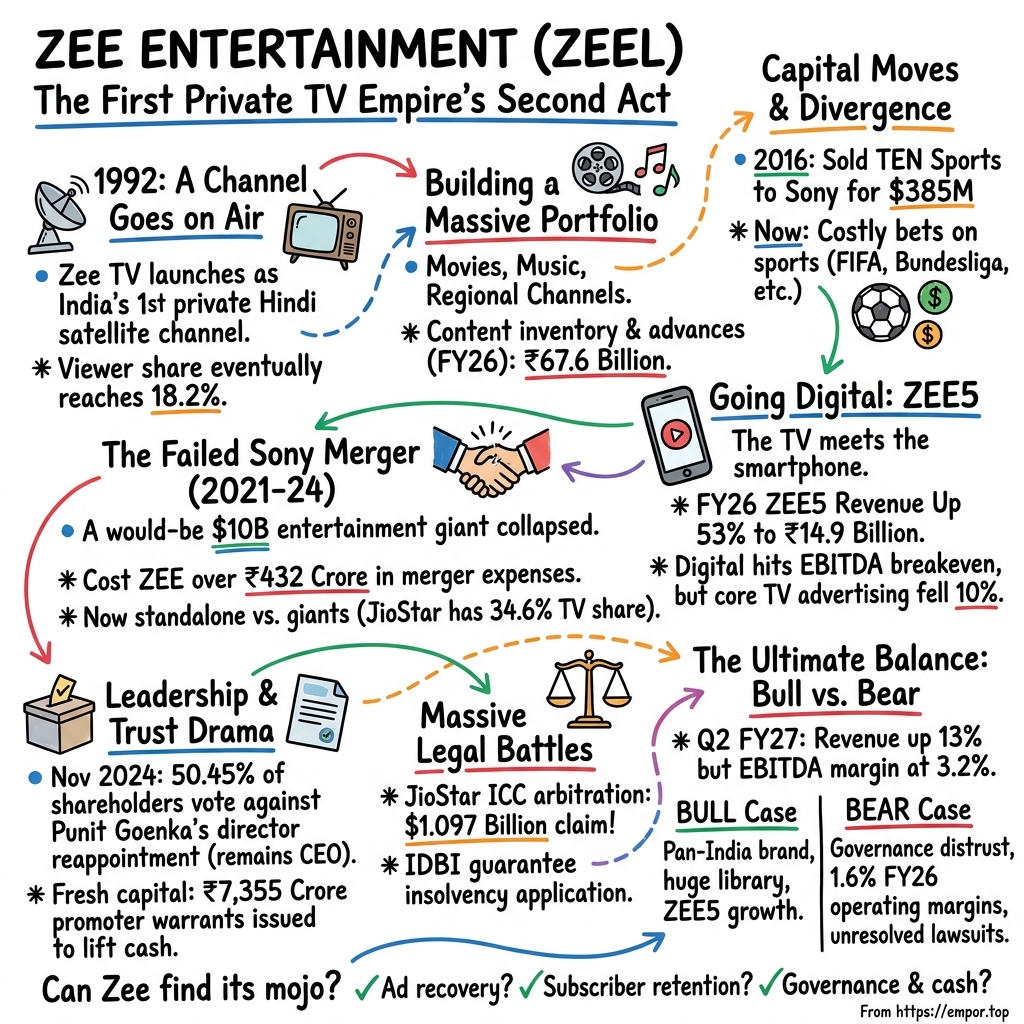
Zee Entertainment: The First Private TV Empire’s Second Act
I. A ₹7,355 Crore Bet on the Next Zee
On the afternoon of October 30, 2026, Zee Entertainment's board met in Mumbai at half past twelve and rose a little after three.1 By evening the numbers were on the exchange, and the next morning Punit Goenka was on a conference call explaining them.
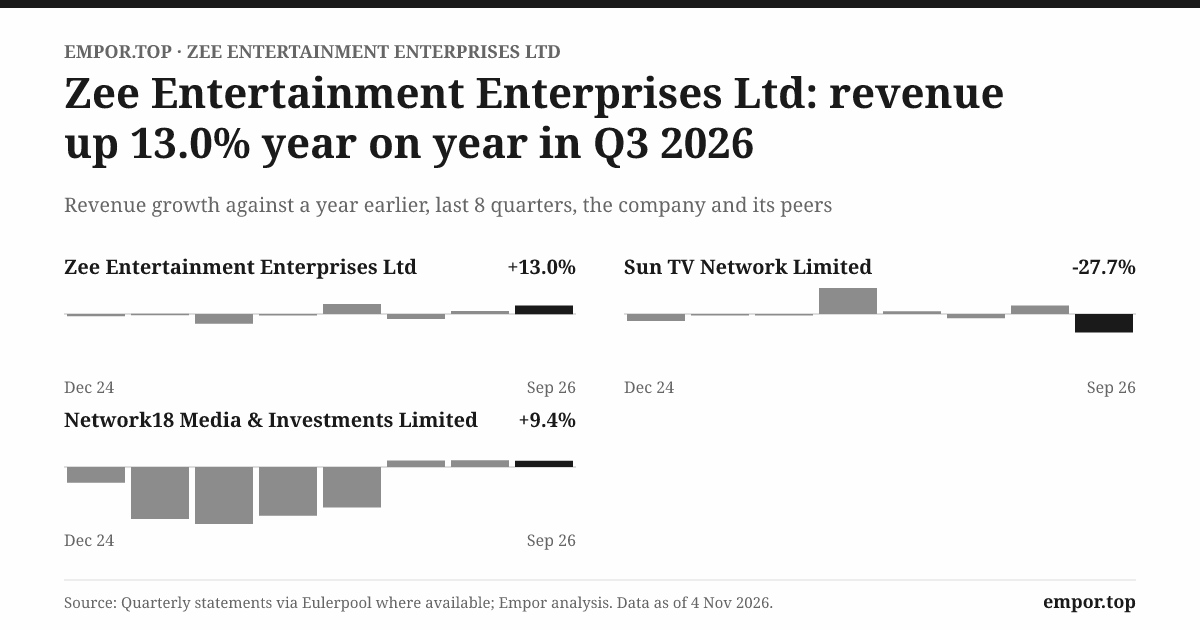
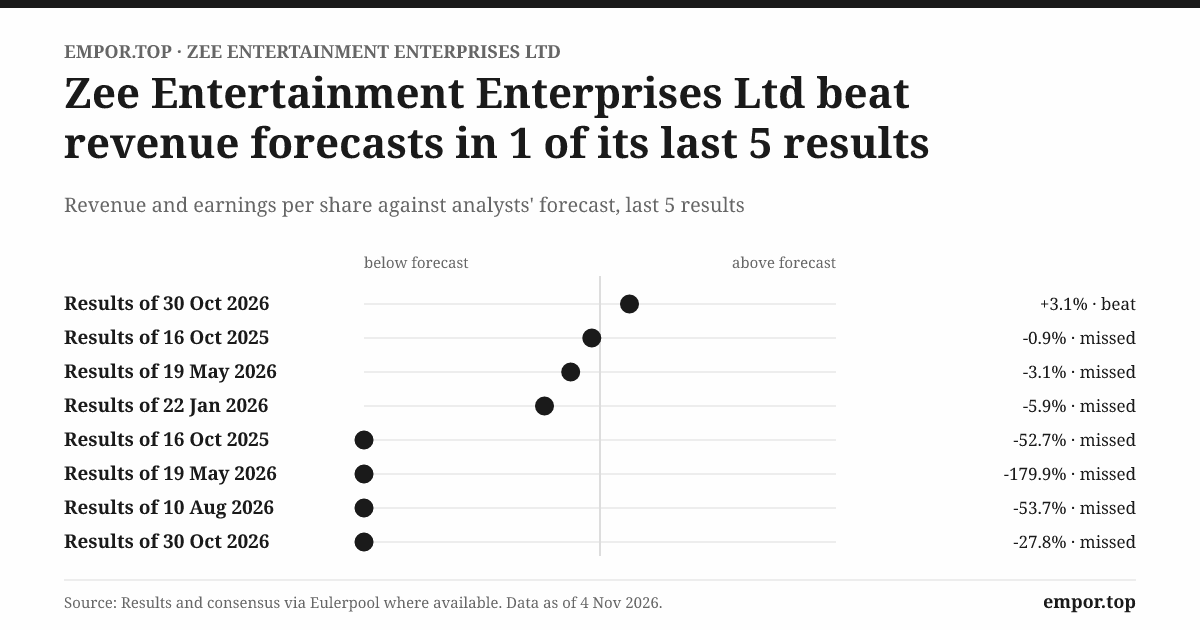
The headline sounded like a comeback. Operating revenue for the September quarter had grown 13% from a year earlier, subscription income had jumped 30%, and the streaming service ZEE5 had more than doubled its revenue to about ₹630 crore in three months.2 Goenka called it a quarter "of growth, strategic future-centric investments, and creative decisions."2
Then came the other half of the sentence. On roughly ₹2,225 crore of revenue, Zee kept about ₹71 crore of EBITDA, a margin of 3.2%.12 For every ₹100 of revenue, more than ₹25 went straight out the door on advertising and publicity, much of it to tell India that the FIFA World Cup was streaming on ZEE5.12
Mukund Galgali, the deputy CEO and chief financial officer, said the margin had been "impacted by higher programming costs and advertising costs on account of FIFA" and asked investors to view the marketing "with a medium-term lens of customer retention strategy."2
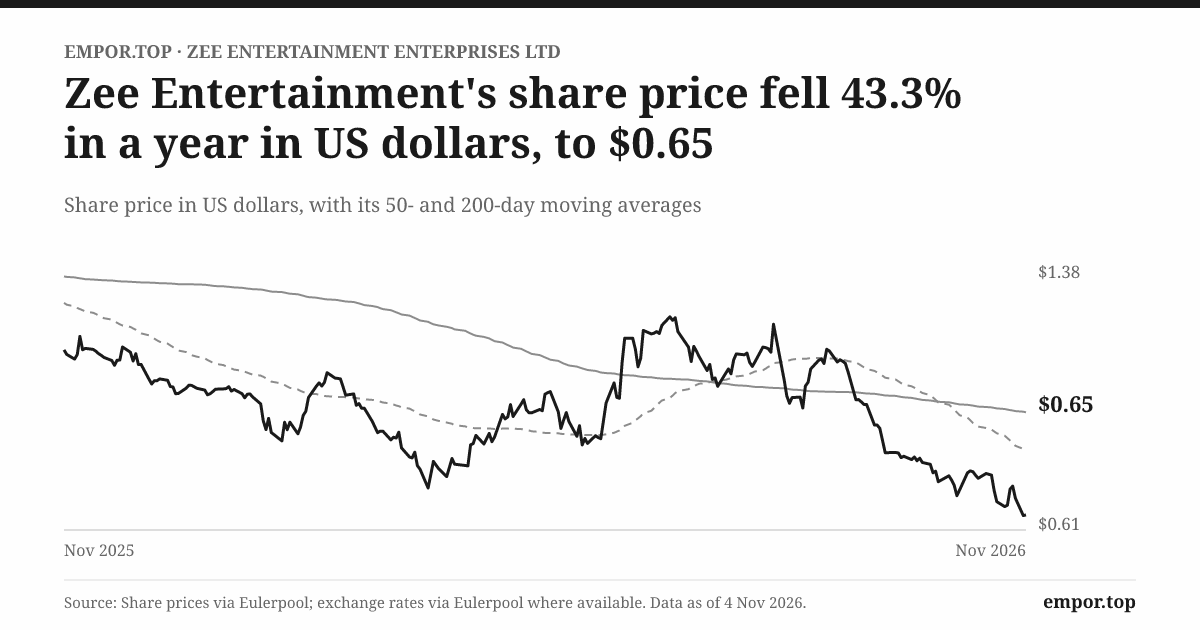
The same quarter brought money in from an unusual place. A promoter-group entity paid ₹7,355 million, a little over ₹735 crore, as the first instalment on convertible warrants priced at ₹126 a share.32 With that cash, Zee ended September holding about ₹2,570 crore in bank balances, deposits and mutual funds.2 That is a large cushion for a company whose entire stock market value, on November 4, 2026, was about ₹5,972 crore, with the share price at ₹61.67, less than half the ₹126 the promoters had agreed to pay.4
That gap captures the whole story in one picture. A family that once built India's first private satellite channel is putting fresh money into the company at roughly twice the market price, while the market, judging from that price, doubts the company can earn a decent return on the money it already has.
The doubts are not mysterious. In the year to March 2026, Zee's revenue slipped 2% to about ₹8,099 crore.5 Advertising, still the heart of the business, fell 10%. Subscription revenue rose 4%, helped by digital, and ZEE5's revenue climbed 53% to about ₹1,489 crore, enough for the digital business to reach breakeven on the company's adjusted EBITDA measure.5
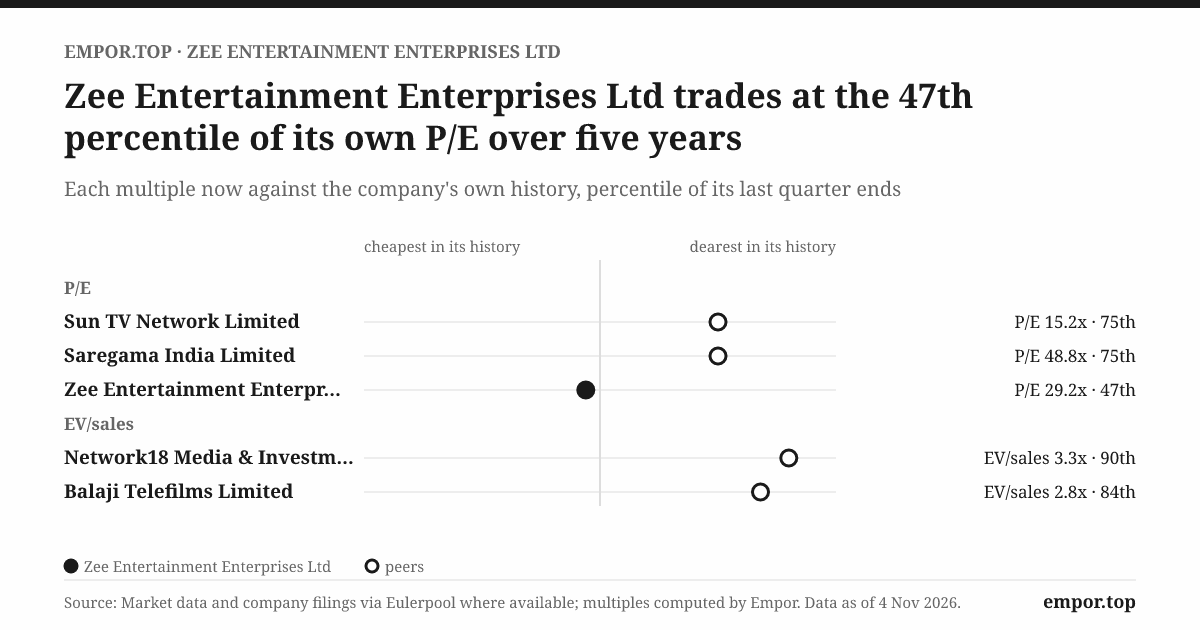
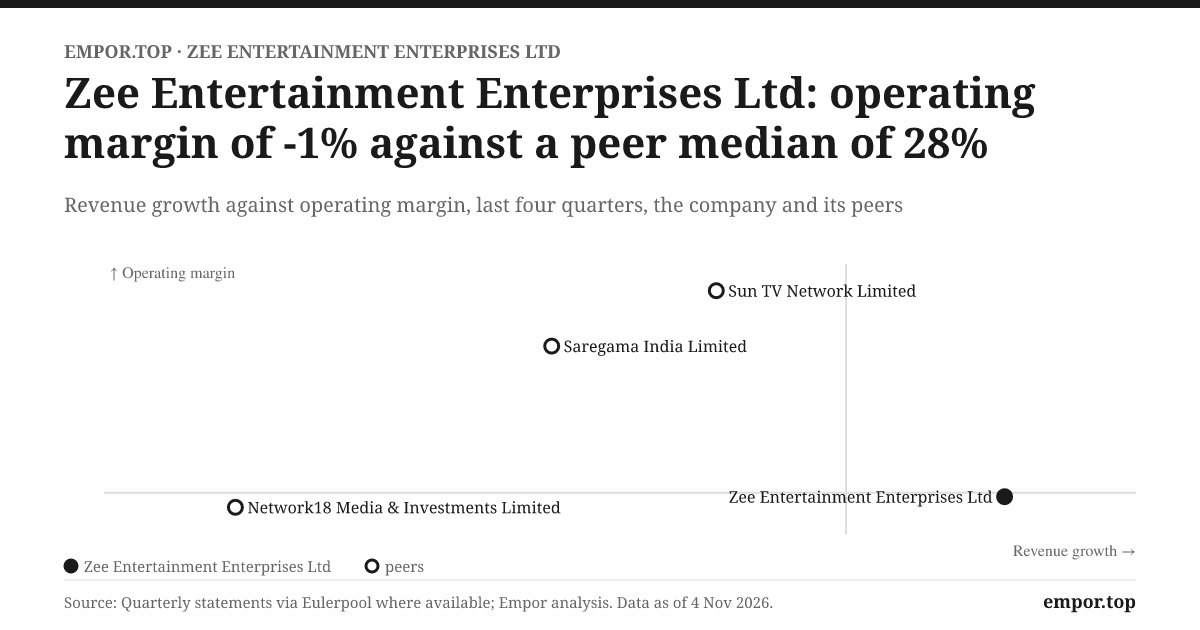
Yet the operating margin, which had been close to 30% as recently as fiscal 2019, ended the year at 1.6%.4 Return on equity was 2.3%.4 At 29.2 times trailing earnings, the stock trades almost exactly at its own five-year median multiple of 29.4, but that multiple now sits on a far thinner slice of profit than it used to.4
So the question is not whether Zee still matters. Its channels still reach hundreds of millions of Indians, and its library of Hindi and regional-language shows and films is one of the deepest in the country. The question is whether that audience can be turned back into durable profit, and whether the people allocating the money can earn the trust to do it.
Three questions run through what follows. The first is whether digital and subscription growth can outrun a slow erosion in television advertising, or whether Zee is simply moving revenue from one pocket to another while paying more to do it. The second is whether Zee still has a real competitive advantage at a time when Indian media is consolidating around much larger platforms, above all JioStar, the Reliance and Disney combination.
The third is whether management can resolve a long tail of governance and legal problems, including a fresh market ban on the CEO and founder, a billion-dollar cricket-rights arbitration and an insolvency petition tied to an old group guarantee, while deploying new capital in a way minority shareholders find credible.
The way to answer them is to follow the money: from a $5 million gamble on a Hong Kong satellite transponder in 1992, through a decade of building channels and buying content, a sports business bought and sold, a merger with Sony that was supposed to change the company's scale and then collapsed, and finally the warrants that put the founding family's money back on the table. The story begins with a grain trader who knew nothing about television, and thought that was an advantage.
 Subscribe on LinkedIn
II. The Packaging Trader Who Saw a Television Network
Subhash Chandra grew up in Hisar district in Haryana, in a family that traded grain and polished rice and dal for a living.6 The business got into trouble when he was a teenager, and he left his studies to work in it.
By eighteen, by his own and his biographers' accounts, he had turned it around, and on a bus ride from Hisar to Delhi he struck up a conversation with an assistant manager from the Food Corporation of India that led to his first big contract: processing raw grain into the form the army needed.6
It is a small story, but it contains the instinct that would define Zee. Chandra looked for places where a large Indian buyer existed but nobody had built the thing in between.
He kept doing it. In 1982 he set up a packaging business that became Essel Propack, introducing laminated tubes for toothpaste and cosmetics to a market that had been importing them, and his customers became the giants of Indian consumer goods: Colgate, Hindustan Lever and Procter & Gamble.76 He built EsselWorld, an amusement park outside Mumbai. Later he would describe the rule he tried to follow across all of it.
"I always pursued in my mind that I wanted to be either number one in any given business or a strong number two," he told an interviewer in 2010. "If I am not either of the two I will exit that business."8 Hold on to that sentence. It becomes the measuring stick for almost every decision in this story, including the ones Zee faces tonight.
By the late 1980s India had a television set in millions of homes and essentially one thing to watch on it. Doordarshan, the state broadcaster, owned the airwaves, and private broadcasting from Indian soil was not allowed. Chandra toyed with video vans that would tour villages selling screenings, and with a terrestrial channel beamed in from Nepal, before abandoning both.7
The trigger, as the group's official history tells it, came in 1990, when he watched CNN's coverage of the Gulf War and asked a simple question: if foreign channels could be seen in India, why could Indians not start one of their own?7
The answer was a satellite. AsiaSat had been licensed out of Hong Kong, and its transponders were leased to STAR, then controlled by Richard Li, son of Li Ka-shing.7 Chandra chased AsiaSat's chief executive down on a Christmas holiday in Canada and knocked repeatedly at STAR's door in Hong Kong. When he finally got a meeting, Li reportedly dismissed India as a market with no money in it.7 The price STAR's executives had discussed for a transponder was $1.2 million.
Li said it was not enough, and Chandra, by his own account, stood up and offered $5 million if the contract was signed within twenty-four hours. Li walked out.7 Months later it was Li who came back, after big Indian newspaper houses and industrialists had declined to match Chandra's price, and after a helicopter tour of the packaging plant showed him the consumer-goods companies Chandra already served. The lease was signed on May 21, 1992, between Chandra's company Asia Today and STAR.7
"The existing media companies felt that satellite television would not succeed in the country," Chandra said later. "As I did not know anything about the media business, I had nothing to fear."7 That is the founding myth, and like most founding myths it is told by the founder.
The point that survives the retelling is economic, not heroic: Chandra paid a high price for scarce distribution before anyone had proved there was demand, and he paid for it with money raised from a Hong Kong fund linked to James Goldsmith and Kerry Packer, a few non-resident Indian friends and venture investors.7
It matters to keep the rest of the Essel empire in proportion. Chandra and his brothers went on to build lottery, cable, direct-to-home satellite, infrastructure and much else, and for a while the group's annual revenue was nearly ₹19,000 crore, about half of it from media.6 Dish TV and Siti Networks will reappear here only where their debts touched the listed company, which, as it turns out, they did.
The listed company itself has grown slowly for a long time: over the decade to March 2026 its revenue rose about 3.3% a year in rupees.4 But in 1992 none of that mattered. There was a lease on a transponder, a government that disapproved, and a single question nobody could answer in advance: would Indian viewers actually watch a privately funded Hindi channel?
III. October 2, 1992: A Channel Goes on Air
Zee TV went on air on October 2, 1992, beaming from Hong Kong into India with about two hours of programming a day.7 The legal structure was a workaround. Chandra renamed an old company of his Zee Telefilms and had it supply programmes to a Hong Kong broadcaster, which sent the signal up to the satellite and back down over India.7
The government's information and broadcasting secretary had reportedly told him the idea would destroy the country "over my dead body."7 The satellite simply did not need his permission.
Launching a channel solved only half the problem. The other half was getting it into homes and persuading people to come back. India's homes did not have satellite dishes; they had a cable operator down the lane who put up a dish, ran wires to his neighbours and charged a monthly fee. Those cable operators were the real gatekeepers. Zee had to be on their systems, and they would carry it only if their customers asked for it.
So the programming had to be cheap enough to fill hours and good enough to create demand. In the first year, the average hour reportedly cost about ₹30,000 to make.7 What filled it were shows that felt like they belonged to the audience rather than to the government: family soaps such as Tara and Hasratein, and interactive music shows like Antakshari and Sa Re Ga Ma.7 Within six months, Zee claimed to be reaching about 12 million homes.7
That number caught the attention of a far larger player. In 1993 Rupert Murdoch's News Corp bought control of STAR, and Murdoch discovered that most of the homes STAR claimed in India were really Zee homes.7 STAR could, in principle, pull Zee off the satellite. Chandra had no money for another transponder, so he sold a stake of nearly half of Asia Today to Murdoch.
The two set up Zee Cinema together, and Murdoch invested in Siticable, Chandra's cable-distribution business.7 The partnership turned sour when STAR began broadcasting in Hindi, which Chandra regarded as a breach of their agreement to keep STAR in English. Murdoch, by Chandra's account, then tried to buy Zee outright, offering about $2 billion for a company Chandra himself valued at roughly $500 million.
Chandra's reply has become part of the company's folklore: "India is not for sale."7 Instead, he sued in London. In September 1999 Zee Telefilms agreed to buy back Star's 50% stakes in Asia Today, the programme supplier Patco and SitiCable for cash and a small shareholding, a deal valued at about $296.5 million that gave Zee full ownership of advertising revenue then estimated at about ₹400 crore a year.9
Chandra said he hoped the deal would pave the way for an Indian media conglomerate.9 It is worth pausing on what he had just done. He had taken capital from the world's most aggressive media owner when he needed it to survive, then bought it back once the business could stand on its own. That pattern, borrowing strength from a bigger partner and then fighting to keep control, would repeat itself a quarter-century later with Sony, with a very different ending.
The buyback gave Zee control, and it also freed STAR to compete head-on. From the late 1990s onward, the Indian television industry turned into the market it remains today: a handful of large networks competing for the same advertisers, the same stars and the same writers, with Star and later Sony able to outbid Zee for talent, shows and cricket.
Zee's response was to widen its portfolio. It built a film channel, a news channel and then, crucially, regional-language channels in Marathi, Bengali, Telugu, Tamil, Kannada and others. Each new channel did two things at once: it reached viewers that Hindi programming did not, and it created more advertising slots to sell to the same national advertisers.
Being first had given Zee a brand and a distribution footprint. It did not give it permanent leadership, and the present-day evidence shows why. In a company-reported measure for July 2025, Zee's network held 18.2% of television viewership.10 On the September 2026 call, management said linear network share had reached 20% in week 24, its highest in seven years.2 Those are real numbers for a network competing against much larger rivals.
Now set them against JioStar, which in January 2026 reported a 34.6% share of TV entertainment viewing, a share it said was close to the combined share of the next three networks.11 JioStar's gross revenue in the December 2025 quarter alone was about ₹8,010 crore.11 Zee's revenue for the entire fiscal year was about ₹8,099 crore.5 The largest rival does in one quarter what Zee does in a year.
What a first mover owns, then, is not a moat but an option. Zee's brand and reach are advantages only while they convert into three things: audience share, the price advertisers will pay for that audience, and the carriage fees and subscriptions distributors will pay to offer Zee's channels. As Zee widened into dozens of channels, the challenge shifted from winning viewers to financing a portfolio large enough to keep them.
IV. When the Portfolio Became the Product
Imagine the life of a single Zee show. A Marathi family drama is commissioned from a production house. It airs first on a Zee channel at prime time, where its audience ratings decide what advertisers pay for the slots around it. A few weeks later every episode sits on ZEE5, where it helps persuade a subscriber to renew. If it is a hit, it may be dubbed into another language, remade for another region, licensed to a broadcaster abroad, or sold to a satellite channel as a repeat.
If it is a film, there may also be music rights, which Zee's music label can monetise on YouTube, where the label claims more than 179 million subscribers.2 Every one of those windows earns a little more from a cost that was paid once. The volume of that pipeline is large: in the September 2026 quarter alone, Zee released 34 shows and films across its platforms, including nine original series on ZEE5, and put six films into cinemas, one in Hindi and five in other Indian languages.2
That is the theory of a content company, and it is why a portfolio of channels eventually becomes the product itself. The more places a show can earn money, the more Zee can afford to pay for it, and the more it can afford to pay, the better its library becomes.
Zee earns money from four broad sources: advertising, which depends on audience size, ratings, the number of ad minutes and advertisers' budgets; subscriptions, which depend on distribution deals, pricing and how many households keep paying; content sales and licensing; and other services such as music and live events.5
The company does not disclose a single pricing unit or contract length across these products, nor what share of revenue is recurring.5 The licensing stream shows how lumpy the later windows can be. In the September 2026 quarter, Zee's other sales and services, which include syndication of its content to other buyers, fell 36% from a year earlier simply because the earlier quarter had included a larger syndication deal.2 A library earns in bursts, not in a smooth line, which is one more reason headline earnings can mislead.
The library shows up on the balance sheet as content inventory and advances, the capitalised cost of shows, films and rights that have not yet been fully expensed. At March 2026 it stood at about ₹6,760 crore, down from about ₹7,050 crore a year earlier.5
That is almost as large as a full year of revenue, which tells you how much of Zee's capital is tied up in the creative pipeline. The fiscal 2026 working-capital measures made the same point from another angle: inventory represented roughly 400 days of the cost of revenue, against about 200 a decade ago.4
Here is the problem for anyone trying to read the business from its earnings. A content company decides how fast to write off what it has spent. If it assumes a film will keep earning for ten years, it spreads the cost thinly and today's profit looks healthy.
If it later decides the film will earn for five, it must catch up, and a large charge hits a single period. In fiscal 2026 that is exactly what happened. Zee changed its estimate of how movie rights should be amortised and recorded additional impairment, a combined charge of about ₹408 crore.512 The March 2026 quarter, where the charge landed, showed an operating loss.4
Decompose the year and the picture is clearer. Revenue fell about ₹200 crore. Advertising, the highest-margin revenue Zee has, fell 10%. Advertising and promotion spending, the money Zee spends marketing its own shows and ZEE5, rose 24%. Personnel costs fell 9%, which helped.5
The movie-rights charge alone was equal to about five percentage points of revenue. Strip it out and the operating margin would still have been only in the mid-single digits, roughly half of fiscal 2025's 11%.4 The charge was a one-time catch-up, but the weaker underlying economics were not.
The charge matters for a second reason. It was the moment Zee's own assumptions about what its library was worth became financially visible. A content balance is only an estimate of future earnings, and when management cuts the estimate, it is saying that some past spending will earn less than it hoped.
Over the twelve years to March 2026, Zee reported cumulative net profit of about ₹10,703 crore but generated only about ₹7,886 crore of operating cash, roughly 74 cents of cash for every rupee of profit.4 A good part of that gap is money that went into the library and has not yet come back.
Two further details complicate the picture. Zee does not report research and development as a separate line; technology and content-creation costs are spread across other expenses.5 And its property, plant and equipment, about ₹568 crore at March 2026, wildly understates what it costs to stay in business, because the real capital expenditure of a media company is the content itself.4
In fiscal 2026 Zee also announced investments of up to ₹116 crore in Phantom Digital Effects, a visual-effects company, and ₹20 crore in Culture of Real Experiences, a live-entertainment venture, small bets on new formats around the core.5
So the central economic question of the business is simple to state and hard to answer. Can Zee monetise its library across enough windows, enough times, to cover the cost and risk of constantly replenishing it? Zee publishes no title-level returns, so the only way to judge is through the company's record of deciding when a bet has stopped paying. The clearest test of that came in sports.
V. The Sports Sale That Set a Capital-Allocation Benchmark
On November 13, 2006, Zee Telefilms bought half of TEN Sports from Dubai-based Taj Television for about $57 million in cash, valuing the whole business at about $114 million.13 TEN had been in long talks with Sony that collapsed over price, and Zee got four of the seven board seats.13
TEN held cricket rights for the Pakistan, Sri Lanka and West Indies boards, and Zee told investors it expected the business to average about $50 million of revenue and about $14 million of EBITDA a year over the following three years.13
Its seller, Abdul Rahman Bukhatir, offered a warning that turned out to be prophetic: "Sports television is an extremely challenging business."13 For Zee the logic was obvious. Cricket was the one programme Indians would reliably watch live, and live viewing is what advertisers value most. A network without sport was, in that era, a network without the biggest audiences.
Zee later took full ownership of TEN. Then, on August 31, 2016, it agreed to sell the entire sports broadcasting business to Sony Pictures Networks for $385 million.14 In its annual report, Zee explained why. The cost of acquiring relevant sports rights had kept rising, while the time it would take for the business to become profitable kept stretching.15
That is a remarkable sentence for a company to put in writing. It is an admission that a decade-long strategic bet had not met its own profitability timetable, and that Zee would rather take the cash than keep paying to find out.
Was it a good deal? The headline comparison is flattering: an entry valuation of about $114 million against an exit of $385 million. But that comparison flatters too much. Zee bought the first half in 2006 and the rest later, at prices that are not part of a simple two-number calculation, and in between it spent heavily on rights.
Purchase price alone cannot establish the return. What can be said is that the sale price looks strong against the disclosed entry value, and that Zee crystallised it at a moment when the cost of sports rights in India was about to rise much further.
The TEN exit is the clearest example of Chandra's "number one or strong number two" rule being applied. Zee was not going to be number one in Indian sports broadcasting, and it chose to leave rather than spend its way there. Around the same time it made smaller portfolio moves that pointed the other way.
In November 2016 Zee agreed to buy Reliance Broadcast Network's general-entertainment television business, including the Big Magic comedy channel and Big Ganga, aimed at Bhojpuri-speaking audiences.16 Goenka said the deal added to Zee's "expanding universe of general entertainment channels."16 It was a modest bolt-on that extended the portfolio into niches, not a bet on the scale of TEN.
Now fast forward a decade. In 2026 Zee is back in sports, with rights to the FIFA World Cup running until 2034, and five-year partnerships for Germany's Bundesliga and Italy's Serie A in India.2 Management frames this as a ZEE5 strategy: live football gives people a reason to download the app and subscribe, and the subscribers then stay for the library. That is a different logic from the cricket-advertising model of TEN, and it may be the right one.
But it collides with the company's own history. Zee once concluded that rising rights costs and a lengthening path to profit made sports a poor use of capital. The new rights are being bought at a moment when the September quarter's margin was compressed precisely by programming and marketing costs tied to FIFA.2 Goenka declined on the call to say how much revenue FIFA generated, saying only that it was "quite healthy."2
That leaves the forward test for capital allocation plainly stated. Management has to show that the new rights create value for Zee's shareholders, not just reach. The test is no longer whether a sports channel breaks even. It is whether football subscribers keep paying for ZEE5 after the final whistle, and that question belongs to the biggest shift in Zee's business since the satellite: the move from the television set to the phone.
VI. The TV Business Meets the Smartphone
On February 14, 2018, Amit Goenka, Punit's younger brother and then head of Zee's international business, stood up at a press event in Mumbai and unveiled ZEE5.17 It launched with about 100,000 hours of on-demand shows and films across a dozen languages, plus live television channels.17 The name, he explained, referred to the five continents where Zee was available, a tribute to its first quarter-century.17 "Digital will play a critical role," he said.17
ZEE5 arrived late to a crowded room. Netflix and Amazon Prime Video had already entered India with global libraries and deep pockets, and Hotstar, then owned by Star, had built a huge audience on the back of cricket. Zee's earlier attempts at streaming had not taken off, and ZEE5 consolidated them into a single service.17
For years afterward, the platform consumed money. Zee does not publish a complete loss history for ZEE5 in a single series, but the shape is visible in the consolidated numbers: as digital spending rose, group margins fell steadily from the high twenties toward single digits.4
To understand why Zee kept going, compare the two businesses. Television is a broadcast. One signal reaches a vast number of homes at once, and advertisers pay for the size of that crowd. The distributor, a cable or satellite company, sits between Zee and the viewer and pays carriage or subscription fees in return for offering Zee's channels in a bundle.
Zee never really knows who is watching. Streaming is the opposite. ZEE5 knows every subscriber, can charge them directly, and can show advertisers exactly who saw what. But each subscriber has to be won individually and kept month by month, and the cost of winning them, mostly marketing and exclusive content, is paid up front.
That is why digital is not a separate novelty for Zee but an extension of the library. The same regional dramas, the same films, the same music that fill the TV channels can sit on ZEE5 at very little extra cost. The bet is that one library, sold through two doors, earns more than either door alone. A first sign came in fiscal 2026: ZEE5 reached adjusted EBITDA breakeven.5
In the September 2026 quarter, digital revenue more than doubled and digital EBITDA was positive at about ₹42 crore, even after the FIFA spending.2 Management attributed the quarter's subscription growth to higher average revenue per user and more subscribers on ZEE5, together with price increases on the linear side.2 Average revenue per user is simply what each paying customer brings in, and its rise suggests ZEE5 was not buying growth purely through discounts, at least in that quarter.
Zee's argument for a moat rests on reach. It reported reaching about 855 million people in India in 2025, and on the September call management said monthly reach across its genres had crossed 800 million.52 The trouble is that reach is not unique.
JioStar's television network reached more than 830 million viewers in a single quarter of fiscal 2026, and its streaming service averaged about 450 million monthly active users.11 When the strongest rival matches you on reach and dwarfs you on share and revenue, reach becomes table stakes rather than an advantage.
The economics of the industry press on Zee from three directions. Advertisers can move their budgets between television, streaming, YouTube, Instagram and retail media with a few clicks, and they have been doing so; that is the main reason Zee's advertising fell 10% in fiscal 2026.5
Distributors bundle channels and platforms together and negotiate hard on the price of each; Galgali said on the September call that linear subscription deals are "negotiated year-on-year," and that the real effect of new sports content on those negotiations would only be visible next financial year.2
And the people who make content, the stars, writers and rights holders, can raise their price whenever several platforms are bidding. FIFA, Bundesliga and Serie A did not come free.
Zee has a recognised brand, a broad channel portfolio and a library that rivals cannot easily replicate. Those are real assets. But the company does not publish the measures that would show whether they confer pricing power or loyalty: it does not disclose customer concentration, subscriber retention by service, bids it has lost, or the price it realises per advertising slot.5 Without them, the moat claim remains plausible but unproven, and the record of falling margins argues that, whatever the advantage is, it has not protected profits.
The FIFA World Cup offers the cleanest test of the new strategy. On the September call, Goenka said Zee's full-tournament reach had grown about 41% compared with the previous World Cup, despite matches being played at awkward hours for Indian viewers, and that about 83% of the viewing happened live on ZEE5.2
Total reach exceeded 400 million across platforms.2 Those are impressive audience numbers. They are not unit economics. Reach describes how many people tuned in; it says nothing about what they paid, what it cost to acquire them, or whether they will stay.
On the stay question, the company did give a number. Galgali said Zee had seen retention "in the range of 35%-40%" among subscribers who signed up for FIFA, and the head of investor relations, Ankit Arora, clarified that most of those were quarterly packs whose holders had renewed for another quarter or longer.2 Arora also tempered expectations: retention would accelerate subscription growth from the second half, but "it will not be to the extent of as large as 30% going forward."2
Read plainly, roughly six in ten FIFA subscribers left after the tournament. Whether 35% to 40% retention is good depends on what each subscriber cost to acquire, and Zee does not say. If the marketing cost of signing a FIFA subscriber was low and the retained ones stay for years, the strategy is working. If the acquisition cost was high and the retained subscribers churn in the next quarter, it is an expensive way to rent an audience for a month.
That makes the digital test specific. Sustained ZEE5 renewals over several quarters after the event window, digital margins that hold up once marketing normalises, and a television advertising line that stops shrinking would together show that the new platform strengthens the listed company. Zee had hoped it would not have to pass that test alone. In 2021 it signed a deal that was supposed to give it the scale to compete with anyone.
VII. The Merger That Was Supposed to Change the Scale
On September 22, 2021, Zee and Sony Pictures Networks India announced that they would merge.18 The combination would have joined two of India's largest entertainment networks into a company widely described as worth about $10 billion, with Zee's channels and library sitting beside Sony's channels, its cricket rights and its SonyLIV streaming service.19
Sony's parent would put in growth capital so that the combined company held about $1.575 billion in cash.18 After that injection, Zee's shareholders would own about 47% of the merged company and Sony's about 53%. Without it, the ratio would have tilted the other way: Zee's shareholders would have owned about 61%.18
The headline value is worth handling carefully. The $10 billion figure described the whole combined enterprise, not cash that Zee or its shareholders would receive. Zee's shareholders were trading control of their company for a minority stake in a bigger one, backed by Sony's money. And one condition mattered more than any other: Punit Goenka would lead the merged company as managing director and CEO.18
The timing was not accidental. Just a week before the announcement, Zee's two largest shareholders, Invesco Developing Markets Fund and OFI Global China Fund, which together held about 17.9%, had demanded an extraordinary general meeting to remove Goenka from the board.18
The merger would give Goenka a bigger company to run and Zee's shareholders a stronger partner. To critics, it also looked like a way to keep Goenka in charge. In December 2021, on a merger update call, management presented the combination as a scale play against global streamers and conglomerate-backed rivals.20
Then the regulator intervened. On June 12, 2023, SEBI issued an interim order barring Subhash Chandra and Punit Goenka from holding director or key managerial positions in listed companies, alleging that funds had been diverted from Zee for the benefit of promoter-group entities.21 The Securities Appellate Tribunal upheld the interim order in July 2023 and directed that the matter be heard quickly.21
In August 2023 SEBI modified it: Chandra and Goenka were now barred from board and key managerial roles in at least four Zee group companies and in the merged Zee-Sony entity, and Goenka was specifically restrained from becoming managing director of the combined company.22 For a merger whose central condition was that Goenka would run the combined company, every turn in that case was a turn in the deal.
The break came on January 22, 2024. Sony said it had sent a termination notice to Zee, calling off the merger after the two sides could not agree on who would lead the combined company and failed to agree an extension to the deadline to close.19 Sony said closing conditions had not been met and claimed a $90 million termination fee.19
Reuters noted at the time that the combination had been seen as crucial for both companies' survival in a market about to be reshaped by the merger of Disney's Indian businesses with Reliance's media assets, and that Zee was contending with declining profits, advertising revenue and cash reserves.19
"A deal collapse will have a negative impact on both parties," said Karan Taurani, an analyst at Elara Capital.19 Zee called the termination wrongful, contested the fee and pursued its own remedies, first in India's company-law tribunal and then in arbitration in Singapore, where it made its own $90 million claim.1923 The two sides' claims were exactly that: claims. Neither claim resulted in an award.
The deal also cost money that did not come back. Zee reported about ₹432 crore of merger-related costs over the life of the attempt.5 It had hired advisers, prepared integration, and run its business for more than two years in anticipation of a combination that never happened. In May 2024, on the fiscal fourth-quarter call, Goenka faced questions on Sony and the termination claims at a time when the litigation was before tribunals, which bounded how much he could say; the call's emphasis was on a standalone plan.24
On August 27, 2024, Zee and Sony announced a settlement. Both agreed to withdraw all claims against each other in the Singapore arbitration and in related proceedings in the National Company Law Tribunal and elsewhere, and said that none of the parties would have any continuing obligations or liabilities to the other.23 Neither termination fee was paid.
So did the merger fail because the logic was wrong, or because governance could not meet its conditions? The record points to the second. The strategic logic, putting two mid-sized networks together to face much larger competitors, was sound enough that the market structure has since moved exactly that way: Reliance and Disney combined to create JioStar. What sank the Zee-Sony deal was a leadership condition tied to a person under regulatory investigation, which gave Sony a reason, or a pretext, to walk away.
What the collapse left behind was a standalone company with weaker negotiating scale, a large bill for nothing, and shareholders who had watched management stake the company's future on a deal it could not close. The problem the merger was meant to solve did not go away. If anything it grew, because while Zee spent two years trying to marry Sony, its biggest competitors combined without it. The next question was whether shareholders still trusted the man who would have to lead Zee alone.
VIII. The CEO Kept the Job; Shareholders Withheld the Vote
On November 28, 2024, Zee held its 42nd annual general meeting, and the result of one resolution made headlines. Shareholders voted on reappointing Punit Goenka as a director. About 49.5% of votes cast supported him. About 50.45% opposed.2526 Ten days earlier he had resigned as managing director and chosen not to seek reappointment to that post; after the vote, he left the board but remained chief executive.26
The breakdown of the vote was as striking as the result. A slim majority of institutional investors, about 52%, voted in favour. Retail shareholders swung it: about 88% of retail votes cast were against Goenka.27 Retail investors in India rarely vote at all, typically 3% to 5% turnout, but about 13% of Zee's retail holders took part.27 Proxy advisers had also recommended voting against.26 For a company whose shareholder register had changed beyond recognition, this was the new electorate speaking.
To see why it had changed, rewind to 2019. That year the Essel Group was buckling under debt of about ₹11,000 crore, much of it secured on pledged Zee shares.28 In July 2019 the promoters agreed to sell up to 11% of Zee to Invesco Oppenheimer for about ₹4,224 crore, at ₹400 a share, to pay lenders.28 By October, over 90% of the promoters' remaining 22% stake was pledged, and the share price had fallen to a six-year low.29
Goenka told investors that October that the promoters planned to repay their remaining debt within the next three months.29 Instead, lenders enforced pledges and more shares were sold. In July 2019, the stake sale to Invesco had been priced at ₹400 a share, after the stock had already fallen to about ₹340.28 Today it trades at about ₹62.4 By March 2022 the promoter group owned just 3.99% of the company their family had founded, and that is where their stake has stayed through September 2026.30
The shareholders who replaced them have also left. Foreign portfolio investors held about 48% of Zee in March 2022 and about 18% by September 2026. Domestic institutions rose to a peak of about 38% in March 2023 and then fell to about 7%. Individual and other public shareholders went from about 24% to about 71%, and Zee now has about 620,000 shareholders.30
The family that runs Zee owns a sliver of it, the professional investors who once might have backed or challenged management have largely sold, and legitimacy now depends on votes from a mass of retail investors who have shown they are willing to say no.
The legal record gives them reasons. The auditor's report on Zee's fiscal 2026 accounts, while unmodified, drew attention to ongoing SEBI and Ministry of Corporate Affairs investigations into earlier vendor transactions, alleged liens on company property, inter-corporate deposits, film advances, related-party dealings and disclosure and control lapses.12 For most of that period those were allegations, not findings.
Then, on July 31, 2026, SEBI passed a final order in one of them. It found that the original title deeds to a Zee property in Jubilee Hills, Hyderabad, had been handed to Indiabulls Housing Finance in December 2018 to support about ₹726 crore of loans taken by four Essel Group entities, without the prior audit committee approval the rules required for a related-party arrangement, and that the deeds stayed with the lender until June 2020, by which time about ₹225 crore of those loans had been repaid.3132
The order also dealt with disclosures linked to litigation in the Delhi High Court and a non-disposal undertaking over the same property.32 SEBI found that Chandra had "misused his position and authority in ZEEL."31 It restrained Chandra and Goenka from dealing in securities for 12 months, barred Zee itself from the securities market for two months, and imposed penalties of ₹60 lakh on Chandra, ₹58 lakh on Goenka and ₹30 lakh on the company.33
Zee's shares fell about 15% on the next trading day.31 SEBI also rejected Zee's applications to settle other show-cause notices, and after September 30, 2026, the company received a notice from the Ministry of Corporate Affairs under the investigation provisions of the Companies Act.3 Zee and Goenka appealed, and that appeal is pending. At the tribunal's hearing in August, the bench questioned SEBI on why Zee had been debarred without any charge of fraudulent market activity, which suggests the final outcome is not a foregone conclusion.34
The difference between continuing investigation and established finding has narrowed: on the Hyderabad pledge, the regulator has now ruled, though the ruling is under challenge.
Against that background, pay becomes a question of accountability, not just generosity. Goenka's compensation for fiscal 2026 was about ₹25 crore, equal to roughly 9% of the year's profit attributable to shareholders of about ₹273 crore, and 148 times the median Zee employee's pay.5 Pay alone does not prove misalignment; a CEO steering a difficult turnaround may deserve to be well paid. The question shareholders cannot easily answer is what measurable conditions attach to that pay. Zee does not publish quantified performance targets alongside it.
The calls give a partial view of how management handles pressure. On the September 2026 call, Galgali was precise when asked about receivables, cash composition and FIFA retention. Goenka was less so. Asked for FIFA revenue, he declined. Asked when Zee would begin reporting its music business as a separate segment, he said he could not give a timeline, "but rest assured, we are working on that."2
Asked when the ICC arbitration might be resolved, he said: "We have to wait and watch."2 None of those answers is unreasonable on its own. Together they describe a management that offers direction but few numbers it can be held to; no advertising, subscription or margin guidance was given in figures.2
The current team around Goenka has also changed. Galgali joined as CFO in June 2024 and is now also deputy CEO; the board is chaired by an independent director, R. Gopalan; and the company secretary who had served through the turbulent years resigned effective October 29, 2026, with a successor taking over on November 2.535
The credibility test for this leadership is concrete: explain why results diverged from expectations, say what was changed, and name the operating measures that will show whether the correction worked. A rejected director vote is a signal of a trust deficit, not proof that leadership cannot recover. But in 2026 management asked those same shareholders to trust it with something much larger than a board seat.
IX. The Warrant Money and the Sports Spending
The first attempt failed. In June 2025, Zee's board approved issuing about 169.5 million convertible warrants at ₹132 each to promoter-group entities, which would have lifted the family's stake from 3.99% to about 18.4%. Proxy advisers InGovern and IiAS recommended voting against, citing dilution and the use of warrants as a fundraising tool. A special resolution needed 75% of votes cast. It got 59.5%.36 Zee had argued that "it is important to keep a sufficient war chest" in a rapidly shifting market; enough shareholders disagreed.36
A year later the family tried again, with different terms. The board approved the new issue on July 1, 2026: up to about 249.5 million fully convertible warrants at ₹126 each, an aggregate commitment of about ₹3,143.5 crore.3 Shareholders approved it at an extraordinary general meeting on July 31, 2026, the very day SEBI signed the Hyderabad order.333 Because the SEBI order temporarily barred Zee from the securities market, the allotment needed the appeals tribunal's help.
On August 14, 2026, the Securities Appellate Tribunal allowed the warrant issue to go ahead, extended the deadline by a week, and required Zee and Goenka to deposit the full penalty, while leaving SEBI's market ban otherwise in force.34 The tribunal also said Zee could use its mutual-fund investments only for daily operations, not for other purposes "including the proposed dividend."34
The mechanics are straightforward once you separate the money that has arrived from the money that might. Each warrant costs ₹126 in total. The holder pays a quarter, ₹31.50, upfront, and the remaining ₹94.50 when converting it into a share, which can happen in tranches within 18 months of allotment.3
In the September quarter Zee allotted about 233.5 million warrants and received about ₹735.5 crore.3 If every allotted warrant is eventually exercised, another roughly ₹2,200 crore would come in, and with about 961 million shares outstanding today the promoter group's holding would rise from 3.99% to somewhere between 22% and 24%, depending on how many of the approved warrants are finally issued.130
Now notice the uncomfortable arithmetic. Zee's shares trade at about ₹62.4 A warrant holder who converts today would pay ₹94.50 in cash for a share worth ₹62 in the market. No rational investor would do that. So the remaining ₹2,200 crore is not money Zee should count on.
It arrives only if the share price recovers well above ₹94.50 within the conversion window. If it does not, the holder can walk away, and under Indian rules the upfront amount is typically forfeited. In other words, the promoters have paid ₹735 crore for an option on a much larger stake, an option whose value depends on precisely the recovery the market currently doubts.
That frames the capital question. Did Zee need the money? At March 2026 it held about ₹2,760 crore of cash and cash equivalents, reported borrowings of well under ₹300 crore, and a debt-to-equity ratio of 0.02.54 Lease liabilities are separate, and Zee repaid about ₹75 crore of them in fiscal 2026.5
Contingent exposures also need separate consideration. But on its face the balance sheet did not require fresh equity. Its enterprise value, after netting its cash and investments, is only about ₹3,468 crore.4
The skeptical investor's case writes itself. Why raise money when liquidity is substantial? What exactly will it be spent on, and how will shareholders measure the return? Why should a family with a 3.99% stake and a 5.38% pledge on its holding, two of whose leaders have just been restrained by the regulator, be allowed to buy up to a quarter of the company?3033
The company's answer on the September call was, in effect, that sports and digital need investment. Galgali reported the cash balance in detail: about ₹530 crore in bank balances, about ₹1,100 crore in deposits and other investments, and about ₹940 crore in mutual funds.2 He noted that a convertible-bond payment and the dividend had reduced the balance during the quarter.2 A specific plan for the warrant proceeds was not part of the discussion.2
Management's case deserves a fair hearing too. More money gives Zee room to bid for rights, fund ZEE5 originals and pursue acquisitions without borrowing, and the promoter group paying a premium to the market price is, on one reading, a costly signal of confidence. And it is not obvious that the money would be better off returned to shareholders who are, after all, valuing the company below its book value.
The FIFA spending is where management's "future-centric investment" language meets the numbers. In the September quarter, operating costs rose 18% while revenue rose 13%, and the company itself tied the margin decline to FIFA programming and higher publicity.2 Galgali said that without the spending on new initiatives, the margin "would have been mid-to-high single digit."2
That is still a long way below the margins Zee earned before it started investing for the future. Reported reach is not monetisation, and Zee's own explanation for its thinner margin was the sports spend. The question is whether the spending is the start of a profitable cycle or the newest version of an old pattern, in which investment keeps arriving and the payback keeps moving.
The proof points are measurable. Investors will see whether the warrants convert, and at what share price, and what the promoter group's final ownership turns out to be. They will see whether Zee publishes clear reports on how the proceeds are used.
They will see whether ZEE5's renewals hold, and whether margins recover once the World Cup marketing ends. And they will see whether any of the large legal claims hanging over the company turn into cash costs, because some of those claims are larger than everything the warrants could ever raise.
X. The Claims That Could Outweigh the Turnaround
Buried in the notes to Zee's September 2026 results are two paragraphs that matter more to the company's value than most of the income statement. The auditors drew attention to them in their limited review. One concerns cricket. The other concerns a bank and a cable company Zee does not even control.112
Start with cricket. On August 26, 2022, Zee and Star India signed what they called an Alliance Agreement, under which Star, which had won the global rights to ICC men's cricket events for 2024 to 2027, would sub-license the television rights in India to Zee.37
For Zee it was a return to the big-ticket sport it had left with the TEN sale, and a costly one: analysts estimated Zee would have had to pay between $1.32 billion and $1.44 billion over the life of the agreement, and Bloomberg News reported in January 2024 that Zee had missed an early-January payment of about $200 million.19
The agreement then collapsed. In March 2024, Star began arbitration in the London Court of International Arbitration, alleging that Zee had failed to comply with the agreement and seeking specific performance or damages; Zee denied the allegations.37
The claim has grown since. Star's successor, JioStar, now claims about $1.097 billion from Zee. Zee has counterclaimed about $8.06 million.1 At today's exchange rate, JioStar's claim is roughly ₹10,400 crore.4 That is more than Zee's entire revenue in fiscal 2026, and nearly twice the company's market value.54 The amount claimed is not the amount Zee will owe. Arbitration claimants often ask for far more than they receive, and Zee contests every element of the claim.
But the size of the number explains why the market will not give Zee full credit for its cash pile: in a bad outcome, a single award could absorb it several times over. On the September call, Goenka would not predict a timetable. "We cannot predict these deadlines on the basis of what the court may do or may not do, or what even the other side party may do," he said.2
The second paragraph concerns IDBI Bank. The bank filed an application under Section 7 of India's Insolvency and Bankruptcy Code, which lets a financial creditor ask the tribunal to start insolvency proceedings against a debtor, in connection with a guarantee linked to Siti Networks, the Essel group's cable-distribution business.1 The guarantee in question relates to a debt service reserve account, which works like a promise to keep a reserve topped up so the lender is always covered for upcoming repayments.
If Siti could not fund the reserve, the bank's argument goes, Zee had to. This is a contingent obligation inherited from the era when Essel companies leaned on each other, not ordinary funded debt on Zee's own balance sheet, and Zee disputes it.1 It is also a reminder that the 2019 group crisis did not end when the shares were sold.
The fiscal 2026 auditor's report also noted the older investigations, and the Hyderabad property order of July 2026 is the clearest sign yet of where one inquiry led.1233
Management's position is consistent: it does not expect a material adverse impact from these matters.12 That view will be tested by events, not words, and the tests are specific: a final arbitral award or settlement with JioStar, the tribunal's decision on whether to admit IDBI's application, and final orders in the remaining investigations.
Each will either confirm management's confidence or force a provision, a cash payment or a change in control. The audit opinion has been unmodified throughout, which is meaningful, but the auditors' repeated emphasis on these matters is their way of telling shareholders that uncertainty remains.
Cash conversion remains a concern.4 In fiscal 2026, the number of days it took to collect receivables rose to 79 from 67 a year earlier, and Zee booked about ₹71 crore of allowances for doubtful debts, advances and other items.45
Galgali said on the September call that receivables were "cyclical in nature" and that "there is no buildup which is affecting the cash flow per se."2 That is a monitoring point, not evidence of a collection crisis; debtor days are still well below the 122 Zee carried in fiscal 2015.4 But in a company where profit is thin and claims are large, the speed at which revenue turns into cash is part of the safety margin.
The settling events are therefore clear: the arbitration decision, the insolvency tribunal's ruling, the investigation orders, and whatever cash, provisions or control changes result. Until they arrive, any valuation of Zee has to price both a turnaround in the income statement and a set of outcomes in the courts. Which raises the question every investor eventually has to answer: at today's price, what is the market actually assuming?
XI. Bear Case vs. Bull Case
On November 4, 2026, Zee's shares closed at ₹61.67, close to their 52-week low and about 47% below their 52-week high.4 The market valued the company at about ₹5,972 crore. On trailing earnings that is 29.2 times, almost exactly Zee's five-year median. On book value, it is half, with each share backed by about ₹128 of shareholders' equity.
Net current assets alone come to about ₹104 a share, well above the share price. Free cash flow over the past year was negative, a yield of about minus 1.3%.4 Those numbers describe a company that looks expensive against what it earns and cheap against what it owns. The two descriptions cannot both be the right way to think about it, and choosing between them is the whole investment debate.
The bull case starts with assets that are hard to build. Zee has a brand that has been in Indian living rooms for more than three decades, a channel portfolio covering Hindi and most major regional languages, and a library of shows, films and music that feeds both television and streaming. Its digital business has turned the corner: ZEE5 revenue grew 53% in fiscal 2026, digital reached adjusted breakeven, and in the September 2026 quarter digital revenue more than doubled with positive EBITDA.52
The balance sheet carries almost no debt and about ₹2,570 crore of cash and treasury investments.2 Management has said it expects advertising, after its long decline, to stop falling.2 If margins merely returned to the low double digits Zee earned in fiscal 2025, today's multiple would look very different.4
The bear case starts with the record. Over the decade to fiscal 2026, Zee's revenue grew about 3.3% a year; over the last three years it was flat.4 Advertising fell 10% in fiscal 2026 and was only flat year on year in the September quarter, helped by the shift of the festive season.52
The operating margin has fallen from about 30% to 1.6% in seven years, and return on equity from above 30% in fiscal 2017 to about 2%.4 Governance has produced a failed merger, a rejected director, a rejected fundraising and a final regulatory order against the founder and CEO. And there is a billion-dollar claim outstanding.
The comparison with peers sharpens the debate without settling it. Sun TV Network, the dominant South Indian broadcaster, traded at about 15.4 times trailing earnings on the same date, roughly half Zee's multiple.38 Network18, part of the Reliance media family, traded at about 27.5 times.[^39]
Business mix and earnings bases differ, and Zee's earnings are depressed, so a high multiple on a low profit can mean the market expects recovery. But it can also mean the market is valuing the cash and the library, not the earnings, and in that case the multiple says little about confidence in the business.
The structure of the industry explains why recovery is hard. Start with rivals. Indian entertainment is dominated by JioStar, which holds about a third of TV entertainment viewing and backs it with Reliance's capital and telecom distribution, with Sony, Sun and Zee in a second tier.11
Rivalry is intense and asymmetric. Buyers are powerful on both sides: advertisers can move budgets to digital platforms that offer better targeting, and distributors negotiate channel fees annually.2 Suppliers of what matters most, star talent and sports rights, gain power every time platforms bid against each other, as Zee learned with cricket and is relearning with football.
The threat of substitutes is the most fundamental of all: every hour an Indian spends on YouTube, Instagram or short-video apps is an hour not spent watching Zee, and Zee's own launch of an AI filmmaking platform for micro-dramas is an admission that the format is changing.2 Only the threat of new entrants is low, because building a library and distribution at Zee's scale takes decades, though global streamers have shown that money can buy entry.
Run the same evidence through Hamilton Helmer's seven powers and the picture narrows. Zee has some scale economies, since a library spread over many channels and ZEE5 lowers the cost per viewer, but JioStar's far larger scale turns that power against Zee. It has some branding power in regional markets, though brand loyalty in entertainment attaches to shows more than networks. Its library is a partial cornered resource, valuable but not exclusive in the way a patent is, because rivals can commission similar shows.
Switching costs are low: a viewer can change channels or cancel ZEE5 in seconds, which is exactly what the FIFA retention numbers show six in ten subscribers did. Network economies and counter-positioning do not apply in any meaningful way. Process power, the ability to make hit shows more reliably and cheaply than rivals, is the one Zee would most need, and the evidence for it is mixed.
The honest conclusion is that Zee's moat is narrower than its history suggests: a regional content franchise and a library, not a structural advantage that protects margins.
That conclusion is testable, and three measures will test it. The first is advertising revenue and network share: advertising fell 10% in fiscal 2026 and was flat year on year in the September quarter, while network share reached 20% in week 24, a seven-year high.52 If share holds and advertising grows, the TV franchise is stabilising. The second is ZEE5 renewals and digital margin: FIFA retention ran at 35% to 40%, and digital EBITDA was positive at about ₹42 crore in the quarter despite the event spend.2
If retention and margin hold after the World Cup, digital is a real business. The third is consolidated operating margin and cash conversion after major content and sports costs: the EBITDA margin was 3.2% in the September quarter, and long-run cash conversion has been about 74% of profit.24 If margin rises without one-off help and cash follows profit, the recovery is real.
So is today's valuation supported by a recovery that can survive beyond one quarter? Not yet. The bull case has genuine evidence of digital growth, content reach and liquidity. The bear case has stronger evidence of weak operating returns, advertising pressure, governance distrust and unresolved legal exposure. At current earnings, Zee is not a clear bargain; it becomes one only if margins recover consistently, and only the next several quarters can show that.
The deeper question is whether Zee's content and distribution can earn an adequate return in a market whose strongest player is larger and whose viewers have more ways than ever to spend their time. Zee's own history has some lessons about that.
XII. Playbook: Business & Strategic Lessons
Go back to three moments: a satellite signal from Hong Kong on October 2, 1992; a sale to Sony on August 31, 2016; and a shareholder vote in Mumbai on November 28, 2024. Between them they hold most of what Zee can teach.
A first broadcast buys you attention, not permanence. Chandra's $5 million transponder bet gave Zee the first claim on India's private television audience, and for a decade that lead looked unassailable.7 Then Murdoch arrived, then Sony, then a Reliance-Disney combination whose quarterly revenue matched Zee's annual revenue.115
Zee's share is a real asset, but it was never a moat; it is a position that must be paid for again every year.102 Founders who win a market by moving first should assume that the people who arrive second will arrive richer.
A library is an asset only when the audience keeps finding it. Zee's fiscal 2026 content write-down showed that some of its library was worth less than the company had estimated.5 A content balance is a forecast, not a fact. Investors in any content business should judge the library by the cash it returns, and Zee's record of converting profit into cash is the honest measure.4
The TEN sale showed that an exit can be the best capital allocation. Zee said it sold because sports rights kept getting dearer and the path to profit kept getting longer.1415 That decision was Chandra's own rule in action: be number one or a strong number two, or leave.8
Today Zee is back in sports with FIFA, Bundesliga and Serie A, and the same discipline should apply. The lesson for any company returning to a business it once left is to write down, in advance, the conditions under which it would leave again.
A strong balance sheet does not settle a trust question. Zee has substantial cash and little debt, and its promoter group has committed to buying new shares at a premium to the market price.234 It also has a final regulatory order against its founder and CEO, a billion-dollar claim and an insolvency application tied to an old guarantee.331
Money in the bank does not reassure shareholders who doubt the people deciding how to spend it. For investors, a cash pile at a company with governance questions is worth less than the same cash anywhere else.
Shareholders have already made their distrust clear: in 2024, they rejected Goenka's reappointment to the board by a narrow margin,2725 and in 2025 they blocked the family's warrant issue.36 When ownership is dispersed and the founding family holds 4%, legitimacy is not inherited; it is earned at every general meeting. A management team that wants patient capital has to give shareholders numbers they can hold it to.
XIII. Epilogue
Tonight Zee goes into its December-quarter results with fresh promoter money, substantial cash and a share price nearly half below its 52-week high.324 The quarter is the first full quarter after the World Cup and includes the festive season management said had shifted out of September.2 The largest risks to its value sit in two places at once: the income statement and the courts.
The first moment to watch is the advertising line. On the September call, Goenka said Zee "should be able to sustain the advertising revenue going forward without any fall further," into the second half.2 That is a specific claim, and the next two quarters will test it. If advertising grows with the festive season, the TV franchise has stabilised and management has earned a measure of credibility. If it falls again, the claim joins a long list of promises that ran ahead of results.
That retention was mostly among quarterly-pack subscribers.2 By early 2027 investors will see whether they renewed again, and whether subscription growth, which management has already said will slow from 30%, holds up without a tournament to drive it.2 Durable retention would show that sports can work as a door into the library. Fading retention would show that Zee paid to rent an audience.
The third is the warrants. The conversion window runs for about 18 months from allotment.3 Watch whether the warrants convert, what the family's final stake becomes, and whether Zee reports clearly how the money is used.
The fourth is the legal calendar: the JioStar arbitration, the insolvency tribunal's decision on IDBI's application, the appeal against SEBI's Hyderabad order and the remaining investigations.1343 Any one could turn into a provision, a cash payment or a change in who runs the company.
Put together, these events will decide whether Zee's second act is a real recovery. The company's future will not be settled by one digital growth rate or one cash injection. It will be settled by margins that rise and stay up, by proof that content spending keeps customers, and by visible progress in the courts and the regulator's office.
The question underneath all of it is the one Zee has carried since January 2024: can the company that opened the door to private television become a durable multi-platform content business without the partner it expected to have?
XIV. Outro
In 1992 Zee's whole business was two hours of cheap programming a day, bounced off a satellite from Hong Kong into homes whose cable operators had never heard of it.7 Thirty-four years later, on the September 2026 call, the company that grew from that signal explained why its margin was 3.2%: it had spent heavily on football so that viewers would subscribe to an app on their phones, and it was counting on a third of them to stay.2
The distance between those two moments is the whole story. Zee's defining asset has always been its ability to gather an audience, first when nobody believed Indians would watch private television and again when it put the World Cup on ZEE5. Its defining challenge now is proving it can keep that audience, earn a return each time it does, and persuade the shareholders who own nearly all of it that the people in charge deserve to be believed.
References
-
Integrated Filing (IndAS), Q2 FY2027 — Zee Entertainment Enterprises via NSE, 2026-10-30 ↩↩↩↩↩↩↩↩↩↩
-
Q2 FY2027 Earnings Call Transcript — Zee Entertainment Enterprises, 2026-10-30 ↩↩↩↩↩↩↩↩↩↩↩↩↩↩↩↩↩↩↩↩↩↩↩↩↩↩↩↩↩↩↩↩↩↩↩↩↩↩↩↩↩↩↩↩↩↩↩↩↩
-
Zee’s SEBI order remains on appeal after SAT warrant stay — Multibagg Market Pulse, 2026-10-30 ↩↩↩↩↩↩↩↩↩↩
-
Investor Financials: annual and quarterly results — Zee Entertainment Enterprises ↩↩↩↩↩↩↩↩↩↩↩↩↩↩↩↩↩↩↩↩↩↩↩↩↩↩↩↩↩
-
Integrated Annual Report 2025–26 — Zee Entertainment Enterprises, 2026 ↩↩↩↩↩↩↩↩↩↩↩↩↩↩↩↩↩↩↩↩↩↩↩↩↩↩
-
Subhash Chandra: The serial entrepreneur — Business Standard, 2016-02-06 ↩↩↩↩
-
From A to Zee (excerpt from the official history of the Essel/Zee Group) — Knowledge at Wharton ↩↩↩↩↩↩↩↩↩↩↩↩↩↩↩↩↩↩↩↩
-
Zee Chairman Subhash Chandra: ‘I Always Want to Be Number One or a Strong Number Two’ — Knowledge at Wharton, 2010-08-15 ↩↩
-
ZEE’s TV Viewership Share Reaches 18.2% — Zee Entertainment Enterprises, 2025-09-02 ↩↩
-
Media Release: Consolidated Results for 3Q FY2025-26, including JioStar — Reliance Industries, 2026-01-16 ↩↩↩↩↩
-
Zee Entertainment Enterprises Annual Report 2026 and Auditor’s Report — FinancialFilings ↩↩↩↩↩
-
Zee Telefilms picks up 50% stake in Ten Sports — Indiantelevision.com, 2006-11-13 ↩↩↩↩
-
Sony Pictures to Acquire TEN Sports from Zee — Zee Entertainment Enterprises, 2016-08-31 ↩↩
-
Annual Report 2017: Management Discussion and Analysis — Zee Entertainment Enterprises ↩↩
-
India: ZEEL to buy Reliance — Advanced Television, 2016-11-23 ↩↩
-
Digital platform ZEE5 launched with 1 lakh hours of On Demand content — Adgully, 2018-02-15 ↩↩↩↩↩
-
Zee Entertainment, Sony Pictures India announce merger of operations — The News Minute, 2021-09-22 ↩↩↩↩↩
-
Japan’s Sony terminates US$10bil Zee India merger — The Star (Reuters), 2024-01-22 ↩↩↩↩↩↩↩
-
ZEEL Merger Update Call Transcript — Zee Entertainment Enterprises, 2021-12-22 ↩
-
SAT upholds SEBI interim order barring Subhash Chandra, Punit Goenka from holding directorial posts — Bar & Bench, 2023-07-10 ↩↩
-
Sebi Modifies Order Against Subhash Chandra, Punit Goenka; Says Probe To Be Completed In 8 Months — Free Press Journal (PTI), 2023-08-16 ↩
-
Sony, Zee settle litigation — Advanced Television, 2024-08-28 ↩↩
-
Q4 FY2024 Earnings Call Transcript — Zee Entertainment Enterprises, 2024-05-17 ↩
-
42nd AGM Voting Results and Scrutinizer’s Report — Zee Entertainment Enterprises, 2024-11-28 ↩↩
-
Zee Shareholders Reject Punit Goenka’s Reappointment as Director — Indian Express, 2024-11-29 ↩↩↩
-
How retail investors of Zee blocked proposal to reappoint Punit Goenka as director — Storyboard18 (Moneycontrol), 2024-12-02 ↩↩↩
-
Zee sells 11% stake to clear debt, still short of Rs 6,800 crore — ThePrint (Bloomberg), 2019-07-31 ↩↩↩
-
Zee shares slump to six-year low as promoters increase pledge to 90% — Business Today, 2019-10-07 ↩↩
-
ZEEL shareholding pattern and NSE filing links — Plenitude Connect ↩↩↩↩
-
ZEEL shares tank 15% after Sebi order in Hyderabad land pledge case — Outlook Business (PTI), 2026-08-03 ↩↩↩
-
Sebi market ban: why Zee Entertainment, Punit Goenka are now at SAT’s door — Outlook Business, 2026-08-10 ↩↩
-
ZEEL share price in focus after Sebi order on CEO Punit Goenka, Subhash Chandra — Business Today, 2026-08-03 ↩↩↩↩↩
-
SAT allows Zee Entertainment’s upcoming capital raise but SEBI’s market ban to continue — Bar & Bench, 2026-08-14 ↩↩↩↩
-
India’s Zee fundraising fails as shareholders block founding family from raising stake — Business Recorder (Reuters), 2025-07-11 ↩↩↩
-
Star India initiates arbitration against Zee over non-compliance of ICC TV rights deal — afaqs!, 2024-03 ↩↩
-
Sun TV Network share price and peer data — The Economic Times ↩
 LinkedIn
 WhatsApp
 Reddit
 Hacker News
 Email
 Kindle
 RSS Feed
 Spotify
 Apple Podcasts
 Amazon Music
 Audible
 YouTube