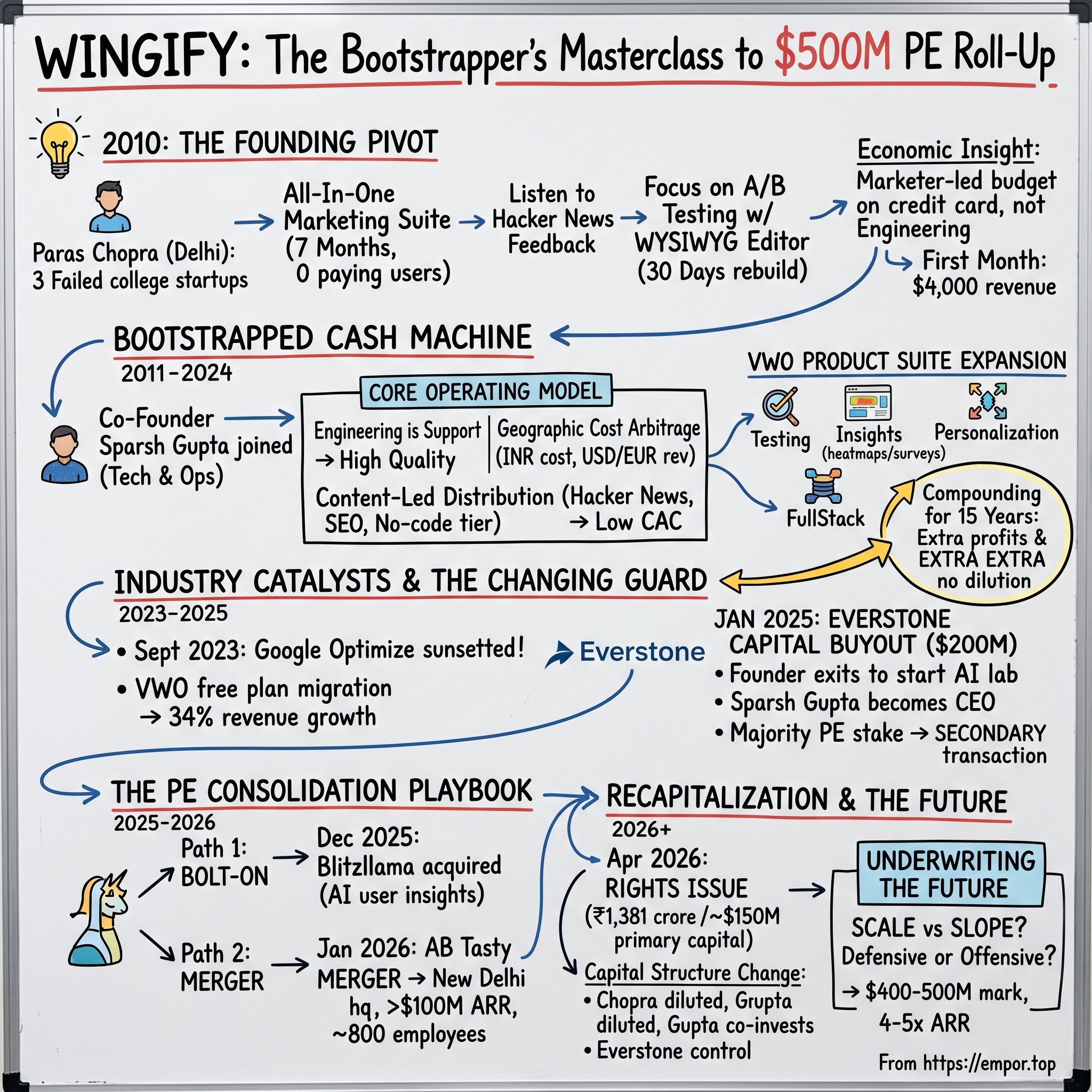
Wingify: The Bootstrapper's Masterclass to $500M PE Roll-Up
I. Introduction & Episode Roadmap (00:00 – 00:10)
In January 2025, a Singapore-headquartered private equity firm wired money to a Delhi software company that had never taken a rupee of outside capital in fifteen years, and bought most of it. The price attached to the transaction was roughly $200 million.1 The founder, Paras Chopra, had owned about 71% of the business going in.1 He sold the bulk of that position, kept a minority stake and a board seat, and walked away from operations to start an AI research lab.12 There was no venture syndicate to satisfy, no preference stack to clear, no ratchet to negotiate around. There was one man's cap table, one co-founder's, and a wire.
That is an unusual way for a software company to arrive at an institutional owner, and it is the reason Wingify is worth underwriting carefully rather than admiring from a distance. Almost every pre-IPO software story an investor is asked to price carries fifteen years of accumulated venture structure: seed notes, participating preferred, pay-to-play provisions, secondary sales at prices that never appeared in a press release. Wingify carried none of it. What it carried instead was a fifteen-year audited record of cash profits — the rarest artifact in private software — and a single, brutally concentrated product franchise that was, by 2025, growing into a market whose own vendors describe as close to saturated.3
The hook is genuinely good: a 22-year-old engineering graduate in New Delhi, working from his parents' house after three failed college startups, builds an all-in-one marketing suite in seven months, launches it, and acquires exactly zero paying customers.4 He listens to the fifteen or twenty people who bothered to give feedback on Hacker News, throws away nearly everything, and rebuilds one feature — A/B testing with a visual editor — in thirty days.4 He sets a target of ₹50,000 a month, roughly $1,000, which is what a decent Indian engineering job paid at the time. The first month of paid plans brings in about $4,000. Eighteen months later the business is at $1 million in annual recurring revenue.4
Fifteen years later it serves over 6,000 clients across 90 countries and Everstone Capital buys it.1
But the story Empor is here to underwrite is not the bootstrapping story. It is what happened after. Within twelve months of the buyout, Wingify's reported net profit fell 61% even as revenue grew 34%.5 Within thirteen months, Everstone had merged it with its Paris-based rival AB Tasty to form a combined company with more than $100 million in annual revenue, roughly 4,000 customers, about 800 employees across eleven offices, and a private mark of $400–500 million.263 Within fifteen months, Everstone and co-investors put another ₹1,381 crore — about $150 million — into the Indian entity through a rights issue priced at ₹8,590 per share.7
So the underwriting question is not "was Wingify a great bootstrapped business?" It plainly was. The question is whether a private equity firm has assembled, out of two profitable mid-market experimentation vendors in a maturing category, something a public market should eventually pay a premium for — or whether it has assembled scale without slope: two flattening revenue bases stapled together to reach an exit-sized number, financed by an owner who has now put roughly $350 million of cost into an asset marked at $400–500 million.
This episode traces five arcs. First, the origins: the failure of the all-in-one product, the thirty-day pivot, and why the WYSIWYG visual editor was a real product insight and not merely a feature. Second, the bootstrapped cash machine: geographic cost arbitrage, content-led distribution, and the compounding math of a company that never had to raise. Third, the structure of the conversion-rate-optimization industry and what the September 2023 sunset of Google Optimize actually did and did not do for VWO.8
Fourth, the Everstone buyout, the FY25 financial turn, and what can and cannot be established about the capital structure from public records. Fifth, the AB Tasty merger, the roll-up logic, and the honest range of values a disciplined investor would put on the combined entity before any filing exists.
There is no draft red herring prospectus, no S-1, no F-1. Everything below is built from statutory filings reported by Indian financial press, funding announcements, counterparty disclosures, founder interviews, and competitor commentary. Where a number is not public, this piece says so rather than reverse-engineering it.
 Subscribe on LinkedIn
II. The Origins: From All-in-One Failure to the No-Code Pivot (00:10 – 00:30)
Paras Chopra came out of Delhi College of Engineering with a machine learning background and a poor track record as a founder. By his own account he attempted three startups during college, all consumer-facing, all unsuccessful, and the recurring failure was not technical but commercial: he could build things and could not market them.4 He then worked for about eighteen months at a job paying roughly ₹50,000 a month before quitting to work from home for close to a year — his description of that period is a coder's monastery: breakfast, lock the door, code until lunch, code again until night.4
The seven-month product nobody wanted. The first version of Wingify was an ambitious all-in-one marketing suite. It was built in isolation, without customer conversations, and it was launched on Hacker News. It drew fifteen to twenty users and a consistent message: the product was trying to do too many things and was confusing.4 Zero of those users paid.
It is worth pausing on why this matters as evidence about management rather than as a nice anecdote. The failure was diagnostic, not fatal, because the founder treated user feedback as an instruction rather than as noise. The decision that followed — cut everything, keep A/B testing, rebuild — is the single most consequential capital allocation choice in the company's history, made when the capital in question was one person's time. Fifteen years later, when Everstone bought the company, that same discipline showed up as a business with one product line, one buyer persona, and a margin structure that most venture-funded peers never achieved.
Why the visual editor was a real insight. In 2010, running an A/B test on a website meant involving a developer. The incumbent tools — Adobe's Omniture family, Google Website Optimizer — required code changes, deployment cycles, and QA for every variant. If a marketer wanted to test whether a green button converted better than a blue one, the marketer filed a ticket and waited.
VWO's contribution was to collapse that loop. The product loaded the customer's own page inside an editing surface and let a non-technical user click a headline and retype it, swap an image, move an element, and publish the variant. In plain terms: it turned experimentation from a software engineering task into a word-processing task. The technical mechanism is a JavaScript snippet on the page that, at load time, applies the variation's DOM changes before the visitor sees the original — which is also the source of the industry's oldest quality problem, "flicker," the brief flash of the original content before the variant renders.
The economic significance is that the visual editor changed who held the budget. A tool that requires engineering time is bought by engineering. A tool that a marketer can operate is bought by marketing, out of a marketing budget, on a credit card, without an architecture review. That is a distribution advantage disguised as a UI decision, and it is the reason a solo founder in Delhi could sell to companies in the United States without a sales force.
The claim frequently repeated in company and press accounts that this was the world's first WYSIWYG visual editor for A/B testing is a first-mover claim that this piece cannot independently verify from primary sources; what can be established is that it was early, that it was the product's central differentiator, and that the market subsequently adopted the pattern universally — which is itself the strongest evidence that the insight was correct and the weakest evidence that it was defensible.
Distribution without a budget. With no money for paid acquisition, Chopra used two channels. The first was Hacker News, which produced the first cohort of beta users and, more importantly, the feedback that produced the pivot.4 The second was long-form technical writing placed in the publications that web designers and developers actually read — the Smashing Magazine tier of the design press. The posts were educational, not promotional; the author bio carried an invite code to the closed VWO beta. Invitation-gating a free beta manufactured scarcity around a product that had no brand and no reference customers.
This is worth naming precisely because it became the company's permanent operating model. VWO's growth engine has always been content, search, and inbound self-serve trial rather than outbound enterprise sales. That model has a specific economic signature: low customer acquisition cost, low average contract value, high volume, and a long, slow accumulation of organic search authority that competitors cannot buy quickly. It also has a specific ceiling, which becomes the central tension of the second half of this story.
The first month. The stated goal was ₹50,000, about $1,000 a month, matching what a competent Indian engineer earned.4 Paid plans launched and produced roughly $4,000 in month one, which then roughly doubled in the following month.4 The business was profitable essentially from the first invoice, because the cost base was one person and a server bill, and the revenue was denominated in dollars.
That last clause is not incidental. It is the entire model, and it deserves its own section.
The context that made this unusual. It is easy, from 2026, to underrate how strange this was in 2010. India's software industry at the time was overwhelmingly a services industry: the default career for a Delhi College of Engineering graduate was an outsourcing firm or a multinational's captive engineering centre. Product companies selling directly to customers in the United States, priced in dollars, sold self-serve over the internet without a sales office in the buyer's country, were rare enough that the ones that succeeded became reference points for everyone who followed.
Two structural things had just changed and made the model possible. Payment infrastructure had matured to the point where a company in Delhi could take a credit card from a marketing manager in Chicago without either party thinking about it. And the buying process for marketing software had moved online — a marketer with a problem searched, read, trialled, and bought, without a procurement process that would have surfaced the vendor's location as an issue.
Wingify's model was, in effect, an arbitrage on the collapse of geography in software distribution, executed early. The company did not need to be American to sell to Americans; it needed to rank in search results and to have a product a marketer could operate without help. That is the whole strategy, and it explains why the content-marketing engine was never a side activity — it was the sales organization.
What this founding period does and does not prove. It proves product judgment, capital discipline, and an unusually good instinct for where distribution was going. It does not prove the things a public-market investor most needs proven: that the company can sell to enterprises through a quota-carrying sales force, that it can retain customers when a well-funded competitor undercuts it, or that it can manage a large organization across cultures. Those capabilities were never tested during the bootstrapped era, because the bootstrapped model was specifically designed to avoid needing them. They are being tested now, under a new owner, and the FY25 accounts are the first data from that experiment.
III. Scaling the Bootstrapped Cash Machine (00:30 – 00:55)
The co-founder. Sparsh Gupta, a former classmate, joined in 2011 and took over technology and operations, which freed Chopra for product, research, and growth.4 The division held for well over a decade and matters to the underwriting for a reason that only became visible in 2025: when the founder-owner sold and left, the operating half of the founding pair stayed and became CEO of both Wingify and, later, the merged entity.12 A great many founder-led companies cannot survive the founder's exit because the founder was the operating system. Wingify could, because the operating system was the other person. Ankit Jain, also described in merger coverage as a Wingify co-founder, became chief product and technology officer of the combined company.2
Geographic cost arbitrage, stated plainly. Wingify sold dollar- and euro-denominated software to customers in the United States and Europe and paid engineering, support, and product salaries in rupees in New Delhi. At the time of the Everstone deal, roughly 99% of customers were outside India,4 and after the merger about 90% of combined revenue came from the US and Europe.2 Pricing ranged from a free tier to enterprise plans in the region of $70,000, with published self-serve tiers scaling by monthly tracked visitors — third-party pricing analyses in 2026 put entry paid plans in the low hundreds of dollars per month, with 50,000-visitor configurations spanning zero to roughly $1,948 per month depending on modules.19
The arbitrage is real but it is not magic, and an underwriter should be precise about what it does. It does not raise gross margin much — hosting and delivery costs are broadly similar for everyone. It compresses operating expense, specifically R&D and support headcount cost per unit of output. For a product company whose largest cost line is people, that is the difference between a 25% operating margin and a 5% one at the same revenue. Wingify's FY24 numbers show what the arbitrage looks like when it is left alone: about ₹288 crore of operating revenue and ₹61 crore of net profit, a net margin above 21%, on total expenses of about ₹221 crore.5
The customer-obsession engine, and its limits. Without a sales organization, Wingify relied on product-led growth and word of mouth. Engineers handled support directly, which is a genuine mechanism for product quality rather than a slogan — the person who has to answer the ticket is the person who can fix the cause. The company's practice of hand-writing thank-you notes to early international customers has become part of the founding lore.
An investor should treat the loyalty claim as partially proven. The proof that exists is durability: fifteen years of growth, over 6,000 clients across 90 countries by 2025, and profitability throughout.1
The proof that does not exist is the one that matters most in software: net revenue retention. Wingify has never publicly disclosed NRR, gross churn, expansion rate, or cohort behavior. For a mid-market SaaS business with a self-serve funnel, this is the single most important missing number, because self-serve mid-market products characteristically churn at rates that enterprise products do not. A company can grow revenue 34% with mediocre retention if new-logo acquisition is strong, and a company can grow 10% with superb retention. Those are entirely different assets, and from the public record it is impossible to tell which one this is.
The suite. VWO expanded from a single testing tool into a stack: VWO Testing (A/B, multivariate, split-URL), VWO Insights (heatmaps, session recordings, on-page surveys, funnel analysis), VWO Personalization (behavioral targeting), and VWO FullStack (server-side experimentation, mobile testing, feature flagging).
The strategic logic of the suite is straightforward — each additional module raises average contract value and adds another integration the customer must unpick to leave. The strategic risk is equally straightforward: each module puts VWO into a fight with a specialist. Heatmaps and session replay compete with Hotjar, Contentsquare, and Microsoft Clarity, the last of which is free. Feature flagging competes with LaunchDarkly, Statsig, and open-source GrowthBook. Suite breadth in software is usually a defensive move dressed as an offensive one.
Revenue quality, examined properly. The right unit of analysis for this business is subscription software economics, and the public record supports only a partial reconstruction.
What is established: revenue is recurring subscription revenue billed against monthly tracked visitors, sold on published tiers running from a free or trial entry point through self-serve plans in the low hundreds of dollars per month to enterprise agreements around $70,000.19 Revenue is essentially all foreign currency — 99% of customers outside India before the buyout, roughly 90% of combined revenue from the US and Europe after the merger.24 The customer count of over 6,000 clients across 90 countries at the time of the Everstone deal, against roughly ₹288 crore of FY24 revenue, implies an average revenue per customer of around ₹4.8 lakh, or roughly $5,700 a year.15
That average is the most revealing derived number in the whole exercise. A $5,700 average contract value is a mid-market and SMB business, not an enterprise one, whatever the logos on the customer page suggest. The Disney and Forbes accounts are real,2 and they are the tail of a distribution whose mass sits in the low thousands of dollars. Three consequences follow. Customer concentration risk is structurally low, which is a genuine strength — no single account can break the P&L. Churn risk is structurally high, because small contracts renew on short cycles and are cancelled without a committee meeting. And the cost of moving this base upmarket is exactly what Everstone is now paying for in the employee benefit line.
What is not established, and matters: net and gross revenue retention, cohort behavior by vintage, customer acquisition cost, CAC payback period, the split of revenue between self-serve and sales-assisted channels, contract duration, and the proportion of revenue under multi-year commitment. None of it has been disclosed. For a company whose entire thesis rests on the durability of a mid-market subscription base, that is the gap that a filing must close before any responsible valuation is possible.
One inference can be drawn about acquisition cost. FY25 advertising expense was ₹22 crore against ₹386 crore of revenue — under 6% of revenue.5 Even allowing that a portion of go-to-market cost sits inside the ₹257 crore employee line rather than in advertising, a company spending single-digit percentages of revenue on paid marketing while growing 34% is a company whose demand is arriving largely for free. That is the content-and-search engine built over fifteen years still working, and it is the most economically valuable thing Wingify owns that does not appear on its balance sheet.
The compounding math. By FY24 the business generated ₹288 crore of operating revenue and ₹61 crore of profit after tax with no external debt and no equity dilution, the equity split between Chopra at roughly 71% and Gupta.15 Compounding at that structure for fifteen years produces an owner outcome that no venture-backed path could match: the founders kept all of it.
There is a second-order point about capital intensity that deserves stating, because it distinguishes this asset from most pre-IPO software. Wingify required essentially no invested capital. There is no capex programme, no working capital drag of consequence — subscription software is typically billed in advance, which means deferred revenue funds operations rather than consuming cash — and no debt service. Return on capital employed was 7.42% even in the compressed FY25 year.5 For a business with almost no capital employed, that ratio is more a commentary on the equity base after the transaction than a measure of operating quality; in FY24, with the same near-zero capital base and ₹61 crore of profit, the underlying capital efficiency was extraordinary.
Free cash flow conversion in such a model is usually close to, or above, accounting profit. The company has never published a cash flow statement publicly, so this is inference from structure rather than observation.
But the same math contains the constraint that eventually forced a sale. A company that funds growth only from operating cash flow cannot buy market share. It cannot build a 200-person enterprise sales organization in North America in a year, cannot outspend a competitor through a downturn, and cannot acquire a rival. Wingify's discipline was also its ceiling, and by the time the founder was ready to move on, the fastest route to the next level of scale required somebody else's balance sheet.
IV. The CRO Industry Structure & The Google Optimize Catalyst (00:55 – 01:15)
Conversion rate optimization sits in an awkward place in the software stack. It is not a system of record — nobody's transactions live in it. It is not infrastructure. It is a measurement and intervention layer that sits on top of a website and tries to make the existing traffic worth more. That position determines almost everything about the industry's economics: budgets are discretionary, buyers are marketing and product rather than IT, and the value proposition must be re-proven each renewal cycle against a number the customer can compute themselves.
The segments. At the top of the market sits Adobe Target, sold as a component of Adobe Experience Cloud. Adobe rarely competes on the merits of the testing product; it competes on the fact that the customer has already signed an eight-figure Adobe agreement and Target arrives inside it. That is bundling power, and it is close to unassailable in the Fortune 500.
Adjacent to Adobe sits Optimizely, the venture-backed pioneer that defined the category in the early 2010s. Optimizely was acquired by Episerver in 2020, itself backed by Insight Partners since 2018, took the Optimizely name, and rolled up content marketing (Welcome) and commerce (Insite Software) into a broader digital experience suite.10
By May 2024 the combined entity announced it had crossed $400 million in ARR, serving over 10,000 businesses, with 52% of ARR coming from customers using multiple products and the multi-product segment growing 21% year over year.10 That is a genuinely large business — roughly four times the size of the merged Wingify–AB Tasty entity — but its center of gravity has moved from experimentation to content and commerce management. Optimizely also abandoned the transparent self-serve pricing that made it famous, moving to quoted enterprise contracts.
In the middle sat the two companies that would eventually merge: VWO, strongest in the mid-market and among self-serve buyers, with roughly 60% of revenue from the US and a meaningful European presence in Germany, Southern Europe, and the Nordics; and AB Tasty, the Paris-based European leader with roughly 70% of revenue from Europe, concentrated in France and the UK, selling primarily to large enterprises with an e-commerce orientation.6
AB Tasty had raised roughly $64 million in total venture funding through a $40 million Series C in July 2020 led by Crédit Mutuel Innovation with Korelya Capital, Omnes, Partech, and XAnge participating.11 Third-party revenue estimate databases put AB Tasty's 2025 revenue in the high-$30-million range with a headcount around 350, though such databases are unaudited and their figures for the same company frequently conflict by a factor of two; they should be treated as directional only.12
Then there is the developer-led wing of the market — Statsig, PostHog, GrowthBook, Eppo — where experimentation is delivered as a feature of a product analytics or engineering platform rather than as a marketer's tool. This is the segment that has attracted the strategic capital, and its pricing behavior is the most dangerous fact in this entire industry structure. PostHog and GrowthBook include experimentation in a broader product for a price that a marketing-tools vendor cannot match. Microsoft Clarity gives away heatmaps and session replay. When capabilities that were once a product become a feature of somebody else's product, the standalone vendor's pricing power erodes regardless of how good the standalone product is.
Kameleoon and Convert.com round out the direct peer set — both smaller, both specialists, and Convert in particular has publicly positioned itself as the vendor that will not migrate upmarket, explicitly courting the $1–10 million revenue customers it expects the consolidated platforms to price out.3 That a competitor sees the merger as an opportunity to pick up abandoned accounts is a data point about integration risk worth holding onto.
The Google Optimize event. On 30 September 2023, Google discontinued Google Optimize and Optimize 360, ending all active experiments and personalizations on that date, and stated that the product lacked features and services customers needed for experimentation testing; Google instead opened APIs so third-party tools could integrate with Google Analytics.8 Google Optimize had been free, which is why it was installed on an enormous share of sites — the frequently cited figure of over 80% market share by site volume reflects installation counts on a free product, not revenue share, and the two are not remotely the same thing.
VWO's response was fast and correct in structure: a free VWO Testing Starter plan supporting up to 50,000 monthly tested visitors, aimed explicitly at Google Optimize users, together with one-click migration tooling that carried across page patterns, targeting conditions, editor variations, goals, and traffic splits, plus a dedicated migration support team.13
An underwriter should be careful about how much credit to assign here. The migration wave was real, and it plausibly contributes to the 34% revenue growth Wingify posted in FY25.5 But the population being migrated was, by definition, a population that had chosen the free option. Converting free users of a free product into paying customers of a paid product is the hardest conversion in software, and the honest read is that Google Optimize's sunset delivered VWO an enormous top-of-funnel at very low cost, of which some unknown fraction monetized.
Notably, by late 2025 VWO had substantially tightened that free tier, restricting or retiring the "free forever" plan in many regions in favor of a 30-day full-feature trial.9 That is what a company does when it has finished harvesting a funnel and needs the revenue — a rational move, and also a quiet admission that the free tier's marketing value had been largely extracted.
The addressable market, sized with restraint. Vendors in this category habitually quote the "digital experience platform" market at figures in the tens of billions of dollars. That number is not the market Wingify sells into. It includes content management, commerce, personalization engines, customer data platforms, and marketing automation — categories owned by Adobe, Salesforce, and Optimizely's suite business, and largely inaccessible to a specialist selling a testing tool to a growth marketer.
The reachable market is narrower and can be bounded from the company's own economics. The relevant buyer is an organization with enough web traffic that a percentage-point conversion improvement pays for the software, enough sophistication to run experiments, and a budget owner in marketing or product.
At an average contract value near $5,700, capturing that customer profitably requires low-touch acquisition, which in practice means English-language inbound demand in North America and Western Europe — precisely where 90% of revenue already comes from.2 The competitor estimate of a roughly $1 billion website-testing segment growing around 10% a year is the more honest frame for the core business, and on that frame a combined $100–120 million entity already holds around 10% of its own category.263
That share figure cuts both ways. It means the merged entity is genuinely a leader in the segment it occupies. It also means the easy growth is behind it: doubling revenue inside the core segment would require taking share to roughly 20% of a slow-growing market against Optimizely, Adobe, Kameleoon, and free substitutes, and the competitive response to that attempt would be immediate and price-based. Growth beyond the core therefore has to come from expanding what the product is — server-side experimentation, feature management, AI-driven personalization — which puts the company into segments where developer-tools vendors already have the account relationship. That is a harder market to enter than the one it currently leads.
The deeper structural point is the one Convert.com's own analysis makes: the website-focused A/B testing segment is roughly a $1 billion market growing around 10% a year, with acquisition getting more expensive and slower, and an analyst view that the total addressable market for web experimentation is close to tapped.3 That assessment comes from an interested party — a competitor explaining why consolidation is happening — and should be discounted accordingly. But it is directionally consistent with everything else visible: the incumbents are moving upmarket and into adjacent categories, the pure-plays are merging, and the growth capital in the category is flowing to the developer-tools wing rather than the marketer-tools wing.
V. The Everstone Buyout: Changing of the Guard (01:15 – 01:35)
The transaction. In January 2025, Everstone Capital acquired a majority stake in Wingify in a transaction reported at approximately $200 million.1 Everstone is the private equity arm of the Everstone Group, headquartered in Singapore with offices in India, London, New York, Mauritius, and the UAE, with a technology practice that includes Everise, Apexon, Omega Healthcare, Servion, Acqueon, and Innoveo.1415 Everstone's own framing of the thesis was that Wingify was "among a select set of highly profitable software companies emerging out of India that have carved a leading position globally," with over $50 million in ARR, attractive margins, and high profitability.114 AZB & Partners and Trilegal acted on the transaction.16
Chopra's public statement at the time was a handover rather than a valediction: confidence that "Sparsh and the Everstone team possess the expertise and vision to lead the business through its next phase of success."1 He retained a minority stake and a board seat, and moved on to found Lossfunk, an AI research lab focused on efficient reasoning models, explicitly positioned as curiosity-driven research rather than a product company.17
What the $200 million figure does and does not tell you. This is where price and value must be separated carefully.
First, the reported $200 million was attached to the acquisition of a majority stake, and public reporting does not consistently distinguish between the consideration paid and the implied valuation of 100% of the equity.1 If $200 million was the price for approximately 76.8% of the company, the implied whole-company equity value would be closer to $260 million. If $200 million was the enterprise valuation of the whole business with a proportionate amount paid for the stake acquired, the number means something quite different. The public record does not resolve this, and any analysis that treats $200 million as a precisely defined valuation of the whole company is overreaching.
Second, this was overwhelmingly a secondary transaction. Chopra was selling. Money went to the founder, not into the company. That distinction is fundamental: a secondary purchase price tells you what one buyer would pay one seller for control at one moment. It tells you nothing about the capital the business needs, and it does not create the cash cushion that a primary round would.
Third — and this is the unusual, favorable feature of Wingify relative to almost every venture-backed pre-IPO company — there is no known preference stack sitting above the common equity from the bootstrapped era. Fifteen years of no outside capital means fifteen years of no liquidation preferences, no participating preferred, no anti-dilution ratchets, no pay-to-play, and no accumulated side letters from a 2021-vintage crossover round that has to be cleared before common shareholders see a dollar.
What terms Everstone negotiated for its own 2025 and 2026 positions — preference, drag-along, tag-along, veto rights, board composition, ratchet protection on a future listing — are not disclosed. In the absence of that disclosure, an investor should assume a control PE holder negotiated meaningful downside protection and governance rights, and should treat the absence of published terms as an information gap rather than as evidence of clean common-only capitalization.
Shareholding as of 31 March 2025. Per statutory filings reported in Indian financial press: Everstone Capital 76.84%, Paras Chopra 10.45%, Vyom Mankekar 5.07%, and CEO Sparsh Gupta 4.86%, with the balance among other holders.7 Those four named positions account for 97.22%; the residual 2.78% is not itemized in public reporting.
The presence of the Mankekar family — Vyom Mankekar at 5.07%, with Shivanand Mankekar, Jt. Laxmi Mankekar, and Kedar Mankekar also identified as participating shareholders in the later rights issue — is a detail worth flagging.7 The Mankekars are well-known Indian public-market investors. Their participation alongside a control PE sponsor in an unlisted company is an ordinary co-investment arrangement, but the terms on which they entered, and whether their economics differ from Everstone's, are not disclosed. For a future filing, the diligence item is whether any shareholder holds rights not shared with the class as a whole.
The FY25 financial turn. Wingify's statutory results for the year ended 31 March 2025 tell a story that looks alarming on the headline and is more nuanced underneath.
Operating revenue rose 34% to ₹386 crore from ₹288 crore. Non-operating income added ₹15 crore, bringing total income to ₹401 crore against ₹301 crore the prior year. Total expenses ballooned 70% to ₹376 crore from ₹221 crore. Net profit fell 61% to ₹24 crore from ₹61 crore. EBITDA margin collapsed to 3.68% from a materially higher prior-year level, and ROCE fell to 7.42%. The cost to generate one rupee of operating revenue rose from ₹0.77 to ₹0.97.5
The driver is unambiguous and sits in one line. Employee benefit expenses rose 88% to ₹257 crore from ₹137 crore, accounting for 68% of total costs.5 Legal and professional charges rose 26% to ₹48 crore, and advertising rose 57% to ₹22 crore.5
Reading the employee cost line honestly. A ₹120 crore year-on-year increase in employee cost against a ₹98 crore increase in revenue is not a normal hiring ramp. Three things are plausibly bundled inside it, and public reporting does not separate them: transaction-related payouts to employees at the change of control, ESOP buybacks or accelerated equity settlements, and genuine new hiring in global sales and go-to-market as Everstone repositions the company upmarket.
There is a corroborating signal in the tax line. Total income of ₹401 crore less total expenses of ₹376 crore implies profit before tax of about ₹25 crore against reported profit after tax of ₹24 crore — an effective tax rate near zero.5 In FY24 the equivalent arithmetic implies pre-tax profit around ₹80 crore against ₹61 crore reported, an effective rate in the mid-twenties, which is normal for an Indian company.5
A one-year collapse in effective tax rate is highly consistent with large deductible one-time employee compensation charges — ESOP perquisite deductions in particular — rather than with a deterioration in the underlying business. The ₹48 crore legal and professional line, up 26% in a year when the company completed a change-of-control transaction and prepared a cross-border merger, points the same direction.
This is the charitable reading, and it is probably the right one. The uncharitable reading is available too, and an underwriter should hold both: it is also entirely consistent with a PE sponsor front-loading investment in an expensive Western sales organization, in which case ₹257 crore of employee cost is not a one-time distortion but the new run-rate, and the 21% net margin of FY24 is gone permanently rather than temporarily.
Which reading is correct is the most important open question in this entire underwriting, and it is not answerable from public data. The FY26 statutory accounts — covering the year ended 31 March 2026, which will include the AB Tasty merger period — are the first document that will settle it. If employee cost normalizes toward a growth-adjusted level and EBITDA margin recovers toward the high teens, the FY25 compression was transaction noise. If employee cost stays near 65–70% of total spend and margin stays in mid-single digits, then the pre-buyout margin structure was a bootstrapped artifact that could not survive contact with a growth mandate.
Balance sheet. Current assets stood at ₹216 crore including ₹97 crore of cash and bank balances at year end.5 There is no reported external debt, consistent with the company's history. That is a comfortable but not enormous cushion — roughly three months of the FY25 expense base — and it is a partial explanation for why a ₹1,381 crore primary infusion followed a year later.
Governance and management, judged on behavior. An investor gets three pieces of usable evidence about how this management team behaves, and all three predate any obligation to impress public shareholders.
The first is the founder's own capital allocation record. Chopra ran a business for fifteen years without raising outside money, which means every rupee of growth investment was a decision to forgo distributable profit. He set a $1,000-a-month goal and built to $50 million of ARR without ever announcing an inflated target he then missed, because he never announced one. When he decided he was finished operating, he sold control rather than staying on as a diminished chairman, and he said so plainly.1
There is no record here of promises made to investors and quietly abandoned — largely because there were no investors to make them to. That is favorable evidence, but it is also thin evidence for the specific question a public shareholder cares about, which is how management behaves under quarterly scrutiny. Nobody at this company has ever been tested that way.
The second is the succession. The operating co-founder became CEO of the acquired company and then CEO of the merged entity, and the technical co-founder became chief product and technology officer of the merged group.2 A sponsor that intended to replace management would not have done this. That Everstone kept both is a statement of confidence, and it also means the merged entity's cultural centre of gravity remains Indian and engineering-led even as its revenue is Western and sales-led — an unresolved tension rather than a settled fact.
The third is the board. Five to six seats, Everstone holding majority control and board rights, three to four independent directors.2 On paper that is a reasonable independence ratio for a sponsor-controlled private company. What matters for a future public shareholder is whether those independents are genuinely independent of the sponsor and whether the control structure survives a listing — in particular, whether Everstone would list with a controlling stake and dual-class or contractual governance rights that outlast its economic majority. None of that is disclosed, and the honest position is that a minority public shareholder in a sponsor-controlled listing is structurally junior in influence regardless of what the share class says.
Insider selling and alignment. Chopra sold the bulk of his position in 2025 and appears not to have participated in the 2026 rights issue.17 That is a founder monetizing and moving on, not a governance red flag, but it does mean the person most identified with the brand has minimal remaining economic alignment. Gupta, by contrast, held 4.86% after the buyout and put fresh money into the rights issue,7 which is the alignment signal that actually matters — the operator increasing exposure at the sponsor's price. Executive compensation, equity incentive design, and any option or RSU pool at the group level are not disclosed, and cannot be inferred from the Indian entity's aggregated employee benefit line.
VI. The PE Consolidation Playbook: Roll-Ups and Cross-Border Mergers (01:35 – 01:55)
Everstone moved quickly, and in a recognizable sequence: buy the platform, bolt on a capability, merge the geography, then recapitalize.
Step one: the AI wedge. In December 2025, Wingify acquired Blitzllama, an AI-powered user insights platform, in an all-cash transaction for an undisclosed amount.18 Blitzllama was founded in 2021 by Rahul Mallapur, Joel Koshy, and Bently Nixon, went through Y Combinator's Winter 2022 batch, and was backed by 2am VC among others; its product collects and analyzes customer feedback in real time, and its customers were to be migrated onto the VWO platform.18
This is a small transaction with strategic rather than financial significance. A Y Combinator company founded in 2021 and sold four years later for cash is, in almost all cases, a modest outcome — the price was not disclosed and the reasonable presumption is that it is immaterial relative to a $500 million platform. What it buys is a defensive answer to the most credible bear argument: that AI-native tools will make manual experimentation obsolete. Folding automated qualitative research into VWO Insights is a sensible response. Whether it is a sufficient one is a question about product execution over the next two years, not about the acquisition itself.
Step two: the merger. On 20 January 2026, Everstone announced the combination of Wingify and AB Tasty.2 The combined entity: more than $100 million in annual revenue, over 4,000 customers, approximately 800 employees across eleven offices with roughly 350 outside India, headquartered in New Delhi, with approximately 90% of revenue from the US and Europe.2 Wingify contributed over 3,000 brands including Forbes, Walt Disney, Amway, Hilton Vacations, TAP Portugal, and Cigna; AB Tasty contributed over 1,000 brands including L'Oréal and Samsonite.2 Both companies were profitable before the merger.2
Leadership: Sparsh Gupta as CEO, Ankit Jain as chief product and technology officer, AB Tasty co-founder Rémi Aubert as chief customer and strategy officer, and co-founder Alix de Sagazan as chief revenue officer.2 The board was structured at five to six seats with Everstone retaining majority control and board rights alongside three to four independent directors.2 Gupta stated explicitly that no layoffs were planned as part of the merger.2
The integration approach disclosed was deliberately gradual: both platforms operate independently at first, with capabilities merged progressively over multiple quarters through 2026.6
Step three: the recapitalization. On 6 April 2026, Wingify filed for a rights issue of 16,08,199 equity shares at ₹8,590 per share, raising ₹1,381 crore, approximately $150 million.7 Everstone Capital led with ₹1,250 crore (about $135 million), Vyom Mankekar contributed ₹84 crore, and the remainder came from existing shareholders including Shivanand Mankekar, Jt. Laxmi Mankekar, Kedar Mankekar, and CEO Sparsh Gupta.7
The stated purpose was to support the VWO–AB Tasty combination and build a scaled digital experience optimization platform with expanded presence in the US and Europe.7 Competitor analysis of the deal suggests roughly $100 million of the infusion went primarily to buying out AB Tasty's existing venture shareholders rather than funding operations.3
Reading the rights issue as a capital structure event. Several things follow from this filing that a careful investor should extract rather than skim past.
The instrument matters. This was a rights issue of equity shares, not preferred, at a single price of ₹8,590 per share.7 A rights issue is offered pro rata to existing holders, which means it is not, on its face, a dilutive down-round mechanism aimed at minority holders. But participation was not proportional: Everstone contributed about 90.5% of the money while holding 76.84% of the equity going in.7 Anyone who did not fully take up their entitlement was diluted. Chopra, at 10.45%, is not listed among the participating shareholders in the reported filing, which — if the reporting is complete — implies his position was diluted by this round. That is worth noting for what it says about the founder's forward-looking posture: he has moved on.
The share price is disclosed; the share count is not. This is the crux of the capital structure problem. ₹8,590 per share is a hard, filed number. To convert it into an implied equity valuation, one needs the total shares outstanding after the issue, and that figure has not been reported publicly. 16,08,199 new shares at ₹8,590 is ₹1,381 crore of new money; if the pre-issue count were, say, 3 million shares, the post-issue count would be about 4.6 million and the implied post-money equity value would be roughly ₹3,960 crore, or about $445 million — squarely inside the reported $400–500 million range.
But the pre-issue share count is an assumption, not a disclosure. The honest statement is that the implied valuation cannot be calculated from public records, and that the $400–500 million figure circulating in press coverage should be treated as a reported market observation rather than as a computed result.63
The enterprise value cannot be bridged either. Cash at the Indian entity was ₹97 crore at 31 March 2025, before the ₹1,381 crore came in and before whatever portion of it left again to buy out AB Tasty's investors.573 AB Tasty's own balance sheet, any acquisition debt at a holding-company level, and the legal structure of the combined group are not disclosed. Any comparison between a private mark and a public company's EV/revenue multiple therefore mixes bases, and this piece will not make one.
What the merger structure does not disclose. Cross-border combinations of this type raise a specific set of questions that public reporting has not answered, and each is a live diligence item rather than a rhetorical flourish.
The legal architecture is unclear. Whether AB Tasty sits as a subsidiary of the Indian entity, whether both sit under a common offshore holding company, or whether the arrangement is contractual pending a formal amalgamation, is not disclosed. This determines which set of accounts an investor should read, and whether the Indian filings that this analysis relies on will continue to represent the whole group or only part of it.
The consideration paid for AB Tasty is not disclosed. Competitor analysis suggests roughly $100 million of the $150 million infusion went to buying out AB Tasty's shareholders,3 which would be a modest outcome relative to the $64 million of venture capital raised through 202011 — respectable, but not the return its investors were underwriting in a 2020 Series C. If accurate, it also implies the merged entity's value is weighted toward the Wingify side.
The accounting treatment matters and is unknown. A cash acquisition of this size will generate goodwill and identifiable intangibles, and the amortization of those intangibles will depress reported profit for years without affecting cash. Any future presentation of "adjusted EBITDA" that excludes amortization of acquired intangibles is making an economically defensible adjustment; one that also excludes integration costs, retention bonuses, and stock compensation is not. The habit of adding those back is where pre-IPO software companies most reliably overstate their earnings power, and it should be watched for.
Currency exposure is now structural. Revenue is dollar- and euro-denominated, the majority of headcount is rupee-denominated, and a large minority of payroll is euro- and dollar-denominated. Whether the group hedges, and on what horizon, is not disclosed. A sustained rupee appreciation would compress the central cost advantage this entire thesis rests on.
Employee equity is entirely opaque. The Indian entity's ₹257 crore employee benefit line aggregates cash and equity compensation with no split.5 Whether there is a group-level option or RSU pool, its size, its strike prices, and the dilution it implies are unknown. This is the single largest gap in any attempt to build a fully diluted share count, and it is the reason this piece has declined to compute one.
The roll-up logic on its merits. Two arguments support the combination, and both are legitimate.
The first is R&D cost arbitrage. If product development consolidates onto the New Delhi engineering base while AB Tasty's French, wider European, and US enterprise sales teams remain, the combined entity gets Western go-to-market coverage on an Indian engineering cost structure. That is a genuine, durable margin advantage over Optimizely and Adobe, neither of which can restructure its cost base that way. It is also the single most credible path from FY25's 3.68% EBITDA margin back toward a 20%+ target.
The second is geographic and segment complementarity. VWO indexes to the US mid-market in media, software, and travel; AB Tasty indexes to European enterprise e-commerce.6 Overlap in customer base should be low, which means the merger adds revenue rather than cannibalizing it, and each side gains a distribution channel into the other's territory. AB Tasty also brings GDPR-native European positioning that matters to European enterprise buyers in a way US-headquartered competitors struggle to replicate.
And the honest counterargument. Gupta's "no layoffs" commitment is good for morale and bad for the cost synergy case.2 Roll-ups create value in two ways: revenue synergy, which is slow and uncertain, and cost synergy, which is fast and usually involves headcount. Committing publicly to neither reducing headcount nor consolidating quickly — the disclosed plan runs both platforms independently for multiple quarters6 — means the near-term financial profile is two cost bases and one revenue base. Double maintenance of two separate testing platforms, two JavaScript delivery stacks, two data models, and two support organizations is expensive. The margin expansion thesis depends on an eventual platform consolidation that has been explicitly deferred.
The multiple expansion argument, stress-tested. The stated PE logic is that a mid-market SaaS asset at $45 million ARR trades at 4–5x revenue, while a global leader at $100 million+ ARR with enterprise capability and geographic diversification commands more. Competitor analysis puts the merged entity's $400–500 million mark at 4–5x combined ARR — which is to say, the same multiple, applied to a bigger number.3
That is the whole trade, stated plainly. Everstone has spent approximately $200 million plus $150 million, roughly $350 million of gross cost, to assemble an asset marked at $400–500 million. Some portion of that $150 million went to selling AB Tasty shareholders rather than into the business, so the marks are not perfectly comparable, and the cost basis calculation depends on the unresolved question of what the $200 million actually bought. But the order of magnitude is clear: at today's mark, the sponsor is not sitting on a large paper gain. The return has to come from what happens next — organic growth, margin recovery, and multiple expansion at exit — and none of the three is yet evidenced.
A scenario framework, held loosely. With no filing, no disclosed share count, no NRR, and no combined audited P&L, a discounted cash flow here would be false precision. What can be done is to state what different futures imply, using the disclosed anchors: roughly $100–120 million of combined revenue,26 a category growing around 10% annually,3 and a target EBITDA margin in the 20%+ range implied by the pre-buyout Wingify structure.
In a consolidation-works case, the merged entity grows revenue at low double digits by taking share from Optimizely's neglected mid-market and from displaced Google Optimize users, consolidates onto one platform by 2027, and restores EBITDA margin to 20–25% on the strength of Indian R&D cost. That produces roughly $25–35 million of EBITDA on $130–150 million of revenue within two to three years — a business that could plausibly support a mark meaningfully above today's, and that a public market would price on profitable-software comparables rather than growth-software comparables.
In a scale-without-slope case, organic growth settles at high single digits because the category is genuinely tapped, integration consumes 2026 and 2027, margin recovers only to low double digits because the enterprise sales investment is permanent, and the asset trades at a multiple appropriate to a slow-growth profitable software business — which is well below 4x revenue. In that world, today's mark is the ceiling, not the floor.
In a disruption case, AI-native optimization erodes the manual testing paradigm faster than the incumbent can adapt, growth turns negative in the self-serve base first, and the value converges toward what the enterprise contracts alone are worth.
The distance between those outcomes is the honest answer to "what is Wingify worth," and it is wide. A single number would be a fiction.
The path to durable profitability, reconstructed line by line. It is worth walking the income statement forward rather than asserting a margin target, because the arithmetic reveals exactly what has to happen.
Start with gross margin, which the Indian filings do not report separately but which can be bounded. Subscription software of this type — JavaScript delivery, data collection, storage of session and experiment data, and report generation — typically runs gross margins in the high seventies to high eighties once hosting, delivery, and the customer-facing portion of support are charged to cost of revenue. Session recording and heatmap products sit at the lower end of that band because they store far more data per visitor than A/B testing does. Nothing in the public record suggests Wingify is unusual either way, and this piece treats gross margin as an estimate, not a disclosure.
Then the operating expense stack. FY25's ₹376 crore of total expenses breaks down into ₹257 crore of employee cost, ₹48 crore of legal and professional charges, ₹22 crore of advertising, and roughly ₹49 crore of everything else.5 Two of those lines should not recur at that level. The legal and professional charge is inflated by a change-of-control transaction and cross-border merger preparation. A meaningful but unquantified portion of the employee cost is transaction payouts and equity settlement rather than payroll, as the near-zero effective tax rate implies.
Suppose, conservatively, that ₹60–80 crore of FY25's cost base was genuinely one-time. Normalized FY25 expenses would be roughly ₹296–316 crore against ₹386 crore of revenue, implying a normalized operating margin somewhere in the 18–23% range — which is approximately where FY24 sat. That is the arithmetic case that the FY25 collapse was noise. It rests on an assumption about a split that has not been disclosed, and it should be held as a hypothesis to be tested against the FY26 accounts, not as a finding.
Now the harder question, which is what the merged entity's cost structure looks like. Roughly 350 of about 800 employees are outside India.2 If Western headcount is 44% of the total and Western salaries run several multiples of Indian ones, then the majority of the combined payroll is Western even though the majority of the headcount is not. The Indian cost advantage applies to engineering and support, not to the French and American sales organizations that generate the revenue. That materially dilutes the arbitrage relative to standalone Wingify, and it means a 20%+ EBITDA margin for the combined group is a harder target than the pre-buyout Wingify precedent suggests.
The reinvestment and capital requirements are, by contrast, modest. Capex is negligible in this model. Working capital is favorable, because annual subscriptions billed in advance generate deferred revenue. The Indian tax rate is roughly 25% in a normal year.5 The company has no debt to service. Once the one-time costs clear, this business should convert operating profit into free cash flow at a high rate — which is why it was attractive to a sponsor in the first place, and why the financing need in 2026 came from an M&A programme rather than from operations.
What would falsify the profitability path. Three observations would each be sufficient. Employee benefit expense remaining at 65–70% of total costs in FY27, two full years after the transaction, would establish the cost base as permanent. A second consecutive year of legal and professional charges near ₹48 crore would suggest the integration is consuming more than expected. And revenue growth decelerating below the category's roughly 10% rate while sales headcount continues rising would indicate that the upmarket push is buying revenue at a price that never earns its cost of capital.
The peer set, constructed carefully. The genuinely comparable operating peers are the specialists that sell experimentation and personalization to marketing and product buyers: Kameleoon, Convert.com, and, before the merger, AB Tasty itself. Almost all are private with unaudited revenue, so multiples cannot be observed.
Optimizely is a category leader, not a direct peer, and the distinction matters: at $400 million+ ARR with 52% multi-product penetration and a CMS and commerce portfolio, it is a different business with different retention economics and a different buyer.10 Adobe is not a peer at all; Target is a bundled component of a much larger enterprise agreement. Contentsquare and Hotjar overlap on analytics but not on experimentation. Statsig, Eppo, PostHog, and GrowthBook are excluded from the operating peer set because they sell to engineering organizations on developer-tools economics — but they belong emphatically in the competitive set, because their pricing constrains VWO's.
Recent IPO comparables are a separate category again and should not be conflated with either group. India-origin software businesses that have listed abroad, and the Indian domestic SaaS listings of recent years, trade on their own supply-demand dynamics and index inclusion effects.
Any comparison drawn to them would need to state the metric, the period, the currency, the share count basis, and whether the multiple is on enterprise value or equity value — and for Wingify, the enterprise value basis simply does not exist yet, because neither the consolidated cash and debt position nor the group share count is public. This piece therefore declines to put a public-market multiple on the asset, and notes that any analysis that does so is comparing an equity-value private mark against an enterprise-value public multiple, which is not a valid comparison.
The most informative recent evidence is transaction comparables in the adjacent experimentation space: OpenAI's acquisition of Statsig at approximately $1.1 billion in 2025, Datadog's purchase of Eppo at approximately $220 million in 2025, and Braze's acquisition of OfferFit at approximately $325 million in 2025.3
These prices should be read with care. All three were strategic acquisitions by well-capitalized buyers of developer-oriented or AI-native assets, and strategic prices routinely embed talent and roadmap value that a financial buyer will not pay. The Statsig price in particular reflects an AI laboratory buying an engineering organization, not a revenue multiple. What the set does establish is that capital in this category is flowing toward the developer and AI-native end — which is precisely where the merged Wingify entity is not positioned.
VII. Hamilton Helmer's 7 Powers Analysis (01:55 – 02:10)
Helmer's framework asks a narrow question: what prevents a competent, motivated competitor from arbitraging away this company's returns? Applied to VWO plus AB Tasty, the answers are mostly modest, and saying so is more useful than inflating them.
Scale economies — moderate, and mostly prospective. The argument is that engineering costs spread across a combined 4,000-plus customer base produce lower cost per customer than either company achieved alone, and that consolidated JavaScript tag delivery across billions of monthly page views buys CDN efficiency.2 The mechanism is real for R&D, where fixed development cost divided by a larger revenue base genuinely lowers unit cost. The CDN argument is weaker — bandwidth and edge delivery are commodities with modest volume pricing gradients, and the cost is small relative to people.
The critical qualifier is that this power does not exist yet. It exists only if and when the two platforms consolidate onto one codebase, and the disclosed plan runs them independently for multiple quarters.6 Until then the combination has more engineering cost per customer, not less. Scale economies here are a promise with a delivery date, and the delivery date has not been met.
Switching costs — moderate, and honestly assessed. Once an enterprise embeds VWO's JavaScript on its site, defines custom audience segments, wires the platform into its CRM and analytics stack, and accumulates years of historical experiment results, migration is genuinely painful. Gupta's own framing captures the buyer's psychology precisely: will a company replace a product that is driving traffic, converting customers, and personalizing experiences when getting it wrong hits revenue directly?6
That is a real friction, and it is the strongest defensive asset in the business. But it should be sized correctly. Historical test results are analytically useful, not operationally load-bearing — a customer can export them and move. The JavaScript tag is a one-line change. The genuine stickiness comes from integrations and from organizational habit, and for a mid-market customer running a handful of tests a quarter, the habit is not deep. A useful sanity check: how much of the switching cost is real, versus how much is the vendor's hope? The absence of published net revenue retention makes this unresolvable from outside, which is itself informative. Companies with outstanding NRR generally publish it.
Process power — weak to moderate. Fifteen years of refining a Bayesian statistical engine (VWO's SmartStats) and of engineering around flicker produces genuine accumulated know-how. Statistical rigor in experimentation is harder than it looks: sequential testing, multiple comparisons, and stopping rules are places where naive implementations produce confidently wrong answers.
The problem is that this expertise is now widely distributed. Bayesian sequential testing is documented in public literature, implemented in open-source libraries, and shipped by every serious competitor. Process power in Helmer's sense requires that a competitor cannot replicate the process even knowing it exists. That is not the situation here.
Counter-positioning — a past power, now spent. VWO's original position was a genuine counter-position: self-serve visual editing and transparent pricing against Optimizely's and Adobe's enterprise complexity, and the incumbents could not follow without cannibalizing their own high-touch sales models. It worked for the better part of a decade. It no longer applies, because visual editing is table stakes and transparent pricing is standard.
More pointedly, the direction of travel has reversed: Wingify is now the one restricting its free tier and moving upmarket,9 while Convert.com explicitly counter-positions against exactly that move.3 Being on the receiving end of a counter-position is uncomfortable, and it is where the merged entity now sits relative to the low end of the market.
Network effects — absent. No VWO customer's experience improves because another customer joined. There is a theoretical aggregated-benchmark dataset play — anonymized cross-customer conversion baselines — but nothing in the public record indicates it is a meaningful part of the product or the sales pitch.
Cornered resource — absent. No exclusive patents, no proprietary data inputs, no exclusive distribution. The Blitzllama acquisition added a team and a product, not a cornered resource.18
Brand — moderate, and geographically split. VWO has strong recognition in the global CRO practitioner community, built over fifteen years of content marketing that also produced durable organic search authority — the accumulated SEO position is arguably the most underrated asset in the business, because it delivers qualified inbound demand at near-zero marginal cost and cannot be bought quickly. AB Tasty carries comparable standing in France and the UK. Neither brand carries weight in the CIO's office, which is where enterprise budgets are approved and where Adobe's name does the work.
The power Helmer's framework does not name. The most durable advantage in this business may not fit any of the seven categories cleanly: the accumulated organic search position and practitioner content library built over fifteen years.
VWO's blog, comparison pages, and educational material rank for the queries a marketer types when they first realize they have a conversion problem. That asset compounds, cannot be bought quickly at any price, and delivers qualified demand at close to zero marginal cost — which is why the company grew 34% in FY25 on under 6% of revenue in advertising spend.5 It sits somewhere between brand and scale economies, and it is worth more to this company than the statistical engine or the visual editor.
It is also the asset most exposed to a change nobody in this industry controls. If buyers increasingly begin their search inside an AI assistant rather than a search engine, fifteen years of accumulated ranking authority converts into a training-data footprint whose commercial value is entirely uncertain. That is a risk to the distribution engine, not to the product, and it is not one the company can hedge.
The aggregate. This is a business with moderate switching costs, a decaying counter-position, a genuine but unrealized scale-economies opportunity, and a strong practitioner brand backed by a formidable organic distribution position — protected principally by a cost structure competitors cannot copy.
That is a real business. It is not a fortress, and the combined powers are not sufficient to hold price against a well-capitalized competitor that decides to bundle experimentation into a broader platform for free. The correct expectation is a company that earns solid returns in its niche and defends them adequately, not one that compounds at a premium multiple for a decade.
VIII. Bull vs. Bear Case & The Skeptic's Stress Test (02:10 – 02:25)
The bull case. The strongest bullish argument is structural rather than narrative: the merged entity may be the only participant in its category with both Western enterprise distribution and Indian engineering costs. Optimizely cannot restructure to that base without dismantling its organization. Adobe will not. Kameleoon and Convert lack the scale. If the combined company consolidates onto one platform and restores the margin structure Wingify demonstrated in FY24 — a 21%+ net margin on ₹288 crore of revenue, with no debt and no dilution5 — it becomes a business that can price aggressively against Optimizely in the mid-market and still generate real free cash flow. That is not a theoretical advantage; the pre-buyout financials prove the cost structure works.
The second bullish argument is share consolidation in a vacuum. Google Optimize's exit removed the free default from a market of hundreds of thousands of sites.8 Optimizely's move upmarket and its abandonment of transparent pricing left the mid-market underserved by the category's most recognized brand.10 A focused specialist with a self-serve funnel and an enterprise sales arm sits directly in that gap, with a path to walking customers up from a $200-a-month starter plan to a $70,000 enterprise contract.19
The third is focus. Optimizely has diversified into CMS, commerce, and content marketing, where experimentation is one of several priorities.10 The merged VWO–AB Tasty entity does one thing. In categories where the buyer is a practitioner rather than a CIO, best-of-breed specialists frequently outcompete suites on product quality, and the practitioner community that VWO has cultivated for fifteen years is the constituency that makes that choice.
The bear case. The core threat is that the manual A/B testing paradigm is a transitional technology. Today's model asks a marketer to hypothesize a change, build two variants, run them for weeks until statistical significance, and pick a winner. An AI system that generates page variants, allocates traffic continuously, and optimizes copy and layout in real time does not need a marketer in the loop, and does not need a testing suite as a separate product — it needs to be inside the content management system or the commerce platform. If that is where optimization goes, the standalone CRO vendor is disintermediated by the systems of record it currently sits on top of.
Gupta's public answer is the switching-cost argument: companies will not replace a product driving their conversions when getting it wrong hits revenue.6 That is a reasonable defense of the installed base and a poor defense of new-logo acquisition, which is where a paradigm shift bites first. The Blitzllama acquisition is the concrete response,18 and it is a step, not an answer — AI-assisted qualitative research is a feature, while the threat is a different architecture.
The second bear argument is integration drag. Merging two platforms with different architectures, different customer success models, and different national cultures — Paris and New Delhi — is hard, and the disclosed plan of running both independently for multiple quarters guarantees a period of double cost.6 Meanwhile a direct competitor is publicly recruiting the customers it expects to be priced out or migrated against their will.3 Post-merger churn among the price-sensitive mid-market tail is the most likely place where this goes wrong quietly.
The third bear argument is the one that shows up in the accounts rather than in the strategy deck: the mid-market squeeze from both directions at once.
From below, free and near-free substitutes are eating the entry tier. Microsoft Clarity gives away heatmaps and session recording. GrowthBook is open source. A small company that would once have paid VWO a few hundred dollars a month now has adequate free options, which is precisely the population VWO's own free tier was courting until it restricted it.9
From above, the enterprise accounts the company is now chasing are defended by Adobe's bundle and Optimizely's suite, and won through a procurement process that rewards vendor consolidation.10 Winning them requires exactly the expensive Western sales organization that is visible in the FY25 employee cost line.5
A vendor squeezed from both ends must grow average contract value faster than it loses logos. Whether that is happening is the single fact the company has never published, and it is not a coincidence that it is also the single fact this analysis most needs.
The fourth is the PE operating squeeze. Wingify's edge was an engineer-led, customer-obsessed, founder-run culture in which developers answered support tickets. That culture is not obviously compatible with a sponsor-owned, target-driven, quota-carrying enterprise organization. FY25's 88% jump in employee benefit costs is the first visible cost of that transition.5 The cultural cost, if there is one, will show up later and in a metric that has not been published.
The skeptic's stress test. Strip away the narrative and the question is uncomfortably simple: is $100 million+ of combined ARR a growth engine, or is it two mid-market platforms with decelerating organic growth added together to reach a number large enough to interest a strategic acquirer or a public market?
Three facts point toward the skeptical reading. First, the category itself is described by participants as roughly a $1 billion market growing around 10% annually with acquisition getting more expensive — and an analyst view that web experimentation's TAM is largely tapped.3 Second, the merger multiple and the standalone multiple appear to be the same 4–5x of revenue, meaning the value creation to date is arithmetic rather than re-rating.3 Third, the sponsor has deployed roughly $350 million of gross cost against a $400–500 million mark, which is not the profile of a completed value-creation story.176
Two facts point the other way. Both companies were profitable before the merger — a genuinely uncommon starting point for a roll-up, and one that means the combination does not need to fund losses.2 And Wingify's own FY25 revenue growth of 34% is not a flatlining number.5
The reconciliation an investor must demand is organic growth for each entity, separately, on a constant-currency basis, excluding the merger and excluding Blitzllama. That number has not been published for the combined entity and cannot be derived. Until it is, the difference between the bull and bear cases is not resolvable by argument.
Reconciling the two valuation views. The intrinsic framework above and the comparable evidence point at broadly the same place, which is mildly reassuring and worth stating explicitly.
The private mark of $400–500 million on $100–120 million of revenue implies roughly 4–5x revenue.63 For a software business, that multiple embeds a specific set of expectations: growth in the low double digits, EBITDA margins recovering into the high teens or better, retention sufficient to make the revenue base durable rather than replacement-funded, and no structural erosion of pricing. It does not embed heroic assumptions. It is, if anything, a multiple that says the market for this asset expects competence rather than transformation.
The intrinsic scenarios land in a similar band in the middle case and materially below it in the pessimistic one. A business generating $25–35 million of EBITDA with high cash conversion, low capital intensity, and low-double-digit growth is worth something in the region of the current mark. A business generating $12–15 million of EBITDA with high-single-digit growth is worth considerably less, and the gap between those two futures is entirely a function of whether the platform consolidation delivers and whether retention holds.
Where the two views diverge is in what a public market would eventually pay versus what a sponsor's mark says today. Several forces could push a listed price above a central intrinsic range and none of them are business value: scarcity of profitable India-origin software assets in public hands, a small free float in a sponsor-controlled listing, the narrative appeal of a bootstrapped founder story, and index or momentum flows.
Equally, forces could push it below: a controlled register discourages some institutional buyers, a category described by its own participants as maturing does not attract growth multiples, and any disclosed retention figure below expectations would re-rate the asset immediately. The distinction to keep is that all of those are pricing mechanisms. None of them changes how much cash the business will generate.
Applying Porter where it clarifies. Buyer power is high: budgets are discretionary, contracts in the mid-market are short, alternatives are numerous, and the customer can compute the ROI themselves. Supplier power is low — cloud infrastructure is a commodity, with engineering talent the only meaningful input, and that is precisely where the cost advantage sits.
Threat of substitutes is the dangerous force: free tools like Microsoft Clarity, open-source GrowthBook, and experimentation bundled into product analytics platforms all substitute at zero or near-zero incremental price. Threat of new entrants is moderate for a full platform but low for AI-native point solutions, which is why the disruption risk is real. Rivalry is intense and consolidating. The industry's structural attractiveness, on this reading, is middling — which is consistent with a category that trades at 4–5x revenue rather than 10x.
IX. Key KPIs to Track (02:25 – 02:30)
Three measurements would confirm or falsify this underwriting faster than anything else, and each has a specific falsification threshold.
Net revenue retention, disclosed separately for the VWO and AB Tasty bases. This is the number that distinguishes a durable software franchise from a leaky one, and it is the number Wingify has never published. For a mid-market SaaS business with a self-serve funnel, NRR above 105% would indicate that existing customers expand faster than they churn, validating both the suite strategy and the switching-cost claim. NRR below 95% would mean the combined entity is running up a down escalator and that the merger bought scale on a shrinking base. Gross logo churn in the self-serve tier is the leading indicator — it will move before NRR does, and it is where post-merger disruption and free-tier restriction will show up first.
EBITDA margin in the FY26 and FY27 statutory accounts. FY25's 3.68% is either transaction noise or the new normal, and the FY26 filing for the year ended 31 March 2026 is the first evidence that separates them.5 Recovery toward the high teens would confirm that employee cost inflation was one-time and that the Indian R&D consolidation thesis is working. A third consecutive year with employee benefit expense near 68% of total costs would establish that the pre-buyout margin structure has been permanently traded away for growth investment — and would force a substantially lower valuation range regardless of revenue.
Organic revenue growth, excluding merger and acquisition contribution. The merged entity's headline revenue will grow in FY27 simply because AB Tasty is now inside it. That tells an investor nothing. The number that matters is what each business would have grown standalone. Sustained double-digit organic growth against a category growing around 10% means share is being taken.3 Mid-single-digit organic growth means the roll-up is defensive.
Secondary indicators worth watching. Four further signals would each move the underwriting meaningfully, and all four are observable from outside without waiting for a filing.
Pricing page changes. VWO's published pricing is a public artifact, and its direction is a direct readout of strategy. The late-2025 restriction of the free tier already told the market that the company had finished harvesting the Google Optimize funnel.9 Further increases in entry-level pricing, or the removal of self-serve tiers entirely, would confirm a decisive move upmarket and would imply that the mid-market base is being deliberately traded away for average contract value.
Hiring patterns. The mix of open roles between New Delhi and Western offices is the most direct available evidence on whether the R&D consolidation thesis is being executed. Engineering hiring concentrated in India alongside sales hiring in the US and Europe is the plan working. Engineering hiring in France or the US would suggest the platform consolidation is stalling.
Customer defections and competitor claims. Convert.com has publicly positioned itself to absorb customers priced out or migrated by the merger.3 Public case studies and competitor comparison content are noisy but not worthless — a visible flow of named mid-market accounts leaving would be an early read on integration damage.
Product release cadence on the AI wedge. Blitzllama was acquired in December 2025 with the stated intent of integrating its capabilities into VWO.18 Shipped, generally available AI research functionality inside the VWO product during 2026 would be evidence that the defensive answer to AI disruption is real. A quiet integration with no customer-visible output would suggest the acquisition bought a team rather than a strategy.
Catalysts and diligence items ahead of any filing. The near-term events that will generate evidence are: the FY26 statutory accounts for the Indian entity, which will show the first post-transaction cost base; disclosure of the group's consolidated structure, which is required before any listing and will finally reveal the combined P&L, the total share count, and the terms attached to Everstone's holdings; completion or slippage of the platform consolidation that was deferred to "multiple quarters into 2026";6 and any further acquisitions, which would signal that the sponsor intends to build scale further before exiting.
A future prospectus is where the currently unknowable becomes knowable.
The items to demand when one exists: the full capitalization table including options, RSUs, and any preferred instruments held by Everstone; the rights attached to the sponsor's shares, including preference, veto, and drag provisions; related-party transactions between the Indian entity, any offshore holding company, and Everstone vehicles; the economics of the Mankekar family holdings relative to other shareholders; executive compensation and equity incentives for Gupta, Jain, and the AB Tasty founders; the accounting treatment of the merger, including goodwill and intangibles; customer concentration; and contract duration and renewal terms. None of this exists today, and its absence is an information gap rather than a clean bill of health.
Finally, the distinction that matters after any eventual listing. A newly listed asset with a controlled register and a small free float can trade on scarcity, narrative, and momentum for quarters at a time. India-origin profitable SaaS is a story public investors have wanted to buy. But the reckoning arrives on the schedule the accounts set, not the schedule the narrative sets: the first quarter in which organic growth is disclosed separately, the first year in which margin either recovers or does not, and the first renewal cycle in which a customer decides whether an AI-native alternative does the job. Those are the events that convert a private mark into a public verdict, and none of them has happened yet.
References
-
Everstone acquires bootstrapped Indian startup Wingify for $200M — TechCrunch, 2025-01-23 ↩↩↩↩↩↩↩↩↩↩↩↩↩↩↩↩↩↩
-
Everstone combines Wingify and ABTasty for $100M+ digital experience optimization platform — TechCrunch, 2026-01-20 ↩↩↩↩↩↩↩↩↩↩↩↩↩↩↩↩↩↩↩↩↩↩↩
-
VWO Merges With AB Tasty: Inside the 2026 Consolidation Wave — Convert.com, 2026 ↩↩↩↩↩↩↩↩↩↩↩↩↩↩↩↩↩↩↩
-
The Wingify Story: How Paras Chopra Outgrew His Humble Ambition Of Earning $1,000 A Month — Inc42 ↩↩↩↩↩↩↩↩↩↩↩↩
-
Wingify profit drops over 60% in FY25; revenue up by 34% — Entrackr, 2025-11-17 ↩↩↩↩↩↩↩↩↩↩↩↩↩↩↩↩↩↩↩↩↩↩↩
-
The Making Of A $500 Mn SaaS Powerhouse: Inside Wingify's Merger With AB Tasty — Inc42, 2026 ↩↩↩↩↩↩↩↩↩↩↩↩↩↩↩
-
Exclusive: Everstone and others inject $150 Mn fresh capital into Wingify — Entrackr, 2026-04 ↩↩↩↩↩↩↩↩↩↩↩↩
-
Sunset of Google Optimize (September 2023) — Google Analytics Help ↩↩↩
-
VWO Pricing in 2026: Which VWO Plan is Right for You? — UXtweak, 2026 ↩↩↩↩↩↩↩
-
Optimizely Reaches $400M ARR Milestone as Demand for Marketing Operation System Surges — PR Newswire / Optimizely, 2024-05-15 ↩↩↩↩↩↩
-
AB Tasty Raises $40M to Become the Leader in the Experience Optimization and Feature Management Markets — PR Newswire, 2020-07 ↩↩
-
AB Tasty revenue and headcount estimates — GetLatka (third-party unaudited estimate database) ↩
-
Launching a Free Plan for VWO Testing, a Better Google Optimize — VWO Blog ↩
-
Everstone Capital Acquires Majority Stake in Wingify, Strengthens Its Tech Investment Portfolio — Businesswire / Everstone Capital, 2025-01-24 ↩↩
-
AZB, Trilegal act on Everstone's $200 mln acquisition of SaaS firm Wingify — Asian Legal Business ↩
-
Paras Chopra to launch advanced AI lab in India after $200 Mn exit — Entrackr ↩
-
Wingify acquires AI user research startup Blitzllama — Entrackr, 2025-12 ↩↩↩↩↩
 LinkedIn
 WhatsApp
 Reddit
 Hacker News
 Email
Email Kindle
 RSS Feed
 Spotify
 Apple Podcasts
 Amazon Music
 Audible
 YouTube