Wheels India Limited: The Wheel Engine of Indian Industry
I. Introduction & Episode Roadmap
Every heavy truck grinding up a ghat road on the Golden Quadrilateral, every tractor turning red soil in Punjab, every mining excavator clawing at an iron-ore face in Odisha shares a small, unglamorous fact of engineering: it rolls on a steel disc and rim that had to be roll-formed, welded, and stress-tested by somebody. In India, more often than not, that somebody has been a company most consumers have never heard of — a quiet, six-decade-old industrial supplier headquartered in the northern Chennai suburb of Padi.
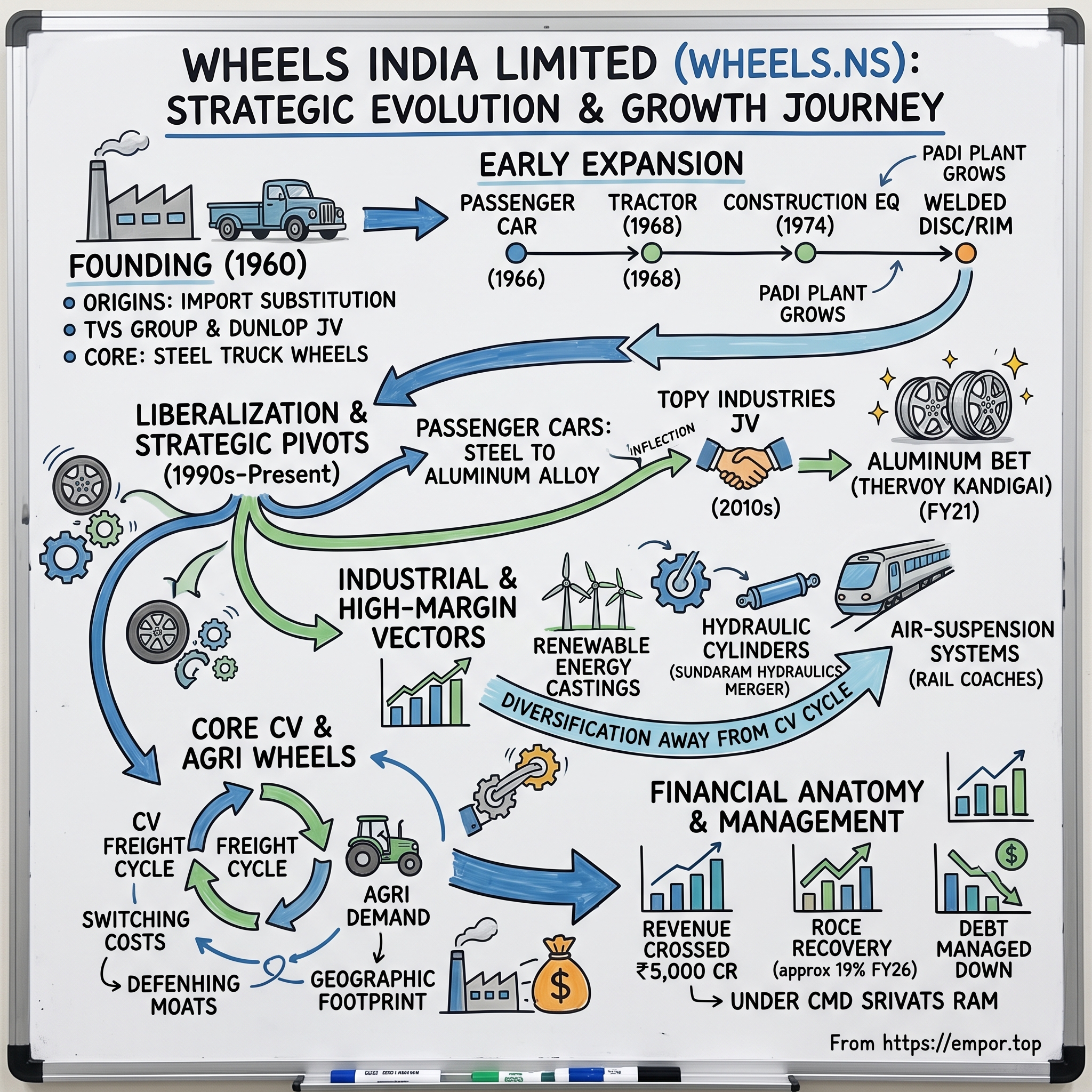
That company is Wheels India Limited, and its origin story is an artifact of a vanished India. It was born in 1960 as a collaboration between the British tyre giant Dunlop and the Chennai-based TVS Group, at a moment when a newly independent nation had decided it would rather manufacture its own truck wheels than import them.12 It is the kind of company that never makes a headline and never leaves the road — the sort of business that a country discovers it cannot function without only if it were somehow to stop.
More than sixty years later, that company sells over ₹5,400 crore of product a year — steel and aluminum wheels by the millions, plus a growing catalogue of things that are not wheels at all: machined castings for wind turbines, hydraulic cylinders for excavators, and air-suspension systems for railway coaches.34 It has grown, in other words, from a single-product import-substituter into a diversified heavy-engineering house — while remaining, at its core, the same thing it always was: a supplier of the essential, unglamorous hardware on which other people's machines depend.
Wheels India trades as WHEELS on the National Stock Exchange and as 590073 on the BSE, with roughly 58% of the equity still held by TVS Group promoter entities.3 It is, in the language of markets, an auto-ancillary — a component supplier sitting one rung below the famous names (Tata Motors, Ashok Leyland, Mahindra) whose vehicles it helps complete. That position is the whole story, and the whole problem.
The central strategic question of this episode is deceptively simple. Can a legacy heavy-industrial steel fabricator — a business whose customers are among the most powerful and price-aggressive buyers in the economy — successfully reinvent itself around higher-margin work: aluminum lightweighting, renewable-energy castings, and hard-currency exports? Or is it destined to remain a capable, cyclical, thin-margin captive of the Indian commercial-vehicle cycle, admired for its engineering and starved for returns?
We will not pretend to know the answer. What we can do is trace how the business actually makes money, test management's claims against its own track record, and lay out — honestly — what would make the bull case real and what would break it.
Here is the roadmap:
- The TVS Group pedigree and India's import-substitution origins.
- Four decades of steel wheels, OEM integration, and the Dunlop-to-Titan partnership evolution.
- The modern inflection points: the Topy Industries steel-wheel JV, the aluminum bet at Thervoy Kandigai, the Sundaram Hydraulics merger, and the TVS family restructuring.
- Core business mechanics: rim roll-forming, tooling lock-in, steel pass-through pricing, and the benchmark rivalry with Steel Strips Wheels.
- The growth vectors: cast aluminum wheels, wind-turbine castings, hydraulic cylinders, and railway suspension.
- Financial anatomy, capital allocation, and management credibility under CMD Srivats Ram.
- Strategic frameworks — Porter's Five Forces and Helmer's 7 Powers.
- The skeptic's stress test, the bull and bear cases, and the KPIs that actually matter.
Let us begin where the company began: not with a product, but with a family and a philosophy.
 Subscribe on LinkedIn
II. Founding Context & The TVS Empire (1960–1990s)
To understand Wheels India, you first have to understand the peculiar institution that gave birth to it. In 1911, a man named T.V. Sundram Iyengar, having failed at both banking and railway employment, started a bus service in the small town of Madurai in what is now Tamil Nadu. It was an unlikely launchpad for an industrial dynasty. Iyengar was, by the standards of colonial-era commerce, a late bloomer and a serial disappointment to his elders — a man who had been turned away from the comfortable clerkships that a Brahmin family of his standing expected him to fill. What he had instead was an almost stubborn conviction that the future of the country would run on wheels, and that the business of moving people and goods reliably, on time, without cheating them, was a business worth a lifetime.
That bus company — Trichur Sundaram Santhanam's forebears would build on it — became the seed of the TVS Group, and it carried with it a founding creed that the group still repeats like a catechism: "Leadership with Trust." The phrase is easy to dismiss as corporate wallpaper until you appreciate what it meant in practice in early-twentieth-century India, where a customer buying a spare part or boarding a bus had almost no recourse against a merchant who short-changed him. Iyengar's radical proposition was that a business could win, and keep winning for generations, simply by being the one everyone believed. In an India where fortunes were more often built on scarcity, hoarding, and proximity to power, TVS chose to compete on reliability, and it turned that reputation into a sprawling automotive network — Sundram Fasteners, Brakes India, Lucas-TVS, Sundaram Finance, TVS Motor — that would go on to supply, build, and finance the country's motorization. By the time India gained independence in 1947, the group was less a company than an ecosystem: whenever a new automotive need appeared, a TVS entity tended to appear to meet it. Wheels India was one such entity, summoned into being by a specific gap.
By the late 1950s, that network had spotted a gap. India's fledgling commercial-vehicle makers — the enterprises that would become Tata Motors and Ashok Leyland — and its tractor pioneers were assembling vehicles that still depended on imported wheel assemblies. In a country busy erecting the walls of a licensed, import-substituting economy, importing something as basic as a truck wheel was both an indignity and a bottleneck. So TVS did what industrial families did in that era: it went looking for a foreign partner who owned the know-how.
It found Dunlop. Wheels India Limited was incorporated on June 13, 1960, as a technical and financial collaboration in which the British Dunlop group took a 35.91% equity stake, and the flagship plant rose at Padi on the northern edge of Chennai.12 The choice of partner was itself a statement of ambition. Dunlop was then one of the giants of the global rubber-and-wheel world, and its willingness to transfer wheel-forming technology to a Chennai start-up gave the venture instant technical legitimacy. This was the era of the "License Raj," when an Indian company could not simply decide to manufacture something; it had to secure a government license to do so, against a backdrop of policy explicitly designed to substitute domestic production for imports. In that environment, a license plus a foreign technology partner plus a trusted promoter was very nearly a license to print — provided you could actually build the thing.
Production began in 1962 — commercial-vehicle wheels first, because that was where the national need was most acute.1 The young Indian truck industry, anchored by the enterprises that would become Tata Motors and Ashok Leyland, had been assembling vehicles on imported running gear; Wheels India's roll-formed rims and pressed discs began to close that gap almost immediately, and the company slid into the role of near-default supplier to the nation's heavy transport. The sequencing that followed reads like a map of India's own industrial awakening: passenger-car wheels in 1966, agricultural-tractor wheels in 1968, construction-equipment wheels in 1974.1 Each new product line tracked a new artery of the physical economy coming online — first the highways, then the farms of the Green Revolution, then the dams and roads of a building nation. A company's product catalogue rarely tells a story this clean, but Wheels India's early one is almost a documentary of post-independence India deciding what kind of country it wanted to be.
What made this business defensible from the start was not glamour but grind. A wheel is a safety-critical structural part; it holds a multi-tonne vehicle off the road at highway speed. Getting a disc-and-rim assembly approved by a vehicle manufacturer meant surviving fatigue tests, radial and cornering load tests, and a validation cycle measured in years, not months. Once you were designed into a truck platform, you tended to stay there for that platform's life. Wheels India, arriving early and backed by Dunlop's engineering, effectively became the default supplier to Indian heavy transport before most competitors existed. That is not a moat you can see; it is a moat you inherit by being first through a slow, regulated door.
The Padi plant grew accordingly — from a few hundred thousand wheels a year in the 1960s to a capacity that would eventually approach five million units at that single site, one of the largest concentrations of wheel-making anywhere in India.2 The product line kept branching in step with the machines Indian industry was buying: wire wheels and the Rampur plant in 1982, chassis and suspension products in 1986, tubeless truck wheels in 1988, earthmover wheels in 1996.1 Each of these was a small act of import substitution in its own right, and each deepened the company's reputation as the firm you called when you needed a rolling structural part that would not fail.
New plants followed the customers geographically: Ranjangaon near Pune in 1997, a wheel-and-tyre assembly unit at Mahindra World City in 2000, so that wheels could be stamped and dressed close to the assembly lines they fed rather than trucked across the subcontinent.1 This was not incidental. Freight, for a heavy, low-value-density product like a steel wheel, is not a rounding error; a wheel is mostly empty space wrapped in dense metal, expensive to move relative to its price. Every kilometre a finished wheel travels to reach an OEM eats into a margin already thin to begin with. Plant proximity is therefore a genuine, compounding cost weapon — one that also makes a supplier stickier, because a wheel-maker whose factory sits an hour from your assembly line can feed you just-in-time in a way a distant competitor cannot. Wheels India was building that weapon, quietly, plant by plant, in a pattern it would repeat for the next quarter-century.
Then the ownership evolved. Around 1998–99, the American off-highway-wheel specialist Titan International bought out Dunlop's entire holding, injecting global expertise in the big, rugged wheels that agricultural and earthmoving machines require.2 Titan itself would later sell out within about a decade, but the sequence tells you something about the company's DNA: for its whole life, Wheels India has rented world-class process technology from a foreign partner while keeping Indian control — first Dunlop, then Titan, and later, as we will see, the Japanese firm Topy.2 The TVS trust brand was the currency that made those decades-long technical marriages possible.
There is a broader lesson buried in that succession of partners, and it is central to how this company thinks. Wheels India has never pretended it must invent everything itself. Its consistent strategy has been to identify the best process-technology owner in the world for whatever it wants to make next, strike a long-horizon technical partnership, and localize the know-how behind India's tariff walls and, later, into its export offering. That is a humbler and often more durable model than heroic in-house R&D, and it depends entirely on being the kind of partner that world-class firms want to work with for decades — which loops straight back to the TVS trust brand. The partner changes; the playbook does not.
The 1991 liberalization of the Indian economy could have been an extinction event for a protected import-substituter. It was not. The manufacturing discipline absorbed from foreign partners — ISO 9001 in 1995, the automotive-specific ISO/TS 16949 in 2003 — meant the company met the world already fluent in its quality language.1 Liberalization opened the door to exports and to global OEMs setting up in India, and Wheels India walked through it rather than being trampled by it. Which raises the obvious next question: once the protected market was gone, how would a wheel-maker keep growing? The answer was a series of deliberate, sometimes uncomfortable pivots.
III. Strategic Pivots & Modern Inflection Points (2000s–Present)
Picture a management meeting sometime in the 2010s at Padi. On the whiteboard is a chart every auto-component executive dreads: the substitution curve. In passenger cars, the humble steel wheel — Wheels India's birthright — is losing ground to lighter, shinier aluminum alloy wheels that consumers increasingly expect. In commercial vehicles, demand swings violently with the freight cycle. The core business is not dying, but it is maturing, and maturity in a low-margin components business is a slow squeeze. The story of the modern company is the story of how it tried to escape that squeeze through five distinct moves.
Inflection Point 1 — The Topy steel-wheel JV. As Japanese carmakers (Maruti Suzuki, Toyota, Honda) scaled up passenger-vehicle production in India, they brought with them a demanding, exacting supplier philosophy — the Japanese quality culture of 改善 kaizen, or relentless continuous improvement, applied to every bolt and bracket — and a preference for suppliers who could meet it. Wheels India wanted that business, but supplying a Japanese OEM at Japanese quality and cost is not something you improvise. So it did what it had always done: it found a partner. It carved its passenger-car steel-wheel operations into a subsidiary, WIL Car Wheels Limited, holding 74% while the more-than-century-old Japanese wheel-maker トピー工業 Topy Industries took 26%.6 Topy brought high-speed automated pressing and rim-rolling process technology honed over generations of supplying the world's most demanding car market; Wheels India brought the plants, labour, land, and existing OEM relationships. It was a classic structure — local scale married to imported precision — and it echoed the original Dunlop template almost exactly.
The subsidiary is not enormous. It turned over about ₹528 crore in FY26 and earned roughly ₹12 crore of profit, a modest slice of the group.4 But its strategic value exceeds its size: it entrenched Wheels India as the steel-wheel supplier of choice to Japanese assembly lines in India, in a segment where those OEMs would otherwise have leaned on suppliers back home. And it planted a relationship — a working, trust-tested collaboration with Topy — that would matter far more a few years later, when the two companies extended it into aluminum. Partnerships, in this company's history, are never one-off transactions; they are options on the future.
Inflection Point 2 — The aluminum bet at Thervoy Kandigai. This is the boldest and most consequential wager in the modern company, and the one on which the investment case now largely hangs. The logic was inescapable. For a century, the passenger-car wheel was steel; then, as buyers came to associate alloy wheels with premiumness and as manufacturers chased the fuel economy of lighter unsprung weight, the mix began tipping toward aluminum. For a company whose birthright was the steel wheel, watching alloy specialists carve off the fastest-growing, highest-margin slice of the car-wheel market was an existential slow burn. You could defend the steel business you had, or you could go build the aluminum business that was replacing it. Wheels India chose to build.
Reading the substitution curve correctly, management committed to a greenfield cast-aluminum-wheel plant at Thervoy Kandigai, on the outskirts of Chennai, which came on stream around FY21.16 The timing was almost cruel. Casting aluminum wheels is a different manufacturing discipline entirely from stamping steel — molten metal poured or pressure-fed into moulds, heat-treated, machined, and coated — so this was not a line extension but a new factory learning a new craft. And it started ramping into the teeth of the COVID-19 pandemic, so a large fixed-cost asset opened its doors into collapsed automotive demand and dismal utilization. This is precisely the kind of greenfield gestation that depresses return on capital before it lifts it: the depreciation and interest are fixed from day one, but the revenue trickles in only as validation and volume build. For a few years, Thervoy Kandigai was a drag the whole company had to carry.
Management's chosen entry route was pragmatic and revealing of the company's temperament. Rather than beg for domestic OEM contracts it could not yet reliably fill, the plant first exported alloy wheels into the U.S. and European aftermarket — a market with lower validation barriers and hungry demand — building manufacturing muscle and reputation. Only then did it pivot to domestic OEM supply, winning Tata Motors and Stellantis, and subsequently orders from Hyundai and Volkswagen, with Volkswagen deliveries slated to begin the following year.6 Capacity was set to climb from roughly 500,000 wheels a year toward 700,000 by the end of the quarter and then a million by FY27 — a doubling in barely two years.6 And in December 2025 came the capstone: a technical-assistance agreement with Topy — this time for aluminum, not steel — explicitly aimed at cracking the Japanese OEMs in the alloy segment, borrowing Topy's century of design know-how to do it.6 It is a genuine, capital-intensive strategic pivot from a mature technology to a growing one. Whether it ultimately earns its cost of capital, rather than merely growing revenue, is still, in mid-2026, an open question — and one we will interrogate hard later, because a great deal of the bull case rides on the answer.
Inflection Point 3 — Diversification into renewable-energy castings. Every cyclical industrial company eventually confronts the same temptation and the same danger: to escape its cycle by buying into someone else's. Wheels India's version was disciplined because it diversified along the grain of what it already did well. To reduce its hostage-to-the-auto-cycle problem, it leaned into heavy industrial fabrication and the machining of large cast components for global wind-turbine makers — work that uses the same metallurgical and machining muscles as an earthmover wheel, pointed at a completely different end-market.1 It opened dedicated renewable-energy component facilities — at Irungattukottai in 2010 and at Thervoy Kandigai in 2021 — turning heavy-engineering capability that might otherwise sit idle between auto cycles into a business that rides the world's decarbonization capex rather than India's monthly truck registrations.1 The appeal is twofold and durable: the work is higher-value precision machining that earns better margins than commodity wheel-stamping, and it benefits from global buyers deliberately diversifying their supply chains away from China. This is the segment management now points to first when it talks about where future margin expansion comes from — and, so far, the segment's EBIT has grown faster than its revenue, which is what real mix improvement looks like.4
Inflection Point 4 — The Sundaram Hydraulics merger. In a piece of intra-group tidying with real strategic logic, Wheels India absorbed the TVS group company Sundaram Hydraulics Limited, a maker of hydraulic cylinders for mining and construction equipment. The board approved the scheme in December 2021; the National Company Law Tribunal's Chennai bench sanctioned the amalgamation, and the merger was completed in 2023.7 The rationale was to consolidate a fragmented group capability — cylinders that go into the same excavators and loaders whose wheels the company already makes — under one listed roof, and it added a component line tied to global infrastructure and mining demand.
Inflection Point 5 — The TVS family realignment. In the background of all these operational moves, the sprawling TVS Group underwent a historic family settlement — one of the most consequential corporate-family reorganizations in Indian business — that reorganized decades of tangled, interlocking cross-holdings into cleaner, clearly demarcated ownership buckets among the various branches of the founding family. Such settlements are delicate; done badly, they trigger years of litigation and boardroom paralysis, and Indian corporate history has no shortage of family feuds that destroyed value. Done well, they remove ambiguity and let each business get on with being run. Wheels India's promoter holding — about 57.5% at the end of 2021 — was consolidated under a specific family entity, Trichur Sundaram Santhanam & Family, clarifying who actually controls the company while preserving the TVS brand and its governance heritage.23 For minority investors, a cleaner promoter structure is a modest but real positive: it reduces the risk that the company becomes collateral damage in a family dispute, and it sharpens accountability for whose interests the board ultimately serves. It is, in effect, governance housekeeping — invisible on the income statement, but the kind of thing whose absence can quietly wreck an otherwise sound company.
Five moves, one thread: each was an attempt to trade a little of the company's low-margin, cyclical inheritance for something more valuable and more durable. To judge whether that trade is working, we have to open the hood on how the core business actually earns its keep.
IV. Core Business Deep Dive: Wheels, Steel, & OEM Economics
Start with a physical object, because this is a business you can only understand by watching metal move. A commercial-vehicle steel wheel begins life as a flat coil of steel. One stream of that steel is cut, rolled into a hoop, and flash-welded into a rim — the cylindrical band the tyre seats on — and then profiled on a rim-rolling machine that squeezes it, in successive passes between hardened rollers, into the exact contoured cross-section a given truck demands. The profile is not cosmetic: it determines how the tyre beads seat, how the wheel sheds heat, and how it survives millions of load reversals. A second stream of steel is blanked, pressed, and spun into the disc — the dished centre that bolts to the hub and carries the vehicle's weight. Disc and rim are then married, welded together on automated lines, painted, and shipped.
Now do that ten-plus million times a year, to tolerances tight enough that a failure could kill someone at highway speed, at a per-unit price a truck-maker's procurement team has spent months trying to grind lower — and you have Wheels India's day job.3 It sounds prosaic until you appreciate the trap it sets: the product is safety-critical (so quality cannot slip), it is heavy and cheap (so freight and scale dominate the economics), and the customer is enormous (so pricing power runs the wrong way). Everything about how this company wins, and everything about why its margins are what they are, flows from that trap.
Automotive wheels across all vehicle types — commercial vehicles, tractors, passenger cars, and construction equipment — remain the bulk of the business. In FY26, the automotive-components segment generated roughly ₹4,526 crore of revenue, about five-sixths of the consolidated total, growing 16% year over year with segment EBIT up 23%.4 Within that, three end-markets drive the volume, and each behaves differently.
Commercial-vehicle wheels are the heart. Wheels India has long held a commanding position — on the order of half — of the Indian medium- and heavy-commercial-vehicle wheel market, which ties its fortunes tightly to freight rates, infrastructure spending, and the truck replacement cycle. This is both the company's greatest strength and its greatest source of volatility. When India's M&HCV cycle turns up — as it does when infrastructure spending accelerates and freight demand booms — this business behaves like a coiled spring, with volumes and operating leverage lifting the whole company. When it turns down, as it periodically and sharply does, the same fixed-cost base that amplifies the upswing bites hard on the way down. Anyone who owns this stock owns the Indian truck cycle whether they intend to or not.
Agricultural-tractor wheels are the second pillar, supplied to Mahindra & Mahindra, TAFE, John Deere, and Escorts Kubota — a roster that includes essentially every serious tractor-maker operating in India. This is also a meaningful export line into North American and European farm markets, which is a double-edged sword: it diversifies the revenue geographically, but it also imports a second cycle, because when American and European farmers and dealers stop buying and start running down inventory — as they did through 2024 and 2025 — that destocking shows up directly and painfully in Wheels India's export order book. Two agricultural cycles, one Indian and one Western, do not always move together, which is part of the appeal; but when they slump in sync with the truck cycle, the pain compounds.
Passenger-vehicle steel wheels, run largely through WIL Car Wheels, are the structurally challenged leg. Here the volume is real but the trend is against it: steel is steadily ceding share to alloy in cars, so this is a business defending a shrinking beachhead. That structural erosion is precisely what drove the aluminum pivot — a supplier watching its own product get designed out has two choices, and Wheels India chose to become the thing replacing it rather than the thing being replaced.
Now the competitive picture, because a supplier's economics are set as much by rivals as by customers. The benchmark is Steel Strips Wheels Limited (SSWL), the Chandigarh-based rival that is Wheels India's mirror image in some respects and its opposite in others. The comparison is genuinely instructive. The two companies have converged to nearly the same size — SSWL turned over about ₹5,186 crore in FY26 versus Wheels India's ₹5,465 crore — but SSWL runs at a somewhat richer operating margin, around 10% versus Wheels India's roughly 8%, and earned about ₹190 crore of net profit against Wheels India's consolidated ₹158 crore.834 Two companies, almost the same revenue, materially different profitability. That margin gap is the single most important fact in the entire investment debate, and Section VIII dissects why it exists and whether it can close.
The strategic contrast is as telling as the numbers. SSWL has leaned harder and earlier into two higher-margin vectors — a larger share of alloy wheels in its mix, and an aggressive, deliberately diversified export push — running a footprint of plants oriented around that strategy.8 Wheels India, by contrast, is the broader, more industrially diversified of the two, carrying more heavy fabrication and a wider spread of end-markets. Neither posture is obviously "right"; they are different bets on where the durable profit pools sit. Beyond this domestic duel, the global field includes Maxion Wheels (part of Brazil's Iochpe-Maxion), KLT Automotive, Accuride Corporation, and Titan International — a reminder that in export markets Wheels India competes not against a same-sized peer but against multinationals many times its size, with global scale in procurement and R&D. Winning share there under "China-plus-one" is plausible but never a gift.
The mechanism that most confuses casual readers of the financials is steel pass-through, and it is worth slowing down to explain properly, because misunderstanding it produces bad investment conclusions. Steel is roughly two-thirds of the raw-material cost of a wheel, and Wheels India's contracts with big OEMs index the selling price to prevailing steel prices, with the adjustment arriving on a lag of, typically, a quarter or so. Think of the company less as a price-setter and more as a converter: it buys steel, adds engineering and labour and machine time, and sells a wheel, and it is really being paid for that conversion rather than for the metal itself.
The investor nuance that follows is genuinely counterintuitive. When steel prices spike, reported rupee revenue balloons — you are billing more for the very same wheels — but the percentage EBITDA margin gets diluted, because that extra revenue is pure cost pass-through carrying no incremental profit, so a fixed rupee of conversion profit is now divided by a bigger revenue number. When steel prices fall, the opposite happens: revenue optically shrinks while margin percentages look healthier. A casual reader seeing revenue jump 20% might cheer; a careful one asks how much of that was steel inflation rather than more wheels sold. The practical lesson — and it is the single most useful analytical habit for this company — is that EBITDA margin percentage and the rupee-of-profit-per-wheel tell you far more than headline revenue growth, which can be a steel-price mirage in either direction. It is also why, when steel and aluminum prices lurch suddenly — as they did in 2026 amid Middle East disruption that pushed up fuel and aluminum costs — the pass-through lag can create a temporary margin pinch before contractual adjustments catch up.5
So how does Wheels India actually win, and where does it lose? It wins on two structural advantages. First, geography: a footprint of plants sited deliberately near OEM assembly lines minimizes the freight cost of a heavy, low-value product — a real, compounding edge in a business where a few percentage points decide contracts. Second, switching costs: the multi-year validation of a structural safety part means an OEM almost never re-tenders a wheel mid-platform, so incumbency on an active vehicle program is sticky. Where it loses is equally structural: its customers are a handful of enormous vehicle-makers who possess overwhelming buying power and demand annual price downs, and on platforms that are multi-sourced, SSWL and others compete hard on price. That tension — deep technical lock-in on one side, brutal buyer power on the other — is the defining paradox of the whole enterprise, and it caps how profitable a pure wheel business can ever be. Which is exactly why what happens outside wheels has become the more interesting part of the story.
V. Industrial & High-Margin Growth Vectors
If Sections II through IV described the body of the company, this section is about its nervous system — the smaller, higher-value businesses that management hopes will re-rate the whole. The industrial-components segment is roughly a sixth of revenue — about ₹939 crore in FY26, up 12%, with EBIT up 15% — but its importance to the investment case is out of proportion to its size, because it carries the option on margin expansion.4 On the Q4 FY26 call, management pointedly flagged that its industrial-components EBIT had surged in the quarter, a sign the mix shift is beginning to show up in the numbers rather than just the narrative.5
Wind-turbine machined castings. Walk into the renewable-energy facilities and you find, instead of stamped wheels, enormous grey-iron castings — hubs and structural housings that sit at the heart of a wind turbine — being machined to fine tolerances on large boring and turning machines the size of small rooms. To picture the work, imagine the hub of a wind turbine: the massive cast component to which the three blades bolt, spinning under colossal, endlessly reversing loads for two decades on top of a tower. It has to be cast, then machined so precisely that blades hundreds of feet long track true. This is a fundamentally different economic animal from wheel-stamping. Where a steel wheel is a high-volume, thin-margin commodity, a machined turbine casting is a low-volume, high-value, engineering-intensive part — better asset turns on the machining capital, richer margins, and far higher switching costs once you are qualified, because re-validating a new supplier of a safety-critical structural casting is slow and expensive for the turbine-maker.
Two tailwinds make it attractive, and both are structural rather than cyclical. One is the world's renewable buildout — the 双碳 dual-carbon push and its Western equivalents translating into a multi-decade pipeline of turbines, with European turbine makers as the demand pull. The other is "China-plus-one": global OEMs, wary of concentrating their critical-component sourcing in China, are deliberately qualifying non-Chinese suppliers, which hands a credible, quality-certified Indian machinist like Wheels India a seat at a table it might not otherwise reach. This is the clearest embodiment of the whole de-risking thesis — auto-cycle exposure swapped, at the margin, for energy-transition capex on a different and longer clock. The caveat an independent analyst must add is that "wind" is itself cyclical and policy-dependent, and European deployment has had its own stop-start rhythm; this is diversification of cycle, not escape from cyclicality altogether.
Cast and forged aluminum wheels. We have met the cast side at Thervoy Kandigai, aimed at domestic passenger cars.6 The forged side is arguably more interesting for the long run. Forged aluminum wheels — squeezed from a solid aluminum billet under enormous pressure — are lighter and stronger than cast ones, and they matter most for heavy commercial vehicles and export trailers, where every kilogram shaved off the wheel is a kilogram of extra payload or fuel saved over a truck's life. Wheels India began making forged aluminum wheels as far back as 2004, well before the current alloy push.1 The electrification of trucks and buses adds a new reason to care: an electric bus lugs a heavy battery pack, and lighter forged wheels are one way to claw back that weight. The lightweighting story is real engineering, not marketing — though, as with any capacity bet, the question is whether it earns adequate returns, not merely whether it is technically clever.
Hydraulic cylinders and railway suspension. The Sundaram Hydraulics merger gave Wheels India a cylinder business selling into construction and mining equipment — the hydraulic rams that lift an excavator's boom or tip a dump truck's bed — a demand pool that rises and falls with global infrastructure and commodity cycles.7 Management has noted that the cylinder business grew reasonably and turned profitable in the years after the merger, which is the modest proof point that the amalgamation was more than paper-shuffling. Separately, the company makes air-suspension systems and chassis and suspension products — a line it has run since the mid-1980s — supplying air-suspension for Indian Railways passenger coaches and for bus chassis, leaning on the group's deep mechanical-design heritage.1 As India invests in modernizing its railway rolling stock and its intercity bus fleets, this is a quietly relevant niche.
None of these are large today. Their collective promise is optionality: a spread of engineering-led niches, each tied to a different macro driver — construction, mining, rail, energy — that together could smooth the auto cycle and, more importantly, lift blended margins over time. The bet is not that any one of them becomes the company; it is that a bundle of higher-value adjacencies, drawing on the same metallurgy and machining core, gradually re-rates the mix.
Here is the sober counterpoint an independent analyst must hold in mind. "Diversification into higher-margin adjacencies" is one of the most seductive and most frequently disappointing stories in industrials, because it can shade into di-worse-ification — capital scattered across sub-scale businesses that never individually reach the scale to matter. The evidence so far is encouraging but not conclusive: the industrial segment is growing faster in EBIT than in revenue, which is what genuine mix improvement looks like.4 But it remains a sixth of the company, and the burden of proof sits with management to show these vectors compound rather than merely diversify. That burden is ultimately settled in the financial statements — so let us read them.
VI. Financial Anatomy, Capital Allocation, & Management Credibility
The single most striking line in Wheels India's recent history is not a revenue figure; it is a return figure. For years the company was a mid-single-digit-margin business earning a return on capital that hovered, unremarkably, in the low teens, weighed down by the greenfield drag of Thervoy Kandigai. In FY26 something shifted. Consolidated revenue crossed ₹5,000 crore for the first time, reaching about ₹5,465 crore, up roughly 15%.34 Consolidated net profit jumped to about ₹158 crore from ₹112 crore.4 The operating margin ticked up toward 8%, and — most tellingly — return on capital employed climbed to around 19%, with return on equity near 16%.3 On a five-year view, sales compounded at roughly 18% a year and profits far faster, off a low, depressed base.3
What does an independent reader make of that? Three things, and they cut in different directions. First, a caution: the profit growth flatters itself against a genuinely poor prior period. A five-year profit CAGR north of 100% is the arithmetic of a depressed starting base as much as operational triumph — the company is climbing out of a hole partly of its own greenfield making — and it should be read as recovery, not perpetual-motion compounding.3 Anchor on that number and you will over-extrapolate. Second, and more durably encouraging: the ROCE recovery from the low teens toward roughly 19% is exactly the pattern you would expect if the previously idle greenfield assets — aluminum wheels, wind castings — are finally filling up.3 Fixed capital that sat under-utilized, dragging down the denominator of every return ratio, is now turning; returns rise mechanically as utilization climbs. That is the single most important structural signal in the recent numbers, because it is the whole aluminum-and-castings thesis showing up in the returns rather than merely in the revenue.
Third, a discipline every reader of this company must impose: do not confuse cyclical tailwind with structural change. A large share of FY26's strength rode a healthy domestic automotive cycle and buoyant export demand — earthmover wheels, in particular, were called out as a bright spot — and quarterly revenue in the fourth quarter jumped 23% year over year to about ₹1,471 crore.45 Some of that is mix improvement that should stick; some is simply the cycle being kind, and cycles are not kind forever. Management itself, on the May 2026 earnings call, was refreshingly candid that long-term visibility is limited because of commodity and geopolitical volatility, and declined to over-promise.5 A single strong year does not retire the cyclicality that has defined this business since 1962. The honest reading of FY26 is that it is the best evidence yet for the transformation thesis and not, on its own, proof of it.
On capital allocation, the record is one of disciplined, unglamorous reinvestment — which, in a capital-intensive cyclical, is exactly the record you want. Capex ran about ₹261 crore in FY26 and was guided to roughly ₹280–300 crore for the following year, aimed squarely at aluminum-wheel and wind-casting capacity rather than sprawling, off-strategy adventures.5 That is the crucial discipline: the money is going into the two vectors the whole thesis depends on, not scattered across vanity projects. Debt has been managed down relative to earnings — borrowings of roughly ₹768 crore against a net worth that crossed ₹1,000 crore in FY26 — with management explicitly citing stable-to-declining leverage, improved debt-to-EBITDA, and stronger free cash flow.345 For a business that spent years in greenfield investment mode, the pivot to free-cash generation is a meaningful maturation, and it is the reason the dividend — about ₹14.44 per share for FY26, split between interim and final — could rise.4
One capital-allocation wrinkle worth watching closely: management signalled an intent to raise its stake in the associate company Axles India — itself a substantial business, with roughly ₹888 crore of turnover and ₹73 crore of profit in FY26 — toward 20–25% over time, framing it as a synergy and value-unlocking move.45 On its face this is reasonable; Axles India is profitable and adjacent. But it is precisely the kind of intra-group, related-party capital deployment that a skeptical investor should scrutinize, asking whether the return on that incremental stake beats simply returning the cash or investing in the core. The honest verdict is that the capital-allocation track record earns the benefit of the doubt — but "trust, and verify each deal on its own return" is the correct posture, not blanket faith.
Which brings us to management credibility, assessed the only honest way — by behaviour over time rather than by the tone of a single press release. Chairman and Managing Director Srivats Ram is the human center of the modern story. An economics graduate of the University of Madras with an MBA from Case Western Reserve University in the United States, he took the helm around 2008 and has spent his tenure methodically converting a "predominantly steel-wheel firm" into a diversified engineering company.2 The transformation shows up starkly in one statistic: under his leadership, exports climbed from around a sixth of sales toward a quarter and beyond, and the customer base broadened to more than a hundred clients across the U.S., Europe, and Asia; revenue roughly tripled over his first dozen-odd years, from about ₹1,166 crore in FY09 to ₹3,701 crore by FY22, before the recent acceleration past ₹5,000 crore.24 That is not the record of a caretaker; it is the record of an operator with a plan, executed patiently over more than a decade.
His temperament matters as much as his résumé. Ram belongs to a school of Indian promoter-managers — engineering-minded, understated, allergic to hype — that tends to under-promise and grind. On earnings calls he speaks in the language of free cash flow and utilization rather than vision and disruption. The promoter group's roughly 58% holding aligns the family's fortunes tightly with minority shareholders and buys the company freedom from the quarterly theatrics that afflict more widely-held firms.3 The flip side of that same conservatism — a possible reluctance to press hard for margin when a bolder operator might — is a fair critique, and we take it seriously in the bear case.
The stronger evidence for credibility, though, is narrative consistency and willingness to own a miss. Across the FY24–FY26 earnings calls, management did not spin away the export weakness in overseas agricultural and construction markets; it named the culprit — prolonged customer inventory destocking in the U.S. and Europe — and redirected capex toward domestic wind-casting opportunities while it waited for the export cycle to heal.5 On the Q4 FY26 call, the framing was consistent: strong results attributed concretely to domestic demand and earthmover-wheel exports, with honest caveats that Middle East disruption had raised fuel and aluminum costs, some recoverable from customers and some not.5 That is the profile of a management team that sets conservative expectations and explains variances specifically rather than blaming the weather. The appropriate skepticism to hold is not about honesty but about ambition: a conservative, engineering-led promoter culture is excellent at protecting downside and can be slower to press an advantage. Whether that temperament closes the margin gap with SSWL, or merely narrows it politely, is the question the frameworks in the next section help us war-game.
VII. Strategic Position & Framework Analysis
Strip away the narrative and ask the coldest structural question an investor can pose: what, precisely, protects this business from having its profits competed away — and how much? It is a question worth asking with discipline, because the easy answer ("sixty years of heritage, a great group, deep relationships") is the kind of soft reassurance that separates investors from their money. Heritage is not a moat. Two rigorous lenses help cut through it — Hamilton Helmer's 7 Powers for the genuine sources of durable advantage, and Porter's Five Forces for the shape of the industry those advantages sit inside. Used honestly, they tend to deflate hype rather than confirm it, which is exactly why they are useful here.
Begin with Helmer's 7 Powers, and be disciplined about which powers Wheels India genuinely has versus which it merely brushes against.
Process Power is its most credible claim. Six decades of doing one hard thing — forming, welding, and machining safety-critical steel and iron parts to tight tolerances — accumulate into know-how that is embodied in people, tooling, and routines and cannot be bought off a shelf. High-precision rim rolling, flow-forming, and heavy-casting machining are learned slowly. This is real, but note its limit: process power protects the ability to make the product cheaply and well; it does not by itself confer pricing power against a giant customer.
Switching Costs are moderate-to-high, and specific in kind. The 18-to-24-month structural validation of a wheel for a vehicle platform means OEMs rarely swap a single-sourced, already-approved supplier mid-lifecycle. But this power is program-by-program, not company-wide: it locks in existing platforms, yet does nothing to guarantee the next platform, which is re-competed, often multi-sourced, and won on price.
Scale Economies are moderate and mostly local. The multi-plant footprint delivers a freight advantage near each OEM cluster, but it does not deliver the crushing global scale of a Maxion, and — crucially — whatever scale benefit exists is largely competed away by customer bargaining power rather than kept as excess profit.
Counter-Positioning is, at best, developing. By scaling its own aluminum capacity alongside legacy steel, Wheels India is trying not to be disintermediated by pure-play alloy specialists as the mix shifts. That is prudent defence, but it is imitation of a proven model, not a novel business model incumbents cannot copy — so it is a weak form of the power, if it qualifies at all. The honest read: Wheels India's durable edge is Process Power plus platform-level Switching Costs. Those are real and worth something. They are not the kind of powers that produce fat, uncapped margins — which is exactly consistent with a business that earns a solid-but-not-spectacular return.
Now Porter's Five Forces, which explains why the margins are what they are.
Bargaining power of buyers — high. This is the dominant force. Tata Motors, Maruti Suzuki, Mahindra, Ashok Leyland and their peers are concentrated, sophisticated, and relentless about annual cost reduction. They are the ceiling on Wheels India's profitability, full stop.
Bargaining power of suppliers — moderate. Steel majors like Tata Steel and JSW have pricing power, but the contractual pass-through mechanism transfers most raw-material swings to customers, muting the direct margin damage even as it distorts reported revenue.
Threat of substitutes — split. High in passenger cars, where aluminum is eating steel's share, which is the strategic threat the Thervoy Kandigai bet answers. Low in heavy trucks and tractors, where steel's durability and cost keep it entrenched.
Threat of new entrants — low. High capital intensity, punishing OEM quality audits, and thin industry margins make this an unattractive market for newcomers. The barriers that trap incumbents in low returns also protect them from disruption.
Competitive rivalry — high. A tight oligopoly with SSWL domestically and formidable multinationals in export markets keeps everyone honest and keeps pricing keen.
Put the two frameworks together and a coherent picture emerges. Wheels India sits in a structurally tough industry — high buyer power, high rivalry — where it has carved out genuine but bounded advantages. That combination does not produce a wide-moat compounder; it produces a well-run, defensible, cyclical supplier whose upside depends entirely on successfully shifting its mix toward the few pockets where the industry structure is kinder. Which is precisely the debate the bulls and bears are having.
VIII. Investment Story Spine & Bear vs. Bull Stress Test
Every serious analysis of Wheels India collides, sooner or later, with one number: the margin gap. So let us put the activist's question on the table without flinching. Why does Wheels India earn an operating margin around 8% while its closest peer, SSWL, earns closer to 10%, on nearly identical revenue?348
The answer is mostly mix, and mix is not something you fix in a quarter. SSWL has pushed a larger share of its volume into higher-margin alloy wheels and has aggressively built a diversified export blend, so more of every rupee it earns comes from the richer end of the wheel spectrum.8 Wheels India, by contrast, still carries heavier exposure to lower-margin steel wheels for tractors and commercial vehicles, plus heavy industrial fabrication that, while strategically valuable, dilutes the blended margin today. Layer on a broader, more dispersed plant footprint that has historically carried higher freight and overhead, and the roughly two-point gap is largely explained by portfolio composition, not by managerial incompetence. This is an important distinction for an activist: you cannot fire your way to SSWL's margin, because the gap is structural to the product mix. You can only close it by shifting the mix — which is precisely what the aluminum and castings strategy is trying to do, and precisely why the pace of that shift is the whole game.
A skeptical long-short investor would not stop there, though; they would press on two genuine soft spots. The first is working capital. The export model that diversifies revenue also consumes cash: selling into North America and Europe often means extended credit terms and inventory buffers parked in overseas warehouses to serve customers on short lead times, all of which ties up money that could otherwise pay down debt or fund capex. A skeptic would want to see inventory and receivable days falling as the export book matures, not merely revenue rising. The second is the aluminum capex risk: if the Thervoy Kandigai ramp is slower than planned, or if overseas alloy specialists undercut on price, that capital sits as under-earning assets, dragging on the very ROCE the strategy is supposed to lift — the exact trap that muted returns in the first place. Both concerns are legitimate. Both are, on the most recent data, directionally improving — debt is stable-to-declining, ROCE has recovered, utilization is climbing.35 But "improving" is not "resolved," and a disciplined investor keeps both on the watch list rather than declaring victory.
Before the bull and bear cases, it is worth puncturing two myths that cling to this stock.
Myth versus reality. The first myth is that Wheels India is "a cheap play on the same story as SSWL" — buy the laggard, collect the catch-up. The reality is more nuanced: the margin gap is structural to a different, more industrially diversified portfolio, so Wheels India is not a discounted clone of its rival but a genuinely different business with a different risk-reward, heavier in fabrication and castings and lighter in alloy. Whether that portfolio converges on SSWL's economics or simply follows its own path is an open question, not a foregone catch-up trade. The second myth is that the aluminum plant is already a proven margin engine. The reality, as of mid-2026, is that it is a promising ramp with real customer wins but still-building utilization; the returns evidence is encouraging but young, and extrapolating a finished re-rating from a couple of good quarters is exactly the error the framework analysis warns against. Neither myth is a lie; both are premature conclusions dressed as facts.
The bull case — why Wheels India could win from here — rests on four pillars, each of which we can test.
First, operating leverage on mix. If aluminum wheels and wind castings fill toward high utilization, blended margins should rise structurally toward and past 8%, and the early FY26 evidence — industrial EBIT growing faster than industrial revenue, ROCE recovering to ~19% — is consistent with that thesis rather than merely asserting it.43 Second, domestic cyclical tailwind: sustained government infrastructure spending drives M&HCV truck demand and bus fleet replacement, the coiled spring at the heart of the CV wheel business. Third, global supply-chain realignment: "China-plus-one" sourcing of off-highway wheels and wind-turbine castings gives an established Indian engineering supplier a structural share-gain opportunity in exports. Fourth, governance: a ~58% promoter holding and the TVS trust brand underwrite a long-term, low-drama capital-allocation posture.3
The bear case — why it may not — is equally concrete, and an honest investor must weight it.
First, synchronized cyclical downturn: Wheels India is levered to two cycles at once — Indian commercial vehicles and Western agricultural and construction machinery — and when they turn down together, as export destocking recently showed, the fixed-cost base bites hard.5 Second, a slow alloy ramp: the aluminum bet is the crux of the re-rating thesis, and if overseas alloy specialists undercut on price, the Thervoy Kandigai capital could earn sub-cost-of-capital returns for years, exactly the outcome that muted ROCE in the first place. Third, input and freight volatility: the pass-through lag and container-shipping and commodity shocks — the Middle East-driven aluminum and fuel spike management flagged in 2026 is a live example — can pinch margins in any given quarter.5
The neutral synthesis is this: the frameworks say Wheels India is a structurally sound but structurally capped business; the bull case is really a single, testable bet that management can shift the mix faster than buyer power and rivalry erode it; and the bear case is the base rate of cyclical, thin-margin auto-ancillaries. FY26 offered the bulls their best evidence in years — but one good year against a decade of modest returns is a data point, not a verdict. The way to adjudicate it is to stop arguing and start tracking the right numbers.
IX. Strategic Position, Key KPIs, & What to Watch
If you could see only three numbers about Wheels India each quarter and had to judge the entire thesis from them, these are the three to watch.
1. EBITDA margin percentage. This is the master metric, because the whole investment debate reduces to one question — is the mix shift toward aluminum, wind castings, and exports actually lifting profitability, or is the company running to stand still against buyer-driven price downs? A durable move sustainably above 8%, holding through a soft patch in the steel-price cycle, would be the single strongest confirmation that the transformation is structural rather than cyclical. Watch it in percentage terms, not rupee terms, precisely because steel pass-through makes rupee revenue a misleading gauge.
2. Export sales and their share of revenue. Exports reached roughly ₹1,342 crore in FY26, around a quarter of sales, and grew about 20% even against U.S. tariff headwinds.45 Export share is the cleanest single proxy for whether Wheels India is genuinely winning global share in off-highway wheels and wind castings under "China-plus-one," or merely riding the domestic cycle. Rising, diversified export share — spread across geographies rather than concentrated on a single tariff-exposed market — is the signal; a stall would undercut a central pillar of the bull case.
3. Return on capital employed. ROCE is the honesty check on the entire capital-allocation program. The company spent years pouring money into greenfield aluminum and casting capacity while returns sagged; FY26's climb to roughly 19% suggests that capital is finally earning.3 Sustained ROCE comfortably above the cost of capital — and not slipping back as the next capex wave (aluminum to a million wheels, more casting capacity) is absorbed — is what separates disciplined reinvestment from value-destructive expansion.
A brief note on what these three do not capture, so a reader does not over-rely on them. They are outcome metrics; they will confirm or deny the thesis after the fact, but they will not warn you early. For earlier signals, the diligent observer watches the leading indicators beneath them: Indian M&HCV truck registrations and freight indices (which lead the CV wheel business by a quarter or two); U.S. and European farm- and construction-equipment inventory commentary (which foreshadows the export order book); and steel and aluminum price direction (which moves reported revenue and, via the pass-through lag, near-term margins). A downgrade or upgrade from a credit-rating agency, a shift in promoter holding, or a large customer win or loss are the kind of second-layer signals that can move the story between quarterly prints.
What to watch over the next 12–24 months, concretely: the ramp speed of Japanese-OEM aluminum-wheel contracts under the Topy technical-assistance agreement, which is the proof point for whether the alloy business can reach scale on the domestic OEM side rather than leaning on the lower-barrier aftermarket; the order book in wind-turbine castings as European renewable deployment recovers or stalls; the pace of the Thervoy Kandigai capacity climb toward a million wheels and, crucially, its utilization; and progress on working-capital reduction and debt paydown in the annual statements, which is where the export model's cash intensity either improves or quietly does not. Each of these is observable in ordinary disclosure. Together they will, over the next two years, settle the argument the frameworks could only frame — whether Wheels India is a genuinely transforming business or a well-run cyclical enjoying a good stretch of weather.
X. Playbook: Key Business & Investing Lessons
Step back from the ticker and Wheels India becomes a case study in four durable lessons for anyone who invests in the unglamorous machinery of the physical economy.
1. The component supplier's paradox. How do you build a durable half-billion-dollar business when your customers are among the most powerful buyers in the economy and squeeze you for price every single year? Wheels India's answer is the template: you do not out-muscle the OEM, you get inside its product. Deep technical integration, ownership of the tooling, multi-year safety validation, and plants sited at the customer's doorstep create a lock-in that survives the annual price negotiation. The lesson for investors is that in supplier businesses, the moat is rarely brand or scale — it is the switching cost embedded in the customer's own engineering process, and it is worth exactly as much as the customer's inability to re-source without pain.
2. De-risking through capability adjacency. The most credible diversifications are not into fashionable end-markets but into markets that use the same core capability. Wheels India did not pivot to software; it took its metallurgy, forming, and heavy-machining skills and pointed them at wind castings, hydraulic cylinders, and rail suspension. The discipline is to diversify along the grain of what you already do superbly, not against it — the difference between synergy and di-worse-ification.
3. The patience tax on greenfield capex. The Thervoy Kandigai story is a clinic in why ROCE dips before it recovers. Building modern, higher-margin capacity (aluminum) to replace maturing legacy technology (steel) means carrying under-utilized fixed assets through a gestation period — made worse, here, by launching into a pandemic. The lesson is that ROCE is a lagging indicator of a transition; the investor's job is to distinguish a temporary gestation drag from a permanent misallocation, and the only way to tell them apart is to watch utilization climb — or fail to.
4. The value of conglomerate trust. Wheels India's entire history is a chain of decades-long technical marriages with foreign partners — Dunlop, then Titan, then Topy — that a less reputable promoter could never have sustained. The TVS "Leadership with Trust" brand is not a slogan on this evidence; it is the intangible asset that makes long-horizon joint ventures possible and, in turn, keeps world-class process technology flowing into an Indian supplier. Governance and reputation, easy to dismiss as soft factors, here compound into a hard competitive input.
XI. Epilogue
Wheels India is not a story that will trend. It makes no consumer product anyone photographs, ships no software, and promises no exponential curve. It is, instead, one of the small, essential organs of a large economy's circulatory system — the maker of the discs and rims and castings and cylinders on which India's freight moves, its fields are ploughed, its infrastructure is built, and, increasingly, its wind is harvested.
The independent verdict is deliberately unsentimental. This is a genuinely well-run, engineering-led company that has spent the last decade trying to buy its way out of a structurally hard industry by shifting toward higher-value work — and FY26 gave that effort its best year of evidence yet, in margins, returns, and exports. It is also, unavoidably, a cyclical supplier to powerful customers, whose bounded competitive advantages cap how good the economics can ever get, and whose recent strength owes something to a favourable cycle that will, in time, turn. Both things are true at once, and holding them together is the whole discipline of analysing a business like this.
As India lays down its freight corridors, rebuilds its bus fleets, wires up its renewable grid, and threads its highways across the subcontinent, the wheels beneath all of it will keep being engineered in Padi, in Pune, and at Thervoy Kandigai. Whether that quiet indispensability translates into durable, above-cost-of-capital returns for shareholders is not a matter of faith in a good company — it is a matter, quarter after quarter, of watching the margin, the exports, and the return on capital tell the truth.
References
-
Wheels India Ltd — Screener.in (consolidated financials) ↩↩↩↩↩↩↩↩↩↩↩↩↩↩↩↩↩
-
Wheels India sets July 1 date for 67th AGM; FY26 results detail — ScanX ↩↩↩↩↩↩↩↩↩↩↩↩↩↩↩↩↩
-
Wheels India Ltd (BOM:590073) Q4 FY26 Earnings Call Highlights — Investing.com / GuruFocus, 2026-05-15 ↩↩↩↩↩↩↩↩↩↩↩↩↩
-
Wheels India partners with Topy Industries to strengthen aluminium alloy wheel business — AlCircle, 2025-12-15 ↩↩↩↩↩↩
-
Certified True Copy of the NCLT Chennai Order — Scheme of Amalgamation of Sundaram Hydraulics Limited with Wheels India Limited (2023) ↩↩
 LinkedIn
 WhatsApp
 Reddit
 Hacker News
 Email
Email Kindle
 RSS Feed
 Spotify
 Apple Podcasts
 Amazon Music
 Audible
 YouTube