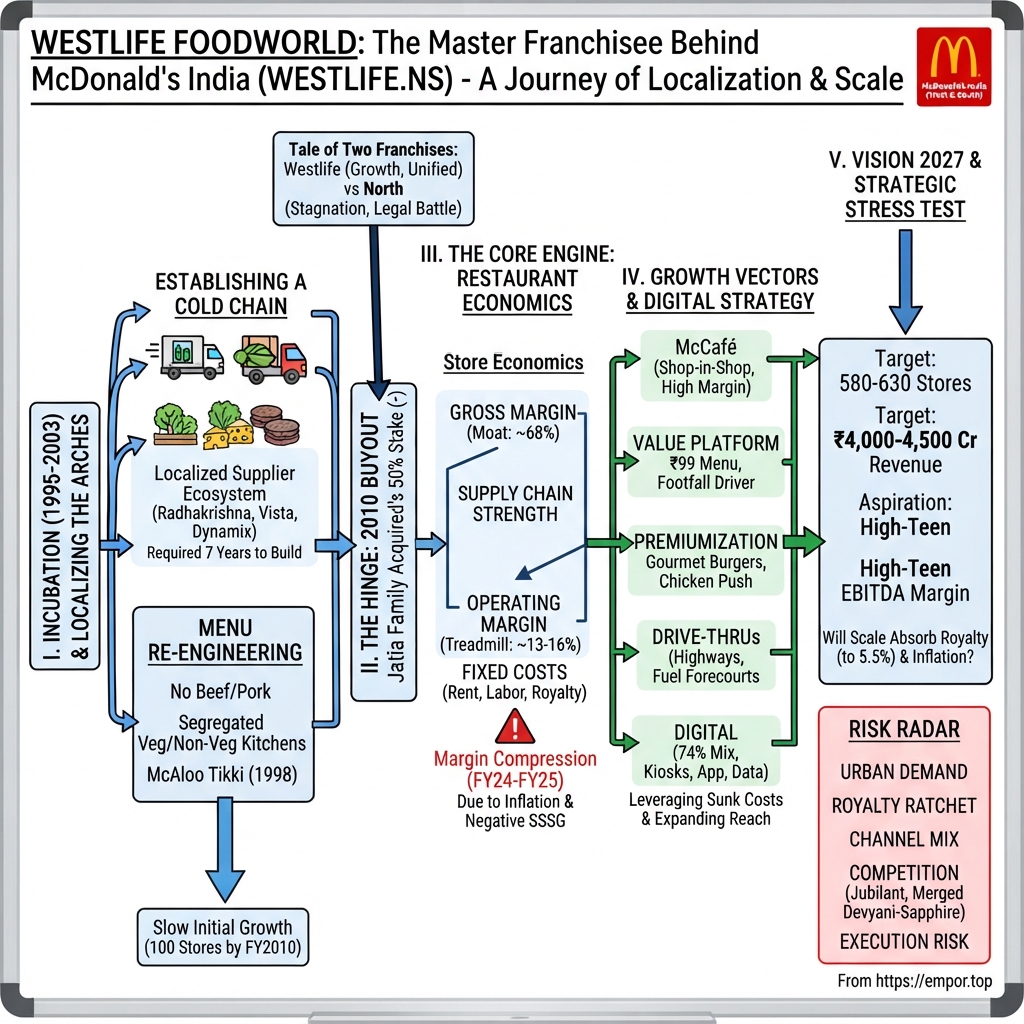
Westlife Foodworld: The Master Franchisee Behind McDonald's India
I. Introduction & Episode Roadmap
In 1995, a 26-year-old named Amit Jatia sat across from executives of a company selling roughly 75 hamburgers a second worldwide and asked them to build a McDonald's without the hamburger.
Not literally—there would be burgers. But there would be no beef, sacred to India's Hindu majority, and no pork, forbidden to a Muslim minority of well over a hundred million people. Stripping beef and pork out of McDonald's removed the Big Mac, the Quarter Pounder, bacon, and essentially the entire global menu architecture around which Ray Kroc's system had been optimized for four decades. What remained was a logo, an operating system, and a bet that the operating system mattered more than the meat.
That bet took seven years to begin paying off. There was no refrigerated trucking network in India worth the name, no lettuce supply capable of surviving a Mumbai August, and no consumer habit of eating a sit-down Western meal for a casual weekday lunch. Hardcastle Restaurants Private Limited—the Jatia family vehicle that entered a 50:50 joint venture with McDonald's Corporation for western and southern India—spent its initial years constructing, almost from raw materials, the cold chain that the business would run on.1 It took until fiscal 2010 for the company to reach 100 restaurants. Then, having proven the model, Amit Jatia bought out McDonald's Corporation's stake.
That transaction—McDonald's Corporation selling its half of the western and southern India joint venture to its local partner, reported at roughly ₹110 crore[^5]—is the hinge of this entire story. A global franchisor, sitting on a business it had helped incubate for fifteen years, chose to convert from co-owner to royalty collector. In fiscal 2013, the operating company was folded into a listed shell, Westlife Development Limited, which later became Westlife Foodworld Limited, giving public shareholders in Mumbai access to the McDonald's West and South India franchise.1
Thirty-one years after that initial conversation, the business operates 482 restaurants across 79 cities as of the June 2026 quarter, with 74% of sales flowing through digital channels.2 While it remains one of the highest-productivity restaurant networks in India by sales per store, it also spent two consecutive fiscal years with negative or barely positive same-store sales, watched its operating margin compress by nearly 300 basis points, and saw subsidiary-level profit after tax fall from ₹71.7 crore in FY2024 to ₹11.3 crore in FY2025—an 84% collapse in reported earnings at the operating entity.1
The core dilemma this story tests: a master franchisee is a leveraged bet on a brand it does not own, paying an escalating rent for that brand. Westlife's royalty to McDonald's Corporation stood at 5% of revenue in FY2025 and is contractually slated to rise to 5.5% across FY2027–FY2028.1 That is a claim on the top line that grows whether or not store-level profitability expands. The company's answer is scale: push from roughly 480 restaurants toward 580–630 by December 2027, lift operating margin into the high teens, and let fixed-cost absorption do the work.[^7] Whether that arithmetic survives contact with a price-sensitive Indian consumer, a ₹99 value meal, 200 basis points of input inflation, and a newly consolidated competitor operating over 3,000 restaurants is the question worth ten thousand words.28
Here is the path: first the incubation years and the cold chain nobody wanted to build; then the 2010 buyout and the strikingly different fate of McDonald's northern partner; then the unglamorous mathematics of a single restaurant; then the growth vectors—McCafé, value platforms, drive-thrus, and the South India chicken war; then a hard look at the family and professionals running it and whether Vision 2027 is a plan or a press release; then Helmer and Porter; then the risks, the bear case, and the two or three numbers that actually settle the argument.
 Subscribe on LinkedIn
II. The Cold Chain Conundrum & Localizing the Arches (1995–2003)
Picture the logistics of a head of iceberg lettuce in India in 1996. Grown in the hills of Maharashtra or Himachal Pradesh, it was cut, packed into a jute sack, loaded onto an unrefrigerated truck, and driven for thirty-six hours through 38-degree Celsius heat over poorly maintained roads. By the time it reached a wholesale market in Mumbai, a substantial portion of the shipment had spoiled. Post-harvest losses in Indian fruits and vegetables during that era were severe by global standards, primarily because temperature control between farm and customer was virtually non-existent.
In global practice, McDonald's operates less as a traditional restaurant operator and more as a standardized supply system designed to deliver uniform products across thousands of locations. Product consistency is enforced upstream through strict specifications for potato varieties, lettuce cuts, bun crumb structures, patty fat content, and temperature controls across every stage of distribution. Because McDonald's could not operate without guaranteed input quality, Hardcastle Restaurants had to establish those supply conditions in India before opening its first outlet.
Building a supply chain that did not exist
Rather than owning the supply infrastructure directly, the Jatia family built a dedicated supplier network around McDonald's specifications. Radhakrishna Foodland managed distribution and temperature-controlled facilities, Vista Processed Foods handled patty and chicken processing, and Dynamix Dairy supplied cheese. Meanwhile, regional commercial bakers were trained to meet rigid global standards consistently. This arrangement created an integrated supplier ecosystem tailored to a single customer, which is why ICRA still describes the resulting structure as a source of "robust supply chain management ensuring consistent taste and quality across outlets."1
The most capital-intensive and time-consuming challenge in the early years was not real estate expansion, but establishing upstream infrastructure. Hardcastle had to persuade farmers to cultivate specific crop varieties, incentivize logistics providers to invest in refrigerated transport for nascent volumes, and absorb the initial cost gap. While store openings were the visible output, the primary entry barrier was a logistics network that competitors could not quickly replicate.
Why the franchisee, not the franchisor, carries the weight
Understanding Westlife requires separating the local operator's financial profile from the global brand. Over several decades, McDonald's Corporation shifted its global model toward brand licensing and real estate leasing. The local master franchisee provides the capital, signs the property leases, hires staff, purchases equipment, and assumes full operational risk. In return, the franchisor provides brand rights, operating systems, menu architecture, and marketing frameworks while collecting a top-line fee.
In India, that division of risk was particularly demanding during the initial incubation phase. Testing localized menu items, developing local suppliers, and absorbing early store losses required sustained capital commitment. In a 50:50 joint venture, both partners shared those initial costs, explaining the lengthy timeline before the business achieved operational scale and prompted a change in ownership structure.
For public market investors, Westlife operates as a traditional retail franchisee rather than an asset-light brand owner. Its financial structure is defined by high fixed operating costs, real capital intensity, thin net profit margins, and a contractual royalty fee deducted from gross revenue before operating expenses are covered.
Rewriting the menu from first principles
Localizing the menu required structural modifications beyond removing beef and pork. Because many Indian consumers follow strict vegetarian dietary rules regarding food cross-contamination, kitchens had to be re-engineered to prevent shared contact. The company installed separate cooking equipment, introduced color-coded utensils, established distinct preparation protocols, and in some locations built segregated assembly lines. These operational safeguards increased store footprint requirements, capital expenditure, and kitchen complexity relative to standard international layouts.
In 1998, the company introduced the McAloo Tikki—a spiced potato-and-pea patty priced for mass-market adoption. The product marked an important shift in commercial strategy. The original Western menu items had been priced for higher-income consumers, limiting customer frequency. By offering a localized product at an accessible price point, the chain positioned itself for higher transaction volumes and regular casual dining.
Testing the "instant brand power" claim
Industry analysts often assume that established global consumer brands automatically command immediate pricing power and rapid profitability in emerging markets.
The historical record in India indicates a more complex trajectory. The West and South India business required nearly fifteen years to reach 100 restaurants, reaching that threshold in FY2010 prior to McDonald's Corporation exiting the joint venture.1 That represented an average net addition of six to seven outlets annually across a major consumer market. By comparison, the company added 48 net locations in FY2026 alone.3 Early menu offerings tailored to Western preferences generated initial curiosity but struggled to build high repeat visitation.
Brand recognition alone did not drive sustainable unit economics. Long-term operating stability depended on back-end capabilities: supplier density, quality compliance, unit-level cost absorption, and pricing aligned with local purchasing power. These foundational elements established the operational foundation for the network's subsequent expansion.
III. The Master Deal: The 2010 Buyout & The Tale of Two India Franchises
McDonald's entered India in 1996 through two mirror-image joint ventures. In the west and south was Amit Jatia; in the north and east, Delhi businessman Vikram Bakshi through Connaught Plaza Restaurants. Both entities shared the same brand, 50:50 corporate structure, and 25-year timeline.7 Fifteen years later, one partnership had yielded a listed enterprise generating hundreds of millions of dollars in revenue, while the other collapsed into a six-year legal dispute.
The northern collapse
The Connaught Plaza relationship began deteriorating around 2008 when McDonald's sought to buy out Bakshi's stake, but the parties failed to agree on valuation. What followed was a protracted corporate feud: Bakshi's removal as managing director of the joint venture, a challenge before India's company law tribunal, his tribunal-ordered reinstatement alongside an independent administrator, and a series of legal appeals.7 The commercial fallout was immediate. Store expansion in northern and eastern India ground to a halt, existing locations closed, and key vendors faced operational uncertainty. The feud concluded in May 2019 with an out-of-court settlement that granted McDonald's complete ownership of the northern franchisee for an undisclosed sum.7
For investors in Westlife, the northern collapse serves as a direct case study on the financial cost of franchisor-franchisee misalignment. With two operators sharing the same brand in the same country over the same period, performance diverged primarily due to governance and relationship management. This history cuts both ways: it shows that Westlife's constructive relationship with McDonald's headquarters in Chicago has provided a distinct operational advantage, but it also underscores the structural vulnerability of a master franchisee. The local operator owns store leases, equipment, and payroll, but lacks rights to the core brand that attracts the customer base.
The buyout, and what McDonald's chose to keep
Against that backdrop, the 2010 transaction looks different than the simple bargain narrative often attached to it. Reports at the time placed the price for McDonald's 50% stake in the western and southern business at roughly ₹110 crore.[^5] Compared to the operating subsidiary's ₹2,490 crore in revenue for fiscal 2025, the initial acquisition price appears modest relative to the scale achieved years later.1
A complete financial analysis reveals an alignment of incentives for both parties. The Jatia family gained full operational control over an enterprise they had built over fifteen years. Meanwhile, McDonald's Corporation exited the capital-heavy responsibility of funding physical restaurant construction in an emerging market, while retaining its perpetual royalty stream—a zero-capital claim on gross sales across the network. The franchisor essentially sold the asset requiring capital investment while retaining the revenue stream that generates cash without capital deployment.
This dynamic shapes Westlife's long-term corporate valuation: regardless of how efficiently Westlife expands, a contractual percentage of gross sales is remitted to the franchisor before any local operating costs are accounted for.
What a master franchise agreement actually is
At its core, a master franchise development agreement functions as a long-term license on a brand identity tied to strict performance milestones. The master franchisee receives exclusive territorial rights in exchange for three obligations: paying a percentage of revenue as a royalty, executing a mandatory store opening schedule, and adhering strictly to global operational standards covering everything from cooking parameters to supplier approvals.
The third requirement limits operational autonomy. Westlife cannot unilaterally modify restaurant formats, source cheaper alternative ingredients, or pivot into unrelated food categories to follow local trends. Any adjustment requires franchisor approval. Furthermore, global strategic directives from McDonald's—such as standardized kitchen equipment, menu updates, or technology upgrades—translate directly into local capital expenditure. The rollout of self-ordering kiosks and digital menu displays under the global "Experience of the Future" initiative illustrates how mandatory franchisor upgrades require local capital investment.
The second obligation, the development timeline, restricts flexibility in setting expansion targets. Credit rating agency ICRA notes that Westlife retains the ability to adjust its store opening pace based on market demand, providing some operational flexibility.1 However, the company disclosed that its fiscal 2026 royalty rate remained tied to achieving specific network growth targets, explicitly linking licensing costs to store expansion pace.9
This contractual structure incentivizes rapid network expansion, as licensing costs escalate if growth targets are missed. While this alignment benefits the franchisor by maximizing top-line royalty growth, it introduces margin pressure for minority shareholders if store additions outpace profitable demand.
The listing, and the governance asterisk
In fiscal 2013, Hardcastle Restaurants was consolidated under Westlife Development Limited—a listed shell entity—via a reverse merger. This structure turned the operating company into a wholly owned subsidiary, providing public equity markets access to the McDonald's franchise in western and southern India.1 The holding company maintains no independent commercial operations beyond holding its stake in Hardcastle.1 The entity was subsequently renamed Westlife Foodworld Limited, with shares listed on both the NSE and the BSE.1011
Two corporate governance aspects of this structure warrant examination. First, securing a public listing through a reverse merger circumvents the price discovery, institutional underwriting, and formal prospectus disclosures of a standard initial public offering. While legal and established in Indian markets, this mechanism offers less initial valuation transparency, and the consolidation of promoter equity via schemes of arrangement frequently draws scrutiny from proxy advisory firms regarding share swap terms. The founding promoter group held a 56.23% stake as of March 2025.1 While this high ownership concentration aligns management with long-term capital growth, it reduces the voting leverage of minority shareholders regarding capital allocation decisions.
Second, public investors own shares in a holding company whose primary asset is an operating subsidiary dependent entirely on a third-party license. As ICRA highlighted, the business's strength "is completely reliant on McDonald's brand strength," and adherence to the master franchise development agreement "remains critical from the credit perspective."1
The royalty ratchet
This leads to a critical yet often overlooked factor in Westlife's financial model: the royalty escalator. Under the master franchise development agreement, Hardcastle pays a percentage of gross revenue to McDonald's Corporation. The royalty rate stood at 5% in fiscal 2025 and is scheduled to rise to 5.5% over fiscal 2027 and fiscal 2028.1 For fiscal 2026, the company disclosed a 5% rate to stock exchanges, contingent on meeting agreed network growth targets.9
The practical impact of this escalator is significant. A 0.5% increase on a revenue base of approximately ₹2,600 crore represents an annual pre-tax transfer of roughly ₹13 crore to the franchisor. Contextualizing this against the operating subsidiary's fiscal 2025 net profit of ₹11.3 crore illustrates the margin sensitivity.1 During periods of robust store-level sales growth, such an increase can be absorbed through operating leverage; during periods of flat or declining same-store sales, it absorbs a substantial share of operating earnings. Furthermore, because the rate step-up is tied to store expansion, the franchisor's royalty fee expands as the franchisee deploys capital to add locations.
Ultimately, the long-term impact of the 2010 buyout presents a more nuanced outcome than popular accounts suggest. While the transaction secured operational autonomy and substantial equity upside for the Jatia family, McDonald's Corporation retained an escalating, capital-free claim on gross revenue. Whether Westlife can maintain operating profitability despite this royalty ratchet depends on the unit economics of its expanding store network.
IV. Store Economics & The Core Restaurant Engine
Walk into a Westlife-operated McDonald's in a Pune mall on a Saturday evening and you will see a machine that has been tuned for two decades. Four self-ordering kiosks absorb the queue that used to pile at the counter. A kitchen display system sequences orders so the fryer, grill, and assembly line stay synchronized. A table-service runner carries trays out so guests sit down instead of hovering. Upstairs in the same footprint, a McCafé counter is pulling espresso for a group that has no intention of eating a burger. Out back, a rider from a delivery aggregator is collecting a bag that was assembled on a dedicated dispatch shelf.
That single box is doing four different businesses out of one lease. Understanding why that matters is the whole of restaurant investing.
One segment, four channels
Westlife reports as a single business — quick-service restaurants — but the revenue arrives through channels with different economics. Dine-in is the highest-quality rupee: no commission, high attachment of fries, desserts and coffee, and the best margin. Delivery, drive-thru and takeaway make up the off-premise side. The company's own framing has increasingly been digital-first: as of the June 2026 quarter, digital channels — the McDelivery app, aggregator platforms, and in-store kiosks — accounted for 74% of sales, up 150 basis points year on year, with cumulative app downloads above 55 million and 3.7 million monthly active users.2 In the March 2026 quarter, digital contribution was reported around 76%.34
Investors should read that number carefully rather than celebrate it. A high digital share is simultaneously evidence of successful adaptation and evidence of channel risk. Orders placed through a third-party aggregator carry commission; orders placed on the company's own app or an in-store kiosk do not. The headline "digital" figure blends both. What determines margin is the mix within digital — own-app and kiosk versus aggregator — and that split is not separately disclosed at the granularity an investor would want.
The unit economics, stated honestly
Here is the part where most write-ups deploy a spreadsheet. The more useful exercise is to explain the shape.
A Westlife restaurant is a large-format, capital-heavy box relative to most Indian QSR competitors — 2,500 to 3,500 square feet is typical, versus roughly a thousand for a delivery-led pizza store. It requires a full commercial kitchen with segregated veg and non-veg lines, a McCafé counter, kiosks, digital menu boards, and often a drive-thru lane. That capital intensity is a real disadvantage in payback terms and a real advantage in productivity terms: the store can serve more dayparts, more occasions, and more channels than a small footprint can.
Crucially, the leases are long — ICRA notes the company generally signs real estate deals of over 20 to 25 years, which front-loads recognized lease liabilities under accounting standards but protects against future rent escalation in prime locations.1 In a country where retail rents in the top cities have compounded hard, a twenty-five-year lease signed today is a durable cost advantage tomorrow, and a durable obligation if the site underperforms.
The gross margin is where the supply chain shows up in the numbers. In the March 2026 quarter, gross margin was 68.1%, which the company achieved despite commodity inflation.3 In the June 2026 quarter it was 67.6%, flat year on year, while management said it absorbed over 200 basis points of inflation across food, packaging and fuel line items.2 Holding a food-cost line stable through that kind of input pressure, without raising menu prices — management confirmed no year-on-year price increase had been taken as of the June quarter call — is the clearest piece of evidence that the supplier network built in the 1990s still confers a genuine cost position.2
The problem is what happens below gross margin. Operating margin at the operating subsidiary fell from 15.8% in FY2024 to 12.9% in FY2025, and profit after tax at that entity collapsed from ₹71.7 crore to ₹11.3 crore.1 The causes ICRA identifies are instructive: negative same-store sales, sizeable store additions that carry heavier marketing spend in their early life, and inflation.1 Two of those three are self-inflicted in the sense that the company chose to keep building through a downturn. Which is a defensible strategic choice and an expensive near-term one.
That is the real lesson of the unit economics: the gross margin is a moat, and the line below it is a treadmill. Rent, labour, electricity and now royalty are largely fixed or contractually escalating. When same-store sales are positive, those fixed costs get spread and margin expands beautifully. When same-store sales go negative — as they did through FY2024 and FY2025 — the same structure runs in reverse with unpleasant speed.
The restaurant P&L in plain English
For readers who do not model restaurants for a living, here is the cascade, and where each player in the story takes its cut.
Start with a hundred rupees of sales. Roughly thirty-two go out as food and packaging cost, leaving the gross margin near sixty-eight that the supply chain has been engineered to protect.3 From that sixty-eight, pay the people in the restaurant, the rent and common-area charges, the electricity and cooking gas, the local marketing, and the cost of running the kitchen. What survives is the restaurant-level profit — the number that tells you whether the individual box works.
Then the corporate layer takes its share: head office, national advertising, technology, and the royalty to McDonald's Corporation. What remains is operating EBITDA, which in the June 2026 quarter was 12.9% of sales.2 Below that sit depreciation on a very capital-heavy asset base and the interest component of lease liabilities, and only then do you arrive at reported profit.
That final stretch is why a company can look healthy at the top and thin at the bottom. Under Ind AS 116, long property leases are brought onto the balance sheet as a right-of-use asset and a corresponding lease liability, with what used to be rent expense split into depreciation and interest. The practical effect is to flatter EBITDA — rent largely disappears from operating costs — while loading depreciation and finance charges below it. A 25-year lease produces a large liability at inception.1 Anyone comparing Westlife's EBITDA margin to a pre-2019 figure, or to an operator with shorter leases, is comparing different things.
This also explains the gap between an impressive operating margin and a nearly invisible bottom line. In FY2025 the operating subsidiary converted 12.9% operating margin into a profit after tax of ₹11.3 crore on ₹2,490 crore of revenue — under half a percent.1 The depreciation and lease-interest load on a growing estate of large, long-leased boxes eats nearly all of it. In a growth year that is an acceptable trade. It also means reported earnings are an extremely sensitive instrument: small movements in comparable sales produce enormous percentage swings in net profit, which is exactly what the FY2024-to-FY2025 collapse demonstrated.
The corollary for investors is to watch cash profit and operating EBITDA rather than reported net profit, which the company itself does — reporting cash profit after tax of ₹51.6 crore, or 7% of sales, in the June 2026 quarter.2
The competitive set
Against Indian peers, Westlife occupies a distinct position: fewer, bigger, more productive restaurants. Jubilant FoodWorks, running Domino's, is the scale leader by an enormous margin — it reported FY2026 consolidated revenue of ₹9,512.5 crore, up 17.4%, ending the year with 3,636 stores globally after adding 351, with Domino's India delivering 6.5% like-for-like growth.12 That is a fundamentally different model: smaller boxes, lower capital per store, delivery-native, and a density strategy that puts stores closer to the customer than Westlife can economically match.
The Yum! Brands side of the market changed shape on January 1, 2026, when the boards of Devyani International and Sapphire Foods approved an amalgamation — 177 Devyani shares for every 100 Sapphire shares — to combine India's two largest Yum! franchisees into a single listed entity operating over 3,000 restaurants with roughly ₹8,000 crore of combined turnover, subject to approvals expected over nine to fifteen months.8 The merged group will control KFC and Pizza Hut in India alongside Costa Coffee and other brands.
That transaction matters to Westlife in three specific ways, and none of them are about pizza. First, KFC is the direct antagonist in the chicken category that Westlife is attacking in South India. Second, a combined entity with identified synergies of ₹210–225 crore over two years gains purchasing scale in exactly the input categories — chicken, oil, packaging — where Westlife's supplier advantage has been a differentiator.8 Third, consolidation historically raises competitive intensity in the short run, because a merged operator must justify the deal with market share.
Burger King's Indian operator, Restaurant Brands Asia, remains the most direct format competitor and has historically run lower sales per store with heavier promotional intensity — which is precisely why the burger category has been the sharpest battleground for value pricing.
What the economics say
Westlife wins on the rupee of gross margin and on productivity per box. It does not win on capital efficiency per store, store density, or category breadth, and it now faces a peer set that is consolidating rather than fragmenting. The investment case therefore cannot rest on "best unit economics in Indian QSR." It has to rest on whether the company can keep the top line of each existing box growing while adding new ones — which is exactly what the growth vectors are supposed to do.
V. The Growth Vectors: McCafé, Value, & Drive-Thrus
There is a specific hour in an Indian shopping mall—around 4:30 in the afternoon—when a restaurant built for lunch and dinner sits largely empty. Rent is accruing, electricity is running, and staff are on shift, but hamburger demand hits a daily trough. Multiplied across hundreds of locations over 365 days, that off-peak lull represented the single largest pool of unutilized fixed costs in Westlife's restaurant network. The company's strategic answer was coffee.
McCafé: the cheapest square footage in the company
McCafé operates as a shop-in-shop concept embedded within existing store footprints. It utilizes real estate the company already leases and staff already on duty, while selling a beverage category with gross margins substantially higher than core food items. The incremental capital required is a fraction of a new store opening, and the revenue lands on an already sunk cost structure—a setup that optimizes unit-level operating efficiency in fixed-cost retail.
By the end of FY2026, the company reported that 100% of its eligible store base had been upgraded with Experience of the Future formats and McCafé counters, with all new locations opening fully equipped with digital displays and coffee capabilities from day one.3 As physical deployment neared completion, strategy shifted toward driving purchasing frequency. Westlife introduced a monthly McCafé subscription aimed at converting periodic coffee buyers into daily customers, supported by bundled value meals and merchandise within its loyalty ecosystem.34 Management has positioned coffee as a long-term strategy to build regular consumption habits in a market where organized coffee penetration remains low.3
While McCafé represents one of the company's most capital-efficient growth initiatives, it also enters a increasingly crowded category. India's coffee retail market has seen rapid expansion from domestic and international chains, and the consolidated Yum! franchisee structure brings Costa Coffee into direct competition.8 Operating a coffee counter within an established fast-food footprint provides a structural real-estate cost advantage over standalone cafes, but it does not inherently guarantee market dominance against specialized coffee operators.
The value platform, and what it admits
For nearly two years, Westlife's core challenge stemmed from broader consumer spending pressures rather than menu design. As urban discretionary spending slowed in tier-one cities, non-essential dining out felt immediate pushback. Same-store sales turned negative, registering a 5% decline in the March 2024 quarter[^8] before weakness persisted into FY2025 and weighed on net earnings.56 Credit rating agency ICRA noted that economic downturns and geopolitical headwinds drove negative same-store sales growth during this period, keeping total revenue growth to just 4–5% despite active store expansion.1
In response, Westlife leaned heavily on its everyday value platform anchored by a ₹99 meal entry point. Management cited the platform as the key driver of store traffic recovery across regions.3 By the June 2026 quarter, management reported double-digit guest count growth—its fastest in recent quarters—alongside positive same-store sales growth of 4.3% across all three months.2
This combination highlights an underlying trade-off in the business model: double-digit guest growth pairing with 4.3% same-store sales growth indicates a lower average transaction value per customer. Increased foot traffic at lower price points stabilized overall store volume, providing a foundation to rebuild ticket sizes through menu mix and future price adjustments. However, it also reflected a shift in consumer spending behavior rather than an immediate return of baseline pricing power. Management confirmed on the June 2026 call that no year-on-year price increases had been implemented, pausing its typical historical cadence of gradual ~3% annual price adjustments.2 Absorbing over 200 basis points of input inflation without price increases underscores the competitive pressure required to protect store traffic.
Premiumization and the South India chicken war
To balance the value platform, Westlife pursued a premiumization strategy featuring gourmet burger ranges designed to lift average order value, alongside a targeted fried chicken push in South India. This expansion directly targets a region where KFC has long maintained a leading position in non-vegetarian quick service, positioning Westlife as a market challenger.
During the June 2026 earnings call, analysts questioned whether sales momentum in South India represented a sustainable shift or a temporary promotional lift. Management maintained that the gains were structural, driven by rolling out the value platform into the region rather than short-term discounting.2 Establishing sustainable market share against an incumbent requires demonstrating consistent positive same-store sales over multiple quarters as comparison bases normalize.
Drive-thrus, highways, and fuel forecourts
Geographic format diversification marks the fourth growth vector. Drive-thru locations along highways and suburban corridors serve distinct customer occasions—including traveling families, long-distance commuters, and late-night traffic—generating higher average order values without mall revenue-sharing agreements. To expand this footprint, Westlife established partnerships with major fuel retailers including Jio-bp, HPCL, and BPCL to secure prime highway forecourt sites.3
This forecourt strategy leverages existing highway real estate: fuel stations provide land, vehicle traffic, and parking, while the restaurant adds dwell time and non-fuel retail draw. It also diversifies location risk away from urban shopping malls. However, highway developments introduce operational complexity in staffing and supply chain management. In the June 2026 quarter, the company opened five new restaurants against a full-year target of 60-plus additions—a slowdown management attributed to temporary LPG supply disruptions while maintaining its full-year store opening guidance.2
The digital layer, explained without the jargon
Reporting a 74% digital sales mix represents an operational shift in order processing: nearly three-quarters of customer orders are now entered directly by consumers via kiosks, mobile apps, or aggregator platforms rather than store counter staff.2
This digital transition drives three key operational outcomes: 1. Automated Upselling: Self-ordering kiosks and app interfaces consistently present add-on options, increasing order attachment rates for side items, beverages, and desserts. 2. Throughput Efficiency: Offloading order entry from service counters reduces front-of-house bottlenecking during peak dining hours, capturing revenue that might otherwise be lost to queue fatigue. 3. Customer Data Integration: Transitioning cash register transactions to registered digital profiles (linked to phone numbers and ordering histories) converts anonymous footfall into trackable customer data.
This data capture gives weight to Westlife's reported 55 million cumulative app downloads and 3.7 million monthly active users.2 Identified customer data allows the company to test whether initiatives like McCafé subscriptions measurably increase visit frequency across specific cohorts.3
At the same time, digital order infrastructure has become standard across the organized Indian quick-service sector. Competitors operate similar kiosk setups, mobile apps, and loyalty frameworks, often supported by larger corporate technology budgets. While Westlife's early digital adoption protects its operational baseline, long-term economic value creation depends on driving higher average order values and repeat visit frequency rather than relying on digital penetration metrics alone.
What the growth vectors prove, and what they do not
A central bull case proposition holds that McCafé and premium menu ranges establish a structural gross margin floor that insulates the operating model from commodity inflation and consumer down-trading.
Historical operational data tests this thesis. Despite McCafé reaching full penetration across eligible stores, operating margins at the subsidiary level compressed by nearly 300 basis points between FY2024 and FY2025, requiring active gross margin management.13 High-margin beverage sales did not offset the need to launch value platforms like the ₹99 meal to protect store footfall. Instead, maintaining gross margins near 68% relied primarily on long-term supplier contracts and procurement controls—the core drivers management highlighted when absorbing 200-plus basis points of cost inflation.23
The evidence indicates that McCafé functions as a capital-efficient margin contributor, but its financial impact remains secondary to broader foot traffic trends and underlying input costs. Holding gross margins at or near 68% during periods of heavy value-meal mix serves as a key test of supply chain efficiency; a sustained dip toward the mid-60s would indicate that unit profitability remains tightly linked to product mix and value pricing adoption.
Evaluating these growth vectors leads directly to executive execution: how management balances expansion goals against operating margin realities.
VI. Current Management, Strategy & Vision 2027 Stress Test
In December 2022, with the Indian consumer story running hot and the company's shares near record levels, Westlife's leadership stood up in front of investors and did something that carries real reputational risk: they put a five-year number on the board. Expand to 580–630 restaurants by December 2027. Reach roughly ₹4,000–4,500 crore of revenue. Push operating margin into the high teens. Spend over ₹1,400 crore of capital to get there, funded from internal accruals rather than debt.[^6][^7]
Four years later is a good vantage point from which to grade the exercise — not because missing a five-year target is a sin, but because how a management team behaves when a public target starts slipping is one of the most reliable signals an investor gets.
The people
Amit Jatia is the founder-figure of this story and now chairs it. His formative experience was not running restaurants; it was fifteen years of building infrastructure that had no immediate payback, inside a family business that could afford patience. That shaped an operator with unusually long time horizons and an unusually deep relationship with the franchisor — the relationship that, as the northern franchise demonstrated, turned out to be worth more than any single year's profit.7
Smita Jatia built the operating muscle through two decades of expansion, menu work, and the regional clustering approach that keeps supply chain costs manageable.
Akshay Jatia represents the generational handover and now serves as President and Chief Executive Officer. His imprint is digital: the McDelivery app, the kiosk rollout, the Experience of the Future format, and the data layer underneath them.2 The 74% digital share is, for better and worse, his number to own.2
Saurabh Kalra, elevated from chief operating officer to managing director, is the professional counterweight to family leadership — the person accountable for store openings, cost governance, and the unglamorous work of absorbing inflation.[^11] On the June 2026 call it was Kalra who took the question about how the company held margin through over 200 basis points of input cost pressure.2
The Jatia family held 56.23% of Westlife as of March 2025.1 That is genuine alignment. It is also concentrated control, and both facts belong in the same sentence.
Grading Vision 2027
Start with what has been delivered. The store count reached 478 across 78 cities at the end of FY2026 after 48 additions during the year, and 482 across 79 cities by the end of the June 2026 quarter.32 The company guided to 60-plus openings annually going forward, with all new stores fully equipped with digital design and McCafé.3 ICRA, working from the company's own plans, described 160–180 additional stores to be opened by December 2027 and noted the capital would be largely funded through internal accruals, with flexibility to reconsider the programme based on demand.1
Now the arithmetic. To hit even the low end of 580 restaurants by December 2027 from 482 in mid-2026 requires roughly 98 net additions in about eighteen months — comfortably above the stated 60-a-year run rate but not absurdly so. The high end of 630 would require something closer to 85 a year, which the company has never done. Meanwhile the first quarter of FY2027 delivered five openings against a 60-plus annual target, attributed to an LPG supply disruption.2 One quarter is not a trend, but it does mean the remaining three quarters have to carry an unusually heavy load.
The revenue target is where the gap is clearest. FY2026 revenue came in at ₹2,626 crore, up about 5%.3 Getting to ₹4,000 crore by the end of calendar 2027 from that base implies a compounding rate well into the high teens sustained across roughly seven quarters — against a company that has just delivered 12% in its strongest recent quarter.2 On the evidence to date, the store target looks achievable with effort; the revenue target looks unlikely without either a sharp acceleration in same-store sales or a pace of openings the company has not demonstrated.
The margin target is the most interesting of the three. Operating EBITDA margin was 12.9% in the June 2026 quarter and 12.9% at the operating subsidiary for full-year FY2025.21 Bridging from there to 18–20% requires roughly 500–700 basis points of expansion while the royalty rate steps up to 5.5%.1 Management's own language on the most recent call was notably more careful than the original 2022 framing: the 100–150 basis points of annual margin improvement was described as a "vision statement" rather than formal guidance.2
That reframing is the most important governance datapoint in this section. It is not a broken promise — it is a management team quietly widening the error bars on a target set in a very different consumer environment. Investors should treat it as such: a signal that the 18–20% figure is an aspiration with a soft deadline, not a commitment against which the team expects to be scored.
What the calls reveal
Three patterns emerge from reading recent earnings calls in sequence.
First, consistency of strategy under pressure. Through two years of negative and then barely positive same-store sales, management did not abandon the expansion programme, did not pivot to discount-led volume on third-party platforms, and did not change the Vision 2027 store target. Whether that is conviction or stubbornness depends entirely on whether the FY2027 recovery holds, but it is not narrative drift.
Second, a genuine willingness to name the miss. The March 2026 quarter's 1.5% same-store sales growth was reported plainly alongside the 8.7% revenue growth, and the composition — growth driven by guest counts — was disclosed rather than obscured.34 Companies with something to hide tend to lead with revenue and bury the comparable metric.
Third, analysts are not letting the margin question go. On the June 2026 call, the central line of questioning was how 4.3% same-store sales growth produces flat EBITDA margin.2 That is exactly the right question, and management's answer — unprecedented input costs across fuel, packaging and food, absorbed through cost governance — is credible but also an admission that operating leverage is currently being consumed by inflation rather than flowing to shareholders.
Credibility, measured over time rather than in a quarter
The fairest way to assess a management team is to line up what they said against what happened. On that test Westlife's record is mixed in an interesting way: strong on operational promises, weak on aspirational ones.
Operationally, the team has consistently done what it said. The FY2026 store programme delivered 48 additions and full upgrade of the eligible estate to the modern format with McCafé capability.3 The balance sheet was kept conservative through a downturn, as the rating agency's reaffirmation confirms.1 Supplier relationships held through an inflation shock severe enough that the company chose to absorb it rather than pass it on.2
Aspirationally, the 2022 targets were set at the top of a consumer cycle and have not been reset in public. A management team with nothing to prove would either reaffirm the numbers with a credible bridge or formally revise them. Westlife has instead recharacterized the margin component as a vision statement.2 That is softer than a revision and less honest than one, and it is the kind of language drift worth logging.
Two smaller diligence notes belong here. First, the reported figures discussed throughout carry the accounting treatment of a heavily leased business, so period-to-period comparisons of margin should be checked against consistent lease accounting. Second, the operating company's dividend flows up to the listed holding company, which is the mechanism by which shareholders eventually see cash; the holding company itself has no operations of its own.1 Investors underwriting Westlife are underwriting Hardcastle, one legal layer removed.
Where does that leave the assessment? This is a competent, long-tenured, conservatively financed operating team with a demonstrated ability to execute on things within its control and a demonstrated tendency to set long-range targets more optimistic than the environment delivered. That is not unusual. It does mean the Vision 2027 numbers should be treated as the company's ambition rather than as a forecast, and the store count — the one component entirely within management's control — should be the metric against which their word is graded.
An activist's angle
What would a skeptical investor push on? Four things. The royalty step-up, and whether the board extracted anything in return for agreeing to it. The pace of capital deployment into new stores during a period when the existing estate was producing negative comparable sales — roughly ₹240–250 crore of capex planned in a twelve-month window while the operating subsidiary earned ₹11.3 crore of profit after tax.1 The long lease commitments, which are excellent economics in a rising rent market and an inescapable fixed cost in a weak one, with lease obligations of ₹147 crore in the near term.1 And the holding-company structure itself, which adds a layer between shareholders and the only asset that matters.
To be fair on the last point, the counterweight is that the balance sheet is conservatively run: ICRA reaffirmed the long-term rating at [ICRA]AA- with a Stable outlook and the short-term at [ICRA]A1+ in May 2025, citing adequate liquidity with over ₹410 crore of working capital headroom, ₹58.9 crore of cash, and external debt repayments of just ₹8 crore.1 A company that expands through a downturn without leveraging up has earned some benefit of the doubt on capital discipline — though ICRA also warned that return on capital employed is likely to remain under pressure near-term given the capex programme.1
VII. Strategic Analysis: 7 Powers & Porter's 5 Forces
Strip away the corporate narrative and ask the fundamental structural question: what prevents a competitor from replicating this business?
Hamilton Helmer's 7 Powers
Scale Economies — Moderate to High, and narrowing. Three decades of supplier development produce a real unit cost advantage, reflected in a gross margin that held near 68% through a 200-basis-point inflation shock without price increases.23 National marketing spend amortizes across a growing estate. But that power has clear limits: at 482 restaurants, Westlife operates a fraction of Jubilant's 3,335-store Domino's India network, while a merged Devyani-Sapphire entity will command over 3,000 restaurants with identified purchasing synergies.2128 Westlife's scale advantage deters new entrants, but offers little leverage against consolidated incumbents.
Process Power — High. This remains the company's most durable and underrated power. The McDonald's operating system, adapted over thirty years to Indian market conditions with segregated vegetarian and non-vegetarian production, represents embodied operational knowledge that cannot simply be purchased. It manifests as high throughput during peak dining hours and product consistency across 79 cities. Process power is slow to build and slow to erode, making it structurally valuable.
Brand — High, but with a specific character. Brand equity in India does not grant premium pricing power; the company has avoided price increases for a full year while anchoring store traffic recovery on a ₹99 value meal.23 Instead, its power lies in trust and default convenience: parents know precisely what to expect. That trust drives visit frequency and lowers customer acquisition costs, even if it fails to confer pricing power.
Cornered Resource — Medium. The master franchise licence for western and southern India is genuinely exclusive—no rival can place golden arches in Mumbai or Bengaluru.1 Yet a licence maintained at the franchisor's discretion, paired with an escalating royalty rate and strict development mandates, represents a leased asset rather than an owned resource.1 The collapse of the northern franchise demonstrated the operational risks when franchisor alignment fractures.7
Switching Costs — Low. Customers face zero friction choosing a competing food option. Loyalty initiatives and McCafé subscriptions represent attempts to create switching costs where none exist naturally, with success measured strictly through repeat visit frequency.3
Network Effects — Low. A restaurant does not become more valuable to a diner simply because others eat there. The closest parallel is delivery store density, where additional locations improve speed, though that benefit accrues primarily to aggregator platforms rather than the restaurant itself.
Counter-Positioning — Low, and potentially misaligned. Cloud kitchens and delivery-native brands operate without expensive dine-in real estate footprints. Westlife cannot adopt their lean cost structure without forfeiting the in-store experience that defines its brand. That represents classic counter-positioning—working against Westlife rather than in its favor. The primary defense is that cloud kitchens often lack the consumer trust and product consistency that bring families back to physical locations.
Frameworks should be applied with analytical rigor: powers are not a simple checklist to tally. Helmer's model asks whether a competitor armed with complete operational knowledge could replicate the business model and choose to do so. A well-funded rival could imitate the store format, recruit the workforce, and match the marketing budget. What it cannot acquire is the exclusive licence, and what it would struggle to match is thirty years of embedded operating routines at equivalent cost. Those two constraints define Westlife's moat; everything else remains contested ground.
Porter's Five Forces
Rivalry — Very high and intensifying. The Yum! franchise merger establishes a formidable rival operating over 3,000 restaurants with ₹8,000 crore in turnover, targeting ₹210–225 crore in synergies that can be reinvested in aggressive pricing.8 Meanwhile, Jubilant expanded FY2026 revenue by 17.4% while delivering a 19.8% consolidated EBITDA margin—materially outperforming Westlife on both top-line growth and profitability.12 That competitive gap remains a central operational challenge.
Threat of substitutes — Very high. In India, the primary substitute for a hamburger is not another Western fast-food item, but a ₹60 street-food meal, a local biryani chain, or home cooking. This broad substitution threat keeps Indian quick-service margins structurally lower than their Western counterparts, making value meal platforms essential for foot traffic.
Buyer power — High. Consumers are individually small but collectively decisive, demonstrating a clear willingness to pull back on dining out for two consecutive years when household budgets tighten.1[^8]5
Supplier power — Moderate. A dedicated supplier network helps cushion cost spikes, but core input commodities—dairy, edible oils, wheat, chicken, and fuel—remain volatile and outside management's control. The LPG supply disruption that slowed first-quarter store openings highlights that supplier risk is operational as well as financial.2 ICRA separately highlights systemic risks from biological outbreaks such as avian influenza.1
Threat of new entrants — Moderate. The capital required to build cold-chain logistics and secure prime long-term leases deters undercapitalized entrants. However, well-funded international concepts face no such barriers, as evidenced by a steady influx of global brands over the past decade.
The synthesis: Westlife's most defensible advantages are process power and brand trust—both real, both durable, and both slow to cultivate. Its scale advantage protects against new entrants but offers limited defense against consolidated incumbents, while its core cornered resource is held under escalating contractual terms. Westlife remains a strong business with a genuine operating edge, but not an unassailable one.
VIII. Material Risk Radar & Investment Story Spine
The risk radar, ranked by what actually moves the numbers
1. Urban discretionary demand. This is the dominant operational variable, and all other factors are secondary. Two fiscal years of weak comparable sales produced annual top-line growth of just 4–5% despite meaningful store additions, pulling the operating subsidiary's margin down from 15.8% to 12.9% and reducing its profit after tax from ₹71.7 crore to ₹11.3 crore.1 No other risk factor has demonstrated a comparable financial impact on the business.
2. The royalty ratchet. The master franchise agreement establishes a contractual, scheduled fee escalation: from 5% of revenue in FY2025 up to 5.5% across FY2027–FY2028.1 This margin headwind arrives regardless of operating performance and coincides directly with the timeline for the company's Vision 2027 profitability targets.
3. Mix and channel economics. A value-led recovery where customer traffic expands faster than overall sales is, by definition, ticket-dilutive.2 At the same time, a 74% digital sales mix means a substantial volume of orders passes through channels where third-party aggregators may extract commissions, while the split between proprietary app sales and aggregator channels remains unquantified in public disclosures.2 Both dynamics exert downward pressure on store-level profitability.
3a. Aggregator take rates, mechanically. When an order arrives through a third-party delivery platform, the platform collects a commission for demand generation and fulfillment. Although the restaurant incurs its full food, packaging, and labor expenses, it keeps a smaller portion of the ticket. A delivery rupee is therefore worth materially less at the margin than a dine-in rupee, even before factoring in promotional discounts co-funded by the operator. Westlife's strategic response has been migrating customers to its proprietary app to avoid aggregator fees, which explains why app downloads and active user metrics are featured prominently in investor presentations.2 However, because delivery platforms control customer discovery across much of the Indian market, withdrawing from them risks forfeiting volume. Because Westlife's disclosed digital metrics do not break out proprietary app sales from aggregator orders, investors cannot verify what proportion of off-premise sales is truly commission-free.
4. Input cost volatility. The company absorbed over 200 basis points of input inflation in a single recent quarter without raising menu prices.2 While this highlights back-end supply chain resilience, it also underscores how vulnerable operating margins become when market conditions restrict price increases.
5. Food safety and reputational shock. For a licensed-brand franchisee, a food safety incident or labeling controversy impairs a brand identity the operator does not own and cannot independently rebuild. Rating agency ICRA notes that potential breaches in food standards carry financial risks, while observing that such issues have not produced material operational fallout to date.1
6. Execution risk in network expansion. ICRA explicitly cautions that return on capital employed will likely remain under pressure given plans to add 160 to 180 restaurants, as new locations require a gestation period during which fixed costs are under-absorbed.1 Expanding aggressively during a subdued demand cycle forces the business to carry immature, lower-margin stores until sales density builds.
The bull case, stated at its strongest
India's organized quick-service restaurant market remains under-penetrated compared to peer economies, and Westlife holds exclusive rights to a globally recognized brand across the country's highest-income regions.1 The June 2026 quarter offered tangible evidence of an operational turn: revenue grew 12%, while same-store sales rose 4.3% with positive growth in all three months, driven by double-digit expansion in customer traffic.2 Customer footfall serves as a key leading indicator of underlying demand.
Gross margin held at 67.6% during the quarter despite input inflation and without taking menu price increases, demonstrating supply chain discipline while preserving roughly 3% in unexercised annual pricing capacity.2 Network expansion remains internally funded, credit ratings stand at [ICRA]AA- (Stable) and [ICRA]A1+, external debt obligations are minimal, and long-term property leases provide cost protection as commercial real estate rents rise.1 Additions like McCafé counters, highway drive-thrus, and fuel forecourt outlets monetize existing store footprints and reach new commuter segments.3 If same-store sales growth stabilizes in the mid-to-high single digits, the high fixed-cost base that squeezed earnings during the downturn will generate positive operating leverage as sales expand.
The bear case, stated at its strongest
Two years of negative same-store sales may reflect structural shifts rather than temporary economic softness. If urban consumers are reallocating spend toward delivery-native concepts and local dining options, Westlife's commitment to capital-intensive, large-format stores risks over-allocating capital to a retail model losing share of dining occasions. Furthermore, recent volume growth has relied heavily on promotional ₹99 value offerings alongside a year-long freeze on menu price increases, effectively supporting sales growth at the expense of store margins.23
Meanwhile, structural operating costs continue to escalate through contractual rent increases, wage inflation, and a scheduled royalty increase to 5.5%.1 Financial comparisons against peers remain challenging: Jubilant FoodWorks delivered 17.4% revenue growth and a 19.8% consolidated EBITDA margin in the same fiscal year that Westlife generated 5% top-line growth and an EBITDA margin near 13%.123 The merger of Yum! Brands' major Indian franchisees establishes a larger, better-capitalized competitor in fried chicken, a category central to Westlife's expansion strategy in South India.8 On current trends, Vision 2027 revenue goals appear distant, while management has recharacterized its medium-term margin expansion target as an aspirational vision statement rather than firm guidance.2 Underlying all operational risks, the business relies entirely on a master franchise agreement with strict compliance mandates, granted by a franchisor that has previously demonstrated a willingness to litigate against local partners to protect its brand.7
Weighing the two cases
Evaluating the bull and bear arguments requires synthesizing how supply chain strengths interact with cost structures.
The premise that Westlife maintains a durable sourcing cost advantage holds up under testing: maintaining gross margins near 68% through a 200-basis-point inflation shock without raising menu prices reflects genuine supply chain efficiency.23 However, the assertion that this cost advantage yields superior bottom-line profitability fails against peer benchmarks, as Jubilant achieved a significantly higher consolidated EBITDA margin alongside more than triple Westlife's revenue growth rate over the same period.123 Westlife's supply chain edge is real at the gross margin level, but gets absorbed further down the income statement by property rents, asset depreciation, store opening expenses, and franchisor royalties.
The operating leverage thesis remains logically sound but unverified under current market conditions. The fixed-cost multiplier clearly operates in reverse, as evidenced by margin compression during FY2024 and FY2025.1 Demonstrating positive operating leverage while absorbing royalty rate increases remains to be proven, and the June 2026 quarter—where positive same-store sales coincided with flat operating margins—shows that sales growth has not yet translated into margin expansion.2
Management's track record shows strong execution on store-level operations, balanced by a more flexible interpretation of long-term aspirational targets.
Reconciling these factors highlights two potential trajectories. If same-store sales sustain mid-single-digit growth while operating margins expand by at least 100 basis points despite royalty increases, the operating leverage thesis will gain credibility and support Vision 2027 margin goals. Conversely, if positive same-store sales coincide with flat operating margins, it will indicate that Westlife's business model converts top-line expansion into overall transaction volume rather than expanding profit margins.
The three numbers that settle the argument
Same-store sales growth. Comparable store sales remain the single most critical performance metric. This figure dictates whether fixed overhead is efficiently absorbed, whether margin targets are realistic, and whether store expansion builds value or dilutes returns. The key benchmark is whether the 4.3% growth recorded in the June 2026 quarter can be sustained across subsequent quarters as comparison bases normalize, and whether growth transitions from traffic volume toward higher average transaction values.2
Operating EBITDA margin, post-royalty. Moving operating margins from approximately 13% toward the high teens underpins the investment thesis, a transition that must occur while the royalty rate increases to 5.5%.21 Key evidence requires demonstrating consistent annual margin expansion of at least 100 basis points. If operating margins remain stagnant during periods of positive same-store sales, the underlying operating leverage hypothesis will be undermined.
Net restaurant additions relative to the 60-plus annual target. Network expansion provides a clear measure of management execution, representing a target fully within operational control. Opening five locations in the first quarter of FY2027 against a full-year goal of 60-plus places heavy reliance on execution across the remaining three quarters.23 Achieving this target will validate the store count objectives outlined in Vision 2027, whereas a material shortfall would require re-evaluating long-term growth assumptions.
IX. Epilogue & Playbook Lessons
There is an image worth holding in mind: a young man in the mid-1990s explaining to executives in Illinois why their most successful product could not be sold in the market he wanted to enter. What he was really proposing was that the brand was separable from the recipe—that McDonald's was a logistics and operations system that happened to sell hamburgers, and that if you kept the system and altered the menu, you still had something valuable.
That premise proved out over time, though it required fifteen years and a hundred restaurants to establish. The validation arrived just as the franchisor partner concluded that collecting a perpetual top-line royalty was the superior financial arrangement.
Localization is infrastructure, not marketing. The durable work in India was not creating a potato burger; it was constructing a cold chain where none existed and re-engineering kitchens around food separation protocols without Western equivalent. Investors evaluating emerging-market consumer rollouts should examine what physical and supply infrastructure had to be built from scratch, as that capital commitment defines the true entry barrier.
Sweat the real estate already paid for. McCafé represents a highly capital-efficient initiative because it requires no incremental lease cost. Yet the financial record illustrates its boundaries: full store deployment coincided with operating margin compression, demonstrating that menu diversification remains a secondary driver relative to total store foot traffic and core input costs.13
Own the operations; understand what is rented. The 2010 buyout provided the Jatia family operational control of an enterprise whose core asset remains licensed under escalating contractual terms.[^5]1 Master franchising offers structural advantages—outsourcing global brand development and core marketing—while carrying governance risks, as the six-year legal dispute in the northern franchise demonstrated.7
Operating leverage works symmetrically. The same high fixed-cost structure that expands margins during strong sales growth drove an 84% earnings decline at the operating subsidiary in FY2025.1 Any investment thesis premised on scale-driven margin expansion must be stress-tested against downside demand cycles, as operational leverage amplifies results in both directions.
The coming quarters will test these dynamics. Either same-store sales compound from the June 2026 inflection to activate fixed-cost absorption, or the ₹99 value platform becomes the baseline price point rather than a temporary bridge to higher tickets. Westlife has outlined its operational targets with sufficient clarity to be evaluated directly against performance—a standard of accountability that provides a clear baseline for investors.
References
-
Hardcastle Restaurants Private Limited: Ratings reaffirmed — ICRA, 2025-05-28 ↩↩↩↩↩↩↩↩↩↩↩↩↩↩↩↩↩↩↩↩↩↩↩↩↩↩↩↩↩↩↩↩↩↩↩↩↩↩↩↩↩↩↩↩↩↩↩
-
Earnings call transcript: Westlife Foodworld Q1 FY2027 results call — Investing.com, 2026-07-30 ↩↩↩↩↩↩↩↩↩↩↩↩↩↩↩↩↩↩↩↩↩↩↩↩↩↩↩↩↩↩↩↩↩↩↩↩↩↩↩↩↩↩
-
Westlife Foodworld targets 60-plus new restaurants annually after FY26 revenue rises 9 per cent in Q4 — Indian Television, 2026-05 ↩↩↩↩↩↩↩↩↩↩↩↩↩↩↩↩↩↩↩↩↩↩↩↩↩↩↩
-
Westlife Foodworld Q4 FY26 Revenue Jumps 8.7% to ₹6.55bn, EBITDA Up 9.6% — Whalesbook, 2026-05 ↩↩↩
-
McDonald's India franchisee Westlife reports fall in Q1 profit on sluggish demand — Reuters, 2024-07-25 ↩↩
-
Westlife Foodworld posts Q1FY25 results — Financial Express, 2024-07-25 ↩
-
McDonald's v. Vikram Bakshi: End of 6-year-old legal battle with an out-of-court settlement — SCC Online, 2019-05-10 ↩↩↩↩↩↩↩
-
Devyani International and Sapphire Foods announce merger to create India's largest F&B platform — ScanX, 2026-01-01 ↩↩↩↩↩↩↩
-
Westlife Foodworld sets 5% royalty fee for FY26, tied to network growth goals — ScanX ↩↩
-
Westlife Foodworld Ltd (505533) corporate stock page — BSE India ↩
-
Westlife Foodworld Limited (WESTLIFE) equity quote — NSE India ↩
-
Jubilant FoodWorks FY26 Annual Report: revenue up 17.4%, 3,636 stores globally — ScanX, 2026 ↩↩↩↩↩
 LinkedIn
 WhatsApp
 Reddit
 Hacker News
 Email
Email Kindle
 RSS Feed
 Spotify
 Apple Podcasts
 Amazon Music
 Audible
 YouTube