VST Industries: The Battles, Brands, and Bargain Power of India's Regional Tobacco Giant
I. Introduction & Episode Roadmap
There is a building in Hyderabad's Azamabad industrial estate that has been manufacturing cigarettes for longer than the Republic of India has existed. It predates the integration of the princely state of Hyderabad into the Indian Union. It has survived the Nizam, the licence raj, the arrival of graphic health warnings covering most of every pack, and roughly four decades of tax policy designed to contract the industry it serves. The factory still operates, and its owner, VST Industries Limited, continues to generate strong profits relative to the capital it employs.1
Yet the most compelling aspect of VST Industries is not its manufacturing operation, but its capitalization table.
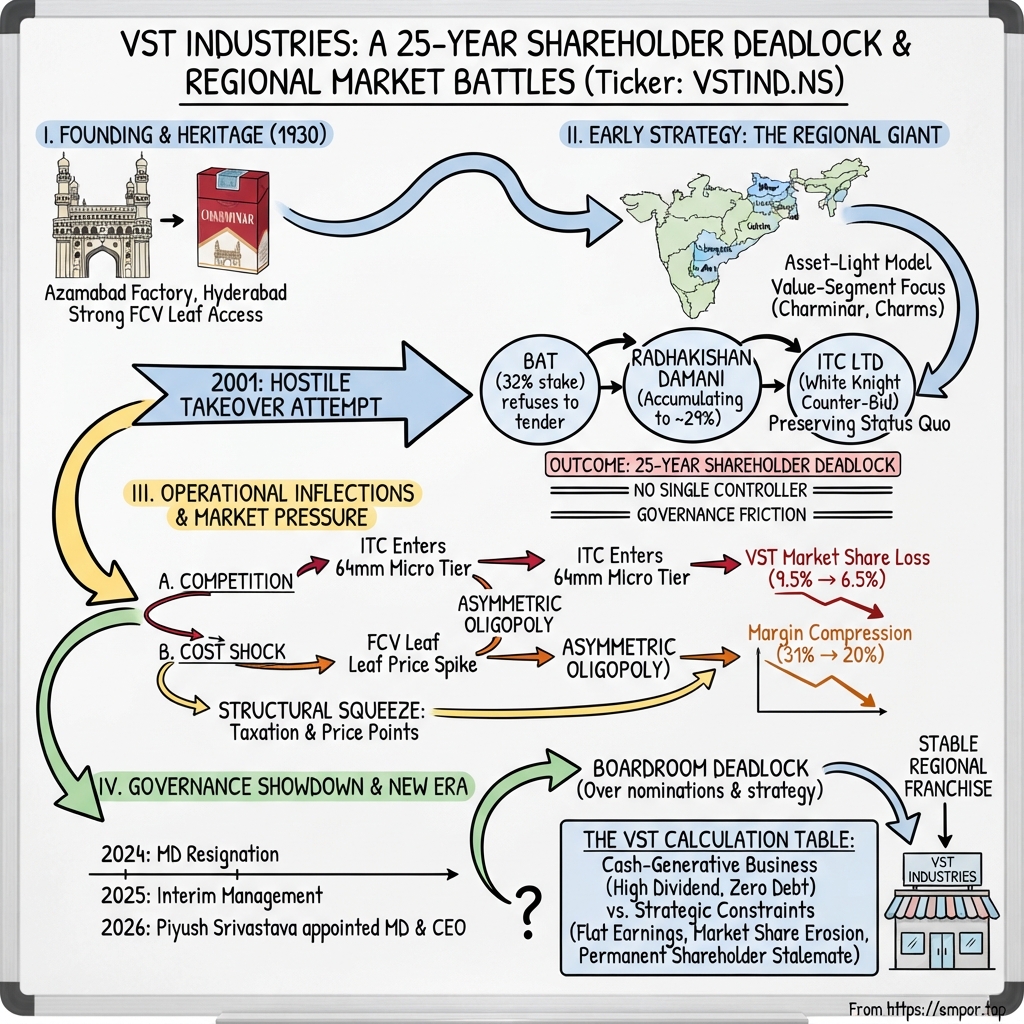
For more than two decades, this ninety-six-year-old regional tobacco manufacturer has been held in a shareholder deadlock between two major capital allocators in India: a London-headquartered multinational operating in Indian tobacco since the colonial era, and a Mumbai investor who subsequently built a prominent national retail chain. British American Tobacco, through its investment vehicles, has held roughly 32% of VST. Radhakishan Damani, founder of Avenue Supermarts and the D-Mart chain, together with associates, has held a stake ranging from the mid-teens to over 30%.[^9]8 Neither party has bought out the other, nor sold its position. For twenty-five years, VST Industries has remained a company whose two largest shareholders disagree on its strategic direction — while the public float in between has remained small enough for that disagreement to carry decisive weight.
That standoff began with a hostile takeover attempt in 2001 that remains a standard case study in Indian corporate finance. It continued through board-level friction that surfaced publicly in the mid-2020s, delayed executive appointments, and a leadership succession process that concluded with the appointment of Piyush Srivastava as Managing Director and Chief Executive Officer on March 2, 2026.10
Understanding scale is essential, as scale dictates the industry's dynamics. VST Industries trades on the National Stock Exchange as VSTIND and on the BSE under code 509966.45 For the financial year ended March 2026, the company reported revenue of approximately ₹2,087 crore and net profit of roughly ₹292 crore.[^14]2 While substantial in absolute terms, these figures represent a small fraction of the broader Indian cigarette market. ITC Limited — the Kolkata-headquartered conglomerate dominating Indian tobacco, which leveraged cigarette cash flows to expand into hospitality, paperboards, and packaged consumer goods — commands the vast majority of legal cigarette sales by volume. Godfrey Phillips India occupies second place, leaving VST in third as a distant residual producer.68
The central question for long-term investors is not how VST won the market, as it did not. Rather, the question is how a manufacturer operating behind market leaders has maintained high profitability, a debt-free balance sheet, and generous dividend payouts over decades — and whether that performance remains sustainable or signals the late stage of a business compressed by a dominant competitor and a restrictive tax regime.
Operationally, that scale gap is decisive. In cigarette manufacturing, major operating costs — including excise and goods and services taxes, leaf tobacco, paper, filter tow, distribution freight, and retail margins — scale directly with volume. Operational efficiencies yield limited cost advantages compared to raw unit scale. When a dominant competitor controls the majority of industry volume while a smaller player holds a single-digit percentage, the smaller firm operates a structurally higher-cost business. It survives by serving value segments and regional markets that larger competitors choose not to prioritize.
For most of VST's modern history, that focus centered on the deep-value segment across southern and eastern Indian states. The developments of the past fifteen years demonstrate what occurred when tax adjustments made those segments attractive to larger competitors.
Four central themes define this analysis.
First, the economics of the Indian cigarette market allow a company to lose market share while remaining cash-generative, as high tax levies leave manufacturer margins as a residual claim on government-administered retail price points.
Second, the 2001 takeover battle — comprising Damani's open offer, ITC's counter-maneuvers, and BAT's refusal to tender — established a twenty-five-year ownership equilibrium.
Third, the BAT dilemma reflects a structural anomaly: despite a multinational tobacco brand-builder owning nearly one-third of VST, the company was never granted access to BAT's global brand portfolio.
Fourth, corporate governance dynamics show how conflicting owner objectives impacted management decisions, as highlighted by the 2024–2026 succession contest.
Each claim can be tested against the company's financial and operational record rather than its public relations statements.
 Subscribe on LinkedIn
II. Nizam's Heritage to BAT Empire: Founding & Early History
Picture Hyderabad in 1930. It was not part of British India, but the Nizam's dominion — the largest and wealthiest of the princely states, a courtly city with its own currency, railway, army, and a ruler frequently described in the international press as the richest person alive. The surrounding Deccan plateau contained a red-soil belt extraordinarily well suited to growing flue-cured Virginia (FCV) tobacco, a light, bright leaf cured in heated barns that forms the backbone of modern cigarettes.
Into that setting came the Vazir Sultan Tobacco Company, founded in 1930 and built around that geographic advantage — a manufacturing operation sitting atop one of Asia's premier FCV growing regions.1 The strategic logic mirrored the development of tobacco hubs in North Carolina and Zimbabwe: positioning the factory at the source of the leaf secured the cheapest link in the supply chain before competitors could bid up raw material costs.
Charminar: a brand named after a monument
The company's defining commercial move came early. It launched Charminar — named for the four-minaret monument that has served as Hyderabad's visual signature since the sixteenth century — creating one of India's first mass-market cigarette brands.1
Charminar succeeded by focusing on accessibility rather than luxury. It was priced for consumers whose alternative was not a premium cigarette but a bidi — the hand-rolled, tendu-leaf smoke that formed the bedrock of India's mass tobacco market. Charminar functioned as the initial step above bidis: cheap enough for daily consumption, branded to convey upward mobility, and distributed densely enough to reach rural villages.
That strategy built deep regional penetration across the Telugu-speaking districts and the eastern belt, encompassing modern-day Andhra Pradesh, Telangana, West Bengal, Odisha, and Bihar.19 This geography was distinct from metropolitan markets like Mumbai or Delhi. VST built its franchise in price-sensitive regions where small price adjustments directly dictated brand choice. That created a defensible regional footprint, albeit one vulnerable to aggressive competitor pricing.
A second factor in Charminar's adoption stemmed from India's retail dynamics. Unlike Western markets where consumers typically purchase full packs at supermarkets, Indian consumers overwhelmingly bought single sticks from local vendors. In this environment, purchase decisions occurred dozens of times a month. Vendor recommendations and minor price differences held decisive weight.
Winning in that setting depended less on high-profile advertising than on consistent physical presence at local kiosks at the right price point. Vazir Sultan established that retail presence across the Deccan and eastern India over decades through local vendor networks — a durable commercial advantage until a higher-capitalized competitor sought to replicate it.
The BAT era and the renaming
During the post-independence decades, British American Tobacco accumulated a substantial minority position in the company via its investment arm, Raleigh Investment Company — the same vehicle structure BAT used for its broader Indian holdings.19 In 1983, Vazir Sultan Tobacco changed its name to VST Industries Limited, shifting from its founding identity rooted in the Nizam's Hyderabad to a generic corporate designation legible to its multinational parent and domestic capital markets.1
As noted, BAT's equity stake has remained at roughly 32% throughout the modern era.[^9]8 This ownership structure sits at the center of the company's long-standing governance dynamics.
The renaming coincided with an operational expansion. During the 1980s and 1990s, VST established a second business line: processing and exporting unmanufactured leaf tobacco. Proximity to farming regions turned raw material access into a tradeable asset, supplying international leaf buyers seeking Indian FCV tobacco without establishing local procurement organizations.3
This dual structure — manufacturing cigarettes and processing export leaf at modest scale within the same region — gave VST a distinct operational profile compared to single-focus competitors.
Myth vs reality: the BAT synergy thesis
The claim, made for decades in brokerage notes and repeated in retail-investor commentary: VST is a BAT company. It has access to the R&D, the blend science, the manufacturing know-how and — critically — the potential to license BAT's global brand portfolio into the world's second-largest tobacco market. That optionality is worth something.
The disconfirming evidence is the entire forty-year record. In four decades of BAT part-ownership, flagship international brands like Dunhill, Lucky Strike, Kent, and Pall Mall were never transferred to VST for Indian manufacture and sale — not under the licence raj, after the 1991 economic reforms, or during subsequent premiumization waves. VST's portfolio has remained centered on Charminar, Charms, Total, Special, and a small set of line extensions.13
The economic rationale is straightforward: BAT was not optimizing for VST alone. BAT has also held a large shareholding in ITC Limited — historically in the region of a quarter to a third of that far larger company.9 From the perspective of a BAT capital allocator, holding roughly a third of the market leader — which generates immense profits — alongside roughly a third of a distant third-place player meant that licensing a premium global brand to the smaller company would spend brand equity to draw volume away from a far more lucrative holding. Doing so would be value-destructive on BAT's own balance sheet.
The conclusion, stated plainly: the BAT relationship should be understood as a dividend-extraction arrangement and a supply-chain hedge — VST's leaf operation gives BAT a procurement window into Indian FCV tobacco — rather than as a growth engine for VST's brand equity. The claim that BAT ownership represents latent brand optionality is not merely unproven; it is contradicted by forty years of revealed preference across multiple regulatory and competitive regimes.
A narrower version of the claim does survive: BAT's presence has plausibly supported manufacturing standards and technical practice, while BAT's refusal to sell has been the single most important reason VST's control block has never changed hands. That is a real structural effect, even if it differs from the traditional bull case.
What remains is a manufacturer with a defensible regional brand, a solid leaf procurement position, a multinational shareholder with divided loyalties, and no clear pathway to the premium segment of its market. In 2001, an outside investor examined that balance, calculated the company's value, and concluded the market had priced it wrong.
III. The 2001 Corporate Siege: Damani, ITC, & BAT
The Indian stock market in 2001 was in severe distress. The Ketan Parekh scandal had erupted in March of that year, collapsing brokerages, exposing bank-funded circular trading across technology and media equities, and draining market liquidity. In the aftermath, numerous cash-generative Indian businesses traded at valuations detached from their underlying earnings and balance sheet assets.
VST Industries was one of them.
The man who noticed
At the time, Radhakishan Damani was not yet the prominent public figure he would later become. The first D-Mart store would not open until 2002, and Avenue Supermarts' initial public offering lay fifteen years in the future. Yet Damani already held a formidable reputation among Dalal Street professionals as a disciplined value investor, having built capital on the short side during the 1992 Harshad Mehta bull market. His approach focused on acquiring cash-generative businesses trading at deep discounts and holding them over long horizons.
VST fit that criteria. The company generated steady cash flow, carried zero debt, held a valuable industrial land parcel in central Hyderabad, and traded at a steep discount relative to its earnings and asset base.
Damani's investment vehicle, Bright Star Investments, accumulated approximately 15% of the company at around ₹88 per share before mounting an open offer at ₹112 per share for an additional 20%—a stake that, if acquired, would have granted effective board control.9[^9]
Hostile bids for established Indian manufacturing firms backed by multinational shareholders were rare in 2001. Damani was implicitly arguing that VST was operating primarily for the benefit of a foreign minority shareholder with limited incentive to maximize corporate value, and that an active domestic owner could improve performance.
The white knight
ITC responded rapidly. A counter-bid entered the market, escalating the contest and driving the offer price up to approximately ₹126 per share.9 ITC was not seeking to construct a new strategic asset, given its existing dominance in Indian tobacco. Instead, it moved to block a well-capitalized independent investor from gaining control of the country's third-largest cigarette manufacturer and operating it aggressively.
The decisive factor, however, was neither bidder, but British American Tobacco. With roughly one-third of the equity locked in BAT's investment vehicles and no willingness to tender, gaining majority control proved mathematically unfeasible for an outside bidder.[^9] Damani could acquire the public float, but not the strategic block.
This intervention underscored the competitive dynamics of the Indian cigarette industry. ITC had little interest in acquiring VST's regional brands, which operated at lower price points. Rather, the market leader sought to preserve the status quo: a conservatively managed competitor without a controlling shareholder motivated to gain market share. A dominant incumbent controlling three-quarters of industry volume rarely fears a minor competitor operating routinely; it fears a minor competitor revitalized by aggressive management.
Damani's open offer was a wager that operational inefficiencies at VST left substantial value to be unlocked under active management. ITC's counter-maneuver was a calculated effort to preempt that threat before it materialized.
The equilibrium that lasted twenty-five years
The bid failed, yet Damani did not exit the position.
Instead, he maintained his stake and expanded it over the subsequent two decades. Disclosed shareholding records through the mid-2020s showed the Damani group holding above 30% at times, before settling at approximately 29% by 2026 following subsequent adjustments.[^9]8 This persistent accumulation indicated a long-term valuation play rather than an ongoing control contest. As a result, VST acquired an active, economically aligned watchdog with sufficient voting power to influence major corporate decisions—establishing a governance structure distinct from both promoter-led and widely held corporations.
This shareholder structure enforced strict capital discipline. VST maintained a debt-free balance sheet and consistently distributed the majority of its earnings as dividends, with payout ratios frequently exceeding 70%.28 In September 2024, the company executed a 10-for-1 bonus share issue, multiplying the total share count tenfold and adjusting the per-share price proportionally—a move designed to improve trading liquidity by lowering the nominal share price for retail investors.97
What to make of the capital allocation record
While high dividend payouts, zero leverage, and an absence of speculative expansion are rare among Indian mid-cap companies—where value-destructive diversification remains common—this record reflects specific operational constraints.
A high dividend payout in a mature market with restricted reinvestment avenues represents a default response rather than strategic brilliance. Regulatory barriers prevent VST from freely expanding manufacturing capacity or advertising, while heavy distribution advantages safeguard the market leader against regional inroads. Lacking a proven path into adjacent sectors, returning cash to shareholders remains the logical recourse. Consequently, VST's financial track record demonstrates capital preservation rather than value creation through redeployment.
Furthermore, this watchdog ownership model created latent friction, which surfaced dramatically in boardroom disputes two decades later. Before examining that period, analyzing VST's core manufacturing operations and revenue engine provides essential context.
IV. Segment Economics: Cigarette Value-Chain vs. Leaf Tobacco Exports
On a tobacco auction platform in the Guntur or Prakasam districts of Andhra Pradesh during the FCV season, the environment resembles a village fair with significant capital at stake. Farmers arrive with bales of cured leaf while graders evaluate color, body, and texture. Buyers, including VST's procurement staff, place their bids. Prices fluctuate based on local rainfall, global crop yields in Brazil and Zimbabwe, and the annual crop limits established by the Tobacco Board.
This annual auction process determines VST's primary cost structure, serving as the arena where the company's operating margins face recurring pressure.
The cigarette business: where the money is
Roughly 85% of gross revenue and approximately 90% of operating profit come from cigarettes.23 The brand portfolio — Charminar, Charms, Total, Special, and the Editions line — is concentrated overwhelmingly in the value tier, with the core volume generated by short filter formats in the 64-millimeter micro and 69-millimeter regular filter segments.38
Understanding the sector requires examining a central structural mechanism: Indian cigarette taxation is length-banded. Rather than taxing purely on product value, the fiscal regime historically applied sharply different excise rates based on stick length and the presence of a filter. A 64-millimeter filter cigarette sits in a lower tax band than an 84-millimeter king-size stick. This regulatory design creates rigid retail price tiers. Because Indian consumers predominantly purchase single sticks using cash, manufacturers must engineer products to hit precise, round-number retail price points after tax.
This creates a structural squeeze. Tax policy fixes the ceiling of the price box, while consumer price sensitivity defines its outer boundary. The manufacturer operates in the narrow residual margin between the two.
Within that constraint, VST's gross margins have run above 50%, a figure that reflects industry norms where raw leaf is inexpensive relative to the final retail price of branded cigarettes.28 Net operational economics emerge further down the income statement, after subtracting excise duties, trade margins, and the fixed overhead of operating facilities at Azamabad in Hyderabad and Toopran.13
The company's distribution network is primarily geographic and relational. VST's competitive strength relies on dense penetration across small-format retail outlets, including kirana stores, paan kiosks, and roadside stalls in tier-2 and tier-3 towns throughout southern and eastern India.19 Under India's comprehensive tobacco advertising ban, physical shelf presence serves as the primary marketing channel, making counter placement at local vendors a key driver of sales volume.
The leaf export business: the quiet half
The unmanufactured leaf tobacco segment contributes roughly 15% of revenue but only around 10% of profits, reflecting a structurally lower-margin profile. EBIT margins in leaf export typically sit in the high single digits to low teens, compared to significantly higher margins in the cigarette division.23
This secondary operation provides three distinct operational advantages. First, it supports direct procurement relationships with farmers across the Andhra Pradesh and Telangana FCV belt, granting VST early visibility into crop quality and pricing. Second, it generates foreign currency receipts from buyers in Europe, the Middle East, and Southeast Asia, offering a partial natural hedge.3 Third, it creates a raw-material buffer, providing operational flexibility during domestic crop shortfalls.
While useful, these benefits represent an informational and supply-chain buffer rather than a standalone growth engine. The segment functions as a low-margin trading operation attached to a high-margin manufacturing core.
This structure also clarifies why top-line gross margin metrics can be deceptive. A substantial portion of consumer expenditure goes directly to the government via Goods and Services Tax (GST) and compensation cess before reaching the manufacturer. Net revenue represents only the remaining fraction after statutory levies and retail trade margins. Consequently, a reported gross margin above 50% indicates that leaf tobacco constitutes the primary controllable expense within a revenue base already compressed by taxation.
Because raw leaf represents the dominant cost inside a tax-compressed revenue structure, a 20% surge in leaf prices creates an immediate contraction in operating margins, with few alternative cost line items available to absorb the increase.
The five forces, run honestly
Threat of new entrants: very low. India's regulatory framework effectively precludes new cigarette manufacturers. Stringent industrial licensing, a comprehensive advertising ban under the Cigarettes and Other Tobacco Products Act (COTPA), and mandatory graphic health warnings prevent new entrants from building brand awareness. Consequently, market protection against outside startups remains robust.
Bargaining power of suppliers: moderate to high, and rising. Under the FCV auction system, VST's raw material costs are determined annually by weather, international crop yields, and Tobacco Board allocations. When leaf prices spiked in financial year 2024, VST absorbed the cost increase directly.211 Although the supplier base comprises thousands of individual farmers, the centralized auction mechanism effectively concentrates pricing power around broader crop availability.
Bargaining power of buyers: asymmetric. End consumers exercise limited bargaining power due to strong brand habituation. Conversely, retail trade partners hold significant influence. Small-format retailers allocate shelf space based on return per square inch. Trade margins and promotional scheme incentives heavily dictate product placement, placing smaller manufacturers with lower volume at a structural disadvantage when matching market leaders' trade spending.
Threat of substitutes: high and persistent. Illicit, tax-evaded, and smuggled cigarettes represent a major competing category, estimated by industry sources to account for roughly a quarter of the total Indian cigarette market.6 Combined with smokeless chewing tobacco and the widespread bidi market, legal cigarettes represent a minority share of total Indian tobacco consumption. Tax increases frequently shift price-sensitive consumers toward illicit or alternative tobacco products.
Industry rivalry: severe and asymmetric. ITC controls well over three-quarters of legal cigarette volume, Godfrey Phillips India holds approximately 11% to 12%, and VST accounts for roughly 6% to 7%.68 In a market dominated by a 75% market leader, competition is defined largely by the leader's strategic decisions regarding volume and pricing across regional markets.
Strategic implications for investors: The regulatory environment protects existing manufacturers from new entrants while offering no defense against established incumbents. The regulatory moat covers the entire legal industry rather than VST specifically, leaving the smallest player in a vulnerable position. With input costs tied to agricultural auction prices and retail distribution governed by trade schemes, VST's operating margins remain constrained by external factors.
These structural pressures manifested directly during market shifts over the past fifteen years.
V. Recent Inflection Points & Historical Falsification Pass
Inflection point one: the 64mm tax tier, and the day the giant walked in
For most of its history, VST operated under an implicit division of the Indian cigarette market: market leader ITC dominated the premium and mid-market tiers, leaving VST to operate unmolested in the lower-priced value segment. This setup persisted not because ITC lacked the capability to compete at the bottom, but because the value segment offered slim profit margins per stick, required intensive distribution effort, and risked cannibalizing ITC's own higher-margin offerings.
That informal boundary disappeared when the fiscal structure changed.
When the Indian government introduced a lower excise tax band for cigarettes under 65 millimeters in the early 2010s, it created a highly attractive product category. The shorter format and reduced tax burden enabled manufacturers to sell at low, round-number retail price points while preserving unit economics—providing a vital channel to maintain sales volumes as taxes rose on longer sticks. ITC responded strategically by launching aggressive 64-millimeter offerings under its established brand names.69
The claim being tested: VST's value brands possessed localized consumer loyalty and a defensible regional moat.
For decades, the central thesis among VST bulls asserted that core brands like Charminar and Charms possessed deep regional affinity across home markets in southern and eastern India that a national competitor could not easily displace.
The disconfirming evidence is unambiguous in VST's market share performance. As ITC deployed its extensive distribution network into the 64-millimeter tier, VST's national cigarette volume share dropped from roughly 9.5% to approximately 6.5% over subsequent years—a loss of nearly one-third of its relative market position.68 This contraction occurred even though the entrant introduced no fundamental product innovation, relying instead on existing brand equity, aggressive trade incentives, and vastly superior retail reach.
The conclusion: the strong form of the regional loyalty hypothesis is unsupported by the historical record. VST's market position reflected distribution incumbency in an uncontested price tier rather than durable brand equity. In value-segment tobacco, brand preference proves fragile when challenged by superior retail distribution and trade economics, primarily because price-sensitive consumers prioritize immediate retail availability at accessible price points.
A narrower interpretation remains valid: VST maintains a dense, established distribution footprint in its core southern and eastern states and remains an active regional manufacturer. However, the fundamental test of brand strength—the capacity to defend market share against a well-capitalized rival competing at the same price point—yielded a clear share loss.
The key metric required to demonstrate true pricing power or brand defense would be consecutive quarters of domestic volume growth in the 64-millimeter segment alongside active competition from ITC.
This episode highlights a broader corporate finance principle: an asset-light regional franchise can resemble a defensible moat until changing economics incentivize a dominant competitor to enter the segment. VST's low-tier position appeared protected only so long as the absolute profit pool remained too small to attract the market leader. A single tax policy adjustment shifted those incentives, exposing the structural vulnerability of distribution incumbency.
VST's response also reflects strategic choices. Holding a debt-free balance sheet and years of strong cash generation, management possessed the financial resources to fund defensive trade schemes or accelerate retail outlet expansion ahead of competitor entry. Instead, the company prioritized high dividend payouts. While contesting market share against a dominant rival ten times its size might have yielded limited results, the decision to absorb volume losses while maintaining cash payouts represented a deliberate capital allocation choice.
Inflection point two: the leaf price shock and the pricing-power question
The second major operational test emerged on the cost side. Domestic and international flue-cured Virginia leaf prices surged in financial year 2024, driving VST's raw material expenses up by over 20%.211 The margin impact was immediate: operating profit margins, which averaged around 31% in financial year 2023, compressed to roughly 20% by financial year 2025 and remained at that reduced level through financial year 2026.2[^14]
An agricultural input cost spike is an external shock, but management's pricing response reveals whether a business possesses genuine market power.
The claim being tested: management's conservative, asset-light approach preserved a superior return on capital employed above 35%.
VST's reported return on capital employed has historically been strong. The underlying arithmetic is straightforward: an operation with modest fixed assets, zero debt, and rapid cash conversion mechanically generates high return metrics on a compact capital base.811
The disconfirming evidence lies in how those returns behaved under margin stress. A manufacturer with pricing power offsets a 20% input cost increase by raising retail prices, accepting temporary volume trade-offs, and recovering historical margins within a few quarters. VST instead absorbed the input inflation directly into its operating margins, sustaining compressed profitability across multiple financial years.2[^14] This trajectory demonstrates the characteristics of a price-taker.
Structural market dynamics explain this outcome. In India's length-banded, cash-traded cigarette market, value manufacturers face rigid constraints. Retail prices operate on discrete, round-number single-stick price steps. Raising a pack price to the next increment represents a steep percentage increase for budget-conscious consumers, risking immediate volume surrender if competitors maintain their price points. Meanwhile, alterative levers like reducing stick length or adjusting filter specifications run directly into statutory tax bands.
Consequently, high return on capital employed in VST's case represents a structural feature of an asset-light, low-capital operating model rather than evidence of pricing power or competitive differentiation. Furthermore, choosing not to invest heavily in automated leaf-processing infrastructure left the company with fewer operational efficiencies to offset rising raw material costs.
Conversely, VST's balance sheet resilience—marked by zero debt, consistent cash flow generation, and no need for equity dilution—provided essential downside protection. This capital cushion enabled the company to navigate multi-year margin compression without operational distress, representing a key defensive asset during commodity price spikes.
However, the pattern across recent operating cycles remains clear: when subjected to competitive entry or raw material cost inflation, VST has absorbed the pressure through lower market share and reduced profit margins. This historical execution context provides the baseline for evaluating management's forward-looking strategic plans.
VI. Conference Call Evidence & Governance Showdown
The two versions of every earnings call
There is a reliable structure to a VST earnings interaction, and it is instructive precisely because it is so consistent.
The prepared remarks, under the tenure of former Managing Director Aditya Deb Gooptu, followed a recognizable arc: volume recovery in the Total and Charms franchises, attempts at premiumization through new launches and the Editions line, and growth in the leaf export business.23 It is a narrative of gradual, incremental improvement — the kind of story a company tells when it is neither growing fast nor shrinking fast.
The analyst Q&A followed a different arc, and in the transcripts and reported coverage of these calls the same four questions recur with the persistence of a drumbeat.27
First: what is management actually doing about persistent share loss to ITC in the southern markets that constitute VST's home turf? The answers have tended toward the general — distribution expansion, brand investment, focus on core geographies — rather than the specific and measurable.
Second: raw material inflation and excise increases are cited as the cause of margin compression, but every competitor faces the same excise regime and largely the same leaf market. If margins compress more, or recover more slowly, that is a statement about relative pricing power, not about the environment. Analysts have pressed on this distinction repeatedly.
Third: realization growth in the 69-millimeter filter segment has been sluggish, which matters because 69-millimeter is where a value manufacturer would logically try to trade consumers up.
Fourth: retail expansion outside the five core states has been slow, raising the natural question of whether that reflects poor execution or the unfavorable economics of entering ITC-dominated territory with a value brand and no advertising.
Evaluating these calls from an investor's perspective reveals a pattern of explanation rather than actionable planning. Attributing margin compression to leaf prices and taxation is factually accurate yet analytically incomplete. What has been consistently absent in these interactions is a specific, falsifiable commitment — a target for outlet expansion, a stated ambition for share recovery in a defined segment, or a timeline for margin restoration. Companies executing a turnaround generally invite measurement, as accountability earns market credibility. Companies managing a structural decline generally prefer context.
This distinction is not an accusation of financial misrepresentation. VST's disclosures have not been a source of accounting controversy, and there is no evidence of related-party value extraction of the kind that plagues parts of the Indian mid-cap universe. It is a judgment regarding strategic ambition and accountability, which are distinct from basic corporate integrity.
The boardroom, 2024–2026
And then the governance question stopped being theoretical.
Aditya Deb Gooptu's resignation as Managing Director in late 2024 opened a succession process at a company with two large, mutually suspicious shareholder blocks and no single controlling promoter.9[^9] What followed was, by the standards of Indian corporate governance, an unusually visible display of what occurs when a 32% shareholder and a 29% shareholder hold conflicting strategic priorities.
The underlying mechanics dictated the outcome. Under Indian company law, executive director appointments require shareholder approval by special resolution, establishing a 75% voting threshold. A shareholder holding close to 30% who votes against a candidate can block an appointment outright, regardless of how the remaining register votes. Damani's block was not merely a protest vote; it functioned as a structural veto.
Reported voting friction over BAT-backed nominations to executive board seats produced exactly the outcome that structure predicts: delay.[^9]9 The company operated through an interim period with Naresh Kumar Sethi serving as Executive Chairman, before the process concluded with the formal appointment of Piyush Srivastava as Managing Director and Chief Executive Officer on March 2, 2026.10
A comparison with broader market norms sharpens the distinction. In most listed Indian companies, a promoter family or founder group holds a controlling or near-controlling stake, rendering governance disputes an asymmetric contest between the promoter and minority shareholders. VST has no single controlling figure. Instead, it features two shareholder blocks of comparable size with divergent objectives: a global tobacco multinational whose economic interest in Indian tobacco spans multiple entities, and a domestic investor whose interest is focused entirely on maximizing the value of this specific equity block. These two entities naturally disagree on corporate leadership and strategy, and the capital structure offers no resolution mechanism short of explicit negotiation.
What the fight actually revealed
Three conclusions emerge, each more important than the individual personalities involved.
One: neither block can govern alone. BAT's roughly 32% stake cannot pass a special resolution over Damani's objection, and Damani's roughly 29% stake cannot pass one over BAT's. Every major executive appointment or corporate action requiring special shareholder sanction requires mutual acquiescence. This represents a persistent structural constraint on strategic boldness.
Two: leadership delay carried a concrete operational cost. A company already surrendering market share in its core segment and absorbing input cost inflation spent a meaningful period without a permanent chief executive. A leadership vacuum during an active competitive squeeze imposes a measurable operational drag.
Three: this environment reflects active stewardship rather than governance failure. Having a large, economically aligned, independent shareholder scrutinizing a board that might otherwise defer to a foreign minority owner with divided incentives provides genuine oversight. That active scrutiny is an element of sound stewardship; periodic deadlock is the structural price of that balance.
Evaluating management credibility requires analyzing consistency across reporting periods. A rigorous exercise for investors involves reading sequential annual reports alongside earnings call transcripts. When stated priorities shift — from premiumization to volume defense to export growth and back — without explicit explanation of what changed or why previous initiatives were abandoned, that pattern provides critical context. It indicates strategy being articulated reactively rather than set in advance.23
This pattern reflects a subtler issue than misstatement. A management team that launches a premium brand initiative, quietly stops reporting on it two years later, and provides no clear performance review has not falsified data. However, it has insulated itself from accountability. The remedy is straightforward: management must establish a limited set of specific, measurable objectives and report against them consistently.
The management credibility scorecard, weighed
On the positive side of the ledger, the historical record demonstrates clear operational strengths. The balance sheet has remained free of debt. Working capital discipline has been maintained. Dividend policy has been reliable and generous rather than opportunistic.28 Management has avoided diversifying into unrelated sectors — avoiding the value-destructive capital allocation that has impaired returns at many cash-generative mid-caps. These are non-trivial accomplishments; many boards managing similar cash flows have deployed capital far less effectively.
On the negative side, premium and new-brand initiatives have launched and faded without clear public accounting; market-share defense has remained reactive; and the two dominant shareholder blocks have demonstrated a willingness to engage in public governance disputes.
The calibrated verdict: VST's historical record demonstrates effective custodianship — assets have been preserved, the balance sheet protected, and cash returned to shareholders. It does not, however, demonstrate proven strategic capability, as the record lacks an instance of the company executing a successful competitive counter-move against market leader ITC or building a durable brand franchise in a higher price tier. With Piyush Srivastava appointed as Chief Executive Officer in March 2026, forward evaluation depends on tracking his publicly stated operational targets and monitoring execution metrics over subsequent quarters.
VII. Investment Story Spine: Bull vs. Bear Case & Helmer's 7 Powers
Running the 7 Powers, without flattery
Hamilton Helmer's framework asks a deliberately harsh question: what, specifically, allows a company to sustain differential returns that a competitor cannot arbitrage away? Applied honestly to VST Industries, most of the answers prove uncomfortable.
Scale Economies: absent, and inverted. Scale economies benefit the largest player. In Indian cigarettes, that is emphatically not VST. ITC's volume base allows it to amortize distribution, procurement, and trade-scheme costs across roughly ten times the stick volume. In a business where the marginal cost of reaching an additional kirana shop is a fixed expense divided by the volume that shop generates, VST operates on the wrong side of the equation in every territory it does not already dominate.
Network Economies: not applicable. Cigarettes do not become more valuable to a consumer because others smoke them. Social contagion exists in tobacco initiation, but it does not accrue to a specific brand's benefit in any durable, defensible way.
Counter-Positioning: none. Counter-positioning requires a business model that an incumbent cannot copy without damaging its existing operations. VST employs the identical model as ITC and Godfrey Phillips — manufacturing, branding, and distributing through traditional trade channels — at a fraction of the scale. Incumbents sacrifice nothing to compete directly with VST, which explains why ITC entered the 64-millimeter segment without hesitation.
Switching Costs: weak. Brand habituation in tobacco is real and persistent among consumers. However, the 64-millimeter episode demonstrated empirically that at the value end of the market, brand loyalty succumbs to retail availability and trade economics. This power evaluates as weak-to-moderate, with empirical evidence showing that VST surrendered market share when challenged.
Branding: weak within the industry. Branding as a Power represents the ability to charge a premium for an identical good. VST's brands command no premium; they occupy tax-and-price-defined budget slots. In a market subject to a total advertising ban, existing brand equity cannot be refreshed through promotional campaigns — a condition that entrenches whichever competitor already held the strongest brands when the ban took effect, namely ITC.
Cornered Resource: moderate, and the strongest item here. VST's multi-decade direct procurement relationships across the Telangana and Andhra Pradesh FCV belt are difficult to replicate quickly, and proximity to the growing region provides a tangible structural cost advantage in leaf sourcing.13 However, clear limits apply: leaf is a traded commodity with global substitutes, ITC procures extensively in the same region, and the auction system translates this advantage into informational visibility and supply reliability rather than materially lower leaf prices. It remains a real Power, but a modest one, and margin compression from financial year 2024 through financial year 2026 demonstrated that it could not insulate the company from raw material inflation.
Process Power: low to moderate. The Hyderabad manufacturing footprint is low-cost and long-optimized. Whether it constitutes Process Power in Helmer's sense — an organizational capability competitors cannot copy even with full visibility — remains doubtful. Nothing in VST's manufacturing processes is proprietary in a manner that market leaders could not replicate.
The aggregate: one moderate Power, one weak Power, and five effectively absent. This structure does not constitute a competitive fortress. The regulatory barrier to entry protects the broader industry's profit pool; within that pool, VST's position is defended primarily by the fact that dislodging it entirely would cost the market leader more than the volume is worth — representing protection through competitor indifference rather than structural advantage.
The bull case: why VST could still work from here
One: valuation and yield as a floor. VST has consistently offered a high dividend yield — in recent years in the range of 4% to 5% or higher depending on the equity price — backed by free cash flow rather than borrowing.87 For an investor, the distinction is significant: a yield funded by genuine cash generation from a business with minimal incremental capital requirements and zero debt is fundamentally different from a yield funded by leverage or asset sales. If the business merely persists — with stable volumes and flat margins — the dividend stream alone provides tangible value. This represents the strongest element of the bull case, and it does not depend on management executing operational breakthroughs.
Two: ownership-structure optionality. The deadlock that constrains VST also represents a potential source of value creation. If BAT ever chose to exit its Indian minority holdings, if Damani transitioned from watchdog to acquirer, or if the two major blocks reached an alignment, the resulting shift could trigger a revaluation of assets that currently reside within a company neither shareholder controls — including a prominent industrial land parcel in central Hyderabad whose market value substantially exceeds its historical book value.
The necessary caveat is substantial: this premise has formed the core bull case since 2001. Twenty-five years is a long duration for strategic optionality to remain unexercised. An option that has not been exercised across changing regulatory regimes, multiple leadership teams, and an open offer carries a low probability. Decades of BAT declining to transfer global brands indicate how investors should evaluate decades of BAT declining to sell its equity stake. The same revealed-preference logic applies to both decisions.
Three: new leadership. Piyush Srivastava's appointment concluded a destabilizing interregnum, providing a new chief executive with the latitude to reset distribution strategy, address leaf-export margins, and re-engage the investment community with explicit operational targets.10 As of September 2026, Srivastava has been in the role for roughly six months. With no extended track record to evaluate, the appropriate analytical stance is observation rather than reliance.
The bear case: what breaks the story
One: the oligopoly asymmetry is structural and expanding. Every tax increase on Indian cigarettes is absorbed more efficiently by the manufacturer with the largest volume and broadest price ladder. ITC can transition consumers across its own portfolio rungs; VST commands fewer price tiers. Similarly, trade-scheme escalations cost the market leader a smaller fraction of its profit per outlet. This represents an arithmetic constraint rather than a temporary operational disadvantage.
Two: regulatory risk is permanent and one-directional. GST Council tax revisions, compensation cess adjustments, plain-packaging proposals, and point-of-sale display restrictions reflect a global regulatory trajectory that has tightened for four decades. VST cannot lobby or diversify away from these pressures, making regulatory risk an ongoing operational reality for investors.
Three: the volume trap. Net profit has remained flat in the range of ₹290 crore to ₹300 crore from financial year 2024 through financial year 2026 — demonstrating stability without compounding growth.2[^14] A business with flat earnings functions similarly to a bond carrying equity risk. Generating attractive investment returns under these conditions depends entirely on entry valuation, as structural acceleration remains unproven in recent performance data.
Four, the activist's question: a skeptical investor examining VST would question why a cash-generative company experiencing share loss, board friction, and holding under-monetized real estate assets has not been restructured or acquired. The shareholder deadlock provides the answer: the exact ownership structure that protects VST from a hostile takeover also prevents value-unlocking corporate transactions. Because the two dominant blocks collectively control the majority of voting shares, public float investors lack the voting power to force strategic change.
For the bull case to become the primary narrative, three conditions would need to materialize in order of probability. First, leaf prices would need to normalize while VST demonstrates the pricing power to restore operating margins rather than accepting lower profitability — a dynamic that will clarify over upcoming reporting periods. Second, the chief executive would need to establish public, measurable targets for outlet expansion and volume recovery, and subsequently achieve them. Third, and least probable based on historical precedent, the ownership deadlock would need to resolve in a manner that enables strategic expansion or a change of control.
The first condition represents a cyclical factor with a reasonable likelihood of favorable resolution. The second remains unproven. The third has failed to occur over twenty-five years and should be weighted accordingly.
Synthesis
At its core, VST Industries represents a cash-generative, low-growth participant in a heavily taxed, volume-constrained industry, supported by a debt-free balance sheet, a strong dividend yield, an unresolvable shareholder standoff, and a focused cost advantage in leaf procurement.
The bull and bear cases operate on distinct analytical variables. The bull case centers on the price an investor pays for a durable cash flow stream, while the bear case evaluates whether that cash flow can compound over time. Historical evidence indicates that both perspectives are valid simultaneously. Consequently, investment evaluation focuses on entry valuation and cash durability rather than expectations of competitive expansion, as market share trends over the past fifteen years have largely defined the competitive landscape.
The risk radar, filtered for relevance
Macroeconomic checklists often contain low-relevance items; evaluating VST requires focusing on exposures with direct transmission mechanisms.
Input-cost inflation represents an active operational risk. Flue-cured Virginia leaf constitutes the primary controllable cost, its price is determined at auction through broader supply dynamics, and VST's historical response has been margin absorption rather than immediate price pass-through.211
Regulatory and tax policy presents an asymmetric risk, as policy shifts overwhelmingly increase operational friction rather than ease it. The primary structural vulnerability involves potential adjustments to length-based tax categories, given VST's product concentration in specific length bands.
Illicit trade remains a persistent competitive factor. Legal manufacturers compete against tax-evaded products that operate with a structural cost advantage equivalent to statutory taxes.6 A value-tier manufacturer faces direct exposure to illicit alternatives, as both target price-sensitive consumers.
Execution risk manifests not as the failure of an ambitious transformation, but as the continuation of passive market-share erosion without strategic counter-measures.
Conversely, several standard risk categories do not apply directly to VST. Traditional technology disruption, debt refinancing risks, and cyclical demand collapses are minimal, as tobacco consumption exhibits low economic elasticity. Furthermore, global debates regarding next-generation alternatives — such as heated tobacco and nicotine pouches — carry limited relevance for domestic operations, as India enacted a complete ban on e-cigarettes and alternative vapor products in 2019.6 This regulatory prohibition prevents both smaller players and market leaders from using alternative categories to offset traditional volume trends.
VIII. Key KPIs to Track & Epilogue
Stripping away noisy quarterly metrics leaves three key indicators that clarify whether VST Industries is stabilizing, eroding, or genuinely turning around. Notably excluded from this core set are aggregate revenue growth, which price adjustments and product mix can easily flatter, and reported net profit, which is frequently distorted by tax timing and non-operating income.
One: domestic cigarette stick volume growth, split by length segment. This metric provides the clearest measure of competitive positioning because stick volumes cannot be inflated by retail price increases. The key indicator to monitor is the 64-millimeter micro-filter segment relative to the 69-millimeter and 84-millimeter formats. Sustained stick volume growth in the 64-millimeter category while ITC maintains an active presence there would provide the first empirical evidence in fifteen years that VST can defend its core market. Conversely, volume growth confined to 69-millimeter and larger formats—or flat volume alongside rising top-line revenue—indicates that the company is harvesting cash rather than expanding its market position.
Two: cigarette segment EBITDA margin. The margin compression from financial year 2024 through financial year 2026, when operating EBIT dropped from roughly 31% to around 20%, reflected the market's assessment of VST's pricing power under cost pressure.2[^14] The key variable going forward is the margin trajectory as raw leaf tobacco prices normalize. A meaningful margin recovery as agricultural input costs ease would confirm that the recent margin pressure was a typical commodity cycle. Conversely, margins that remain depressed even after leaf costs decline would indicate that the company surrendered pricing power to preserve volume and could not recover it—a structural repositioning downward rather than a temporary shock.
Three: leaf tobacco export realization per kilogram and the segment's EBIT contribution. Although leaf export is the smaller business line and carries less strategic weight, it represents the primary operational area where management discretion is not neutralized by ITC's dominant scale. Rising export realization per kilogram paired with expanding segment EBIT would demonstrate that VST is converting its raw leaf procurement network into economic value rather than merely maintaining throughput. Flat realization accompanied by volume growth would suggest that the company is trading low-margin commodities simply to generate turnover.
These three metrics specifically test structural claims that the historical record has already called into question. The KPIs that matter most are precisely those capable of proving or disproving the prevailing analytical consensus.
Excluding certain conventional financial metrics from this tracking framework is intentional. Dividend yield functions as a trailing output of equity valuation and payout ratios; a rising yield in a business with contracting operating profits serves as a warning signal rather than an investment thesis. Return on capital employed is similarly uninformative as a dynamic tracking metric: in an asset-light, debt-free operation, it remains a structural constant reflecting balance sheet design rather than competitive performance. Finally, while market share represents an important analytical variable, third-party estimates are published with variable lags and inconsistencies across sources, making direct stick volume disclosures from company reporting the superior proxy.
Epilogue: the factory in Azamabad
Benjamin Graham famously described a specific class of deep-value investments as "cigar butts"—discarded stubs offering a single remaining puff of value, available at a price low enough to justify picking them up. Because VST Industries is an actual tobacco manufacturer, applying Graham's metaphor is tempting, yet the comparison is fundamentally imperfect.
Graham's cigar butt referred to a failing asset trading below its liquidation value. VST is not a failing business. The company generates hundreds of crores in annual net profit, directly employs thousands of workers while supporting extensive farming communities across its procurement belt, carries no debt, and has maintained substantial dividend payouts for decades.28 VST is not a discarded stub, but a well-maintained operational engine engineered to run at a consistent speed inside a steadily shrinking room.
What makes VST a compelling corporate case study is its capitalization table. Two of the most sophisticated capital allocators in Indian equity markets—a London multinational with over a century of global tobacco operating experience and the domestic entrepreneur who built India's premier hypermarket chain—have each evaluated the business, built major ownership positions, and spent twenty-five years in a strategic stalemate. Neither party has sold its position. That enduring equilibrium reveals a dual reality: the asset possesses durable cash-generating value, yet its structural constraints present no easy resolution.
Piyush Srivastava assumed leadership in March 2026, inheriting a ninety-six-year-old regional franchise, an input cost structure tied to agricultural harvests, a market leader ten times its size, a board that required over a year to complete his appointment, and two dominant shareholders with conflicting strategic priorities.10 His management of domestic stick volumes over upcoming operating cycles will determine whether the enterprise founded in the Nizam's Hyderabad operates as a managed cash harvest or achieves a renewed operational trajectory.
Historical evidence through 2026 strongly points toward the cash-harvest scenario. While historical patterns do not dictate future performance, fifteen years of market-share contraction and three years of margin compression present a consistent analytical trend. Reevaluating that trajectory requires concrete evidence from future operational metrics, and the burden of proof rests entirely on any thesis predicting a structural turnaround.
References
-
VST Industries Limited Official Website — VST Industries ↩↩↩↩↩↩↩↩↩↩
-
Financial Results & Stock Exchange Filings — VST Industries Investor Relations ↩↩↩↩↩↩↩↩↩↩↩↩↩↩↩↩↩
-
Annual Reports & Business Responsibility Reports — VST Industries ↩↩↩↩↩↩↩↩↩↩
-
VST Industries Ltd Scrip Info — Bombay Stock Exchange (BSE: 509966) ↩
-
VST Industries Ltd Stock Quote — National Stock Exchange of India (NSE: VSTIND) ↩
-
VST Industries Financial Profile & Corporate Data — Economic Times ↩↩↩↩↩↩↩
-
VST Industries Stock Price & Financial Analysis — Moneycontrol ↩↩↩
-
VST Industries Detailed Financials & Peer Comparison — Trendlyne ↩↩↩↩↩↩↩↩↩↩↩↩↩
-
VST Industries Corporate News & Financial History — Business Standard ↩↩↩↩↩↩↩↩↩↩
-
VST Industries Appoints Piyush Srivastava as MD & CEO — Financial Express, 2026-03-02 ↩↩↩↩
-
VST Industries Research Report & Stock Analysis — ICICI Direct ↩↩↩↩
 LinkedIn
 WhatsApp
 Reddit
 Hacker News
 Email
Email Kindle
 RSS Feed
 Spotify
 Apple Podcasts
 Amazon Music
 Audible
 YouTube