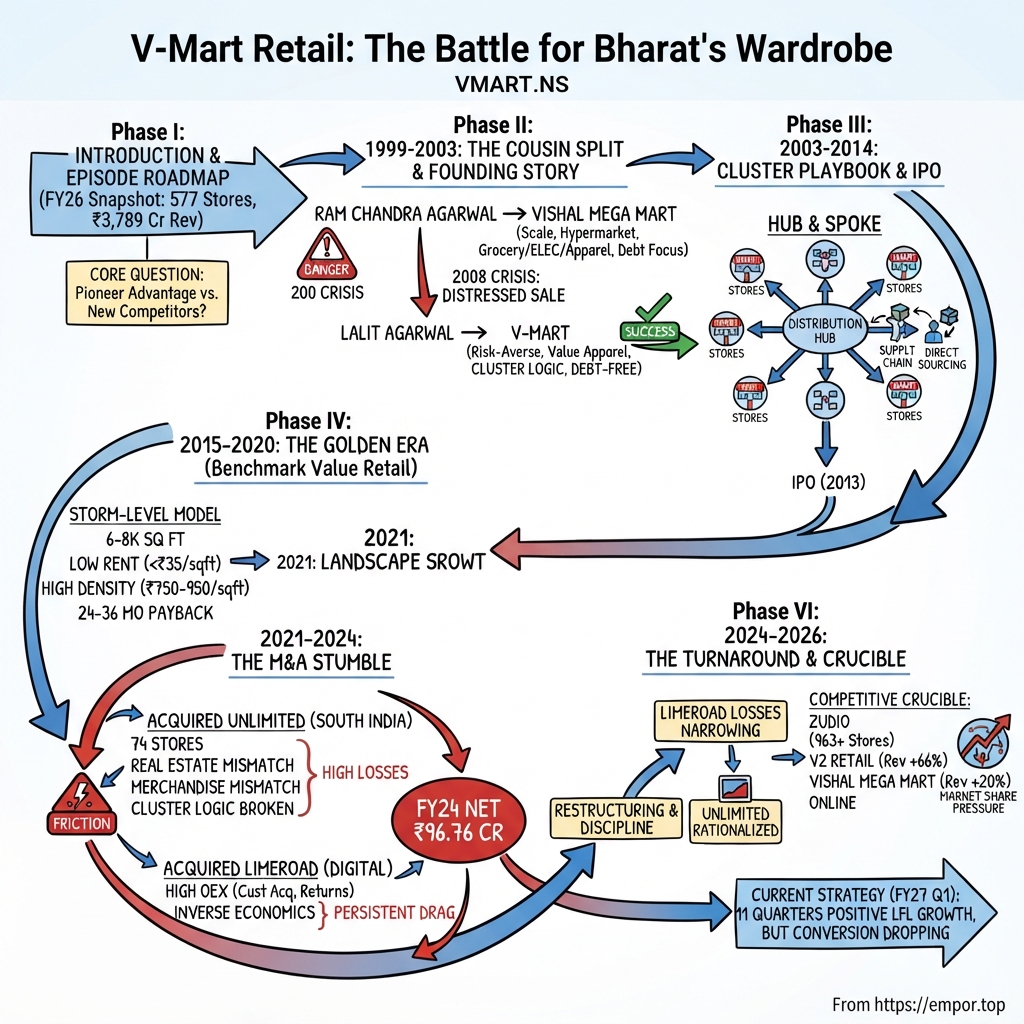
V-Mart Retail: The Battle for Bharat's Wardrobe
I. Introduction & Episode Roadmap
There is a particular kind of building on the main high street of a town like Bareilly, Gaya, or Muzaffarpur: three floors, a glass frontage, a sign in saturated red and yellow, and — the detail that matters most — air conditioning. On a Sunday afternoon in the weeks before Diwali, the staircase inside is a slow-moving river of families. A father holds a shopping basket; a teenager negotiates for a pair of jeans priced at ₹499; a grandmother inspects a bedsheet. Nobody in the building is buying luxury goods, but almost everybody is buying something.
That store model is the entire business. V-Mart Retail built itself into an enterprise generating roughly ₹3,789 crore in annual revenue — around $430 million — by selling jeans priced between ₹300 and ₹600 and t-shirts from ₹150 to ₹300 to households across India's Tier 2, Tier 3, and Tier 4 towns, the region often broadly termed "Bharat."1 In FY26, the company operated 577 stores across roughly 5.0 million square feet of retail space after opening a record 92 stores during the year.1 By the end of the June 2026 quarter, its footprint had expanded to 591 stores.2
This is not a story about a company that simply identified an untapped market; the demand for apparel in small-town India was already well known. Rather, it is the story of a company that engineered a viable cost structure — placing an air-conditioned, organised, fixed-price apparel store into a town of 200,000 residents while generating a sustainable return on capital. For nearly fifteen years, that operational blueprint served as a formidable moat.
Then the landscape shifted. V-Mart executed two costly acquisitions that disrupted its core operating model, resulting in a consolidated net loss of ₹96.76 crore in FY24.3 Meanwhile, the Indian value-fashion sector transformed from a quiet retail niche into one of the country's most fiercely contested consumer battlegrounds.
The core question of this episode: can V-Mart defend its pioneer advantage in Bharat's value-fashion market against Tata's Zudio — which crossed 1,000 stores in September 20264 — as well as a revived V2 Retail run by the founder's estranged cousin, a newly listed Vishal Mega Mart, and a well-funded Baazar Style Retail? And does the company's FY26 recovery — with revenue expanding 16%, EBITDA growing 36%, and net profit surging 171% to ₹124 crore1 — signal a structural return to form, or merely a cyclical rebound from a self-inflicted low?
The narrative arc moves through five distinct phases. The Cousin Split (1999–2003): two founders from the same family and trade who took opposing views on capital allocation. The Cluster Playbook & IPO (2003–2014): mastering small-town retail economics and scaling store clusters. The Golden Era (2015–2020): delivering high returns on capital to become a benchmark value retailer. The M&A Stumble (2021–2024): acquiring Arvind Fashions' Southern Unlimited stores and the LimeRoad e-commerce platform, revealing management execution limits. The Turnaround & Crucible (2024–2026): curtailing LimeRoad losses, rationalising Southern operations, and delivering eleven consecutive quarters of positive like-for-like growth5 amid an increasingly crowded market.
The analytical posture up front is clear: while V-Mart's management presents a coherent recovery narrative backed by improving financial metrics, the same executive team offered similarly persuasive arguments for the Unlimited and LimeRoad deals in 2021 and 2022. The objective here is to evaluate those management assertions against the historical and operational record.
 Subscribe on LinkedIn
II. The Split & Founding Story: Two Cousins, Two Philosophies (1999–2003)
Picture the wholesale garment lanes of Kolkata in the late 1990s: narrow, crowded, humid, and stacked floor-to-ceiling with bales of unbranded cloth. Nothing had a fixed price. Every transaction was a negotiation, and profit margins belonged to whoever held the stronger relationship with suppliers. This was where the Agarwal family did business, and where two cousins — Ram Chandra Agarwal and Lalit Agarwal — learned the same trade while drawing opposing operational conclusions.
Ram Chandra was the elder, more visible, and initially more prominent of the two. His takeaway from unorganised trade was that scale was the primary opportunity. If consumers shopped in chaotic bazaars, the winning strategy was to build the largest, most comprehensive retail footprint possible: a hypermarket selling groceries, electronics, and apparel under one roof across as many cities as capital permitted. That business became Vishal Mega Mart, becoming one of India's fastest-expanding retail ventures during the 2000s.
Lalit reached the opposite conclusion, focused primarily on risk. In retail, growth is easy to buy but hard to sustain. Every new store represents a fixed lease obligation signed today against uncertain future revenue, while every new product category ties up capital in inventory. His counter-thesis was disciplined: focus tightly on value apparel, keep store formats small, cluster locations geographically to optimize logistics costs, and avoid debt-financed expansion.
The two philosophies could not coexist within a single family business. Lalit separated from the group in the early 2000s, moved west and north, and incorporated V-Mart Retail in 2002, opening the first store in Ahmedabad, Gujarat in 2003 before pushing the format into Uttar Pradesh.6 The expansion targeted underserved markets rather than contested urban centers, establishing stores in towns where the primary competition was an independent merchant with a ledger, offering customers fixed prices in an air-conditioned environment.
The Man Who Chose Boring
Lalit Agarwal's operational style directly shaped V-Mart's corporate culture. Avoiding the role of a high-profile retail personality, he rarely gave expansive media interviews. On earnings calls, he focused on granular metrics — inventory days, sales density, and store-level contribution margins — rather than speculative growth targets. The company's official background reflects this orientation, describing him as a founder who pioneered organised value retailing specifically for Tier II, III and IV India.6
That operating philosophy stemmed from the lessons of the garment trade: retailers are rarely undone by tight margins alone, but by holding excess inventory when fashion seasons turn. Unsold inventory and fixed leverage create vulnerability, whereas cash reserves provide endurance. Lalit Agarwal built V-Mart around that principle, and for nearly two decades, the conservative playbook delivered consistent results.
The central question that emerged later in V-Mart's history was how a risk-averse founder would react as competitors pursuing aggressive growth recovered and began gaining market share. The acquisitions V-Mart executed in 2021 and 2022 marked a clear departure from its founding principles, reflecting a management team that had come to view excessive caution as its own strategic liability.
The Falsification That Arrived in 2008
The model faced its first major test during the 2008 global financial crisis, as India's credit conditions tightened and aggressive expansion strategies hit a wall. Vishal Mega Mart had financed its growth through heavy borrowing; when consumer demand slowed and working capital dried up, debt servicing obligations remained fixed. The company entered corporate debt restructuring and was sold in a distressed transaction to TPG and Kedaara in 2011, forcing Ram Chandra Agarwal to yield control of the enterprise he had founded.
On the surface, V-Mart's conservative posture was vindicated. Operating with low leverage and small store formats in secondary markets, the company remained resilient while debt-laden competitors faltered.
However, that caution also carried long-term operational trade-offs. By avoiding large-format stores, dense metro locations, and rapid supply chain turnarounds, V-Mart deferred building the capabilities that would later define the value-fashion sector. Competencies such as rapid design-to-shelf cycles, precise price-point architecture, and high-frequency inventory rotation are developed in highly competitive urban markets. When Tata's Zudio entered the market with those capabilities, it exploited an execution gap that a more aggressive V-Mart had not filled.
The founding takeaway was clear: conservatism protects a retailer from balance-sheet insolvency, but offers no protection against merchandising obsolescence. That distinction would resurface throughout V-Mart's subsequent strategic shifts.
The story also took an unexpected turn in the years that followed: Ram Chandra Agarwal re-entered the market by building V2 Retail. By FY26, V2 Retail had reached ₹3,067 crore of revenue — larger, on the top line, than his cousin's.7 The two founders were once again competing in the same retail landscape, with the dynamics of their initial rivalry inverted.
III. Building the "King of Bharat Retail": The Cluster Playbook & IPO (2003–2014)
The target customer V-Mart set out to serve is worth describing precisely, because almost every strategic decision the company made followed from her profile. She was a woman in a household earning between ₹15,000 and ₹35,000 a month in a town like Moradabad, Patna, or Gaya. She had historically bought apparel from unorganised street markets, where prices depended on negotiation and quality was unpredictable. Her aspiration was not designer fashion, but certainty: fixed prices, clear return policies, clean trial rooms, and a retail environment comparable to the modern stores in larger metropolitan centers.
V-Mart did not win by offering cheaper clothes than the street markets, which could almost always undercut formal retailers on price. Instead, it offered similar price points with the friction and unpredictability removed. That counter-positioning built the business. Unorganised merchants structurally could not match it; fixed pricing, standardized returns, and air-conditioned stores required scale and fixed overhead that a single bazaar stall could not support.
The Hub-and-Spoke Discipline
The second critical element of the business model was logistics. V-Mart avoided opening stores haphazardly wherever real estate appeared available. Instead, it expanded within a defined radius — typically 150 to 200 kilometers — of a central distribution center, building dense regional networks outward from hubs in Northern and Eastern India.
The logistics discipline operated like a centralized kitchen network: one central distribution hub serving multiple retail outlets within short transit distances. Under cluster economics, freight costs per garment fell as store density within a geographic radius increased, allowing a single delivery vehicle to service multiple locations on a single route. High store density enabled frequent store replenishment, mitigating the twin risks of apparel retail: stockouts on high-demand items and steep markdowns on slow-moving inventory.
Geographic density yielded a secondary advantage in marketing efficiency. The cost of a regional newspaper insert or local cable spot remained constant whether a retailer operated two stores in a district or twelve. Cluster density converted marketing costs from a store-level burden into a shared regional asset. In its core territories of Uttar Pradesh and Bihar, V-Mart became the primary name in organised apparel not through massive national advertising budgets, but through local market dominance.
The Revenue Mix, and What Got Cut
V-Mart's merchandise mix reflected management's clear operational priorities. Apparel served as the core category, offering the highest gross margins and driving primary purchase intent. General merchandise — including footwear, luggage, toys, and household goods — functioned as an add-on category to increase basket size. Early in its development, the company also carried a small grocery and FMCG line, which management progressively phased out.
Phasing out groceries marked the fundamental strategic divergence between V-Mart and the hypermarket model. While groceries drive high footfall through frequent routine purchases, they carry thin operating margins, require higher working capital per rupee of profit, and consume shelf space that apparel monetizes more efficiently. V-Mart prioritized profit margins over transaction frequency. By contrast, Vishal Mega Mart under new ownership chose to retain FMCG — a strategic divergence that would yield very different competitive outcomes by 2026.
Myth vs Reality: The "Nobody Else Wanted These Towns" Story
A common narrative surrounding V-Mart's first decade suggests that the company succeeded simply by entering markets that major competitors ignored — framing small-town India as an open, uncontested field.
The operational reality was more complex. Small-town India remained underserved not because larger retailers were unaware of the opportunity, but because the operating economics were difficult: low average transaction values, cash-reliant consumers, scarce commercial real estate, undeveloped supply chains, and a workforce unfamiliar with organised retail processes. Other national operators had attempted regional expansions and retreated. V-Mart's achievement was not discovering an empty market, but engineering a cost structure disciplined enough to generate returns within it.
This distinction is critical to evaluating V-Mart's competitive moat. If the company's advantage lay merely in early market discovery, that edge would evaporate as soon as larger rivals entered — which eventually occurred. If the moat depended on a low-cost operating structure, it would endure only as long as competitors failed to replicate that structure. By 2024–2026, multiple competitors had successfully replicated the cluster model, and some executed it with superior capital scale, demonstrating that V-Mart's early dominance represented a head start rather than an unassailable fortress.
Similarly, the narrative that V-Mart avoided debt purely out of corporate philosophy warrants nuance. While conservative leverage protected the company during the 2008 financial crisis, an unlisted regional retailer operating in secondary markets during the mid-2000s had limited access to institutional credit regardless of management preference. Financial discipline aligned with both founder principles and capital availability, and subsequent market cycles validated the approach.
The 2013 IPO
V-Mart completed its initial public offering in February 2013, raising roughly ₹123 crore.8 The company listed with a modest market capitalization of approximately $75 million. The public listing served primarily as a proof of concept, presenting audited financial performance to institutional investors and demonstrating that organised apparel retail could operate profitably in smaller regional markets.
Following the IPO, V-Mart entered a prolonged growth phase. Store counts compounded, regional expansion continued across Tier 2 and Tier 3 towns, and return metrics remained robust. However, the expansion left an open strategic question for the decade ahead: how V-Mart's low-cost regional model would fare if well-capitalized national competitors entered its core markets with modern supply chains and faster fashion cycles.
IV. The Golden Era of Execution & Core Unit Economics (2015–2020)
Understanding why public equity markets embraced V-Mart between 2015 and 2020 requires examining the arithmetic of a single store, as the core investment thesis rested on whether that unit-level economics model could be replicated hundreds of times over.
Anatomy of a Store-Level Cash Machine
A typical V-Mart store occupied 6,000 to 8,000 square feet, usually spread across two or three floors on the primary high street of a Tier 3 or Tier 4 town—deliberately avoiding shopping malls, as high streets represented the central retail hubs in those markets. Capital expenditure to open a location, including store fit-outs and initial inventory, required roughly ₹1.5 crore to ₹2.0 crore.
The decisive variable in this model was rent. Across V-Mart's core footprint in Northern India, monthly store rentals averaged ₹25 to ₹35 per square foot. By comparison, a similar footprint in a metropolitan shopping mall could cost several times that figure. Because rent represents a strictly fixed, unavoidable operating cost, paying a fraction of urban market rates gave the company a structurally higher tolerance for slow sales days.
During high-growth periods, monthly sales density reached ₹750 to ₹950 per square foot, translating into store-level EBITDA margins in the low-to-mid teens prior to the adoption of Ind AS 116 lease accounting standards. Investment payback was typically achieved within 24 to 36 months, with mature locations generating returns on invested capital above 25%.
Stripped of retail jargon, a store format that recovers its initial capital in two to three years self-funds its own expansion. A retailer operating under these economics did not require external equity dilution or heavy debt to expand store count. Growth was constrained primarily by the availability of suitable high-street real estate rather than access to capital—creating a classic compounding retail engine throughout this period.
The Sourcing Network
The second pillar of the model was direct procurement. V-Mart established direct buying relationships across India's primary garment manufacturing clusters: Ludhiana for woolens, Tirupur for knitwear, the Delhi-NCR belt for denim, and Surat for synthetics and sarees. By purchasing directly from producers, the company bypassed the traditional wholesale layer in Indian apparel trade, capturing the intermediary margin.
Critically, V-Mart chose not to retain those intermediary margins as excess profit. Instead, management passed the procurement savings directly into lower retail prices. In economic terms, this reflected a scale-economies-shared strategy: as operating scale expanded, lower unit procurement costs were passed to consumers, driving higher store throughput and further strengthening scale advantages over unorganized traders and higher-cost regional competitors.
However, the durability of that sourcing advantage warrants precise evaluation, as market enthusiasm during the 2015–2020 period often exaggerated its defensibility. India's garment manufacturing ecosystem remains highly fragmented, with thousands of independent manufacturing units competing for orders. While this fragmentation provided V-Mart with immediate purchasing leverage, it also meant that identical supplier access was available to any competing retailer with sufficient purchasing volume and reliable payment terms. The sourcing network provided an operational advantage in degree rather than an exclusive structural moat.
The Hidden Skill: Buying for a Customer You Are Not
Beyond real estate and sourcing, V-Mart relied on an operational capability not captured on financial balance sheets: the merchandising judgment required to select inventory for a consumer base in a distinct income bracket.
The operational risk was substantial. A corporate merchandising team in Gurugram had to determine, months in advance, what a household in Gaya would buy for major festival seasons like Chhath Puja—specifying exact price points, size distributions, and color palettes. Misjudging color preferences necessitated steep price markdowns; improper size allocation resulted in rapid stockouts of mid-range sizes while tail sizes sat on shelves; and misreading weather trends—such as ordering heavy winter wear during a mild season—trapped working capital for twelve months. In an enterprise operating with single-digit net profit margins, two consecutive purchasing errors could eliminate an entire year of net income.
V-Mart addressed this risk through supply chain architecture rather than speculative forecasting. Short transit distances between regional distribution centers and stores allowed the company to ship modest initial inventory and rapidly replenish items demonstrating strong sell-through rates, reducing reliance on large pre-season orders. That operational flexibility represented the true value of cluster density: converting an upfront forecasting challenge into a responsive feedback system where speed of inventory replenishment mattered more than initial predictive accuracy.
This requirement for localized responsiveness explains why V-Mart's subsequent expansions encountered operational friction. A logistics network extending from Northern hubs to dispersed Southern stores could not maintain that tight replenishment loop, while an e-commerce platform presented elevated return rates rather than store-level feedback. Both strategic expansions weakened the core operational loop that had historically protected profitability.
The Falsification: What Happened to Same-Store Sales
Evaluating V-Mart's performance under macroeconomic stress reveals clear boundaries to its underlying competitive moat.
During the 2015–2020 period, market commentary often asserted that cluster density combined with direct vendor relationships provided V-Mart with an unassailable cost position in semi-urban India. However, historical performance during macroeconomic shocks demonstrated the limits of that thesis whenever target consumer purchasing power contracted.
When cash availability contracted following demonetization in November 2016, V-Mart's cash-reliant customer base immediately curtailed spending. The implementation of the Goods and Services Tax (GST) in 2017 temporarily disrupted small-town supply chains and local trade. Later, food and fuel inflation in 2022 and 2023 disproportionately squeezed discretionary budgets among lower-middle-income households. Across each of these macroeconomic shocks, same-store sales growth slowed dramatically toward zero or turned negative.
These cycles highlighted a fundamental characteristic of the value-retail business: V-Mart's cost moat protects its relative position against competitors; it does nothing to protect its absolute earnings against the fragility of its customer's income. When a household earning ₹25,000 a month experiences food price inflation, it does not migrate to a competing retailer—it reduces total apparel purchases. A low-cost structure cannot generate demand during a consumer downturn; it merely dictates which operator remains solvent while demand is depressed.
Consequently, V-Mart's cost advantage was genuine but more narrow than bull-case arguments suggested, leaving earnings inherently exposed to semi-urban discretionary spending cycles. Same-store sales growth remains the definitive metric tracking this vulnerability, serving as a critical barometer across retail cycles.
That underlying vulnerability was soon compounded by a series of strategic choices that introduced self-inflicted operating challenges.
V. Capital Allocation Missteps: The M&A Gambit (2021–2023)
In the summer of 2021, as India emerged from the second wave of the COVID-19 pandemic, retail real estate was distressed and asset sellers were motivated. For a management team that had spent nineteen years expanding sequentially, the environment presented an uncharacteristic deal-making window. V-Mart executed two major acquisitions in fifteen months, and both disrupted its underlying cost structure.
1. The "Unlimited" Acquisition (July 2021)
In July 2021, V-Mart agreed to acquire the Unlimited value-retail chain—comprising 74 stores concentrated in South India across Tamil Nadu, Karnataka, Andhra Pradesh, and Telangana—from Arvind Fashions.[^9] The cash consideration was approximately ₹150 crore.[^10]
The strategic rationale appeared compelling on paper: V-Mart was geographically concentrated in Northern and Eastern India, while South India represented a large, under-penetrated value-fashion market. Building 74 stores organically would require years of securing high-street real estate, whereas an acquisition offered immediate pan-India scale.
Contemporaneous market commentary was cautious; analysts noted that while the transaction price appeared reasonable, the operational turnaround of the store network presented substantial execution risk.[^10] That assessment proved accurate, as operational friction emerged across three distinct areas:
Real estate mismatch. Unlimited’s store formats averaged 8,000 to 12,000 square feet—materially larger than V-Mart’s typical layout—and were situated in markets where rental rates significantly exceeded the ₹25 to ₹35 per square foot baseline of V-Mart's Northern stores. Low rent is not merely an advantage when retailing jeans at ₹499; it is the foundational requirement of the store payback calculation. Operating larger square footage at twice the unit rent required dramatically higher sales density to achieve break-even, a threshold many acquired locations failed to meet.
Merchandise mismatch. V-Mart’s Northern product assortment relied heavily on winter wear, a high-margin, seasonally concentrated category. In cities such as Chennai and Hyderabad, winter wear is virtually non-existent. Southern apparel demand favored different fabrics, silhouettes, and festival purchasing cycles, preventing acquired stores from leveraging V-Mart's existing procurement network. The transaction acquired physical store units without supplying the specialized regional supply chain required to stock them.
Cluster logic broken. V-Mart's core operational model relied on high store density surrounding regional distribution hubs. Seventy-four stores dispersed across four large Southern states did not constitute a geographic cluster; instead, they created an extended, high-cost supply line. The centralized logistics structure that underpinned V-Mart's cost advantage was absent in the new territory. Consequently, V-Mart expanded its brand footprint while leaving its operational moat behind.
The resulting financial impact was immediate margin dilution. Stores operating near break-even at the store-level EBITDA line pulled the group's pre-lease-accounting EBITDA margin down from the low teens to the mid-single digits.
2. The LimeRoad Acquisition (October 2022)
Fifteen months later, in October 2022, V-Mart signed an agreement to acquire the online fashion marketplace LimeRoad, operated by A M Marketplaces, via a slump sale.[^11] The transaction was structured as a cash payment of ₹31.12 crore alongside the assumption of ₹36.26 crore in liabilities, with a commitment to deploy approximately ₹150 crore in growth capital into the platform.[^12]
Management framed the acquisition as an omnichannel defensive move. E-commerce platforms such as Flipkart, Myntra, and Meesho were increasingly reaching Tier 2 and Tier 3 consumers directly on mobile devices. Management reasoned that V-Mart required a digital sales channel, and acquiring a distressed platform offered a faster route than organic development.
However, the modest upfront purchase price masked substantial ongoing commitments. The primary cost of operating an online marketplace lies in continuous operating losses. In Indian online fashion retail, customer acquisition requires sustained digital marketing spend due to minimal consumer lock-in, while return rates are structurally high. Each returned item incurs two-way freight costs on inventory that rapidly depreciates in value.
This cost structure directly contradicted V-Mart's store model. In a physical store, customer footfall is driven by fixed real estate leases, shoppers fit-test apparel prior to purchase, and return rates remain minimal. In contrast, digital customer acquisition costs scale with volume, and merchandise returns represent a continuous tax on revenue. Acquiring LimeRoad did not confer effective omnichannel capability; rather, it introduced an adjacent business with economics inverse to V-Mart's core competency.
Operating losses followed predictably. The digital division incurred annual operating losses of roughly ₹70 crore to ₹80 crore across FY23 and FY24—a drag that absorbed a substantial portion of the company's historical profit pool.
A Note on Lease Accounting, in Plain English
The introduction of Ind AS 116—India's accounting standard corresponding to IFRS 16—materially altered V-Mart's reported financial metrics starting in 2019 and remains central to evaluating its Southern expansion.
Under Ind AS 116, lease payments are no longer recorded as simple operating rental expenses. Instead, the present value of future lease commitments is capitalized on the balance sheet as a lease liability alongside a corresponding right-of-use asset. The rental expense is removed from EBITDA calculations and reclassified lower down the income statement as asset depreciation and interest expense.
This accounting treatment has two primary effects. First, reported EBITDA margins artificially expand, reflecting the removal of rent from operating costs rather than operational improvement. Consequently, evaluating V-Mart's store-level economics across historical periods requires focusing on pre-Ind AS 116 metrics. Second, signing long-term leases for larger, higher-rent stores immediately capitalizes substantial future liabilities. The Southern expansion not only increased monthly cash outlays but also added persistent depreciation and interest burdens to the income statement.
While store staffing can be adjusted rapidly and vendor terms renegotiated over a season, a ten-year lease commitment on an unclustered 10,000-square-foot location represents an enduring liability. Exiting those commitments required negotiating lease modifications, reducing store footprints, or executing outright closures. Subsequent asset write-downs and store impairments reflected the accounting recognition of what operational data had established: a subset of acquired locations could not deliver a sustainable return on invested capital.
The Bottom: FY24
The compounding effects of both acquisitions materialized in fiscal 2024. Although consolidated revenue reached a record ₹2,786 crore, V-Mart reported a consolidated net loss of ₹96.76 crore.3 Top-line expansion had been achieved at the expense of bottom-line profitability, causing return on capital employed to drop to single-digit levels.
Falsification: Was Management Actually Disciplined?
The central question arising from this period is whether V-Mart's management retained its long-standing reputation for disciplined capital allocation—a reputation established by surviving the 2008 financial crisis and compounding earnings through 2020.
The empirical record shows that within eighteen months, management departed from three core operational principles: it assumed high fixed rental burdens in unclustered markets, entered a loss-making digital business outside its operational expertise, and executed both transactions concurrently without allowing sufficient time to absorb integration lessons. The resulting impairments and operating losses stemmed directly from acquiring assets whose unit economics conflicted with V-Mart's foundational model.
The calibrated conclusion: the discipline thesis is not intact, and not wholly rejected — it is narrowed. Management has demonstrated strong competence in organic capital deployment within its core regional store model, supported by two decades of unit payback data. However, it lacked established execution capabilities in inorganic M&A outside its primary format and geographic footprint. This distinction is critical for evaluating future strategic decisions; announcements regarding organic store expansion in core markets draw upon a proven operational track record, whereas initiatives involving adjacent formats or acquisitions lack equivalent empirical backing.
Subsequent performance metrics provide the test of whether these acquired assets have been successfully restructured to converge with legacy return profiles. Evaluating that empirical evidence forms the focus of the turnaround phase, following an examination of how the broader competitive landscape evolved during this integration period.
VI. The Competitive Crucible: Zudio, V2 Retail, & the Value Retail Arms Race
On 12 September 2026, Zudio announced it had crossed 1,000 stores across roughly 300 Indian cities, ten years after launch.4 Set against V-Mart’s footprint of 591 stores accumulated over twenty-three years,2 the shift in competitive scale is stark.
At this stage of the company's trajectory, the narrative shifts from historical evolution to active market competition across multiple fronts.
The Field
Evaluating sector growth metrics reframes V-Mart's position relative to its peer group. Trent Ltd—the Tata Group retail company operating Zudio and Westside—reported FY26 revenue of ₹19,701 crore, an 18% increase, ending the year with 1,286 total stores, including 963 Zudio outlets, after adding a net 198 Zudio locations in a single year.9 By comparison, V-Mart added 92 stores in FY26, its highest single-year addition.1 Zudio added more than double that total in an otherwise routine expansion year.
Vishal Mega Mart—the now-public hypermarket operator—reported FY26 revenue of ₹12,906 crore, up 20.4%, with profit after tax rising 32.8% to ₹839 crore. The company added 105 gross stores to reach 795 locations across 535 cities, reporting adjusted same-store sales growth of 11.0% for the year and 13.2% in the fourth quarter.10 The strategic implication is clear: the hypermarket model that Lalit Agarwal set aside two decades earlier reached roughly three and a half times V-Mart’s revenue scale by 2026 while outpacing it on like-for-like growth. The high-frequency grocery footfall engine V-Mart intentionally bypassed evolved into a powerful driver of customer acquisition.
V2 Retail reported FY26 revenue of ₹3,067 crore compared to ₹1,846 crore in the prior year—an expansion of roughly 66%—with net profit surging 125% to ₹162 crore as its footprint reached 325 stores following 136 additions during the year.7 Notably, V2 Retail generated higher absolute net profit in FY26 than V-Mart did on a comparable revenue base, despite operating with roughly half as many stores, underscoring a substantial store productivity differential.
Baazar Style Retail, focused on Eastern India, expanded FY26 revenue by 37% to ₹1,841 crore with EBITDA rising 40% to ₹264 crore, growing its network from 214 to 263 stores while guiding toward 450 to 500 stores over three years.11
Across the sector, a clear dynamic emerges: V-Mart is no longer the fastest-growing operator in the value-apparel segment it helped pioneer. On most key growth metrics, it has become the slowest.
The Zudio Mechanics
Zudio's market dominance relies less on absolute price undercutting—as V-Mart maintains competitive price points—and more on three distinct structural mechanisms:
Velocity. Zudio runs a fast-fashion operating model, refreshing store assortments every few weeks rather than adhering to the traditional seasonal buying cycles inherited from the wholesale trade. For consumers, this turns store visits into a discovery process rather than a periodic purchasing errand, driving footfall frequency—the single most valuable metric in apparel retail.
Price architecture. By capping price points at ₹999 and concentrating inventory between ₹299 and ₹499, Zudio eliminates price friction for buyers. This approach functions less as a marketing slogan and more as an operational constraint, forcing procurement teams to design strictly to target cost ceilings rather than relying on end-of-season discounting.
Scale and distribution. Zudio allocates minimal budget to traditional advertising relative to its store network, relying on high-visibility store locations as its primary brand medium. Supported by the Tata Group's supply chain infrastructure, real estate leverage, and balance sheet, Zudio can open locations adjacent to established V-Mart stores and sustain initial sub-scale operating returns while building local market share.
The Fifth Competitor Nobody Signs a Lease For
A critical market participant that does not appear in store-count comparisons is the smartphone.
E-commerce operators such as Meesho, Flipkart, and the value tier of Myntra have expanded sub-₹300 apparel distribution directly into the Tier 2, Tier 3, and Tier 4 postal codes served by V-Mart. Offering cash-on-delivery, free returns, and catalog choices measured in millions of items, digital platforms present consumers with options far exceeding the local store selection.
Physical stores retain distinct advantages: trial rooms, immediate product availability, social family shopping experiences, and touch-and-feel fabric evaluation. These elements explain why store networks continue to expand. However, digital penetration gradually erodes market share, particularly among younger demographics and in basic apparel categories where fit risk is low and price comparison is straightforward.
This digital shift provides analytical context for V-Mart's acquisition of LimeRoad. While management was responding to a genuine competitive threat, acquiring a digital marketplace characterized by high customer acquisition costs and persistent operating losses addressed the challenge through an expensive mechanism. Operating an independent platform required paid traffic acquisition that directly contradicted V-Mart's low-cost physical retail economics.
The Other War: Real Estate
A second, less visible battle line involves commercial real estate. When V-Mart was the sole organized retail tenant bidding for prime high-street properties in Tier 3 towns, it commanded strong lease bargaining power. In 2026, multiple value retailers—including Zudio, V2 Retail, and Vishal Mega Mart—frequently compete for the same 8,000-square-foot locations.
This competition shifts pricing power to property owners across the exact fixed-cost line that historically anchored V-Mart’s store payback model. Management’s stated FY27 approach—maintaining discipline on rentals and store profitability while targeting aggressive gross store additions12—reflects this operating tension. Maintaining rental caps amid landlord bidding wars risks losing prime retail locations, while securing top sites requires accepting higher square-foot occupancy costs. Over the coming years, store-level return metrics and sales density will reveal which priority management ultimately favors.
And the Cousin Came Back
The resurgence of V2 Retail serves as a compelling comparative case study. Operating in the same geographic markets, targeting the same income demographic, and sourcing from identical garment clusters without corporate conglomerate backing, founder Ram Chandra Agarwal delivered over 60% revenue growth in FY26 while aggressively expanding store count and targeting an additional 170 to 200 store openings.7
The restructured V2 Retail operates a leaner model than the original Vishal Mega Mart hypermarkets: focusing strictly on apparel, maintaining low overhead, enforcing keen price points, and aligning inventory cycles with fast-fashion rotation rather than traditional seasonal purchasing. Essentially, V2 Retail combined Zudio’s fast-fashion inventory velocity with the lean operating cost structure of a small-town retailer.
For V-Mart, this signals that market pressure is not merely a function of well-capitalized conglomerates entering the sector. A competitor operating with a comparable cost structure and a higher-velocity merchandising model is actively capturing market share. Addressing a capability gap in merchandising speed presents a more complex operational challenge than defending against pure capital scale.
Evaluating how V-Mart’s operational metrics and strategic adjustments have responded to these pressures forms the central focus of the turnaround analysis.
VII. Turnaround, Capital Discipline & Current Strategy (2024–2026)
Two years after reporting its steepest loss, V-Mart delivered a marked financial recovery in FY26. Consolidated revenue expanded 16% to ₹3,789 crore, while EBITDA grew 36% to ₹514 crore, lifting the EBITDA margin to 13.6%. Net profit climbed 171% to ₹124 crore, and adjusted profit after tax surged 507% to ₹125 crore. During the fiscal year, the retailer added a record 92 stores to reach 577 outlets spanning 5.0 million square feet, recorded 12% same-store sales growth in the fourth quarter, and recommended a final dividend of ₹1 per share.1
While these metrics demonstrate operational recovery, evaluating the underlying drivers reveals whether the turnaround reflects structural efficiency or a temporary cyclical bounce.
What the Operating Data Says
Results from the first quarter of FY27 (ended June 2026) offer a clear view of current store-level dynamics. Revenue rose 23% year-on-year to ₹1,089 crore, net profit increased 41% to ₹47 crore, and the total store footprint expanded to 591 locations.212 Same-store sales growth reached 9%, supported by a 39% surge in footfall and an 18% increase in bill counts—marking the company's eleventh consecutive quarter of positive like-for-like growth.512
Analyzing this quarterly data highlights three distinct operational dynamics.
First, consumer demand rebounded on a volume basis. The 39% rise in footfall and 18% increase in bill transactions reflect actual customer traffic rather than price inflation, indicating sustained brand pull across core regional markets.
Second, store conversion rates dropped from the mid-40% range to between 38% and 39%, a decline management attributed directly to heightened competitive pressure.12 Evaluating rising store footfall against falling conversion indicates that while shoppers continue to browse V-Mart stores, a smaller proportion completes purchases. In retail formats reliant on physical footfall for customer acquisition, this divergence signals active comparison shopping in markets where rivals like Zudio or V2 Retail operate in close proximity.
Third, gross margin compressed by 80 basis points to 34.5%. Management attributed the contraction to product pricing and inventory provisioning, clarifying that the shift resulted from "the price at which products are bought and sold" rather than category mix.12 Consequently, quarterly profit expansion relied on operating leverage—which improved by 150 basis points—and working capital control, as inventory turnover improved to 86 days (an 8% decline) and per-store inventory fell 5%.12 The profit recovery stems primarily from cost efficiency and asset velocity rather than expanding pricing power.
The Two Problem Children
Unlimited. The Southern network demonstrated operational improvement in the first quarter of FY27, with revenue growing 33% and EBITDA rising 40%. Crucially, management noted that newly opened Southern stores generated higher sales density per square foot than the legacy acquired footprint.12 This performance gap indicates that initial losses stemmed from sub-optimal acquired real estate rather than geographic incompatibility, demonstrating that V-Mart's organic store-selection discipline can achieve viable unit economics in Southern markets.
LimeRoad. The digital marketplace logged an 18% year-on-year increase in net merchandise value while narrowing operating losses by 39%.12 Management maintained a cautious outlook regarding profitability; during prior earnings updates, the chief financial officer characterized the platform as being in a build-up phase and declined to project break-even for FY26.13 While narrowing operating drag represents progress, the platform continues to generate cash burn nearly four years post-acquisition. Containing cash drain stabilizes consolidated margins, but establishing the platform's long-term strategic value to the core retail enterprise remains an open requirement.
Narrative Consistency Across Calls
Tracking executive communications across successive earnings calls provides a measure of management transparency and strategic consistency.
Regarding LimeRoad, management disclosures remained consistent across reporting periods. During FY26, the chief financial officer characterized the marketplace as being in a build-up phase and refrained from forecasting break-even for that fiscal year.13 By the first quarter of FY27, reporting shifted to concrete financial metrics: operating losses down 39%, net merchandise value up 18%, and commission revenues improving.12 The transition from qualitative framing to measurable operating targets demonstrates reporting consistency on an underperforming asset.
Regarding store expansion, management recalibrated its target metrics. Rather than focusing on gross footprint expansion, executive guidance prioritized net store additions of 13% to 15% annually within a disciplined capital expenditure framework and strict lease cost parameters.112 While the company opened a record 92 stores in FY26, capital allocation messaging shifted toward per-store returns rather than total door count.
Disclosures regarding competitive dynamics remain less detailed. Management cited competitive pressure to explain declining conversion rates but did not specify affected merchandise categories, regional variations, or operational countermeasures.12 While executive teams provide granular data on inventory days and store costs, disclosures regarding inventory refresh speed and design-to-shelf cycles remain general.
On gross margin performance, the explanation provided in Q1 FY27 was explicit: management attributed margin compression directly to realized buying and selling prices rather than product mix shifts.12 Overall, while transparency around cost controls, inventory management, and integration restructuring has improved since FY24, disclosures regarding competitive merchandising capabilities remain high-level relative to financial reporting.
Management, Incentives and Credibility
Executive leadership evolved during the restructuring period. Founder Lalit Agarwal continues as Chairman and Managing Director, Anand Agarwal serves as Chief Operating Officer and Chief Financial Officer, and Suraj Rathor was appointed Head of Finance during the first quarter of FY27.12
Ownership structure centers on Conquest Business Service Pvt Ltd, which holds approximately 37.7% of V-Mart.14 Lalit Agarwal expanded his economic and voting control by raising his stake in Conquest to roughly 71% through compulsorily convertible debentures by December 2025.15 Additionally, in March 2026, he acquired 69,120 V-Mart shares in the open market for ₹3.49 crore, raising his direct equity holding to 1.27%.14 Open-market purchases by founding executives provide a tangible indicator of internal alignment during an operational turnaround.
Management's forward guidance since FY24 reflects increased forecasting conservatism. Management projected FY27 capital outlays at ₹170 crore to ₹180 crore, annual net store growth at 13% to 15%, and full-year same-store sales growth in the mid-to-high single digits—below the 9% rate recorded in the first quarter.15 Guiding below recent quarterly run-rates marks a departure from the expansionary projections that preceded the FY24 downturn.
Nevertheless, key strategic questions persist. The company continues to fund a loss-making digital platform four years post-acquisition without clear evidence of omnichannel synergy with physical stores. Furthermore, store conversion rates continue to soften alongside footfall growth, and V-Mart's 16% top-line expansion trails the 20% to 66% growth rates posted by sector peers. While the FY26 financial recovery stabilized the balance sheet, resolving these core operational challenges remains central to V-Mart's long-term competitive position.
VIII. Strategic Frameworks: Porter's 5 Forces & Helmer's 7 Powers
Stepping back from short-term financial performance reveals a central structural question: does V-Mart possess a durable economic moat, or simply high operating competence in an industry that has become structurally far more competitive? The distinction is critical for evaluating long-term returns on capital.
Helmer's 7 Powers
Scale Economies Shared — moderate, and geographically bounded. V-Mart's cluster logistics model provides genuine scale benefits in its core Northern and Eastern markets. High store density around distribution hubs keeps freight costs low and supports frequent inventory replenishment, allowing the company to pass savings to consumers. However, this advantage is defined by regional geography rather than corporate scale. In Southern India, where store density remained thin, the logistics advantage largely vanished during the Unlimited integration. Furthermore, as rivals such as Trent and Vishal Mega Mart expand to operate at multiples of V-Mart's national revenue, V-Mart's relative procurement advantage has inverted.
Process Power — real in the core, but eroding in relevance. Two decades of direct sourcing relationships across manufacturing clusters in Ludhiana, Tirupur, Delhi-NCR, and Surat have built deep organizational capability, yielding reliable supply, favorable terms, and custom low-cost garment production. However, the nature of process competition in value fashion has evolved. While V-Mart's historical process excellence focused on minimizing the cost of goods, modern value-fashion competition centers on the speed of assortment turnover. Maintaining traditional cost-focused procurement while competitors excel at rapid design-to-shelf cycles exposes V-Mart to structural merchandising risk.
Counter-Positioning — historically powerful, now running in reverse. V-Mart's original model counter-positioned effectively against unorganized bazaar merchants who could not match fixed-price, air-conditioned retail without incurring unviable fixed overhead. Having demonstrated the viability of organized value retail, V-Mart now finds the market shared among multiple organized peers. Meanwhile, Zudio has counter-positioned against V-Mart's traditional seasonal purchasing loop with a high-velocity fast-fashion model, transforming the early pioneer into an incumbent defending against faster market entrants.
Cornered Resource and Switching Costs — essentially nil. V-Mart possesses no proprietary inputs, exclusive supplier agreements, or scarce assets. For consumers, switching costs between value fashion retailers are non-existent. In sub-₹1,000 apparel, customer retention depends on price competitiveness and product freshness rather than brand attachment, limiting the defensive barrier of any individual retail banner.
Branding — modest and local. Across its core territories in Uttar Pradesh and Bihar, V-Mart retains strong brand recognition developed over two decades, reducing customer acquisition costs in established markets. However, brand equity has not translated into pricing power—a limitation underscored by gross margin compression in the first quarter of FY27.
Porter's Five Forces
Threat of new entrants: high. Entry barriers in value fashion are low for well-capitalized retail chains. The rapid scaling of Zudio, V2 Retail, and Baazar Style demonstrates that competing operators can secure real estate, connect with fragmented manufacturing clusters, and capture market share quickly without facing entrenched consumer lock-in.
Bargaining power of buyers: high. Bargaining power among buyers is high. Price-sensitive shoppers in regional markets increasingly choose among multiple organized retailers located on the same commercial high streets, supplemented by digital marketplaces accessible via mobile devices.
Bargaining power of suppliers: low. Supplier power remains structurally low due to India's fragmented garment manufacturing base, which comprises thousands of small-scale producers with minimal pricing leverage. However, because this sourcing access is available to all competing chains, supplier fragmentation confers no relative advantage—and recent raw-material cost inflation alongside rising wage pressures in Uttar Pradesh and Karnataka indicates supplier-side costs have tightened at the margin.112
Threat of substitutes: medium and rising. The threat of substitutes is moderate but expanding as digital platforms deliver low-cost apparel directly to Tier 3 and Tier 4 locations, competing for discretionary spend among younger consumers. V-Mart's digital acquisition, LimeRoad, sought to counter this trend, though the platform has generated ongoing operating drag rather than meaningful distribution synergy.
Competitive rivalry: extremely high. Competitive rivalry is intense and operates across both merchandise pricing and store real estate acquisition. As multiple well-funded retail chains bid for prime high-street locations in secondary cities, property owners capture a larger share of retail economics. In a sector with minimal switching costs, sustained multi-front rivalry risks driving category-wide margin compression and lowering long-term returns on capital across all operators.
Strategic synthesis. V-Mart remains an operationally competent, cash-generative business, but it operates in a market whose structural attractiveness has diminished significantly as competition has intensified. Its competitive moats are real and locally effective, yet narrower than market consensus assumed during the company's peak expansion phase. While disciplined low-cost operators can sustain profitability in highly competitive sectors, V-Mart's long-term returns on capital are unlikely to replicate its historical highs without a structural solution to inventory velocity and competitive real estate costs.
IX. The Investment Spine: Bull vs. Bear Case & Key KPIs
Why V-Mart Wins From Here
The organized conversion runway remains substantial. The vast majority of India's apparel market remains unorganized—dominated by street bazaars, local tailors, and independent merchants. Each store that V-Mart, Zudio, or V2 Retail opens in a town of 150,000 residents primarily captures market share from unorganized sellers rather than competing operators. The category can support multiple expanding chains simultaneously, and V-Mart holds two decades of brand recognition and real estate experience across core districts in Uttar Pradesh, Bihar, and Madhya Pradesh where this structural shift is underway. The 39% year-on-year surge in footfall demonstrates that consumer traffic in these markets remains active.12
Integration drag is receding on disclosed metrics. In the first quarter of FY27, the Southern Unlimited network expanded revenue by 33% and EBITDA by 40%, with management reporting that newly opened organic Southern stores achieved higher sales density than the acquired store base.12 Concurrently, LimeRoad narrowed its operating losses by 39% as net merchandise value grew 18%, reflecting a platform being restructured toward financial viability rather than unconstrained expansion.12 While neither integration is complete, both assets show operational trajectories aligning with management's recovery guidance.
Operating leverage is expanding earnings. A consolidated FY26 EBITDA margin of 13.6% on 16% top-line growth, paired with a 150 basis point expansion in operating leverage during the first quarter of FY27, indicates an operating cost structure responding to volume recovery.112 With inventory turnover improving to 86 days and per-store inventory levels contracting, a tighter working capital cycle is supporting a recovery in return on capital employed.
Capital allocation has refocused on organic retail. Capital expenditure guidance of ₹170 crore to ₹180 crore alongside planned net store additions of 13% to 15% redirects capital toward organic store expansion within V-Mart's core operating format.1 Furthermore, founding promoter open-market stock purchases during the recovery phase provide a tangible signal of management alignment.14
Why the Case Breaks
Diverging conversion rates signal merchandising pressure. Management disclosed that store conversion rates fell from the mid-40% range to between 38% and 39% even as customer footfall expanded.12 This pattern suggests that while V-Mart stores continue to generate footfall, a smaller proportion of visitors completes transactions when browsing alongside nearby competitors. If conversion rates continue to soften, elevated footfall yields diminishing financial returns while store staffing and real estate lease overhead remain fixed.
The growth differential relative to peers remains substantial. V-Mart's 16% top-line growth in FY26 trailed sector peers, including Baazar Style at 37%, Vishal Mega Mart at 20.4%, Trent at 18% on a revenue base five times larger, and V2 Retail at 66%.1910117 Expanding slower than direct competitors within an under-penetrated market indicates a loss of relative market share despite absolute revenue gains. Moreover, V2 Retail generated ₹162 crore in net profit compared to V-Mart's ₹124 crore on a similar revenue base while operating roughly half as many stores,71 highlighting a clear productivity disparity within identical regional markets.
Gross margin compression reflects limited pricing power. A gross margin contraction of 80 basis points—which management attributed directly to realized buying and selling prices rather than product mix—coincided with rising raw-material costs and wage inflation across Uttar Pradesh and Karnataka.112 An operator unable to pass input cost increases to consumers remains vulnerable to competitive pricing pressure.
Target demographic income sensitivity persists. Discretionary spending among lower-middle-income households in Tier 2 to Tier 4 towns remains highly vulnerable to macroeconomic volatility, including uneven monsoon distribution, food inflation spikes, and agricultural income pressures. Operating efficiency cannot fully insulate earnings from contractions in customer purchasing power.
Capitalized lease obligations weigh on balance sheet returns. The larger square footage of acquired Southern stores expanded long-term lease liabilities under Ind AS 116. These balance-sheet commitments depress overall return on capital employed even as income-statement profitability recovers, reflecting a capital base that takes longer to optimize than short-term operating margins.
Promoter structure and digital portfolio complexity. Ownership concentration—where voting control is maintained through a holding entity via convertible debentures15—alongside the continued operation of an unprofitable digital marketplace, introduces corporate governance and operational focus considerations. For a regional retailer navigating heightened physical market competition, managing adjacent digital operations creates ongoing capital and executive attention demands.
The Three KPIs That Matter
Evaluating V-Mart's ongoing turnaround requires monitoring three primary operational key performance indicators on a quarterly basis.
1. Same-store sales growth and store conversion rates. Same-store sales growth measures store-level competitiveness as rivals open adjacent locations. Management guided to mid-to-high single-digit SSSG for FY27.5 However, store conversion rates serve as the underlying diagnostic metric. While footfall expansion can support SSSG during initial store visits, stabilizing conversion rates near historical mid-40% levels would confirm merchandising recovery. Continued conversion softening alongside rising footfall would indicate that browsing traffic is failing to convert into retail sales.
2. Sales density across legacy and acquired stores. Monthly sales per square foot tests store productivity and indicates whether unit economics can self-fund store expansion. Crucially, sales density across the acquired Southern footprint must converge toward legacy Northern averages to validate the broader pan-India expansion thesis. With total retail space reaching 5.0 million square feet in FY26,1 overall profitability depends directly on revenue generated per square foot.
3. LimeRoad operating loss trajectory toward break-even. LimeRoad narrowed its quarterly operating losses by 39% in the first quarter of FY27 from an annual loss baseline of roughly ₹70 crore to ₹80 crore.12 Management has not provided a definitive timeline for profitability. Until the platform achieves operating break-even or is divested, digital cash drain continues to weigh on consolidated net margins and capital allocation efficiency.
X. Epilogue & Playbook Lessons
The competitive trajectory of V-Mart and its peers highlights a central strategic paradox. In the early 2000s, two cousins separated over opposing retail philosophies: one prioritized rapid scale and financial leverage, while the other emphasized geographic density and low debt. By 2026, the cautious strategy produced a ₹3,789 crore enterprise defending its market share against fast-fashion rivals—while the aggressive approach, on its second iteration at V2 Retail, yielded a ₹3,067 crore business growing at 66% annually with higher net profit.17 The historical assumption that operational conservatism alone guarantees long-term market leadership has been thoroughly tested by the sector's evolution.
Three primary strategic lessons emerge from this evolution:
1. Serving value consumers is an operational execution challenge, not a discount pricing strategy. V-Mart's two decades of profitability rested on low rental costs, tight inventory replenishment cycles, and direct supplier relationships—the operational infrastructure required to sell a ₹499 pair of jeans at a sustainable margin. While any retailer can reduce price points, maintaining a cost structure that survives low margins requires strict execution discipline. However, low operational overhead cannot generate organic demand or compensate for weak product selection. A low-cost retail footprint stocked with slow-moving inventory remains an unproductive asset.
2. Regional retail models cannot be assumed to be portable across geographies. The Unlimited acquisition presumed that a retail format proven in Northern high streets could be transplanted directly into Southern urban centers. In practice, V-Mart's competitive edge depended on low rental rates, regional cluster density, localized product assortments, and supplier proximity—none of which automatically accompanied the acquired store base. The company ultimately improved its Southern operating performance not through M&A integration, but by returning to its core practice of organic store rollouts within disciplined cost parameters.
3. Acquiring a digital marketplace introduces fundamentally different business dynamics. The LimeRoad transaction assumed that omnichannel distribution could be acquired off the shelf. While e-commerce software platforms can be purchased, high customer acquisition costs and elevated product return rates represent structural features of online fashion retail that physical store expertise cannot easily alter. Four years post-acquisition, with roughly ₹150 crore in committed growth capital deployed, narrowing operating losses has stabilized cash drain, but true omnichannel integration remains unrealized.
As of September 2026, V-Mart presents a dual operational profile. The company remains an organized retail pioneer executing a tangible recovery, supported by a healthy balance sheet, cash-generative core stores, open-market promoter share purchases, and disciplined forward guidance.
Concurrently, top-line growth trails key listed peers, store conversion rates face pressure from nearby competitors, gross margins reflect limited pricing power, and digital operations continue to weigh on net profitability. The FY26 financial recovery demonstrated that management can stabilize operating losses. The decisive question for V-Mart's long-term trajectory is whether a twenty-three-year-old retailer built on low-cost regional discipline can adapt to the inventory turnover speed and merchandising velocity that newer rivals have established.
That question will be answered quarter by quarter—measured in the conversion rates of air-conditioned stores along the high streets of towns like Bareilly.
References
-
V-Mart Retail FY26 results: net profit surges to ₹12,400 lakhs, board recommends dividend — ScanX, 2026-05 ↩↩↩↩↩↩↩↩↩↩↩↩↩↩↩
-
V-Mart Retail Reports 23% YoY Revenue Surge to ₹1,089 Crore in Q1 FY27; Net Profit Jumps 41% to ₹47 Crore — EquityBulls, 2026-07 ↩↩↩
-
V-Mart Retail (VMART) Q4 24/25 earnings summary — Quartr, 2025 ↩↩
-
Zudio crosses 1,000-store milestone in 10 yrs, expands to 300 cities — Business Standard, 2026-09-12 ↩↩
-
V-Mart Retail posts 11th straight SSG growth, eyes mid-to-high single digits — ScanX, 2026-07 ↩↩↩↩
-
Lalit Agarwal, Chairman & Managing Director — V-Mart Retail Ltd ↩↩
-
V2 Retail Posts ₹3,067 Crore Revenue for FY26, Plans 170-200 New Stores — Whalesbook, 2026 ↩↩↩↩↩↩
-
Trent revenue tops Rs 19,700 crore in FY26; Zudio-led expansion drives scale — Storyboard18, 2026 ↩↩
-
Vishal Mega Mart Limited Investor Presentation, May 2026 — NSE India, 2026-05-14 ↩↩
-
Baazar Style Retail Delivers Strong FY26 Performance with 37% Revenue Growth — PR Newswire India, 2026-05-20 ↩↩
-
V-Mart Retail Ltd (BOM:534976) Q1 2027 Earnings Call Highlights: Strong Revenue Growth Amidst Margin Pressures — GuruFocus, 2026-07-27 ↩↩↩↩↩↩↩↩↩↩↩↩↩↩↩↩↩↩↩↩↩
-
V-Mart Retail Q1 26/27 earnings summary and transcript — Quartr ↩↩
-
V-Mart Retail: Promoter Lalit Agarwal Buys Shares, Lifts Stake to 1.27% — Whalesbook, 2026-03 ↩↩↩
-
V-Mart Promoter Lalit Agarwal Completes Major CCD Acquisition in Promoter Company — ScanX, 2025-12 ↩↩
 LinkedIn
 WhatsApp
 Reddit
 Hacker News
 Email
Email Kindle
 RSS Feed
 Spotify
 Apple Podcasts
 Amazon Music
 Audible
 YouTube