Vishnu Chemicals: The Story of the Chromium Maker Betting Its Balance Sheet on a Mine in South Africa
I. Introduction & Episode Roadmap (5 min)
A bulk carrier noses into the harbour at Visakhapatnam on India's east coast. In its holds is chrome ore: grey-black, heavy and unremarkable. It was dug out of the ground in South Africa, the source of every tonne of chrome ore that Vishnu Chemicals turns into chemicals.2 Before the ship left port, Vishnu had already paid for that cargo, either in advance or against a letter of credit that falls due in about 90 days.2
Now the waiting starts. The ore is unloaded, trucked and stockpiled, then roasted, leached and crystallised into sodium dichromate and its derivatives. The finished goods are shipped to a tannery in Brazil, a pigment maker in Italy or a pharmaceutical intermediate plant elsewhere in India. Then the customer takes its 60 to 90 days to pay.2 At the end of fiscal 2026, Vishnu held about 154 days of cost of sales in inventory alone.1 In other words, the money that paid for this ship's cargo will come back to the company sometime around the end of the next season.
This story is about that delay, and about what Vishnu Chemicals is doing to shorten it.
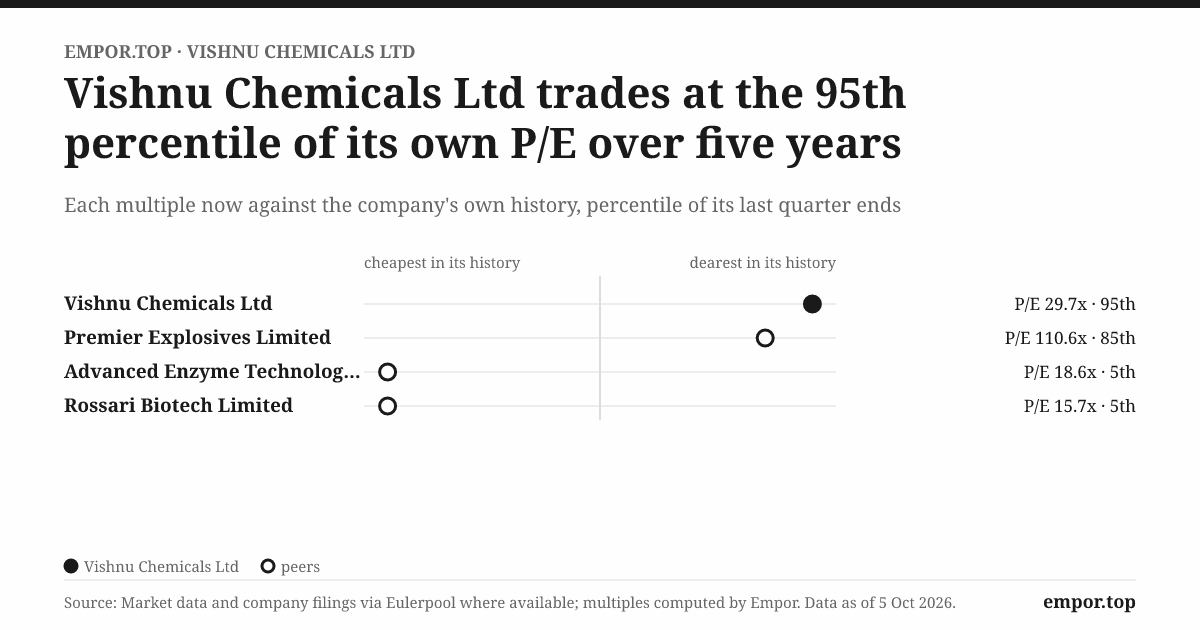
On paper, the company looks like a quiet success. Over the twelve months to June 2026, revenue was about $187 million (roughly ₹1,750 crore) and net profit was about $16.5 million.1 On 5 October 2026 the market valued the company at about ₹4,435 crore, or 29.7 times trailing earnings. Its own five-year median is 22.4 times.1 Investors are paying a premium, which usually means they expect something better than the past.
What they expect is a payoff from the biggest capital programme in Vishnu's history. It includes a chrome ore mine in South Africa, a new DMSO plant, a chrome oxide green line and backward integration into barium.23 If those projects work, a single-source importer of ore becomes an integrated mineral-to-chemical group with better margins and less inventory. If they do not, the company will have more debt, more working capital and another set of dates that slipped.
The short verdict, which the rest of this story tests: the business is real and growing again, but the market is already paying for a capex payoff that has not been proven.
Why an unglamorous chemical maker deserves a long story
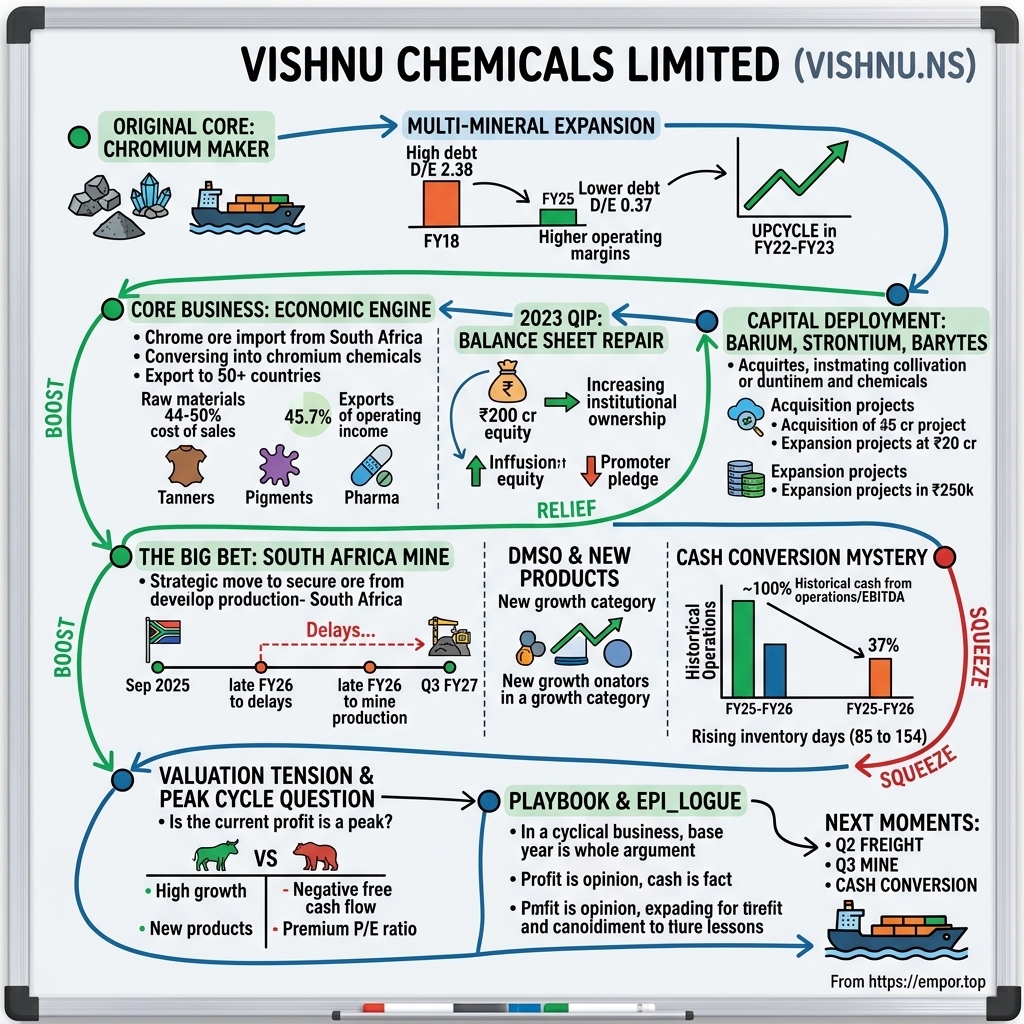
Chromium chemicals rarely make headlines. They are hazardous to make, regulated to dispose of and priced like commodities. But Vishnu's record contains a puzzle that should interest any long-term investor. Over twelve years, from FY2015 to FY2026, operations produced about ₹909 crore of cash against ₹740 crore of reported net profit, or 123% of profit.1 Few Indian chemical companies of this size can claim that. Yet in each of the last three years, only about a third of EBITDA turned into operating cash.1 The long record says this is a cash machine. The recent one says it is not.
Four questions run through the story:
- Will the capex and the South Africa mine turn into returns, or into more working capital?
- Why does only about 37% of EBITDA arrive as cash, and will that reverse?
- Is current profit a peak-cycle level or a structural one?
- How clean are the accounts and governance behind the consolidation?
The route goes from the chromium core, through the barium roll-up and the 2023 equity raise, to the working-capital squeeze, the mine, the moat and the verdict. It starts with a company that, less than a decade ago, was close to the edge.
 Subscribe on LinkedIn
II. From a Single-Product Chromium Maker to a Multi-Mineral Group (8 min)
In March 2018, Vishnu Chemicals' balance sheet looked fragile. Shareholders' equity was about $17 million and borrowings were about $41 million, so debt was 2.4 times equity.1 For every rupee of revenue that year, the company kept a little over two paise as net profit.1 It was a heavily borrowed chromium processor in a business where one bad ore cycle could wipe out a year's earnings.
The family and the core
Vishnu is a Cherukuri family company. Ch Krishna Murthy is the founding promoter and the central figure. Ch Manjula is part of the promoter group, and Ch Siddhartha, the next generation, is Joint Managing Director of the listed company and Managing Director of the barium subsidiary.2 The company has been listed for decades on the BSE (scrip 516072) and the NSE.48 For most of that time it did one thing: it took imported chrome ore and made sodium dichromate, the first link in the chromium chemicals chain, along with derivatives sold to leather tanners and pigment makers.
The origin story matters less than the economics it left behind. Between 2017 and 2020 the business earned net margins of about 2–3%, carried more than 200 days of inventory in some years and returned between 8% and 17% on equity.1 It was a respectable industrial business but not a compounder. The ore had to be bought in dollars, held for months and processed into products whose prices were set by global markets.
The upcycle
Then the market moved in Vishnu's favour. In FY2022 revenue rose about 59%, and in FY2023 it rose another 30%.1 Chemical prices across the world spiked after the pandemic, Chinese supply was disrupted and Western buyers looked for alternatives. Vishnu's operating margin rose from below 10% to about 14.7% in FY2023, and net profit reached about $17 million.1 Return on equity rose above 30%.1
The good years paid down debt. Then, in FY2024, the cycle turned: revenue fell about 13% and net profit about 26%.1 Nothing broke inside the company. The industry simply returned to normal pricing. That fall is the best evidence of the base rate here. A strong year in chromium chemicals can be followed by a weaker one regardless of how well the plant is run.
The base-year trap
This is the one place where the arithmetic needs saying plainly. Measured from FY2021, at the bottom of the cycle, net profit has compounded at about 33% a year over five years.1 Measured from FY2023, at the top, it has grown by about 1.4% a year over three years.1 Both numbers are accurate, but only the second is honest about the trend. Since the peak, the company has added revenue and capacity, and profit has only just returned to its earlier high.
By FY2025, debt to equity was down to about 0.37, and equity had grown roughly sevenfold from its 2018 low.1 The balance sheet was repaired by two things the company did not fully control: a once-in-a-decade chemicals boom and, as Section V shows, a large equity raise in 2023. The record is of a company that was lucky as well as good. That matters because the next phase depends on skill, not luck.
The next question is how the core business makes its money.
III. The Core Business: How Chromium Chemicals Make Money (14 min)
Follow the ore through the plant. It arrives from South Africa as chromite, an iron-chromium oxide. Vishnu roasts it with soda ash at high temperatures, which turns the chromium into a water-soluble form that can be leached out, purified and crystallised as sodium dichromate. Dichromate is the base material. From it the company makes chromic acid (used in metal plating), chrome oxide green (a very stable green pigment used in paints, ceramics and coatings) and basic chromium sulphate (the tanning salt that turns hides into leather).
A simple way to understand the business is to think of a refinery rather than a pharmaceutical lab. Vishnu does not invent molecules. It converts a mineral into a chemical and earns the spread between the cost of ore, energy and soda ash and the selling price of the finished product. The plant ran at about 85% utilisation on sodium dichromate when CARE Ratings last reviewed it.2 Standalone capacity is about 231,000 tonnes a year across four units.2
Where the profit comes from
Three facts explain the economics.
First, raw materials are about 44–50% of cost of sales.2 When chrome ore prices rise faster than dichromate prices, the spread narrows. When they fall, it widens. That is the main driver of margin.
Second, exports were about 46% of operating income in FY2025.2 Vishnu sells to more than 50 countries, with Brazil, the US, Mexico, South Korea, Italy, Germany, Australia, Bangladesh, Argentina and Egypt among the larger markets.2 Tanners in Latin America and pigment and plating customers in Europe and Asia make Vishnu a global player in a small industry.
Third, mix is the lever the company controls. Higher-value derivatives such as chromic acid and chrome oxide green are now close to half of sales.2 A tonne of dichromate converted into chrome oxide green earns more than a tonne sold as dichromate. That is why so much of the capital plan is aimed at moving further along the chain.
The industry
Globally, chromium chemicals are made by a small number of producers. Western names such as Elementis and Lanxess have long been involved, alongside a large Chinese industry that sets the marginal price. India has a few domestic producers, and import competition is something CARE names as a constraint on Vishnu's pricing.2 Neither the company nor its rating agency publishes a global market share for Vishnu, and there is no reliable public capacity league table to set it against. The fair conclusion is that Vishnu is a meaningful Indian producer with global reach, not a price-setter.
How it sells
Vishnu sells at spot or negotiated prices. Customers are mostly repeat buyers and get 60 to 90 days of credit.2 Management told analysts in August 2026 that a long-term European supply agreement prices in line with exchange rates.3 The company does not disclose the length or minimum volumes of its contracts, so it is not possible to say how much revenue is locked in.
Customer concentration is moderate. In FY2025 the top ten customers made up about 43% of the standalone company's operating income.2 Named customers include Solara Active Pharma Sciences, IOL Chemicals and Pharmaceuticals, and Brazil's Montana Quimica.2 The company does not disclose any single customer above 10% of revenue. A tanner or pharmaceutical buyer can switch suppliers, but each buyer is only a small part of the book.
The supplier problem
The sharpest exposure is on the supply side. All of Vishnu's chrome ore comes from South Africa, and it is paid for in advance or against 90-day letters of credit.2 Vishnu pays before the ore is processed and collects months later. If freight rates spike, if a South African mine stalls or if the rand or the rupee moves sharply, the impact falls on Vishnu's margin and its working capital at the same time.
That single fact explains the company's biggest strategic move. If you buy all your ore from one country, owning a source in that country is the obvious hedge. Section VIII covers the mine.
Currency: a hedge, not a shield
Because Vishnu exports almost half of what it makes and imports its ore in dollars, its currency exposure partly cancels out. CARE calls it a net exporter with a natural hedge, while still listing currency risk as a rating constraint.2 In FY2024 the group booked foreign exchange gains of about ₹6.5 crore.2 Gains of that size matter in a business whose annual profit before tax is around ₹180–200 crore, but they are not a substitute for operating earnings.
The margin path
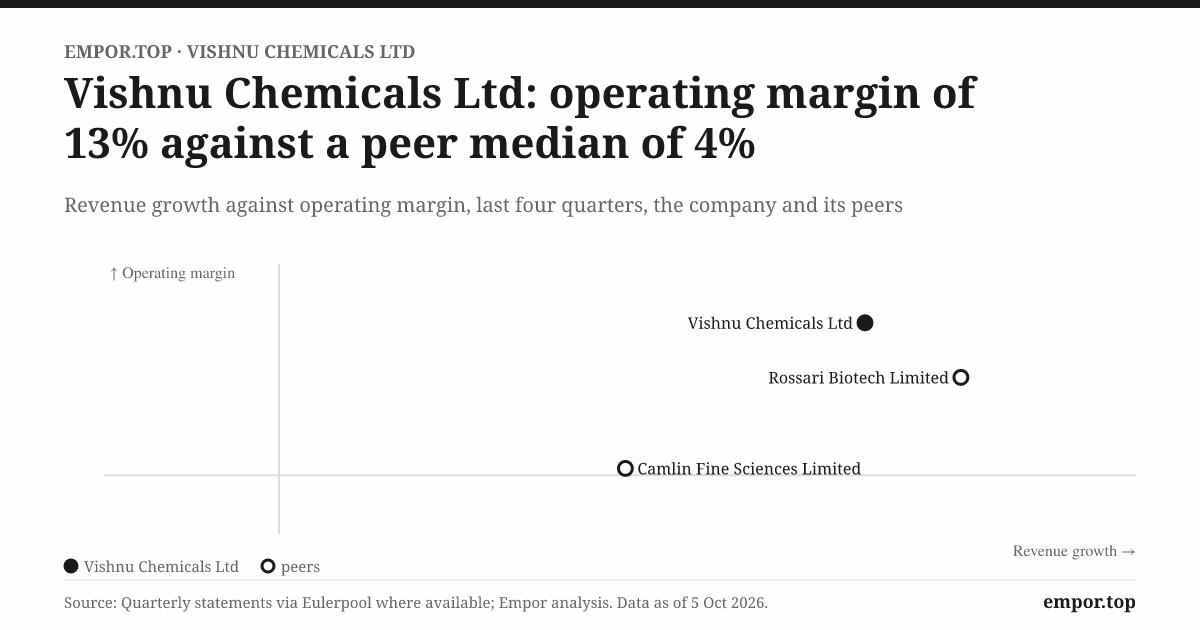
The operating margin peaked at about 14.7% in FY2023 and has eased in each year since, to about 13.1% in FY2026.1 Revenue grew over the same period. In other words, the business has added volume but not improved its economics per unit. That could be the cycle, freight, the startup costs of new subsidiaries or pricing pressure. The quarterly record and management's own guidance help separate those explanations in Section VII.
For now, the conclusion is simple. Vishnu is a conversion business that earns a spread over imported ore. Mix shift is the long-term lever and freight is the short-term swing factor. Good management can move the spread, but it cannot set it.
The group did not stop at chromium, however. The next story is barium.
IV. The Barium and Strontium Roll-Up: Capital Deployment Under the Microscope (10 min)
Picture two very different assets on the same organisation chart. One is Vishnu Barium Private Limited (VBPL), which CARE describes as India's largest maker of barium chemicals and which now produces about a quarter of group operating income.2 The other is a small former pharmaceutical company called Jayansree Pharma, bought for about ₹52 crore, renamed Vishnu Strontium and brought into commercial production in the second quarter of FY2026.2 One of them is proven. The other is a bet.
What the group owns
Vishnu Chemicals is now a group of five companies:2
- Vishnu Chemicals Limited, the listed parent and the chromium business.
- Vishnu Barium, which makes barium carbonate, precipitated barium sulphate and sodium sulphide. These go into glass, ceramics, paints, plastics and specialty uses.
- Ramadas Minerals, a step-down subsidiary that beneficiates barytes, the mineral that feeds the barium plant.
- Vishnu Strontium, which makes strontium compounds.
- Vishnu South Africa, the vehicle for the chrome ore mine.
The pattern is consistent. Each step either adds a related product or moves the group closer to its raw material.
Standalone versus consolidated
The difference between the parent and the group is large. In FY2025 the standalone chromium business earned operating income of about ₹1,104 crore and profit after tax of about ₹80 crore. The consolidated group earned about ₹1,453 crore and ₹127 crore.2 So about a quarter of revenue but well over a third of profit came from outside the parent, mostly from barium. That makes barium a higher-margin business than chromium, or the parent bears costs that the subsidiaries do not, or both. The company does not report formal segments, so a precise profit split is not disclosed.
Money flowing inside the group
CARE describes some intra-group financing. Optionally convertible debentures that the parent put into Vishnu Barium are being redeemed using new borrowings at Vishnu Barium, and Vishnu Barium has borrowed to reimburse an investment. Ramadas Minerals has taken on debt for its expansion.2 In plain terms, money that the listed parent put into its subsidiary is coming back, funded by debt raised in the subsidiary.
These flows cancel out in the consolidated accounts, so they do not inflate group profit. What matters to a minority shareholder is how the transactions are priced and who owns the subsidiaries. If anyone other than the listed parent holds a stake in Vishnu Barium, that stake has a claim on the group's best business. The accounts available do not state the parent's percentage holding plainly, and investors should look for it in the subsidiary note of the annual report before assuming barium's profit belongs wholly to listed shareholders.
Did the deals make sense?
Vishnu Barium has clearly paid off: a quarter of operating income and a disproportionate share of profit. Strontium is too new to judge. The ₹52 crore price for Jayansree Pharma cannot be benchmarked against comparable deals, because there are no listed strontium makers in India and the company did not publish a price per tonne of capacity. Price untested is not the same as overpriced, but it does mean investors are relying on management's judgment.
The execution record
The most useful evidence on capital allocation is the timeline. The South Africa mine was originally expected to start producing in September 2025. That date moved to late FY2026, and on the latest call to the third quarter of FY2027.23 The DMSO plant is now expected to begin commercial production in FY2028.3 Projects have not been abandoned, which is good. But almost every date has moved, which suggests that management's targets are aspirations rather than commitments.
The group's earlier record is mostly steady expansion within known chemistry. The new projects are different: a mine in another country and a new product category. The roll-up so far shows the company can grow within adjacent chemistry. The next phase asks whether it can do things it has never done.
Before that phase began, the company raised a large amount of equity.
V. The 2023 QIP: The Moment the Balance Sheet Was Repaired (7 min)
In February 2023, Vishnu's board approved raising up to ₹300 crore through a qualified institutional placement (QIP), a way for listed Indian companies to sell new shares quickly to institutional investors.7 In August 2023 the company raised about ₹200 crore.71 For a promoter family that had held 75% of the company, the maximum allowed for a listed company, it was a significant moment. For the first time, domestic mutual funds and insurers came onto the register in a meaningful way.
What changed
Shareholders' equity rose from about $52 million at March 2023 to about $85 million a year later.1 Domestic institutional ownership went from zero to about 7.4%, and the promoter stake fell from 75.0% to about 68.4%.51 By March 2024, debt was less than half of equity. A year later it was 0.37.1
At the time it looked like a clean deleveraging. But the relief did not last. Borrowings rose from about $38.5 million at March 2024 to about $59.8 million at March 2026.1 On the company's own reported basis, borrowings were about ₹527 crore at March 2026, up from about ₹342 crore a year earlier.1 And the ₹240 crore term loan for the DMSO and chrome oxide green project had been arranged but not drawn by November 2025.2 Debt to equity was back up to about 0.49 by FY2026, and CARE expects it to rise further as that loan is drawn.12
So equity paid down debt once, and growth is now borrowing it back.
Who owns the company now
At March 2026 the promoters owned about 69.2%, foreign institutions about 2.3%, domestic institutions about 5.7% and the public about 22.8%.51 The number of shareholders grew from about 22,800 to about 30,500 over three years.1 The two institutional groups are moving in opposite directions. Domestic institutions have trimmed since the QIP, and foreign institutions have built a small position. That is not a strong signal either way, but it is worth watching.
The promoter's stake is high, which aligns the family with outside shareholders. There is also one pointed fact. In July 2024, a disclosure under India's takeover regulations recorded that Ch Krishna Murthy had pledged 1,720,000 shares.6 Promoter pledges are common among Indian mid-caps and are not a sign of distress on their own. But a pledge links the promoter's personal borrowing to the share price, and investors should check the current pledge level in the latest exchange-filed shareholding pattern rather than assume it has been released.
The per-share test
Dilution matters because it changes what each shareholder owns. Earnings per share in FY2026 were about ₹22, which is only slightly above the FY2023 peak of about ₹21–22 once the stock's earlier share split is adjusted for.1 Net profit has grown since FY2023, but the per-share gain is smaller because there are more shares. Part of the reason the three-year compounding rate is so low is that the 2023 equity was spent on making the balance sheet safer, not on earnings growth.
Retention
Vishnu paid out about 1.4% of FY2026 profit as dividends, against a twelve-year median of about 3%.1 Management is keeping almost all its earnings to fund the capex programme. That is a sensible policy only if the reinvested rupee earns more than a shareholder could earn elsewhere. Section VIII shows that, so far, returns on capital have fallen as the capital has grown.
The QIP repaired the balance sheet. It did not fix the cash cycle, which brings us to the core puzzle.
VI. The Cash Conversion Mystery: Why Profit Isn't Turning Into Cash (12 min)
FY2026 looked like a good year in the income statement. EBITDA was about $28.6 million, and net profit reached a record of about $16.1 million.1 But the cash flow statement tells a different story. Operating cash flow was about $10.6 million, about 37% of EBITDA. After capital spending, free cash flow was about minus $18.6 million. The gap was filled by about $20.7 million of financing.1
So, for every ₹100 of EBITDA Vishnu reported, only about ₹37 came in as operating cash. Three years running.
The old record and the new one
This is a sharp change. Between FY2017 and FY2019, operating cash flow was roughly equal to EBITDA.1 Over twelve years, cash from operations exceeded net profit by about a quarter.1 That long-run average is real, but it was built mostly before FY2023. The last three years have been weaker every year: about 33%, 37% and 37% conversion.1 The long average hides the turn rather than disproving it.
Where the cash went
The answer is working capital, and mostly inventory.
- Inventory rose from about 85 days of cost of sales in FY2023 to about 154 days in FY2026.1 That is the biggest single change.
- Receivables rose from about 48 days to about 71 days.1 That is higher than at the peak, but well below the 108 days of FY2015, and within the company's stated 60–90 days of credit.2
- Payables rose too, from about 72 days to about 110, which partly offset the other two.1
Put together, the cash conversion cycle, the time between paying for raw materials and collecting from customers, nearly doubled from about 60 days to about 115 days.1 On CARE's own measure, the operating cycle reached 109 days in FY2025, against 60 days two years earlier. CARE attributes it to higher raw material stocks and slower collections.2
Buffer or drag?
There is a reasonable explanation for some of the inventory. A company that buys all its ore from one country, by sea, through a volatile freight market, has good reason to keep a buffer. The Red Sea disruptions of recent years and the freight spike management expects in Q2 FY2027 are exactly the risks a buffer is meant to absorb.3 New products such as strontium also need their own starting inventory.
But a buffer that rises for three years running is not just a buffer. It ties up roughly a third of a year's cost of sales in stock that has to be financed by debt. And it is the reason why CARE lists the operating cycle as a monitorable: an operating cycle above 120 days is one of its downgrade triggers.2 At 109 days in FY2025 on CARE's measure, Vishnu is closer to that line than to the 90-day upgrade trigger.2
Treasury and other income
The company runs with very little free cash. The fact sheet shows about ₹8 crore of cash and short-term investments at March 2026 and negligible investments.1 (The larger cash balance at March 2025 included an escrow deposit of about ₹56 crore, which is why the two year-ends should not be compared directly.2) Other income was about ₹23 crore in FY2026.1 With so little cash, this is not interest on a treasury portfolio. It most likely includes currency gains and export incentives, but the company does not break it down in the summary figures, so investors should treat it as a variable item rather than core earnings.
Twelve years of free cash
The most telling number is the cumulative one. Over twelve years, free cash flow added up to about minus ₹48 crore, and the company paid about ₹32 crore in dividends.1 Cash at the end of the period was only about ₹1.4 crore higher than at the start.1 In other words, the business has reinvested everything it generated, and then some. That is not unusual for a company in a growth phase, but it does mean the returns on that reinvestment have to be good.
The test is simple. If the mine produces and inventory falls below about 120 days, the cash will start coming back. If not, profit will remain largely an accounting number. The next question is whether the profit itself is sustainable.
VII. Peak Cycle or New Plateau? Reading the Latest Quarters and the Call (9 min)
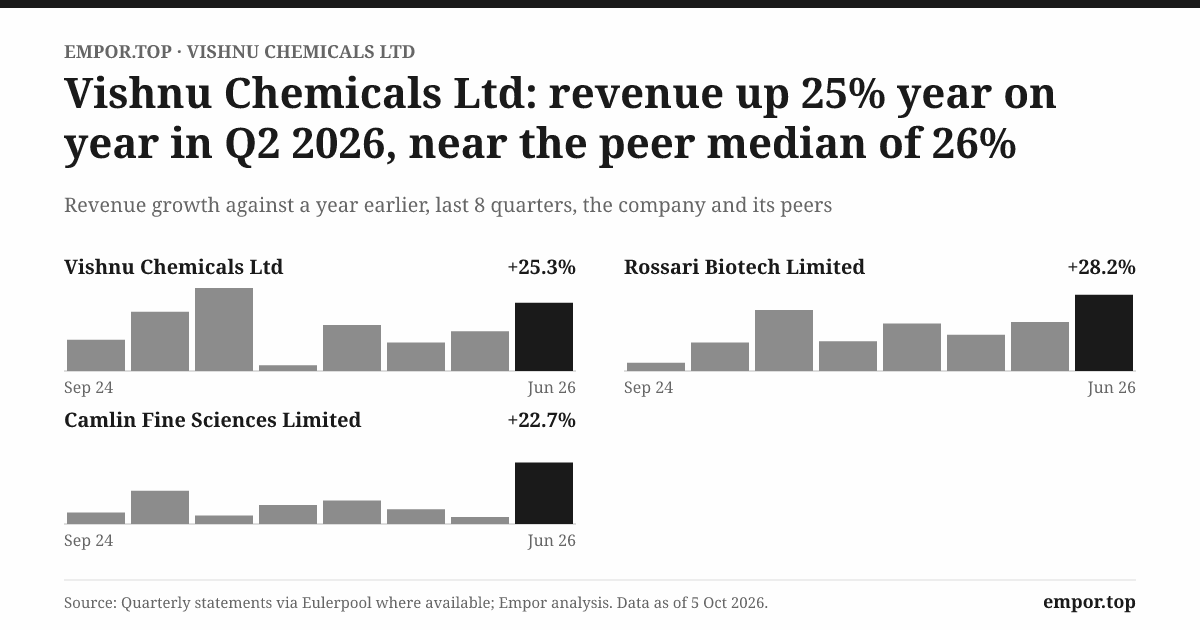
The August 2026 earnings call for Q1 FY2027 opened with good news. Revenue was about ₹433 crore, up about 25% from a year earlier. Profit after tax was about ₹40 crore, up 23%. EBITDA was about ₹66 crore, up about 17.5%.3 International sales grew about 52%.3 On a headline basis, this was the strongest first quarter in the company's history.
Then management added a warning. Logistics costs, which had been about 9–10% of revenue in Q1, could reach about 20% of revenue in Q2 FY2027.3 For a company whose operating margin is in the low teens, a freight cost that doubles as a share of revenue is not a detail. It could take out most of a quarter's margin unless prices are passed on.
The quarterly picture
Over the last thirteen quarters, Vishnu's operating margin has moved between about 10.5% and 14.8%, with no sustained improvement.1 The best quarter in that period, March 2026, was followed by a 12.5% margin in June 2026.1 Tax rates have swung between about 22% and 43% from quarter to quarter, which makes net profit noisier than the operations underneath.1
The pattern in Q1 FY2027 is the important part. Revenue grew faster than EBITDA, which means each extra rupee of revenue earned less than the average rupee did a year earlier.3 That could be because volume growth came from lower-margin exports or because freight and raw material costs rose. Either way, it is the opposite of what a mix-upgrade story would predict.
What management says and what it guides
Management's prepared remarks focus on volume, international growth and the capex pipeline.3 It has also talked about a gross margin target of about 50%.3 The same management has warned that freight will squeeze the next quarter. That warning carries more weight than any outside inference, because it comes from the people with the best view of the order book. Any argument that margins have reached a structural new level needs to sit next to management's own guidance of a near-term squeeze.
The questions analysts pressed were the obvious ones: when will the mine actually produce, how much freight can be passed through and when will DMSO contribute.3 The answers gave dates and figures for capex, but they were less specific on what margin the mine would add and on pricing pass-through.3 The fair reading is that the volume story is concrete and the margin story is still a plan.
Is profit at a peak?
On the evidence, current profit is neither clearly a peak nor clearly a plateau. Profit has recovered to the FY2023 high on more volume and a broader product range, which supports a structural view. But margins are lower than at the peak, the freight warning is real, and the business has fallen 25% in a single year once before.1 The verdict is that volume growth is real and margin expansion is unproven. The Q2 FY2027 EBITDA margin after freight will be the first test.
What the market is paying for
At 29.7 times trailing earnings, the stock trades well above its own five-year median of 22.4 times.1 On enterprise value, it is about 16 times EBITDA. The free cash flow yield is about 0.2%, and the earnings yield about 3.4%.1 Screener's peer list of Indian specialty chemical companies spans a wide range of multiples, and a chromium processor with Vishnu's return profile would not normally sit at the top of it.1 The market is valuing Vishnu as though the capex will lift returns. Without that payoff, today's price would assume more than the past has delivered.
So, the capex is the swing factor.
VIII. The South Africa Mine and DMSO: The Big Bet (12 min)
For FY2027, management guided capital spending of ₹200–250 crore, with about ₹68 crore already spent on the DMSO project.3 In absolute terms, that is more than the company's entire net profit for a year. The mine that was supposed to start producing in September 2025 is now expected in the third quarter of FY2027.23 Everything about the next three years depends on whether these projects deliver.
What is being built
- DMSO and chrome oxide green, a ₹320 crore project, funded by ₹240 crore of term debt and ₹80 crore of internal accruals. DMSO (dimethyl sulfoxide) is a solvent used in pharmaceuticals, electronics and agrochemicals. It is a new product category for Vishnu, unrelated to chromium chemistry.
- About ₹50 crore for more chromium derivatives.
- About ₹40 crore for barium backward integration.
- About ₹20–25 crore for the South Africa mine.
The capital work in progress line shows the build-out: about ₹16 crore two years before March 2026, about ₹69 crore a year before, and about ₹159 crore at March 2026.1 Cash used in investing reached about $31 million in FY2026.1
Returns are going the wrong way
Here is the tension. As capital has gone into the business, returns have fallen. Return on capital employed fell from about 30% in FY2023 to about 15% in FY2026. Asset turnover, revenue per rupee of assets, fell from about 1.3 to about 0.8.1 Some of that is normal: half-built plants are on the balance sheet but produce nothing yet. But it means every rupee of new capital so far has earned less than the old rupees did.
The mine
The case for the mine is clear. Vishnu buys all its ore from South Africa. Owning ore there would lower costs, reduce dependence on third-party suppliers and, if logistics work, allow it to hold less inventory. CARE expects the mine to lift consolidated margins.2
The case against is the record. The start date has moved twice, from September 2025 to late FY2026 to Q3 FY2027.23 Management has not publicly given a detailed explanation for each delay. Running a mine is a very different business from running a chemical plant: it involves South African mining permits, labour, power, rail and port logistics, and community relations. A delayed mine also costs money: it requires capital without producing anything, and once it starts, it adds a second country and a new set of operating risks.
The verdict is that the mine is strategically sensible but unproven. The test is whether it produces meaningful ore in Q3 FY2027 and whether inventory days start to fall afterwards.
DMSO and the conversion record
DMSO is a different kind of bet. It is not backward integration; it is a new product. The question is whether Vishnu can sell it at a profit against established Chinese and Western producers. The company's history mostly involves products within its existing chemistry, such as chromium derivatives, barium and strontium. Strontium has only just been commercialised, and the company does not disclose its revenue separately. Building a plant is not the same as selling into a new market. Until DMSO produces revenue in FY2028, it is a technical milestone, not a business.
Who is paying?
The financing is straightforward. The ₹240 crore term loan had reached financial closure but had not been drawn by November 2025.2 Debt to equity of about 0.49 and interest cover of about 5.9 times in FY2025 leave room for more borrowing.12 But with only about 37% of EBITDA turning into cash, operations cannot fund the programme. Lenders will.
A skeptical investor would put it this way: free cash flow is negative, the dividend is close to zero, and the next ₹240 crore is borrowed. If the projects earn their cost of capital, this is a classic build phase. If they slip again, the company will have more debt, more inventory and lower returns at the same time. So far, the evidence leaves the claim unproven. Q3 FY2027 mine output and FY2028 DMSO revenue will decide it.
That brings us to the people making these decisions.
IX. Management, Governance and the Credit View (7 min)
In November 2025, CARE Ratings reaffirmed Vishnu Chemicals' long-term bank facilities at A- with a stable outlook. The facilities rated had grown from about ₹166 crore to about ₹478 crore, a near-tripling that reflects the new term loans.2 Short-term facilities of about ₹83 crore were rated A2+.2 The rating is solidly investment grade for an Indian mid-cap. But the details of the rationale are what matter.
What the rating agency watches
CARE spelled out what would move the rating.2
- Upgrade: an operating margin above 18%, return on capital above 20%, an operating cycle under 90 days and debt below two times operating profit.
- Downgrade: an operating margin below 13%, an operating cycle above 120 days or debt at three times operating profit.
Compare those with today. The FY2026 operating margin was about 13.1%, almost exactly on the downgrade line by the fact sheet's measure.1 The FY2025 operating cycle was 109 days on CARE's measure.2 Return on capital is about 15%, well below the upgrade threshold.1 Vishnu is closer to the downgrade triggers than to the upgrade triggers. That does not mean a downgrade is coming. CARE's measure of margin (PBILDT) is not identical to the fact sheet's, and the agency explicitly expected leverage to rise as part of the plan. But the margin of safety in the rating is thin.
CARE's strengths list includes a flexible product portfolio, high utilisation, exports to more than 50 countries, experienced promoters and backward integration.2 Its constraints list includes raw material price exposure, currency risk, import competition, ESG risk, a working-capital-heavy cycle and debt-funded capex.2 Average working-capital limit utilisation was about 81% over the twelve months to August 2025.2 That is busy but not stretched.
Management
Vishnu is promoter-led and family-run. Ch Krishna Murthy heads the group, and Ch Siddhartha runs Vishnu Barium as well as serving as Joint MD of the listed company.2 CARE describes a professional team below them, including chartered accountants, engineers and MBAs.2 This structure has advantages: long-term thinking, fast decisions and owners who bear the consequences. It also has costs: less independent challenge, and a governance model where the board and the promoter are closely linked.
The company's annual reports and AGM results are filed with the exchanges.4 Investors should read the remuneration table against profit, the independence of the board, any shareholder dissent on related-party or pay resolutions, and the auditor's CARO annexure. Those are the places where governance problems usually show first.
Regulation and contingent items
Contingent liabilities were about ₹9.4 crore at March 2026, small relative to the group's profits.4 The more significant regulatory exposure is environmental. Chromium chemical production creates chrome-bearing sludge that must be treated and disposed of under strict pollution-control rules. CARE names regulatory and pollution-control risk as a rating factor.2 For a chromium producer, environmental compliance is a licence to operate, and one adverse ruling could shut a unit.
The credibility ledger
What has management promised, and what has it delivered?
- Mine start: promised for September 2025, then late FY2026, now Q3 FY2027.23 Not yet delivered.
- DMSO: now guided to FY2028.3 Not yet delivered.
- Volume growth: delivered. Revenue in Q1 FY2027 grew about 25%.3
- Strontium commercialisation: delivered in Q2 FY2026.2
- Margin improvement: CARE's 18% upgrade trigger has not been met, and the 50% gross margin target remains a target.23
The pattern is that management delivers on things within its existing operations and is slower on new projects. That is common in Indian mid-cap chemicals, but it is important for a stock whose valuation depends on the new projects.
With that, the question is whether Vishnu has a real competitive advantage.
X. Moat, Competition and the Bull-Versus-Bear Case (10 min)
Picture two desks. At one, a procurement manager at a Brazilian tannery is choosing between basic chromium sulphate from Vishnu and from a Chinese or Turkish supplier. The quality is comparable, so the decision comes down to price, delivery time and credit terms. At the other desk, a banker in Hyderabad is deciding whether to disburse the next ₹240 crore. The tanner wants a lower price. The banker wants cash flow. Vishnu's moat has to satisfy both.
Porter's five forces
- Buyer power: moderate. The top ten customers made up about 43% of standalone income, and customers expect 60–90 days of credit.2 No single buyer dominates, but customers can switch and do negotiate.
- Supplier power: high. All chrome ore is imported from South Africa, and suppliers are paid in advance or against letters of credit.2 This is the weakest point in Vishnu's position and the reason for the mine.
- Threat of imports and substitutes: real. CARE names import competition as a constraint.2 In leather tanning, chromium salts are hard to replace, but in pigments and some industrial uses, alternatives exist.
- Rivalry: commodity-like. Pricing follows the global cycle, as the 26% profit fall in FY2024 shows.1
- Barriers to entry: meaningful. A new chromium chemicals plant needs capital, technical skill and, above all, environmental permits, which are hard to obtain for hazardous chrome chemistry.
Hamilton Helmer's 7 Powers
Two of the seven powers are plausible.
- Scale economies: about 231,000 tonnes of capacity and high utilisation give Vishnu lower costs per tonne than smaller domestic rivals.2
- Process power: making chromium chemicals safely and within environmental rules is hard. Experience in handling hazardous materials and managing sludge is a real skill.
The other powers are weak. There are no network effects, little brand pricing, low switching costs and no cornered resource, at least until the mine produces. Counter-positioning does not apply.
The test of a moat is returns. Return on invested capital was about 9.7% in FY2026, down from about 19% at the FY2023 peak.1 Indian specialty chemical peers listed on Screener vary widely, and several larger names have also seen returns fall since the 2022 boom.1 A 10% return on invested capital is roughly equal to the cost of capital for an Indian mid-cap, not clearly above it. The margin record, which has drifted down while volume grew, argues against pricing power.
The verdict: Vishnu has a modest advantage based on scale, process skill and the breadth of its portfolio. It is narrower than the valuation implies. It would strengthen if the mine works, because owning ore is the one thing that could give it a durable cost advantage.
The bull case
- Volume growth is real, with international sales up about 52% in the latest quarter.3
- Higher-value derivatives are now about half of sales.2
- The mine could reduce input costs and the need for inventory.
- DMSO could open a new profit pool.
- Leverage is moderate, the credit rating is investment grade, and institutional ownership is growing.25
The bear case
- Net profit has grown only about 1.4% a year since FY2023.1
- Margins have drifted down, and management has warned of a freight squeeze.13
- Free cash flow is negative, inventory is rising and borrowings are increasing.1
- The stock trades at a premium to its own history, and it has fallen as much as about 41% in the last five years.1
The risk radar
- Chrome ore and freight costs: the main driver of margin. A spike in either compresses the spread.
- Rupee and dollar: a natural hedge, but still a source of earnings volatility.
- Import competition: limits pricing, especially from Chinese producers.
- Chrome sludge regulation: an adverse ruling could shut a unit.
- Refinancing and execution risk: if the projects slip, the company will carry more debt for longer.
The three numbers to watch
- Cash from operations as a share of EBITDA, currently about 37% and flat for two years.1 This is the cleanest test of earnings quality.
- Return on capital employed, read with the EBITDA margin, currently about 15%, down from about 30%.1 This tells you whether the capex is earning.
- Inventory days, currently about 154 and rising for three years.1 This tells you whether the mine is working.
XI. Playbook: Business & Investing Lessons (4 min)
Return to the inventory line. Between FY2023 and FY2026, Vishnu's inventory went from about 85 days of cost of sales to about 154, while reported profit reached new highs.1 Two things were growing at the same time: profits on paper, and the warehouse that was absorbing them.
1. In a cyclical business, the base year is the whole argument. Start from the FY2021 trough and Vishnu looks like a 33%-a-year compounder. Start from the FY2023 peak and it is a 1.4%-a-year business.1 The company did not change; the starting point did. Anyone who shows a growth rate for a commodity processor without naming the base year is selling something.
2. Profit is an opinion; inventory is a bill. Three years of roughly one-third cash conversion show that a record year in the income statement can be a weak year in the bank account.1 When a company that once turned all of its EBITDA into cash starts turning only a third, the warehouse is the first place to look.
3. Owning your supply costs capital, and capital has to be earned. The mine and DMSO make strategic sense. But as capital has gone in, return on capital has halved.1 Integration is an advantage only once it produces; before that, it is a cost.
4. Equity repairs a balance sheet once. The 2023 QIP brought debt down to about a third of equity. Three years later, borrowings are up by about half and a large term loan is still to be drawn.12 An equity raise buys time; it does not change the cash cycle.
5. A promoter who owns 69% and pays out 1.4% is betting alongside you, with your cash. High promoter ownership aligns incentives, but near-zero dividends, a pledge on record and negative free cash flow mean minority shareholders are funding the bet without being paid along the way.16 Alignment is real only if the bet pays.
XII. Epilogue (3 min)
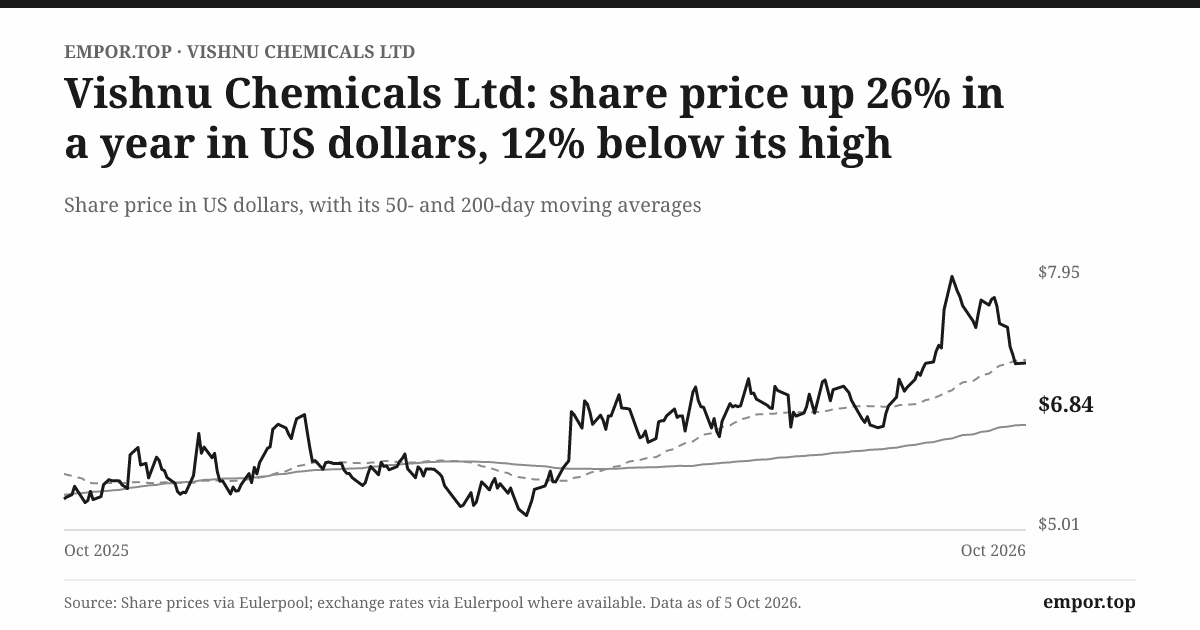
Tonight, Vishnu Chemicals is a growing company with a premium valuation and negative free cash flow. Its share price is about ₹659, roughly 10% below its 52-week high.1 Its plants are running, its export customers are ordering more, and its biggest projects are still being built.
Five moments in the next year or so will decide the story.
Q2 FY2027 results, due in the coming weeks. If management's freight warning is right and margins fall well below 12%, the "structural plateau" view weakens and the stock's premium becomes harder to justify. If the company passes freight through and holds margins near 13%, it suggests some pricing power that the record has not yet shown.
First ore from South Africa, guided for Q3 FY2027. If the mine produces on time, Vishnu takes its first real step from importer to integrated producer, and the first central question starts to resolve in its favour. If it slips a third time, the pattern of delays becomes the main story.
Drawdown of the ₹240 crore term loan. Once the money is drawn, leverage rises as CARE expects.2 The question is whether the new plants produce earnings fast enough to keep debt below the agency's three-times threshold.
FY2027 cash conversion. If operating cash rises above about half of EBITDA and inventory falls toward 120 days, the cash puzzle starts to reverse. If conversion stays near a third, the profits will continue to be financed by lenders.
The next CARE review. With margins close to the 13% downgrade line and the operating cycle near 110 days, the next rating action will show how an independent credit analyst reads the trade-off between growth and cash.
The four central questions remain open. The capex is strategically sound but unproven. The cash gap is real and only partly explained by buffer stock. The current profit is a recovery to the old peak, not yet a new level. And the governance picture is that of a family company with a decent credit rating and a balance sheet that will be tested.
That is the tension: a business that earns, a balance sheet that funds and a market that has already priced in the payoff.
XIII. Outro (1 min)
Go back to the ship in Visakhapatnam harbour. Every tonne of ore in its holds came from someone else's mine, was paid for before it left port, and will spend about five months in Vishnu's yard before it turns back into cash. Vishnu is spending hundreds of crores of rupees so that, one day, the ore in that hold comes from its own ground.
Until that day, Vishnu remains a chromium company buying its future in advance, paid for with its lenders' cash.
References
-
Vishnu Chemicals consolidated financials, shareholding and peers — Screener.in ↩↩↩↩↩↩↩↩↩↩↩↩↩↩↩↩↩↩↩↩↩↩↩↩↩↩↩↩↩↩↩↩↩↩↩↩↩↩↩↩↩↩↩↩↩↩↩↩↩↩↩↩↩↩↩↩↩↩↩↩↩↩↩↩↩↩↩↩↩↩
-
CARE Ratings press release (revised), Vishnu Chemicals Limited — CARE Ratings, 2025-11-21 ↩↩↩↩↩↩↩↩↩↩↩↩↩↩↩↩↩↩↩↩↩↩↩↩↩↩↩↩↩↩↩↩↩↩↩↩↩↩↩↩↩↩↩↩↩↩↩↩↩↩↩↩↩↩↩↩↩↩
-
Vishnu Chemicals Q1 FY27 earnings call highlights — Investing.com / GuruFocus ↩↩↩↩↩↩↩↩↩↩↩↩↩↩↩↩↩↩↩↩↩↩↩
-
Vishnu Chemicals corporate announcements (annual reports, results, call transcripts, AGM scrutinizer reports) — BSE, scrip 516072 ↩↩↩
-
Vishnu Chemicals shareholding pattern — BSE, scrip 516072 ↩↩↩
-
Vishnu Chemicals insider trading and SAST disclosures — Trendlyne ↩↩
-
Business Standard coverage of Vishnu Chemicals QIP and Visakhapatnam unit — Business Standard ↩↩
 LinkedIn
 WhatsApp
 Reddit
 Hacker News
 Email
Email Kindle
 RSS Feed
 Spotify
 Apple Podcasts
 Amazon Music
 Audible
 YouTube