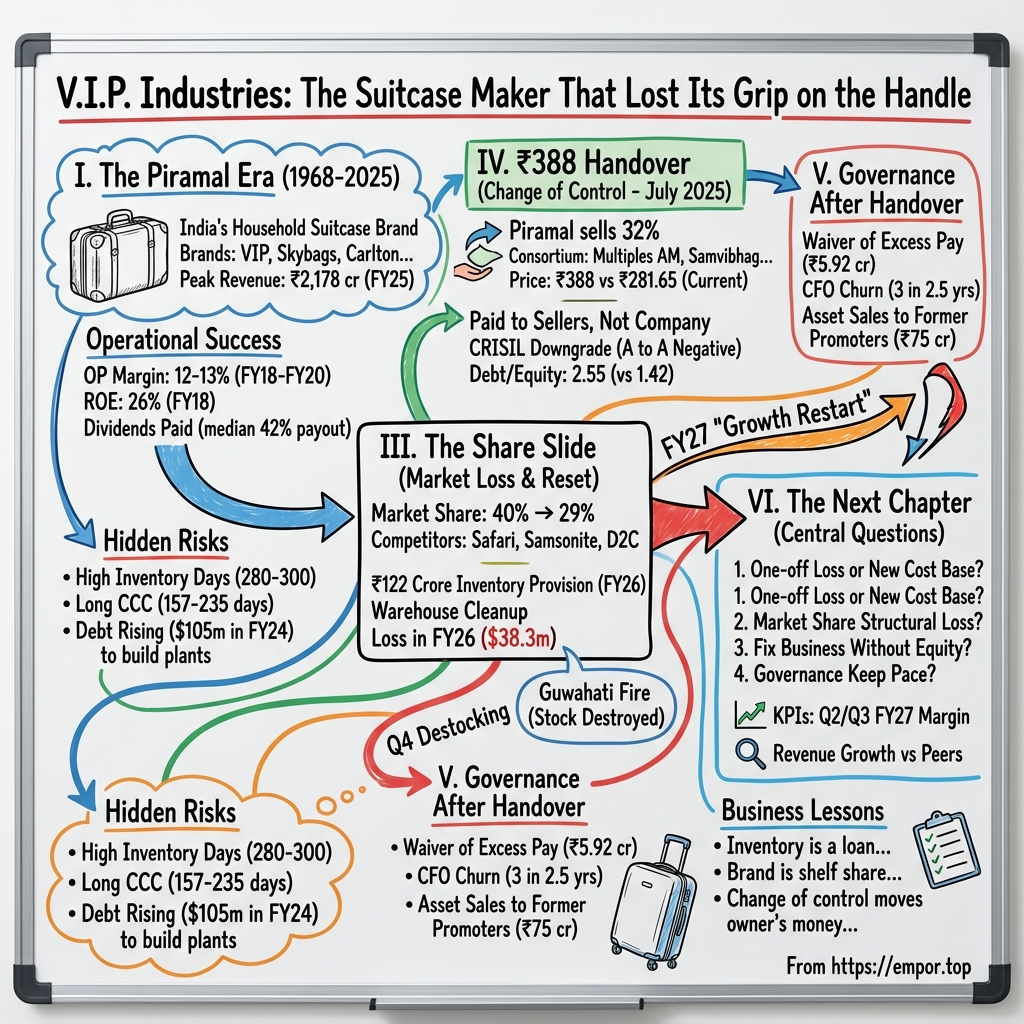
V.I.P. Industries: The Suitcase Maker That Lost Its Grip on the Handle
I. Introduction & Episode Roadmap
Walk into any railway station in India in the week before a big family wedding and count the suitcases. For two generations, a large share of them carried one of a handful of names stamped into the plastic: VIP, Aristocrat, later Skybags. The hard-shell suitcase with the chunky combination lock was a rite of passage for the Indian middle class: a first job posting, a daughter's trousseau, a son's hostel admission. Buying one was a small declaration that the family was now the kind of family that travelled.
The company behind those names, V.I.P. Industries, is still India's largest luggage brand house. It sells VIP, Skybags, Carlton, Aristocrat and the Caprese handbag line through roughly 14,000 points of sale, from the corner bag shop in a district town to the airport-mall flagship and the e-commerce warehouse1. Its revenue peaked at about ₹2,178 crore in FY25 and fell to about ₹1,858 crore in FY262.
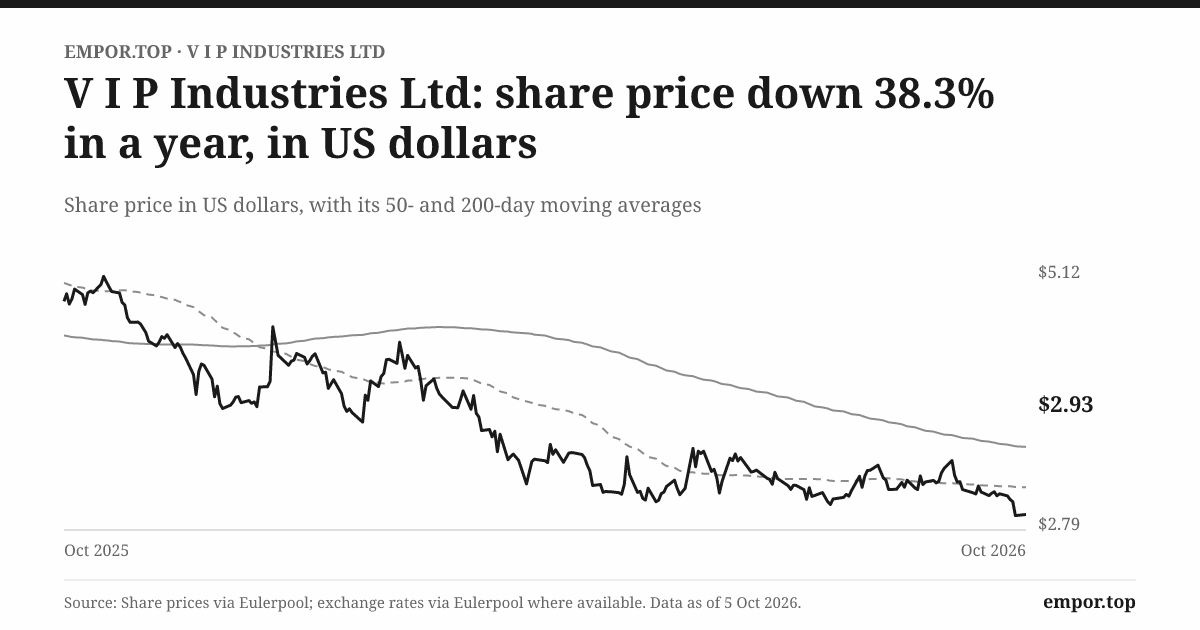
That is the first clue that something has gone wrong. Here is the second. On 5 October 2026, the company carries a market value of about ₹4,001 crore with its shares at ₹281.65, just 0.3% above their 52-week low and almost 36% below the 52-week high3. That high came after a consortium led by private-equity firm Multiples Alternate Asset Management agreed to pay ₹388 a share to take control from the Piramal family who had built the business1. In the twelve months around that handover, the company's net worth fell from roughly ₹616 crore to about ₹290 crore4. More than half of the shareholders' equity in a fifty-eight-year-old brand evaporated in a single year.
How does a household name with the biggest distribution network in its category end up worth less on the stock market than its new owners paid for it barely a year earlier, while its book equity halves? That is the story this piece sets out to tell.
The road map runs in four movements. First, the Piramal years, when a plastics subsidiary became a national brand and built the habits (lots of stock, steady dividends, rising debt) that later turned against it. Second, the share slide, in which the company lost roughly a quarter of its market position to Safari, American Tourister and a swarm of online brands. Third, the reset: a ₹122.7 crore inventory provision, a deep FY26 loss and a warehouse fire. Fourth, the handover and what came after it: who bought what, what the company itself received (nothing), and whether the boardroom has kept pace with the change in ownership.
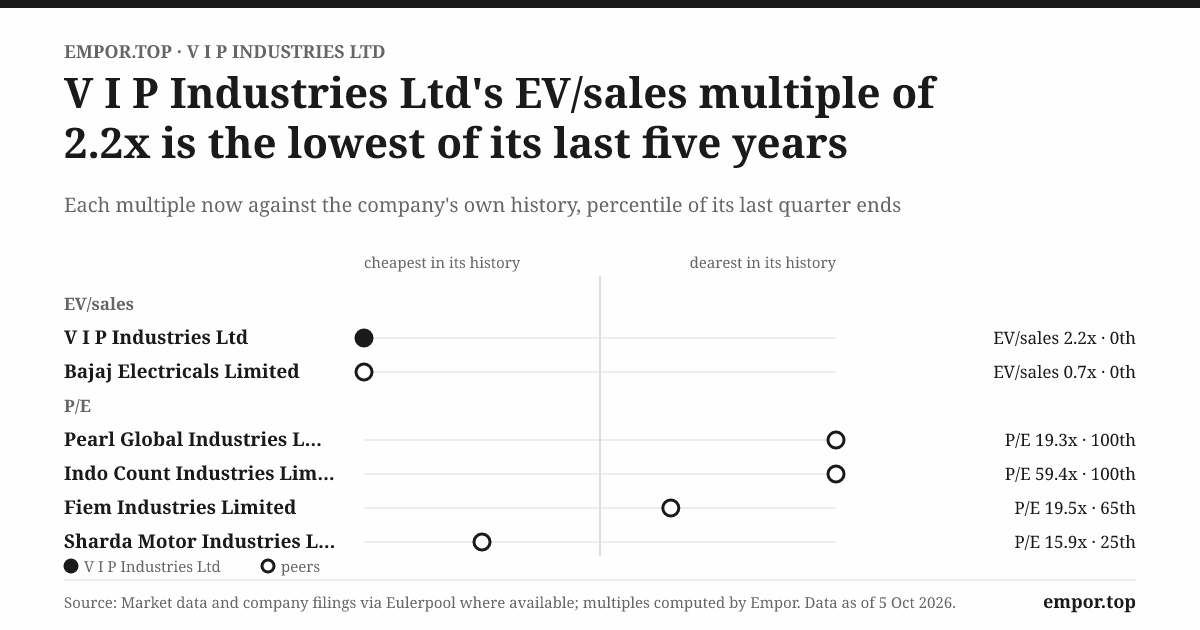
A quick note on valuation before going any further. Standard screens show V.I.P. at a price-to-earnings multiple of several thousand times. That figure is computed off a trailing year ending June 2024, when profit was close to zero, and it means nothing. The company is loss-making. The useful yardsticks are price to sales of about 2.1 times and enterprise value to sales of about 2.2 times3. Those numbers say the market is still paying for the brand and the distribution network, not for profits that currently do not exist.
To understand why investors are willing to pay anything at all for a company that lost money in each of its last two years, it helps to go back to the period when V.I.P. was one of the more reliable consumer franchises on the Indian market.
 Subscribe on LinkedIn
II. The Piramal Era: How a Plastics Subsidiary Became India's Suitcase
The origin is unglamorous. V.I.P. Industries was incorporated in 1968 as a wholly owned subsidiary of Blow Plast Ltd, a plastics moulder; the parent later merged into it in FY20071. The business that became India's suitcase was, at birth, a way for a plastics company to sell more moulded plastic. Dilip Piramal and his family turned that subsidiary into a consumer brand with a jingle, a showroom presence and a reputation for suitcases that survived the luggage hold of an Indian Railways sleeper coach.
The model that emerged combined making and buying. V.I.P. manufactured hard luggage in its own Indian plants, sourced soft luggage and some hard luggage from China, and over time built manufacturing subsidiaries in Bangladesh to make soft bags at lower cost1. That hybrid approach let the company control quality on its signature hard cases while chasing the cheaper labour that soft luggage needs.
The base rate before the break
The question that matters for an investor today is simple: what did this business earn when it worked? The answer is: quite a lot, but not spectacularly. Between FY18 and FY20 the company's operating margin sat at around 12 to 13%, and return on equity reached about 26% in FY183. In dollar terms, revenue grew from about $170 million in FY15 to about $270 million at its FY24 peak3. Over the decade to FY26 that works out to roughly 4% a year in rupees, which is ordinary growth for a branded durables company in a fast-growing economy.
There is one growth figure that should be ignored. The fact sheet shows revenue compounding at almost 25% a year over five years. That is an artefact of Covid. In FY21, when trains stopped, weddings shrank and borders closed, revenue fell by about 64%; in FY22 it more than doubled from that depressed base3. Measured from the bottom of a pandemic, almost anything looks like a growth stock.
V.I.P. also paid its owners generously. Dividend payout ranged from about 29% of profit in FY18 to about 65% in FY20, with a median of about 42% over the decade3. For the Piramal family, who owned roughly half the shares, those dividends were a reliable income stream.
Too good a cash story
A headline ratio flatters this period. Over FY15 to FY26, the company generated about ₹1,051 crore of operating cash flow against cumulative net profit of about ₹350 crore, three times as much cash as profit3. In most companies that would signal very high-quality earnings. Here it signals something else. A large part of the gap comes from two sources: non-cash charges, such as the giant FY26 inventory write-down that hit profit without costing cash that year, and the release of working capital as the company finally cut its stock. The cash was real, but much of it was money that had been locked up in inventory years earlier and was only being returned now. It is a refund, not a profit.
The seeds of the problem
The tell was always in the warehouse. V.I.P. held a lot of stock, and for long stretches held a great deal of it. Inventory days, the number of days of cost of sales sitting on shelves, rose from about 145 in FY15 to between 280 and 300 in FY21, FY22 and FY243. Put simply, the company was carrying close to ten months of goods. Its cash conversion cycle, the time from paying for goods to collecting cash from customers, ran from about 157 days to as high as 235 days in the same years3.
Why does that matter? Because luggage is a fashion-sensitive product. Colours, finishes, wheel designs and sizes go in and out of favour. A suitcase that sat in a warehouse for ten months is more likely to need a discount, and a suitcase that sat for two years may need to be written off. A company carrying this much stock was quietly making a bet that tastes and channels would not move under it.
Testing the "disciplined allocator" claim
For much of the Piramal era V.I.P. was described as a conservative, almost debt-free compounder, and for a while that was accurate: borrowings were zero in FY17 and FY183. Then the picture changed. The company built plants, and net property, plant and equipment rose from about $9 million in FY17 to about $65 million in FY24, while borrowings climbed from nothing to about $105 million3. Debt to equity went from zero to about 1.33.
Through those years the dividend kept flowing. Over FY15 to FY26 the company paid out about ₹365 crore in dividends, roughly 68% of the free cash flow it produced3. In FY24, payout was about 53% of profit even as borrowings more than doubled in a single year3.
That record narrows the "disciplined capital allocator" claim considerably. Paying half your profit to shareholders while borrowing to build plants and fund ten months of stock is not reckless on its own. It is a bet that the good years will continue. When they stopped, the company had neither the retained equity nor the low inventory that would have cushioned the fall. The verdict on this era: a good, cash-generative branded business with modest growth and a balance sheet that was steadily being stretched behind the scenes.
All of that would have been survivable if V.I.P. had held its place on the retail shelf. It did not.
III. The Share Slide: Who Took the Handle?
Picture a luggage shop in a Tier-2 city during wedding season. A family arrives to buy a set of three: a large check-in case, a medium one and a cabin bag. On the left wall sits a row of VIP and Skybags cases. Beside them, at similar prices and sometimes lower, stand Safari's polycarbonate shells, Samsonite's American Tourister line, and a cluster of brightly coloured cases from brands that barely existed five years ago and mostly sell online. The shopkeeper has a margin target and a stock problem of his own. Which brand does he point the family towards?
For decades the answer was VIP by default. That default has weakened. CRISIL Ratings, the credit agency that rates V.I.P.'s bank lines, estimates the company's share of the organised luggage market at about 29%, down from about 40%1. That is a loss of roughly 11 percentage points, or more than a quarter of the company's position.
The timeline of the slide
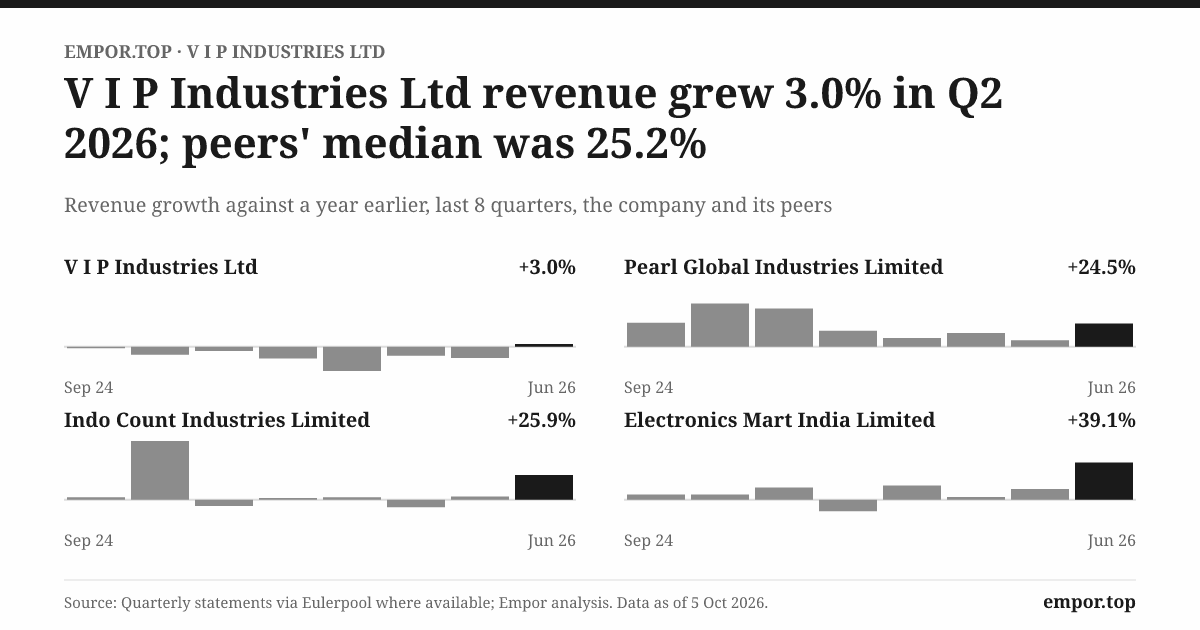
The revenue line tells the same story. After growing about 7.5% in FY24, revenue fell about 3.3% in FY25 and about 14.2% in FY263. Quarter by quarter, the company reported seven consecutive quarters of year-on-year decline before revenue grew again, by 3.0%, to about ₹578 crore in Q1 FY275.
Notice the sequence. The decline began in late 2024, under Piramal management, almost a year before the change of control. FY25 was already a loss-making year3. That counts against any reading that the slide is simply a disruption caused by new owners. The rot started on the old watch.
Who took the share?
There is no audited industry census of Indian luggage. CRISIL's 29% is the only hard share figure, and independent estimates for individual competitors are thin. What can be said with confidence is the cast. Samsonite, the global market leader, competes through both its premium Samsonite brand and the mass-market American Tourister line; Safari Industries, an Indian rival, has built a large business around value-priced hard luggage; and direct-to-consumer brands selling mainly through online marketplaces have pulled younger buyers at the low end5. PL Capital, the brokerage that covers the stock, names competitive pressure from D2C brands as a central reason for the share loss5.
The best signal of relative scale comes from how the market prices them. PL Capital values Samsonite at about 3.0 times its FY27 estimated sales, against the roughly 2.1 times at which V.I.P. trades53. Investors are paying more for every rupee of a rival's revenue than for every rupee of V.I.P.'s, which is the market's way of saying it trusts the rival's sales to be more profitable and more durable.
How the money comes in
V.I.P. sells physical products, one unit at a time. Revenue flows through general trade (independent shops), modern trade and large-format retail, e-commerce marketplaces, and the company's own stores1. There is no subscription, no service contract and no recurring revenue. Demand follows the Indian calendar: travel seasons, the wedding season and the start of the school year.
This matters because when a company sells through distributors and retailers, its reported revenue is the amount it ships to them, not the amount consumers buy. If retailers are overstocked, they stop ordering, and reported revenue falls even if consumers keep buying. The offline business shows the pattern. Offline revenue was about ₹750 crore in the first half of FY26, down about 11%, and about ₹724 crore in the second half, down about 3%4. The second-half decline was smaller, which management presents as evidence of stabilisation4.
Channel stuffing or destocking?
Here is the puzzle every investor needs to solve. Revenue fell because the company was shipping less into the channel. Was that because consumers stopped buying VIP, or because retailers had been overloaded with VIP stock and needed to clear it?
The company's own numbers suggest a large part was the second. Under the new management, inventory in the channel fell from more than 90 days to fewer than 60, and gross inventory units fell from about 45 lakh to about 28 lakh4. That clearing was not free. In Q4 FY26 the company spent about ₹30 crore on direct support to channel partners, and its presentation cites ₹40–50 crore of liquidation support in total4. In other words, V.I.P. paid retailers to sell off old stock, often at discounts.
That is a revealing admission. If retailers needed tens of crores of support to clear VIP inventory, the stock that the company had earlier booked as sales was not moving fast enough at full price. The FY24 revenue growth of 7.5%, followed by the destocking, looks in hindsight like a channel that had been filled faster than consumers were emptying it. Whether that was deliberate loading or optimistic forecasting cannot be settled from the published record, but the economic result is the same: some of the earlier revenue was borrowed from later years.
The growth restart, tested
New management says FY27 is a "growth restart": new products, a revamped website, influencer and outdoor advertising campaigns, and a target of roughly 9% compound revenue growth to FY2845. There are early data points. In early April 2026, management reported retailer billings up more than 30% and general-trade secondary sales up more than 35%4.
Set against two years of decline, those claims need careful weighting. A 30% jump in one month of billings after a deliberate destocking is what a recovery looks like, but also what it looks like when retailers simply restock shelves that were emptied on purpose. The 3% growth in Q1 FY27 came against a quarter a year earlier that was already shrinking5. Neither is proof that VIP is winning back the family in the wedding-season shop.
The moat, tested once
Using Hamilton Helmer's framework of seven durable powers, the only serious candidate for V.I.P. is brand, with a secondary claim to scale through distribution.
Brand. The case is real: decades of recognition, multiple brands across price points, and a name that still means "suitcase" to many older Indian buyers. But brand power is supposed to let a company charge more or sell more than a rival with a similar product. Losing about 11 points of share in a growing category is the disconfirming evidence. Brand power has not been destroyed; it has been shown to be weaker than its reputation.
Scale and distribution. Roughly 14,000 points of sale is a large network that a D2C entrant cannot easily replicate offline1. Yet distribution is only a moat if retailers want to stock the product. When a company must pay tens of crores to help retailers clear its goods, the network becomes a cost centre as much as an asset.
Switching costs, network effects, counter-positioning, cornered resources, process power. None applies in any meaningful way. A family buying a suitcase faces no cost in choosing a different brand next time.
Porter's five forces point the same way. Buyer power is high and sits with two groups: large retailers and the e-commerce platforms that control search rankings and discount events. Threat of substitutes and new entrants is high, because contract manufacturing in China and India lets a brand launch with little capital. Supplier power is moderate; sourcing can move between countries. Rivalry is intense, with a global leader above and low-cost entrants below.
The missing evidence is unit economics. A proper moat test would compare price realisation per unit and gross margin trends against Samsonite's Indian business and Safari over several years. The company does not publish volume and price splits in a way that makes this clean, and that gap itself is informative: a business claiming brand power should be able to show that it holds price.
The verdict: the moat claim is narrowed, not rejected. VIP still has a recognisable brand and the largest network, but the last two years show those assets do not protect share against cheaper, sharper competitors. Whether the slide is reversible will be decided by the next few quarters' growth relative to peers, not by management's targets. And to understand why the new owners could not simply sell their way out, it is necessary to open the warehouse door.
IV. The ₹122 Crore Reset: Cleanup or New Cost Base?
On 17 May 2025, a fire broke out at V.I.P.'s regional warehouse in Guwahati, destroying property and inventory6. It was a literal image for a metaphorical problem. Within a year the company would write down far more stock than any fire could reach, not because it burned, but because it could no longer be sold at a price that justified its value on the books.
The bill arrives
In FY26 V.I.P. booked an inventory provision of about ₹122.7 crore, against about ₹7.5 crore the year before4. CRISIL described it as a provision for slow-moving inventory and recorded about ₹122 crore of it within the first nine months1. The effect on the income statement was dramatic. The operating margin went from about −1.1% in FY25 to about −19.8% in FY26, and the net loss reached about $38 million, or a little over ₹320 crore at the period's exchange rates3.
A provision is easiest to understand as a bill that arrives late. The cash to buy those suitcases left the company years earlier, when inventory days were near 300. At the time it was recorded as an asset. The FY26 provision is the moment the accounts admitted that a large part of that asset was worth much less than it cost. Seen that way, at least part of the FY26 loss is genuinely a one-off cleanup of old decisions.
Why the cleanup reading is incomplete
Three facts complicate the convenient story.
First, FY25 was already loss-making before the reset began, with a small negative operating margin3. The business was not earning its keep even before the new owners wrote anything down.
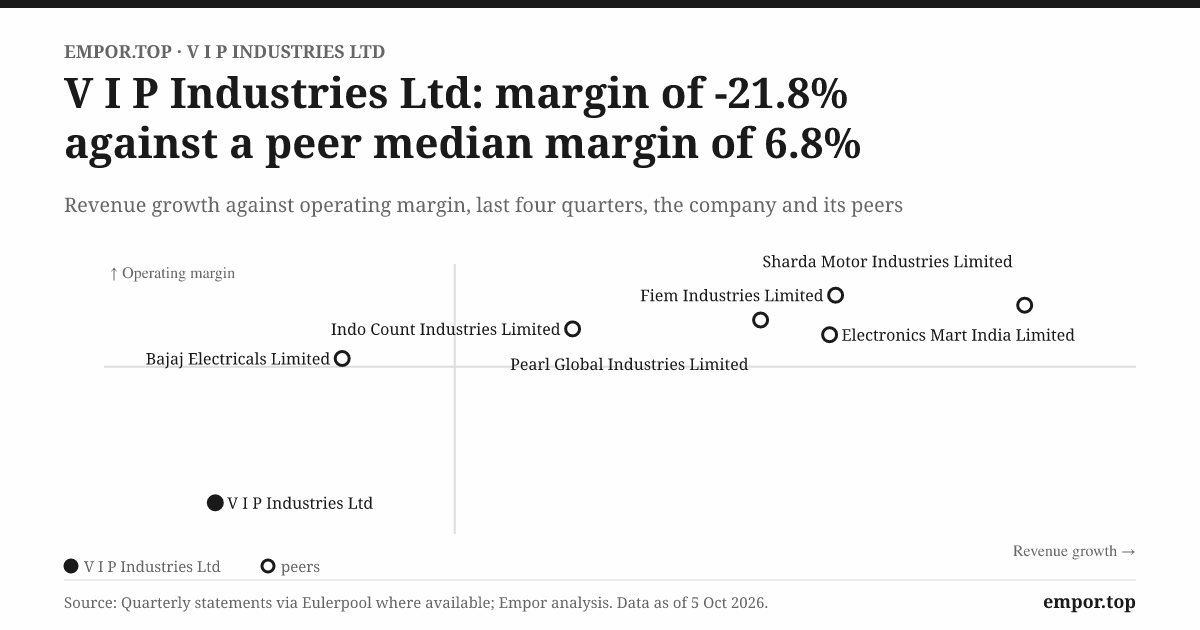
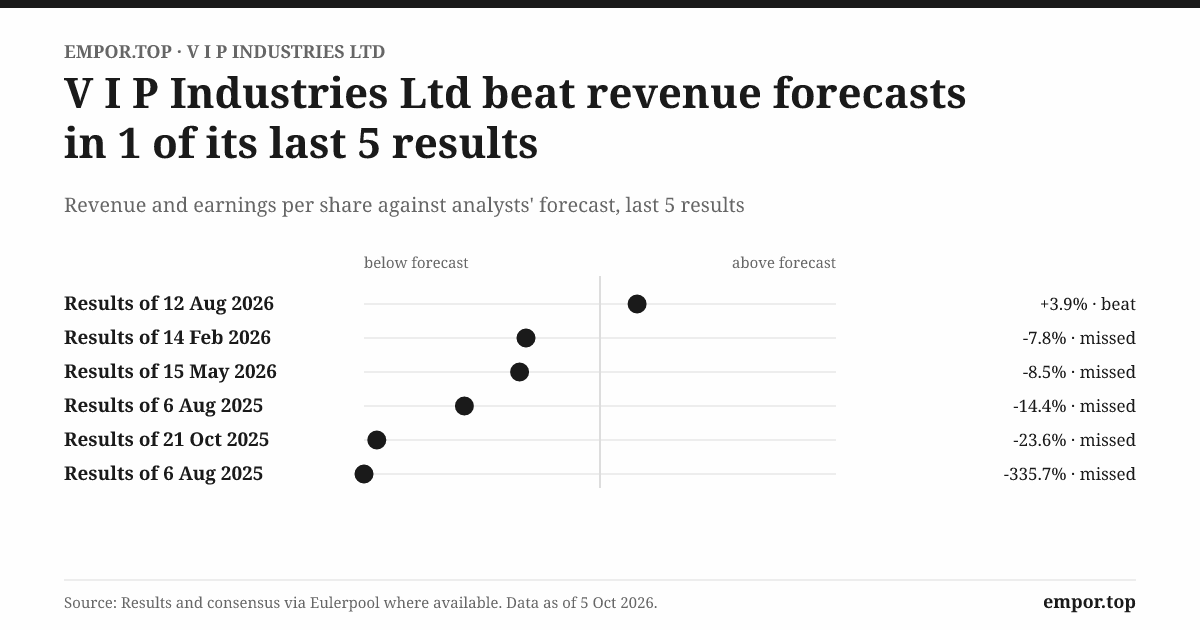
Second, the first quarter after the cleanup was not clean. In Q1 FY27 the operating margin was about −7.4% and the net loss was about ₹53.6 crore, against about ₹13.1 crore a year earlier5. The loss widened, not narrowed, even with revenue growing.
Third, the gross margin, the share of revenue left after the cost of goods, was about 39.3% in Q1 FY275. That is a respectable figure for a branded goods company. If gross margin is healthy and the operating line is still deeply negative, the problem sits in the costs below the gross line: advertising, staff, rent, freight, and the overhead of a network built for a larger business.
Management has said there will be no more large provisions and that H2 FY26 adjusted losses narrowed4. That claim is unproven until the next quarters report. The tests are clear: whether Q2 FY27 gross margin holds near Q1's level, and whether the operating margin moves back towards zero. PL Capital, for its part, forecasts a FY27 net loss of about ₹187 crore and a FY28 EBITDA margin of about 8.1%5. If that forecast is roughly right, FY27 will be another heavy loss year, which is hard to reconcile with a reset that was finished in FY26.
Profit into cash: a clue, not a celebration
FY26 operating cash flow was positive, about $15.8 million3. On its face that looks like a business that keeps generating cash even when it loses money. Look closer and it is the warehouse being emptied. Inventory on the balance sheet fell from about ₹698 crore to about ₹472 crore4. Inventory days fell from about 215 to about 113, the cash conversion cycle from about 158 days to about 59, and working-capital days turned negative3.
Every suitcase sold out of old stock released cash that had been locked up for years. That cannot happen twice. Once the warehouse is lean, the company has to generate cash from margin, not from liquidation. The reverse case proves the point: in FY24, when inventory days peaked near 300, operating cash flow was negative, about −$15.9 million3. The cash line in this company has tracked the warehouse more than the profit line.
Receivables: not where the trouble sits
Debtor days, the time customers take to pay, have stayed in a narrow band of about 45 to 62 days since FY22 and were about 53 in FY263. They peaked at 92 in the Covid year3. That stability is useful information: the problem is not retailers refusing to pay; it is that they did not want to buy.
Reinvestment: shrinking to fit
Net property, plant and equipment fell from about $65 million in FY24 to about $58.5 million in FY263. Gross inventory units dropped from about 45 lakh to about 28 lakh4. Management has also announced supply-chain consolidation4. This is a company shrinking its asset base to fit its revenue, not one expanding.
That is defensible. But it raises the flip side of the Piramal-era plant build. If the plants built in FY20 to FY24 are now being trimmed, the return on that capital spending was poor.
Small items, quickly
Contingent liabilities fell from about ₹57 crore to about ₹33 crore2. Set against net worth of about ₹290 crore, they are not material to the investment case. The Guwahati fire produced an insurance receipt of only about ₹0.53 crore, booked as an exceptional item in Q4 FY266; the event mattered more as disruption than as a financial loss.
What management said before
The falsification test for any cleanup story is to compare what management said when it built the stock with what it later wrote off. During FY24, as inventory days climbed towards 300, the company carried the stock at full value and continued to pay a dividend of more than half its profit3. The provision that followed was effectively a reversal of that judgement. Whatever was said on calls at the time, the actions told investors the stock was worth what it cost. Two years later the accounts said otherwise.
The verdict on the reset: part of the FY26 loss is a genuine one-off bill for past overbuying, but the widening Q1 FY27 loss shows the cost base itself is not yet fixed. The cleanup is real; the recovery is not yet visible. That raises the question of who is paying for the repair, and the answer is not who most readers would assume.
V. The ₹388 Handover: Who Bought What?
July 2025. After more than half a century, the Piramal family agreed to sell. The buyer was a consortium led by Multiples Alternate Asset Management, a Mumbai-based private-equity firm, together with Samvibhag Securities, with Mithun Sacheti and Siddhartha Sacheti as co-investors1. The deal covered up to 32% of the company at ₹388 a share1. Because the purchase crossed the thresholds in SEBI's takeover regulations, it triggered a mandatory open offer to public shareholders for a further 26%7.
For a moment the stock market cheered. The share price rose towards ₹439, its 52-week high3. Today it trades around ₹282, roughly 27% below what the buyers paid.
Follow the money
The single most important fact about the handover is this: the company itself received nothing. The consortium's outlay, reported at about ₹1,763 crore for the 32% stake8, went to the Piramal family and to public shareholders who tendered into the offer. Not a rupee landed on V.I.P.'s balance sheet.
That distinction is easy to miss and central to the investment case. A change of control moves the owners' money, not the company's. The new owners now control a business whose net worth has more than halved to about ₹290 crore4, whose interest coverage fell to about 1.25 times from about 3.54 times1, and whose borrowings at March 2026 stood at about $84 million3.
What the balance sheet actually looks like
There are two versions of leverage in circulation. The fact sheet shows debt to equity of about 2.55, which probably includes lease liabilities3. The company's own measure, about 1.42, likely excludes them4. Either way, the trend is the problem: equity shrank much faster than debt.
There is genuine progress to acknowledge. Gross borrowings fell from about ₹377 crore to about ₹309 crore over FY26, and net debt from about ₹367 crore to about ₹295 crore4. CRISIL counted an unencumbered cash surplus of about ₹114 crore at the end of December 20251. The asset sales described in the next section brought in about ₹75 crore more2. Those moves buy time.
They do not buy a recovery. Most of the debt reduction came from the one-off inventory release discussed earlier. If losses continue at the pace PL Capital forecasts, the cash cushion erodes within a year or two.
The credit agency's condition
CRISIL's view frames the question more sharply than any analyst. In March 2026 it downgraded V.I.P.'s long-term rating to A from A+, with a Negative outlook, and cut the short-term rating to A2+ from A1, on about ₹464 crore of rated facilities including ₹50 crore of commercial paper1. It described liquidity as adequate, with working-capital lines about 60% used1.
Its stated path to an upgrade requires three things: revenue growth, a recovery in operating margin to about 7–9%, and "significant equity infusion by the new promoters"9. Downgrade triggers include continuing losses or debt that stays high9.
The update dated 6 August 2026 was not a reaffirmation. CRISIL said it was "awaiting adequate information" from the company and flagged information-availability risk9. For a company just taken over by sophisticated investors, that is an awkward note. Rating agencies use this language when a borrower has not supplied the material they need to complete a review.
Testing the "financial strength" claim
Long-time holders remember V.I.P. as a financially strong company. The record narrows that memory sharply. The company paid dividends at a median payout of about 42% of profit while borrowings rose from nothing to over $100 million3. Then shareholders' equity fell by about 55% in a single year3. A business that was strong in the good years turned out to have little buffer for the bad ones. The specific risk now is covenant and refinancing pressure: net worth more than halved, the commercial paper has to be rolled, and loan agreements often include minimum net-worth tests. The company's filings do not spell out covenant headroom, which leaves investors unable to measure how close that risk is.
Did the buyers overpay?
That question remains open, and it depends on what they bought. At ₹388 a share, the consortium paid roughly 2.9 times trailing sales at the then share count, against the 2.1 times the market now applies and the 3.0 times PL Capital assigns to Samsonite's FY27 sales53. A private-equity buyer pays for control: the right to change the management, the cost base and the strategy. Whether that control premium was worth it depends entirely on execution. The market's current price suggests public investors are not yet convinced.
Who owns it now
The ownership trail is muddier than it should be. CRISIL said the consortium held about 5.89% as promoters at 30 September 2025 and reached about 31.89% after acquiring the Piramal stake and shares through the open offer in the following quarter1. Later exchange filings classify the Indian promoter group at about 42%, with mutual funds holding around 14.6%, foreign institutions around 5.2% and other investors the rest10. The difference likely reflects how the co-investors are classified as part of the promoter group, but the gap is wide enough that investors should rely on the latest exchange-filed shareholding pattern rather than any summary.
The new team
Atul Jain was appointed managing director for five years, and the board is now chaired by Renuka Ramnath, the founder of Multiples2. Ramnath's firm has a record of backing consumer and financial businesses through growth phases, which lends the turnaround some credibility. That is outside V.I.P.'s own economics, however, and the only evidence that counts here will be V.I.P.'s own results.
The verdict on the handover: the new owners bought control, not a repaired company, and the credit agency has said plainly that the repair will need fresh equity from them. Until that equity arrives, the turnaround is being financed from the warehouse and from selling assets. Which brings the story to the boardroom, and to the question of whose money was moving where.
VI. Whose Money Is This? Governance After the Handover
The 59th annual general meeting of V.I.P. Industries was, on its face, uneventful. All eight resolutions passed with strong majorities2. One of them deserves a closer look. Shareholders were asked to approve a waiver of recovery of about ₹5.92 crore of excess managerial pay to three executives who had left with the old regime2.
The waiver
The breakdown: about ₹1.54 crore to Radhika Piramal, the former executive vice-chairperson; about ₹3.72 crore to Neetu Kashiramka, the former chief executive; and about ₹0.07 crore to Ashish Saha2. Indian company law caps managerial pay when a company has inadequate profits; when the cap is exceeded, the excess must be recovered unless shareholders waive it.
The pay covered only the first half of FY26, the six months before the control change2. In those two quarters the business swung from roughly breakeven to a deep operating loss, with Q2 FY26 recording an operating margin of about −34%3. The pay exceeded statutory limits precisely because the company was losing money. Approving the waiver means shareholders absorbed that cost rather than chasing departing executives for it.
There is a pragmatic argument for the waiver: recovering pay from departed executives is slow, expensive and often unsuccessful. But the decision deserves to be seen for what it is. Executives were paid above legal limits during the half-year in which the business sharply deteriorated, and the company chose not to recover it.
The asset sales
The second legacy item is more material. In FY26 the company sold a non-core land parcel in Nashik for about ₹24.28 crore to DGP Realty Nashik Pvt Ltd and assigned a Nagpur property lease for about ₹51.18 crore to DGP Realty Nagpur Pvt Ltd, both entities connected to the outgoing promoter group2. The company described both as arm's-length transactions below the SEBI materiality threshold2.
The skeptic's stress test is straightforward. A company losing money sold about ₹75 crore of real-estate assets to its departing owners, at prices set by valuations the company does not publish in detail. If the prices were fair, the cash helped a stretched balance sheet at a useful moment. If they were favourable to the buyers, value moved from all shareholders to the controlling family on its way out. "Below the materiality threshold" means the deals did not require a separate shareholder vote; it does not mean they were small relative to a company with roughly ₹290 crore of net worth. They equal roughly a quarter of it.
The related-party supply chain
Related-party purchases were about 24.2% of total purchases in FY26, down from about 27.2% in FY252. Because the Bangladesh manufacturing subsidiaries are consolidated, these purchases are from entities outside the listed group. The company's summary disclosures do not name the counterparties or the pricing basis in a way that lets an outsider judge whether the terms are better or worse than market. For a company where nearly a quarter of what it buys comes from related parties, that opacity is itself a governance fact. The ratio's decline is a step in the right direction; whether it continues under the new owners is a test worth watching.
The new board
The new board's composition points in a better direction. Independent directors now include Vaishali Bhat, a former finance chief at consumer companies such as P&G, Johnson & Johnson and Reckitt, and Sanjay Rastogi, from Tata's retailer Trent2. Deloitte has replaced Price Waterhouse as statutory auditor, at a fee of about ₹75 lakh for FY272. These are credentials that suit a consumer turnaround.
The CFO carousel
The finance function tells a less reassuring story. Manish Desai became chief financial officer in February 2024. Rahul Poddar followed and resigned with effect from 31 August 2026 after about five months. Narayan Saraf, formerly of J.B. Chemicals, Cipla and Hindustan Unilever, took over on 1 September 202610. That makes three finance chiefs in about two and a half years, and one of them lasted less than half a year.
Taken together with CRISIL's August note that it was awaiting adequate information9, the CFO churn is the single most important governance signal. A rating agency that cannot get information and a finance chief who leaves within months are not proof of anything wrong, but they are the kind of signals that make lenders and minority investors ask harder questions.
The verdict: the old regime's dealings (the pay waiver, the asset sales, the related-party purchases) are a legacy that the new owners inherited and, in the case of the waiver, approved. The new board's credentials are strong. But the governance claim stays narrowed until the next CRISIL action completes and the finance team stabilises. And that leaves the investor with lessons that apply well beyond one suitcase company.
VII. Playbook: Business & Investing Lessons
Inventory is a loan you make to your future self. When V.I.P. carried close to ten months of stock, it was lending money to a future in which tastes stayed still and retailers kept ordering. The ₹122.7 crore provision was the repayment notice. For any consumer brand, inventory days rising faster than sales is the earliest and loudest warning in the accounts, louder than any slowdown in revenue.
A brand is a share of the shelf, not a feeling. Everyone in India knows the VIP name. That did not stop the company sliding from about 40% to about 29% of its market. Recognition is an asset; whether the retailer chooses to put your product in front of the customer is the business. Investors who valued VIP on nostalgia were valuing the wrong thing.
A change of control moves the owners' money, not the company's. The buyers spent well over a thousand crore at ₹388 a share, and the company's balance sheet saw none of it. A headline deal price says what someone paid for the right to fix a business; it says nothing about whether the business has the money to be fixed.
Cash flow from clearing the warehouse is a one-time dividend. FY26's positive operating cash flow came from turning stock back into money. It paid down debt and looked like resilience. It can only happen once, and the next year's cash has to come from margins that are still negative.
Pay out half your profit, borrow to expand, and you are betting that the good years never end. V.I.P.'s dividends kept flowing while debt built up and plants were added. When the cycle turned, there was no retained cushion. The lesson for founders is not "never pay dividends"; it is to match the dividend to the risk on the balance sheet, not to the habit.
These are lessons from what already happened. The harder question is what happens next, and there two analysts can look at the same share price and see completely different companies.
VIII. Analysis, Bull vs. Bear & KPIs
Two analysts are looking at ₹281.65 on their screens. The first sees a turnaround trading at about 2.1 times sales, below a global peer at about 3.0 times, with a balance sheet that has already been cleaned of bad stock53. The second sees a stock at about 19 times book value, with no earnings to anchor it, a credit agency waiting for information and a market share that has fallen by more than a quarter31. Both are reading the same filings.
The bull case
The bull's argument starts with the cleanup. The worst of the stock has been written off, channel inventory is below 60 days, and gross margin of about 39% in Q1 FY27 shows the product still sells at a decent markup54. Distribution of about 14,000 points of sale is still the biggest in the category1. The new owners bring consumer-industry credentials, a board with relevant experience and an incentive to make the ₹388 investment pay off. If margins recover to the 7–9% range that CRISIL names as an upgrade condition9, and revenue grows even modestly, a company trading at about 2 times sales could look inexpensive against the 12–13% margins it earned before.
The bear case
The bear's argument starts with the trend. Share loss began before the deal, and nothing so far proves it has stopped. The operating loss widened in Q1 FY27 even as revenue grew5. PL Capital's estimate of a FY27 loss of about ₹187 crore implies another year of equity erosion5. The rating agency has made equity from the new promoters a condition of improvement, and no infusion has been announced. Return on invested capital over the last year was deeply negative3, a reading distorted by a tiny equity base but still a sign that the business is destroying capital at present. PL Capital rates the stock a sell with a target that values it at about 1.75 times FY28 sales5, lower than the current multiple.
Risks with mechanisms
Demand cyclicality. Luggage is discretionary. If travel or wedding spending softens, retailers cut orders first, and V.I.P.'s reported revenue falls faster than consumer demand.
D2C and price competition. Online brands can launch with contract manufacturing and little capital, and compete on price during platform sale events. That caps how much V.I.P. can raise prices to repair margins.
Sourcing and currency. V.I.P. imports from China and manufactures in Bangladesh1. A weaker rupee or supply disruption would raise costs. The company does not quantify its currency exposure in its summary disclosures, which leaves investors unable to size the risk.
Refinancing. At A with a Negative outlook and ₹50 crore of commercial paper outstanding1, a further downgrade would raise borrowing costs and could make short-term paper harder to roll.
Execution. Supply-chain consolidation, product relaunches and a website rebuild all run at once, under a finance team on its third leader in two and a half years.
Information risk. CRISIL's own flag on information availability9 is a risk in itself: investors may learn about problems later than they should.
What the calls show
On the Q4 FY26 call in May 2026, management framed the year as a completed balance-sheet repair and laid out a multi-phase growth agenda46. By the Q1 FY27 results in August, the emphasis had moved to the return to growth, the first in seven quarters5. The consistent element is the "growth restart" message. The inconsistency is that the restart arrived with a wider loss, not a narrower one. Analysts covering the stock, including PL Capital, focused on that gap and maintained a negative stance5. The narrative has held steady; the numbers have not yet caught up with it.
The three KPIs that matter
-
Operating margin and gross margin. Q1 FY27 gross margin was about 39.3% and operating margin about −7.4%53. The direction over the past year has been toward smaller losses from the FY26 trough but not yet positive. This is the clearest test of whether FY26 was a cleanup or the new cost base.
-
Revenue growth relative to peers. Q1 FY27 revenue grew about 3%, after seven quarters of decline5. The question is whether V.I.P. grows faster than Safari and Samsonite's Indian business over the next several quarters; anything slower means share is still leaking.
-
Net debt and any equity infusion. Net debt stood at about ₹295 crore at March 2026, down from about ₹367 crore4. Whether it continues to fall without further inventory release, and whether the promoters put in new equity, will decide the credit path.
The overall verdict: the case is intact but unproven. The brand and network are real, the cleanup was real, and the new owners have relevant experience. But two years of decline, a loss that is still widening and the absence of fresh equity mean the bull case rests on events that have not yet happened.
IX. Epilogue
Tonight, V.I.P. Industries is a company in the middle of a sentence. It has finished the hard admission (the write-down, the destocking, the sale of the family's control) and has not yet written the recovery. The stock sits near its lowest point of the year, below the price the new owners paid, waiting for the next piece of evidence.
That evidence has a calendar.
The Q2 FY27 results come first. If gross margin holds near 39% and the operating loss narrows sharply, management's claim that the provisions are behind it gains weight. If gross margin slips and discounting returns, the "no more provisions" promise will look premature.
The festive and wedding season that runs from now into early 2027 is the real consumer test. This is when families buy luggage in sets. Retailer reorders in November and December will show whether the early-April surge in billings was restocking or genuine demand.
The next CRISIL action will reveal whether the agency received the information it was waiting for and what it concluded. A move that ends the review without further downgrade would ease the refinancing worry; another cut would tighten it.
Any rights issue or preferential allotment is the event that most clearly separates the two futures. CRISIL has said the upgrade path runs through new promoter equity9. If the consortium writes a cheque to the company, it signals conviction and resets the balance sheet. If it does not, the turnaround must be funded from a business that is still losing money.
Finally, the full-year FY27 loss against PL Capital's estimate of about ₹187 crore5 will show whether the new cost base is lighter than the old one.
Put the outcomes together. An equity infusion plus a margin climb towards 7–9% would confirm the cleanup reading: a fundamentally sound brand that needed a painful reset and found owners willing to pay for it. A wider loss with no new capital would confirm the darker reading: a business whose costs were built for a market position it no longer holds, now financed by a shrinking balance sheet. Neither is proven tonight. The suitcase is packed; nobody yet knows where it is going.
X. Outro
Go back to that shop in wedding season. The family is still standing in front of the wall. The VIP case is there, its name still familiar to the grandmother who remembers her own first trip with one. Next to it is a cheaper, brighter case from a brand the grandson found on his phone. The shopkeeper, who was paid by V.I.P. to clear last year's stock, now has to decide which one to recommend this year.
For fifty-eight years, that choice usually went one way. V.I.P.'s future depends on whether it still does. India's biggest luggage company is now an experiment in whether a brand can be bought, emptied and refilled.
References
-
VIP Industries Limited — Rating Rationale — CRISIL Ratings, 2026-03-06 ↩↩↩↩↩↩↩↩↩↩↩↩↩↩↩↩↩↩↩
-
VIP Industries annual report FY 2025-26 summary: structural reset amid revenue decline and record losses — scanx ↩↩↩↩↩↩↩↩↩↩↩↩↩
-
V.I.P. Industries (BSE 507880) — filings, results and shareholding — BSE ↩↩↩↩↩↩↩↩↩↩↩↩↩↩↩↩↩↩↩↩↩↩↩↩↩↩↩↩↩↩↩↩↩↩↩↩↩
-
VIP Industries Q4 FY26 Investor Presentation summary — scanx ↩↩↩↩↩↩↩↩↩↩↩↩↩↩↩↩↩↩
-
V.I.P. Industries (VIP IN) Q1FY27 Result Update — PL Capital ↩↩↩↩↩↩↩↩↩↩↩↩↩↩↩↩↩↩↩↩
-
VIP Industries Ltd Q4 FY26 summary — Eduinvesting, 2026-05-20 ↩↩↩
-
Business Standard — capital market news on V.I.P. Industries — Business Standard ↩
-
VIP Industries Limited — Rating Update — CRISIL Ratings, 2026-08-06 ↩↩↩↩↩↩↩
-
VIPIND — company page, announcements and shareholding — NSE India ↩↩
 LinkedIn
 WhatsApp
 Reddit
 Hacker News
 Email
Email Kindle
 RSS Feed
 Spotify
 Apple Podcasts
 Amazon Music
 Audible
 YouTube