Vikram Thermo (India): The Story of a ₹134 Crore Excipient Maker Priced Like a Compounder
I. Introduction & Episode Roadmap
Pick up a strip of tablets in any pharmacy and press one through the foil. What lands in your palm is mostly invisible chemistry. The active drug may be a few milligrams. Around it sits a thin, glossy shell, a few microns thick, whose job is to keep the pill from crumbling in the bottle, mask a bitter taste on the tongue, or survive the acid of the stomach so that the drug releases further down the gut. Nobody buys a medicine for its coating. But if the coating fails, the medicine fails.
Some of that shell is made in Ahmedabad. Vikram Thermo (India) Limited sells tablet-coating and speciality polymers under brand names such as DRUGCOAT, DRCOAT, AQUAPOL and APION, and it sells them by the kilogram to the pharmaceutical formulators who press and coat the world's pills16. It is a single-segment business, "Pharma Polymers", with no subsidiary, no associate and no joint venture2. At the end of March 2026 it employed 153 permanent staff1.
On the surface, this is the kind of company most investors never hear about. Revenue in the year to March 2026 was about ₹134 crore1. That is less than many Indian mid-caps earn in a fortnight. Yet three facts make it worth an episode.
The first is the margin. In FY2015, Vikram Thermo kept about 12 rupees of operating profit from every 100 rupees of sales. In FY2026 it kept about 381. A tripling of profitability over a decade, in a commodity-adjacent chemicals business, is rare enough to demand an explanation.
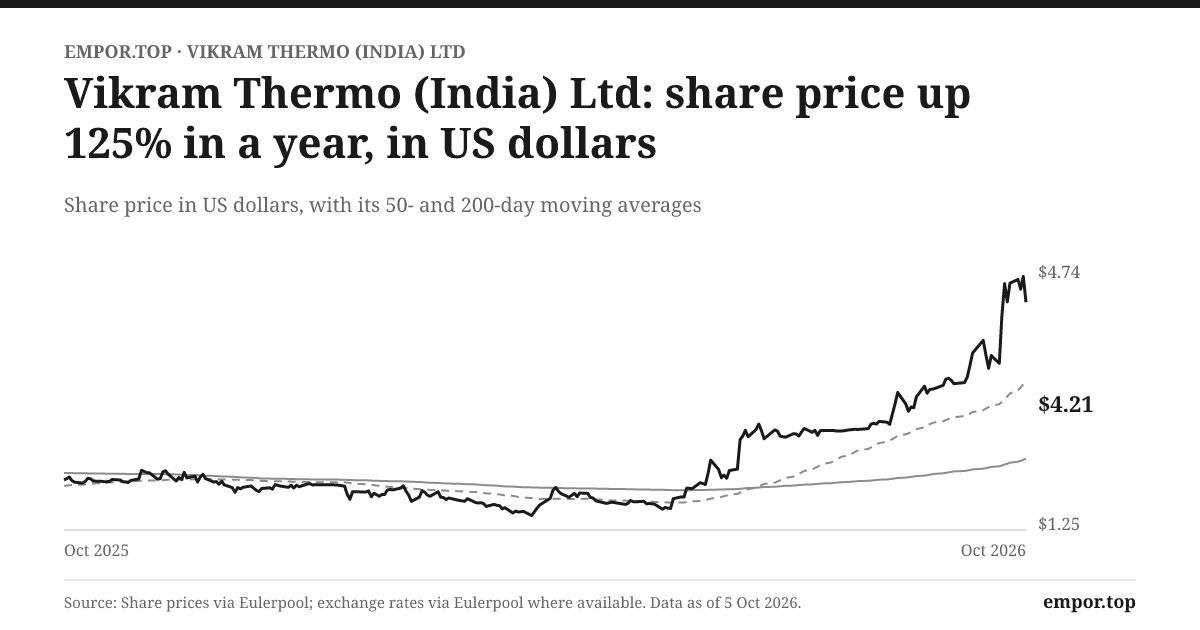
The second is the stock. Over the 52 weeks to 5 October 2026, the share price traded as low as ₹136 and as high as ₹436, and it closed near ₹406, giving the company a market value of about ₹1,273 crore7. The market now pays roughly 29 times trailing earnings for a business it priced at around 16 times, on median, over the previous five years7.
The third is the register. Two domestic institutions own about a quarter of one percent of the shares. No foreign portfolio investor appears at all. The rest belongs to the Patel family and about 12,000 retail holders3. There is no professional price-setter in the room.
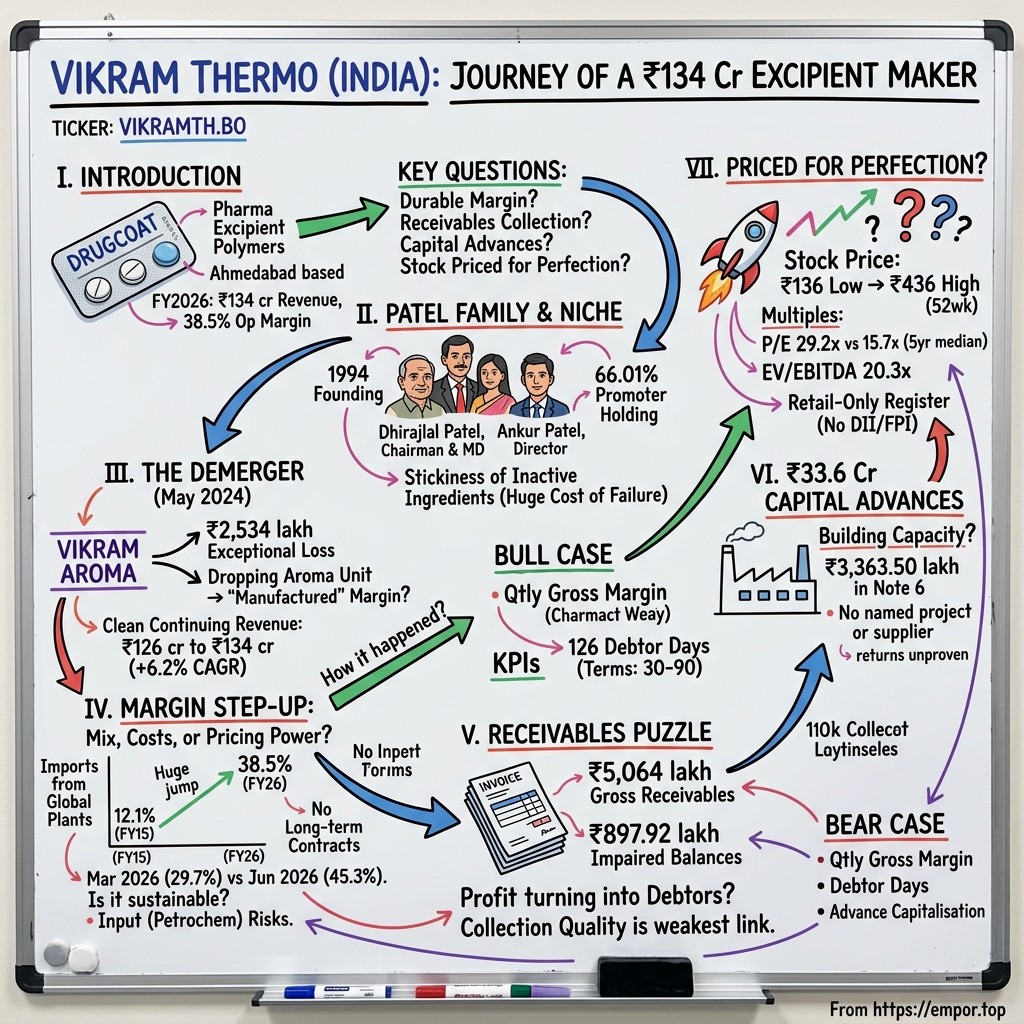
So the episode asks one question in four parts. The business is real and unusually profitable. But the stock now asks investors to believe that the margin is permanent. To test that belief, the story works through four questions in turn:
- Is the margin durable, or did mix and cost timing produce it?
- Is the revenue being collected, or is profit piling up as unpaid invoices?
- What are the ₹33.6 crore of capital advances on the balance sheet buying?
- Is the stock priced for perfection?
One caution before the story starts. In May 2024 the company spun its aromatic-chemicals unit off into a separate company1. That demerger makes every three-year growth rate and every FY2025 figure misleading if taken at face value, and it produced a quarter that looked like a collapse and was not. The story will untangle it in Section III. Until then, treat any figure that straddles 2024 with suspicion.
The place to start, though, is with the family that has run this business for three decades, and with the strange economics of selling an ingredient that is supposed to do nothing at all.
 Subscribe on LinkedIn
II. The Patel Family and the Excipient Niche
In 1994, in Gujarat, the state that would become the workshop of India's generic-drug industry, a company called Vikram Thermo (India) Limited was incorporated. Its corporate identity number still carries the year and the state: L24296GJ1994PLC0215241. It listed on the Bombay Stock Exchange in the 1990s, under the scrip code 5304777. And three decades later, the man at the top is the same: Dhirajlal K. Patel, Chairman and Managing Director1.
That continuity is the first fact about this company and arguably the most important one. There has been no change of control, no private-equity owner, no professional CEO brought in to "institutionalise" the business. There is no separate CEO post at all; the Chairman and MD runs the company1. Around him sit his son Ankur D. Patel and Dineshkumar H. Patel, both whole-time directors1. Other family members work in the business too, including Vikalp D. Patel, who heads formulation and development1.
What an excipient actually is
To understand why a family business could quietly earn high returns here, it helps to understand the product. An excipient is the "inactive" part of a medicine: the binders, fillers, coatings and thickeners that turn a pinch of active drug into something a patient can swallow, store and trust. A coating polymer is to a tablet what paint and primer are to a car body. It is a tiny fraction of the cost, but it decides how the product looks, lasts and behaves.
That gives excipients an unusual commercial profile. For the drug maker, the polymer is a rounding error in the cost of each tablet. But the cost of failure is enormous. A coating that cracks, discolours or releases the drug at the wrong point can trigger batch rejections, regulatory questions and recalls. Once a formulator has validated a particular grade from a particular supplier into a product, changing it can mean new stability studies and, for regulated markets, new paperwork. The logic of the industry is that buyers stick with what works.
That is the theory of the moat, and it is a plausible one. But it is worth saying plainly at the start: Vikram Thermo publishes no data on customer retention, repeat-order share or switching costs1. The stickiness is an inference from how the industry works, not something the company has demonstrated with numbers. Section IV tests how far that inference can carry.
Skin in the game
The family's grip on the equity is tight and has tightened over time. At 30 June 2026, 29 promoter-group holders owned 66.01% of the company, and none of those shares was pledged3. Dhirajlal Patel alone held 18.56%3. A decade earlier the promoter stake was about 61%7. The family has been a net accumulator, not a seller, and the company has never diluted them: there have been no equity raises, no warrants, no buybacks and no convertibles in the capital history1. The one big change to the share count was a bonus issue in FY2023 of about 25.1 million shares, which took the total to 31,357,8501. A bonus issue moves rupees from reserves to share capital; it changes the number of slices, not the size of the pie.
For an outside investor, a founder family owning two-thirds of the company with no pledges is a meaningful form of alignment. When the share price falls, the family loses most of all.
How the family is paid
Alignment in the equity, though, does not settle the question of how the profits are split before they reach shareholders. In FY2026 the three executive directors took about ₹5.6 crore between them1. Dhirajlal Patel's package was about ₹2.55 crore, of which ₹1.75 crore was commission; Dinesh Patel and Ankur Patel each received about ₹1.51 crore1. Taken together, that was about 14.5% of the year's profit after tax1. Total pay to key management personnel was about ₹5.95 crore, up from about ₹5.05 crore1.
Because most of that pay is commission tied to profit, it rewards the right thing in one sense: the family earns more when the company earns more. But the shape of the increases tilts toward the top. Pay for directors and key management rose about 19.3% in FY2026, against about 15.6% for other employees and about 10% for the median employee1. The Chairman's pay rose about 20% in a year when continuing profit after tax rose about 14%1.
Two more details sharpen the picture. At the AGM on 29 September 2026, shareholders were asked to approve a rise in Vikalp Patel's monthly salary from about ₹2.0 lakh to about ₹2.9 lakh, a 46.7% increase14. The published outcome of that meeting lists the agenda but gives no vote counts4, so the size of any dissent is not public in that document. And in May 2025 the company's CFO changed: Motibhai D. Fosi was replaced by Switi G. Patel1. The annual report does not state whether the new CFO is related to the promoter family; the shared surname is common in Gujarat, and the observation is a question rather than a finding.
The board
The board has six directors: three family executives and three independent directors, Vipulkumar Patel, Aanal Shah and Dineshkumar Mistry, who are paid ₹20,000 a meeting in sitting fees1. The board met five times in FY20261. Half-independent meets the letter of Indian listing rules for a board whose chairman is an executive, but it is not a majority-independent board, and in a company where the family sets its own commission, the independents carry most of the weight of minority protection.
The verdict on this section is straightforward. This is a founder-family business with real skin in the game, no leverage on the family's shares and no history of diluting outsiders. The pay structure is profit-linked but family-skewed, and the governance is adequate rather than strong.
The most consequential decision this family made in recent years, however, was not about pay. It was to cut the company in two.
III. The Demerger That Rewrote the Numbers
On 4 May 2024, shareholders of Vikram Thermo woke up owning something new. For every ten Vikram Thermo shares they held, they now also held one share of Vikram Aroma Limited, a separate company that took over the aromatic-chemicals unit under a scheme approved by the National Company Law Tribunal in Ahmedabad1. Nothing had been sold. A business had simply been moved out of one listed box and into another, with the same family in control of both.
Then the accounts for the June 2024 quarter arrived, and they showed a loss of about $1.9 million12. For a company that had been reporting steady profits, a loss quarter is the kind of headline that scares retail holders. It was also, almost entirely, an accounting artefact.
The mechanics of a paper loss
When a company demerges a business, it transfers that unit's net assets out of its own balance sheet. If the book value moved out does not match what accounting treats as the consideration, the difference can land in the profit and loss account as an exceptional item. That is what happened here. Vikram Thermo booked an exceptional loss of about ₹25.3 crore on the transfer of the aroma unit's net assets in FY20251.
That one line explains a cluster of ugly FY2025 numbers. It turned the June 2024 quarter into a loss. It drove the full-year net profit down by about 68%1. It pushed the reported tax rate to an odd 55%, because a loss on transfer of this kind does not reduce tax in the same way trading costs do1. And it dragged the return on equity down to about 6.6% for the year1. None of it reflected customers ordering less coating polymer. In the cash-flow statement, the loss was added back as a non-cash item1.
The lesson of that quarter is simple. The exceptional line was the story, not the headline.
The distortion the other way
The demerger distorts the numbers in a second, subtler direction. Standard three-year growth rates now compare FY2026, a year with no aroma business, against FY2023, a year that included it. On that basis revenue appears to have grown about 6% a year and net profit about 31.5% a year1. Neither number is a clean measure of the business that investors now own.
The cleaner comparison uses the company's own restated continuing-operations figures. On that basis, revenue rose from about ₹126.2 crore in FY2025 to about ₹134.1 crore in FY2026, a gain of about 6.2%1. That is respectable, but it is about half the company's ten-year revenue growth rate of roughly 13% a year1. Continuing profit after tax rose from about ₹33.8 crore to about ₹38.5 crore, about 14%1.
So the honest reading of the most recent full year is this: profit grew more than twice as fast as sales. Whatever is happening at Vikram Thermo, it is mostly happening in the margin, not in the top line. The margin story is stronger than the revenue story.
What was left behind
The demerger created a related party that did not exist before. How much business still flows between the two companies?
The answer is: very little. In FY2026 Vikram Thermo sold goods worth about ₹35,000 to Vikram Aroma, about 0.003% of revenue1. It bought nothing from it, against about ₹2.9 crore of purchases in FY20251. Payments made or received on the other company's behalf, which ran to about ₹8 crore in the transition year, shrank to well under ₹1 crore1. Vikram Thermo earned about ₹29 lakh of interest income from Vikram Aroma, roughly 0.6% of its profit before tax1. Dinesh Patel sits on both boards1.
One item deserves a sentence of its own. The related-party note shows a balance of about ₹5.2 crore with Vikram Aroma at 31 March 2026, down from about ₹5.8 crore a year earlier, but the company does not state clearly whether it is owed money or owes it1. The interest income suggests an interest-bearing balance of roughly that size, and the company's separate disclosure of loans to related parties shows nil1. It is small next to a ₹1,273 crore market value. It is also exactly the kind of loose end a careful minority shareholder would ask the audit committee to tie off.
Capital allocation by subtraction
The demerger is also the clearest test of how this family allocates capital. Many Indian promoters respond to success with diversification: a new unit, an acquisition, a venture into an adjacent sector. Vikram Thermo did the opposite. It took a business out and handed it to shareholders directly. The company has made no acquisitions in its history as reported, so there is no M&A record to grade against peers.
That is a modest point in the family's favour. Simplifying a company so that the listed entity is a pure excipient maker makes it easier to understand and value. But the demerger also raises the question the rest of this story must answer. If dropping a business helped the margin, how much of the 38.5% is the remaining business's own earning power, and how much is the absence of something less profitable?
IV. Why the Margin Stepped Up: Mix, Costs, or Pricing Power?
Look at two consecutive quarters side by side. In the three months to March 2026, Vikram Thermo sold about ₹37.8 crore of product and earned an operating margin of about 30%1. In the three months to June 2026, it sold almost exactly the same amount, about ₹37.9 crore2. Its operating margin was about 45%2.
Same factory. Same customers, broadly. Same revenue to within a rounding error. And a fifteen-point swing in how much of each rupee the company kept. Whatever drives this business's profitability, it is not simply volume.
Taking the margin apart
The cleanest way to find out what moved is to go line by line through the costs. The biggest single line in a chemicals business is materials. At Vikram Thermo, the cost of materials plus the change in inventories fell from about 40.6% of revenue to about 32.3% between FY2025 and FY20261. That eight-point drop in material intensity is the core of the margin step-up.
Why did materials get cheaper relative to sales? Three explanations compete, and the evidence supports more than one.
The first is mix by subtraction. In FY2025 the company still bought about ₹3.5 crore of finished goods for resale, so-called stock-in-trade, which carries thin margins because someone else did the manufacturing1. In FY2026 that line was nil1. Some of that trading was linked to the aroma business. Dropping it mechanically lifts the margin, because low-margin revenue has gone and the remaining revenue is manufactured product.
The second is input costs. Vikram Thermo's raw materials are petrochemical derivatives, and management itself names swings in petroleum prices as the main risk to the business1. When the oil complex softens, a polymer maker's costs fall before its selling prices adjust, and margins widen. When oil rises, the opposite happens. Nothing in the filings separates how much of the gain came from cheaper inputs versus better pricing.
The third is genuine pricing power: customers paying more because the product is worth more to them. This is the bull case, and it is the hardest to prove, because the company does not disclose price realisation per kilogram, product mix, or volumes.
Against all three, one cost line moved the wrong way. Other expenses rose from about 15.0% of revenue to about 17.3%1. Part of that increase was a provision for doubtful receivables, which Section V examines. Part may be the ordinary cost of running a larger, more export-oriented business.
The decomposition leads to a split verdict. Part of the margin gain is real and repeatable: the trading line and the aroma mix are gone, and they are not coming back. But part of it rests on input costs the company does not control and prices it does not disclose. With quarterly margins swinging by fifteen points on flat revenue, the 38.5% annual figure is better read as the middle of a wide range than as a new floor.
How the money is made
The commercial model is simple. Vikram Thermo sells polymers per kilogram or per tonne to pharmaceutical formulators, in India and abroad1. Standard credit terms are 30 to 90 days for both domestic and export customers1. The notes describe no long-term supply contracts and no minimum purchase commitments1. Every order is, in principle, a new decision by the customer.
That combination explains why revenue is lumpy. In the June 2025 quarter, sales fell about 8% from a year earlier1. In the March and June 2026 quarters they rose about 39% and 32%2. But those last two jumps came against weak year-earlier quarters, and June 2026 revenue was flat against March 20262. Some of the recent "growth" is a rebound from a soft base rather than a new trajectory.
The customer base is broad. No single customer accounted for 10% or more of revenue in FY20261, and the company describes its credit risk as diversified across a large customer base1. India supplied about 72.8% of sales and exports about 27.2%, down from 30% the year before1. The company's own marketing claims more than 3,000 completed projects, customers in more than 45 countries, and EXCiPACT GMP certification, an industry quality standard for excipient manufacturing6.
Arguing the moat once, properly
Is there a durable competitive advantage here? It is worth working through the standard frameworks, because this is the section where the moat argument has to stand or fall.
Start with Michael Porter's five forces.
Buyer power is low at the level of any single customer, because no buyer is large enough to dictate terms. But pharmaceutical formulators are sophisticated purchasers, and nothing in their contracts with Vikram Thermo locks them in. Their power is not in their size but in their freedom to qualify an alternative.
The threat of substitutes is the force that would actually break the moat. A coating polymer is not substituted by a different technology; it is substituted by another supplier's equivalent grade. When a formulator qualifies a rival's product into a new drug launch, the incumbent loses that revenue stream for the product's life. The company itself names imports from large global excipient plants as its principal competitive threat1. Those global producers have far greater scale in R&D, distribution and regulatory support.
Supplier power is a blind spot. Raw materials are petrochemical, and the company does not disclose how concentrated its suppliers are or in which currency it buys1. The quarterly margin swings suggest that input prices matter a great deal.
The threat of new entrants is moderated by regulation. A new excipient maker must earn GMP certification and then win qualification at each customer, which takes time. But certification is a ticket to compete, not a source of revenue in itself. EXCiPACT tells a buyer that Vikram Thermo can make excipients to standard; it does not tell an investor that the buyer will pay more for them.
Rivalry within the excipient industry is real but quiet: Indian makers compete on price and service, global makers on breadth and brand.
Now Hamilton Helmer's 7 Powers, which asks which of seven durable advantages a company actually has.
- Switching costs are the most plausible power. Re-qualifying an excipient grade in an approved drug is costly. But the company publishes no retention data to show how strong this is in practice.
- Scale economies do not apply in Vikram Thermo's favour. At about ₹134 crore of revenue, it is a small player against global excipient producers.
- Brand exists within its niche, in names like DRUGCOAT, but there is no evidence that it commands a price premium.
- Cornered resource, process power, network effects and counter-positioning are not visible in the record.
Testing the moat against the record
The historical-falsification test for a moat is whether the company has ever visibly lost price or lost customers. The company has published no lost-bid disclosures, no price cuts and no customer losses. That is not proof of strength; it is an absence of disclosure. What the record does show is a decade of operating margins swinging between about 10% and 38% before FY2026, with a ten-year median in the teens1. A business with strong pricing power would usually show steadier margins through input-cost cycles. This one has not, at least until recently.
The verdict: the moat is intact but unproven. Switching costs probably protect the existing book of business. Whether they allow the company to hold a 38–45% margin when input costs rise again is a question only the next oil-price move can answer. The key figure to watch is gross margin, revenue minus materials, in the coming two quarters, read against the crude price.
A small currency tailwind
One more influence on profit deserves a brief mention. Export receivables are unhedged: at 31 March 2026 the company held about USD 3.5 lakh and EUR 0.2 lakh of foreign-currency receivables with no derivatives against them1. It recorded a foreign-exchange gain of about ₹52 lakh in FY2026, about 1% of profit before tax1. A weaker rupee helps an exporter like this, but at this scale the currency is a tailwind, not a driver of the margin.
A margin, however, is only as real as the cash it eventually turns into. And that is where Vikram Thermo's accounts get more uncomfortable.
V. The Receivables Puzzle: Is Profit Turning into Cash or into Debtors?
Deep in the annual report, in note 9, there is an ageing table. It is the least glamorous page in the document and possibly the most informative. It lists every rupee customers owe Vikram Thermo, sorted by how long the money has been outstanding.
At 31 March 2026 the total was about ₹50.6 crore of gross trade receivables1. Of that, about ₹9.0 crore, or roughly 18%, was classified as credit-impaired, meaning the company itself judged there was meaningful doubt it would be collected in full1. Some balances in the table were more than three years old1. For a company whose stated credit terms are 30 to 90 days, three-year-old invoices are not late payments. They are disputes, or losses waiting to be recognised.
The size of the gap
The fact sheet translates receivables into days of revenue. In FY2026, Vikram Thermo's customers took on average about 126 days to pay1. That is well beyond the 90-day upper end of the company's own terms. It is better than the 144–146 days of FY2024 and FY2025, and much better than the peak of 168 in FY20161, so the trend has improved. But for a decade, this company has routinely waited four to five months to be paid.
Why? The company charges no interest on late payment1. A formulator who pays late suffers no penalty, and in a business where suppliers compete for qualification, a small excipient maker may be reluctant to press a customer too hard. The company does not publish which customers are slow or whether the impaired balances sit mainly with domestic or export buyers.
Now look at how well the books provide for the risk. Against the ₹9.0 crore of impaired receivables, the company carried an allowance of about ₹4.7 crore1. That leaves roughly ₹4.3 crore of impaired balances not provided for. If those balances prove uncollectable, future profits will absorb the shortfall.
The direction of travel also matters. Disputed receivables, all of which were classified as impaired, rose from about ₹0.8 crore in FY2025 to about ₹3.0 crore in FY20261. A near-fourfold increase in a single year is the most concerning number in the receivables note.
Where it showed up in the profit and loss account
The company did respond. It added about ₹2.8 crore to the allowance during FY2026 and reversed about ₹0.7 crore, a net charge of about ₹2.1 crore1. That was about 4% of the year's profit before tax1. Much of it appears to have landed in the March 2026 quarter, when other expenses ran to about ₹9.3 crore, against about ₹5.7 crore in the June 2026 quarter12. That provision helps explain why the March quarter's margin dropped to about 30% before bouncing to about 45%.
So part of the quarterly volatility in the margin is not about oil or pricing at all. It is about when the company recognises that a customer will not pay.
The counterweight
The ageing table also contains reassurance. About ₹24.4 crore of the gross balance was not yet due, and another ₹17.2 crore was less than three months overdue1. Together that is roughly 82% of receivables in reasonably current condition1. With no customer above 10% of revenue, there is no single default that could sink the year.
And over the long run, profit has turned into cash. Across the twelve years from FY2015 to FY2026, the company reported about ₹135 crore of net profit and generated about ₹161 crore of cash from operations, about 120% of profit1. That is a strong record, partly because depreciation and other non-cash charges add back to cash flow, but also because the business does not, over time, leak working capital.
Why FY2026 flatters the picture
The most recent year looks even better: cash from operations was about ₹51.6 crore against profit after tax of about ₹38.5 crore, about 134%1. But look at how it was built. Working capital released about ₹7.6 crore in FY2026, as other current assets fell and other current liabilities rose, more than offsetting a ₹3.9 crore rise in receivables1. A year earlier, working capital absorbed about ₹8.6 crore1. One good year after one bad year does not establish a trend.
The free cash flow figure needs similar care. On the fact sheet's definition, FY2026 free cash flow was about $4.7 million1. But the company also placed about ₹12.8 crore in margin-money deposits and bought about ₹42 crore of mutual-fund units during the year, flows that sit in the investing section rather than in capital expenditure1. The purpose of the margin money is not stated.
The treasury is a side show
What is the company doing with its cash? Conservatively, it is parking it. At 31 March 2026 it held about ₹20 crore in mutual funds, mostly an HDFC liquid fund, plus about ₹6.5 crore in cash and bank balances1. A year earlier, cash was barely ₹16 lakh and the fund holding was nil1. Total debt was only about ₹4.7 crore1.
Other income was about ₹1.6 crore in FY2026, about 3% of profit before tax1. It rose to about ₹0.9 crore in the June 2026 quarter alone, about 5% of that quarter's pre-tax profit2. That is worth watching, but other income does not carry the profit.
Litigation and the auditor
Contingent liabilities are minor: about ₹26 lakh of disputed GST demands1. The auditor, J.T. Shah & Co., gave an unmodified opinion, and its single key audit matter was revenue recognition around the year-end cut-off1. That focus on cut-off is ordinary for a manufacturer, but it sits naturally beside a receivables book that has grown faster than the company's terms would imply.
The verdict on cash conversion is two-sided. Over twelve years this business has collected its profits and then some. But the quality of the receivables book is the weakest part of the earnings quality: the allowance trails the impaired balance, disputes nearly quadrupled in a year, and debtor days still exceed the company's own terms by a wide margin. The figures to watch are the impaired and disputed balances at 30 September 2026, and whether debtor days fall below 110.
If receivables are the weakest part of the earnings, the largest unknown on the balance sheet sits elsewhere: in a single line of advances for plant that has not yet been named.
VI. ₹33.6 Crore on Account: What Is Being Built?
Note 6 of the annual report contains a line that, at this company's scale, is very large. Under non-current assets, "capital advances" stood at about ₹33.6 crore at 31 March 20261. Elsewhere, in note 40, the company records the estimated amount of contracts remaining to be executed on capital account, and it is the same figure: about ₹33.6 crore1.
Put those two notes together and the meaning becomes clear. Vikram Thermo has paid suppliers, in advance, the full value of capital contracts that have not yet been delivered. The money has left the company. The plant has not yet arrived. And the annual report does not name the project, the supplier, the capacity or the commissioning date1.
How big is this?
Scale is the point. ₹33.6 crore is about a quarter of FY2026 revenue and about a fifth of shareholders' equity1. It is larger than the company's entire cash and mutual-fund pile. If a company of this size were spending that amount on a new plant, investors would expect to hear what the plant makes, how much capacity it adds, and when it will produce revenue. Here, they have heard none of those things.
The timing shows in the cash-flow statement. Cash spent on property, plant and equipment, including advances, was about ₹40.8 crore in FY2025, and then only about ₹9.7 crore in FY20261. Most of the advance was paid in FY2025, the year of the demerger. Meanwhile, additions to fixed assets that were actually capitalised in FY2026 were about ₹15 crore, about 11% of revenue1, and net fixed assets rose from about ₹44.9 crore to about ₹57.0 crore1. So the company has been building, and something larger is still in the pipeline.
The generous reading
There is a straightforward bull interpretation. Revenue in the last two reported quarters ran about 30% above a year earlier2. If demand for Vikram Thermo's polymers is growing, more reactor capacity is a sensible response. The company is funding it entirely from internal accruals and a small bank loan1. And with return on capital employed at about 31.5%1, each rupee of new capacity, if it earns anything like the existing base, would be highly accretive.
The skeptical reading
The counterarguments are equally concrete.
First, asset turnover, the rupees of revenue generated by each rupee of assets, has been drifting down. It was about 0.92 in FY2015 and about 0.71 in FY20261. Part of that decline is the cash pile and the advance itself, which are assets not yet producing sales. But it means the company already needs more capital to generate each rupee of revenue than it did a decade ago.
Second, the company describes research and development as a core strength, yet R&D spending in FY2026 was about ₹47 lakh, about 0.35% of revenue, all expensed1. For a business that markets itself on formulation expertise, that is a small number. Capacity is being bought; technology is not visibly being built. Where new revenue will come from, new products or more of the existing ones, is not disclosed.
Third, the advance coincides with margin-money deposits of about ₹12.8 crore whose purpose is also unstated1. Margin money is often posted as security for letters of credit or bank guarantees, which could be linked to equipment imports. But that is a reasonable guess, not a disclosure.
Balance-sheet strength, tested
Can the company afford all this without stress? The evidence says yes. Borrowing is a single bank term loan of about ₹4.6 crore, priced at an external benchmark rate plus about 2.4%, secured on plant, receivables and stock and backed by the directors' personal guarantees1. Interest cover was about 115 times, and debt was about 3% of equity1. The current ratio was 3.31.
There is no credit rating; the company reports ratings as "not applicable"1. With no rating agency in the picture, there is no independent outside assessment of the receivables or of the capex plan. The bank is the only lender, and its terms are those of a comfortable, well-collateralised small borrower.
The historical-falsification test here asks whether the company has ever had to rescue its balance sheet. The worst year in the record is FY2025, when profit fell by about two-thirds and return on equity dropped to about 6.6%1. But that was the demerger's accounting loss, not a funding crisis. In the twelve years from FY2015 to FY2026, the reported record shows no equity raise, no rights issue, no default and no covenant breach1. The claim that growth has been funded without stress survives, narrowed to its precise form: no balance-sheet stress in FY2015–FY2026 as reported.
Where the cash goes
Dividends are modest. The board proposed ₹1.25 a share for FY2026, about ₹3.9 crore1. Over twelve years the median payout was about 10% of profit, and dividends absorbed about 34% of cumulative free cash flow1. The family has chosen to retain capital and reinvest it.
That makes the capital advances the real test of capital allocation. Retained capital is only as good as the returns it earns. The settling event is simple to name: the transfer of the ₹33.6 crore from advances into productive fixed assets, accompanied by a statement of capacity and expected revenue. Until then, an unexplained advance remains a question rather than an asset.
And it is in exactly that uncertainty that the stock market has chosen to triple the price.
VII. Priced for Perfection? The Stock and Its Retail Register
Over the 52 weeks to 5 October 2026, Vikram Thermo's share price ran from a low of about ₹136 to a high of about ₹4367. At one point earlier in the year, the company's own investor page still carried a quote of about ₹1555. By early October the stock sat near ₹406, about 2.6 times that figure and only 7% below its peak7.
Who did the buying? Not institutions. At 30 June 2026, the only institutional holders were two domestic entities owning about 0.26% of the company between them3. No foreign portfolio investor appeared on the register3. The Investor Education and Protection Fund, which holds shares whose owners have not claimed dividends for years, owned about 1.19%3. Another 386,255 unclaimed shares, belonging to 97 shareholders, sat in a suspense account1.
Everyone else was a member of the public. The shareholder count reached 12,055 at June 2026, up from about 5,000 in March 2022 and roughly 3,000 in 201737. Some of that growth came mechanically, as the bonus issue and the demerger created more tradable shares; some reflects retail investors discovering a high-margin small-cap. With the family holding two-thirds and almost no institutions, the free float is small and the price is set by retail order flow. The stock's annual volatility of about 50% and a five-year maximum drawdown of about 42% reflect that7.
What the price assumes
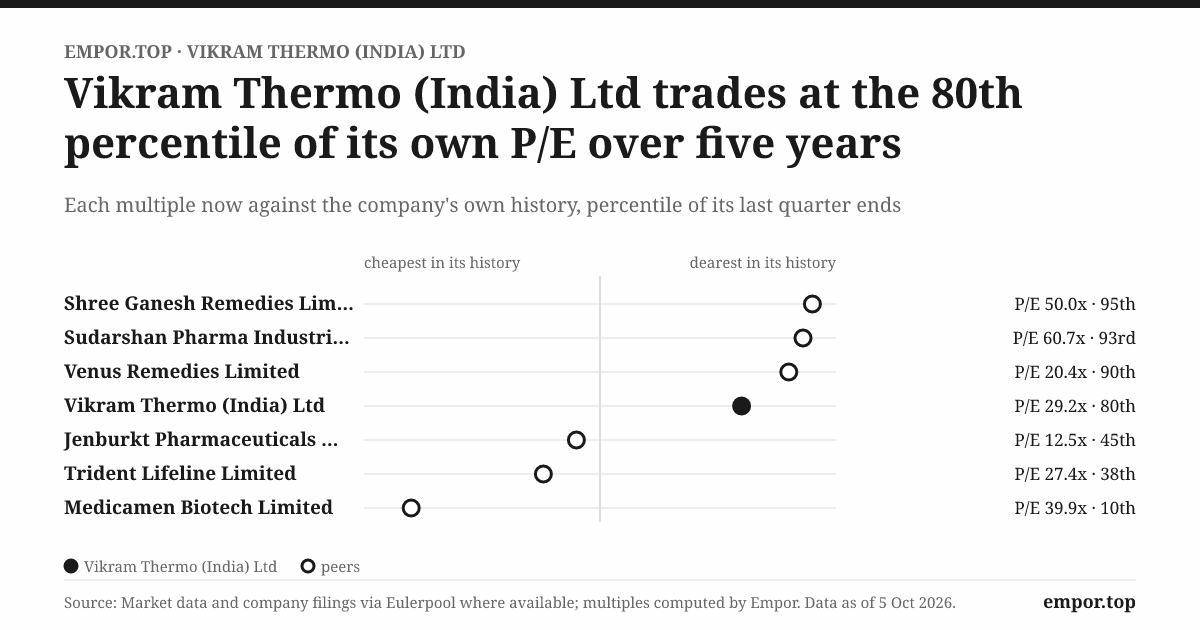
At about ₹406, the market valued Vikram Thermo at about 29 times trailing earnings, against a five-year median of about 16 times7. It paid about 8 times book value and about 20 times EV/EBITDA7. The earnings yield, the inverse of the P/E, was about 3.4%7.
A business earning around 28–32% on its capital with almost no debt deserves a premium to the market. The question is how much premium, and what it assumes.
Here is the uncomfortable arithmetic. Twelve-month earnings per share, to June 2026, were about ₹142. Those earnings include the strong June 2026 quarter at a 45% operating margin. If the margin settles back toward its FY2026 annual level of about 38.5%, earnings fall; if it returns to the teens of its ten-year median, they fall a lot. The current multiple is being applied to near-peak profitability.
The PEG ratio, which divides the P/E by earnings growth, stood at about 0.937. A figure below 1 is often read as "growth at a reasonable price." But that growth input is the 31.5% three-year profit growth, which the demerger flatters. The continuing business grew revenue about 6% last year, and its ten-year revenue base rate is about 13%. If profit growth converges toward revenue growth once the margin stops expanding, the PEG roughly doubles.
The verdict is that the price embeds the Jun 2026 margin. In plain terms: investors are paying almost twice the company's own historical multiple for a margin that has been at its current level for about two years, in a business whose margins have historically been volatile.
The skeptical investor's stress test
Imagine a sceptical long-short investor reading this company's annual report. The questions would be specific.
Would you pay 20 times EBITDA for a business whose customers take about 126 days to pay on 30-to-90-day terms, and whose disputed receivables nearly quadrupled in a year?
Would you pay it for a company that has advanced a fifth of its equity to unnamed suppliers for an unnamed project?
Would you pay it when the controlling family takes about one rupee in seven of profit after tax as executive pay, mostly as commission, and sought a 47% raise for another family member at the latest AGM?
And would you pay it without a single institutional holder or rating agency to provide an independent check?
None of these questions proves that the price is wrong. Each one could be answered by better disclosure. But a premium multiple usually assumes that such questions have already been answered.
Peers
A full peer comparison would set Vikram Thermo against listed Indian excipient and speciality-chemical makers. The company does not publish market-share data, and its closest global competitors are large diversified chemical groups whose excipient businesses are not separately valued. In the absence of a clean peer set, the most reliable benchmark is the company's own history, and against that benchmark the current multiple is roughly double.
There is also no obvious catalyst in the record beyond the results themselves. The re-rating appears to have been driven by the margin, by the post-demerger clarity of the business, and by retail investors' discovery of both.
The investing lessons from this company follow almost directly from its numbers.
VIII. Playbook: Business & Investing Lessons
Go back to the summer of 2024. A retail shareholder opens a stock app and sees that Vikram Thermo, a business that had been quietly profitable for years, has reported a quarterly loss of about $1.9 million. The natural reaction is alarm. The correct reaction was to read one line further down.
The year after that loss quarter, profit rose about 380%1. Not because the business was transformed, but because the paper loss did not recur. That swing contains the first lesson, and four more follow from the rest of the story.
"Read the exceptional line before the headline." The June 2024 loss was a demerger accounting entry, not a collapse in demand. Investors who sold on the headline sold a business that had not changed. For founders, the corollary is that restructuring creates noise that can mislead the people you most want as shareholders; for investors, it is that the most informative number in a bad quarter is often the one labelled "exceptional."
"Margin is a number; mix is a story." Vikram Thermo's operating margin went from about 12% to about 38% in a decade. Some of that came from what the company stopped doing: buying goods for resale and running an aroma unit. Removing a low-margin business raises the margin without making the remaining business any better. Before rewarding a margin expansion, ask what left the revenue base.
"Profit is an opinion until the debtors pay." A company can report record profit while its customers stretch payment from 90 days to 126, and while disputed invoices quadruple. Vikram Thermo's twelve-year cash record is strong, which is why the recent receivables trend matters: the best-performing companies show their first cracks in the debtor book, not the income statement.
"An unexplained advance is a question, not an asset." ₹33.6 crore paid in advance for unnamed plant is, in accounting terms, an asset. In investing terms it is a promise whose content has not been disclosed. Capital spent before it is explained should be valued at what it will earn, not at what it cost.
"A family-run, debt-free firm can still be badly priced." Two-thirds family ownership, no pledges, no debt: everything about the alignment story is real. None of it says anything about what the shares are worth. Ownership alignment protects against the company being run badly. It does nothing to protect an investor who pays too much.
Those lessons frame the debate that bulls and bears now have over the same set of numbers.
IX. Bull vs. Bear and KPIs
Picture two analysts reading the June 2026 quarter on the same morning. Operating margin about 45%. Operating profit up about 61% from a year earlier2. One sees proof that a niche excipient maker has found its level. The other sees a margin at the top of a volatile range, applied to a stock already at twice its normal multiple. Both are reading the same filing correctly. They disagree about what comes next.
The bull case
The bull case starts with returns. Return on capital employed was about 31.5% in FY2026, and return on equity over the twelve months to June 2026 was about 28%17. The company carries almost no debt and holds more cash than it owes1. It sells into pharmaceutical demand, which does not collapse in a recession because people keep taking medicine. No customer accounts for even a tenth of revenue1. The treasury is parked in liquid and short-term debt funds rather than in speculative ventures1. The family owns two-thirds of the shares and has never diluted outside holders31. And the company is visibly adding capacity, funded from its own cash, at a time when quarterly revenue is running about 30% above last year2.
If the switching-cost argument from Section IV is right, every new drug that qualifies a Vikram Thermo polymer adds a revenue stream that lasts for the life of that product. Capacity added now would compound that annuity. On that reading, the current multiple is the market belatedly recognising a quality business.
The bear case
The bear case is not vague. It rests on specific, testable numbers.
Input costs are petrochemical, and the margin has swung by fifteen points between consecutive quarters on flat revenue12. Imports from global excipient plants are, on the company's own account, its main competitive threat1. Receivables run well beyond terms, with an under-provided impaired balance and fast-growing disputes1. A capital advance worth a fifth of equity has no named project1. The register has no institutional anchor and no rating agency watches the credit31. Pay is profit-linked but tilted toward the family1. And revenue from continuing operations grew only about 6% in the last full year, well below the ten-year base rate1.
On that reading, the current multiple is extrapolating the best quarter in the company's recent history.
Weighing it
The moat argument, worked through in Section IV, came out intact but unproven. That verdict carries over here. The bull case does not need anything to go wrong to be wrong; it only needs the margin to revert toward the high 30s while revenue grows at its base rate. The bear case does not need a disaster either; it would be confirmed simply by another quarter of rising disputed receivables or another year without disclosure on the capital advance.
The risk radar
Only four risks are material, and each has a clear mechanism.
- Input costs. Crude oil drives petrochemical feedstock prices, which drive polymer raw-material costs, which flow straight into gross margin before selling prices adjust.
- Customer re-qualification. A formulator qualifying a rival grade, domestic or imported, for a new product removes Vikram Thermo from that product's life cycle.
- Receivable defaults. The ₹4.3 crore gap between impaired balances and the allowance would hit profit directly if those balances prove uncollectable.
- Capex execution. The ₹33.6 crore advance must become working plant that customers fill with orders.
Cybersecurity and AI disruption are not material to a business of this kind.
The three numbers that matter
If an investor could track only three numbers, these would be the ones.
Quarterly gross margin, revenue minus materials. Material costs fell from about 41% to about 32% of revenue in FY2026, and the June 2026 operating margin reached about 45%12. The direction has been favourable; the question is whether it holds when input prices rise.
Debtor days and the impaired balance. Debtor days improved to about 126 in FY2026 from about 144, but impaired receivables reached about ₹9 crore and disputed balances about ₹3 crore, both up sharply1. The direction is mixed.
Capitalisation of the capital advances. At 31 March 2026, ₹33.6 crore was still outstanding as advances1. Its conversion into productive plant, and the revenue that follows, is the real measure of whether retained profits are earning a return.
Each of those three numbers will get its next reading within weeks.
X. Epilogue
Tonight, Vikram Thermo stands at an odd juncture. Its September quarter has closed. Its AGM met on 29 September 2026 and dealt with the reappointment of Dinesh Patel and Ankur Patel for five-year terms from 13 August 2026 and the proposed pay rise for Vikalp Patel14. The share price sits within a few percent of its high7. And the half-year results for the six months to 30 September 2026, the first full test of whether the June quarter's margin was a new level or a peak, have yet to be published.
Three moments will decide the story from here.
The margin test. The H1 FY27 results will show whether the September quarter held the June quarter's 45% operating margin or reverted toward the high 30s of FY2026. If it held, with revenue still growing, the bulls will have their strongest evidence yet that the step-up reflects pricing power or a permanently better mix. If it slipped, the market will be forced to reprice the business on a lower margin, and with the stock at about twice its historical multiple, there is little cushion for that.
The capital advance. At some point the ₹33.6 crore of advances must turn into plant. When it does, the company will either explain what it built, how much capacity it adds and what revenue it expects, or it will simply move the number from one line to another. The first outcome would turn the largest unknown on the balance sheet into a growth story with numbers attached. The second would leave investors valuing capacity they cannot measure.
The receivables test. The half-year balance sheet will show the impaired and disputed receivables at 30 September 2026. If disputes have stabilised and debtor days have fallen toward or below 110, the earnings-quality concern eases considerably. If disputes keep growing faster than sales, the gap between the allowance and the impaired balance will start to look less like conservatism waiting to be confirmed and more like a provision waiting to be taken.
Behind those three moments sit two slower questions. Will any institution, domestic fund or foreign investor take a meaningful position in the stock, bringing professional price discovery to a register that has none? And when the AGM voting results surface, how many shareholders voted against a 47% pay rise for a family member?
Each outcome points the multiple in a specific direction. Margin holds, advance explained, receivables clean: the market's current price begins to look earned. Margin slips, advance unexplained, disputes rising: the stock is left priced for a business it may not be.
The tension that remains is the same one this story opened with. Vikram Thermo is unmistakably a good small business. Whether it is a compounder is a question the next two quarters will begin to answer.
XI. Outro
Go back to the pill in the blister pack. Its coating is a few microns thick. The patient never notices it, the pharmacist never mentions it, and the drug maker thinks about it only when something goes wrong. That invisibility is the whole commercial logic of an excipient: a product that matters most when no one is looking at it.
Vikram Thermo has built a ₹1,273 crore market value on that thin layer of polymer. The company sells protection that nobody sees, and the stock now asks investors to look past the margin in the same way, as if it were simply part of the pill.
References
-
Annual Report 2025-26 — Vikram Thermo (India) Limited, 2026-09-03 ↩↩↩↩↩↩↩↩↩↩↩↩↩↩↩↩↩↩↩↩↩↩↩↩↩↩↩↩↩↩↩↩↩↩↩↩↩↩↩↩↩↩↩↩↩↩↩↩↩↩↩↩↩↩↩↩↩↩↩↩↩↩↩↩↩↩↩↩↩↩↩↩↩↩↩↩↩↩↩↩↩↩↩↩↩↩↩↩↩↩↩↩↩↩↩↩↩↩↩↩↩↩↩↩↩↩↩↩↩↩↩↩↩↩↩↩↩↩↩↩↩↩
-
Unaudited standalone results, quarter ended 30 Jun 2026 — Vikram Thermo (India) Limited, 2026-08-11 ↩↩↩↩↩↩↩↩↩↩↩↩↩↩
-
Shareholding pattern, 30 Jun 2026 — Vikram Thermo (India) Limited ↩↩↩↩↩↩↩↩↩
-
Proceedings of the 32nd AGM — Vikram Thermo (India) Limited, 2026-09-29 ↩↩↩
-
Vikram Thermo share price and shareholding history — Screener.in ↩↩↩↩↩↩↩↩↩↩↩↩↩↩
 LinkedIn
 WhatsApp
 Reddit
 Hacker News
 Email
Email Kindle
 RSS Feed
 Spotify
 Apple Podcasts
 Amazon Music
 Audible
 YouTube