Vidhi Specialty Food Ingredients Limited (NSE: VIDHIING): The Color Maker Waiting for Its Next Mix
I. The Color in the Sample Jar — 3 minutes
Picture a small glass jar on a laboratory bench. Inside is a powder, bright as a traffic light: tartrazine yellow, or a red destined for a sports drink, a candy shell or a tablet coating. A customer's food technologist on another continent will dissolve a few grams of it, check the shade against a standard, run it through their own process and ask the paperwork questions. Does it meet the purity limits? Is it approved for this use in this market? Will the next batch look exactly like this one? Only if every answer is yes does the jar turn into a purchase order, and only if the next hundred batches behave does the order turn into a relationship.
That is the business of Vidhi Specialty Food Ingredients Limited, a Mumbai-based manufacturer and trader of food colours and chemicals listed on both the BSE and the NSE.1 It ships to customers in more than 80 countries.1 Its colours end up in food, beverages, confectionery and pharmaceuticals, almost always invisibly: nobody buys a fizzy drink because of the dye supplier, but nobody wants to be the brand whose drink turned the wrong shade.
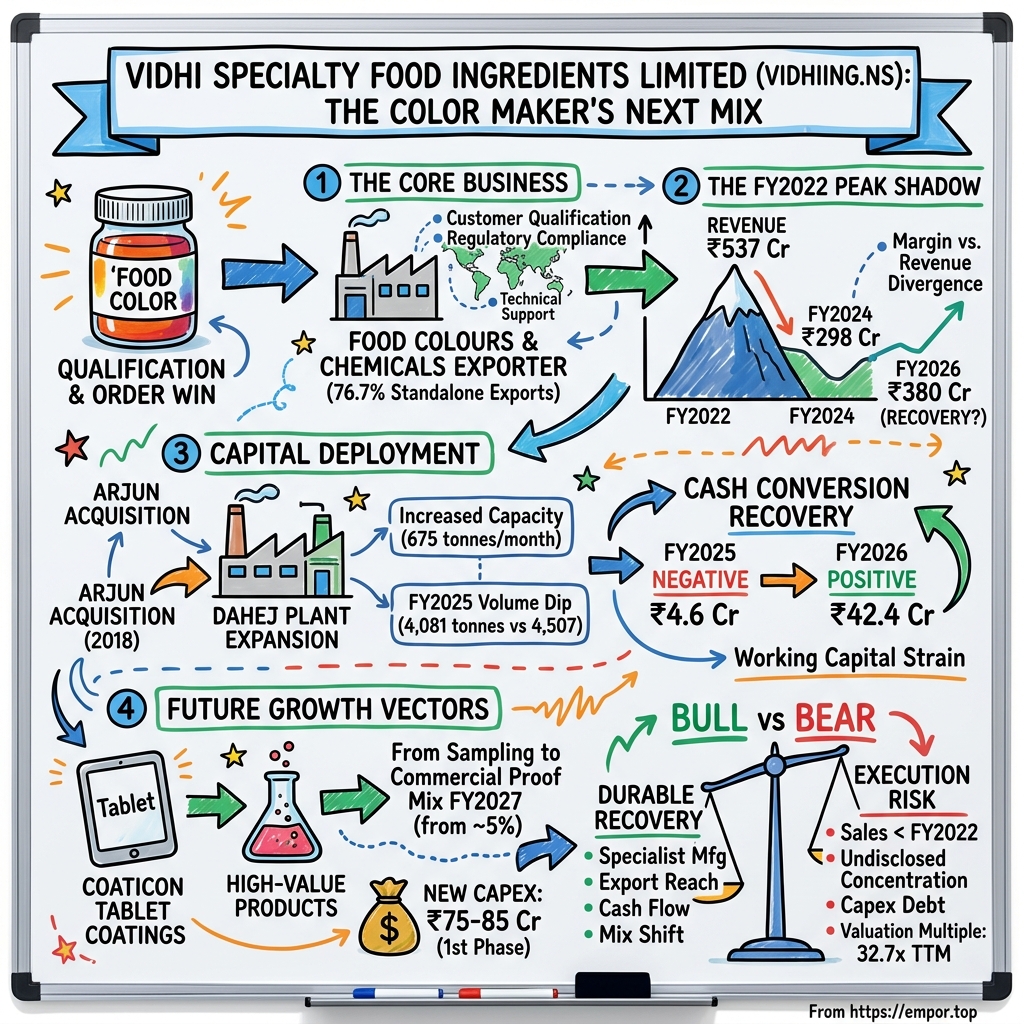
The headline numbers make Vidhi look like a steady, profitable exporter. In FY2025–26, the year ended 31 March 2026, standalone revenue was about ₹380 crore and profit after tax about ₹49 crore.1 Roughly 76.7% of standalone revenue came from outside India.1 That is a solid, cash-generating specialist, the kind of company that rarely makes headlines.
The trouble is the shape of the line rather than its level. Vidhi's sales have not climbed in a straight line. They doubled to a record in FY2022 and then fell by almost half over two years before recovering partway.11 So the question this story has to answer is simple to state and hard to settle: is Vidhi building a durable growth curve, or is it still trying to get back to a peak that may have been a one-off?
Four questions will carry the story. Has growth actually resumed? Are customer relationships and product knowledge strong enough to protect the core? Can Vidhi turn new capacity and cash into better returns? And will the newer, higher-value products become real businesses rather than promising samples?
One boundary matters from the first page. Vidhi owns a subsidiary, Arjun Food Colorants Manufacturing Private Limited.1 The credit-rating agency CRISIL analyses the two together as the "Vidhi group".3 Unless stated otherwise, the numbers here are standalone Vidhi; where group figures appear, they are labelled.
It also helps to set the scale correctly. In FY2025–26, manufactured food colours brought in about ₹319 crore and traded products about ₹50 crore.1 Despite talk of new product lines, this is still overwhelmingly a synthetic food-colour company. Any investment case rests on that core. Management's ambitions for higher-value products are real enough to discuss, but they sit on top of a dye business whose own growth record is what the market is really pricing.
The verdict, before the evidence: Vidhi is an established exporter with a profitable core. Whether it deserves a growth investor's multiple depends on whether its better margins and newer mix can restart growth after a steep fall. To see why that is unresolved, start with the chart that still shadows the company.
 Subscribe on LinkedIn
II. The FY2022 Peak That Still Casts a Shadow — 7 minutes
Lay the revenue series on a table and it looks like a mountain with a long ledge on the far side. In FY2021, standalone revenue was about ₹266 crore.8 One year later it had more than doubled, to roughly ₹537 crore.11 Then the slope ran the other way: about ₹404 crore in FY2023 and about ₹298 crore in FY2024.9 Since then the business has climbed back to around ₹380 crore and stayed there, with FY2026 slightly below FY2025's ₹382 crore.12
That shape tells a story common to specialty chemicals in the post-pandemic years. Customers worried about supply shortages ordered ahead, prices for inputs and outputs rose, and suppliers booked record sales. When supply chains normalized, customers worked through the extra stock and ordered less. The FY2022 peak was very likely a mixture of genuine demand, higher prices and restocking. Vidhi does not publish a clean split between those three, which means the peak cannot be used as a reliable measure of the company's normal earning power.
The base rate matters for investors. Across these six years, the company's revenue has grown at a modest compound rate if measured from FY2021 to FY2026, about 7% a year. Measured from the peak, it has shrunk by about 30%. Pick the starting year and you can tell almost any story. The honest reading is that Vidhi has shown it can stay profitable through a cycle, not that it has shown it can compound sales.
The profit divergence
What makes FY2026 interesting is that profit moved when sales did not. Standalone profit after tax rose from about ₹43 crore to about ₹49 crore, an increase of roughly 13%, on revenue that was essentially flat.12 That is a margin story, and margin stories deserve more scrutiny than volume stories, because they can reverse faster.
Management's explanation, given on the May 2026 call, leaned on better realizations, an improved product mix, manufacturing efficiencies and cost control.5 Each of those is plausible. Several are hard to test from the outside. A few clues do help.
First, the line between manufactured and traded goods. Manufactured colours earn a manufacturing margin; traded products typically earn a thinner reseller margin. Manufactured sales of about ₹319 crore made up the large majority of FY2026 product sales.1 The research record shows FY2026 finished-product sales slightly below FY2025, which means the margin gain did not come from simply selling more of the richer product.12
Second, the cost lines. Employee costs, finance costs and depreciation all rose in FY2026.1 So the improvement did not come from cutting overhead. It came, by elimination, mainly from the gross margin: what Vidhi paid for raw materials relative to what it charged. That fits management's "better realizations" language but also fits a simpler explanation, namely that input prices eased faster than selling prices.
Third, currency. The net foreign-exchange gain booked within operating revenue rose from about ₹4.5 crore to about ₹7.9 crore.1 That increase of roughly ₹3.3 crore accounts for a meaningful slice of the year's profit improvement before tax. A weaker rupee is a gift to an exporter, but it is not a capability.
Put those clues together and the verdict is more cautious than the press release. FY2026's profit growth was real, but it was a margin and currency story on flat sales, not evidence of a new demand curve. "Mix improvement" may well be part of it. Vidhi has not published a consistent multi-year bridge that walks from volume and price to revenue and margin, which is exactly what an investor would need to separate durable mix change from a favourable year for input costs.
The latest quarter
The first quarter of FY2027, ended June 2026, arrived against a weak prior-year base. After those results, trailing-twelve-month sales were about 13% higher than a year earlier.11 That is welcome, but it is a rebound off a soft comparison, and management had itself attributed earlier softness partly to customers running down inventories during U.S. tariff uncertainty.5 A quarter of restocking can look exactly like a quarter of new demand. The test is whether the growth persists through the rest of FY2027 once the base normalizes.
The missing ruler
The cleanest single measure of this business would be manufactured tonnage. Vidhi has disclosed it occasionally rather than systematically, which makes a long-run series hard to assemble. The fragments show volume moving both ways: CRISIL credited the group with about 40% manufacturing-volume growth in FY2025,3 while standalone manufactured volume in FY2025 was reported at about 4,081 tonnes, down from about 4,507 tonnes.12 The two figures are on different bases, group versus standalone, which is precisely why a consistent company disclosure would help.
So for investors, the record supports a profitable business that has survived a full cycle, not yet a dependable compounder. That distinction leads directly to the next question: what, exactly, keeps customers buying Vidhi's colours rather than someone else's?
III. A Colour Is a Specification; a Sale Is a Purchase Order — 11 minutes
In June 2024, on a conference call with analysts, someone asked the question every investor in a niche manufacturer eventually asks: who are your competitors, and how big is the market? Management did not dodge. It named names and gave numbers.4
By management's estimate, Roha, the Indian colour maker, produced roughly 10,000 tonnes a year. Vidhi expected to reach about 8,000 tonnes of capacity after its Dahej expansion. Neelikon was put at about 2,000 tonnes and DyStar at 3,000 to 3,500 tonnes. The global synthetic food-colour market, in this telling, was about 50,000 tonnes, with much of the remainder attributed to Sensient, the U.S. colours and flavours group.4
It is a useful map, and it should be read as exactly what it is: one competitor's sketch of the battlefield. These are management's estimates, not audited market shares. They compare Vidhi's capacity with rivals' apparent output, which is not like for like. And none of the competitors has confirmed them. Still, the outline of the field is credible. Synthetic food colours are a concentrated global niche with a handful of meaningful producers, two of them in India, and one large Western incumbent.
How Vidhi makes money
The economics are simpler than the chemistry. Vidhi sells finished colours, and traded products it sources from others, on an order-by-order basis.1 It does not disclose contract lengths, minimum purchase commitments or any share of revenue that is contractually recurring.12 Customers buy when they need colour. Volume rises and falls with their production and their inventory decisions. Margins move with three things Vidhi does not fully control: raw-material prices, the mix of products ordered, and the rupee.
Customers also pay slowly. CRISIL notes credit periods of 60 to 120 days.3 In plain terms, Vidhi finances a quarter of a year or more of its customers' purchases. That is normal for an exporter to large food and pharmaceutical groups, and it tells you something about who holds the cards in the relationship.
Why qualification might matter
The bullish argument for Vidhi's position starts with the qualification process described earlier. Vidhi describes offering customized colour solutions and technical support from product development through to commercial production.1
An analogy helps. Switching a colour supplier is a little like changing the paint supplier on a car assembly line. The new paint may be cheaper, but somebody has to test it, sign off on it, update the documentation and accept the risk that a batch will be slightly off. For a beverage maker whose red is part of its brand, that is a real cost for a small saving, because colour is usually a tiny part of total product cost. That asymmetry, low share of cost and high cost of failure, is the classic recipe for sticky supply relationships.
It is a plausible switching cost. It is not proof of lock-in. Large buyers routinely qualify two or three suppliers precisely to avoid dependence on one. Vidhi does not disclose customer retention, the share of revenue from its largest customers, or how often it wins or loses a qualified position.12 Without those, "customers find it hard to switch" remains an inference, not a finding.
Five forces, once
Run the industry through Porter's framework and the picture is mixed.
Rivalry. Several established producers compete, including two Indian manufacturers with export ambitions similar to Vidhi's. No public source establishes reliable market shares or relative cost positions. Rivalry looks moderate: concentrated enough to avoid commodity price wars most of the time, but not so concentrated that any one producer sets prices.
Buyer power. This is where the evidence tilts against Vidhi. Order-by-order sales and 60–120-day credit terms mean customers can compare suppliers each time they buy and are being financed while they do.3 Vidhi names well-known brands among its customers but does not quantify concentration.1 If a few large distributors or food groups account for much of revenue, their bargaining power would be considerable. That cannot be settled from what the company publishes.
Supplier power. Raw-material volatility is a stated risk in CRISIL's assessment.3 Vidhi's FY2026 margin gain suggests it can sometimes keep the benefit of falling input costs; the real test is the opposite case, whether it can pass on rising costs without losing volume. The FY2023–24 contraction offers some evidence that it cannot always protect both price and volume at once.
Substitutes. Natural colours, made from sources such as beet, paprika or spirulina, are the long-term threat. Consumer preference and regulation have been moving in their direction in some markets. But substitution is application- and geography-specific: natural colours are often less stable, more expensive and harder to match. Regulatory approvals are product- and market-specific, not a universal barrier for Vidhi or a universal ban against it.
Threat of entry. Customer qualification, quality systems, technical support and regulatory dossiers take years to build. That slows entrants. It does not stop them, and the existence of several Indian producers shows that the know-how is not unique to one firm.
What would prove the edge
Management describes its advantage as a combination of manufacturing cost, sourcing, product quality, customer service and approvals.45 Each component is sensible; none is quantified. The proof, if it exists, would show up in a handful of numbers: realized price per tonne relative to rivals, repeat-order rates, new-customer wins, rejection rates and volume gains through a down cycle. The company's own history provides one partial test. When demand fell in FY2023 and FY2024, revenue dropped by nearly half from the peak.11 A business with strong pricing power and locked-in customers would usually show a shallower fall.
The calibrated verdict: Vidhi has a credible operating position in a concentrated global niche, built on qualification and service. The record narrows the moat claim to "useful switching friction", not a durable pricing advantage. The KPI that would widen it again is a disclosed, rising manufactured volume at stable or rising realizations. To see how Vidhi has tried to build that position, the story turns to a deal it did with its own promoters.
IV. The Promoter-Linked Business Vidhi Bought — 7 minutes
On 29 March 2018, Vidhi's shareholders received a notice for an extraordinary general meeting. The item that mattered asked them to approve the purchase of 100% of Arjun Food Colorants Manufacturing Private Limited, a company promoted by Vidhi's own promoters, for a cash consideration of about ₹7.92 crore.7
Related-party acquisitions are where minority shareholders learn the most about a controlling family. The promoters were, in effect, on both sides of the table: selling a business they controlled privately into a business they controlled publicly. That is not inherently wrong. It can be a sensible way to consolidate operations, eliminate conflicts of interest and give the listed company the full benefit of a related plant. It does require more evidence, not less, that the price was fair.
What shareholders bought
The deal was approved and completed in April 2019, making Arjun a wholly owned subsidiary.8 Arjun is a food-colour manufacturer, so the acquisition expanded Vidhi's own production base rather than taking it into a new business. It also removed an awkward overlap: a promoter-owned colour maker operating alongside the listed one.
The price, in context, was small. At about ₹7.92 crore, it was a fraction of a single year's profit for Vidhi today. Benchmarking it properly would require comparing the consideration with Arjun's net assets and earnings at the time, and with comparable specialty-colour transactions. Vidhi set out the proposal in the EGM notice, but there is no public set of truly comparable deals for small Indian food-colour plants.7 So the honest conclusion is limited: the acquisition cannot be shown to have been either a bargain or an overpayment. What can be said is that the amount was modest relative to the company's later scale, and that the business acquired has remained inside the group rather than being written off.
The more consequential effect was on disclosure. Since the acquisition, CRISIL has rated the group as a unit,3 and consolidated statements combine the two companies. That is reasonable, but it means an investor reading a credit report sees a slightly different company from the one reading standalone results.
Dahej: the bigger bet
The larger capital decision came later, at Dahej in Gujarat, a chemicals hub. The expansion moved through approval and trial production to commercial operations in December 2023.9 Reported capacity rose from about 325 tonnes a month to about 675 tonnes a month, roughly doubling the company's manufacturing ability.13
In the June 2024 call, management described teething issues at the new plant and expected it to reach optimal capacity by FY2025.4 That is the kind of statement that should be checked against later results rather than remembered as a milestone.
The check is uncomfortable. Standalone manufactured volume in FY2025 was about 4,081 tonnes, down from about 4,507 tonnes the year before, even though installed capacity was now far higher.12 Annualized, the new capacity of about 675 tonnes a month implies roughly 8,100 tonnes a year, so FY2025 production ran at about half of that. More capacity did not, in its first full year, produce more output.
There are fair caveats. Part of Vidhi's production sits in Arjun, and CRISIL's group numbers showed manufacturing-volume growth of about 40% in FY2025,3 which suggests the group as a whole was producing more even if standalone tonnage fell. Production may also have been shifted between plants. One year is not enough to declare persistent under-utilization. But the outline of the problem is clear: Dahej was built for a demand level the company has not yet consistently shown, and a plant running at half capacity carries the depreciation of a full one.
So for investors, Arjun looks like a small, plausibly sensible consolidation whose price cannot be benchmarked, while Dahej is the far bigger question. A larger plant is an option on demand. The next section follows the money to see whether profits have been arriving as cash to fund that option.
V. The Profit Was ₹49 Crore; Where Did the Cash Go? — 6 minutes
Imagine two years side by side. In the first, the income statement showed a healthy profit. The cash-flow statement, the record of money actually collected and paid, showed the company had absorbed more cash than it generated from operations. In the second year, with a somewhat larger profit, the cash arrived.
That was Vidhi's FY2025 and FY2026. On a consolidated basis, operating cash flow was about negative ₹4.6 crore in FY2025, against profit after tax in the low forties of crores.2 In FY2026, it swung to about positive ₹42.4 crore.1
The bridge
The FY2025 shortfall was not a mystery. Receivables absorbed about ₹43 crore and inventory about ₹19 crore.2 In other words, Vidhi sold more on credit and built stock as volumes recovered, and the cash stayed stuck with customers and in warehouses.
In FY2026, operating profit before working-capital changes was about ₹80 crore.1 After working-capital movements and roughly ₹16 crore of income tax paid, about ₹42 crore became operating cash.1 That was a conversion of a little under nine-tenths of profit after tax into operating cash, a respectable result and a large improvement on the prior year.
The two-year swing is the real lesson. Across FY2025 and FY2026 together, cash from operations was well below cumulative profit. That is what working-capital intensity looks like in practice. CRISIL put the group's gross current-asset days at about 243 at March 2025, including roughly 126 receivable days and 88 inventory days.3 Put simply, the group carried roughly eight months of sales on its balance sheet as receivables and stock. Any growth phase will demand more cash before it returns any.
Who owes the money
Standalone trade receivables were about ₹143 crore at March 2026.1 Of that, about ₹1.3 crore was classified as credit-impaired and fully provided for, and about ₹8.9 crore of receivables considered good were six months to a year past due.1 The provision fell after a small reversal of about ₹0.36 crore, which means some previously doubtful money was collected or reassessed.1
The long-aged tail is small relative to the total. The broader point is that most of the ₹143 crore is simply normal export credit, and Vidhi does not publish customer-level ageing. That limits what anyone can conclude about collection quality beyond the aggregate.
Currency is woven into this. Unhedged foreign-currency receivables at March 2026 included about ₹114 crore in U.S. dollars and about ₹6.5 crore in euros.1 Vidhi's policy permits derivatives when needed but gives no hedge ratio.1 That is why the FY2026 foreign-exchange gain of about ₹7.9 crore appeared: when the rupee weakens while dollar invoices are outstanding, those invoices become worth more rupees. The same exposure would cut the other way in a year of rupee strength.
Related parties, in proportion
A fair question in any promoter-controlled company is how much business flows to related entities. The answer at Vidhi is: very little. In FY2025, the company disclosed sales of about ₹1.36 crore to Chroma Food Ingredients and about ₹1.24 crore to Vidhi Finechem, both companies where a director is also a director.10 Together that is about 0.7% of FY2025 revenue. Balances due from director- or relative-linked firms fell to about ₹0.37 crore by March 2026 from about ₹1.74 crore a year earlier.1 The transactions are described as approved and in the ordinary course; no comparison with pricing to unrelated customers is published.1 Small enough not to distort the economics, but worth watching for growth.
Pay, ownership and the audit trail
Director remuneration and commissions were about ₹7.3 crore in FY2026, up from about ₹6.6 crore, against standalone profit of about ₹49 crore.1 That is roughly 15% of profit, a high share by the standards of larger listed companies, though not unusual for a small family-run Indian manufacturer where executive directors are also the founders. Promoters hold about 64.3% of the company and have held that level since at least FY2017.11
The balance sheet was otherwise clean. Disputed tax contingencies were nil at March 2026, and capital commitments net of advances were about ₹1.7 crore.1 Borrowings of about ₹56.5 crore were mainly working-capital facilities, with no covenant breach or refinancing pressure reported.13
One audit point deserves mention rather than burial. The FY2025 consolidated auditor's report included CARO remarks on Vidhi covering inventory verification and loan- and guarantee-related clauses.2 The FY2026 standalone and consolidated opinions were unmodified.1 The cleaner opinion is the current evidence; the earlier remarks are a reason to keep reading the annexures each year, particularly because inventory is one of the two largest cash sinks in this business.
So the money trail ends in a balanced place. Cash conversion snapped back, and governance leakage looks small. But working capital, not capital expenditure, is the main competitor for every rupee of profit. That makes the next chapter, management's plan to spend heavily on new products, the most important test of capital allocation in the story.
VI. From Food Colours to Tablet Coatings: When Does a Sample Become a Business? — 9 minutes
On the May 2026 earnings call, an analyst reached back six months. In November 2025, management had described high-value products as about 15% of Vidhi's mix and had spoken about moving toward 50% over the next few quarters.6 Where, the analyst wanted to know, did that stand now?
The answer reframed the ambition. Management said high-value products made up about 5% of the FY2026 mix and set a target of 10–12% for FY2027.5
Read side by side, the two calls do not reconcile. Either the definition of "high-value products" changed, the period being described changed, or the share fell sharply. Management did not, on the call, walk through which.5 For an investor, the cleanest reading is that the 50% ambition is unfulfilled and, in practice, withdrawn in favour of a much smaller near-term target. That is not a scandal. It is exactly the kind of guidance drift that matters most in a company whose investment case leans on a mix shift.
The people making the call
Bipin Manek, Chairman and Managing Director, and Mihir Manek, Joint Managing Director, remain at the centre of Vidhi's strategy.1 Their decisions are, for practical purposes, the company's decisions. The board includes independent directors, and an additional independent director was appointed in August 2026, subject to shareholder approval.1 A Company Secretary, Anupam Vyas, took office in June 2025.1
Stable control has a real upside here: owners who have built a profitable export business over decades and who carry the consequences of their own capital decisions. It also means the useful way to judge management is not tenure but track record of promises against delivery. On that score, the evidence so far is mixed: Dahej was built and commissioned, but the timetable to optimal capacity and the high-value mix targets both slipped.
CoatIcon: the most concrete new product
The highest-profile new line is CoatIcon, a range of tablet-coating systems for pharmaceutical companies.5 Most tablets wear a thin film coat that protects the drug, masks taste and gives the pill its colour. Coating systems are pre-mixed powders that manufacturers dissolve and spray. It is an adjacent market for Vidhi: colour is part of the coating, and pharmaceutical customers already buy its dyes.
In May 2026, CoatIcon was in sampling and customer qualification with pharmaceutical companies, with management describing an approximately six-month testing cycle.5 Management expected an outlay of about ₹5–12 crore to scale up.5
Here, certification is not commercialization. Pharmaceutical customers are slow and conservative buyers, for good reason: changing a tablet coating can require regulatory re-filings. Favourable sample feedback is the first gate, not the last. What would turn CoatIcon into an investment thesis is a sequence that has not yet been disclosed: named approvals, first commercial sales, repeat orders, customer counts and a contribution margin.
The bigger cheque
Separately, management described a first-phase project costing about ₹75–85 crore, with most of the spending in FY2027 and commissioning around the middle of FY2027–28.5
Put that number against the business. It is roughly twice FY2026 operating cash flow and well above a full year's profit after tax. Vidhi's capital expenditure in FY2026 was about ₹16 crore on a consolidated basis.1 Funding the project will require some combination of operating cash, borrowing and lower dividends. CRISIL has already flagged large dividend payouts as a constraint.3
The return question is harder still. Management gave specific capex and commissioning estimates but described expected margins and competitive dynamics for new products in broad terms.5 Analysts on the call pressed on margin progress after the manufacturing shift, customer inventories and project timing.5 The answers were most concrete where they concerned spending and least concrete where they concerned returns. That is the reverse of what a minority shareholder would want.
R&D at its true weight
Vidhi reported about ₹3.4 crore of R&D expenditure in FY2026, with 126 permanent employees including key managerial personnel.1 That is under 1% of revenue. It is real spending for a company this size, but it is a modest engine for the decades of pipeline opportunity management sometimes describes. Small R&D budgets can still produce valuable formulations; they rarely produce a rapid change in mix.
The historical falsification test is direct. Dahej's utilization remains a useful precedent. Vidhi's stated mix ambition was cut sharply within six months. Neither fact means CoatIcon or the new project will fail. Together they mean the burden of proof sits with delivery: any value assigned to the new lines should wait for disclosed revenue.
The verdict: CoatIcon is a strategically sensible adjacency, and the larger project could be meaningful. Both are early-stage promises that carry real execution and return risk relative to a ₹49 crore profit base. Which raises the question the market answers every trading day: what is the current price already assuming?
VII. Bull vs. Bear: What Is ₹350 Pricing In? — 9 minutes
On 1 October 2026, Vidhi's shares closed at about ₹350.11 That valued the company at roughly ₹1,749 crore and about 32.7 times trailing earnings.11 The business entering FY2027 has a stronger first quarter behind it, as noted above,11 and a large capital plan ahead.
A multiple in the low thirties is not a price for a no-growth specialty chemical company. A business earning ₹49 crore and growing slowly would usually trade at a lower multiple. At about 33 times, investors are paying for something more: a return to growth, a richer mix, or both. Put differently, if profits merely held steady, the earnings yield of about 3% would be thin compensation for the cyclicality this story has documented. The price is a bet that FY2026 was a floor, not a ceiling.
The bull case
The bull case has a real core. Vidhi is a specialist manufacturer in a concentrated global niche, with established export reach.1 It has survived a severe demand downturn without losses, kept a modest balance sheet and shown in FY2026 that it can convert most of its profit into cash. Its new Dahej capacity means future volume growth need not wait for another big plant. If demand recovers, operating leverage could be powerful: a plant running at half capacity has room to add volume with modest incremental cost.
Then there is optionality. If CoatIcon wins pharmaceutical qualifications, and the new project reaches commissioning on schedule, Vidhi could slowly become less of a dye maker and more of a formulation company with stickier, higher-margin revenue.
The bear case
The bear case is equally concrete. Sales remain well below the FY2022 peak.11 Customer concentration and retention are not disclosed. Pricing is order by order. Input costs and currency move margins in ways the company does not control. Working capital remains heavy at the group level.3 The mix-shift target has already been cut, and a capex programme roughly twice a year's operating cash flow is being committed before the new products have proven revenue.
An activist-style skeptic would push on four points: why build more capacity before Dahej is fully used; why director pay absorbs about 15% of profit; why the company does not disclose volume, customer concentration and a consistent product-mix definition; and why dividend payouts and a large capex plan are being pursued at the same time.
Regulation and tariffs
Synthetic colours face changing consumer preferences and market-specific regulation. On the May 2026 call, management discussed U.S. colour regulation and Vidhi's export exposure.5 The right way to read this risk is product by product and market by market. A regulatory change affecting one colour in one country is a revenue headwind of a specific size, not a blanket ban on Vidhi's business. Conversely, a shift toward natural colours in large markets would be a slow structural threat that no single quarter's growth can disprove.
The tariff channel is more immediate. Management said customer inventories fell sharply during U.S. tariff uncertainty and described uneven demand across export markets.5 That cuts both ways. It helps explain the weak FY2026 base and the strong Q1 FY2027 comparison. It also means part of the recent growth may be restocking rather than end-demand.
Helmer's seven powers, briefly
Applying Hamilton Helmer's framework sharpens the moat question.
- Switching costs are Vidhi's most plausible power, rooted in qualification and regulatory documentation. Unproven without retention data.
- Process power may exist in formulation and batch consistency; it would show up as low rejection rates and premium realizations, neither of which is disclosed.
- Scale economies are moderate at best. By management's own map, Vidhi is not the largest producer.4
- Cornered resource, network effects, counter-positioning and branding are largely absent. End consumers do not know Vidhi's name.
That leaves one plausible power and one possible one, both lacking hard proof.
The credit lens
CRISIL reaffirmed the group at A-/Stable for long-term facilities and A2+ for short-term facilities in January 2026.3 That is a solid, investment-grade view of default risk for the combined Vidhi and Arjun. Its concerns are telling: working-capital intensity, raw-material volatility and large dividend payouts.3 These are mechanisms equity investors should care about, even though the rating says little about growth.
Three numbers to watch
Three KPIs will settle more of this debate than any narrative:
- Manufactured volume and utilization. These remain the key operating test.12
- High-value product share, on a reconciled definition. The target remains as discussed above.5
- Operating cash flow relative to profit, alongside receivable and inventory days. Cash conversion has recovered.1
The investment test closes where the evidence runs out. The moat and the value of past acquisitions remain unproven on public evidence. At roughly 33 times trailing earnings, the market has partly priced a recovery that the business has begun but not yet proved. The lessons of this story are about exactly that gap.
VIII. Lessons from a Business Built on Small Specifications — 4 minutes
Go back to Dahej in December 2023. A new plant switches on. For months, engineers chase teething problems. Management tells analysts it should reach optimal capacity by the following year.4 The plant runs. And then, as with every factory ever built, it has to earn its place one repeat order at a time.
Vidhi's story is a lesson in conversion, and each conversion has its own line.
"A larger plant is a question, not an answer." Dahej's underused capacity is the case in point.1312 Capacity is a call option on demand, and demand does not care how many reactors you own. Founders building plants ahead of orders should remember that the market is the only thing that fills them, and investors should value a plant by its utilization, not its nameplate.
"A sample is not a sale." As discussed above, CoatIcon was still in sampling in May.5 That is real progress and nothing more. In industries built on qualification, the slowest step is often the last: the move from "approved" to "reordered". Until the paid orders repeat, a product line is a hypothesis.
"Profit has to make the trip home." Vidhi's cash conversion swung from negative in FY2025 to positive in FY2026.21 For an exporter selling on 60–120-day terms, the income statement is a promise and the cash-flow statement is the delivery receipt. Read them together, every year.
"A target that shrinks quietly is still information." The mix ambition was cut within two calls.65 Changing a target is fine. Not explaining the change is the part investors should price.
The wider lesson is specific to small specialist suppliers. Their edge may live in formulation and reliability, invisible to end consumers. But the public record must eventually show customers rewarding that edge with durable volume or price. Until it does, the edge is a belief.
IX. Epilogue: The Next Two Years Will Decide the Mix — 3 minutes
Tonight, Vidhi stands in an in-between moment. FY2026's results are in the books, the annual report is published, Q1 FY2027 has shown a rebound, and the next big capacity programme is planned but not yet built. The stock is priced for something better than the past four years.
The next scenes are already scheduled. Each quarterly result will show whether Q1's growth was restocking or a new run-rate. The FY2027 full-year results, due around May 2027, will reveal whether the high-value mix reached the 10–12% target management set.5 Somewhere in that window, CoatIcon either reports its first paid, repeat pharmaceutical orders or it does not. And by the middle of FY2027–28, the ₹75–85 crore project is supposed to be commissioned.5
Each outcome points somewhere specific. If manufactured volume climbs toward Dahej's capacity while margins hold, Vidhi's growth question gets its first convincing yes. If the mix target is met on a consistent definition, management's credibility repairs itself. If the new project is commissioned on time and starts generating sales, the capital-allocation question shifts from "why now?" to "what return?" If receivable days stay near the 126 that CRISIL measured in FY20253 while sales grow, the cash question resolves in the company's favour.
The opposite outcomes are equally legible. Flat volume with rising capex would mean a larger cost base chasing the same demand. A second quiet cut to the mix target would make the new-products narrative harder to credit. A working-capital surge in an upswing would reprise FY2025.
At the next calls, the most informative thing management can do is quantify: volume, utilization, mix definition, customer concentration. The tension that remains is the one this story opened with. Vidhi has proved it can make the colour. It has not yet proved it can make the curve.
X. Outro — 1 minute
Back to the jar on the bench in Mumbai: a few grams of bright powder, waiting for a customer half a world away to say yes. Vidhi has done this tens of thousands of times, building its export business.1
The next chapter asks for a different kind of yes: not "this shade matches" but "we will buy this new product, again and again, at a price that earns a return on the plant that made it". For Vidhi, the distance between "this works in the lab" and "this earns a place in the business" is the whole story.
References
-
Annual Report 2025–26 — Vidhi Specialty Food Ingredients Limited, 2026-08-31 ↩↩↩↩↩↩↩↩↩↩↩↩↩↩↩↩↩↩↩↩↩↩↩↩↩↩↩↩↩↩↩↩↩↩↩↩↩↩↩↩
-
Annual Report 2024–25 — Vidhi Specialty Food Ingredients Limited, 2025-09 ↩↩↩↩↩↩↩↩↩
-
Rating Rationale — CRISIL Ratings, 2026-01-07 ↩↩↩↩↩↩↩↩↩↩↩↩↩↩
-
Analyst and Investor Conference Call Transcript — Vidhi Specialty Food Ingredients Limited, 2024-06-12 ↩↩↩↩↩↩
-
Q4 and FY2026 Earnings Call Transcript — Vidhi Specialty Food Ingredients Limited, 2026-05-14 ↩↩↩↩↩↩↩↩↩↩↩↩↩↩↩↩↩↩
-
Q2 and H1 FY2026 Earnings Call Transcript — Vidhi Specialty Food Ingredients Limited, 2025-11-13 ↩↩
-
EGM Notice: Arjun Food Colorants Acquisition — Vidhi Specialty Food Ingredients Limited, 2018-03-29 ↩↩
-
Annual Report 2020–21 — Vidhi Specialty Food Ingredients Limited, 2021-09-06 ↩↩
-
Annual Report 2023–24 — Vidhi Specialty Food Ingredients Limited ↩↩
-
FY2024–25 Integrated Filing with Related-Party Disclosures — National Stock Exchange of India ↩
-
Share Price, Financial History, and Ownership — Screener ↩↩↩↩↩↩↩↩↩
-
Q4 FY2026 Investor Presentation — Vidhi Specialty Food Ingredients Limited, 2026-05-14 ↩↩↩↩
-
Q2 FY2025 Investor Presentation — Vidhi Specialty Food Ingredients Limited, 2024-11-12 ↩↩
 LinkedIn
 WhatsApp
 Reddit
 Hacker News
 Email
Email Kindle
 RSS Feed
 Spotify
 Apple Podcasts
 Amazon Music
 Audible
 YouTube