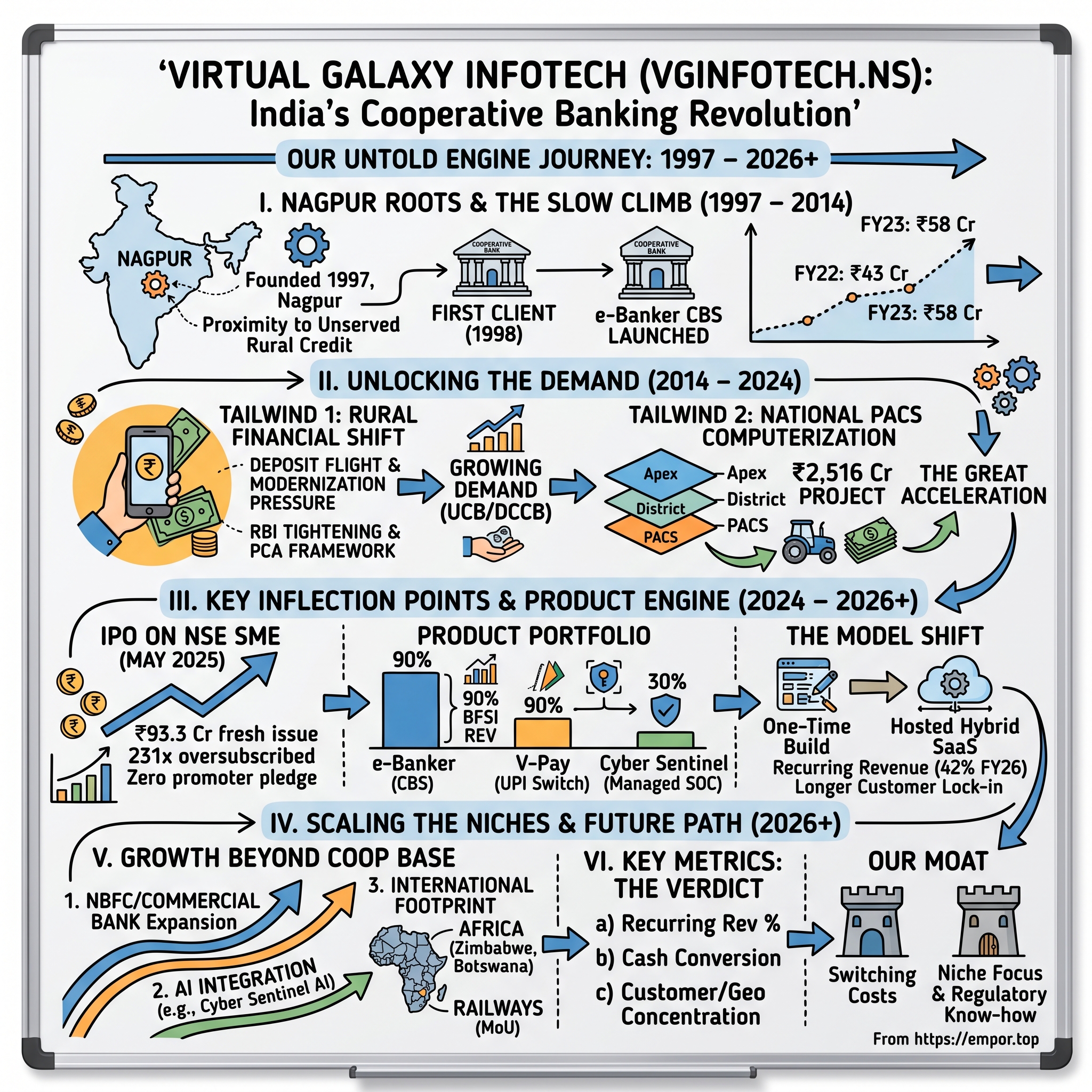
Virtual Galaxy Infotech: The Untold Engine of India's Cooperative Banking Revolution
I. Introduction & Episode Roadmap
There is a particular kind of Indian company that almost never gets written about. It does not sell to consumers. It does not appear in airport advertising. It has no celebrity founder, no venture round, no Bengaluru campus with a climbing wall. It sits in a second-tier city, sells unglamorous software to institutions most urban Indians have never heard of, and compounds quietly for a quarter of a century until, one day, a stock exchange listing forces it into public view.
Virtual Galaxy Infotech is that company. Founded in 1997 in Nagpur — the geographic centre of India, and almost the exact opposite of its technology centre — it spent twenty-seven years writing core banking software for district cooperative banks in Maharashtra while the rest of the Indian IT industry chased dollar-denominated contracts from Western financial institutions.1 Then, in May 2025, it listed on the NSE Emerge SME platform, and the numbers it had to disclose turned out to be startling.5
Consider the trajectory. Revenue was ₹43 crore in FY22 and ₹58 crore in FY23. It reached ₹61 crore in FY24, then ₹120 crore in FY25, and ₹182.1 crore in FY26 — a 52% increase in the most recent year alone.13 Profit after tax followed: roughly ₹2 crore in FY23, ₹16 crore in FY24, ₹32 crore in FY25, and ₹46.1 crore in FY26.1 EBITDA in FY26 was ₹84.2 crore, a margin of 46.2%, with net margin of 25.3%.3 Return on equity ran near 30% in the latest year and averaged around 33% over five years.1
Those are not the economics of an IT services body shop. They are the economics of a product company with pricing power in a captive niche — which is precisely how management describes itself. "We are a product-based company, we are not a service company," Chairman and CFO Avinash Shende said in a May 2026 interview. "All our products are homegrown and all IPRs are with us only."7
The niche nobody wanted
Here is the strategic joke at the centre of this story. While Tata Consultancy Services and Infosys built core banking platforms — BaNCS and Finacle — designed for banks with millions of accounts and eight-figure IT budgets, Virtual Galaxy went the other way entirely. Its customers are urban cooperative banks, district central cooperative banks, and the village-level primary agricultural credit societies that sit underneath them. These are institutions with a handful of branches, thin capital, and IT budgets measured in tens of lakhs.
That customer set is enormous in number and tiny in individual size. As of March 2025, India had 1,457 urban cooperative banks under RBI supervision, plus 351 district central cooperative banks and 34 state cooperative banks — collectively the largest category of banks in the country by count, though only about 3–4% of system deposits.8 Below them sit roughly 63,000 functional primary agricultural credit societies, the last-mile lenders that put crop loans into farmers' hands.[^8]
Serving them requires software that is cheap, light, tolerant of bad connectivity, and — critically — compliant with a regulatory regime that differs from commercial banking. It also requires a sales motion that involves sitting across a table from a cooperative bank board in a district town, not a procurement RFP in Mumbai. Virtual Galaxy's founders have argued that this is exactly where the global platforms break down. Managing Director and CTO Sachin Pande claimed in the same interview that the company has displaced Temenos in competitive situations and replaced Infosys and Wipro deployments at district cooperative banks, attributing the wins to speed of customisation rather than feature depth.7 Those are management claims, not audited facts, and this article will treat them as such — but the direction of travel is at least consistent with a client base that grew to more than 5,000 bank branches and over 200 institutions.5
The anomaly on the screen
And yet, the market has not rewarded any of this. As of July 27, 2026, the stock traded at ₹152.20, giving a market capitalisation of roughly ₹379 crore against trailing earnings per share of ₹19.20 — a price-to-earnings multiple of about 7.9.2 Over the preceding fifty-two weeks the share price had fallen about 10%, even as revenue grew by half and profit by more than 40%.23
An eight-times multiple on a business compounding at fifty percent is either a gift or a warning. Usually, in Indian small caps, it is a warning wrapped around a partial gift. The market is pricing something: perhaps the durability of the growth, perhaps the quality of the earnings, perhaps just the structural illiquidity of the SME segment where institutional money cannot easily go. Working out which of those explanations carries the most weight is the analytical spine of this episode.
Where we are going
The roadmap: first, the Nagpur origin story and the strange architecture of Indian rural credit that created the opportunity. Then the decade of regulatory and policy tailwinds — Digital India, the RBI's tightening grip on cooperative banks, and the ₹2,516 crore national project to computerise every functioning PACS in the country — that turned a slow business into a fast one.[^8] Then a look inside the product engine, because the difference between a licence sale and a recurring SaaS contract determines whether this business is worth eight times earnings or considerably more. Then the IPO, the peer set, and the competitive war-game. Then the friction: customer concentration, receivables, the lumpy shape of revenue recognition, and the questions a skeptical investor would put to management. Finally, the frameworks — Porter, Helmer — and the small number of metrics that will actually settle the argument over the next three years.
It starts, as these stories often do, with two engineers in a city nobody was watching.
 Subscribe on LinkedIn
II. Nagpur Roots & The Cooperative Banking Backdrop (1997–2014)
Nagpur in 1997 was not a technology city. It was, and largely remains, an orange-growing, coal-hauling administrative hub in the Vidarbha region of eastern Maharashtra — a place better known in the national press for agrarian distress than for software. The National Stock Exchange was five years old. Infosys had just crossed $100 million in revenue. The Y2K remediation wave that would build the Indian IT industry's first fortunes was about to break over Bengaluru, Hyderabad, and Chennai, none of which is within seven hundred kilometres of Nagpur.
Into that setting, Avinash Narayanrao Shende and Sachin Purushottam Pande incorporated Virtual Galaxy Infotech.4 Both were first-generation entrepreneurs; both would go on to accumulate more than three decades in the industry. Neither had a marquee employer's brand or a foreign degree to trade on. What they had was proximity — to a region where the formal banking system barely reached, and where credit flowed instead through a cooperative structure most software engineers had never had to think about.
The three-tier machine
To understand what Virtual Galaxy built, you have to understand the plumbing it plugged into, because Indian rural credit does not work the way retail banking works.
Picture it as three floors of a building. On the top floor sit the state cooperative banks — 34 of them — which act as apex institutions and interface with NABARD, the national agricultural refinancing body.8 On the middle floor are the district central cooperative banks, 351 of them, each serving one district, aggregating deposits and channelling refinance downward.8 On the ground floor are the primary agricultural credit societies: village-level bodies, often with a manager, a clerk, and a cupboard of ledgers, which actually hand short-term crop loans to farmers and collect repayment after harvest.[^8]
Money moves down this structure and repayments move back up it. Each layer keeps its own books. And for most of the twentieth century, and a surprising amount of the twenty-first, those books were paper.
The consequences were not abstract. When a PACS keeps loan records in a physical register, three things follow. Reconciliation with the district bank happens in arrears, sometimes by months, so nobody knows the true state of the loan book in real time. Auditing becomes an archaeological exercise. And because the society sits outside the electronic payments grid, a farmer who wants to move money must physically travel to a branch. Errors, leakage, and delayed disbursal are not aberrations in that design; they are features of it.
Building the weapon
Virtual Galaxy's first significant break came quickly. The company secured its first cooperative bank project in 1998, roughly a year after incorporation — a foothold that management has since described as the foundation for everything that followed.7 From that engagement grew e-Banker, the core banking solution that remains the company's economic engine.
It is worth being precise about what a core banking system does, because the term gets used loosely. A core banking platform is the bank's system of record: it holds every customer account, posts every debit and credit, calculates interest, runs the loan lifecycle from sanction to closure, and generates the statutory returns the regulator demands. It is, functionally, the bank's memory and its nervous system at once. Replacing it is closer to a heart transplant than to swapping an app.
Building one for a cooperative bank in Vidarbha in the early 2000s imposed constraints that a Finacle architect would find bizarre. Bandwidth was scarce and unreliable. Power supply in district branches was intermittent. Hardware budgets were minimal. The staff operating the system might have limited computer literacy and would work in a mix of English and Marathi. And the regulatory reporting requirements were those of a cooperative institution answering to both the RBI and the state registrar of cooperative societies — a different, and in some ways fiddlier, compliance surface than a commercial bank faces.
The design response was a lightweight system that could run on modest infrastructure, on-premises where the bank insisted, and later in a hosted model where it did not.6 That architectural choice — cheap to deploy, tolerant of poor connectivity, customisable at speed — became the company's positioning, and it is still how management explains its competitive wins today. Pande has framed the differentiator as "quick service and quick customisation," arguing that when a cooperative bank launches a new deposit or loan scheme, the ability to reflect it in software within days rather than quarters is worth more than architectural elegance.7
Seventeen years of not much
Here is the part that gets skipped in most retellings. From 1997 to roughly 2014, this was a small, slow business. There was no venture capital. There was no scaling playbook. The company survived on custom software development, IT consulting, and an enterprise resource planning product, IBS-ERP, sold to small and mid-sized manufacturers in sugar, textiles, fertiliser, and education.4 Revenue was measured in single-digit and low double-digit crores. Cash was tight.
What that period bought was not growth but trust — and in cooperative banking, trust is the distribution channel. Cooperative bank boards are elected, politically connected, and highly networked within a state. A vendor that has run a district bank's core system without a catastrophic failure for a decade acquires a reference that no marketing budget can buy. The Buldana District Central Co-operative Bank, for instance, has been a Virtual Galaxy client since 2014, and in July 2026 it bought an entirely different product — a managed cybersecurity service — from the same vendor.9 That is what a twelve-year relationship converts into.
The strategic reading is straightforward, if uncomfortable for anyone who prizes speed. Virtual Galaxy did not build a moat by out-innovating anyone. It built one by being present, cheap, and non-catastrophic in a market so unattractive that no well-capitalised competitor bothered to contest it for seventeen years. That is a real advantage, but it is a slow advantage, and on its own it would have produced a nice ₹60 crore business and nothing more.
What changed the trajectory was not the company. It was the state.
III. The Great Tailwinds: Regulatory Mandates & The PACS Wave (2014–2024)
In 2014, an Indian citizen without a bank account was unremarkable. By 2024, that citizen was a statistical outlier. The intervening decade compressed roughly half a century of financial-infrastructure development into ten years, and it did so through a stack of state-built systems: universal biometric identity, a mass account-opening drive, and a real-time payments rail that made moving money as cheap as sending a text.
For a cooperative bank in a district town, this was not a technology story. It was an existential one.
The deposit-flight problem
Think about it from the perspective of a farmer in Yavatmal in 2018. For decades, the local cooperative bank had a captive customer: it was physically there, it understood crop cycles, and the alternatives were far away. Then the same farmer's son opened an account with a private bank on his phone, moved money instantly to anyone in the country, paid the electricity bill without queueing, and received government transfers directly.
If the cooperative bank could not offer the same, deposits would leave — not in a dramatic run, but in the slow, generational bleed that kills institutions quietly. Every cooperative bank board in India worked this out at roughly the same time. The choice was to modernise or to shrink.
This is the demand-side engine underneath Virtual Galaxy's growth, and it is worth stating plainly because it explains why the company's revenue inflected without any obvious change in strategy. The customer base did not expand. The customer base's willingness to pay expanded, because the alternative to spending became losing the franchise.
The regulator applies pressure
The second force was supervisory rather than competitive. The RBI, which had allowed the cooperative sector to sprawl for decades, spent the post-2004 period consolidating it — refusing new licences, merging weak banks into stronger ones, and steadily raising the compliance bar. The count of urban cooperative banks fell from roughly 1,926 in 2004 to 1,457 by March 2025.8 In December 2022 the RBI formalised a four-tier regulatory classification based on deposit size, and from April 1, 2025 it extended its Prompt Corrective Action framework — the supervisory regime that constrains weak banks' operations — to urban cooperative banks.8
Every one of those measures has a software implication. A four-tier framework means different reporting obligations by tier, and a bank that grows across a threshold must upgrade its systems. A PCA framework means the regulator is watching capital, asset quality, and leverage on a continuous basis, which requires the bank to actually be able to produce those numbers on demand. Tightening supervision is, for a core banking vendor, indistinguishable from demand creation.
There is a nuance here that cuts against the simplest bull case, and it deserves attention. By some industry estimates, core banking penetration among urban cooperative banks already exceeds 90%.8 If that is right, the greenfield opportunity in UCB core banking is largely gone; the available business is displacement of incumbent vendors, upgrade cycles, and the sale of adjacent modules — loan origination, loan management, CRM, analytics, cybersecurity — where penetration remains low.8 That reframes the growth story. It is less "computerising the unbanked" and more "selling the second, third, and fourth product into an installed base." Both can work. They have different economics and different competitive dynamics.
The ₹2,516 crore project
The third force was the largest and the most specific. On June 29, 2022, the Cabinet Committee on Economic Affairs approved a centrally sponsored project to computerise about 63,000 functional primary agricultural credit societies over five years, with a total outlay of ₹2,516 crore — ₹1,528 crore from the central government, ₹736 crore from the states, and ₹252 crore from NABARD.[^8] The design was to bring every PACS onto a common ERP-based platform and link it upward through the district and state cooperative banks to NABARD, touching an estimated 13 crore farmers.[^8]
This is the single largest digitisation programme ever aimed at the bottom floor of Indian rural credit, and it is the reason the phrase "PACS computerisation" appears in every bullish note written about this sector.
But the details matter more than the headline number, and this is where a neutral reading diverges from the promotional one. The project's architecture is a common national ERP — a standardised platform, not 63,000 bespoke deployments. That design deliberately reduces the vendor's ability to differentiate at the society level. The economics that flow to any individual software company depend on which states award which work packages, how implementation and hardware are bundled, and who ends up holding the multi-year support contract once the rollout is done.
Here an honest gap has to be flagged. Virtual Galaxy is frequently described in market commentary as a PACS computerisation beneficiary, and its client footprint spans multiple states. But in the company's own public announcements that this analysis could verify, the named, quantified order wins are not state-wide PACS packages. They are core banking and adjacent contracts with individual cooperative institutions: a ₹19.78 crore, seven-year hybrid SaaS core banking order from the Osmanabad District Central Co-operative Bank announced on July 2, 2025 — itself a renewal of an existing relationship;10 a ₹5.30 crore, five-year UPI 2.0 switch mandate from the Mizoram Cooperative Apex Bank;[^12] and the Buldana cybersecurity order already mentioned.9 State-wise PACS award details are not disclosed in the company's public filings reviewed here.
That distinction is analytically important. If the growth is being driven by DCCB and UCB contracts rather than by the national PACS programme, then the "PACS cliff" risk that bears cite may be overstated — but so is the "63,000 societies" total addressable market that bulls cite. Investors should want management to disaggregate this, and it is a fair question for any earnings call.
The model shift
The final development of this decade was commercial rather than political. Virtual Galaxy moved from selling software as a one-time build to selling it as a bundled, multi-year, hosted arrangement — the "hybrid SaaS" language that now appears in every order announcement.10 The Osmanabad contract illustrates the shape: supply, installation, commissioning and management of the core banking solution including the data centre, disaster recovery site, networking and connectivity, with services running seven years from go-live.10
The strategic consequence is that a single win now carries a long tail of recurring revenue, and the bank's dependency deepens because the vendor is running the infrastructure, not just licensing the code. In FY26, recurring revenue reached ₹76.7 crore, or 42% of the total.3 That number is the most important single disclosure in the company's results, and we will return to it, because the gap between 42% and 100% is precisely the gap between a project business and a subscription business — and the market is currently valuing it much closer to the former.
IV. Inside the Product Engine: e-Banker, V-Pay, and Specialized SaaS
Walk into a district cooperative bank branch in Maharashtra and you will not see Virtual Galaxy's name anywhere. You will see a teller at a terminal, a passbook printer, and a queue. The software is invisible, which is exactly the point. Infrastructure businesses are legible only when they fail.
But the composition of what sits behind that terminal determines almost everything about the investment case, so it is worth taking the product portfolio apart piece by piece — and, more usefully, ranking it by how much of the profit pool each piece actually represents.
e-Banker: where the money is
The concentration is extreme. At the time of the IPO, e-Banker accounted for 78.58% of revenue in FY24, up from 68.50% in FY23 and 64.54% in FY22.4 Segment-wise, BFSI represented 93.19% of FY24 revenue and remained around 90% in FY26, with ERP at 9.31% and e-governance at 0.59%.43 Whatever else the company sells, this is a core banking company with side projects.
What does e-Banker actually do? Strip away the jargon and it is a general ledger with a regulatory compliance layer and a loan engine bolted on. It records every account and every transaction; it applies interest rules that in cooperative banking can be genuinely baroque, varying by scheme, member category, crop cycle, and state subsidy; it manages the loan from application to closure; it produces the returns the RBI and NABARD require; and it handles asset-liability management and fraud risk monitoring.6
The customer lock-in is not a marketing claim, it is arithmetic. Migrating a core banking system means moving years of historical ledger data, re-encoding every product rule, re-validating every regulatory report, and retraining every branch employee — all without a single day of downtime, because a bank cannot stop taking deposits while its IT is being replaced. For a bank with thin technical staff and a board of elected directors, the risk-adjusted case for switching is close to unarguable. You do it when the incumbent fails, when the regulator forces you, or when you are merged into someone else's system. You do not do it to save fifteen percent.
That is the mechanism that produces 46% EBITDA margins and near-30% returns on equity. Once implementation is complete, the annual maintenance and hosting revenue arrives with very little incremental cost, and the code is amortised across an installed base that now spans over 5,000 branches.5
The proof point worth watching is new deployment velocity, not installed base. In FY26 the company added 97 new branches to the e-Banker platform, which it described as the highest annual addition in its history.3 That is a genuine operating metric rather than a revenue restatement, and it says the land-grab phase is still running — though 97 branches against a base above 5,000 is roughly 2% expansion, which suggests that most of FY26's 52% revenue growth came from something other than new core banking seats. Higher realisation per client, bundled infrastructure, and adjacent products are the likelier explanations, and management has not disaggregated it publicly.
V-Pay: the bridge to the payments grid
If e-Banker is the bank's memory, V-Pay is its connection to the outside world. It is the company's enterprise digital payments product, covering UPI, point-of-sale acceptance and mobile payment flows.4
The strategic logic is straightforward. A cooperative bank that cannot offer UPI is not a competitive bank in 2026, but building a payments switch — the system that routes and settles transactions with the national infrastructure — is far beyond the technical capacity of an institution with a dozen branches. Virtual Galaxy sells that capability as a service, and it captures the bank as a payments customer as well as a core banking customer.
The Mizoram Cooperative Apex Bank order shows the commercial shape: a ₹5.30 crore purchase order for implementation of a UPI 2.0 switch, running five years.[^12] What is notable is the geography. Mizoram is about as far from Nagpur as it is possible to get within India, which is a small data point against the "Maharashtra-only" characterisation of this business, and a reminder that apex-level cooperative institutions in smaller states are a distinct customer class from district banks.
The same platform has become the company's export product. In June 2026 it announced a USD 550,000 mobile wallet and QR payment order in Zimbabwe, covering wallet services, merchant QR acceptance, fund transfers, bill payments, customer onboarding and integration with existing banking infrastructure.11 Chairman Shende framed Africa as showing "strong demand for digital banking, mobile payments, and financial inclusion solutions," while Pande emphasised interoperability and scalability in the platform's design.11
An analytical caution is appropriate here. Payments is a business where volume economics eventually dominate, and Virtual Galaxy currently sells payments infrastructure to banks on contract value rather than earning meaningful per-transaction economics at scale. That is a lower-risk, lower-ceiling model than a pure transaction processor. It protects the core relationship; it is not yet evidence of a second growth engine.
The long tail: e-governance, ERP, and now cybersecurity
Beneath the two main products sits a scatter of smaller offerings that are best understood as door-openers rather than profit centres.
e-APMC digitises Agricultural Produce Market Committees — the regulated mandis where farmers sell produce at auction — bringing transparency to price discovery and settlement.6 E-Autopsy is forensic laboratory software for public hospitals.6 IBS-ERP serves small and mid-sized manufacturers.4 The company also lists V-SOC, and management has referenced Audit Flux, FinFlow, and a conversational AI product called Virtual Vani.47
The e-governance segment contributed 0.59% of FY26 revenue.3 That is a rounding error, and it should be read as such: these products are not moving the financial needle. Their function is relationship-building with state government departments and boards — the company counts the Maharashtra Labour Welfare Board and the State Agricultural Marketing Board among its clients — which can later support larger enterprise sales.4 Whether that cross-sell actually materialises is unproven; five years of segment data at sub-1% would suggest it has not yet.
One adjacent product does look more material. Cyber Sentinel, an AI-assisted security operations centre offered as a managed service covering SIEM, SOAR, user behaviour analytics, threat intelligence and 24x7 monitoring, won a TECHNOVITI 2026 award from Banking Frontiers on July 9, 2026.12 More persuasively than any award, it converted into a paying contract: the ₹1.53 crore, five-year managed cybersecurity order from Buldana DCCB in July 2026.9
This is the cross-sell thesis working in miniature, and it matters more than the ticket size suggests. Cooperative banks face rising cyber-supervision pressure and have essentially no in-house security capability. A vendor already running their core system and their data centre is the natural place to buy it from. If Virtual Galaxy can attach a security subscription to even a modest fraction of its 5,000-branch base, it adds recurring revenue with almost no new customer acquisition cost. That is the single clearest path from a 42% recurring-revenue mix toward something structurally higher — and it is worth more scrutiny than the international headlines that generate more press.
V. The SME IPO & Competitive Benchmarking
By late 2024, the company that had spent twenty-seven years avoiding the spotlight decided to walk into it. On September 12, 2024, Virtual Galaxy Infotech converted from a private limited company to a public limited entity — the procedural step that precedes any listing.7 Eight months later, it went to market.
The offer
The IPO was a pure fresh issue: 65,70,000 equity shares of ₹10 face value, priced in a band of ₹135 to ₹142, raising ₹93.29 crore at the upper end, with no offer-for-sale component.4 That last detail is worth pausing on. In a market where SME promoters routinely use listings to sell down, Shende and Pande took nothing off the table. Every rupee raised went into the company.
The book opened on May 9, 2025 and closed on May 14. Demand was extraordinary even by the standards of a frothy SME market: 231.45 times overall subscription, with non-institutional investors at 590.27 times, qualified institutional buyers at 129.72 times, and retail at 134.03 times.5 Allotment was finalised on May 15, and the shares listed on the NSE SME platform on May 19, 2025 at ₹180 — a 26.76% premium to the issue price.5
And yet the listing was, in the market's own terms, a disappointment. The grey market premium ahead of listing had been around ₹110, implying an expected opening near ₹252.5 Investors who had bid on that expectation got roughly half of it. That gap between grey-market euphoria and actual price discovery is a useful early signal: the marginal buyer at listing was less convinced than the marginal speculator before it.
Where the money went
The stated objects of the issue were specific and, notably, mostly growth-oriented rather than balance-sheet repair: capital expenditure for an additional development facility in Nagpur — an integrated technology campus at the MIHAN special economic zone; repayment or prepayment of certain borrowings; investment in GPUs, servers and storage for the company's data centre; funding product enhancement and maintenance through manpower hiring; business development and marketing; and general corporate purposes.4
Two of those items deserve comment. The GPU and data centre investment is consistent with the hosted delivery model — if you are going to run banks' core systems and disaster recovery sites yourself, you need infrastructure, and that is a capital cost the customer no longer bears. The MIHAN campus, paired with a stated intention to expand the workforce by more than 1,000 professionals within two years, is a bet on scale that has so far been only partially executed: headcount stood at 340 in March 2025, reached 468 by the June 2026 quarter, and management referenced "over 500 technology professionals" in July 2026.152312 Roughly 160 net additions in fifteen months against a 1,000-person ambition is a meaningful gap between statement and delivery, and it is the kind of target-versus-outcome comparison that tells you how to weight future management guidance.
The debt repayment line addressed real leverage. At the time of the offer, outstanding financial indebtedness was ₹35.47 crore, alongside contingent liabilities of ₹50.83 crore relating to tax and guarantee matters.6 Contingent liabilities of that size against a company then earning ₹32 crore a year are not trivial, and their subsequent resolution is a legitimate item for continuing diligence.
The peer war-game
The most revealing way to value this company is to line it up against the handful of listed Indian companies selling software into the same general space, because the dispersion of multiples is enormous and the reasons for it are instructive.
Trust Fintech is the closest comparable — and, curiously, also headquartered in Nagpur. It sells TrustBankCBS for medium and large financial institutions and MicroFinS, a cloud product for smaller cooperative societies, SACCOs, and microfinance institutions. In FY26 it reported sales of ₹41.78 crore and net profit of ₹8.22 crore, with operating margin of 23.72% — down sharply from 50.99% in FY24.13 Its market capitalisation was around ₹69 crore at a P/E of about 8.4, with return on equity of 7.21%.13
Set that against Virtual Galaxy and two things jump out. First, the multiples are almost identical — roughly eight times earnings for both — which tells you the market is applying a sector-and-format discount rather than a company-specific one. Second, the operating performance is not identical at all: Trust Fintech's margins halved over two years while Virtual Galaxy's held above 46%, and Trust Fintech's debtor days stood at 185.7 with working capital days at 490 as of March 2026, against Virtual Galaxy's 64.5 debtor days and 36 working capital days.131 On the evidence of the last two years, Virtual Galaxy has been the materially better-run business of the two, and the market is not distinguishing between them.
Network People Services Technologies occupies the other extreme. A UPI-focused technology service provider and payments-platform-as-a-service company, it reported FY26 sales of ₹194 crore — similar in scale to Virtual Galaxy — but net profit of ₹41 crore, slightly below the previous year's ₹45 crore.14 Its market capitalisation was roughly ₹3,255 crore at a P/E near 79.14 So the market pays about ten times the earnings multiple for a company with comparable revenue, lower and declining profit, return on equity of 15.1%, working capital days that swung from negative 32 to 143, and a promoter stake that fell from 67.55% in March 2024 to 60.48% by June 2026.14
That comparison is the single most uncomfortable fact in this entire analysis, and it cuts both ways. The bull reading is that the market is mispricing Virtual Galaxy by an order of magnitude. The bear reading is that the market is paying for transaction-volume-linked revenue with theoretically unlimited scaling, and refusing to pay for contract-linked revenue with an execution requirement attached to every rupee. Both readings can be partially true.
Veefin Solutions, in supply chain finance SaaS, sits between them: FY26 sales of ₹345 crore and net profit of ₹32 crore — almost exactly Virtual Galaxy's profit on nearly double the revenue — at a market capitalisation around ₹767 crore and a P/E of about 34, with return on equity of 4.35% and 72.1% of the promoter holding pledged.16 Half the profitability, four times the multiple, and a governance flag that Virtual Galaxy does not carry.
Why the giants stay away
The final competitive question is the one that determines whether any of this is durable: why do TCS and Infosys not simply take this market?
The answer is economic, not technical. Finacle and BaNCS are engineered for institutions where a core banking implementation is a multi-crore, multi-year programme with a dedicated bank IT department on the other side. The cost of a single enterprise sales cycle at those firms likely exceeds the lifetime contract value of a typical district cooperative bank. Serving 1,457 urban cooperative banks and 351 district banks profitably requires a low-cost delivery organisation, extreme deployment standardisation, tolerance for small ticket sizes, and a relationship network built over decades in state cooperative circles. A global vendor could build that. It has no rational reason to.
That is a real structural insulation. It is also, precisely, a ceiling: the same characteristics that keep competitors out keep the addressable market small. Virtual Galaxy is safe in its pond largely because the pond is not worth draining. Growth beyond it — into NBFCs, into commercial banks, into Africa — means leaving the insulation behind, which is exactly what management now proposes to do.
VI. Current Management & Shareholding Architecture
Twenty-nine years after they incorporated the company, the same two people run it. That is unusual enough in Indian small caps to be worth examining rather than merely noting.
Avinash Narayanrao Shende serves as Chairman, Executive Director and Chief Financial Officer. Sachin Purushottam Pande serves as Managing Director and Chief Technology Officer.7 The division of labour has been consistent: Shende handles capital, compliance and the external face of the company — he is the one quoted in the results releases and the international contract announcements — while Pande owns the technology and delivery organisation.311
Reading them through their own words
The most useful window into how these two think is a long-form interview they gave in May 2026, because it reveals both conviction and blind spots.
Shende's framing is relentlessly product-centric: homegrown IP, ownership of all intellectual property, and now an initiative to integrate AI functionality "to each and every product."7 That last phrase deserves the standard skeptical treatment applied to any 2026 management team announcing AI everywhere. The concrete evidence so far is one shipped and awarded product — Cyber Sentinel — and one paying customer for it.129 Everything else is roadmap.
Pande's answers are more operational and, in places, more combative. He describes the company competing with and beating Temenos, and replacing Infosys and Wipro installations at district cooperative banks, attributing this to responsiveness rather than capability parity: larger competitors, in his telling, "lack" the ability to adapt quickly to customer-specific requirements.7 He also gave a rare piece of organisational disclosure — roughly 400-plus employees at the time, with about half in product engineering and the rest in implementation, testing and support.7
That split is more informative than it looks. A fifty-fifty product-to-services headcount ratio is not a software company's ratio; it is a hybrid. Pure product businesses run far leaner on delivery. The implication is that revenue growth still requires headcount growth in the implementation organisation, which caps operating leverage and explains why margins, though excellent, have been roughly flat at 46% rather than expanding as revenue doubled.1
Ownership and alignment
The promoter group held 65.00% of equity as of June 2026, with public shareholders at 32.71%, domestic institutions at 1.18%, and foreign institutions at 1.12%.1 The two founders hold the promoter stake in near-equal proportions.17 In a filing dated April 3, 2026 under SEBI's takeover regulations, Shende declared that no encumbrance — direct or indirect — was created or invoked on promoter group shares during FY26.18
Zero pledging is a genuinely meaningful data point in the Indian SME context, and it reads better still next to the peer set: Veefin's promoters had pledged 72.1% of their holding, and NPST's promoter stake declined by seven percentage points in three years.1614 Virtual Galaxy's founders neither sold at IPO nor borrowed against their stock afterward. Whatever else one concludes, their economic exposure to being wrong is undiluted.
The company also reported full compliance with SEBI's insider trading regulations for FY26, with all ten required unpublished price sensitive information events captured in its structured digital database.19 Routine, but for a company fourteen months into public life, routine is the right answer.
The Nagpur cost position
The location that once looked like a handicap is now a structural advantage. Engineering salaries, real estate, and attrition in Nagpur run materially below Bengaluru, Pune, or Mumbai levels — the company's own management discussion identifies talent acquisition in a tier-two city as a risk while simultaneously building a campus there.15 The precise cost differential is not disclosed, and this analysis will not invent one, but the effect is visible in the financials: a company generating ₹182 crore of revenue with roughly 500 people and 46% EBITDA margins is running a cost structure that a metro-based competitor would struggle to match.312
The offsetting risk is equally real. As the company pushes into cybersecurity, AI, and international delivery, the specialist talent it needs becomes scarcer and less willing to relocate to Vidarbha. Cost arbitrage works best for well-understood engineering work. It works worst at the frontier.
Capital allocation, so far
The record is short but coherent. Earnings have gone into software development, infrastructure, and headcount rather than acquisitions or unrelated diversification. Return on capital employed of 33.7% and return on equity near 30% indicate that reinvestment has been productive rather than merely large.1 The company also initiated a dividend, with a yield of about 0.66% at the current price — small, but a signal that management is not hoarding cash indefinitely.1
The test that has not yet been run is what happens when growth requires something other than organic reinvestment. There has been no acquisition, no equity raise since the IPO, and no capital structure event to judge. Investors should hold that judgement open rather than score it prematurely.
VII. The Friction Points: The Working Capital Trap & Risk Radar
Now to the uncomfortable part. A company growing revenue at 52% with 46% EBITDA margins, near-30% returns on equity, no promoter pledging, and a doubling order book trades at under eight times earnings and has fallen about 10% over the past year.21 Markets are not efficient, particularly in SME segments, but they are rarely stupid for no reason at all. So what is the reason?
There are at least five candidate explanations, and they are not mutually exclusive.
One: the revenue is lumpy in a way that invites questions
Start with an arithmetic observation that the company has not, in the materials reviewed here, publicly explained.
FY25 revenue was ₹120.14 crore.3 Q4 FY25 revenue was ₹18.9 crore.20 That means roughly ₹101 crore — about 84% of the full year — was recognised in the first nine months, the period ending December 2024, which is also the period whose accounts anchored the IPO prospectus. The fourth quarter, immediately following, was the weakest of the year by a wide margin.
Then in FY26 the shape reversed: first-half revenue of ₹86.13 crore, Q3 of ₹41.26 crore, and Q4 of ₹54.66 crore.3 The 189% year-on-year growth in Q4 FY26 that headlined the results release is therefore substantially a function of how depressed the comparable quarter was, not purely underlying acceleration.20
None of this is evidence of impropriety, and it should not be read as such. Project-based enterprise software with milestone-linked recognition is genuinely lumpy, and a company that has just completed several large implementations can plausibly show exactly this pattern. But an investor is entitled to ask why the pre-IPO nine months were so heavily loaded and the quarter after so light, and to want that explained on the record. Until it is, some portion of the valuation discount is rationally attributable to earnings-quality uncertainty.
Two: the receivables story is improving but was not always good
Cash conversion is the classic failure mode for vendors selling into government-linked and cooperative institutions, because those buyers pay slowly and their payment cycles are political as much as commercial.
The company's own trajectory shows the problem and the correction. Debtor days stood at 93.6 in the prior year and improved to 64.5 by FY26, with working capital days at 36 and a cash conversion cycle of 17 days.1 Those are respectable numbers for this customer base — and they look outstanding next to Trust Fintech's 185.7 debtor days and 490 working capital days, which is what the failure mode actually looks like when it bites.13
But the improvement is recent, and the risk has not gone away; it has been managed. As the company shifts toward hosted, multi-year contracts with data centre and disaster recovery obligations bundled in, it is taking more of the infrastructure cost onto its own balance sheet upfront and recovering it over the contract term. That is a working capital-hungry model even when customers pay on time. The Osmanabad contract's seven-year service period following go-live is a case in point: the cost is front-loaded, the revenue is not.10
Three: concentration is severe on three separate axes
The IPO disclosures were blunt about this, and the concentration is threefold.
By customer: the top ten customers accounted for 81.14% of revenue as of December 2024.6 By sector: BFSI represented 93.19% of FY24 revenue, still around 90% in FY26.43 By geography: Maharashtra contributed 89.42% of revenue for the period ended December 2024, having been 82.37% in FY24, 73.25% in FY23 and 87.76% in FY22.46
Read those together and a single state's cooperative banking sector — subject to state political cycles, cooperative department policy, and RBI merger activity that has historically concentrated in Maharashtra — drives the large majority of this company's revenue. FY26 disclosure showed domestic revenue at 93.6% and exports at 6.44%, but the company has not published a comparable state-level split for FY26, so the current geographic concentration cannot be verified from public materials.3
The mitigation is visible in the order flow. Mizoram, Botswana, Zimbabwe, and a two-year memorandum of understanding with Konkan Railway covering ERP, AI, cybersecurity and digital payments all point away from the Maharashtra core.[^12]119 Management has stated a target of raising international revenue from about 6% to 20–25%.3 Whether that target is achieved is one of the few genuinely falsifiable claims on the table.
Four: the growth targets are aggressive and the track record is short
Management has guided to a 40%-plus revenue CAGR over three years, targeting ₹500 crore of revenue by FY29 while holding PAT margin near 25%, with growth to come from NBFC expansion, cybersecurity, and AI-led products.3 For FY27 specifically, it reiterated 40–50% revenue growth after the June 2026 quarter, in which revenue rose 60% to ₹40.4 crore and the order book doubled year-on-year to ₹145.5 crore.23
The order book gives that guidance some grounding. Unexecuted orders stood at ₹111.6 crore at the end of FY26, up 150%, against a stated active bid pipeline of about ₹1,000 crore.3 But a bid pipeline is not backlog — it is the sum of everything the company has bid on, at whatever win rate — and the company does not disclose its conversion rate. A ₹1,000 crore pipeline figure should be treated as a marketing disclosure until a conversion history exists.
More to the point, the company has only two full years of public reporting. There is not yet enough history to assess whether this management team sets targets it beats, matches, or misses. The one multi-year commitment that can be partially scored — hiring 1,000-plus professionals within two years — is running well behind pace.1512 That single data point argues for discounting stated ambitions somewhat, though it is far from damning.
Five: the SME platform itself
The final explanation may be the most powerful and the least company-specific. NSE Emerge is a segment where institutional participation is structurally constrained, lot sizes are large, free float is limited, and index inclusion does not occur. With domestic and foreign institutions holding a combined 2.3% of the equity, there is essentially no professional buy-side price discovery happening in this stock.1 Multiples in such segments can persist far away from fundamental value in either direction, for years, without any resolution mechanism.
That mechanism, if it comes, is migration to the main board — an event with specific eligibility conditions and no announced timeline here.
The activist's questions
If a skeptical concentrated investor sat across from Shende and Pande, the agenda would write itself. Why was FY25 revenue so heavily weighted to the pre-IPO nine months? What is the historical bid-to-win conversion on that ₹1,000 crore pipeline? What proportion of the ₹111.6 crore order book is committed recurring revenue versus one-time implementation? What has happened to the ₹50.83 crore of contingent liabilities disclosed at IPO? What is the state-wise revenue split today? And why, with 46% EBITDA margins and ₹46 crore of annual profit, has the company not accelerated the return of capital or set out a clearer plan for main-board migration?
Management held an earnings call on June 3, 2026 to discuss the FY26 results, with both founders participating.21 Investors who want to test the durability of this business should read the Q&A on that call and the ones that follow it far more closely than the press releases — the prepared remarks in the FY26 release emphasised AI, order books and international wins, while the questions that matter are about cash conversion, revenue mix, and concentration.
VIII. Playbook: Key Lessons for Investors & Founders
Step back from the numbers and there is a set of transferable lessons here — some about this company, most about the category of company it represents.
The moat, assessed honestly
Applying Hamilton Helmer's 7 Powers framework — which asks not "is this a good business?" but "what specific, persistent condition prevents competitors from arbitraging away the returns?" — Virtual Galaxy scores clearly on two of the seven, weakly on one, and not at all on the rest.
Switching costs are the anchor, and they are as strong here as anywhere in enterprise software. This has already been laid out mechanically: the migration risk for a small bank with limited technical staff is asymmetric, and the vendor now runs the data centre and disaster recovery site as well as the application.10 The observable evidence supports it — a client relationship dating to 2014 that expanded into a new product category in 2026, and a large core banking order that was itself a renewal.910 Renewals and cross-sells into a twelve-year-old account are what switching-cost power looks like in the wild.
Scale economies operate, but in a narrow and specific form. The fixed cost of building NABARD-compliant, cooperative-specific banking software — including the regulatory reporting logic that changes whenever the RBI issues a circular — is amortised across a base above 5,000 branches.5 A new entrant would have to fund that development against a much smaller initial base. This is a genuine barrier, and it is why the competitive set in this niche is measured in single digits.
Cornered resource is arguable but weak. The decades-long relationship network within Maharashtra's cooperative banking establishment functions somewhat like a cornered resource: it cannot be bought and takes a very long time to build. But it is not contractually protected, it does not travel to Mizoram or Botswana, and it depends on two individuals.
The other four powers — network economies, counter-positioning, branding, and process power — are essentially absent. There is no network effect between cooperative banks using the same software. There is no business model that incumbents cannot copy; the giants simply choose not to. There is no brand premium in a procurement-driven sale. And there is no evidence of a proprietary process advantage beyond ordinary execution quality.
Two solid powers is enough for a durable niche business. It is not enough to justify assuming the returns persist automatically as the company moves outside the niche.
The fortune at the bottom of the IT pyramid
The broader strategic lesson is one that applies well beyond this company: the most defensible position in enterprise technology is often the one that is too small, too regulated, and too unfashionable for anyone with capital to want.
Every structural feature that made cooperative banking software unattractive — tiny deal sizes, fragmented buyers, byzantine local compliance, price sensitivity, geographic dispersion, relationship-driven sales — is the same feature that kept better-funded competitors out for twenty-seven years. The unattractiveness was the moat. Founders who instinctively chase large, growing, obviously attractive markets should note that those markets attract capital, capital attracts competition, and competition destroys the returns that made the market look attractive.
The corollary is a warning. Businesses built on unattractiveness do not scale gracefully into attractive markets. When Virtual Galaxy sells to NBFCs, or to commercial banks, or to African financial institutions, it meets competitors who chose those markets deliberately and have been competing there for years.
The twenty-seven-year overnight success
The timeline deserves emphasis: incorporated 1997, first cooperative bank client 1998, and roughly ₹60 crore of annual revenue by FY24 — a compound growth rate over that stretch that would embarrass most venture-backed startups.17 Then revenue tripled in two years.
The pattern is characteristic of regulated infrastructure software. Value accrues in step functions, triggered by external events — a regulatory mandate, a policy programme, a competitive threat to the customer base — that arrive on the state's timetable, not the company's. What the founders controlled during the slow period was survival, product quality, and the accumulation of references. What they did not control was when the tailwind arrived.
For investors, the practical implication is about identification rather than patience: the interesting moment in these businesses is not the twenty-seven years of waiting, but the two or three years immediately after the external catalyst lands, when the installed base and the credibility are already built and the spending has just begun.
The SME discount, understood properly
The last lesson is about market structure. The eight-times multiple on this stock is not primarily an assessment of business quality; it is substantially an artefact of where the stock is listed. The absence of institutional participation, index inclusion, and analyst coverage means the price is set by retail flows and sentiment rather than by fundamental valuation.
That creates opportunity and trap in equal measure. The opportunity is obvious. The trap is that a discount driven by market structure can persist indefinitely, because nothing forces it to close. An investor buying an SME-listed company at eight times earnings on the expectation of a re-rating is making two bets: one on the business, and one on a liquidity event that may never occur. Those should be underwritten separately.
IX. Analysis & Bull vs Bear Case
The bull case
The bull case rests on a specific claim: that Virtual Galaxy is in the early innings of converting a project business into a subscription business, inside an installed base it already owns.
The evidence for the conversion is real but partial. Recurring revenue reached ₹76.7 crore in FY26, 42% of the total.3 Contracts are being written with five- and seven-year service tails rather than as one-time implementations.10[^12] The cybersecurity attach is demonstrably working at at least one long-standing account.9 If the recurring proportion moves from 42% toward 60% or above while absolute revenue grows, the business changes character — earnings become predictable, the working capital drag falls, and the current multiple becomes very difficult to defend.
The second bull leg is international. The company earned about 6.4% of FY26 revenue from exports and has targeted 20–25%.3 The signed contracts give the ambition substance rather than mere direction: a USD 1,099,000 software development agreement with the Botswana Development Corporation announced on April 17, 2026, running 48 months and covering design, implementation, licensing, maintenance, integration, testing, training and disaster recovery;22 and the Zimbabwe payments order.11 Management has also referenced existing clients in Tanzania and Malawi and World Bank-funded projects won through competitive bidding.7
The logic is sound. Savings and credit cooperative organisations across East and Southern Africa are structurally similar to Indian cooperative banks: small, member-owned, under-served by global core banking vendors, and operating in low-bandwidth environments. Software built for Vidarbha may genuinely be better suited to Malawi than software built for Zurich. But the current international revenue base is small, the contracts are individually modest, and the operational complexity of supporting African deployments from Nagpur is unproven at scale.
The third leg is a re-rating on migration from NSE Emerge to the main board, which would open the stock to mutual funds and index-linked flows. No timeline has been announced. This is optionality, not a plan.
The bear case
The bear case has three distinct legs, and they are not equally strong.
The weakest is the "PACS cliff" — the concern that national digitisation programmes complete and implementation revenue collapses. It is weaker than it first appears, precisely because the company's verifiable order wins are DCCB and UCB contracts rather than state PACS packages, and because those contracts carry multi-year service tails. The company is less exposed to the programme's completion than the popular narrative assumes — but by the same token, it is less exposed to its upside.
The strongest bear leg is the combination of concentration and cash conversion. A business with 81% of revenue from ten customers, ~90% from one sector, and historically ~89% from one state is a business where a single adverse political or regulatory event in Maharashtra's cooperative sector could remove a large fraction of revenue in a single year.64 Layer onto that a shift toward capital-intensive hosted contracts, and a scenario where a state-linked customer delays payment for two quarters while the company continues funding data centre commitments is entirely plausible. Debtor days have improved, but they improved from a level that was already problematic.1
The third leg is competitive and technological. Trust Fintech's margin collapse from 51% to 24% over two years is a live demonstration that pricing in this niche is not permanently protected.13 And on the technology side, the AI narrative that management now attaches to every product cuts both ways: the same tools that let Virtual Galaxy build faster also lower the cost for a well-funded new entrant to build a modern, cloud-native core banking platform for small institutions. Switching costs protect the installed base. They do not protect the next contract.
Porter's five forces
Rivalry is moderate and asymmetric. Few direct competitors, but the nearest listed peer is discounting hard enough to have halved its own margins.
Buyer power is the most underrated force here. Individually, a cooperative bank has almost none — it cannot credibly threaten to switch. Collectively, however, buyers are politically organised, price-sensitive, and increasingly purchase through state-level and centrally-designed programmes that standardise specifications and commoditise vendors. The national PACS common-ERP architecture is exactly this dynamic in action.[^8] Buyer power in this market is migrating from the individual bank to the state.
Supplier power is low. The main inputs are engineers and cloud or data centre capacity, both available; the Nagpur cost position helps on the first.
Threat of substitutes is low near-term. There is no alternative to having a core banking system, and the substitute for a small bank is not different software but merger into a larger institution — which the RBI's consolidation drive is actively producing.8 Every merger removes a potential customer, which is a slow structural headwind on the domestic base.
Threat of new entrants is low in the traditional niche and rising at the edges. Nobody will replicate twenty-seven years of Maharashtra cooperative relationships. Anyone can build a cybersecurity or payments product and sell it into Indian financial institutions, which is where the company's growth is increasingly coming from.
The synthesis: the fortress is real but its walls face inward. The protected part of the business is the mature part; the growing part is the exposed part.
The three KPIs that will settle this
Everything above reduces to a small number of observable metrics. Three matter, and readers should track them directly from company disclosures rather than relying on any calculation here.
1. Recurring revenue as a percentage of total revenue. This is the master metric. The company disclosed it for FY26 at 42%, and that disclosure is the most valuable number it publishes.3 If the proportion rises while revenue grows, the bull case is being validated in the only way that matters — the business is becoming a subscription business, and the earnings deserve a different multiple. If it stalls or falls while revenue grows, then growth is coming from one-time implementation work, the current multiple is defensible, and every year requires a fresh order book to stand still. Continued disclosure of this figure is itself a test of management transparency.
2. Debtor days and the cash conversion cycle. Reported earnings quality in a business selling to government-linked and cooperative buyers lives or dies here. The FY26 figures — 64.5 debtor days, 36 working capital days, a 17-day cash conversion cycle — represent a material improvement.1 Sustaining them while shifting to capital-intensive hosted contracts is the real test. Deterioration back toward the peer's 185-day territory would signal that the customer base's payment behaviour, not the vendor's discipline, is in control.13
3. Revenue concentration — customer, sector, and geography. Specifically, the share of revenue from outside BFSI, outside Maharashtra, and outside India. The company has published international revenue at 6.44% and set a 20–25% target.3 Progress against that, together with any restoration of state-wise disclosure, is the direct measure of whether diversification is a strategy or a slogan. Concentration is the risk that could impair the business permanently in a single bad year; the other risks merely slow it down.
X. Epilogue & Outro
There is a version of the Indian technology story that everyone knows: the campus in Bengaluru, the offshore delivery model, the Nasdaq listing, the billion-dollar contract with a Wall Street bank. It is a good story and mostly a true one.
Virtual Galaxy Infotech is a different story, and it is worth telling for what it reveals about where value actually accumulates. Two engineers in Nagpur spent seventeen years building software for institutions that most of the Indian financial press has never covered, in a region better known for agrarian crisis than for enterprise SaaS. They took no outside capital. They sold no shares at listing. They built a product that works on bad power and thin bandwidth for banks with a dozen branches, and they waited for the state to decide that those banks mattered. When it did, revenue tripled in twenty-four months.
Whether the next chapter is as good is genuinely open. The company is trying to do three hard things at once: convert a project business into a subscription business, extend from core banking into cybersecurity and payments, and take a product built for Maharashtra into Southern Africa. Each is plausible. None is proven. And the market, pricing the shares at under eight times earnings while they fell 10% in a year of 52% revenue growth, has voted for skepticism — though partly for reasons that have nothing to do with the business and everything to do with which exchange segment the shares happen to trade on.23
What makes the case interesting is not that it is obviously cheap. It is that the disagreement is unusually testable. Recurring revenue mix, cash conversion, and concentration are all disclosed or disclosable, and each will move visibly over the next several reporting periods in a direction that favours one side of the argument. That is a rarer property in small-cap investing than it should be.
The source materials follow.
References
-
Virtual Galaxy Infotech Ltd — Screener.in Financial Profile ↩↩↩↩↩↩↩↩↩↩↩↩↩↩↩
-
Virtual Galaxy Infotech (NSE:VGINFOTECH) Statistics & Valuation Metrics — StockAnalysis, 2026-07-27 ↩↩↩↩
-
Virtual Galaxy Infotech FY26 revenue rises 52% to INR182.1 crores — ScanX, 2026-06-03 ↩↩↩↩↩↩↩↩↩↩↩↩↩↩↩↩↩↩↩↩↩
-
Virtual Galaxy Infotech coming with IPO to raise Rs 93.29 crore — MoneyWorks4Me, 2025-05-08 ↩↩↩↩↩↩↩↩↩↩↩↩↩
-
Virtual Galaxy Infotech IPO Listed at 26.76% premium on NSE at ₹180 — IPO Watch, 2025-05-19 ↩↩↩↩↩↩↩
-
Virtual Galaxy Infotech IPO — Issue Date, Price, Lot Size & Details, Groww ↩↩↩↩↩↩↩↩
-
Avinash Shende, Chairman, ED & CFO and Sachin Pande, MD & CTO, Virtual Galaxy Infotech — SmallCap Spotlight, 2026-05-27 ↩↩↩↩↩↩↩↩↩↩↩↩
-
Cooperative Banks: A Sector Waiting for Its Technology Moment — FrankBanker ↩↩↩↩↩↩↩↩
-
Virtual Galaxy Infotech wins BDCC Bank order for C-SoC SaaS — ScanX, 2026-07-22 ↩↩↩↩↩↩↩
-
Virtual Galaxy Infotech wins Rs 19.78 crore Core Banking project order from Osmanabad District Central Co-op Bank — Business Upturn, 2025-07-02 ↩↩↩↩↩↩↩
-
Virtual Galaxy Infotech Expands African Presence with Zimbabwe Entry, Secures USD 550,000 Mobile Payment Order — Business News This Week, 2026-06-17 ↩↩↩↩↩
-
Virtual Galaxy Infotech Wins TECHNOVITI 2026 Award for AI-Powered Cybersecurity Platform 'Cyber Sentinel' — Business News This Week, 2026-07-09 ↩↩↩↩↩
-
Network People Services Technologies Ltd — Screener.in Financial Profile ↩↩↩↩
-
Virtual Galaxy Infotech Ltd — Management Discussions, India Infoline ↩↩↩
-
Virtual Galaxy Infotech Limited — Ownership, Simply Wall St ↩
-
Virtual Galaxy Infotech Limited Submits Annual Promoter Disclosure Under SEBI Takeover Regulations for FY26 — ScanX, 2026-04-03 ↩
-
Virtual Galaxy Infotech complies with SEBI PIT norms for FY26 — ScanX ↩
-
Virtual Galaxy Infotech Reports Robust Performance in Q4 FY26 — Content Media Solution, 2026-06 ↩↩
-
Virtual Galaxy Infotech to discuss Q4FY26 and FY26 results on June 3 — ScanX, 2026-06 ↩
-
Virtual Galaxy Infotech Limited Signs USD 1.1 Million Software Development Contract with Botswana Development Corporation — PNI News, 2026-04-17 ↩
-
Virtual Galaxy Infotech Q1 revenue rises 60% to ₹40.4 crores — ScanX, 2026-07-16 ↩↩
 LinkedIn
 WhatsApp
 Reddit
 Hacker News
 Email
Email Kindle
 RSS Feed
 Spotify
 Apple Podcasts
 Amazon Music
 Audible
 YouTube