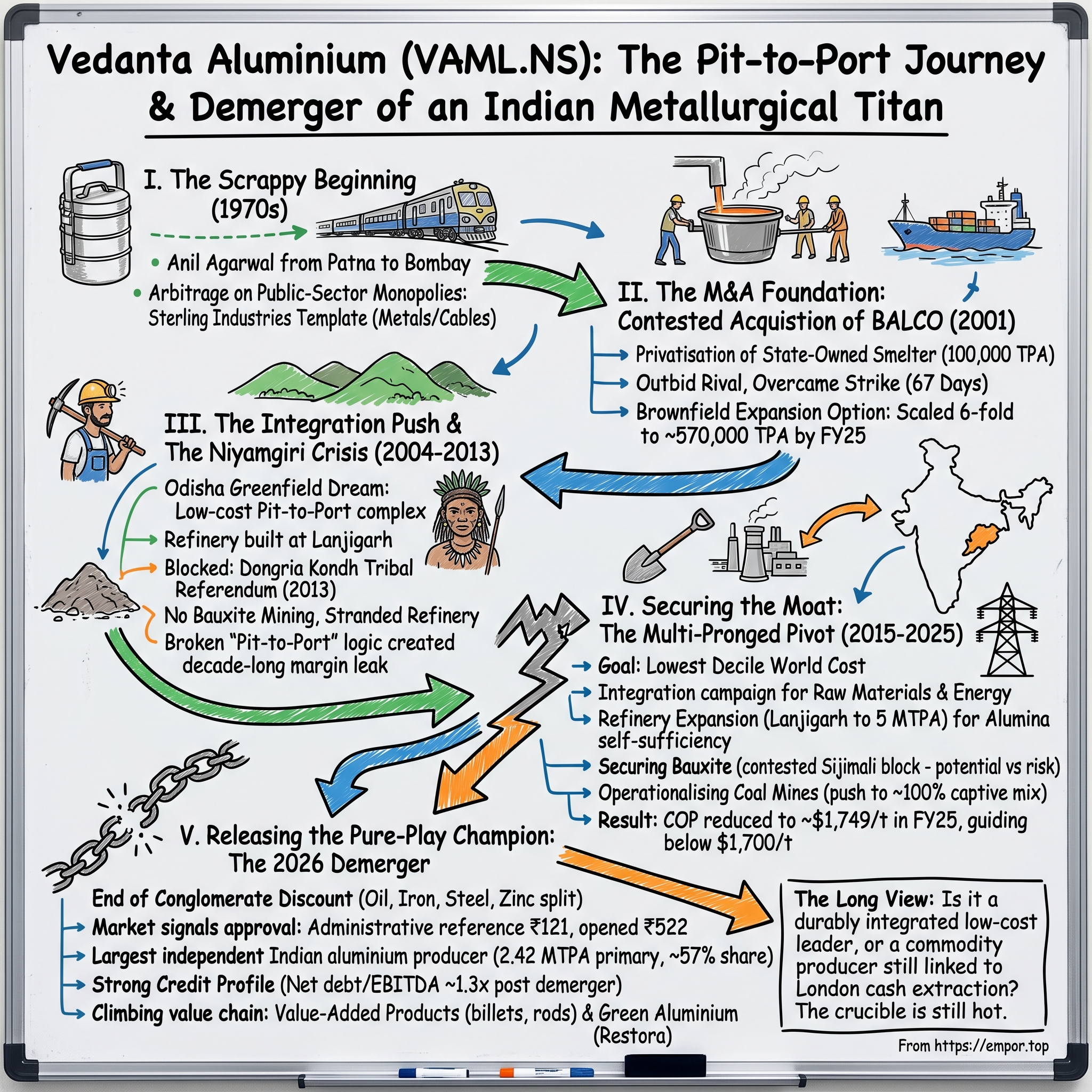
Vedanta Aluminium: The Pit-to-Port Crucible and the Demerger of India's Metallurgical Titan
I. Introduction & Episode Roadmap
On the morning of June 15, 2026, a curious thing happened on the National Stock Exchange of India. A company that had never traded a single share before opened for the first time — and the price the market printed had almost nothing to do with the number the exchange had penciled in the night before.
Regulators had run a special pre-listing price-discovery exercise and arrived at a base of roughly ₹121 per share. The market took one look at that number, laughed, and opened Vedanta Aluminium Metal Limited at ₹522.1 Within a session, the same stock would kiss its lower circuit, because a five-fold gap between an administrative reference price and a real one is not a smooth thing to digest.2
But the signal was unmistakable. India's investors had been waiting a long time to buy the country's aluminium champion on its own, and they were not going to be polite about it.
A listing without an IPO
It is worth pausing on the mechanics, because they are unusual and they shaped everything about those first sessions. VAML.NS did not come to market through a conventional initial public offering. There was no roadshow, no anchor book, no price band, no investment bank building a demand curve over two weeks. The shares simply appeared in existing Vedanta shareholders' accounts as a consequence of a corporate restructuring, and then the exchange opened a market in them.
Because of that, the stock debuted in the exchange's Trade-to-Trade (T2T) segment, a regime where every trade must be settled by actual delivery of shares and intraday speculation is effectively throttled.2 Think of T2T as training wheels the exchange bolts onto a newly listed or unusually volatile stock: you cannot buy in the morning and flip in the afternoon, so the froth has to be paid for in real capital.
The practical consequence is that the first days of price formation were unusually raw — a market feeling out the fair value of a business it had only ever seen bundled inside a sprawling conglomerate, with no underwriter's stabilizing hand and no pre-agreed valuation to anchor against. The ₹121 reference price was an administrative artifact. The ₹522 print was the market's actual opinion. The gap between them is the entire subject of this story.
Why aluminium, and why now
Why the appetite? Aluminium is, quietly, one of the best leveraged bets on the physical build-out of modern India, and it is worth being concrete about why rather than waving at "infrastructure demand."
Aluminium's properties make it the default answer to a specific engineering question: what do you use when you need something light, highly conductive, corrosion-resistant, cheap to work with, and infinitely recyclable? Copper conducts better, but it costs multiples more per unit of conductivity delivered. Steel is stronger, but it is heavy and it rusts.
That trade-off shows up across exactly the sectors India is building out right now. As the country strings up thousands of kilometres of new high-voltage transmission lines to move solar power from the deserts of the west to the load centres of the south and east, aluminium is the conductor of choice — grids are built on aluminium precisely because the cost-per-amp math beats copper once you account for the towers needed to hold the weight. As India carpets Rajasthan and Gujarat with utility-scale solar, aluminium frames, mounts, and racks those panels. As a dozen cities tunnel metro networks, aluminium goes into rolling stock. And as electric vehicles begin their slow-then-fast climb, aluminium displaces steel in body panels and battery enclosures, because in an EV every kilogram saved is range gained.
Put differently: aluminium demand is a derivative of electrification and urbanisation, and India is running both at once. It is an infrastructure proxy with a stock ticker.
That is the demand story, and it is genuinely attractive. But an investor should notice immediately that a great demand backdrop is available to every producer in the country. Demand growth tells you the market is worth being in; it tells you nothing about who captures the profit. What determines that, in a commodity, is cost position — and cost position is the spine of everything that follows.
The demerger that let the market see it
The reason VAML could list at all in June 2026 is that its parent finally stopped hiding it.
On May 1, 2026, Vedanta Limited (VEDL.NS) executed a landmark demerger, splitting the group into separate listed entities so that shareholders received one share in each new company for every Vedanta share they held.3 The aluminium undertaking — the smelters, the refinery, the captive mines, and the group's 51% stake in Bharat Aluminium Company (BALCO) — was carved out into VAML.4
For years, all of this had been buried inside a holding-company structure that traded at a persistent "conglomerate discount," its cash flows quietly siphoned upward to service debt in London. An investor who liked Indian aluminium had no clean way to own it; buying Vedanta Limited meant also buying oil and gas, iron ore, power, and a promoter's leverage. Now the aluminium business stood on its own, controlling — on the group's own telling — the majority of India's primary aluminium production.[^5]
Roadmap
This is the story of how it got here, and it is not a tidy one. It runs through a scrap-metal dealer's ambition, a privatization that half the country called a robbery, a tribal referendum that a decade of financial models never recovered from, and a race to own every tonne of bauxite and every kilogram of coal that goes into the metal.
- The Promoter's Crucible: how Anil Agarwal went from buying scrap in Patna to listing a resources empire in London — and why that London structure haunts the India story to this day.
- The M&A Masterclass: the deeply controversial 2001 privatization of BALCO, and whether Vedanta stole an asset or simply saw value nobody else would pay for.
- The Niyamgiri Crisis: how a 2013 tribal referendum severed the "pit-to-port" logic that justified the entire Odisha build-out, and structurally leaked margin for over a decade.
- The Integration Push: the modern scramble for raw-material security — captive coal, the contested Sijimali bauxite block, and the Lanjigarh refinery's expansion to 5 million tonnes a year, all aimed at getting the cost of a tonne of aluminium into the world's cheapest decile.
Keep one question in mind throughout, because it is the question a serious long-term investor must answer: is VAML a genuinely low-cost, integrated cost leader with a durable resource moat — or a highly capital-intensive commodity producer whose fortunes still ride on the London Metal Exchange price and on a promoter group with a long memory for cash extraction?
The demerger changed the wrapper. Whether it changed the substance is what we are here to test.
 Subscribe on LinkedIn
II. The Promoter's Genesis: Anil Agarwal & The Vedanta Empire
Anil Agarwal likes to tell a version of his own origin story that begins with a tiffin box and a train ticket. A young man from Patna, in the eastern state of Bihar — not a place from which India's industrial dynasties are usually minted — arrives in Bombay in the mid-1970s with more nerve than capital.
He starts, of all places, in scrap: buying the metal cast off by the cable industry, learning the unglamorous arithmetic of copper, and noticing something that the country's more respectable industrialists had largely ceded to the state.
The arbitrage nobody else wanted
The observation that made Agarwal's career was almost embarrassingly simple, and it is the kind of thing only an outsider notices. Post-colonial India was going to need staggering quantities of basic materials — copper, aluminium, zinc, power. Almost all of that capacity was locked inside sleepy public-sector monopolies, run to employment targets rather than return targets, with utilisation rates that a private operator would consider a scandal. If you could get your hands on those assets and run them like a business, the arbitrage was enormous and it required no technological invention whatsoever. It required only capital, nerve, and a tolerance for the political friction that comes with buying things the state used to own.
His first real foothold came from buying distressed and undervalued cable and conductor companies, absorbing their know-how, and rolling them up. Out of that came Sterlite Industries, which grew into a copper and telecom-cable manufacturer and listed on the Bombay Stock Exchange in the late 1980s.
Sterlite was the template for everything that followed, and the template is worth naming precisely because Vedanta has run it, with variations, for forty years: acquire an unloved industrial asset at a price that reflects its current mediocrity, apply capital and operational intensity to raise output far beyond nameplate, and let the resulting cash flows compound into the next acquisition. Agarwal's instinct was never for the frontier of technology; it was for the boring, essential, oversold middle of the industrial economy, where a determined operator could wring out returns that polite capital wouldn't touch.
The style has an obvious corollary that recurs throughout this story. A strategy built on buying contested assets cheaply and expanding them aggressively is a strategy that generates litigation, political opposition, and community conflict as a matter of course. Those are not accidents in the Vedanta story. They are the cost of the business model.
The London structure — triumph and trap
The truly consequential move — the one that shapes VAML's risk profile even today — came in 2003. Agarwal created Vedanta Resources Plc and listed it on the London Stock Exchange, the first Indian-promoter-controlled company to do so.5
On paper this was a triumph of ambition: an Indian scrap dealer's roll-up now carried a premium London listing, an international investor base, and access to global capital markets at a cost of funding no purely domestic mid-cap could match.
But structurally it created something more double-edged, and it is worth spelling out the mechanism carefully because it explains almost every governance controversy that followed.
Vedanta Resources (VRL) sat at the top of the pyramid as a holding company, owning controlling stakes in the cash-generative Indian operating businesses below. Crucially, VRL itself had very little operating cash of its own — a holding company does not smelt anything. What it had was debt, raised in international markets against the value of those subsidiaries, and a schedule of interest and maturities that had to be paid in hard currency on fixed dates.
The only way to service that debt was to move cash upward from India: dividends, inter-company transfers, and periodic stake sales. And because VRL did not own 100% of the Indian entities, every rupee of dividend paid to satisfy London's obligations also went, pro rata, to minority shareholders — which meant the cheapest way to move a given amount of cash to the parent was to declare a large dividend, whether or not the operating business had better uses for the money.
For the next two decades, that architecture generated an almost permanent tension: the promoter's need for cash at the top versus the minority shareholder's desire to see profits reinvested in growth or retained to reduce leverage. Every governance debate about Vedanta — and there have been many — traces back to this single design choice. It is not a scandal. It is a structure, and structures produce predictable behaviour.
The 2026 balance sheet: a genuine clean-up
By 2026, the picture on paper looks dramatically healthier than it did just a few years earlier, and understanding that clean-up is essential to understanding the demerger's timing. Three numbers tell the story.
First, promoter holding. Following a series of block deals in mid-2026, the promoter group held roughly 54.72% of the listed structure through Twin Star Holdings and related entities — still a firm control position, but one that had been trimmed to raise cash rather than pledged to borrow it.6 That distinction is the whole game. Selling a slice of your stake is a permanent, transparent way to raise money. Pledging it is a temporary, opaque way to raise money that leaves a landmine in the capital structure.
Second, the pledge overhang. In 2022–2023, promoter share pledges had climbed to nearly 99% — meaning almost every share the family owned had been posted as collateral against loans.6 For readers less steeped in Indian market plumbing, this is a classic source of tail risk. When a promoter pledges shares, the lender holds them as security and can sell them if the share price falls below a threshold. That creates a reflexive doom loop: the stock falls, the lender sells, which makes the stock fall further, which triggers more selling. A near-100% pledge means the promoter has essentially no dry powder left and the entire control block is one bad quarter away from being liquidated into the market. By the post-demerger period in 2026, the group had systematically brought pledged shares at the listed level down to essentially zero.6 For a promoter who had spent years being a byword for leverage, taking the pledge to 0.0% was less a financial detail than a credibility statement.
Third, the London debt wall. In early 2024, Vedanta Resources completed a high-stakes liability-management exercise, winning creditor consent to restructure roughly $3.2 billion of bonds — pushing maturities out toward the end of the decade and making sizeable upfront payments, backed by private-credit packages arranged with lenders including Cerberus and Standard Chartered.7 It is important to characterise this accurately, because the group's own framing tends to describe it as a resolution. It was not. Restructuring does not extinguish debt; it moves it. What the exercise bought was time — several years of breathing room in place of an imminent maturity wall.
But time is exactly what the group needed, and here the analytical point is genuinely favourable to management: a demerger executed under duress is a fire sale, while a demerger executed with a five-year runway is a strategic choice. The 2024 restructuring is what converted the 2026 split from an act of desperation into an act of design.
The next generation
Watching over the next chapter is Priya Agarwal Hebbar, Anil's daughter, who sits as a non-executive director and has become the public face of the group's pivot toward ESG credibility, low-carbon metal branding, and international positioning.
An independent read should be careful here. Generational transitions at founder-controlled resource groups are often marketed as governance transformations and turn out to be continuity in a softer register. The substantive test is not whether the company's sustainability reporting improves — it almost always does — but whether the underlying flow of cash to the promoter level changes character. That test has not yet been run in earnest.
So hold the thought: the demerger and the balance-sheet clean-up are real and measurable, but they sit on top of two decades of a structure engineered to move cash upward. Before we judge the modern company, we have to go back to the deal that made Vedanta a serious aluminium player in the first place — and it is a deal that started a riot.
III. The M&A Foundation: The Controversial BALCO Turnaround (2001)
In the winter of 2001, the town of Korba in Chhattisgarh became a battlefield of a peculiarly Indian kind.
Workers at the Bharat Aluminium Company — a state-owned smelter that had been part of the national industrial furniture since the 1960s — walked off the job and stayed off for 67 days. Politicians denounced the sale of a "national asset." Cases piled up in the Chhattisgarh High Court and the Supreme Court of India. And the man at the centre of the storm was Anil Agarwal, who had just bought control of the company and now had to persuade thousands of hostile employees to switch the pot lines back on before the molten metal froze solid inside them.
The Vajpayee disinvestment moment
Rewind a few months. India in 2001 was governed by the Vajpayee-led coalition, and its Disinvestment Minister, Arun Shourie, was pursuing an unusually determined programme of selling government stakes in underperforming public-sector undertakings.
The intellectual case was straightforward and, in economic terms, sound: the state was a poor operator of commodity businesses, the assets were starved of capital, and the proceeds could be redeployed. The political case was far harder, because privatisation in India collides immediately with organised labour, regional politics, and a deep public suspicion that national wealth is being handed to well-connected businessmen at a discount.
BALCO — with an inefficient smelter of roughly 100,000 tonnes per annum capacity — was one of the marquee sales. The government offered 51% and invited bids. Sterlite Industries won it with a bid of ₹551.5 crore for the controlling stake.8
Did Vedanta overpay, or steal it?
This question deserves genuine scrutiny, because the "Vedanta got BALCO for a song" narrative has hardened into folklore, and folklore is where investors lose money. Let's run the benchmarks properly.
BALCO had earned a modest profit after tax of around ₹56 crore in FY2000. The ₹551.5 crore paid for 51% implied an enterprise valuation in the region of ₹1,080 crore — which puts the transaction at roughly a high-teens multiple of trailing earnings.8 That is not, on its face, a giveaway multiple. It is what you might pay for a decent listed industrial, and Vedanta was paying it for a business that was, at that moment, badly run and capital-starved.
The comparison that settles the argument is the competing bid. The only other serious bidder was Hindalco — the Aditya Birla group's aluminium arm, an experienced, well-capitalised industrial buyer that knew exactly what a smelter was worth. Hindalco came in at around ₹275 crore.8 Vedanta's bid was therefore roughly double what its most sophisticated rival was willing to pay, and it landed above the government's own reserve price of about ₹514 crore.8 The judicial challenge that followed — argued all the way up — ultimately did not undo the sale.9
So on the day, Vedanta was the high bidder, not the lowball opportunist. It paid a substantial premium to the only competing industrial buyer and cleared the government's floor. The "daylight robbery" charge, whatever its political resonance, does not survive contact with the bid table.
What made the deal look like a giveaway was not the price but the hindsight — and understanding the difference is the actual lesson.
What Vedanta was really buying
Vedanta did not buy a 100,000-tonne smelter. It bought a platform.
Bundled into that ₹551.5 crore was land at industrial scale, existing power infrastructure, water rights, established environmental clearances, a trained industrial workforce, rail connectivity, and — most valuable of all — brownfield expansion headroom inside a mineral-rich state. Every one of those things is a permission or an asset that a new entrant would need years and a fortune to assemble from scratch, assuming it could assemble them at all.
This is the general principle worth extracting: pay a fair price for a mediocre asset that happens to sit on a platform you can scale ten-fold, and you have not overpaid. You have bought a call option the seller did not know it was writing. The government valued BALCO as a running smelter with poor economics. Vedanta valued it as an option on everything that could be built on the same footprint. Both were reasonable valuations of different things; only one of them turned out to be the right frame.
Execution: the 67 days
Options only pay off if you exercise them, and exercise is where the Korba drama comes in.
The technical stakes were higher than a normal labour dispute. Aluminium smelting runs on electrolytic pot lines — enormous carbon-lined cells holding molten cryolite and dissolved alumina, kept at roughly 950°C around the clock while current runs through them. They are not machines you switch off. If a pot line loses power long enough, the bath solidifies, and restarting can mean physically excavating the frozen mass and rebuilding the cell. A prolonged, hostile shutdown can therefore destroy a substantial fraction of a smelter's value, which gave the striking workforce genuine leverage and gave Vedanta a fast-ticking clock.
Agarwal, by most accounts, treated the strike not as a legal problem to be delegated to counsel but as a negotiation to be personally won, engaging the unions and local political leadership directly. The plant was eventually restarted without the catastrophic equipment damage a long freeze can cause.
Then came the capital, and this is where the option paid. Over the following two decades, Vedanta expanded BALCO's capacity from that original 100,000 tonnes toward roughly 570,000 tonnes, with FY25 output around 592,000 tonnes — meaning the asset was running above its rated capacity — and further brownfield expansion under way toward the one-million-tonne mark.10[^12]
Sit with that number for a moment. A stagnant state smelter was expanded roughly six-fold under private ownership, on substantially the same land, using the clearances that came with the deal. Whatever one thinks of the politics of the sale, the operational record is not ambiguous: this was a genuine industrial turnaround, not a financial one.
The government that never left
One structural feature endures and deserves an investor's attention: the government of India never fully exited BALCO. It retained a 49% minority stake, with nominee directors on the board.4
This is a double-edged inheritance. On the constructive side, it anchors governance and keeps a public eye on a strategically sensitive asset — a useful check on a promoter with a history of aggressive cash movement. On the constraining side, it complicates treasury integration in ways that matter for valuation. BALCO runs its own operational cash management and cannot simply be swept into the parent's balance sheet like a wholly owned division. Dividends from BALCO leak 49% to the state. Capital allocation decisions require accommodating a partner whose objectives include employment and regional development, not only returns.
As we will see when we reach segment economics, BALCO is best understood as a semi-independent cash generator sitting inside VAML rather than a fully fungible division — and that distinction is routinely flattened in the headline claim that VAML controls the majority of Indian aluminium.
The BALCO acquisition proved Vedanta could take a broken state asset and make it hum. Flush with that confidence, Agarwal set his sights on something far more ambitious: not fixing an existing smelter, but building an entirely new, fully integrated aluminium complex from bare ground in Odisha. That dream would deliver Vedanta's greatest theoretical cost advantage — and its most humiliating defeat.
IV. The Greenfield Dream and the Niyamgiri Crisis (2004–2013)
Look at a map of the global aluminium cost curve, and you will understand why Vedanta fell in love with Odisha.
The two-step problem
Making aluminium is really two industrial problems stacked on top of each other, and it helps to picture them plainly.
The first step is refining. You dig up bauxite — a reddish, clay-like ore — and process it, using heat and caustic soda, into alumina, a fine white powder that looks like table salt. It takes roughly two tonnes of bauxite to make one tonne of alumina.
The second step is smelting. You dissolve that alumina in a molten bath and run an enormous electric current through it to rip the aluminium atoms away from the oxygen. It takes roughly two tonnes of alumina to make one tonne of metal, and it takes a staggering amount of electricity — so much that aluminium is sometimes described, only half-jokingly, as solid electricity.
That chain has an obvious implication. The cheapest producers on earth are the ones who own the bauxite, refine it next door to the mine, and smelt it with cheap captive power — no long-distance freight on low-value ore, no import duties, no merchant middlemen taking a spread at each hand-off. The industry has a name for that integrated design: pit-to-port.
The whiteboard plan
Odisha offered the raw materials for exactly that dream, and the plan was elegant.
Build a large alumina refinery at Lanjigarh, in the Kalahandi district, sitting right at the foot of the bauxite-rich Niyamgiri hills. Mine the bauxite from the top of those hills and drop it — almost literally downhill — into the refinery below. Rail the resulting alumina to a mammoth low-cost smelting complex at Jharsuguda, powered by captive coal-fired generation.
Do that, and Vedanta's cost of metal would sink toward the bottom decile of the global cost curve: a structural, almost unassailable advantage that no domestic competitor could replicate and that would survive any downturn in the metal price, because when prices crash the low-cost producer is the one still making money while everyone else idles capacity.
The refinery was built and began operating in the mid-2000s in anticipation of its captive mine. Everything hinged on one assumption: that the bauxite on top of Niyamgiri would be Vedanta's to dig.
The assumption fails
It was not.
The Niyamgiri hills are the ancestral home of the Dongria Kondh, a Particularly Vulnerable Tribal Group who regard the range not as a mineral deposit but as the living body of their deity, Niyam Raja. To mine the summit was, in their understanding, to decapitate a god. This was not a negotiation over compensation, and Vedanta's early approach — which treated it substantially as a land-and-livelihood problem to be solved with money and development spending — badly misread what was actually at stake.
What began as local resistance grew, through the late 2000s, into one of the most visible corporate-versus-indigenous confrontations on the planet. International NGOs took up the cause. Global media reached for the shorthand of a "real-life Avatar," casting Vedanta as the mining corporation and the Dongria Kondh as forest people defending a sacred mountain — a framing that was reductive but devastatingly effective.
Then the money moved. Prominent European institutional investors, including the Church of England and Norway's sovereign wealth fund, divested Vedanta shares on human-rights and ethical grounds.[^13] For a company that had listed in London precisely to acquire international respectability, being named in a Norwegian ethics-council exclusion was a reputational wound that would take more than a decade to close — and it raised the group's cost of capital in exactly the Western markets it had gone to London to access.
The referendum
The decisive blow came through India's own institutions, and it set a genuine legal precedent that reshaped Indian mining law.
The Supreme Court of India, invoking the Forest Rights Act, directed that the affected village councils — the Gram Sabhas — should themselves decide whether the mining project impaired their religious and cultural rights.[^13] This was extraordinary. Rather than the court ruling on the merits, or a ministry issuing a clearance, the decision was handed to the people who lived on the mountain.
In 2013, across a series of village referendums, the councils voted, one after another, to reject the mining proposal. The verdict was effectively unanimous. The central government followed by declining to clear Vedanta's mining lease.[^13]
A tribe had voted down one of the country's largest industrial groups, and the vote held.
The structural margin leak
Strip away the drama and look at what this did to the economics, because that is the part that outlived the headlines and that most retrospectives underweight.
Lanjigarh had been designed as a captive refinery — engineered around the assumption of ore arriving from directly above it. Overnight, it became a refinery stranded without its orebody. Vedanta was forced to source bauxite from wherever it could: other Indian states such as Gujarat and Chhattisgarh, and eventually imports from as far away as Guinea and Brazil.[^12]
Every tonne of that substitute bauxite arrived carrying freight, handling, and port costs that the original design had been specifically engineered to avoid — and remember the ratio: roughly two tonnes of ore for every tonne of alumina, which means you are paying to move a great deal of low-value rock across oceans and continents. Lanjigarh's alumina cost, which was supposed to be the source of a structural advantage, instead became a persistent drag: a high-cost, under-integrated unit leaking margin out of the aluminium segment year after year.
Here is the crucial, under-appreciated point for anyone valuing VAML today. The Niyamgiri defeat was not a one-time write-off that a single accounting period absorbed. It was a decade-long structural tax on the business. For roughly ten years, the single most important lever in aluminium economics — cheap, captive alumina — was broken, and the company's cost position sat higher on the global curve than its scale alone should have allowed.
That reframes how one should read the recent improvement in Vedanta's cost numbers. Much of what looks like brilliant new cost innovation is, more accurately, the slow repair of a self-inflicted structural wound. That is still valuable — repairing a decade-long margin leak creates real earnings — but it is a different claim from "this company has discovered a new source of advantage," and investors should price the difference.
It also sets the stakes for what comes next. The grinding, expensive campaign to rebuild integration from scratch is the real turning point in this story — far more consequential than any share-price debut.
V. Securing the Moat: The Integration Pivot (2015–2025)
To grasp why the years from roughly 2015 to 2025 mattered so much, you have to internalise a single sentence that governs this entire industry: primary aluminium is not really a metals business, it is a raw-material-and-energy business wearing a metal's clothing.
The cost anatomy
Break down the cost of smelting a tonne of aluminium and two inputs dominate. Alumina — the refined feedstock — typically accounts for something like 40–50% of the cost. Electricity accounts for another 35–40%. Everything else — labour, carbon anodes, maintenance, freight — fights over what's left.
Read that breakdown again and the strategic implication falls out immediately. Roughly 80–90% of a smelter's cost structure is determined by two purchasing decisions. A world-class management team that shaves 10% off labour and maintenance moves the total cost by a rounding error. A team that secures its own alumina and its own coal moves it by hundreds of dollars a tonne.
Which means the entire competitive contest reduces to two questions: do you control your alumina, and do you control your power? Vedanta spent this decade trying to answer both with "yes."
The alumina answer
The alumina answer arrived in early 2026, and it was enormous.
Vedanta commissioned the expansion of its Lanjigarh refinery to a nameplate 5 million tonnes per annum, up from the 2 MTPA level it had long operated at — a step-change that, on the company's account, made Lanjigarh India's largest and among the world's largest alumina refineries.[^14]
The strategic point is not the trophy status. It is self-sufficiency, and the arithmetic is worth doing explicitly. Vedanta's Indian smelting capacity runs at roughly 2.42 MTPA of metal. At the roughly two-to-one ratio, turning that much aluminium requires something close to 5 million tonnes of alumina. A 5 MTPA refinery, running well, can therefore in principle cover essentially all of that internal need.
Why does that matter so much? Because the alternative is buying alumina on the merchant spot market, which is one of the more violent commodity markets in existence. Alumina supply is concentrated in a handful of regions, and a single refinery outage, export restriction, or shipping disruption can send spot prices spiking — episodically toward and beyond $400 a tonne, levels that have wrecked the margins of merchant smelters forced to buy at the top.[^14]
The whole point of the expansion is to convert aluminium's single biggest cost line from a market you are hostage to into an internal transfer price you control. When it works, this is genuinely transformative — not because it lowers the average cost dramatically in a calm year, but because it removes the tail risk that turns a profitable year into a loss.
The Sijimali problem
But a refinery is only as self-sufficient as its ore supply, and here the ghost of Niyamgiri walks straight back into the room.
To feed a 5 MTPA Lanjigarh, Vedanta needs mountains of bauxite — on the order of 10 million tonnes of ore a year at full run-rate. Its answer is the Sijimali block: a high-grade deposit in the Rayagada and Kalahandi districts, with estimated reserves running into the hundreds of millions of tonnes, which the company won in a government auction in 2023.[^15] On paper, Sijimali finally closes the pit-to-port loop that Niyamgiri broke. Vedanta secured an early-stage forest clearance in 2025.[^15]
The problem is geography, and it is almost eerie. Sijimali sits in the same tribal belt as Niyamgiri, and it has drawn the same kind of resistance: local protests, disputes over whether the Gram Sabha consents were validly obtained, and legal challenges — the early choreography of the exact conflict that cost Vedanta a decade the first time.[^15]
An independent investor has to hold two ideas at once here, and resist the temptation to resolve the tension prematurely in either direction.
If Sijimali comes online at scale, VAML's cost structure is transformed and the cornered-resource advantage becomes real and durable. If it becomes "a second Niyamgiri," then the shiny new 5 MTPA refinery is left half-fed on expensive imported and third-party bauxite — and note how much worse that outcome is than the status quo, because the company will have spent the capital on a refinery whose economics only work at high utilisation with cheap captive ore. A large fixed-cost asset running below capacity on expensive inputs is not a neutral outcome; it actively destroys returns.
This is not a modelling nicety. It is arguably the single most important binary in the entire investment case, and it was genuinely unresolved as of mid-2026.
The coal answer
The power answer is further along and considerably less contested.
Smelters need vast, uninterrupted electricity — those electrolysis cells run around the clock and, as we saw at Korba, cannot simply be switched off. Vedanta runs captive power plants to feed them, but a captive plant is only as cheap as the coal going into it. Buying coal on Coal India's e-auctions or importing it exposes the smelter to fuel-price shocks that can vaporise a quarter's margin, and e-auction premiums have a nasty habit of spiking precisely when power demand is tightest.
So Vedanta went the other way, systematically acquiring and operationalising domestic coal blocks — names including Jamkhani, Radhikapur, and Kurloi-A — with the explicit goal of pushing its captive-coal mix from around 40% toward as close to 100% as regulation and geology allow.[^5]
Every percentage point of captive coal is a percentage point less exposure to auction pricing and a structurally lower, more predictable power cost. It is unglamorous, incremental, and it compounds — and unlike Sijimali, most of it is already in hand rather than pending a clearance.
Did it work?
Here is where an independent read matters most, because both the bull and bear narratives can quote the same trend.
The evidence says the integration campaign genuinely moved the needle, but has not yet reached the promised land. Vedanta's aluminium hot-metal cost of production came down to roughly $1,749 per tonne in FY25.12 Management has been guiding — on the back of Sijimali bauxite and the coal ramp — toward getting below $1,700 a tonne, with sell-side analysts sketching a path toward the high-$1,500s later in the decade if integration fully lands.1112
Those are real, bankable improvements that place Vedanta credibly in the lower half of the global cost curve, and they are the strongest available evidence that this management team executes on operational promises rather than merely announcing them.
But note the gap between the achieved number and the bull-case target, and note precisely what closes it. Getting from roughly $1,749 to the mid-$1,500s depends almost entirely on Sijimali and the coal blocks — that is, on clearances and social license, not on engineering. The company has demonstrated it can build refineries and expand smelters. It has not yet demonstrated it can reliably secure the right to mine in Odisha's tribal belt. Those are different competencies, and the market has a tendency to credit the second because it has observed the first.
The moat is being dug. It is not yet finished. And it was precisely to let investors price that half-built moat on its own terms that the group finally decided to break itself apart.
VI. The 2026 Demerger: Releasing the Pure-Play Champion
For years, the knock on Vedanta Limited was that it was impossible to value and easy to dislike.
Inside one ticker you had aluminium, zinc, oil and gas, iron ore, steel, and power — businesses with wildly different cost structures, cycles, capital intensities, and regulatory regimes, stapled together and topped with a leveraged London holding company that periodically reached down for dividends. Analysts called the resulting valuation gap the conglomerate discount, and it was the kind of discount that never seemed to close.
Why conglomerate discounts persist
It is worth being precise about why, because "conglomerate discount" is often used as a hand-wave.
Three mechanisms drive it. First, analytical: no analyst is simultaneously an expert in upstream oil, base metals, and iron ore, so the company gets covered shallowly by everyone and deeply by nobody. Second, allocative: investors cannot express a view on the good business without also owning the bad one, so the specialist buyer — the one who would pay the most for the aluminium franchise — simply stays away. Third, and most corrosive here, trust: when a structure exists that can move cash from a strong subsidiary to weaker uses or to a parent's debt service, investors rationally discount the strong subsidiary's cash flows, because those cash flows are not reliably theirs.
Vedanta suffered from all three, and the third was the worst.
The split
The demerger was the group's answer, and its logic is the standard sum-of-the-parts case executed at scale. Split the conglomerate into focused, independently listed entities, and each can be valued on its own merits: the steady, integrated aluminium franchise no longer priced as though it were a volatile oil-and-gas explorer, and vice versa. Just as important, each entity allocates its own capital — VAML's cash flows freed from subsidising the capex appetites of unrelated segments, and its credit profile standing on its own feet.
On May 1, 2026, the scheme took effect. Vedanta shareholders received one share in each new company for every share they held, and the businesses began trading independently in June.31
The debt allocation — and what it actually signals
The balance-sheet split is where the substance lives, and it is telling.
As the most capital-intensive of the demerged units, VAML was allocated the largest slug of group debt — on the order of ₹32,700 crore, roughly $3.5 billion.[^5] At first glance that is a daunting figure to hang on a freshly independent company, and the headline invites alarm.
But absolute debt is the wrong lens; leverage relative to earnings is the right one. On that measure, VAML emerged as the strongest credit of the family, with net debt to EBITDA of about 1.3 times — against roughly 0.4 times for the residual Vedanta Ltd, about 1.4 times for the iron-and-steel entity, and a debt-free oil-and-gas business.13
In other words, VAML was handed the most debt precisely because it generates the most cash to carry it. A 1.3x leverage ratio for a scaled heavy industrial with a demonstrated cost-reduction trajectory is comfortably manageable — most rating frameworks would treat that as investment-grade territory for a cyclical, provided the cycle cooperates.
The real risk is therefore not the level of leverage today. It is what management chooses to do with the free cash flow: pay the debt down and build a fortress balance sheet ahead of the next downturn, or route it back upward as dividends. Which brings us to the segment economics that will fund that choice.
Segment economics — and reading them honestly
Consider the FY25 figures the demerger was built on.
The aluminium segment generated revenue of roughly ₹58,522 crore, up about 21% from ₹48,371 crore the year before, while segment EBITDA jumped to around ₹17,798 crore from ₹9,657 crore — an increase of roughly 84%.14
That EBITDA leap is the number that made the pure-play story sellable, and it is precisely the number that requires the most careful handling. An 84% jump in earnings on a 21% rise in revenue means margins expanded dramatically, and margin expansion in a commodity business comes from two sources that behave very differently.
The first is price. Higher LME realisations and firmer premiums flow almost entirely to the bottom line, because a smelter's costs do not rise with the metal price. This portion is cyclical, and it will reverse when the cycle does — possibly violently, since the same operating leverage that amplifies gains amplifies losses.
The second is cost. The integration campaign genuinely lowered the cost per tonne, and that portion is structural. It should persist through the cycle and it belongs in a long-term valuation.
The honest read separates the two, and the uncomfortable truth is that from outside, the split is difficult to determine precisely. But the direction of the inference is clear: an EBITDA near-doubling in a year when metal prices firmed is substantially a cyclical event dressed in a structural narrative. A doubling of earnings that leans on the commodity cycle is a very different asset from one built on permanent cost-out, and an investor who capitalises FY25 EBITDA as a run-rate is making a strong implicit bet on aluminium prices.
Not all the cash is VAML's
Within that segment, the earnings are also not evenly distributed, and the ownership structure matters more than headline market share suggests.
The Jharsuguda complex — wholly owned by VAML and running on low-cost captive power and Lanjigarh's alumina — throws off the lion's share, on the order of ₹13,268 crore of segment EBITDA.14 BALCO, of which VAML owns 51% with the government's 49% alongside, contributes roughly ₹4,530 crore.14
That split matters concretely for a shareholder. Roughly a quarter of the segment's EBITDA sits inside a company where nearly half the economics, and a bloc of board seats, belong to the state. Dividends from BALCO leak proportionally to the government. Cash trapped there cannot be freely applied to VAML's ₹32,700 crore of debt without the partner's cooperation.
When you value VAML, then, you are valuing a wholly owned crown jewel bolted to a partially owned, government-anchored second engine — a nuance the headline claim about controlling the majority of India's aluminium tends to flatten. Which brings us to the market that production share actually competes in.
VII. Competitive Landscape & Market Economics
If you want to understand VAML's competitive position, picture the Indian primary aluminium market as a room with exactly three chairs.
There is no meaningful fourth player, and there is unlikely to be one for a generation. Building an integrated smelter in India means assembling billions of dollars of capital, thousands of acres of land, dedicated power generation, and a stack of environmental and forest clearances that — as Niyamgiri demonstrated — can be denied by a show of hands in a village. The barrier to entry is not primarily financial. It is social and regulatory, and it is close to absolute.
The three chairs
Vedanta Aluminium holds the largest. At roughly 2.42 million tonnes of FY25 production, it commands on the order of 57% of India's primary aluminium output, and it plays the volume game — massive low-cost scale, a heavy export orientation, and an ambition to push smelting capacity toward 3 MTPA later in the decade.[^5][^20]
Hindalco holds the second, with domestic primary capacity of roughly 1.3–1.4 MTPA and something near a third of the market.[^20] But Hindalco plays a subtly and deliberately different game, and dismissing it as merely "the number two" misreads the industry. Globally, Hindalco is a giant through Novelis, its North American rolled-products and recycling arm, and its strategy tilts toward high-value downstream products and recycled aluminium rather than brute-force expansion of Indian primary tonnage. That is a defensible strategic choice rather than a concession: recycled aluminium requires a small fraction of the energy of primary smelting, which makes it structurally cheaper on power and dramatically lower in carbon. In a world that is pricing carbon at borders, the recycler's position may age better than the coal-fired smelter's.
NALCO, the National Aluminium Company, holds the third — a public-sector producer of around 0.46 MTPA, roughly a tenth of the market.[^20] NALCO's paradox is instructive. It sits on some of the best, lowest-cost bauxite in the country at Panchpatmali, an ore position Vedanta has spent two decades and enormous political capital trying to approximate. And yet state ownership and slow decision-making have kept it from scaling. Owning a great orebody is not the same as building a great company around it — a useful reminder that resources without execution compound very slowly, and a partial answer to anyone who assumes Sijimali alone would settle the competitive question.
Scale is not the same as pricing power
So VAML wins on scale and cost. But scale in a commodity is a double-edged sword: it makes you the low-cost survivor, not the price-setter.
The price of primary aluminium is set in London, not in Odisha. VAML's revenue line inhales global cyclicality no matter how efficient its plants are, and no amount of Indian market share changes that. This is the single most important thing to understand about the business and the thing most likely to be forgotten during a good year.
The strategic response — and it is the right one — is to climb the value chain. Rather than selling undifferentiated ingots at pure LME-linked prices, VAML has been shifting its mix toward value-added products (VAP): billets, primary foundry alloys, slabs, and wire rods that carry a conversion premium over the base metal, with a stated ambition to push the VAP share past half of output.[^5]
The mechanism is worth understanding. A billet is not just metal; it is metal cast to a customer's specification, with a guaranteed alloy composition, delivered to a schedule. The customer pays the LME price plus a conversion premium, and that premium is negotiated bilaterally rather than set by a global exchange. It does not escape the cycle — the LME is still the anchor and the bulk of the price — but it widens and stabilises the spread, and it builds customer relationships that are stickier than spot ingot sales.
An honest caveat: VAP mix targets are among the easiest metrics for a commodity producer to define generously, since the boundary between "value-added" and "slightly processed" is a matter of internal classification. The number to watch is realised premium per tonne, not the percentage claim.
The green wedge
The second climb is greener, and potentially more valuable — or potentially a rounding error, depending on politics.
In 2022, Vedanta launched Restora and Restora Ultra, its low-carbon and ultra-low-carbon aluminium brands. Restora is made using renewable power; Restora Ultra incorporates recovered metal from aluminium dross — the oxide-rich skim that forms on molten metal and was historically treated as waste — processed through a partnership with Runaya Refining using licensed technology.15
The commercial logic is genuinely interesting, and it is one of the few places where a commodity producer can briefly become a price-setter. As the European Union phases in its Carbon Border Adjustment Mechanism (CBAM) — effectively a carbon tariff on imported goods based on their embedded emissions — high-carbon aluminium from coal-heavy grids faces a growing penalty at the European border. A verified low-carbon product can, in principle, sail in at a premium while dirtier metal pays the tax. For an exporter, that is not a marketing story; it is a tariff arbitrage.
But hold the enthusiasm at arm's length, and note the irony sitting at the centre of it. Restora is a green wedge sold by a group whose core cost advantage is cheap, captive, coal-fired power. The two strategies are in genuine tension: every percentage point of progress on the captive-coal target makes the average tonne of VAML metal more carbon-intensive, not less. Restora volumes remain modest relative to total output, verification standards for "green" aluminium are still contested internationally, and CBAM's ultimate stringency is a moving political target subject to European industrial lobbying.
It is optionality, not yet a pillar. Which is the right frame for the harder analytical question: how durable, really, is VAML's advantage?
VIII. Analysis: Porter's 5 Forces, Helmer's 7 Powers & Management Credibility
Every management team will tell you it has a moat. The job of an independent analyst is to ask where, exactly, the water is — and whether it would still be there if the tide of high commodity prices went out.
Helmer's 7 Powers: three out of seven
Start with Hamilton Helmer's framework, because it forces specificity about the kind of advantage in play rather than allowing a vague appeal to "leadership."
VAML has a credible claim to three of the seven powers.
Scale economies is the clearest and the most bankable. Operating one of the world's largest single-location smelting complexes at Jharsuguda lets VAML spread fixed costs — infrastructure, corporate overhead, logistics, captive power generation, maintenance organisations — across a tonnage no domestic rival can match. In a business where the low-cost producer is the last one standing in a downturn, that fixed-cost dilution is a genuine and durable edge. It is also self-reinforcing: scale funds the capex that extends scale.
Cornered resource is potential rather than realised. If Sijimali's bauxite and the captive coal blocks are fully secured and operationalised, VAML would own low-cost inputs its competitors physically cannot access — an advantage rooted in geology and government allocation rather than operational hustle, and therefore very hard to compete away. Note the conditional. This is a power under construction, contingent on clearances that did not exist as of mid-2026, and an analyst who models it as though it were already in hand is not analysing but hoping.
Process power is the most modest of the three: two decades of accumulated know-how in blending domestic and imported feedstocks of varying quality, and in running very large pot lines at high utilisation. This is real — the FY25 BALCO output above rated capacity is evidence of it10 — but it is tacit, hard to verify from outside, and the sort of thing competent competitors eventually replicate.
What VAML conspicuously does not have is equally important. There is no branding power in any meaningful sense: aluminium is fungible, and no buyer pays more for an ingot because it says Vedanta. There are no network effects. There are essentially no switching costs — a customer can change primary metal suppliers with a phone call, constrained only by logistics. There is no counter-positioning, since VAML's model is the industry-standard model executed at larger scale.
The conclusion is clean and worth stating plainly: VAML's moat is a cost moat, full stop. That is a real and valuable thing — cost leadership in a commodity is one of the most durable advantages in business — but it has a specific profile. It protects you magnificently in bad times, when high-cost competitors idle capacity and you keep running. It does very little for you in good times, when everyone makes money and your advantage is simply that you make somewhat more. It is a defensive moat, not an offensive one, and it should be valued accordingly.
Porter's Five Forces — and the sixth
Porter's framework sharpens the same picture and reveals one gap.
Threat of new entrants: extremely low. Capital, land, power, and clearances form a barrier close to impassable in the Indian context, as discussed. This is the strongest force in VAML's favour and it is unlikely to change.
Buyer power: mixed. Domestic buyers are somewhat captive because a 7.5% import tariff on primary aluminium nudges them toward the domestic triopoly rather than imports, which supports domestic realisations meaningfully. But the underlying price remains LME-linked, so buyers ultimately negotiate against a global benchmark rather than against VAML's cost structure — meaning VAML's cost advantage accrues to VAML's margin, not to its pricing latitude. Note also that the tariff is a policy variable, not a law of nature; a government facing downstream industry lobbying about input costs could reduce it, and that is an under-discussed regulatory risk.
Supplier power: historically high, actively declining. For most of the company's history, VAML's most important suppliers were effectively the government and Coal India, through state-controlled coal and bauxite allocation. The entire backward-integration campaign is precisely an effort to demote those suppliers into internal cost centres — and it is working, unevenly.
Rivalry: moderate and unusually stable. Three players with differentiated strategies, high barriers, and no meaningful capacity war. Hindalco is not trying to out-tonne Vedanta domestically, and NALCO cannot.
The force Porter's framework handles least well is the one that matters most here, and it deserves naming as a sixth force: the power of communities and courts to withhold social license. Niyamgiri established that a company's binding constraint may be neither competitor nor supplier nor customer, but the people living on top of the orebody — exercising a veto with statutory backing. No cost-curve analysis captures this, no capital budget can overcome it, and it is the risk least amenable to management skill.
Management: what the behaviour shows
Frameworks do not run smelters, so consider the people.
Rajiv Kumar took over as CEO of the aluminium business effective March 26, 2025, brought in specifically to steer the company into and through its independence. He arrived with roughly three decades in steel and mining, including senior roles at Tata Steel, and a mandate centred on operationalising the mines, de-bottlenecking BALCO, and scaling the low-carbon franchise.1617
Two things are worth noting about that appointment. First, the timing: hiring an operations-heavy outsider roughly a year before a demerger suggests the split was planned well in advance rather than opportunistic. Second, the pedigree: recruiting from Tata Steel — a group with a markedly different governance reputation — reads as a deliberate signal about the kind of operator VAML wants to be seen as. Signals are cheap; the follow-through is what counts, and as of mid-2026 the tenure is too short to judge on execution against stated targets.
The CFO seat carries the assignment that arguably matters most to minority holders: managing VAML's independent balance sheet, refinancing the ₹32,700 crore on its own terms, and resisting the historic gravitational pull that treated cash-rich Indian subsidiaries as a treasury for obligations elsewhere.[^5]
The activist stress test
Now assume you are a skeptical activist investor building a short case, or a long-only manager demanding accountability. What would you attack?
You would not attack the assets. The smelters are real, the scale is real, and the cost trajectory is documented. You would attack four things.
Capital allocation and dividend policy. This is the central charge. The entire history of this group is a leveraged promoter vehicle in London reaching down for cash, and a demerger does not repeal that instinct — it merely changes the plumbing. If VAML, freed to deleverage, instead pays aggressive dividends that happen to help service promoter-level obligations, minority holders will have inherited the old conglomerate problem in a shinier wrapper. Nothing in the corporate structure prevents this outcome; only management restraint does.
The gap between guidance and delivery on mining. Management has repeatedly framed low-cost bauxite as imminent — the sub-$1,700 cost guidance is explicitly conditioned on Sijimali nearing approval.11 An activist would note that "the mine is nearly approved" is a claim this group has made before, in a different district, and would insist on discounting cost guidance until ore actually moves.
Related-party and structural complexity. Even post-demerger, VAML sits within a group with cross-holdings, a partially state-owned subsidiary, and a controlling shareholder with external obligations. Complexity is where value leaks quietly.
Cyclical earnings presented as a run-rate. As discussed, the FY25 EBITDA near-doubling flatters the structural story, and any valuation anchored to it is anchored to a good year.
The credible verdict, then, is neither a defence nor a prosecution. Management has earned a measure of benefit of the doubt on operations and on balance-sheet clean-up — the pledge to zero, the debt restructuring, the refinery expansion, and the falling cost per tonne are all verifiable follow-through on stated intentions.67[^14]12 It has not yet earned that benefit on capital allocation, because the post-demerger dividend record does not yet exist. That is the honest scorecard heading into the risk analysis.
IX. Risk Radar, Bull vs. Bear Case & KPIs
Every good investment debate boils down to a fight between two coherent stories told about the same facts. For VAML, the facts are a scaled, integrating, low-cost aluminium producer with a contested orebody and a promoter with a long memory.
Myth versus reality
Before the two cases, it is worth dispatching three consensus narratives that circulate around this stock, because each contains a real fact wrapped around a misleading conclusion.
Myth: "VAML controls 57% of Indian aluminium, so it has pricing power." The production share is accurate.[^20] The conclusion is not. Aluminium is priced on the LME, and domestic share confers cost-recovery advantages and logistics benefits, not the ability to set prices. Market share in a globally-priced commodity is a volume statistic, not a pricing one.
Myth: "The demerger unlocked value." The demerger removed structural obstacles to fair valuation — analytical neglect, forced bundling, and trust discount. Whether it created value depends entirely on what independent capital allocation does next. A split that is followed by the same upstream cash extraction has re-labelled the problem, not solved it.
Myth: "Vedanta got BALCO for free, which is why it's so profitable." As examined, Vedanta was the high bidder at roughly double the competing industrial offer.8 The profitability came from two decades of capital deployment that multiplied capacity roughly six-fold, not from a cheap entry price. Attributing today's economics to the 2001 purchase price gets both the history and the investment lesson backwards.
The risk radar
Three risks dominate, and they are not equally weighted.
Sijimali social and regulatory risk (high). The danger that the bauxite block becomes a second Niyamgiri. If protests and legal disputes stall it, the expanded 5 MTPA Lanjigarh stays dependent on costly third-party and imported bauxite, and the sub-$1,700 cost target quietly slips out of reach.[^15]11 This is the fulcrum risk; almost everything bullish in the case runs through it, and it is the risk least within management's control.
The LME commodity cycle (medium-high). A global slowdown — particularly further deceleration in Chinese construction or a stall in Western automotive demand — would compress aluminium prices and squeeze the EBITDA on which the entire equity story now rests. VAML's low cost position cushions this but does not remove it. A low-cost producer still bleeds when the price falls below everyone's cost, and the operating leverage that produced an 84% EBITDA gain works identically in reverse.
Group-level debt and promoter risk (medium). Even fully demerged, VAML's share price and sentiment remain tethered to any credit event at Vedanta Resources, and to the possibility of promoter block sales to raise cash. A demerger walls off the balance sheet; it does not wall off the reputation, the correlation, or the incentive to extract dividends.
Two second-order risks deserve brief mention. Carbon and regulatory drift: a coal-powered smelting fleet is structurally exposed if border carbon mechanisms tighten faster than the low-carbon product line scales — the tension flagged earlier. And tariff policy: the 7.5% import duty that supports domestic realisations is a policy choice that downstream users have every incentive to lobby against.
The bull case
The bull case is coherent and, importantly, testable — which is the highest compliment one can pay an investment thesis.
It runs: VAML operationalises Sijimali and its captive coal blocks broadly on schedule. Lanjigarh runs near its 5 MTPA nameplate, delivering close to full alumina self-sufficiency and severing exposure to spot alumina spikes. The cost of production drops toward the global bottom decile, in the neighbourhood of $1,600 a tonne. India's own infrastructure, solar, and EV demand keeps domestic premiums firm, letting VAML run an expanded roughly 3 MTPA of smelting at high utilisation and rich margins.[^5]12
In that world, VAML is not a cyclical commodity play but a structurally advantaged integrated cost leader that compounds through the cycle — generating cash in downturns that competitors cannot, and using the demerged balance sheet to keep expanding while others retrench.
The bear case
The bear case uses precisely the same facts and turns them over.
Social unrest permanently stalls Sijimali, locking in expensive imported bauxite and leaving a very large, very expensive refinery running below the utilisation its economics require. Coal bottlenecks persist, forcing continued purchases on pricey e-auctions. A global downturn drags the LME sharply lower just as promoter cash needs push VAML toward fat dividends instead of debt reduction — so the ₹32,700 crore stays put while earnings shrink and the comfortable 1.3x leverage ratio quietly creeps the wrong way, because leverage ratios deteriorate from the denominator far faster than from the numerator.
In that world, the "pure-play champion" is a highly geared, commodity-exposed producer whose promised moat never fully closed, and whose independence delivered governance optics rather than governance substance.
The three numbers that decide it
Notice that both stories share the same load-bearing walls. That is the signature of a well-defined investment case: the bull and the bear disagree far less about the business than about execution on two or three specific, observable things.
Which is why the diligent way to hold VAML is not to pick a side today, but to track the handful of metrics that will settle the argument. Three stand above the rest.
1. Cost of production per tonne. The single cleanest measure of whether the integration story is real. It sat around $1,749 in FY25; management has guided below $1,700, and the bull case needs it materially lower still.1112 If this number grinds down consistently, the moat is being built. If it stalls or rises, the thesis is stalling with it — and this metric has the useful property of being hard to dress up.
2. Alumina self-sufficiency. The share of VAML's alumina requirement met internally by Lanjigarh. This is the direct read-through from the 5 MTPA expansion and, upstream, from Sijimali. Moving toward 100% is the actual mechanism behind the cost target; falling short of it is the actual mechanism behind the bear case.
3. Captive coal mix. The percentage of coal sourced from owned mines versus Coal India linkage and imports. Every point higher is a point of insulation from fuel-price shocks and structurally lower, more predictable power cost.
A fourth item is not a KPI but a behaviour to watch: the dividend payout ratio relative to debt reduction in VAML's first independent years. That single choice will reveal more about whether the demerger changed anything fundamental than any operating metric can.
Track those, and you will know which story is winning long before the metal price or the share price tells you. Everything else — the branding, the demerger optics, the quarterly headlines — is commentary.
X. Epilogue & Surprises
There is a version of this company's obituary that was half-written in 2013.
In that telling, Vedanta was the pariah of Niyamgiri: a group whose flagship growth project had been voted down by a tribe, abandoned by European pension funds, and left holding a stranded refinery with no ore to feed it. For a while, that obituary looked accurate. The refinery ran on expensive imported bauxite. The cost curve stayed stubbornly mid-pack. The conglomerate discount widened. And the promoter's leverage climbed until nearly every family share was pledged against a loan.
The genuinely surprising thing — the part that makes this a business story worth telling rather than a cautionary tale — is that the company answered a structural defeat not with a clever financial manoeuvre but with a decade of grinding, unglamorous physical work.
It went and won new bauxite blocks. It bought and lit up captive coal mines. It quadrupled the nameplate capacity of a refinery. It took the promoter pledge to zero and restructured the London debt to buy itself a runway. And then, in 2026, it did the one thing that finally let the market see the result clearly: it broke the conglomerate apart and let the aluminium business stand alone on the exchange, where a ₹121 reference price met a ₹522 opening print and the gap between them became the market's verdict on a decade of rebuilding.1
There is a lesson in that sequence for anyone who invests in emerging-market industrials. The market spent a decade pricing Vedanta on its governance reputation and its holding-company leverage, which was rational. What it underweighted was that physical assets, patiently expanded, eventually assert themselves — that six-fold capacity growth at a single smelter, or a refinery going from two million tonnes to five, is a fact that no discount can permanently hide.
But the resonant surprise is also a warning, and an honest epilogue holds both.
The speed of the Lanjigarh expansion transformed VAML on paper from a vulnerable importer into an integrated cost leader. Yet that transformation is only as real as the ore that will feed it — and that ore sits under the same kind of contested tribal hillside that humbled the company once before, in the same state, under the same statute, with the same veto in the same hands.
The deepest lesson of the Vedanta aluminium story is that in emerging-market heavy industry, the binding constraint is rarely capital and it is almost never engineering. It is social license: the consent of the people who live on top of the resource. That constraint does not appear in a cost curve, cannot be bought with capex, and does not respond to a persuasive investor presentation.
Vedanta learned it the hard way at Niyamgiri. Whether it has genuinely learned it, or has merely relocated the same gamble a few districts over to Sijimali, is the question that will define the next decade of this newly minted titan.
The crucible, in other words, is still hot.
References
-
Vedanta Aluminium lists at ₹522 on the NSE; all four demerged Vedanta entities now trading — Upstox, 2026-06-15 ↩↩↩
-
Vedanta Aluminium Metal Limited lists at massive premium on NSE — Fortune India, 2026-06-15 ↩↩
-
Vedanta Sets 1 May 2026 as Demerger Record Date; Shareholders To Receive 1:1 Shares in Four New Entities — Moneylife, 2026-04-21 ↩↩
-
Vedanta Sets May 1 as Effective and Record Date for Four-Way Demerger; BALCO Transfer to VAML Approved — Business Upturn, 2026-04-21 ↩↩
-
Vedanta Ltd shareholding pattern and promoter pledge history — Trendlyne, 2026-06-30 ↩↩↩↩
-
Vedanta Resources gets creditor nod to restructure $3.2 billion bonds — Reuters, 2024-01-05 ↩↩
-
BALCO disinvestment — bid, reserve price and valuation record — Indian Kanoon, 2001-12-10 ↩↩↩↩↩
-
BALCO acquisition judicial challenge ruling — Indian Kanoon, 2001-12-10 ↩
-
Vedanta breaks fiscal records in FY2025; aluminium production and BALCO output — AlCircle, 2025 ↩↩
-
Vedanta sees aluminium costs falling below $1,700/t in H2FY26 as Sijimali bauxite mine nears approval — AlCircle, 2026 ↩↩↩↩
-
Vedanta Aluminium Metal shares: Nuvama expects upside, cites FY25 CoP ~$1,749/t and FY28 path — Business Today, 2026-07-12 ↩↩↩↩↩
-
Vedanta Aluminium Metal may emerge as strongest performer after demerger; net debt/EBITDA ~1.3x — Business Standard, 2026-06-15 ↩
-
Vedanta Limited FY25 Segment Review — Aluminium segment revenue and EBITDA ↩↩↩
-
Vedanta Aluminium launches 'Restora', India's first low-carbon 'green' aluminium — BusinessWire, 2022-02-24 ↩
-
Vedanta board approves appointment of Rajiv Kumar as CEO of aluminium business — Business Standard, 2025-03-26 ↩
-
Vedanta Aluminium appoints Rajiv Kumar as CEO to lead growth and innovation — Storyboard18, 2025-03-26 ↩
 LinkedIn
 WhatsApp
 Reddit
 Hacker News
 Email
Email Kindle
 RSS Feed
 Spotify
 Apple Podcasts
 Amazon Music
 Audible
 YouTube