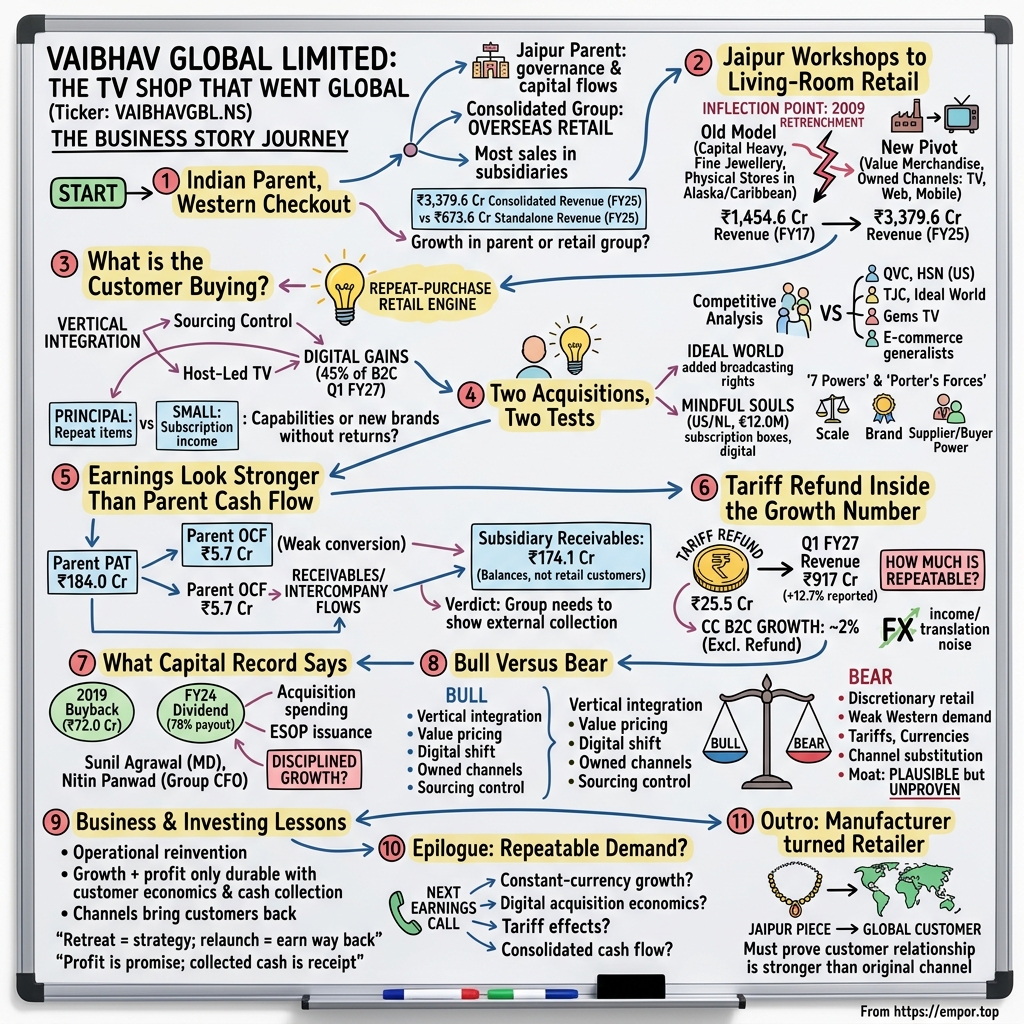
Vaibhav Global Limited: The TV Shop That Went Global
I. The Indian Parent, the Western Checkout
Late on a weeknight in Ohio, a woman picks up her remote, lands on a channel where a presenter is turning a gemstone pendant under studio lights, and orders it before the countdown clock runs out. A few weeks later, an accountant in Jaipur books a sale, an intercompany receivable and perhaps a dividend. Both events belong to the same company, Vaibhav Global Limited. They tell very different stories about it.
Here is the puzzle. In FY25, the Jaipur-based listed company, the legal entity whose shares trade on the NSE and BSE, reported standalone revenue from operations of about ₹674 crore.1 In the same year its consolidated group, which includes the overseas retail subsidiaries that actually face the customer, reported revenue of about ₹3,380 crore, roughly five times as much.1 Sitting above both is Brett Enterprises Private Limited, the promoter holding company, which owned 55.97% of VGL at 31 March 2026.2
So where does the growth happen: in the listed parent, or in the retail group beneath it?
The answer shapes everything that follows. The customer-facing business is the consolidated group. Shop LC in the United States, Shop TJC in the United Kingdom, Shop LC in Germany and the acquired brands all sell through subsidiaries.1 The parent in Jaipur manufactures and sources, sells goods to those subsidiaries, collects management fees and receives dividends. When accountants consolidate the group, those internal flows vanish, the way a family's finances do not change when one sibling pays another back.
That distinction is not pedantry. In FY25 the parent's profit was heavily supported by income from its own subsidiaries, and its operating cash flow was tiny relative to that profit (Section V takes this apart in detail).1 Read the parent's accounts as if they were the retail business and the result looks alarming. Read only the consolidated numbers and an investor misses how cash and control move between Jaipur and the overseas storefronts. Both views are needed. They answer different questions.
This episode keeps them apart throughout and asks four questions of the retail group:
- What makes customers buy here? Is there something specific about the product, the price or the presenter that brings people back, or is VGL simply cheap in a world full of cheap things?
- Has the company escaped its dependence on television? Shopping television is an ageing medium, and digital is where VGL says its future lies.
- Have its acquisitions earned their price? VGL bought two businesses in 2023; one has early evidence of traction, the other is less clear.
- Do reported profits turn into cash? The parent's FY25 cash flow raises that question sharply. The group's audited cash generation should answer it.
The structure also matters for governance. A promoter vehicle controls a majority. The Managing Director is paid partly through an overseas subsidiary (Section V).3 The listed parent lends to and collects from companies it controls.1 None of this is unusual for an Indian company with global operations, and none of it is evidence of wrongdoing. It does mean minority shareholders depend on disclosure to see the economics clearly.
The bottom line for investors is simple to state and easy to forget: judge VGL as a Western retailer reporting in rupees, and use the Jaipur parent's accounts to follow capital, not to measure customer demand. The retailer itself began as something quite different: a jewellery workshop in Jaipur selling to other people's stores.
 Subscribe on LinkedIn
II. From Jaipur Workshops to Living-Room Retail
Jaipur has cut and set coloured gemstones for centuries. In the old walled city, small workshops still pass rough stones from cutter to polisher to setter. Vaibhav Global's founder and Managing Director, Sunil Agrawal, grew up in that world. The company's early identity, recorded in its own milestones, was as a manufacturer of gemstone jewellery selling to other businesses: wholesalers, department stores and retailers abroad.4
The manufacturer's problem is ancient. You make the product, someone else owns the customer, and that someone else sets the price. VGL's history is a series of attempts to reverse that relationship.
The road to the customer
The route ran from Jaipur manufacturing and sourcing, through early business-to-business relationships with overseas buyers, into owned retail: physical stores in some markets, then shopping television in the US, UK and Germany, and later websites and mobile apps.4 Each step moved the company closer to the end buyer and put more of the retail margin, and more of the retail risk, on its own balance sheet.
Television was the decisive bet. A shopping channel is a strange kind of store. It has one aisle, one product at a time, a host who acts as both salesperson and entertainer, and a clock counting down. It suits a vertically integrated jeweller unusually well. Coloured stones are hard to sell from a static photo but easy to sell when someone tilts them under a light and explains where they came from. And a manufacturer that controls cutting, setting and sourcing can feed a channel that needs new product hour after hour.
The 2008–09 shock
Then the model broke. The 2008 financial crisis hit discretionary Western spending hard, and VGL's mix of fine jewellery, physical stores and expansive market entry was poorly suited to it. In 2009 the company retreated: it exited the German TV market and closed physical stores in Alaska and the Caribbean, then repositioned toward lower-priced products and online retail.45
This should not be told as a heroic origin myth. It was a genuine falsification of the earlier strategy. A capital-heavy, store-led, higher-price-point model did not survive a severe demand shock, and management closed businesses where it could not see a path to cash generation.5 That willingness to cut is real evidence about how this team behaves under pressure. It is also evidence that VGL's original model was wrong in important ways.
The new model was value merchandise sold through channels VGL owned: jewellery, gemstones and, over time, lifestyle products at prices low enough to be impulse purchases.1 The company says it produced between 14,000 and 15,000 new jewellery designs in FY25.1 That cadence matters more than any one design. A shopping channel burns inventory like a furnace burns coal; without constant novelty, viewers stop watching.
What the growth record shows
Consolidated revenue was about ₹1,455 crore in FY17.6 By FY25 it had more than doubled.1 That is substantial expansion for a business that nearly stalled a decade earlier. It does not, by itself, prove pricing power. Some of it came from currency translation, because VGL earns in dollars, pounds and euros and reports in rupees, and a weaker rupee mechanically lifts reported revenue. Some came from acquisitions made in 2023. What remains is real organic growth of a value retailer, but it is the growth of a company winning wallet share at low price points, not one demonstrating that it can raise prices.
Germany, again
One footnote to the 2009 retreat became a test case. VGL went back into Germany, launching Shop LC DE in 2021.4 Four years later the FY25 report still described the German business as reaching EBITDA breakeven only in the second half of that year.1 Re-entry is not the same as proven returns, and a breakeven milestone measures operating losses ending, not capital being earned back.
Sunil Agrawal still runs the company as Managing Director, with Nitin Panwad as Group CFO; there was no change in key managerial personnel during FY26.2 The older leadership history matters less than this: the person who made the 2009 exit decisions is the same person now steering the shift from television to digital. That continuity is useful for judging behaviour over time, and it means there is no new manager to blame if the next pivot misfires.
The 2009 lesson is that VGL can recognize a broken model. Whether it has built a durable one depends on what, exactly, the customer is buying.
III. What Exactly Is the Customer Buying?
Picture the moment on air. A host holds up a sterling-silver ring set with a coloured stone. The camera pushes in. A price appears, low enough that the viewer does not need to think about it for long. A quantity counter starts falling. Calls and app orders come in. When the counter hits zero, the next item appears.
That is VGL's product. It is not only the ring. It is the show, the price, the scarcity and the habit of tuning in.
The unit of sale
The transaction unit is mostly a single item or order, recognized as revenue when control passes to the customer.1 In FY25, consolidated product sales were about ₹3,357 crore, while subscription income was only about ₹10.5 crore.1 So this is a repeat-purchase retail business, not a subscription business. The recurring element is customer behaviour: viewers come back night after night, but are not bound by a contract. VGL does not disclose minimum commitments, contract lengths or retention cohorts.1
How big are the storefronts?
The FY25 subsidiary figures give a sense of scale. Shop LC US had sales of about $225 million, Shop TJC UK about £86 million, and Shop LC Germany about £31 million.1 The United States is the engine: ICRA put the US at roughly 59% of sales.7 These are operating brands within a single reported segment, not separate businesses with separately audited profits, so investors cannot see channel-level or country-level margins.
Television to digital
The channel map is the heart of the strategic question. Television remains important. Digital now covers proprietary websites, mobile apps, marketplaces, OTT streaming and social channels.8 In Q1 FY27, management said digital reached 45% of B2C revenue.8 That is a meaningful transition marker. It is not proof that the transition is complete or profitable. Digital revenue that is simply TV viewers ordering through the app instead of the phone is a change of checkout, not a new source of demand.
The competitive arena
VGL competes in two arenas at once. In shopping television it faces QVC and HSN in the US, and in the UK it competes with other channels including Gems TV (Ideal World is now one of its own channels; see Section IV). QVC Group is the benchmark, with annual revenue measured in billions of dollars across its businesses.9 VGL's US business is a small fraction of that. In digital, VGL competes with every online retailer and marketplace fighting for the same discretionary dollar.
VGL does not publish market-share or customer-retention figures that would establish category leadership. Its edge has to be argued from mechanism, so here is the full argument, made once.
The moat test
Scale economies. VGL could gain from scale in sourcing, studios, fulfilment and content: a studio and a merchandising team cost roughly the same whether they sell a thousand rings or ten thousand. But group scale remains far below QVC's.9 Scale is a possible advantage against small UK channels, not against the category leader.
Counter-positioning and process power. The interesting claim is vertical integration: a retailer that also designs and manufactures can turn new products faster and at lower cost than a channel buying from wholesalers. That is a plausible process advantage, and the design cadence is consistent with it.1 VGL does not quantify its cost advantage against peers, so the claim stays plausible rather than proven.
Brand and switching costs. Shop LC and TJC have direct relationships with customers and a host-led format that some viewers clearly enjoy. Evidence of switching costs is thin. A viewer who stops watching loses nothing except a habit.
Buyer power and substitutes. Individual buyers are fragmented, so none has bargaining power. But collectively they can switch to Amazon, Etsy, marketplaces or other channels with almost no friction. The substitute threat is the dominant force.
Supplier power. Global sourcing plus in-house manufacturing should limit supplier leverage, but VGL does not quantify supplier dependence.1 India's role as a key jewellery sourcing base has become a tariff exposure (Section VI).7
Rivalry and channel access. TV carriage, digital discovery and consumer attention all have alternatives. The digital shift helps reach, but also places VGL's products next to direct price comparisons, something a live TV audience rarely made.
Verdict: the moat is plausible but narrow. It rests on sourcing and merchandising speed plus a loyal TV-bred audience, and the company does not disclose the numbers that would prove either.
Technology without economics
Management talks about AI in merchandising, content and customer service.8 It may help. VGL's filings do not quantify its contribution or show it as a current earnings driver, so it belongs in the "watch" column, not the thesis.1
The proof points to look for in calls and reports are concrete: repeat-customer share, digital customer acquisition cost and payback, gross margin by channel, return rates and local-currency sales. Until those appear, the edge remains a story VGL tells about itself. And in 2023, the company tested that story by buying two other people's businesses.
IV. Two Acquisitions, Two Different Tests
In 2023 a familiar British shopping channel went quiet. Ideal World, which had sold everything from kitchen gadgets to craft kits to a generation of UK viewers, had collapsed into administration. VGL bought its assets, including broadcasting rights, equipment and the brand, for £1.125 million.3 For a company that had once retreated from markets that could not make money, it was a cheap option on a recognised name.
The same year, VGL made a different kind of bet. It acquired Mindful Souls, a Netherlands-based digital seller of wellness and lifestyle products including subscription boxes, which generated more than 80% of its revenue in the US.3[^10] The FY24 annual report puts the price at €12.0 million.3 On the Q2 FY24 call, management described it as €12.5 million.10 The gap is small and may reflect deal adjustments or deferred consideration; investors should use the audited figure.
Two theses, two tests
The deals are a matched pair that test different claims.
Ideal World tests operational know-how. If VGL's edge really lies in running shopping channels efficiently, it should be able to take a failed UK channel, plug it into its sourcing and fulfilment, and make it profitable. Early evidence supports that version: Ideal World generated about £21 million of revenue in FY25, and the FY25 report says it reached full-cost EBITDA profitability in the second half.1
That is encouraging, with two cautions. First, revenue is not payback. A £21 million revenue line on a £1.1 million asset price sounds spectacular, but the purchase price was never the main cost: working capital, integration, staffing and the losses before breakeven were. Second, one half-year of EBITDA profitability is a milestone, not a track record.
Mindful Souls tests digital capability. The thesis, as Nitin Panwad described it, was to add a digital-first business with its own customer acquisition skills and a subscription model.[^10] That is the capability VGL needs for its digital shift. But the evidence that the deal has paid off is thin. VGL does not disclose Mindful Souls' standalone profitability, return on the purchase price, or the cross-selling and sourcing synergies it realised. Group subscription income remained small in FY25, suggesting the model had not become a major revenue line.1
Cheap or expensive?
The disclosures do not support a credible comparison with peer acquisition multiples, so this account will not claim either deal was cheap or expensive in valuation terms. Ideal World was small in absolute terms and has early operating traction. Mindful Souls was more substantial and remains unproven.
The historical counterweight
VGL's 2009 exits show a willingness to close ventures that fail a cash-generation test.5 That is the right reference point for these deals: it shows the discipline exists, not that these acquisitions will pass. The German relaunch, with breakeven years after re-entry, shows that the company also tolerates long periods of losses on strategic bets.14
So the acquisition verdict is: one early operational win, one capability bet waiting for evidence. Both depend on the same underlying question as the rest of the business: do profits turn into cash? At the parent, in FY25, that answer looked worrying.
V. Earnings Look Stronger Than the Parent's Cash Flow
Here is the scene that should make any careful reader stop. In FY25, Vaibhav Global's listed parent reported profit after tax of about ₹184 crore. Its cash flow from operations was about ₹5.7 crore.1
That is roughly three rupees of cash for every hundred rupees of profit. In most companies a gap like that is a red flag. Here, the question is what kind of flag.
Walking the bridge
Start where accountants do. The parent's operating profit before working-capital changes was about ₹61 crore, far below its PAT, because a large part of that PAT came from other income that is not operating cash (more on that below).1 Then working capital absorbed cash. Trade receivables rose by about ₹114 crore, and inventory by about ₹27 crore; higher payables and other liabilities offset roughly ₹27 crore of that.1 Trade receivables roughly doubled, from about ₹104 crore to about ₹212 crore.1
Now the key clue: about ₹174 crore of the parent's trade receivables were due from its own subsidiaries.1 Those are not unpaid retail customers in Ohio or Leeds. They are amounts Shop LC US and its siblings owe Jaipur for goods. The parent also had about ₹23 crore of loans to subsidiaries, against which it booked about ₹2.35 crore of impairment.1
The reveal
The parent's weak cash conversion is chiefly an intercompany timing issue: the subsidiaries bought goods and had not yet paid the parent at year end. That does not mean group retail earnings convert badly. It also does not prove they convert well.
It matters for two reasons. First, intercompany payment timing is controlled by management. A parent can be paid faster or slower depending on where the group wants cash to sit, for tax, financing or currency reasons. Second, the subsidiary receivable carried no impairment allowance.1 That is reasonable if the subsidiaries are healthy, but the parent's loans to subsidiaries were impaired, which shows not every intercompany balance is beyond question.
Who owes the group money?
The group's external receivables are mainly due from retail customers in the US and UK, and VGL conducts quarterly impairment analysis based on ageing and collection history.1 VGL does not publish a detailed group receivables ageing table or a history of doubtful debts. For a retailer selling mostly by card, external credit risk should be low, but the company does not provide the numbers to confirm it.
Where the parent's profit came from
The parent's FY25 other income was about ₹124 crore, against profit before tax and exceptional items of about ₹146 crore.1 Of that other income, about ₹91 crore was dividends from subsidiaries and about ₹11 crore management fees.1 In other words, most of the parent's pre-tax profit came from its own subsidiaries, and that income disappears on consolidation. At group level, other income was a much smaller ₹28 crore, including about ₹9 crore of net foreign-exchange gains, against consolidated PAT of about ₹153 crore.1
That is the cleanest single reason not to use the standalone PAT as a measure of the business. The parent's profit is largely the group's cash being moved upstairs.
Pay and ownership
Incentives fit into the same structure. Sunil Agrawal received fixed pay, bonus and profit-related commission from Shop LC Global Inc., the US subsidiary, according to the FY24 annual report.3 That ties his pay to the part of the business that matters, which is reasonable. It also means a key part of executive pay sits in a subsidiary, where the shareholder vote and disclosure are less direct. Promoter-group ownership near 56% gives Agrawal a large economic stake alongside public shareholders.2 Employee share options and restricted stock units continue to be allotted; weighted average shares rose from about 165.2 million to 165.8 million between FY24 and FY25.1 That dilution is modest so far, but it is persistent.
The FY25 auditors also flagged that they could not fully confirm audit-trail operation and retention in parts of the accounting software, including a new third-party jewellery-manufacturing system.1 That is a control point, not an accounting finding, but it belongs alongside any discussion of intercompany balances.
What would settle it
Three numbers would settle this: audited consolidated operating cash flow against consolidated profit, external receivables ageing and collections, and the movement in intercompany balances year on year. If the parent's subsidiary receivable shrinks in FY26 and group operating cash flow tracks profit, the FY25 parent gap was timing. If not, the question gets louder.
Cash conversion at the group level ultimately depends on whether customers keep buying. In 2026, that was being tested by an unusual force: tariffs.
VI. The Tariff Refund Inside the Growth Number
On 5 August 2026, Vaibhav Global's management reported a quarter that looked good on its face. Revenue was about ₹917 crore, up 12.7%.8 EBITDA margin rose to 11% from 9.2% a year earlier.8 Then the analysts started asking questions.
Peeling back the headline
Management's own answers took the headline apart. US B2C growth in dollar terms was about 2%, and largely flat once a US tariff refund was excluded; UK growth was flat.8 The refund itself was about ₹25.5 crore.8 Favourable currency movements lifted the rupee number further.8
Put plainly: most of the 12.7% reported growth was the rupee, the refund and the translation of foreign sales, not more customers buying more things. Underlying demand, in local currency, was roughly flat. The margin improvement is real in the reported numbers, but a one-off refund in the quarter flattered it, and it is not a repeatable operating gain.
The tariff story so far
Compare that with the earlier narrative. In August 2025, when steep US tariffs on Indian goods arrived, management said VGL had advanced inventory into the US ahead of the duties and could pass costs on to customers.11 ICRA, in its September 2025 update, estimated that 24–27% of VGL's business was exposed to elevated US tariffs, given the US's roughly 59% share of sales and India's role as a jewellery sourcing base.7
The mitigation plan has several parts: shifting sourcing away from India where possible, passing through price, and building an in-house jewellery-casting line in the US, which the FY26 presentation said helps mitigate tariff exposure.12 Each lever has a cost. Price pass-through tests whether a value retailer's customers will accept higher prices. Sourcing shifts weaken the vertical-integration story centred on Jaipur. A US casting line adds fixed cost in a high-wage country. The company has not yet quantified the actual gross-margin effect of these moves.
The question analysts kept asking
The Q1 FY27 call's analyst Q&A pressed on consecutive quarters of weak constant-currency growth and whether management's explanation—that US consumer spending was cautious—fully accounted for it.8 Management's answer leaned on the macro environment.8 That may be correct; Western discretionary spending was soft. But a macro explanation cannot be falsified by a single quarter, and it does not address whether product, channel or execution factors are also at work. A retailer whose digital mix is rising while total local-currency sales stay flat is, at least in part, moving existing customers between channels.
Currency as noise
Currency affects VGL twice. It moves reported revenue and profit through translation, and it flows through other comprehensive income. In FY26, consolidated OCI was about ₹111 crore, much of it currency translation.2 FY26 consolidated revenue and other income was about ₹3,733 crore and PAT about ₹266 crore; operating profit before depreciation and finance costs rose to about ₹400 crore from about ₹317 crore.2 Investors should read those numbers with currency movements in mind rather than treat translation effects as operating momentum. VGL hedges some exposure with forward contracts designated as cash-flow hedges, but that dampens rather than removes it.1
The guidance test
Management has set FY27 revenue and margin targets and a longer-range FY30 revenue ambition.812 The test for those numbers is not the reported rupee figure; it is local-currency sales and cash conversion after the tariff refund rolls off. A target met through rupee depreciation is not evidence of execution.
The risk radar here is economic, not generic: US discretionary demand, tariffs combined with India-heavy sourcing, product and fashion mix, sterling, euro and dollar movements against the rupee, and the rising cost of acquiring digital customers. Each one runs through gross margin or volume. How management has deployed capital through earlier shocks is the next clue.
VII. What the Capital Record Says About Management
In late 2019, before the pandemic, Vaibhav Global completed a share buyback, spending about ₹72 crore to repurchase shares.13 Four years later it spent money buying two businesses. In between, it paid generous dividends: the FY24 payout ratio was 78%.3
Put those decisions side by side and a pattern emerges, but not a simple one.
Four uses of capital
Dividends. A 78% payout is high for a company that also says it is investing in growth.3 It signals that management sees limited high-return reinvestment within the business, or that the promoter group values cash distributions, or both. Promoters owning a majority receive most of every dividend rupee.2
The buyback. The 2019 repurchase returned capital at a time the board judged appropriate.13 It was a single event, not a programme.
Acquisitions. Ideal World was small; Mindful Souls was larger and, as Section IV showed, unproven.3
Share-based pay. ESOP and RSU allotments continued through FY26.14 They are a cost to existing shareholders, even if a modest one.
The record therefore mixes shareholder returns, reinvestment and selective acquisitions. It supports a history of returning capital and one early acquisition traction point. It does not support a blanket claim of superior allocation.
The balance sheet
Debt is modest and working-capital driven. FY25 standalone borrowings were about ₹114 crore, short-term facilities secured on current assets and personally guaranteed by the Managing Director, with lease liabilities separate and small.1 The parent had foreign-currency floating-rate borrowings in FY26.15 ICRA reaffirmed A+ (Stable) and A1+ ratings in September 2025, citing about ₹262 crore of cash and liquid balances plus ₹86 crore of undrawn limits as of 31 August 2025, while flagging tariff exposure.7 That is comfortable near-term liquidity. The personal guarantee from the MD is a detail worth noting: it links the founder's personal balance sheet to the company's bank lines.
Management over time
Management continuity persisted through FY26.2 Its narrative has been consistent on the destination, more digital, more efficient sourcing, steady margins, and less precise on the route. The tariff narrative shifted as conditions changed, as Section VI details.118 Both can be true. Together they show that the earlier reassurance did not translate into growth.
Shareholder support should be judged from AGM voting results and remuneration disclosures, not inferred from promoter ownership, which delivers a majority on most resolutions regardless of minority views.14
The falsification test
The 2009 exit and later German relaunch show both sides: a willingness to cut weak operations and a willingness to tolerate long periods before breakeven.451 The capital record narrows the "disciplined allocator" claim to a smaller version: management cuts losses in a crisis and returns cash generously, but its recent growth investments have not yet proven their returns.
Which brings the story to the question every investor ultimately has to answer: why might this business win, and why might it not?
VIII. Bull Versus Bear: A Retail Flywheel or a Channel at Risk?
Put two exhibits on the table. The first is VGL's own description of itself: a vertically integrated retailer that designs, sources, manufactures and sells through channels it owns. The second is the analyst question on the Q1 FY27 call: if constant-currency growth is flat, what is actually driving the improvement?8
The bull case
The bull sees a flywheel. Low prices bring in viewers; owned TV channels turn viewers into buyers; those buyers move to apps and websites; digital reach brings new customers at lower cost; scale in sourcing and manufacturing keeps prices low. Digital reached 45% of B2C revenue in Q1 FY27, and EBITDA margin reached 11%.8 FY26 consolidated revenue and other income was about ₹3,733 crore.2 Ideal World shows the company can absorb a channel and make it profitable. Product mix is shifting toward lifestyle categories, broadening the addressable wallet. And the balance sheet, with net cash and an A+ rating, gives room to keep investing.7
The bear case
The bear sees a discretionary retailer facing weak Western demand with an ageing primary channel. The absence of customer concentration is not the same as loyalty: individual buyers can switch with a click, and VGL does not establish relative market share or pricing power. Digital growth may simply be cannibalising TV. Tariffs push against the India-centred sourcing advantage. Currency translation flatters reported results. Mindful Souls has not demonstrated its value. And without disclosed retention or customer-acquisition data, there is no way to verify that the flywheel turns.
Weighing it
As Section III argued, the moat is plausible but unproven. The Q1 FY27 numbers sharpen the point. A real flywheel should produce local-currency growth as digital mix rises. Flat local-currency growth alongside rising digital share is more consistent with channel substitution than with expansion. That does not refute the bull case; one quarter in a weak consumer environment cannot. It narrows it: VGL has shown it can protect margins and shift channels, not yet that it can grow customers in a soft market.
Three KPIs that settle the argument
- Constant-currency retail revenue by geography. Latest reading: US dollar B2C growth about 2% and roughly flat ex-refund; UK flat in Q1 FY27.8 Direction: weak.
- Digital mix alongside customer acquisition payback. Digital at 45% of B2C, rising; acquisition payback is not disclosed.8
- Consolidated operating cash flow against profit and external receivables. The parent's FY25 conversion was very weak for intercompany reasons; group-level evidence should be tracked each year.1
The activist question
No activist is involved in VGL. But a skeptical shareholder would ask: if the company holds a strategic cash cushion and has limited high-return capex, why not route more cash to buybacks or dividends rather than acquisitions whose returns are undisclosed? Management's answer, and evidence that Mindful Souls is earning its keep, would matter.
Price versus quality
None of this is a valuation verdict. Business quality and share price are separate questions, and operating facts alone do not say whether the market already prices in the bull or the bear case.
What the operating history does say is something about how this company learns, which is where the lessons begin.
IX. Business and Investing Lessons
Go back to 2009. Sunil Agrawal's company had just discovered that its stores and its German channel could not make money in a downturn, and it shut them.4 Then, over the next decade and a half, it rebuilt: cheaper products, owned TV, websites, apps, a relaunched Germany, a rescued UK brand. Revenue more than doubled between FY17 and FY25.61 And in FY25 the listed parent collected only about ₹5.7 crore of operating cash.1
Three lessons belong to this company.
"A channel is an asset only while it can bring customers back." Shopping television gave VGL something most manufacturers never get: a direct line into the living room. But the line is only as valuable as the audience that picks up. As viewers drift to streaming and phones, the channel's value lies in whether its customers follow the brand into digital or simply leave. VGL's 45% digital mix answers the first half of that question; flat local-currency sales leave the second open. For founders, the lesson is that a distribution channel is rented attention, however much you own the infrastructure.
"A retreat can be strategy, but a relaunch has to earn its way back." The 2009 German exit was a decision to stop losing money. The 2021 relaunch was a decision to try again, and it took years to reach breakeven. Investors often treat a company's courage in exiting as proof of good judgement in re-entering. VGL's own record shows those are different skills, and only the first is proven.
"Profit is a promise; collected cash is the receipt." The Jaipur parent booked a large profit that was mostly income from its subsidiaries, and received only a sliver of it as operating cash. The explanation, intercompany timing, is reasonable. But the lesson for any investor in a parent-subsidiary structure is to follow the money across the entity boundary before trusting the number at the top.
There is a fourth lesson, smaller but specific: "In a value retailer, growth in rupees is not growth in rings." When most revenue is earned in dollars and pounds, a falling rupee does part of the work. VGL's Q1 FY27 quarter is the case study.
Those lessons point to the moments that will decide the next chapter.
X. Epilogue
Tonight, VGL is a profitable, modestly leveraged retailer with a majority promoter, a long-serving founder, and an operating story at an awkward midpoint. Digital is nearly half of retail revenue. Margins have improved. Underlying demand, in the currencies its customers spend, is flat.
The next earnings call will be the first real test. Analysts will ask management to reconcile reported growth with local-currency sales, now that the tariff refund has been booked and cannot repeat. If constant-currency growth returns while margins hold, the bull case gains its missing piece: evidence that the flywheel turns in a soft market. If growth stays flat and margins slip back as the refund disappears, the bear's channel-substitution reading becomes harder to dismiss.
The FY27 guidance is the scoreboard management chose for itself.812 Watch whether it is met in constant currency or only in rupees, and whether management explains any gap with specifics or with the macro environment again.
Then watch the three markets separately. The US decides the group: its tariff exposure, its digital economics and its customer behaviour. The UK shows whether Ideal World's second-half profitability became a durable business. Germany shows whether the relaunch earns more than breakeven.
And watch the cash. The audited FY26 statements and subsequent filings show whether the parent's subsidiary receivables shrank, whether external receivables stay clean, and whether consolidated operating cash flow keeps pace with profit. Add share dilution from continuing ESOP allotments and whether Mindful Souls ever gets its own line of evidence.
The open question is whether VGL's customers are loyal to Shop LC or to the habit of watching television. The next few quarters will start to answer it.
XI. Outro
Back to the gemstone pendant on the Ohio television screen. It was cut in Jaipur, set in a workshop the company controls, priced by a merchandising team that knows how low it can go, presented by a host who knows how to sell it, and shipped by a subsidiary thousands of miles from the parent that made it.
That journey made Vaibhav Global its own retailer. The remaining question is whether the relationship it built with the customer is stronger than the channel that first created it.
References
-
Integrated Annual Report 2024–25 — Vaibhav Global Limited, 2025 ↩↩↩↩↩↩↩↩↩↩↩↩↩↩↩↩↩↩↩↩↩↩↩↩↩↩↩↩↩↩↩↩↩↩↩↩↩↩
-
Integrated Annual Report 2023–24 — Vaibhav Global Limited, 2024 ↩↩↩↩↩↩↩↩
-
Vaibhav Global: Can It Turn Around Its Fortunes? — Value Research ↩↩↩↩
-
Update on Entity: Vaibhav Global Limited — ICRA, 2025-09-23 ↩↩↩↩↩
-
Q1 FY27 Earnings Conference Call Transcript — Vaibhav Global Limited, 2026-08-05 ↩↩↩↩↩↩↩↩↩↩↩↩↩↩↩↩↩
-
Q2 FY24 Earnings Call Transcript — Vaibhav Global Limited, 2023 ↩
-
Q1 FY26 Earnings Call Presentation — Vaibhav Global Limited, 2025 ↩↩
-
Q4 and FY26 Investor Presentation — Vaibhav Global Limited, 2026 ↩↩↩
-
2019 Buyback Post-Offer Public Advertisement — SEBI, 2019 ↩↩
-
Shareholder Meeting Notices, Results and Voting — Vaibhav Global Limited ↩↩
 LinkedIn
 WhatsApp
 Reddit
 Hacker News
 Email
Email Kindle
 RSS Feed
 Spotify
 Apple Podcasts
 Amazon Music
 Audible
 YouTube