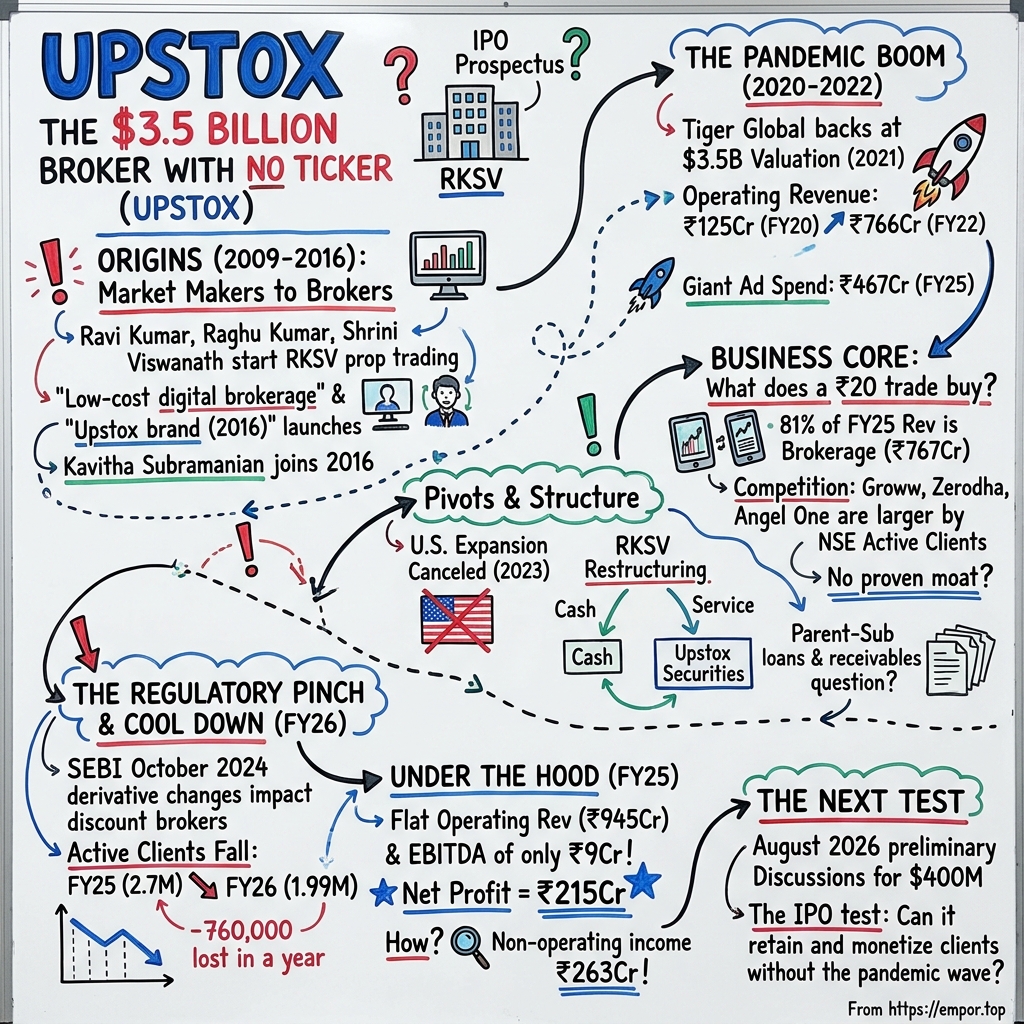
Upstox: The $3.5 Billion Broker With No Ticker
I. The $3.5 Billion Broker With No Ticker
In the third week of August 2026, word reached Mumbai's brokerage world that Upstox had begun talking to investment bankers. Bloomberg, citing people familiar with the matter, reported that the Tiger Global-backed broker was holding preliminary discussions about an initial public offering that could raise around $400 million, or roughly ₹3,800 crore, through a mix of new shares and shares sold by existing investors.1 The company declined to comment, no bankers were named, and the report itself warned that size and timing could change.1 Still, the conversation had begun, and with it a question that private-market investors had been able to postpone for five years: what is Upstox actually worth?
The number that hangs over the company is $3.5 billion. That was the valuation attached to Upstox when it entered India's unicorn club in 2021, at the height of a retail trading frenzy.1 It was a financing mark, set in a private round, by a small group of buyers, at a moment when Indian trading apps were signing up first-time investors faster than they could verify their documents. It was never a market price in the sense that a listed share has one, and in the five years since, nothing has replaced it.
Put that mark beside the business today and the tension is plain. In the year to March 2025, Upstox's consolidated operating revenue was ₹945 crore, slightly below the ₹951 crore of the year before.2 Profit rose to ₹215 crore, but the operating business before interest, tax, depreciation and amortisation earned only about ₹9 crore; the profit came mostly from ₹263 crore of non-operating income.2
Then the customer base began to shrink. Over the year to March 2026, Upstox lost about 760,000 active clients on the National Stock Exchange, ending the year with roughly 1.99 million, while the exchange's total active base fell about 7%.3 A company that had once been the market's growth story was now losing customers roughly four times as fast as the market.
That is the puzzle this story sets out to solve. Upstox built one of India's best-known trading apps. It spent heavily to put that app in front of millions of people. It remains profitable on paper. Yet the clues point in different directions, and an investor preparing to underwrite a listing has to sort them before anyone else sets a price.
Four questions organise the investigation. The first is whether the core brokerage business, which still produces most of the revenue, can grow again after a boom that flattered everyone. The second is whether the profit reflects a stronger operating business or income earned outside the core. The third is whether Upstox has anything that resembles a defensible edge in a market where price is visible in one glance and customers can open a second account in minutes. The fourth is whether management's strategy, and the company's legal structure, can survive the scrutiny that a prospectus and quarterly public reporting would bring.
Before any of that, the boundaries need to be set. Upstox is a brand, not a listed company. The legal parent is RKSV Securities India Private Limited. In March 2024, RKSV moved its equity, futures and options, currency and depository operations into a wholly owned subsidiary, Upstox Securities Private Limited, while commodity trading on the MCX stayed in another subsidiary, RKSV Commodities India Private Limited.4 When this story talks about Upstox's economics, it means the consolidated group. When it talks about RKSV, it means the parent alone, whose accounts are dominated by fees and loans that move between group companies and disappear when the group is added up.
As of 16 November 2026, no draft red herring prospectus or other offer document from Upstox or RKSV appears in the Securities and Exchange Board of India's public-issue filings, in the regulator's status report on draft offer documents dated 9 November 2026, or in the National Stock Exchange's status report as of 31 October 2026.567 There is no exchange-listed share price, no price band and no fresh issue. What exists is a five-year-old valuation, a set of filed annual accounts, exchange client data, interviews, and press reports that describe talks rather than a filing.
That matters for how the evidence should be weighed. The August reports are a possible next chapter, not a verdict. A listing would force Upstox to produce audited consolidated statements, a formal risk-factor section, a related-party schedule, a capital table and an explanation of where the money from any fresh issue would go. Until then, every judgment about value has to be built from the operating record, and the operating record is where the story becomes interesting. To understand how a company can carry a multi-billion-dollar mark on revenue of under ₹1,000 crore, it helps to go back to a trading firm that had no consumer brand at all.
 Subscribe on LinkedIn
II. The Market Makers Who Became Brokers
Upstox did not begin as a consumer app. It began as a trading business run by people who spent their days watching order books. The company's own account says it received its licence to begin trading in India in 2010, under the entity that is now Upstox Securities, and that it entered retail trading in 2012.8 The National Stock Exchange's records agree on the first date: the broker has been enabled for trading in the cash and futures-and-options segments since August 2010.[^9] Recent reporting dates the founding of the parent to 2009 and names Ravi Kumar, Raghu Kumar and Shrini Viswanath as its founders, though even that detail varies, with another Inc42 report giving 2008.91
For its first couple of years, then, RKSV was a firm that traded, not a firm that served traders. That origin shaped the product. People who trade for a living care about speed, cost and reliability in a way that casual investors rarely articulate, and the founders built their first retail offer around a feature traders immediately understand.
When RKSV entered retail broking in 2012, it says, it was the first to launch unlimited trading plans: customers paid a fixed price rather than a commission on each trade.8 Business Today later described Upstox as the first online broker to offer unlimited trading at a fixed price.10 Within two years, the company says, its customers were generating trading turnover of ₹4,000 crore.8
The insight was simple and close to the founders' own experience. Indian broking had long been dominated by banks' broking arms and full-service houses that charged a percentage of the value traded. For an active trader, that could make frequent trading prohibitively expensive. A flat price turned the economics around. The more someone traded, the cheaper each trade became. Other young firms, Zerodha most prominently, were making similar bets on low, fixed pricing, and the discount model spent the following decade dismantling the economics of the old commission houses.
What the founding insight did not provide was a moat. A flat or capped fee is the kind of innovation that is obvious once someone has done it, and in Indian broking everyone eventually did. The question that has followed Upstox for the rest of its history was already visible in 2012: once low prices became the industry standard, what would make a customer stay?
The person who spent much of the following decade on that question arrived in 2016. Kavitha Subramanian, a Mumbai native with engineering degrees from IIT Bombay and an MBA from Wharton, had worked at McKinsey's Mumbai office, at SKS Microfinance and in private equity at LeapFrog and Actis before joining the company as a co-founder in 2016.11 Her remit, by the company's description, came to span growth, strategy, finance and customer experience.11 Today Upstox lists three co-founders on its website: Ravi Kumar, Kavitha Subramanian and Shrini Viswanath.8
The same year brought two other changes. In February 2016 the company raised $4 million in a round led by Kalaari Capital, and Ratan Tata, the former chairman of Tata Sons, made a personal investment that YourStory put at about $200,000.11 By that point the firm already had an app called Upstox and a platform called Upstox Pro, and the business soon became known by the app's name rather than the parent's initials.11 Public accounts differ on exactly when the rebrand took hold, but the direction was clear: RKSV was becoming a consumer brand.
That shift carried a hidden cost that would only become obvious later. A trading firm earns money from its own decisions. A consumer brokerage earns money from the decisions of millions of strangers, and it must first persuade those strangers to arrive. Every retail broker therefore faces a trade-off between what it spends to acquire customers and what those customers are worth over time. In 2016 that trade-off was abstract. Within five years it would dominate Upstox's income statement.
The founders' background gave Upstox credibility with active traders and a product sense that the large incumbents lacked. It also left the company with a particular strength and a particular blind spot. The strength was execution and cost: building a platform that could handle a large volume of trades cheaply. The blind spot was retention: low-cost access lowers the cost of trying an app, but it does not by itself create a reason to come back. To see why that distinction matters so much, it helps to follow a single ₹20 order through Upstox's economics.
III. What Does a ₹20 Trade Actually Buy?
Open the Upstox app today and the pricing is printed in large type. Equity delivery trades cost ₹20 per executed order. Intraday equity trades cost ₹20 or 0.1% of the trade value, whichever is lower; equity futures cost ₹20 or 0.05%, whichever is lower; and equity options cost a flat ₹20 per order.12 Mutual funds and IPO applications carry no brokerage at all.12 Account opening is free, though the company notes that an account processing fee may be charged during onboarding, and customers who are not on the basic demat service pay an annual maintenance charge of ₹300 plus tax after their first year.12
That price card tells a listener almost everything about how the business earns money. Upstox is paid when its customers trade. Each executed order is a small toll, and the toll is capped at a level low enough that a customer barely notices it. Investing products such as mutual funds are given away to bring customers in and keep them engaged, in the hope that they will also trade. Depository charges and other fees add some revenue that does not depend on trading, but they are small by comparison.
The reported revenue mix confirms it. Of the ₹945 crore in FY25 operating revenue, brokerage contributed ₹767 crore, or about 81%. Depository operations added ₹65 crore, and management services and other operating revenue made up the remaining ₹113 crore.2 The company's filed accounts recognise brokerage on the trade date and depository maintenance fees over the period of service, but Upstox does not disclose how much of its revenue comes from recurring annual or quarterly fees as opposed to transaction-based income.13 For practical purposes, four rupees in five depend on customers choosing to trade.
That makes the most important number in the business not the number of accounts opened, nor the number of app downloads, nor the "2 crore+" Indians the company says love and trust it.8 The important number is how many customers trade actively, how often they do it, and how much each pays. A registered user who opened an account during the pandemic and has not traded since is a cost, not an asset: someone who must be reminded, serviced and kept compliant without producing revenue.
Measured by the National Stock Exchange's count of active clients, the customers who are actually trading, Upstox is no longer close to the leaders. At the end of March 2026, Groww had about 1.29 crore active clients, Zerodha about 69 lakh and Angel One about 68 lakh.14 Upstox, with about 19.9 lakh, had roughly one-sixth of Groww's active base and less than a third of Zerodha's.3 Its share of the exchange's active clients fell from about 5.6% to about 4.4% during the year, while Groww's rose to more than 28%.15 By July 2026, NSE data put Upstox fifth among brokers, behind ICICI Securities, with about 18.6 lakh active users.1
Size matters in broking for reasons that go beyond bragging rights. A broker's costs are heavily fixed: technology, compliance, surveillance and customer support do not halve when the customer base halves. A larger active base spreads those costs over more trades. It also feeds the most powerful acquisition channel a broker has, which is word of mouth from friends and colleagues who already use the app. Groww's ability to win 116% of the industry's net additions in January 2026, while the rest of the industry lost customers, shows how strongly that flywheel can turn in favour of the leader.15
The revealing comparison is not just size, but what each broker earns from its customers. Dividing FY25 operating revenue by year-end active clients is a rough measure, because client counts move during the year and revenue lines are not identical across companies. It is still telling. Upstox's ₹945 crore of revenue across about 27.5 lakh active clients at the end of FY25 works out to roughly ₹3,400 per active client.23 Groww, with about ₹3,900 crore of FY25 operating revenue and about 1.29 crore active clients, earned roughly ₹3,000 per active client.214 Zerodha, with about ₹8,850 crore of revenue and about 79 lakh active clients at the end of FY25, earned more than ₹11,000 per active client.23
So Upstox's customers are not unusually unprofitable to serve at the top line. They pay roughly what Groww's customers pay. The difference is what happens below the revenue line. Groww reported FY25 profit of about ₹1,819 crore on its larger base.16 Zerodha reported profit of about ₹4,237 crore.2 Upstox's operating business earned approximately nothing before interest, tax and depreciation.2 Its problem is not price realisation. It is the cost of getting and keeping the customer.
The competitive structure explains why that cost is so hard to escape. Seen through Michael Porter's five forces, Indian retail broking is a tough place to earn excess returns. Customers have strong bargaining power, because prices are public and nearly identical, and because opening a second account is quick and free. Many active traders hold accounts with more than one broker and route orders wherever the app works best that day.
Substitutes multiply: mutual-fund platforms, bank apps and full-service brokers all compete for the same savings. The exchanges and the regulator act like powerful suppliers, setting transaction charges, margin rules and product design, as later events showed. The threat of entry has been demonstrated repeatedly, most dramatically by Groww, which reached the top of the active-client table within a few years.
Hamilton Helmer's seven powers offer a stricter test, because they ask what would let a company earn returns above its cost of capital for a long time. Scale economies are real in broking, but they belong to the leaders, and Upstox's share is shrinking. Network effects are weak, because one trader's presence on Upstox does not make the app more valuable to another.
Switching costs exist in a mild form, because moving holdings and relearning an interface is a nuisance, but they are not strong enough to stop customers from trading elsewhere. Brand counts for something in a business built on trust, and Upstox's marketing has made it well known. Counter-positioning was the founders' original weapon against high-commission incumbents, but it lost its force once every serious competitor copied the low-price model. Cornered resources and process power are not evident in the public record.
The honest assessment is that Upstox is a recognised retail platform with a broad product menu and no proven moat. Its edge, if it has one, would have to show up in customer behaviour: higher retention than peers, more trades per active customer, or a lower cost of service. The company has made claims in that direction. In March 2026 Ravi Kumar told Business Today that retention among high-value traders was close to 90% and that average revenue per user had risen more than 40%.17
Those are management claims, not audited disclosures, and they sit awkwardly beside a fall of about 28% in exchange-reported active clients in the same financial year. Both can be true if Upstox kept its most valuable traders while losing a long tail of occasional ones, but a public investor would need the cohort data to know. Upstox does not publish it.
That leaves the central unit-economics question unanswered in the company's own disclosure. What does it cost to acquire an active customer, how long does that customer stay, and how much brokerage does the average customer generate over that life? The answer would determine whether Upstox's marketing builds an asset or simply rents attention. To see how the company came to spend so much on attention, the story has to return to the years when attention was cheap and the market was flooding with new investors.
IV. The Pandemic Made the Numbers Look Easy
In the spring of 2020, India locked down, salaried workers found themselves at home, and the stock market fell sharply and then began one of the fastest recoveries in its history. Millions of young Indians opened their first demat accounts. Upstox was in the right place with the right product: a low-cost app, a simple onboarding process and a brand built for people who had never visited a broker's office.
The numbers show the scale of the surge. Business Today reported that Upstox's customer base rose from nearly 2 million in January 2021 to more than 7 million later that year.10 By May 2022, Business Standard reported that Upstox had doubled its user base in six months to 10 million.18 CDSL recognised it for the highest number of demat accounts opened in a single month in October 2021, an award Upstox still lists on its website.8 Revenue followed. Operating revenue went from ₹125 crore in FY20 to ₹386 crore in FY21, roughly tripling in a year.19 In FY23 it rose 44% to more than ₹1,000 crore.20
Growth of that kind always invites a question: how much was the company, and how much was the market? The honest answer for Upstox is that both mattered, but the market mattered more than the early financing narrative admitted. Every Indian discount broker grew rapidly in 2020 and 2021. Upstox grew faster than many, which shows its marketing and product worked. Yet the later reversal shows that the pandemic boom was not a dependable base from which to project the future.
Profitability did not keep pace with growth. Upstox had earned a post-tax profit of about ₹13 crore in FY19, then moved to a loss of about ₹38 crore in FY20.21 Its FY21 loss roughly doubled to about ₹72 crore as employee and other expenses rose faster than revenue.19 The company was buying growth, and growth at the time was what investors wanted to buy.
They paid handsomely for it. Tiger Global, the New York investment firm, first backed Upstox in September 2019, investing $25 million, a deal Business Standard reported as ₹178 crore for a stake of about 31%.111 That implied a whole-company value of under ₹600 crore. Two years later, in November 2021, Tiger Global returned. Regulatory filings reviewed by Entrackr showed Upstox allotting 18,761 Series C preference shares at ₹98,608 each to raise about ₹185 crore, or $25 million.21
Entrackr estimated the post-money valuation at about $3.4 billion, or ₹25,458 crore, and noted that the price per share was 28 times the Series B price of ₹3,514.21 Business Today reported a larger round of about $200 million at a valuation of $3.5 billion, led by Tiger Global.10 The figure that entered company folklore, and later Upstox's own press releases, was $3.5 billion.20
The discrepancy between $25 million and $200 million is not trivial, because it bears on how much weight the mark deserves. A valuation is the price paid for a slice of a company multiplied up to the whole. If the slice was a ₹185 crore allotment of preference shares to an existing investor, the $3.4 billion figure was extrapolated from a transaction worth less than 1% of the implied value. Preference shares in Indian venture rounds commonly carry rights that ordinary shares do not, such as priority in a sale, anti-dilution protection and information rights.
Upstox has not disclosed the terms attached to its Series C shares, so a public investor cannot tell how much of the headline price paid for protection rather than for the business. Later data providers count about $220 million raised across six rounds in total.1 Either way, the 2021 valuation was set by an existing shareholder doubling down at the height of the market, not by a broad auction.
The money bought reach. Upstox became one of the most visible brands in Indian consumer finance, with large advertising campaigns and sponsorships. The cost of that visibility appears in the most recent accounts. Advertising and promotion expense was ₹455 crore in FY24 and ₹467 crore in FY25, the single largest expense line and nearly half of total expenses of ₹991 crore.2 Put another way, Upstox spent about 49 paise on advertising for every rupee of FY25 operating revenue.
That is where the pandemic's flattering arithmetic begins to unwind. Advertising can build something lasting if it brings customers who stay and trade for years. It can also build very little if it brings customers who try the app once and leave. The exchange data suggest the second pattern played a large part in Upstox's history.
YourStory reported in 2023 that Upstox's active clients fell from about 4.9 million in January 2022 to about 3.4 million in January 2023, among the steepest declines in the industry, at a time when Zerodha, Groww and Angel One were gaining share.2211 By the end of FY25 the figure was about 2.75 million, and by the end of FY26 about 1.99 million.3 The company had lost roughly three in five of its peak active clients in four years.
The FY26 drop is especially revealing because it can be compared with the market. The National Stock Exchange's total active-client base fell about 7% that year, from about 4.92 crore to about 4.57 crore, as volatility, weak earnings, foreign selling and geopolitical tension cooled retail trading.143 Upstox's active base fell about 28%. Zerodha and Angel One also lost clients, about 13% and 11% respectively, while Groww held its base roughly flat.314 The market explains why everyone suffered. It does not explain why Upstox suffered more than twice as much as its closest rivals.
Set the advertising bill beside the client count and the question becomes sharper. In FY25 Upstox spent about ₹467 crore on advertising and ended the year with about 2.75 million active clients, roughly ₹1,700 of advertising per active client, against revenue of roughly ₹3,400 per active client.23 In FY26, the active base shrank by more than a quarter. Unless the FY26 advertising budget fell sharply, which Upstox has not yet shown in filed accounts, the company was spending heavily to stand still or go backwards. The evidence does not establish that its marketing has bought durable loyalty or attractive acquisition economics.
That conclusion bears directly on the 2021 valuation. A mark set when active clients were near their peak and revenue was doubling cannot simply be carried forward to a company whose active base has fallen by roughly three-fifths. Any valuation discussion now has to start from disclosed operating performance. There is no public-market multiple for Upstox, and no transaction since 2021 has reset the price in a way that outside investors can test. Before the story turns to what the company is worth today, it has to look at how management responded when the boom ended, because the response says a good deal about whether the people in charge can manage a business in reverse as well as in growth.
V. The U.S. Plan That Was Put on Hold
In May 2023, YourStory published an account of a company in upheaval. At least half a dozen senior executives had left Upstox over the previous year, the publication reported, including a Silicon Valley finance head who departed after about two months.22 The losses reached deep into the technology organisation: by YourStory's account, the chief technology officer, the head of human resources, the chief growth officer and a senior engineering director all left during 2022 and 2023, and the technology team shrank from about 400 people to roughly 270 full-time staff and about 30 contractors.11
In the same report, Ravi Kumar explained that Upstox had abandoned its plan to expand into the United States. "These past couple of years have been so exciting on the India side," he said, "that we decided to just forget about the global expansion." A company spokesperson confirmed that the U.S. plan had been paused.22
Read one way, that was a disciplined decision. India's retail investment market was growing quickly, Upstox's home position was under attack from Groww and Zerodha, and spreading management attention across two continents during a downturn would have been a gamble. No material U.S. acquisition was made, so whatever was spent on the international plan appears to have been mostly people and preparation rather than a large write-off. A founder who says, in effect, "we got carried away and are coming home" is doing something many founders cannot.
Read another way, the episode shows a growth plan that had outrun the company's ability to execute it. The U.S. ambition coincided with a period of extraordinary promises at home. In April 2022, Business Standard reported Ravi Kumar's expectation that Upstox's customer base would grow threefold in FY23.23 The following month, the paper reported that the user base had doubled in six months to 10 million.18 A tripling from that base would have put Upstox somewhere near 30 million users by March 2023.
Today, more than three years later, the company describes itself as trusted by "2 crore+" Indians, which is to say more than 20 million.8 Registered users are an easy measure to inflate and a poor measure of revenue, but even on that generous yardstick the FY23 target was missed by a wide margin. On the stricter measure of active clients, Upstox was shrinking during the very year it had hoped to triple.22
The leadership exits are harder to interpret. YourStory quoted anonymous former employees who described a culture of founder interference and micromanagement. Ravi Kumar disputed that picture, attributing most departures to personal reasons while acknowledging that a few were probably linked to the company's changed priorities. He said the Dallas-based technology chief, Thippesha Dyamappa, would remain as a consultant.22
Anonymous complaints from departed staff are not evidence of governance failure, and executives leave growth companies for ordinary reasons, especially when a strategy they were hired to execute is cancelled. But the pattern matters because it touched the functions that determine whether a broker can compete: technology, growth and people. The public record does not settle whether the exits reflected personal choices, a deliberate change in priorities or deeper friction. A prospectus would at least have to list the current key managerial personnel and their tenure.
What the public record does show is how the company paid for its talent once the turmoil passed. Group employee-benefit expense rose 11% to ₹211 crore in FY25, of which ₹13.6 crore was the non-cash cost of employee stock options.2 That is less than half of the advertising bill, which says something about where Upstox has chosen to put its money: into reaching customers rather than into a much larger engineering organisation.
The international story did not end with the pause. Upstox kept a footprint abroad. In its FY25 parent accounts, RKSV recorded expenses paid on its behalf by two overseas related companies, EPowerX Pte Ltd and Upstox Middle East-FZCO, and reported foreign-exchange outgo of about ₹48 crore with no foreign-exchange earnings.13
In September 2026, Upstox launched U.S. stock investing for Indian customers through the GIFT City branch of Upstox Securities, offering access to more than 8,000 U.S.-listed stocks and over 2,000 exchange-traded funds, with fractional investing from as little as $1.9 "International investing represents the next significant phase of growth for India's wealth ecosystem," Ravi Kumar said at the launch.9 The approval came at about the same time as similar approvals for Zerodha, Groww and Angel One, so the product is a catch-up feature rather than a differentiator.9
That reversal is instructive. In 2023, global expansion meant taking Upstox to American customers, and it was dropped. In 2026, global expansion means taking American stocks to Indian customers through a regulated Indian channel, and every major competitor is doing the same thing. The second plan is cheaper and better suited to Upstox's strengths. It also illustrates how little the earlier pivot protected: the company returned to India to defend its home market, and then lost customers sharply.3
The cleanest evidence of management quality in a private company is behaviour against commitments. Measured that way, the record has some genuine positives. The company stopped a costly international plan instead of throwing more money at it, and it moved from losses to reported profits after FY22. Against that sit a missed public user target, a period of senior turnover in critical functions, and an active-client decline that management has explained mostly as an industry phenomenon.
In May 2026, Ravi Kumar told Business Standard that retail trading was becoming more disciplined and that investors were growing more discerning and risk-aware.24 As a description of the market, that is plausible. As an explanation for why Upstox lost customers four times as fast as the exchange as a whole, it is incomplete.
Even the question of who runs Upstox requires care. RKSV's filed FY25 accounts identify Kavitha Subramanian as chief executive officer of the parent.13 Ravi Kumar was quoted as CEO in January 2025 coverage of the FY24 results, introduced as "CEO & Co-founder" in a March 2026 Business Today interview, and described as CEO in the May 2026 Business Standard interview.251724
The most likely explanation is a split between the parent company's statutory chief executive and the group's operating leader, which is common in Indian private groups. A public company cannot leave that ambiguity unresolved. A prospectus would have to state who holds which role, in which entity, with what pay and what accountability. That leads to the legal architecture itself, and to some of the more consequential numbers in Upstox's filings.
VI. One Brokerage, Several Legal Entities
On 22 February 2024, Upstox sent its customers a notice that most of them probably skimmed. From 8 March, it said, the broking and depository operations of RKSV Securities India would move to Upstox Securities Private Limited, a wholly owned subsidiary. Equity, mutual funds, futures and options, and currency trading would sit in the new entity. Commodity trading on the MCX would remain in RKSV Commodities India. Client IDs and holdings would stay the same, though customers who had enabled certain authorisations would have to re-enable them, and payments would go to new bank details.4
For a customer, nothing much changed. For anyone trying to understand Upstox's money, a great deal did: the operating business moved to the subsidiary, while RKSV's standalone accounts capture the parent's transactions with its subsidiaries, not group earnings from customers.
The scale of those flows is striking. In FY25, RKSV reported ₹505.3 crore of management-service income from Upstox Securities and ₹9.6 crore from RKSV Commodities, together about 98% of the parent's standalone operating revenue of ₹514.9 crore.13 During the year it lent ₹101 crore to Upstox Securities and ₹203 crore to RKSV Commodities, and at year-end ₹88.2 crore and ₹16.4 crore respectively remained outstanding. Related-party loans carried interest at 11%, and the notes disclose no stipulated repayment schedule for principal or interest.13
It is important to be precise about what these numbers do and do not mean. The ₹505 crore of management fees is not additional revenue for the Upstox group. When the parent and subsidiaries are consolidated, the fee charged by one group company to another cancels out, and so do intercompany loans and the interest on them. Nobody should add the parent's ₹515 crore to the group's ₹945 crore. The flows matter for a different reason: they show how cash and control move inside the group, and they shape the profit and cash position of each legal entity.
Here the disclosure becomes thin. Upstox does not disclose how the management fee is calculated: whether it is a cost-plus charge, a percentage of subsidiary revenue, or a negotiated amount. The related-party note states that the transactions complied with the Companies Act where applicable, but it does not set out the pricing basis or the full methodology for allocating shared services.13
No royalty or brand fee appears in the related-party note.13 For a group whose ownership is concentrated among a few holders, those are not academic points. Transfer prices between group entities determine where profit is recognised and therefore which entity can pay tax, accumulate cash or pay dividends. In a future listed company, minority shareholders would want to know that intercompany pricing serves the group rather than any particular holder.
The receivables tell a related story. RKSV's trade receivables rose from about ₹8.2 crore at the end of March 2024 to ₹219.3 crore a year later, and the parent disclosed ₹214.9 crore of related-party receivables at year-end.13 No allowance for bad debts was reported.13 Upstox does not publish the ageing of those balances in a readable form, so an outside investor cannot see how long the subsidiaries take to pay the parent. Because the counterparty is a wholly owned subsidiary, collection risk in the ordinary sense is limited. The real question is timing and cash: if the subsidiary owes the parent a large balance at year-end, the parent's profit is running ahead of its cash.
That is exactly what the cash-flow statement shows. RKSV reported FY25 net profit of ₹157.1 crore and cash from operations of ₹67.2 crore. The largest reconciling item was a ₹211.7 crore increase in trade receivables, partly offset by ₹14.7 crore of depreciation and amortisation, and the parent paid ₹37.4 crore in income tax.13 In other words, the parent booked large fees from its subsidiary, recognised profit on them, and had not yet collected much of the cash by the year-end.
This is a parent-only story and must remain one. It does not show that the Upstox group has weak cash conversion; the group cash flow is not public, and intercompany balances cancel on consolidation. What it shows is that the internal arrangement after March 2024 created large balances between related entities on terms the company has not fully explained. The parent's other figures reinforce the point that RKSV is now largely a holding company. At year-end it held ₹5.8 crore of cash and bank balances, ₹79.6 crore of current investments and ₹854.4 crore of non-current investments, mostly in subsidiaries.13 Its borrowings fell from ₹44.5 crore to almost nothing, leaving lease liabilities as its main debt-like obligation.13
The parent's auditor gave an unmodified opinion on the FY25 accounts, but flagged an exception: the accounting software did not fully meet the audit-trail requirements of the company rules, and the annexure noted that goods and services tax payments had been delayed in a few cases, although no disputed statutory dues were outstanding at year-end.13 Neither point is alarming on its own. But together with the undisclosed fee basis, missing ageing data and repayment terms, they describe a governance and reporting system built for a private company, not yet for public scrutiny.
There is a sensible business reason for the structure. Separating the regulated broker from the holding company can make compliance, capital adequacy and licensing cleaner, and it lets each licensed business carry its own capital and its own regulatory obligations. The question is not whether the restructuring was legitimate. It is whether a public investor will be able to see, in one consolidated set of numbers, how much cash the business produces and where it goes. That question becomes urgent once the external environment turns hostile, and in October 2024 it did.
VII. When the Regulator Changed the Price of Activity
On 1 October 2024, the Securities and Exchange Board of India published a set of measures to strengthen the equity index derivatives framework. The regulator was responding to evidence that retail traders were losing heavily in futures and options, particularly in short-dated index options that expired weekly.
It raised the minimum contract size for index derivatives, from a range of ₹5 lakh to ₹10 lakh to at least ₹15 lakh, required option premiums to be collected upfront from buyers, and limited each exchange to weekly expiries on a single benchmark index.2627 At almost the same moment, the exchanges replaced their slab-based transaction charges with a uniform charge per category of trade from 1 October 2024, a change the industry called "true to label".27
To a listener who has never placed an option trade, the mechanism needs a moment's explanation. Weekly index options let a trader bet on the direction of the Nifty or another benchmark over a few days, for a small premium. They became wildly popular with retail traders because they were cheap per contract and fast to settle. For a discount broker charging a flat ₹20 per order, each of those trades was a toll. More expiries meant more trades, and smaller contracts meant more traders could afford to play. SEBI's changes made each contract larger and reduced the number of weekly expiries, so the number of orders fell.
The exchange-charge change hit a quieter source of profit. Under slab pricing, exchanges charged brokers lower transaction fees as their monthly volumes rose, while brokers often passed through a flat, higher rate to customers. The difference was a spread that large brokers kept. A uniform charge removed it.
Both changes struck the core of discount-broker economics, because, as CRISIL Ratings noted, derivatives accounted for roughly 60% to 80% of total income for discount brokers and about 95% of volumes for many brokers, with options making up more than 98% of industry volumes.27 CRISIL estimated that discount brokers' profit before tax could fall by up to a quarter, all else equal, mainly because of the transaction-charge change, while full-service brokers with more diversified revenue faced an impact below 10%.27
Upstox sits squarely in the most exposed category. About 81% of its FY25 operating revenue came from brokerage, and its tariff charges a flat ₹20 on every option order.212 The company does not disclose how much of its brokerage comes from derivatives as opposed to cash equities, which is itself one of the most important gaps in its reporting, because the answer determines how much of the business the October 2024 rules touched. FY25, which ended in March 2025, captured only part of the regulatory change. FY26 was the first full year under the new rules, and that is the year in which Upstox's active base fell about 28%.3
Ravi Kumar has acknowledged the pressure while framing it as manageable. In March 2026 he told Business Today that tighter rules reducing futures and options activity "could have a near-term impact on industry revenues", and argued that Upstox was diversifying so that its growth did not depend on one segment.17 He pointed to commodities revenue growing nearly 400% in monthly terms, a margin-trading book that had more than doubled year on year, insurance distribution, new licences including asset management, and lending as a new revenue stream.17 In May 2026 he described retail trading as becoming more disciplined, with behaviour shifting from momentum-driven bets toward more considered strategies.24
That is a coherent strategy, and the direction is right. Margin trading earns interest rather than per-order fees; insurance and asset management produce recurring income; commodities offer a derivatives market outside SEBI's index rules. But the scale is not yet visible. The 400% growth figure refers to monthly revenue from a small base and is not accompanied by a rupee amount. Depository income, the clearest recurring line in the accounts, was ₹65 crore in FY25, less than a tenth of brokerage.2 Until the company reports revenue by product, the diversification claim is a direction of travel rather than an established counterweight.
The comparison with peers sharpens the company-specific question. Every discount broker faced the same SEBI rules and the same exchange-charge change. Zerodha lost about 13% of its active clients in FY26, Angel One about 11%, and Groww roughly held its base.314 Upstox lost about 28%. If regulation alone explained the decline, the rates would be closer together. Something about Upstox's customer mix, product or service made its base more fragile. One plausible explanation is that its pandemic-era marketing brought in a disproportionate number of occasional, options-curious traders who left first when the rules changed. That explanation fits the evidence, but Upstox does not publish the cohort data that would confirm it.
That returns the analysis to the moat question. Upstox's brand and scale may still help with trust and cost, but the strongest evidence for a durable edge would be better retention, higher activity per customer or a lower cost to serve, and the FY26 record points the other way on retention.
Regulation also tests a broker's controls, and here the record contains one specific episode. On 22 February 2023, two Upstox clients who shared common mobile numbers traded a deep out-of-the-money NMDC call option back and forth within about three minutes. The two legs moved a premium from ₹0.05 to ₹3.05 and shifted ₹5.4 lakh from one account to the other; their trades made up 100% of the market's volume in that contract that day, and nobody else had traded it for five days on either side.[^9]
Upstox told the exchange that it had sought an explanation from the clients, kept them under watch, and introduced new pre-trade controls to block trading in illiquid strikes far from the market price. Amit Lalan, a designated director, appeared at the hearing.[^9] The exchange's committee was not persuaded that the controls had been adequate. It found the trades non-genuine, held that Upstox could easily have identified them at the end of the day and withheld payouts, and imposed a penalty of ₹10.8 lakh, equal to 100% of the close-out difference on each side, in an order NSE published in June 2025.[^9]
The order deserves to be weighed proportionately. It concerns one pair of clients, one contract and one trading day, and the penalty is immaterial to a business with ₹945 crore of revenue. It is not evidence of a broad pattern. What it does show is that a broker processing millions of orders through automated systems can miss a simple, clearly identifiable abuse, and that the regulator expects brokers to catch such trades themselves.
Upstox also settled a separate SEBI proceeding in November 2023; settlement orders resolve proceedings without findings of violation.28 The evidence that would settle the control question is straightforward: whether the stronger systems Upstox described were implemented, and whether later inspection and compliance disclosures show that they work. A prospectus would require a full list of regulatory actions and their status.
All of this points to a business more exposed to regulatory change than its headline profitability suggests. And that headline profitability itself turns out to need explaining.
VIII. The Profit That Came From Outside the Core
Entrackr's headline in January 2026 was a good one for Upstox: the broker had posted ₹1,208 crore of income and ₹215 crore of profit for FY25, up from ₹177 crore the year before.2 The apparent recovery needs the lines underneath.
Operating revenue slipped from ₹951 crore to ₹945 crore. Total expenses rose about 6%, from ₹935 crore to ₹991 crore.2 On the business of serving customers, then, Upstox spent more than it earned from operations. What turned that into a profit of ₹215 crore was non-operating income of ₹263 crore, which rose by about ₹103 crore in the year.2 The increase in non-operating income was larger than the entire increase in net profit. Entrackr calculated EBITDA of about ₹9 crore, an EBITDA margin of roughly 1%, and a negative return on capital employed of about 0.45%.2
That was not an operating recovery. Many brokers earn substantial interest income, and income from investing a strong balance sheet is real income. But it is a different kind of income from brokerage. It depends on interest rates, on the size of the deposits the company holds and, in many brokerages, on balances connected to client funds and exchange margins. It does not reflect the competitive health of the brokerage franchise, and it does not grow because the app gets better.
Upstox does not break down its ₹263 crore of non-operating income. In the parent alone, other income was only ₹14.5 crore in FY25, down from ₹51.6 crore, and consisted mainly of bank-deposit interest, interest on loans to subsidiaries and fair-value gains.13 That figure is small, and part of it is intercompany interest that disappears on consolidation, which means most of the group's non-operating income is earned inside the subsidiaries, presumably the regulated broker.
Whether it comes from interest on fixed deposits pledged with clearing corporations, from treasury investments, from interest on margin funding, or from something else is not disclosed. Each of those sources has different durability, and some depend on balances funded by client money rather than by shareholders' capital.
The cash balance raises the same question from a different direction. At the end of March 2025, the group reported cash and bank balances of ₹2,744 crore within current assets of ₹4,029 crore, which Entrackr described as healthy.2 For a broker, a large cash and bank line is not the same as corporate cash available to shareholders. Brokers receive client money and margin deposits, which they must hold and segregate under exchange and regulatory rules.
Some of the ₹2,744 crore is likely to be client-related, some may be deposits held as margin with clearing corporations, and some may be the company's own money. Without a consolidated cash-flow statement and a note distinguishing client balances from own funds, an outside investor cannot tell how much of that cash belongs to the business. The same caution applies to the ₹263 crore of non-operating income, because interest earned on client-related deposits is a different asset from interest earned on surplus capital.
The difference between Upstox's own numbers and the consolidated filings adds another layer. In January 2025, the company announced FY24 revenue of ₹1,311 crore, up 25%, and profit of ₹190 crore.25 The consolidated filing with the Registrar of Companies shows FY24 operating revenue of ₹951 crore and profit of ₹177 crore.2
The likely explanation is definitional: the company's announced revenue probably included non-operating income, and the profit difference may reflect a different consolidation basis or adjustments. But it means the two series cannot be spliced together. The trend from ₹386 crore in FY21 to more than ₹1,000 crore in FY23 and then about ₹950 crore in FY24 and FY25 mixes bases, and a public investor would need the company to restate its history on a single audited basis before treating it as a clean growth record.
Seen through that lens, the expense lines become the real story. Advertising and business promotion cost ₹467 crore in FY25, almost unchanged from ₹455 crore the year before, and accounted for more than 47% of all expenses.2 Employee costs were ₹211 crore. Legal and professional fees were ₹123 crore, down about 8%.2
Those three lines alone absorbed about ₹800 crore of the ₹945 crore operating revenue, before technology, exchange costs and everything else. The company kept advertising almost flat while revenue went sideways, which means it did not cut its acquisition budget in response to slower growth. The returns on that decision should show up in retained, transacting customers and in EBITDA. In FY26, exchange data show the first of those going the wrong way.
Management says the second is improving sharply. In March 2026, Ravi Kumar told Business Today that FY26 EBITDA had grown nearly 120% year on year and that profit after tax was tracking at more than twice the previous year's level, and he said profitability was "being driven by stronger unit economics and operating discipline, not just buoyant markets."17
If those figures are measured on the same basis as the FY25 filing, they would mean EBITDA rising from about ₹9 crore to perhaps ₹20 crore, a big percentage gain on a tiny base, while net profit rose by something like ₹200 crore or more. That combination would imply that most of the improvement still came from below the operating line, or from a different definition of EBITDA. The claim may be correct, but it cannot be tested until FY26 accounts are filed, and the gap between the company's description and the filed numbers in FY24 is a reason for caution.
The durability and cash quality of the profit remain unproven, because the company publishes neither a consolidated cash-flow statement in an accessible form nor a breakdown of the income that makes up most of its earnings. Those are exactly the disclosures that an IPO would force, and they lead to the central question of any listing: what, exactly, would public investors be buying, and at what price?
IX. The IPO Conversation Before the Filing
The last time Upstox's shares changed hands in a publicly announced transaction, the seller was Ratan Tata. In October 2024, days before his death, the company announced that it had bought back 5% of his holding, leaving him with the other 95%.2011 Upstox said the sale returned ten times his original 2016 investment in cash, and that his whole stake, valued at the company's last valuation of $3.5 billion, represented a gain of 23,000%.20 It was a warm story about a revered investor, and it carried a quiet message: the $3.5 billion mark was still the company's preferred measure of its worth.
A buyback, however, is not a market test. The buyer was the company itself, the seller was a single small shareholder, and the price was set privately. Upstox did not disclose the price per share. The parent's FY25 cash-flow statement shows ₹10.97 crore paid for a share buyback during the year.13 Tata's stake was about 1.33% in 2019, before the 2021 round diluted it somewhat.11
If the ₹11 crore paid during FY25 related wholly to his 5% sliver, the implied value of the whole company would be somewhere between about ₹16,000 crore and ₹20,000 crore, depending on how far his stake had been diluted, well below the roughly ₹25,000 crore that the 2021 mark represented even at that year's exchange rate.21 That calculation depends on assumptions the company has not confirmed: the exact stake after dilution, whether the payment covered only Tata's shares, and whether the price was set at the full mark. It is not evidence of a lower valuation. It is evidence that the one recent transaction cannot be used to confirm the old one.
The same accounts show that capital was flowing in as well as out. RKSV's auditor reported that the company privately placed compulsorily convertible preference shares during FY25.13 Upstox has not publicly disclosed the amount, the price or the investors. That matters for the capital table, because convertible preference shares turn into ordinary shares at terms that can dilute existing holders, and because their price would be a more recent valuation reference than 2021.
What is publicly known about ownership comes from third-party analysis of company filings rather than from exchange-reported shareholding patterns, which do not exist for a private company. Inc42's capital-table summary gives Tiger Global 38.5%, the founders collectively 36.1% and the employee stock option pool 6.2%, as of 27 September 2025.29 Tiger Global is therefore the largest single shareholder, with an existing investor's incentive to see the business listed at a price that validates its 2021 decision. The founders, collectively, hold a stake of similar size. Any IPO structure, the balance between fresh shares and an offer for sale, and the question of who sells, will reveal a great deal about how each of them sees the price.
The 6.2% option pool is the most important dilution item that can be identified from public information. Employee stock option expense was ₹13.6 crore in FY25, a small charge relative to the pool's potential value if the company lists at a high price.2 At a public listing, options that are deep in the money become a real claim on the company. A proper fully diluted share count would have to add vested and unvested options, any outstanding convertible preference shares, and any new shares issued in the IPO. None of those numbers can be assembled from public sources today, which means any headline market capitalisation built on the old mark is only a rough implied value, not a share-count-based figure.
Management pay is a related diligence point. The FY25 parent accounts report zero salary, commission or other remuneration for the directors listed for the parent, whereas in FY24 the parent paid ₹1.37 crore to director Amit Lalan and ₹2.75 crore to director Puneet Maheshwari.13 That shift probably reflects the move of operating staff into Upstox Securities, rather than unpaid directors. But it means that compensation for the group's senior executives, including any one-off bonuses or option grants to founders, is not publicly disclosed. A prospectus would have to set it out in full.
The proposed offer itself is still a set of reported intentions. A $400 million issue would represent a little over a tenth of the company if the old mark held, and it would be a mix of new shares and shares sold by existing investors, according to the reports.30 Nobody knows yet how much would go into the company and how much to selling shareholders, what the fresh money would be used for, or how long existing holders would be locked up.
Five months before those reports, Ravi Kumar had said the company was "not in a rush" to list and that, "with a strong balance sheet and healthy cash flows, we will go public at the right time."17 The healthy cash flows he described are precisely the figure that the public cannot yet see.
A prospectus would need to close the cash-flow, income-breakdown and intercompany-disclosure gaps already evident, and set out group borrowings, executive compensation, revenue by product, regulatory actions, preference-share terms and the full capital table.
There is one thing a prospectus would probably not reveal, because no significant operating acquisition by Upstox has been reported: a material acquisition, and thus any goodwill to test or evidence that the company overpaid for growth. Its visible capital-allocation decisions have been of a different kind: a heavy, sustained marketing budget, an abandoned U.S. expansion plan, a share buyback from a famous investor, and large loans and fees between group entities. Those are the choices a public investor would have to judge. They also frame the bull and bear cases that a listing would ask the market to price.
X. Analysis & Bear vs. Bull Case
Start with the scale of the business as it stands. In FY25, Upstox produced ₹945 crore of operating revenue, of which ₹767 crore was brokerage. It spent ₹467 crore on advertising. It earned about ₹9 crore of EBITDA. And by the end of FY26 it had about 1.99 million active clients on the National Stock Exchange, down by more than a quarter in a year.23 Those four numbers are the ground on which any valuation must stand.
The bull case is not foolish. India's retail investment market is still young. NSE's unique registered investors passed 13 crore in April 2026, growing about 26% a year between FY21 and FY26.1 Ravi Kumar argues that retail participation in Indian equities is still not even in double digits as a share of the population.17 Upstox has a recognised brand, a working technology platform, regulatory licences across equities, derivatives, commodities, depository services, insurance distribution and now GIFT City, and a product menu that now includes U.S. stocks.917
If it can turn those products into repeat engagement, it could earn more per customer and depend less on any single market. Management's own FY26 claims, of average revenue per user up more than 40%, high-value-trader retention near 90% and EBITDA up roughly 120%, describe exactly that kind of shift toward fewer but more valuable customers.17
The bear case has the stronger near-term evidence. Revenue is flat. Operating profit is negligible. Advertising consumes about half of revenue. Active clients are falling faster than the market, and the leader is taking a growing share. Regulation can cut activity and fees at a stroke, and low prices are easy to match. A broker can retain a large registered-user count while losing the active traders who pay its bills, and Upstox's history since January 2022 fits that pattern closely. The diversification products are real, but the company does not disclose their revenue, and depository income, the clearest recurring line, was ₹65 crore in FY25.2
Management's explanation of FY26 as normalisation can be tested against the peer gap: Upstox lost about 28% of active clients, against declines of roughly 11% to 13% at Zerodha and Angel One.3 The data that would settle the argument are quarterly active clients, brokerage revenue per active client, retention by cohort and customer-acquisition cost. Upstox publishes none of them.
Valuation has to begin with what cannot be done. There is no public share price, so there is no market capitalisation, no trading multiple and no history of the company's own multiple. The 2021 mark is a private financing price on preference shares with undisclosed rights. Enterprise value cannot be calculated reliably either, because the ₹2,744 crore of cash and bank balances includes amounts that are probably tied to clients and exchange margins, and consolidated borrowings are not disclosed.2 Any comparison therefore has to be on equity value and has to be clearly labelled as such.
The cleanest listed comparison is Groww, a direct operating peer with the same customer type, the same discount-broking model and the same geography, which listed in November 2025 after raising about ₹6,630 crore.1 By August 2026 Groww was valued at about $12.8 billion.30 In FY25 it reported operating revenue of about ₹3,900 crore, up about 50%, and profit of about ₹1,819 crore.216 Comparing Upstox's 2021 mark with Groww's current market value, both as equity values against FY25 numbers in rupees, gives a striking result.
At $3.5 billion, Upstox would be valued at roughly 13% more per rupee of FY25 operating revenue than Groww, and at more than twice Groww's multiple of FY25 profit. That would be a premium for a company whose revenue was flat, whose operating margin was near zero and whose share of active clients was shrinking, against one whose revenue grew by half, whose net margin was above 40% and whose share was rising. The comparison mixes a 2021 private mark with a 2026 public price, and Groww's later earnings will have moved its multiple. But the direction is clear: the old mark cannot be defended by reference to the best-performing listed peer.
Angel One, which is listed, and Zerodha, which is private but publishes its results, round out the direct peer set. Zerodha's FY25 revenue of about ₹8,850 crore and profit of about ₹4,237 crore show what a mature discount broker with strong retention and minimal advertising can earn: profit of nearly half of revenue.2 Angel One's FY25 operating revenue was about ₹5,238 crore.2 Full-service brokers owned by banks belong in a separate category, because they cross-sell banking products and depend less on derivatives, and global platforms such as Robinhood are aspirational rather than comparable, operating in a different market under a different regulator.
An intrinsic view can be built transparently, as a range of scenarios rather than a target. Assume, for simplicity, a tax rate of about 25% and that non-operating income stays around its FY25 level of about ₹250 crore before tax, while noting that this income depends on interest rates and on balances that may not all belong to shareholders.
In a bear case, active clients keep falling, operating revenue drifts toward ₹850 crore to ₹900 crore, and advertising stays high, leaving an operating margin of 5% to 10%. Add the non-operating income and post-tax profit would be about ₹220 crore to ₹250 crore, most of it from treasury rather than broking. A public market that sees a shrinking broker earning mainly interest might pay 15 to 20 times those earnings, a range of roughly ₹3,500 crore to ₹5,000 crore.
In a central case, the client base stabilises, diversification adds modestly, revenue recovers to about ₹1,200 crore within two or three years, and advertising falls to around 30% of revenue, which would allow an operating margin near 25%. Post-tax profit would be about ₹400 crore. At 25 to 30 times, a reasonable range for a profitable Indian broker growing in the low teens, the equity would be worth about ₹10,000 crore to ₹12,000 crore.
In a bull case, Upstox turns its product menu into deep relationships, revenue reaches about ₹2,000 crore, and operating margins approach 40%, still well below Zerodha's. Post-tax profit would be about ₹790 crore. At 30 to 35 times, the equity would be worth about ₹24,000 crore to ₹28,000 crore, roughly the rupee value of the 2021 mark at that year's exchange rate.
The sensitivities matter more than the ranges. The single biggest driver is the advertising ratio: every ten percentage points of revenue taken out of marketing adds about ₹95 crore of pre-tax profit on today's revenue base. The second driver is the active-client trend, which determines whether revenue can grow at all. The third is the quality of non-operating income, because if a large part depends on client balances, it deserves a lower multiple than broking profit.
A higher cost of capital, which a public investor would reasonably demand from a regulation-exposed broker, pushes every range down. On these assumptions, the 2021 mark is consistent only with the bull case, and the bull case requires Upstox to roughly double revenue while cutting marketing intensity sharply and holding off Groww.
Why might the market still price an IPO above the central range? Scarcity is one reason: there are few listed discount brokers, and Groww's strong debut showed demand for the category. A small free float could support the price. A narrative about India's long runway for retail investing is easy to tell. None of those forces changes what the business earns. A listing priced on scarcity or momentum could rise or fall sharply as quarterly results arrive, because public markets eventually revalue companies on the numbers they publish.
The post-listing test therefore comes down to three measures. The first is NSE active clients and market share, which would show whether the customer base has stopped shrinking. The second is operating revenue and EBITDA margin, which would show whether the core business, not treasury income, is producing profit. The third is advertising as a share of operating revenue, which would show whether the company can grow without buying every customer. Behind those sit two disclosure tests: consolidated cash generation and the composition of non-operating income. Those are the numbers that would turn a story into an investment case, and they lead naturally to what Upstox's history teaches.
XI. Playbook: Business & Investing Lessons
Go back to October 2021, the month for which CDSL recognised Upstox for the highest number of demat accounts opened in a single month.8 That was the image of success: a queue of new investors stretching out the door of a digital broker. Four and a half years later, the same company ended the year with about 1.99 million active clients, down more than a quarter in twelve months, while the market as a whole lost 7%.3 Between those two moments lie the lessons that belong to Upstox and to almost no one else.
The first is that a market wave can disguise a customer-retention problem. In 2021, every number at Upstox pointed up, and it was impossible to separate the company's skill from the market's tide. Revenue had tripled in a year, and a tiger-sized investor had paid 28 times its previous share price.1921 Only when the tide went out did the difference between a customer who signs up and a customer who stays become visible.
For founders, the lesson is to measure retention by cohort from the first day, especially during a boom, because the boom will make every other measure look good. For investors, the lesson is to ask for those cohorts before accepting any growth number. The line that fits Upstox is simple: a sign-up is a visit, not a relationship.
The second is that cheap access is a starting advantage, not a moat. RKSV was a pioneer of unlimited trading plans in 2012, and that innovation helped build the brand.8 Within a decade, the ₹20 order was the industry standard, and Upstox had to compete with firms offering identical prices and similar products. The price card that once set Upstox apart now sits next to its competitors' in the same app store. If customers can compare your price in one glance, you have to win the next trade with the product.
The third is that a profit number needs a source. In FY25, Upstox's net profit rose by more than a fifth while operating revenue fell and EBITDA was about ₹9 crore.2 The headline told one story; the line items told another. Investors in brokers, banks and insurers know that income from the balance sheet can make an operating business look healthier than it is, and that such income can vanish when rates fall or rules change. Ask what the business earned before the balance sheet helped.
The fourth is that a pivot earns credibility only when the next scoreboard is clear. In 2023, Upstox dropped its U.S. plan to focus on India.22 That was a reasonable call. But the company then lost a larger share of its Indian active clients than its major rivals, and its explanation has remained mostly about the market rather than about measurable progress against a stated goal. A pivot is a promise to do better at something else. Upstox's next test is to name that something and publish the score.
The wider lesson connects all four. A financing mark is a memory of what someone once paid, not a measure of what a business is worth. Upstox's $3.5 billion is a photograph of India's trading boom at its brightest. The listing, when it comes, will take a new photograph, and the light will be different.
XII. Epilogue
Tonight, Upstox is still a private company with a famous number and no ticker. The IPO remains only a possibility, and the company says it is in no rush.6717 Its app has added U.S. stocks9, management describes a more disciplined generation of traders,24 and active clients continue to drift lower.1
The next moments that will decide the story are not far away. The first is the filing of the FY26 consolidated accounts. Last year's accounts became public in January, and the FY26 numbers will show whether Ravi Kumar's claims of rising EBITDA and doubled profit hold up on an audited basis, and whether the improvement came from the core or again from the treasury line.217 If EBITDA rose meaningfully while advertising fell as a share of revenue, the bear case will weaken. If profit rose mainly through non-operating income again, the central question of this story will have been answered in the wrong direction.
The second moment is monthly. Every month, the National Stock Exchange publishes the number of active clients at each broker. If Upstox's count stabilises and its share stops falling while Groww's growth slows, the company will have evidence that its FY26 decline was a clearing-out of occasional traders rather than a loss of its core. If the decline continues, the "normalisation" explanation will become harder to sustain each month.
The third moment would be a filing. SEBI and the exchanges publish lists of draft offer documents and their processing status, and the day Upstox or RKSV appears on one of them, its financials will be laid out in a prospectus investors can test.56 That document would show the consolidated cash flow, the basis of the intercompany fees, the terms of the preference shares, the full capital table, executive pay, the split between fresh shares and the offer for sale, and the complete record of regulatory actions, including whether the controls the exchange demanded after the NMDC trades are working.[^9] It would also show whether Tiger Global, the largest shareholder, is selling.
Each outcome would mean something different. A filing accompanied by recovering clients and genuine operating profit would let the market price a business with a real path to durable earnings, even if that price falls short of the 2021 mark. A filing made while clients are still falling would put the company in the awkward position of asking the market to value a turnaround before it has happened. And no filing at all would leave the $3.5 billion number where it has been for five years, as a reference point that nobody can test.
The central questions remain open, but they are now answerable. Does activity recover? Does the core business produce cash? Can management show a customer proposition that holds people when rivals offer the same price? The first audited, consolidated, public answer to those questions will matter more than any valuation headline. Until it arrives, Upstox remains a well-known brand standing between its boom-era valuation and its post-boom numbers.
XIII. Outro
Picture a young investor opening Upstox for the first time, perhaps in 2021, perhaps tonight. The screen promises a trade for no more than ₹20 and mutual funds for nothing at all.12 Opening the account takes minutes. That ease was Upstox's breakthrough, and it helped millions of Indians enter the market.
But the company behind that screen now has to prove something much harder than making the first trade easy. It has to prove that customers stay, trade again and create value on ₹945 crore of revenue.2 Upstox made the market easy to enter. Its next chapter will be decided by whether anyone has a reason to stay.
References
-
Tiger Global-Backed Upstox Begins IPO Talks, Eyes $400 Mn Public Issue: Report — Inc42, 2026-08-20 ↩↩↩↩↩↩↩↩↩↩
-
Upstox posts Rs 1,208 Cr income and Rs 215 Cr profit in FY25 — Entrackr, 2026-01-23 ↩↩↩↩↩↩↩↩↩↩↩↩↩↩↩↩↩↩↩↩↩↩↩↩↩↩↩↩↩↩↩
-
Zerodha, Angel One, Upstox lead discount brokerage investor account losses in FY26 — Moneycontrol via TradingView, 2026-04-15 ↩↩↩↩↩↩↩↩↩↩↩↩↩↩
-
Notification about our upcoming changes — Upstox, 2024-02-22 ↩↩
-
Public Issues filings — Securities and Exchange Board of India ↩↩
-
Processing status of draft offer documents — Securities and Exchange Board of India, 2026-11-09 ↩↩↩
-
Processing status of draft offer documents as of 31 October 2026 — National Stock Exchange of India, 2026-11-11 ↩↩
-
Upstox Launches US Stock Investing After IFSCA Nod — Inc42, 2026-09-07 ↩↩↩↩↩↩
-
Upstox to take on Groww, Zerodha with Tiger Global's $200 mn push — Business Today, 2021-11-29 ↩↩↩
-
Kavitha Subramanian: Upstox Co-founder's Story — CapitalVia, 2026-11-10 ↩↩↩↩↩↩↩↩↩
-
RKSV Securities India Private Limited standalone financial statements and annual report, FY2024–25 — MCA filing reproduction via Scribd ↩↩↩↩↩↩↩↩↩↩↩↩↩↩↩↩↩
-
Zerodha, Groww, Angel One, Upstox: How active clients changed in past 8 years — Business Today, 2026-04-20 ↩↩↩↩↩
-
NSE Active Clients Down 7% in FY26; Accounts Falls to 4.57 Crore — Angel One, 2026-04-15 ↩↩
-
Groww Sees 3X Profit Surge to Rs 1,819 Cr in FY25 Ahead of IPO — Outlook Business, 2025-06-13 ↩↩
-
Geopolitical volatility boosting user activity; Upstox not in rush for IPO: CEO Ravi Kumar — Business Today, 2026-03-13 ↩↩↩↩↩↩↩↩↩↩↩
-
Upstox doubles user base in six months to 10 mn on strong millennial push — Business Standard, 2022-05-04 ↩↩
-
Upstox FY21 net loss doubles as employee charges, other expenses weigh — VCCircle, 2022-02-16 ↩↩↩
-
Upstox delivers 10x return to Ratan Tata following buyback — Entrackr, 2024-10-03 ↩↩↩↩
-
Exclusive: Upstox turns unicorn with fresh round from Tiger Global — Entrackr, 2021-11-25 ↩↩↩↩↩
-
An upheaval at Upstox: Leadership exits, strategy U-turns, user churn — YourStory, 2023-05-05 ↩↩↩↩↩↩
-
We expect our customer base to grow 3x in FY23: Upstox's Ravi Kumar — Business Standard, 2022-04-11 ↩
-
Retail trading is becoming more disciplined, says Upstox CEO Ravi Kumar — Business Standard, 2026-05-07 ↩↩↩↩
-
Upstox FY24 revenue up 25% to Rs 1,311 crore, net profit at Rs 190 crore — Economic Times, 2025-01-31 ↩↩
-
Measures to strengthen equity index derivatives framework for increased investor protection and market stability — Securities and Exchange Board of India, 2024-10-01 ↩
-
Raft of recent regulatory moves to curb profitability of brokerages — CRISIL Ratings, 2024-10-08 ↩↩↩↩
-
Settlement Order in respect of RKSV Securities India Private Limited — Securities and Exchange Board of India, 2023-11-03 ↩
-
Upstox IPO: Tiger Global-backed brokerage begins talks with bankers for $400 million issue — Business Today, 2026-08-19 ↩↩
 LinkedIn
 WhatsApp
 Reddit
 Hacker News
 Email
 Kindle
 RSS Feed
 Spotify
 Apple Podcasts
 Amazon Music
 Audible
 YouTube